25.1 Properties of Stars
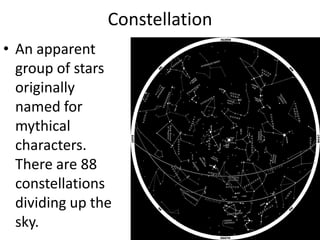
ConstellationAn apparent group of stars originally named for mythical characters. There are 88 constellations dividing up the sky.
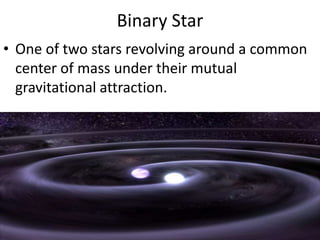
Binary StarOne of two stars revolving around a common center of mass under their mutual gravitational attraction.
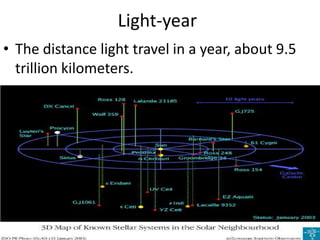
Light-yearThe distance light travel in a year, about 9.5 trillion kilometers.
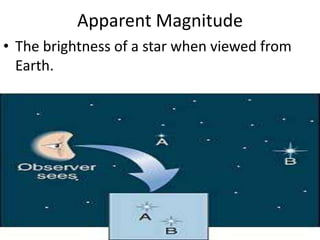
Apparent Magnitude The brightness of a star when viewed from Earth.
Absolute Magnitude The apparent brightness of a star if it were viewed from a distance of 32.6 light-years; used to compare the true brightness of stars.
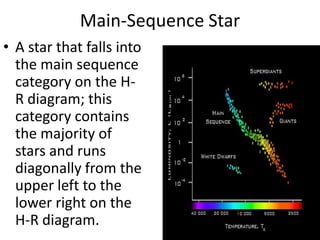
Main-Sequence StarA star that falls into the main sequence category on the H-R diagram; this category contains the majority of stars and runs diagonally from the upper left to the lower right on the H-R diagram.
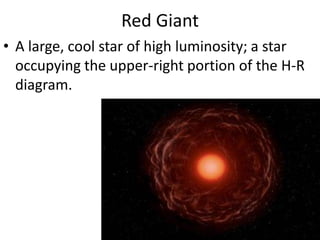
Red Giant A large, cool star of high luminosity; a star occupying the upper-right portion of the H-R diagram.
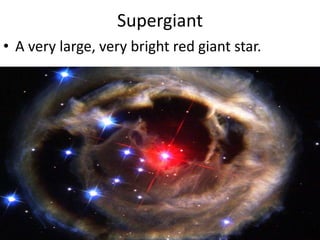
Supergiant A very large, very bright red giant star.
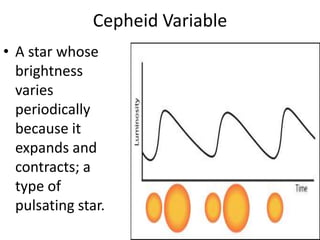
Cepheid Variable A star whose brightness varies periodically because it expands and contracts; a type of pulsating star.
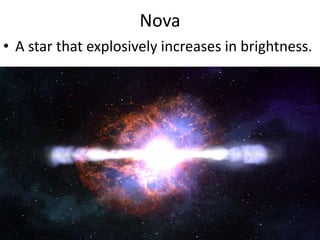
Nova A star that explosively increases in brightness.
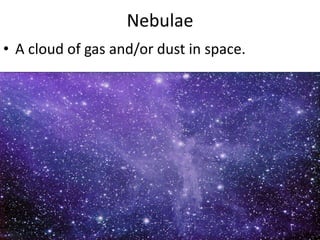
NebulaeA cloud of gas and/or dust in space.
Key Concept Color is a clue to a star’s temperature.
Key ConceptBinary stars are used to determined the star property most difficult to calculate its mass.
Key ConceptThe nearest stars have the largest parallax angles, while those of distant stars are too small to measure.
Key Concept Three factors control the apparent brightness of a star as seen from Earth: how big it is, how hot it is, and how far away it is.
Key ConceptA Hertzsprung-Russell diagram shows the relationship between the absolute magnitude and temperature of stars.

Earth science 25.1

  • 1.
  • 2.
    ConstellationAn apparent groupof stars originally named for mythical characters. There are 88 constellations dividing up the sky.
  • 3.
    Binary StarOne oftwo stars revolving around a common center of mass under their mutual gravitational attraction.
  • 4.
    Light-yearThe distance lighttravel in a year, about 9.5 trillion kilometers.
  • 5.
    Apparent Magnitude Thebrightness of a star when viewed from Earth.
  • 6.
    Absolute Magnitude Theapparent brightness of a star if it were viewed from a distance of 32.6 light-years; used to compare the true brightness of stars.
  • 7.
    Main-Sequence StarA starthat falls into the main sequence category on the H-R diagram; this category contains the majority of stars and runs diagonally from the upper left to the lower right on the H-R diagram.
  • 8.
    Red Giant Alarge, cool star of high luminosity; a star occupying the upper-right portion of the H-R diagram.
  • 9.
    Supergiant A verylarge, very bright red giant star.
  • 10.
    Cepheid Variable Astar whose brightness varies periodically because it expands and contracts; a type of pulsating star.
  • 11.
    Nova A starthat explosively increases in brightness.
  • 12.
    NebulaeA cloud ofgas and/or dust in space.
  • 13.
    Key Concept Coloris a clue to a star’s temperature.
  • 14.
    Key ConceptBinary starsare used to determined the star property most difficult to calculate its mass.
  • 15.
    Key ConceptThe neareststars have the largest parallax angles, while those of distant stars are too small to measure.
  • 16.
    Key Concept Threefactors control the apparent brightness of a star as seen from Earth: how big it is, how hot it is, and how far away it is.
  • 17.
    Key ConceptA Hertzsprung-Russelldiagram shows the relationship between the absolute magnitude and temperature of stars.