Cepheid Variables
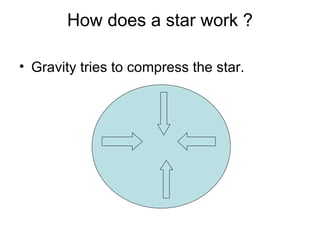
How does a star work ? Gravity tries to compress the star.
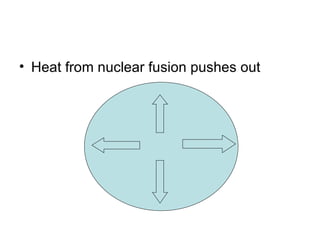
Heat from nuclear fusion pushes out
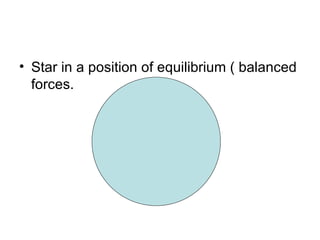
Star in a position of equilibrium ( balanced forces.
Many stars pass through a period of instability during their lives.
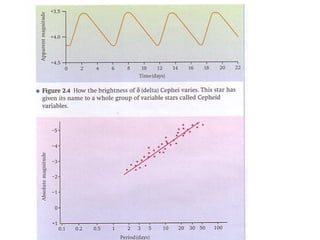
Cepheid Variables are yellow supergiants with a mass over 3x the mass of the sun They pulse in periods of a few days.
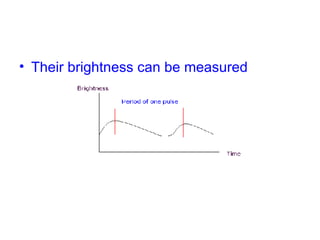
Their brightness can be measured
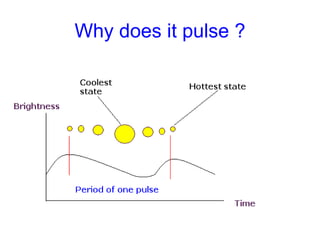
Why does it pulse ?
So how can we measure the distance of stars?
What do we know ? 1 .  The further a star is away, the dimmer it will seem. 2 . The size of the star is important in deciding how bright it is. 3 . We need to know the type of star ( e.g. White dwarf, red giant)
So its temperature is important too
 
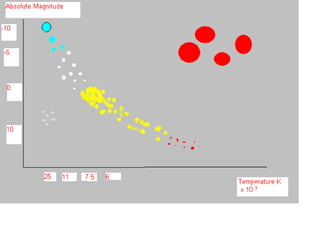
Red Giants are large but cool White dwarfs are small but hot.
So  The  distance  and the  temperature  are key factors in deciding the brightness of stars.
So why are Cepheid variables important? We can use them to measure their distances from Earth. Gives us a capability of measuring more distant objects . Better than parallax.
From their period, we can calculate their Absolute magnitude ( apparent magnitude it would have if it is 10 parsecs from Earth) We can measure its apparent magnitude. The distance can be calculated from the Absolute and apparent magnitude using a simple formula.
 
Remember from P1 The Great Debate of 1920 Harlow Shapley  said nebula were part of the Milky Way. Heber Curtis claimed that spiral nebulae were star systems outside the Milky Way.
Shapley won the debate but Curtis was later proved to be right. Edwin Hubble used a 100 inch telescope to discover Cepheid variables in the Andromeda nebula and in other spiral clusters of stars. These turned out to be much further away than stars in our own galaxy.
Hubble used Cepheid variables to measure the distances of many local galaxies e.g. 2.5 million light years away. Most galaxies were too far away to pick out Cepheid variables The Milky Way is 100,000 light years in diameter.

Cepheid Variables

  • 1.
  • 2.
    How does astar work ? Gravity tries to compress the star.
  • 3.
    Heat from nuclearfusion pushes out
  • 4.
    Star in aposition of equilibrium ( balanced forces.
  • 5.
    Many stars passthrough a period of instability during their lives.
  • 6.
    Cepheid Variables areyellow supergiants with a mass over 3x the mass of the sun They pulse in periods of a few days.
  • 7.
  • 8.
    Why does itpulse ?
  • 9.
    So how canwe measure the distance of stars?
  • 10.
    What do weknow ? 1 . The further a star is away, the dimmer it will seem. 2 . The size of the star is important in deciding how bright it is. 3 . We need to know the type of star ( e.g. White dwarf, red giant)
  • 11.
    So its temperatureis important too
  • 12.
  • 13.
    Red Giants arelarge but cool White dwarfs are small but hot.
  • 14.
    So The distance and the temperature are key factors in deciding the brightness of stars.
  • 15.
    So why areCepheid variables important? We can use them to measure their distances from Earth. Gives us a capability of measuring more distant objects . Better than parallax.
  • 16.
    From their period,we can calculate their Absolute magnitude ( apparent magnitude it would have if it is 10 parsecs from Earth) We can measure its apparent magnitude. The distance can be calculated from the Absolute and apparent magnitude using a simple formula.
  • 17.
  • 18.
    Remember from P1The Great Debate of 1920 Harlow Shapley said nebula were part of the Milky Way. Heber Curtis claimed that spiral nebulae were star systems outside the Milky Way.
  • 19.
    Shapley won thedebate but Curtis was later proved to be right. Edwin Hubble used a 100 inch telescope to discover Cepheid variables in the Andromeda nebula and in other spiral clusters of stars. These turned out to be much further away than stars in our own galaxy.
  • 20.
    Hubble used Cepheidvariables to measure the distances of many local galaxies e.g. 2.5 million light years away. Most galaxies were too far away to pick out Cepheid variables The Milky Way is 100,000 light years in diameter.