Going Green!A Science Unit on Going Green Using a UBD FormatPace UniversityED 620July 2009Professor Sal ZimmermanJoe Baird, Ilana Grossman, Candice Kim, Stephanie Kirby, Kenneth Kroog
An Introduction to Our Unit	The goal of this unit is to offer students access to the curriculum through the lens of “Going Green.”  Today, environmental awareness and the concept of “green” living is all around us: in the media, where we buy groceries, where we chose to live and how we interact with our environments.  This unit will open students up to issues and ideas associated with the Green movement, while exploring the standard content areas with this theme.
Our ClassroomFourth GradeStudents with EBD12:1:1DifferentiationVerbal and visual directions and writing promptsOpportunity to draw or find images instead of writing Different types of questions (multiple choice, fill in, short answer)Group work, pair work, and individual work
Essential QuestionsWhat is the environment?What effects do humans have on the environment?How can groups of people work together to achieve a common goal?What can we do as a community to limit a negative impact on our environment?What is pollution? What causes it?
Students Will Be Able to: Identify man-made and natural environmentsDescribe how man-made and natural environments interactDefine and identify land, water, air, light, and noise pollutionDefine and identify the impact of reducing, reusing, and recyclingCreate pollution solutions for school and homeCollect school recycling data, graph it, and project next year’s recycling rates Research data on recycling and create a powerpoint presentation Work together to plan and execute an assembly
Standards:4.PS.1 Explore, examine, and make observations about a social problem or mathematical situation4.PS.3 Interpret information correctly, identify the problem, and generate possible solutions4.PS.7 Represent problem situations in oral, written, concrete, pictorial, and graphical forms4.PS.13 Work in collaboration with others to solve problems4.S.2 Collect data using observations, surveys, and experiments and record appropriately4.S.3  Represent data using tables, bar graphs, and pictographs4th grade, Science Process Skills:7.1a Humans depend on their natural and constructed environments.7.1b Over time humans have changed their environment by cultivating crops and raising animals, creating shelter, using energy, manufacturing goods, developing means of transportation, changing populations, and carrying out other activities.7.1c Humans, as individuals or communities, change environments in ways that can be either helpful or harmful for themselves and other organisms.
Students Will Know:That people can work together to make positive changeThat they can change the world around themHow to graph numbers in real world situationsThat garbage can be used to make usable itemsHow pollution effects various places and people
Students Will Understand That: Recycling is important and our individual and community actions affect the environment around us. They can make positive changes within their school by working as a team.There are different kinds of pollution, positive and negative. There are varying degrees of effects of pollution on our environment and there are ways humans can limit these effects by being knowledgeable.
ContentPre-AssessmentDiscussion surrounding the word “environment” and informal assessment in groups regarding natural and man-made environments will indicate how much our students knowFinal ProjectPowerpoint Presentation including definition of recycling, examples of items that can be recycling, recorded recycling rates, and projected rates.Unit CalendarOur unit will cover science, citizenship, writing, reading, art, library research, and computers
AssessmentsWorksheetsShort QuizzesRubrics for ProjectsInformal Questioning Writing PromptsWhole Group Discussion
Name_______________________________ Date:_____________What did we learn today about Air Pollution?Define Air Pollution: Circle anything in this list that causes air pollution:driving a carfactoriesreading a bookburning wood in stoves or chimneys   sleepingsmoking cigarettes List three things that you can do to prevent air pollution: 1.____________________________________________________2.____________________________________________________3.____________________________________________________List three ways that air pollution affects humans: 1.____________________________________________________2.____________________________________________________3.____________________________________________________
Name:___________________ Date:________Locating Pollution!In the picture below, draw lines from the piece of garbage or recyclable container to the appropriate bin.
Name: 								Date: Below draw or find a picture of two places where you can find a man-made and natural environment very close to each other.Example: Some playgrounds are on the sandy part of a beach. The playground is man-made. The sand and water of the beach is natural.
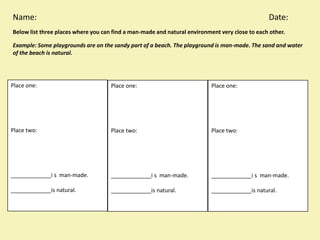
Name: 								Date: Below list three places where you can find a man-made and natural environment very close to each other.Example: Some playgrounds are on the sandy part of a beach. The playground is man-made. The sand and water of the beach is natural.Place one: Place two: _____________i s  man-made._____________is natural. Place one: Place two: _____________i s  man-made._____________is natural. Place one: Place two: _____________i s  man-made._____________is natural.
For the lesson plan Fun and Useful Ways to Reuse Materials, the students understanding will be assessed by a group project and presentation.  During the presentation, the teams will to explain to the class how their new object can be used and how they changed the material so that it can serve the new function. Below is the Rubric that will be used to score the teams’ success in meeting this expectation during the presentation.  Team Presentations of Created Objects Rubric (5 points)

4th Grade Science Unit on Going Green

  • 1.
    Going Green!A ScienceUnit on Going Green Using a UBD FormatPace UniversityED 620July 2009Professor Sal ZimmermanJoe Baird, Ilana Grossman, Candice Kim, Stephanie Kirby, Kenneth Kroog
  • 2.
    An Introduction toOur Unit The goal of this unit is to offer students access to the curriculum through the lens of “Going Green.” Today, environmental awareness and the concept of “green” living is all around us: in the media, where we buy groceries, where we chose to live and how we interact with our environments. This unit will open students up to issues and ideas associated with the Green movement, while exploring the standard content areas with this theme.
  • 3.
    Our ClassroomFourth GradeStudentswith EBD12:1:1DifferentiationVerbal and visual directions and writing promptsOpportunity to draw or find images instead of writing Different types of questions (multiple choice, fill in, short answer)Group work, pair work, and individual work
  • 4.
    Essential QuestionsWhat isthe environment?What effects do humans have on the environment?How can groups of people work together to achieve a common goal?What can we do as a community to limit a negative impact on our environment?What is pollution? What causes it?
  • 5.
    Students Will BeAble to: Identify man-made and natural environmentsDescribe how man-made and natural environments interactDefine and identify land, water, air, light, and noise pollutionDefine and identify the impact of reducing, reusing, and recyclingCreate pollution solutions for school and homeCollect school recycling data, graph it, and project next year’s recycling rates Research data on recycling and create a powerpoint presentation Work together to plan and execute an assembly
  • 6.
    Standards:4.PS.1 Explore, examine,and make observations about a social problem or mathematical situation4.PS.3 Interpret information correctly, identify the problem, and generate possible solutions4.PS.7 Represent problem situations in oral, written, concrete, pictorial, and graphical forms4.PS.13 Work in collaboration with others to solve problems4.S.2 Collect data using observations, surveys, and experiments and record appropriately4.S.3 Represent data using tables, bar graphs, and pictographs4th grade, Science Process Skills:7.1a Humans depend on their natural and constructed environments.7.1b Over time humans have changed their environment by cultivating crops and raising animals, creating shelter, using energy, manufacturing goods, developing means of transportation, changing populations, and carrying out other activities.7.1c Humans, as individuals or communities, change environments in ways that can be either helpful or harmful for themselves and other organisms.
  • 7.
    Students Will Know:Thatpeople can work together to make positive changeThat they can change the world around themHow to graph numbers in real world situationsThat garbage can be used to make usable itemsHow pollution effects various places and people
  • 8.
    Students Will UnderstandThat: Recycling is important and our individual and community actions affect the environment around us. They can make positive changes within their school by working as a team.There are different kinds of pollution, positive and negative. There are varying degrees of effects of pollution on our environment and there are ways humans can limit these effects by being knowledgeable.
  • 9.
    ContentPre-AssessmentDiscussion surrounding theword “environment” and informal assessment in groups regarding natural and man-made environments will indicate how much our students knowFinal ProjectPowerpoint Presentation including definition of recycling, examples of items that can be recycling, recorded recycling rates, and projected rates.Unit CalendarOur unit will cover science, citizenship, writing, reading, art, library research, and computers
  • 11.
    AssessmentsWorksheetsShort QuizzesRubrics forProjectsInformal Questioning Writing PromptsWhole Group Discussion
  • 12.
    Name_______________________________ Date:_____________What didwe learn today about Air Pollution?Define Air Pollution: Circle anything in this list that causes air pollution:driving a carfactoriesreading a bookburning wood in stoves or chimneys sleepingsmoking cigarettes List three things that you can do to prevent air pollution: 1.____________________________________________________2.____________________________________________________3.____________________________________________________List three ways that air pollution affects humans: 1.____________________________________________________2.____________________________________________________3.____________________________________________________
  • 13.
    Name:___________________ Date:________Locating Pollution!Inthe picture below, draw lines from the piece of garbage or recyclable container to the appropriate bin.
  • 14.
    Name: Date: Belowdraw or find a picture of two places where you can find a man-made and natural environment very close to each other.Example: Some playgrounds are on the sandy part of a beach. The playground is man-made. The sand and water of the beach is natural.
  • 15.
    Name: Date: Belowlist three places where you can find a man-made and natural environment very close to each other.Example: Some playgrounds are on the sandy part of a beach. The playground is man-made. The sand and water of the beach is natural.Place one: Place two: _____________i s man-made._____________is natural. Place one: Place two: _____________i s man-made._____________is natural. Place one: Place two: _____________i s man-made._____________is natural.
  • 16.
    For the lessonplan Fun and Useful Ways to Reuse Materials, the students understanding will be assessed by a group project and presentation. During the presentation, the teams will to explain to the class how their new object can be used and how they changed the material so that it can serve the new function. Below is the Rubric that will be used to score the teams’ success in meeting this expectation during the presentation. Team Presentations of Created Objects Rubric (5 points)