EARLY TRENDS IN EQUITY
CROWDFUNDING
PRESENTED BY
THE FINAL RULES IMPLEMENTING THE
EQUITY CROWDFUNDING PROVISIONS
OF THE JOBS ACT WENT INTO EFFECT
IN MAY 2016.
We examined a number of the first
crowdfunding offerings to see what early
trends, if any, exist.
DATA SOURCE
U.S. Securities and Exchange Commission
EDGAR online filing system
First 100 crowdfunding campaigns filed
Spanning from May through September
2016
INDUSTRY TYPE
MANY INDUSTRIES ARE USING
CROWFUNDING
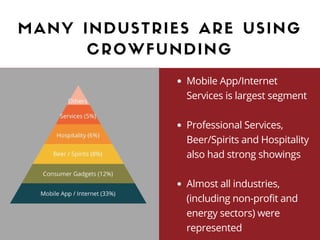
Mobile App/Internet
Services is largest segment
Professional Services,
Beer/Spirits and Hospitality
also had strong showings
Almost all industries,
(including non-profit and
energy sectors) were
represented
Regardless of industry, approx. 60% of
the offerors had been in business for
1 year or less. A staggering 85% of
offerors had been in business for 5
years or less. A significant majority of
businesses were in the startup and
pre-revenue stage with 70% having
annual assets of $100,000 or less.
These trends are consistent with what
one would expect and the purpose of
the JOBS Act in creating an avenue for
startups and newer businesses who
are not ready or able to access
traditional capital markets.
MORE TRENDS
TYPE OF SECURITY
EQUITY
Over 50% of crowdfunding campaigns offered equity
Common stock (or LLC membership units) was the
predominant type of security offered
The strong preference (about two-thirds) was to
offer non-voting equity
In preferred stock offerings, a liquidation preference
was the most frequent right and preference offered
DEBT
Approximately one-half of the debt offerings were
revenue-sharing notes that offered purchasers a
return of between 1.5X to 2X on their investment
Term notes and convertible notes comprised the
remaining half of debt instruments offered
Most common annual rate of interest: 5-6%
Term of note: Widely varied (12 mos. - 12 yrs)
SIMPLE AGREEMENT FOR EQUITY
Simple Agreements for Equity (SAFEs) were the most
common type of convertible security, allowing
holders to convert their SAFE into preferred stock at
the next financing of the offeror (or into common
stock if additional financing was not secured)
Discounts on next round pricing commonly ranged
from 20-25%
Valuation caps ranged between $1.5-$4 million
TARGET AMOUNT
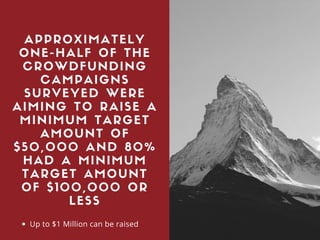
APPROXIMATELY
ONE-HALF OF THE
CROWDFUNDING
CAMPAIGNS
SURVEYED WERE
AIMING TO RAISE A
MINIMUM TARGET
AMOUNT OF
$50,000 AND 80%
HAD A MINIMUM
TARGET AMOUNT
OF $100,000 OR
LESS
Up to $1 Million can be raised
POSSIBLE EXPLANATIONS FOR
LOW TARGET AMOUNTS
Attempting to stay below the thresholds that would
have required more detailed ongoing financial
reports to investors
With all-or-nothing stakes, setting the bar low
enough to ensure a successful result
Using crowdfunding campaign to supplement
traditional seed round already underway
FEES & DOCUMENTATION
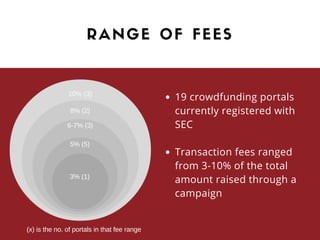
RANGE OF FEES
19 crowdfunding portals
currently registered with
SEC
Transaction fees ranged
from 3-10% of the total
amount raised through a
campaign
3% (1)
5% (5)
6­7% (3)
8% (2)
10% (3)
(x) is the no. of portals in that fee range
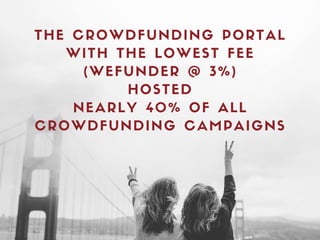
THE CROWDFUNDING PORTAL
WITH THE LOWEST FEE
(WEFUNDER @ 3%)
HOSTED
NEARLY 40% OF ALL
CROWDFUNDING CAMPAIGNS
The quality of investor disclosure
documentation varied greatly. Most
businesses used the SEC's Q&A
format for disclosures over the more
traditional private placement
memorandum.
DOCUMENTATION
SUCCESS RATE
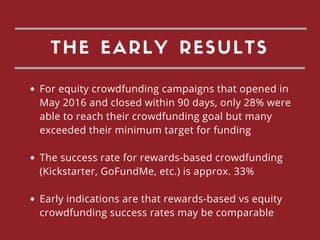
THE EARLY RESULTS
For equity crowdfunding campaigns that opened in
May 2016 and closed within 90 days, only 28% were
able to reach their crowdfunding goal but many
exceeded their minimum target for funding
The success rate for rewards-based crowdfunding
(Kickstarter, GoFundMe, etc.) is approx. 33%
Early indications are that rewards-based vs equity
crowdfunding success rates may be comparable
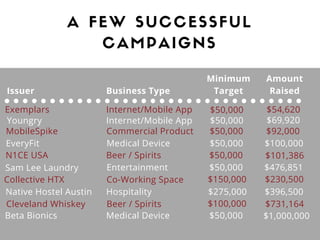
A FEW SUCCESSFUL
CAMPAIGNS
Issuer Business Type
Minimum
Target
Amount
Raised
Exemplars Internet/Mobile App $50,000 $54,620
Youngry Internet/Mobile App $50,000 $69,920
MobileSpike Commercial Product $50,000 $92,000
EveryFit Medical Device $50,000 $100,000
N1CE USA Beer / Spirits $50,000 $101,386
Sam Lee Laundry
Collective HTX
Native Hostel Austin
Cleveland Whiskey
Beta Bionics
Entertainment $50,000 $476,851
Co-Working Space $150,000 $230,500
Hospitality $275,000 $396,500
Beer / Spirits $100,000 $731,164
Medical Device $50,000 $1,000,000
THANK YOU!

Early Trends in Equity Crowdfunding

  • 1.
    EARLY TRENDS INEQUITY CROWDFUNDING
  • 2.
  • 3.
    THE FINAL RULESIMPLEMENTING THE EQUITY CROWDFUNDING PROVISIONS OF THE JOBS ACT WENT INTO EFFECT IN MAY 2016. We examined a number of the first crowdfunding offerings to see what early trends, if any, exist.
  • 4.
    DATA SOURCE U.S. Securitiesand Exchange Commission EDGAR online filing system First 100 crowdfunding campaigns filed Spanning from May through September 2016
  • 5.
  • 6.
    MANY INDUSTRIES AREUSING CROWFUNDING Mobile App/Internet Services is largest segment Professional Services, Beer/Spirits and Hospitality also had strong showings Almost all industries, (including non-profit and energy sectors) were represented
  • 7.
    Regardless of industry,approx. 60% of the offerors had been in business for 1 year or less. A staggering 85% of offerors had been in business for 5 years or less. A significant majority of businesses were in the startup and pre-revenue stage with 70% having annual assets of $100,000 or less. These trends are consistent with what one would expect and the purpose of the JOBS Act in creating an avenue for startups and newer businesses who are not ready or able to access traditional capital markets. MORE TRENDS
  • 8.
  • 9.
    EQUITY Over 50% ofcrowdfunding campaigns offered equity Common stock (or LLC membership units) was the predominant type of security offered The strong preference (about two-thirds) was to offer non-voting equity In preferred stock offerings, a liquidation preference was the most frequent right and preference offered
  • 10.
    DEBT Approximately one-half ofthe debt offerings were revenue-sharing notes that offered purchasers a return of between 1.5X to 2X on their investment Term notes and convertible notes comprised the remaining half of debt instruments offered Most common annual rate of interest: 5-6% Term of note: Widely varied (12 mos. - 12 yrs)
  • 11.
    SIMPLE AGREEMENT FOREQUITY Simple Agreements for Equity (SAFEs) were the most common type of convertible security, allowing holders to convert their SAFE into preferred stock at the next financing of the offeror (or into common stock if additional financing was not secured) Discounts on next round pricing commonly ranged from 20-25% Valuation caps ranged between $1.5-$4 million
  • 12.
  • 13.
    APPROXIMATELY ONE-HALF OF THE CROWDFUNDING CAMPAIGNS SURVEYEDWERE AIMING TO RAISE A MINIMUM TARGET AMOUNT OF $50,000 AND 80% HAD A MINIMUM TARGET AMOUNT OF $100,000 OR LESS Up to $1 Million can be raised
  • 14.
    POSSIBLE EXPLANATIONS FOR LOWTARGET AMOUNTS Attempting to stay below the thresholds that would have required more detailed ongoing financial reports to investors With all-or-nothing stakes, setting the bar low enough to ensure a successful result Using crowdfunding campaign to supplement traditional seed round already underway
  • 15.
  • 16.
    RANGE OF FEES 19crowdfunding portals currently registered with SEC Transaction fees ranged from 3-10% of the total amount raised through a campaign 3% (1) 5% (5) 6­7% (3) 8% (2) 10% (3) (x) is the no. of portals in that fee range
  • 17.
    THE CROWDFUNDING PORTAL WITHTHE LOWEST FEE (WEFUNDER @ 3%) HOSTED NEARLY 40% OF ALL CROWDFUNDING CAMPAIGNS
  • 18.
    The quality ofinvestor disclosure documentation varied greatly. Most businesses used the SEC's Q&A format for disclosures over the more traditional private placement memorandum. DOCUMENTATION
  • 19.
  • 20.
    THE EARLY RESULTS Forequity crowdfunding campaigns that opened in May 2016 and closed within 90 days, only 28% were able to reach their crowdfunding goal but many exceeded their minimum target for funding The success rate for rewards-based crowdfunding (Kickstarter, GoFundMe, etc.) is approx. 33% Early indications are that rewards-based vs equity crowdfunding success rates may be comparable
  • 21.
    A FEW SUCCESSFUL CAMPAIGNS IssuerBusiness Type Minimum Target Amount Raised Exemplars Internet/Mobile App $50,000 $54,620 Youngry Internet/Mobile App $50,000 $69,920 MobileSpike Commercial Product $50,000 $92,000 EveryFit Medical Device $50,000 $100,000 N1CE USA Beer / Spirits $50,000 $101,386 Sam Lee Laundry Collective HTX Native Hostel Austin Cleveland Whiskey Beta Bionics Entertainment $50,000 $476,851 Co-Working Space $150,000 $230,500 Hospitality $275,000 $396,500 Beer / Spirits $100,000 $731,164 Medical Device $50,000 $1,000,000
  • 22.