By: Tom Hales Early English Opera
Early English Opera Henry Purcell John Blow William D’Avenant Composers First Opera Venus and Adonis Dido and Aeneas  The Siege of Rhodes   Pre-Opera English Masques Music in Dramas Information Author Resources Concept Map Exit
Henry Purcell (1659-95) Henry Purcell is often  considered the greatest English composer of all  time.  Throughout his life he helped to refine the art of opera in England. Purcell helped to establish a musical  style that was distinctly English in nature. English composers still emulate his style to this day. Exit
John Blow (1649-1708)  John Blow was the teacher of  Henry Purcell. Blow was the  organist at Westminster Abbey for 11 years. He was also a private musician of James II. Blow is often credited for having composed the first English opera. Whether or not this is true, he like Purcell undoubtedly played a  major role in the establishment of the English Opera Exit
William D’Avenant Unlike Blow and Purcell, D’Avenant was not a composer; he was a playwright. D’Avenant Had written several English  plays and had collaborated with several different composers to produce a  great number of Masques before they were outlawed by the Puritan ruled Parliament. Though he is not often credited, he decisively wrote the first English Opera. Exit
Pre-Opera Before opera had established itself in England, music could still be heard on the stage in collaboration with drama. Although this may sound very similar to opera, it has very distinct differences. The following items were the two settings that music and drama were combined. English Masques Music in Dramas Exit
English Masques Masques represented England’s first attempt at combining the visual, and fine arts. Masques differed from operas in the particular arts that were stressed. Though there was singing in masques, it was generally done in choruses between movements. Masques tended to focus more on the visual arts, dance, and poetry.    Cont. to Music in Drama Exit
Music in Drama Long before opera was even created in Italy, Elizabethan playwrights like William Shakespeare were already incorporating song into dramatic works. What separated these works from opera was the context behind the singing. Opera uses song to tell a story, it plays a central role in the progression of the storyline. Playwrights like Shakespeare only used song when one character onstage was entertaining another.  Back to English Masques  Exit
First Opera There is some debate that currently wages over who wrote the first English opera. The following are the three works that are often credited as the first English opera. Venus and Adonis Dido and Aeneas  The Siege of Rhodes    Exit
Venus and Adonis Venus and Adonis was written in 1683 by John Blow.  Both the libretto and the music survive today. However,  many experts argue over the classification of this work. Some experts call Venus and Adonis a masque and  others call it a semi-opera. The New  Grove names it as the earliest  surviving English opera. This work  greatly influenced Purcell to attempt  his own opera. Cont. to Dido and Aeneas  Exit
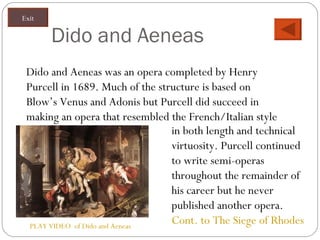
Dido and Aeneas Dido and Aeneas was an opera completed by Henry  Purcell in 1689. Much of the structure is based on  Blow’s Venus and Adonis but Purcell did succeed in making an opera that resembled the French/Italian style in both length and technical  virtuosity. Purcell continued  to write semi-operas  throughout the remainder of his career but he never  published another opera. Cont. to The Siege of Rhodes   Exit PLAY VIDEO  of Dido and Aeneas
The Siege of Rhodes  The Siege of Rhodes is undoubtedly the earliest  attempt at creating an English opera in the  French/Italian style. The opera was mostly written by armature musicians who collaborated with D’Avenant to produce the work in 1656. None of the music from the production has survived. Exit
Author My name is Thomas Hales I am  currently a student at Grand Valley State University. I am majoring in vocal music education. Some day I hope to get a job as a high school  choir director. If you wish to contact me, my  email address is  [email_address] . Exit
Resources Robert Donington,  The Rise of Opera.  Faber and Faber, London WC. 1981 Edward J. Dent,  Foundations of English Opera.  Da Capo Press, NY. 1965  William Patterson,  The Dramatic Works of Sir William D’Avenant,  Vol 3. H. Sutheran & co., London. 1873  William D’Avenant,  Love and Honour and the Siege of Rhodes.  D.C Health and Co. Publishers, Boston, and London. 1909 Exit
Concept Map Exit

Early English Opera

  • 1.
    By: Tom HalesEarly English Opera
  • 2.
    Early English OperaHenry Purcell John Blow William D’Avenant Composers First Opera Venus and Adonis Dido and Aeneas The Siege of Rhodes Pre-Opera English Masques Music in Dramas Information Author Resources Concept Map Exit
  • 3.
    Henry Purcell (1659-95)Henry Purcell is often considered the greatest English composer of all time. Throughout his life he helped to refine the art of opera in England. Purcell helped to establish a musical style that was distinctly English in nature. English composers still emulate his style to this day. Exit
  • 4.
    John Blow (1649-1708) John Blow was the teacher of Henry Purcell. Blow was the organist at Westminster Abbey for 11 years. He was also a private musician of James II. Blow is often credited for having composed the first English opera. Whether or not this is true, he like Purcell undoubtedly played a major role in the establishment of the English Opera Exit
  • 5.
    William D’Avenant UnlikeBlow and Purcell, D’Avenant was not a composer; he was a playwright. D’Avenant Had written several English plays and had collaborated with several different composers to produce a great number of Masques before they were outlawed by the Puritan ruled Parliament. Though he is not often credited, he decisively wrote the first English Opera. Exit
  • 6.
    Pre-Opera Before operahad established itself in England, music could still be heard on the stage in collaboration with drama. Although this may sound very similar to opera, it has very distinct differences. The following items were the two settings that music and drama were combined. English Masques Music in Dramas Exit
  • 7.
    English Masques Masquesrepresented England’s first attempt at combining the visual, and fine arts. Masques differed from operas in the particular arts that were stressed. Though there was singing in masques, it was generally done in choruses between movements. Masques tended to focus more on the visual arts, dance, and poetry. Cont. to Music in Drama Exit
  • 8.
    Music in DramaLong before opera was even created in Italy, Elizabethan playwrights like William Shakespeare were already incorporating song into dramatic works. What separated these works from opera was the context behind the singing. Opera uses song to tell a story, it plays a central role in the progression of the storyline. Playwrights like Shakespeare only used song when one character onstage was entertaining another. Back to English Masques Exit
  • 9.
    First Opera Thereis some debate that currently wages over who wrote the first English opera. The following are the three works that are often credited as the first English opera. Venus and Adonis Dido and Aeneas The Siege of Rhodes Exit
  • 10.
    Venus and AdonisVenus and Adonis was written in 1683 by John Blow. Both the libretto and the music survive today. However, many experts argue over the classification of this work. Some experts call Venus and Adonis a masque and others call it a semi-opera. The New Grove names it as the earliest surviving English opera. This work greatly influenced Purcell to attempt his own opera. Cont. to Dido and Aeneas Exit
  • 11.
    Dido and AeneasDido and Aeneas was an opera completed by Henry Purcell in 1689. Much of the structure is based on Blow’s Venus and Adonis but Purcell did succeed in making an opera that resembled the French/Italian style in both length and technical virtuosity. Purcell continued to write semi-operas throughout the remainder of his career but he never published another opera. Cont. to The Siege of Rhodes Exit PLAY VIDEO of Dido and Aeneas
  • 12.
    The Siege ofRhodes The Siege of Rhodes is undoubtedly the earliest attempt at creating an English opera in the French/Italian style. The opera was mostly written by armature musicians who collaborated with D’Avenant to produce the work in 1656. None of the music from the production has survived. Exit
  • 13.
    Author My nameis Thomas Hales I am currently a student at Grand Valley State University. I am majoring in vocal music education. Some day I hope to get a job as a high school choir director. If you wish to contact me, my email address is [email_address] . Exit
  • 14.
    Resources Robert Donington, The Rise of Opera. Faber and Faber, London WC. 1981 Edward J. Dent, Foundations of English Opera. Da Capo Press, NY. 1965 William Patterson, The Dramatic Works of Sir William D’Avenant, Vol 3. H. Sutheran & co., London. 1873 William D’Avenant, Love and Honour and the Siege of Rhodes. D.C Health and Co. Publishers, Boston, and London. 1909 Exit
  • 15.