Epimenides was a Cretan who said, ‘Cretans always lie,’
Was Epimenides telling the truth?
Documentary
Documentary
• The term documentary derived from the french
word documentaire, which was used to
describe travel films.
• The word developed to describe a type of film
making that was concerned with capturing a
reflection of society.
• What do you think a ‘proper’ documentary
should contain?
• Write down the aspects that you think combine
to create a proper documentary.
• What should the documentary seek to do?
• What should it feature?
• How should it convey it’s messages/narratives?
What is Documentary?
Documentary
• The main aims of documentary are to
INFORM, EDUCATE AND ENTERTAIN
• Words that you should associate with
documentary are: OBJECTIVITY,
MANIPULATION, BIAS, CONSTRUCTION &
MEDIATION.
• How would you link the above words to
documentary? Why are these points so
important?
Documentary
• As with any genre, the documentary can be
recognised via the inclusion of certain codes
and convention:
Generally stated, these are:
• Voice-over/narrator
• Visible disruption of camerwork/attention
drawn towards production process
• Use of music as
anchorage/contradiction/emotive device
• Archive Footage
• Actuality Footage
Documentary
• Interviews – these are generally split up into
EXPERT and EYEWITNESS
• Facts and figures to provide
information/credibility/authenticity
• Closed narrative – this may vary depending on
the style of documentary
• An emphasis on the projection of reality: real
people, real events, real stories
• Compression of time
• Reconstruction
Documentary
The primary aim for any documentary is to remain OBJECTIVE
(present a balanced version of events that assesses all aspects of the
argument).
As you can imagine, this is an extremely difficult and problematic
process as we all have strong feelings about certain subjects.
Q: Imagine you are making a documentary about Pig Farming.
• What would you include in your documentary?
• What do you feel about this subject matter?
Documentary
As you can probably tell, it is very hard to try and
formulate an idea around something you do not feel
passionate about or have no interest in.
Therefore, it is important to remember that the
director/producer of the documentary will usually have a
vested interested in their subject matter that has spurned
them to produce it. Ultimately, they will have a
PREFERRED READING that they will be trying to convey.
Documentary
It is argued that it almost impossible to present reality as
our feelings, bias and mediation all impact on what we see
and what the director wants the audience to see.
It is important to recognise that documentary can only
offer an interpretation of reality.
Therefore, documentary is often referred to as a FLAWED
GENRE.
John Grierson
• Documentary = ‘The creative treatment of
actuality’ (Grierson)
• Many critics have championed John Grierson
as a pioneer of documentary filmmaking. He is
believed to be one of the first to utilise the
word in its contemporary form.
• The documentary movement in Grierson’s
belief, ‘was from the beginning an adventure in
public observation.’
• He is quoted as having referred to
documentary as ‘the creative treatment of
actuality’.
• ‘The basic force behind it was social not
aesthetic. It was a desire to make a drama
from the ordinary to set against the prevailing
drama of the extra ordinary.’
Bill Nichols
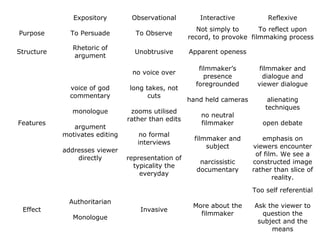
Styles of Documentary
Expository Observational Interactive Reflexive
Purpose To Persuade To Observe
Not simply to
record, to provoke
To reflect upon
filmmaking process
Structure
Rhetoric of
argument
Unobtrusive Apparent openess
Features
voice of god
commentary
monologue
argument
motivates editing
addresses viewer
directly
no voice over
long takes, not
cuts
zooms utilised
rather than edits
no formal
interviews
representation of
typicality the
everyday
filmmaker’s
presence
foregrounded
hand held cameras
no neutral
filmmaker
filmmaker and
subject
narcissistic
documentary
filmmaker and
dialogue and
viewer dialogue
alienating
techniques
open debate
emphasis on
viewers encounter
of film. We see a
constructed image
rather than slice of
reality.
Effect
Authoritarian
Monologue
Invasive
More about the
filmmaker
Too self referential
Ask the viewer to
question the
subject and the
means
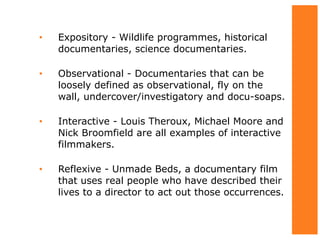
• Expository - Wildlife programmes, historical
documentaries, science documentaries.
• Observational - Documentaries that can be
loosely defined as observational, fly on the
wall, undercover/investigatory and docu-soaps.
• Interactive - Louis Theroux, Michael Moore and
Nick Broomfield are all examples of interactive
filmmakers.
• Reflexive - Unmade Beds, a documentary film
that uses real people who have described their
lives to a director to act out those occurrences.
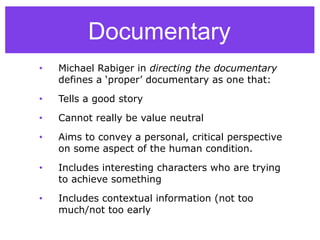
• Michael Rabiger in directing the documentary
defines a ‘proper’ documentary as one that:
• Tells a good story
• Cannot really be value neutral
• Aims to convey a personal, critical perspective
on some aspect of the human condition.
• Includes interesting characters who are trying
to achieve something
• Includes contextual information (not too
much/not too early
Documentary
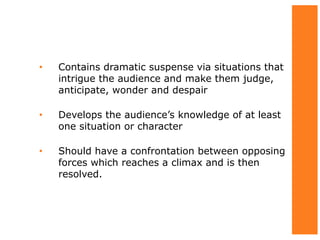
• Contains dramatic suspense via situations that
intrigue the audience and make them judge,
anticipate, wonder and despair
• Develops the audience’s knowledge of at least
one situation or character
• Should have a confrontation between opposing
forces which reaches a climax and is then
resolved.

Early documentary

  • 1.
    Epimenides was aCretan who said, ‘Cretans always lie,’ Was Epimenides telling the truth?
  • 2.
  • 3.
    Documentary • The termdocumentary derived from the french word documentaire, which was used to describe travel films. • The word developed to describe a type of film making that was concerned with capturing a reflection of society.
  • 4.
    • What doyou think a ‘proper’ documentary should contain? • Write down the aspects that you think combine to create a proper documentary. • What should the documentary seek to do? • What should it feature? • How should it convey it’s messages/narratives? What is Documentary?
  • 5.
    Documentary • The mainaims of documentary are to INFORM, EDUCATE AND ENTERTAIN • Words that you should associate with documentary are: OBJECTIVITY, MANIPULATION, BIAS, CONSTRUCTION & MEDIATION. • How would you link the above words to documentary? Why are these points so important?
  • 6.
    Documentary • As withany genre, the documentary can be recognised via the inclusion of certain codes and convention: Generally stated, these are: • Voice-over/narrator • Visible disruption of camerwork/attention drawn towards production process • Use of music as anchorage/contradiction/emotive device • Archive Footage • Actuality Footage
  • 7.
    Documentary • Interviews –these are generally split up into EXPERT and EYEWITNESS • Facts and figures to provide information/credibility/authenticity • Closed narrative – this may vary depending on the style of documentary • An emphasis on the projection of reality: real people, real events, real stories • Compression of time • Reconstruction
  • 8.
    Documentary The primary aimfor any documentary is to remain OBJECTIVE (present a balanced version of events that assesses all aspects of the argument). As you can imagine, this is an extremely difficult and problematic process as we all have strong feelings about certain subjects. Q: Imagine you are making a documentary about Pig Farming. • What would you include in your documentary? • What do you feel about this subject matter?
  • 9.
    Documentary As you canprobably tell, it is very hard to try and formulate an idea around something you do not feel passionate about or have no interest in. Therefore, it is important to remember that the director/producer of the documentary will usually have a vested interested in their subject matter that has spurned them to produce it. Ultimately, they will have a PREFERRED READING that they will be trying to convey.
  • 10.
    Documentary It is arguedthat it almost impossible to present reality as our feelings, bias and mediation all impact on what we see and what the director wants the audience to see. It is important to recognise that documentary can only offer an interpretation of reality. Therefore, documentary is often referred to as a FLAWED GENRE.
  • 11.
    John Grierson • Documentary= ‘The creative treatment of actuality’ (Grierson) • Many critics have championed John Grierson as a pioneer of documentary filmmaking. He is believed to be one of the first to utilise the word in its contemporary form.
  • 12.
    • The documentarymovement in Grierson’s belief, ‘was from the beginning an adventure in public observation.’ • He is quoted as having referred to documentary as ‘the creative treatment of actuality’. • ‘The basic force behind it was social not aesthetic. It was a desire to make a drama from the ordinary to set against the prevailing drama of the extra ordinary.’
  • 13.
  • 14.
    Expository Observational InteractiveReflexive Purpose To Persuade To Observe Not simply to record, to provoke To reflect upon filmmaking process Structure Rhetoric of argument Unobtrusive Apparent openess Features voice of god commentary monologue argument motivates editing addresses viewer directly no voice over long takes, not cuts zooms utilised rather than edits no formal interviews representation of typicality the everyday filmmaker’s presence foregrounded hand held cameras no neutral filmmaker filmmaker and subject narcissistic documentary filmmaker and dialogue and viewer dialogue alienating techniques open debate emphasis on viewers encounter of film. We see a constructed image rather than slice of reality. Effect Authoritarian Monologue Invasive More about the filmmaker Too self referential Ask the viewer to question the subject and the means
  • 15.
    • Expository -Wildlife programmes, historical documentaries, science documentaries. • Observational - Documentaries that can be loosely defined as observational, fly on the wall, undercover/investigatory and docu-soaps. • Interactive - Louis Theroux, Michael Moore and Nick Broomfield are all examples of interactive filmmakers. • Reflexive - Unmade Beds, a documentary film that uses real people who have described their lives to a director to act out those occurrences.
  • 16.
    • Michael Rabigerin directing the documentary defines a ‘proper’ documentary as one that: • Tells a good story • Cannot really be value neutral • Aims to convey a personal, critical perspective on some aspect of the human condition. • Includes interesting characters who are trying to achieve something • Includes contextual information (not too much/not too early Documentary
  • 17.
    • Contains dramaticsuspense via situations that intrigue the audience and make them judge, anticipate, wonder and despair • Develops the audience’s knowledge of at least one situation or character • Should have a confrontation between opposing forces which reaches a climax and is then resolved.