Early Civilization
Definition of early civilization is a human society that has highly developed material and
spiritual resources and complex cultural, political, and legal organization; an advanced state
in social development. Let’s us discuss the early civilization of Mesopotamia, Egypt, Greece,
Rome, China and Indus.
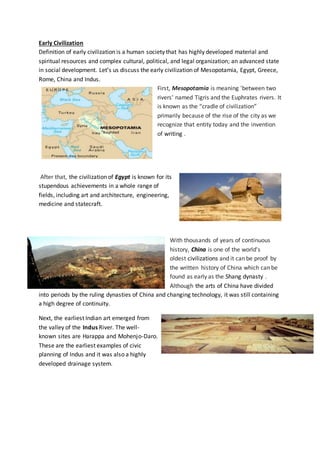
First, Mesopotamia is meaning 'between two
rivers’ named Tigris and the Euphrates rivers. It
is known as the “cradle of civilization”
primarily because of the rise of the city as we
recognize that entity today and the invention
of writing .
After that, the civilization of Egypt is known for its
stupendous achievements in a whole range of
fields, including art and architecture, engineering,
medicine and statecraft.
With thousands of years of continuous
history, China is one of the world's
oldest civilizations and it can be proof by
the written history of China which can be
found as early as the Shang dynasty .
Although the arts of China have divided
into periods by the ruling dynasties of China and changing technology, it was still containing
a high degree of continuity.
Next, the earliest Indian art emerged from
the valley of the Indus River. The well-
known sites are Harappa and Mohenjo-Daro.
These are the earliest examples of civic
planning of Indus and it was also a highly
developed drainage system.

Early civilization

  • 1.
    Early Civilization Definition ofearly civilization is a human society that has highly developed material and spiritual resources and complex cultural, political, and legal organization; an advanced state in social development. Let’s us discuss the early civilization of Mesopotamia, Egypt, Greece, Rome, China and Indus. First, Mesopotamia is meaning 'between two rivers’ named Tigris and the Euphrates rivers. It is known as the “cradle of civilization” primarily because of the rise of the city as we recognize that entity today and the invention of writing . After that, the civilization of Egypt is known for its stupendous achievements in a whole range of fields, including art and architecture, engineering, medicine and statecraft. With thousands of years of continuous history, China is one of the world's oldest civilizations and it can be proof by the written history of China which can be found as early as the Shang dynasty . Although the arts of China have divided into periods by the ruling dynasties of China and changing technology, it was still containing a high degree of continuity. Next, the earliest Indian art emerged from the valley of the Indus River. The well- known sites are Harappa and Mohenjo-Daro. These are the earliest examples of civic planning of Indus and it was also a highly developed drainage system.