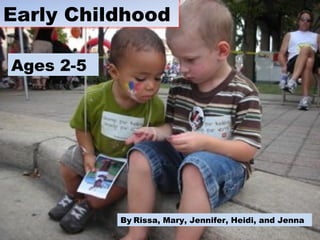
Ages 2-5 By   Rissa, Mary, Jennifer, Heidi, and Jenna  Early Childhood
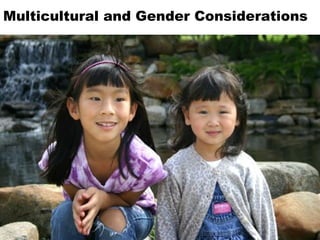
Multicultural and Gender Considerations
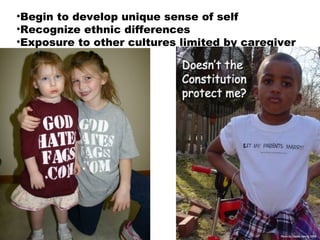
Begin to develop unique sense of self Recognize ethnic differences Exposure to other cultures limited by caregiver
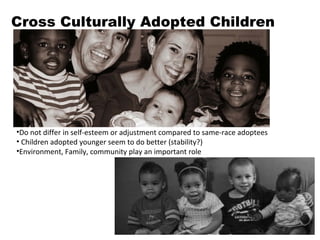
Cross Culturally Adopted Children Do not differ in self-esteem or adjustment compared to same-race adoptees Children adopted younger seem to do better (stability?) Environment, Family, community play an important role
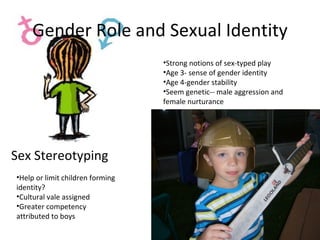
Gender Role and Sexual Identity Strong notions of sex-typed play Age 3- sense of gender identity Age 4-gender stability Seem genetic-- male aggression and female nurturance Sex Stereotyping Help or limit children forming identity? Cultural vale assigned Greater competency attributed to boys
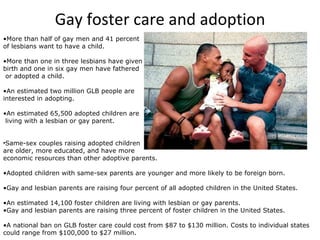
Gay foster care and adoption More than half of gay men and 41 percent  of lesbians want to have a child.  More than one in three lesbians have given  birth and one in six gay men have fathered or adopted a child.  An estimated two million GLB people are  interested in adopting.  An estimated 65,500 adopted children are living with a lesbian or gay parent.  Same-sex couples raising adopted children  are older, more educated, and have more  economic resources than other adoptive parents.  Adopted children with same-sex parents are younger and more likely to be foreign born.  Gay and lesbian parents are raising four percent of all adopted children in the United States.  An estimated 14,100 foster children are living with lesbian or gay parents.  Gay and lesbian parents are raising three percent of foster children in the United States. A national ban on GLB foster care could cost from $87 to $130 million. Costs to individual states could range from $100,000 to $27 million.
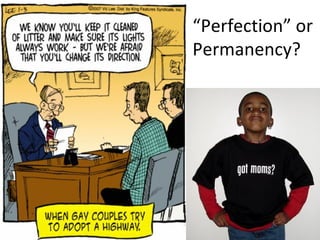
“ Perfection” or Permanency?
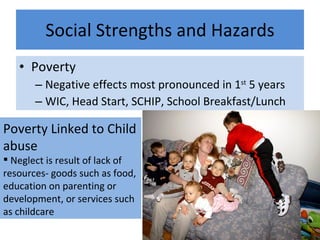
Social Strengths and Hazards Poverty Negative effects most pronounced in 1 st  5 years WIC, Head Start, SCHIP, School Breakfast/Lunch Poverty Linked to Child abuse Neglect is result of lack of resources- goods such as food, education on parenting or development, or services such as childcare
Child Abuse Composition of substantiated (DHHS) child abuse in 2000:      879,000 children were victims of child maltreatment.      Neglect ~ 63%      Physical ~ 19%      Sexual ~10%       Psychological ~ 8%   1 of every 7 victims of sexual assault were under age 6;      40% of offenders who victimized children under age 6 were juveniles (under age 18). Bureau of Justice Statistics (BJS) Children's Hospital Medical Center, Cincinnati Rate of child abuse by race:      White = 51%      African American = 25%      Hispanic = 15%      American Indian/Alaska Natives = 2%      Asian/Pacific Islanders = 1%
Types of abuse (most to least common) Neglect  Physical  Sexual Psychological Why Not Report? Cues from family Don’t realize importance Do realize importance Guilt Relationship with abuser No framework
Reporting Most children don’t report, especially males Trusting age, and child nearly always knows perpetrator Difficult to substantiate Can children’s testimony be trusted? Usually testimony more reliable than physical exams ( Children's Hospital Medical Center, Cincinnati) The typical child sex offender molests an average of 117 children, most of who do not report the offence. Source: National Institute of Mental Health, 1988.
Effects Long term effects of child abuse include fear, anxiety, depression, anger, hostility, inappropriate sexual behavior, poor self esteem, tendency toward substance abuse and difficulty with close relationships. Source: Browne & Finkelhor, 1986. Guilt Self-destructive behavior May not manifest until child is older Social maladjustment Victimizing others
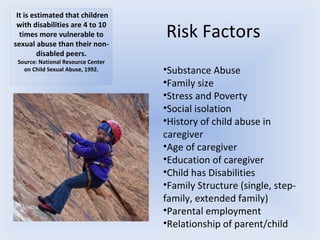
Risk Factors Substance Abuse Family size Stress and Poverty Social isolation History of child abuse in caregiver Age of caregiver Education of caregiver Child has Disabilities Family Structure (single, step-family, extended family) Parental employment Relationship of parent/child   It is estimated that children with disabilities are 4 to 10 times more vulnerable to sexual abuse than their non-disabled peers. Source: National Resource Center on Child Sexual Abuse, 1992.
Child Interviews
Resources http://www.acf.hhs.gov/  Administration of Children and Families Adoption and Foster Care by Lesbian and Gay Parents in the United States ,  Author(s): Gary Gates, Lee M.V. perman e nt link: http://www.urban.org/url.cfm?ID=411437 A Coordinated Response to Child Abuse and Neglect: The Foundation for Practice User Manual Series (2003) Author(s):  Office on Child Abuse and Neglect (HHS) Goldman, Salus, Wolcott, Kennedy Year Published:  2003 Liederman, David S. “Child Welfare Overview” Encyclopedia of Social Work 19 th  ed. Washington D.C., NASW Wells, Susan J. “Child Abuse and Neglect Overview” Encyclopedia of Social Work 19 th  ed. Washington D.C., NASW Barth, Richard P. “Adoption” Encyclopedia of Social Work 19 th  ed. Washington D.C., NASW http://www.prevent-abuse-now.com/stats.htm http://www.childwelfare.gov/index.cfm  Child Welfare Information Gateway  Brisset-Chapman, Sheryl. “Child Abuse and Neglect: Direct Practice” Encyclopedia of Social Work 19 th  ed. Washington D.C., NASW Conte, Jon R. “Child Sexual Abuse Overview” Encyclopedia of Social Work 19 th  ed. Washington D.C., NASW Berliner, Lucy. “Child Sexual Abuse: Direct Practice” Encyclopedia of Social Work 19 th  ed. Washington D.C., NASW

Early Childhood Development And Abuse

  • 1.
    Ages 2-5 By Rissa, Mary, Jennifer, Heidi, and Jenna Early Childhood
  • 2.
  • 3.
    Begin to developunique sense of self Recognize ethnic differences Exposure to other cultures limited by caregiver
  • 4.
    Cross Culturally AdoptedChildren Do not differ in self-esteem or adjustment compared to same-race adoptees Children adopted younger seem to do better (stability?) Environment, Family, community play an important role
  • 5.
    Gender Role andSexual Identity Strong notions of sex-typed play Age 3- sense of gender identity Age 4-gender stability Seem genetic-- male aggression and female nurturance Sex Stereotyping Help or limit children forming identity? Cultural vale assigned Greater competency attributed to boys
  • 6.
    Gay foster careand adoption More than half of gay men and 41 percent of lesbians want to have a child. More than one in three lesbians have given birth and one in six gay men have fathered or adopted a child. An estimated two million GLB people are interested in adopting. An estimated 65,500 adopted children are living with a lesbian or gay parent. Same-sex couples raising adopted children are older, more educated, and have more economic resources than other adoptive parents. Adopted children with same-sex parents are younger and more likely to be foreign born. Gay and lesbian parents are raising four percent of all adopted children in the United States. An estimated 14,100 foster children are living with lesbian or gay parents. Gay and lesbian parents are raising three percent of foster children in the United States. A national ban on GLB foster care could cost from $87 to $130 million. Costs to individual states could range from $100,000 to $27 million.
  • 7.
  • 8.
    Social Strengths andHazards Poverty Negative effects most pronounced in 1 st 5 years WIC, Head Start, SCHIP, School Breakfast/Lunch Poverty Linked to Child abuse Neglect is result of lack of resources- goods such as food, education on parenting or development, or services such as childcare
  • 9.
    Child Abuse Compositionof substantiated (DHHS) child abuse in 2000:    879,000 children were victims of child maltreatment.    Neglect ~ 63%    Physical ~ 19%    Sexual ~10%    Psychological ~ 8%   1 of every 7 victims of sexual assault were under age 6;    40% of offenders who victimized children under age 6 were juveniles (under age 18). Bureau of Justice Statistics (BJS) Children's Hospital Medical Center, Cincinnati Rate of child abuse by race:    White = 51%    African American = 25%    Hispanic = 15%    American Indian/Alaska Natives = 2%    Asian/Pacific Islanders = 1%
  • 10.
    Types of abuse(most to least common) Neglect Physical Sexual Psychological Why Not Report? Cues from family Don’t realize importance Do realize importance Guilt Relationship with abuser No framework
  • 11.
    Reporting Most childrendon’t report, especially males Trusting age, and child nearly always knows perpetrator Difficult to substantiate Can children’s testimony be trusted? Usually testimony more reliable than physical exams ( Children's Hospital Medical Center, Cincinnati) The typical child sex offender molests an average of 117 children, most of who do not report the offence. Source: National Institute of Mental Health, 1988.
  • 12.
    Effects Long termeffects of child abuse include fear, anxiety, depression, anger, hostility, inappropriate sexual behavior, poor self esteem, tendency toward substance abuse and difficulty with close relationships. Source: Browne & Finkelhor, 1986. Guilt Self-destructive behavior May not manifest until child is older Social maladjustment Victimizing others
  • 13.
    Risk Factors SubstanceAbuse Family size Stress and Poverty Social isolation History of child abuse in caregiver Age of caregiver Education of caregiver Child has Disabilities Family Structure (single, step-family, extended family) Parental employment Relationship of parent/child   It is estimated that children with disabilities are 4 to 10 times more vulnerable to sexual abuse than their non-disabled peers. Source: National Resource Center on Child Sexual Abuse, 1992.
  • 14.
  • 15.
    Resources http://www.acf.hhs.gov/ Administration of Children and Families Adoption and Foster Care by Lesbian and Gay Parents in the United States , Author(s): Gary Gates, Lee M.V. perman e nt link: http://www.urban.org/url.cfm?ID=411437 A Coordinated Response to Child Abuse and Neglect: The Foundation for Practice User Manual Series (2003) Author(s):  Office on Child Abuse and Neglect (HHS) Goldman, Salus, Wolcott, Kennedy Year Published:  2003 Liederman, David S. “Child Welfare Overview” Encyclopedia of Social Work 19 th ed. Washington D.C., NASW Wells, Susan J. “Child Abuse and Neglect Overview” Encyclopedia of Social Work 19 th ed. Washington D.C., NASW Barth, Richard P. “Adoption” Encyclopedia of Social Work 19 th ed. Washington D.C., NASW http://www.prevent-abuse-now.com/stats.htm http://www.childwelfare.gov/index.cfm Child Welfare Information Gateway Brisset-Chapman, Sheryl. “Child Abuse and Neglect: Direct Practice” Encyclopedia of Social Work 19 th ed. Washington D.C., NASW Conte, Jon R. “Child Sexual Abuse Overview” Encyclopedia of Social Work 19 th ed. Washington D.C., NASW Berliner, Lucy. “Child Sexual Abuse: Direct Practice” Encyclopedia of Social Work 19 th ed. Washington D.C., NASW