
The effect of CFO characteristics and organizational factors on the use of activity –based costing in a service context Dr Odysseas Pavlatos Athens University of Economics an Business Department of Accounting and Finance
Presentation Outline Research objective Literature review Research hypotheses Research methodology Survey results Conclusions, limitations and future research
Introduction Over the last three decades a number of  innovative  management accounting (MA) techniques have been developed across a range of industries   (Abdel-Kader and Luther, 2008)   The literature shows that important characteristics  (contingencies)  affecting organizational structure include size, environmental uncertainty, production technology, corporate strategy and market environment (Otley, 1995; Covaleski et al., 1996; Mitchell, 2002). Activity Based Costing (ABC)  is one of the most important innovations in the field of cost and management accounting (Bjornenak and Mitchell, 1999; Bjornenak, 1997)
Research objective The purpose of this study is to examine the extent to which potential  factors  affect the use of activity-based costing in a service context
Literature review   (1) Since  the mid-1990s researchers have started to examine the  contextual factors  that influence the adoption and the implementation of  ABC  (see Gosselin 1997a for a review) Various survey-based studies use  selection  and  interaction  approaches (e.g Bjornenak, 1997; Gosselin, 1997b; Krumwiede, 1998; Malmi, 1999; Clarke  et al.,  1999; Hoque, 2000; Cagwin and Bouwman, 2002; Abernethy  et al.,  2001)
Literature review (2) Kaplan and Cooper (1998) suggest that  service companies  are ideal candidates for ABC even more than  manufacturing companies Chenhall (2003) reports that there is a need for  more research into service  organizations, such as  hospitality industry , about cost system design and contextual variables, as these entities become increasingly important within most economies There is an  active interest in hospitality management  and particularly in cost and management accounting practices of hotels and tourism enterprises (Pavlatos and Paggios, 2009a; 2000b; Guilding, 2003)   Within the hospitality context ABC  has been  studied in connection with   customer profitability analysis  (CPA) (Dunn and Brooks 1990; Noone and Griffin, 1999; Karadag and Wod Kim, 2006; and Harris and Krakhmal, 2008)  Pavlatos and Paggios (2009a; 2009b) found that  Activity Based Costing diffusion  in hospitality industry in  Greece  is considered very satisfactory (23.5%)
Research hypotheses   (1) H 1q : There is a negative association between the  CFO age  and the use of ABC H 1b : There is a negative association between the  CFO tenure  and the use of ABC H 1c : There is a positive association between the  CFO  relatively  business-oriented educational background  and the use of ABC
Research hypotheses   (2) H 2 : Firms following a  differentiation strategy  use more activity-based costing than firms following a  cost leadership strategy H 3 : There is a positive association between the  quality of information technology  the use of ABC H 4 : There is a positive association between the  membership of multinational chain  and the use of ABC H 5 :There is a positive association between the extent of the use of  strategic management accounting techniques  and the use of ABC
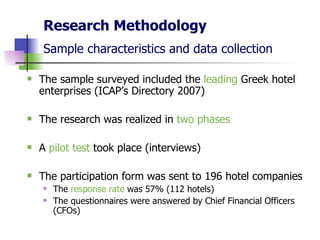
Research Methodology Sample characteristics and data collection   The sample surveyed included the  leading  Greek hotel enterprises (ICAP’s Directory 2007) The research was realized in  two phases A  pilot test  took place (interviews)  The participation form was sent to 196 hotel companies The  response rate  was 57% (112 hotels) The questionnaires were answered by Chief Financial Officers (CFOs)
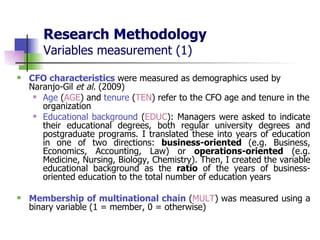
Research Methodology Variables measurement (1) CFO characteristics   were measured as demographics used by Naranjo-Gil  et al.  (2009) Age  ( AGE ) and  tenure  ( TEN ) refer to the CFO age and tenure in the organization Educational background  ( EDUC ): Managers were asked to indicate their educational degrees, both regular university degrees and postgraduate programs. I translated these into years of education in one of two directions:  business-oriented  (e.g. Business, Economics, Accounting, Law) or  operations-oriented  (e.g. Medicine, Nursing, Biology, Chemistry). Then, I created the variable educational background as the  ratio  of the years of business-oriented education to the total number of education years   Membership of multinational chain  ( MULT )   was measured using a binary variable (1 = member, 0 = otherwise)
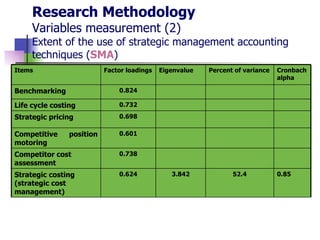
Research Methodology Variables measurement (2) Extent of the use of  strategic management accounting techniques ( SMA ) 0.698 Strategic pricing 0.601 Competitive position motoring 0.738 Competitor cost assessment 0.85 52.4 3.842 0.624 Strategic costing (strategic cost management)   0.732 Life cycle costing 0.824 Benchmarking Cronbach alpha  Percent of variance  Ε igenvalue Factor loadings Items
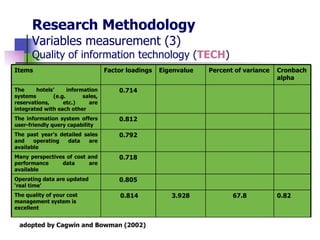
Research Methodology Variables measurement (3) Quality of information technology ( TECH ) adopted by Cagwin and Bowman (2002)   0.792 The past year’s detailed sales and operating data are available 0.718 Many perspectives of cost and performance data are available 0.805 Operating data are updated ‘real time’ 0.82 67.8 3.928 0.814   The quality of your cost management system is excellent 0.812 The information system offers user-friendly query capability 0.714 The hotels’ information systems (e.g. sales, reservations, etc.) are integrated with each other Cronbach alpha  Percent of variance  Ε igenvalue Factor loadings Items
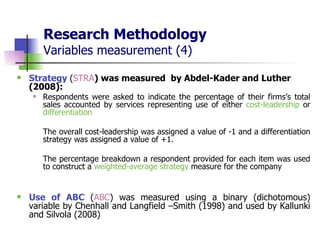
Research Methodology Variables measurement (4) Strategy  ( STRA ) was measured  by Abdel-Kader and Luther (2008):  Respondents were asked to indicate the percentage of their firms’s total sales accounted by services representing use of either  cost-leadership  or  differentiation The overall cost-leadership was assigned a value of -1 and a differentiation strategy was assigned a value of +1.  The percentage breakdown a respondent provided for each item was used to construct a  weighted-average strategy  measure for the company   Use of ABC  ( ABC ) was measured using a binary (dichotomous) variable by Chenhall and Langfield –Smith (1998) and used by Kallunki and Silvola (2008)
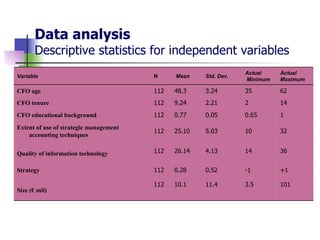
Data analysis Descriptive statistics for independent variables 101 3.5 11.4 10.1 112 Size (€ mil)   +1 -1 0.52 0.28 112 Strategy   36 14 4.13 26.14 112 Quality of information technology   32 10 5.03 25.10 112 Extent of use of strategic management accounting techniques   1 0.65 0.05 0.77 112 CFO educational background 14 2 2.21 9.24 112 CFO tenure 62 35 3.24 48.3 112 CFO age Actual  Maximum Actual Minimum Std. Dev. Mean N Variable
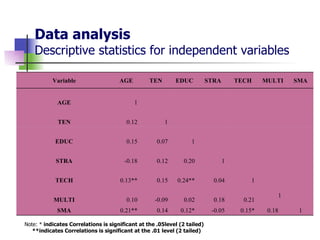
Data analysis Descriptive statistics for independent variables Note: *  indicates Correlations is significant at the .05level (2 tailed) **indicates Correlations is significant at the .01 level (2 tailed) 1 0.18 0.15* -0.05 0.12* 0.14 0.21** SMA 1 0.21 0.18 0.02 -0.09 0.10 MULTI 1 0.04 0.24** 0.15 0.13** TECH 1 0.20 0.12 -0.18 STRA 1 0.07 0. 15 EDUC 1 0.12 TEN         1 AGE SMA MULTI TECH STRA EDUC TEN AGE Variable
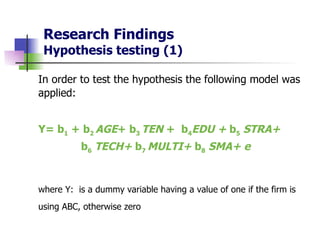
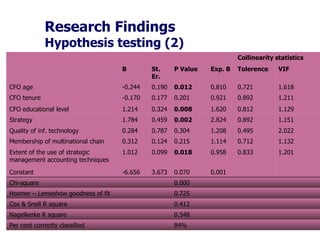
Research Findings Hypothesis testing (1) In order to test the hypothesis the following model was applied: Y= b 1  + b 2  AGE + b 3  TEN  +  b 4 EDU +  b 5  STRA+   b 6   TECH+  b 7  MULTI+  b 8  SMA+ e   where Y:  is a dummy variable having a value of one if the firm is using ABC, otherwise zero
Research Findings Hypothesis testing (2) 1.132 0.712 1.114 0.215 0.124 0.312 Membership of multinational chain   0.548 Nagelkerke R square  0.412 Cox & Snell R square  0.725 Hosmer – Lemeshow goodness of fit 0.000 Chi-square 0.001 0.070 3.673 -6.656 Constant   1.201 0.833 0.958 0.018 0.099 1.012 Extent of the use of strategic  management accounting techniques   2.022 0.495 1.208 0.304 0.787 0.284 Quality of inf. technology 1.151 0.892 2.824 0.002 0.459 1.784 Strategy 1.129 0.812 1.620 0.008 0.324 1.214 CFO educational level 1.211 0.892 0.921 0.201 0.177 -0.170 CFO tenure 1.618 0.721 0.810 0.012 0.190 -0.244 CFO age  VIF Tolerence Exp. B P Value St .  Er . B 84% Per cent correctly classified Collinearity statistics
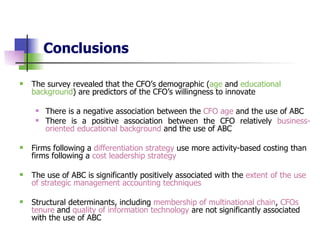
Conclusions   The survey revealed that the CFO’s demographic ( age  and  educational background ) are predictors of the CFO’s willingness to innovate There is a negative association between the  CFO age  and the use of ABC There is a positive association between the CFO relatively  business-oriented educational background  and the use of ABC Firms following a  differentiation strategy  use more activity-based costing than firms following a  cost leadership strategy The use of ABC is significantly positively associated with the  extent of the use of strategic management accounting techniques   Structural determinants, including  membership of multinational chain ,  CFOs tenure  and  quality of information technology  are not significantly associated with the use of ABC
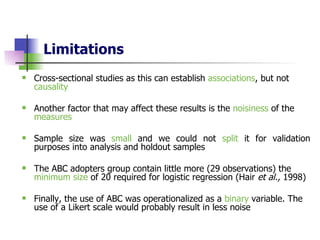
Limitations Cross-sectional studies as this can establish  associations , but not  causality Another factor that may affect these results is the  noisiness  of the  measures Sample size was  small  and we could not  split  it for validation purposes into analysis and holdout samples   The ABC adopters group contain little more (29 observations) the  minimum   size  of 20 required for logistic regression (Hair  et al.,  1998) Finally, the use of ABC was operationalized as a  binary  variable.  The use of a Likert scale would probably result in less noise
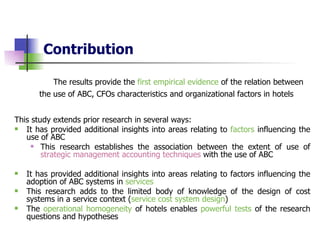
Contribution The results provide the  first empirical evidence  of the relation between the use of ABC, CFOs characteristics and organizational factors in hotels   This study extends prior research in several ways: It has provided additional insights into areas relating to  factors  influencing the use of ABC  This research establishes the association between  the extent of use  of  strategic management accounting techniques  with the use  of  ABC It has provided additional insights into areas relating to factors influencing the adoption of ABC systems  in  services This research adds to the limited body of knowledge of the design of cost systems in a service context ( service cost system design ) The  operational homogeneity  of hotels enables  powerful tests  of the research questions   and hypotheses
Future research Incorporate other important  variables  from  contingency theory  that are likely to influence the use of ABC in a service context: service process type organizational life cycle stage   top management support etc. Cost accounting systems of services that use ABC could be studied in depth in order to examine the  perceived benefits  and  problems  that arise from their implementation
 

Eaa 2010

  • 1.
    The effect ofCFO characteristics and organizational factors on the use of activity –based costing in a service context Dr Odysseas Pavlatos Athens University of Economics an Business Department of Accounting and Finance
  • 2.
    Presentation Outline Researchobjective Literature review Research hypotheses Research methodology Survey results Conclusions, limitations and future research
  • 3.
    Introduction Over thelast three decades a number of innovative management accounting (MA) techniques have been developed across a range of industries (Abdel-Kader and Luther, 2008) The literature shows that important characteristics (contingencies) affecting organizational structure include size, environmental uncertainty, production technology, corporate strategy and market environment (Otley, 1995; Covaleski et al., 1996; Mitchell, 2002). Activity Based Costing (ABC) is one of the most important innovations in the field of cost and management accounting (Bjornenak and Mitchell, 1999; Bjornenak, 1997)
  • 4.
    Research objective Thepurpose of this study is to examine the extent to which potential factors affect the use of activity-based costing in a service context
  • 5.
    Literature review (1) Since the mid-1990s researchers have started to examine the contextual factors that influence the adoption and the implementation of ABC (see Gosselin 1997a for a review) Various survey-based studies use selection and interaction approaches (e.g Bjornenak, 1997; Gosselin, 1997b; Krumwiede, 1998; Malmi, 1999; Clarke et al., 1999; Hoque, 2000; Cagwin and Bouwman, 2002; Abernethy et al., 2001)
  • 6.
    Literature review (2)Kaplan and Cooper (1998) suggest that service companies are ideal candidates for ABC even more than manufacturing companies Chenhall (2003) reports that there is a need for more research into service organizations, such as hospitality industry , about cost system design and contextual variables, as these entities become increasingly important within most economies There is an active interest in hospitality management and particularly in cost and management accounting practices of hotels and tourism enterprises (Pavlatos and Paggios, 2009a; 2000b; Guilding, 2003) Within the hospitality context ABC has been studied in connection with customer profitability analysis (CPA) (Dunn and Brooks 1990; Noone and Griffin, 1999; Karadag and Wod Kim, 2006; and Harris and Krakhmal, 2008) Pavlatos and Paggios (2009a; 2009b) found that Activity Based Costing diffusion in hospitality industry in Greece is considered very satisfactory (23.5%)
  • 7.
    Research hypotheses (1) H 1q : There is a negative association between the CFO age and the use of ABC H 1b : There is a negative association between the CFO tenure and the use of ABC H 1c : There is a positive association between the CFO relatively business-oriented educational background and the use of ABC
  • 8.
    Research hypotheses (2) H 2 : Firms following a differentiation strategy use more activity-based costing than firms following a cost leadership strategy H 3 : There is a positive association between the quality of information technology the use of ABC H 4 : There is a positive association between the membership of multinational chain and the use of ABC H 5 :There is a positive association between the extent of the use of strategic management accounting techniques and the use of ABC
  • 9.
    Research Methodology Samplecharacteristics and data collection The sample surveyed included the leading Greek hotel enterprises (ICAP’s Directory 2007) The research was realized in two phases A pilot test took place (interviews) The participation form was sent to 196 hotel companies The response rate was 57% (112 hotels) The questionnaires were answered by Chief Financial Officers (CFOs)
  • 10.
    Research Methodology Variablesmeasurement (1) CFO characteristics were measured as demographics used by Naranjo-Gil et al. (2009) Age ( AGE ) and tenure ( TEN ) refer to the CFO age and tenure in the organization Educational background ( EDUC ): Managers were asked to indicate their educational degrees, both regular university degrees and postgraduate programs. I translated these into years of education in one of two directions: business-oriented (e.g. Business, Economics, Accounting, Law) or operations-oriented (e.g. Medicine, Nursing, Biology, Chemistry). Then, I created the variable educational background as the ratio of the years of business-oriented education to the total number of education years Membership of multinational chain ( MULT ) was measured using a binary variable (1 = member, 0 = otherwise)
  • 11.
    Research Methodology Variablesmeasurement (2) Extent of the use of strategic management accounting techniques ( SMA ) 0.698 Strategic pricing 0.601 Competitive position motoring 0.738 Competitor cost assessment 0.85 52.4 3.842 0.624 Strategic costing (strategic cost management) 0.732 Life cycle costing 0.824 Benchmarking Cronbach alpha Percent of variance Ε igenvalue Factor loadings Items
  • 12.
    Research Methodology Variablesmeasurement (3) Quality of information technology ( TECH ) adopted by Cagwin and Bowman (2002) 0.792 The past year’s detailed sales and operating data are available 0.718 Many perspectives of cost and performance data are available 0.805 Operating data are updated ‘real time’ 0.82 67.8 3.928 0.814 The quality of your cost management system is excellent 0.812 The information system offers user-friendly query capability 0.714 The hotels’ information systems (e.g. sales, reservations, etc.) are integrated with each other Cronbach alpha Percent of variance Ε igenvalue Factor loadings Items
  • 13.
    Research Methodology Variablesmeasurement (4) Strategy ( STRA ) was measured by Abdel-Kader and Luther (2008): Respondents were asked to indicate the percentage of their firms’s total sales accounted by services representing use of either cost-leadership or differentiation The overall cost-leadership was assigned a value of -1 and a differentiation strategy was assigned a value of +1. The percentage breakdown a respondent provided for each item was used to construct a weighted-average strategy measure for the company Use of ABC ( ABC ) was measured using a binary (dichotomous) variable by Chenhall and Langfield –Smith (1998) and used by Kallunki and Silvola (2008)
  • 14.
    Data analysis Descriptivestatistics for independent variables 101 3.5 11.4 10.1 112 Size (€ mil) +1 -1 0.52 0.28 112 Strategy 36 14 4.13 26.14 112 Quality of information technology 32 10 5.03 25.10 112 Extent of use of strategic management accounting techniques 1 0.65 0.05 0.77 112 CFO educational background 14 2 2.21 9.24 112 CFO tenure 62 35 3.24 48.3 112 CFO age Actual Maximum Actual Minimum Std. Dev. Mean N Variable
  • 15.
    Data analysis Descriptivestatistics for independent variables Note: * indicates Correlations is significant at the .05level (2 tailed) **indicates Correlations is significant at the .01 level (2 tailed) 1 0.18 0.15* -0.05 0.12* 0.14 0.21** SMA 1 0.21 0.18 0.02 -0.09 0.10 MULTI 1 0.04 0.24** 0.15 0.13** TECH 1 0.20 0.12 -0.18 STRA 1 0.07 0. 15 EDUC 1 0.12 TEN         1 AGE SMA MULTI TECH STRA EDUC TEN AGE Variable
  • 16.
    Research Findings Hypothesistesting (1) In order to test the hypothesis the following model was applied: Y= b 1 + b 2 AGE + b 3 TEN + b 4 EDU + b 5 STRA+ b 6 TECH+ b 7 MULTI+ b 8 SMA+ e where Y: is a dummy variable having a value of one if the firm is using ABC, otherwise zero
  • 17.
    Research Findings Hypothesistesting (2) 1.132 0.712 1.114 0.215 0.124 0.312 Membership of multinational chain 0.548 Nagelkerke R square 0.412 Cox & Snell R square 0.725 Hosmer – Lemeshow goodness of fit 0.000 Chi-square 0.001 0.070 3.673 -6.656 Constant 1.201 0.833 0.958 0.018 0.099 1.012 Extent of the use of strategic management accounting techniques 2.022 0.495 1.208 0.304 0.787 0.284 Quality of inf. technology 1.151 0.892 2.824 0.002 0.459 1.784 Strategy 1.129 0.812 1.620 0.008 0.324 1.214 CFO educational level 1.211 0.892 0.921 0.201 0.177 -0.170 CFO tenure 1.618 0.721 0.810 0.012 0.190 -0.244 CFO age VIF Tolerence Exp. B P Value St . Er . B 84% Per cent correctly classified Collinearity statistics
  • 18.
    Conclusions The survey revealed that the CFO’s demographic ( age and educational background ) are predictors of the CFO’s willingness to innovate There is a negative association between the CFO age and the use of ABC There is a positive association between the CFO relatively business-oriented educational background and the use of ABC Firms following a differentiation strategy use more activity-based costing than firms following a cost leadership strategy The use of ABC is significantly positively associated with the extent of the use of strategic management accounting techniques Structural determinants, including membership of multinational chain , CFOs tenure and quality of information technology are not significantly associated with the use of ABC
  • 19.
    Limitations Cross-sectional studiesas this can establish associations , but not causality Another factor that may affect these results is the noisiness of the measures Sample size was small and we could not split it for validation purposes into analysis and holdout samples The ABC adopters group contain little more (29 observations) the minimum size of 20 required for logistic regression (Hair et al., 1998) Finally, the use of ABC was operationalized as a binary variable. The use of a Likert scale would probably result in less noise
  • 20.
    Contribution The resultsprovide the first empirical evidence of the relation between the use of ABC, CFOs characteristics and organizational factors in hotels This study extends prior research in several ways: It has provided additional insights into areas relating to factors influencing the use of ABC This research establishes the association between the extent of use of strategic management accounting techniques with the use of ABC It has provided additional insights into areas relating to factors influencing the adoption of ABC systems in services This research adds to the limited body of knowledge of the design of cost systems in a service context ( service cost system design ) The operational homogeneity of hotels enables powerful tests of the research questions and hypotheses
  • 21.
    Future research Incorporateother important variables from contingency theory that are likely to influence the use of ABC in a service context: service process type organizational life cycle stage top management support etc. Cost accounting systems of services that use ABC could be studied in depth in order to examine the perceived benefits and problems that arise from their implementation
  • 22.