http://www.iaeme.com/IJMET/index.asp 550 editor@iaeme.com
International Journal of Mechanical Engineering and Technology (IJMET)
Volume 10, Issue 01, January 2019, pp. 550–563, Article ID: IJMET_10_01_057
Available online at http://www.iaeme.com/ijmet/issues.asp?JType=IJMET&VType=10&IType=01
ISSN Print: 0976-6340 and ISSN Online: 0976-6359
© IAEME Publication Scopus Indexed
IMPLEMENTING ACTIVITY BASED COSTING
AMONG AUTOMOTIVE ENGINEERING
INDUSTRIES IN SMALL AND MEDIUM
ENTERPRISES SECTOR OF TAMIL NADU
CMA. Dr. C. Samuel Joseph
Professor & Head, Department of Commerce, School of Sciences, Arts, Media and
Management, Karunya Institute of Technology and Sciences, Coimbatore, Tamil Nadu, India
Dr. F.J. Peter Kumar
Associate Professor, Department of Management Studies, School of Sciences, Arts, Media and
Management, Karunya Institute of Technology and Sciences, Coimbatore, Tamil Nadu, India
Dr. R. Magesh Kumar
Assistant Professor, Department of Management Studies, School of Sciences, Arts, Media and
Management, Karunya Institute of Technology and Sciences, Coimbatore, Tamil Nadu, India
ABSTRACT
There has been a long time discussions on which costing systems are to adopted in
the Indian Manufacturing Industries especially, the industries involved in Mechanical
Process. Normally, it is understood that a lot many companies is in the Automotive
Engineering Industry in the SME Sector are having their costing done in a traditional
method without having much progress or knowledge in the new way in which costing is
being done elsewhere. On surveying the literature, the author’s found a research gap
that, implementation issues of ABC costing system by the Indian Automotive Engineering
Industry of the SMEs need to be focused and studies need to be entertained. This study
assumes significance due to high prevalence of SME’s, with significant concentration of
automotive engineering industries, which confers a huge relevance to a study of this sort
to make concrete suggestions.
Key Words: Activity Based Costing, Quality, Customer, SME, Products and Services,
Business Classification, Management Accounting, Management Process, Competitor
Analysis, Traditional Costing, Financial and Non-Financial Metrics, Business Excellence,
Cost of Quality, Production.
Cite this Article: CMA. Dr. C. Samuel Joseph, Dr. F.J. Peter Kumar and Dr. R. Magesh
Kumar, Implementing Activity Based Costing Among Automotive Engineering Industries
in Small and Medium Enterprises Sector of Tamil Nadu, International Journal of
Mechanical Engineering and Technology, 10(01), 2019, pp.550–563
http://www.iaeme.com/IJMET/issues.asp?JType=IJMET&VType=10&Type=01
CMA. Dr. C. Samuel Joseph, Dr. F.J. Peter Kumar and Dr. R. Magesh Kumar,
http://www.iaeme.com/IJMET/index.asp 551 editor@iaeme.com
1. INTRODUCTION
Management Accounting is an activity that is interwoven in the management process of all
organizations. It refers to that part of the management process which is focused on adding value
to organizations by attaining the effective use of resources by people, in dynamic and competitive
context. It involves distinctive modes of thoughts and practice.
Management Accounting is the process of identifying, measuring, reporting and analyzing
information about economic events of organization. The process should be ambitious by the
informational needs of individuals internal to the organization and should lead their operating
and investment decisions. (Robert Kaplan, 1980) in his review of The Evolution of Management
Accounting, and with (Johnson, 1991) in the Relevance Lost: The Rise and Fall of Management
Accounting leveled strong criticism at the management accounting practices of the day. Since
then a number of innovative management accounting techniques have been developed across a
range of industries and publicized internationally.
Among other things, the most notable innovations are Activity Based Techniques, (including
activity-based costing, activity-based budgeting and activity based management). This technique
has been designed to support modern technologies and management processes, such as total
quality management, just-in-time production systems, and the search for a competitive advantage
to meet the challenge of global competition. As firms adapt to these technological and
management developments, they must design a management accounting system congruent with
the new requirements (Gerdin, 2005).
It has been argued that these new techniques have affected the whole process of planning,
controlling, decision-making and communication of management accounting. (Ittner and
Larcker, 2001; Kaplan and Atkinson, 1998; Otley, 1995; Fullerton and McWatters, 2002; Hoque
and Mia, 2001). These techniques have shifted its focus from a simple role of cost determination
and financial control, to a sophisticated role of creating value through improved deployment of
resources.
1.1. Activity Based Costing – Conceptual Insights
Activity Based Costing was first developed in the mid of 1980’s. Two different organizations
significantly contributed to the development of the ABC process through two of its researchers,
Robert Kaplan and Robin Cooper as well as an R&D organization called Computer –Aided
Manufacturing, International (Jones, Dugdale, 2002). It is a discipline that focuses on the
management of activities as the route to improving the value received by the customer and the
profit achieved by providing this value (Cost Accounting Management – International (CAM –
I). Activity Based Costing refines the costing system by focusing on individual activities as the
fundamental cost objects. ABC system calculate the cost of individual activities and assign costs
to cost objects such as products and services on the basis of the activities undertaken to produce
each product or service. Activity Based Management as a discipline draws on activity-based
costing as its major source of information (Berliner and Brimson, 1988) which includes cost
drivers analysis, activity analysis and performance measurements, to improve the decision-
making processes. This involves continual search for opportunities to improve which in turn
involves a careful and methodical study of activities (Kaplan, 1984)
Therefore, ABC is a technique that assigns costs to activities and services that are based on
the amount consumed. It helps administrators manage costs, a tool for linking costs and results,
action required for the production and delivery of specific results (Balalaie Somee Saraye et al.,
2013)
Implementing Activity Based Costing Among Automotive Engineering Industries in Small and Medium
Enterprises Sector of Tamil Nadu
http://www.iaeme.com/IJMET/index.asp 552 editor@iaeme.com
1.2. Rationale of the Study
There has been a strong criticism in the recent past that the Indian corporate, viz., Small and
Medium Enterprises in general and Automotive Engineering Industries under SME’s in
particular, have not been able to adapt recent management accounting practices to changing
business scenario coupled with technological advancements in tune with the dynamics of
production and operating activities. In spite of the Governments initiative SME’s have less well
developed management systems and were not as good at meeting financial targets using
appropriate non-financial indicators, and were less likely to benchmark their results. However,
the literature claims that most of these criticisms are true but not supported by extensive
systematic study as evidenced, and it varies across countries. SME’s may take practical steps to
implement desirable growth paths through management practices that utilize appropriate intra
and inter organizational capabilities (Jin, 2007). Therefore, more specifically ABC could assist
SME’s in Automotive Engineering in enhancing efficiency and innovation through improved
pricing and better planning.
These SME’s in the Indian context predominantly use traditional costing methods (Joseph &
Samuel, 2017). Further, Under Traditional Cost Accounting the organization lacks the ability to
evaluate the internal efficiency, quality and profitability per product or service line (Narong,
2009). Even today, over 20 years since ABC was first introduced a majority of firm still employ
traditional accounting methods (Fei, 2010; Maelah, 2007; Hughes.S., 2003).
In SME’s adoption of ABC has been even slower (Carenzo, 2010; Hughes, A, 2005). SME’s
may take practical steps to implement desirable growth paths through management practices that
utilize appropriate intra and inter organizational capabilities (Jin, 2007). Therefore, more
specifically ABC could assist SME’s in enhancing efficiency and innovation through improved
pricing and better planning. Further, this study assumes significance as it focuses on Coimbatore
District, in the State of Tamil Nadu (located in the down South –Western region in the Indian
Map) due to high prevalence of SME’s, which confers a huge relevance to a study of this sort to
make concrete suggestions.
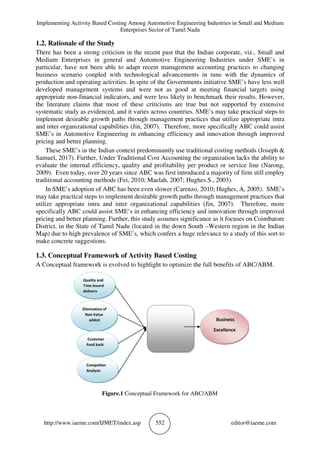
1.3. Conceptual Framework of Activity Based Costing
A Conceptual framework is evolved to highlight to optimize the full benefits of ABC/ABM.
Figure.1 Conceptual Framework for ABC/ABM
CMA. Dr. C. Samuel Joseph, Dr. F.J. Peter Kumar and Dr. R. Magesh Kumar,
http://www.iaeme.com/IJMET/index.asp 553 editor@iaeme.com
2. LITERATURE REVIEW
A significant body of research has been published in the field of management accounting
practices by Chenhall and Langfield-Smith (1998), Ghosh and Chan (1997) Guidling,
Lamminmaki, and Drury, (1998), Wijewardena and Zoysa (1999), Mendoza and Bescos (2002)
Magdy Abdel-Kader and Robert Luther, (2006). These studies report on the use of various
management accounting techniques in different countries and industries. In a bid to support such
changes in the operating environment, management accounting practice in many developed
countries has introduced new cost and management accounting systems (Innes and Mitchell,
1990; Peasnell, 1993; Libby Waterhouse, 1996; Vaivio, 1999; Gray et.al., 2001; Haldma and
Laats, 2002; Hoque, 2003). However, there is little research on the adoption of these practices
in developing countries, (Wallace, 1990, Hoque and Hopper, 1994, 1997; Anderson and Lanen
`1999; Narayan et al., 2000; Abdul –Rahman and Lawrence, 2001; Luther and longden, 2001 ;)
in this context significant research studies have been reviewed and revisited
2.1. Reviews on Use of Traditional Costing
(Lyall, 1990) found that of the 423 companies that they surveyed 76 percent claimed that they
used traditional costing. (Joshi, 2001) specified that in India, 68 percent of the 60 firms surveyed
still use traditional costing techniques. (Drury, 1993) reported 73 percent of the respondents using
traditional costing. (Ghosh, 1987) found that 47 percent of the companies surveyed used the
traditional costing system in Singapore. (Asquer, 2003) explains that “many state of the art
technologies use a range of tools to assess operational efficiency and the achievement of
organization goals. Yet many firms are far from adopting most of these innovations.” (Mann et
al. 1999) conducted an investigation of the “best practices” employed by nine companies that
scored well in the Business excellence model and concluded that the industry needs to be more
progressive and more willing to learn and apply new methods. (Magdy Abdel-Kader and Robert
Luther, 2006) had investigated and reported on the management accounting practices in the
British food and drinks Industry, concludes that direct costing is widely practiced and important
by contrast with activity-based costing. (Adelegan, Olatundun Janet, 1998) in her study concludes
that management accounting in Nigeria is still evolving and will continue to do so in the future.
2.2. Reviews on Use of Strategic Cost Management Techniques
(Andrew Hughes, 2011), Activity based costing helps business in understanding its business
processes in detail, the cost of process failures, the relationship of processes to customers, the
profitability of customer segments and the affordable amount that can be spent on influencing the
preferred customer groups. Gunasekaran, et al. (1999) have suggested to shift for ABC under the
following criteria that is timing, implementation, the factors against the implementation of ABC
and conditions favouring the applications of ABC. (Wien Hsien Tsaiin 1998), ABC uses nested
activity centres to create a multi-tier COQ reporting system to meet various management’s
information needs and to support COQ responsibility accounting. (Curtis Walker et al.2000)
concludes that, the manufacturing industry can now effectively apply a cost to activities of the
planning process for each individual job as a direct cost, rather than an indirect cost. Studies on
Activity Based costing methodology for SME’s in different sectors has been published on firms
such as printing firms (Mendiola and Peralta, 1999), Metal Aluminium and ironwork structures
(Flores, 2002), polyvinyl chloride industry (Ruiz, 2003), Mexican logistics sector (Prieto et.al
2007). To compete in a highly competitive market, companies must implement a costing system
strong for their ability to respond to any changes in the products and activities (Kazempour,
2011). New costing methods for improving cost management systems have been created, these
methods are not only used for accounting, but also for management as a decision- making
(Bogdanoiu, 2009)
Implementing Activity Based Costing Among Automotive Engineering Industries in Small and Medium
Enterprises Sector of Tamil Nadu
http://www.iaeme.com/IJMET/index.asp 554 editor@iaeme.com
2.3. Reviews on Small and Medium Enterprises
(Gecevska and anisic 2006) investigated the use of small and medium enterprises engaged in the
activity based costing transitioning from traditional costing system. (Husin and Ibrahim, 2014)
examined the role of accounting services and its impact on the performance of SME’s and
concludes that there is a relationship between service quality and performance of SME’s
accounting services. (Manriquez et al., 2014) examined the activity based pricing system for
SME’s in Mexico and the results indicate low penetration of ABC and SME’s are still using
traditional systems because of lack of knowledge. (Carnes, 2010), says Many firms that have
adopted ABC have found it challenging to maintain the system, as a result of these challenges a
modified ABC approach called Time Driven ABC (TDABC) was introduced (Kaplan, 2007).
(Ayvez, 2011; Sherratt, 2005), advantages of TDABC when compared to traditional ABC are
lower processing costs, increased system flexibility, improved accuracy and enhanced simplicity
This is especially important to SME’s with their more limited resource base and margins of
decision errors (Cardinaels, 2004)
2.4. Research Gap Identified
The Study have extensively done literature survey in the area of ABC Techniques applied in
Industries and identified that a very few study is conducted in the area of ABC Technique being
used in SMEs especially in the Automotive Engineering Industry. This motivated the author’s to
embark and develop a model for effective implementation of ABC applications in the Automotive
Engineering Industry of the SME Sector.
3. OBJECTIVES OF THE STUDY
On identifying the research gap from an intensive survey of literature, the Study have set the
following Objectives for the Analysis on the Implementation of Activity Based Costing in the
Automotive Engineering Industry of the SMEs in the South-Western India.
1. To Identify the factors influencing the Non-implementation of Activity Based Costing
in the Automotive Engineering Industry of the SMEs in the South-Western India
2. To study the Awareness of Activity Based Costing among the Persons responsible for
determining the costing system in the Organisation.
3. To analyse the relative importance of Predictor Variable in discriminating between
groups on current cost management practices
4. To find substantially important contributing variable towards adopting activity based
costing technique as the Cost Management Practices
4. RESEARCH METHODOLOGY
Based on a thorough review of existing literature, the study ensured that the data that was planned
to be collected was compatible with the objectives of the study. The following research questions
were formulated.
I. What are the variables that discriminates Automotive Engineering in SME’s from
implementing activity based costing?
II. Is there a functional relationship between current cost management practices and the
demography of the Automotive Engineering SME’s?
Considering the research objectives, that is to Infer the relative importance of variables that
discriminates SME’s from implementing Activity Based Costing and to establish a functional
relationship among current cost management practices and Profile of the SME’s, the study, opted
to adopt interview method of data collection, because, the study could explain the nature of
questions in the interview schedule to the respondents, thus generating a greater reliability on the
CMA. Dr. C. Samuel Joseph, Dr. F.J. Peter Kumar and Dr. R. Magesh Kumar,
http://www.iaeme.com/IJMET/index.asp 555 editor@iaeme.com
data sourced. Further, this method would facilitate the author to gather most diversified data and
understand how Indian SME’s optimize basic cost management practices. The interview has
been conducted solely with the person responsible for accounting who are supposed to have
reasonable knowledge in participating such interviews of this kind. Thus, the data captured were
quantified to understand the behavior of SME’s in this region
The Survey is based on the source list with reference to the SME’s registered with Coimbatore
District Small Scale Industries Association (CODISSIA) an official organ of the SME’s in
Coimbatore, Erode and the Nilgiris District. Automotive engineering is a study of engineering
which includes mechanical, electrical, electronic and safety engineering for manufacturing,
designing, mechanical systems and operation of automobiles as well.
The study included the companies that were engaged in manufacturing or designing or
production of automobile components and assembling. Scheduled/Unscheduled meetings were
done in four phases, were the author managed to meet with 165 companies. The interviews were
performed with people responsible for the cost management. However, out of which 165
contacted, the author could succeed with the response rate of only 60 per cent which was
compatible to the reviews of literature. (Abernethy et.al 1999) concludes that regardless of the
research method used, to generalize something based solely on a single research paper is
necessarily limited and therefore untrustworthy. (Mario Joao Cardoso Vieira Machado, 2012) in
their study believes that generalizing in managerial accounting has to be achieved through a series
of consecutive studies with new samples, different places and time periods.
5. FINDINGS AND RESULTS
With reference to the research question (i) the analyzed data concludes that No SME’s uses the
activity - based costing method, which needs a special look out by the Industry association
(CODISSIA).
On analyzing the question (ii) for the variable awareness of activity - based costing among
the persons responsible for accounting. The results detail that the 100 per cent are not aware of
the ABC. This confirms the result of Q.No. (i)
5.1 Factors Influencing Non – Implementation of Activity Based Costing among
Automotive Engineering Industry of SME’s using Mean and ANOVA
To estimate and compare the mean score on factor influencing non – implementation of activity-
based costing by the firms, weighted average analysis is performed using three rating score by
assigning 3 for to great extent; 2 for Good; 1 for not at all and the results are presented in the
following tables.
H0: There is no significant difference in the mean scores on the factors influencing non-
implementation of activity based costing among Automotive Engineering Industry of SMEs.
Ha: There is significant difference in the mean scores on the factors influencing non-
implementation of activity based costing among Automotive Engineering Industry of
SMEs.
Table No. 1 Analysis of Relationship on the Factors Influencing Non – Implementation of Activity
Based Costing
SOURCE DF S S M S F
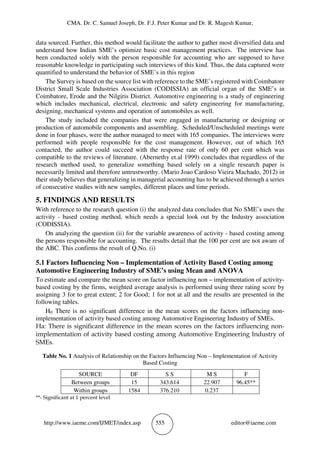
Between groups 15 343.614 22.907 96.45**
Within groups 1584 376.210 0.237
**- Significant at 1 percent level
Implementing Activity Based Costing Among Automotive Engineering Industries in Small and Medium
Enterprises Sector of Tamil Nadu
http://www.iaeme.com/IJMET/index.asp 556 editor@iaeme.com
Since the F is significant the null hypothesis is rejected and inferred that there is significant
difference in the mean scores among organizations. The mean scores are presented below:
Table No. 2 Drivers Influencing Non – Implementation of Activity Based Costing Among Automotive
Engineering Industry of SMEs
S.No
Drivers Influencing Non – Implementation
of ABC
Mean score Rank
1
Lack of Knowledge by Staff in
understanding the ABC model
2.60 10
2 No Top Management Support 2.65 9
3 Resources Constraint 2.75 8
4
Complexity in the identification and
Selection of Activities
2.78 7
5
Not Suitable for the type of production
systems being used in our firm
2.84 3
6
Hard to assign activity cost to products or
services
2.85 2
7 Difficulty in identifying cost drivers 2.83 5
8
Difficult to embed with information and
Communication Technology
2.84 4
9
High Implementation Costs, than the
benefits ABC provides
2.81 6
10
Non-Compatibility with existing accounting
systems, ABC is just an informational tool
1.51 16
11
More Efficient solutions are available than
ABC
2.13 12
12
Not Needed now, already my firm is in
profit zone 2.19 11
13 No idea of immediate expansion of business 1.99 14
14
Viewed as ABC will do more harm than
good 1.60 15
15
Obtaining Data is Complex and
Cumbersome, No MIS in our firm
2.05 13
16
Not a Priority for the firm at present given
the leadership style
2.99 1
From the above table 2, sixteen factors that influence non-implementation of activity - based
costing by the firms, shows the mean score that ranged from 1.51 to 2.99. The Factor “Not a
Priority for the firm at present given the leadership style”, secured higher mean score and was
ranked first, followed by “Hard to assign activity cost to products or services” and subsequently,
“Not Suitable for the type of production systems being used in our firm” secured next higher
mean score and stood at third and finally ‘Non - Compatibility with existing accounting systems,
ABC is just an informational tool’ secured least score and stood at last. Therefore, it is clear from
the analysis that, firms under study were not at all interested to go for implementing activity -
based costing technique. This, findings perfectly conform to the earlier studies by Manriquez
et.al (2014), Magdey Abdel-Kader & Robert Luther, (2006) and Adelegan, Olatundun Janet
(1998). Therefore, the study conclude that activity-based costing is yet to evolve among SME’s
in this part of region. For SME’s to be competitive they need to be more progressive and adoptive
CMA. Dr. C. Samuel Joseph, Dr. F.J. Peter Kumar and Dr. R. Magesh Kumar,
http://www.iaeme.com/IJMET/index.asp 557 editor@iaeme.com
to new strategic cost management techniques. Government, Small Industries Associations and
Professional Accounting bodies should take on these challenges forward to educate and train such
entrepreneurs in the Automotive Engineering Industry of SME’s on the benefits of implementing
activity - based costing technique.
5.2. Classification of Firms using Discriminant Analysis
Discriminant analysis is a statistical technique which allows to study the differences from two or
more groups with respect to several variables simultaneously and provide a means of classifying
any object/individual into the group with which it is most closely associated and to infer the
relative importance of each variable used to discriminate from different groups. A linear
combination of predictor variables, weighted in such a way that it will best discriminate among
groups with the least error is called a linear discriminant function and is given by:
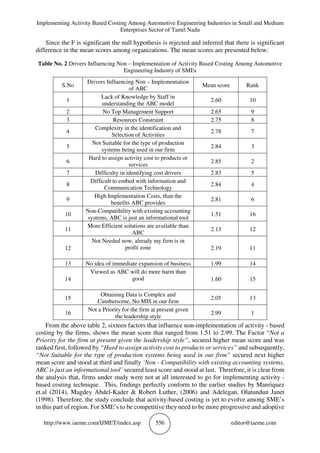
D = L1.X1 + L2.X2 + ……………….+ LK.XK, where Xi ‘s are predictor variables, Li’s
represents the discriminant coefficients, and D is the value of the discriminant function of a
particular individuals/element such that if this value is greater than a certain critical value D*=(D1
bar + D2 BAR)/2, the individual would be classified in group I ; otherwise the individual would
be classified in Group II.
In the present study there are two groups namely those firms with Lower overall score (Group
I n1=33), and firms with Higher overall score (Group II n2=67). Eight predictor variables were
considered for the analysis which includes, No of years of experience-X1, Years of existence of
the company-X2, Annual Turnover-X3, Business Classification-X4, Employment Structure-X5,
Degree of Competition-X6, Level of production-X7, and Range of products and service-X8.
Table 8.1 describes these as below:
Table No. 3 MEAN SCORE
Explanatory Variables
Firms with
Lower overall
score on current
costing practices
used (n1=33)
Higher overall
score on current
costing practices
used (n2=67)
Experience of the Respondent -X1 1.88 1.96
Year of Existence of the Firm -X2 2.06 2.28
Annual Turnover- X3 1.73 1.70
Business Classification – X4 1.79 2.27
Employee Structure- X5 1.45 1.22
Competetion-X6 1.61 2.06
Level of Production -X7 1.76 2.12
Products & Services- X8 1.79 2.06
Implementing Activity Based Costing Among Automotive Engineering Industries in Small and Medium
Enterprises Sector of Tamil Nadu
http://www.iaeme.com/IJMET/index.asp 558 editor@iaeme.com
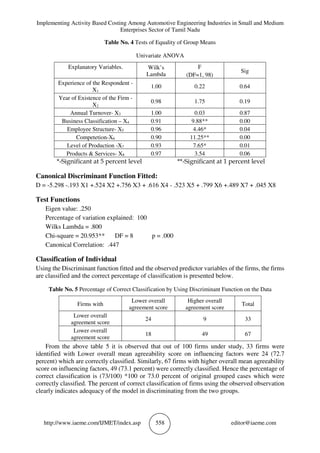
Table No. 4 Tests of Equality of Group Means
Univariate ANOVA
Explanatory Variables. Wilk’s
Lambda
F
(DF=1, 98)
Sig
Experience of the Respondent -
X1
1.00 0.22 0.64
Year of Existence of the Firm -
X2
0.98 1.75 0.19
Annual Turnover- X3 1.00 0.03 0.87
Business Classification – X4 0.91 9.88** 0.00
Employee Structure- X5 0.96 4.46* 0.04
Competetion-X6 0.90 11.25** 0.00
Level of Production -X7 0.93 7.65* 0.01
Products & Services- X8 0.97 3.54 0.06
*-Significant at 5 percent level **-Significant at 1 percent level
Canonical Discriminant Function Fitted:
D = -5.298 -.193 X1 +.524 X2 +.756 X3 + .616 X4 - .523 X5 + .799 X6 +.489 X7 + .045 X8
Test Functions
Eigen value: .250
Percentage of variation explained: 100
Wilks Lambda = .800
Chi-square = 20.953** DF = 8 p = .000
Canonical Correlation: .447
Classification of Individual
Using the Discriminant function fitted and the observed predictor variables of the firms, the firms
are classified and the correct percentage of classification is presented below.
Table No. 5 Percentage of Correct Classification by Using Discriminant Function on the Data
Firms with
Lower overall
agreement score
Higher overall
agreement score
Total
Lower overall
agreement score
24 9 33
Lower overall
agreement score
18 49 67
From the above table 5 it is observed that out of 100 firms under study, 33 firms were
identified with Lower overall mean agreeability score on influencing factors were 24 (72.7
percent) which are correctly classified. Similarly, 67 firms with higher overall mean agreeability
score on influencing factors, 49 (73.1 percent) were correctly classified. Hence the percentage of
correct classification is (73/100) *100 or 73.0 percent of original grouped cases which were
correctly classified. The percent of correct classification of firms using the observed observation
clearly indicates adequacy of the model in discriminating from the two groups.
CMA. Dr. C. Samuel Joseph, Dr. F.J. Peter Kumar and Dr. R. Magesh Kumar,
http://www.iaeme.com/IJMET/index.asp 559 editor@iaeme.com
5.3. Relative Importance of Predictor Variable in discriminating between groups
on current cost management practices
The relative importance of each predictor variables in discriminating from the two groups is
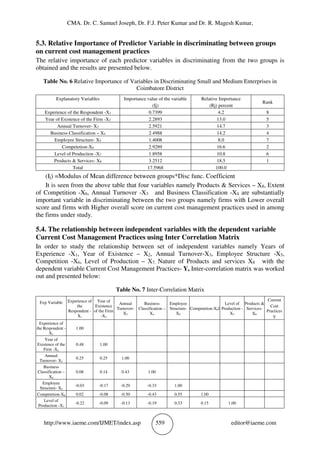
obtained and the results are presented below.
Table No. 6 Relative Importance of Variables in Discriminating Small and Medium Enterprises in
Coimbatore District
Explanatory Variables Importance value of the variable
(Ij)
Relative Importance
(Rj) percent
Rank
Experience of the Respondent -X1 0.7399 4.2 8
Year of Existence of the Firm -X2 2.2893 13.0 5
Annual Turnover- X3 2.5921 14.7 3
Business Classification – X4 2.4988 14.2 4
Employee Structure- X5 1.4008 8.0 7
Competetion-X6 2.9289 16.6 2
Level of Production -X7 1.8958 10.8 6
Products & Services- X8 3.2512 18.5 1
Total 17.5968 100.0
(Ij) =Modulus of Mean difference between groups*Disc func. Coefficient
It is seen from the above table that four variables namely Products & Services – X8, Extent
of Competition -X6, Annual Turnover -X3 and Business Classification -X4 are substantially
important variable in discriminating between the two groups namely firms with Lower overall
score and firms with Higher overall score on current cost management practices used in among
the firms under study.
5.4. The relationship between independent variables with the dependent variable
Current Cost Management Practices using Inter Correlation Matrix
In order to study the relationship between set of independent variables namely Years of
Experience -X1, Year of Existence – X2, Annual Turnover-X3, Employee Structure -X5,
Competition -X6, Level of Production – X7, Nature of Products and services X8 with the
dependent variable Current Cost Management Practices- Y, Inter-correlation matrix was worked
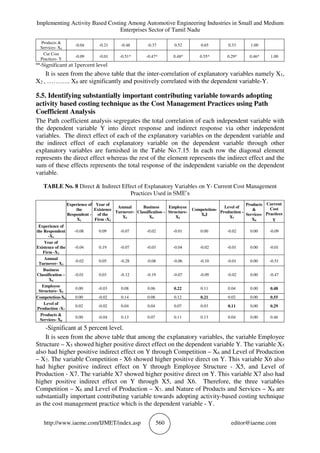
out and presented below:
Table No. 7 Inter-Correlation Matrix
Exp Variable Experience of
the
Respondent -
X1
Year of
Existence
of the Firm
-X2
Annual
Turnover-
X3
Business
Classification –
X4
Employee
Structure-
X5
Competetion-X6I
Level of
Production -
X7
Products &
Services-
X8
Current
Cost
Practices
Y
Experience of
the Respondent -
X1
1.00
Year of
Existence of the
Firm -X2
0.48 1.00
Annual
Turnover- X3
0.25 0.25 1.00
Business
Classification –
X4
0.08 0.14 0.43 1.00
Employee
Structure- X5
-0.03 -0.17 -0.29 -0.33 1.00
Competetion-X6 0.02 -0.08 -0.50 -0.43 0.55 1.00
Level of
Production -X7
-0.22 -0.09 -0.13 -0.19 0.33 0.15 1.00
Implementing Activity Based Costing Among Automotive Engineering Industries in Small and Medium
Enterprises Sector of Tamil Nadu
http://www.iaeme.com/IJMET/index.asp 560 editor@iaeme.com
Products &
Services- X8
-0.04 -0.21 -0.48 -0.37 0.52 0.65 0.33 1.00
Cur Cost
Practices- Y
-0.09 -0.01 -0.51* -0.47* 0.48* 0.55* 0.29* 0.46* 1.00
**-Significant at 1percent level
It is seen from the above table that the inter-correlation of explanatory variables namely X1,
X2 , ……….. X8 are significantly and positively correlated with the dependent variable-Y.
5.5. Identifying substantially important contributing variable towards adopting
activity based costing technique as the Cost Management Practices using Path
Coefficient Analysis
The Path coefficient analysis segregates the total correlation of each independent variable with
the dependent variable Y into direct response and indirect response via other independent
variables. The direct effect of each of the explanatory variables on the dependent variable and
the indirect effect of each explanatory variable on the dependent variable through other
explanatory variables are furnished in the Table No.7.15. In each row the diagonal element
represents the direct effect whereas the rest of the element represents the indirect effect and the
sum of these effects represents the total response of the independent variable on the dependent
variable.
TABLE No. 8 Direct & Indirect Effect of Explanatory Variables on Y- Current Cost Management
Practices Used in SME’s
Experience of
the
Respondent -
X1
Year of
Existence
of the
Firm -X2
Annual
Turnover-
X3
Business
Classification –
X4
Employee
Structure-
X5
Competetion-
X6I
Level of
Production -
X7
Products
&
Services-
X8
Current
Cost
Practices
Y
Experience of
the Respondent
-X1
-0.08 0.09 -0.07 -0.02 -0.01 0.00 -0.02 0.00 -0.09
Year of
Existence of the
Firm -X2
-0.04 0.19 -0.07 -0.03 -0.04 -0.02 -0.01 0.00 -0.01
Annual
Turnover- X3
-0.02 0.05 -0.28 -0.08 -0.06 -0.10 -0.01 0.00 -0.51
Business
Classification –
X4
-0.01 0.03 -0.12 -0.19 -0.07 -0.09 -0.02 0.00 -0.47
Employee
Structure- X5
0.00 -0.03 0.08 0.06 0.22 0.11 0.04 0.00 0.48
Competetion-X6 0.00 -0.02 0.14 0.08 0.12 0.21 0.02 0.00 0.55
Level of
Production -X7
0.02 -0.02 0.04 0.04 0.07 0.03 0.11 0.00 0.29
Products &
Services- X8
0.00 -0.04 0.13 0.07 0.11 0.13 0.04 0.00 0.46
-Significant at 5 percent level.
It is seen from the above table that among the explanatory variables, the variable Employee
Structure – X5 showed higher positive direct effect on the dependent variable Y. The variable X5
also had higher positive indirect effect on Y through Competition – X6 and Level of Production
– X7. The variable Competition - X6 showed higher positive direct on Y. This variable X6 also
had higher positive indirect effect on Y through Employee Structure - X5, and Level of
Production - X7. The variable X7 showed higher positive direct on Y. This variable X7 also had
higher positive indirect effect on Y through X5, and X6. Therefore, the three variables
Competition – X6 and Level of Production – X7. and Nature of Products and Services – X8 are
substantially important contributing variable towards adopting activity-based costing technique
as the cost management practice which is the dependent variable - Y.
CMA. Dr. C. Samuel Joseph, Dr. F.J. Peter Kumar and Dr. R. Magesh Kumar,
http://www.iaeme.com/IJMET/index.asp 561 editor@iaeme.com
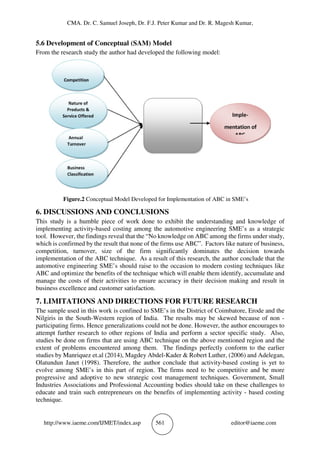
5.6 Development of Conceptual (SAM) Model
From the research study the author had developed the following model:
Figure.2 Conceptual Model Developed for Implementation of ABC in SME’s
6. DISCUSSIONS AND CONCLUSIONS
This study is a humble piece of work done to exhibit the understanding and knowledge of
implementing activity-based costing among the automotive engineering SME’s as a strategic
tool. However, the findings reveal that the “No knowledge on ABC among the firms under study,
which is confirmed by the result that none of the firms use ABC”. Factors like nature of business,
competition, turnover, size of the firm significantly dominates the decision towards
implementation of the ABC technique. As a result of this research, the author conclude that the
automotive engineering SME’s should raise to the occasion to modern costing techniques like
ABC and optimize the benefits of the technique which will enable them identify, accumulate and
manage the costs of their activities to ensure accuracy in their decision making and result in
business excellence and customer satisfaction.
7. LIMITATIONS AND DIRECTIONS FOR FUTURE RESEARCH
The sample used in this work is confined to SME’s in the District of Coimbatore, Erode and the
Nilgiris in the South-Western region of India. The results may be skewed because of non -
participating firms. Hence generalizations could not be done. However, the author encourages to
attempt further research to other regions of India and perform a sector specific study. Also,
studies be done on firms that are using ABC technique on the above mentioned region and the
extent of problems encountered among them. The findings perfectly conform to the earlier
studies by Manriquez et.al (2014), Magdey Abdel-Kader & Robert Luther, (2006) and Adelegan,
Olatundun Janet (1998). Therefore, the author conclude that activity-based costing is yet to
evolve among SME’s in this part of region. The firms need to be competitive and be more
progressive and adoptive to new strategic cost management techniques. Government, Small
Industries Associations and Professional Accounting bodies should take on these challenges to
educate and train such entrepreneurs on the benefits of implementing activity - based costing
technique.
Implementing Activity Based Costing Among Automotive Engineering Industries in Small and Medium
Enterprises Sector of Tamil Nadu
http://www.iaeme.com/IJMET/index.asp 562 editor@iaeme.com
REFERENCES
[1] Abdel‐Kader, M. and Luther, R. (2006). Management accounting practices in the British food
and drinks industry. British Food Journal, 108(5), pp.336-357.
[2] Abernethy, M., Chua, W., Luckett, P. and Selto, F. (1999). Research in managerial
accounting: Learning from others' experiences. Accounting and Finance, 39(1), pp.1-27.
[3] Alamdari, H. (2005). “Investigate the Use of Activity Based Costing in Small and Medium
Enterprises”. International Journal of Review in Life Sciences 5(5), 2015817-829..
[4] Berliner C., Brimson, J. Cost Management for Today’s Advanced Manufacturing. The CAM
– I Conceptual Design,. (1988). Harvard Business School Press,.
[5] Colwyn Jones, T. and Dugdale, D. (2002). The ABC bandwagon and the juggernaut of
modernity. Accounting, Organizations and Society, 27(1-2), pp.121-163.
[6] Factors affecting the establishment and development of quality costing in companies
producing consumer goods. (2013). Tehran Stock Exchange, Conference Manager,
Challenges and strategies, Shiraz..
[7] Fei, Z. and Isa, C. (2010). Factors Influencing Activity-Based Costing Success: A Research
Framework. International Journal of Trade, Economics and Finance, 1(2), pp.144-150.
[8] Fleischman, R. and Tyson, T. (1998). The Evolution of Standard Costing in the U.K. and
U.S.: From Decision Making to Control. Abacus, 34(1), pp.92-119.
[9] Gerdin, J. (2005). Management accounting system design in manufacturing departments: an
empirical investigation using a multiple contingencies approach. Accounting, Organizations
and Society, 30(2), pp.99-126.
[10] Ghosh, B. and Chan, Y. (1997). Management accounting in Singapore ‐ well in
place?. Managerial Auditing Journal, 12(1), pp.16-18.
[11] Gunasekaran, A., Marri, H. and Yusuf, Y. (1999). Application of activity‐based costing: some
case experiences. Managerial Auditing Journal, 14(6), pp.286-293.
[12] Hughes A (2005) ABC/ABM- activity based costing and activity based management: A
profitability model for SME’s manufacturing clothing and textiles in the UK. Journal of
Fashion marketing and Management, 9(1), 8.
[13] Hughes S and Gjerde K., Do different cost systems make a difference?. (2003). Management
Accounting Quarterly 5(1), 22..
[14] Ittner and Larcker (2001). “Assessing Empirical Research in Managerial Accounting: A
Value Based Management Perspective” SSRN Electronic Journal 32(1), 349-410.
[15] Jin,Y & Hong.P (2007). “Coordinating global inter-firm product development. Journal of
Enterprise Information Management, 20(5), 544.
[16] John C. Lere. (2000). Activity based costing is a powerful tool for pricing. the journal of
Business & Industrial marketing,, 15(1).
[17] Joseph & Samuel (2017), “Antecedents of Cost Management and Operational Dimensions: A
Perspective Study Among select MSME”s in Coimbatore District, Tamil Nadu” Asian
Journal of Research in Business Economics and Management 7(4), 14-24.
[18] Maelah. R & Ibrahim D. (2007). Factors influencing activity -based costing adoption in
manufacturing industry. Investment Management and Financial Innovations, 4(2), 113-148.
[19] Management Accounting Practices in Nigerian Companies. (2001). [online] Available at:
https://www.scribd.com/document/43873767/Preview [Accessed 7 May 2018].
[20] Mario Joao Cardoso Vieira Machado. (2012), Activity Based Costing Knowledge: Empirical
study on small and medium size enterprises, Contemporary Journal of Accounting, 9(18)
pg167-186.
[21] Owen P. Hall, Jr. Charles J.McPeak, (2011) “Are SME’s ready for ABC?” Journal of
Accounting and Finance 11(4), 11-22.
CMA. Dr. C. Samuel Joseph, Dr. F.J. Peter Kumar and Dr. R. Magesh Kumar,
http://www.iaeme.com/IJMET/index.asp 563 editor@iaeme.com
[22] Siu Y. Chan and Dominica Suk-Yee lee. (2003). An empirical investigation of symptoms of
obsolete costing systems and overhead cost structure”,. Managerial Auditing, 18(2).
[23] The diffusion of Management Accounting systems in manufacturing companies: an empirical
analysis of Italian firms. (2010). Studies in Managerial and Financial Accounting, 20 457-
499..
[24] Walker, C. and L’abbe Wu, N. (2000). Systematic approach to activity based costing of the
production planning activity in the book manufacturing industry. International Journal of
Operations & Production Management, 20(1), pp.103-115.
[25] Wien Hsien Tsaiin. (1998). Quality cost management under Activity Based
Costing.international journal of quality and reliability management, 15(7).
[26] Aydın Gersil and Cevdet Kayal, A Comparative Analysis of Normal Costing Method with
Full Costing and Variable Costing in Internal Reporting. International Journal of
Management, 7(3), 2016, pp. 79–92.
[27] Mohd I. Elnaeim, Mohd Salman Leong, and M S Somia Alfatih, Life Cycle Costing In
Engineering Asset Management: A Study In The Steel Fabrication Industry, International
Journal of Mechanical Engineering and Technology, 8(6), 2017, pp. 348-359.

Ijmet 10 01_057

  • 1.
    http://www.iaeme.com/IJMET/index.asp 550 editor@iaeme.com InternationalJournal of Mechanical Engineering and Technology (IJMET) Volume 10, Issue 01, January 2019, pp. 550–563, Article ID: IJMET_10_01_057 Available online at http://www.iaeme.com/ijmet/issues.asp?JType=IJMET&VType=10&IType=01 ISSN Print: 0976-6340 and ISSN Online: 0976-6359 © IAEME Publication Scopus Indexed IMPLEMENTING ACTIVITY BASED COSTING AMONG AUTOMOTIVE ENGINEERING INDUSTRIES IN SMALL AND MEDIUM ENTERPRISES SECTOR OF TAMIL NADU CMA. Dr. C. Samuel Joseph Professor & Head, Department of Commerce, School of Sciences, Arts, Media and Management, Karunya Institute of Technology and Sciences, Coimbatore, Tamil Nadu, India Dr. F.J. Peter Kumar Associate Professor, Department of Management Studies, School of Sciences, Arts, Media and Management, Karunya Institute of Technology and Sciences, Coimbatore, Tamil Nadu, India Dr. R. Magesh Kumar Assistant Professor, Department of Management Studies, School of Sciences, Arts, Media and Management, Karunya Institute of Technology and Sciences, Coimbatore, Tamil Nadu, India ABSTRACT There has been a long time discussions on which costing systems are to adopted in the Indian Manufacturing Industries especially, the industries involved in Mechanical Process. Normally, it is understood that a lot many companies is in the Automotive Engineering Industry in the SME Sector are having their costing done in a traditional method without having much progress or knowledge in the new way in which costing is being done elsewhere. On surveying the literature, the author’s found a research gap that, implementation issues of ABC costing system by the Indian Automotive Engineering Industry of the SMEs need to be focused and studies need to be entertained. This study assumes significance due to high prevalence of SME’s, with significant concentration of automotive engineering industries, which confers a huge relevance to a study of this sort to make concrete suggestions. Key Words: Activity Based Costing, Quality, Customer, SME, Products and Services, Business Classification, Management Accounting, Management Process, Competitor Analysis, Traditional Costing, Financial and Non-Financial Metrics, Business Excellence, Cost of Quality, Production. Cite this Article: CMA. Dr. C. Samuel Joseph, Dr. F.J. Peter Kumar and Dr. R. Magesh Kumar, Implementing Activity Based Costing Among Automotive Engineering Industries in Small and Medium Enterprises Sector of Tamil Nadu, International Journal of Mechanical Engineering and Technology, 10(01), 2019, pp.550–563 http://www.iaeme.com/IJMET/issues.asp?JType=IJMET&VType=10&Type=01
  • 2.
    CMA. Dr. C.Samuel Joseph, Dr. F.J. Peter Kumar and Dr. R. Magesh Kumar, http://www.iaeme.com/IJMET/index.asp 551 editor@iaeme.com 1. INTRODUCTION Management Accounting is an activity that is interwoven in the management process of all organizations. It refers to that part of the management process which is focused on adding value to organizations by attaining the effective use of resources by people, in dynamic and competitive context. It involves distinctive modes of thoughts and practice. Management Accounting is the process of identifying, measuring, reporting and analyzing information about economic events of organization. The process should be ambitious by the informational needs of individuals internal to the organization and should lead their operating and investment decisions. (Robert Kaplan, 1980) in his review of The Evolution of Management Accounting, and with (Johnson, 1991) in the Relevance Lost: The Rise and Fall of Management Accounting leveled strong criticism at the management accounting practices of the day. Since then a number of innovative management accounting techniques have been developed across a range of industries and publicized internationally. Among other things, the most notable innovations are Activity Based Techniques, (including activity-based costing, activity-based budgeting and activity based management). This technique has been designed to support modern technologies and management processes, such as total quality management, just-in-time production systems, and the search for a competitive advantage to meet the challenge of global competition. As firms adapt to these technological and management developments, they must design a management accounting system congruent with the new requirements (Gerdin, 2005). It has been argued that these new techniques have affected the whole process of planning, controlling, decision-making and communication of management accounting. (Ittner and Larcker, 2001; Kaplan and Atkinson, 1998; Otley, 1995; Fullerton and McWatters, 2002; Hoque and Mia, 2001). These techniques have shifted its focus from a simple role of cost determination and financial control, to a sophisticated role of creating value through improved deployment of resources. 1.1. Activity Based Costing – Conceptual Insights Activity Based Costing was first developed in the mid of 1980’s. Two different organizations significantly contributed to the development of the ABC process through two of its researchers, Robert Kaplan and Robin Cooper as well as an R&D organization called Computer –Aided Manufacturing, International (Jones, Dugdale, 2002). It is a discipline that focuses on the management of activities as the route to improving the value received by the customer and the profit achieved by providing this value (Cost Accounting Management – International (CAM – I). Activity Based Costing refines the costing system by focusing on individual activities as the fundamental cost objects. ABC system calculate the cost of individual activities and assign costs to cost objects such as products and services on the basis of the activities undertaken to produce each product or service. Activity Based Management as a discipline draws on activity-based costing as its major source of information (Berliner and Brimson, 1988) which includes cost drivers analysis, activity analysis and performance measurements, to improve the decision- making processes. This involves continual search for opportunities to improve which in turn involves a careful and methodical study of activities (Kaplan, 1984) Therefore, ABC is a technique that assigns costs to activities and services that are based on the amount consumed. It helps administrators manage costs, a tool for linking costs and results, action required for the production and delivery of specific results (Balalaie Somee Saraye et al., 2013)
  • 3.
    Implementing Activity BasedCosting Among Automotive Engineering Industries in Small and Medium Enterprises Sector of Tamil Nadu http://www.iaeme.com/IJMET/index.asp 552 editor@iaeme.com 1.2. Rationale of the Study There has been a strong criticism in the recent past that the Indian corporate, viz., Small and Medium Enterprises in general and Automotive Engineering Industries under SME’s in particular, have not been able to adapt recent management accounting practices to changing business scenario coupled with technological advancements in tune with the dynamics of production and operating activities. In spite of the Governments initiative SME’s have less well developed management systems and were not as good at meeting financial targets using appropriate non-financial indicators, and were less likely to benchmark their results. However, the literature claims that most of these criticisms are true but not supported by extensive systematic study as evidenced, and it varies across countries. SME’s may take practical steps to implement desirable growth paths through management practices that utilize appropriate intra and inter organizational capabilities (Jin, 2007). Therefore, more specifically ABC could assist SME’s in Automotive Engineering in enhancing efficiency and innovation through improved pricing and better planning. These SME’s in the Indian context predominantly use traditional costing methods (Joseph & Samuel, 2017). Further, Under Traditional Cost Accounting the organization lacks the ability to evaluate the internal efficiency, quality and profitability per product or service line (Narong, 2009). Even today, over 20 years since ABC was first introduced a majority of firm still employ traditional accounting methods (Fei, 2010; Maelah, 2007; Hughes.S., 2003). In SME’s adoption of ABC has been even slower (Carenzo, 2010; Hughes, A, 2005). SME’s may take practical steps to implement desirable growth paths through management practices that utilize appropriate intra and inter organizational capabilities (Jin, 2007). Therefore, more specifically ABC could assist SME’s in enhancing efficiency and innovation through improved pricing and better planning. Further, this study assumes significance as it focuses on Coimbatore District, in the State of Tamil Nadu (located in the down South –Western region in the Indian Map) due to high prevalence of SME’s, which confers a huge relevance to a study of this sort to make concrete suggestions. 1.3. Conceptual Framework of Activity Based Costing A Conceptual framework is evolved to highlight to optimize the full benefits of ABC/ABM. Figure.1 Conceptual Framework for ABC/ABM
  • 4.
    CMA. Dr. C.Samuel Joseph, Dr. F.J. Peter Kumar and Dr. R. Magesh Kumar, http://www.iaeme.com/IJMET/index.asp 553 editor@iaeme.com 2. LITERATURE REVIEW A significant body of research has been published in the field of management accounting practices by Chenhall and Langfield-Smith (1998), Ghosh and Chan (1997) Guidling, Lamminmaki, and Drury, (1998), Wijewardena and Zoysa (1999), Mendoza and Bescos (2002) Magdy Abdel-Kader and Robert Luther, (2006). These studies report on the use of various management accounting techniques in different countries and industries. In a bid to support such changes in the operating environment, management accounting practice in many developed countries has introduced new cost and management accounting systems (Innes and Mitchell, 1990; Peasnell, 1993; Libby Waterhouse, 1996; Vaivio, 1999; Gray et.al., 2001; Haldma and Laats, 2002; Hoque, 2003). However, there is little research on the adoption of these practices in developing countries, (Wallace, 1990, Hoque and Hopper, 1994, 1997; Anderson and Lanen `1999; Narayan et al., 2000; Abdul –Rahman and Lawrence, 2001; Luther and longden, 2001 ;) in this context significant research studies have been reviewed and revisited 2.1. Reviews on Use of Traditional Costing (Lyall, 1990) found that of the 423 companies that they surveyed 76 percent claimed that they used traditional costing. (Joshi, 2001) specified that in India, 68 percent of the 60 firms surveyed still use traditional costing techniques. (Drury, 1993) reported 73 percent of the respondents using traditional costing. (Ghosh, 1987) found that 47 percent of the companies surveyed used the traditional costing system in Singapore. (Asquer, 2003) explains that “many state of the art technologies use a range of tools to assess operational efficiency and the achievement of organization goals. Yet many firms are far from adopting most of these innovations.” (Mann et al. 1999) conducted an investigation of the “best practices” employed by nine companies that scored well in the Business excellence model and concluded that the industry needs to be more progressive and more willing to learn and apply new methods. (Magdy Abdel-Kader and Robert Luther, 2006) had investigated and reported on the management accounting practices in the British food and drinks Industry, concludes that direct costing is widely practiced and important by contrast with activity-based costing. (Adelegan, Olatundun Janet, 1998) in her study concludes that management accounting in Nigeria is still evolving and will continue to do so in the future. 2.2. Reviews on Use of Strategic Cost Management Techniques (Andrew Hughes, 2011), Activity based costing helps business in understanding its business processes in detail, the cost of process failures, the relationship of processes to customers, the profitability of customer segments and the affordable amount that can be spent on influencing the preferred customer groups. Gunasekaran, et al. (1999) have suggested to shift for ABC under the following criteria that is timing, implementation, the factors against the implementation of ABC and conditions favouring the applications of ABC. (Wien Hsien Tsaiin 1998), ABC uses nested activity centres to create a multi-tier COQ reporting system to meet various management’s information needs and to support COQ responsibility accounting. (Curtis Walker et al.2000) concludes that, the manufacturing industry can now effectively apply a cost to activities of the planning process for each individual job as a direct cost, rather than an indirect cost. Studies on Activity Based costing methodology for SME’s in different sectors has been published on firms such as printing firms (Mendiola and Peralta, 1999), Metal Aluminium and ironwork structures (Flores, 2002), polyvinyl chloride industry (Ruiz, 2003), Mexican logistics sector (Prieto et.al 2007). To compete in a highly competitive market, companies must implement a costing system strong for their ability to respond to any changes in the products and activities (Kazempour, 2011). New costing methods for improving cost management systems have been created, these methods are not only used for accounting, but also for management as a decision- making (Bogdanoiu, 2009)
  • 5.
    Implementing Activity BasedCosting Among Automotive Engineering Industries in Small and Medium Enterprises Sector of Tamil Nadu http://www.iaeme.com/IJMET/index.asp 554 editor@iaeme.com 2.3. Reviews on Small and Medium Enterprises (Gecevska and anisic 2006) investigated the use of small and medium enterprises engaged in the activity based costing transitioning from traditional costing system. (Husin and Ibrahim, 2014) examined the role of accounting services and its impact on the performance of SME’s and concludes that there is a relationship between service quality and performance of SME’s accounting services. (Manriquez et al., 2014) examined the activity based pricing system for SME’s in Mexico and the results indicate low penetration of ABC and SME’s are still using traditional systems because of lack of knowledge. (Carnes, 2010), says Many firms that have adopted ABC have found it challenging to maintain the system, as a result of these challenges a modified ABC approach called Time Driven ABC (TDABC) was introduced (Kaplan, 2007). (Ayvez, 2011; Sherratt, 2005), advantages of TDABC when compared to traditional ABC are lower processing costs, increased system flexibility, improved accuracy and enhanced simplicity This is especially important to SME’s with their more limited resource base and margins of decision errors (Cardinaels, 2004) 2.4. Research Gap Identified The Study have extensively done literature survey in the area of ABC Techniques applied in Industries and identified that a very few study is conducted in the area of ABC Technique being used in SMEs especially in the Automotive Engineering Industry. This motivated the author’s to embark and develop a model for effective implementation of ABC applications in the Automotive Engineering Industry of the SME Sector. 3. OBJECTIVES OF THE STUDY On identifying the research gap from an intensive survey of literature, the Study have set the following Objectives for the Analysis on the Implementation of Activity Based Costing in the Automotive Engineering Industry of the SMEs in the South-Western India. 1. To Identify the factors influencing the Non-implementation of Activity Based Costing in the Automotive Engineering Industry of the SMEs in the South-Western India 2. To study the Awareness of Activity Based Costing among the Persons responsible for determining the costing system in the Organisation. 3. To analyse the relative importance of Predictor Variable in discriminating between groups on current cost management practices 4. To find substantially important contributing variable towards adopting activity based costing technique as the Cost Management Practices 4. RESEARCH METHODOLOGY Based on a thorough review of existing literature, the study ensured that the data that was planned to be collected was compatible with the objectives of the study. The following research questions were formulated. I. What are the variables that discriminates Automotive Engineering in SME’s from implementing activity based costing? II. Is there a functional relationship between current cost management practices and the demography of the Automotive Engineering SME’s? Considering the research objectives, that is to Infer the relative importance of variables that discriminates SME’s from implementing Activity Based Costing and to establish a functional relationship among current cost management practices and Profile of the SME’s, the study, opted to adopt interview method of data collection, because, the study could explain the nature of questions in the interview schedule to the respondents, thus generating a greater reliability on the
  • 6.
    CMA. Dr. C.Samuel Joseph, Dr. F.J. Peter Kumar and Dr. R. Magesh Kumar, http://www.iaeme.com/IJMET/index.asp 555 editor@iaeme.com data sourced. Further, this method would facilitate the author to gather most diversified data and understand how Indian SME’s optimize basic cost management practices. The interview has been conducted solely with the person responsible for accounting who are supposed to have reasonable knowledge in participating such interviews of this kind. Thus, the data captured were quantified to understand the behavior of SME’s in this region The Survey is based on the source list with reference to the SME’s registered with Coimbatore District Small Scale Industries Association (CODISSIA) an official organ of the SME’s in Coimbatore, Erode and the Nilgiris District. Automotive engineering is a study of engineering which includes mechanical, electrical, electronic and safety engineering for manufacturing, designing, mechanical systems and operation of automobiles as well. The study included the companies that were engaged in manufacturing or designing or production of automobile components and assembling. Scheduled/Unscheduled meetings were done in four phases, were the author managed to meet with 165 companies. The interviews were performed with people responsible for the cost management. However, out of which 165 contacted, the author could succeed with the response rate of only 60 per cent which was compatible to the reviews of literature. (Abernethy et.al 1999) concludes that regardless of the research method used, to generalize something based solely on a single research paper is necessarily limited and therefore untrustworthy. (Mario Joao Cardoso Vieira Machado, 2012) in their study believes that generalizing in managerial accounting has to be achieved through a series of consecutive studies with new samples, different places and time periods. 5. FINDINGS AND RESULTS With reference to the research question (i) the analyzed data concludes that No SME’s uses the activity - based costing method, which needs a special look out by the Industry association (CODISSIA). On analyzing the question (ii) for the variable awareness of activity - based costing among the persons responsible for accounting. The results detail that the 100 per cent are not aware of the ABC. This confirms the result of Q.No. (i) 5.1 Factors Influencing Non – Implementation of Activity Based Costing among Automotive Engineering Industry of SME’s using Mean and ANOVA To estimate and compare the mean score on factor influencing non – implementation of activity- based costing by the firms, weighted average analysis is performed using three rating score by assigning 3 for to great extent; 2 for Good; 1 for not at all and the results are presented in the following tables. H0: There is no significant difference in the mean scores on the factors influencing non- implementation of activity based costing among Automotive Engineering Industry of SMEs. Ha: There is significant difference in the mean scores on the factors influencing non- implementation of activity based costing among Automotive Engineering Industry of SMEs. Table No. 1 Analysis of Relationship on the Factors Influencing Non – Implementation of Activity Based Costing SOURCE DF S S M S F Between groups 15 343.614 22.907 96.45** Within groups 1584 376.210 0.237 **- Significant at 1 percent level
  • 7.
    Implementing Activity BasedCosting Among Automotive Engineering Industries in Small and Medium Enterprises Sector of Tamil Nadu http://www.iaeme.com/IJMET/index.asp 556 editor@iaeme.com Since the F is significant the null hypothesis is rejected and inferred that there is significant difference in the mean scores among organizations. The mean scores are presented below: Table No. 2 Drivers Influencing Non – Implementation of Activity Based Costing Among Automotive Engineering Industry of SMEs S.No Drivers Influencing Non – Implementation of ABC Mean score Rank 1 Lack of Knowledge by Staff in understanding the ABC model 2.60 10 2 No Top Management Support 2.65 9 3 Resources Constraint 2.75 8 4 Complexity in the identification and Selection of Activities 2.78 7 5 Not Suitable for the type of production systems being used in our firm 2.84 3 6 Hard to assign activity cost to products or services 2.85 2 7 Difficulty in identifying cost drivers 2.83 5 8 Difficult to embed with information and Communication Technology 2.84 4 9 High Implementation Costs, than the benefits ABC provides 2.81 6 10 Non-Compatibility with existing accounting systems, ABC is just an informational tool 1.51 16 11 More Efficient solutions are available than ABC 2.13 12 12 Not Needed now, already my firm is in profit zone 2.19 11 13 No idea of immediate expansion of business 1.99 14 14 Viewed as ABC will do more harm than good 1.60 15 15 Obtaining Data is Complex and Cumbersome, No MIS in our firm 2.05 13 16 Not a Priority for the firm at present given the leadership style 2.99 1 From the above table 2, sixteen factors that influence non-implementation of activity - based costing by the firms, shows the mean score that ranged from 1.51 to 2.99. The Factor “Not a Priority for the firm at present given the leadership style”, secured higher mean score and was ranked first, followed by “Hard to assign activity cost to products or services” and subsequently, “Not Suitable for the type of production systems being used in our firm” secured next higher mean score and stood at third and finally ‘Non - Compatibility with existing accounting systems, ABC is just an informational tool’ secured least score and stood at last. Therefore, it is clear from the analysis that, firms under study were not at all interested to go for implementing activity - based costing technique. This, findings perfectly conform to the earlier studies by Manriquez et.al (2014), Magdey Abdel-Kader & Robert Luther, (2006) and Adelegan, Olatundun Janet (1998). Therefore, the study conclude that activity-based costing is yet to evolve among SME’s in this part of region. For SME’s to be competitive they need to be more progressive and adoptive
  • 8.
    CMA. Dr. C.Samuel Joseph, Dr. F.J. Peter Kumar and Dr. R. Magesh Kumar, http://www.iaeme.com/IJMET/index.asp 557 editor@iaeme.com to new strategic cost management techniques. Government, Small Industries Associations and Professional Accounting bodies should take on these challenges forward to educate and train such entrepreneurs in the Automotive Engineering Industry of SME’s on the benefits of implementing activity - based costing technique. 5.2. Classification of Firms using Discriminant Analysis Discriminant analysis is a statistical technique which allows to study the differences from two or more groups with respect to several variables simultaneously and provide a means of classifying any object/individual into the group with which it is most closely associated and to infer the relative importance of each variable used to discriminate from different groups. A linear combination of predictor variables, weighted in such a way that it will best discriminate among groups with the least error is called a linear discriminant function and is given by: D = L1.X1 + L2.X2 + ……………….+ LK.XK, where Xi ‘s are predictor variables, Li’s represents the discriminant coefficients, and D is the value of the discriminant function of a particular individuals/element such that if this value is greater than a certain critical value D*=(D1 bar + D2 BAR)/2, the individual would be classified in group I ; otherwise the individual would be classified in Group II. In the present study there are two groups namely those firms with Lower overall score (Group I n1=33), and firms with Higher overall score (Group II n2=67). Eight predictor variables were considered for the analysis which includes, No of years of experience-X1, Years of existence of the company-X2, Annual Turnover-X3, Business Classification-X4, Employment Structure-X5, Degree of Competition-X6, Level of production-X7, and Range of products and service-X8. Table 8.1 describes these as below: Table No. 3 MEAN SCORE Explanatory Variables Firms with Lower overall score on current costing practices used (n1=33) Higher overall score on current costing practices used (n2=67) Experience of the Respondent -X1 1.88 1.96 Year of Existence of the Firm -X2 2.06 2.28 Annual Turnover- X3 1.73 1.70 Business Classification – X4 1.79 2.27 Employee Structure- X5 1.45 1.22 Competetion-X6 1.61 2.06 Level of Production -X7 1.76 2.12 Products & Services- X8 1.79 2.06
  • 9.
    Implementing Activity BasedCosting Among Automotive Engineering Industries in Small and Medium Enterprises Sector of Tamil Nadu http://www.iaeme.com/IJMET/index.asp 558 editor@iaeme.com Table No. 4 Tests of Equality of Group Means Univariate ANOVA Explanatory Variables. Wilk’s Lambda F (DF=1, 98) Sig Experience of the Respondent - X1 1.00 0.22 0.64 Year of Existence of the Firm - X2 0.98 1.75 0.19 Annual Turnover- X3 1.00 0.03 0.87 Business Classification – X4 0.91 9.88** 0.00 Employee Structure- X5 0.96 4.46* 0.04 Competetion-X6 0.90 11.25** 0.00 Level of Production -X7 0.93 7.65* 0.01 Products & Services- X8 0.97 3.54 0.06 *-Significant at 5 percent level **-Significant at 1 percent level Canonical Discriminant Function Fitted: D = -5.298 -.193 X1 +.524 X2 +.756 X3 + .616 X4 - .523 X5 + .799 X6 +.489 X7 + .045 X8 Test Functions Eigen value: .250 Percentage of variation explained: 100 Wilks Lambda = .800 Chi-square = 20.953** DF = 8 p = .000 Canonical Correlation: .447 Classification of Individual Using the Discriminant function fitted and the observed predictor variables of the firms, the firms are classified and the correct percentage of classification is presented below. Table No. 5 Percentage of Correct Classification by Using Discriminant Function on the Data Firms with Lower overall agreement score Higher overall agreement score Total Lower overall agreement score 24 9 33 Lower overall agreement score 18 49 67 From the above table 5 it is observed that out of 100 firms under study, 33 firms were identified with Lower overall mean agreeability score on influencing factors were 24 (72.7 percent) which are correctly classified. Similarly, 67 firms with higher overall mean agreeability score on influencing factors, 49 (73.1 percent) were correctly classified. Hence the percentage of correct classification is (73/100) *100 or 73.0 percent of original grouped cases which were correctly classified. The percent of correct classification of firms using the observed observation clearly indicates adequacy of the model in discriminating from the two groups.
  • 10.
    CMA. Dr. C.Samuel Joseph, Dr. F.J. Peter Kumar and Dr. R. Magesh Kumar, http://www.iaeme.com/IJMET/index.asp 559 editor@iaeme.com 5.3. Relative Importance of Predictor Variable in discriminating between groups on current cost management practices The relative importance of each predictor variables in discriminating from the two groups is obtained and the results are presented below. Table No. 6 Relative Importance of Variables in Discriminating Small and Medium Enterprises in Coimbatore District Explanatory Variables Importance value of the variable (Ij) Relative Importance (Rj) percent Rank Experience of the Respondent -X1 0.7399 4.2 8 Year of Existence of the Firm -X2 2.2893 13.0 5 Annual Turnover- X3 2.5921 14.7 3 Business Classification – X4 2.4988 14.2 4 Employee Structure- X5 1.4008 8.0 7 Competetion-X6 2.9289 16.6 2 Level of Production -X7 1.8958 10.8 6 Products & Services- X8 3.2512 18.5 1 Total 17.5968 100.0 (Ij) =Modulus of Mean difference between groups*Disc func. Coefficient It is seen from the above table that four variables namely Products & Services – X8, Extent of Competition -X6, Annual Turnover -X3 and Business Classification -X4 are substantially important variable in discriminating between the two groups namely firms with Lower overall score and firms with Higher overall score on current cost management practices used in among the firms under study. 5.4. The relationship between independent variables with the dependent variable Current Cost Management Practices using Inter Correlation Matrix In order to study the relationship between set of independent variables namely Years of Experience -X1, Year of Existence – X2, Annual Turnover-X3, Employee Structure -X5, Competition -X6, Level of Production – X7, Nature of Products and services X8 with the dependent variable Current Cost Management Practices- Y, Inter-correlation matrix was worked out and presented below: Table No. 7 Inter-Correlation Matrix Exp Variable Experience of the Respondent - X1 Year of Existence of the Firm -X2 Annual Turnover- X3 Business Classification – X4 Employee Structure- X5 Competetion-X6I Level of Production - X7 Products & Services- X8 Current Cost Practices Y Experience of the Respondent - X1 1.00 Year of Existence of the Firm -X2 0.48 1.00 Annual Turnover- X3 0.25 0.25 1.00 Business Classification – X4 0.08 0.14 0.43 1.00 Employee Structure- X5 -0.03 -0.17 -0.29 -0.33 1.00 Competetion-X6 0.02 -0.08 -0.50 -0.43 0.55 1.00 Level of Production -X7 -0.22 -0.09 -0.13 -0.19 0.33 0.15 1.00
  • 11.
    Implementing Activity BasedCosting Among Automotive Engineering Industries in Small and Medium Enterprises Sector of Tamil Nadu http://www.iaeme.com/IJMET/index.asp 560 editor@iaeme.com Products & Services- X8 -0.04 -0.21 -0.48 -0.37 0.52 0.65 0.33 1.00 Cur Cost Practices- Y -0.09 -0.01 -0.51* -0.47* 0.48* 0.55* 0.29* 0.46* 1.00 **-Significant at 1percent level It is seen from the above table that the inter-correlation of explanatory variables namely X1, X2 , ……….. X8 are significantly and positively correlated with the dependent variable-Y. 5.5. Identifying substantially important contributing variable towards adopting activity based costing technique as the Cost Management Practices using Path Coefficient Analysis The Path coefficient analysis segregates the total correlation of each independent variable with the dependent variable Y into direct response and indirect response via other independent variables. The direct effect of each of the explanatory variables on the dependent variable and the indirect effect of each explanatory variable on the dependent variable through other explanatory variables are furnished in the Table No.7.15. In each row the diagonal element represents the direct effect whereas the rest of the element represents the indirect effect and the sum of these effects represents the total response of the independent variable on the dependent variable. TABLE No. 8 Direct & Indirect Effect of Explanatory Variables on Y- Current Cost Management Practices Used in SME’s Experience of the Respondent - X1 Year of Existence of the Firm -X2 Annual Turnover- X3 Business Classification – X4 Employee Structure- X5 Competetion- X6I Level of Production - X7 Products & Services- X8 Current Cost Practices Y Experience of the Respondent -X1 -0.08 0.09 -0.07 -0.02 -0.01 0.00 -0.02 0.00 -0.09 Year of Existence of the Firm -X2 -0.04 0.19 -0.07 -0.03 -0.04 -0.02 -0.01 0.00 -0.01 Annual Turnover- X3 -0.02 0.05 -0.28 -0.08 -0.06 -0.10 -0.01 0.00 -0.51 Business Classification – X4 -0.01 0.03 -0.12 -0.19 -0.07 -0.09 -0.02 0.00 -0.47 Employee Structure- X5 0.00 -0.03 0.08 0.06 0.22 0.11 0.04 0.00 0.48 Competetion-X6 0.00 -0.02 0.14 0.08 0.12 0.21 0.02 0.00 0.55 Level of Production -X7 0.02 -0.02 0.04 0.04 0.07 0.03 0.11 0.00 0.29 Products & Services- X8 0.00 -0.04 0.13 0.07 0.11 0.13 0.04 0.00 0.46 -Significant at 5 percent level. It is seen from the above table that among the explanatory variables, the variable Employee Structure – X5 showed higher positive direct effect on the dependent variable Y. The variable X5 also had higher positive indirect effect on Y through Competition – X6 and Level of Production – X7. The variable Competition - X6 showed higher positive direct on Y. This variable X6 also had higher positive indirect effect on Y through Employee Structure - X5, and Level of Production - X7. The variable X7 showed higher positive direct on Y. This variable X7 also had higher positive indirect effect on Y through X5, and X6. Therefore, the three variables Competition – X6 and Level of Production – X7. and Nature of Products and Services – X8 are substantially important contributing variable towards adopting activity-based costing technique as the cost management practice which is the dependent variable - Y.
  • 12.
    CMA. Dr. C.Samuel Joseph, Dr. F.J. Peter Kumar and Dr. R. Magesh Kumar, http://www.iaeme.com/IJMET/index.asp 561 editor@iaeme.com 5.6 Development of Conceptual (SAM) Model From the research study the author had developed the following model: Figure.2 Conceptual Model Developed for Implementation of ABC in SME’s 6. DISCUSSIONS AND CONCLUSIONS This study is a humble piece of work done to exhibit the understanding and knowledge of implementing activity-based costing among the automotive engineering SME’s as a strategic tool. However, the findings reveal that the “No knowledge on ABC among the firms under study, which is confirmed by the result that none of the firms use ABC”. Factors like nature of business, competition, turnover, size of the firm significantly dominates the decision towards implementation of the ABC technique. As a result of this research, the author conclude that the automotive engineering SME’s should raise to the occasion to modern costing techniques like ABC and optimize the benefits of the technique which will enable them identify, accumulate and manage the costs of their activities to ensure accuracy in their decision making and result in business excellence and customer satisfaction. 7. LIMITATIONS AND DIRECTIONS FOR FUTURE RESEARCH The sample used in this work is confined to SME’s in the District of Coimbatore, Erode and the Nilgiris in the South-Western region of India. The results may be skewed because of non - participating firms. Hence generalizations could not be done. However, the author encourages to attempt further research to other regions of India and perform a sector specific study. Also, studies be done on firms that are using ABC technique on the above mentioned region and the extent of problems encountered among them. The findings perfectly conform to the earlier studies by Manriquez et.al (2014), Magdey Abdel-Kader & Robert Luther, (2006) and Adelegan, Olatundun Janet (1998). Therefore, the author conclude that activity-based costing is yet to evolve among SME’s in this part of region. The firms need to be competitive and be more progressive and adoptive to new strategic cost management techniques. Government, Small Industries Associations and Professional Accounting bodies should take on these challenges to educate and train such entrepreneurs on the benefits of implementing activity - based costing technique.
  • 13.
    Implementing Activity BasedCosting Among Automotive Engineering Industries in Small and Medium Enterprises Sector of Tamil Nadu http://www.iaeme.com/IJMET/index.asp 562 editor@iaeme.com REFERENCES [1] Abdel‐Kader, M. and Luther, R. (2006). Management accounting practices in the British food and drinks industry. British Food Journal, 108(5), pp.336-357. [2] Abernethy, M., Chua, W., Luckett, P. and Selto, F. (1999). Research in managerial accounting: Learning from others' experiences. Accounting and Finance, 39(1), pp.1-27. [3] Alamdari, H. (2005). “Investigate the Use of Activity Based Costing in Small and Medium Enterprises”. International Journal of Review in Life Sciences 5(5), 2015817-829.. [4] Berliner C., Brimson, J. Cost Management for Today’s Advanced Manufacturing. The CAM – I Conceptual Design,. (1988). Harvard Business School Press,. [5] Colwyn Jones, T. and Dugdale, D. (2002). The ABC bandwagon and the juggernaut of modernity. Accounting, Organizations and Society, 27(1-2), pp.121-163. [6] Factors affecting the establishment and development of quality costing in companies producing consumer goods. (2013). Tehran Stock Exchange, Conference Manager, Challenges and strategies, Shiraz.. [7] Fei, Z. and Isa, C. (2010). Factors Influencing Activity-Based Costing Success: A Research Framework. International Journal of Trade, Economics and Finance, 1(2), pp.144-150. [8] Fleischman, R. and Tyson, T. (1998). The Evolution of Standard Costing in the U.K. and U.S.: From Decision Making to Control. Abacus, 34(1), pp.92-119. [9] Gerdin, J. (2005). Management accounting system design in manufacturing departments: an empirical investigation using a multiple contingencies approach. Accounting, Organizations and Society, 30(2), pp.99-126. [10] Ghosh, B. and Chan, Y. (1997). Management accounting in Singapore ‐ well in place?. Managerial Auditing Journal, 12(1), pp.16-18. [11] Gunasekaran, A., Marri, H. and Yusuf, Y. (1999). Application of activity‐based costing: some case experiences. Managerial Auditing Journal, 14(6), pp.286-293. [12] Hughes A (2005) ABC/ABM- activity based costing and activity based management: A profitability model for SME’s manufacturing clothing and textiles in the UK. Journal of Fashion marketing and Management, 9(1), 8. [13] Hughes S and Gjerde K., Do different cost systems make a difference?. (2003). Management Accounting Quarterly 5(1), 22.. [14] Ittner and Larcker (2001). “Assessing Empirical Research in Managerial Accounting: A Value Based Management Perspective” SSRN Electronic Journal 32(1), 349-410. [15] Jin,Y & Hong.P (2007). “Coordinating global inter-firm product development. Journal of Enterprise Information Management, 20(5), 544. [16] John C. Lere. (2000). Activity based costing is a powerful tool for pricing. the journal of Business & Industrial marketing,, 15(1). [17] Joseph & Samuel (2017), “Antecedents of Cost Management and Operational Dimensions: A Perspective Study Among select MSME”s in Coimbatore District, Tamil Nadu” Asian Journal of Research in Business Economics and Management 7(4), 14-24. [18] Maelah. R & Ibrahim D. (2007). Factors influencing activity -based costing adoption in manufacturing industry. Investment Management and Financial Innovations, 4(2), 113-148. [19] Management Accounting Practices in Nigerian Companies. (2001). [online] Available at: https://www.scribd.com/document/43873767/Preview [Accessed 7 May 2018]. [20] Mario Joao Cardoso Vieira Machado. (2012), Activity Based Costing Knowledge: Empirical study on small and medium size enterprises, Contemporary Journal of Accounting, 9(18) pg167-186. [21] Owen P. Hall, Jr. Charles J.McPeak, (2011) “Are SME’s ready for ABC?” Journal of Accounting and Finance 11(4), 11-22.
  • 14.
    CMA. Dr. C.Samuel Joseph, Dr. F.J. Peter Kumar and Dr. R. Magesh Kumar, http://www.iaeme.com/IJMET/index.asp 563 editor@iaeme.com [22] Siu Y. Chan and Dominica Suk-Yee lee. (2003). An empirical investigation of symptoms of obsolete costing systems and overhead cost structure”,. Managerial Auditing, 18(2). [23] The diffusion of Management Accounting systems in manufacturing companies: an empirical analysis of Italian firms. (2010). Studies in Managerial and Financial Accounting, 20 457- 499.. [24] Walker, C. and L’abbe Wu, N. (2000). Systematic approach to activity based costing of the production planning activity in the book manufacturing industry. International Journal of Operations & Production Management, 20(1), pp.103-115. [25] Wien Hsien Tsaiin. (1998). Quality cost management under Activity Based Costing.international journal of quality and reliability management, 15(7). [26] Aydın Gersil and Cevdet Kayal, A Comparative Analysis of Normal Costing Method with Full Costing and Variable Costing in Internal Reporting. International Journal of Management, 7(3), 2016, pp. 79–92. [27] Mohd I. Elnaeim, Mohd Salman Leong, and M S Somia Alfatih, Life Cycle Costing In Engineering Asset Management: A Study In The Steel Fabrication Industry, International Journal of Mechanical Engineering and Technology, 8(6), 2017, pp. 348-359.