MKTG7037 / MKTG2032 E-marketing Week 13
Course Structure Chapter 15 International marketing 21 May 13 Chapter 14 Relationship marketing 28 May 12 Chapter 13 Services marketing online 14 May 11 Chapter 12 Distribution 7 May 10 Chapter 11 Pricing strategies 30 April 9 Chapter 10 Promotion 2: the internet as a promotional medium 23 April 8 Chapter 9 Promotion: the internet in the promotional mix 2 April 7 Chapter 8 The role of product in internet marketing 26 March 6 Chapter 7 The internet in marketing strategy 19 March* 5 Chapter 6 Applications for business and non-business 12 March 4 Chapter 5 Creating cybercommunities 5 March 3 Chapter 4 Consumer behaviour 26 February 2 Chapter 3 Unique features of internet-based marketing 19 February  1 Topic(s)/Task(s) Week beginning Week No
International Marketing
Internet and international marketing Not all web-based marketing can be realistically classified as international. While anyone, anywhere can access the promotional and informational materials on a site, accessing the full range of services and products may be limited by geographical and other constraints.
Classification of web sites Web sites can be classified in terms of their commitment to globalisation: Domestic: web sites that offer goods only to those within the local area International by default: they do not actively seek international clients but will nevertheless provide goods/services International by design: they have full international orientation and actively seek external markets for their goods/services
Characteristics of different international orientations
Trends in global Internet marketing Rugman’s ‘myths’ of globalisation: Global strategies Single world markets Free trade and free market access Rugman provides three basic rules: Think local, and act regional Pay attention to government rules Recognise the world trade blocs of Europe, America, Japan etc.
Globalisation Globalisation: develop a successful domestic strategy and use as a formula for expansion Choice is whether to base the strategies for all markets on one winning formula or to modify and adapt to local conditions of the new market  Levitt a major proponent of this approach
Localisation  Emphasises the unique nature of different markets and develops a unique marketing mix for each May have an ‘international’ scope; however, it markets specifically or locally to a particular market  This approach presumes that markets and consumers vary considerably because of culture and country
Two tiers of trading Be aware of: Cultural  Societal Economic history Language issue Internet is dominated by English Consumers have different motivations to buy same product
Entry mode Exporting Licensing Contract manufacturing Management contracting Joint venturing Wholly owned subsidiary Multinational corporation
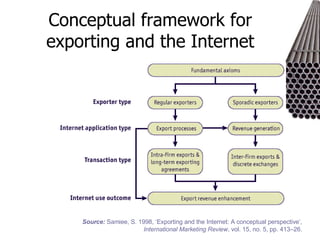
Types of exporters  Regular exporters Sporadic exporters
Impact of the Internet on barriers to export  Barriers can be grouped into four categories: Psychological barriers Operational barriers Organisational barriers Product/market barriers
Internet applications in overcoming the barriers
Internet applications in overcoming the barriers (contd) Source:   Hamill, J. 1997, ‘The Internet and international marketing’,  International Marketing Review , vol. 14, no. 5,  pp. 300–23.
Conceptual framework for exporting and the Internet Source:   Samiee, S. 1998, ‘Exporting and the Internet: A conceptual perspective’,  International Marketing Review , vol. 15, no. 5, pp. 413–26.
Discussion Questions for the Board Make a LOLCat Macro.

E Marketing Week13

  • 1.
    MKTG7037 / MKTG2032E-marketing Week 13
  • 2.
    Course Structure Chapter15 International marketing 21 May 13 Chapter 14 Relationship marketing 28 May 12 Chapter 13 Services marketing online 14 May 11 Chapter 12 Distribution 7 May 10 Chapter 11 Pricing strategies 30 April 9 Chapter 10 Promotion 2: the internet as a promotional medium 23 April 8 Chapter 9 Promotion: the internet in the promotional mix 2 April 7 Chapter 8 The role of product in internet marketing 26 March 6 Chapter 7 The internet in marketing strategy 19 March* 5 Chapter 6 Applications for business and non-business 12 March 4 Chapter 5 Creating cybercommunities 5 March 3 Chapter 4 Consumer behaviour 26 February 2 Chapter 3 Unique features of internet-based marketing 19 February 1 Topic(s)/Task(s) Week beginning Week No
  • 3.
  • 4.
    Internet and internationalmarketing Not all web-based marketing can be realistically classified as international. While anyone, anywhere can access the promotional and informational materials on a site, accessing the full range of services and products may be limited by geographical and other constraints.
  • 5.
    Classification of websites Web sites can be classified in terms of their commitment to globalisation: Domestic: web sites that offer goods only to those within the local area International by default: they do not actively seek international clients but will nevertheless provide goods/services International by design: they have full international orientation and actively seek external markets for their goods/services
  • 6.
    Characteristics of differentinternational orientations
  • 7.
    Trends in globalInternet marketing Rugman’s ‘myths’ of globalisation: Global strategies Single world markets Free trade and free market access Rugman provides three basic rules: Think local, and act regional Pay attention to government rules Recognise the world trade blocs of Europe, America, Japan etc.
  • 8.
    Globalisation Globalisation: developa successful domestic strategy and use as a formula for expansion Choice is whether to base the strategies for all markets on one winning formula or to modify and adapt to local conditions of the new market Levitt a major proponent of this approach
  • 9.
    Localisation Emphasisesthe unique nature of different markets and develops a unique marketing mix for each May have an ‘international’ scope; however, it markets specifically or locally to a particular market This approach presumes that markets and consumers vary considerably because of culture and country
  • 10.
    Two tiers oftrading Be aware of: Cultural Societal Economic history Language issue Internet is dominated by English Consumers have different motivations to buy same product
  • 11.
    Entry mode ExportingLicensing Contract manufacturing Management contracting Joint venturing Wholly owned subsidiary Multinational corporation
  • 12.
    Types of exporters Regular exporters Sporadic exporters
  • 13.
    Impact of theInternet on barriers to export Barriers can be grouped into four categories: Psychological barriers Operational barriers Organisational barriers Product/market barriers
  • 14.
    Internet applications inovercoming the barriers
  • 15.
    Internet applications inovercoming the barriers (contd) Source: Hamill, J. 1997, ‘The Internet and international marketing’, International Marketing Review , vol. 14, no. 5, pp. 300–23.
  • 16.
    Conceptual framework forexporting and the Internet Source: Samiee, S. 1998, ‘Exporting and the Internet: A conceptual perspective’, International Marketing Review , vol. 15, no. 5, pp. 413–26.
  • 17.
    Discussion Questions forthe Board Make a LOLCat Macro.