E-learning and its Impact
to University of Saint Louis Tuguegarao
By: BENEDICT D. SY
What is E-learning?
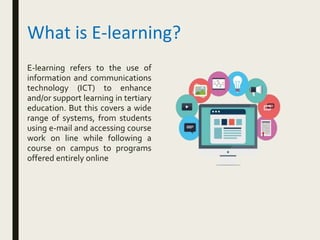
E-learning refers to the use of
information and communications
technology (ICT) to enhance
and/or support learning in tertiary
education. But this covers a wide
range of systems, from students
using e-mail and accessing course
work on line while following a
course on campus to programs
offered entirely online
E-learning can be divided into several
different types
■ Web-supplemented courses focus on classroom-based teaching
but include elements such as putting a course outline and lecture
notes on line, use of e-mail and links to online resources.
■ Web-dependent courses require students to use the Internet for key
elements of the program such as online discussions, assessment, or
online project/ collaborative work, but without significant reduction
in classroom time.
■ In mixed mode courses, the e-learning element begins to replace
classroom time. Online discussions, assessment, or
project/collaborative work replace some face-to-face teaching and
learning. But significant campus attendance remains part of the mix.
How to encourage academics and students
to make better use of e-learning?
■ The University generally feel that e-learning has a broadly positive
effect on the quality of teaching and learning, although few have been
able to offer detailed evidence.
■ The “learning object” model is perhaps the most prominent
“revolutionary” approach to date. A learning object can be described as
an electronic tool/ resource that can be used, re-used and re-designed
in different contexts, for different purposes and by different
academics/actors
E- Learning at University of Saint
Louis Tuguegarao
■ The E-learning in the University is a good example of the
promises of e-learning to enhance the outcomes of learning.
courses include a number of innovative online instructional
components such as: cognitive tutors; virtual laboratories;
group experiments; simulations.
■ E-Learning Strategy, Reaches InternationalCommunity
Can online learning help cut costs?
■ Universities still expect e-learning to help reduce costs, although
few can offer direct evidence of this happening. The good news is
that experienced institutions are generally optimistic about a
positive cost impact of e-learning in the medium run.
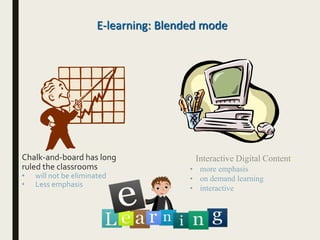
Chalk-and-board has long
ruled the classrooms
• will not be eliminated
• Less emphasis
Interactive Digital Content:
• more emphasis
• on demand learning
• interactive
E-learning: Blended mode
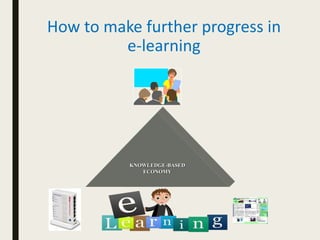
How to make further progress in
e-learning
KNOWLEDGE-BASED
ECONOMY
■ Given that e-learning is still a novel activity and that it has
already improved the overall student experience, albeit
primarily outside the classroom, there is a case for continued
government funding.
■ One prerequisite for better understanding the benefits of e-
learning would be to disentangle the different activities
covered by the concept of e-learning and assess them
separately.
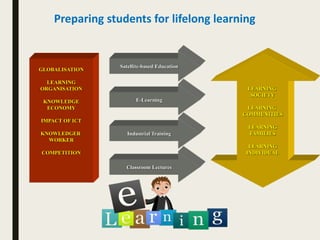
Preparing students for lifelong learning
GLOBALISATION
LEARNING
ORGANISATION
KNOWLEDGE
ECONOMY
IMPACT OF ICT
KNOWLEDGER
WORKER
COMPETITION
Satellite-based Education
E-Learning
Industrial Training
Classroom Lectures
LEARNING
SOCIETY
LEARNING
COMMUNITIES
LEARNING
FAMILIES
LEARNING
INDIVIDUAL
Benefits
• Convenient
– self-service (mix and match)
– on-demand (anytime, anywhere)
– private learning
– self-paced
– Flexibility: (modular package)
Conclusion
■ Given that e-learning is still a novel activity and that it has
already improved the
■ overall student experience, albeit primarily outside the
classroom, there is a case
■ to have a clearer understanding of the costs and benefits of e-
learning.
THANK YOU!

E learning and its impact to USLT

  • 1.
    E-learning and itsImpact to University of Saint Louis Tuguegarao By: BENEDICT D. SY
  • 2.
    What is E-learning? E-learningrefers to the use of information and communications technology (ICT) to enhance and/or support learning in tertiary education. But this covers a wide range of systems, from students using e-mail and accessing course work on line while following a course on campus to programs offered entirely online
  • 3.
    E-learning can bedivided into several different types ■ Web-supplemented courses focus on classroom-based teaching but include elements such as putting a course outline and lecture notes on line, use of e-mail and links to online resources. ■ Web-dependent courses require students to use the Internet for key elements of the program such as online discussions, assessment, or online project/ collaborative work, but without significant reduction in classroom time. ■ In mixed mode courses, the e-learning element begins to replace classroom time. Online discussions, assessment, or project/collaborative work replace some face-to-face teaching and learning. But significant campus attendance remains part of the mix.
  • 4.
    How to encourageacademics and students to make better use of e-learning? ■ The University generally feel that e-learning has a broadly positive effect on the quality of teaching and learning, although few have been able to offer detailed evidence. ■ The “learning object” model is perhaps the most prominent “revolutionary” approach to date. A learning object can be described as an electronic tool/ resource that can be used, re-used and re-designed in different contexts, for different purposes and by different academics/actors
  • 5.
    E- Learning atUniversity of Saint Louis Tuguegarao ■ The E-learning in the University is a good example of the promises of e-learning to enhance the outcomes of learning. courses include a number of innovative online instructional components such as: cognitive tutors; virtual laboratories; group experiments; simulations. ■ E-Learning Strategy, Reaches InternationalCommunity
  • 6.
    Can online learninghelp cut costs? ■ Universities still expect e-learning to help reduce costs, although few can offer direct evidence of this happening. The good news is that experienced institutions are generally optimistic about a positive cost impact of e-learning in the medium run.
  • 7.
    Chalk-and-board has long ruledthe classrooms • will not be eliminated • Less emphasis Interactive Digital Content: • more emphasis • on demand learning • interactive E-learning: Blended mode
  • 8.
    How to makefurther progress in e-learning KNOWLEDGE-BASED ECONOMY
  • 9.
    ■ Given thate-learning is still a novel activity and that it has already improved the overall student experience, albeit primarily outside the classroom, there is a case for continued government funding.
  • 10.
    ■ One prerequisitefor better understanding the benefits of e- learning would be to disentangle the different activities covered by the concept of e-learning and assess them separately.
  • 11.
    Preparing students forlifelong learning GLOBALISATION LEARNING ORGANISATION KNOWLEDGE ECONOMY IMPACT OF ICT KNOWLEDGER WORKER COMPETITION Satellite-based Education E-Learning Industrial Training Classroom Lectures LEARNING SOCIETY LEARNING COMMUNITIES LEARNING FAMILIES LEARNING INDIVIDUAL
  • 12.
    Benefits • Convenient – self-service(mix and match) – on-demand (anytime, anywhere) – private learning – self-paced – Flexibility: (modular package)
  • 13.
    Conclusion ■ Given thate-learning is still a novel activity and that it has already improved the ■ overall student experience, albeit primarily outside the classroom, there is a case ■ to have a clearer understanding of the costs and benefits of e- learning.
  • 14.