1/28
May 2013
2/28
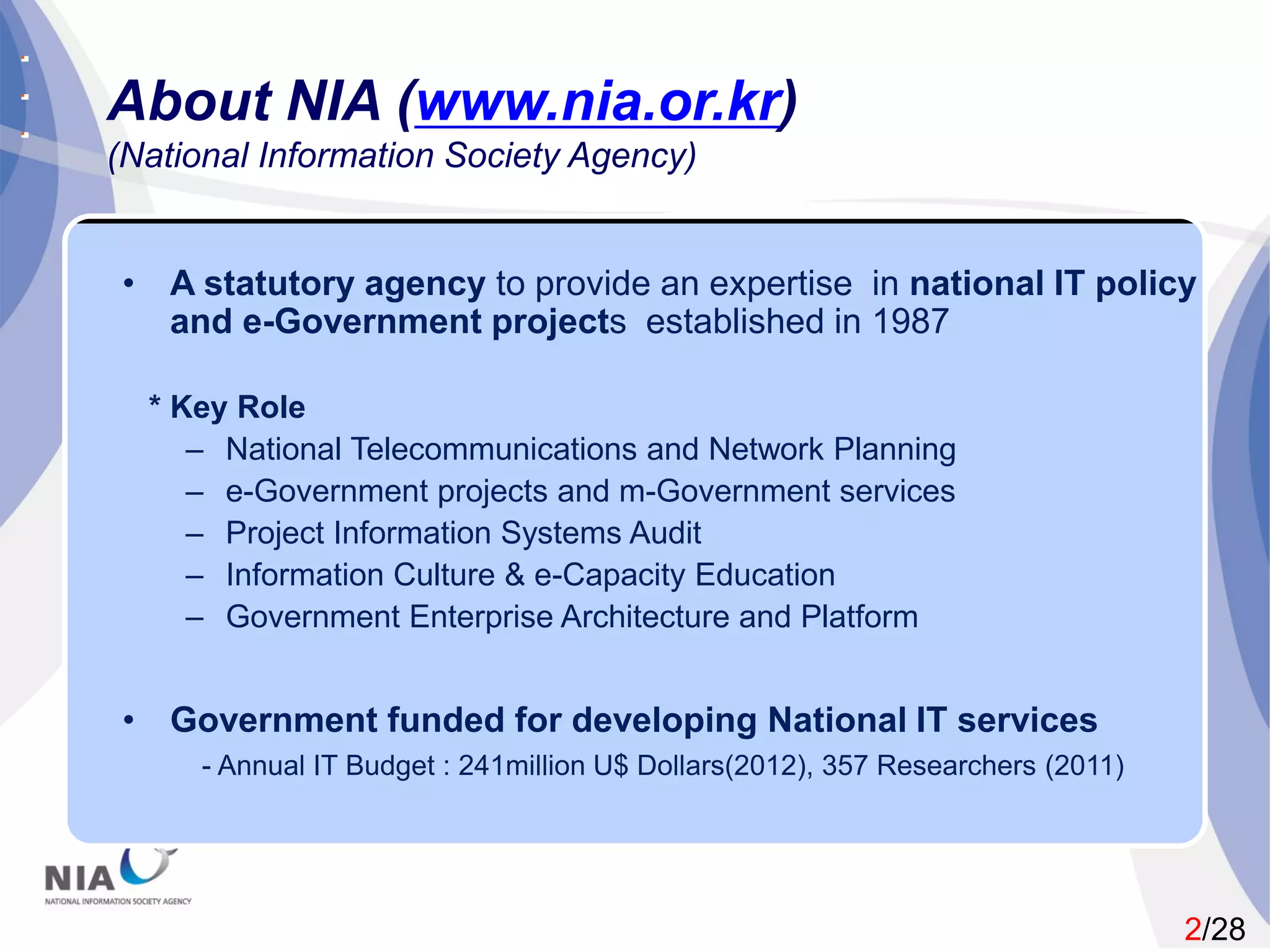
About NIA (www.nia.or.kr)
(National Information Society Agency)
• A statutory agency to provide an expertise in national IT policy
and e-Government projects established in 1987
* Key Role
– National Telecommunications and Network Planning
– e-Government projects and m-Government services
– Project Information Systems Audit
– Information Culture & e-Capacity Education
– Government Enterprise Architecture and Platform
• Government funded for developing National IT services
- Annual IT Budget : 241million U$ Dollars(2012), 357 Researchers (2011)
3/28
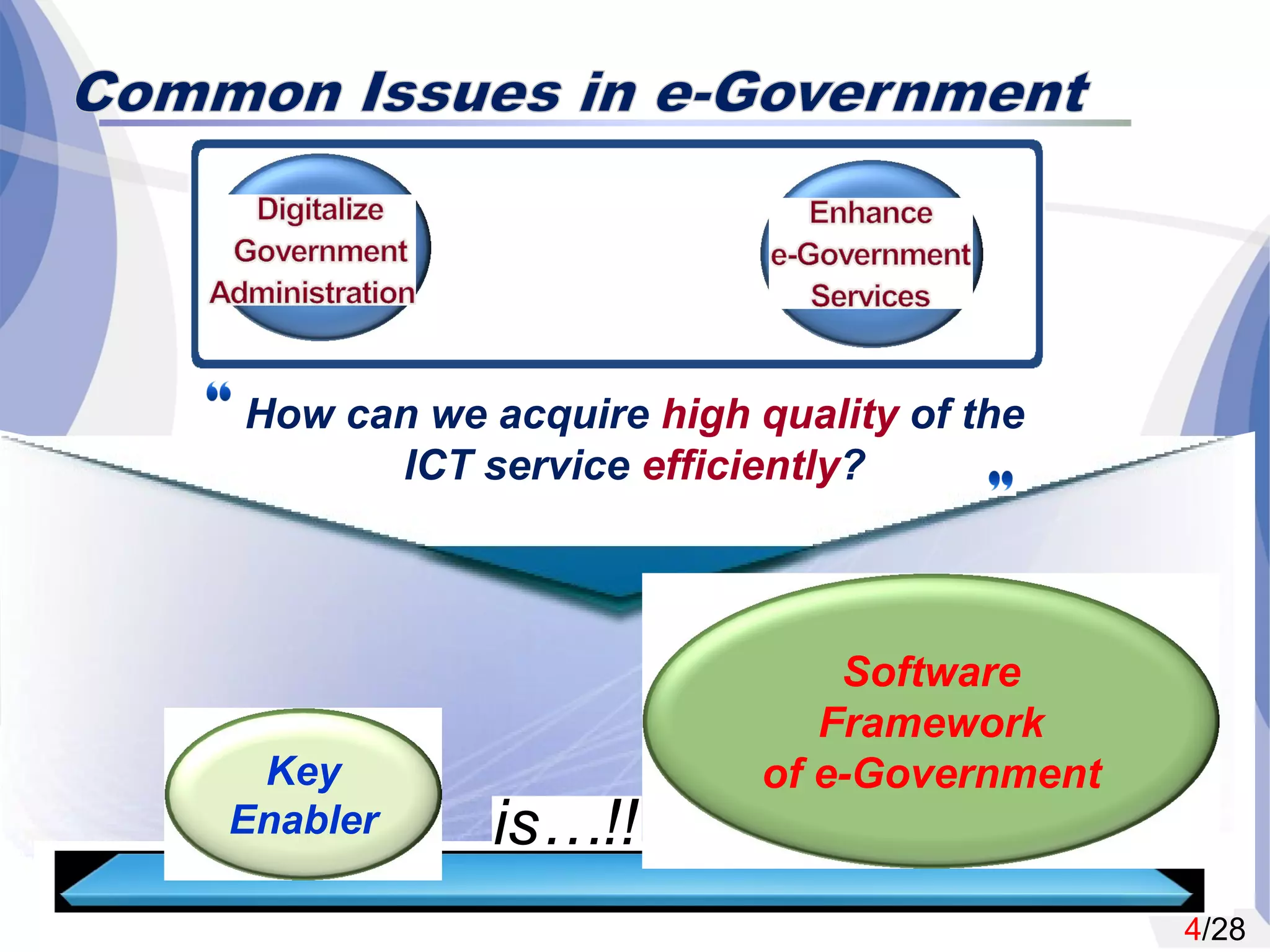
4/28
Key
Enabler
Software
Framework
of e-Government
5/28
Software framework is a special case of software libraries in that they are
reusable abstractions of code wrapped in a well-defined API. [Wikipedia]
• With Software framework, you can improve 20-30% of development
productivity and enhance the quality of e-Government services
- Most of technical issues are handled by SW framework
Architecture policy
Common technical service
Common biz service
SW Framework
<IS development with SW framework><IS development without SW framework>
* IS : Information System, SW: Software
6/28
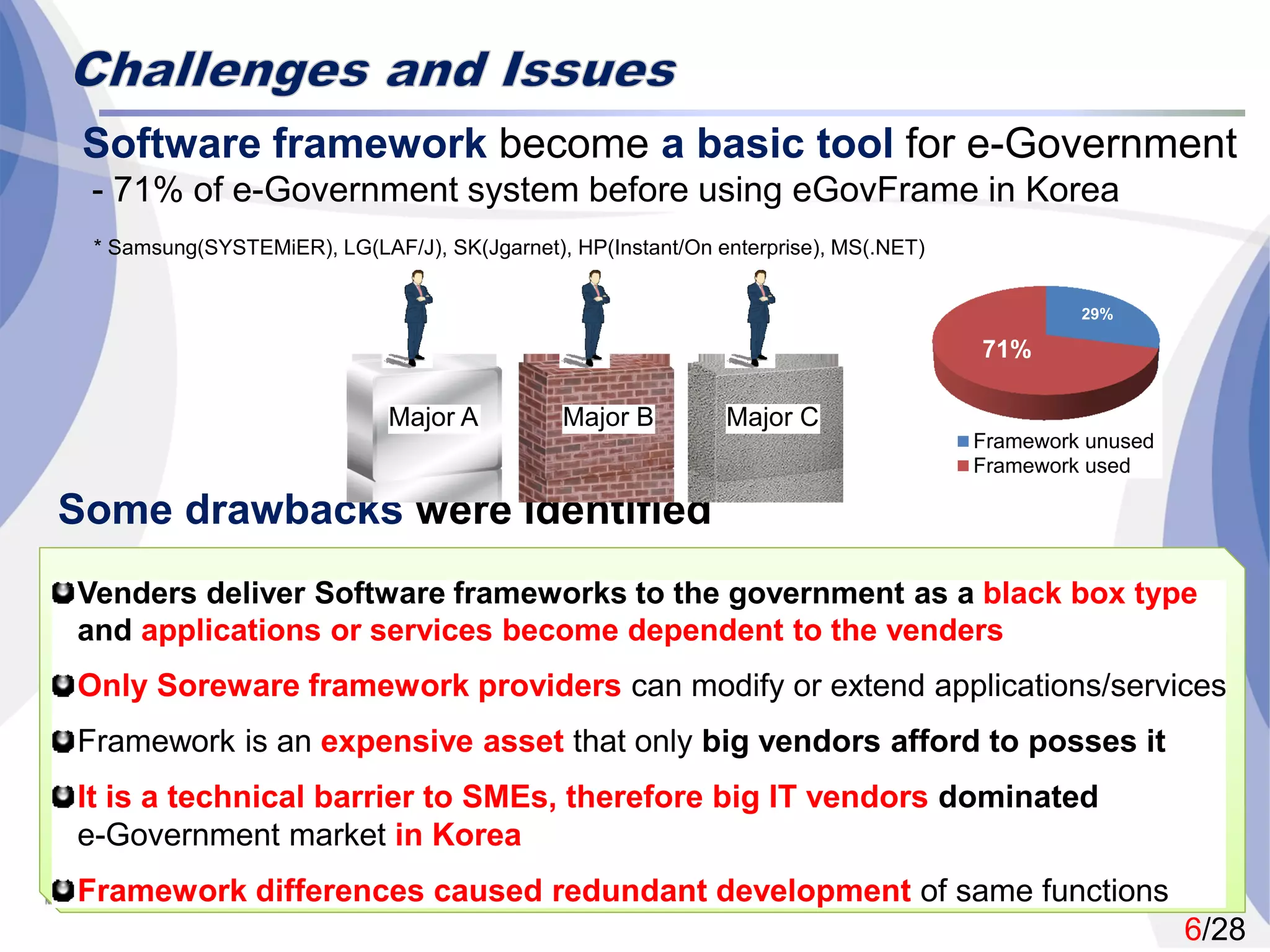
Some drawbacks were identified
Software framework become a basic tool for e-Government
- 71% of e-Government system before using eGovFrame in Korea
Framework unused
Framework used
71%
29%
* Samsung(SYSTEMiER), LG(LAF/J), SK(Jgarnet), HP(Instant/On enterprise), MS(.NET)
7/28
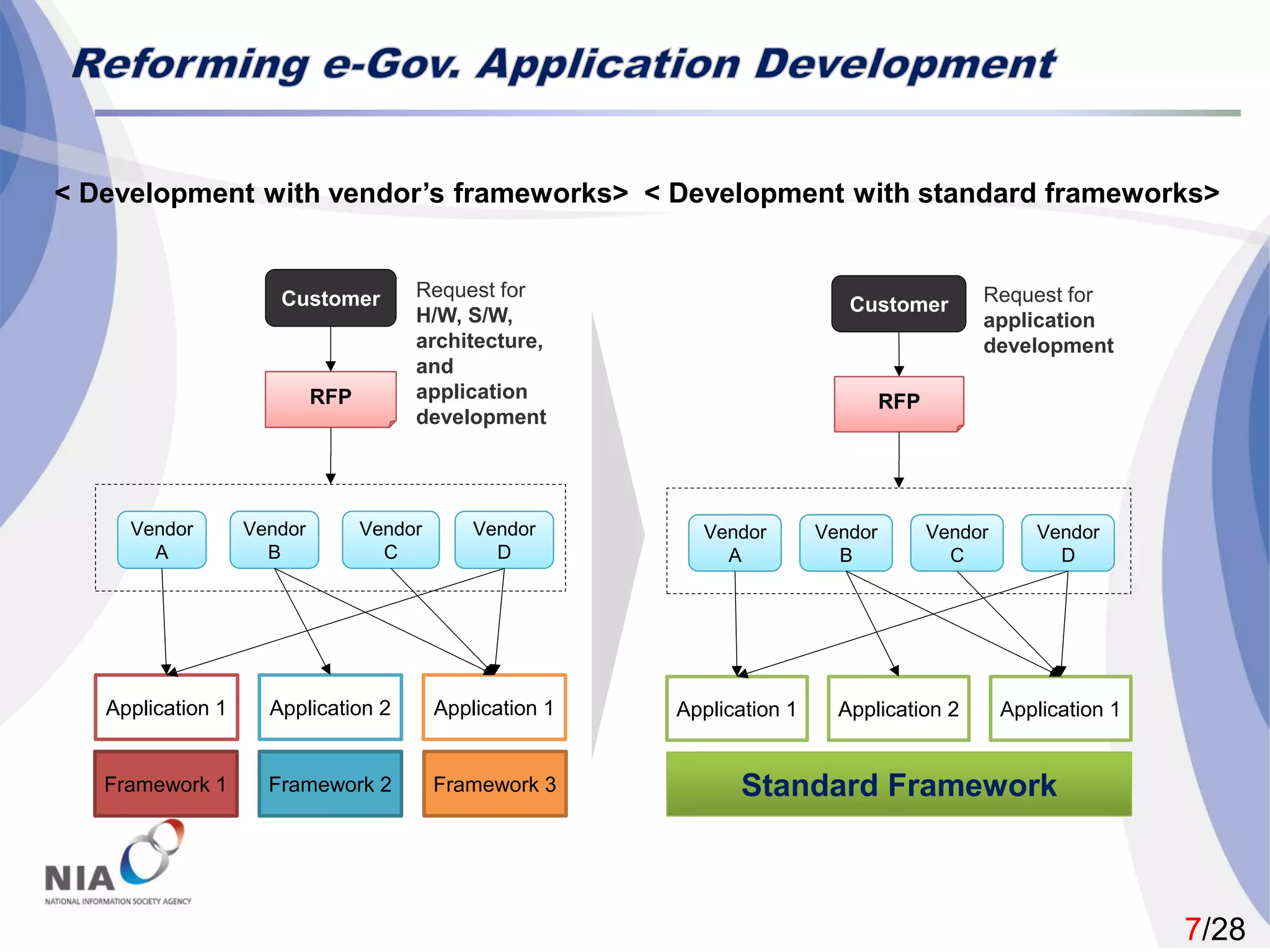
Vendor
A
Vendor
A
Vendor
B
Vendor
B
Vendor
C
Vendor
C
Vendor
D
Vendor
D
Application 1 Application 2 Application 1
Framework 1 Framework 2 Framework 3
Customer
RFPRFP
Request for
H/W, S/W,
architecture,
and
application
development
Vendor
A
Vendor
A
Vendor
B
Vendor
B
Vendor
C
Vendor
C
Vendor
D
Vendor
D
Application 1 Application 2 Application 1
Standard FrameworkStandard Framework
Customer
RFPRFP
Request for
application
development
< Development with vendor’s frameworks> < Development with standard frameworks>
8/28
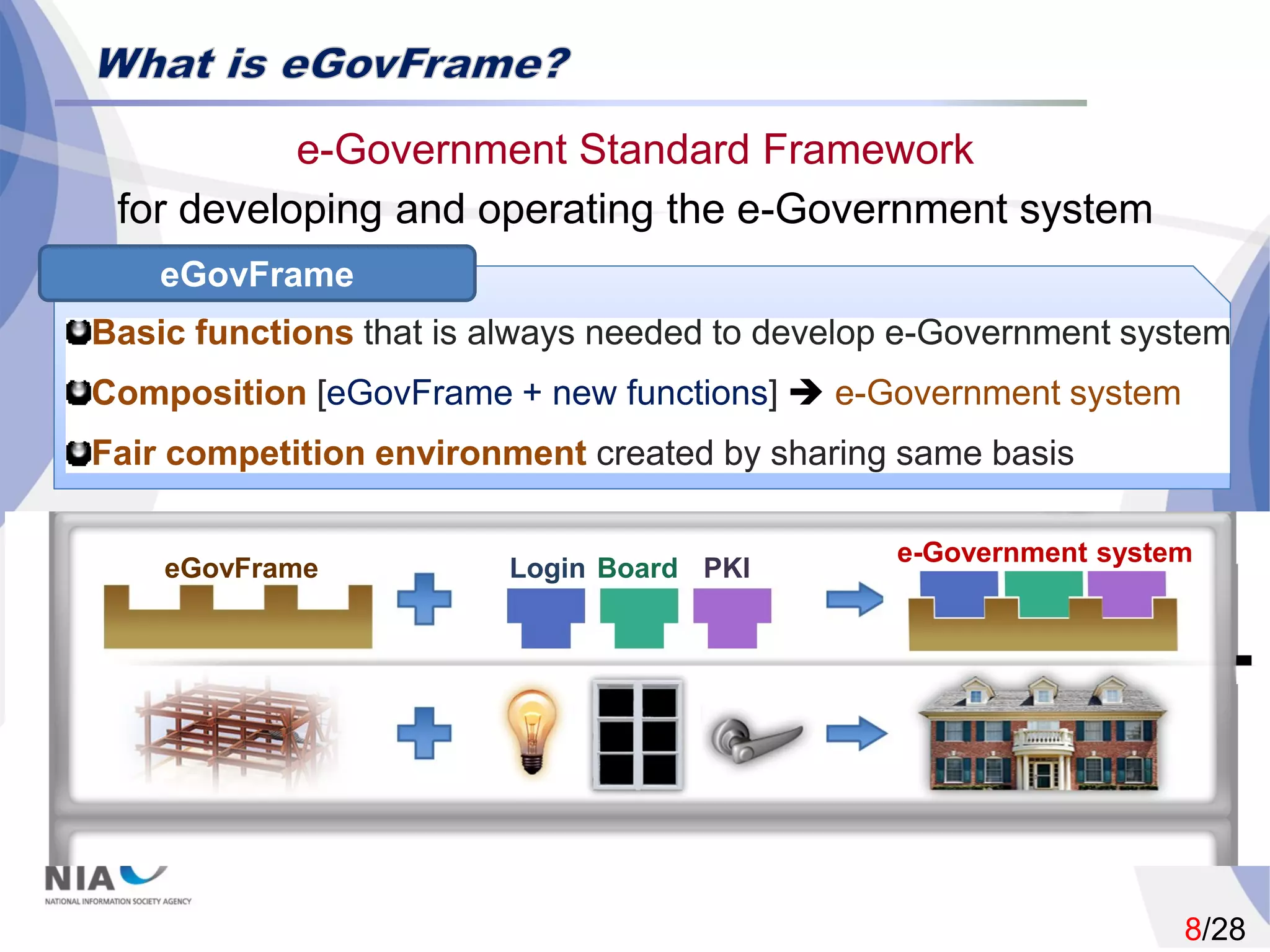
e-Government Standard Framework
for developing and operating the e-Government system
eGovFrame
9/28
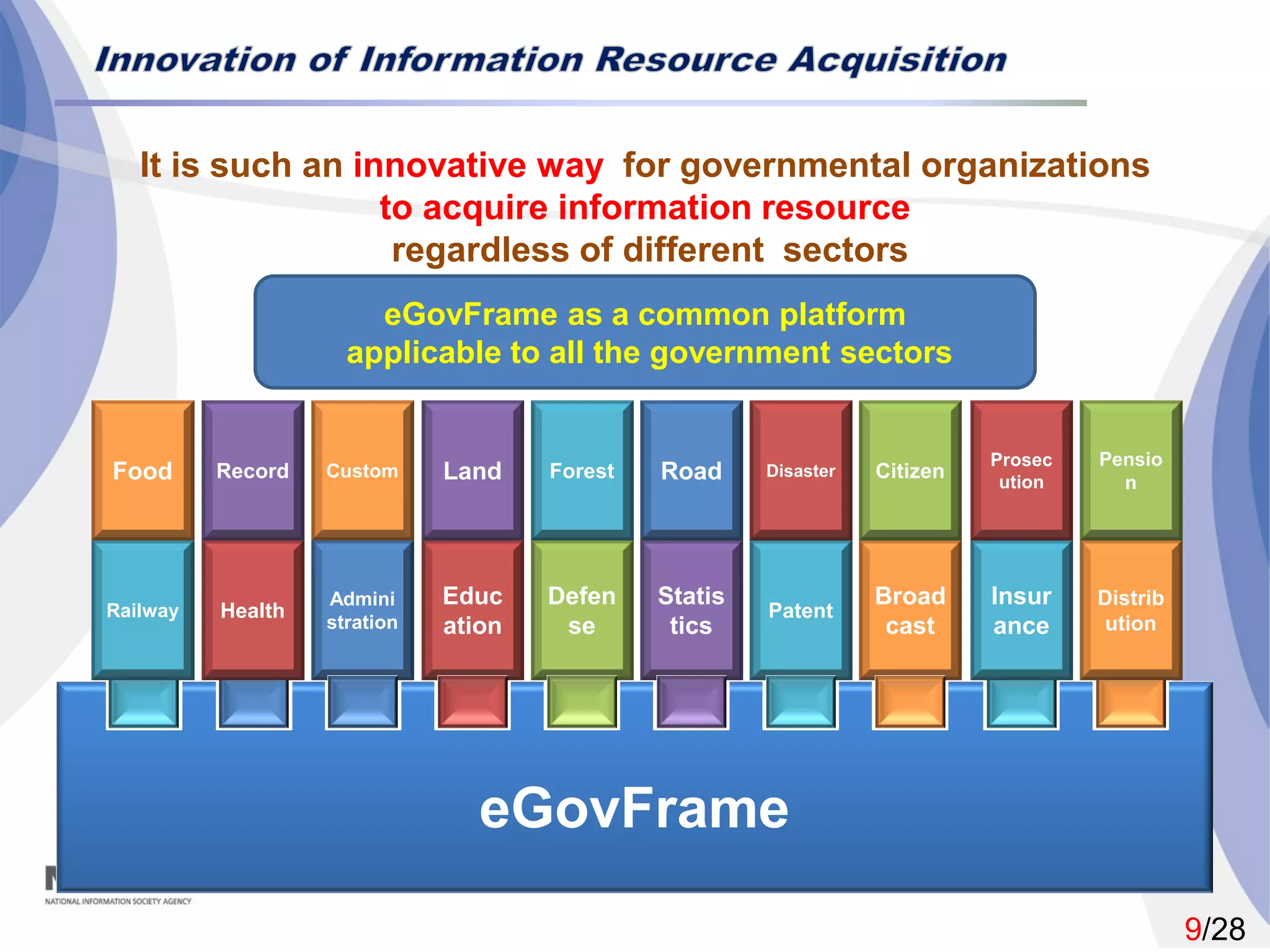
eGovFrame
Admini
stration
Custom
Educ
ation
Land
Defen
se
Forest
Statis
tics
Road
Patent
Disaster
Broad
cast
Citizen
Insur
ance
Distrib
ution
Railway Health
Food Record
Prosec
ution
Pensio
n
It is such an innovative way for governmental organizations
to acquire information resource
regardless of different sectors
eGovFrame as a common platform
applicable to all the government sectors
10/28
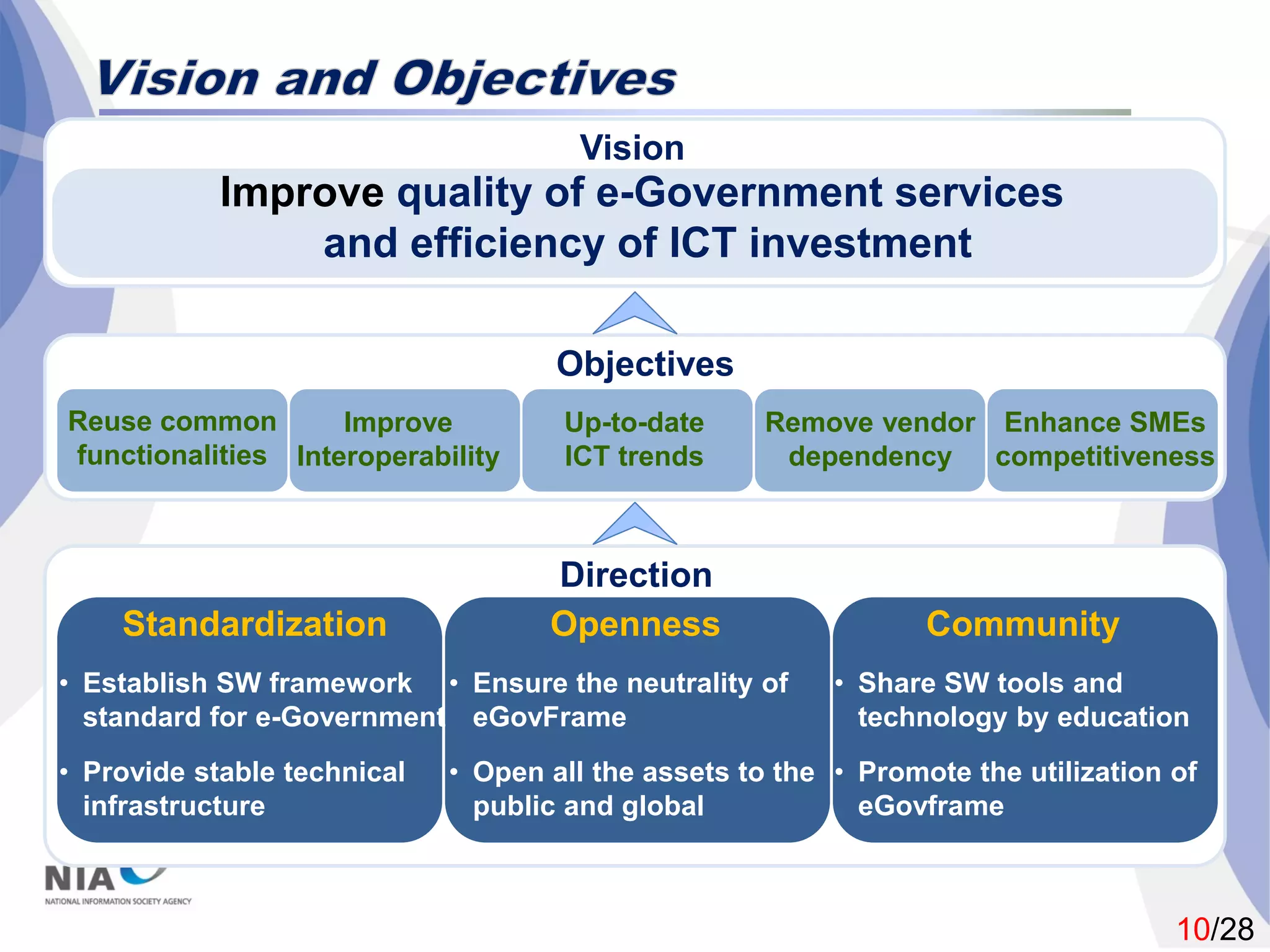
Vision
Objectives
Direction
Improve quality of e-Government services
and efficiency of ICT investment
Enhance SMEs
competitiveness
Remove vendor
dependency
Up-to-date
ICT trends
Improve
Interoperability
Reuse common
functionalities
Standardization
• Establish SW framework
standard for e-Government
• Provide stable technical
infrastructure
Openness
• Ensure the neutrality of
eGovFrame
• Open all the assets to the
public and global
Community
• Share SW tools and
technology by education
• Promote the utilization of
eGovframe
11/28
[Major open sources]
•Biz. transaction : Spring & 22
•Data : ibatis, Hibernate &1
•Development tool : Eclipse & 3
•Test tool : Junit & 5
•Distribution tool : Maven & 1
•Configuration Management tool
: Subversion & 1
 Define Open Source Selection Policy
Open Source Evaluation Process
License with no restriction on
distribution and usage
 Evaluate candidate open sources(175)
Functional/non-functional requirements
Constraints for integration and interfaces
 Physically test candidate open sources(85)
Basic functions
Non-functional requirements(SW Quality)
BestOpenSourceSelection
Final Result
40 open sources selected
Policy
Setting
Policy
Setting
Logical
Test
Logical
Test
Physical
Test
Physical
Test
 Define basic functions and architecture
Analyze 3 big vendor’s frameworks and
e-Gov. projects from 2004 to 2007
54 functions and 219 common components
Function
Design
Function
Design
12/28
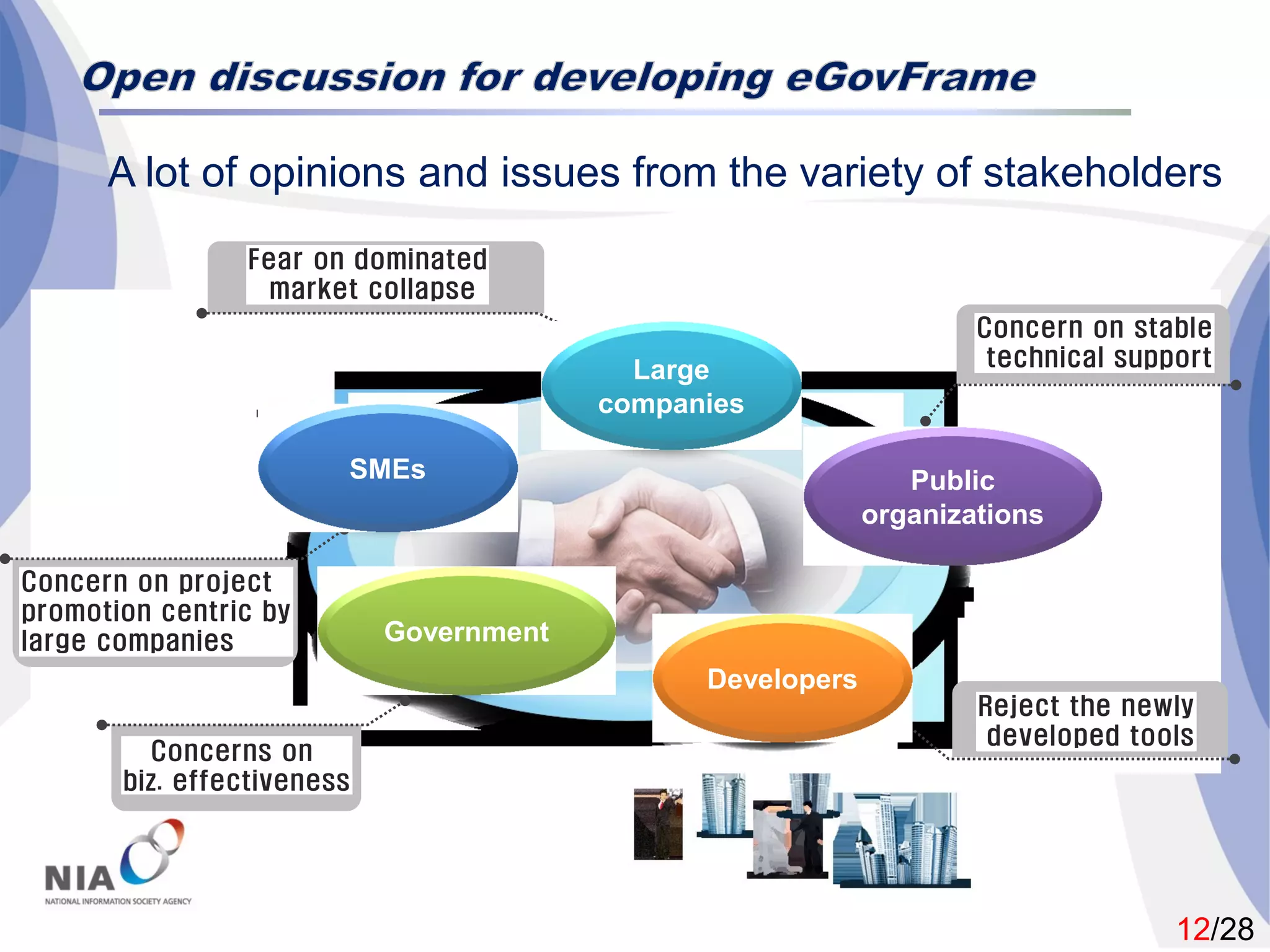
A lot of opinions and issues from the variety of stakeholders
Large
companies
SMEs
Government
Developers
Public
organizations
13/28
14/28
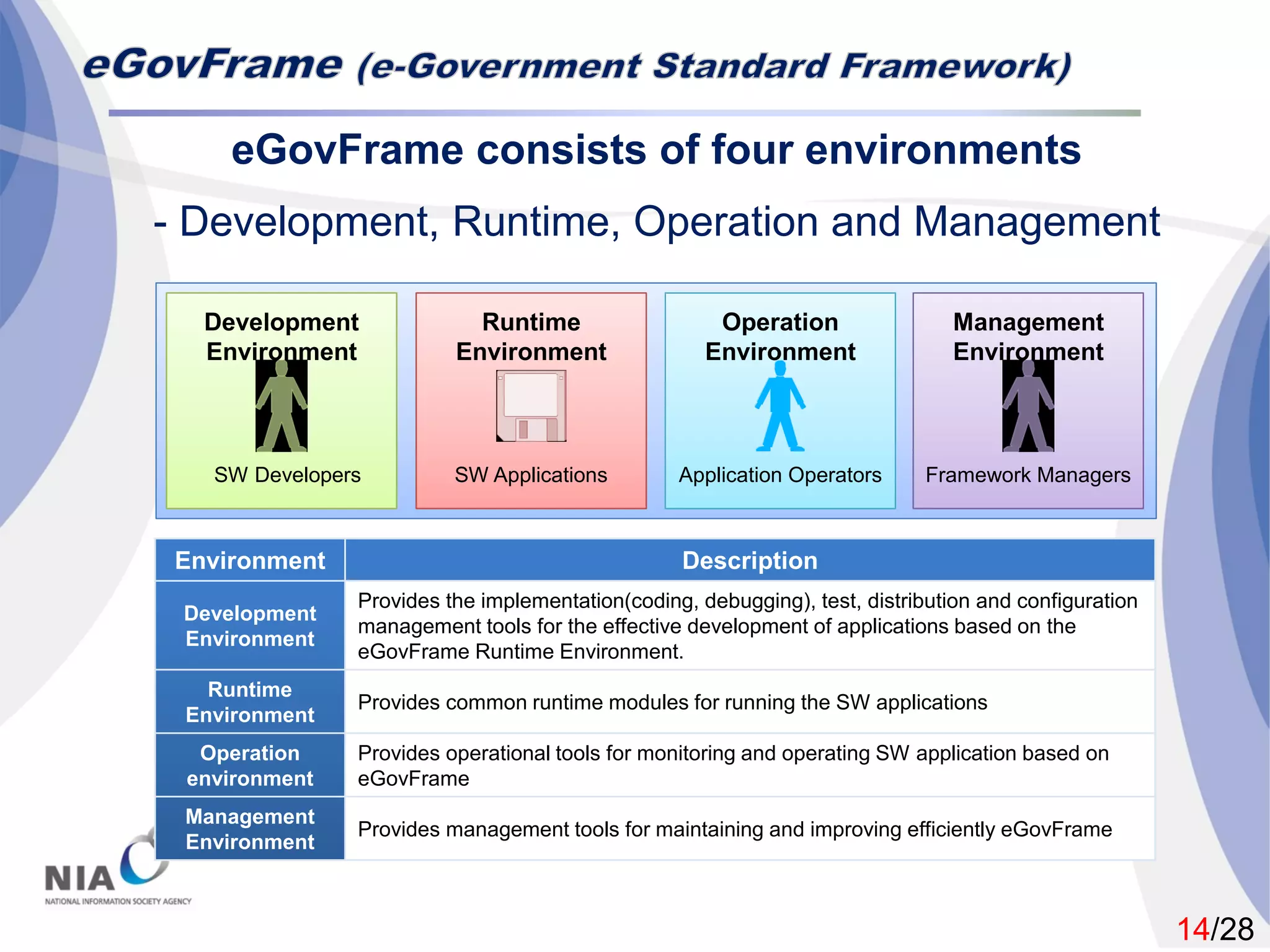
eGovFrame consists of four environments
- Development, Runtime, Operation and Management
Environment Description
Development
Environment
Provides the implementation(coding, debugging), test, distribution and configuration
management tools for the effective development of applications based on the
eGovFrame Runtime Environment.
Runtime
Environment
Provides common runtime modules for running the SW applications
Operation
environment
Provides operational tools for monitoring and operating SW application based on
eGovFrame
Management
Environment
Provides management tools for maintaining and improving efficiently eGovFrame
Development
Environment
Operation
Environment
SW Developers
Management
Environment
Framework ManagersApplication Operators
Runtime
Environment
SW Applications
15/28
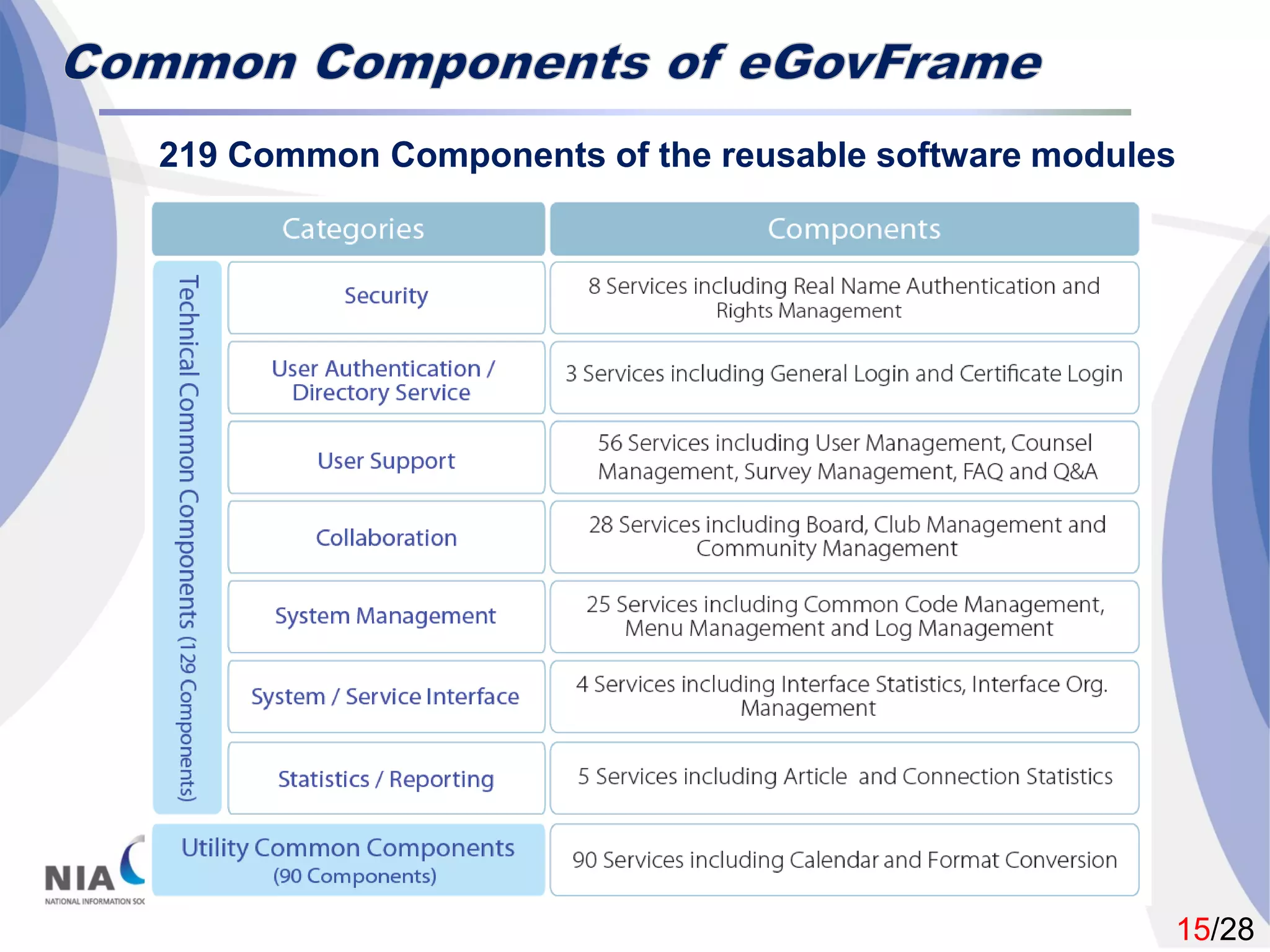
219 Common Components of the reusable software modules
16/28
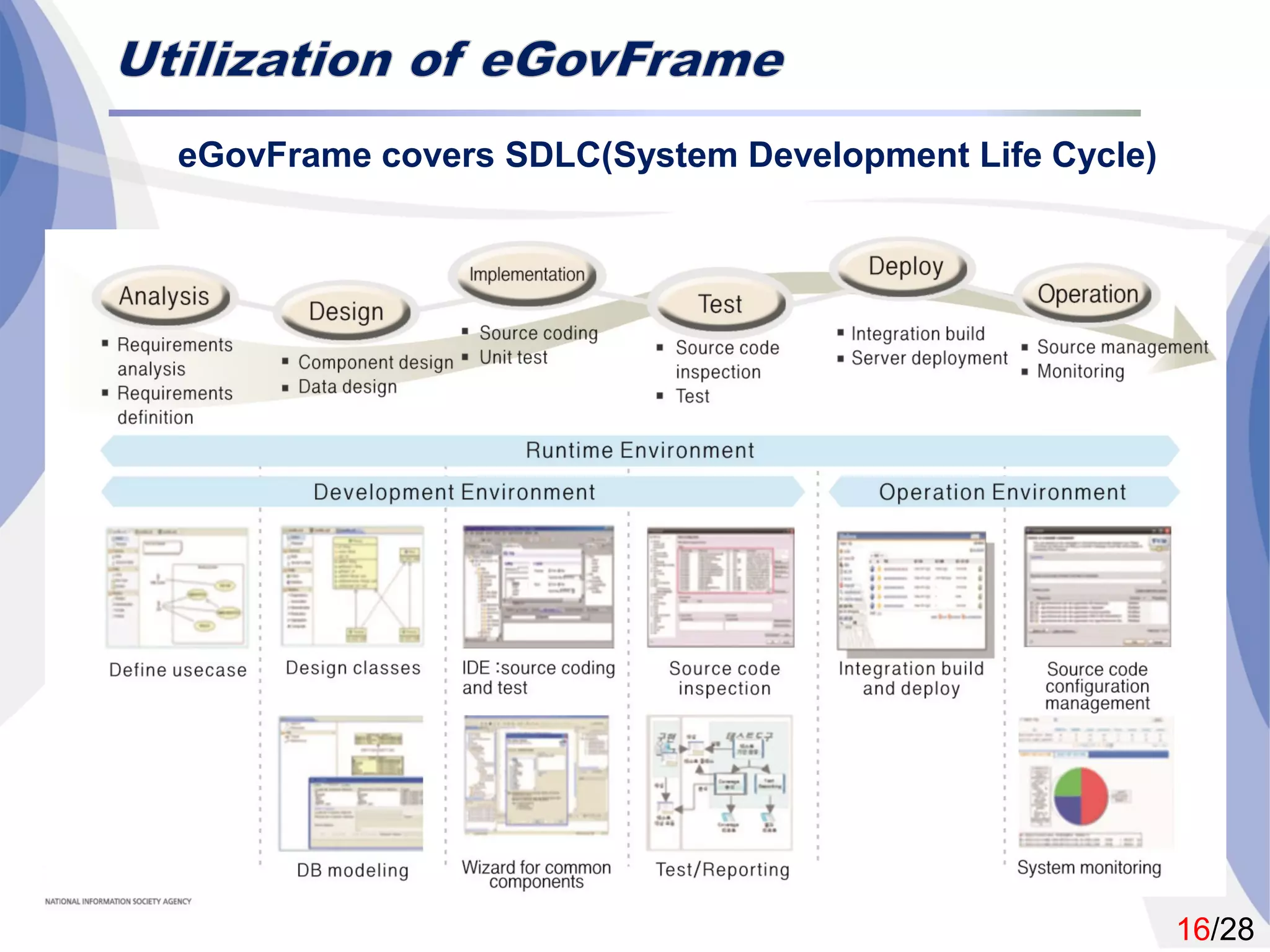
eGovFrame covers SDLC(System Development Life Cycle)
17/28
Current
eGovFrame
Current
eGovFrame
Mobile eGovFrame
Mobile
User eXperience(UX)
Mobile common
components
Next Version
eGovFrame
Next Version
eGovFrame
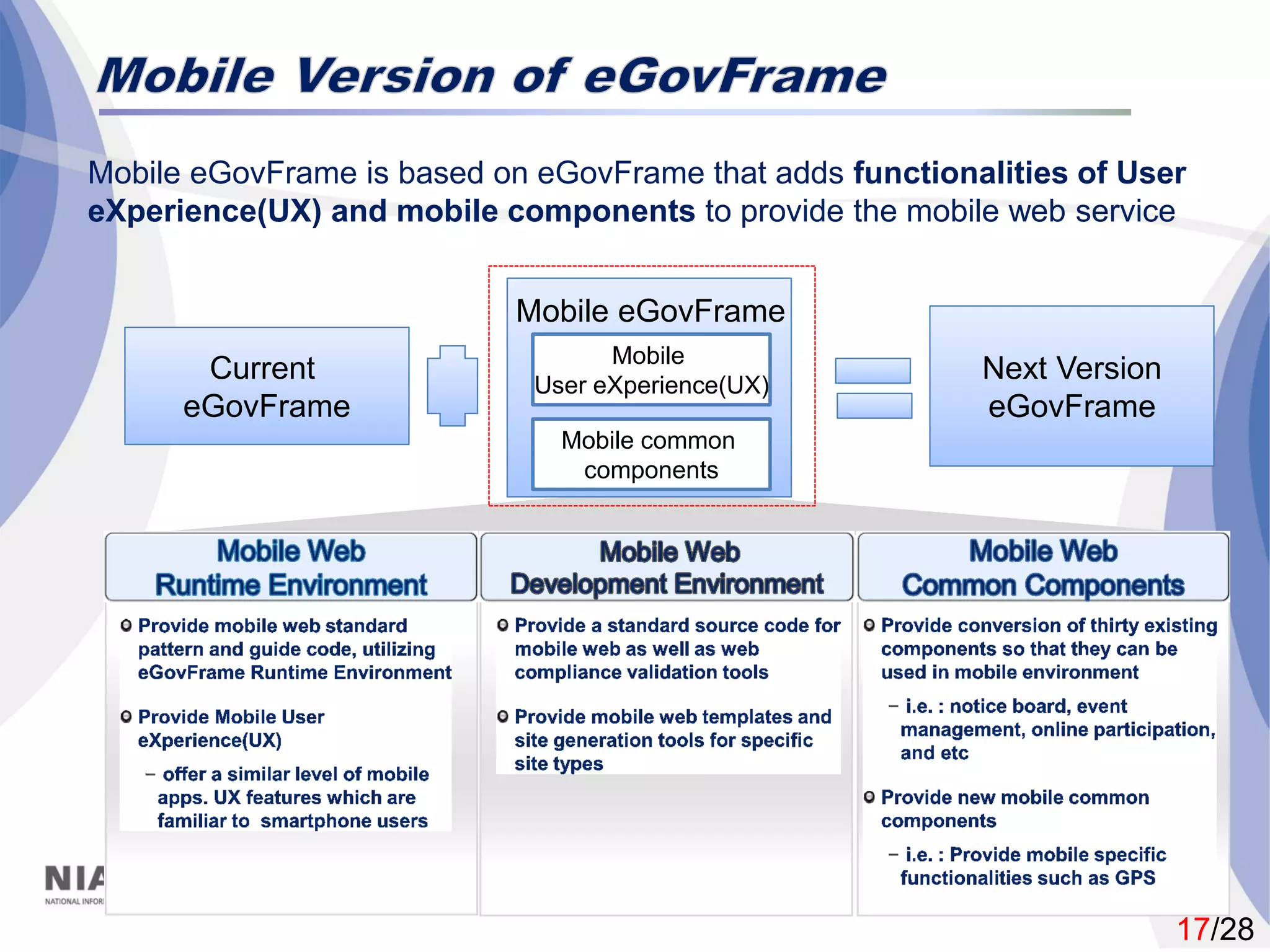
Mobile eGovFrame is based on eGovFrame that adds functionalities of User
eXperience(UX) and mobile components to provide the mobile web service
18/28
Footer bars
Header barsNavbars
Form element gallery Footer bars
Footer bars
Header bars
Icons list
icon
Basic list
Inline
buttons
Button icons
Popup event
Button icons
Grouped buttons
bar
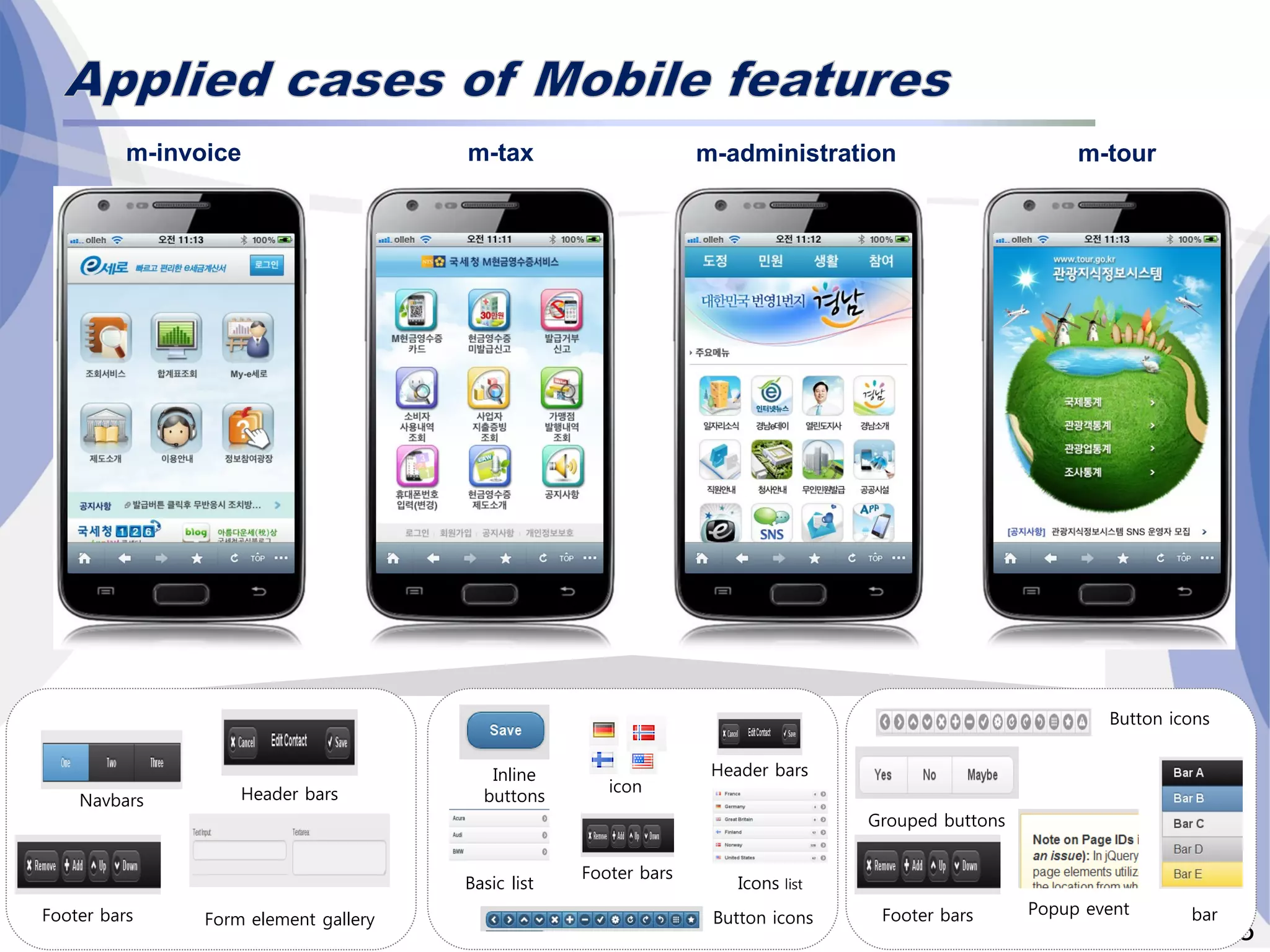
m-invoice m-tax m-administration m-tour
19/28
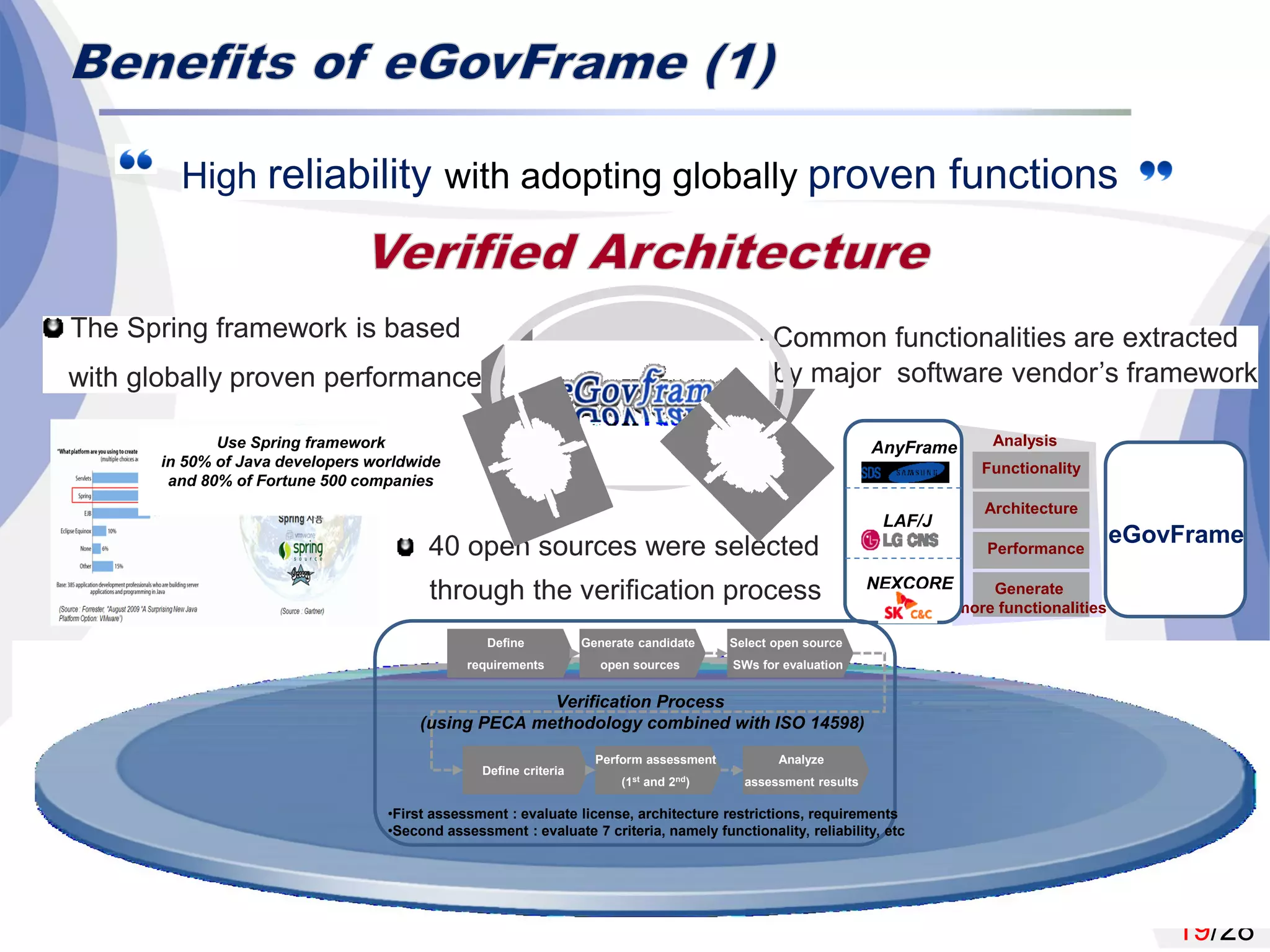
eGovFrame
Functionality
Architecture
Performance
Generate
more functionalities
AnyFrame
LAF/J
NEXCORE
Define
requirements
Generate candidate
open sources
Select open source
SWs for evaluation
Define criteria
Perform assessment
(1st and 2nd)
Analyze
assessment results
Verification Process
(using PECA methodology combined with ISO 14598)
•First assessment : evaluate license, architecture restrictions, requirements
•Second assessment : evaluate 7 criteria, namely functionality, reliability, etc
AnalysisUse Spring framework
in 50% of Java developers worldwide
and 80% of Fortune 500 companies
20/28* IS : Information system
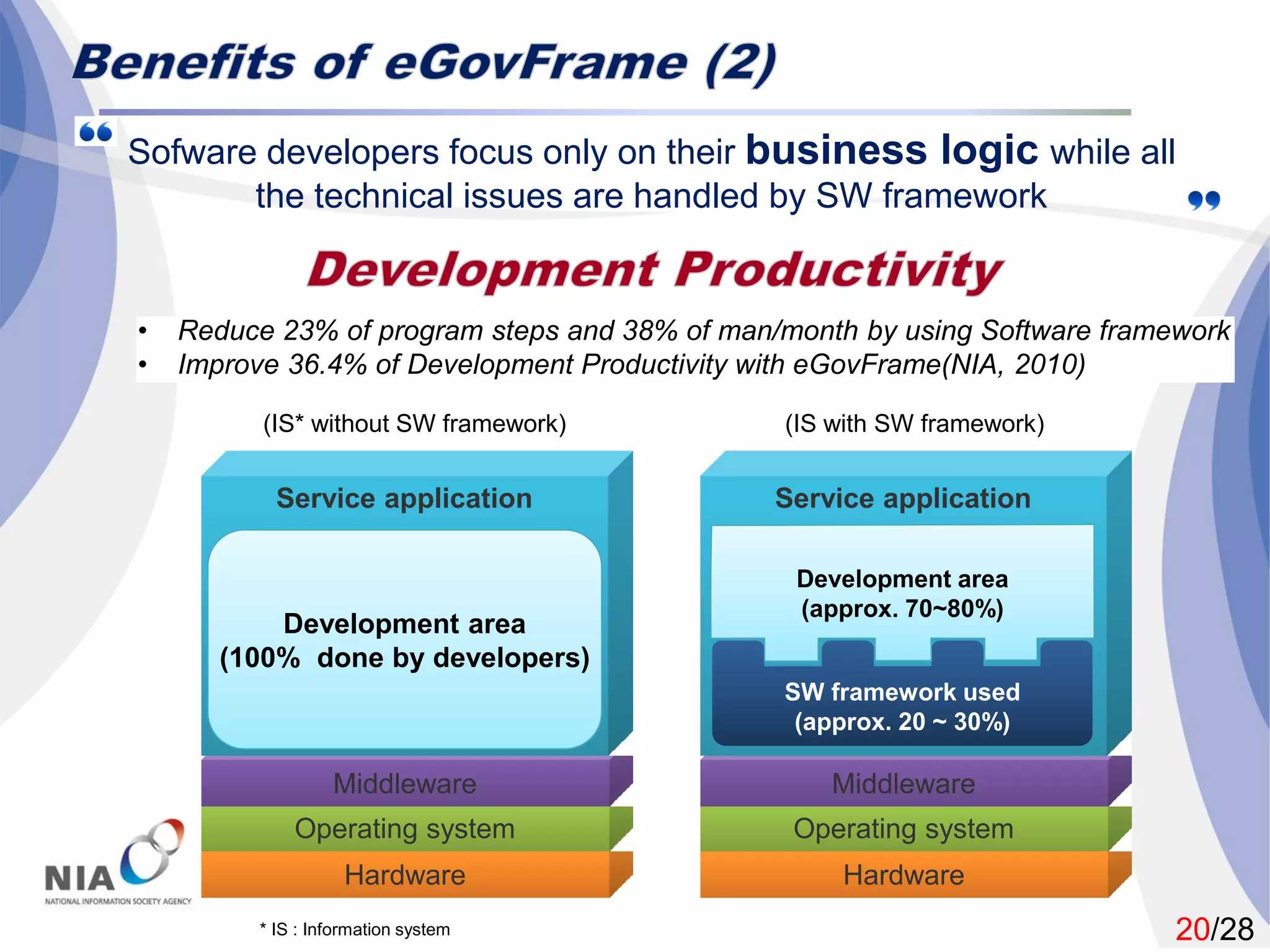
(IS with SW framework)
Hardware
Operating system
Middleware
Service application
Development area
(100% done by developers)
Development area
(100% done by developers)
Hardware
Operating system
Middleware
Service application
SW framework used
(approx. 20 ~ 30%)
SW framework used
(approx. 20 ~ 30%)
Development area
(approx. 70~80%)
Development area
(approx. 70~80%)
(IS* without SW framework)
Sofware developers focus only on their business logic while all
the technical issues are handled by SW framework
21/28
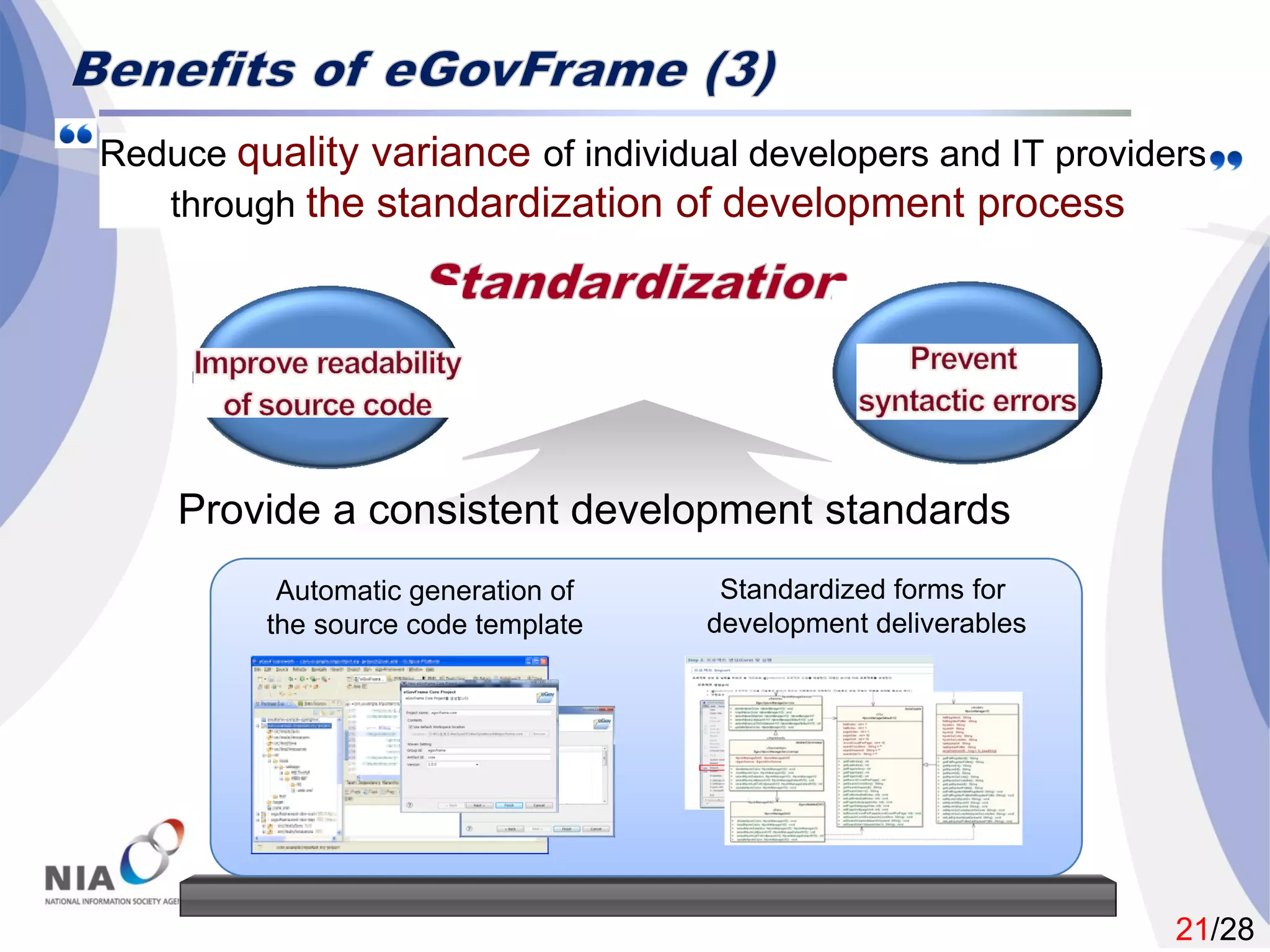
Provide a consistent development standards
Standardized forms for
development deliverables
Automatic generation of
the source code template
22/28
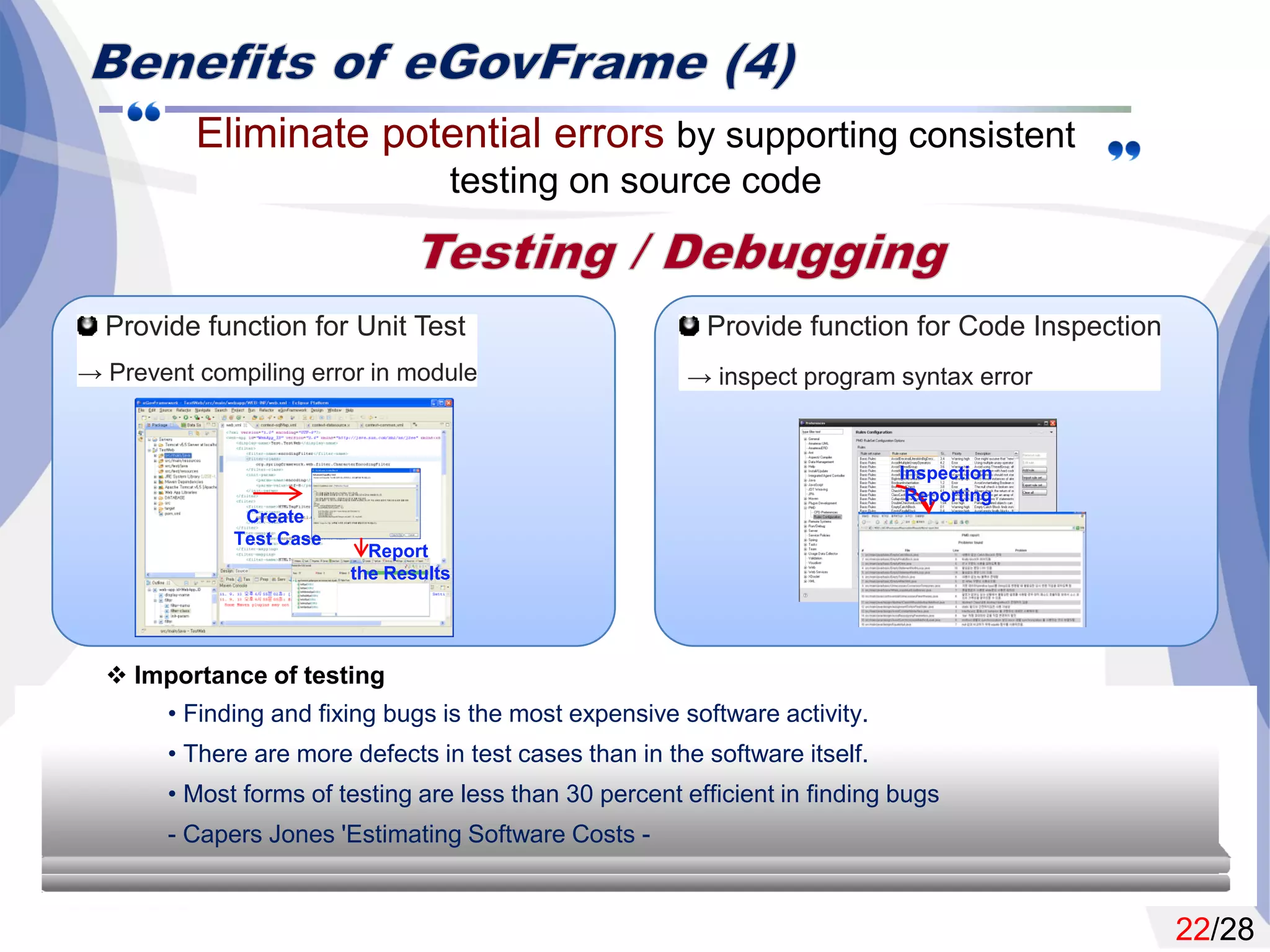
 Importance of testing
• Finding and fixing bugs is the most expensive software activity.
• There are more defects in test cases than in the software itself.
• Most forms of testing are less than 30 percent efficient in finding bugs
- Capers Jones 'Estimating Software Costs -
Create
Test Case
Report
the Results
Inspection
Reporting
23/28
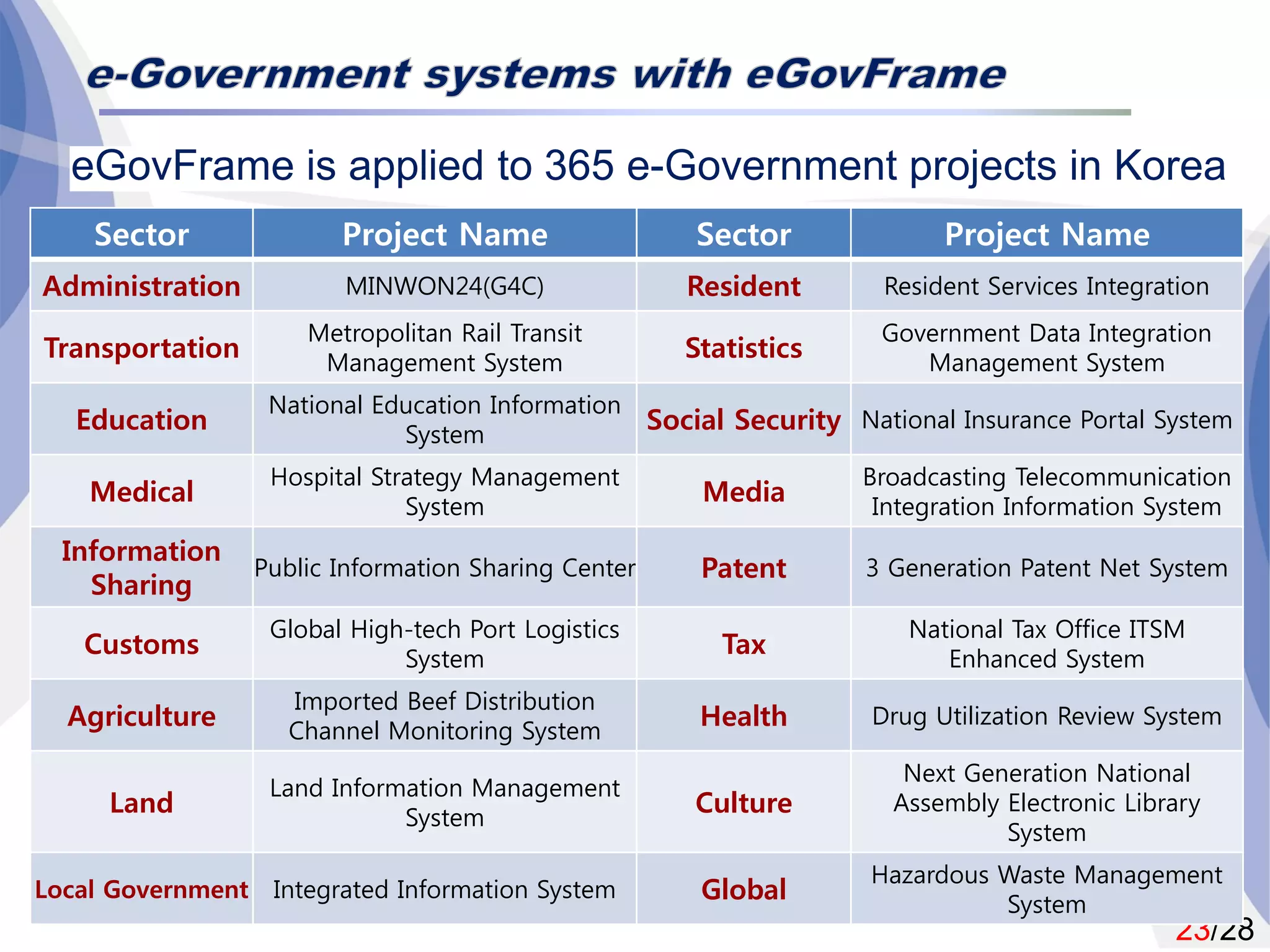
Sector Project Name Sector Project Name
Administration MINWON24(G4C) Resident Resident Services Integration
Transportation
Metropolitan Rail Transit
Management System
Statistics
Government Data Integration
Management System
Education
National Education Information
System
Social Security National Insurance Portal System
Medical
Hospital Strategy Management
System
Media
Broadcasting Telecommunication
Integration Information System
Information
Sharing
Public Information Sharing Center Patent 3 Generation Patent Net System
Customs
Global High-tech Port Logistics
System
Tax
National Tax Office ITSM
Enhanced System
Agriculture
Imported Beef Distribution
Channel Monitoring System
Health Drug Utilization Review System
Land
Land Information Management
System
Culture
Next Generation National
Assembly Electronic Library
System
Local Government Integrated Information System Global
Hazardous Waste Management
System
24/28
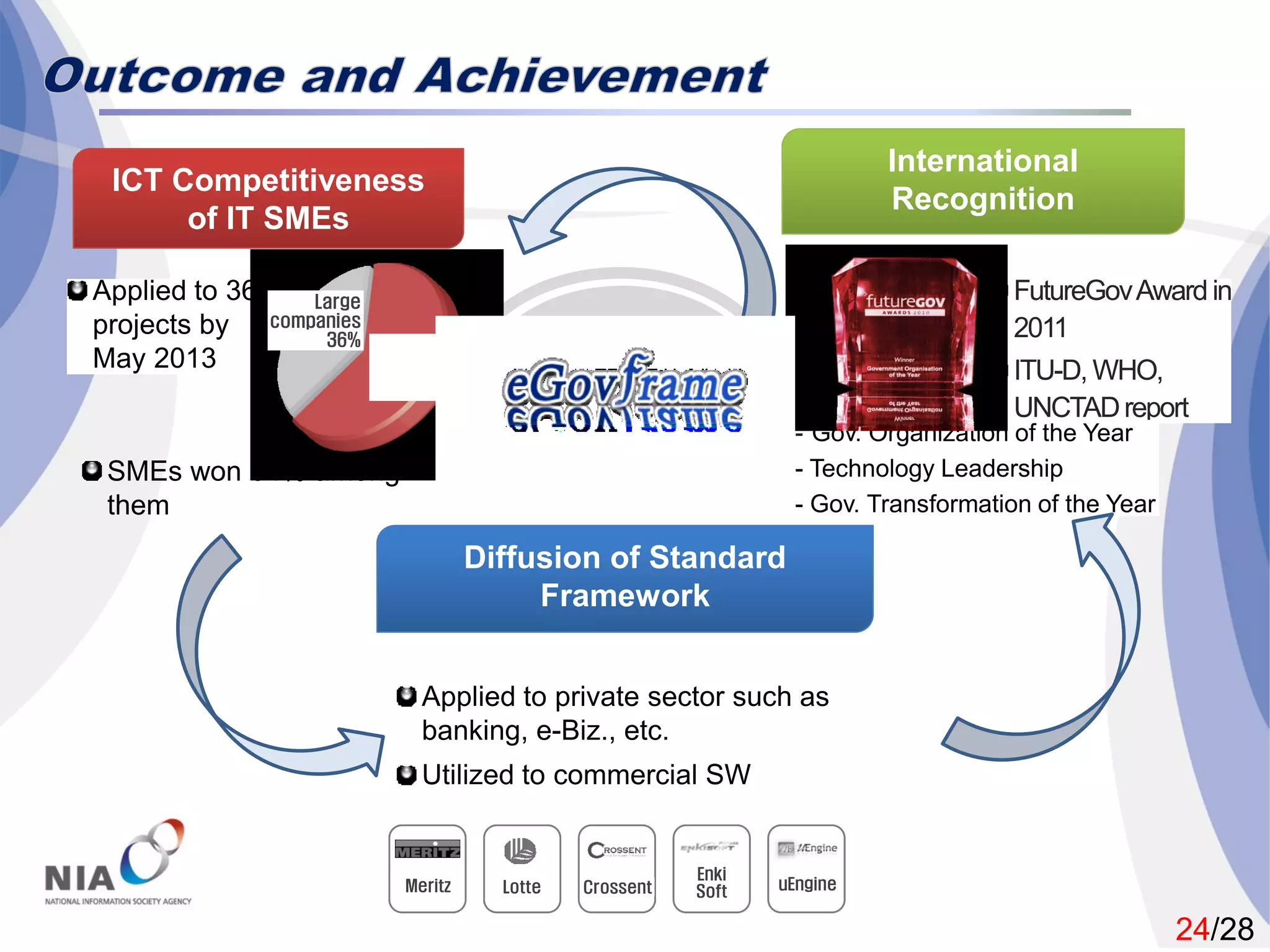
International
Recognition
International
Recognition
ICT Competitiveness
of IT SMEs
ICT Competitiveness
of IT SMEs
SMEs won 64% among
them
Diffusion of Standard
Framework
Diffusion of Standard
Framework
25/28
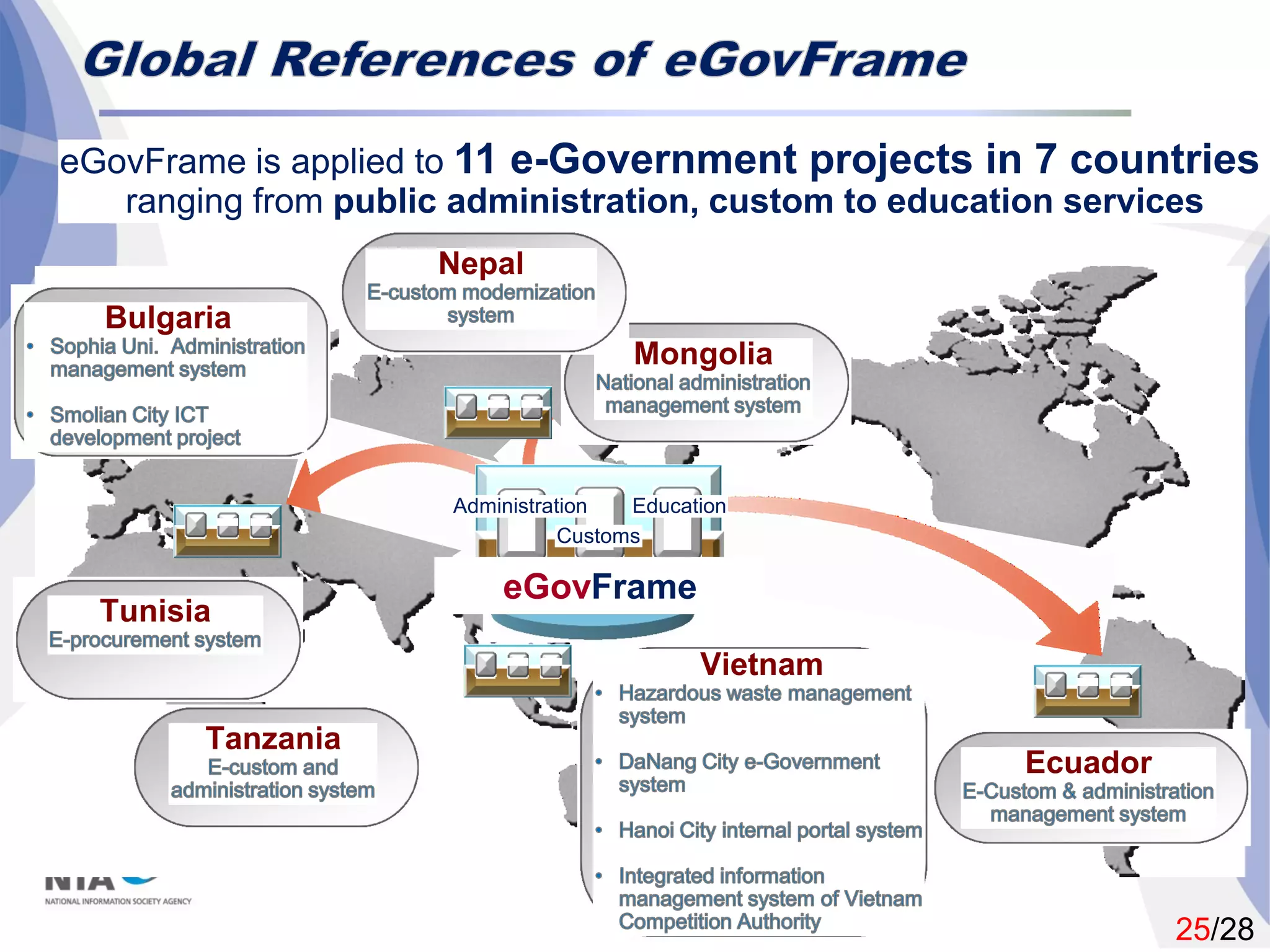
eGovFrame
26/28
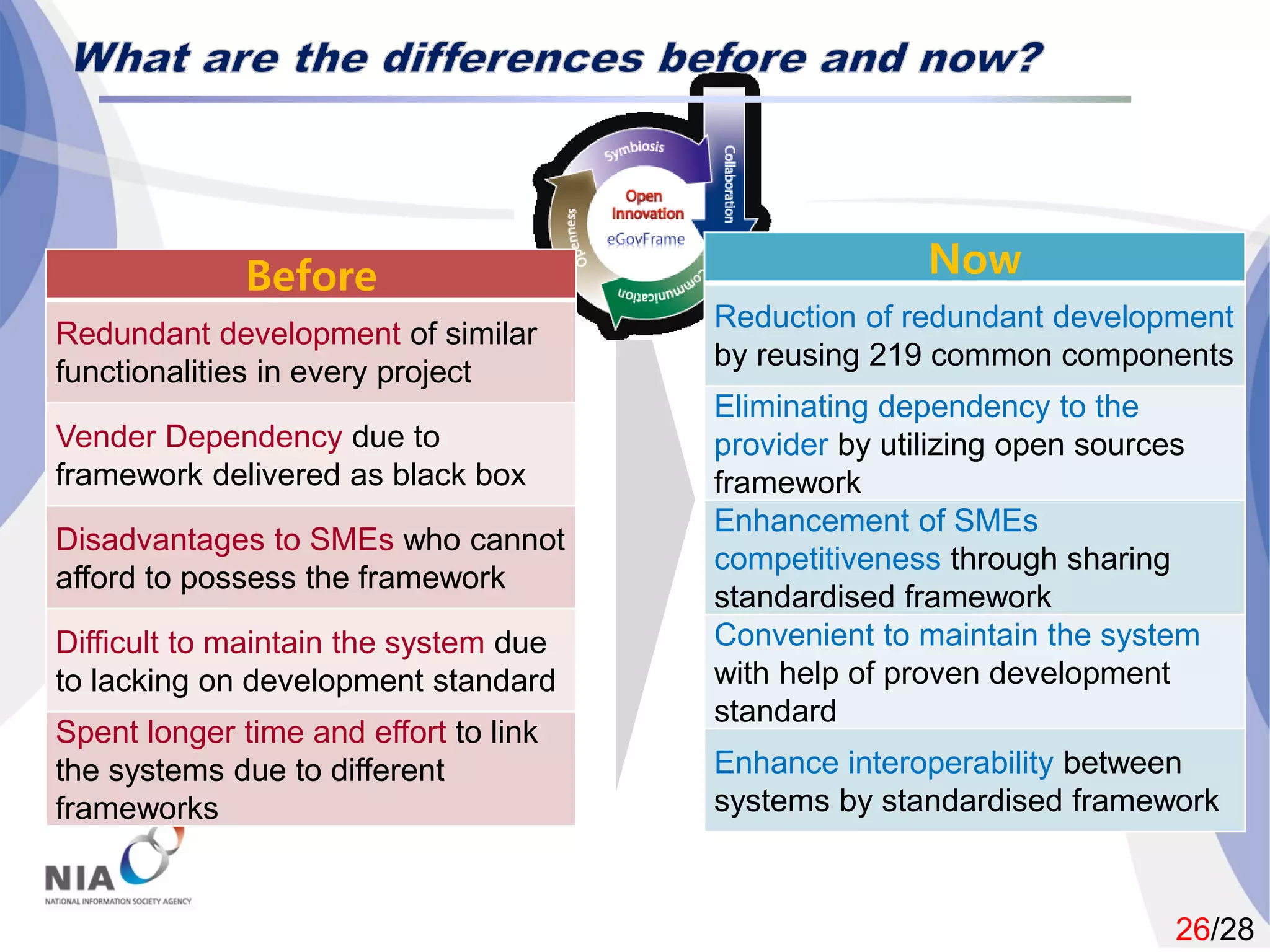
Before
Redundant development of similar
functionalities in every project
Vender Dependency due to
framework delivered as black box
Disadvantages to SMEs who cannot
afford to possess the framework
Difficult to maintain the system due
to lacking on development standard
Spent longer time and effort to link
the systems due to different
frameworks
Now
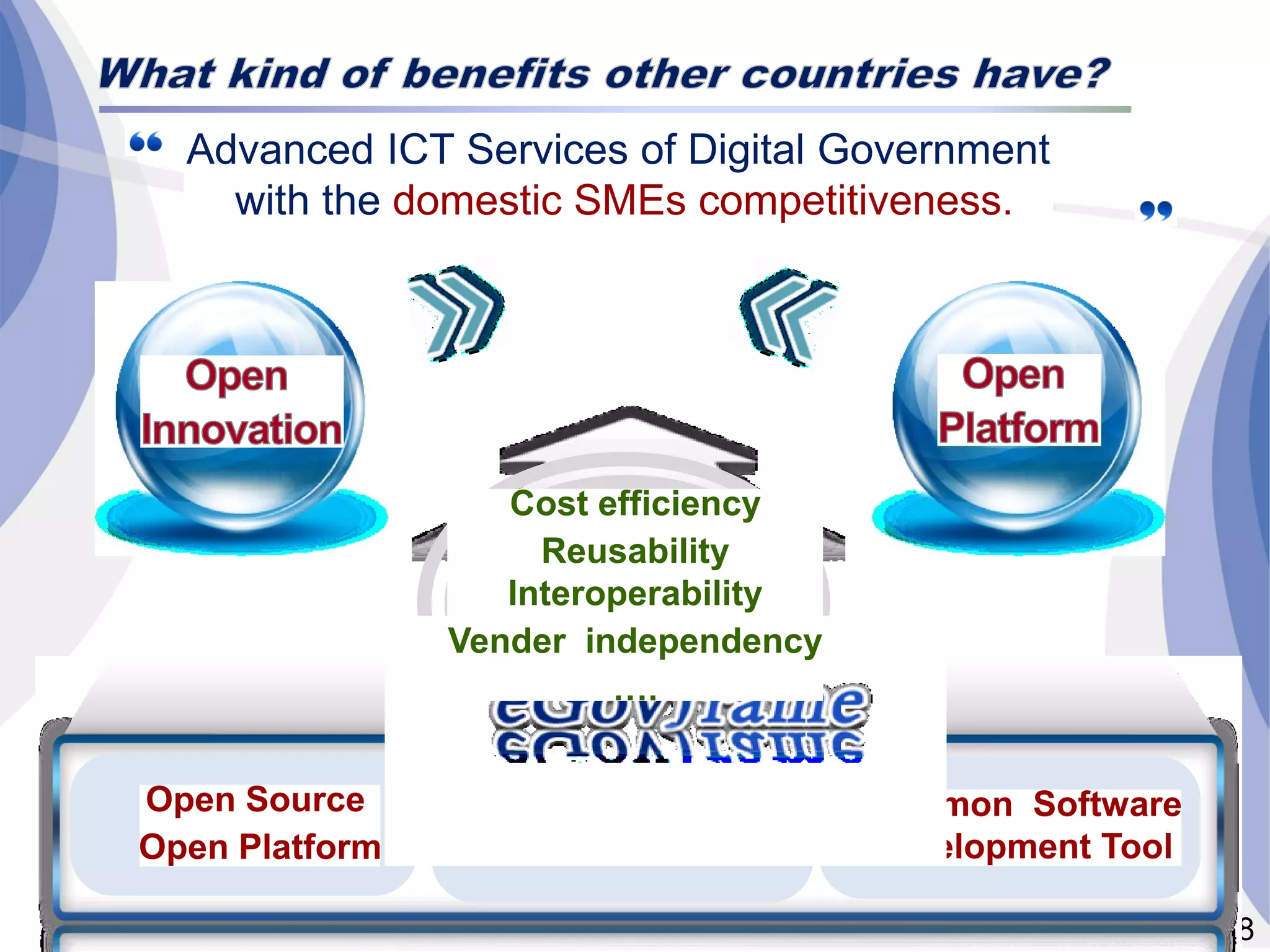
Reduction of redundant development
by reusing 219 common components
Eliminating dependency to the
provider by utilizing open sources
framework
Enhancement of SMEs
competitiveness through sharing
standardised framework
Convenient to maintain the system
with help of proven development
standard
Enhance interoperability between
systems by standardised framework
27/28
28/28

E government standard framework(general)

  • 1.
  • 2.
    2/28 About NIA (www.nia.or.kr) (NationalInformation Society Agency) • A statutory agency to provide an expertise in national IT policy and e-Government projects established in 1987 * Key Role – National Telecommunications and Network Planning – e-Government projects and m-Government services – Project Information Systems Audit – Information Culture & e-Capacity Education – Government Enterprise Architecture and Platform • Government funded for developing National IT services - Annual IT Budget : 241million U$ Dollars(2012), 357 Researchers (2011)
  • 3.
  • 4.
  • 5.
    5/28 Software framework isa special case of software libraries in that they are reusable abstractions of code wrapped in a well-defined API. [Wikipedia] • With Software framework, you can improve 20-30% of development productivity and enhance the quality of e-Government services - Most of technical issues are handled by SW framework Architecture policy Common technical service Common biz service SW Framework <IS development with SW framework><IS development without SW framework> * IS : Information System, SW: Software
  • 6.
    6/28 Some drawbacks wereidentified Software framework become a basic tool for e-Government - 71% of e-Government system before using eGovFrame in Korea Framework unused Framework used 71% 29% * Samsung(SYSTEMiER), LG(LAF/J), SK(Jgarnet), HP(Instant/On enterprise), MS(.NET)
  • 7.
    7/28 Vendor A Vendor A Vendor B Vendor B Vendor C Vendor C Vendor D Vendor D Application 1 Application2 Application 1 Framework 1 Framework 2 Framework 3 Customer RFPRFP Request for H/W, S/W, architecture, and application development Vendor A Vendor A Vendor B Vendor B Vendor C Vendor C Vendor D Vendor D Application 1 Application 2 Application 1 Standard FrameworkStandard Framework Customer RFPRFP Request for application development < Development with vendor’s frameworks> < Development with standard frameworks>
  • 8.
    8/28 e-Government Standard Framework fordeveloping and operating the e-Government system eGovFrame
  • 9.
    9/28 eGovFrame Admini stration Custom Educ ation Land Defen se Forest Statis tics Road Patent Disaster Broad cast Citizen Insur ance Distrib ution Railway Health Food Record Prosec ution Pensio n Itis such an innovative way for governmental organizations to acquire information resource regardless of different sectors eGovFrame as a common platform applicable to all the government sectors
  • 10.
    10/28 Vision Objectives Direction Improve quality ofe-Government services and efficiency of ICT investment Enhance SMEs competitiveness Remove vendor dependency Up-to-date ICT trends Improve Interoperability Reuse common functionalities Standardization • Establish SW framework standard for e-Government • Provide stable technical infrastructure Openness • Ensure the neutrality of eGovFrame • Open all the assets to the public and global Community • Share SW tools and technology by education • Promote the utilization of eGovframe
  • 11.
    11/28 [Major open sources] •Biz.transaction : Spring & 22 •Data : ibatis, Hibernate &1 •Development tool : Eclipse & 3 •Test tool : Junit & 5 •Distribution tool : Maven & 1 •Configuration Management tool : Subversion & 1  Define Open Source Selection Policy Open Source Evaluation Process License with no restriction on distribution and usage  Evaluate candidate open sources(175) Functional/non-functional requirements Constraints for integration and interfaces  Physically test candidate open sources(85) Basic functions Non-functional requirements(SW Quality) BestOpenSourceSelection Final Result 40 open sources selected Policy Setting Policy Setting Logical Test Logical Test Physical Test Physical Test  Define basic functions and architecture Analyze 3 big vendor’s frameworks and e-Gov. projects from 2004 to 2007 54 functions and 219 common components Function Design Function Design
  • 12.
    12/28 A lot ofopinions and issues from the variety of stakeholders Large companies SMEs Government Developers Public organizations
  • 13.
  • 14.
    14/28 eGovFrame consists offour environments - Development, Runtime, Operation and Management Environment Description Development Environment Provides the implementation(coding, debugging), test, distribution and configuration management tools for the effective development of applications based on the eGovFrame Runtime Environment. Runtime Environment Provides common runtime modules for running the SW applications Operation environment Provides operational tools for monitoring and operating SW application based on eGovFrame Management Environment Provides management tools for maintaining and improving efficiently eGovFrame Development Environment Operation Environment SW Developers Management Environment Framework ManagersApplication Operators Runtime Environment SW Applications
  • 15.
    15/28 219 Common Componentsof the reusable software modules
  • 16.
    16/28 eGovFrame covers SDLC(SystemDevelopment Life Cycle)
  • 17.
    17/28 Current eGovFrame Current eGovFrame Mobile eGovFrame Mobile User eXperience(UX) Mobilecommon components Next Version eGovFrame Next Version eGovFrame Mobile eGovFrame is based on eGovFrame that adds functionalities of User eXperience(UX) and mobile components to provide the mobile web service
  • 18.
    18/28 Footer bars Header barsNavbars Formelement gallery Footer bars Footer bars Header bars Icons list icon Basic list Inline buttons Button icons Popup event Button icons Grouped buttons bar m-invoice m-tax m-administration m-tour
  • 19.
    19/28 eGovFrame Functionality Architecture Performance Generate more functionalities AnyFrame LAF/J NEXCORE Define requirements Generate candidate opensources Select open source SWs for evaluation Define criteria Perform assessment (1st and 2nd) Analyze assessment results Verification Process (using PECA methodology combined with ISO 14598) •First assessment : evaluate license, architecture restrictions, requirements •Second assessment : evaluate 7 criteria, namely functionality, reliability, etc AnalysisUse Spring framework in 50% of Java developers worldwide and 80% of Fortune 500 companies
  • 20.
    20/28* IS :Information system (IS with SW framework) Hardware Operating system Middleware Service application Development area (100% done by developers) Development area (100% done by developers) Hardware Operating system Middleware Service application SW framework used (approx. 20 ~ 30%) SW framework used (approx. 20 ~ 30%) Development area (approx. 70~80%) Development area (approx. 70~80%) (IS* without SW framework) Sofware developers focus only on their business logic while all the technical issues are handled by SW framework
  • 21.
    21/28 Provide a consistentdevelopment standards Standardized forms for development deliverables Automatic generation of the source code template
  • 22.
    22/28  Importance oftesting • Finding and fixing bugs is the most expensive software activity. • There are more defects in test cases than in the software itself. • Most forms of testing are less than 30 percent efficient in finding bugs - Capers Jones 'Estimating Software Costs - Create Test Case Report the Results Inspection Reporting
  • 23.
    23/28 Sector Project NameSector Project Name Administration MINWON24(G4C) Resident Resident Services Integration Transportation Metropolitan Rail Transit Management System Statistics Government Data Integration Management System Education National Education Information System Social Security National Insurance Portal System Medical Hospital Strategy Management System Media Broadcasting Telecommunication Integration Information System Information Sharing Public Information Sharing Center Patent 3 Generation Patent Net System Customs Global High-tech Port Logistics System Tax National Tax Office ITSM Enhanced System Agriculture Imported Beef Distribution Channel Monitoring System Health Drug Utilization Review System Land Land Information Management System Culture Next Generation National Assembly Electronic Library System Local Government Integrated Information System Global Hazardous Waste Management System
  • 24.
    24/28 International Recognition International Recognition ICT Competitiveness of ITSMEs ICT Competitiveness of IT SMEs SMEs won 64% among them Diffusion of Standard Framework Diffusion of Standard Framework
  • 25.
  • 26.
    26/28 Before Redundant development ofsimilar functionalities in every project Vender Dependency due to framework delivered as black box Disadvantages to SMEs who cannot afford to possess the framework Difficult to maintain the system due to lacking on development standard Spent longer time and effort to link the systems due to different frameworks Now Reduction of redundant development by reusing 219 common components Eliminating dependency to the provider by utilizing open sources framework Enhancement of SMEs competitiveness through sharing standardised framework Convenient to maintain the system with help of proven development standard Enhance interoperability between systems by standardised framework
  • 27.
  • 28.