E-GOVERNANCE –
OPPORTUNITIES &
CHALLENEGES
Various e-Governance Projects
• Smart Gov: It makes use of e-file instead of paper files. It is implemented in the Andhra
Pradesh Secretariat. It is concerned with streamlining operations, knowledge
management, and workflow automation.
• Khajane Project: It is a project undertaken by the Government of Karnataka. The
project resulted in the computerization of the entire treasury data of the Government
of the State. Some of the noticeable results are that the number of drawing officers
was brought down to around 21,000 from 40000, nearly 2000 staff members were
trained to handle the software, about 200 posts in the department of treasury have
been abolished, and so on.
• Digital India Programme: This programme was started by the Department of
Electronics and Information Technology. The program aimed at empowering the
country by making it digitally developed. The program was implemented in different
phases till 2018. The impact of the agenda is that overall 12,000 rural post offices have
been linked electronically.
• e-Kranti Scheme: It aimed at the expansion of the internet, mobile phones, and
computers to rural areas. The scheme includes the starting up of IT-based jobs in rural
areas and also the linking of the internet to the remote villages of the country. There
are 44 Mission Mode Projects under the e-Kranti program.
• e-Governance in municipalities: It is an initiative done under the umbrella of the overall
National e-Governance Plan and the Jawaharlal Nehru National Urban Renewal Mission.
The program is aimed at increasing the operational working of the Urban Local Bodies.
According to NeGP, Government has decided on four infrastructural pillars for the
implementation of e-governance- State Wide Area Network, State Data Centre, Common
Service Centre, and Service Delivery Gateway.
• Public Distribution System: In PDS, there was the computerization of storage and
movement of food grains, fair price shop automation, redressal of grievances, etc.
• e-Panchayats: The computerization of panchayat is done on a mission mode basis
because the e-governance revolution has not touched the Panchayati Raj Institutions
significantly. To improve the quality of governance in Panchayati Raj Institutions including
6094 Block Panchayats and 633 Zilla Panchayats, the Ministry of Panchayati Raj,
Government of India has initiated the e-governance scheme known as e-panchayats.
• Digi-Locker: It is an initiative introduced by the Government of India under the umbrella
of Digital India. Important documents such as Aadhaar cards, mark sheets, and
certificates can be digitally stored in Digi-locker. Aadhaar number is essentially required
for using Digi-Locker. In 2016, there were 20.13 lakh users of the Digi Locker. The main
purpose behind the initiative is to go paperless and the security of documents that can
be accessed easily from any place and at any time.
Challenges in e-Governance
• Trust: People should trust the Government and they should be comfortable
and confident of the tool and technology that they are using. But due to
fraudulent transactions and other factors, the trust of the people is
compromised which becomes one of the factors responsible for the limited
use of e-governance.
• Digital divide: It refers to the division between the people who have access
to digital technology and the others who don’t have access to it. Economic
poverty is one of the main causes of the digital divide. People are unable to
afford computers.
• Lack of Awareness: Due to the use of digital technology also contributes to
the limited use of e-governance techniques. People are not aware of the
scope of e-governance and depend on intermediaries for its use.
• Cost: In a developing country like India, cost plays a major role in regulating
the use of e-governance.
• Privacy and Security: People are apprehensive about the security and
privacy of their personal data. Government should ensure that no
compromise should be done at that end.
• Accessibility: Due to inadequate infrastructure facilities in rural areas
and language barriers people are unable to access e-governance.
• Low Computer Literacy: More than 90% of India’s population is
digitally illiterate. In addition, the illiterate population comprises 25%
to 30% which is one of the biggest challenges.
• Resistance to Change: Due to the introduction of Information
Technology, a lot of changes have taken place but still, there are
various officials, citizens, and politicians who are resistant to change
and have different opinions regarding e-Governance.
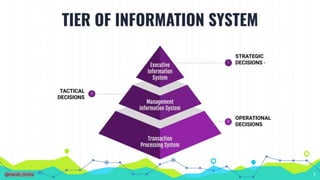
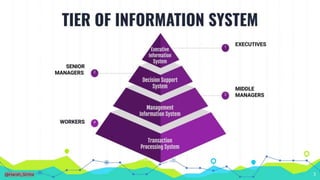
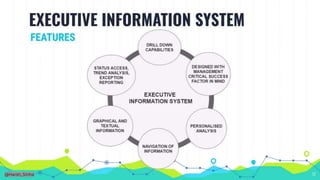
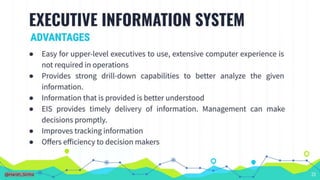
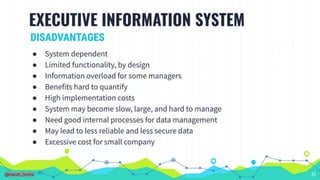
Executive Information System
• An executive information system (EIS) is a decision support system
(DSS) used to assist senior executives in the decision-making process.
It does this by providing easy access to important data needed to
achieve strategic goals in an organization. An EIS normally features
graphical displays on an easy-to-use interface.
E-GOVERNANCE.pptx E-GOVERNANCE E-GOVERNANCE

E-GOVERNANCE.pptx E-GOVERNANCE E-GOVERNANCE

  • 1.
  • 2.
    Various e-Governance Projects •Smart Gov: It makes use of e-file instead of paper files. It is implemented in the Andhra Pradesh Secretariat. It is concerned with streamlining operations, knowledge management, and workflow automation. • Khajane Project: It is a project undertaken by the Government of Karnataka. The project resulted in the computerization of the entire treasury data of the Government of the State. Some of the noticeable results are that the number of drawing officers was brought down to around 21,000 from 40000, nearly 2000 staff members were trained to handle the software, about 200 posts in the department of treasury have been abolished, and so on. • Digital India Programme: This programme was started by the Department of Electronics and Information Technology. The program aimed at empowering the country by making it digitally developed. The program was implemented in different phases till 2018. The impact of the agenda is that overall 12,000 rural post offices have been linked electronically. • e-Kranti Scheme: It aimed at the expansion of the internet, mobile phones, and computers to rural areas. The scheme includes the starting up of IT-based jobs in rural areas and also the linking of the internet to the remote villages of the country. There are 44 Mission Mode Projects under the e-Kranti program.
  • 3.
    • e-Governance inmunicipalities: It is an initiative done under the umbrella of the overall National e-Governance Plan and the Jawaharlal Nehru National Urban Renewal Mission. The program is aimed at increasing the operational working of the Urban Local Bodies. According to NeGP, Government has decided on four infrastructural pillars for the implementation of e-governance- State Wide Area Network, State Data Centre, Common Service Centre, and Service Delivery Gateway. • Public Distribution System: In PDS, there was the computerization of storage and movement of food grains, fair price shop automation, redressal of grievances, etc. • e-Panchayats: The computerization of panchayat is done on a mission mode basis because the e-governance revolution has not touched the Panchayati Raj Institutions significantly. To improve the quality of governance in Panchayati Raj Institutions including 6094 Block Panchayats and 633 Zilla Panchayats, the Ministry of Panchayati Raj, Government of India has initiated the e-governance scheme known as e-panchayats. • Digi-Locker: It is an initiative introduced by the Government of India under the umbrella of Digital India. Important documents such as Aadhaar cards, mark sheets, and certificates can be digitally stored in Digi-locker. Aadhaar number is essentially required for using Digi-Locker. In 2016, there were 20.13 lakh users of the Digi Locker. The main purpose behind the initiative is to go paperless and the security of documents that can be accessed easily from any place and at any time.
  • 4.
    Challenges in e-Governance •Trust: People should trust the Government and they should be comfortable and confident of the tool and technology that they are using. But due to fraudulent transactions and other factors, the trust of the people is compromised which becomes one of the factors responsible for the limited use of e-governance. • Digital divide: It refers to the division between the people who have access to digital technology and the others who don’t have access to it. Economic poverty is one of the main causes of the digital divide. People are unable to afford computers. • Lack of Awareness: Due to the use of digital technology also contributes to the limited use of e-governance techniques. People are not aware of the scope of e-governance and depend on intermediaries for its use. • Cost: In a developing country like India, cost plays a major role in regulating the use of e-governance.
  • 5.
    • Privacy andSecurity: People are apprehensive about the security and privacy of their personal data. Government should ensure that no compromise should be done at that end. • Accessibility: Due to inadequate infrastructure facilities in rural areas and language barriers people are unable to access e-governance. • Low Computer Literacy: More than 90% of India’s population is digitally illiterate. In addition, the illiterate population comprises 25% to 30% which is one of the biggest challenges. • Resistance to Change: Due to the introduction of Information Technology, a lot of changes have taken place but still, there are various officials, citizens, and politicians who are resistant to change and have different opinions regarding e-Governance.
  • 9.
    Executive Information System •An executive information system (EIS) is a decision support system (DSS) used to assist senior executives in the decision-making process. It does this by providing easy access to important data needed to achieve strategic goals in an organization. An EIS normally features graphical displays on an easy-to-use interface.