DynaVox Series 5With InterAACT
Jane FarrallSpeech PathologistAAC Support Services ManagerBarbara LandsbergOccupational TherapistSales and Marketing Director
DynaVox Series 5Express Yourself!
V+, Vmax+ and MaestroFully integrated Win7 technologyBuilt-in WiFi for access to Internet: Free e-mail accountIntegrated web browsing Built-in Bluetooth for text messaging Remote technical support InterAACtLoud speakers and a range of voices
V+ and Vmax+Vmax+ – 30.7cm screenV+ – 21.3cm screen23 X 20 X 7cm2kg32 X 25.4 X 7.6cm3.12kg
MaestroMaestro – 26.4cm screen27cm x 21.6cm x 4.76cm 1.25kg, 1.56kg with Ext. batt
Speak and Be HeardVoices:Nuance Australian voices (Karen & Lee)AT&T Natural VoicesAcapela HQ Child VoicesLegacy Voices:DECtalk by FONIXVeriVoxDigitized SpeechLoud, dual front-facing, high clarity speakers
Connections to our worldEmail -free DynaVox account with every device plus a variety of pre-programmed email pagesComputer access –integrated or with Access ITControl of your environmentText messaging via BluetoothTS Phone access
Accessible to Everyone!Touch screen Visual and Auditory ScanningMouse Pause Joystick SelectionMorse CodeEyeMax option with Vmax+
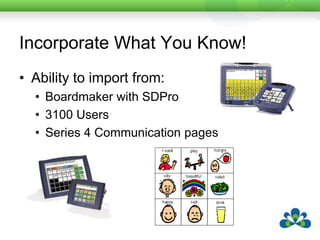
Incorporate What You Know!Ability to import from:Boardmaker with SDPro3100 UsersSeries 4 Communication pages
We Have You CoveredRemote-Access Tech SupportLifelong Tech SupportDynaCarePhone, Chat, and Email SupportGetting Started videos, on-board searchable help, web-based training, 24/7 on-line knowledge base and more!
  Language and Communication Framework   AAC Linking Interaction and Technology
As part of the AAC community, DynaVox believes:At the heart of every AAC device is the language system that is used.That this system should:encourage successful day to day, face to face, real time interactionsupport timely language and literacy skill use and developmentbe age and level appropriate
The InterAACT FrameworkBuilt on two core elements:Language Use Language Structure
Language UseRelies on conversational messages that are designed to encourage interactionIt focuses on interaction, conversation, quick messages and messages that are based on pre-programmed phrases and sentencesAllows the ability to maintain and managethe flow of a conversation
Language StructureBuilding blocks for developing higher level language skills Includes grammatical components that are designed for language and literacy learningAllows composition of novel messages for either spoken or written communicationKeyboards, core word vocabularies and dictionaries
Why Language Use and Language Structure? To provide a balance Every system should support successful day to day “language use” as well as supporting the “language structure” elements needed for generating novel messages and developing and using language and literacy skills
Language Use – quick access to messagesCommon ConstructionsMessages that allow me to interact quickly in a conversation in a particular situation Watching TVBedtimeQuickfires/Generic small talk (Beukelman)Messages that allow me to interact quickly in any conversation any time, any placeFillersInterjectionsGeneric Comments
Young Child  Quickfires
Teen Quickfires
The InterAACT FrameworkRelies on the understanding and use of the continuum of communication independence Segmented by age to include communication across the lifespan.
The InterAACT Framework3 Broad levels of communicative independence:Emergent:  (Beginner; partner dependent)Contextual:  (transitional; context-dependent)Independent: (creative; independent)
How do these levels affect content presentationEmergent:  Scenes are simple and primary and set the context for interactionFew levels to traversePrimarily functional utterancesFacilitator master for partner assisted/partner dependent communication within context
How do these levels affect content presentationContext DependentScenes are simple and primary and set the context for interactionGreater number of levels to traverseIntroduction of message building using common constructionsIncrease in the number of utterances presentedBroader representation of language structure using GatewayFacilitator master for partner assisted navigation
How do these levels affect content presentationIndependentScenes play a role for Young Child, Child, and to some extent Teen due to the anticipated literacy levels.  All other age ranges are text based.Equally reliant on Structure and UseLinguistically complex skills based on the norm for the age range
Skill Levels within The ContinuumChanges between these levels take into consideration many different skills:  Level of awarenessCommunicative intentWorld knowledgeMemory skillsSymbolic representation skillsMetacognitive skills
Presentation of Communication Pages
EmergentScenes are simple and primary and set the context for interactionFew levels to traversePrimarily functional utterancesFacilitator master for partner assisted/partner dependent communication
Context DependentScenes are simple and primary and set the context for interactionGreater number of levels to traverseIntroduction of message building using common constructionsIncrease in the number of utterances presentedBroader representation of language structure using GatewayFacilitator master for partner assisted navigation
IndependentScenes play a role for Young Child, Child, and to some extent Teen due to the anticipated literacy levels.  All other age ranges are text basedEqually reliant on Structure and UseLinguistically complex skills based on the norm for the age range
Age RangesFor each level of communication independence, the InterAACT system supports “5 life stages”Differences in these “stages” determine vocabulary selection, typical range of contexts, and social roles (rituals) represented.
Backgrounds
New Symbols
InterAACT is:Interactive and context basedA unique work based on solid yet diverse pieces of research from a wide variety of fieldsAbout the joint construction of meaning and sees communication as co-constructed by both partners in the interaction
Visual Scene DisplaysDifferent areas of researchYoung children (2 – 7 years)*People with aphasia*People with Autism Spectrum DisorderVSDs can be used by “groups [who] are unserved or underserved by current AAC technologies” Blackstone, 2006*Sponsored by AAC RERC
VSDs and young childrenJanice Light and Kathryn DragerSeries of research studies over a number of yearsLooked at difficulties children with typical development have with existing AAC systemsCurrently investigating VSDs to support the language and communication development in young children with severe communication impairments
VSDs in AphasiaBeukelman et al have been investigating how VSDs support the social conversations of individuals with severe aphasia
VSDs and children with ASDVisual scene displays have tremendous potential as a way to improve communication and communication instruction for persons with autism spectrum disordersCan be used successfully as aided language displaysUsing visual scenes to provide elaboration about the surroundings, people, and structure of activities gives those on the autism spectrum the greatest amount of support to safely and effectively interact in their environment (Shane, 2006)

DynaVox Series 5 Hands-On training

  • 2.
  • 3.
    Jane FarrallSpeech PathologistAACSupport Services ManagerBarbara LandsbergOccupational TherapistSales and Marketing Director
  • 4.
  • 5.
    V+, Vmax+ andMaestroFully integrated Win7 technologyBuilt-in WiFi for access to Internet: Free e-mail accountIntegrated web browsing Built-in Bluetooth for text messaging Remote technical support InterAACtLoud speakers and a range of voices
  • 6.
    V+ and Vmax+Vmax+– 30.7cm screenV+ – 21.3cm screen23 X 20 X 7cm2kg32 X 25.4 X 7.6cm3.12kg
  • 8.
    MaestroMaestro – 26.4cmscreen27cm x 21.6cm x 4.76cm 1.25kg, 1.56kg with Ext. batt
  • 9.
    Speak and BeHeardVoices:Nuance Australian voices (Karen & Lee)AT&T Natural VoicesAcapela HQ Child VoicesLegacy Voices:DECtalk by FONIXVeriVoxDigitized SpeechLoud, dual front-facing, high clarity speakers
  • 10.
    Connections to ourworldEmail -free DynaVox account with every device plus a variety of pre-programmed email pagesComputer access –integrated or with Access ITControl of your environmentText messaging via BluetoothTS Phone access
  • 11.
    Accessible to Everyone!Touchscreen Visual and Auditory ScanningMouse Pause Joystick SelectionMorse CodeEyeMax option with Vmax+
  • 12.
    Incorporate What YouKnow!Ability to import from:Boardmaker with SDPro3100 UsersSeries 4 Communication pages
  • 13.
    We Have YouCoveredRemote-Access Tech SupportLifelong Tech SupportDynaCarePhone, Chat, and Email SupportGetting Started videos, on-board searchable help, web-based training, 24/7 on-line knowledge base and more!
  • 14.
    Languageand Communication Framework AAC Linking Interaction and Technology
  • 15.
    As part ofthe AAC community, DynaVox believes:At the heart of every AAC device is the language system that is used.That this system should:encourage successful day to day, face to face, real time interactionsupport timely language and literacy skill use and developmentbe age and level appropriate
  • 16.
    The InterAACT FrameworkBuilton two core elements:Language Use Language Structure
  • 17.
    Language UseRelies onconversational messages that are designed to encourage interactionIt focuses on interaction, conversation, quick messages and messages that are based on pre-programmed phrases and sentencesAllows the ability to maintain and managethe flow of a conversation
  • 18.
    Language StructureBuilding blocksfor developing higher level language skills Includes grammatical components that are designed for language and literacy learningAllows composition of novel messages for either spoken or written communicationKeyboards, core word vocabularies and dictionaries
  • 19.
    Why Language Useand Language Structure? To provide a balance Every system should support successful day to day “language use” as well as supporting the “language structure” elements needed for generating novel messages and developing and using language and literacy skills
  • 20.
    Language Use –quick access to messagesCommon ConstructionsMessages that allow me to interact quickly in a conversation in a particular situation Watching TVBedtimeQuickfires/Generic small talk (Beukelman)Messages that allow me to interact quickly in any conversation any time, any placeFillersInterjectionsGeneric Comments
  • 21.
    Young Child Quickfires
  • 22.
  • 23.
    The InterAACT FrameworkRelieson the understanding and use of the continuum of communication independence Segmented by age to include communication across the lifespan.
  • 24.
    The InterAACT Framework3Broad levels of communicative independence:Emergent: (Beginner; partner dependent)Contextual: (transitional; context-dependent)Independent: (creative; independent)
  • 25.
    How do theselevels affect content presentationEmergent: Scenes are simple and primary and set the context for interactionFew levels to traversePrimarily functional utterancesFacilitator master for partner assisted/partner dependent communication within context
  • 26.
    How do theselevels affect content presentationContext DependentScenes are simple and primary and set the context for interactionGreater number of levels to traverseIntroduction of message building using common constructionsIncrease in the number of utterances presentedBroader representation of language structure using GatewayFacilitator master for partner assisted navigation
  • 27.
    How do theselevels affect content presentationIndependentScenes play a role for Young Child, Child, and to some extent Teen due to the anticipated literacy levels. All other age ranges are text based.Equally reliant on Structure and UseLinguistically complex skills based on the norm for the age range
  • 28.
    Skill Levels withinThe ContinuumChanges between these levels take into consideration many different skills: Level of awarenessCommunicative intentWorld knowledgeMemory skillsSymbolic representation skillsMetacognitive skills
  • 29.
  • 30.
    EmergentScenes are simpleand primary and set the context for interactionFew levels to traversePrimarily functional utterancesFacilitator master for partner assisted/partner dependent communication
  • 31.
    Context DependentScenes aresimple and primary and set the context for interactionGreater number of levels to traverseIntroduction of message building using common constructionsIncrease in the number of utterances presentedBroader representation of language structure using GatewayFacilitator master for partner assisted navigation
  • 32.
    IndependentScenes play arole for Young Child, Child, and to some extent Teen due to the anticipated literacy levels. All other age ranges are text basedEqually reliant on Structure and UseLinguistically complex skills based on the norm for the age range
  • 33.
    Age RangesFor eachlevel of communication independence, the InterAACT system supports “5 life stages”Differences in these “stages” determine vocabulary selection, typical range of contexts, and social roles (rituals) represented.
  • 35.
  • 38.
  • 39.
    InterAACT is:Interactive andcontext basedA unique work based on solid yet diverse pieces of research from a wide variety of fieldsAbout the joint construction of meaning and sees communication as co-constructed by both partners in the interaction
  • 40.
    Visual Scene DisplaysDifferentareas of researchYoung children (2 – 7 years)*People with aphasia*People with Autism Spectrum DisorderVSDs can be used by “groups [who] are unserved or underserved by current AAC technologies” Blackstone, 2006*Sponsored by AAC RERC
  • 41.
    VSDs and youngchildrenJanice Light and Kathryn DragerSeries of research studies over a number of yearsLooked at difficulties children with typical development have with existing AAC systemsCurrently investigating VSDs to support the language and communication development in young children with severe communication impairments
  • 42.
    VSDs in AphasiaBeukelmanet al have been investigating how VSDs support the social conversations of individuals with severe aphasia
  • 43.
    VSDs and childrenwith ASDVisual scene displays have tremendous potential as a way to improve communication and communication instruction for persons with autism spectrum disordersCan be used successfully as aided language displaysUsing visual scenes to provide elaboration about the surroundings, people, and structure of activities gives those on the autism spectrum the greatest amount of support to safely and effectively interact in their environment (Shane, 2006)