SEAR
C
H
AND RE
S
CUE
O
X
F O R D S H I R
E
A L S A R
Dynamic Risk
Assessment
David Webster
12th March 2013
Dynamic Risk
Assessment
Covers: ST 1.1.2 and TL 3.1.1
Static Risk Assessment
 It’s all about creating:
 A Safe place for
 Safe People
 Who Follow Safe Procedures
Dynamic Risk Assessment
 It’s all about creating:
 A Safe place for
 Safe People
 Who Follow Safe Procedures
 We can’t control where someone goes
missing
 We can’t put procedures in place for every
situation.
Why is it useful to do a
Dynamic Risk Assessment?
 It reduces the risk you’re exposed to:
 You don’t want to get hurt
 We don’t want you to get hurt
 None of us want anyone else to get hurt
 If something goes wrong you’ll at least be
able to justify why you did it.
 ALSAR says so.
 It’s what you’ll be doing anyway when you
think before you act.
Who needs to be a:
“Safe Person”
 A) Search Controller
 B) Team Leader
 C) Search Technician
Who needs to be a:
“Safe Person”
 A) Search Controller
 B) Team Leader
 C) Search Technician
 D) ALL OF THE ABOVE
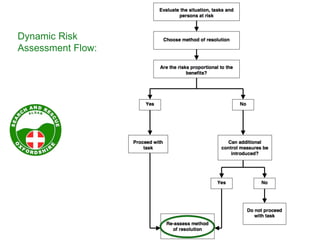
Dynamic Risk
Assessment Flow:
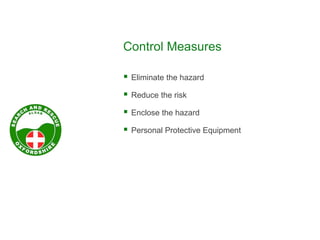
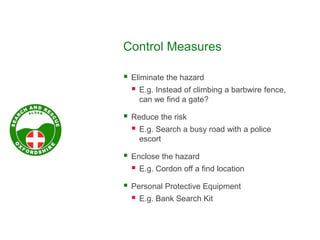
Control Measures
 Eliminate the hazard
 Reduce the risk
 Enclose the hazard
 Personal Protective Equipment
Control Measures
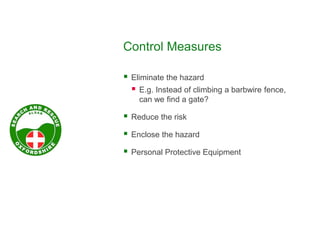
 Eliminate the hazard
 E.g. Instead of climbing a barbwire fence,
can we find a gate?
 Reduce the risk
 Enclose the hazard
 Personal Protective Equipment
Control Measures
 Eliminate the hazard
 E.g. Instead of climbing a barbwire fence,
can we find a gate?
 Reduce the risk
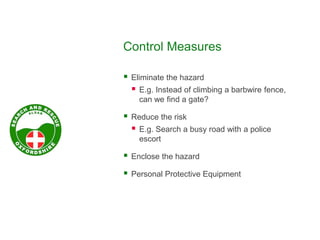
 E.g. Search a busy road with a police
escort
 Enclose the hazard
 Personal Protective Equipment
Control Measures
 Eliminate the hazard
 E.g. Instead of climbing a barbwire fence,
can we find a gate?
 Reduce the risk
 E.g. Search a busy road with a police
escort
 Enclose the hazard
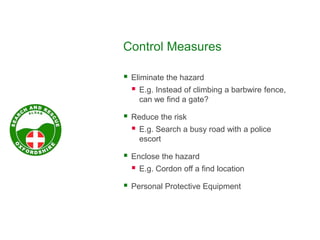
 E.g. Cordon off a find location
 Personal Protective Equipment
Control Measures
 Eliminate the hazard
 E.g. Instead of climbing a barbwire fence,
can we find a gate?
 Reduce the risk
 E.g. Search a busy road with a police
escort
 Enclose the hazard
 E.g. Cordon off a find location
 Personal Protective Equipment
 E.g. Bank Search Kit
Dynamic Risk
Assessment Flow:
Test
Every search is a
Test
Every search is a
Test
If you do something without thinking about the risk and
hurt yourself or someone else, you’ve failed

Dynamic Risk Assessment, March 2013

  • 1.
    SEAR C H AND RE S CUE O X F OR D S H I R E A L S A R Dynamic Risk Assessment David Webster 12th March 2013
  • 2.
  • 3.
    Static Risk Assessment It’s all about creating:  A Safe place for  Safe People  Who Follow Safe Procedures
  • 4.
    Dynamic Risk Assessment It’s all about creating:  A Safe place for  Safe People  Who Follow Safe Procedures  We can’t control where someone goes missing  We can’t put procedures in place for every situation.
  • 5.
    Why is ituseful to do a Dynamic Risk Assessment?  It reduces the risk you’re exposed to:  You don’t want to get hurt  We don’t want you to get hurt  None of us want anyone else to get hurt  If something goes wrong you’ll at least be able to justify why you did it.  ALSAR says so.  It’s what you’ll be doing anyway when you think before you act.
  • 6.
    Who needs tobe a: “Safe Person”  A) Search Controller  B) Team Leader  C) Search Technician
  • 7.
    Who needs tobe a: “Safe Person”  A) Search Controller  B) Team Leader  C) Search Technician  D) ALL OF THE ABOVE
  • 8.
  • 9.
    Control Measures  Eliminatethe hazard  Reduce the risk  Enclose the hazard  Personal Protective Equipment
  • 10.
    Control Measures  Eliminatethe hazard  E.g. Instead of climbing a barbwire fence, can we find a gate?  Reduce the risk  Enclose the hazard  Personal Protective Equipment
  • 11.
    Control Measures  Eliminatethe hazard  E.g. Instead of climbing a barbwire fence, can we find a gate?  Reduce the risk  E.g. Search a busy road with a police escort  Enclose the hazard  Personal Protective Equipment
  • 12.
    Control Measures  Eliminatethe hazard  E.g. Instead of climbing a barbwire fence, can we find a gate?  Reduce the risk  E.g. Search a busy road with a police escort  Enclose the hazard  E.g. Cordon off a find location  Personal Protective Equipment
  • 13.
    Control Measures  Eliminatethe hazard  E.g. Instead of climbing a barbwire fence, can we find a gate?  Reduce the risk  E.g. Search a busy road with a police escort  Enclose the hazard  E.g. Cordon off a find location  Personal Protective Equipment  E.g. Bank Search Kit
  • 14.
  • 15.
  • 16.
  • 17.
    Every search isa Test If you do something without thinking about the risk and hurt yourself or someone else, you’ve failed

Editor's Notes

  • #3 Tonight we’re looking at Dynamic Risk Assessment, or DRA. For those keeping notes (and you all should, there’s going to be a test), it covers ALSAR’s Search Tech requirements 1.1.2 and the Team Leader requirements 3.1.1. I’ll mention those numbers more when we look at D4H I’ve based it off the training that the Met Police Service training (purely because I found it online after someone put a Freedom Of Information request in to get it).
  • #4 Think about the typical static risk assessment scenario – a factory creating stuff. People know what they’re doing. You control risk by making the working environment as safe as you can by removing or reducing hazards, you train people up so that they know what they’re doing and you put procedures in place so that the things they are doing follow set plans that have been reviewed and agreed as safe. That management of risk doesn’t reflect the environment that we work in any more than it applies to Firemen or Policemen.
  • #5 The HSE recognised that and came up with the concept of a DRA. I think they borrowed it from the New York Fire Dept but it basically put in writing what lots of people had been doing anyway. If you can’t control where you’re putting people, or exactly what those people are doing you need to train them to be safe and you need to trust that they’ll make the right decisions.
  • #7 In a lowland search environment, who needs to be the safe person?
  • #8 Everyone! We need to be able to trust you ALL to make safe decisions to look after yourself, your team, the public and the Misper. We’ve not actually spoken about
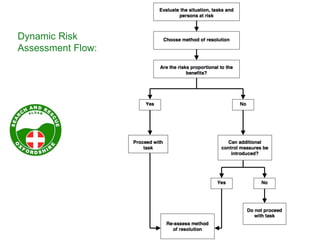
  • #9 Evaluation: Tasks: - Normally search a sector Who is at risk: - You, The whole team, another team, the public, or the misper? Plan: What can you do to reduce that risk? Decide: Does the plan mean it’s safe enough? Are the risks proportional to the benefits? - What might the benefits of an action be? - Who decides if the risk is proportional? - It depends on the situation - ALSAR (you can’t jump into the river to save someone), - MOU (the Police say that we can’t), - Search Controller (we may say that this area is off limits) - Team Leader (the road is too busy) - Search Tech (that bank is too steep) If it’s not safe what control measures do we have available? - (We’ll look at them in a second) If you can’t reduce the risk to a safe level, then don’t proceed. If you can, then continue to assess the situation.
  • #10 A control measure is something that you put in place to reduce or remove the risk. If you can get rid of the hazard completely, that would be ideal, but not always possible. Is there a way you’re able to reduce the risk posed by that hazard? Are other people at danger from the hazard, can you enclose is? If you can’t do anything else, is there some PPE you can get/take to reduce the impact of that risk? Example of something you may do to eliminate a hazard?
  • #11 Eliminate a hazard. Don’t climb a fence you don’t need to. Don’t carry something heavy further than you need to. Example of something to complete the same task but with reduced risk?
  • #12 Reduce risk: - get a police escort to search along side a busy road - ask someone else to help you carry something heavy What hazards might we want to enclose and how would we do that?
  • #13 What hazards are we protecting people from? (psychological) What situations could PPE help with?
  • #15 Coming back to the flow chat: Why reassess the risk? Because the situation is dynamic. There’s no point the response being static. We fully expect that the evaluation will happen quickly, sometimes under duress, sometimes with incomplete information. It may be that with hindsight you didn’t choose the best course of action – that’s okay, as long as the risk has been assessed and you’ve chosen a reasonable method to resolve it, you’ve done what you can.
  • #17 The test comes every time you go our on a search or on an exercise: If you do something without thinking about the risk and hurt yourself or someone else, you’ve failed. Any questions? Tea break time.
  • #18 The test comes every time you go our on a search or on an exercise: If you do something without thinking about the risk and hurt yourself or someone else, you’ve failed. Any questions? Tea break time.