International Research Journal of Engineering and Technology (IRJET) e-ISSN: 2395-0056
Volume: 09 Issue: 08 | Aug 2022 www.irjet.net p-ISSN: 2395-0072
© 2022, IRJET | Impact Factor value: 7.529 | ISO 9001:2008 Certified Journal | Page 1321
Dynamic Data Masking Mechanism on Cloud Platform
Chirag Dave, Deepa Dave
Chirag Dave, Program Manager, Department of Education
Deepa Dave, Snowflake Lead Consultant, Under Armor
---------------------------------------------------------------------***---------------------------------------------------------------------
Abstract - In recent years, Cloud Computing is gaining
popularity and has changed the overall business computing
environment. It is flexible and cost effective. However, this
change has brought its own set of Data Security challenges.
In this paper, the author has focused on explaining the
application of Dynamic Data Masking policies using ELT tool
named Data Build Tool (DBT). Thispaperattemptstodescribe
a detailed approach to create the DDM policies on Cloud
Datawarehouse (Snowflake) andapplyingthoseDDMpolicies
to DBT models which will selectively mask the plain text data
and view columns at query time within Snowflake before
sharing it outside the organization. This white paper
addresses the Data masking aspects for most of the projects
which use Snowflake and DBT as their Data Warehouse and
ELT tool respectively.
Key Words: Cloud Computing, Data Security, Data
Sharing, Data Masking, Data Build Tool, Snowflake, DBT
Macro, DDM Policies
1. INTRODUCTION
With humongous Data Sharing capabilities on Cloud
Platform, Organization’s sensitive information has been the
utmost threat, as most of third-party infrastructure can
access this information remotelyandfromanywherearound
the world. One of the instrumental solutions to overcome
this Data Security threat, is to protect this sensitive
information from unauthorized access is with the
implementation of Dynamic Data Masking(DDM)onCloud
Data Warehouse.
2. BACKGROUND OF THE PROJECT
There are numerous projects that have sensitive Customer
and Personally Identifiable Information, which requires
special Authentication for anyone in the organization to
access it. The Customer may also be responsible to notshare
this information with Third Party vendors and Consultants.
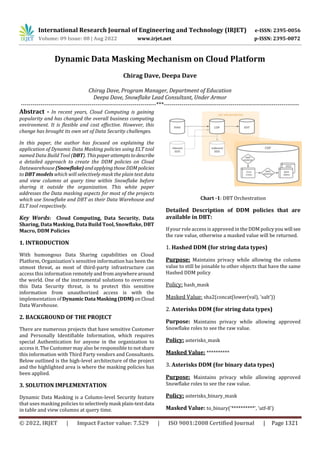
Below outlined is the high-level architecture of the project
and the highlighted area is where the masking policies has
been applied.
3. SOLUTION IMPLEMENTATION
Dynamic Data Masking is a Column-level Security feature
that uses masking policies to selectivelymask plain-textdata
in table and view columns at query time.
Chart -1: DBT Orchestration
Detailed Description of DDM policies that are
available in DBT:
If your role access is approved in the DDMpolicyyou will see
the raw value, otherwise a masked value will be returned.
1. Hashed DDM (for string data types)
Purpose: Maintains privacy while allowing the column
value to still be joinable to other objects that have the same
Hashed DDM policy
Policy: hash_mask
Masked Value: sha2(concat(lower(val), 'salt'))
2. Asterisks DDM (for string data types)
Purpose: Maintains privacy while allowing approved
Snowflake roles to see the raw value.
Policy: asterisks_mask
Masked Value: **********
3. Asterisks DDM (for binary data types)
Purpose: Maintains privacy while allowing approved
Snowflake roles to see the raw value.
Policy: asterisks_binary_mask
Masked Value: to_binary('**********', 'utf-8')
International Research Journal of Engineering and Technology (IRJET) e-ISSN: 2395-0056
Volume: 09 Issue: 08 | Aug 2022 www.irjet.net p-ISSN: 2395-0072
© 2022, IRJET | Impact Factor value: 7.529 | ISO 9001:2008 Certified Journal | Page 1322
STEPS TO CREATE MASKING POLICIES IN
SNOWFLAKE:
Based on business requirementandthewaycustomer wants
to encrypt sensitive information can be implemented using
below steps in Snowflake. Customer can choose one of the
DDM policies outlined above and mask the data accordingly.
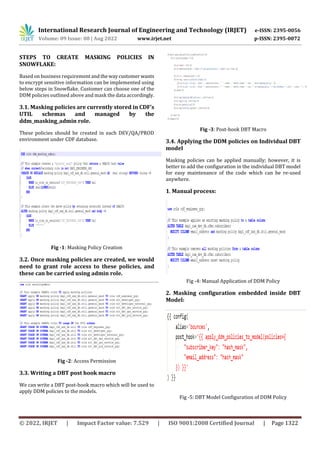
3.1. Masking policies are currently stored in CDF’s
UTIL schemas and managed by the
ddm_masking_admin role.
These policies should be created in each DEV/QA/PROD
environment under CDF database.
Fig -1: Masking Policy Creation
3.2. Once masking policies are created, we would
need to grant role access to these policies, and
these can be carried using admin role.
Fig -2: Access Permission
3.3. Writing a DBT post hook macro
We can write a DBT post-hook macro which will be used to
apply DDM policies to the models.
Fig -3: Post-hook DBT Macro
3.4. Applying the DDM policies on Individual DBT
model
Masking policies can be applied manually; however, it is
better to add the configuration in the individual DBT model
for easy maintenance of the code which can be re-used
anywhere.
1. Manual process:
Fig -4: Manual Application of DDM Policy
2. Masking configuration embedded inside DBT
Model:
Fig -5: DBT Model Configuration of DDM Policy
International Research Journal of Engineering and Technology (IRJET) e-ISSN: 2395-0056
Volume: 09 Issue: 08 | Aug 2022 www.irjet.net p-ISSN: 2395-0072
© 2022, IRJET | Impact Factor value: 7.529 | ISO 9001:2008 Certified Journal | Page 1323
This is how data looks like after the DDM policies
implementation.
Fig -6: Masking Implementation on Table
We can also apply DDM Policies to All DBT Models in a
specific Folder by calling the post-hook macro created in
Step 2. Folder level implementation can be done in
dbt_project.yml which is the DBT configuration file.
The policies parameter is set to apply the hash_mask policy
to column subscriber_key and asterisks_mask policy to
column email_address.
Note: The columns subscriber_keyandemail_addressshould
exist in ALL models.
Fig -6: dbt_project.yml configuration
3.5. Manage the DDM policies
Once the DDM policies are implemented in DBT Models, we
can easily outsource the data by creating Snowflake’s
Outbound secure data share.
4. CONCLUSION
Data masking is essential to organizations in adhering and
implementing various compliances. Some of the compliance
policies include HIPAA, Legal Compliances, IT and Data
Sharing Compliances, Financial and Intellectual Property
Compliances, etc.
Data Masking is one of the primary methods of storing or
transforming the data, while making it inaccessible to non-
authorized users within or outside of Organization.
Benefits of the approach mentioned in this white paper are:
 Non-availability of Raw Data in case of Data Loss
 Data protection from Insider hazard within
Organization
 Secured data transfer in case of Insecure interfaces
for data in motion
 Minimal maintenance of the DBT code
 Reusability of the code is unique
 Masked Data can be used for Joins and
Transformations (under special conditions)
REFERENCES
[1] Snowflake Community Documentation.
[2] DBT Cloud Community
[3] Slack Community

Dynamic Data Masking Mechanism on Cloud Platform

  • 1.
    International Research Journalof Engineering and Technology (IRJET) e-ISSN: 2395-0056 Volume: 09 Issue: 08 | Aug 2022 www.irjet.net p-ISSN: 2395-0072 © 2022, IRJET | Impact Factor value: 7.529 | ISO 9001:2008 Certified Journal | Page 1321 Dynamic Data Masking Mechanism on Cloud Platform Chirag Dave, Deepa Dave Chirag Dave, Program Manager, Department of Education Deepa Dave, Snowflake Lead Consultant, Under Armor ---------------------------------------------------------------------***--------------------------------------------------------------------- Abstract - In recent years, Cloud Computing is gaining popularity and has changed the overall business computing environment. It is flexible and cost effective. However, this change has brought its own set of Data Security challenges. In this paper, the author has focused on explaining the application of Dynamic Data Masking policies using ELT tool named Data Build Tool (DBT). Thispaperattemptstodescribe a detailed approach to create the DDM policies on Cloud Datawarehouse (Snowflake) andapplyingthoseDDMpolicies to DBT models which will selectively mask the plain text data and view columns at query time within Snowflake before sharing it outside the organization. This white paper addresses the Data masking aspects for most of the projects which use Snowflake and DBT as their Data Warehouse and ELT tool respectively. Key Words: Cloud Computing, Data Security, Data Sharing, Data Masking, Data Build Tool, Snowflake, DBT Macro, DDM Policies 1. INTRODUCTION With humongous Data Sharing capabilities on Cloud Platform, Organization’s sensitive information has been the utmost threat, as most of third-party infrastructure can access this information remotelyandfromanywherearound the world. One of the instrumental solutions to overcome this Data Security threat, is to protect this sensitive information from unauthorized access is with the implementation of Dynamic Data Masking(DDM)onCloud Data Warehouse. 2. BACKGROUND OF THE PROJECT There are numerous projects that have sensitive Customer and Personally Identifiable Information, which requires special Authentication for anyone in the organization to access it. The Customer may also be responsible to notshare this information with Third Party vendors and Consultants. Below outlined is the high-level architecture of the project and the highlighted area is where the masking policies has been applied. 3. SOLUTION IMPLEMENTATION Dynamic Data Masking is a Column-level Security feature that uses masking policies to selectivelymask plain-textdata in table and view columns at query time. Chart -1: DBT Orchestration Detailed Description of DDM policies that are available in DBT: If your role access is approved in the DDMpolicyyou will see the raw value, otherwise a masked value will be returned. 1. Hashed DDM (for string data types) Purpose: Maintains privacy while allowing the column value to still be joinable to other objects that have the same Hashed DDM policy Policy: hash_mask Masked Value: sha2(concat(lower(val), 'salt')) 2. Asterisks DDM (for string data types) Purpose: Maintains privacy while allowing approved Snowflake roles to see the raw value. Policy: asterisks_mask Masked Value: ********** 3. Asterisks DDM (for binary data types) Purpose: Maintains privacy while allowing approved Snowflake roles to see the raw value. Policy: asterisks_binary_mask Masked Value: to_binary('**********', 'utf-8')
  • 2.
    International Research Journalof Engineering and Technology (IRJET) e-ISSN: 2395-0056 Volume: 09 Issue: 08 | Aug 2022 www.irjet.net p-ISSN: 2395-0072 © 2022, IRJET | Impact Factor value: 7.529 | ISO 9001:2008 Certified Journal | Page 1322 STEPS TO CREATE MASKING POLICIES IN SNOWFLAKE: Based on business requirementandthewaycustomer wants to encrypt sensitive information can be implemented using below steps in Snowflake. Customer can choose one of the DDM policies outlined above and mask the data accordingly. 3.1. Masking policies are currently stored in CDF’s UTIL schemas and managed by the ddm_masking_admin role. These policies should be created in each DEV/QA/PROD environment under CDF database. Fig -1: Masking Policy Creation 3.2. Once masking policies are created, we would need to grant role access to these policies, and these can be carried using admin role. Fig -2: Access Permission 3.3. Writing a DBT post hook macro We can write a DBT post-hook macro which will be used to apply DDM policies to the models. Fig -3: Post-hook DBT Macro 3.4. Applying the DDM policies on Individual DBT model Masking policies can be applied manually; however, it is better to add the configuration in the individual DBT model for easy maintenance of the code which can be re-used anywhere. 1. Manual process: Fig -4: Manual Application of DDM Policy 2. Masking configuration embedded inside DBT Model: Fig -5: DBT Model Configuration of DDM Policy
  • 3.
    International Research Journalof Engineering and Technology (IRJET) e-ISSN: 2395-0056 Volume: 09 Issue: 08 | Aug 2022 www.irjet.net p-ISSN: 2395-0072 © 2022, IRJET | Impact Factor value: 7.529 | ISO 9001:2008 Certified Journal | Page 1323 This is how data looks like after the DDM policies implementation. Fig -6: Masking Implementation on Table We can also apply DDM Policies to All DBT Models in a specific Folder by calling the post-hook macro created in Step 2. Folder level implementation can be done in dbt_project.yml which is the DBT configuration file. The policies parameter is set to apply the hash_mask policy to column subscriber_key and asterisks_mask policy to column email_address. Note: The columns subscriber_keyandemail_addressshould exist in ALL models. Fig -6: dbt_project.yml configuration 3.5. Manage the DDM policies Once the DDM policies are implemented in DBT Models, we can easily outsource the data by creating Snowflake’s Outbound secure data share. 4. CONCLUSION Data masking is essential to organizations in adhering and implementing various compliances. Some of the compliance policies include HIPAA, Legal Compliances, IT and Data Sharing Compliances, Financial and Intellectual Property Compliances, etc. Data Masking is one of the primary methods of storing or transforming the data, while making it inaccessible to non- authorized users within or outside of Organization. Benefits of the approach mentioned in this white paper are:  Non-availability of Raw Data in case of Data Loss  Data protection from Insider hazard within Organization  Secured data transfer in case of Insecure interfaces for data in motion  Minimal maintenance of the DBT code  Reusability of the code is unique  Masked Data can be used for Joins and Transformations (under special conditions) REFERENCES [1] Snowflake Community Documentation. [2] DBT Cloud Community [3] Slack Community