

Privacy by Design: Can it
Work?

Catherine Dwyer
Seidenberg School of
Computer Science & Information Systems
Pace University
New York, NY


                      Pitney Bowes Privacy and Security Conference
                      6/26/2012 © Catherine Dwyer 2012               1
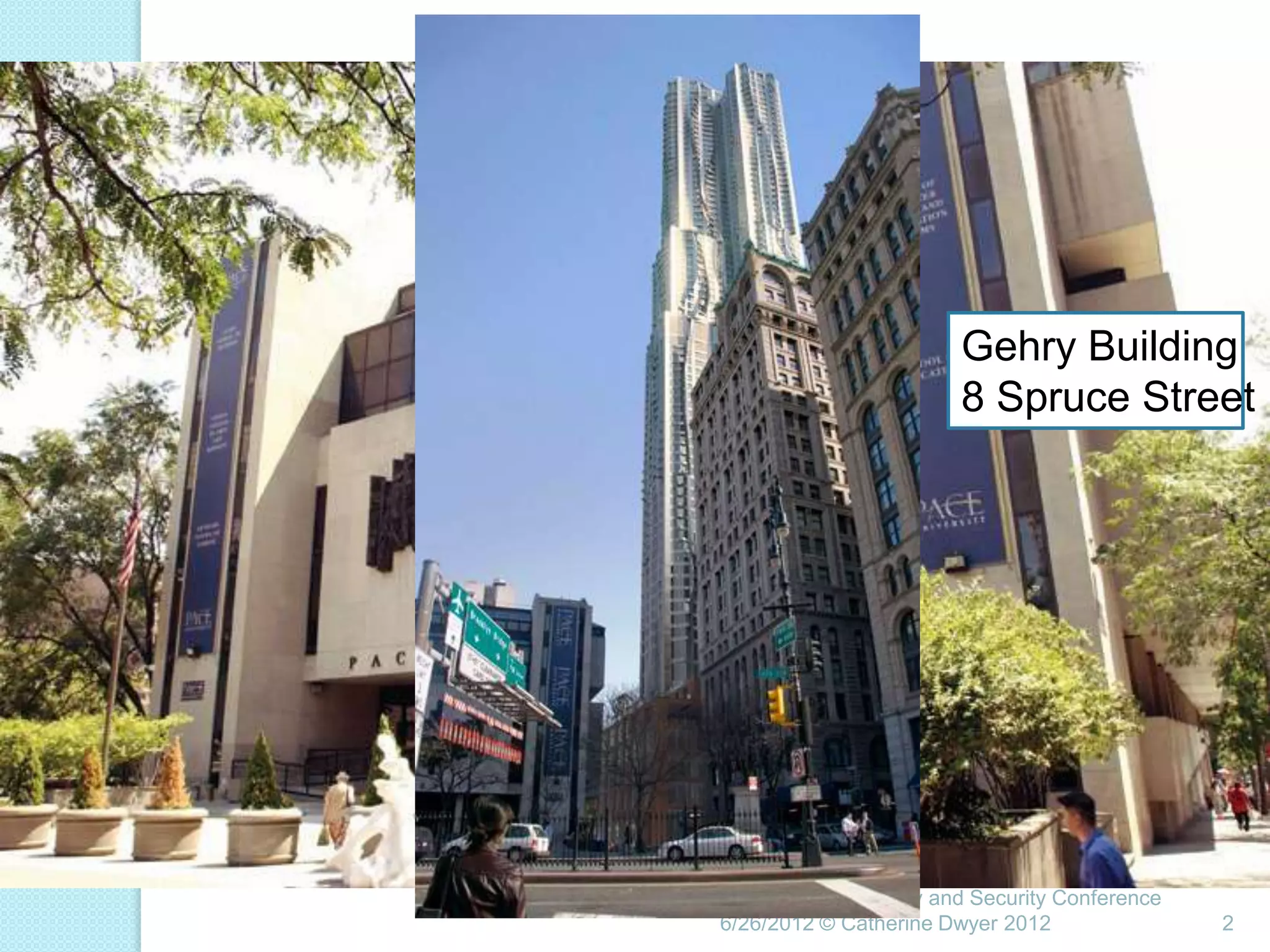
Gehry Building
                        8 Spruce Street


Pitney Bowes Privacy and Security Conference
6/26/2012 © Catherine Dwyer 2012               2
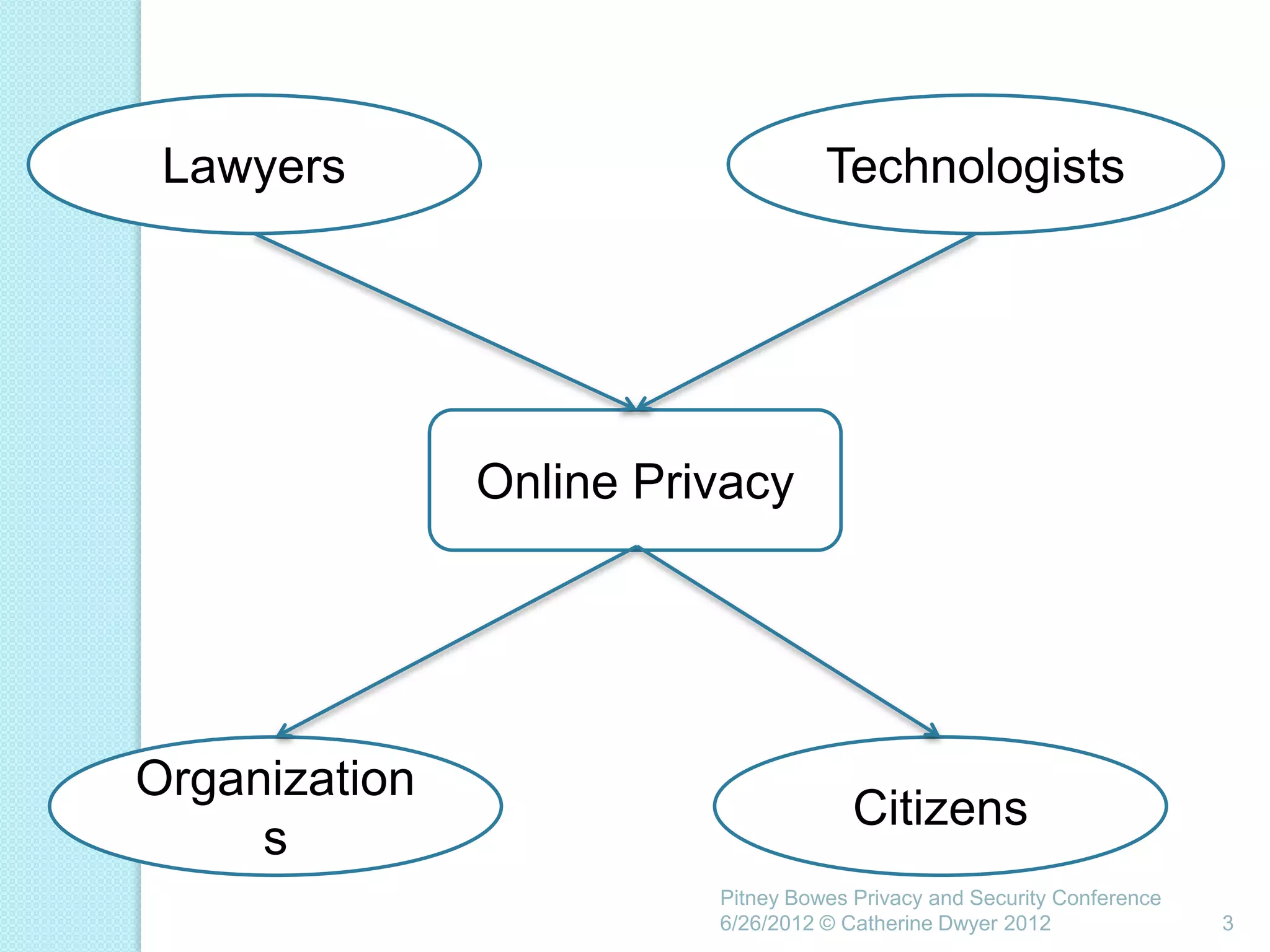
Lawyers                           Technologists


               Online Privacy


Organization
                                      Citizens
     s
                         Pitney Bowes Privacy and Security Conference
                         6/26/2012 © Catherine Dwyer 2012               3
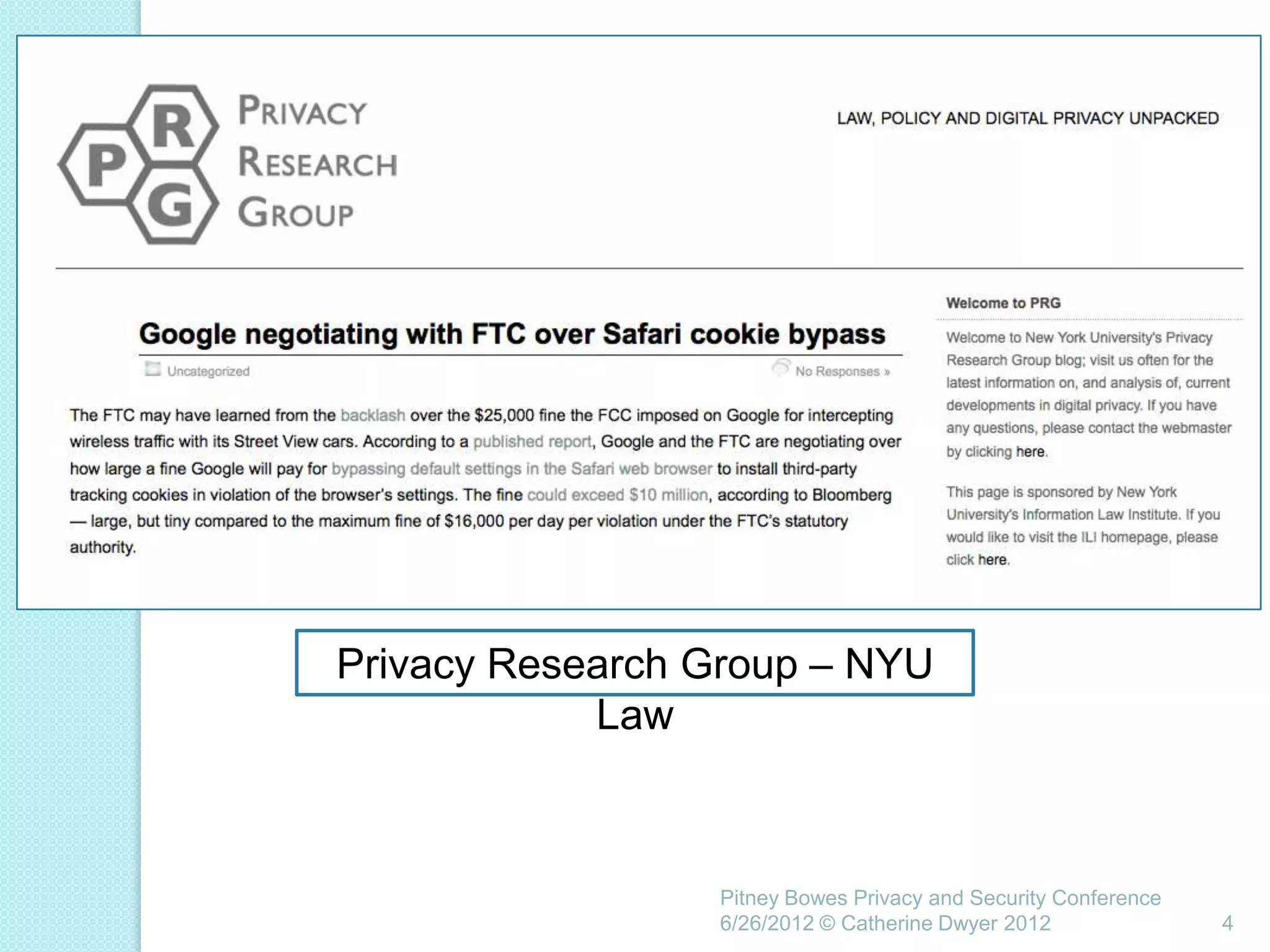
Privacy Research Group – NYU
            Law


                 Pitney Bowes Privacy and Security Conference
                 6/26/2012 © Catherine Dwyer 2012               4
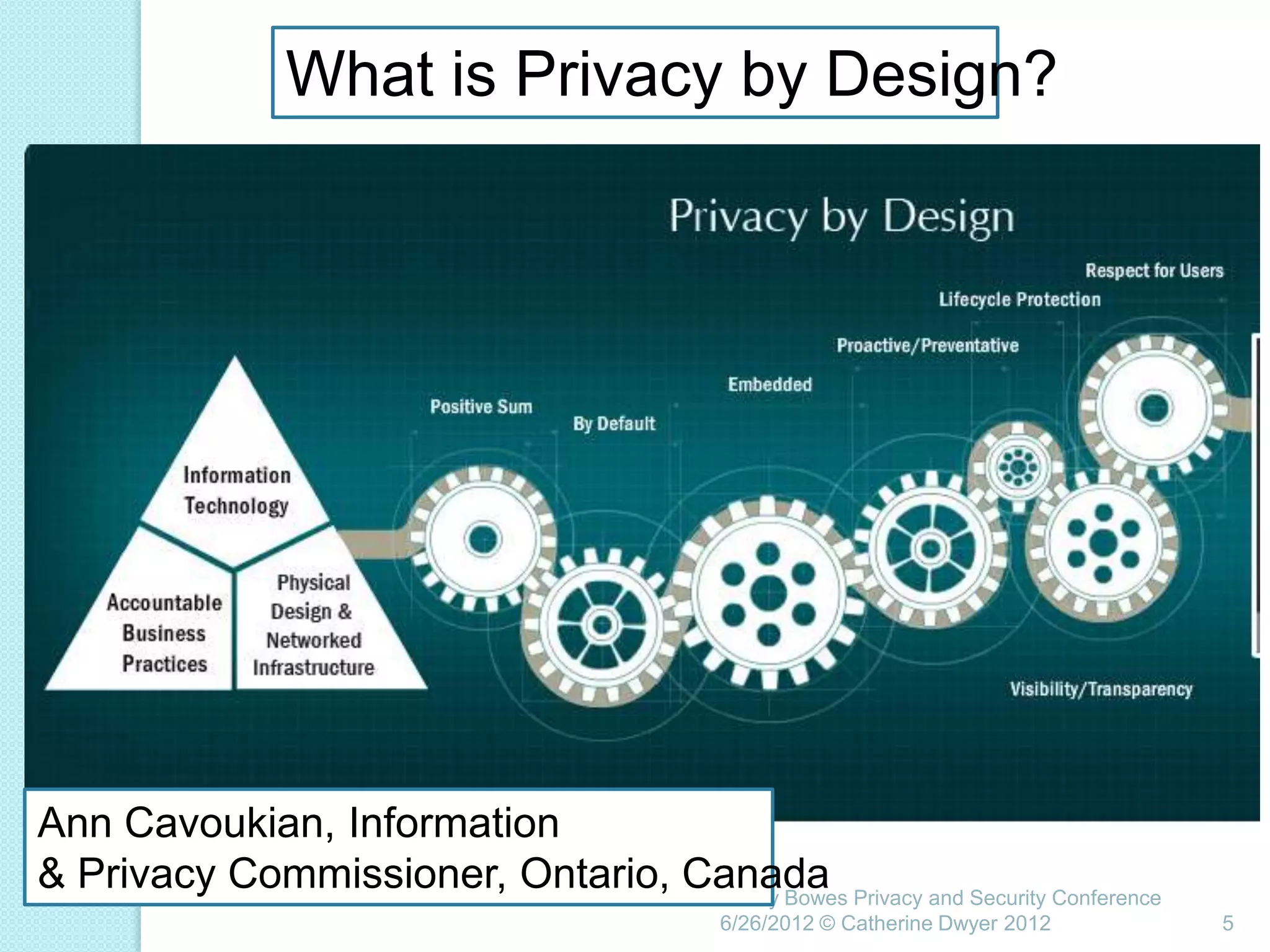
What is Privacy by Design?


Ann Cavoukian, Information
& Privacy Commissioner, Ontario, Canada Privacy and Security Conference
                                  Pitney Bowes
                                           6/26/2012 © Catherine Dwyer 2012   5
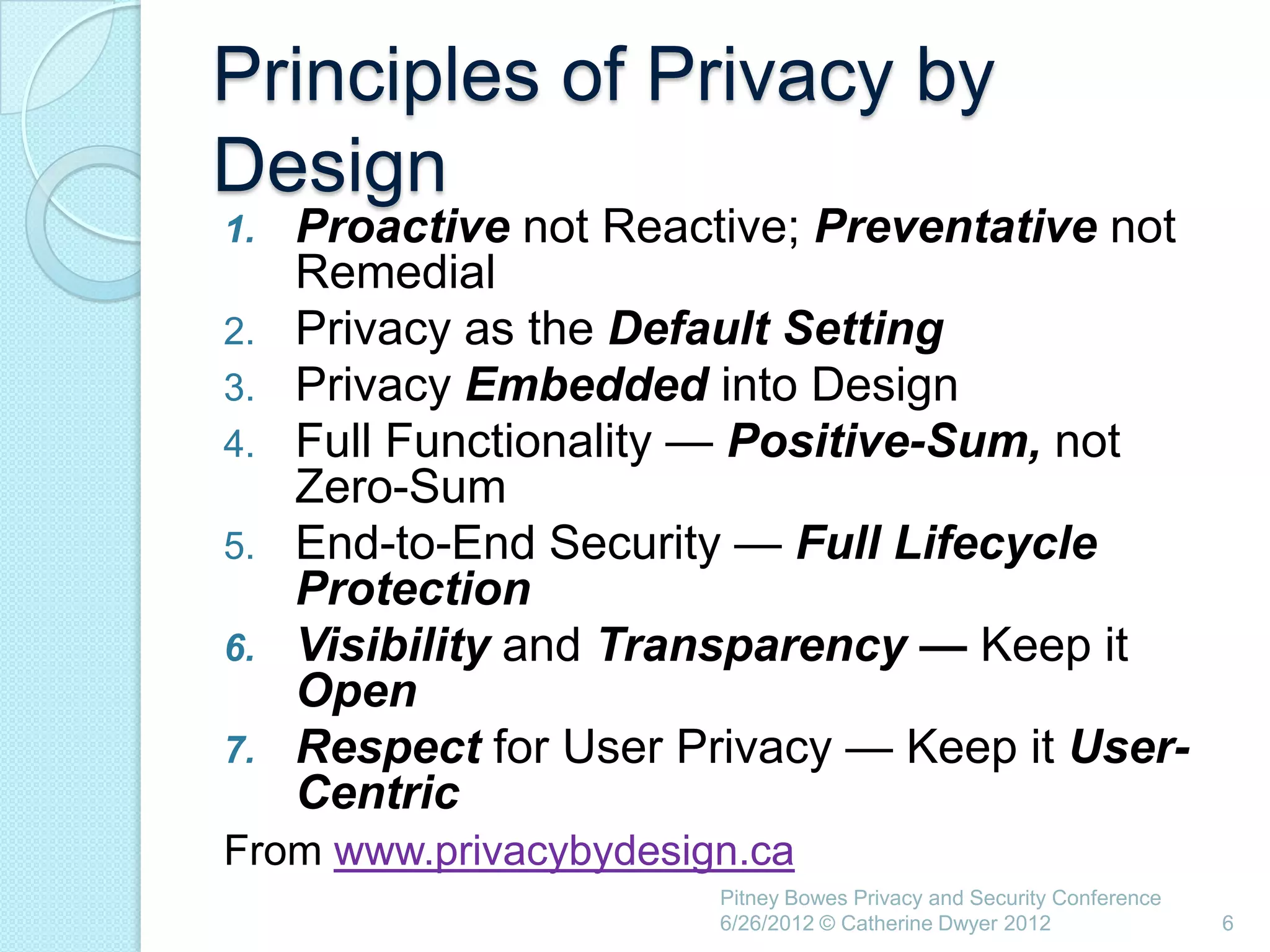
Principles of Privacy by
Design
1.   Proactive not Reactive; Preventative not
     Remedial
2.   Privacy as the Default Setting
3.   Privacy Embedded into Design
4.   Full Functionality — Positive-Sum, not
     Zero-Sum
5.   End-to-End Security — Full Lifecycle
     Protection
6.   Visibility and Transparency — Keep it
     Open
7.   Respect for User Privacy — Keep it User-
     Centric
From www.privacybydesign.ca
                        Pitney Bowes Privacy and Security Conference
                        6/26/2012 © Catherine Dwyer 2012               6
Legal perspective
   4th Amendment: ―The right of the
    people to be secure in their persons,
    houses, papers, and effects, against
    unreasonable searches and seizures,
    shall not be violated, and no Warrants
    shall issue, but upon probable cause,
    supported by Oath or affirmation, and
    particularly describing the place to be
    searched, and the persons or things to
    be seized.‖
                      Pitney Bowes Privacy and Security Conference
                      6/26/2012 © Catherine Dwyer 2012               7
Third party doctrine
 ―The Supreme Court has repeatedly
  held, however, that the Fourth
  Amendment does not protect information
  revealed to third parties.‖ (Kerr, 2004)
 Third party – any
  business, organization, ISP, cloud
  service providers
 Once you ―share‖ data with a third
  party, you lose 4th amendment protection
 4th amendment standard is ―probable
  cause,‖ 3rd party standard is ―relevant to
  an investigation‖ and ―not overbroad‖
  (Kerr, 2004)       Pitney Bowes Privacy and Security Conference
                     6/26/2012 © Catherine Dwyer 2012               8
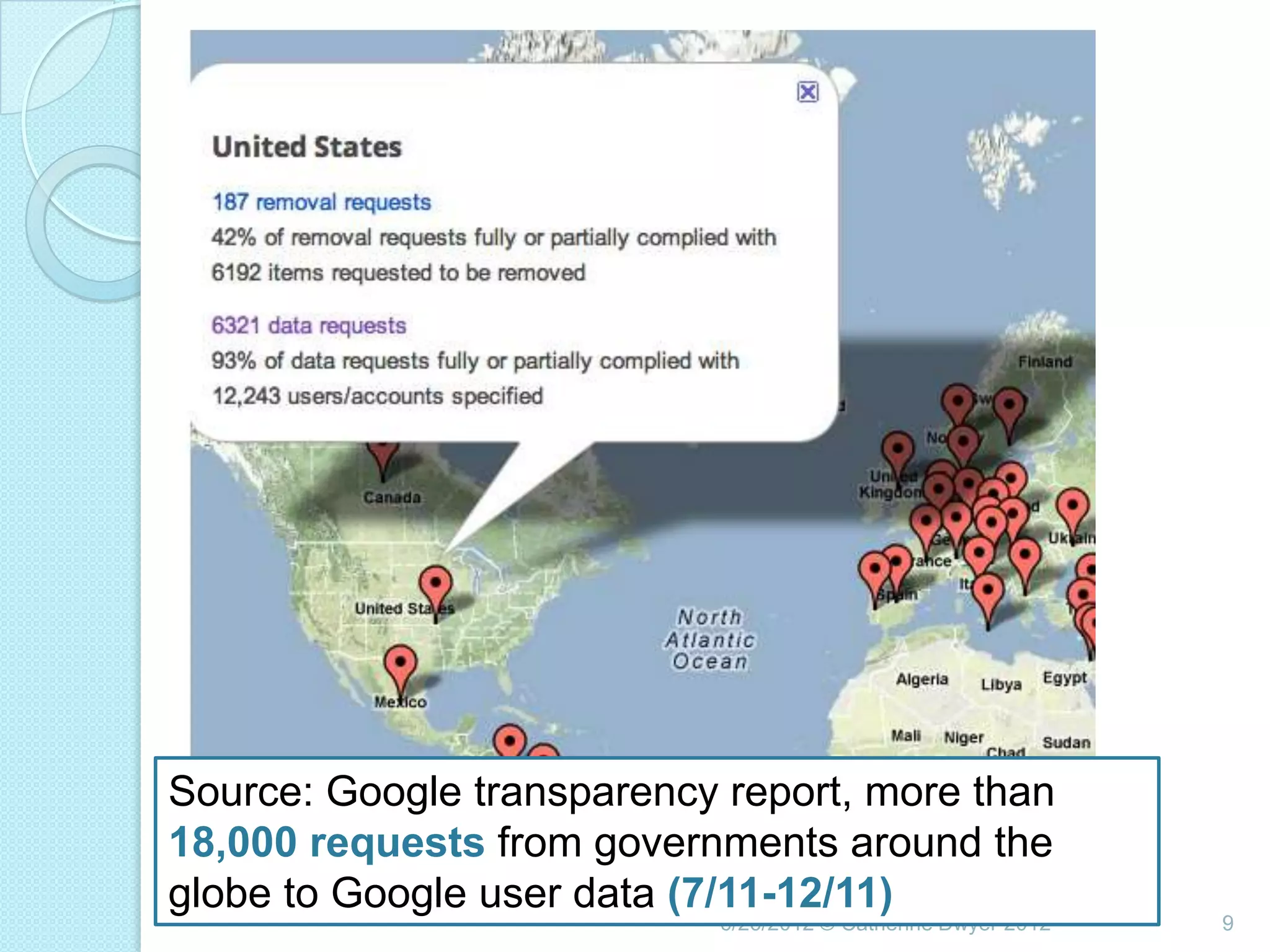
Source: Google transparency report, more than
18,000 requests from governments around the
globe to Google user data (7/11-12/11) and Security Conference
                             Pitney Bowes Privacy
                                  6/26/2012 © Catherine Dwyer 2012   9
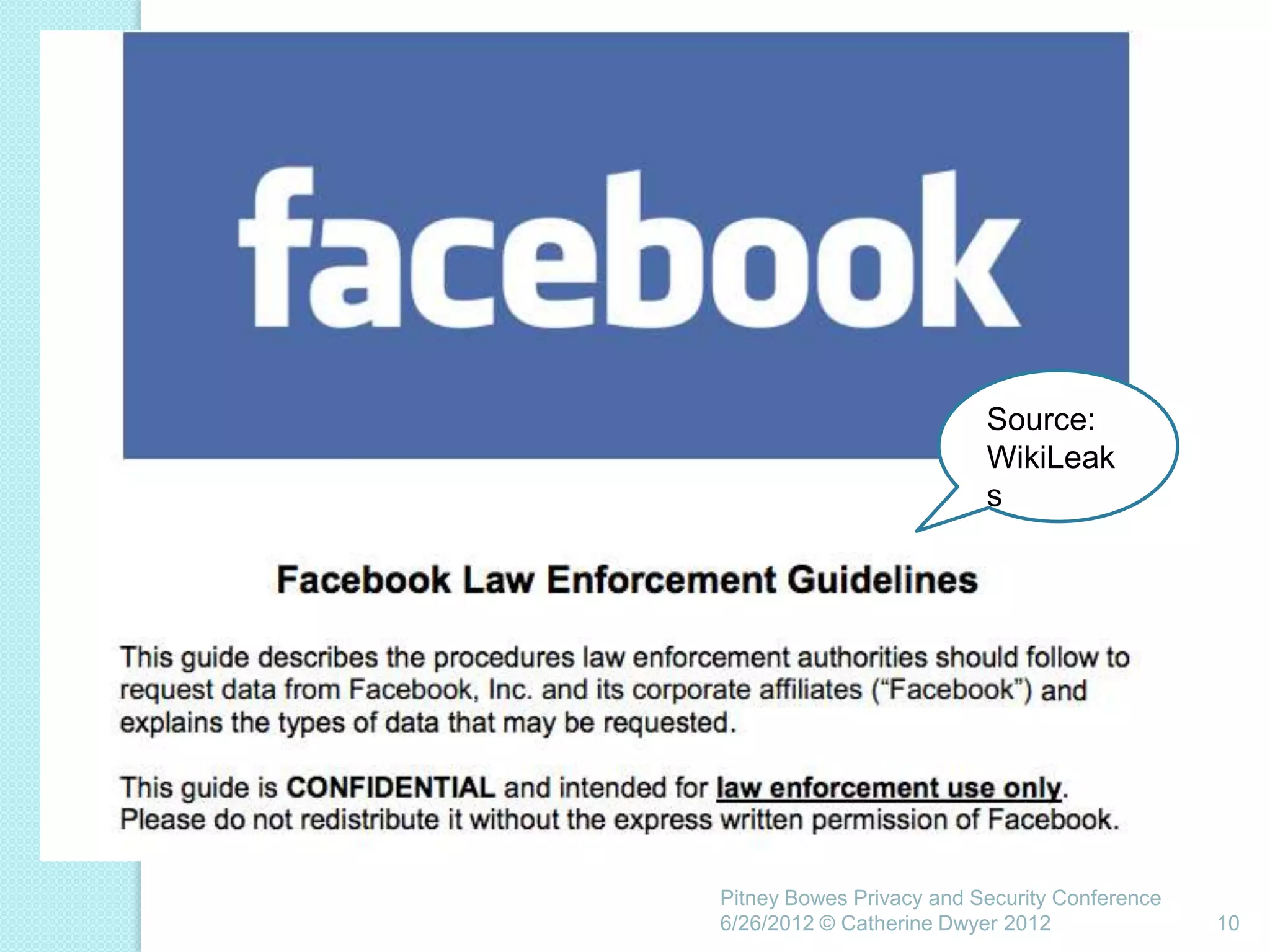
Source:
                          WikiLeak
                          s


Pitney Bowes Privacy and Security Conference
6/26/2012 © Catherine Dwyer 2012               10
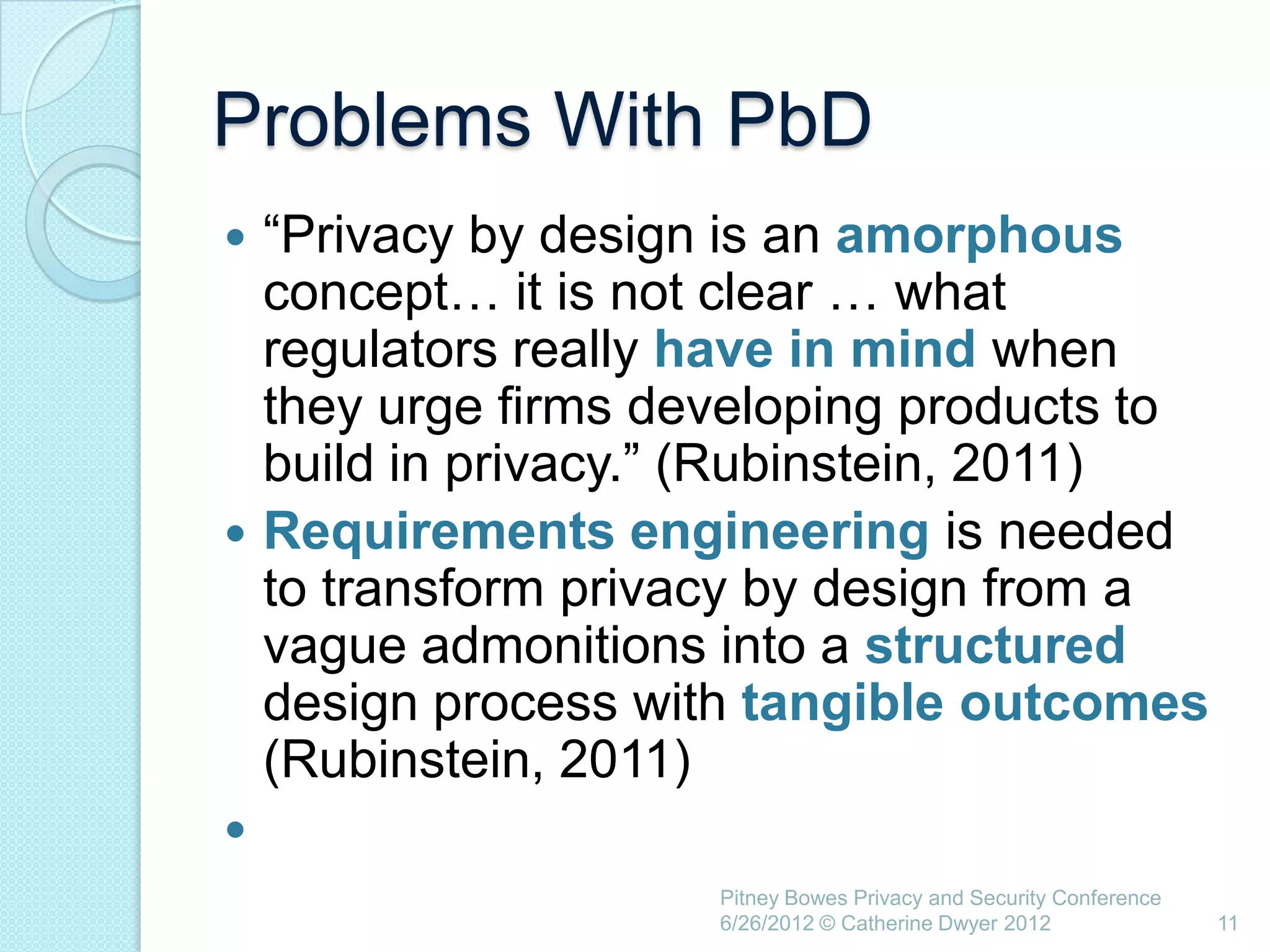
Problems With PbD
 ―Privacy by design is an amorphous
  concept… it is not clear … what
  regulators really have in mind when
  they urge firms developing products to
  build in privacy.‖ (Rubinstein, 2011)
 Requirements engineering is needed
  to transform privacy by design from a
  vague admonitions into a structured
  design process with tangible outcomes
  (Rubinstein, 2011)

                    Pitney Bowes Privacy and Security Conference
                    6/26/2012 © Catherine Dwyer 2012               11
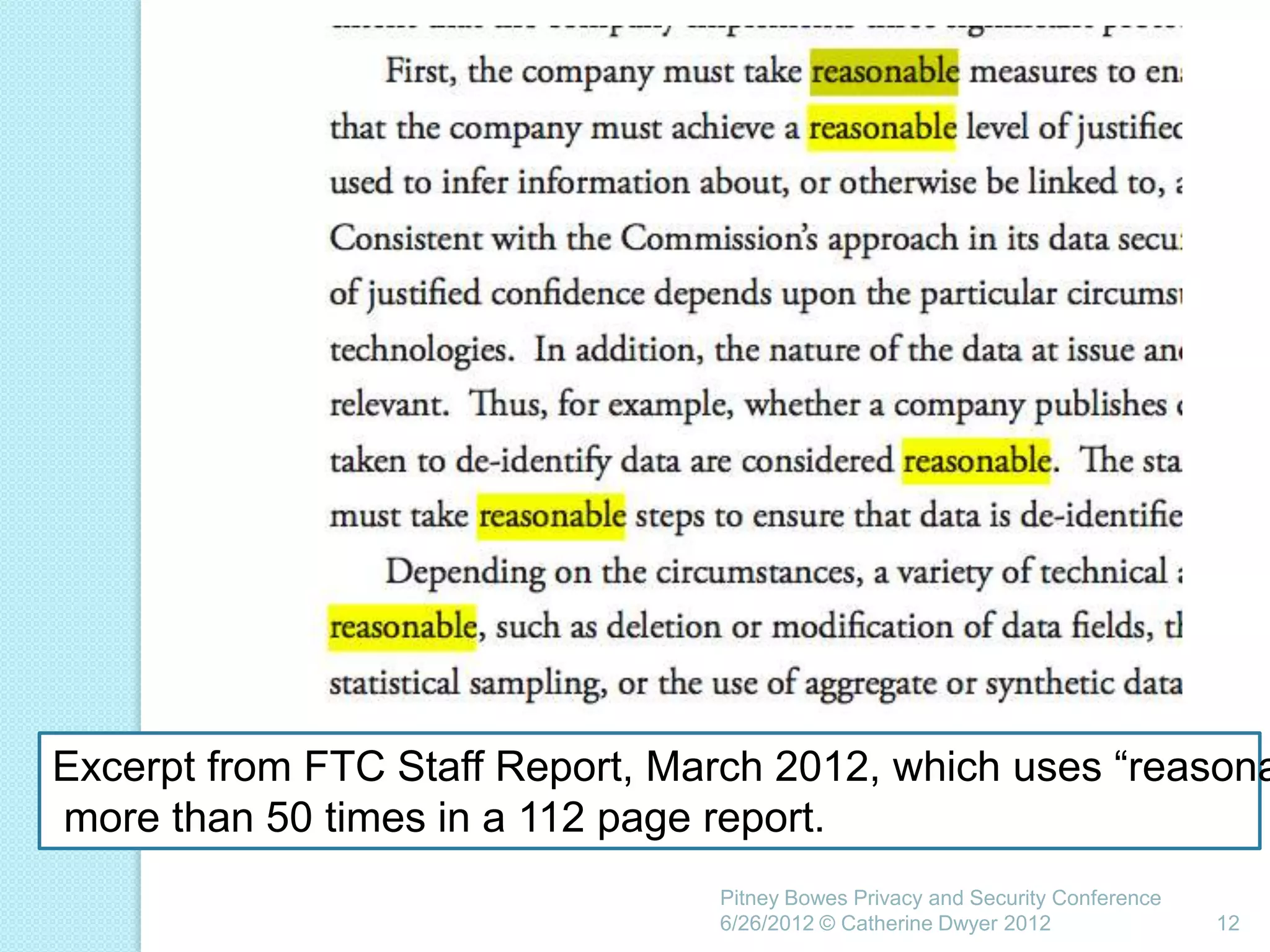
Excerpt from FTC Staff Report, March 2012, which uses ―reasona
more than 50 times in a 112 page report.
                                 Pitney Bowes Privacy and Security Conference
                                 6/26/2012 © Catherine Dwyer 2012               12
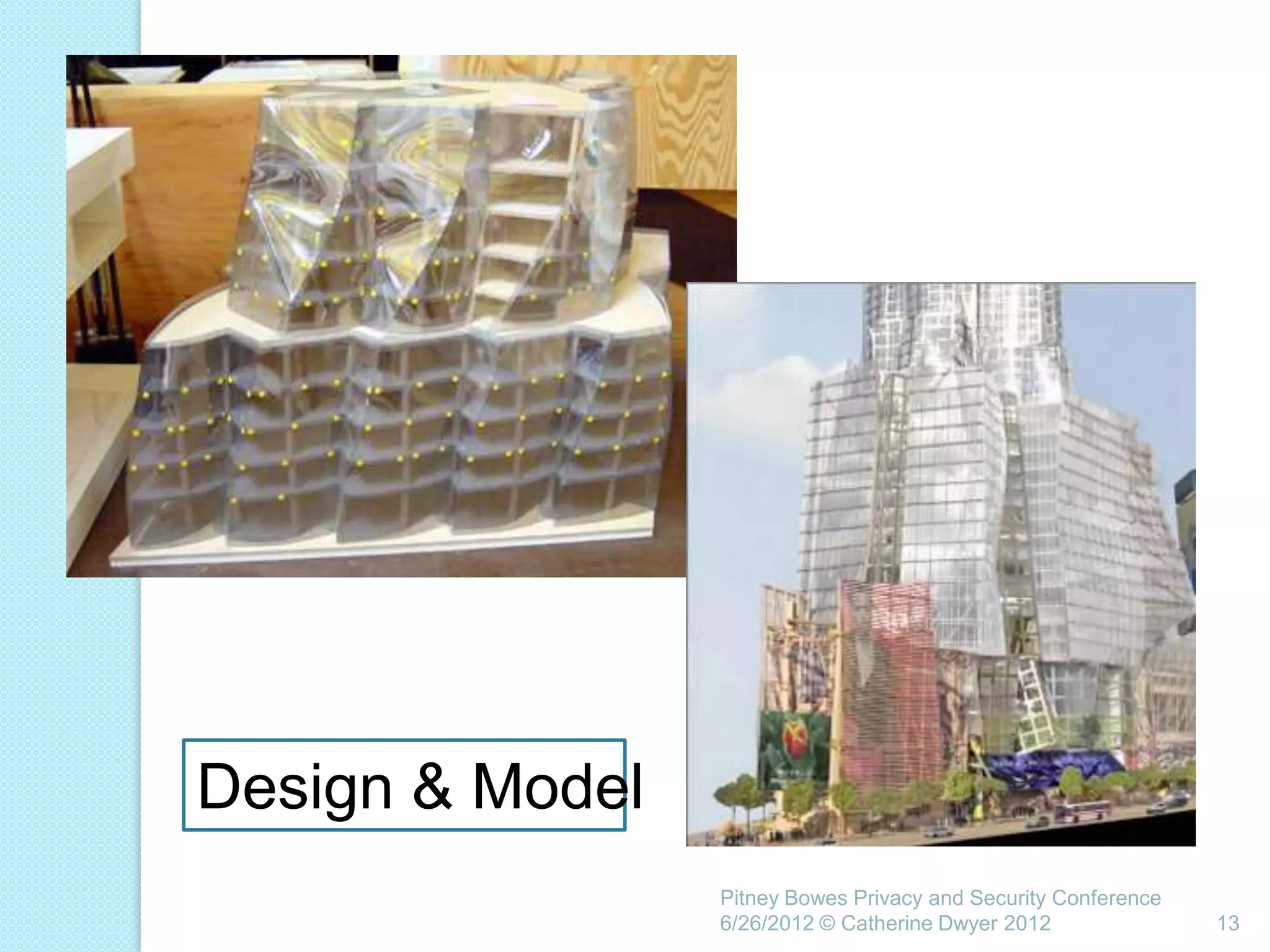
Design & Model
                 Pitney Bowes Privacy and Security Conference
                 6/26/2012 © Catherine Dwyer 2012               13
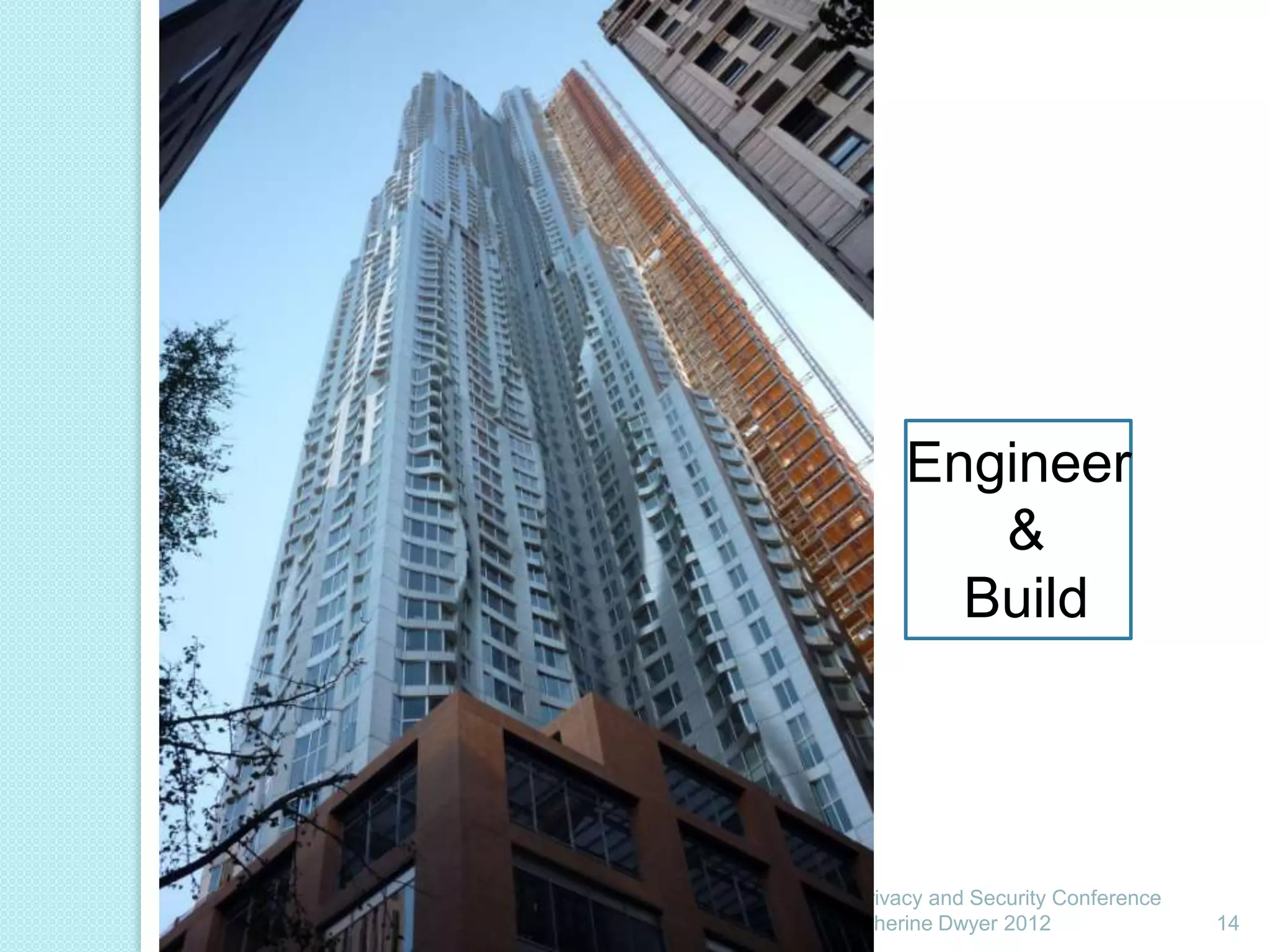
Engineer
                     &
                    Build


Pitney Bowes Privacy and Security Conference
6/26/2012 © Catherine Dwyer 2012               14
Tangible Outcome


         Pitney Bowes Privacy and Security Conference
         6/26/2012 © Catherine Dwyer 2012               15
Gehry building – 8 Spruce Street


                 Pitney Bowes Privacy and Security Conference
                 6/26/2012 © Catherine Dwyer 2012               16
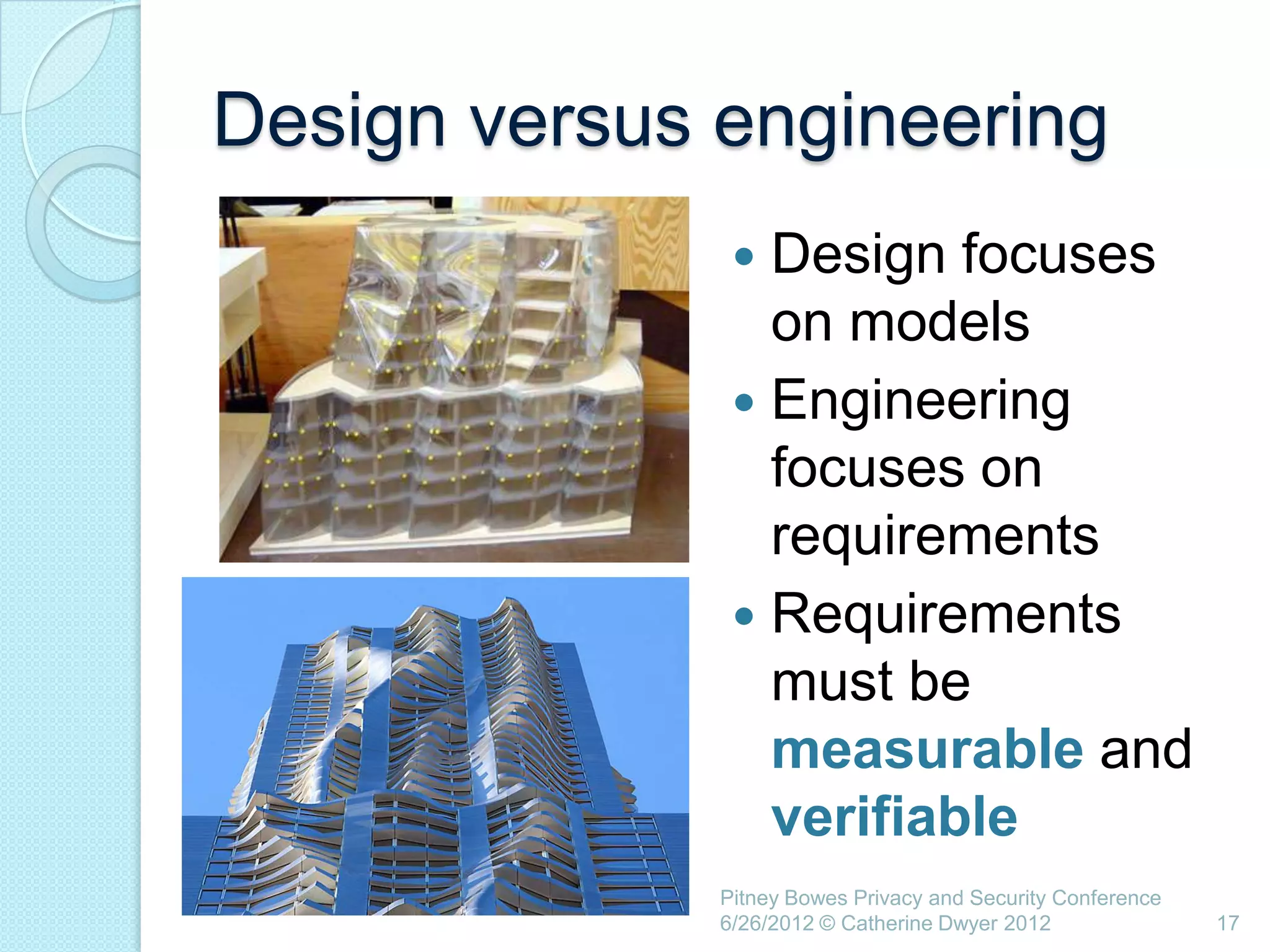
Design versus engineering
                Design focuses
                 on models
                Engineering
                 focuses on
                 requirements
                Requirements
                 must be
                 measurable and
                 verifiable
              Pitney Bowes Privacy and Security Conference
              6/26/2012 © Catherine Dwyer 2012               17
Moving to privacy engineering
 Need to move from ―privacy by
  design‖ to ―privacy requirements
  engineering‖
 Design can capture broad objectives
  (―buildings should be constructed with
  fireproof materials‖)
 Engineering makes those objectives
  tangible (―fireproof material must be
  able to bear weight for four hours of
  fire at 1000 degrees F‖)
                    Pitney Bowes Privacy and Security Conference
                    6/26/2012 © Catherine Dwyer 2012               18
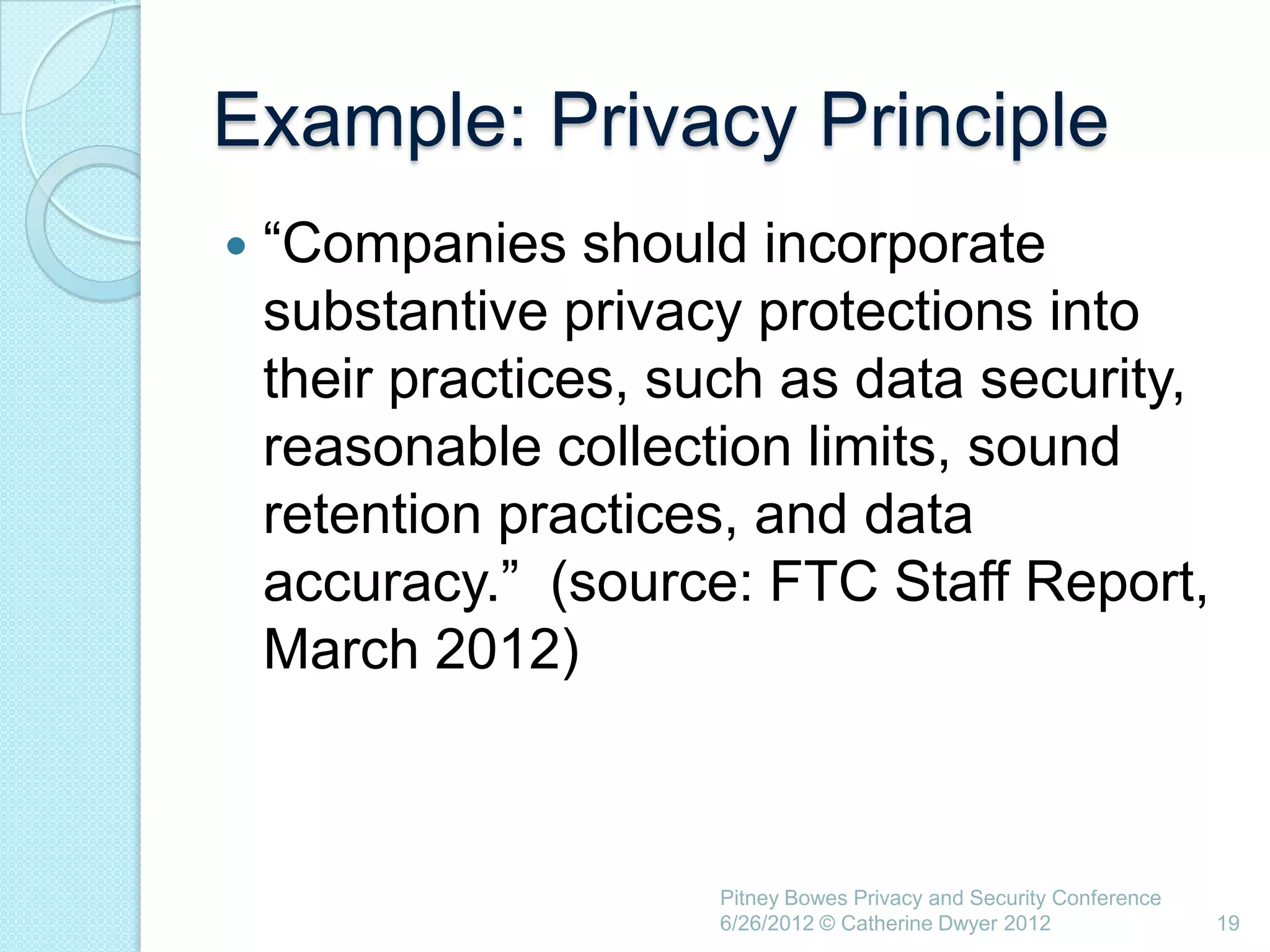
Example: Privacy Principle
   ―Companies should incorporate
    substantive privacy protections into
    their practices, such as data security,
    reasonable collection limits, sound
    retention practices, and data
    accuracy.‖ (source: FTC Staff Report,
    March 2012)


                      Pitney Bowes Privacy and Security Conference
                      6/26/2012 © Catherine Dwyer 2012               19
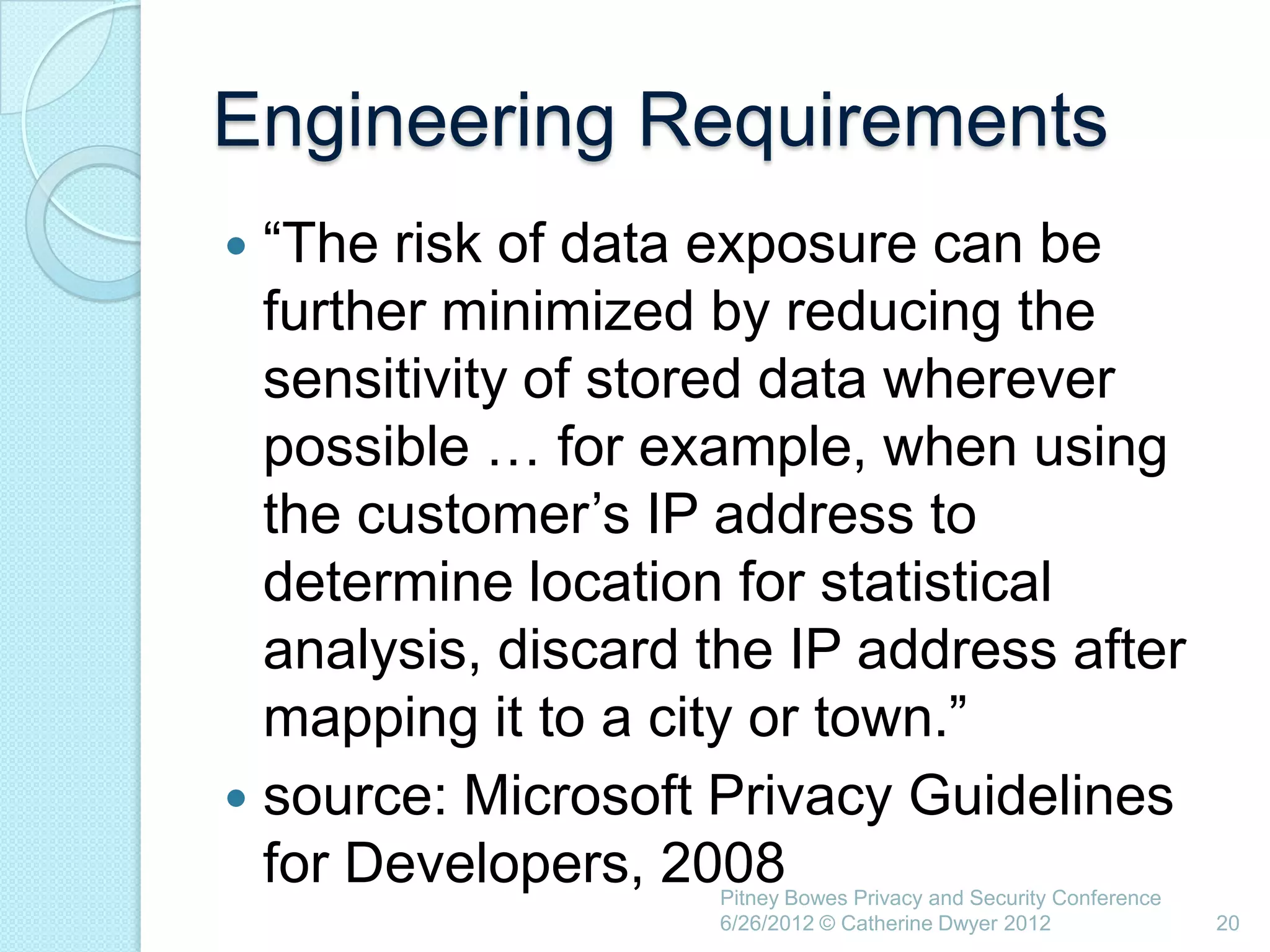
Engineering Requirements
 ―The risk of data exposure can be
  further minimized by reducing the
  sensitivity of stored data wherever
  possible … for example, when using
  the customer‘s IP address to
  determine location for statistical
  analysis, discard the IP address after
  mapping it to a city or town.‖
 source: Microsoft Privacy Guidelines
  for Developers, 2008
                    Pitney Bowes Privacy and Security Conference
                    6/26/2012 © Catherine Dwyer 2012               20
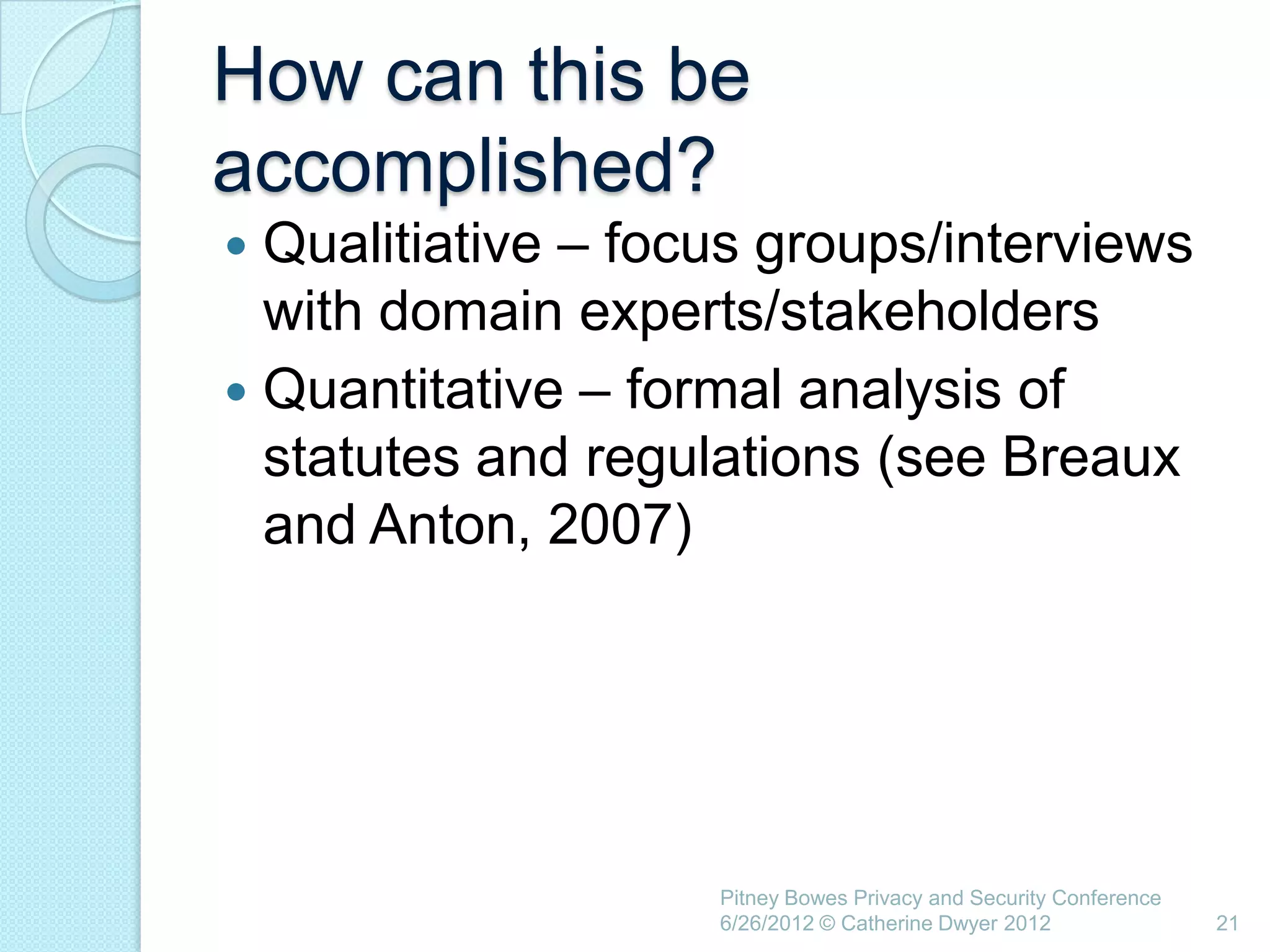
How can this be
accomplished?
 Qualitiative – focus groups/interviews
  with domain experts/stakeholders
 Quantitative – formal analysis of
  statutes and regulations (see Breaux
  and Anton, 2007)


                    Pitney Bowes Privacy and Security Conference
                    6/26/2012 © Catherine Dwyer 2012               21
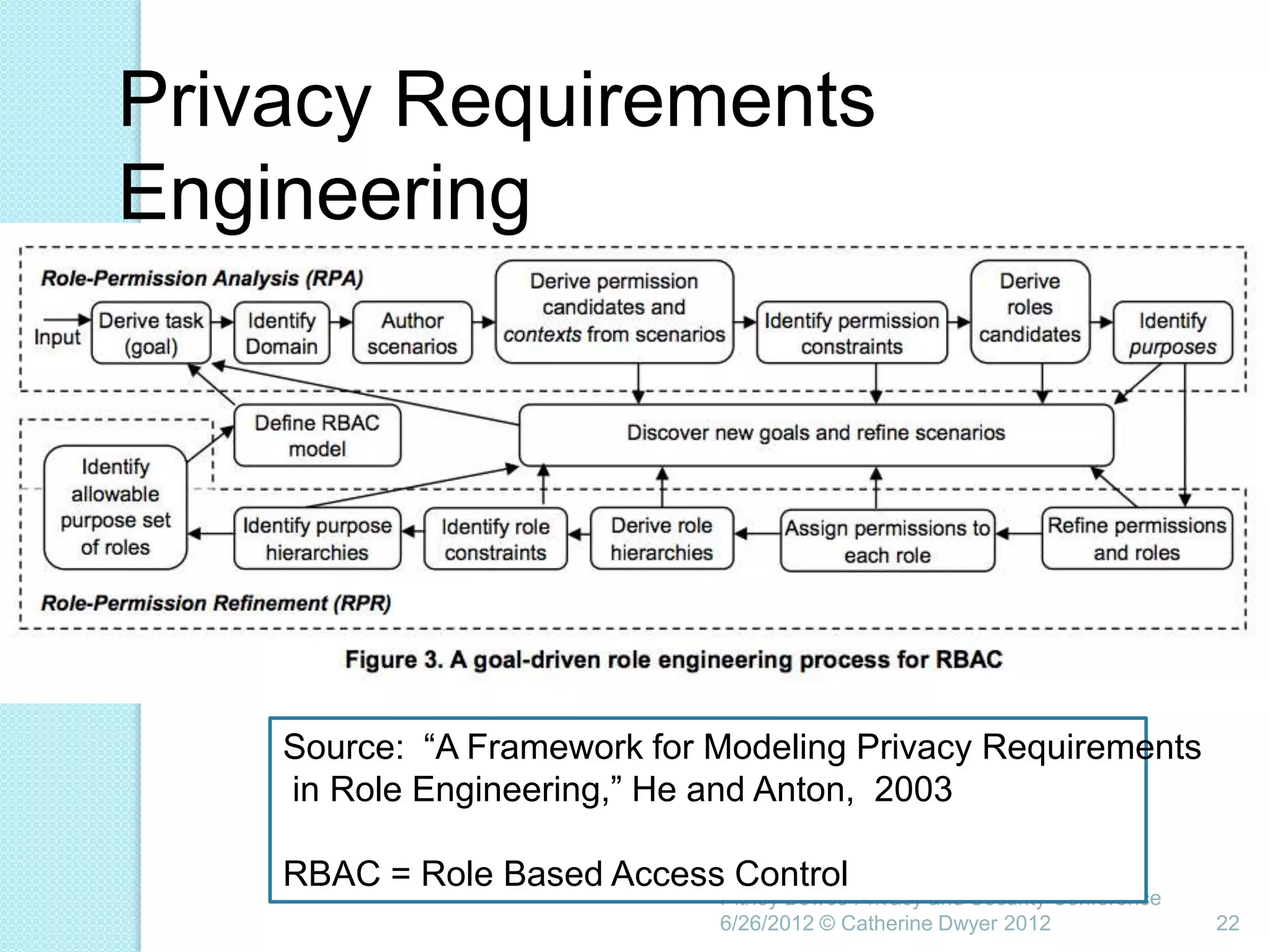
Privacy Requirements
Engineering


    Source: ―A Framework for Modeling Privacy Requirements
    in Role Engineering,‖ He and Anton, 2003

    RBAC = Role Based Access Control
                             Pitney Bowes Privacy and Security Conference
                             6/26/2012 © Catherine Dwyer 2012               22
Development tools are
needed
 Can‘t manage the complexity of
  describing privacy engineering
  requirements ―by hand,‖ takes too long
 Can‘t audit privacy of information
  systems ‗by hand,‘ not comprehensive
  enough


                   Pitney Bowes Privacy and Security Conference
                   6/26/2012 © Catherine Dwyer 2012               23
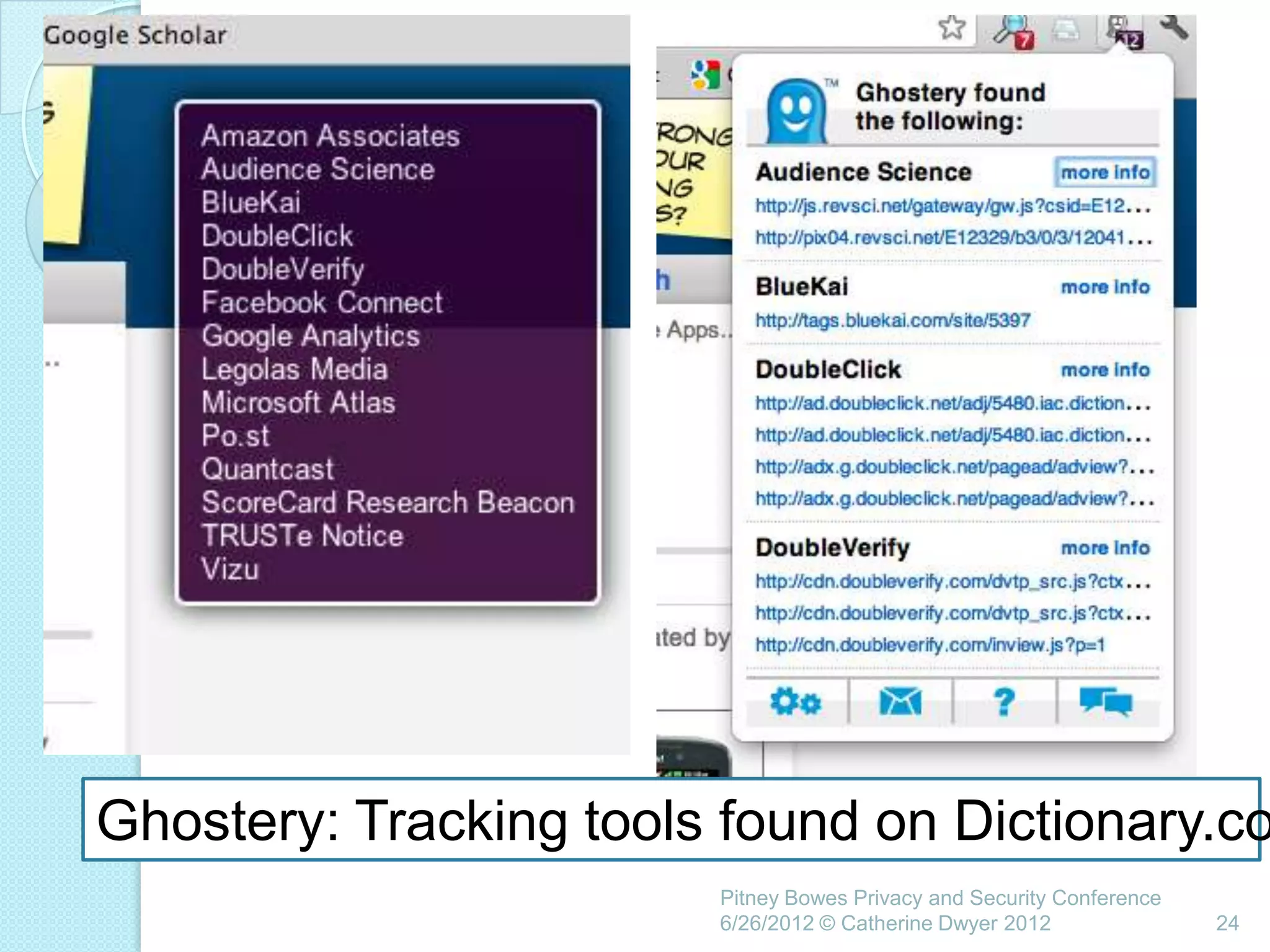
Ghostery: Tracking tools found on Dictionary.co
                        Pitney Bowes Privacy and Security Conference
                        6/26/2012 © Catherine Dwyer 2012               24
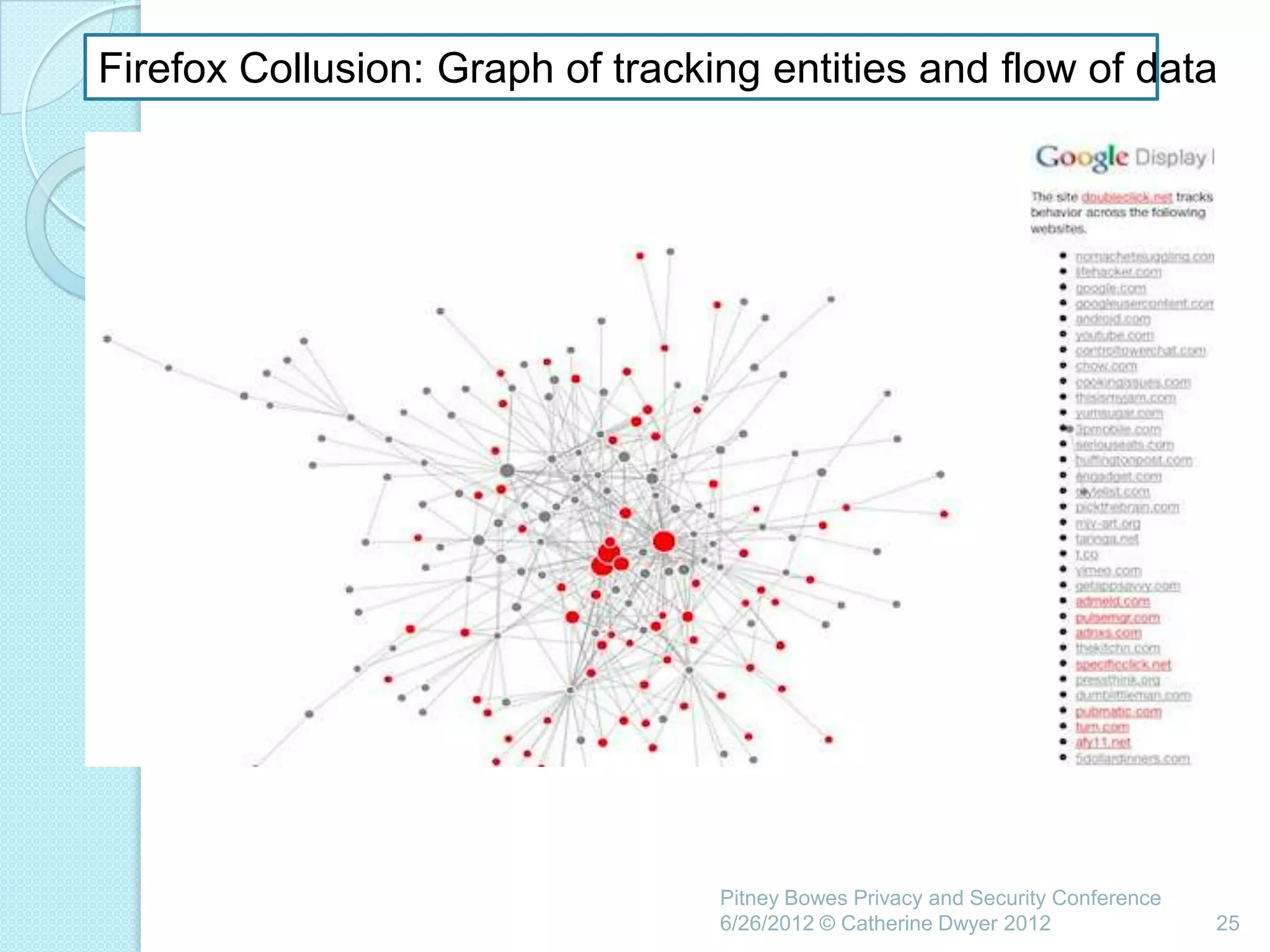
Firefox Collusion: Graph of tracking entities and flow of data


                                  Pitney Bowes Privacy and Security Conference
                                  6/26/2012 © Catherine Dwyer 2012               25
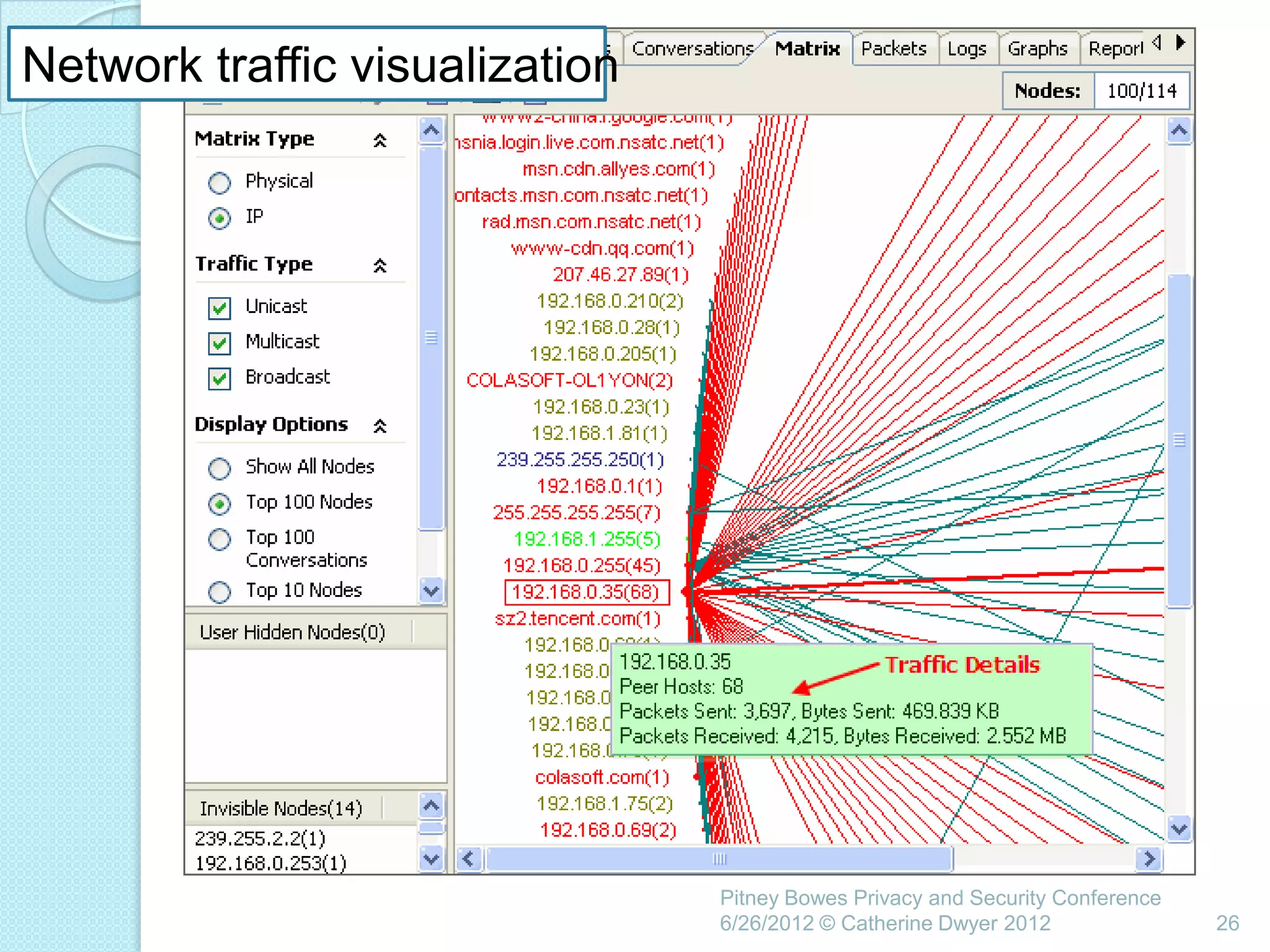
Network traffic visualization


                                Pitney Bowes Privacy and Security Conference
                                6/26/2012 © Catherine Dwyer 2012               26
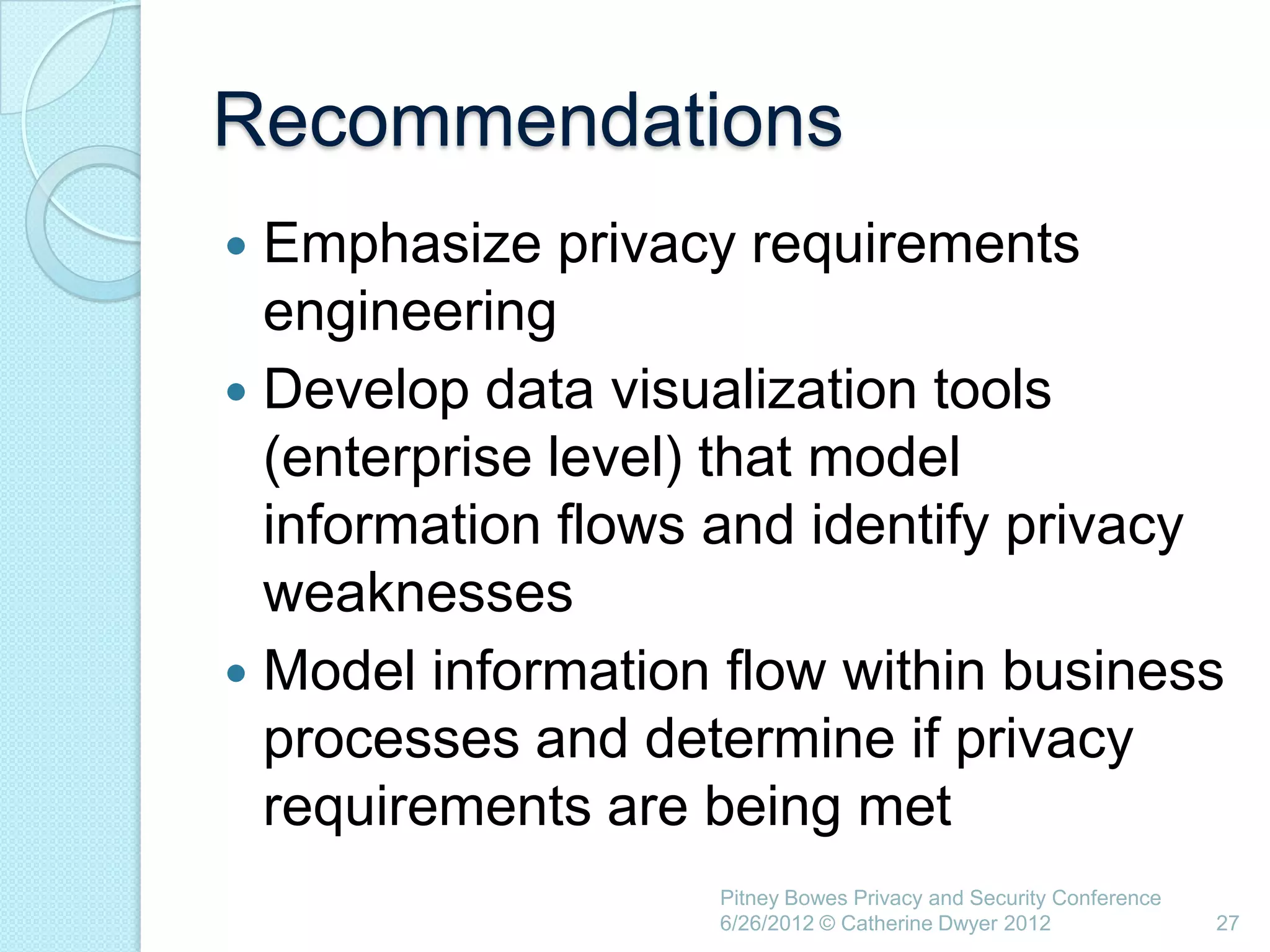
Recommendations
 Emphasize privacy requirements
  engineering
 Develop data visualization tools
  (enterprise level) that model
  information flows and identify privacy
  weaknesses
 Model information flow within business
  processes and determine if privacy
  requirements are being met
                   Pitney Bowes Privacy and Security Conference
                   6/26/2012 © Catherine Dwyer 2012               27
Questions?
   Thank you!

   Catherine Dwyer
    Seidenberg School of Computer
    Science and Information Systems
    Pace University

   Twitter: @ProfCDwyer

                    Pitney Bowes Privacy and Security Conference
                    6/26/2012 © Catherine Dwyer 2012               28

Dwyer "Privacy by Design: Can It Work?"

  • 1.
    Privacy by Design:Can it Work? Catherine Dwyer Seidenberg School of Computer Science & Information Systems Pace University New York, NY Pitney Bowes Privacy and Security Conference 6/26/2012 © Catherine Dwyer 2012 1
  • 2.
    Gehry Building 8 Spruce Street Pitney Bowes Privacy and Security Conference 6/26/2012 © Catherine Dwyer 2012 2
  • 3.
    Lawyers Technologists Online Privacy Organization Citizens s Pitney Bowes Privacy and Security Conference 6/26/2012 © Catherine Dwyer 2012 3
  • 4.
    Privacy Research Group– NYU Law Pitney Bowes Privacy and Security Conference 6/26/2012 © Catherine Dwyer 2012 4
  • 5.
    What is Privacyby Design? Ann Cavoukian, Information & Privacy Commissioner, Ontario, Canada Privacy and Security Conference Pitney Bowes 6/26/2012 © Catherine Dwyer 2012 5
  • 6.
    Principles of Privacyby Design 1. Proactive not Reactive; Preventative not Remedial 2. Privacy as the Default Setting 3. Privacy Embedded into Design 4. Full Functionality — Positive-Sum, not Zero-Sum 5. End-to-End Security — Full Lifecycle Protection 6. Visibility and Transparency — Keep it Open 7. Respect for User Privacy — Keep it User- Centric From www.privacybydesign.ca Pitney Bowes Privacy and Security Conference 6/26/2012 © Catherine Dwyer 2012 6
  • 7.
    Legal perspective  4th Amendment: ―The right of the people to be secure in their persons, houses, papers, and effects, against unreasonable searches and seizures, shall not be violated, and no Warrants shall issue, but upon probable cause, supported by Oath or affirmation, and particularly describing the place to be searched, and the persons or things to be seized.‖ Pitney Bowes Privacy and Security Conference 6/26/2012 © Catherine Dwyer 2012 7
  • 8.
    Third party doctrine ―The Supreme Court has repeatedly held, however, that the Fourth Amendment does not protect information revealed to third parties.‖ (Kerr, 2004)  Third party – any business, organization, ISP, cloud service providers  Once you ―share‖ data with a third party, you lose 4th amendment protection  4th amendment standard is ―probable cause,‖ 3rd party standard is ―relevant to an investigation‖ and ―not overbroad‖ (Kerr, 2004) Pitney Bowes Privacy and Security Conference 6/26/2012 © Catherine Dwyer 2012 8
  • 9.
    Source: Google transparencyreport, more than 18,000 requests from governments around the globe to Google user data (7/11-12/11) and Security Conference Pitney Bowes Privacy 6/26/2012 © Catherine Dwyer 2012 9
  • 10.
    Source: WikiLeak s Pitney Bowes Privacy and Security Conference 6/26/2012 © Catherine Dwyer 2012 10
  • 11.
    Problems With PbD ―Privacy by design is an amorphous concept… it is not clear … what regulators really have in mind when they urge firms developing products to build in privacy.‖ (Rubinstein, 2011)  Requirements engineering is needed to transform privacy by design from a vague admonitions into a structured design process with tangible outcomes (Rubinstein, 2011)  Pitney Bowes Privacy and Security Conference 6/26/2012 © Catherine Dwyer 2012 11
  • 12.
    Excerpt from FTCStaff Report, March 2012, which uses ―reasona more than 50 times in a 112 page report. Pitney Bowes Privacy and Security Conference 6/26/2012 © Catherine Dwyer 2012 12
  • 13.
    Design & Model Pitney Bowes Privacy and Security Conference 6/26/2012 © Catherine Dwyer 2012 13
  • 14.
    Engineer & Build Pitney Bowes Privacy and Security Conference 6/26/2012 © Catherine Dwyer 2012 14
  • 15.
    Tangible Outcome Pitney Bowes Privacy and Security Conference 6/26/2012 © Catherine Dwyer 2012 15
  • 16.
    Gehry building –8 Spruce Street Pitney Bowes Privacy and Security Conference 6/26/2012 © Catherine Dwyer 2012 16
  • 17.
    Design versus engineering  Design focuses on models  Engineering focuses on requirements  Requirements must be measurable and verifiable Pitney Bowes Privacy and Security Conference 6/26/2012 © Catherine Dwyer 2012 17
  • 18.
    Moving to privacyengineering  Need to move from ―privacy by design‖ to ―privacy requirements engineering‖  Design can capture broad objectives (―buildings should be constructed with fireproof materials‖)  Engineering makes those objectives tangible (―fireproof material must be able to bear weight for four hours of fire at 1000 degrees F‖) Pitney Bowes Privacy and Security Conference 6/26/2012 © Catherine Dwyer 2012 18
  • 19.
    Example: Privacy Principle  ―Companies should incorporate substantive privacy protections into their practices, such as data security, reasonable collection limits, sound retention practices, and data accuracy.‖ (source: FTC Staff Report, March 2012) Pitney Bowes Privacy and Security Conference 6/26/2012 © Catherine Dwyer 2012 19
  • 20.
    Engineering Requirements  ―Therisk of data exposure can be further minimized by reducing the sensitivity of stored data wherever possible … for example, when using the customer‘s IP address to determine location for statistical analysis, discard the IP address after mapping it to a city or town.‖  source: Microsoft Privacy Guidelines for Developers, 2008 Pitney Bowes Privacy and Security Conference 6/26/2012 © Catherine Dwyer 2012 20
  • 21.
    How can thisbe accomplished?  Qualitiative – focus groups/interviews with domain experts/stakeholders  Quantitative – formal analysis of statutes and regulations (see Breaux and Anton, 2007) Pitney Bowes Privacy and Security Conference 6/26/2012 © Catherine Dwyer 2012 21
  • 22.
    Privacy Requirements Engineering Source: ―A Framework for Modeling Privacy Requirements in Role Engineering,‖ He and Anton, 2003 RBAC = Role Based Access Control Pitney Bowes Privacy and Security Conference 6/26/2012 © Catherine Dwyer 2012 22
  • 23.
    Development tools are needed Can‘t manage the complexity of describing privacy engineering requirements ―by hand,‖ takes too long  Can‘t audit privacy of information systems ‗by hand,‘ not comprehensive enough Pitney Bowes Privacy and Security Conference 6/26/2012 © Catherine Dwyer 2012 23
  • 24.
    Ghostery: Tracking toolsfound on Dictionary.co Pitney Bowes Privacy and Security Conference 6/26/2012 © Catherine Dwyer 2012 24
  • 25.
    Firefox Collusion: Graphof tracking entities and flow of data Pitney Bowes Privacy and Security Conference 6/26/2012 © Catherine Dwyer 2012 25
  • 26.
    Network traffic visualization Pitney Bowes Privacy and Security Conference 6/26/2012 © Catherine Dwyer 2012 26
  • 27.
    Recommendations  Emphasize privacyrequirements engineering  Develop data visualization tools (enterprise level) that model information flows and identify privacy weaknesses  Model information flow within business processes and determine if privacy requirements are being met Pitney Bowes Privacy and Security Conference 6/26/2012 © Catherine Dwyer 2012 27
  • 28.
    Questions?  Thank you!  Catherine Dwyer Seidenberg School of Computer Science and Information Systems Pace University  Twitter: @ProfCDwyer Pitney Bowes Privacy and Security Conference 6/26/2012 © Catherine Dwyer 2012 28