1
2
DUTY, IDENTITY, CREDIBILITY
Fake news and the ordinary citizen in
India
Lead author: Santanu Chakrabarti, Ph.D, Head of
Audiences Research team, BBC World Service
With Lucile Stengel and Sapna Solanki (Senior
Researchers, BBC World Service Audiences Research
team).
And the teams at The Third Eye, and Synthesis.
A note on the authorship of this report:
This has been a truly collaborative project between the World
Service Audiences Research team and its agency partners. The
ideas, words and phrases in this report have come from many
places, including from discussions and meetings with the
various individuals named above, as well as in presentations,
emails, and conversations with all our partner agencies. In
particular, the lead author would like to credit our research
agency partners: one, The Third Eye, our qualitative research
partner, many of whose sentences - and insightful analysis-
have been used nearly unaltered in significant sections of the
report, and two, Synthesis, our data science partner, who came
up with sophisticated techniques - and easy to understand
explanations - for understanding the workings of a very
complex phenomenon. The lead author however takes full
responsibility for any lack of clarity in the report.1
This is a work of empirical evidence, not of opinions. Nonetheless,
any opinions that have slipped through in the report are solely those
of the lead author.
Nothing in this report is to be construed as indicating or reflecting
the corporate policy of the BBC, BBC World Service or any related
entity.
Google & Twitter are co-sponsors of this independent research
conducted by BBC and its partners. Google and Twitter had no input or
influence over the scope, research methodology, process or final report.
1
As indeed he does for the overuse of footnotes. Starting with this one.
3
Credits and Acknowledgments
The BBC World Service Audiences Research team
would like to thank:
 Jamie Angus, Director, BBC World Service Group, for
commissioning the work
 Marie Helly, Tess Colley, Marysia Novak, Alex Milner
and Joel Gunter for pushing us to think in ways we
weren’t accustomed to doing. And other colleagues for
discussions and suggestions
 Trushar Barot, for making all of this happen
 Catherine Blizzard, Director, World Service Marketing
& Audiences, for her unstinting support
 Dejan Calovski, for reading the report and ensuring
that every now and then research- ese was replaced by
human language
 The rest of the World Service Audience Insight team,
for picking up the slack without complaining
 Suey Kweon, for her invaluable intellectual help
 Anne Orwell, without whom nothing would move
 And finally, our research respondents, for giving us so
much of their time. We hope that if any of them read
this report they will recognise much of the
phenomenon we describe in this report
Report contributors:
BBC researchers:
Santanu Chakrabarti, Ph.D
Lucile Stengel
Sapna Solanki
Research partners:
Ethnography - The Third Eye
Gitanjali Ghate
Jasmeet Kaur Srivastava
Jayadevan Ambat
Aamir Siddiqui
Arjun Surendra
Saloni Garg
Swapnil Sakpal
Big data - Synthesis
Ankit Kalkar
Harriet Robertson
Aakash Gupta
Report design
Mule Design
Lucile Stengel
Sapna Solanki
Contacts for this research:
Santanu Chakrabarti: santanu.chakrabarti@bbc.co.uk
Lucile Stengel: Lucile.stengel@bbc.co.uk
Sapna Solanki: Sapna.solanki@bbc.co.uk
4
CONTENTS
Executive summary
Introduction
Part I. The conditions for sharing news
without verification
1. The lines between various kinds of news really blurry
2. Scepticism about the media’s motivations and
intentions
3. The digital deluge – and the move to a high frequency
information environment
4. Copying mechanisms for dealing with the deluge
5. The broken link between consumption and sharing
Part II. The motivations behind sharing
1. Sharing to verify (within the network)
2. Sharing as a civic duty
3. Interlude: Emerging political identities in India today
4. Sharing as an expression and projection of identity
Part III. What is fake news?
INTERLUDE: WHY ATTEMPTS TO CURTAIL
FAKE NEWS FALL ON DEAF EARS
Part IV. The effective narratives of fake
news messages
1. The fake news messages circulating amongst those
with a right leaning identity
INTERLUDE: THREE EMMERGING RIGHT WING
IDENTITIES IN INDIA
2. The fake news messages circulating amongst the
left
Part V. Fact-checking and verification:
Limited and specific
1. Two groups that assess fake news better than
others – and the techniques they use
2. Verification – and the very specific use of Google
3. TV and Newspapers: Still some credibility (even if
‘bought out’)
4. V.4. The challenges of fact checking - on and off
the network
Part VI. The fake news ecosystem
Part VI. Conclusions
5
A note on the quotes from research respondents used here:
Most of the research interviews were done in the language the respondent was most familiar with, usually the local
language. Where respondents spoke in English, they have been left as is, without any grammatical or syntactical
corrections. Where they did not speak in English, the interviews were translated into English and have been used in this
report. We have not edited the translations or corrected grammatical errors in the translations, as we believe it gives a
better flavour of the original interviews. We are aware that out of context some of these English translations are likely to
look odd to the non-Indian observer; or they might give a misleading or negative sense of the linguistic ability of
respondents. When quotes or sections of quotes have been used they have not been edited, other than condensing
occasionally. When this has happened, it has been shown with ellipsis (…
6
Executive summary
In all of the heated discussion about fake news around the world, the one thing that has remained
subdued is the voice of the ordinary citizen. In this project, therefore, we started with a central
question: why does the ordinary citizen spread fake news, without verification? And if ordinary citizens
are concerned about fake news, as multiple surveys seem to show, how have they changed their
behaviour in response to that concern? We were also interested in understanding better the type of
fake news spread not as stories/urls but as images and memes - anecdotally known to be the key
method of information dissemination in private WhatsApp and Facebook feeds. We were however also
keenly interested in starting to explore the question of whether or not there was a fake news ecosystem
in India on social media.
Using a combination of in-depth qualitative/ethnographic and big data techniques, we found that:
1. There are certain conditions that are necessary for the spread of fake news.
These are:
 The blurring of lines between all types of news
 Scepticism about the motivations of the news media
 The flood of digital information and the shift to a high frequency news consumption world
7
 The coping mechanisms for dealing with onrushing digital information. These are: selective
consumption, preference for images, sender primacy, source agnosticism, nature of the forum,
and ‘feel’ over ‘think’
 The broken link between consumption and sharing
 The audiences sharing tactics for WhatsApp and Facebook
2. The motivations behind sharing are rich and complex and need to be
understood to establish why fake news is shared.
These are:
 Sharing to verify within the networks
 Sharing as a civic duty
 Sharing for nation building
 Sharing as an expression of one’s socio-political identity.
We discovered that socio-political identity plays a key role in sharing of fake news, especially
for those on the right. While we see multiple distinct identities emerging within the right, they
are all bound by common narratives, but there is no real unified sense of a ‘left’ identity in
India; instead there are micro identities (eg Tamil, Bengali, Dalit), and even within that a deeply
held socio-political identity can sometimes get reduced to the level of an issue for others within
the broad ‘left’.
8
3. This means that four types of narratives in fake news messages are particularly
effective at passing by the critical filters of a wide swathe of the citizenry.
These are:
 Hindu power and superiority
 Preservation and revival
 Progress and national pride
 Personality and prowess (of PM Modi)
That is, validation of identity trumps verification of facts. We also discovered that similar tactics
were used, by right leaning and left leaning fake news messages, but the volume of right leaning
fake news messages was much more prominent in most respondent’s phones.
4. There is some use of fact checking,
For example the use of Google or going to television, but this is limited and specific. But even the
few groups that do engage in this kind of verification behaviour are prone to sharing unverified false
information if it resonates with their identity
9
5. There is an emerging fake news ecosystem on Twitter, where we find fake news
sources and amplifiers on the political right to be much more densely
interconnected and intermeshed.
On the network analysis map produced during this research, we see that many more of the
Twitter handles that have published fake news sit in the pro-BJP cluster, than in the anti-BJP
cluster. On Facebook, we also see signs of a polarised nation, with indications that those most
engaged with politics also seem to take the most interest in sources of fake news. We also find on
Facebook that legitimate news sources, and sources known to have published fake news, are
followed by audiences with distinct interests.
We conclude that for the reasons discovered, checking the flow of fake news – especially in their
current predominant form of images and memes - is likely to be extremely challenging. We suggest that
all actors - platforms, media organisations, government, civil society- need to come together to tackle
the problem, since it is, in fact, as much a social problem as a technological problem.
But in this, ordinary citizens too need to take more responsibility about sharing things without
verification - and surely platform centric solutions to help them can be found without compromising
too much the essential characteristics of the platform. We also recommend that journalists investigate
further whether or not there is an organised ecosystem of fake news production and dissemination.
10
DUTY, IDENTITY, CREDIBILITY
Fake news and the ordinary citizen
in India
INTRODUCTION
There was a time, “what a time it was, it was a time of
innocence, a time of confidences”2
. In that ancient era, the
term ‘fake news’ was used to refer to a particular form of
satire; and commentary of that time grappled with the
troubling notion that young people might be getting their
information not from actual legitimate journalistic outlets, but
from such satire3 4
.
We refer of course to the discussions in the early 2010s
around The Daily Show and The Colbert Report, the American
TV shows that blurred the lines between ‘hard news’ and
satire. Difficult as it is to imagine at this particular moment in
2
Simon & Garfunkel. (1968). Bookends. Bookends. Universal Music. LP.
3
Amarasingam, Amarnath,ed. ,The Stewart/ Colbert Effect: Essays on the
Real Impact of Fake News (Jefferson: McFarland, 2011)
4
Baym, Geoffrey, From Cronkite to Colbert: The Evolution of Broadcast News.
(Boulder: Paradigm Publishers , 2010)
time, this form of ‘fake news’ was even called ‘some sort of
corrective to, and substitute, for mainstream journalism’.5
Today, it is fair to say, the term ‘fake news’ carries few
positive associations. Today it is an inarguably negative term,
irrespective of who is using it, though broadly speaking all
users of the terms refer to misleading or false information.
The term has been used by journalists and researchers in
conjunction with words such as ‘crisis’, or even ‘democratic
crisis’6
. As is well known, influential politicians around the
world have taken up the term to connote any news that is
critical of them and their achievements.
‘Fake News’ in the Indian media
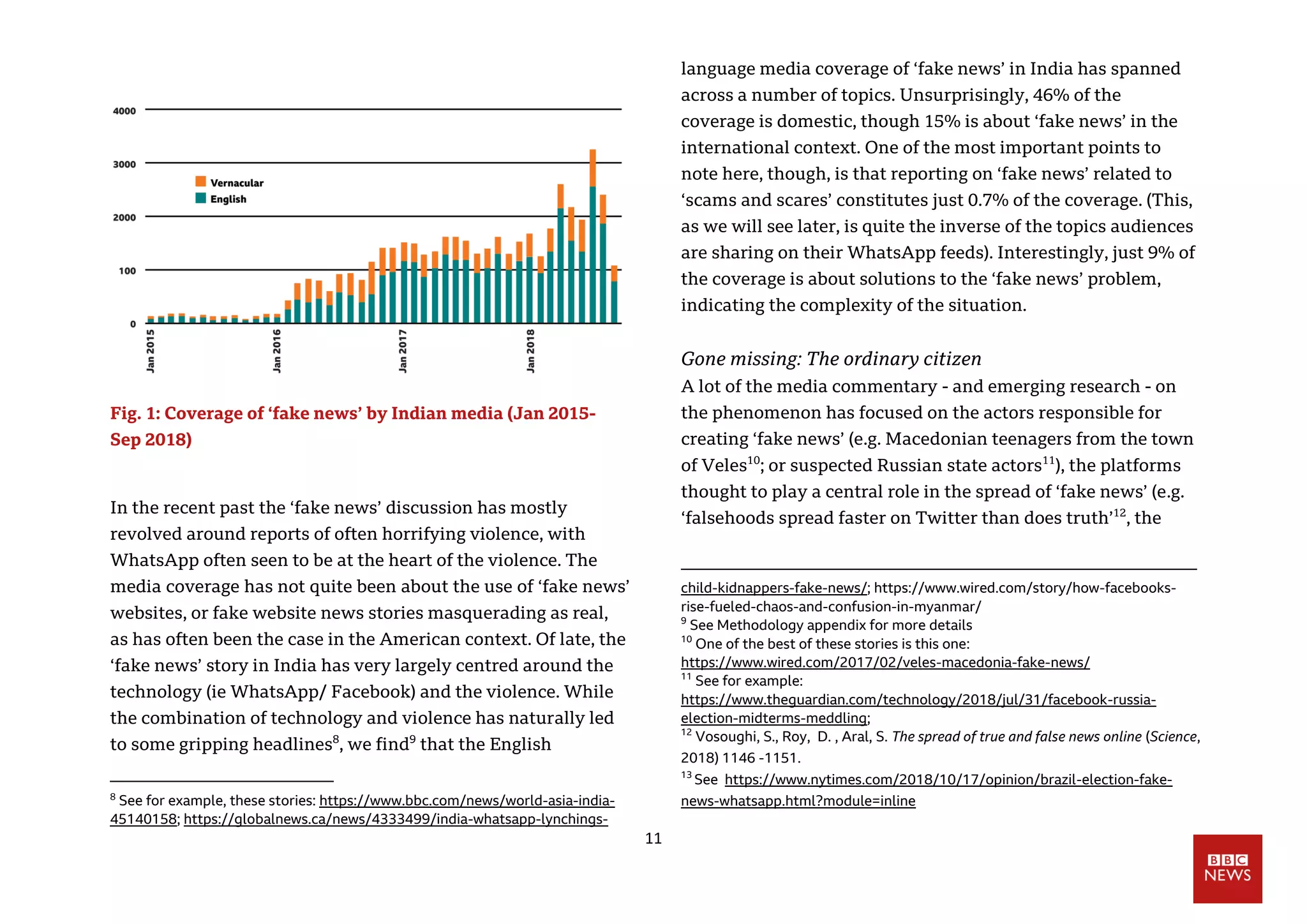
In the course of this project itself, we have found that
coverage of ‘fake news’ in the Indian media over the last three
odd years has grown by nearly 200%, partly driven by the
Cambridge Analytica exposes at the time of state elections. In
all there have been 47,5437
news articles online about ‘fake
news’ between January 2015 and September 2018. English
language media were the first to start talking about ‘fake news’
and continue to cover it most often, with vernacular media are
starting to engage with the issue more of late. (See Figure 1
below)
5
McChesney, Robert W., Foreword to The Stewart/ Colbert Effect. By
Amarnath Amarsingam (Jefferson: McFarland, 2011).
6
See, for example, https://qz.com/india/1335161/indias-fake-news-crisis-
to-worsen-ahead-of-election-oxford-study/ and
https://www.bbc.co.uk/news/technology-44967650
7
Please see methodology appendix for details.
11
Fig. 1: Coverage of ‘fake news’ by Indian media (Jan 2015-
Sep 2018)
In the recent past the ‘fake news’ discussion has mostly
revolved around reports of often horrifying violence, with
WhatsApp often seen to be at the heart of the violence. The
media coverage has not quite been about the use of ‘fake news’
websites, or fake website news stories masquerading as real,
as has often been the case in the American context. Of late, the
‘fake news’ story in India has very largely centred around the
technology (ie WhatsApp/ Facebook) and the violence. While
the combination of technology and violence has naturally led
to some gripping headlines8
, we find9
that the English
8
See for example, these stories: https://www.bbc.com/news/world-asia-india-
45140158; https://globalnews.ca/news/4333499/india-whatsapp-lynchings-
language media coverage of ‘fake news’ in India has spanned
across a number of topics. Unsurprisingly, 46% of the
coverage is domestic, though 15% is about ‘fake news’ in the
international context. One of the most important points to
note here, though, is that reporting on ‘fake news’ related to
‘scams and scares’ constitutes just 0.7% of the coverage. (This,
as we will see later, is quite the inverse of the topics audiences
are sharing on their WhatsApp feeds). Interestingly, just 9% of
the coverage is about solutions to the ‘fake news’ problem,
indicating the complexity of the situation.
Gone missing: The ordinary citizen
A lot of the media commentary - and emerging research - on
the phenomenon has focused on the actors responsible for
creating ‘fake news’ (e.g. Macedonian teenagers from the town
of Veles10
; or suspected Russian state actors11
), the platforms
thought to play a central role in the spread of ‘fake news’ (e.g.
‘falsehoods spread faster on Twitter than does truth’12
, the
child-kidnappers-fake-news/; https://www.wired.com/story/how-facebooks-
rise-fueled-chaos-and-confusion-in-myanmar/
9
See Methodology appendix for more details
10
One of the best of these stories is this one:
https://www.wired.com/2017/02/veles-macedonia-fake-news/
11
See for example:
https://www.theguardian.com/technology/2018/jul/31/facebook-russia-
election-midterms-meddling;
12
Vosoughi, S., Roy, D. , Aral, S. The spread of true and false news online (Science,
2018) 1146 -1151.
13
See https://www.nytimes.com/2018/10/17/opinion/brazil-election-fake-
news-whatsapp.html?module=inline
12
possible use of WhatsApp to ‘poison’ Brazilian politics13
) or
indeed the ‘victims’ of fake news - from individuals to
communities to even entire democracies. A whole host of
academics from a whole host of disciplines - including
economics, computer science, have sought to understand
various aspects of the phenomenon, from the consequences of
digital information overload to the economics of fake news
production.
A lot of the research in the area has been focused on the
technology or platform and used technology in the analysis14
.
In all of the frenetic and frantic research and commentary,
there is one thing that has gone underexplored: the voice of
the ordinary citizen - and indeed, the responsibilities of the
ordinary citizen. Where the ordinary citizen does appear,
especially in the media, s/he is sometimes inadvertently
portrayed as dupe of malicious actors, or heavily influenced
by social media/chat app messages to the extent of
committing acts of egregious harm.15
Despite the injunctions
of researchers like Alice Marwick, who call for a
“sociotechnical approach” to understanding the ‘fake news’
phenomenon, and Wardle & Derakshan16
, who draw upon the
work of James Carey and urge researchers to understand
14
See for example: Qiu, Xiaoyan, Oliveira, Diego F. M., Shirazi, Alireza Sahami,
Flammini, Alessandro Menczer, Filippo, Limited individual attention and online
virality of low-quality information (Nature Human Behavior, 2017), 1-132.
15
For example, the headline here says ‘How WhatsApp helped turn an Indian
village into a lynch mob’: https://www.bbc.com/news/world-asia-india-
44856910
16
Wardle, Claire, Derakhshan, Hossein . Information Disorder (Strasbourg,
France: Council of Europe, 2017)
better the ‘ritualistic function of communication’, some bits of
the academic research and a lot of the journalism so far have
inadvertently diminished the agency of ordinary human
beings, focusing more on the technology of the
communication. Even Wardle & Derakshan, who do think
about communication as culture, recommend action by
technology companies, national governments, media
organisations, civil society, education ministries, and funding
bodies - but don’t have anything to say about what the
responsibility of the ordinary citizen is in addressing the
problem of ‘fake news’.
The occasional study has centred the public’s voice/role on
the phenomenon of ‘fake news’. A study commissioned by the
BBC’s commercial news arm, Global News Ltd., found that
79% of the public in 6 countries of the APAC region were ‘very
concerned’ about the spread of fake news.17
A late 2017 global
poll in 18 countries conducted by Globescan for the BBC
World Service found that 79% of the respondents globally
were concerned about ‘what’s fake and what’s real on the
Internet’.18
In Kenya, 87% of the respondents in a study by
Portland reported that they had seen ‘deliberately false
news’.19
All of these studies shed some light upon the
phenomenon as experienced by the public. However, they
answer more of the what questions than the why or the how
17
BBC Global News Limited, The value of news (BBC Global News, 2017)
18
See: https://www.bbc.com/news/technology-41319683
19
Available here: https://portland-communications.com/pdf/The-Reality-of-
Fake-News-in-Kenya.pdf; the study did not go into the question of how
respondents knew the content was deliberately fake.
13
questions about citizens’ motivations and behaviours20
.But
because the research terrain is relatively new, these studies
lead to more questions than answers. Above all, though, the
main question that these studies throw up is this: what
exactly is this ‘concern’ that people seem to be expressing?
And if indeed they are so concerned, how have they changed
their behaviour in response to that concern21
? It is well-nigh
impossible to answer these questions by simply tracking their
behaviour on technology platforms or even by asking them a
set of questions in a large scale quantitative survey. It is by
immersing ourselves to some extent in the lives of these
ordinary citizens to some extent can we start to understand
how social and cultural forces, and their own desires and
aspirations, come together to influence the role they play in
the spread and growth of ‘fake news’.
Whither India?
In addition to this people sized hole at the centre of many of
the research projects and papers, much of the published or
20
This is as it should be - quantitative surveys are better at answering certain
questions than others. However, it must be said that online quantitative studies
are increasingly easier and quicker to do than ever before, and many
journalists find it easier to report on such studies than others. Consequently,
quantitative surveys are often being used for purposes they are not designed
to fulfil.
21
We are assuming that ‘concern’ usually leads to some kind of change, first
in the individual’s internal state of being and then in their external actions.
We recognize though that there is a body of scientific evidence that argues
this is not inevitable and that existing human behaviour, say, for example,
humanity’s response to the threat of climate change, is ample evidence of
the big gap that exists between attitudes and behaviour. (Which also leads
us to the depressing conclusion that the movie ‘Wall-E’s’ depiction of future
humans might be extremely prescient…).
publicly available research has been centred in the USA, and
to a certain extent, Europe. While there has been reporting on
‘fake news’ and its consequences from around the world and
extensive coverage of the issue in local media in many
countries of the world, this has not yet been accompanied by a
similar volume of published research in those countries. In
India, especially, much of the discussion seems to have been
conducted in the media, and not so much in the academy or
within think tanks.22
Of course, the research cycle moves
slowly while the news cycle moves at the speed of light, but
the lack is glaring; and the first draft of history, which is what
journalists write, should not become the final verdict on the
phenomenon.
And what’s going on inside private WhatsApp and
Facebook feeds?
In addition, it is well-nigh impossible for researchers to use
algorithmic/computerized/automated techniques to
investigate audience behaviour within encrypted private
networks (eg Facebook, WhatsApp) - and this is as it should be
to ensure people’s privacy.23
As a result, the picture we have
about how people are sharing information, especially ‘fake
news’, is from the ‘outside’, so to speak, assessed primarily
22
There have been research studies looking into government/ state
disinformation which have included India, for example:
http://comprop.oii.ox.ac.uk/wp-
content/uploads/sites/93/2018/07/ct2018.pdf
23
In this paper we do not engage with the debate on fundamental issues of
privacy and data collection on technology platforms.
14
from the metrics that are available within the analytics
systems of the platforms24
. This picture is especially fuzzy
when it comes to the WhatsApp and Facebook. Not that much
is known25
of the content of what is actually in the feeds/
groups of users. Nor is that much known about the actual
strategies and tactics people adopt to share messages on
WhatsApp. WhatsApp, for example, has been put at the heart
of Indian coverage of ‘fake news’ and violence, but it has not
been fully explained, which innate characteristics of
WhatsApp have made it so central to the debate. Or, talking
about Facebook, or Twitter, or any other platform for that
matter, how exactly – and for what purposes - ordinary
citizens are using these platforms - and how that matters in
the context of ‘fake news’. Not that much work has been done
either in categorising the messages within these networks by
content, even though there have been proposals to categorise
these by intent 26
.
24
Here we are referring mainly to Facebook and Twitter. WhatsApp lacks even
rudimentary analytics systems, or at least does not make it available widely -
this is a feature, not a bug, from the perspectives of its founds, a consequence
of their commitment to user privacy and lack of interest in advertising. See for
example, https://www.theguardian.com/technology/2018/apr/30/jan-koum-
whatsapp-co-founder-quits-facebook.
25
At least not to the external world; Facebook, for example, will know about
the material flagged for moderation.
26
Wardle, Claire, Derakhshan, Hossein . Information Disorder (Strasbourg,
France: Council of Europe, 2017)
What do we mean when we use the term ‘fake news’ in this
report?
As we have touched upon earlier, there are multiple uses - and
abuses - of the term ‘fake news’. While a precise definition of
the object of inquiry is critical to high quality research, one of
the objectives of this project was to understand how ordinary
citizens defined the term, if at all. That being said, Wardle’s
categorisation27
of ‘mis and disinformation’ into seven broad
categories of satire/parody, misleading content, imposter
content, fabricated content, false connection, false context,
and manipulated content, was certainly a starting point.
However, classifying ‘fake news’ by the intent into mis, dis
and mal-information seems problematic, because judging
intent from outcome is - as journalists well know28
- no easy
task. Also, including satire/ parody in the bucket of mis/dis-
information because it has the ‘potential to fool’29
sat
uncomfortably with us: not just because satire has been
historically a weapon of the weak against the powerful but
also because we suspected that most people for the most part
did have the ability not to be ‘fooled’ by satire.
In this report, we will use the term ‘fake news’30
. Our rationale
for doing so, as opposed to the variety of other terms proposed
27
Ibid.
28
See, this: https://www.nytimes.com/2018/06/25/reader-center/donald-
trump-lies-falsehoods.html
29
Wardle, Claire, Derakhshan, Hossein . Information Disorder (Strasbourg,
France: Council of Europe, 2017) p17
30
A number of prominent social scientists observed in an article in Science, that
just because a terms has been weaponised should not mean we do not use it.
See: http://science.sciencemag.org/content/359/6380/1094
15
such as ‘mis-information/mal-information/disinformation’31
,
‘junk news’ 32
, or even ‘propaganda’, is in line with many of the
arguments of Marwick33
. However, while Marwick, borrowing
from Caroline Jack, prefers to use the term ‘problematic
information’, we persist in using the term ‘fake news’ for the
simple reason that this project starts with the emic
perspective34
, even if it does not end there as we will see later,
that the term that the ordinary citizen uses to refer to the
entire spectrum of incorrect or misleading information (and
more) is - for good or for bad - ‘fake news’. It is mainly for this
reason that we use the term fake news35
in this report- and not
just as a heuristic. Note, though, that while we were keenly
interested in understanding how citizens perceived fake news,
we did not use their definitions in the analysis of news stories
or the content of their private networks. We have used Indian
fact-checking sites such as altnews and boomlive to assess the
truth claims of news articles called out as fake. Researchers on
this project have also assessed the truth claims of various
pieces of private network content. As a starting point, then,
our definition of fake news was this: information, however
31
Wardle, Claire, Derakhshan, Hossein . Information Disorder (Strasbourg,
France: Council of Europe, 2017) p17
32
Bradshaw, Samantha, Howard, Phillip N.,Why does junk news spread so quickly
across social media ? Algorithms, advertising and exposure in public life (Oxford
Internet Institute, 2018)
33
Marwick, Alice E.,Why do people share fake news: a sociotechnical model of
media effect (Geo. L. Tech.Rev.474, 2018).
34
For a good- but very specialist discussion- see Harris, Marvin, History and
Significance of the Emic/Etic Distinction (Annual Review of Anthropology, 1976)
329-50.
35
We report relief at this point to be able to drop the quotation marks from
‘fake news’!
conveyed, in whichever format, on whatever platform, which is
not fully supported by factual evidence.36
That is, our starting
definition of fake news certainly goes much beyond the news
stories on websites, located somewhere on the internet,
available by using an url, and shareable on social media
platforms using that same url. We deliberately include all
formats of information sharing, primarily because we
anecdotally know that the dominant form of information
sharing on private networks in India is not through news
stories as defined above, but very much in the form of images,
pictures, memes, etc.
Approaching this project: Ordinary citizen, sharing, and
verification
Our starting observation for this project was the simple
observation that there are a few basic conditions that are
required for fake news to spread through networks. It
certainly needs someone to create the fake news, and it
certainly needs platforms and technologies which enable
them to spread. But it also needs one critical element:
ordinary citizens to share the fake news in their networks.
And it needs these things to be spread on without verification.
For us, then, an understanding of the fake news phenomenon
is simply incomplete without understanding this key
question: why does the ordinary citizen share fake news without
36
We note here that the issue of what constitutes ‘evidence’ can be debated, of
course. In India, for example, debates around history in India often centre
around what constitutes evidence. For the purposes of this project, we follow
the standards of factual evidence that are regarded as normative in the
academy and can be arrived at by a process of inductive or deductive reasoning.
16
verification? The simplest and therefore simplistic37
answer is
that they don’t care about ‘facts’ and ‘accuracy’ or even ‘truth’.
Equally reductive is any sense that the majority of ordinary
citizens spreading fake news are either malicious or
duplicitous, or conversely dupes of malicious state actors.
None of these assumptions and explanations seemed
sufficient to us as researchers, leave alone the necessity to
explain the phenomenon of fake news.
To be absolutely clear, our focus in this project is neither state
actors nor government propaganda. In this project, we aim to
shift the focus to the actions of ordinary citizens. We aim to
understand the fake news phenomenon as a socio-cultural
and socio-political phenomenon enabled by technology rather
than as a purely technological phenomenon.
In this project then, we draw upon the British Cultural Studies
research tradition to understand the usage38
, but in particular,
the sharing of fake news by ordinary citizens, both within
encrypted Facebook networks and within WhatsApp. And in
particular, we aim to understand if and why sharing happens
without verification. We attempt to situate this sharing
activity of citizens in their specific sociocultural contexts. In
this project, therefore, we start with people and the nature,
content, and structure of the messages they are sharing, but
37
And more common in more circles of discussion than anyone would care
to admit…
38
Without arguing that media effects are minimal. In fact, one of the central
objectives of this project is to assess the effects of people’s networks on
their sharing behaviour.
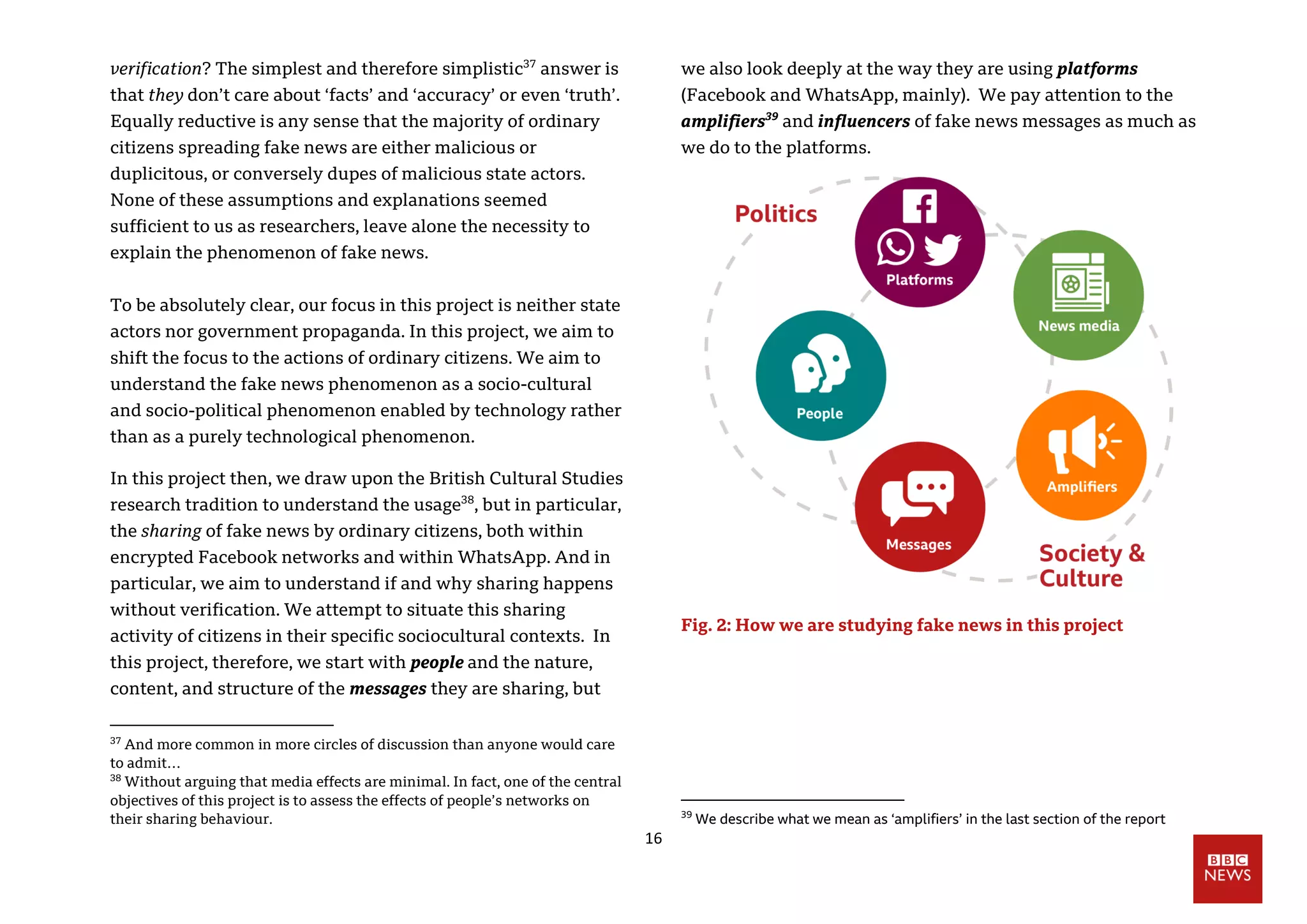
we also look deeply at the way they are using platforms
(Facebook and WhatsApp, mainly). We pay attention to the
amplifiers39
and influencers of fake news messages as much as
we do to the platforms.
Fig. 2: How we are studying fake news in this project
39
We describe what we mean as ‘amplifiers’ in the last section of the report
17
This project is exploratory in nature, and aims to approach
something close to a ‘thick’ description40
of the phenomenon
of fake news. However, while being exploratory, it is also
conclusive in many of its findings, given the breadth and
depth of the fieldwork. We do hope this report will be read
widely by anyone interested in ‘fake news’ or for that matter
India, but the principal audience we had in mind while writing
this report are academic researchers. We want this report to
spur exploration and research across multiple fields of inquiry,
and as such we have borrowed magpie like from multiple
disciplines41
in the writing of this report.
About the methodology and research process
We set out in this project to try and answer the question of
why ordinary citizens spread fake news without verification -
a little understood part of the fake news equation. The project
was extremely quick turnaround, from starting to final report
publication was to be completed in three months flat. This
meant that we would not be able to address all of the
questions we would like to answer and we would also not be
able to use all of the methodological tools at our disposal.
40
See Geertz, Clifford, The interpretation of cultures (New York: Basic Books, Inc,
Publishers,1973)
41
The lead author takes full responsibility for this cavalier approach to
disciplinary boundaries, and drawing upon literature he is only passingly
familiar with.
Key to deciding on approach was the fact that the fake news
phenomenon is very new indeed, and not yet that well
understood. When a phenomenon is new or not very well
understood, qualitative research techniques are especially
useful. These techniques - in this case, in-depth interviews
and up-close observation of sharing behaviours - allowed us to
explore fake news with nuance, richness and depth. And
because we wanted to know what was spreading in encrypted
private networks like Whatsapp, semi ethnographic
approaches – in this case, visiting people at home - was
essential. This allowed us to understand the individual in full,
and establish how their histories and backgrounds had
brought them to the present point; and how they were
contending with societal and cultural forces surrounding
them.
We debated using large sample quantitative surveys42
but we
came to believe that the survey methodology should follow
the establishment of a conceptual framework and intellectual
scaffolding. Our interest was in exploring audience
psychology in-depth to start with, in particular to understand
what citizens meant by the term ‘fake news’, so we decided
against using survey methods for this project.
Fieldwork and analysis were carried out in six overlapping
stages (see Methodology Appendix for more detail on each
stage of the methodology):
42
Not least because we work in a journalistic organisation and have
observed that journalists feel the most comfortable reporting on research
whose findings are conveyed in charts and graphs!
18
1. Respondents were recruited and consent forms signed.
Respondents came from a mix of social, political, age,
gender and economic backgrounds. They were first
asked to share with researchers what they found
interesting in their WhatsApp and Facebook feeds and
were sharing within their networks. Researchers were
very careful to not use the term ‘fake news’ at this
stage-because one of the key objects of the inquiry was
to assess whether or not respondents were able to
detect what was fake and what was not; and what they
labelled as fake.
2. Post seven days of such sharing, in-depth, in home
interviews were held, where researchers had detailed
conversations touching on multiple aspects of their
lives – from childhood to adulthood, their influences,
their idols, their likes and dislikes, their reaction to
their changing environments, their news consumption,
their usage of digital platforms, their social, cultural,
and political perspectives and their sharing activity,
eventually arriving at the topic of fake news. During
the course of - and again at the end of - the sessions,
respondents were asked to show researchers the
contents of their WhatsApp and Facebook feeds, and
discussions were held on what they would share, would
not share, and why. Also, they were shown known fake
news messages and asked whether or not they found
these credible and why. Respondents were finally
asked to share with researchers. Their interviews were
then analysed using a grounded theory approach43
-
given that this was a new phenomenon being explored-
and the results married to what was being found in the
analysis of the messages.
3. The messages shared by participants were in parallel
analysed by semioticians on the one hand, and data
scientists using machine learning methods on the other
- for tone, content, style and structure.
4. Data science approaches were then used to retrieve and
analyse the media coverage of fake news in India, in
English and vernacular languages.
5. After a seed list of fake news sources was generated in
stages 3 and 4, the Twitter network of fake news
sources and amplifiers in India was mapped44
, and
clustering analysis was conducted to understand
agents sharing similar connections.
6. Publicly available Facebook advertising data was used
to understand strength of affinity between audiences of
fake news sources and audiences of legitimate news
sources, and build a network map of these various
communities.
That is, the project ended up using multiple methodologies
eventually:
o In-depth in home qualitative and semi-
ethnographic approaches: 120+ hours of in
depth interviews at home across 10 cities and 40
43
See methodology appendix for more details
44
See methodology appendix for more details
19
individuals in India. The cities in which the
interviews were conducted were a mix of metros
and smaller towns, spanning the north, south,
east, and west of the country: Mumbai, Delhi,
Kolkata, Chennai, Rajkot, Vijayawada, Raipur,
Udaipur, Amritsar, Varanasi. The interviews
were conducted in the language the respondent
was most comfortable in- in most cases the local
language. The interviews were transcribed and
translated. Original recordings, photographs and
videos taken inside the respondents’ homes
were used for analysis, alongside English
language translations of the conversations.
o Auto ethnography: Collection of a corpus of fake
news messages.
o Semiotic analysis: Understanding signs,
symbols, and structures of fake news messages.
o Big data/ network analysis: Across 16,000
Twitter profiles (370,999 relationships); 3,200
Facebook pages & interests
o News scan and topic modelling: Media scans
from last two years of news about fake news, in
English and in local languages. 47,543 in total.
The findings from all of these stages- plus learnings from desk
research/ review of existing literature- was brought together
by the research teams to create initial presentations, finally
followed by this report that you are reading.
For taking the time to read this report, thank you.
And now, here’s what we found.
20
The findings
21
In the next few45
pages we will tell you the story of fake news
and ordinary citizens in India as we see it from our analysis of
the data. We will tell you this story in six main parts.
These are:
1. The breeding ground: In which we outline what our
analysis suggests are the necessary conditions for the spread
of fake news. We outline six ‘conditions’ from the news
environment to psychological attributes to citizens’ sharing
strategies on the sharing platforms.
2. The motivations behind sharing: In which we try to
understand why people share. In an interlude, we outline our
observations on the socio-political identities we see
crystallising in India today- as we find this quite central to
understanding sharing behaviour by citizens
3. What is fake news: In which we address this question from
the perspective of the citizens
4. The narratives of effective fake news messages: In which
we understand the narratives that effectively short-circuit
critical thinking (And we look at fake news messages of the
left and right) effective
45
Ok. It’s not exactly ‘few’.
5. Fact-checking and verification: In which we address why
verifying behaviour is limited and specific
6. The fake news ecosystem on social media (Twitter and
Facebook): In which we try to understand if there is a fake
news ecosystem, and see how sources known to have shared
fake news, are interacting with political and media actors.
7. Conclusions and suggestions for further research. Does
what it says on the tin
22
The breeding ground
The conditions created for sharing
news without verification
1
23
I. The breeding ground: the
conditions created for
sharing news without
verification
I.1. The lines between various kinds of news have
blurred
When discussing fake news, both parts of the term are
equally important. So first, we must understand how people
understand the term ‘news’, before we move onto issues of
fake and genuine.
As a term, ‘news’ itself has always had more than one
meaning: on the one hand, news is what you got in your
newspapers and televisions and radio sets; on the other hand,
news is also information about you, your family, and others
important to you. In the realm of institutional news providers
- and researchers of media - too, there has always been a
further demarcation between ‘hard news’ and ‘soft news’ 46
as
there has been one between ‘news’ and ‘features’. Many of
46
See, for example, Reinemann, Carsten , Stanyer, James, Scherr,
Sebastian, Legnante, Guido. Hard and soft news: A review of concepts,
operationalizations and key findings. (Journalism, 2012) 221-240
these demarcations originated from the world of print
newspapers, and were carried over into TV news when it first
started. But the emergence of Facebook as a key platform for
news – and the centrality of its ‘newsfeed’- established a
forum where not only hard and soft news and ‘news’ and
‘features’ blended together; it also created a forum where
‘news’ about your niece’s birthday and ‘news’ about a
dictator’s latest autocratic actions merrily intermingle. A third
demarcation is of most importance for our purposes - the
demarcation between ‘fact’ (i.e. just the pure reporting) and
‘opinion’, with the category of ‘analysis’ lying somewhere in
between. This has been a key feature of traditional journalism
with its routines, structures and adherence to the norms of
objectivity and/or impartiality.47
It is this distinction between
fact/reporting and opinion that seems to have been almost
completely decimated by digital news sources, especially by
social platforms, such as Facebook.
This, at the level of the ordinary citizen has had certain very
important consequences. In India, we see amongst our
respondents an upending of the traditional divide between
news and opinion. For the respondents, news is primarily
47
These are related but different terms, with ‘objectivity’ more commonly
used in the American journalism context. For example, see the BBCs editorial
guidelines ( https://www.bbc.co.uk/editorialguidelines/guidelines/bbc-
editorial-values/editorial-values) for how it thinks about the idea of
impartiality, and Tuchman’s classic sociological investigation of the workings
of objectivity in an American newsroom: Gaye, Tuchman. "Objectivity as a
Strategic Ritual: An Examination of Newsmen's Notions of Objectivity."
(American Journal of Sociology , 1972) 660-679
24
divided into two categories to start with. First, citizens think
in terms of ‘information’, which is related to the ‘fact’ that the
headline conveys - and mostly that. And then, there is ‘news’
which is the actual content. It is acknowledged and largely
desired that there be a layering of opinion - or at least a stance
- on the facts. It is then this layering in of opinion on to facts
that makes it news.
Crucially, news is now considered to be as much about ‘how it
makes me feel’ as about ‘what it tells me.’ ‘Human interest
stories’, or softer news in general is considered to be a core
part of news, while political and policy reportage is expected
to not just be dry and analytical, but to express some emotion.
In other words, people expect news to not just inform but to
entertain.
This is not an entirely new phenomenon. This collapsing of
boundaries between various types of news - albeit many of the
boundaries said more about news organisation norms than
news consumer needs- predates the rise of digital and social
media. Media scholars have been expressing anxiety about the
blurring of news and entertainment for a while now,
lamenting the rise of global ‘infotainment’ and the
‘Bollywoodization of news’.48
It will take us outside of the
purview of this report, so we will not develop the idea at
length: but it seems to us that one of the ways to understand
this development is to see it as the ‘mainstreaming’ of the
48
Thussu, Daya Kissan. News as Entertainment: The Rise of Global
Infotainment. (London: Sage Publications, 2007)
codes and norms of Indian vernacular news media - which
have traditionally been quite different from those of the
English language media in India49
.
What is new though, is that with the definition of news
becoming expansive and all encompassing, we find that
anything of importance to the citizen is now considered ‘news’.
It then also stands to reason that they are happy receiving
information from just about anyone – and not just a handful of
news organisations with rigorous journalistic practices,
trusted brand images, and legacies of accuracy. Even more
importantly for our purposes, we find that people don’t
differentiate – or more accurately find it too hard or too
resource intensive50
- to differentiate between various sources
of news (in the broad sense outlined above). Social media, with
its low barriers to entry provides innumerable sources of
information - and the distinctions between them are flattened
in the minds of the users. In fact, as we detail later, the
identity of the source is not at all central to the question of
consumption or sharing of information. But this is - at least
partly - a function of the sheer volume of digital information
that the average Indian user of WhatsApp and Facebook now
receives in their feeds every day.
49
See, for a discussion, Rajagopal, Arvind. Politics After Television: Hindu
Nationalism and the Reshaping of the Public in India. (Cambridge,UK:
Cambridge University Press., 2001)
50
Here, when we say ‘resource’ we primarily mean time and cognitive
resources. See later sections where we discuss this in detail.
25
I.2. Scepticism about the media’s motivations and
intentions
Amongst our respondents, we see a loss of trust about
the intentions of the news media, accompanied with a longing
for a past era when all was well and journalism was of the
highest standards. There is widespread belief that TV- and to
some extent, print - are motivated by profit more than
anything else; if anything, for today’s citizens, the agenda of
the media isn’t even so much hidden. The media is certainly
felt to be more biased and partisan today than it was before,
and the credibility of journalism per se is not dramatically
high. This attitude, though, comes from exposure to satellite
TV stations, particularly in the local languages, which are
known for their shrill and sensationalistic tone and hyperbolic
presentation style. Those whose media mix includes
newspapers are not that negative about journalism. (And
Doordarshan,51
considered staid and boring by many, does
have some amount of residual affection - in part because staid
and boring stands out in marked contrast to sensationalistic
and hyperbolic!) But overall, the sense is that the media has its
own agenda, stemming from its affiliation, with either
business, or political interests. There is a caveat emptor
attitude when it comes to the output of Indian media, especially
that of TV news channels.
51
The Indian state broadcaster, now a network of channels. Still consumed
widely, despite the number of private players in the market. See:
http://www.indiantelevision.com/television/tv-channels/viewership/urban-
areas-dominate-dd-viewership-zapr-180225
M: News is coming from your father’s time, so the news
which you get at those days like the way of telling, the
topics, in all things comparing it with the news now what
it is, is there any difference?
“R: At that time, what the reality in news was
there it has come down compare to now. At that
time, Doordarshan mean like news telling etc.
and it was real news.”
(Male, 25, Vijayawada)
“Like if you see Doordarshan, the host is a simple
one and just read the news but the private news
channel they make the small news into a breaking
news. To increase their TRP, they will hype that
small news to a breaking channel.”
(Female, 25, Udaipur)
“If we take TV news, each channel is biased with
some party, so there is no one neutral. In
newspaper also, each paper is biased with some
party. Only the social websites have common
news because it is uploaded by a common people
only, so I feel that, this is only unbiased news.”
(Male, 26, Chennai)
26
Note here the last line of the last comment. This will be of
importance later in the story.
“Fake news was not there as on Doordarshan and
CNN and BBC would put paid content in biased
view, but they won't put fake and untrue things.
I.3. The digital deluge- and the move to a high
frequency information environment
Indians today are having to deal with a huge volume of
digital information in their WhatsApp and Facebook feeds.
This is partly a result of the recent and dramatic drops in the
cost of data as well as the costs of smart phones and
subsidised feature phones.52
Since data costs are no longer a
key constraining factor in the use of digital networks, unlike
their peers in Kenya and Nigeria, people simply do not have to
52
See for example, Majumdar, Romita. “Two years of Jio: How free calls,
data catalysed India's digital revolution”, Business Standard. 6 September
2018. https://www.business-standard.com/article/companies/two-years-
of-jio-how-free-calls-data-catalysed-india-s-digital-revolution-
118090501169_1.html (accessed November 3, 2018).
think twice about sharing digital media, irrespective of the
nature of said media.
As a result, we find our respondents inundated with messages
on WhatsApp and Facebook. There is a near constant flurry of
notifications and forwards throughout the day on their
phones - encompassing from news organisations updates to a
mindboggling variety of social messages (for example,
“inspiring quotes” and “good morning” forwards, the latter of
which seems to be a peculiarly Indian phenomenon, even the
subject of discussion in the international media).53
News providers - and there are tens of thousands of them in
India54
- do not make it any easier, by sending regular, even
incessant, notifications to phones.
“I am attached to social media, and I have an app
of ABP news and it updates me in every 2-4
minutes about job and at present it is coming, and
it may have a lot of notifications of news”.
(Male, 34, Amritsar)
53
See, for example, Purnell, Newley. “The Internet Is Filling Up Because
Indians Are Sending Millions of ‘Good Morning!’ Texts.” The Wall Street
Journal. 22 January 2018. https://www.wsj.com/articles/the-internet-is-
filling-up-because-indians-are-sending-millions-of-good-morning-texts-
1516640068 (accessed November 4, 2018)
54
Source for saying the number of news providers available
27
The default behaviour for our respondents at the moment
seems to be to have notifications on rather than off- and we
believe this behaviour is quite widespread, for many
respondents, when asked how they come to know about a
news event, say that it’s ‘ because of notifications’. The rise of
digital as the central means of acquiring information has
effectively transformed news behaviour from a high time spent,
low frequency behavioural pattern to a high frequency, low time
spent behavioural pattern. In other words, people have many
more moments of news consumption than ever before, but
each of these moments is now of really short duration. In
India, citizens actively seem to be privileging breadth of
information over depth, partly as a response to the digital
deluge. This, we find, is necessitating the adoption of coping
mechanisms – which then end up facilitating the spread of
fake news.
I.4. Coping mechanisms for dealing with the
deluge
To be absolutely clear, Indians at this moment are not
themselves articulating any kind of anxiety about dealing
with the flood of information in their phones. If anything, they
only see the positives of social media.
“Because contacting has become easier due to
social media, people are easily connected on
WhatsApp, Facebook, there you relate to each
other, you get to know the birthdates of people,
you keep on getting texts, notifications about
people. Earlier this was not there, earlier people
needed to meet each other, talk face to face. But
now things have changed, people talk with each
other on WhatsApp, so that change has happened.
Connection has become easier now”
(Respondent, Male, 63, Delhi).
In India, the need to stay ‘updated’ (and that is exactly the
term that respondents use) overrides any anxiety about
needing to cope with the constant stream of digital signals
asking for attention. Over the years, in multiple research
projects, including this one, we have repeatedly picked up a
desire from Indian citizens to somehow stay abreast of
everything that is going on. This is especially pronounced
among the young- the reasons for this are multifaceted, from
not wanting to come across as uninformed in a peer group, to
the pressures coming from the country’s competitive entrance
exams, many of which test candidates on “general knowledge”.
“Our knowledge will be increased if we get
updated with the news, so if tomorrow we go in
any interview or we gets attached to any website,
28
or communicate with any customer, then we give
them information.”
(Male, 34, Amritsar)
In effect, navigating WhatsApp and Facebook is now part of
everyday life and people are doing it without consciously
thinking about how they are doing so. That does not mean
though that it is easy to do. WhatsApp and Facebook - which
we will from this point refer to collectively as digital sharing
platforms- are quite likely leading to a situation of
information overload.55
For example, refer to the quote earlier
from the male respondent in Delhi; he says “you keep on
getting texts, notifications about people”. The telling phrase
there is: “keep on”, and we hear similar use of language to talk
about information flows in these networks, but while it
sometimes flows over into irritation, a tone of anxiety or
concern about the difficulty of managing these flows does not
really come through.
55
“Information overload” is not the most well-defined of terms, despite
being used in diverse fields such as cognitive science, business, and
technology. Clay Shirky argues that the problem is not ‘information
overload’, because we have always been dealing with information overload,
but ‘filter failure’ – there are no economic incentives for producers of digital
content to filter for quality before publication. See Juskalian, Russ.
“Interview with Clay Shirky Part I.” Columbia Journalism Review. 19
December 2008
https://archives.cjr.org/overload/interview_with_clay_shirky_par.php?page
=all (accessed November 4, 2018).
“... You don’t want, but still, the posts are coming
through, right? The people keep sharing it, it’s
very irritating…Constantly, you will keep getting.
There are groups in that people have their
political affiliations. The regular ones have come,
it's Okay. Political things keep coming. It's very
irritating.”
(Male, 38, Mumbai)
But while people are not articulating their anxieties, we find
that they are certainly adopting a slew of tactics and
stratagems to cope with their digital feeds. It seems, though,
that as Qiu et al56
have suggested when reviewing the
literature on cognition in computer mediated/ digital
environments, that “paradoxically, our behavioural
mechanisms to cope with information overload may make
online information markets less meritocratic57
and diverse,
increasing the spread of misinformation and making us
vulnerable to manipulation”.
56
Xiaoyan Qiu, Diego F.M. Oliviera, Alireza Sahami Shirazi, Alessandro
Flammini, Filippo Menczer. “Limited individual attention and online virality
of low-quality information .” Nature Human Behaviour, 2017, 4
57
The approach here is based in the field of economics, so merit and quality
are not limited to ideas of the accuracy of a piece of information.
29
The strategies that are being adopted by people include:
I.4.1 Selective consumption58
: This operates in two ways. First,
given the volume of messages in their feeds, a significant
proportion of the messages received in their feeds, especially
WhatsApp feeds, are simply not opened or consumed. Second,
messages are often part consumed before they are forwarded
on. This part consumption could be based simply on the
headline without actually consuming the content59
This can
sometimes lead to situations where messages are forwarded
on, whose content is not even subscribed to by the sender, but
they are sent on because the image attached to the message
triggers an emotion in the sender, or a desire to show an
endorsement of that image.
58
We use this term to differentiate this from the very well-known media
psychology term ‘selective exposure’, where citizens favour information
which reinforces their pre-existing views. See Klapper, Joseph T. The effects
of mass communication . (Free Press, 1960) - (and a library of research after
that)
59
Of all the people reading this, who are also active on any social media,
90% of them have shared something without consuming. The other 10% are
lying to themselves. (Estimates, obviously!)
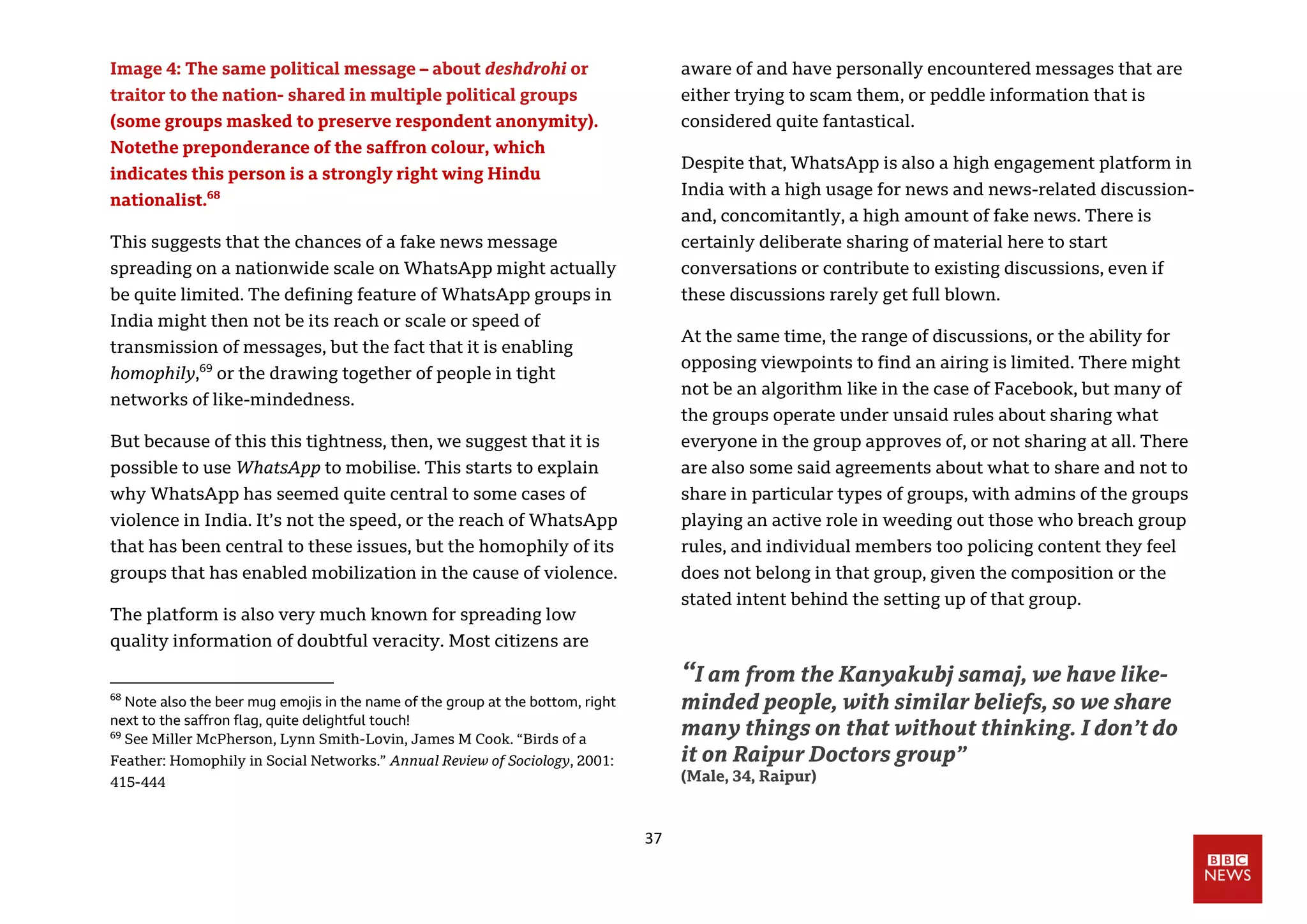
Image 1: WhatsApp message forwarded with a ‘Jai Shree
Ram’ note appended to show fondness for Lord Rama, even
though the sender did not intend to endorse the actual
content of the message.
30
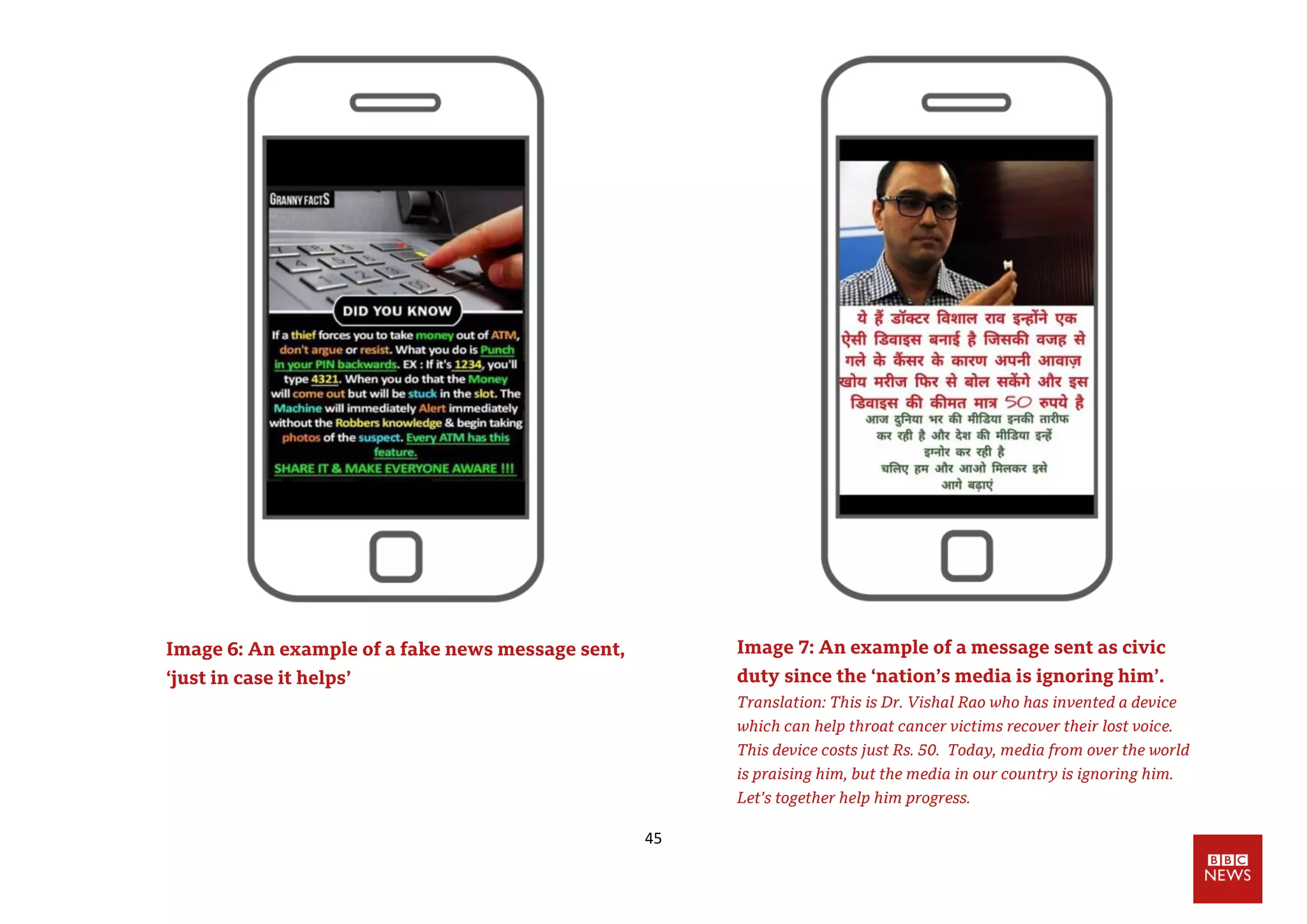
Image 2: A fairly typical example of unopened messages in a
WhatsApp group
I.4.2 Preference for images60
: Images (memes or otherwise) or
image heavy messages are overwhelmingly preferred for
consumption or to engage with. Long text forwards and videos
are generally not preferred: the time/ effort involved in
consuming these and the low storage available in most phones
(for videos), are big barriers to the consumption of these
formats.
Given the demands on people’s attention and cognition, the
fact that they would be using visual cues to decide whether or
not to engage with the content does make sense; while the
claim that visuals are processed 60,000 times faster than
words is an internet myth61
, there is certainly evidence that
pictures – especially those with a positive or negative affect
(crudely, ability to arouse an emotional response) - are
processed faster than words.62
This is, in fact, one of the central discoveries of this project.
The canonical example of fake news, for example, the story
60
It could be argued that this is so much same old-same old. The history of
communicating in India more through images than through words is long
and rich. See for example Jain, Kajri. Gods in the bazaar : The economies of
Indian calendar art. (Durham : Duke University Press, 2007) and Pinney,
Christopher. 'Photos of the Gods' : The printed image and political struggle in
India. (London: Reaktion, 2004)
61
Or should we say ‘visuals are processed 60,000 times faster than words’ is
fake news?
62
See, for example, Jan De Houwer, Dirk Hermans. “Differences in the
Affective Proccessing of Words and Pictures .” Cognition and Emotion , 1994:
1-20
31
about the Pope endorsing Donald Trump, created by
Macedonian teenagers, and circulating all over social media,
does not seem to be that prevalent in WhatsApp feeds in
India63
. To be clearer, stories as a collection of words on a
website, circulated in the form of the url, do not seem to be the
most prevalent means of sharing information (and
disinformation).
The form of information that is consumed or engaged with
more, is visual information, sometimes layered with a
minimum amount of text.
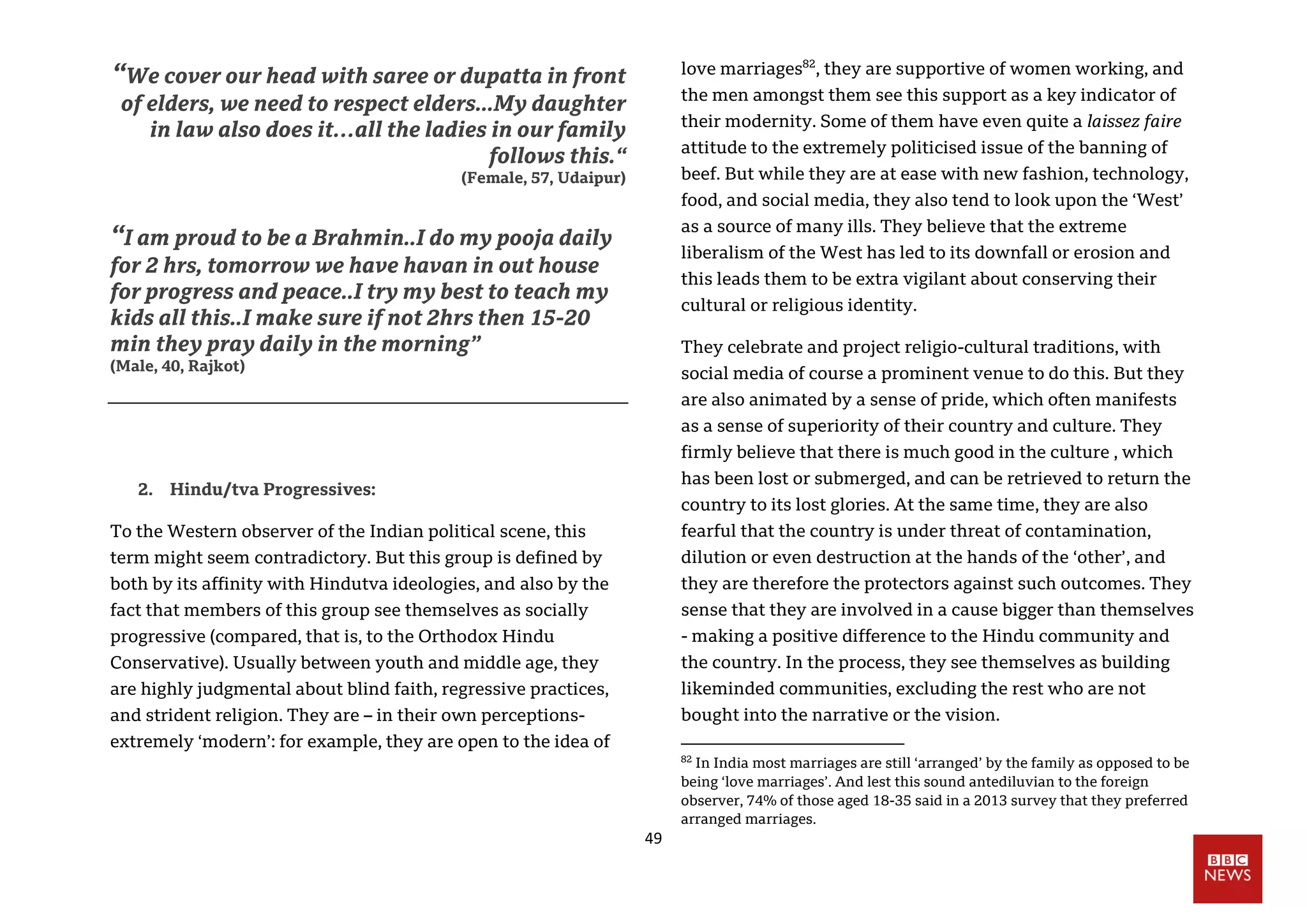
Image 3: Translation: “In a list of honest leaders issues in the
USA, there is only one person from Indian, that is Shree
Narendra Modi, and that too in first place” (Note: Versions of
63
Note that this is based on observations of the respondent’s WhatsApp and
Facebook feeds. It would be useful for future researchers to establish exact
proportions through quantitative surveys.
this with ex- Prime Minister Manmohan Singh replacing
Narendra Modi are found too in WhatsApp/Facebook feeds).
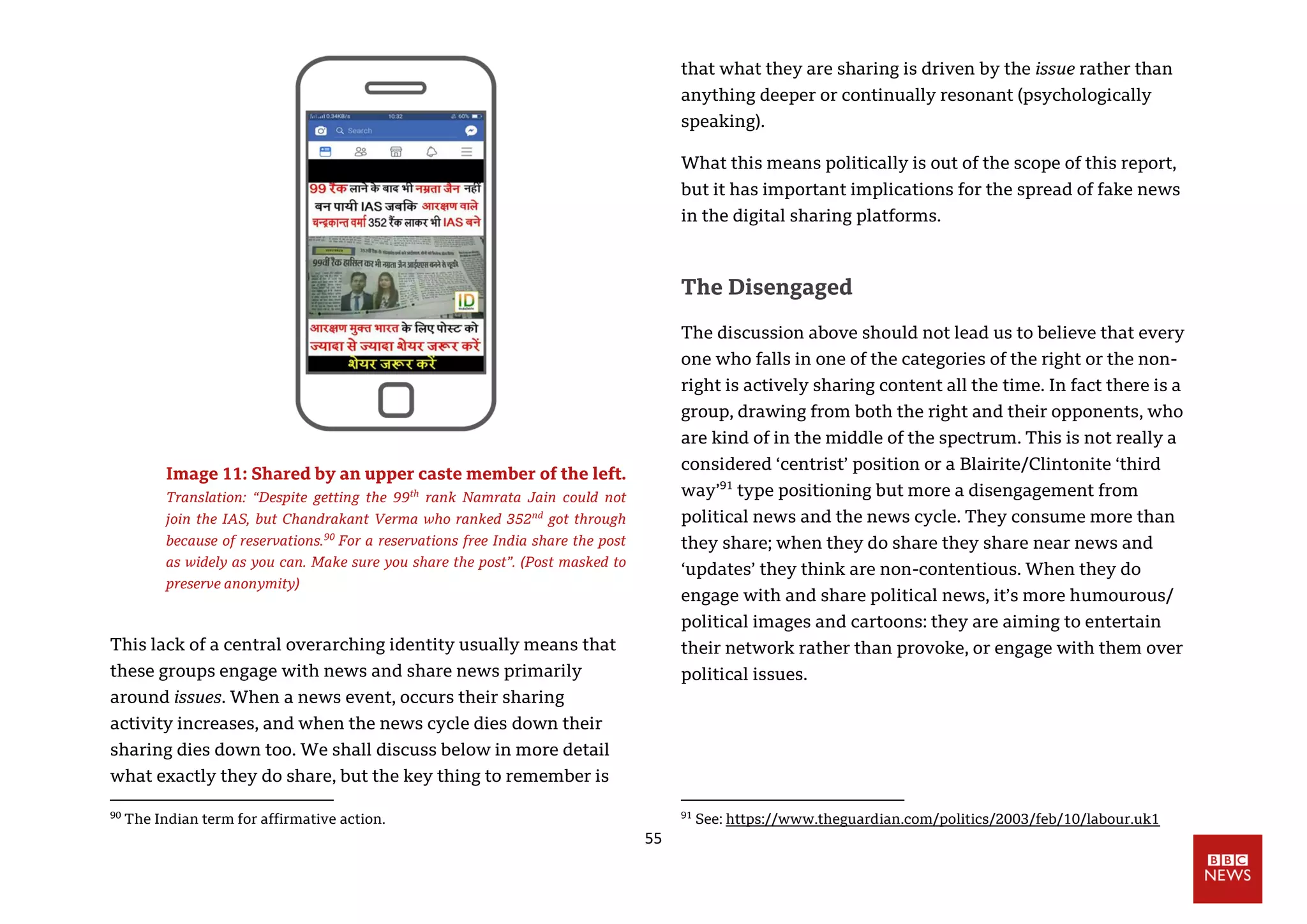
Image 4: Translation “Modi ji had said he would increase
GDP. He meant he would increase [the price of] Gas, Diesel,
Petrol. The failure to understand was ours, what’s his fault?”
32
Since people prefer to consume information in visual heavy
formats - or at best, very short text formats - they also prefer
to share in these formats. A very common mode of sharing is
through ‘screenshots’. In fact the practice of ‘screenshotting’ is
something that has become relatively automatic and
instinctive!
“There was inspiring news after long time search
news had come. There was a program in Delhi for
Kerala flood relief. Supreme Court lawyer and
judge they did the singing and did the charity. I
took the screenshot and forwarded. That time
people came to know that judge can sing.”
(Male, 56, Rajkot)
‘Screenshotting’ (and storing it in the photo gallery) is used as
a method of sending something at a time later than the time
when the material has been consumed. Screenshots also act as
aide memoires:
“Whatever I wish to purchase in gadgets I save its
screenshots on my phone…I have kept it for my
collection of all the things I liked and want to look
in detail about them.
(Male, 20, Udaipur)
Finally, because networks are relatively large and personal
relevance of messages is hard for the sender to assess,
screenshots become a way for the sender to signal to the
network that the sender does not know if this is relevant, but
will be happy to send more information (for example, the full
video) if required. It is also a way to compensate for the
possible low memory of the recipient’s phone – and
consequent irritation if the message turns out to be irrelevant
but hogs memory.
“Because I am sending screenshot to other person
and if he or she finds it useful then they will
message me that you send more details about it.
If I am sending in the group, some person might
think that this is useful but cannot download it
properly, then that person might get irritated.
M: So, you feel it should send a small page?
R: Yes. If a person asks for more information,
then I will send that person more details about
that information personally.
M: So, you feel people will get irritated if you
have shared the entire article?
33
R: Yes, since I myself feel irritated. Suppose I am
not giving RPSC exam and somebody writes to me
that this is very important please download it, I
downloaded it but that was no use for me, so I am
losing my MB, my memory is full, then I get some
irritation”
(Female, 25, Udaipur)
This preference for images, screenshots and minimal text has
three key consequences, important for our purposes:
a) in depth information or analyses conveyed in words finds it
difficult to flourish in this environment
b) the headline often is the full story
c) it is harder for both the consumers - and for researchers/
analysts - to get to the source/creators of the information.
For example, in an environment that is predominantly image
heavy, the very effective digital techniques such as those
suggested in A Field Guide to “Fake News” and other
Information Disorders,64
become more difficult to pull off (as
most of the “recipes” in the Field Guide start with urls, which
in the case of images, rarely exist).
I.4.3. Sender primacy: Given the overwhelming amount of
information and the consequent inability or disinclination to
subject each message in ones’ feed to rational critical analysis,
people use heuristics to decide which content to engage with
64
See the various “recipes” suggested at https://fakenews.publicdatalab.org/.
and even to assess what they find credible. As such,
consumption decisions are disproportionately influenced by
which individual has sent the message in the first place. If that
individual happens to be a person of influence or social
standing in the recipient’s online or real life network, or
perhaps even more importantly an ideological/political leader
chances are that the message will be consumed and even
shared. On the flip side, certain individuals are labelled as
‘pointless spammers’ and their messages are avoided.
“As I told you, I respect [xxx] Bhai, he is
knowledgeable and knows more than me. So
whatever, he sends me, I follow it. He has taught
me a lot of things, I didn’t know”
(Male, 24, Varanasi)
“I trust anything my Mamaji sends, he knows a
lot about the world. There are my other uncles
who stay in our hometown, I instantly mistrust
anything they send. I don’t even open most of
their forwards”
(Male, 27, Mumbai)
“(On a piece of fake news) My friend has sent
this to me, why would he send anything fake to
34
me?”
(Female, 24, Vijayawada)
“XXXX is a leader who talks facts and figures.
People may sleep in his speech but he talks
numbers. That is why when he shares anything or
talks I just pay attention to it”
(Female, 23, Raipur)
Note here the ages of the individuals quoted: they are all
young people. Our analysis suggests that sender primacy
operates across all ages and demographics, and does not
have that much to do with levels of formal education.
I.4.4. Source agnosticism: This reliance on the identity of the
sender to judge the content of the messages is related to what
we are calling ‘source agnosticism’. That is, people really don’t
seem to worry too much about where the messages they are
receiving originated from, especially on WhatsApp. It is not
that people don’t know that there are more credible and less
credible sources. Nor is it the case that they don’t care about
consuming incorrect information. It’s that on the digital
platforms, while contending with the flood of onrushing
information, they simply cannot be bothered. The credibility
of the sender is what gives legitimacy to the message. The
original source, if at all present in the message itself, is often
ignored or unnoticed in Facebook,65
or completely absent in
WhatsApp. This is also happening, as detailed earlier, in an
environment where the scepticism about the motivations and
intentions of the media is widespread- so it’s not as if there is
someone established as an arbiter of truth anyway. And as we
will see later, for many types of messages, the question of
where the message originated from becomes immaterial, since
they are anyway not about truth or lies, they are about
something much deeper than that.
I.4.5. The nature of the forum: The forum or composition of the
WhatsApp group something has been sent in becomes a key
determinant of engagement with and sharing of a message. It
matters whether the message is a personal one (i.e. sent one to
one) or whether the message has been sent in a group. If a
group, it matters what type of group it is: is it a family group,
or is it a group from work, or is it, in fact, a group dedicated to
politics - formal or informal? People think very actively about
the composition of their WhatsApp groups and therefore what
should be shared in which group. The same message
considered appropriate to share in one group can be
considered completely inappropriate to share in another
group.
65
This is true even after consumption. A private study commissioned by the
BBC World Service has established that on Facebook as less as 30% of the
audience recognised the source of a news item, even after they had consumed
the news item.
35
I. 4.6: The affective more than the cognitive66
: Given the deluge
of digital information and the (unarticulated but certainly
experienced) pressure to process information quickly, what is
engaged with more often than not, is what triggers an emotion.
And the way citizens often learn about things is through an
affective style, not a cognitive one. Put in non-academic
language, digital sharing platforms seem to be operating more
in the domain of ‘feeling’ than ‘thinking’, though once in a
while, there is some critical engagement based on whether or
not something is of interest or relevance. Very importantly, in
the Indian case, what is engaged with and then shared is what
resonates with their ideology, especially their socio-political
identity. We will come back to this point later.
I.5. The broken link between consumption and
sharing:
For the ordinary citizen, consumption is hard, and
critically- engaged consumption is even harder. However,
sharing is easy. Digital sharing platforms are built to make
sharing easy - and there is no requirement built into the
platforms that sharing be done only after the consumption of
content. This means that there are very few considerations
that arrest the process of sharing, other than propriety and
relevance to the group that it is being shared in.
66
We are using these terms here in the sense used in the field of education/
learning. See, for a quick overview:
https://thesecondprinciple.com/instructional-design/threedomainsoflearning/
There is little verification by the citizen of the accuracy or
authenticity of the content that is being shared today. There
are some categories that are considered to be important for all:
non-political or soft news (for example, health) , updates (for
example, ATMs are going to be closed for five days) or policy
news ( for example, taxes have risen in the latest budget).
Because these are seen as being of universal relevance,
considerations of relevance do not come into play and they
are shared very widely and very quickly.
“Health news and information - I will share with
all, someone will benefit out of it”
I.6 Sharing Strategies on WhatsApp and
Facebook
Our two platforms of focus, WhatsApp and Facebook,
are used quite differently and quite strategically by citizens,
but in their own ways ,both end up facilitating conditions
conducive to the sharing of fake news.
How WhatsApp is used by citizens
WhatsApp is today the indispensable67
platform for citizens. It
is also the platform de jure to share. It is the platform to
67
Strictly speaking we can’t make this claim from a qualitative study; any
quantitative study should be able to easily validate, this, though.
36
connect with people you –well - have a connection with. The
connection could be personal (ie family/ friends), or slightly
less personal (larger township, where it could include
strangers), or it could be a group about politics (a group for a
RSS shakha, say). But every group in WhatsApp has
something that bonds the group together - and makes it
behave like a group. That is, WhatsApp groups have group
norms, and it is seen as socially quite problematic to breach
those group norms. Generally speaking, these groups – once
created - do not grow too fast, and because there are definite
criteria for membership of groups, there is a natural limit to
their size.
Very importantly for our purposes, sharing in WhatsApp
groups is very targeted. WhatsApp usage is about validation of
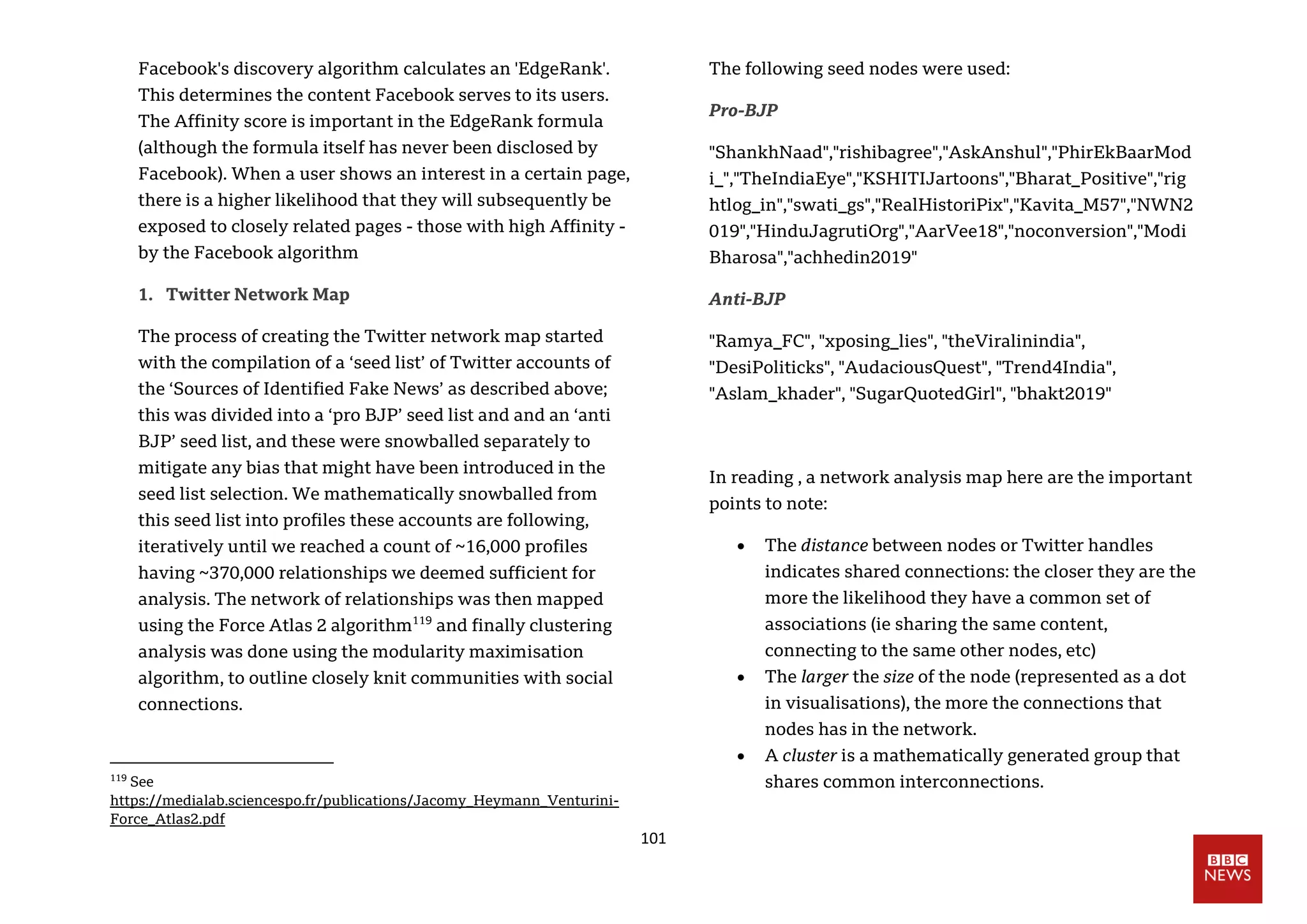
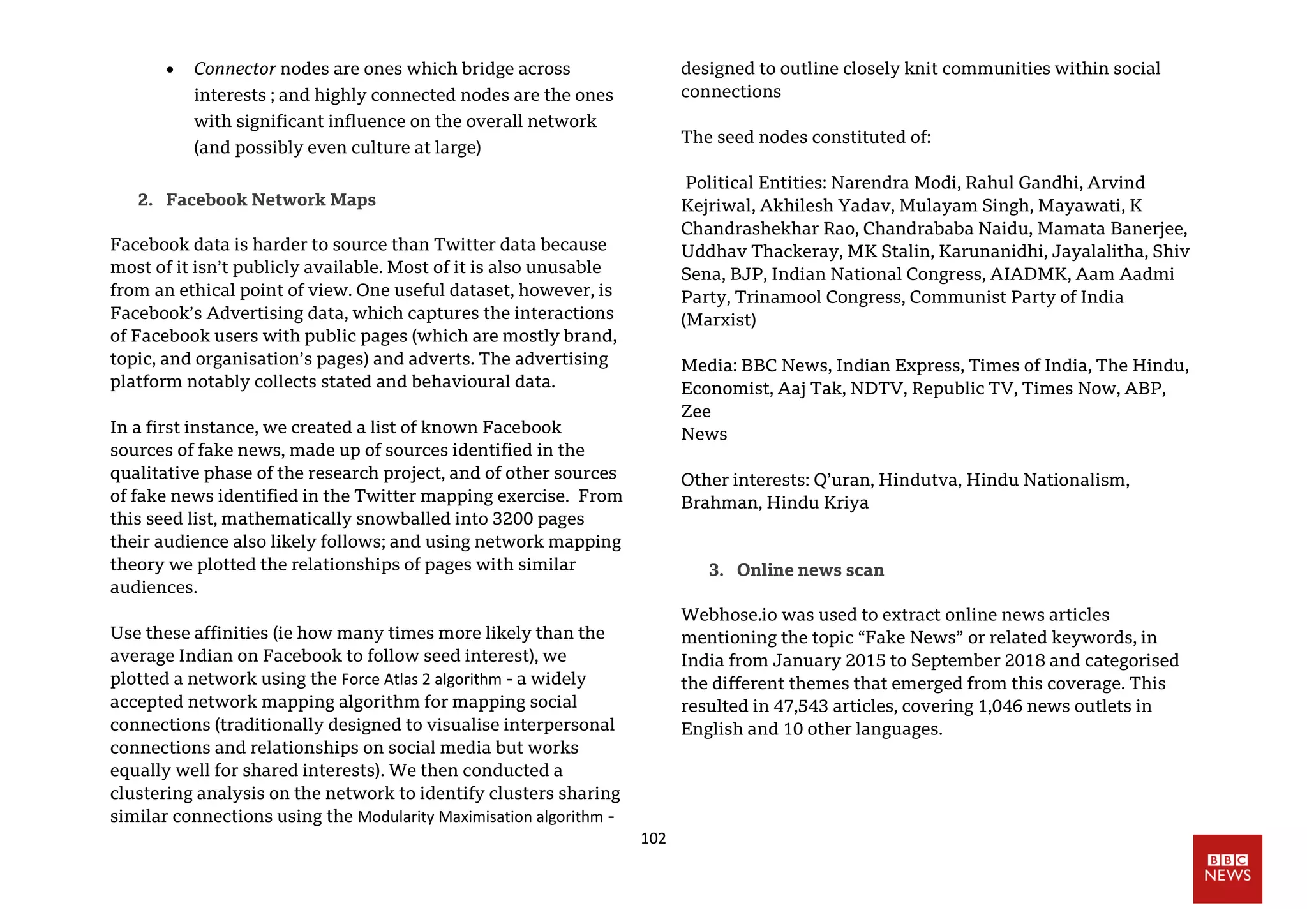
one’s beliefs and identities through the sharing of news and
information. Messages that originate in one group don’t find it
that easy to move to another group. People are acutely
conscious of which messages belong in which groups. The
most actively political of persons might post a rabidly anti
Congress or BJP message in the political group s/he is part of,
but s/he will not post that same message in a family group.
“I have not forwarded this to my lawyers group, I
am in the minority there, they are all different
kinds of people there. I share things in my
cousin’s group, many like-minded people there,
we can have discussions”
(Male, 62, Chennai)
However, if that person is part of multiple political groups, she
will share the same message in all of the political groups. This,
though, imposes costs in terms of time and effort. There isn’t
any easy ‘one click’ way of sharing with everyone in every
group you are part of, thereby imposing a threshold on the
number of people any message can be shared with relative
ease.
37
Image 4: The same political message – about deshdrohi or
traitor to the nation- shared in multiple political groups
(some groups masked to preserve respondent anonymity).
Notethe preponderance of the saffron colour, which
indicates this person is a strongly right wing Hindu
nationalist.68
This suggests that the chances of a fake news message
spreading on a nationwide scale on WhatsApp might actually
be quite limited. The defining feature of WhatsApp groups in
India might then not be its reach or scale or speed of
transmission of messages, but the fact that it is enabling
homophily,69
or the drawing together of people in tight
networks of like-mindedness.
But because of this this tightness, then, we suggest that it is
possible to use WhatsApp to mobilise. This starts to explain
why WhatsApp has seemed quite central to some cases of
violence in India. It’s not the speed, or the reach of WhatsApp
that has been central to these issues, but the homophily of its
groups that has enabled mobilization in the cause of violence.
The platform is also very much known for spreading low
quality information of doubtful veracity. Most citizens are
68
Note also the beer mug emojis in the name of the group at the bottom, right
next to the saffron flag, quite delightful touch!
69
See Miller McPherson, Lynn Smith-Lovin, James M Cook. “Birds of a
Feather: Homophily in Social Networks.” Annual Review of Sociology, 2001:
415-444
aware of and have personally encountered messages that are
either trying to scam them, or peddle information that is
considered quite fantastical.
Despite that, WhatsApp is also a high engagement platform in
India with a high usage for news and news-related discussion-
and, concomitantly, a high amount of fake news. There is
certainly deliberate sharing of material here to start
conversations or contribute to existing discussions, even if
these discussions rarely get full blown.
At the same time, the range of discussions, or the ability for
opposing viewpoints to find an airing is limited. There might
not be an algorithm like in the case of Facebook, but many of
the groups operate under unsaid rules about sharing what
everyone in the group approves of, or not sharing at all. There
are also some said agreements about what to share and not to
share in particular types of groups, with admins of the groups
playing an active role in weeding out those who breach group
rules, and individual members too policing content they feel
does not belong in that group, given the composition or the
stated intent behind the setting up of that group.
“I am from the Kanyakubj samaj, we have like-
minded people, with similar beliefs, so we share
many things on that without thinking. I don’t do
it on Raipur Doctors group”
(Male, 34, Raipur)
38
“M: Do you discuss only cricket related topics
here?
R: Yes. It tells us about the trip series match,
timings, the trophy picture is put up. I have a few
friends in this group who are in favour of Modi
and a few who are against him they constantly
have fights over this. I just comment once or twice
here. If it goes on then the Admin of the group
tries to calm them saying this is a cricket group,
no Kejriwal or Modi discussions. At times their
arguments heat up so much that till 1am the
phone keeps buzzing. I have to mute the group. I
have not made a group to discuss politics
specially”
(Male, 41, Delhi)
Image 5: Response to a posted message: “Please do not share
such messages. Group admin please pay attention to this
message
39
How Facebook is used by citizens:
Facebook, however, is very clearly perceived as a broadcasting
platform, with the main source of news being the newsfeed,
rather than one on one shares. Citizens do actively curate
their Facebook feed, ‘liking’ the pages of various news or news
like organizations. Facebook is not seen as a platform for
likeminded or hemophilic groups, especially since it
constitutes of many contacts who are ‘added’ with very little
personal connection to them. This nature of Facebook- added
to the extreme ease of sharing with every one of your ‘friends’-
makes it a broadcasting platform and every comment there is
considered an articulation of ones own stance. Activity on
Facebook is much more designed to attract attention- in a way
that activity on WhatsApp is not. While people are perfectly
content to not receive reactions to everything they say or
every piece of content they put across on WhatsApp, they
expect and crave reactions for things they put on Facebook.
And because Facebook does not constitute of homophilic
groups in quite that way, there are few barriers to actively
evangelizing your beliefs and seeking to convert others to
your beliefs, or at the very least evoking a strong counter
response.
However, in contrast to WhatsApp, Facebook as a platform
has quite a ‘clean’ reputation. Because many have subscribed
to their preferred journalistic sources on Facebook, it is seen
as more truthful and reliable, less local and more national, and
great for breaking news. Unlike WhatsApp then, on Facebook,
it is quite possible through ‘likes’ and ‘comments’ to have
some degree of dialogue around the news- and perhaps to
even come across some viewpoints opposed to your own. At
the same time there is a level of self-censoring and self-
checking going on in Facebook- and this is pronounced among
those who have had some kind of a negative experience from
a comment or post of theirs. Also, let’s be under no illusions
that people are using Facebook as some kind of digital agora
or a fully functioning public sphere70
has been created.
Ultimately it seems that whatever the Facebook algorithm
might serve up (and Facebook itself has done studies that
show that in theory people are at least exposed to somewhat
opposing points of view) 71
, people are skimming over or
skipping past opposing points of view, with not that much
appetite to engage. In extreme instances, they are resorting
also to unfollowing or unfriending. In effect, then, both
WhatsApp and Facebook are ending up being to some extent
echo chambers, with a lot of confirmation bias going on.
On both of these platforms, though, a key feature is the
sharing of content without active, engaged consumption. That
is, there is no necessary relationship between the activity of
consuming something and the sharing of that thing.
70
In the sense, obviously, of Habermas. There are strong counterarguments
that at best what has historically existed is not a ‘public sphere’ but
‘public sphericules’ See, for an interesting debate: Calhoun, Craig.
Habermas and the Public Sphere. MIT Press. ISBN 0-262-53114-3.
Boston, MA. : MIT, 1993.
71
See: https://www.adweek.com/digital/exposure-to-diverse-information-
on-facebook/
40
Summing up: Implications for Fake News
These conditions that we observe seem to be necessary to
create an environment in which fake news can spread:
 The lines between various types and sources of news
blur, especially when they are all available in the same
spac e- and since every type of ‘news’ is in the same
space, ‘fake news’ too can be hosted there.
 A skepticism about the news media’s motivations and
intentions leads to an openness for alternate sources of
news and information
 The digital deluge , with its near infinite sources, and
near incessant notifications, contributes to a high
frequency, low time spent news behaviour - therefore
reducing the individual’s scrutiny on a single piece of
information
As citizens try to manage the flow of digital information, and
because they can’t scrutinize the truth claims of this flood of
digital information, they adopt a number of behaviours and
strategies, which allow fake news to be shared without
verification: they indulge in selective consumption, exhibit a
preference for images
41
The motivations
behind sharing
2
42
II. The motivations behind
sharing
Why do people share in the first place? What are they
getting out of it? And how do these motivations allow fake
news messages to slip through the cracks?
Before we look at these motivations, let’s look at what they
are sharing. Analysing the corpus of WhatsApp messages
collected during the fieldwork,72
we noticed that the
categories emerging are quite at odds with what we saw in
media coverage of fake news73
(see fig. 1 on next page).
This is no more than indicative, given the limitations of the
methodology, but it is certainly suggestive of what’s being
shared in the private networks. As you can see, unlike in the
media coverage which the majority was about ‘domestic news
and current affairs’, the top category here (at 37%) is Scares &
Scams, closely followed behind by what we are calling
72
This was supplemented with fake news messages from the /unkill thread
on Reddit
73
Note: we are not quite comparing apples and apples here. First we are
talking different time frames here. Then, the media coverage classification
was of news stories about fake news; the message classification is about
messages shared overall, including fake news messages. This was a function
of the limited time available to the project team, but we do see in the data
that there is a strong correspondence between type of messages shared and
types of fake news messages shared.
‘national myths’ (more on which later, after a discussion on
identities).
Image 1: A fake news message warning citizens
against forwarding any posts/videos regarding
“politics/ present situation about Government/PM” as
everything is apparently being ‘monitored’.
If these are the types of messages they are sharing, why
are they in fact sharing? The reasons people share
messages on digital sharing platforms form a mix of the
not too surprising and the quite counterintuitive.
43
Fig. 1: Categorisation of messages shared
within private networks in India
(Indicative)
44
II.1. Sharing to verify (within the network)
One of the more counterintuitive behaviours we
discovered was that of people sharing messages of dubious
provenance or facticity within the networks, because they
want someone in the network to verify the information
contained in the messages. Usually, though, these messages
are not shared with an explicit request to verify; but it is
shared in the expectation that someone in the network itself
would get back to the sender disproving the contents of the
message if it were untrue. Usually, for every individual there
is someone in the network who is trusted - either on specific
issues, or because they are generally considered to be ‘learned’
or ‘educated’ - to point out if something is untrue. In some
ways, this is mirror behaviour to what we earlier termed
‘sender primacy’. Cues about veracity are being sought not
from third parties, but from someone in the network. As a
result, fake news messages are spreading, even if the intention
is very much there to check verification.
II.2. Sharing as a civic duty
Sharing something and coming across to your friends
as ‘in the know’ certainly continues to drive some sharing
behaviour. But in an environment where the media’s
motivations are considered suspect, and as an ordinary citizen,
you feel like you finally have the power to spread the word,
sharing and dissemination of information becomes almost a
civic duty. There is a sense that certain things need to be
spread farther, wider and faster. This falls into two broad
categories:
a. First, as a duty to spread information far and wide
because it is thought to be in the public interest and
could help someone, even if the onus of verification is
left to the receiver. Importantly, these are the types of
fake news messages where the costs to the recipient of
the information being false are not seen to be high. But
before we delve into the next motivations for sharing,
we must take a detour to understand the new form
identities are taking in India today.
45
Image 6: An example of a fake news message sent,
‘just in case it helps’
Image 7: An example of a message sent as civic
duty since the ‘nation’s media is ignoring him’.
Translation: This is Dr. Vishal Rao who has invented a device
which can help throat cancer victims recover their lost voice.
This device costs just Rs. 50. Today, media from over the world
is praising him, but the media in our country is ignoring him.
Let’s together help him progress.
46
Interlude
Emerging socio-political identities in India
today - findings from this project
India is a nation grappling with the various ideas of India74
and Indians are trying to work out what it means to be an
Indian in the world today. Social media such as Facebook and
Twitter, and messaging apps such as WhatsApp have become
the terrain on which this is playing out. The story of the last
three decades in Indian politics is mainly about the rise of two
important forces: Hindu nationalism and the Dalit rights
movements.75
Hindu nationalism, in particular, has positioned
itself directly against Nehruvian socialism (and secularism);
and the triumphal moment of Hindu nationalism, aided by an
impressive mastery of social media,76
was the election of
74
Still one of the best discussions of what defines India- at least in the
vision of Nehru, one of its founding fathers, is to be found in Sunil
Khilnani’s The Idea of India. Khilnani, S. (1999). The idea of India.
New York: Farrar Straus Giroux
75
These are very closely interconnected and the first is often seen as a
reaction to the second. See for example: Jaffrelot, C. (1996). The
Hindu nationalist movement in India. New York: Columbia
University Press ; and Vanaik, A. (1997). The furies of Indian
communalism: Religion, modernity and secularization. London: Verso
76
See for example: https://www.indiatoday.in/magazine/cover-
story/story/20140224-narendra-modi-bjp-prime-ministerial-candidate-
campaign-social-media-800175-1999-11-30
Narendra Modi of the Bharatiya Janata Party (BJP) in 2014 as
the Prime Minister of India.
Hindu nationalism or Hindutva77
, the ideology closely
associated with the BJP, encompasses a range of discourses,
ranging from the comparatively mild to the extreme, and there
is much that is fascinating and contradictory in that discourse.
As with any ideology, the ideology of Hindu nationalism
encompasses a range of discourses, ranging from the
comparatively mild to the extreme, and there is much that is
fascinating and contradictory in that discourse. What unites
this range of discourse is the central idea that India is a
country for Hindus, or more accurately reflecting the view
point that India is a culturally Hindu country. This idea of
culture is central to the discourse of Hindutva; and because
culture is central to Hindutva, one could be an atheist and still
be an adherent of Hindutva, as indeed was one of its key
founding fathers, V.D. Savarkar. It was Savarkar himself who
in the eponymous book coined the term ‘Hindutva’ and sought
to distinguish it from Hinduism78
.
For Savarkar, it was Hindu culture that embodied Indian
national identity. Hindu culture comprised of the religion, the
language (Sanskrit and Hindi which was derived from it), the
cult of the golden Vedic age, and the territoriality of India as
the sacred Fatherland of ‘Hindusthan’, the name Savarkar
claimed had been the preferred name for India through the
77
These are not necessarily identical terms, but for simplicity we will use
these two terms interchangeably in this report.
78
Jaffrelot (1996)
47
ages. Since Hindusthan played such a central role in defining
who a Hindu was, all those professing religions that had
“grown out of the soil of India”—not just Hindus and Hindu
sects but Buddhists, Jains and Sikhs as well—were willy-nilly
embraced into the fold of Hindus. Christians and Muslims
whose holy lands were outside of India were suspected to
have ‘extraterritorial loyalties’ but could be admitted back
into the Hindu fold if they gave up their ‘alien’ beliefs.
Hindutva was not about the Hindu religion, but about a ‘whole
way of life’79
. On top of this Muslim men were seen as
lascivious and lustful, not only raping Hindu women, but
symbolically raping Bharatmata [Mother India], or the Indian
nation itself 80
Importantly, and often forgotten in discussions about it,
Hindutva should not be understood as identical with the
Hindu religion. In fact, the diversity of practice of Hindu
religion is not necessarily seen as a very good thing, lacking as
it does a central locus around which to unite. As it happens,
one of the founding fathers of Hindu nationalism, Veer
Savarkar, was an atheist, but as he said himself, he was
‘culturally Hindu’.
Media commentary about India often uses the term
‘polarisation’ to talk about the divisions in Indian society
today. These discussions usually veer off into existing
79
See Jaffrelot (1996), and Hansen, Thomas Blom. The saffron wave :
Democracy and Hindu nationalism in modern India. Princeton, N.J: Princeton
University Press., 1999
80
Bacchetta, 2005; Hansen, 1999
differences between religions. Our fieldwork has picked up the
different ways in which socio-political identities are shaping
up – and differentiating even within those who are affiliated
with the right and identify as Hindu; and of course, amongst
those who broadly are affiliated against it. And we find that
these are in turn influencing the intensity and spread of fake
news.
Research Findings: The Crystallising Identities
of the Right
There are multiple socio-political identities crystallising in
India, with three broad groups on the right: one which we call
Hindu/tva Conservatives; two, the Hindu/tva Progressives;
three, the Hindu/tva Warriors. We are using the u/tva
formation to indicate that some of these individuals are
Hindus without being strongly wedded to Hindutva, while
some in the group are indeed ideologically aligned to
Hindutva.
1. Hindu/tva Conservatives:
They are typically older and they see conformity to traditions
and following rituals by the whole family as all important,
even non-negotiable within the family. They are highly
resistant to change, finding security in continuity. Modernity
is therefore a threat, as is any foreign culture, the fear of
cultural erosion is constant and times gone by are
48
remembered nostalgically. Many of them are explicitly – and
even vociferously- supportive of Hindutva ideologies, but it
should be remembered that being Conservative Hindu does
not automatically make into a strong supporter of Hindutva,
but it is quite likely.
Image 8: The caption says “Perhaps this is why in
Indian culture, the cow is given the status of mother”.
This talks to an issue that has certainly been politicised by Hindutva
ideologues and has led to some acts of horrific violence, but the idea of the
cow as life bestowing mother is also something that is quite deeply felt by
many conservative - and non-conservative - Hindus. 81
(Note: This message
is here as an illustration of general sharing behaviour, not fake news sharing
behaviour).
“….. in Hinduism it is a custom that if you are
performing the last rituals, you will not be
allowed to leave the house or meet people, you
have to sit separately and eat once a day for 10
days until the day you shave your hair it is also a
custom. These are some rituals and customs that
have been followed religiously since generations
now, so we are bound to do it….There are many
rituals like this... But nowadays children say
about rituals "I won't be able to do it you do it
please or I would just join my hands and pray
once" so they do it as just a formality they don't
mean it.”
(Male, 60, Varanasi)
81
Though by no means all. Cow worship as being quite central to a ‘Hindu’
identity is historically quite a recent phenomenon, and Savarkar was staunchly
opposed to cow worship. See: https://timesofindia.indiatimes.com/blogs/toi-
edit-page/the-cow-and-savarkar-where-the-bovine-is-not-divine-but-the-
framework-is-still-hardline-hindutva/. And beef is consumed in many parts of
the country by Hindus who don’t see it as dissonant with their Hindu identity.
49
“We cover our head with saree or dupatta in front
of elders, we need to respect elders...My daughter
in law also does it…all the ladies in our family
follows this.“
(Female, 57, Udaipur)
“I am proud to be a Brahmin..I do my pooja daily
for 2 hrs, tomorrow we have havan in out house
for progress and peace..I try my best to teach my
kids all this..I make sure if not 2hrs then 15-20
min they pray daily in the morning”
(Male, 40, Rajkot)
2. Hindu/tva Progressives:
To the Western observer of the Indian political scene, this
term might seem contradictory. But this group is defined by
both by its affinity with Hindutva ideologies, and also by the
fact that members of this group see themselves as socially
progressive (compared, that is, to the Orthodox Hindu
Conservative). Usually between youth and middle age, they
are highly judgmental about blind faith, regressive practices,
and strident religion. They are – in their own perceptions-
extremely ‘modern’: for example, they are open to the idea of
love marriages82
, they are supportive of women working, and
the men amongst them see this support as a key indicator of
their modernity. Some of them have even quite a laissez faire
attitude to the extremely politicised issue of the banning of
beef. But while they are at ease with new fashion, technology,
food, and social media, they also tend to look upon the ‘West’
as a source of many ills. They believe that the extreme
liberalism of the West has led to its downfall or erosion and
this leads them to be extra vigilant about conserving their
cultural or religious identity.
They celebrate and project religio-cultural traditions, with
social media of course a prominent venue to do this. But they
are also animated by a sense of pride, which often manifests
as a sense of superiority of their country and culture. They
firmly believe that there is much good in the culture , which
has been lost or submerged, and can be retrieved to return the
country to its lost glories. At the same time, they are also
fearful that the country is under threat of contamination,
dilution or even destruction at the hands of the ‘other’, and
they are therefore the protectors against such outcomes. They
sense that they are involved in a cause bigger than themselves
- making a positive difference to the Hindu community and
the country. In the process, they see themselves as building
likeminded communities, excluding the rest who are not
bought into the narrative or the vision.
82
In India most marriages are still ‘arranged’ by the family as opposed to be
being ‘love marriages’. And lest this sound antediluvian to the foreign
observer, 74% of those aged 18-35 said in a 2013 survey that they preferred
arranged marriages.
50
It is worth noting here that for this group and the earlier group
(Hindu/tva Conservatives), Hindus are more or less identified
with India. But it is also worth remarking upon how the most
part this group is not supportive of the extremes of religiously
motivated intolerance. Their attitude towards minorities,
especially religious minorities and in particular Muslims, is
not driven by out and out antagonism, but a feeling that the
Hindu religion is the ultimate guarantor of the freedoms of
Muslims & Christians. This idea - that Hinduism in India is the
religion under the umbrella of which every other religion
exists - certainly has deep roots in Hindu nationalist
ideology83
. In today’s India, this translates into a subtle
majoritarianism amongst some of the Hindu/tva Progressives.
We see that there is no desire to include the ‘other’ in
WhatsApp groups, or generally engage with them otherwise
offline - and there is a marked resistance to intermarriage or
comingling. But we don’t see in this group any desire to wreak
violence on minorities, even if there is a sense that there are
wrongs that have been done to Hindus in the past by ‘Muslim’
rulers, or by over privileging of Muslim interests by non BJP
governments, both at the state and the center. 84
There is, in
fact, for these respondents, a marked distaste for the reports
of violence that comes out in the media every now and then
related to Hindu nationalism.
83
See Jaffrelot (1996) and Blom Hansen (1999)
84
The politics of twentieth century Hindu nationalism and the confused
responses to it from supposedly non Hindu nationalist forces is too complex
a topic to get into at length here. Once again Jaffrelot (1996) and Blom
Hansen (1999) are two of the best books on the subject.
The Hindu/tva Progressive sees in Prime Minister Modi a
personality that embodies their own identity and
philosophies: he is both progressive but also rooted in and
aiming to restore pride in Indian culture, understood by
default to be a Hindu culture.
While this group is not lacking for confidence in their identity,
every now and then they do have moments of doubt, and they
are not totally closed off to debate. They sometimes also have
quite unexpected responses to issues, especially unlike the
next group we will encounter, the Hindutva warriors. (See for
example the comment below on the ‘beef ban’).
We believe that this group is likely to be the biggest group of
the three in the country, though this research being
qualitative and exploratory we can’t say this with any
certainty.
“My mother and mother in law only wear Sari,
but I don’t want to be like them.. Freedom is big
for me, earlier times there was no freedom. I don’t
like to be restricted so I am making sure that my
kid has complete freedom”
(Female, 33, Rajkot)
“You cannot keep following all the traditions. If I
go out and work, I cannot ask people of other
51
communities not to touch me (ritual purity). We
have to move with the times”
(Male, 25, Vijayawada)
“India is a secular country. We all have the
freedom to practice, preach and follow the
religion of our choice. People may eat if they like
or not if they do not like but forcing them to quit
eating by imposing rules and regulations does not
seem correct to me. It must be a matter of choice
and not imposing. If a person is a non-vegetarian
it does not matter what meat he is eating. India is
a free country [for] open minded thoughts. It is
not correct to restrain the people on such choices.
Let them do what they like. We can set
limitations to it like not cutting the animal in
open premises, steal and all. We are independent
and we should be allowed to take our decisions.
Government must not interfere in this.”
(Male, 41, Delhi)
“We celebrate all the festivals, today is Baach
Baras, my mother does tika85
to males of the
family, we pray to cow on this day..I have shared
how and why this is celebrated with other people
also so that they know the purpose and reason
behind the celebration..everyone should know all
85
Temporary ceremonial mark on forehead
this, it is our dharm”
(Male, 34, Udaipur)
“They are copying western culture blindly…It is
good if somebody has good spoken power in
English but they shouldn’t neglect their roots
also…It is not good if they can’t speak or read
Bengali…”
(Male, 37, Kolkata)
“There is none other religion other than
Hinduism who takes all religions together, and
Hindus and Muslims don’t get that respect there
in foreign which is given in India, and this is the
reason that people of all religion are living here
like Muslim, Christian, but they say themselves
Indian firs. Why they say themselves because
there is a love of Indian, there is a brotherhood,
like people who are Sikhs or Muslims or Christian
then Sikhs are seen in temples, there was a fair in
Saawan, I went to temple, one lady comes
towards me she was of age 35-40 and ask me that
which thing is known as Shiv ling, which are
Ganesha, which are Parvati, and it is not possible
that she belong to Hindu culture, she may be of
any other religion, and in spite of that she comes
to temple as she is Indian”
(Male, 34, Amritsar)
52
Image 9: Fake news seen in the feed of a Hindu/tva
Progressive
3. Hindutva warriors
These are the people who wear their Hindutva ideology on
their sleeves. They are very significantly animated by a
sense of threat to their identity, a lot of it revolving around
a sense of cultural dilution. Most importantly, their stance-
and therefore their communication and sharing behaviour-
is marked by an extreme anti-other stance. They deal in
very heightened emotions and this tone spills over into the
kind of news and information they share. This the group
that often finds itself in the limelight due to the incendiary
tone and content of many of their messages. The messages
that they share are often extremely offensive- and possibly
are also geared to generate offence. These types of
messages are most often shared in very particular
WhatsApp groups- the Hindutva warrior will be careful
about not sharing this on, say, a family group but will
share it in the political groups created in WhatsApp. Of all
the groups defined here, the Hindutva warrior is likeliest
to be on Twitter, seeing it as a battleground for his battles.
(The Hindutva warrior is also more likely to be male than
female). 86
86
The explanations are sociological, not biological, obviously. Note that
some of the most virulent and vitriolic discourse of the Hindu right of the
last few decades has come from women (for eg Sadhvi Rithambara). See for
example: Bacchetta, Paola. Gender in the Hindu nation : RSS women as
ideologues.(New Delhi: Women Unlimited, 2004.) Anand Patwardhan’s
Father, Son and Holy War is an exceptional dissection of the crisis of
masculinity driving Hindu nationalism in the 1990s.
53
Image 10: Fake news message shared by a Hindutva Warrior.
Caption in the red band translates to: “The Quran sanctions
rape of young girls if they are of a different religion”
While these groups have their distinct characteristics as
outlined above, they are all ‘hailed’87
by the discourse of
Hindutva as ‘Hindu’ subjects. This is of course a particular
type of Hindu subjectivity, usually upper caste88
, North
Indian and even Brahminical.
87
The term is very much used here in the Althusserian sense. See Althusser,
Louis. Lenin and Philosophy and Other Essays. Michigan: Monthly Review
Press, 1972
88
Hindutva has historically been an upper caste ideology; and its late
twentieth century expression is often seen as a reaction to lower caste
movements. The Hindu nationalist movement has made concerted efforts to
embrace lower castes into its fold of late. Cordbridge & Harris (2003) in fact
see Hindu nationalism as an ‘elite revolt’ of the upper castes
Sociopolitical identities of the ‘Left’
In some ways, the classic leftist is somewhat thin on
the ground amongst the ordinary citizenry. In our process of
recruiting respondents, it was much easier to find someone on
the extreme right end of the political spectrum than it was to
find someone on the extreme left end of the political
spectrum.89
We are therefore choosing to use the term ‘Left’
within quotation marks. This is a way to suggest that these
groups are more defined by their opposition to the right than
as being truly on the ‘left’.
Unlike the three groups discussed above, unified by a
particular way of being Hindu, we find that the individuals on
the left have no unifying thread other than an opposition to
the right. They are not animated by a unified narrative but
occasionally cohere around particular issues; unlike the
groups on the right, there is no consistent underlying
narrative that constitutes their subjectivity.
We see in our fieldwork, four main ways in which this
positioning against the right playing out:
1. Anti Modi-policies:
A focus on the grievances rather than identity or ideology,
89
This is not to argue that they don’t exist, especially since central India,
where we did conduct some fieldwork has been marked by a Maoist
insurgency for the last xxx years. It’s that amongst the citizenry we did
profile, it was
54
often driven by a sense of indignation, or harm felt by policies,
such as the introduction of the GST and demonetisation.
2. Anti-Hindutva:
Those who see themselves as ‘secular’ as opposed to the
Hindu nationalism of the BJP, and minorities who are worried
about their safety, and indeed, place in the India of today.
3. Anti Modi- personality:
A group that might even have voted for Modi initially but now
disappointed by what they see as a lack of tangible change.
4. Pro Congress/ other parties:
Those who have long been supporters of other parties and
have still held on.
This is not to say that these individuals don’t have identities,
but their identities play out on a more localised scale. There
are strong geographically defined identities (i.e. Tamil,
Bengali), or identities defined by status as religious minorities
(e.g. Christian, Muslim) or by caste status (e.g. Dalits), or
finally, by being secular. On top of the fact that these groups
do not coalesce around identities but around particular issues,
we see that what is core to the identity of each one of these
groups (say, Dalits) is often dismissed by other groups as
‘issues’.
“You know people say that (after Modi) India’s
international image has improved – we have an
identity beyond poverty and snake charmers- but
see Rome was not built in a day. Many people
have contributed towards it. Modi is very good in
marketing. ”
(Male,27, Mumbai)
“All these big big schemes, Make in India,
Start up India all are only in PM’s speeches,
nothing on the ground. These schemes are
designed to exclude states where the state
government is not a BJP one”
(Female, 24, Vijayawada)
55
Image 11: Shared by an upper caste member of the left.
Translation: “Despite getting the 99th
rank Namrata Jain could not
join the IAS, but Chandrakant Verma who ranked 352nd
got through
because of reservations.90
For a reservations free India share the post
as widely as you can. Make sure you share the post”. (Post masked to
preserve anonymity)
This lack of a central overarching identity usually means that
these groups engage with news and share news primarily
around issues. When a news event, occurs their sharing
activity increases, and when the news cycle dies down their
sharing dies down too. We shall discuss below in more detail
what exactly they do share, but the key thing to remember is
90
The Indian term for affirmative action.
that what they are sharing is driven by the issue rather than
anything deeper or continually resonant (psychologically
speaking).
What this means politically is out of the scope of this report,
but it has important implications for the spread of fake news
in the digital sharing platforms.
The Disengaged
The discussion above should not lead us to believe that every
one who falls in one of the categories of the right or the non-
right is actively sharing content all the time. In fact there is a
group, drawing from both the right and their opponents, who
are kind of in the middle of the spectrum. This is not really a
considered ‘centrist’ position or a Blairite/Clintonite ‘third
way’91
type positioning but more a disengagement from
political news and the news cycle. They consume more than
they share; when they do share they share near news and
‘updates’ they think are non-contentious. When they do
engage with and share political news, it’s more humourous/
political images and cartoons: they are aiming to entertain
their network rather than provoke, or engage with them over
political issues.
91
See: https://www.theguardian.com/politics/2003/feb/10/labour.uk1
56
We come back now to the reasons for sharing. (Just to recap,
the first two motivations for sharing were ‘sharing to verify
within the network’ and ‘sharing as civic duty’.
II.3. Sharing for community- and nation- building:
News/ information is now seen as something that
builds awareness about key issues (but particularly the
country’s progress). Importantly news and the circulation of
news is something that allows for likeminded people to come
together and keep the ‘other’ out. This sense of purpose- of
doing something bigger than oneself- is felt more in certain
groups than others, but we have observed that this aspect of it
applies not just to individuals united by a right leaning
identity but by some of the ‘non-right’ as well. In fact, as we
saw with the message shared about IAS and reservations,
there is a belief amongst the creators and sharers of these
messages that sharing means active participation in
awareness raising- and therefore building on the specific idea
of India that the particular citizen believes in. This sense of
purpose overrides the need to assess truth claims of content
for the most part.
II.4 . Sharing as an expression & projection of identity:
Sharing might be thought of as an act of
communication, but on WhatsApp and on Facebook today,
sharing is mostly an expression and projection of identity. A
significant amount of the shares that we see on these private
networks- and therefore a significant amount of the fake news
shares are geared to reaffirm and validate people’s identities.
The identity work happens most strongly on the right,
especially as each new message works well in reaffirming the
core Hindu identity; or in the case of those not on the right it
works in reaffirming their sub –identity. Again, because
what’s at play here is so much deeper than sharing
information, fact checking and truth claims become quite
irrelevant.
57
Summing up: Implications for Fake News
What we find therefore is that sharing on digital platforms is
very rarely, if at all, about communicating, leave alone
engaging in rational critical discussions.
There are, then, two broad ways in which sharing of fake news
happens: the first comes from relatively good intentions of
honest citizens to either share as civic duty or to attempt to
verify through the network. The second comes from a sense of
purpose when sharing is for community and nation building
or for projection of identity.
Both of these broad ways of sharing are happening for
reasons which make the question of the truth content of the
messages fairly redundant. As a result the question of
verifying the content of the messages before sharing simply
does not arise.
We will discuss at length the nature, content and structure of
how these identities shape the consumption and sharing of
fake news messages, but first let’s address an all important
question. What is ‘fake news’, at least from the perspective of the
ordinary citizen?
58
3What is fake news?
How validation of identity
trumps verification of facts
59
III. What is fake news? How
validation of identity trumps
verification of facts
We are now ready to understand what, from the
perspectives of the citizens, is ‘fake news’. How we come to
this needs some explanation. Note that a critical part of the
research design involved not disclosing to participants when
auto-ethnographic collection of the content they had shared
would happen. This was therefore a project trying to
understand the dissemination of fake news. In fact, for the
most part, the moderators of the interviews did not bring up
the term ‘fake news’ till such time as the respondents did so
themselves. If the respondents did not bring up the term in the
interview right till the very end, then the moderator would
introduce the term. This was a deliberate choice, aimed at
understanding how central to citizen’s discussions of news
and information the term fake news was, and how they used it.
Our analysis suggests that people India are not that concerned
about fake news, no matter what they say in quantitative
surveys. First, the initial association with or the working
definition of the term ‘fake news’ is largely limited to scams
(all kinds of schemes, offers and attempted cons) that they
keep coming across, or messages in the realm of the
fantastical, which are just too incredible to believe. Usually,
this immediate connection made with scams and the
fantastical is because they have had moments of truth in the
past - either because they have clicked on a link or shared a
number and have subsequently been spammed, or they have
suffered the social embarrassment of being called out for
something fantastical they have shared. None of these two
categories are remotely in the territory of political or ‘hard’
news. There is not much thought given by citizens to who is
creating these types of ‘fake news’ other than scammers
possibly trying to make a quick buck, or ‘marketers’ trying to
get personal details through nefarious means.
When probed, or in deep conversation, however, they label as
‘fake’ things that clash with their socio-political identities, or
deeply cherished beliefs. Usually, these are to do with politics,
policies, personalities and culture. Fake news messages are
usually associated with, and considered, the handiwork of the
political parties - the opposition trying to discredit the ruling
party, and the ruling party trying to defend their position.
There is a slightly blasé attitude to this: that this is the way
the political game has always been played. So, often, most of
what is coming from the political party you support is then
the truth, while what is coming from your opponent is ‘fake
news’.
Beyond this simplistic schema, there is no sense of fake news
being any larger a problem - or more importantly, there is no
sense that this is might be a social problem needing a
collective solution. There is no connection to this politically
polarised nature of fake news having consequences beyond
60
the immediate. In fact, even knowledge of fake news messages
associated with violence is fuzzy at best - and recalled vaguely
from media reports rather than from encountering those
messages themselves. There is certainly no recognition that it
might be getting harder and harder to differentiate between
what’s fact and what’s not. And in many ways, there is a level
of overestimation of their own abilities to detect fake from
fact. As part of the research process, respondents were
exposed to a mix of real and fake news messages. And almost
no respondent was adequately able to identify the fakes. But
one of the more concerning things that we observed
happening, though, is that those some looked at legitimate
news items or sources and judged them to be fake.
Going back over all that we have discussed so far, it is
understandable why this is so. Ultimately, the main work that
citizens are doing on messaging apps and social media is not
rational critical debate and discussion. They are effectively
looking for validation of their belief systems. And beliefs are,
by definition, not about facts. On these platforms then,
validation of identity trumps92
verification of the facts.
92
No pun or political point intended. This just happens to be the most
appropriate word in this sentence.
“I follow many TV channels, newspaper pages on
Facebook and most of their news is biased
towards Yogi93
and Modi. It is all fake. They have
bought out all the channels and they only say
what BJP want them to say”
(Male, 24, Varanasi)
“Many new anchors have come today. It has made
news interesting. But some I don’t agree with,
they have no data or they just don’t like BJP”
(Male, 34, Raipur)
93
The very hard right Chief Minister of India’s most populous and perhaps most
politically important state.
61
Interlude: Why attempts to curtail fake
news fall on deaf ears
Knowing what we now know, we can see why attempts
to curtain the spread of fake news might fall on deaf ears. In
India, WhatsApp, under heavy government pressure to curtail
the spread of disinformation introduced94
the forwarded tag on
messages, and Facebook launched an advertising campaign95
to educate citizens about the perils of fake news are likely
insufficient in combating fake news.
Image 1: The ‘forwarded’ tag on WhatsApp
94
See: https://www.hindustantimes.com/tech/whatsapp-s-new-forwarded-
label-all-you-need-to-know/story-Ug5iUiGvXpP8Xleo2WeETK.html
95
See: https://www.outlookindia.com/website/story/rising-fake-news-force-
facebook-to-pullout-full-page-ads-in-newspapers-educating/302010
During the fieldwork, we observed that citizens for the most
part had either not quite noticed the tag or if they had noticed
they had misinterpreted what it meant. In what is possibly an
isolated case, a respondent even though that the tag was
encouragement to further forward the message on!
“M: Now you will see there is a feature forward
it, have you noticed that, previously it was there?
R: Yes, I have noticed it and previously it was not
there. Here forwarded means somebody has
forwarded to you and you should forward the
same.”
But more importantly, as we discussed earlier, the sender96
matters much more than the original source of the content (i.e.
who created the content); and since the decision to consume,
and, to an extent, to share further, is based on the identity of
the sender, the forwarded tag does little to prevent sharing.
Similarly, Facebook’s injunctions not to spread news that
hasn’t been verified are likely not to have much traction
because, as we have seen most people do not believe they are
the ones spreading fake news. For them, the dominant
96
Just to refresh our memory: when we say ‘sender’ we mean a person in the
network who has sent the message; and when we say ‘source’ we are referring
to the original creator of the content, be it a news organisation or a Macedonian
teenager.
62
association of fake news is scams and scares, done by
nefarious actors for profit making, or at a deeper level fake
news is news that is dissonant with their closely held beliefs
and self-identity, done by those in a political out group. Either
way, citizens don’t think they themselves have a role to play
in this. This creates a challenge in tackling the spread of fake
news: if you don’t believe you have a role to play in the
sharing of fake news, then you certainly won’t respond to
messages exhorting you to not share fake news.
63
The narratives of
effective fake news
messages 4
64
IV. The narratives of effective
fake news messages
Having looked at the central role that beliefs and
identities are playing on digital platforms, it is time now to
look at the messages themselves. What are the types of fake
news messages that are being shared in these networks? And
what relationship do they have with the identities and
ideologies described earlier?
IV.1. The fake news messages circulating amongst
those with a right leaning identity
Narrative 1: Overtly Anti- Minority Discourse:
The most Hindu/tva affiliated respondents share messages
that betray anti Muslim animosity. Broadly speaking, these
can be divided into two categories. The first litigates supposed
injustices of the past, often using misleading or motivated
readings of history. History is for these groups a key
battleground on which ideas of India are being fought out 97
97
Many Indian historians have come under fire from Hindu nationalists for their
leftist leanings. This includes India’s possibly most well known historian, Romila
Thapar. See this commentary: https://www.firstpost.com/india/whipping-girl-
of-the-right-attack-romila-thapars-ideas-not-her-integrity-1792173.html. For
the counter view, see: https://www.telegraphindia.com/opinion/beyond-the-
These types of messages are shared by more than one group
on the Hindu right, but in this project we did not really find
them to be extremely commonplace.
Image 2: The headline says ‘I haven’t forgotten’ (and this is
part of a series). The body copy says “I haven’t forgotten that impure
Akbar, who asked Hemu’s elderly 72 year old father to accept Islam and when
he didn’t acceded, beheaded him.” The key phrase here is “I haven’t forgotten”.
Not forgetting is critical of course, when history is up for grabs.
historians-the-ichr-s-project-must-be-to-depoliticize-the-liberal-
arts/cid/167694
65
The second category of fake news messages is the type shared
by the out and out Hindutva warrior, which are located
squarely in the present.
Image 13: Public tweet (ie not gathered from respondents during fieldwork
for this project), indicative of Hindutva warrior ideology.
The use of misleading, decontextualized or false tactics is a common move in
fake news messages. Note the use of the asterisk in the word Muslims, to
express distaste for all adherents of the religion.
This fake news message plays upon the emotionally resonant
idea, for this group, that Hindus are threatened by Muslims. In
its most hyperbolic form, this idea suggests that Muslims are
aiming in some ways to ‘take over’ India. Again, note here,
that while the content of the message might be found quite
disturbing by many, and the tone quite inflammatory and
alarmist, one cannot judge from the message alone that the
sender is deliberately making up the facts. The important
thing here is that the recipients of the message will pass the
message on without verification, not because of the accuracy
of the data in the message, but because of how the message
fits in with his or her worldview.
Similarly messages like the one below are shared: purportedly
a tweet from a genuine Muslim cleric, but coming – we
suspect- from a Hindu right wing network of parody/ satirical
accounts. The cleric is apparently looking forward to ‘our rule’
over India, reacting on Twitter to the opposition leader Rahul
Gandhi’s comment about Congress being a party for Muslims.
66
Image 3: From a pro-Hindutva parody Twitter account,
circulating as genuine on WhatsApp. The text purportedly comes
from a Muslim religious leader saying ‘Inshallah, now we will rule over India’.
As we have stated before, we believe that the Hindu/tva
warrior is in a minority amongst the Hindu right. And our
analysis also suggests that their messages, especially at their
most vitriolic, have relatively limited circulation. By this we
mean that they have circulation within fairly tighly knit
groups, and do not really become mainstream.
Most of the other groups of the right, especially the Hindu/tva
Progressives, shy away from this type of outright animus. As
we have discussed earlier, they are quite reluctant to share
things they believe might incite violence. What resonates for
them, though, are some of the softer narratives of Hindu
nationalism. These take various forms, including:
Narrative 2- Hindu Power and Superiority: This is conveyed
through two main approaches. One, celebrating the supposed
glories of the ancient Vedic age, suggesting that many –if not
all - of the great achievements of humankind, had their roots
in ancient India (which is imagined to be exclusively Hindu).
A subset of this-playing on the fear of cultural dilution by the
West-are fake news messages suggesting that India is superior
to the ‘West’.
Image 4: A fake news message trying to persuade recipients
that NASA was set up by ancient ‘Vedic’ sages - and the story
was suppressed by ‘Muslim invaders’
67
When situated in the present day, the messages are mostly
about how Hindus are superior to those who are non-Hindus.
Some of these messages use the classic technique of using
data or statistics (as in the tweet about rapes, above) to ask a
rhetorical question. Note that while the message draws upon
established Hindu nationalist ideas about the divided loyalties
of Muslims and Christians, it does not resort to outright
vilification.
Image 5: A decontextualized message asking a rhetorical
question about why mosques & churches did not donate to
the Kerala floods. This message works well for a recipient who believes
that mosques and churches are somehow not fully Indian. For others, the
answer might well be something to do with relative wealth of temples, mosques,
and churches in India.
Image 6. Celebrating a ‘3500 year old Sree Ganesha98
temple’
in Azerbaijan - and ignoring the fact that it was among other things also
dedicated to Ganesha and that it hasn’t been a Ganesha temple for 5000
years.99
Narrative 3 -Preservation and revival:
A related narrative - and associated messages - are more to do
with the preservation and revival of ancient glories (usually
98
Elephant headed Hindu god, son of the gods Shiva and Parvati
99
As you can see, fact checking beliefs makes the fact checker seem tedious
and pedantic.
68
Hindu). These are mostly to do with the retrieval of
supposedly long lost aspects of culture, especially rituals; and
it certainly has to do with positioning the ancient Vedic age as
a glorious chapter in history of humankind. But it has also to
do with drawing attention to neglect about the country’s
(Hindu) cultural and architectural treasures.
The next two categories are interesting in that their content
resonates most with the identities of the right, but by no
means are those on the anti-right entirely immune to their
appeal. In particular, the next narrative holds appeal across
many identity types.
Narrative 4-Progress and national pride:
One of the most common types of fake news messages found
in private encrypted feeds in India, these are built around a
central narrative of India’s near-unstoppable progress in the
modern world. Often, international or global bodies like
UNESCO are included in these messages as evidence for the
truth content of the statements. (In fact, for some reason,
UNESCO happens to be a favourite for the creators of these
fake news messages, popping up in multiple contexts in
multiple messages).
There are a few common characteristics to these messages.
They usually:
 Urge ‘Indians’ to celebrate or be proud about an
achievement
 Are usually aligned to an issue of the day
 Will refer to non-Indian experts or non Indian bodies as
markers of credibility
Image 7: A classic example of a fake news message in the
Progress and national pride category, subtly conveying the
success of the PMs demonetisation100
initiative by using the
term ‘fiat’ currency. Another one picked up during the fieldwork in
100
As good a summary as any is available here, (and apologies for the heretical
act of citing Wikipedia):
https://en.wikipedia.org/wiki/2016_Indian_banknote_demonetisation
69
Kolkata was about UNESCO declaring Bengali the world’s sweetest
language.101
Image 8: Another fake news message, works well with
Hindu/tva Conservatives and Hindu/tva Progressives, who
101
Given that Bengalis have been declaring Bengali India’s sweetest language for
years, maybe it was about time for UNESCO to get in on the act.
generally tend to be upper caste, and for whom ‘reservations’
are anathema
Image 9: Fake news message trying to convey its audience of
the merits of a controversial statue of the Maratha leader
70
Shivaji, revered by many Hindu nationalists (and for that
matter many non-Hindu nationalists as well).
The fourth narrative is linked to the third. It is in some ways
still about national pride and progress but in this case it is
about the progress wrought by one individual: Modi.
Narrative 4-Personality & Prowess (of PM Modi) :
These messages are threaded with a common narrative, in
fact a narrative that has been seen time and again, the
narrative of the Great Man who singlehandedly is leading a
nation into a glorious future. These messages have some
underlying sub narratives- and visual signifiers- as well:
 Modi is the first Indian leader to get respect and
recognition in the West102
 Modi’s achievements, often listed and quantified with a
barrage of data and statistics
 Modi’s achievements compared and contrasted with
the lack of achievements- and outright corruption- of
the then ruling Congress party.
 Often featuring Modi dynamically striding forward
and/or looking upward at an angle: conveying a future
facing leader
102
There are many contradictions in craving the recognition of the West, yet
at the same time fearing cultural pollution from the same West. But then
human beings are contradictory!
Image 10: Message listing Modi’s supposed achievements: a
mixture of accurate statistics, and false, misleading or
decontextualized ones.
71
Image 11: Fake news message suggesting that because of
Modi, India has left behind the USA and Japan to become the
world’s second largest installer of solar panels.
Image 12: Fake news message falsely claiming that the ruling
Congress party siphoned off funds from World Bank loans,
while the Modi government has not taken a single paisa
worth of loans from the World Bank; and is instead working
hard to repay those debts.
72
Image 13: Misleading message claiming that because of the
fear of bankruptcy laws changing, 2100 companies paid back
bank loans worth 830,000,000,000.
These four narratives are extremely effective when it comes to
sharing, and especially the last two, as they manage to cut
across quite a bit of the ideological spectrum. And because
they play on narratives of nation building and progress, they
are much more resistant to fact checking.
IV.2. The fake news messages circulating amongst the
left
We have seen above how the fake news messages circulating
amongst the right, play consistently on themes of Hindu
identity and national progress, and how the ones playing to
national pride and progress and Modi’s personality and
prowess, sometimes also find traction in those not on the
right . And just as identities are more diverse or fragmented
amongst those opposed to the right, we observe that fake
news messages too are diverse, united only in opposition to
PM Modi, the BJP and its affiliates. These are interested in
calling out various imagined flaws and corruptions in Modi
and the Modi led government without any attempt at
providing evidence. Just as with messages on the right, on the
left too you see the use of multiple data points to establish
veracity; and there are attempts too, to use doctored images to
establish their points. There are examples found also of using
distortions of history to land anti Hindutva points.
73
Image 14: Fake news message circulating on the left, calling
Modi ‘The Emperor of Scams.’ It lists a whole list of these
supposed scams and rupee value of those so-called scams,
without even attempting to provide evidence. (The semiotic
analysis of why Modi is shown dressed partially in Batman and partially in
Spiderman garb will, we are afraid, take up far too many pages for us to
attempt here!)
Image 15: Facebook post with doctored image, replacing the
image of then Pakistan PM Nawaz Sharif with that of Hafiz
Saeed, founder of the Pakistan based militant group
Lashkar-e-Taiba(LeT). The caption says “See ‘deshdrohis’ who is the real
traitor”. Deshdrohi is the term often used in right wing circles to call out their
opponents for lacking sufficient patriotism.
74
Image 26: Fake news message stating that ‘none of the BJP
ruled states have come forward to help Kerala’, attributed to
a Justice Dharmavathi.
Image 27: Fake news message suggesting that when ‘the
country was fighting the British, members of the RSS, were
saluting the queen. This image was created using a picture of Queen
Elizabeth II inspecting a guard of honour from Nigerian soldiers.
It must however be said here that in the course of our fake
news message collection from the field, and scanning of the
Reddit Unkill corpus of fake news messages, the volume of
fake news messages from the right and supporting the right
was significantly higher than that from the left and on the left.
However, the point isn’t that somehow citizens on the left are
less willing or able to share fake news messages. That is
something that can only be assessed by statistical techniques
outside the scope of this project. A partial explanation for why
we have unearthed many more right leaning fake news
messages than left leaning ones could be in the sampling,
75
though inordinate care was taken with the recruitment to
ensure there were equal number of right leaning and ‘left’
leaning respondents; however it could be the case that
production of fake news messages on the right is much more
organised, a topic for further journalistic investigation. (As we
will see later, we can certainly see that the dissemination of
right leaning messages on Twitter is certainly much more
organised and closely connected). Before we go there, a quick
look at what types of fact checking and verification, ordinary
citizens are using, if any.
76
Fact checking and
verification:
Limited and specific
5
77
V. Fact checking and
verification: Limited and
specific
V.1. Two groups that assess fake news better than
others – and the techniques they use
We are not suggesting above that every citizen who
comes across a message carrying one of the narratives
mentioned previously is immediately persuaded by those
messages. But we must remember that a significant portion of
messages are not consumed - and therefore, it cannot be the
case that all fake news messages are being consumed by
everyone who receives it.
There are two audience groups who are able to call out fake
news messages as such. The first group consists of citizens
who are voracious consumers of in-depth news. They are able
to weed out the more obvious fakes, for example, the one in
the image below. They are more aware of the fake news
discussion in the media, and can sometimes use structural
features of fake news messages (e.g. too many exclamation
points; too many data points) or simply to call out
impossibilities (e.g. “too good to be true”)
“So many people share this news about Jet
airways I am convinced these are all fake news I
don’t think we would get anything free, for the
first time I received like this in my email saying
that I would get a free iPad so that was the first
time I believed and I forwarded that to many
people then someone told me that it is fake so I
stop sending such message”
(Female, 50, Chennai)
The other group of people who are able to call out fake news
messages are younger citizens who have grown up exposed to
digital platforms. They have an intuitive understanding of
‘virality’ and understand the idea of clickbait (the use of
tantalising headlines to lure people into clicking on a link,
with the promise of the headline usually going unfulfilled)
conceptually. They also use cues internal to the messages to
spot possible fakes, for example, excessive brand mentions,
explicit and repeated calls to share, linguistic cues (e.g.
good/bad English) or seemingly morphed images.
78
Image 1: Fake news message urging people to switch off
phones lest high radiation from cosmic rays cause damage.
Note the use of ‘CNN’, ‘BBC’, ‘Google’, and ‘NASA’ to establish authenticity.
This is one of the messages that many respondents were able to identify as
fake.
V.2. Verification – and the very specific use of Google:
Verification by citizens of messages received on social
media is generally low. There are some instances when
citizens are motivated to check the information received - and
more often than not, the tool used for this is Google (very
much a synonym for searching in India). These are usually to
do with checking details about news events (e.g. which movie
celebrities donated how much to aid victims of Kerala floods;
farmers protests ) ; topics that you yourself are interested in
personally (‘something of my own concern’); or things the
realm of practical usable information (e,g. what can I use to
alleviate toothache). ‘Trust’ in Google is indeed high, but
trust mostly comes into play for these practical uses.
“Google news can never be false. It’s our God.
Even for kids’ products, from hair to needle
making work we search Google only”
(Female, 33, Delhi)
When it comes to news, things are slightly different. While it
is well recognised by citizens that Google gives you ‘many
links’ so that you can – in theory- be exposed to a multiplicity
of opinions; in practice, it is too time consuming for someone
to either read material from all of those links or try to verify
information in a transient message! For example, none of the
WhatsApp messages with reams of data about the
achievements of the Modi government are actually put
through Google for verification checks. The consumption and
the sharing on digital platforms is in the moment and
continuous, and, simply put, is not interrupted by fact
checking.
The type of behaviour where a citizen is patiently examining a
billion points of views and coming to a conclusion about the
state of the universe is as rare in the real world as unicorns
with two horns.
79
V.3. TV and Newspapers: Still some credibility (even if
‘bought out’)
The paradox of the digital world seems to be that TV and
newspapers are still seen to be credible. In particular, the
relationship that citizens have to TV news networks and
especially the local TV news networks in the various states is
quite complicated. On the one hand they are seen as partisan
and obviously linked to business or political interests and
many of them are ‘bought out’. Also because they are partisan,
citizens believe they don’t provide the ‘full picture’. This
certainly makes them purveyors of ‘fake news’ on occasion.
But at the same time, they are seen as entities that will not
traffic in extreme/obvious falsehoods. Citizens make intuitive
judgments about the amount at stake for TV networks, and
conclude that out and out falsehoods will be beyond the pale
for them. The fact that all TV news content features actual
people or personalities, as opposed to online / digital content
that is often ‘faceless’103
adds to the aura of credibility.
Importantly also, what really works to the advantage of TV is
that it is a visual medium-and as we have seen before citizens
are increasingly relying on visual evidence to assess whether
something has actually happened or not.
Note, though, that while people do turn to TV to verify
messages received on WhatsApp and Facebook, this is
behaviour that is limited to occasions such as news about
103
A term that cropped up in the parallel research project in Nigeria, but is
applicable here as well
disasters, especially international ones, or events of national
importance, or –unsurprisingly- news about celebrities. The
use of TV for verification is largely about events, where the
presence of visuals confirms the fact that the event has
happened (or not!).
“R: If you hear somewhere that Amitabh
Bachchan is no more he has met with an accident.
You can simply switch on the television and
check if it is right or wrong.
M: Ok, so that way you can check if there is any
other way that you could check? Do you have any
example of fake news in your phone?
R: Yes, I had this in my phone only about Amitabh
Bachchan's death; there was an image of
Abhishek Bachchan and other people crying.
M: Really? How did you find out that it was fake?
R: I checked it on the TV.”
80
Newspapers - and here we are talking about the physical thing
itself - still retain an aura of high reliability, and benefit from
the same attribute that is increasingly seen as a liability in the
fast paced digital world: their slowness! The idea here for
citizens seems to be that because the printed newspaper only
comes out the next day, it gives enough time for them to get it
right!104
Incidentally, international news channels like those from the
BBC and CNN are generally considered to be free from the
biases and influences bedevilling Indian TV channels - but
because they are ‘international’, their relevance to Indian
affairs is felt to be limited. As a result, despite high credibility
of these networks, citizens do not use them to fact check.
V.4. The challenges of fact checking - on and off the
network
As discussed earlier in this section, certain citizens in certain
circumstances do indeed identify fake news, and also actively
verify information. But based on data gathered in this project,
in general we would argue that high levels of education,
income, digital usage or indeed high levels of news
consumption cannot adequately guard against the sharing of
104
Now, if only digital news platforms were in competition with each other
to publish best, not publish first…
fake news messages, especially those resonating with ones
socio political identity105
.
This also makes these messages resistant to fact checking.
Effectively, attempts at ‘fact checking’ are perceived not as
fact checking but – to coin a phrase - belief checking. And
counter narratives, even if in the form of jokes, are quickly
shut down, with group admins on WhatsApp often quite
vigilant about policing these.
These behaviours are not linked that much to being on the
political right or the political left. It is about the cognitive
systems of human beings. It is about the narrative coherence
of certain messages that allow all messages in that category to
be more easily ingested. And it is about the production and
dissemination of these messages.
105
Clearly, this is one area for future quantitative studies to examine,
possibly using experimental test-control designs.
81
The fake news
ecosystem 6
82
VI. The fake news ecosystem on
social media
When we started out this project, we did not know if
the term ‘fake news ecosystem’ was appropriate to use in the
context of India. At the end of this project, we suspect there
are some grounds to do so. As we have discussed, the fake
news messages on the right have a narrative unity. And in our
fieldwork, we found that fake news messages leaning right
seemed to be dominant in people’s WhatsApp and Facebook
feeds.
But one of the main limititations of exploring citizen attitudes
and psychologies is that questions around production and
dissemination of fake news messages remain relatively
unexplored. In the interests of completeness for this project,
we also wanted to explore the interrelationships of sources
called out for disseminating fake news and sources of
mainstream news; and indeed, the relationship between
sources disseminating fake news and the political sphere. As
such we created a network analysis map of Twitter to
understand the interplay of sources of fake news, mainstream
media and politics. We also created a Facebook network map
of audience affinities and interests to understand if fake news
consumption on Facebook in India was politically polarised.
Before we go to the findings though, it is important to
understand a little bit about the methodology, its limitations,
and some key terms and concepts.106
A note about the methodology and key limitations of the
Twitter & Facebook network analysis:
One of the challenges of analysing fake news in the media is
that there are very few sources that can be classified as out
and out fake news sources. On the other hand, even the most
well respected journalistic sources such as Aaj Tak, Swarajya,
India Today and CNN News 18 have on occasion slipped from
their standards and have been called out for spreading
misinformation107
.
As such, our analysis is not about ‘fake news sources’ (as that
indicates there are sources who only publish fake news) but
about ‘sources that have published fake news’. For the
purposes of the Twitter network analysis therefore, we define
two cateories, 1) ‘Sources of Identified Fake News’ and 2)
‘Likely Fake News Disseminatiors’. The ‘Sources of Identified
Fake News’ are established in the two following ways:
A. Identified as fake news by a fact checking site (one or
more of the following: smhoaxslayer, altnews,
boomlive.in, factchecker.in ) or by the platform (e.g.
Facebook/ Twitter), or
106
For more details, please see the Methodology Appendix
107
See https://www.altnews.in/top-fake-news-stories-circulated-indian-
media-2017/
83
B. Identified in the qualitative fieldwork by researchers or
picked up from the /Unkill thread on Reddit.
We also use algorithmic techniques to establish a list of likely
disseminators of fake news in the following ways:
To identify these, we looked at sources very closely linked
within our network analysis to Identified Sources of fake
news, via at least one of the following:
A. Twitter Following Network: At least 15% of their
following are being followed by the identified fake
news Source AND have at least 5000 followers, or
B. Facebook Audience Network: Classified in a modularity
class108
with at least 15% identified fake Sources, and
at least 80x affinity with identified fake news sources
As must be obvious, the analysis would vary depending on
the choice of the ‘15%’ or the ‘80x’ affinity. However, the
substantive results are unlikely to change much.
We have also used the term Twitter ‘amplifiers’. These are
accounts that disseminate a high volume of content
(defined as greater than 10,000 tweets), at least some of
which is fake news, to a wide audience (defined as greater
than 10,000 accounts). It is reasonable to assume that
above these threshholds, accounts are broadcasting to a
108
See , for the mathematics behind this:
https://arxiv.org/pdf/1602.01016.pdf
network greater than immediate friends and family, and at
a volume, which suggests more than personal updates.
The process of creating the Twitter network map started
with the compilation of a ‘seed list’ of Twitter accounts of
the ‘Sources of Identified Fake News’ as described above;
this was divided into a ‘pro BJP’ seed list and and an ‘anti
BJP’ seed list, and these were snowballed separately to
mitigate any bias that might have been introduced in the
seed list selection. We mathematically snowballed from
this seed list into profiles that these accounts are following,
iteratively until we reached a count of ~16,000 profiles
having ~370,000 relationships we deemed sufficient for
analysis. The network of relationships was then mapped
using the Force Atlas 2 algorithm109
,and finally, clustering
analysis was done using the modularity maximisation
algorithm, to outline closely knit communities with social
connections.
In reading , a network analysis map here are the important
points to note:
 The distance between nodes or Twitter handles
indicates shared connections: the closer they are the
more the likelihood they have a common set of
associations (ie sharing the same content,
connecting to the same other nodes, etc)
109
See
https://medialab.sciencespo.fr/publications/Jacomy_Heymann_Venturini-
Force_Atlas2.pdf
84
 The larger the size of the node (represented as a dot
in visualisations), the more the connections that
nodes has in the network.
 A cluster is a mathematically generated group that
shares common interconnections.
 Connector nodes are ones which bridge across
interests ; and highly connected nodes are the ones
with significant influence on the overall network
(and possibly even culture at large)
The findings:
You can see from the map above that the Twitter network
generated with a fake news source seed list breaks into six
different clusters. To the extreme left110
of the map are the
anti-BJP amplifiers, to the extreme right are the pro-BJP
amplifiers. Somewhat in the middle are mainstream media,
politics and pop culture, and above them are a loose
configurations of Twitter accounts that include a wide
diversity of account types, ranging from intellectuals to stand
up comics.
The first thing to observe in the network map on Fig. 1 is that
the Twitter handle of the BJP and Narendra Modi are at a
lower distance to the pro-BJP amplifiers than the Twitter
handles of the Congress and Rahul Gandhi are to the anti-BJP
110
Note that this is just a representation on a network map. The terms ‘left’,
‘right’ etc here are simply spatial and do not mean anything in the political
context.
amplifiers. But what the map most clearly shows us is that the
anti-BJP amplifiers are very loosely interconnected but the
pro BJP amplifiers are very closely interoconnected.
Note that we have used here the Twitter accounts of PM
Narendra Modi (@narendramodi) and Rahul Gandhi
(@RahulGandhi). To be absolutely clear, we have no evidence
to suggest that either of these political entities personally post
all the messages on the network or indeed make active
decisions around which other Twitter accounts they have
interconnections with.
As such, all we can say about the next map is that the
@narendramodi Twitter handle follows multiple pro BJP
amplifiers.
85
Fig. 1: Twitter network map
86
Fig 2: ‘Amplifiers’ followed by the @narendramodi and
@RahulGandhi accounts
87
As it happens, of the accounts that the @narendramodi
handle follows, 56.2111
% are unverified. Twitter uses a blue
tick mark or ‘verified badge’ to indicate an account of public
interest.112
So the fact that the @narendramodi handle follows
a large proportion of unverified accounts could simply mean
that these are ordinary citizens being followed. We cannot
rule out this possibility, but we observe that most (61%) of
these followed accounts sit in the cluster of pro-BJP
amplifiers, and these accounts have an average following of
25,370 and have made an average tweet of 48,388 tweets in
their lifetime. This makes it probabilistically unlikely that
these are simply ordinary citizens, though again, we cannot
completely rule it out. (Note that other leaders of national
profile @RahulGandhi and @ArvindKejriwal too follow
unverified accounts, but the proportions are lower than that of
@narendramodi at 11% and 37.7% respectively).
After plotting the sources who have published fake news, on
this network map a pattern does emerge, where we see that
handles that have published fake news sit in the pro BJP
cluster. And of the 30 sources known to have published at
111
All the data is correct on the date of extraction, November 8th
, 2018. Any
changes to Twitter accounts and handles since that date will not be
reflected in this analysis.
112
See: https://help.twitter.com/en/managing-your-account/about-twitter-
verified-accounts
least one piece of fake news, that sit in the pro-BJP cluster,
the @narendramodi account follows 15 of the113
.
113
These are Anshul Saxena; Vande Mataram; Gita S. Kapoor;
iSupportNamo; Jay(R); KavitaM; Mahesh Vikram Hegde; Modi Bharosa;
Narendra Modi Army; OpIndia.com; R Jagannathan; Republic; Rishi Bagree
IN; Sanju Verma; नंदिता ठाकु र
88
Figure 5: Handles known to have published fake news sit
more in the pro- BJP cluster. Key: 1:Abhishek Mishra; 2: Anshul
Saxena; 3: Bhaiyyaji; 4: BharatPositive; 5: VandeMataram; 6: Gita S. Kapoor;
7: iSupportNamo; 8: Jay® ; 9: Kapil Mishra; 10: KavitaM; 11:Kunal Vimal
(KV); 12:Mahesh Vikram Hegde; 13: Modi Bharosa; 14: Narendra Modi
Army; 15: News Nation; 16: No Conversion; 17: OpIndia.com; 18: PostCard;
19: R Jagannathan; 20: Republic; 21: rightlog.in; 22: Rishi Bagree IN ; 23:
Sanju Verma; 24: SatyaVijayi; 25: ShankhNaad; 26:Shubhrastha; 28: The
India Eye; 29: True Indology; 30: VandeMataram; 31: Viral in India; 32: नंदिता
ठाकु र; 34:प्रशान्त पटेल उमराव
89
Note, again, we do not have any evidence here to suggest that
the BJP as a political entity or PM Modi himself is either
aware of or supportive of other entities in their support
network publishing fake news. The reason why we see this
pattern of known sources of fake news more dominant in the
pro BJP cluster could be because of a number of points:
 As we have seen in the qualitative fieldwork,
verification and fact checking take second place to the
projection of identity and ideologies, especially when
those identities are very strongly held. It is a possibility
that Hindu/tva identities are more strongly held by
those operating these Twitter accounts and therefore
no fact checking or verification is going on.
 It is possible for fake news to have been spread from
these accounts through slippages in journalistic
standards (for those that are journalistic accounts) or
error (for those that are not journalistic accounts).
 Fake news could have been shared because the entities
involved believe in the truth content of what they are
sharing, even if they do not pass the standards of
evidence of fact checkers or independent third parties.
 And finally, it is possible, though unlikely, that the
independent fact checkers who have identified these
sources as having published fake news have made
errors.
Twitter is more a platform used by ‘influentials’ than ordinary
citizens in India. Twitter’s importance as a platform therefore
is not in its reach, but in its ability to influence the national
conversation, and for messages to emerge from Twitter into
the citizen’s private networks. It is therefore especially
important for all entities who publish information on Twitter,
and others – including political entities that follow them - to
be cautious about what is fact and what is fake.
It seems, though, looking at the network maps above, that
there isn’t a lot of cross pollination going on between the
activity on the extreme left of the map and the extreme right
of the map i.e. there is certainly strong indications of political
polarisation.114
This is also something that we see when we try
to look at audience affinities through publicly available
Facebook Advertising data (which reflects interactions of
users with public content and advertising, taking into account
stated likes/ preferences and behavioural data points).
The first thing to observe when we map this network of
affinities115
is that the landscape of politics and news, at least
observed through the lens of users on Facebook, is certainly
politically polarized. It is also interesting to observe that
interest in regional politics seem to be operating in
independent clusters for the most part, not engaging either
with the media or the national political space. The final thing
to notice is that vernacular media sits much closer to the
political interests in the main cluster than do English media.
114
Note. Because the analysis starts with fake news sources as seeds, the
conclusions drawn here are limited.
115
How many times more likely than the average Indian on Facebook is this
account likely to follow seed interest, for example audiences following BBC
News are 40x more likely to also consume NDTV
90
This possibly indicates that those who consume English
media are likelier to express strong affiliations for either of the
two main political parties.
Fig.3. Network map of affinities, from Facebook advertising
data
.
91
Next (Fig. 4.) we take a look at sources known to have
published fake news. Here, we observe an interesting pattern.
Most sources known to have published fake news cluster
around political interests, indicating that audiences heavily
invested in a political identity or in political discourse are
more likely to be exposed to political fake news stories. This
adds a layer to our understanding from the qualitative
research that sociopolitical identities are playing a significant
role in the dissemination of fake news.
The Facebook network maps show us something else as well:
that mainstream media and sources known to have published
fake news are followed by audiences with distinct interests.
This has very important implications, if those who are
socioeconomically better off, or are fluent enough in English
to consume news in that language - and the two categories
have very high overlap in India - are in effect less exposed to
fake news than others. We would urge future researchers to
explore this further.
92
Fig. 4: Those with an affinity for politics are likeliest to have
consumed sources known to have shared fake news.
1: Viral in India
2: The India Eye
4: ShankhNaad
5: Republic
6: Prof. Abhishek Mishra
7: Phir Ek Baar Modi Sarkar
8: News Nation
9: Namo Supporter
10: India Support Namo
11: Bharat Positive
93
Summing up
We observe that there certainly seem to be signs that an
ecosystem of fake news is visible on right of the political
spectrum, at least on Twitter- if we are to define an ecosystem
as a community connected intimately through similar
interests. To be strictly accurate, though, what we observe is
that the dense interconnections on the right on Twitter are
enabling the effective circulation of fake news in a way the
loose interconnections on the left of the political spectrum are
not.
More concerning from our point of view - given our interest is
in understanding fake news at the level of the ordinary citizen
- is what we see on Facebook. It is – we would suggest-
extremely harmful to democracy and an informed citizenry
that strongly felt political identities became a magnet for
exposure to fake news.
94
Conclusions
7
95
Conclusion
The fake news problem is not going away anywhere
any time soon. While researchers have found some ways of
identifying and weeding out fake news circulating as news
stories, in India, the challenge seems of a different order
altogether. Given that central to our observations is the idea
that people’s socio-political identities seem to influence their
consumption and sharing of fake news quite a bit, and that
national pride, and nationalistic feelings seem to affect their
critical thinking, fake news will need to be handled as a social
problem.
We would urge future researchers to quantitatively assess -
perhaps through regression analysis techniques - just how
important socio-political identities are in fake news
consumption relative to other factors. In fact we are eager that
many of the avenues that we have just started exploring in
this report are exhaustively navigated by other researchers.
We hope that this report will spur researchers from multiple
disciplines to investigate the fake news problem in India. This
report was intended to serve as a starting point in the research
conversation, and we are keen to carry on the research
conversation with anyone who is interested. We are also
happy to share the network analysis data sets for others to
work on. For confidentiality reasons we cannot share the
respondent interview tapes, but do get in touch if you want to
discuss. Our contacts are given below.
We have to conclude, though, that checking the flow of fake
news, especially in their current predominant form of images
and memes is likely to be extremely challenging. We suggest
that all actors - platforms, media organisations, government,
civil society - come together to tackle the problem, since it is
not just a technological problem. But in this, ordinary citizens
too, need to take more responsibility about sharing things
without verification - and surely, platform centric solutions to
help them can be found without compromising too much on
the essential characteristics of the platform. We also
recommend that journalists investigate further whether or not
there is an organised ecosystem of fake news production and
dissemination.
The fake news challenge in India is a big one. If this report, in
time, contributes even a little to meeting the challenge, we
would consider it a job well worth the blood, sweat, tears and
sleepless nights.
BBC World Service Audiences team contacts:
Santanu Chakrabarti: santanu.chakrabarti@bbc.co.uk
Lucile Stengel: Lucile.stengel@bbc.co.uk
Sapna Solanki: Sapna.solanki@bbc.co.uk
96
BIBLIOGRAPHY
Althusser, Louis. ‘‘Ideology and Ideological State Apparatuses
(Notes towards an Investigation)” pp. 127–86, from “Lenin and
Philosophy and Other Essays”. New York and London:
Monthly Review Press, 1971.
Amarasingam, Amarnath,ed. The Stewart/ Colbert Effect:
Essays on the Real Impact of Fake News. Jefferson:
McFarland, 2011.
Bacchetta, Paola. Gender in the Hindu nation : RSS women as
ideologues. New Delhi: Women Unlimited, 2004.
Baym, Geoffrey. From Cronkite to Colbert: The Evolution of
Broadcast News. Boulder: Paradigm Publishers, 2010.
BBC Global News Limited.The value of news. BBC Global
News, 2017.
Bounegru, Liliana, Gray, Jonathan, Venturini, Tommaso,
Mauri, Michele. A Field Guide to 'Fake News' and Other
Information Disorders (January 8, 2018). Amsterdam: Public
Data Lab, 2018. Available at SSRN:
https://ssrn.com/abstract=3097666 or
http://dx.doi.org/10.2139/ssrn.3097666
Bradshaw, Samantha, Howard, Phillip N.Why does junk news
spread so quickly across social media ? Algorithms,
advertising and exposure in public life. Oxford Internet
Institute, 2018.
Calhoun, Craig. Habermas and the Public Sphere.Boston: MIT
Press. ISBN 0-262-53114-3. 1993.
Corbridge, Stuart and Harris, John. Reinventing India:
Liberalization, Hindu Nationalism and Popular Democracy.
Cambridge: Polity Press; Malden: Blackwell Publishers, 2000.
De Houwer, Jan, Hermans,Dirk. “Differences in the Affective
Proccessing of Words and Pictures .” Cognition and Emotion
(1994): 1-20.
Gaye, Tuchman. “Objectivity as a Strategic Ritual: An
Examination of Newsmen's Notions of Objectivity.” American
Journal of Sociology (1972): 660-679.
Geertz, Clifford. The interpretation of cultures. New York:
Basic Books, Inc, Publishers,1973.
Harris, Marvin. “History and Significance of the Emic/Etic
Distinction.” Annual Review of Anthropology (1976): 329-50.
Hansen, Thomas Blom. The saffron wave : Democracy and
Hindu nationalism in modern India. Princeton, N.J: Princeton
University Press., 1999
Houwer, Jan De, Hermans, Dirk. “Differences in the affective
processing of words and pictures”. Cognition & Emotion 8. no.
1. (1994):1-20
Jaffrelot, Christophe. The Hindu nationalist movement and
Indian politics: 1925 to the 1990s. London, UK: Hurst. 1996
Jain, Kajri. Gods in the bazaar : The economies of Indian
calendar art. Durham : Duke University Press, 2007.
Juskalian, Russ, “Interview with Clay Shirky Part I”. Columbia
Journalism Review (2008)
Khilnani, S. The Idea of India.New York: Farrar Straus Giroux.
1999.
Klapper, Joseph T. The effects of mass communication. Free
Press, 1960.
97
Majumdar, Romita, Two years of Jio: How free calls, data
catalysed India's digital revolution Business Standard.
September 6, 2018.
Marwick, Alice E..Why do people share fake news: a
sociotechnical model of media effect. Geo. L. Tech.Rev.474,
2018.
McChesney, Robert W.. Foreword to The Stewart/ Colbert
Effect. By Amarnath Amarsingam. Jefferson: McFarland, 2011.
McPherson, Miller, Smith-Lovin, Lynn, Cook,James M., “Birds
of a Feather: Homophily in Social Networks.” Annual Review
of Sociology, 2001: 415-444.
Pinney, Christopher. Photos of the Gods' : The printed image
and political struggle in India. London: Reaktion, 2004.
Purnell, Newley, The Internet Is Filling Up Because Indians
Are Sending Millions of ‘Good Morning!’ Texts The Wall Street
Journal. January 22, 2018.
Qiu, Xiaoyan, Oliveira, Diego F. M., Shirazi, Alireza Sahami,
Flammini, Alessandro, Menczer, Filippo. “Limited individual
attention and online virality of low-quality information”.
Nature Human Behavior (2017): 1-132.
Rajagopal,Arvind. Politics After Television: Hindu
Nationalism and the Reshaping of the Public in India.
Cambridge, UK: Cambridge University Press, 2001.
Reinemann, Carsten, Stanyer, James, Scherr, Sebastian,
Legnante, Guido. Hard and soft news: A review of concepts,
operationalizations and key findings. Journalism (2012): 221-
240.
Simon & Garfunkel. Bookends. Universal Music. LP.,1968.
Thussu, Daya Kissan. News as Entertainment: The Rise of
Global Infotainment, London: Sage Publications, 2007.
Vanaik, A. The furies of Indian communalism: Religion,
modernity and secularization. London: Verso. 1997.
Vosoughi, S., Roy, D. , Aral, S. “The spread of true and false
news online”, Science (2018):1146 -1151.
Wardle, Claire, Derakhshan, Hossein. Information Disorder.
Strasbourg, France: Council of Europe, 2017.
98
Data appendix
99
Data and Methodology Appendix
I. Qualitative/ethnographic in-depth interviews
1. Sampling
The sample for the qualitative stage was drawn to
achieve an equal mix or gender, age and political affiliation
across the total sample. For political affiliation the screening
questionnaire used a localised version of the 10 point left-
right orientation questionnaire developed by John Curtice and
Caroline Bryson.116
This allowed us to recruit for political
affiliation without asking questions about people’s voting
behaviours or support for particular political entities.
The final sample ended up looking like this:
19-23: Male 6; Female 4
24-35: Male 4; Female 6
36-45: Male 5; Female 5
45-65: Male 5; Female 5
116
See more detail here:
https://www.europeansocialsurvey.org/docs/methodology/core_ess_questionna
ire/ESS_core_questionnaire_socio_political_orientations.pdf
The cities in which the fieldwork was conducted were:
Mumbai, Delhi, Kolkata, Chennai, Rajkot, Vijayawada, Raipur,
Udaipur, Amritsar, Varanasi.
2. Analytical technique
The approach to data analysis was mainly a grounded
theoretical one where the analyst does not approach the data
with ready hypothesis but induces the hypothesis from close
data analysis. In practice this means that across the data set
(in this case the forty interview recordings or transcripts), one
gathers new data to test suppositions about theoretical
categories till the properties of that category are ‘saturated’
with the data- at this point fresh data are not producing any
new insights. Central to the approach, and indeed good
qualitative research, is to not ignore any data at variance with
others, but find an explanation for that variance. In qualitative
data analysis the tools of analytic induction (eg the use of the
constant comparative method, or the search for deviant cases)
help ensure the rigour and credibility of the final analysis.
II. Big data/ data science / network analysis approaches
One of the challenges of analysing fake news in media
is that there are very few sources that can be classified as out
and out fake news sources. On the other hand even the most
well respected journalistic sources such as Aaj Tak, Swarajya,
India Today and CNN News 18 have on occasion slipped from
100
their standards and have been called out for spreading
misinformation.117
As such our analysis is not about ‘fake news sources’ (as that
indicates there are sources who only publish fake news) but
about ‘Sources who have published fake news’. For the
purposes of the Twitter network analysis therefore, we define
two cateories, 1) ‘Sources of Identified Fake News’ and 2)
‘Likely Fake News Disseminatiors’. The ‘Sources of Identified
Fake News’ is established in the two following ways:
C. Identified as fake news by a fact checking site (one or
more of the following: smhoaxslayer, altnews,
boomlive.in, factchecker.in ) or by the platform (e.g.
Facebook/ Twitter), or
D. Identified in the qualitative fieldwork by researchers or
picked up from the /Unkill thread on Reddit.
We also use algorithmic techniques to establish a list of likely
disseminators of fake news in the following ways:
To identify these, we looked at sources very closely linked
within our network analysis to Identified Sources of fake
news, via at least one of the following:
C. Twitter Following Network: At least 15% of their
following are being followed by the identified fake
news Source AND have at least 5000 followers, or
117
See https://www.altnews.in/top-fake-news-stories-circulated-indian-
media-2017/
D. Facebook Audience Network: Classified in a modularity
class118
with at least 15% identified fake Sources, and
at least 80x affinity with identified fake news sources
As must be obvious, the analysis would vary depending on
the choice of the ‘15%’ or the ‘80x’ affinity. However, the
substantive results are unlikely to change much.
Some other definitions:
Amplifiers: We have also used the term Twitter
‘amplifiers’. These are accounts that disseminate a high
volume of content (defined as greater than 10,000 tweets),
at least some of which is fake news, to a wide audience
(defined as greater than 10,000 accounts). It is reasonable
to assume that above these threshholds, accounts are
broadcasting to a network greater than immediate friends
and family, and at a volume which suggests more than
personal updates.
Facebook Affinity: Affinity is the likelihood a person will
be interested in page B if they have shown interest in page
A. By ‘interest’, Facebook means multiple touchpoints
such as liking, commenting, sharing, viewing content from,
responding to ads from etc. This is expressed as a multiple
of the likelihood compared to an average Indian on FB - for
example, BBC fans are 40x likely to also be interested in
NDTV.
118
See , for the mathematics behind this:
https://arxiv.org/pdf/1602.01016.pdf
101
Facebook's discovery algorithm calculates an 'EdgeRank'.
This determines the content Facebook serves to its users.
The Affinity score is important in the EdgeRank formula
(although the formula itself has never been disclosed by
Facebook). When a user shows an interest in a certain page,
there is a higher likelihood that they will subsequently be
exposed to closely related pages - those with high Affinity -
by the Facebook algorithm
1. Twitter Network Map
The process of creating the Twitter network map started
with the compilation of a ‘seed list’ of Twitter accounts of
the ‘Sources of Identified Fake News’ as described above;
this was divided into a ‘pro BJP’ seed list and and an ‘anti
BJP’ seed list, and these were snowballed separately to
mitigate any bias that might have been introduced in the
seed list selection. We mathematically snowballed from
this seed list into profiles these accounts are following,
iteratively until we reached a count of ~16,000 profiles
having ~370,000 relationships we deemed sufficient for
analysis. The network of relationships was then mapped
using the Force Atlas 2 algorithm119
and finally clustering
analysis was done using the modularity maximisation
algorithm, to outline closely knit communities with social
connections.
119
See
https://medialab.sciencespo.fr/publications/Jacomy_Heymann_Venturini-
Force_Atlas2.pdf
The following seed nodes were used:
Pro-BJP
"ShankhNaad","rishibagree","AskAnshul","PhirEkBaarMod
i_","TheIndiaEye","KSHITIJartoons","Bharat_Positive","rig
htlog_in","swati_gs","RealHistoriPix","Kavita_M57","NWN2
019","HinduJagrutiOrg","AarVee18","noconversion","Modi
Bharosa","achhedin2019"
Anti-BJP
"Ramya_FC", "xposing_lies", "theViralinindia",
"DesiPoliticks", "AudaciousQuest", "Trend4India",
"Aslam_khader", "SugarQuotedGirl", "bhakt2019"
In reading , a network analysis map here are the important
points to note:
 The distance between nodes or Twitter handles
indicates shared connections: the closer they are the
more the likelihood they have a common set of
associations (ie sharing the same content,
connecting to the same other nodes, etc)
 The larger the size of the node (represented as a dot
in visualisations), the more the connections that
nodes has in the network.
 A cluster is a mathematically generated group that
shares common interconnections.
102
 Connector nodes are ones which bridge across
interests ; and highly connected nodes are the ones
with significant influence on the overall network
(and possibly even culture at large)
2. Facebook Network Maps
Facebook data is harder to source than Twitter data because
most of it isn’t publicly available. Most of it is also unusable
from an ethical point of view. One useful dataset, however, is
Facebook’s Advertising data, which captures the interactions
of Facebook users with public pages (which are mostly brand,
topic, and organisation’s pages) and adverts. The advertising
platform notably collects stated and behavioural data.
In a first instance, we created a list of known Facebook
sources of fake news, made up of sources identified in the
qualitative phase of the research project, and of other sources
of fake news identified in the Twitter mapping exercise. From
this seed list, mathematically snowballed into 3200 pages
their audience also likely follows; and using network mapping
theory we plotted the relationships of pages with similar
audiences.
Use these affinities (ie how many times more likely than the
average Indian on Facebook to follow seed interest), we
plotted a network using the Force Atlas 2 algorithm - a widely
accepted network mapping algorithm for mapping social
connections (traditionally designed to visualise interpersonal
connections and relationships on social media but works
equally well for shared interests). We then conducted a
clustering analysis on the network to identify clusters sharing
similar connections using the Modularity Maximisation algorithm -
designed to outline closely knit communities within social
connections
The seed nodes constituted of:
Political Entities: Narendra Modi, Rahul Gandhi, Arvind
Kejriwal, Akhilesh Yadav, Mulayam Singh, Mayawati, K
Chandrashekhar Rao, Chandrababa Naidu, Mamata Banerjee,
Uddhav Thackeray, MK Stalin, Karunanidhi, Jayalalitha, Shiv
Sena, BJP, Indian National Congress, AIADMK, Aam Aadmi
Party, Trinamool Congress, Communist Party of India
(Marxist)
Media: BBC News, Indian Express, Times of India, The Hindu,
Economist, Aaj Tak, NDTV, Republic TV, Times Now, ABP,
Zee
News
Other interests: Q’uran, Hindutva, Hindu Nationalism,
Brahman, Hindu Kriya
3. Online news scan
Webhose.io was used to extract online news articles
mentioning the topic “Fake News” or related keywords, in
India from January 2015 to September 2018 and categorised
the different themes that emerged from this coverage. This
resulted in 47,543 articles, covering 1,046 news outlets in
English and 10 other languages.
103
For the news scan, we fist sourced 112,000 articles dating
from January 2015 to September 2018, which mentioned the
below keywords relating to “Fake News” in India.
Keywords used for extraction:
"fake news" OR "misinformation" OR "disinformation" OR
"whatsapp forward" OR ("fake" AND ("whatsapp" OR
"facebook" OR "twitter")) OR "फे क न्यूज़" OR "फे क न्यूज" OR
"ப ோலி செய்தி" OR "வதந்தி" OR "தவறோன செய்தி" OR
"పుకారు" OR "నకిలీ వారతలు" OR "తపుుడు వారతలు" OR "গুজব" OR
"ವದಂತಿಯನ್ನು" OR "ನ್ಕಲಿ ಸನದ್ದಿ" OR "ಸನಳ್ಳು ಸನದ್ದಿ" OR "തെറ്റായ
വാർത്ത" OR "വയാജ വാർത്ത" OR "खोट्या बातम्या"
We then moved on to statistical topic modelling, using the
LDA (Latent Dirichlet Allocation) algorithm. This model
assumes that all documents within the dataset are a collection
of topics, and that each topic is a collection of words in the
document. Since the number of topics is unknown at the start
of the process, topic modelling is performed iteratively to
achieve optimal coherence in the topics.
The LDA model assumes that each document is a collection of
topics, however for sizing, we have used the dominant topic in
each document to ensure that no document is duplicated in
the sizing process.
The process consisted of 4 key stages:
 Firstly, we ran an initial topic model to generate top
words and to establish which is the most
representative story in each topic
 Next, we qualitatively analysed each topic to gauge
thematic consistency of stories within each topic
 If a topic category seemed ambiguous or appeared to
contain more than one story, we took that category in
isolation and performed another topic modelling on
that topic to gain more granularity
 Lastly, we sized topics based on the number of stories
within each category.
The output achieved was a visualisation of the most recurrent
“fake news” categories covered by Indian media outlets, from
January 2015 to September 2018.
4. Whatsapp topic modelling of consumption of Fake
News
We reviewed the messages shared in private networks to
categorise & size the topics discussed by the public. In this
exercise, we used posts extracted from subreddit threads,
such as r/theunkillnetwork and r/india, and the content
shared by respondents in the qualitative phase of the project -
priority was given to content from the qualitative study that
could be automatically converted to text for easier cleaning
and analysis.Our total dataset what of ~1000 WhatsApp
forwards
Similarly to the first news coverage scan exercise, topic
modelling was processed using LDA (Latent Dirichlet
Allocation).
104
Process:
 We ran an initial topic model to generate key topics of
the dataset, and establish which content pieces were
most representative of each topic.
 We then qualitatively analysed each topic in our topic
modelling to gauge the thematic consistency of the
documents within. We isolated topics that seemed
ambiguous and performed another round of topic
modelling on that topic.
The output achieved was a visualisation of the most recurrent
themes shared by citizens in India.
If you have any further questions, would like to have access to
the network analysis data, or would like to have a chat about
the project, please send an email to
santanu.chakrabarti@bbc.co.uk.
105
Research
Methodology
FAQs
106
1. The ‘sample size’ is just 40. How can we draw conclusions
about a country as vast and diverse as India as this?
 If this were a quantitative study (ie a survey), sample
size of 40 would be too small to draw any meaningful
conclusions. But this is a qualitative study- and the
analytical technique used for the data analysis is
‘grounded theory’. For qualitative studies, using a
grounded theory technique, recommended sample sizes
range between 30 and 50. See the clear explanation
here:
https://link.springer.com/article/10.1007/s10508-012-
0016-6 (and the references to this article). For a
discussion amongst academics on what qualitative
sample size looks like, see here:
https://www.researchgate.net/post/Whats_is_ideal_sa
mple_size_in_qualitative_research.
 Note that because we did three hour interviews, we
ended up with 120 hours worth of data and over two
thousand pages of interview transcripts. So the data is
really rich and extensive.
 As we have stated clearly in the research report, this
project is exploratory in research; as we have also said
the report was intended to serve as a ‘starting point in
the research conversation’ – not the final word. No
study can be the final word. The next step necessarily
has to be for other researchers to take up some of the
findings in this project and use all kinds of other
techniques to extend, validate, finesse, or even rebut
the findings.
2. Why did you even choose qualitative approaches in the first
case?
 In this project, we were aiming to properly understand
a phenomenon which we believed to be complex and
insufficiently well understood in the case of India; and
we were trying to describe that phenomenon really
well. As we say in the report “our interest was in
exploring audience psychology in-depth to start with,
in particular to understand what citizens meant by the
term ‘fake news’”. So we wanted to “understand the
individual in full, and establish how their histories and
backgrounds had brought them to the present point;
and how they were contending with societal and
cultural forces surrounding them”. That is, we wanted
to take the ordinary citizen seriously and understand
them as the complex, contradictory beings they were.
 Given that these were the objectives ie that we are
trying to get richness and depth, in an area of research
that is quite under-investigated, we believed
qualitative/ semi-ethnographic techniques were the
most appropriate to use.
3. Why did we not just do a survey with a large sample size?
 We could not at the start because so much of the area
was poorly understood in our opinion. Too much of the
107
discussion/ debate was centred on technology and not
enough on people’s psychologies or on the societal
forces around them. Say, for example, we asked a
question in a quantitative study that said ‘Have you
ever encountered fake news?’ and say 75% said yes.
We still would not have any clarity because we don’t
know what they consider fake news: is it scams &
scares or is it political messages. And of course we
can’t quite ask 1,000 people ‘What are the factors that
explain the spread of fake news messages?’, because
the ordinary citizen is not always able to explain their
actions the best. This is not because they lie but
because our motivations are often opaque to us. So,
people can give us their opinions in an quantitative
survey, but they can’t explain to us their behaviours.
So of course we could have done a quantitative study,
basis what we know about the phenomenon from
international/ non-Indian research, but it would likely
have missed out on many of the factors critical in
understanding the fake news phenomenon in the
Indian context.
4. Can 40 people’s ‘opinions’ be representative of a nation of
130 crore people?
 Of course not! But this project was not aiming to report
on people’s opinions. It is tracing the various factors
that influence the sharing / spread of fake news. By
speaking to people- and then analysing the data- we
try to understand their psychology, why they behave
the way they behave and the various influences and
currents and counter currents in their lives. We don’t
simply take what people say at face value and report
on those. People don’t use terms like ‘sender primacy’
or ‘source agnosticism’: these come from the analysis.
 So what we can say with absolute confidence is this:
the picture we have painted is a very realistic picture
of how psychological factors (eg motivations for
sharing; people’s identities and beliefs, etc.) intersect
with technological factors (eg the platforms) and the
content of messages to contribute to the spread of fake
news. We are confident that whatever the tools future
researchers use to study this phenomenon, the basic
picture we have painted will remain unaltered.
 So, can we know from this study what is the relative
importance of each of these factors? No we do not, but
we know that all of these factors will play a role. Can
we know from this study if men as compared to
women are less likely or more likely to be influenced
by the technological factors in spreading fake news?
No we do not. But we can be sure that for both men
and women technological factors will play some role.
To understand these things requires a quantitative
study. But to even start with that quantitative study,
needs us to know the factors to study.
108
5. What you have described could not apply to particular
groups (eg young people) because you don’t have enough
young people in the sample. Correct?
 We are confident that what we have described will
apply to all audience groups. What we can’t say from
this project is the degree to which the various factors
outlined will apply. So it could well be the case that for
young people the motivation of civic duty plays much
more strongly than their socio-political identities- but
both of these certainly will.
6. Why didn’t you do a quantitative survey in addition to the
qualitative component?
 This is because we believed we would provide more of
a service to the research community and other
interested communities by doing an exploratory study
understanding and describing the phenomenon. We
chose qualitative/ semi-ethnographic approaches (ie
long in-home interviews). These studies are very time
consuming, both for the fieldwork and then for the
analysis of data. This meant that there was no time to
do a quantitative component after the analysis of the
qualitative component was included. We are really
keen that quantitative studies are done as a follow up
to this current project.
7. Did you just go and interview people who would give you
what you wanted to hear?
 First, note that the qualitative research was carried out
as per the code of conduct of the Market Research
Society of India, the supervisory body for market
research in India. In this project, as with many others,
the respondents are selected after multiple calls and
multiple approaches to ensure that the respondents are
appropriate for the research project. Our research
partners, Third Eye, are extremely experienced in the
field, including ensuring that recruitment is done to the
highest standards possible. The steps taken to ensure
that recruitment was done right includes:
o This recruitment screener was administered to
individuals to check their fit within the
demographic criteria & their socio-economic
strata. As per standard practice, the NCCS scale
developed by BARC was used for this.
o Additionally, the recruitment screener also
checked their news consumption & sharing
patterns along with the platforms used for the
same
o Further the recruitment screener was also
designed to identify their socio-political
inclination, based on the Curtis-Bryson scale:
https://www.europeansocialsurvey.org/docs/m
ethodology/core_ess_questionnaire/ESS_core_q
uestionnaire_socio_political_orientations.pdf.
This scale was localized for the Indian context
by the BBC and the local agency.
109
o The recruitment screener did not require
respondents to disclose any of their political
affiliations, associations or memberships
o Following this, there were two levels of 'back-
checks' to verify the veracity of information
provided by the respondents in the recruitment
screener. These back-checks were in the form of
a personal visit followed by a short telephonic
interview
 We therefore ensured that we have equal numbers of
men and women, a good representation across ages, a
good representation across socio economic status (ie
the SEC classification) and a good representation across
the right-left spectrum. And in assessing people’s
position on the right-left spectrum, we did not ask them
which political party they support or voted for, because
that would be rather simplistic. Instead we created a
localised version of a set of questions created by the
well-known researchers John Curtice and Caroline
Bryson to profile people by their opinions on economic
and socio-political issues. See here:
https://www.europeansocialsurvey.org/docs/methodol
ogy/core_ess_questionnaire/ESS_core_questionnaire_s
ocio_political_orientations.pdf. ( To be absolutely clear:
we have NO idea which political parties our
respondents voted for- we had no interest in the matter.
This is not about political parties at all.)
 One of the key challenges in qualitative research – and
indeed any research that involves human respondents-
is to ensure respondents aren’t simply trying to guess
what the researchers want. Which is a key reason why
we adopted the method of three hour in-home
interviews. These interviews feel to the respondent like
long free flowing conversations about their lives. At no
time are they able to guess what answers the
researchers want, especially since the researchers do
not have any answers in mind when interviewing.
 The researchers don’t have answers in mind because
the analytical technique they are using is ‘grounded
theory’. Critical to grounded theory is to not approach
the data with preconceived notions or even hypothesis,
but to develop these in the course of the analysis. So, in
effect, the researchers are not ‘looking’ for an answer
when they are interviewing; so there is no scope of
interviewees in turn second guessing researchers.
8. Which fact-checking sites have been used to decide which
entities/ handles to use in the Twitter network analysis? Has
this suffered from bias?
 We have explained in the Twitter network analysis
methodology in the report how we carefully did the
initial snowballing separately, simply to avoid any kind
of bias.
 When it comes to fact-checking sites we have used to
compile an initial list of seed nodes, these are fact
checking sites that we selected by looking carefully at
their criteria for calling out and verifying truthfulness/
fake-ness of claims - AltNews are very clear on their
110
criteria here. factchecker.in and boomlive.in are
certified by IFCN, a global verified network of fact
checkers.
8. What is the criteria for inclusion as a source of fake news?
 To be absolutely clear: we have NOT labelled any
source as ‘source of fake news’. This is because there
are unlikely to be sources that only produce 100% fake
news. We have included in this all sources that had
shared fake news even once.
9. Amendments
 We made an error in the translation of the Hindi word
‘diwaliya’. This has been corrected.
111
112

Duty identity-credibility

  • 1.
  • 2.
    2 DUTY, IDENTITY, CREDIBILITY Fakenews and the ordinary citizen in India Lead author: Santanu Chakrabarti, Ph.D, Head of Audiences Research team, BBC World Service With Lucile Stengel and Sapna Solanki (Senior Researchers, BBC World Service Audiences Research team). And the teams at The Third Eye, and Synthesis. A note on the authorship of this report: This has been a truly collaborative project between the World Service Audiences Research team and its agency partners. The ideas, words and phrases in this report have come from many places, including from discussions and meetings with the various individuals named above, as well as in presentations, emails, and conversations with all our partner agencies. In particular, the lead author would like to credit our research agency partners: one, The Third Eye, our qualitative research partner, many of whose sentences - and insightful analysis- have been used nearly unaltered in significant sections of the report, and two, Synthesis, our data science partner, who came up with sophisticated techniques - and easy to understand explanations - for understanding the workings of a very complex phenomenon. The lead author however takes full responsibility for any lack of clarity in the report.1 This is a work of empirical evidence, not of opinions. Nonetheless, any opinions that have slipped through in the report are solely those of the lead author. Nothing in this report is to be construed as indicating or reflecting the corporate policy of the BBC, BBC World Service or any related entity. Google & Twitter are co-sponsors of this independent research conducted by BBC and its partners. Google and Twitter had no input or influence over the scope, research methodology, process or final report. 1 As indeed he does for the overuse of footnotes. Starting with this one.
  • 3.
    3 Credits and Acknowledgments TheBBC World Service Audiences Research team would like to thank:  Jamie Angus, Director, BBC World Service Group, for commissioning the work  Marie Helly, Tess Colley, Marysia Novak, Alex Milner and Joel Gunter for pushing us to think in ways we weren’t accustomed to doing. And other colleagues for discussions and suggestions  Trushar Barot, for making all of this happen  Catherine Blizzard, Director, World Service Marketing & Audiences, for her unstinting support  Dejan Calovski, for reading the report and ensuring that every now and then research- ese was replaced by human language  The rest of the World Service Audience Insight team, for picking up the slack without complaining  Suey Kweon, for her invaluable intellectual help  Anne Orwell, without whom nothing would move  And finally, our research respondents, for giving us so much of their time. We hope that if any of them read this report they will recognise much of the phenomenon we describe in this report Report contributors: BBC researchers: Santanu Chakrabarti, Ph.D Lucile Stengel Sapna Solanki Research partners: Ethnography - The Third Eye Gitanjali Ghate Jasmeet Kaur Srivastava Jayadevan Ambat Aamir Siddiqui Arjun Surendra Saloni Garg Swapnil Sakpal Big data - Synthesis Ankit Kalkar Harriet Robertson Aakash Gupta Report design Mule Design Lucile Stengel Sapna Solanki Contacts for this research: Santanu Chakrabarti: santanu.chakrabarti@bbc.co.uk Lucile Stengel: Lucile.stengel@bbc.co.uk Sapna Solanki: Sapna.solanki@bbc.co.uk
  • 4.
    4 CONTENTS Executive summary Introduction Part I.The conditions for sharing news without verification 1. The lines between various kinds of news really blurry 2. Scepticism about the media’s motivations and intentions 3. The digital deluge – and the move to a high frequency information environment 4. Copying mechanisms for dealing with the deluge 5. The broken link between consumption and sharing Part II. The motivations behind sharing 1. Sharing to verify (within the network) 2. Sharing as a civic duty 3. Interlude: Emerging political identities in India today 4. Sharing as an expression and projection of identity Part III. What is fake news? INTERLUDE: WHY ATTEMPTS TO CURTAIL FAKE NEWS FALL ON DEAF EARS Part IV. The effective narratives of fake news messages 1. The fake news messages circulating amongst those with a right leaning identity INTERLUDE: THREE EMMERGING RIGHT WING IDENTITIES IN INDIA 2. The fake news messages circulating amongst the left Part V. Fact-checking and verification: Limited and specific 1. Two groups that assess fake news better than others – and the techniques they use 2. Verification – and the very specific use of Google 3. TV and Newspapers: Still some credibility (even if ‘bought out’) 4. V.4. The challenges of fact checking - on and off the network Part VI. The fake news ecosystem Part VI. Conclusions
  • 5.
    5 A note onthe quotes from research respondents used here: Most of the research interviews were done in the language the respondent was most familiar with, usually the local language. Where respondents spoke in English, they have been left as is, without any grammatical or syntactical corrections. Where they did not speak in English, the interviews were translated into English and have been used in this report. We have not edited the translations or corrected grammatical errors in the translations, as we believe it gives a better flavour of the original interviews. We are aware that out of context some of these English translations are likely to look odd to the non-Indian observer; or they might give a misleading or negative sense of the linguistic ability of respondents. When quotes or sections of quotes have been used they have not been edited, other than condensing occasionally. When this has happened, it has been shown with ellipsis (…
  • 6.
    6 Executive summary In allof the heated discussion about fake news around the world, the one thing that has remained subdued is the voice of the ordinary citizen. In this project, therefore, we started with a central question: why does the ordinary citizen spread fake news, without verification? And if ordinary citizens are concerned about fake news, as multiple surveys seem to show, how have they changed their behaviour in response to that concern? We were also interested in understanding better the type of fake news spread not as stories/urls but as images and memes - anecdotally known to be the key method of information dissemination in private WhatsApp and Facebook feeds. We were however also keenly interested in starting to explore the question of whether or not there was a fake news ecosystem in India on social media. Using a combination of in-depth qualitative/ethnographic and big data techniques, we found that: 1. There are certain conditions that are necessary for the spread of fake news. These are:  The blurring of lines between all types of news  Scepticism about the motivations of the news media  The flood of digital information and the shift to a high frequency news consumption world
  • 7.
    7  The copingmechanisms for dealing with onrushing digital information. These are: selective consumption, preference for images, sender primacy, source agnosticism, nature of the forum, and ‘feel’ over ‘think’  The broken link between consumption and sharing  The audiences sharing tactics for WhatsApp and Facebook 2. The motivations behind sharing are rich and complex and need to be understood to establish why fake news is shared. These are:  Sharing to verify within the networks  Sharing as a civic duty  Sharing for nation building  Sharing as an expression of one’s socio-political identity. We discovered that socio-political identity plays a key role in sharing of fake news, especially for those on the right. While we see multiple distinct identities emerging within the right, they are all bound by common narratives, but there is no real unified sense of a ‘left’ identity in India; instead there are micro identities (eg Tamil, Bengali, Dalit), and even within that a deeply held socio-political identity can sometimes get reduced to the level of an issue for others within the broad ‘left’.
  • 8.
    8 3. This meansthat four types of narratives in fake news messages are particularly effective at passing by the critical filters of a wide swathe of the citizenry. These are:  Hindu power and superiority  Preservation and revival  Progress and national pride  Personality and prowess (of PM Modi) That is, validation of identity trumps verification of facts. We also discovered that similar tactics were used, by right leaning and left leaning fake news messages, but the volume of right leaning fake news messages was much more prominent in most respondent’s phones. 4. There is some use of fact checking, For example the use of Google or going to television, but this is limited and specific. But even the few groups that do engage in this kind of verification behaviour are prone to sharing unverified false information if it resonates with their identity
  • 9.
    9 5. There isan emerging fake news ecosystem on Twitter, where we find fake news sources and amplifiers on the political right to be much more densely interconnected and intermeshed. On the network analysis map produced during this research, we see that many more of the Twitter handles that have published fake news sit in the pro-BJP cluster, than in the anti-BJP cluster. On Facebook, we also see signs of a polarised nation, with indications that those most engaged with politics also seem to take the most interest in sources of fake news. We also find on Facebook that legitimate news sources, and sources known to have published fake news, are followed by audiences with distinct interests. We conclude that for the reasons discovered, checking the flow of fake news – especially in their current predominant form of images and memes - is likely to be extremely challenging. We suggest that all actors - platforms, media organisations, government, civil society- need to come together to tackle the problem, since it is, in fact, as much a social problem as a technological problem. But in this, ordinary citizens too need to take more responsibility about sharing things without verification - and surely platform centric solutions to help them can be found without compromising too much the essential characteristics of the platform. We also recommend that journalists investigate further whether or not there is an organised ecosystem of fake news production and dissemination.
  • 10.
    10 DUTY, IDENTITY, CREDIBILITY Fakenews and the ordinary citizen in India INTRODUCTION There was a time, “what a time it was, it was a time of innocence, a time of confidences”2 . In that ancient era, the term ‘fake news’ was used to refer to a particular form of satire; and commentary of that time grappled with the troubling notion that young people might be getting their information not from actual legitimate journalistic outlets, but from such satire3 4 . We refer of course to the discussions in the early 2010s around The Daily Show and The Colbert Report, the American TV shows that blurred the lines between ‘hard news’ and satire. Difficult as it is to imagine at this particular moment in 2 Simon & Garfunkel. (1968). Bookends. Bookends. Universal Music. LP. 3 Amarasingam, Amarnath,ed. ,The Stewart/ Colbert Effect: Essays on the Real Impact of Fake News (Jefferson: McFarland, 2011) 4 Baym, Geoffrey, From Cronkite to Colbert: The Evolution of Broadcast News. (Boulder: Paradigm Publishers , 2010) time, this form of ‘fake news’ was even called ‘some sort of corrective to, and substitute, for mainstream journalism’.5 Today, it is fair to say, the term ‘fake news’ carries few positive associations. Today it is an inarguably negative term, irrespective of who is using it, though broadly speaking all users of the terms refer to misleading or false information. The term has been used by journalists and researchers in conjunction with words such as ‘crisis’, or even ‘democratic crisis’6 . As is well known, influential politicians around the world have taken up the term to connote any news that is critical of them and their achievements. ‘Fake News’ in the Indian media In the course of this project itself, we have found that coverage of ‘fake news’ in the Indian media over the last three odd years has grown by nearly 200%, partly driven by the Cambridge Analytica exposes at the time of state elections. In all there have been 47,5437 news articles online about ‘fake news’ between January 2015 and September 2018. English language media were the first to start talking about ‘fake news’ and continue to cover it most often, with vernacular media are starting to engage with the issue more of late. (See Figure 1 below) 5 McChesney, Robert W., Foreword to The Stewart/ Colbert Effect. By Amarnath Amarsingam (Jefferson: McFarland, 2011). 6 See, for example, https://qz.com/india/1335161/indias-fake-news-crisis- to-worsen-ahead-of-election-oxford-study/ and https://www.bbc.co.uk/news/technology-44967650 7 Please see methodology appendix for details.
  • 11.
    11 Fig. 1: Coverageof ‘fake news’ by Indian media (Jan 2015- Sep 2018) In the recent past the ‘fake news’ discussion has mostly revolved around reports of often horrifying violence, with WhatsApp often seen to be at the heart of the violence. The media coverage has not quite been about the use of ‘fake news’ websites, or fake website news stories masquerading as real, as has often been the case in the American context. Of late, the ‘fake news’ story in India has very largely centred around the technology (ie WhatsApp/ Facebook) and the violence. While the combination of technology and violence has naturally led to some gripping headlines8 , we find9 that the English 8 See for example, these stories: https://www.bbc.com/news/world-asia-india- 45140158; https://globalnews.ca/news/4333499/india-whatsapp-lynchings- language media coverage of ‘fake news’ in India has spanned across a number of topics. Unsurprisingly, 46% of the coverage is domestic, though 15% is about ‘fake news’ in the international context. One of the most important points to note here, though, is that reporting on ‘fake news’ related to ‘scams and scares’ constitutes just 0.7% of the coverage. (This, as we will see later, is quite the inverse of the topics audiences are sharing on their WhatsApp feeds). Interestingly, just 9% of the coverage is about solutions to the ‘fake news’ problem, indicating the complexity of the situation. Gone missing: The ordinary citizen A lot of the media commentary - and emerging research - on the phenomenon has focused on the actors responsible for creating ‘fake news’ (e.g. Macedonian teenagers from the town of Veles10 ; or suspected Russian state actors11 ), the platforms thought to play a central role in the spread of ‘fake news’ (e.g. ‘falsehoods spread faster on Twitter than does truth’12 , the child-kidnappers-fake-news/; https://www.wired.com/story/how-facebooks- rise-fueled-chaos-and-confusion-in-myanmar/ 9 See Methodology appendix for more details 10 One of the best of these stories is this one: https://www.wired.com/2017/02/veles-macedonia-fake-news/ 11 See for example: https://www.theguardian.com/technology/2018/jul/31/facebook-russia- election-midterms-meddling; 12 Vosoughi, S., Roy, D. , Aral, S. The spread of true and false news online (Science, 2018) 1146 -1151. 13 See https://www.nytimes.com/2018/10/17/opinion/brazil-election-fake- news-whatsapp.html?module=inline
  • 12.
    12 possible use ofWhatsApp to ‘poison’ Brazilian politics13 ) or indeed the ‘victims’ of fake news - from individuals to communities to even entire democracies. A whole host of academics from a whole host of disciplines - including economics, computer science, have sought to understand various aspects of the phenomenon, from the consequences of digital information overload to the economics of fake news production. A lot of the research in the area has been focused on the technology or platform and used technology in the analysis14 . In all of the frenetic and frantic research and commentary, there is one thing that has gone underexplored: the voice of the ordinary citizen - and indeed, the responsibilities of the ordinary citizen. Where the ordinary citizen does appear, especially in the media, s/he is sometimes inadvertently portrayed as dupe of malicious actors, or heavily influenced by social media/chat app messages to the extent of committing acts of egregious harm.15 Despite the injunctions of researchers like Alice Marwick, who call for a “sociotechnical approach” to understanding the ‘fake news’ phenomenon, and Wardle & Derakshan16 , who draw upon the work of James Carey and urge researchers to understand 14 See for example: Qiu, Xiaoyan, Oliveira, Diego F. M., Shirazi, Alireza Sahami, Flammini, Alessandro Menczer, Filippo, Limited individual attention and online virality of low-quality information (Nature Human Behavior, 2017), 1-132. 15 For example, the headline here says ‘How WhatsApp helped turn an Indian village into a lynch mob’: https://www.bbc.com/news/world-asia-india- 44856910 16 Wardle, Claire, Derakhshan, Hossein . Information Disorder (Strasbourg, France: Council of Europe, 2017) better the ‘ritualistic function of communication’, some bits of the academic research and a lot of the journalism so far have inadvertently diminished the agency of ordinary human beings, focusing more on the technology of the communication. Even Wardle & Derakshan, who do think about communication as culture, recommend action by technology companies, national governments, media organisations, civil society, education ministries, and funding bodies - but don’t have anything to say about what the responsibility of the ordinary citizen is in addressing the problem of ‘fake news’. The occasional study has centred the public’s voice/role on the phenomenon of ‘fake news’. A study commissioned by the BBC’s commercial news arm, Global News Ltd., found that 79% of the public in 6 countries of the APAC region were ‘very concerned’ about the spread of fake news.17 A late 2017 global poll in 18 countries conducted by Globescan for the BBC World Service found that 79% of the respondents globally were concerned about ‘what’s fake and what’s real on the Internet’.18 In Kenya, 87% of the respondents in a study by Portland reported that they had seen ‘deliberately false news’.19 All of these studies shed some light upon the phenomenon as experienced by the public. However, they answer more of the what questions than the why or the how 17 BBC Global News Limited, The value of news (BBC Global News, 2017) 18 See: https://www.bbc.com/news/technology-41319683 19 Available here: https://portland-communications.com/pdf/The-Reality-of- Fake-News-in-Kenya.pdf; the study did not go into the question of how respondents knew the content was deliberately fake.
  • 13.
    13 questions about citizens’motivations and behaviours20 .But because the research terrain is relatively new, these studies lead to more questions than answers. Above all, though, the main question that these studies throw up is this: what exactly is this ‘concern’ that people seem to be expressing? And if indeed they are so concerned, how have they changed their behaviour in response to that concern21 ? It is well-nigh impossible to answer these questions by simply tracking their behaviour on technology platforms or even by asking them a set of questions in a large scale quantitative survey. It is by immersing ourselves to some extent in the lives of these ordinary citizens to some extent can we start to understand how social and cultural forces, and their own desires and aspirations, come together to influence the role they play in the spread and growth of ‘fake news’. Whither India? In addition to this people sized hole at the centre of many of the research projects and papers, much of the published or 20 This is as it should be - quantitative surveys are better at answering certain questions than others. However, it must be said that online quantitative studies are increasingly easier and quicker to do than ever before, and many journalists find it easier to report on such studies than others. Consequently, quantitative surveys are often being used for purposes they are not designed to fulfil. 21 We are assuming that ‘concern’ usually leads to some kind of change, first in the individual’s internal state of being and then in their external actions. We recognize though that there is a body of scientific evidence that argues this is not inevitable and that existing human behaviour, say, for example, humanity’s response to the threat of climate change, is ample evidence of the big gap that exists between attitudes and behaviour. (Which also leads us to the depressing conclusion that the movie ‘Wall-E’s’ depiction of future humans might be extremely prescient…). publicly available research has been centred in the USA, and to a certain extent, Europe. While there has been reporting on ‘fake news’ and its consequences from around the world and extensive coverage of the issue in local media in many countries of the world, this has not yet been accompanied by a similar volume of published research in those countries. In India, especially, much of the discussion seems to have been conducted in the media, and not so much in the academy or within think tanks.22 Of course, the research cycle moves slowly while the news cycle moves at the speed of light, but the lack is glaring; and the first draft of history, which is what journalists write, should not become the final verdict on the phenomenon. And what’s going on inside private WhatsApp and Facebook feeds? In addition, it is well-nigh impossible for researchers to use algorithmic/computerized/automated techniques to investigate audience behaviour within encrypted private networks (eg Facebook, WhatsApp) - and this is as it should be to ensure people’s privacy.23 As a result, the picture we have about how people are sharing information, especially ‘fake news’, is from the ‘outside’, so to speak, assessed primarily 22 There have been research studies looking into government/ state disinformation which have included India, for example: http://comprop.oii.ox.ac.uk/wp- content/uploads/sites/93/2018/07/ct2018.pdf 23 In this paper we do not engage with the debate on fundamental issues of privacy and data collection on technology platforms.
  • 14.
    14 from the metricsthat are available within the analytics systems of the platforms24 . This picture is especially fuzzy when it comes to the WhatsApp and Facebook. Not that much is known25 of the content of what is actually in the feeds/ groups of users. Nor is that much known about the actual strategies and tactics people adopt to share messages on WhatsApp. WhatsApp, for example, has been put at the heart of Indian coverage of ‘fake news’ and violence, but it has not been fully explained, which innate characteristics of WhatsApp have made it so central to the debate. Or, talking about Facebook, or Twitter, or any other platform for that matter, how exactly – and for what purposes - ordinary citizens are using these platforms - and how that matters in the context of ‘fake news’. Not that much work has been done either in categorising the messages within these networks by content, even though there have been proposals to categorise these by intent 26 . 24 Here we are referring mainly to Facebook and Twitter. WhatsApp lacks even rudimentary analytics systems, or at least does not make it available widely - this is a feature, not a bug, from the perspectives of its founds, a consequence of their commitment to user privacy and lack of interest in advertising. See for example, https://www.theguardian.com/technology/2018/apr/30/jan-koum- whatsapp-co-founder-quits-facebook. 25 At least not to the external world; Facebook, for example, will know about the material flagged for moderation. 26 Wardle, Claire, Derakhshan, Hossein . Information Disorder (Strasbourg, France: Council of Europe, 2017) What do we mean when we use the term ‘fake news’ in this report? As we have touched upon earlier, there are multiple uses - and abuses - of the term ‘fake news’. While a precise definition of the object of inquiry is critical to high quality research, one of the objectives of this project was to understand how ordinary citizens defined the term, if at all. That being said, Wardle’s categorisation27 of ‘mis and disinformation’ into seven broad categories of satire/parody, misleading content, imposter content, fabricated content, false connection, false context, and manipulated content, was certainly a starting point. However, classifying ‘fake news’ by the intent into mis, dis and mal-information seems problematic, because judging intent from outcome is - as journalists well know28 - no easy task. Also, including satire/ parody in the bucket of mis/dis- information because it has the ‘potential to fool’29 sat uncomfortably with us: not just because satire has been historically a weapon of the weak against the powerful but also because we suspected that most people for the most part did have the ability not to be ‘fooled’ by satire. In this report, we will use the term ‘fake news’30 . Our rationale for doing so, as opposed to the variety of other terms proposed 27 Ibid. 28 See, this: https://www.nytimes.com/2018/06/25/reader-center/donald- trump-lies-falsehoods.html 29 Wardle, Claire, Derakhshan, Hossein . Information Disorder (Strasbourg, France: Council of Europe, 2017) p17 30 A number of prominent social scientists observed in an article in Science, that just because a terms has been weaponised should not mean we do not use it. See: http://science.sciencemag.org/content/359/6380/1094
  • 15.
    15 such as ‘mis-information/mal-information/disinformation’31 , ‘junknews’ 32 , or even ‘propaganda’, is in line with many of the arguments of Marwick33 . However, while Marwick, borrowing from Caroline Jack, prefers to use the term ‘problematic information’, we persist in using the term ‘fake news’ for the simple reason that this project starts with the emic perspective34 , even if it does not end there as we will see later, that the term that the ordinary citizen uses to refer to the entire spectrum of incorrect or misleading information (and more) is - for good or for bad - ‘fake news’. It is mainly for this reason that we use the term fake news35 in this report- and not just as a heuristic. Note, though, that while we were keenly interested in understanding how citizens perceived fake news, we did not use their definitions in the analysis of news stories or the content of their private networks. We have used Indian fact-checking sites such as altnews and boomlive to assess the truth claims of news articles called out as fake. Researchers on this project have also assessed the truth claims of various pieces of private network content. As a starting point, then, our definition of fake news was this: information, however 31 Wardle, Claire, Derakhshan, Hossein . Information Disorder (Strasbourg, France: Council of Europe, 2017) p17 32 Bradshaw, Samantha, Howard, Phillip N.,Why does junk news spread so quickly across social media ? Algorithms, advertising and exposure in public life (Oxford Internet Institute, 2018) 33 Marwick, Alice E.,Why do people share fake news: a sociotechnical model of media effect (Geo. L. Tech.Rev.474, 2018). 34 For a good- but very specialist discussion- see Harris, Marvin, History and Significance of the Emic/Etic Distinction (Annual Review of Anthropology, 1976) 329-50. 35 We report relief at this point to be able to drop the quotation marks from ‘fake news’! conveyed, in whichever format, on whatever platform, which is not fully supported by factual evidence.36 That is, our starting definition of fake news certainly goes much beyond the news stories on websites, located somewhere on the internet, available by using an url, and shareable on social media platforms using that same url. We deliberately include all formats of information sharing, primarily because we anecdotally know that the dominant form of information sharing on private networks in India is not through news stories as defined above, but very much in the form of images, pictures, memes, etc. Approaching this project: Ordinary citizen, sharing, and verification Our starting observation for this project was the simple observation that there are a few basic conditions that are required for fake news to spread through networks. It certainly needs someone to create the fake news, and it certainly needs platforms and technologies which enable them to spread. But it also needs one critical element: ordinary citizens to share the fake news in their networks. And it needs these things to be spread on without verification. For us, then, an understanding of the fake news phenomenon is simply incomplete without understanding this key question: why does the ordinary citizen share fake news without 36 We note here that the issue of what constitutes ‘evidence’ can be debated, of course. In India, for example, debates around history in India often centre around what constitutes evidence. For the purposes of this project, we follow the standards of factual evidence that are regarded as normative in the academy and can be arrived at by a process of inductive or deductive reasoning.
  • 16.
    16 verification? The simplestand therefore simplistic37 answer is that they don’t care about ‘facts’ and ‘accuracy’ or even ‘truth’. Equally reductive is any sense that the majority of ordinary citizens spreading fake news are either malicious or duplicitous, or conversely dupes of malicious state actors. None of these assumptions and explanations seemed sufficient to us as researchers, leave alone the necessity to explain the phenomenon of fake news. To be absolutely clear, our focus in this project is neither state actors nor government propaganda. In this project, we aim to shift the focus to the actions of ordinary citizens. We aim to understand the fake news phenomenon as a socio-cultural and socio-political phenomenon enabled by technology rather than as a purely technological phenomenon. In this project then, we draw upon the British Cultural Studies research tradition to understand the usage38 , but in particular, the sharing of fake news by ordinary citizens, both within encrypted Facebook networks and within WhatsApp. And in particular, we aim to understand if and why sharing happens without verification. We attempt to situate this sharing activity of citizens in their specific sociocultural contexts. In this project, therefore, we start with people and the nature, content, and structure of the messages they are sharing, but 37 And more common in more circles of discussion than anyone would care to admit… 38 Without arguing that media effects are minimal. In fact, one of the central objectives of this project is to assess the effects of people’s networks on their sharing behaviour. we also look deeply at the way they are using platforms (Facebook and WhatsApp, mainly). We pay attention to the amplifiers39 and influencers of fake news messages as much as we do to the platforms. Fig. 2: How we are studying fake news in this project 39 We describe what we mean as ‘amplifiers’ in the last section of the report
  • 17.
    17 This project isexploratory in nature, and aims to approach something close to a ‘thick’ description40 of the phenomenon of fake news. However, while being exploratory, it is also conclusive in many of its findings, given the breadth and depth of the fieldwork. We do hope this report will be read widely by anyone interested in ‘fake news’ or for that matter India, but the principal audience we had in mind while writing this report are academic researchers. We want this report to spur exploration and research across multiple fields of inquiry, and as such we have borrowed magpie like from multiple disciplines41 in the writing of this report. About the methodology and research process We set out in this project to try and answer the question of why ordinary citizens spread fake news without verification - a little understood part of the fake news equation. The project was extremely quick turnaround, from starting to final report publication was to be completed in three months flat. This meant that we would not be able to address all of the questions we would like to answer and we would also not be able to use all of the methodological tools at our disposal. 40 See Geertz, Clifford, The interpretation of cultures (New York: Basic Books, Inc, Publishers,1973) 41 The lead author takes full responsibility for this cavalier approach to disciplinary boundaries, and drawing upon literature he is only passingly familiar with. Key to deciding on approach was the fact that the fake news phenomenon is very new indeed, and not yet that well understood. When a phenomenon is new or not very well understood, qualitative research techniques are especially useful. These techniques - in this case, in-depth interviews and up-close observation of sharing behaviours - allowed us to explore fake news with nuance, richness and depth. And because we wanted to know what was spreading in encrypted private networks like Whatsapp, semi ethnographic approaches – in this case, visiting people at home - was essential. This allowed us to understand the individual in full, and establish how their histories and backgrounds had brought them to the present point; and how they were contending with societal and cultural forces surrounding them. We debated using large sample quantitative surveys42 but we came to believe that the survey methodology should follow the establishment of a conceptual framework and intellectual scaffolding. Our interest was in exploring audience psychology in-depth to start with, in particular to understand what citizens meant by the term ‘fake news’, so we decided against using survey methods for this project. Fieldwork and analysis were carried out in six overlapping stages (see Methodology Appendix for more detail on each stage of the methodology): 42 Not least because we work in a journalistic organisation and have observed that journalists feel the most comfortable reporting on research whose findings are conveyed in charts and graphs!
  • 18.
    18 1. Respondents wererecruited and consent forms signed. Respondents came from a mix of social, political, age, gender and economic backgrounds. They were first asked to share with researchers what they found interesting in their WhatsApp and Facebook feeds and were sharing within their networks. Researchers were very careful to not use the term ‘fake news’ at this stage-because one of the key objects of the inquiry was to assess whether or not respondents were able to detect what was fake and what was not; and what they labelled as fake. 2. Post seven days of such sharing, in-depth, in home interviews were held, where researchers had detailed conversations touching on multiple aspects of their lives – from childhood to adulthood, their influences, their idols, their likes and dislikes, their reaction to their changing environments, their news consumption, their usage of digital platforms, their social, cultural, and political perspectives and their sharing activity, eventually arriving at the topic of fake news. During the course of - and again at the end of - the sessions, respondents were asked to show researchers the contents of their WhatsApp and Facebook feeds, and discussions were held on what they would share, would not share, and why. Also, they were shown known fake news messages and asked whether or not they found these credible and why. Respondents were finally asked to share with researchers. Their interviews were then analysed using a grounded theory approach43 - given that this was a new phenomenon being explored- and the results married to what was being found in the analysis of the messages. 3. The messages shared by participants were in parallel analysed by semioticians on the one hand, and data scientists using machine learning methods on the other - for tone, content, style and structure. 4. Data science approaches were then used to retrieve and analyse the media coverage of fake news in India, in English and vernacular languages. 5. After a seed list of fake news sources was generated in stages 3 and 4, the Twitter network of fake news sources and amplifiers in India was mapped44 , and clustering analysis was conducted to understand agents sharing similar connections. 6. Publicly available Facebook advertising data was used to understand strength of affinity between audiences of fake news sources and audiences of legitimate news sources, and build a network map of these various communities. That is, the project ended up using multiple methodologies eventually: o In-depth in home qualitative and semi- ethnographic approaches: 120+ hours of in depth interviews at home across 10 cities and 40 43 See methodology appendix for more details 44 See methodology appendix for more details
  • 19.
    19 individuals in India.The cities in which the interviews were conducted were a mix of metros and smaller towns, spanning the north, south, east, and west of the country: Mumbai, Delhi, Kolkata, Chennai, Rajkot, Vijayawada, Raipur, Udaipur, Amritsar, Varanasi. The interviews were conducted in the language the respondent was most comfortable in- in most cases the local language. The interviews were transcribed and translated. Original recordings, photographs and videos taken inside the respondents’ homes were used for analysis, alongside English language translations of the conversations. o Auto ethnography: Collection of a corpus of fake news messages. o Semiotic analysis: Understanding signs, symbols, and structures of fake news messages. o Big data/ network analysis: Across 16,000 Twitter profiles (370,999 relationships); 3,200 Facebook pages & interests o News scan and topic modelling: Media scans from last two years of news about fake news, in English and in local languages. 47,543 in total. The findings from all of these stages- plus learnings from desk research/ review of existing literature- was brought together by the research teams to create initial presentations, finally followed by this report that you are reading. For taking the time to read this report, thank you. And now, here’s what we found.
  • 20.
  • 21.
    21 In the nextfew45 pages we will tell you the story of fake news and ordinary citizens in India as we see it from our analysis of the data. We will tell you this story in six main parts. These are: 1. The breeding ground: In which we outline what our analysis suggests are the necessary conditions for the spread of fake news. We outline six ‘conditions’ from the news environment to psychological attributes to citizens’ sharing strategies on the sharing platforms. 2. The motivations behind sharing: In which we try to understand why people share. In an interlude, we outline our observations on the socio-political identities we see crystallising in India today- as we find this quite central to understanding sharing behaviour by citizens 3. What is fake news: In which we address this question from the perspective of the citizens 4. The narratives of effective fake news messages: In which we understand the narratives that effectively short-circuit critical thinking (And we look at fake news messages of the left and right) effective 45 Ok. It’s not exactly ‘few’. 5. Fact-checking and verification: In which we address why verifying behaviour is limited and specific 6. The fake news ecosystem on social media (Twitter and Facebook): In which we try to understand if there is a fake news ecosystem, and see how sources known to have shared fake news, are interacting with political and media actors. 7. Conclusions and suggestions for further research. Does what it says on the tin
  • 22.
    22 The breeding ground Theconditions created for sharing news without verification 1
  • 23.
    23 I. The breedingground: the conditions created for sharing news without verification I.1. The lines between various kinds of news have blurred When discussing fake news, both parts of the term are equally important. So first, we must understand how people understand the term ‘news’, before we move onto issues of fake and genuine. As a term, ‘news’ itself has always had more than one meaning: on the one hand, news is what you got in your newspapers and televisions and radio sets; on the other hand, news is also information about you, your family, and others important to you. In the realm of institutional news providers - and researchers of media - too, there has always been a further demarcation between ‘hard news’ and ‘soft news’ 46 as there has been one between ‘news’ and ‘features’. Many of 46 See, for example, Reinemann, Carsten , Stanyer, James, Scherr, Sebastian, Legnante, Guido. Hard and soft news: A review of concepts, operationalizations and key findings. (Journalism, 2012) 221-240 these demarcations originated from the world of print newspapers, and were carried over into TV news when it first started. But the emergence of Facebook as a key platform for news – and the centrality of its ‘newsfeed’- established a forum where not only hard and soft news and ‘news’ and ‘features’ blended together; it also created a forum where ‘news’ about your niece’s birthday and ‘news’ about a dictator’s latest autocratic actions merrily intermingle. A third demarcation is of most importance for our purposes - the demarcation between ‘fact’ (i.e. just the pure reporting) and ‘opinion’, with the category of ‘analysis’ lying somewhere in between. This has been a key feature of traditional journalism with its routines, structures and adherence to the norms of objectivity and/or impartiality.47 It is this distinction between fact/reporting and opinion that seems to have been almost completely decimated by digital news sources, especially by social platforms, such as Facebook. This, at the level of the ordinary citizen has had certain very important consequences. In India, we see amongst our respondents an upending of the traditional divide between news and opinion. For the respondents, news is primarily 47 These are related but different terms, with ‘objectivity’ more commonly used in the American journalism context. For example, see the BBCs editorial guidelines ( https://www.bbc.co.uk/editorialguidelines/guidelines/bbc- editorial-values/editorial-values) for how it thinks about the idea of impartiality, and Tuchman’s classic sociological investigation of the workings of objectivity in an American newsroom: Gaye, Tuchman. "Objectivity as a Strategic Ritual: An Examination of Newsmen's Notions of Objectivity." (American Journal of Sociology , 1972) 660-679
  • 24.
    24 divided into twocategories to start with. First, citizens think in terms of ‘information’, which is related to the ‘fact’ that the headline conveys - and mostly that. And then, there is ‘news’ which is the actual content. It is acknowledged and largely desired that there be a layering of opinion - or at least a stance - on the facts. It is then this layering in of opinion on to facts that makes it news. Crucially, news is now considered to be as much about ‘how it makes me feel’ as about ‘what it tells me.’ ‘Human interest stories’, or softer news in general is considered to be a core part of news, while political and policy reportage is expected to not just be dry and analytical, but to express some emotion. In other words, people expect news to not just inform but to entertain. This is not an entirely new phenomenon. This collapsing of boundaries between various types of news - albeit many of the boundaries said more about news organisation norms than news consumer needs- predates the rise of digital and social media. Media scholars have been expressing anxiety about the blurring of news and entertainment for a while now, lamenting the rise of global ‘infotainment’ and the ‘Bollywoodization of news’.48 It will take us outside of the purview of this report, so we will not develop the idea at length: but it seems to us that one of the ways to understand this development is to see it as the ‘mainstreaming’ of the 48 Thussu, Daya Kissan. News as Entertainment: The Rise of Global Infotainment. (London: Sage Publications, 2007) codes and norms of Indian vernacular news media - which have traditionally been quite different from those of the English language media in India49 . What is new though, is that with the definition of news becoming expansive and all encompassing, we find that anything of importance to the citizen is now considered ‘news’. It then also stands to reason that they are happy receiving information from just about anyone – and not just a handful of news organisations with rigorous journalistic practices, trusted brand images, and legacies of accuracy. Even more importantly for our purposes, we find that people don’t differentiate – or more accurately find it too hard or too resource intensive50 - to differentiate between various sources of news (in the broad sense outlined above). Social media, with its low barriers to entry provides innumerable sources of information - and the distinctions between them are flattened in the minds of the users. In fact, as we detail later, the identity of the source is not at all central to the question of consumption or sharing of information. But this is - at least partly - a function of the sheer volume of digital information that the average Indian user of WhatsApp and Facebook now receives in their feeds every day. 49 See, for a discussion, Rajagopal, Arvind. Politics After Television: Hindu Nationalism and the Reshaping of the Public in India. (Cambridge,UK: Cambridge University Press., 2001) 50 Here, when we say ‘resource’ we primarily mean time and cognitive resources. See later sections where we discuss this in detail.
  • 25.
    25 I.2. Scepticism aboutthe media’s motivations and intentions Amongst our respondents, we see a loss of trust about the intentions of the news media, accompanied with a longing for a past era when all was well and journalism was of the highest standards. There is widespread belief that TV- and to some extent, print - are motivated by profit more than anything else; if anything, for today’s citizens, the agenda of the media isn’t even so much hidden. The media is certainly felt to be more biased and partisan today than it was before, and the credibility of journalism per se is not dramatically high. This attitude, though, comes from exposure to satellite TV stations, particularly in the local languages, which are known for their shrill and sensationalistic tone and hyperbolic presentation style. Those whose media mix includes newspapers are not that negative about journalism. (And Doordarshan,51 considered staid and boring by many, does have some amount of residual affection - in part because staid and boring stands out in marked contrast to sensationalistic and hyperbolic!) But overall, the sense is that the media has its own agenda, stemming from its affiliation, with either business, or political interests. There is a caveat emptor attitude when it comes to the output of Indian media, especially that of TV news channels. 51 The Indian state broadcaster, now a network of channels. Still consumed widely, despite the number of private players in the market. See: http://www.indiantelevision.com/television/tv-channels/viewership/urban- areas-dominate-dd-viewership-zapr-180225 M: News is coming from your father’s time, so the news which you get at those days like the way of telling, the topics, in all things comparing it with the news now what it is, is there any difference? “R: At that time, what the reality in news was there it has come down compare to now. At that time, Doordarshan mean like news telling etc. and it was real news.” (Male, 25, Vijayawada) “Like if you see Doordarshan, the host is a simple one and just read the news but the private news channel they make the small news into a breaking news. To increase their TRP, they will hype that small news to a breaking channel.” (Female, 25, Udaipur) “If we take TV news, each channel is biased with some party, so there is no one neutral. In newspaper also, each paper is biased with some party. Only the social websites have common news because it is uploaded by a common people only, so I feel that, this is only unbiased news.” (Male, 26, Chennai)
  • 26.
    26 Note here thelast line of the last comment. This will be of importance later in the story. “Fake news was not there as on Doordarshan and CNN and BBC would put paid content in biased view, but they won't put fake and untrue things. I.3. The digital deluge- and the move to a high frequency information environment Indians today are having to deal with a huge volume of digital information in their WhatsApp and Facebook feeds. This is partly a result of the recent and dramatic drops in the cost of data as well as the costs of smart phones and subsidised feature phones.52 Since data costs are no longer a key constraining factor in the use of digital networks, unlike their peers in Kenya and Nigeria, people simply do not have to 52 See for example, Majumdar, Romita. “Two years of Jio: How free calls, data catalysed India's digital revolution”, Business Standard. 6 September 2018. https://www.business-standard.com/article/companies/two-years- of-jio-how-free-calls-data-catalysed-india-s-digital-revolution- 118090501169_1.html (accessed November 3, 2018). think twice about sharing digital media, irrespective of the nature of said media. As a result, we find our respondents inundated with messages on WhatsApp and Facebook. There is a near constant flurry of notifications and forwards throughout the day on their phones - encompassing from news organisations updates to a mindboggling variety of social messages (for example, “inspiring quotes” and “good morning” forwards, the latter of which seems to be a peculiarly Indian phenomenon, even the subject of discussion in the international media).53 News providers - and there are tens of thousands of them in India54 - do not make it any easier, by sending regular, even incessant, notifications to phones. “I am attached to social media, and I have an app of ABP news and it updates me in every 2-4 minutes about job and at present it is coming, and it may have a lot of notifications of news”. (Male, 34, Amritsar) 53 See, for example, Purnell, Newley. “The Internet Is Filling Up Because Indians Are Sending Millions of ‘Good Morning!’ Texts.” The Wall Street Journal. 22 January 2018. https://www.wsj.com/articles/the-internet-is- filling-up-because-indians-are-sending-millions-of-good-morning-texts- 1516640068 (accessed November 4, 2018) 54 Source for saying the number of news providers available
  • 27.
    27 The default behaviourfor our respondents at the moment seems to be to have notifications on rather than off- and we believe this behaviour is quite widespread, for many respondents, when asked how they come to know about a news event, say that it’s ‘ because of notifications’. The rise of digital as the central means of acquiring information has effectively transformed news behaviour from a high time spent, low frequency behavioural pattern to a high frequency, low time spent behavioural pattern. In other words, people have many more moments of news consumption than ever before, but each of these moments is now of really short duration. In India, citizens actively seem to be privileging breadth of information over depth, partly as a response to the digital deluge. This, we find, is necessitating the adoption of coping mechanisms – which then end up facilitating the spread of fake news. I.4. Coping mechanisms for dealing with the deluge To be absolutely clear, Indians at this moment are not themselves articulating any kind of anxiety about dealing with the flood of information in their phones. If anything, they only see the positives of social media. “Because contacting has become easier due to social media, people are easily connected on WhatsApp, Facebook, there you relate to each other, you get to know the birthdates of people, you keep on getting texts, notifications about people. Earlier this was not there, earlier people needed to meet each other, talk face to face. But now things have changed, people talk with each other on WhatsApp, so that change has happened. Connection has become easier now” (Respondent, Male, 63, Delhi). In India, the need to stay ‘updated’ (and that is exactly the term that respondents use) overrides any anxiety about needing to cope with the constant stream of digital signals asking for attention. Over the years, in multiple research projects, including this one, we have repeatedly picked up a desire from Indian citizens to somehow stay abreast of everything that is going on. This is especially pronounced among the young- the reasons for this are multifaceted, from not wanting to come across as uninformed in a peer group, to the pressures coming from the country’s competitive entrance exams, many of which test candidates on “general knowledge”. “Our knowledge will be increased if we get updated with the news, so if tomorrow we go in any interview or we gets attached to any website,
  • 28.
    28 or communicate withany customer, then we give them information.” (Male, 34, Amritsar) In effect, navigating WhatsApp and Facebook is now part of everyday life and people are doing it without consciously thinking about how they are doing so. That does not mean though that it is easy to do. WhatsApp and Facebook - which we will from this point refer to collectively as digital sharing platforms- are quite likely leading to a situation of information overload.55 For example, refer to the quote earlier from the male respondent in Delhi; he says “you keep on getting texts, notifications about people”. The telling phrase there is: “keep on”, and we hear similar use of language to talk about information flows in these networks, but while it sometimes flows over into irritation, a tone of anxiety or concern about the difficulty of managing these flows does not really come through. 55 “Information overload” is not the most well-defined of terms, despite being used in diverse fields such as cognitive science, business, and technology. Clay Shirky argues that the problem is not ‘information overload’, because we have always been dealing with information overload, but ‘filter failure’ – there are no economic incentives for producers of digital content to filter for quality before publication. See Juskalian, Russ. “Interview with Clay Shirky Part I.” Columbia Journalism Review. 19 December 2008 https://archives.cjr.org/overload/interview_with_clay_shirky_par.php?page =all (accessed November 4, 2018). “... You don’t want, but still, the posts are coming through, right? The people keep sharing it, it’s very irritating…Constantly, you will keep getting. There are groups in that people have their political affiliations. The regular ones have come, it's Okay. Political things keep coming. It's very irritating.” (Male, 38, Mumbai) But while people are not articulating their anxieties, we find that they are certainly adopting a slew of tactics and stratagems to cope with their digital feeds. It seems, though, that as Qiu et al56 have suggested when reviewing the literature on cognition in computer mediated/ digital environments, that “paradoxically, our behavioural mechanisms to cope with information overload may make online information markets less meritocratic57 and diverse, increasing the spread of misinformation and making us vulnerable to manipulation”. 56 Xiaoyan Qiu, Diego F.M. Oliviera, Alireza Sahami Shirazi, Alessandro Flammini, Filippo Menczer. “Limited individual attention and online virality of low-quality information .” Nature Human Behaviour, 2017, 4 57 The approach here is based in the field of economics, so merit and quality are not limited to ideas of the accuracy of a piece of information.
  • 29.
    29 The strategies thatare being adopted by people include: I.4.1 Selective consumption58 : This operates in two ways. First, given the volume of messages in their feeds, a significant proportion of the messages received in their feeds, especially WhatsApp feeds, are simply not opened or consumed. Second, messages are often part consumed before they are forwarded on. This part consumption could be based simply on the headline without actually consuming the content59 This can sometimes lead to situations where messages are forwarded on, whose content is not even subscribed to by the sender, but they are sent on because the image attached to the message triggers an emotion in the sender, or a desire to show an endorsement of that image. 58 We use this term to differentiate this from the very well-known media psychology term ‘selective exposure’, where citizens favour information which reinforces their pre-existing views. See Klapper, Joseph T. The effects of mass communication . (Free Press, 1960) - (and a library of research after that) 59 Of all the people reading this, who are also active on any social media, 90% of them have shared something without consuming. The other 10% are lying to themselves. (Estimates, obviously!) Image 1: WhatsApp message forwarded with a ‘Jai Shree Ram’ note appended to show fondness for Lord Rama, even though the sender did not intend to endorse the actual content of the message.
  • 30.
    30 Image 2: Afairly typical example of unopened messages in a WhatsApp group I.4.2 Preference for images60 : Images (memes or otherwise) or image heavy messages are overwhelmingly preferred for consumption or to engage with. Long text forwards and videos are generally not preferred: the time/ effort involved in consuming these and the low storage available in most phones (for videos), are big barriers to the consumption of these formats. Given the demands on people’s attention and cognition, the fact that they would be using visual cues to decide whether or not to engage with the content does make sense; while the claim that visuals are processed 60,000 times faster than words is an internet myth61 , there is certainly evidence that pictures – especially those with a positive or negative affect (crudely, ability to arouse an emotional response) - are processed faster than words.62 This is, in fact, one of the central discoveries of this project. The canonical example of fake news, for example, the story 60 It could be argued that this is so much same old-same old. The history of communicating in India more through images than through words is long and rich. See for example Jain, Kajri. Gods in the bazaar : The economies of Indian calendar art. (Durham : Duke University Press, 2007) and Pinney, Christopher. 'Photos of the Gods' : The printed image and political struggle in India. (London: Reaktion, 2004) 61 Or should we say ‘visuals are processed 60,000 times faster than words’ is fake news? 62 See, for example, Jan De Houwer, Dirk Hermans. “Differences in the Affective Proccessing of Words and Pictures .” Cognition and Emotion , 1994: 1-20
  • 31.
    31 about the Popeendorsing Donald Trump, created by Macedonian teenagers, and circulating all over social media, does not seem to be that prevalent in WhatsApp feeds in India63 . To be clearer, stories as a collection of words on a website, circulated in the form of the url, do not seem to be the most prevalent means of sharing information (and disinformation). The form of information that is consumed or engaged with more, is visual information, sometimes layered with a minimum amount of text. Image 3: Translation: “In a list of honest leaders issues in the USA, there is only one person from Indian, that is Shree Narendra Modi, and that too in first place” (Note: Versions of 63 Note that this is based on observations of the respondent’s WhatsApp and Facebook feeds. It would be useful for future researchers to establish exact proportions through quantitative surveys. this with ex- Prime Minister Manmohan Singh replacing Narendra Modi are found too in WhatsApp/Facebook feeds). Image 4: Translation “Modi ji had said he would increase GDP. He meant he would increase [the price of] Gas, Diesel, Petrol. The failure to understand was ours, what’s his fault?”
  • 32.
    32 Since people preferto consume information in visual heavy formats - or at best, very short text formats - they also prefer to share in these formats. A very common mode of sharing is through ‘screenshots’. In fact the practice of ‘screenshotting’ is something that has become relatively automatic and instinctive! “There was inspiring news after long time search news had come. There was a program in Delhi for Kerala flood relief. Supreme Court lawyer and judge they did the singing and did the charity. I took the screenshot and forwarded. That time people came to know that judge can sing.” (Male, 56, Rajkot) ‘Screenshotting’ (and storing it in the photo gallery) is used as a method of sending something at a time later than the time when the material has been consumed. Screenshots also act as aide memoires: “Whatever I wish to purchase in gadgets I save its screenshots on my phone…I have kept it for my collection of all the things I liked and want to look in detail about them. (Male, 20, Udaipur) Finally, because networks are relatively large and personal relevance of messages is hard for the sender to assess, screenshots become a way for the sender to signal to the network that the sender does not know if this is relevant, but will be happy to send more information (for example, the full video) if required. It is also a way to compensate for the possible low memory of the recipient’s phone – and consequent irritation if the message turns out to be irrelevant but hogs memory. “Because I am sending screenshot to other person and if he or she finds it useful then they will message me that you send more details about it. If I am sending in the group, some person might think that this is useful but cannot download it properly, then that person might get irritated. M: So, you feel it should send a small page? R: Yes. If a person asks for more information, then I will send that person more details about that information personally. M: So, you feel people will get irritated if you have shared the entire article?
  • 33.
    33 R: Yes, sinceI myself feel irritated. Suppose I am not giving RPSC exam and somebody writes to me that this is very important please download it, I downloaded it but that was no use for me, so I am losing my MB, my memory is full, then I get some irritation” (Female, 25, Udaipur) This preference for images, screenshots and minimal text has three key consequences, important for our purposes: a) in depth information or analyses conveyed in words finds it difficult to flourish in this environment b) the headline often is the full story c) it is harder for both the consumers - and for researchers/ analysts - to get to the source/creators of the information. For example, in an environment that is predominantly image heavy, the very effective digital techniques such as those suggested in A Field Guide to “Fake News” and other Information Disorders,64 become more difficult to pull off (as most of the “recipes” in the Field Guide start with urls, which in the case of images, rarely exist). I.4.3. Sender primacy: Given the overwhelming amount of information and the consequent inability or disinclination to subject each message in ones’ feed to rational critical analysis, people use heuristics to decide which content to engage with 64 See the various “recipes” suggested at https://fakenews.publicdatalab.org/. and even to assess what they find credible. As such, consumption decisions are disproportionately influenced by which individual has sent the message in the first place. If that individual happens to be a person of influence or social standing in the recipient’s online or real life network, or perhaps even more importantly an ideological/political leader chances are that the message will be consumed and even shared. On the flip side, certain individuals are labelled as ‘pointless spammers’ and their messages are avoided. “As I told you, I respect [xxx] Bhai, he is knowledgeable and knows more than me. So whatever, he sends me, I follow it. He has taught me a lot of things, I didn’t know” (Male, 24, Varanasi) “I trust anything my Mamaji sends, he knows a lot about the world. There are my other uncles who stay in our hometown, I instantly mistrust anything they send. I don’t even open most of their forwards” (Male, 27, Mumbai) “(On a piece of fake news) My friend has sent this to me, why would he send anything fake to
  • 34.
    34 me?” (Female, 24, Vijayawada) “XXXXis a leader who talks facts and figures. People may sleep in his speech but he talks numbers. That is why when he shares anything or talks I just pay attention to it” (Female, 23, Raipur) Note here the ages of the individuals quoted: they are all young people. Our analysis suggests that sender primacy operates across all ages and demographics, and does not have that much to do with levels of formal education. I.4.4. Source agnosticism: This reliance on the identity of the sender to judge the content of the messages is related to what we are calling ‘source agnosticism’. That is, people really don’t seem to worry too much about where the messages they are receiving originated from, especially on WhatsApp. It is not that people don’t know that there are more credible and less credible sources. Nor is it the case that they don’t care about consuming incorrect information. It’s that on the digital platforms, while contending with the flood of onrushing information, they simply cannot be bothered. The credibility of the sender is what gives legitimacy to the message. The original source, if at all present in the message itself, is often ignored or unnoticed in Facebook,65 or completely absent in WhatsApp. This is also happening, as detailed earlier, in an environment where the scepticism about the motivations and intentions of the media is widespread- so it’s not as if there is someone established as an arbiter of truth anyway. And as we will see later, for many types of messages, the question of where the message originated from becomes immaterial, since they are anyway not about truth or lies, they are about something much deeper than that. I.4.5. The nature of the forum: The forum or composition of the WhatsApp group something has been sent in becomes a key determinant of engagement with and sharing of a message. It matters whether the message is a personal one (i.e. sent one to one) or whether the message has been sent in a group. If a group, it matters what type of group it is: is it a family group, or is it a group from work, or is it, in fact, a group dedicated to politics - formal or informal? People think very actively about the composition of their WhatsApp groups and therefore what should be shared in which group. The same message considered appropriate to share in one group can be considered completely inappropriate to share in another group. 65 This is true even after consumption. A private study commissioned by the BBC World Service has established that on Facebook as less as 30% of the audience recognised the source of a news item, even after they had consumed the news item.
  • 35.
    35 I. 4.6: Theaffective more than the cognitive66 : Given the deluge of digital information and the (unarticulated but certainly experienced) pressure to process information quickly, what is engaged with more often than not, is what triggers an emotion. And the way citizens often learn about things is through an affective style, not a cognitive one. Put in non-academic language, digital sharing platforms seem to be operating more in the domain of ‘feeling’ than ‘thinking’, though once in a while, there is some critical engagement based on whether or not something is of interest or relevance. Very importantly, in the Indian case, what is engaged with and then shared is what resonates with their ideology, especially their socio-political identity. We will come back to this point later. I.5. The broken link between consumption and sharing: For the ordinary citizen, consumption is hard, and critically- engaged consumption is even harder. However, sharing is easy. Digital sharing platforms are built to make sharing easy - and there is no requirement built into the platforms that sharing be done only after the consumption of content. This means that there are very few considerations that arrest the process of sharing, other than propriety and relevance to the group that it is being shared in. 66 We are using these terms here in the sense used in the field of education/ learning. See, for a quick overview: https://thesecondprinciple.com/instructional-design/threedomainsoflearning/ There is little verification by the citizen of the accuracy or authenticity of the content that is being shared today. There are some categories that are considered to be important for all: non-political or soft news (for example, health) , updates (for example, ATMs are going to be closed for five days) or policy news ( for example, taxes have risen in the latest budget). Because these are seen as being of universal relevance, considerations of relevance do not come into play and they are shared very widely and very quickly. “Health news and information - I will share with all, someone will benefit out of it” I.6 Sharing Strategies on WhatsApp and Facebook Our two platforms of focus, WhatsApp and Facebook, are used quite differently and quite strategically by citizens, but in their own ways ,both end up facilitating conditions conducive to the sharing of fake news. How WhatsApp is used by citizens WhatsApp is today the indispensable67 platform for citizens. It is also the platform de jure to share. It is the platform to 67 Strictly speaking we can’t make this claim from a qualitative study; any quantitative study should be able to easily validate, this, though.
  • 36.
    36 connect with peopleyou –well - have a connection with. The connection could be personal (ie family/ friends), or slightly less personal (larger township, where it could include strangers), or it could be a group about politics (a group for a RSS shakha, say). But every group in WhatsApp has something that bonds the group together - and makes it behave like a group. That is, WhatsApp groups have group norms, and it is seen as socially quite problematic to breach those group norms. Generally speaking, these groups – once created - do not grow too fast, and because there are definite criteria for membership of groups, there is a natural limit to their size. Very importantly for our purposes, sharing in WhatsApp groups is very targeted. WhatsApp usage is about validation of one’s beliefs and identities through the sharing of news and information. Messages that originate in one group don’t find it that easy to move to another group. People are acutely conscious of which messages belong in which groups. The most actively political of persons might post a rabidly anti Congress or BJP message in the political group s/he is part of, but s/he will not post that same message in a family group. “I have not forwarded this to my lawyers group, I am in the minority there, they are all different kinds of people there. I share things in my cousin’s group, many like-minded people there, we can have discussions” (Male, 62, Chennai) However, if that person is part of multiple political groups, she will share the same message in all of the political groups. This, though, imposes costs in terms of time and effort. There isn’t any easy ‘one click’ way of sharing with everyone in every group you are part of, thereby imposing a threshold on the number of people any message can be shared with relative ease.
  • 37.
    37 Image 4: Thesame political message – about deshdrohi or traitor to the nation- shared in multiple political groups (some groups masked to preserve respondent anonymity). Notethe preponderance of the saffron colour, which indicates this person is a strongly right wing Hindu nationalist.68 This suggests that the chances of a fake news message spreading on a nationwide scale on WhatsApp might actually be quite limited. The defining feature of WhatsApp groups in India might then not be its reach or scale or speed of transmission of messages, but the fact that it is enabling homophily,69 or the drawing together of people in tight networks of like-mindedness. But because of this this tightness, then, we suggest that it is possible to use WhatsApp to mobilise. This starts to explain why WhatsApp has seemed quite central to some cases of violence in India. It’s not the speed, or the reach of WhatsApp that has been central to these issues, but the homophily of its groups that has enabled mobilization in the cause of violence. The platform is also very much known for spreading low quality information of doubtful veracity. Most citizens are 68 Note also the beer mug emojis in the name of the group at the bottom, right next to the saffron flag, quite delightful touch! 69 See Miller McPherson, Lynn Smith-Lovin, James M Cook. “Birds of a Feather: Homophily in Social Networks.” Annual Review of Sociology, 2001: 415-444 aware of and have personally encountered messages that are either trying to scam them, or peddle information that is considered quite fantastical. Despite that, WhatsApp is also a high engagement platform in India with a high usage for news and news-related discussion- and, concomitantly, a high amount of fake news. There is certainly deliberate sharing of material here to start conversations or contribute to existing discussions, even if these discussions rarely get full blown. At the same time, the range of discussions, or the ability for opposing viewpoints to find an airing is limited. There might not be an algorithm like in the case of Facebook, but many of the groups operate under unsaid rules about sharing what everyone in the group approves of, or not sharing at all. There are also some said agreements about what to share and not to share in particular types of groups, with admins of the groups playing an active role in weeding out those who breach group rules, and individual members too policing content they feel does not belong in that group, given the composition or the stated intent behind the setting up of that group. “I am from the Kanyakubj samaj, we have like- minded people, with similar beliefs, so we share many things on that without thinking. I don’t do it on Raipur Doctors group” (Male, 34, Raipur)
  • 38.
    38 “M: Do youdiscuss only cricket related topics here? R: Yes. It tells us about the trip series match, timings, the trophy picture is put up. I have a few friends in this group who are in favour of Modi and a few who are against him they constantly have fights over this. I just comment once or twice here. If it goes on then the Admin of the group tries to calm them saying this is a cricket group, no Kejriwal or Modi discussions. At times their arguments heat up so much that till 1am the phone keeps buzzing. I have to mute the group. I have not made a group to discuss politics specially” (Male, 41, Delhi) Image 5: Response to a posted message: “Please do not share such messages. Group admin please pay attention to this message
  • 39.
    39 How Facebook isused by citizens: Facebook, however, is very clearly perceived as a broadcasting platform, with the main source of news being the newsfeed, rather than one on one shares. Citizens do actively curate their Facebook feed, ‘liking’ the pages of various news or news like organizations. Facebook is not seen as a platform for likeminded or hemophilic groups, especially since it constitutes of many contacts who are ‘added’ with very little personal connection to them. This nature of Facebook- added to the extreme ease of sharing with every one of your ‘friends’- makes it a broadcasting platform and every comment there is considered an articulation of ones own stance. Activity on Facebook is much more designed to attract attention- in a way that activity on WhatsApp is not. While people are perfectly content to not receive reactions to everything they say or every piece of content they put across on WhatsApp, they expect and crave reactions for things they put on Facebook. And because Facebook does not constitute of homophilic groups in quite that way, there are few barriers to actively evangelizing your beliefs and seeking to convert others to your beliefs, or at the very least evoking a strong counter response. However, in contrast to WhatsApp, Facebook as a platform has quite a ‘clean’ reputation. Because many have subscribed to their preferred journalistic sources on Facebook, it is seen as more truthful and reliable, less local and more national, and great for breaking news. Unlike WhatsApp then, on Facebook, it is quite possible through ‘likes’ and ‘comments’ to have some degree of dialogue around the news- and perhaps to even come across some viewpoints opposed to your own. At the same time there is a level of self-censoring and self- checking going on in Facebook- and this is pronounced among those who have had some kind of a negative experience from a comment or post of theirs. Also, let’s be under no illusions that people are using Facebook as some kind of digital agora or a fully functioning public sphere70 has been created. Ultimately it seems that whatever the Facebook algorithm might serve up (and Facebook itself has done studies that show that in theory people are at least exposed to somewhat opposing points of view) 71 , people are skimming over or skipping past opposing points of view, with not that much appetite to engage. In extreme instances, they are resorting also to unfollowing or unfriending. In effect, then, both WhatsApp and Facebook are ending up being to some extent echo chambers, with a lot of confirmation bias going on. On both of these platforms, though, a key feature is the sharing of content without active, engaged consumption. That is, there is no necessary relationship between the activity of consuming something and the sharing of that thing. 70 In the sense, obviously, of Habermas. There are strong counterarguments that at best what has historically existed is not a ‘public sphere’ but ‘public sphericules’ See, for an interesting debate: Calhoun, Craig. Habermas and the Public Sphere. MIT Press. ISBN 0-262-53114-3. Boston, MA. : MIT, 1993. 71 See: https://www.adweek.com/digital/exposure-to-diverse-information- on-facebook/
  • 40.
    40 Summing up: Implicationsfor Fake News These conditions that we observe seem to be necessary to create an environment in which fake news can spread:  The lines between various types and sources of news blur, especially when they are all available in the same spac e- and since every type of ‘news’ is in the same space, ‘fake news’ too can be hosted there.  A skepticism about the news media’s motivations and intentions leads to an openness for alternate sources of news and information  The digital deluge , with its near infinite sources, and near incessant notifications, contributes to a high frequency, low time spent news behaviour - therefore reducing the individual’s scrutiny on a single piece of information As citizens try to manage the flow of digital information, and because they can’t scrutinize the truth claims of this flood of digital information, they adopt a number of behaviours and strategies, which allow fake news to be shared without verification: they indulge in selective consumption, exhibit a preference for images
  • 41.
  • 42.
    42 II. The motivationsbehind sharing Why do people share in the first place? What are they getting out of it? And how do these motivations allow fake news messages to slip through the cracks? Before we look at these motivations, let’s look at what they are sharing. Analysing the corpus of WhatsApp messages collected during the fieldwork,72 we noticed that the categories emerging are quite at odds with what we saw in media coverage of fake news73 (see fig. 1 on next page). This is no more than indicative, given the limitations of the methodology, but it is certainly suggestive of what’s being shared in the private networks. As you can see, unlike in the media coverage which the majority was about ‘domestic news and current affairs’, the top category here (at 37%) is Scares & Scams, closely followed behind by what we are calling 72 This was supplemented with fake news messages from the /unkill thread on Reddit 73 Note: we are not quite comparing apples and apples here. First we are talking different time frames here. Then, the media coverage classification was of news stories about fake news; the message classification is about messages shared overall, including fake news messages. This was a function of the limited time available to the project team, but we do see in the data that there is a strong correspondence between type of messages shared and types of fake news messages shared. ‘national myths’ (more on which later, after a discussion on identities). Image 1: A fake news message warning citizens against forwarding any posts/videos regarding “politics/ present situation about Government/PM” as everything is apparently being ‘monitored’. If these are the types of messages they are sharing, why are they in fact sharing? The reasons people share messages on digital sharing platforms form a mix of the not too surprising and the quite counterintuitive.
  • 43.
    43 Fig. 1: Categorisationof messages shared within private networks in India (Indicative)
  • 44.
    44 II.1. Sharing toverify (within the network) One of the more counterintuitive behaviours we discovered was that of people sharing messages of dubious provenance or facticity within the networks, because they want someone in the network to verify the information contained in the messages. Usually, though, these messages are not shared with an explicit request to verify; but it is shared in the expectation that someone in the network itself would get back to the sender disproving the contents of the message if it were untrue. Usually, for every individual there is someone in the network who is trusted - either on specific issues, or because they are generally considered to be ‘learned’ or ‘educated’ - to point out if something is untrue. In some ways, this is mirror behaviour to what we earlier termed ‘sender primacy’. Cues about veracity are being sought not from third parties, but from someone in the network. As a result, fake news messages are spreading, even if the intention is very much there to check verification. II.2. Sharing as a civic duty Sharing something and coming across to your friends as ‘in the know’ certainly continues to drive some sharing behaviour. But in an environment where the media’s motivations are considered suspect, and as an ordinary citizen, you feel like you finally have the power to spread the word, sharing and dissemination of information becomes almost a civic duty. There is a sense that certain things need to be spread farther, wider and faster. This falls into two broad categories: a. First, as a duty to spread information far and wide because it is thought to be in the public interest and could help someone, even if the onus of verification is left to the receiver. Importantly, these are the types of fake news messages where the costs to the recipient of the information being false are not seen to be high. But before we delve into the next motivations for sharing, we must take a detour to understand the new form identities are taking in India today.
  • 45.
    45 Image 6: Anexample of a fake news message sent, ‘just in case it helps’ Image 7: An example of a message sent as civic duty since the ‘nation’s media is ignoring him’. Translation: This is Dr. Vishal Rao who has invented a device which can help throat cancer victims recover their lost voice. This device costs just Rs. 50. Today, media from over the world is praising him, but the media in our country is ignoring him. Let’s together help him progress.
  • 46.
    46 Interlude Emerging socio-political identitiesin India today - findings from this project India is a nation grappling with the various ideas of India74 and Indians are trying to work out what it means to be an Indian in the world today. Social media such as Facebook and Twitter, and messaging apps such as WhatsApp have become the terrain on which this is playing out. The story of the last three decades in Indian politics is mainly about the rise of two important forces: Hindu nationalism and the Dalit rights movements.75 Hindu nationalism, in particular, has positioned itself directly against Nehruvian socialism (and secularism); and the triumphal moment of Hindu nationalism, aided by an impressive mastery of social media,76 was the election of 74 Still one of the best discussions of what defines India- at least in the vision of Nehru, one of its founding fathers, is to be found in Sunil Khilnani’s The Idea of India. Khilnani, S. (1999). The idea of India. New York: Farrar Straus Giroux 75 These are very closely interconnected and the first is often seen as a reaction to the second. See for example: Jaffrelot, C. (1996). The Hindu nationalist movement in India. New York: Columbia University Press ; and Vanaik, A. (1997). The furies of Indian communalism: Religion, modernity and secularization. London: Verso 76 See for example: https://www.indiatoday.in/magazine/cover- story/story/20140224-narendra-modi-bjp-prime-ministerial-candidate- campaign-social-media-800175-1999-11-30 Narendra Modi of the Bharatiya Janata Party (BJP) in 2014 as the Prime Minister of India. Hindu nationalism or Hindutva77 , the ideology closely associated with the BJP, encompasses a range of discourses, ranging from the comparatively mild to the extreme, and there is much that is fascinating and contradictory in that discourse. As with any ideology, the ideology of Hindu nationalism encompasses a range of discourses, ranging from the comparatively mild to the extreme, and there is much that is fascinating and contradictory in that discourse. What unites this range of discourse is the central idea that India is a country for Hindus, or more accurately reflecting the view point that India is a culturally Hindu country. This idea of culture is central to the discourse of Hindutva; and because culture is central to Hindutva, one could be an atheist and still be an adherent of Hindutva, as indeed was one of its key founding fathers, V.D. Savarkar. It was Savarkar himself who in the eponymous book coined the term ‘Hindutva’ and sought to distinguish it from Hinduism78 . For Savarkar, it was Hindu culture that embodied Indian national identity. Hindu culture comprised of the religion, the language (Sanskrit and Hindi which was derived from it), the cult of the golden Vedic age, and the territoriality of India as the sacred Fatherland of ‘Hindusthan’, the name Savarkar claimed had been the preferred name for India through the 77 These are not necessarily identical terms, but for simplicity we will use these two terms interchangeably in this report. 78 Jaffrelot (1996)
  • 47.
    47 ages. Since Hindusthanplayed such a central role in defining who a Hindu was, all those professing religions that had “grown out of the soil of India”—not just Hindus and Hindu sects but Buddhists, Jains and Sikhs as well—were willy-nilly embraced into the fold of Hindus. Christians and Muslims whose holy lands were outside of India were suspected to have ‘extraterritorial loyalties’ but could be admitted back into the Hindu fold if they gave up their ‘alien’ beliefs. Hindutva was not about the Hindu religion, but about a ‘whole way of life’79 . On top of this Muslim men were seen as lascivious and lustful, not only raping Hindu women, but symbolically raping Bharatmata [Mother India], or the Indian nation itself 80 Importantly, and often forgotten in discussions about it, Hindutva should not be understood as identical with the Hindu religion. In fact, the diversity of practice of Hindu religion is not necessarily seen as a very good thing, lacking as it does a central locus around which to unite. As it happens, one of the founding fathers of Hindu nationalism, Veer Savarkar, was an atheist, but as he said himself, he was ‘culturally Hindu’. Media commentary about India often uses the term ‘polarisation’ to talk about the divisions in Indian society today. These discussions usually veer off into existing 79 See Jaffrelot (1996), and Hansen, Thomas Blom. The saffron wave : Democracy and Hindu nationalism in modern India. Princeton, N.J: Princeton University Press., 1999 80 Bacchetta, 2005; Hansen, 1999 differences between religions. Our fieldwork has picked up the different ways in which socio-political identities are shaping up – and differentiating even within those who are affiliated with the right and identify as Hindu; and of course, amongst those who broadly are affiliated against it. And we find that these are in turn influencing the intensity and spread of fake news. Research Findings: The Crystallising Identities of the Right There are multiple socio-political identities crystallising in India, with three broad groups on the right: one which we call Hindu/tva Conservatives; two, the Hindu/tva Progressives; three, the Hindu/tva Warriors. We are using the u/tva formation to indicate that some of these individuals are Hindus without being strongly wedded to Hindutva, while some in the group are indeed ideologically aligned to Hindutva. 1. Hindu/tva Conservatives: They are typically older and they see conformity to traditions and following rituals by the whole family as all important, even non-negotiable within the family. They are highly resistant to change, finding security in continuity. Modernity is therefore a threat, as is any foreign culture, the fear of cultural erosion is constant and times gone by are
  • 48.
    48 remembered nostalgically. Manyof them are explicitly – and even vociferously- supportive of Hindutva ideologies, but it should be remembered that being Conservative Hindu does not automatically make into a strong supporter of Hindutva, but it is quite likely. Image 8: The caption says “Perhaps this is why in Indian culture, the cow is given the status of mother”. This talks to an issue that has certainly been politicised by Hindutva ideologues and has led to some acts of horrific violence, but the idea of the cow as life bestowing mother is also something that is quite deeply felt by many conservative - and non-conservative - Hindus. 81 (Note: This message is here as an illustration of general sharing behaviour, not fake news sharing behaviour). “….. in Hinduism it is a custom that if you are performing the last rituals, you will not be allowed to leave the house or meet people, you have to sit separately and eat once a day for 10 days until the day you shave your hair it is also a custom. These are some rituals and customs that have been followed religiously since generations now, so we are bound to do it….There are many rituals like this... But nowadays children say about rituals "I won't be able to do it you do it please or I would just join my hands and pray once" so they do it as just a formality they don't mean it.” (Male, 60, Varanasi) 81 Though by no means all. Cow worship as being quite central to a ‘Hindu’ identity is historically quite a recent phenomenon, and Savarkar was staunchly opposed to cow worship. See: https://timesofindia.indiatimes.com/blogs/toi- edit-page/the-cow-and-savarkar-where-the-bovine-is-not-divine-but-the- framework-is-still-hardline-hindutva/. And beef is consumed in many parts of the country by Hindus who don’t see it as dissonant with their Hindu identity.
  • 49.
    49 “We cover ourhead with saree or dupatta in front of elders, we need to respect elders...My daughter in law also does it…all the ladies in our family follows this.“ (Female, 57, Udaipur) “I am proud to be a Brahmin..I do my pooja daily for 2 hrs, tomorrow we have havan in out house for progress and peace..I try my best to teach my kids all this..I make sure if not 2hrs then 15-20 min they pray daily in the morning” (Male, 40, Rajkot) 2. Hindu/tva Progressives: To the Western observer of the Indian political scene, this term might seem contradictory. But this group is defined by both by its affinity with Hindutva ideologies, and also by the fact that members of this group see themselves as socially progressive (compared, that is, to the Orthodox Hindu Conservative). Usually between youth and middle age, they are highly judgmental about blind faith, regressive practices, and strident religion. They are – in their own perceptions- extremely ‘modern’: for example, they are open to the idea of love marriages82 , they are supportive of women working, and the men amongst them see this support as a key indicator of their modernity. Some of them have even quite a laissez faire attitude to the extremely politicised issue of the banning of beef. But while they are at ease with new fashion, technology, food, and social media, they also tend to look upon the ‘West’ as a source of many ills. They believe that the extreme liberalism of the West has led to its downfall or erosion and this leads them to be extra vigilant about conserving their cultural or religious identity. They celebrate and project religio-cultural traditions, with social media of course a prominent venue to do this. But they are also animated by a sense of pride, which often manifests as a sense of superiority of their country and culture. They firmly believe that there is much good in the culture , which has been lost or submerged, and can be retrieved to return the country to its lost glories. At the same time, they are also fearful that the country is under threat of contamination, dilution or even destruction at the hands of the ‘other’, and they are therefore the protectors against such outcomes. They sense that they are involved in a cause bigger than themselves - making a positive difference to the Hindu community and the country. In the process, they see themselves as building likeminded communities, excluding the rest who are not bought into the narrative or the vision. 82 In India most marriages are still ‘arranged’ by the family as opposed to be being ‘love marriages’. And lest this sound antediluvian to the foreign observer, 74% of those aged 18-35 said in a 2013 survey that they preferred arranged marriages.
  • 50.
    50 It is worthnoting here that for this group and the earlier group (Hindu/tva Conservatives), Hindus are more or less identified with India. But it is also worth remarking upon how the most part this group is not supportive of the extremes of religiously motivated intolerance. Their attitude towards minorities, especially religious minorities and in particular Muslims, is not driven by out and out antagonism, but a feeling that the Hindu religion is the ultimate guarantor of the freedoms of Muslims & Christians. This idea - that Hinduism in India is the religion under the umbrella of which every other religion exists - certainly has deep roots in Hindu nationalist ideology83 . In today’s India, this translates into a subtle majoritarianism amongst some of the Hindu/tva Progressives. We see that there is no desire to include the ‘other’ in WhatsApp groups, or generally engage with them otherwise offline - and there is a marked resistance to intermarriage or comingling. But we don’t see in this group any desire to wreak violence on minorities, even if there is a sense that there are wrongs that have been done to Hindus in the past by ‘Muslim’ rulers, or by over privileging of Muslim interests by non BJP governments, both at the state and the center. 84 There is, in fact, for these respondents, a marked distaste for the reports of violence that comes out in the media every now and then related to Hindu nationalism. 83 See Jaffrelot (1996) and Blom Hansen (1999) 84 The politics of twentieth century Hindu nationalism and the confused responses to it from supposedly non Hindu nationalist forces is too complex a topic to get into at length here. Once again Jaffrelot (1996) and Blom Hansen (1999) are two of the best books on the subject. The Hindu/tva Progressive sees in Prime Minister Modi a personality that embodies their own identity and philosophies: he is both progressive but also rooted in and aiming to restore pride in Indian culture, understood by default to be a Hindu culture. While this group is not lacking for confidence in their identity, every now and then they do have moments of doubt, and they are not totally closed off to debate. They sometimes also have quite unexpected responses to issues, especially unlike the next group we will encounter, the Hindutva warriors. (See for example the comment below on the ‘beef ban’). We believe that this group is likely to be the biggest group of the three in the country, though this research being qualitative and exploratory we can’t say this with any certainty. “My mother and mother in law only wear Sari, but I don’t want to be like them.. Freedom is big for me, earlier times there was no freedom. I don’t like to be restricted so I am making sure that my kid has complete freedom” (Female, 33, Rajkot) “You cannot keep following all the traditions. If I go out and work, I cannot ask people of other
  • 51.
    51 communities not totouch me (ritual purity). We have to move with the times” (Male, 25, Vijayawada) “India is a secular country. We all have the freedom to practice, preach and follow the religion of our choice. People may eat if they like or not if they do not like but forcing them to quit eating by imposing rules and regulations does not seem correct to me. It must be a matter of choice and not imposing. If a person is a non-vegetarian it does not matter what meat he is eating. India is a free country [for] open minded thoughts. It is not correct to restrain the people on such choices. Let them do what they like. We can set limitations to it like not cutting the animal in open premises, steal and all. We are independent and we should be allowed to take our decisions. Government must not interfere in this.” (Male, 41, Delhi) “We celebrate all the festivals, today is Baach Baras, my mother does tika85 to males of the family, we pray to cow on this day..I have shared how and why this is celebrated with other people also so that they know the purpose and reason behind the celebration..everyone should know all 85 Temporary ceremonial mark on forehead this, it is our dharm” (Male, 34, Udaipur) “They are copying western culture blindly…It is good if somebody has good spoken power in English but they shouldn’t neglect their roots also…It is not good if they can’t speak or read Bengali…” (Male, 37, Kolkata) “There is none other religion other than Hinduism who takes all religions together, and Hindus and Muslims don’t get that respect there in foreign which is given in India, and this is the reason that people of all religion are living here like Muslim, Christian, but they say themselves Indian firs. Why they say themselves because there is a love of Indian, there is a brotherhood, like people who are Sikhs or Muslims or Christian then Sikhs are seen in temples, there was a fair in Saawan, I went to temple, one lady comes towards me she was of age 35-40 and ask me that which thing is known as Shiv ling, which are Ganesha, which are Parvati, and it is not possible that she belong to Hindu culture, she may be of any other religion, and in spite of that she comes to temple as she is Indian” (Male, 34, Amritsar)
  • 52.
    52 Image 9: Fakenews seen in the feed of a Hindu/tva Progressive 3. Hindutva warriors These are the people who wear their Hindutva ideology on their sleeves. They are very significantly animated by a sense of threat to their identity, a lot of it revolving around a sense of cultural dilution. Most importantly, their stance- and therefore their communication and sharing behaviour- is marked by an extreme anti-other stance. They deal in very heightened emotions and this tone spills over into the kind of news and information they share. This the group that often finds itself in the limelight due to the incendiary tone and content of many of their messages. The messages that they share are often extremely offensive- and possibly are also geared to generate offence. These types of messages are most often shared in very particular WhatsApp groups- the Hindutva warrior will be careful about not sharing this on, say, a family group but will share it in the political groups created in WhatsApp. Of all the groups defined here, the Hindutva warrior is likeliest to be on Twitter, seeing it as a battleground for his battles. (The Hindutva warrior is also more likely to be male than female). 86 86 The explanations are sociological, not biological, obviously. Note that some of the most virulent and vitriolic discourse of the Hindu right of the last few decades has come from women (for eg Sadhvi Rithambara). See for example: Bacchetta, Paola. Gender in the Hindu nation : RSS women as ideologues.(New Delhi: Women Unlimited, 2004.) Anand Patwardhan’s Father, Son and Holy War is an exceptional dissection of the crisis of masculinity driving Hindu nationalism in the 1990s.
  • 53.
    53 Image 10: Fakenews message shared by a Hindutva Warrior. Caption in the red band translates to: “The Quran sanctions rape of young girls if they are of a different religion” While these groups have their distinct characteristics as outlined above, they are all ‘hailed’87 by the discourse of Hindutva as ‘Hindu’ subjects. This is of course a particular type of Hindu subjectivity, usually upper caste88 , North Indian and even Brahminical. 87 The term is very much used here in the Althusserian sense. See Althusser, Louis. Lenin and Philosophy and Other Essays. Michigan: Monthly Review Press, 1972 88 Hindutva has historically been an upper caste ideology; and its late twentieth century expression is often seen as a reaction to lower caste movements. The Hindu nationalist movement has made concerted efforts to embrace lower castes into its fold of late. Cordbridge & Harris (2003) in fact see Hindu nationalism as an ‘elite revolt’ of the upper castes Sociopolitical identities of the ‘Left’ In some ways, the classic leftist is somewhat thin on the ground amongst the ordinary citizenry. In our process of recruiting respondents, it was much easier to find someone on the extreme right end of the political spectrum than it was to find someone on the extreme left end of the political spectrum.89 We are therefore choosing to use the term ‘Left’ within quotation marks. This is a way to suggest that these groups are more defined by their opposition to the right than as being truly on the ‘left’. Unlike the three groups discussed above, unified by a particular way of being Hindu, we find that the individuals on the left have no unifying thread other than an opposition to the right. They are not animated by a unified narrative but occasionally cohere around particular issues; unlike the groups on the right, there is no consistent underlying narrative that constitutes their subjectivity. We see in our fieldwork, four main ways in which this positioning against the right playing out: 1. Anti Modi-policies: A focus on the grievances rather than identity or ideology, 89 This is not to argue that they don’t exist, especially since central India, where we did conduct some fieldwork has been marked by a Maoist insurgency for the last xxx years. It’s that amongst the citizenry we did profile, it was
  • 54.
    54 often driven bya sense of indignation, or harm felt by policies, such as the introduction of the GST and demonetisation. 2. Anti-Hindutva: Those who see themselves as ‘secular’ as opposed to the Hindu nationalism of the BJP, and minorities who are worried about their safety, and indeed, place in the India of today. 3. Anti Modi- personality: A group that might even have voted for Modi initially but now disappointed by what they see as a lack of tangible change. 4. Pro Congress/ other parties: Those who have long been supporters of other parties and have still held on. This is not to say that these individuals don’t have identities, but their identities play out on a more localised scale. There are strong geographically defined identities (i.e. Tamil, Bengali), or identities defined by status as religious minorities (e.g. Christian, Muslim) or by caste status (e.g. Dalits), or finally, by being secular. On top of the fact that these groups do not coalesce around identities but around particular issues, we see that what is core to the identity of each one of these groups (say, Dalits) is often dismissed by other groups as ‘issues’. “You know people say that (after Modi) India’s international image has improved – we have an identity beyond poverty and snake charmers- but see Rome was not built in a day. Many people have contributed towards it. Modi is very good in marketing. ” (Male,27, Mumbai) “All these big big schemes, Make in India, Start up India all are only in PM’s speeches, nothing on the ground. These schemes are designed to exclude states where the state government is not a BJP one” (Female, 24, Vijayawada)
  • 55.
    55 Image 11: Sharedby an upper caste member of the left. Translation: “Despite getting the 99th rank Namrata Jain could not join the IAS, but Chandrakant Verma who ranked 352nd got through because of reservations.90 For a reservations free India share the post as widely as you can. Make sure you share the post”. (Post masked to preserve anonymity) This lack of a central overarching identity usually means that these groups engage with news and share news primarily around issues. When a news event, occurs their sharing activity increases, and when the news cycle dies down their sharing dies down too. We shall discuss below in more detail what exactly they do share, but the key thing to remember is 90 The Indian term for affirmative action. that what they are sharing is driven by the issue rather than anything deeper or continually resonant (psychologically speaking). What this means politically is out of the scope of this report, but it has important implications for the spread of fake news in the digital sharing platforms. The Disengaged The discussion above should not lead us to believe that every one who falls in one of the categories of the right or the non- right is actively sharing content all the time. In fact there is a group, drawing from both the right and their opponents, who are kind of in the middle of the spectrum. This is not really a considered ‘centrist’ position or a Blairite/Clintonite ‘third way’91 type positioning but more a disengagement from political news and the news cycle. They consume more than they share; when they do share they share near news and ‘updates’ they think are non-contentious. When they do engage with and share political news, it’s more humourous/ political images and cartoons: they are aiming to entertain their network rather than provoke, or engage with them over political issues. 91 See: https://www.theguardian.com/politics/2003/feb/10/labour.uk1
  • 56.
    56 We come backnow to the reasons for sharing. (Just to recap, the first two motivations for sharing were ‘sharing to verify within the network’ and ‘sharing as civic duty’. II.3. Sharing for community- and nation- building: News/ information is now seen as something that builds awareness about key issues (but particularly the country’s progress). Importantly news and the circulation of news is something that allows for likeminded people to come together and keep the ‘other’ out. This sense of purpose- of doing something bigger than oneself- is felt more in certain groups than others, but we have observed that this aspect of it applies not just to individuals united by a right leaning identity but by some of the ‘non-right’ as well. In fact, as we saw with the message shared about IAS and reservations, there is a belief amongst the creators and sharers of these messages that sharing means active participation in awareness raising- and therefore building on the specific idea of India that the particular citizen believes in. This sense of purpose overrides the need to assess truth claims of content for the most part. II.4 . Sharing as an expression & projection of identity: Sharing might be thought of as an act of communication, but on WhatsApp and on Facebook today, sharing is mostly an expression and projection of identity. A significant amount of the shares that we see on these private networks- and therefore a significant amount of the fake news shares are geared to reaffirm and validate people’s identities. The identity work happens most strongly on the right, especially as each new message works well in reaffirming the core Hindu identity; or in the case of those not on the right it works in reaffirming their sub –identity. Again, because what’s at play here is so much deeper than sharing information, fact checking and truth claims become quite irrelevant.
  • 57.
    57 Summing up: Implicationsfor Fake News What we find therefore is that sharing on digital platforms is very rarely, if at all, about communicating, leave alone engaging in rational critical discussions. There are, then, two broad ways in which sharing of fake news happens: the first comes from relatively good intentions of honest citizens to either share as civic duty or to attempt to verify through the network. The second comes from a sense of purpose when sharing is for community and nation building or for projection of identity. Both of these broad ways of sharing are happening for reasons which make the question of the truth content of the messages fairly redundant. As a result the question of verifying the content of the messages before sharing simply does not arise. We will discuss at length the nature, content and structure of how these identities shape the consumption and sharing of fake news messages, but first let’s address an all important question. What is ‘fake news’, at least from the perspective of the ordinary citizen?
  • 58.
    58 3What is fakenews? How validation of identity trumps verification of facts
  • 59.
    59 III. What isfake news? How validation of identity trumps verification of facts We are now ready to understand what, from the perspectives of the citizens, is ‘fake news’. How we come to this needs some explanation. Note that a critical part of the research design involved not disclosing to participants when auto-ethnographic collection of the content they had shared would happen. This was therefore a project trying to understand the dissemination of fake news. In fact, for the most part, the moderators of the interviews did not bring up the term ‘fake news’ till such time as the respondents did so themselves. If the respondents did not bring up the term in the interview right till the very end, then the moderator would introduce the term. This was a deliberate choice, aimed at understanding how central to citizen’s discussions of news and information the term fake news was, and how they used it. Our analysis suggests that people India are not that concerned about fake news, no matter what they say in quantitative surveys. First, the initial association with or the working definition of the term ‘fake news’ is largely limited to scams (all kinds of schemes, offers and attempted cons) that they keep coming across, or messages in the realm of the fantastical, which are just too incredible to believe. Usually, this immediate connection made with scams and the fantastical is because they have had moments of truth in the past - either because they have clicked on a link or shared a number and have subsequently been spammed, or they have suffered the social embarrassment of being called out for something fantastical they have shared. None of these two categories are remotely in the territory of political or ‘hard’ news. There is not much thought given by citizens to who is creating these types of ‘fake news’ other than scammers possibly trying to make a quick buck, or ‘marketers’ trying to get personal details through nefarious means. When probed, or in deep conversation, however, they label as ‘fake’ things that clash with their socio-political identities, or deeply cherished beliefs. Usually, these are to do with politics, policies, personalities and culture. Fake news messages are usually associated with, and considered, the handiwork of the political parties - the opposition trying to discredit the ruling party, and the ruling party trying to defend their position. There is a slightly blasé attitude to this: that this is the way the political game has always been played. So, often, most of what is coming from the political party you support is then the truth, while what is coming from your opponent is ‘fake news’. Beyond this simplistic schema, there is no sense of fake news being any larger a problem - or more importantly, there is no sense that this is might be a social problem needing a collective solution. There is no connection to this politically polarised nature of fake news having consequences beyond
  • 60.
    60 the immediate. Infact, even knowledge of fake news messages associated with violence is fuzzy at best - and recalled vaguely from media reports rather than from encountering those messages themselves. There is certainly no recognition that it might be getting harder and harder to differentiate between what’s fact and what’s not. And in many ways, there is a level of overestimation of their own abilities to detect fake from fact. As part of the research process, respondents were exposed to a mix of real and fake news messages. And almost no respondent was adequately able to identify the fakes. But one of the more concerning things that we observed happening, though, is that those some looked at legitimate news items or sources and judged them to be fake. Going back over all that we have discussed so far, it is understandable why this is so. Ultimately, the main work that citizens are doing on messaging apps and social media is not rational critical debate and discussion. They are effectively looking for validation of their belief systems. And beliefs are, by definition, not about facts. On these platforms then, validation of identity trumps92 verification of the facts. 92 No pun or political point intended. This just happens to be the most appropriate word in this sentence. “I follow many TV channels, newspaper pages on Facebook and most of their news is biased towards Yogi93 and Modi. It is all fake. They have bought out all the channels and they only say what BJP want them to say” (Male, 24, Varanasi) “Many new anchors have come today. It has made news interesting. But some I don’t agree with, they have no data or they just don’t like BJP” (Male, 34, Raipur) 93 The very hard right Chief Minister of India’s most populous and perhaps most politically important state.
  • 61.
    61 Interlude: Why attemptsto curtail fake news fall on deaf ears Knowing what we now know, we can see why attempts to curtain the spread of fake news might fall on deaf ears. In India, WhatsApp, under heavy government pressure to curtail the spread of disinformation introduced94 the forwarded tag on messages, and Facebook launched an advertising campaign95 to educate citizens about the perils of fake news are likely insufficient in combating fake news. Image 1: The ‘forwarded’ tag on WhatsApp 94 See: https://www.hindustantimes.com/tech/whatsapp-s-new-forwarded- label-all-you-need-to-know/story-Ug5iUiGvXpP8Xleo2WeETK.html 95 See: https://www.outlookindia.com/website/story/rising-fake-news-force- facebook-to-pullout-full-page-ads-in-newspapers-educating/302010 During the fieldwork, we observed that citizens for the most part had either not quite noticed the tag or if they had noticed they had misinterpreted what it meant. In what is possibly an isolated case, a respondent even though that the tag was encouragement to further forward the message on! “M: Now you will see there is a feature forward it, have you noticed that, previously it was there? R: Yes, I have noticed it and previously it was not there. Here forwarded means somebody has forwarded to you and you should forward the same.” But more importantly, as we discussed earlier, the sender96 matters much more than the original source of the content (i.e. who created the content); and since the decision to consume, and, to an extent, to share further, is based on the identity of the sender, the forwarded tag does little to prevent sharing. Similarly, Facebook’s injunctions not to spread news that hasn’t been verified are likely not to have much traction because, as we have seen most people do not believe they are the ones spreading fake news. For them, the dominant 96 Just to refresh our memory: when we say ‘sender’ we mean a person in the network who has sent the message; and when we say ‘source’ we are referring to the original creator of the content, be it a news organisation or a Macedonian teenager.
  • 62.
    62 association of fakenews is scams and scares, done by nefarious actors for profit making, or at a deeper level fake news is news that is dissonant with their closely held beliefs and self-identity, done by those in a political out group. Either way, citizens don’t think they themselves have a role to play in this. This creates a challenge in tackling the spread of fake news: if you don’t believe you have a role to play in the sharing of fake news, then you certainly won’t respond to messages exhorting you to not share fake news.
  • 63.
    63 The narratives of effectivefake news messages 4
  • 64.
    64 IV. The narrativesof effective fake news messages Having looked at the central role that beliefs and identities are playing on digital platforms, it is time now to look at the messages themselves. What are the types of fake news messages that are being shared in these networks? And what relationship do they have with the identities and ideologies described earlier? IV.1. The fake news messages circulating amongst those with a right leaning identity Narrative 1: Overtly Anti- Minority Discourse: The most Hindu/tva affiliated respondents share messages that betray anti Muslim animosity. Broadly speaking, these can be divided into two categories. The first litigates supposed injustices of the past, often using misleading or motivated readings of history. History is for these groups a key battleground on which ideas of India are being fought out 97 97 Many Indian historians have come under fire from Hindu nationalists for their leftist leanings. This includes India’s possibly most well known historian, Romila Thapar. See this commentary: https://www.firstpost.com/india/whipping-girl- of-the-right-attack-romila-thapars-ideas-not-her-integrity-1792173.html. For the counter view, see: https://www.telegraphindia.com/opinion/beyond-the- These types of messages are shared by more than one group on the Hindu right, but in this project we did not really find them to be extremely commonplace. Image 2: The headline says ‘I haven’t forgotten’ (and this is part of a series). The body copy says “I haven’t forgotten that impure Akbar, who asked Hemu’s elderly 72 year old father to accept Islam and when he didn’t acceded, beheaded him.” The key phrase here is “I haven’t forgotten”. Not forgetting is critical of course, when history is up for grabs. historians-the-ichr-s-project-must-be-to-depoliticize-the-liberal- arts/cid/167694
  • 65.
    65 The second categoryof fake news messages is the type shared by the out and out Hindutva warrior, which are located squarely in the present. Image 13: Public tweet (ie not gathered from respondents during fieldwork for this project), indicative of Hindutva warrior ideology. The use of misleading, decontextualized or false tactics is a common move in fake news messages. Note the use of the asterisk in the word Muslims, to express distaste for all adherents of the religion. This fake news message plays upon the emotionally resonant idea, for this group, that Hindus are threatened by Muslims. In its most hyperbolic form, this idea suggests that Muslims are aiming in some ways to ‘take over’ India. Again, note here, that while the content of the message might be found quite disturbing by many, and the tone quite inflammatory and alarmist, one cannot judge from the message alone that the sender is deliberately making up the facts. The important thing here is that the recipients of the message will pass the message on without verification, not because of the accuracy of the data in the message, but because of how the message fits in with his or her worldview. Similarly messages like the one below are shared: purportedly a tweet from a genuine Muslim cleric, but coming – we suspect- from a Hindu right wing network of parody/ satirical accounts. The cleric is apparently looking forward to ‘our rule’ over India, reacting on Twitter to the opposition leader Rahul Gandhi’s comment about Congress being a party for Muslims.
  • 66.
    66 Image 3: Froma pro-Hindutva parody Twitter account, circulating as genuine on WhatsApp. The text purportedly comes from a Muslim religious leader saying ‘Inshallah, now we will rule over India’. As we have stated before, we believe that the Hindu/tva warrior is in a minority amongst the Hindu right. And our analysis also suggests that their messages, especially at their most vitriolic, have relatively limited circulation. By this we mean that they have circulation within fairly tighly knit groups, and do not really become mainstream. Most of the other groups of the right, especially the Hindu/tva Progressives, shy away from this type of outright animus. As we have discussed earlier, they are quite reluctant to share things they believe might incite violence. What resonates for them, though, are some of the softer narratives of Hindu nationalism. These take various forms, including: Narrative 2- Hindu Power and Superiority: This is conveyed through two main approaches. One, celebrating the supposed glories of the ancient Vedic age, suggesting that many –if not all - of the great achievements of humankind, had their roots in ancient India (which is imagined to be exclusively Hindu). A subset of this-playing on the fear of cultural dilution by the West-are fake news messages suggesting that India is superior to the ‘West’. Image 4: A fake news message trying to persuade recipients that NASA was set up by ancient ‘Vedic’ sages - and the story was suppressed by ‘Muslim invaders’
  • 67.
    67 When situated inthe present day, the messages are mostly about how Hindus are superior to those who are non-Hindus. Some of these messages use the classic technique of using data or statistics (as in the tweet about rapes, above) to ask a rhetorical question. Note that while the message draws upon established Hindu nationalist ideas about the divided loyalties of Muslims and Christians, it does not resort to outright vilification. Image 5: A decontextualized message asking a rhetorical question about why mosques & churches did not donate to the Kerala floods. This message works well for a recipient who believes that mosques and churches are somehow not fully Indian. For others, the answer might well be something to do with relative wealth of temples, mosques, and churches in India. Image 6. Celebrating a ‘3500 year old Sree Ganesha98 temple’ in Azerbaijan - and ignoring the fact that it was among other things also dedicated to Ganesha and that it hasn’t been a Ganesha temple for 5000 years.99 Narrative 3 -Preservation and revival: A related narrative - and associated messages - are more to do with the preservation and revival of ancient glories (usually 98 Elephant headed Hindu god, son of the gods Shiva and Parvati 99 As you can see, fact checking beliefs makes the fact checker seem tedious and pedantic.
  • 68.
    68 Hindu). These aremostly to do with the retrieval of supposedly long lost aspects of culture, especially rituals; and it certainly has to do with positioning the ancient Vedic age as a glorious chapter in history of humankind. But it has also to do with drawing attention to neglect about the country’s (Hindu) cultural and architectural treasures. The next two categories are interesting in that their content resonates most with the identities of the right, but by no means are those on the anti-right entirely immune to their appeal. In particular, the next narrative holds appeal across many identity types. Narrative 4-Progress and national pride: One of the most common types of fake news messages found in private encrypted feeds in India, these are built around a central narrative of India’s near-unstoppable progress in the modern world. Often, international or global bodies like UNESCO are included in these messages as evidence for the truth content of the statements. (In fact, for some reason, UNESCO happens to be a favourite for the creators of these fake news messages, popping up in multiple contexts in multiple messages). There are a few common characteristics to these messages. They usually:  Urge ‘Indians’ to celebrate or be proud about an achievement  Are usually aligned to an issue of the day  Will refer to non-Indian experts or non Indian bodies as markers of credibility Image 7: A classic example of a fake news message in the Progress and national pride category, subtly conveying the success of the PMs demonetisation100 initiative by using the term ‘fiat’ currency. Another one picked up during the fieldwork in 100 As good a summary as any is available here, (and apologies for the heretical act of citing Wikipedia): https://en.wikipedia.org/wiki/2016_Indian_banknote_demonetisation
  • 69.
    69 Kolkata was aboutUNESCO declaring Bengali the world’s sweetest language.101 Image 8: Another fake news message, works well with Hindu/tva Conservatives and Hindu/tva Progressives, who 101 Given that Bengalis have been declaring Bengali India’s sweetest language for years, maybe it was about time for UNESCO to get in on the act. generally tend to be upper caste, and for whom ‘reservations’ are anathema Image 9: Fake news message trying to convey its audience of the merits of a controversial statue of the Maratha leader
  • 70.
    70 Shivaji, revered bymany Hindu nationalists (and for that matter many non-Hindu nationalists as well). The fourth narrative is linked to the third. It is in some ways still about national pride and progress but in this case it is about the progress wrought by one individual: Modi. Narrative 4-Personality & Prowess (of PM Modi) : These messages are threaded with a common narrative, in fact a narrative that has been seen time and again, the narrative of the Great Man who singlehandedly is leading a nation into a glorious future. These messages have some underlying sub narratives- and visual signifiers- as well:  Modi is the first Indian leader to get respect and recognition in the West102  Modi’s achievements, often listed and quantified with a barrage of data and statistics  Modi’s achievements compared and contrasted with the lack of achievements- and outright corruption- of the then ruling Congress party.  Often featuring Modi dynamically striding forward and/or looking upward at an angle: conveying a future facing leader 102 There are many contradictions in craving the recognition of the West, yet at the same time fearing cultural pollution from the same West. But then human beings are contradictory! Image 10: Message listing Modi’s supposed achievements: a mixture of accurate statistics, and false, misleading or decontextualized ones.
  • 71.
    71 Image 11: Fakenews message suggesting that because of Modi, India has left behind the USA and Japan to become the world’s second largest installer of solar panels. Image 12: Fake news message falsely claiming that the ruling Congress party siphoned off funds from World Bank loans, while the Modi government has not taken a single paisa worth of loans from the World Bank; and is instead working hard to repay those debts.
  • 72.
    72 Image 13: Misleadingmessage claiming that because of the fear of bankruptcy laws changing, 2100 companies paid back bank loans worth 830,000,000,000. These four narratives are extremely effective when it comes to sharing, and especially the last two, as they manage to cut across quite a bit of the ideological spectrum. And because they play on narratives of nation building and progress, they are much more resistant to fact checking. IV.2. The fake news messages circulating amongst the left We have seen above how the fake news messages circulating amongst the right, play consistently on themes of Hindu identity and national progress, and how the ones playing to national pride and progress and Modi’s personality and prowess, sometimes also find traction in those not on the right . And just as identities are more diverse or fragmented amongst those opposed to the right, we observe that fake news messages too are diverse, united only in opposition to PM Modi, the BJP and its affiliates. These are interested in calling out various imagined flaws and corruptions in Modi and the Modi led government without any attempt at providing evidence. Just as with messages on the right, on the left too you see the use of multiple data points to establish veracity; and there are attempts too, to use doctored images to establish their points. There are examples found also of using distortions of history to land anti Hindutva points.
  • 73.
    73 Image 14: Fakenews message circulating on the left, calling Modi ‘The Emperor of Scams.’ It lists a whole list of these supposed scams and rupee value of those so-called scams, without even attempting to provide evidence. (The semiotic analysis of why Modi is shown dressed partially in Batman and partially in Spiderman garb will, we are afraid, take up far too many pages for us to attempt here!) Image 15: Facebook post with doctored image, replacing the image of then Pakistan PM Nawaz Sharif with that of Hafiz Saeed, founder of the Pakistan based militant group Lashkar-e-Taiba(LeT). The caption says “See ‘deshdrohis’ who is the real traitor”. Deshdrohi is the term often used in right wing circles to call out their opponents for lacking sufficient patriotism.
  • 74.
    74 Image 26: Fakenews message stating that ‘none of the BJP ruled states have come forward to help Kerala’, attributed to a Justice Dharmavathi. Image 27: Fake news message suggesting that when ‘the country was fighting the British, members of the RSS, were saluting the queen. This image was created using a picture of Queen Elizabeth II inspecting a guard of honour from Nigerian soldiers. It must however be said here that in the course of our fake news message collection from the field, and scanning of the Reddit Unkill corpus of fake news messages, the volume of fake news messages from the right and supporting the right was significantly higher than that from the left and on the left. However, the point isn’t that somehow citizens on the left are less willing or able to share fake news messages. That is something that can only be assessed by statistical techniques outside the scope of this project. A partial explanation for why we have unearthed many more right leaning fake news messages than left leaning ones could be in the sampling,
  • 75.
    75 though inordinate carewas taken with the recruitment to ensure there were equal number of right leaning and ‘left’ leaning respondents; however it could be the case that production of fake news messages on the right is much more organised, a topic for further journalistic investigation. (As we will see later, we can certainly see that the dissemination of right leaning messages on Twitter is certainly much more organised and closely connected). Before we go there, a quick look at what types of fact checking and verification, ordinary citizens are using, if any.
  • 76.
  • 77.
    77 V. Fact checkingand verification: Limited and specific V.1. Two groups that assess fake news better than others – and the techniques they use We are not suggesting above that every citizen who comes across a message carrying one of the narratives mentioned previously is immediately persuaded by those messages. But we must remember that a significant portion of messages are not consumed - and therefore, it cannot be the case that all fake news messages are being consumed by everyone who receives it. There are two audience groups who are able to call out fake news messages as such. The first group consists of citizens who are voracious consumers of in-depth news. They are able to weed out the more obvious fakes, for example, the one in the image below. They are more aware of the fake news discussion in the media, and can sometimes use structural features of fake news messages (e.g. too many exclamation points; too many data points) or simply to call out impossibilities (e.g. “too good to be true”) “So many people share this news about Jet airways I am convinced these are all fake news I don’t think we would get anything free, for the first time I received like this in my email saying that I would get a free iPad so that was the first time I believed and I forwarded that to many people then someone told me that it is fake so I stop sending such message” (Female, 50, Chennai) The other group of people who are able to call out fake news messages are younger citizens who have grown up exposed to digital platforms. They have an intuitive understanding of ‘virality’ and understand the idea of clickbait (the use of tantalising headlines to lure people into clicking on a link, with the promise of the headline usually going unfulfilled) conceptually. They also use cues internal to the messages to spot possible fakes, for example, excessive brand mentions, explicit and repeated calls to share, linguistic cues (e.g. good/bad English) or seemingly morphed images.
  • 78.
    78 Image 1: Fakenews message urging people to switch off phones lest high radiation from cosmic rays cause damage. Note the use of ‘CNN’, ‘BBC’, ‘Google’, and ‘NASA’ to establish authenticity. This is one of the messages that many respondents were able to identify as fake. V.2. Verification – and the very specific use of Google: Verification by citizens of messages received on social media is generally low. There are some instances when citizens are motivated to check the information received - and more often than not, the tool used for this is Google (very much a synonym for searching in India). These are usually to do with checking details about news events (e.g. which movie celebrities donated how much to aid victims of Kerala floods; farmers protests ) ; topics that you yourself are interested in personally (‘something of my own concern’); or things the realm of practical usable information (e,g. what can I use to alleviate toothache). ‘Trust’ in Google is indeed high, but trust mostly comes into play for these practical uses. “Google news can never be false. It’s our God. Even for kids’ products, from hair to needle making work we search Google only” (Female, 33, Delhi) When it comes to news, things are slightly different. While it is well recognised by citizens that Google gives you ‘many links’ so that you can – in theory- be exposed to a multiplicity of opinions; in practice, it is too time consuming for someone to either read material from all of those links or try to verify information in a transient message! For example, none of the WhatsApp messages with reams of data about the achievements of the Modi government are actually put through Google for verification checks. The consumption and the sharing on digital platforms is in the moment and continuous, and, simply put, is not interrupted by fact checking. The type of behaviour where a citizen is patiently examining a billion points of views and coming to a conclusion about the state of the universe is as rare in the real world as unicorns with two horns.
  • 79.
    79 V.3. TV andNewspapers: Still some credibility (even if ‘bought out’) The paradox of the digital world seems to be that TV and newspapers are still seen to be credible. In particular, the relationship that citizens have to TV news networks and especially the local TV news networks in the various states is quite complicated. On the one hand they are seen as partisan and obviously linked to business or political interests and many of them are ‘bought out’. Also because they are partisan, citizens believe they don’t provide the ‘full picture’. This certainly makes them purveyors of ‘fake news’ on occasion. But at the same time, they are seen as entities that will not traffic in extreme/obvious falsehoods. Citizens make intuitive judgments about the amount at stake for TV networks, and conclude that out and out falsehoods will be beyond the pale for them. The fact that all TV news content features actual people or personalities, as opposed to online / digital content that is often ‘faceless’103 adds to the aura of credibility. Importantly also, what really works to the advantage of TV is that it is a visual medium-and as we have seen before citizens are increasingly relying on visual evidence to assess whether something has actually happened or not. Note, though, that while people do turn to TV to verify messages received on WhatsApp and Facebook, this is behaviour that is limited to occasions such as news about 103 A term that cropped up in the parallel research project in Nigeria, but is applicable here as well disasters, especially international ones, or events of national importance, or –unsurprisingly- news about celebrities. The use of TV for verification is largely about events, where the presence of visuals confirms the fact that the event has happened (or not!). “R: If you hear somewhere that Amitabh Bachchan is no more he has met with an accident. You can simply switch on the television and check if it is right or wrong. M: Ok, so that way you can check if there is any other way that you could check? Do you have any example of fake news in your phone? R: Yes, I had this in my phone only about Amitabh Bachchan's death; there was an image of Abhishek Bachchan and other people crying. M: Really? How did you find out that it was fake? R: I checked it on the TV.”
  • 80.
    80 Newspapers - andhere we are talking about the physical thing itself - still retain an aura of high reliability, and benefit from the same attribute that is increasingly seen as a liability in the fast paced digital world: their slowness! The idea here for citizens seems to be that because the printed newspaper only comes out the next day, it gives enough time for them to get it right!104 Incidentally, international news channels like those from the BBC and CNN are generally considered to be free from the biases and influences bedevilling Indian TV channels - but because they are ‘international’, their relevance to Indian affairs is felt to be limited. As a result, despite high credibility of these networks, citizens do not use them to fact check. V.4. The challenges of fact checking - on and off the network As discussed earlier in this section, certain citizens in certain circumstances do indeed identify fake news, and also actively verify information. But based on data gathered in this project, in general we would argue that high levels of education, income, digital usage or indeed high levels of news consumption cannot adequately guard against the sharing of 104 Now, if only digital news platforms were in competition with each other to publish best, not publish first… fake news messages, especially those resonating with ones socio political identity105 . This also makes these messages resistant to fact checking. Effectively, attempts at ‘fact checking’ are perceived not as fact checking but – to coin a phrase - belief checking. And counter narratives, even if in the form of jokes, are quickly shut down, with group admins on WhatsApp often quite vigilant about policing these. These behaviours are not linked that much to being on the political right or the political left. It is about the cognitive systems of human beings. It is about the narrative coherence of certain messages that allow all messages in that category to be more easily ingested. And it is about the production and dissemination of these messages. 105 Clearly, this is one area for future quantitative studies to examine, possibly using experimental test-control designs.
  • 81.
  • 82.
    82 VI. The fakenews ecosystem on social media When we started out this project, we did not know if the term ‘fake news ecosystem’ was appropriate to use in the context of India. At the end of this project, we suspect there are some grounds to do so. As we have discussed, the fake news messages on the right have a narrative unity. And in our fieldwork, we found that fake news messages leaning right seemed to be dominant in people’s WhatsApp and Facebook feeds. But one of the main limititations of exploring citizen attitudes and psychologies is that questions around production and dissemination of fake news messages remain relatively unexplored. In the interests of completeness for this project, we also wanted to explore the interrelationships of sources called out for disseminating fake news and sources of mainstream news; and indeed, the relationship between sources disseminating fake news and the political sphere. As such we created a network analysis map of Twitter to understand the interplay of sources of fake news, mainstream media and politics. We also created a Facebook network map of audience affinities and interests to understand if fake news consumption on Facebook in India was politically polarised. Before we go to the findings though, it is important to understand a little bit about the methodology, its limitations, and some key terms and concepts.106 A note about the methodology and key limitations of the Twitter & Facebook network analysis: One of the challenges of analysing fake news in the media is that there are very few sources that can be classified as out and out fake news sources. On the other hand, even the most well respected journalistic sources such as Aaj Tak, Swarajya, India Today and CNN News 18 have on occasion slipped from their standards and have been called out for spreading misinformation107 . As such, our analysis is not about ‘fake news sources’ (as that indicates there are sources who only publish fake news) but about ‘sources that have published fake news’. For the purposes of the Twitter network analysis therefore, we define two cateories, 1) ‘Sources of Identified Fake News’ and 2) ‘Likely Fake News Disseminatiors’. The ‘Sources of Identified Fake News’ are established in the two following ways: A. Identified as fake news by a fact checking site (one or more of the following: smhoaxslayer, altnews, boomlive.in, factchecker.in ) or by the platform (e.g. Facebook/ Twitter), or 106 For more details, please see the Methodology Appendix 107 See https://www.altnews.in/top-fake-news-stories-circulated-indian- media-2017/
  • 83.
    83 B. Identified inthe qualitative fieldwork by researchers or picked up from the /Unkill thread on Reddit. We also use algorithmic techniques to establish a list of likely disseminators of fake news in the following ways: To identify these, we looked at sources very closely linked within our network analysis to Identified Sources of fake news, via at least one of the following: A. Twitter Following Network: At least 15% of their following are being followed by the identified fake news Source AND have at least 5000 followers, or B. Facebook Audience Network: Classified in a modularity class108 with at least 15% identified fake Sources, and at least 80x affinity with identified fake news sources As must be obvious, the analysis would vary depending on the choice of the ‘15%’ or the ‘80x’ affinity. However, the substantive results are unlikely to change much. We have also used the term Twitter ‘amplifiers’. These are accounts that disseminate a high volume of content (defined as greater than 10,000 tweets), at least some of which is fake news, to a wide audience (defined as greater than 10,000 accounts). It is reasonable to assume that above these threshholds, accounts are broadcasting to a 108 See , for the mathematics behind this: https://arxiv.org/pdf/1602.01016.pdf network greater than immediate friends and family, and at a volume, which suggests more than personal updates. The process of creating the Twitter network map started with the compilation of a ‘seed list’ of Twitter accounts of the ‘Sources of Identified Fake News’ as described above; this was divided into a ‘pro BJP’ seed list and and an ‘anti BJP’ seed list, and these were snowballed separately to mitigate any bias that might have been introduced in the seed list selection. We mathematically snowballed from this seed list into profiles that these accounts are following, iteratively until we reached a count of ~16,000 profiles having ~370,000 relationships we deemed sufficient for analysis. The network of relationships was then mapped using the Force Atlas 2 algorithm109 ,and finally, clustering analysis was done using the modularity maximisation algorithm, to outline closely knit communities with social connections. In reading , a network analysis map here are the important points to note:  The distance between nodes or Twitter handles indicates shared connections: the closer they are the more the likelihood they have a common set of associations (ie sharing the same content, connecting to the same other nodes, etc) 109 See https://medialab.sciencespo.fr/publications/Jacomy_Heymann_Venturini- Force_Atlas2.pdf
  • 84.
    84  The largerthe size of the node (represented as a dot in visualisations), the more the connections that nodes has in the network.  A cluster is a mathematically generated group that shares common interconnections.  Connector nodes are ones which bridge across interests ; and highly connected nodes are the ones with significant influence on the overall network (and possibly even culture at large) The findings: You can see from the map above that the Twitter network generated with a fake news source seed list breaks into six different clusters. To the extreme left110 of the map are the anti-BJP amplifiers, to the extreme right are the pro-BJP amplifiers. Somewhat in the middle are mainstream media, politics and pop culture, and above them are a loose configurations of Twitter accounts that include a wide diversity of account types, ranging from intellectuals to stand up comics. The first thing to observe in the network map on Fig. 1 is that the Twitter handle of the BJP and Narendra Modi are at a lower distance to the pro-BJP amplifiers than the Twitter handles of the Congress and Rahul Gandhi are to the anti-BJP 110 Note that this is just a representation on a network map. The terms ‘left’, ‘right’ etc here are simply spatial and do not mean anything in the political context. amplifiers. But what the map most clearly shows us is that the anti-BJP amplifiers are very loosely interconnected but the pro BJP amplifiers are very closely interoconnected. Note that we have used here the Twitter accounts of PM Narendra Modi (@narendramodi) and Rahul Gandhi (@RahulGandhi). To be absolutely clear, we have no evidence to suggest that either of these political entities personally post all the messages on the network or indeed make active decisions around which other Twitter accounts they have interconnections with. As such, all we can say about the next map is that the @narendramodi Twitter handle follows multiple pro BJP amplifiers.
  • 85.
    85 Fig. 1: Twitternetwork map
  • 86.
    86 Fig 2: ‘Amplifiers’followed by the @narendramodi and @RahulGandhi accounts
  • 87.
    87 As it happens,of the accounts that the @narendramodi handle follows, 56.2111 % are unverified. Twitter uses a blue tick mark or ‘verified badge’ to indicate an account of public interest.112 So the fact that the @narendramodi handle follows a large proportion of unverified accounts could simply mean that these are ordinary citizens being followed. We cannot rule out this possibility, but we observe that most (61%) of these followed accounts sit in the cluster of pro-BJP amplifiers, and these accounts have an average following of 25,370 and have made an average tweet of 48,388 tweets in their lifetime. This makes it probabilistically unlikely that these are simply ordinary citizens, though again, we cannot completely rule it out. (Note that other leaders of national profile @RahulGandhi and @ArvindKejriwal too follow unverified accounts, but the proportions are lower than that of @narendramodi at 11% and 37.7% respectively). After plotting the sources who have published fake news, on this network map a pattern does emerge, where we see that handles that have published fake news sit in the pro BJP cluster. And of the 30 sources known to have published at 111 All the data is correct on the date of extraction, November 8th , 2018. Any changes to Twitter accounts and handles since that date will not be reflected in this analysis. 112 See: https://help.twitter.com/en/managing-your-account/about-twitter- verified-accounts least one piece of fake news, that sit in the pro-BJP cluster, the @narendramodi account follows 15 of the113 . 113 These are Anshul Saxena; Vande Mataram; Gita S. Kapoor; iSupportNamo; Jay(R); KavitaM; Mahesh Vikram Hegde; Modi Bharosa; Narendra Modi Army; OpIndia.com; R Jagannathan; Republic; Rishi Bagree IN; Sanju Verma; नंदिता ठाकु र
  • 88.
    88 Figure 5: Handlesknown to have published fake news sit more in the pro- BJP cluster. Key: 1:Abhishek Mishra; 2: Anshul Saxena; 3: Bhaiyyaji; 4: BharatPositive; 5: VandeMataram; 6: Gita S. Kapoor; 7: iSupportNamo; 8: Jay® ; 9: Kapil Mishra; 10: KavitaM; 11:Kunal Vimal (KV); 12:Mahesh Vikram Hegde; 13: Modi Bharosa; 14: Narendra Modi Army; 15: News Nation; 16: No Conversion; 17: OpIndia.com; 18: PostCard; 19: R Jagannathan; 20: Republic; 21: rightlog.in; 22: Rishi Bagree IN ; 23: Sanju Verma; 24: SatyaVijayi; 25: ShankhNaad; 26:Shubhrastha; 28: The India Eye; 29: True Indology; 30: VandeMataram; 31: Viral in India; 32: नंदिता ठाकु र; 34:प्रशान्त पटेल उमराव
  • 89.
    89 Note, again, wedo not have any evidence here to suggest that the BJP as a political entity or PM Modi himself is either aware of or supportive of other entities in their support network publishing fake news. The reason why we see this pattern of known sources of fake news more dominant in the pro BJP cluster could be because of a number of points:  As we have seen in the qualitative fieldwork, verification and fact checking take second place to the projection of identity and ideologies, especially when those identities are very strongly held. It is a possibility that Hindu/tva identities are more strongly held by those operating these Twitter accounts and therefore no fact checking or verification is going on.  It is possible for fake news to have been spread from these accounts through slippages in journalistic standards (for those that are journalistic accounts) or error (for those that are not journalistic accounts).  Fake news could have been shared because the entities involved believe in the truth content of what they are sharing, even if they do not pass the standards of evidence of fact checkers or independent third parties.  And finally, it is possible, though unlikely, that the independent fact checkers who have identified these sources as having published fake news have made errors. Twitter is more a platform used by ‘influentials’ than ordinary citizens in India. Twitter’s importance as a platform therefore is not in its reach, but in its ability to influence the national conversation, and for messages to emerge from Twitter into the citizen’s private networks. It is therefore especially important for all entities who publish information on Twitter, and others – including political entities that follow them - to be cautious about what is fact and what is fake. It seems, though, looking at the network maps above, that there isn’t a lot of cross pollination going on between the activity on the extreme left of the map and the extreme right of the map i.e. there is certainly strong indications of political polarisation.114 This is also something that we see when we try to look at audience affinities through publicly available Facebook Advertising data (which reflects interactions of users with public content and advertising, taking into account stated likes/ preferences and behavioural data points). The first thing to observe when we map this network of affinities115 is that the landscape of politics and news, at least observed through the lens of users on Facebook, is certainly politically polarized. It is also interesting to observe that interest in regional politics seem to be operating in independent clusters for the most part, not engaging either with the media or the national political space. The final thing to notice is that vernacular media sits much closer to the political interests in the main cluster than do English media. 114 Note. Because the analysis starts with fake news sources as seeds, the conclusions drawn here are limited. 115 How many times more likely than the average Indian on Facebook is this account likely to follow seed interest, for example audiences following BBC News are 40x more likely to also consume NDTV
  • 90.
    90 This possibly indicatesthat those who consume English media are likelier to express strong affiliations for either of the two main political parties. Fig.3. Network map of affinities, from Facebook advertising data .
  • 91.
    91 Next (Fig. 4.)we take a look at sources known to have published fake news. Here, we observe an interesting pattern. Most sources known to have published fake news cluster around political interests, indicating that audiences heavily invested in a political identity or in political discourse are more likely to be exposed to political fake news stories. This adds a layer to our understanding from the qualitative research that sociopolitical identities are playing a significant role in the dissemination of fake news. The Facebook network maps show us something else as well: that mainstream media and sources known to have published fake news are followed by audiences with distinct interests. This has very important implications, if those who are socioeconomically better off, or are fluent enough in English to consume news in that language - and the two categories have very high overlap in India - are in effect less exposed to fake news than others. We would urge future researchers to explore this further.
  • 92.
    92 Fig. 4: Thosewith an affinity for politics are likeliest to have consumed sources known to have shared fake news. 1: Viral in India 2: The India Eye 4: ShankhNaad 5: Republic 6: Prof. Abhishek Mishra 7: Phir Ek Baar Modi Sarkar 8: News Nation 9: Namo Supporter 10: India Support Namo 11: Bharat Positive
  • 93.
    93 Summing up We observethat there certainly seem to be signs that an ecosystem of fake news is visible on right of the political spectrum, at least on Twitter- if we are to define an ecosystem as a community connected intimately through similar interests. To be strictly accurate, though, what we observe is that the dense interconnections on the right on Twitter are enabling the effective circulation of fake news in a way the loose interconnections on the left of the political spectrum are not. More concerning from our point of view - given our interest is in understanding fake news at the level of the ordinary citizen - is what we see on Facebook. It is – we would suggest- extremely harmful to democracy and an informed citizenry that strongly felt political identities became a magnet for exposure to fake news.
  • 94.
  • 95.
    95 Conclusion The fake newsproblem is not going away anywhere any time soon. While researchers have found some ways of identifying and weeding out fake news circulating as news stories, in India, the challenge seems of a different order altogether. Given that central to our observations is the idea that people’s socio-political identities seem to influence their consumption and sharing of fake news quite a bit, and that national pride, and nationalistic feelings seem to affect their critical thinking, fake news will need to be handled as a social problem. We would urge future researchers to quantitatively assess - perhaps through regression analysis techniques - just how important socio-political identities are in fake news consumption relative to other factors. In fact we are eager that many of the avenues that we have just started exploring in this report are exhaustively navigated by other researchers. We hope that this report will spur researchers from multiple disciplines to investigate the fake news problem in India. This report was intended to serve as a starting point in the research conversation, and we are keen to carry on the research conversation with anyone who is interested. We are also happy to share the network analysis data sets for others to work on. For confidentiality reasons we cannot share the respondent interview tapes, but do get in touch if you want to discuss. Our contacts are given below. We have to conclude, though, that checking the flow of fake news, especially in their current predominant form of images and memes is likely to be extremely challenging. We suggest that all actors - platforms, media organisations, government, civil society - come together to tackle the problem, since it is not just a technological problem. But in this, ordinary citizens too, need to take more responsibility about sharing things without verification - and surely, platform centric solutions to help them can be found without compromising too much on the essential characteristics of the platform. We also recommend that journalists investigate further whether or not there is an organised ecosystem of fake news production and dissemination. The fake news challenge in India is a big one. If this report, in time, contributes even a little to meeting the challenge, we would consider it a job well worth the blood, sweat, tears and sleepless nights. BBC World Service Audiences team contacts: Santanu Chakrabarti: santanu.chakrabarti@bbc.co.uk Lucile Stengel: Lucile.stengel@bbc.co.uk Sapna Solanki: Sapna.solanki@bbc.co.uk
  • 96.
    96 BIBLIOGRAPHY Althusser, Louis. ‘‘Ideologyand Ideological State Apparatuses (Notes towards an Investigation)” pp. 127–86, from “Lenin and Philosophy and Other Essays”. New York and London: Monthly Review Press, 1971. Amarasingam, Amarnath,ed. The Stewart/ Colbert Effect: Essays on the Real Impact of Fake News. Jefferson: McFarland, 2011. Bacchetta, Paola. Gender in the Hindu nation : RSS women as ideologues. New Delhi: Women Unlimited, 2004. Baym, Geoffrey. From Cronkite to Colbert: The Evolution of Broadcast News. Boulder: Paradigm Publishers, 2010. BBC Global News Limited.The value of news. BBC Global News, 2017. Bounegru, Liliana, Gray, Jonathan, Venturini, Tommaso, Mauri, Michele. A Field Guide to 'Fake News' and Other Information Disorders (January 8, 2018). Amsterdam: Public Data Lab, 2018. Available at SSRN: https://ssrn.com/abstract=3097666 or http://dx.doi.org/10.2139/ssrn.3097666 Bradshaw, Samantha, Howard, Phillip N.Why does junk news spread so quickly across social media ? Algorithms, advertising and exposure in public life. Oxford Internet Institute, 2018. Calhoun, Craig. Habermas and the Public Sphere.Boston: MIT Press. ISBN 0-262-53114-3. 1993. Corbridge, Stuart and Harris, John. Reinventing India: Liberalization, Hindu Nationalism and Popular Democracy. Cambridge: Polity Press; Malden: Blackwell Publishers, 2000. De Houwer, Jan, Hermans,Dirk. “Differences in the Affective Proccessing of Words and Pictures .” Cognition and Emotion (1994): 1-20. Gaye, Tuchman. “Objectivity as a Strategic Ritual: An Examination of Newsmen's Notions of Objectivity.” American Journal of Sociology (1972): 660-679. Geertz, Clifford. The interpretation of cultures. New York: Basic Books, Inc, Publishers,1973. Harris, Marvin. “History and Significance of the Emic/Etic Distinction.” Annual Review of Anthropology (1976): 329-50. Hansen, Thomas Blom. The saffron wave : Democracy and Hindu nationalism in modern India. Princeton, N.J: Princeton University Press., 1999 Houwer, Jan De, Hermans, Dirk. “Differences in the affective processing of words and pictures”. Cognition & Emotion 8. no. 1. (1994):1-20 Jaffrelot, Christophe. The Hindu nationalist movement and Indian politics: 1925 to the 1990s. London, UK: Hurst. 1996 Jain, Kajri. Gods in the bazaar : The economies of Indian calendar art. Durham : Duke University Press, 2007. Juskalian, Russ, “Interview with Clay Shirky Part I”. Columbia Journalism Review (2008) Khilnani, S. The Idea of India.New York: Farrar Straus Giroux. 1999. Klapper, Joseph T. The effects of mass communication. Free Press, 1960.
  • 97.
    97 Majumdar, Romita, Twoyears of Jio: How free calls, data catalysed India's digital revolution Business Standard. September 6, 2018. Marwick, Alice E..Why do people share fake news: a sociotechnical model of media effect. Geo. L. Tech.Rev.474, 2018. McChesney, Robert W.. Foreword to The Stewart/ Colbert Effect. By Amarnath Amarsingam. Jefferson: McFarland, 2011. McPherson, Miller, Smith-Lovin, Lynn, Cook,James M., “Birds of a Feather: Homophily in Social Networks.” Annual Review of Sociology, 2001: 415-444. Pinney, Christopher. Photos of the Gods' : The printed image and political struggle in India. London: Reaktion, 2004. Purnell, Newley, The Internet Is Filling Up Because Indians Are Sending Millions of ‘Good Morning!’ Texts The Wall Street Journal. January 22, 2018. Qiu, Xiaoyan, Oliveira, Diego F. M., Shirazi, Alireza Sahami, Flammini, Alessandro, Menczer, Filippo. “Limited individual attention and online virality of low-quality information”. Nature Human Behavior (2017): 1-132. Rajagopal,Arvind. Politics After Television: Hindu Nationalism and the Reshaping of the Public in India. Cambridge, UK: Cambridge University Press, 2001. Reinemann, Carsten, Stanyer, James, Scherr, Sebastian, Legnante, Guido. Hard and soft news: A review of concepts, operationalizations and key findings. Journalism (2012): 221- 240. Simon & Garfunkel. Bookends. Universal Music. LP.,1968. Thussu, Daya Kissan. News as Entertainment: The Rise of Global Infotainment, London: Sage Publications, 2007. Vanaik, A. The furies of Indian communalism: Religion, modernity and secularization. London: Verso. 1997. Vosoughi, S., Roy, D. , Aral, S. “The spread of true and false news online”, Science (2018):1146 -1151. Wardle, Claire, Derakhshan, Hossein. Information Disorder. Strasbourg, France: Council of Europe, 2017.
  • 98.
  • 99.
    99 Data and MethodologyAppendix I. Qualitative/ethnographic in-depth interviews 1. Sampling The sample for the qualitative stage was drawn to achieve an equal mix or gender, age and political affiliation across the total sample. For political affiliation the screening questionnaire used a localised version of the 10 point left- right orientation questionnaire developed by John Curtice and Caroline Bryson.116 This allowed us to recruit for political affiliation without asking questions about people’s voting behaviours or support for particular political entities. The final sample ended up looking like this: 19-23: Male 6; Female 4 24-35: Male 4; Female 6 36-45: Male 5; Female 5 45-65: Male 5; Female 5 116 See more detail here: https://www.europeansocialsurvey.org/docs/methodology/core_ess_questionna ire/ESS_core_questionnaire_socio_political_orientations.pdf The cities in which the fieldwork was conducted were: Mumbai, Delhi, Kolkata, Chennai, Rajkot, Vijayawada, Raipur, Udaipur, Amritsar, Varanasi. 2. Analytical technique The approach to data analysis was mainly a grounded theoretical one where the analyst does not approach the data with ready hypothesis but induces the hypothesis from close data analysis. In practice this means that across the data set (in this case the forty interview recordings or transcripts), one gathers new data to test suppositions about theoretical categories till the properties of that category are ‘saturated’ with the data- at this point fresh data are not producing any new insights. Central to the approach, and indeed good qualitative research, is to not ignore any data at variance with others, but find an explanation for that variance. In qualitative data analysis the tools of analytic induction (eg the use of the constant comparative method, or the search for deviant cases) help ensure the rigour and credibility of the final analysis. II. Big data/ data science / network analysis approaches One of the challenges of analysing fake news in media is that there are very few sources that can be classified as out and out fake news sources. On the other hand even the most well respected journalistic sources such as Aaj Tak, Swarajya, India Today and CNN News 18 have on occasion slipped from
  • 100.
    100 their standards andhave been called out for spreading misinformation.117 As such our analysis is not about ‘fake news sources’ (as that indicates there are sources who only publish fake news) but about ‘Sources who have published fake news’. For the purposes of the Twitter network analysis therefore, we define two cateories, 1) ‘Sources of Identified Fake News’ and 2) ‘Likely Fake News Disseminatiors’. The ‘Sources of Identified Fake News’ is established in the two following ways: C. Identified as fake news by a fact checking site (one or more of the following: smhoaxslayer, altnews, boomlive.in, factchecker.in ) or by the platform (e.g. Facebook/ Twitter), or D. Identified in the qualitative fieldwork by researchers or picked up from the /Unkill thread on Reddit. We also use algorithmic techniques to establish a list of likely disseminators of fake news in the following ways: To identify these, we looked at sources very closely linked within our network analysis to Identified Sources of fake news, via at least one of the following: C. Twitter Following Network: At least 15% of their following are being followed by the identified fake news Source AND have at least 5000 followers, or 117 See https://www.altnews.in/top-fake-news-stories-circulated-indian- media-2017/ D. Facebook Audience Network: Classified in a modularity class118 with at least 15% identified fake Sources, and at least 80x affinity with identified fake news sources As must be obvious, the analysis would vary depending on the choice of the ‘15%’ or the ‘80x’ affinity. However, the substantive results are unlikely to change much. Some other definitions: Amplifiers: We have also used the term Twitter ‘amplifiers’. These are accounts that disseminate a high volume of content (defined as greater than 10,000 tweets), at least some of which is fake news, to a wide audience (defined as greater than 10,000 accounts). It is reasonable to assume that above these threshholds, accounts are broadcasting to a network greater than immediate friends and family, and at a volume which suggests more than personal updates. Facebook Affinity: Affinity is the likelihood a person will be interested in page B if they have shown interest in page A. By ‘interest’, Facebook means multiple touchpoints such as liking, commenting, sharing, viewing content from, responding to ads from etc. This is expressed as a multiple of the likelihood compared to an average Indian on FB - for example, BBC fans are 40x likely to also be interested in NDTV. 118 See , for the mathematics behind this: https://arxiv.org/pdf/1602.01016.pdf
  • 101.
    101 Facebook's discovery algorithmcalculates an 'EdgeRank'. This determines the content Facebook serves to its users. The Affinity score is important in the EdgeRank formula (although the formula itself has never been disclosed by Facebook). When a user shows an interest in a certain page, there is a higher likelihood that they will subsequently be exposed to closely related pages - those with high Affinity - by the Facebook algorithm 1. Twitter Network Map The process of creating the Twitter network map started with the compilation of a ‘seed list’ of Twitter accounts of the ‘Sources of Identified Fake News’ as described above; this was divided into a ‘pro BJP’ seed list and and an ‘anti BJP’ seed list, and these were snowballed separately to mitigate any bias that might have been introduced in the seed list selection. We mathematically snowballed from this seed list into profiles these accounts are following, iteratively until we reached a count of ~16,000 profiles having ~370,000 relationships we deemed sufficient for analysis. The network of relationships was then mapped using the Force Atlas 2 algorithm119 and finally clustering analysis was done using the modularity maximisation algorithm, to outline closely knit communities with social connections. 119 See https://medialab.sciencespo.fr/publications/Jacomy_Heymann_Venturini- Force_Atlas2.pdf The following seed nodes were used: Pro-BJP "ShankhNaad","rishibagree","AskAnshul","PhirEkBaarMod i_","TheIndiaEye","KSHITIJartoons","Bharat_Positive","rig htlog_in","swati_gs","RealHistoriPix","Kavita_M57","NWN2 019","HinduJagrutiOrg","AarVee18","noconversion","Modi Bharosa","achhedin2019" Anti-BJP "Ramya_FC", "xposing_lies", "theViralinindia", "DesiPoliticks", "AudaciousQuest", "Trend4India", "Aslam_khader", "SugarQuotedGirl", "bhakt2019" In reading , a network analysis map here are the important points to note:  The distance between nodes or Twitter handles indicates shared connections: the closer they are the more the likelihood they have a common set of associations (ie sharing the same content, connecting to the same other nodes, etc)  The larger the size of the node (represented as a dot in visualisations), the more the connections that nodes has in the network.  A cluster is a mathematically generated group that shares common interconnections.
  • 102.
    102  Connector nodesare ones which bridge across interests ; and highly connected nodes are the ones with significant influence on the overall network (and possibly even culture at large) 2. Facebook Network Maps Facebook data is harder to source than Twitter data because most of it isn’t publicly available. Most of it is also unusable from an ethical point of view. One useful dataset, however, is Facebook’s Advertising data, which captures the interactions of Facebook users with public pages (which are mostly brand, topic, and organisation’s pages) and adverts. The advertising platform notably collects stated and behavioural data. In a first instance, we created a list of known Facebook sources of fake news, made up of sources identified in the qualitative phase of the research project, and of other sources of fake news identified in the Twitter mapping exercise. From this seed list, mathematically snowballed into 3200 pages their audience also likely follows; and using network mapping theory we plotted the relationships of pages with similar audiences. Use these affinities (ie how many times more likely than the average Indian on Facebook to follow seed interest), we plotted a network using the Force Atlas 2 algorithm - a widely accepted network mapping algorithm for mapping social connections (traditionally designed to visualise interpersonal connections and relationships on social media but works equally well for shared interests). We then conducted a clustering analysis on the network to identify clusters sharing similar connections using the Modularity Maximisation algorithm - designed to outline closely knit communities within social connections The seed nodes constituted of: Political Entities: Narendra Modi, Rahul Gandhi, Arvind Kejriwal, Akhilesh Yadav, Mulayam Singh, Mayawati, K Chandrashekhar Rao, Chandrababa Naidu, Mamata Banerjee, Uddhav Thackeray, MK Stalin, Karunanidhi, Jayalalitha, Shiv Sena, BJP, Indian National Congress, AIADMK, Aam Aadmi Party, Trinamool Congress, Communist Party of India (Marxist) Media: BBC News, Indian Express, Times of India, The Hindu, Economist, Aaj Tak, NDTV, Republic TV, Times Now, ABP, Zee News Other interests: Q’uran, Hindutva, Hindu Nationalism, Brahman, Hindu Kriya 3. Online news scan Webhose.io was used to extract online news articles mentioning the topic “Fake News” or related keywords, in India from January 2015 to September 2018 and categorised the different themes that emerged from this coverage. This resulted in 47,543 articles, covering 1,046 news outlets in English and 10 other languages.
  • 103.
    103 For the newsscan, we fist sourced 112,000 articles dating from January 2015 to September 2018, which mentioned the below keywords relating to “Fake News” in India. Keywords used for extraction: "fake news" OR "misinformation" OR "disinformation" OR "whatsapp forward" OR ("fake" AND ("whatsapp" OR "facebook" OR "twitter")) OR "फे क न्यूज़" OR "फे क न्यूज" OR "ப ோலி செய்தி" OR "வதந்தி" OR "தவறோன செய்தி" OR "పుకారు" OR "నకిలీ వారతలు" OR "తపుుడు వారతలు" OR "গুজব" OR "ವದಂತಿಯನ್ನು" OR "ನ್ಕಲಿ ಸನದ್ದಿ" OR "ಸನಳ್ಳು ಸನದ್ದಿ" OR "തെറ്റായ വാർത്ത" OR "വയാജ വാർത്ത" OR "खोट्या बातम्या" We then moved on to statistical topic modelling, using the LDA (Latent Dirichlet Allocation) algorithm. This model assumes that all documents within the dataset are a collection of topics, and that each topic is a collection of words in the document. Since the number of topics is unknown at the start of the process, topic modelling is performed iteratively to achieve optimal coherence in the topics. The LDA model assumes that each document is a collection of topics, however for sizing, we have used the dominant topic in each document to ensure that no document is duplicated in the sizing process. The process consisted of 4 key stages:  Firstly, we ran an initial topic model to generate top words and to establish which is the most representative story in each topic  Next, we qualitatively analysed each topic to gauge thematic consistency of stories within each topic  If a topic category seemed ambiguous or appeared to contain more than one story, we took that category in isolation and performed another topic modelling on that topic to gain more granularity  Lastly, we sized topics based on the number of stories within each category. The output achieved was a visualisation of the most recurrent “fake news” categories covered by Indian media outlets, from January 2015 to September 2018. 4. Whatsapp topic modelling of consumption of Fake News We reviewed the messages shared in private networks to categorise & size the topics discussed by the public. In this exercise, we used posts extracted from subreddit threads, such as r/theunkillnetwork and r/india, and the content shared by respondents in the qualitative phase of the project - priority was given to content from the qualitative study that could be automatically converted to text for easier cleaning and analysis.Our total dataset what of ~1000 WhatsApp forwards Similarly to the first news coverage scan exercise, topic modelling was processed using LDA (Latent Dirichlet Allocation).
  • 104.
    104 Process:  We ranan initial topic model to generate key topics of the dataset, and establish which content pieces were most representative of each topic.  We then qualitatively analysed each topic in our topic modelling to gauge the thematic consistency of the documents within. We isolated topics that seemed ambiguous and performed another round of topic modelling on that topic. The output achieved was a visualisation of the most recurrent themes shared by citizens in India. If you have any further questions, would like to have access to the network analysis data, or would like to have a chat about the project, please send an email to santanu.chakrabarti@bbc.co.uk.
  • 105.
  • 106.
    106 1. The ‘samplesize’ is just 40. How can we draw conclusions about a country as vast and diverse as India as this?  If this were a quantitative study (ie a survey), sample size of 40 would be too small to draw any meaningful conclusions. But this is a qualitative study- and the analytical technique used for the data analysis is ‘grounded theory’. For qualitative studies, using a grounded theory technique, recommended sample sizes range between 30 and 50. See the clear explanation here: https://link.springer.com/article/10.1007/s10508-012- 0016-6 (and the references to this article). For a discussion amongst academics on what qualitative sample size looks like, see here: https://www.researchgate.net/post/Whats_is_ideal_sa mple_size_in_qualitative_research.  Note that because we did three hour interviews, we ended up with 120 hours worth of data and over two thousand pages of interview transcripts. So the data is really rich and extensive.  As we have stated clearly in the research report, this project is exploratory in research; as we have also said the report was intended to serve as a ‘starting point in the research conversation’ – not the final word. No study can be the final word. The next step necessarily has to be for other researchers to take up some of the findings in this project and use all kinds of other techniques to extend, validate, finesse, or even rebut the findings. 2. Why did you even choose qualitative approaches in the first case?  In this project, we were aiming to properly understand a phenomenon which we believed to be complex and insufficiently well understood in the case of India; and we were trying to describe that phenomenon really well. As we say in the report “our interest was in exploring audience psychology in-depth to start with, in particular to understand what citizens meant by the term ‘fake news’”. So we wanted to “understand the individual in full, and establish how their histories and backgrounds had brought them to the present point; and how they were contending with societal and cultural forces surrounding them”. That is, we wanted to take the ordinary citizen seriously and understand them as the complex, contradictory beings they were.  Given that these were the objectives ie that we are trying to get richness and depth, in an area of research that is quite under-investigated, we believed qualitative/ semi-ethnographic techniques were the most appropriate to use. 3. Why did we not just do a survey with a large sample size?  We could not at the start because so much of the area was poorly understood in our opinion. Too much of the
  • 107.
    107 discussion/ debate wascentred on technology and not enough on people’s psychologies or on the societal forces around them. Say, for example, we asked a question in a quantitative study that said ‘Have you ever encountered fake news?’ and say 75% said yes. We still would not have any clarity because we don’t know what they consider fake news: is it scams & scares or is it political messages. And of course we can’t quite ask 1,000 people ‘What are the factors that explain the spread of fake news messages?’, because the ordinary citizen is not always able to explain their actions the best. This is not because they lie but because our motivations are often opaque to us. So, people can give us their opinions in an quantitative survey, but they can’t explain to us their behaviours. So of course we could have done a quantitative study, basis what we know about the phenomenon from international/ non-Indian research, but it would likely have missed out on many of the factors critical in understanding the fake news phenomenon in the Indian context. 4. Can 40 people’s ‘opinions’ be representative of a nation of 130 crore people?  Of course not! But this project was not aiming to report on people’s opinions. It is tracing the various factors that influence the sharing / spread of fake news. By speaking to people- and then analysing the data- we try to understand their psychology, why they behave the way they behave and the various influences and currents and counter currents in their lives. We don’t simply take what people say at face value and report on those. People don’t use terms like ‘sender primacy’ or ‘source agnosticism’: these come from the analysis.  So what we can say with absolute confidence is this: the picture we have painted is a very realistic picture of how psychological factors (eg motivations for sharing; people’s identities and beliefs, etc.) intersect with technological factors (eg the platforms) and the content of messages to contribute to the spread of fake news. We are confident that whatever the tools future researchers use to study this phenomenon, the basic picture we have painted will remain unaltered.  So, can we know from this study what is the relative importance of each of these factors? No we do not, but we know that all of these factors will play a role. Can we know from this study if men as compared to women are less likely or more likely to be influenced by the technological factors in spreading fake news? No we do not. But we can be sure that for both men and women technological factors will play some role. To understand these things requires a quantitative study. But to even start with that quantitative study, needs us to know the factors to study.
  • 108.
    108 5. What youhave described could not apply to particular groups (eg young people) because you don’t have enough young people in the sample. Correct?  We are confident that what we have described will apply to all audience groups. What we can’t say from this project is the degree to which the various factors outlined will apply. So it could well be the case that for young people the motivation of civic duty plays much more strongly than their socio-political identities- but both of these certainly will. 6. Why didn’t you do a quantitative survey in addition to the qualitative component?  This is because we believed we would provide more of a service to the research community and other interested communities by doing an exploratory study understanding and describing the phenomenon. We chose qualitative/ semi-ethnographic approaches (ie long in-home interviews). These studies are very time consuming, both for the fieldwork and then for the analysis of data. This meant that there was no time to do a quantitative component after the analysis of the qualitative component was included. We are really keen that quantitative studies are done as a follow up to this current project. 7. Did you just go and interview people who would give you what you wanted to hear?  First, note that the qualitative research was carried out as per the code of conduct of the Market Research Society of India, the supervisory body for market research in India. In this project, as with many others, the respondents are selected after multiple calls and multiple approaches to ensure that the respondents are appropriate for the research project. Our research partners, Third Eye, are extremely experienced in the field, including ensuring that recruitment is done to the highest standards possible. The steps taken to ensure that recruitment was done right includes: o This recruitment screener was administered to individuals to check their fit within the demographic criteria & their socio-economic strata. As per standard practice, the NCCS scale developed by BARC was used for this. o Additionally, the recruitment screener also checked their news consumption & sharing patterns along with the platforms used for the same o Further the recruitment screener was also designed to identify their socio-political inclination, based on the Curtis-Bryson scale: https://www.europeansocialsurvey.org/docs/m ethodology/core_ess_questionnaire/ESS_core_q uestionnaire_socio_political_orientations.pdf. This scale was localized for the Indian context by the BBC and the local agency.
  • 109.
    109 o The recruitmentscreener did not require respondents to disclose any of their political affiliations, associations or memberships o Following this, there were two levels of 'back- checks' to verify the veracity of information provided by the respondents in the recruitment screener. These back-checks were in the form of a personal visit followed by a short telephonic interview  We therefore ensured that we have equal numbers of men and women, a good representation across ages, a good representation across socio economic status (ie the SEC classification) and a good representation across the right-left spectrum. And in assessing people’s position on the right-left spectrum, we did not ask them which political party they support or voted for, because that would be rather simplistic. Instead we created a localised version of a set of questions created by the well-known researchers John Curtice and Caroline Bryson to profile people by their opinions on economic and socio-political issues. See here: https://www.europeansocialsurvey.org/docs/methodol ogy/core_ess_questionnaire/ESS_core_questionnaire_s ocio_political_orientations.pdf. ( To be absolutely clear: we have NO idea which political parties our respondents voted for- we had no interest in the matter. This is not about political parties at all.)  One of the key challenges in qualitative research – and indeed any research that involves human respondents- is to ensure respondents aren’t simply trying to guess what the researchers want. Which is a key reason why we adopted the method of three hour in-home interviews. These interviews feel to the respondent like long free flowing conversations about their lives. At no time are they able to guess what answers the researchers want, especially since the researchers do not have any answers in mind when interviewing.  The researchers don’t have answers in mind because the analytical technique they are using is ‘grounded theory’. Critical to grounded theory is to not approach the data with preconceived notions or even hypothesis, but to develop these in the course of the analysis. So, in effect, the researchers are not ‘looking’ for an answer when they are interviewing; so there is no scope of interviewees in turn second guessing researchers. 8. Which fact-checking sites have been used to decide which entities/ handles to use in the Twitter network analysis? Has this suffered from bias?  We have explained in the Twitter network analysis methodology in the report how we carefully did the initial snowballing separately, simply to avoid any kind of bias.  When it comes to fact-checking sites we have used to compile an initial list of seed nodes, these are fact checking sites that we selected by looking carefully at their criteria for calling out and verifying truthfulness/ fake-ness of claims - AltNews are very clear on their
  • 110.
    110 criteria here. factchecker.inand boomlive.in are certified by IFCN, a global verified network of fact checkers. 8. What is the criteria for inclusion as a source of fake news?  To be absolutely clear: we have NOT labelled any source as ‘source of fake news’. This is because there are unlikely to be sources that only produce 100% fake news. We have included in this all sources that had shared fake news even once. 9. Amendments  We made an error in the translation of the Hindi word ‘diwaliya’. This has been corrected.
  • 111.
  • 112.