1)Present Day Dust Suppression Systems A Case Study by Prashant Mehrotra and
Mukesh Dubey G.B Technical University, Jhansi.


2)Alternate Technologies for Dust Suppression and Location by Makarand Joshi
R.G. Technical University ITM Universe, Gwalior.


3)Systems for Dust Control in Thermal Power Plant by Ankush Kumar and Sumit
Chakraborty NIT Hazratbal,Srinagar.
1. Must be efficient to meet Health & Safety requirements.
2. Be practical and simple in operation.
3. Have low operating costs.
4. No adverse effects on product quality or plant and
machinery should be created.
5. The spray discharge should be proportional with dust
emission.
6. The solenoid valve should be open with proportion with
quantity of dust generation.
7.Metering pump should function effectively for detecting
chemical concentration in main water tank.
• Auto control or manual control
  governs the system. It has to be
  insured that main tank is filled
  with water. The water is
  pumped by feed water pump
  from main tank to feed water
  tank and at the same time
  metering pump doses proper
  quantity of chemical. The feed
  water pump operation is
  controlled by float switch
  automatically. The pump picks
  up at low level and stopped at
  high level.
• The system is based on a very
  unique device which can produce a
  very dense fog of 1 - 10 micron size
  water droplets which literally
  blanket the dust source and keep
  the dust particles from becoming
  airborne.The fogger is an air driven
  acoustic oscillator for fogging
  liquids by passing them through a
  field of high frequency sound
  waves. This is accomplished by
  compressing air upstream of a
  specially designed converge section
  of the nozzle.
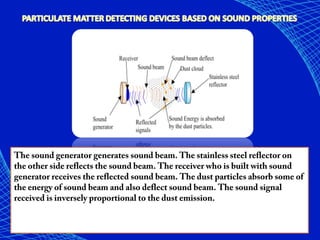
The sound generator generates sound beam. The stainless steel reflector on
the other side reflects the sound beam. The receiver who is built with sound
generator receives the reflected sound beam. The dust particles absorb some of
the energy of sound beam and also deflect sound beam. The sound signal
received is inversely proportional to the dust emission.

 
CENTRIFUGAL DUST COLLECTOR


•   Centrifugal collectors use cyclonic action to
    separate dust particles from the gas stream.
•   This device uses the principle of dynamic
    precipitation technique in which very high
    suction pressure suck the dusty air and allow
    to centrifuge through it.
•    The dust collector has a small tank full of
    water which has two valves. These two
    springs loaded valves are operated to allow
    passage of concentrated dust and automatic
    filling of fresh water.
•   The centrifugal dust collector is highly
    efficient since it uses minimum amount of
    water and discharges dust in its concentrated
    form.
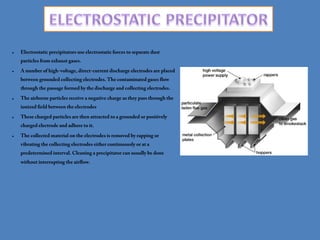
•   Electrostatic precipitators use electrostatic forces to separate dust
    particles from exhaust gases.

•   A number of high-voltage, direct-current discharge electrodes are placed
    between grounded collecting electrodes. The contaminated gases flow
    through the passage formed by the discharge and collecting electrodes.

•   The airborne particles receive a negative charge as they pass through the
    ionized field between the electrodes

•   These charged particles are then attracted to a grounded or positively
    charged electrode and adhere to it.

•   The collected material on the electrodes is removed by rapping or
    vibrating the collecting electrodes either continuously or at a
    predetermined interval. Cleaning a precipitator can usually be done
    without interrupting the airflow.
•   1. Research paper “Control of Respirable Dust” by Schowengerdt, F.D.
    & Brown, J.T. in the April 1976 issue of "Coal Age Magazine".
•   2. Report No 1-800-35-NIOSH of National Institute for Occupational
    Safety and Health.
•   3. Study by the Bureau of Mines' Dust Lab in Pittsburgh.
•   4. Literature by T&T Systems, Inc. Eastern Regional Office P.O. Box
    1484 Bluffton, SC.29910.
•   5. Research paper “Fundamental Scattering Properties Of Respirable
    Dusts And Suspended Particulate Matter” by C. D. Litton, Affiliation:
    Pittsburgh Research Laboratory, National Institute for Occupational
    Safety and Health 1-412-386-5167 .
Dust identification & suppression systems

Dust identification & suppression systems

  • 2.
    1)Present Day DustSuppression Systems A Case Study by Prashant Mehrotra and Mukesh Dubey G.B Technical University, Jhansi. 2)Alternate Technologies for Dust Suppression and Location by Makarand Joshi R.G. Technical University ITM Universe, Gwalior. 3)Systems for Dust Control in Thermal Power Plant by Ankush Kumar and Sumit Chakraborty NIT Hazratbal,Srinagar.
  • 3.
    1. Must beefficient to meet Health & Safety requirements. 2. Be practical and simple in operation. 3. Have low operating costs. 4. No adverse effects on product quality or plant and machinery should be created. 5. The spray discharge should be proportional with dust emission. 6. The solenoid valve should be open with proportion with quantity of dust generation. 7.Metering pump should function effectively for detecting chemical concentration in main water tank.
  • 4.
    • Auto controlor manual control governs the system. It has to be insured that main tank is filled with water. The water is pumped by feed water pump from main tank to feed water tank and at the same time metering pump doses proper quantity of chemical. The feed water pump operation is controlled by float switch automatically. The pump picks up at low level and stopped at high level.
  • 5.
    • The systemis based on a very unique device which can produce a very dense fog of 1 - 10 micron size water droplets which literally blanket the dust source and keep the dust particles from becoming airborne.The fogger is an air driven acoustic oscillator for fogging liquids by passing them through a field of high frequency sound waves. This is accomplished by compressing air upstream of a specially designed converge section of the nozzle.
  • 6.
    The sound generatorgenerates sound beam. The stainless steel reflector on the other side reflects the sound beam. The receiver who is built with sound generator receives the reflected sound beam. The dust particles absorb some of the energy of sound beam and also deflect sound beam. The sound signal received is inversely proportional to the dust emission.  
  • 10.
    CENTRIFUGAL DUST COLLECTOR • Centrifugal collectors use cyclonic action to separate dust particles from the gas stream. • This device uses the principle of dynamic precipitation technique in which very high suction pressure suck the dusty air and allow to centrifuge through it. •  The dust collector has a small tank full of water which has two valves. These two springs loaded valves are operated to allow passage of concentrated dust and automatic filling of fresh water. • The centrifugal dust collector is highly efficient since it uses minimum amount of water and discharges dust in its concentrated form.
  • 11.
    Electrostatic precipitators use electrostatic forces to separate dust particles from exhaust gases. • A number of high-voltage, direct-current discharge electrodes are placed between grounded collecting electrodes. The contaminated gases flow through the passage formed by the discharge and collecting electrodes. • The airborne particles receive a negative charge as they pass through the ionized field between the electrodes • These charged particles are then attracted to a grounded or positively charged electrode and adhere to it. • The collected material on the electrodes is removed by rapping or vibrating the collecting electrodes either continuously or at a predetermined interval. Cleaning a precipitator can usually be done without interrupting the airflow.
  • 12.
    1. Research paper “Control of Respirable Dust” by Schowengerdt, F.D. & Brown, J.T. in the April 1976 issue of "Coal Age Magazine". • 2. Report No 1-800-35-NIOSH of National Institute for Occupational Safety and Health. • 3. Study by the Bureau of Mines' Dust Lab in Pittsburgh. • 4. Literature by T&T Systems, Inc. Eastern Regional Office P.O. Box 1484 Bluffton, SC.29910. • 5. Research paper “Fundamental Scattering Properties Of Respirable Dusts And Suspended Particulate Matter” by C. D. Litton, Affiliation: Pittsburgh Research Laboratory, National Institute for Occupational Safety and Health 1-412-386-5167 .