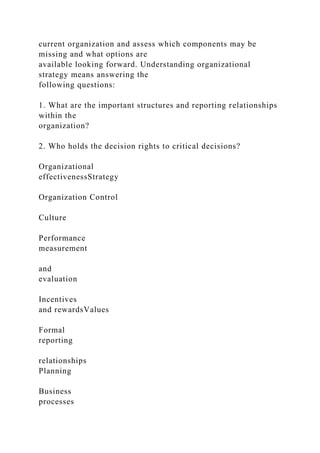
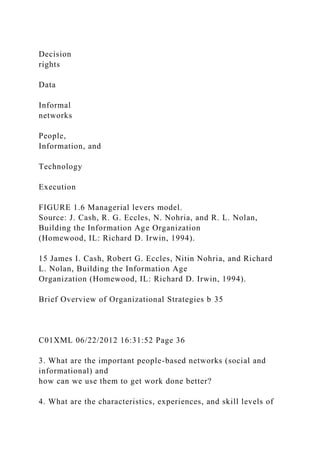
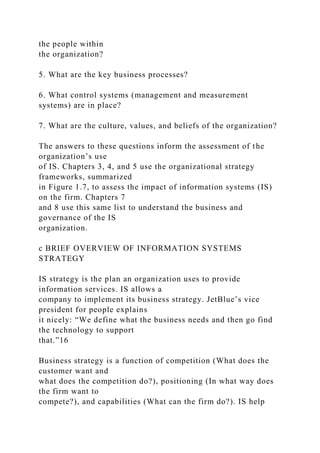
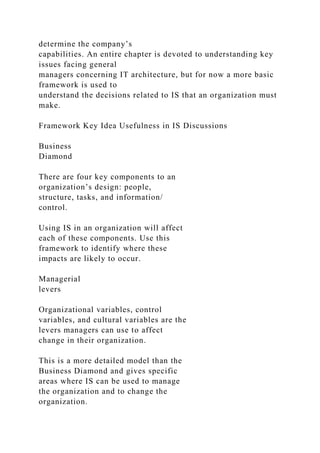
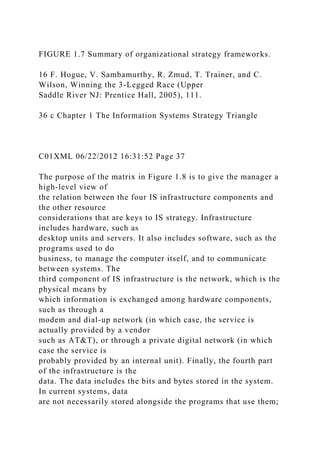
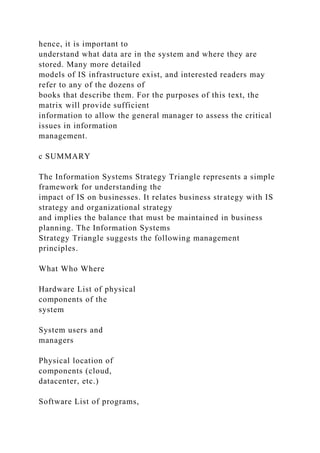
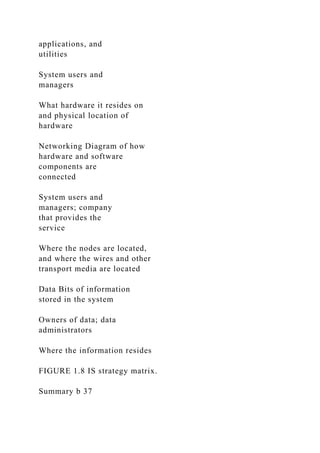
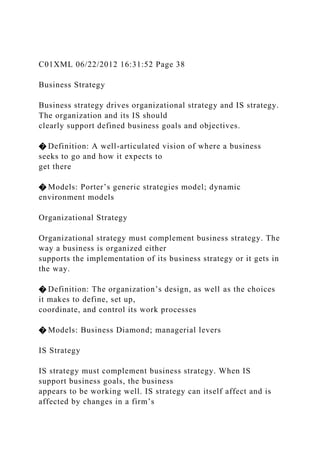
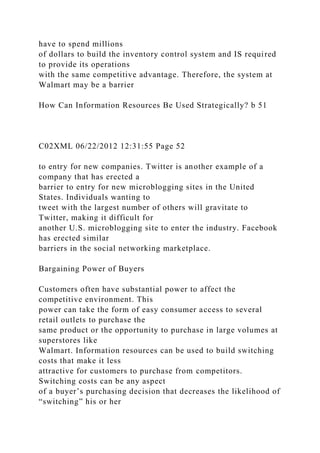
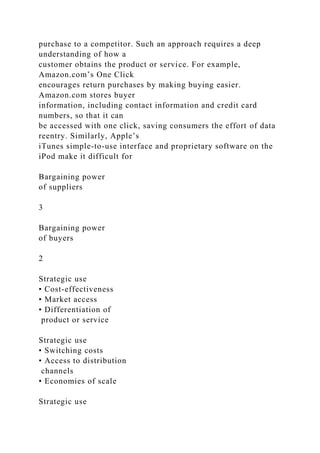
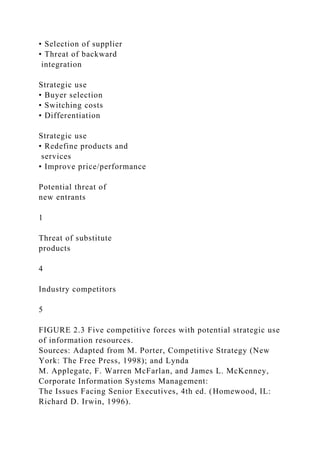
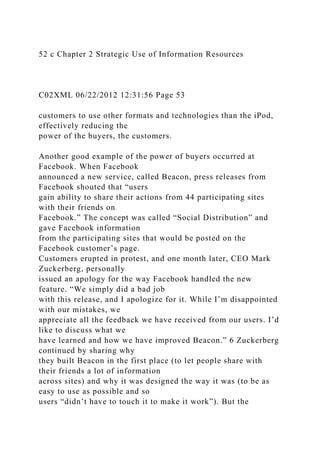
Dunkin Donuts
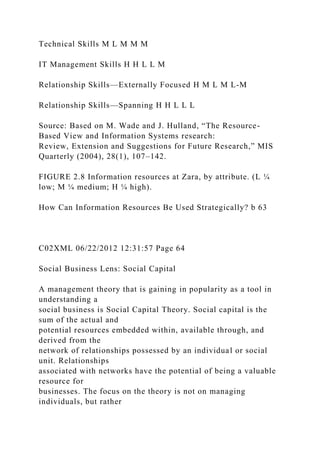
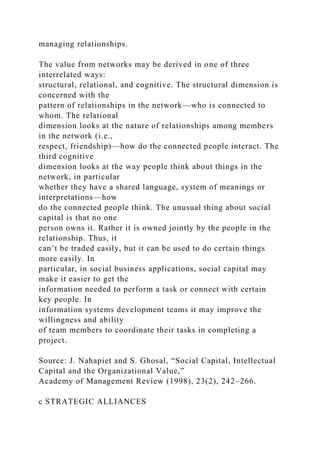
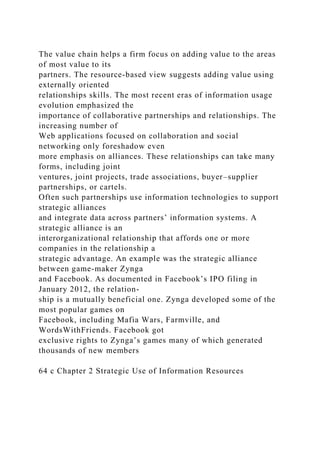
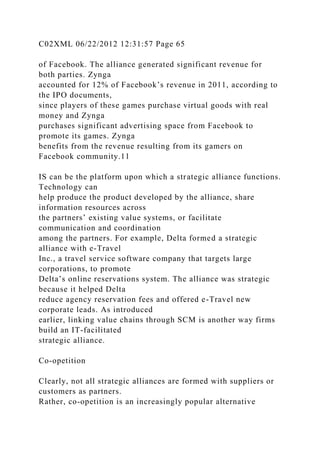
I. Technology
1. Describe the core technology of your organization. Be
detailed in your descriptions.
2. Select 1 department within the organization and describe its
technology. Give examples.
3. Assess interdepartmental technology and connections. Give
examples.
4. Using the various concepts in the textbook, provide a strategy
for current or future use that would allow the organization to
develop and enhance its use of information technology. E.g., if
the organization is currently at the operational level, what
would enhance its effectiveness at that level and would
decision-making and control tools would be appropriate to
introduce at this stage? Alternatively, if it operates at the
decision-making and control level, how effective is it at that
level and what strategic applications should it be considering?
Be detailed and specific in
your answers
BINDEXXML 06/22/2012 18:40:24 Page 402
FFIRSXML 06/22/2012 18:37:30 Page 1
5TH EDITION
Managing and Using
Information Systems
A Strategic Approach
KERI E. PEARLSON
KP Partners
CAROL S. SAUNDERS
University of Central Florida
Dr. Theo and Friedl Schoeller Research Center for Business and
Society
JOHN WILEY & SONS, INC.
FFIRSXML 06/22/2012 18:37:30 Page 2
To Yale & Hana
To Rusty, Russell & Kristin
VP & EXECUTIVE PUBLISHER: Don Fowley
EXECUTIVE EDITOR: Beth Lang Golub
ASSISTANT EDITOR: Samantha Mandel
PROGRAM ASSISTANT: Elizabeth Mills
MARKETING MANAGER: Chris Ruel
MARKETING ASSISTANT: Ashley Tomeck
DESIGNER: Wendy Lai
ASSOCIATE PRODUCTION MANAGER: Joyce Poh
PRODUCTION EDITOR: Jolene Ling
This book was set in 10/12pt NewCaledonia by Thomson Digital
and printed and bound by Courier Westford. The cover was
printed by Courier Westford.
This book is printed on acid free paper.
Founded in 1807, John Wiley & Sons, Inc. has been a valued
source of knowledge and understanding for more than 200
years,
helping people around the world meet their needs and fulfill
their aspirations. Our company is built on a foundation of
principles that include responsibility to the communities we
serve and where we live and work. In 2008, we launched a
Corporate Citizenship Initiative, a global effort to address the
environmental, social, economic, and ethical challenges we face
in our business. Among the issues we are addressing are carbon
impact, paper specifications and procurement, ethical conduct
within our business and among our vendors, and community and
charitable support. For more information, please visit our
website: www.wiley.com/go/citizenship.
Copyright # 2013, 2010, 2006, 2004 John Wiley & Sons, Inc.
All rights reserved. No part of this publication may be
reproduced, stored in a retrieval system or transmitted in any
form or by any means, electronic, mechanical, photocopying,
recording, scanning or otherwise, except as permitted under
Sections 107 or 108 of the 1976 United States Copyright Act,
without either the prior written permission of the Publisher, or
authorization through payment of the appropriate per-copy fee
to the Copyright Clearance Center, Inc., 222 Rosewood Drive,
Danvers, MA 01923, website www.copyright.com. Requests to
the Publisher for permission should be addressed to the
Permissions Department, John Wiley & Sons, Inc., 111 River
Street,
Hoboken, NJ 07030-5774, (201)748-6011, fax (201)748-6008,
website http://www.wiley.com/go/permissions.
Evaluation copies are provided to qualified academics and
professionals for review purposes only, for use in their courses
during the next academic year. These copies are licensed and
may not be sold or transferred to a third party. Upon
completion of the review period, please return the evaluation
copy to Wiley. Return instructions and a free of charge
return mailing label are available at
www.wiley.com/go/returnlabel. If you have chosen to adopt this
textbook for use in
your course, please accept this book as your complimentary
desk copy. Outside of the United States, please contact your
local sales representative.
Library of Congress Cataloging-in-Publication Data
Pearlson, Keri.
Managing and using information systems: a strategic
approach/Keri E. Pearlson, Carol S. Saunders. – 5th ed.
p. cm.
Includes index.
ISBN 978-1-118-28173-4 (pbk.)
1. Knowledge management. 2. Information technology–
Management. 3. Management information systems.
4. Electronic commerce. I. Saunders, Carol S. II. Title.
HD30.2.P4 2013
658.4 0038011—dc23 2012015379
Printed in the United States of America
10 9 8 7 6 5 4 3 2 1
http://www.copyright.com
http://www.wiley.com/go/permissions
http://www.wiley.com/go/returnlabel
http://www.wiley.com/go/citizenship
FPREFXML 06/14/2012 9:35:41 Page 3
cPreface
Information technology and business are becoming inextricably
interwoven. I don’t think
anybody can talk meaningfully about one without the talking
about the other.1
Bill Gates
Microsoft
I’m not hiring MBA students for the technology you learn while
in school, but for your
ability to learn about, use and subsequently manage new
technologies when you get out.
IT Executive
Federal Express
Give me a fish and I eat for a day; teach me to fish and I eat for
a lifetime.
Proverb
Managers do not have the luxury of abdicating participation in
information
systems decisions. Managers who choose to do so risk limiting
their future business
options. Information systems are at the heart of virtually every
business interaction,
process, and decision, especially when one considers the vast
penetration of the Web
in the last few years. Mobile and social technologies have
brought information
systems to an entirely new level within firms, and between
individuals in their
personal lives. Managers who let someone else make decisions
about their informa-
tion systems are letting someone else make decisions about the
very foundation of
their business. This is a textbook about managing and using
information, written for
current and future managers as a way of introducing the broader
implications of the
impact of information systems.
The goal of this book is to assist managers in becoming
knowledgeable partic-
ipants in information systems decisions. Becoming a
knowledgeable participant
means learning the basics and feeling comfortable enough to ask
questions. It
does not mean having all the answers nor having a deep
understanding of all the
technologies out in the world today. No text will provide
managers with everything
they need to know to make important information systems
decisions. Some texts
instruct on the basic technical background of information
systems. Others discuss
applications and their life cycle. Some take a comprehensive
view of the management
information systems (MIS) field and offer readers snapshots of
current systems along
with chapters describing how those technologies are designed,
used, and integrated
into business life.
This book takes a different approach. This text is intended to
provide the reader with
a foundation of basic concepts relevant to using and managing
information. It is not
intended to provide a comprehensive treatment on any one
aspect of MIS, for certainly
1 http://www.woopidoo.com/business quotes/authors/bill-gates-
quotes.htm.
iii
http://www.woopidoo.com/businessquotes/authors/bill-gates-
quotes.htm
FPREFXML 06/14/2012 9:35:41 Page 4
each aspect is itself a topic of many books. It is not intended to
provide readers with
enough technological knowledge to make them MIS experts. It
is not intended to be a
source of discussion of any particular technology. This textbook
is written to help
managers begin to form a point of view of how information
systems will help, hinder, and
create opportunities for their organizations.
The idea for this text grew out of discussions with colleagues in
the MIS area. Many
faculties use a series of case studies, trade and popular press
readings, and Web sites to
teach their MIS courses. Others simply rely on one of the
classic texts, which include
dozens of pages of diagrams, frameworks, and technologies.
The initial idea for this text
emerged from a core MIS course taught at the business school at
the University of
Texas at Austin. That course was considered an “appetizer”
course—a brief introduc-
tion into the world of MIS for MBA students. The course had
two main topics: using
information and managing information. At the time, there was
no text like this one,
hence students had to purchase thick reading packets made up of
articles and
case studies to provide them with the basic concepts. The course
was structured to
provide the general MBA with enough knowledge of the field of
MIS that they could
recognize opportunities to use the rapidly changing technologies
available to them. The
course was an appetizer to the menu of specialty courses, each
of which went much
deeper into the various topics. But completion of the appetizer
course meant that
students were able to feel comfortable listening to, contributing
to, and ultimately
participating in information systems decisions.
Today, many students are digital natives—people who have
grown up using
information technologies all of their lives. That means that
students come to their
courses with significantly more knowledge about things like
tablets, apps, personal
computers, smartphones, texting, the Web, social networking,
file downloading, online
purchasing, and social media than their counterparts in school
just a few years ago. This
is a significant trend that is projected to continue; students will
be increasingly
knowledgeable in personally using technologies. That
knowledge has begun to change
the corporate environment. Today’s digital natives expect to
find information systems
in corporations that provide at least the functionality they have
at home. At the same
time, they expect to be able to work in ways that take advantage
of the technologies they
have grown to depend on for social interaction, collaboration,
and innovation. This
edition of the text has been completely edited with this new
group of students in mind.
We believe the basic foundation is still needed for managing
and using information
systems, but we understand that the assumptions and knowledge
base of today’s
students is significantly different.
Also different today is the vast amount of information amassed
by firms, sometimes
called the “Big Data Problem.” Not only have organizations
figured out that there is a lot
of data around their processes, their interactions with
customers, their products, and
their suppliers, but with the increase in communities and social
interactions on the Web,
there is an additional pressure to collect and analyze vast
amounts of unstructured
information contained in these conversations to identify trends,
needs, and projections.
We believe that today’s managers face an increasing amount of
pressure to understand
what is being said by those inside and outside their corporations
and to join the
iv c Preface
FPREFXML 06/14/2012 9:35:42 Page 5
conversations as much as reasonable. That is significantly
different from just a few
years ago.
This book includes an introduction, twelve chapters of text and
minicases, and
a set of case studies and supplemental readings on a Web site.
The introduction
makes the argument introduced in this preface that managers
must be knowledge-
able participants in information systems decisions. The first few
chapters build a
basic framework of relationships between business strategy,
information systems
strategy, and organizational strategy and explore the links
between these strategies.
Readers will also find a chapter on how information systems
relate to business
transformation. Supplemental materials, including longer cases
from all over the
globe, can be found on the W eb. Please v isit
http://www.wiley.com/ college/pearlson
for more information.
General managers also need some foundation on how IT is
managed if they are to
successfully discuss their next business needs with IT
professionals who can help them.
Therefore, the remaining chapters describe the basics of
information architecture and
infrastructure, the business of IT, the governance of the IS
organization, the sourcing of
information systems, project management, business intelligence,
business analytics and
knowledge management, and relevant ethical issues.
No text in the field of MIS is current. The process of writing the
chapters, coupled
with the publication process, makes a text somewhat out-of-date
prior to delivery to its
audience. With that in mind, this text is written to summarize
the “timeless” elements
of using and managing information. Although this text is
complete in and of itself,
learning is enhanced by coupling the chapters with the most
current readings and cases.
Students are encouraged to search the Web for examples and
current events and
bring them into the discussions of the issues at hand. The
format of each chapter begins
with a navigational guide, a short case study and the basic
language for a set of important
management issues. This is followed up with a set of managerial
concerns related
to the topic. The chapter concludes with a summary, a set of
study questions, key
words, and case studies.
This is the fifth edition of this text, and this version includes
several significant
additions and revisions. Each chapter now has a Social Business
Lens, a textbox that
calls out one topic related to the main chapter, but that is
enabled or fundamental to
using social tools in the enterprise. Most chapters also have a
Geographic Lens box, a
single idea from a global issue related to the topic of the main
chapter. Gone are the
“food for thought” sections in each chapter. Some have been
incorporated into the
main part of the chapter, and others have been moved to the
companion Web site
available to instructors using this text. Each chapter has been
significantly revised,
with newer concepts added, discussions of more current topics
fleshed out, and
old, outdated topics removed or at least their discussion
shortened. And every
chapter now has a navigation box to help the reader understand
the flow and key
topics of the chapter.
Who should read this book? General managers interested in
participating in
information systems decisions will find this a good reference
resource for the language
and concepts of IS. Managers in the information systems field
will find this book a good
Preface b v
http://www.wiley.com/college/pearlson
FPREFXML 06/14/2012 9:35:42 Page 6
resource for beginning to understand the general manager’s
view of how information
systems affect business decisions. And IS students will be able
to use the readings and
concepts in this book as the beginning point in their journey to
become informed and
successful business people.
The information revolution is here. Where do you fit in?
Keri E. Pearlson and Carol S. Saunders
vi c Preface
FACKNWXML 06/22/2012 12:8:9 Page 7
cAcknowledgments
Books of this nature are written only with the support of many
individuals. We would like
to personally thank several individuals who helped with this
text. Although we’ve made
every attempt to include everyone who helped make this book a
reality, there is always
the possibility of unintentionally leaving some out. We
apologize in advance if that is the
case here.
Brandt Walker helped us with this edition by researching
various topics, finding
cases, and verifying examples from previous editions. We really
appreciate his thoughtful
efforts. We also appreciate the considerable efforts of Parul
Acharya and Arturo
Watlington III, students at the University of Central Florida
who enthusiastically helped
with proofreading, research and background checking of facts.
Thank you also goes to
Matthew Riley and Steve Kaplan of Presidio for help with the
infrastructure and
architecture concepts.
We also want to acknowledge and thank pbwiki.com. Without
their incredible and
free wiki, we would have been relegated to e-mailing drafts of
chapters back and forth.
For this edition, as with the fourth edition, we wanted to use
Web 2.0 tools as we wrote
about them. We found that having used the wiki for our
previous edition, we were able to
get up and running much faster than if we had to start over
without the platform.
We have been blessed with the help of our colleagues in this
and in previous editions
of the book. They helped us by writing cases and reviewing the
text. Our thanks continue
to go out to Dennis Galletta, Jonathan Trower, Espen Andersen,
Janis Gogan, Ashok
Rho, Yvonne Lederer Antonucci, E. Jose Proenca, Bruce
Rollier, Dave Oliver, Celia
Romm, Ed Watson, D. Guiter, S. Vaught, Kala Saravanamuthu,
Ron Murch, John
Greenwod, Tom Rohleder, Sam Lubbe, Thomas Kern, Mark
Dekker, Anne Rutkowski,
Kathy Hurtt, Kay Nelson, John Butler, Philip Russell Saunders,
Mihir Parikh, and Craig
Tidwell. In addition, the students of the spring 2008 Technology
Management and
summer 2008 Information Resource Management classes at the
University of Central
Florida provided comments that proved helpful in writing some
cases and making
revisions. Though we cannot thank them by name, we also
greatly appreciate the
comments of the anonymous reviewers who have made a mark
on this edition.
The book would not have been started were it not for the initial
suggestion of a
wonderful editor at John Wiley & Sons, Inc., Beth Lang Golub.
Her persistence and
patience have helped shepherd this book through many months
of creation, modifica-
tion, evaluation, and production, and she will shepherd it
through translation into other
languages. Special thanks go to Samantha Mandel, who very
patiently helped us through
the revision process. We also appreciate the help of all the staff
at Wiley, who have made
this edition a reality.
From Keri: Thank you to my husband, Dr. Yale Pearlson, and
my daughter, Hana
Pearlson. Once again, their patience with me while I worked on
this edition was
incredibly supportive. They understood my manic moments, and
celebrated the
vii
FACKNWXML 06/22/2012 12:8:9 Page 8
victories and completion with as much joy as if they had written
this book themselves.
They also provided some ideas and examples, especially around
the social business
topics. I love you guys!
From Carol: Rusty, thank you for being my compass (always
keeping me headed in
the right direction) and my release valve (patiently walking me
through stressful times—
like writing revisions). I couldn’t do it without you. Every year
I love you more! I love
you, Kristin, Russell, and Janel very much!
viii c Acknowledgments
FLAST01XML 06/14/2012 9:51:12 Page 9
cAbout the Authors
Dr. Keri E. Pearlson is president of KP Partners, an advisory
services firm specializing in
creating business leaders skilled in the strategic use of
information systems and
organizational design in the Web 2.0 world. Dr. Pearlson is an
entrepreneur, teacher,
researcher, consultant, and thought leader. She has held various
positions in academia
and industry. She was a member of the information systems
faculty at the Graduate
School of Business at the University of Texas at Austin, where
she taught management
information systems courses to MBAs and executives. She held
positions at the Harvard
Business School, CSC, nGenera (formerly the Concours Group),
AT&T, and Hughes
Aircraft Company. While writing this edition, she was also an
Adjunct faculty member at
Babson College, in Wellesley, MA, and elected the first
President of the Austin Area
Society of Information Management chapter.
She is co-author of Zero Time: Providing Instant Customer
Value—Every Time, All
the Time (John Wiley & Sons, 2000). Her work has been
published in numerous places
including Sloan Management Review, Academy of Management
Executive, and Infor-
mation Resources Management Journal. Many of her case
studies have been published
by Harvard Business School Publishing and are used all over the
world. She currently
writes a blog on issues at the intersection of IT and business
strategy. It’s available at
www.kp partners .com.
Dr. Pearlson holds a Doctorate in Business Administration
(DBA) in Management
Information Systems from the Harvard Business School and
both a Master’s Degree in
Industrial Engineering Management and a Bachelor’s Degree in
Applied Mathematics
from Stanford University.
Dr. Carol S. Saunders is professor of Management at the
University of Central Florida in
Orlando, Florida, and Schoeller Senior Fellow (2012) at the
University of Erlangen-
Nuremberg. She served as General Conference Chair of the
International Conference
on Information Systems (ICIS) in 1999 and Telecommuting in
1996. She was the chair of
the ICIS Executive Committee in 2000. For three years, she
served as editor-in-chief of
MIS Quarterly. She has received the Association of Information
Systems (AIS) LEO
award for lifetime accomplishments and is a Fellow of the AIS.
Her current research interests include the impact of information
system on power
and communication, overload, virtual teams, virtual worlds,
time, sourcing, and inter-
organizational linkages. Her research is published in a number
of journals including MIS
Quarterly, Information Systems Research, Journal of MIS,
Communications of the ACM,
Academy of Management Journal, Academy of Management
Review, Communications
Research, and Organization Science.
ix
http://www.kppartners.com
FTOCXML 06/14/2012 8:54:4 Page 10
cContents
Introduction 1
The Case for Participating in Decisions about Information
Systems 3
What If a Manager Doesn’t Participate? 6
Social Business Lens 8
Skills Needed to Participate Effectively in Information
Technology Decisions 9
Basic Assumptions 11
Economics of Information Versus Economics of Things 17
Summary 19
Key Terms 20
Discussion Questions 20
Case Study I-1: Terry Cannon, MBA 20
Case Study I-2: Anyglobal Company Inc. 22
c CHAPTER 1 The Information Systems Strategy Triangle 23
Brief Overview of Business Strategy Frameworks 26
Brief Overview of Organizational Strategies 33
Social Business Lens: Building a Social Business Strategy 34
Brief Overview of Information Systems Strategy 36
Summary 37
Key Terms 38
Discussion Questions 39
Case Study 1-1: Lego 39
Case Study 1-2: Google 41
c CHAPTER 2 Strategic Use of Information Resources 44
Evolution of Information Resources 45
Information Resources as Strategic Tools 47
How Can Information Resources Be Used Strategically? 51
Social Business Lens: Social Capital 64
Strategic Alliances 64
Risks 66
Co-Creating IT and Business Strategy 68
Summary 69
Key Terms 70
x
FTOCXML 06/14/2012 8:54:4 Page 11
Discussion Questions 70
Case Study 2-1: Groupon 71
Case Study 2-2: Zipcar 72
c CHAPTER 3 Organizational Strategy and Information Systems
74
Information Systems and Organizational Design 78
Social Business Lens: Social Networks 85
Information Systems and Management Control Systems 85
Information Systems and Culture 89
Summary 95
Key Terms 96
Discussion Questions 96
Case Study 3-1: The Merger of AirTran by Southwest Airlines:
Will the Organizational Cultures Merge? 97
Case Study 3-2: The FBI 98
c CHAPTER 4 Information Systems and the Design of Work 100
Work Design Framework 102
How Information Technology Supports Communication and
Collaboration 104
How Information Technology Changes the Nature of Work 104
Social Business Lens: Activity Streams 113
How Information Technology Changes Where and When Work
Is
Done and Who Does It 116
Gaining Acceptance for IT-Induced Change 128
Summary 130
Key Terms 131
Discussion Questions 132
Case Study 4-1: Trash and Waste Pickup Services, Inc. 132
Case Study 4-2: Social Networking: How does IBM Do It? 133
c CHAPTER 5 Information Systems for Managing Business
Processes 135
Silo Perspective versus Business Process Perspective 137
Building Agile and Dynamic Business Processes 142
Changing Business Processes 143
Workflow and Mapping Processes 145
Enterprise Systems 148
Social Business Lens: Crowdsourcing Changes Innovation
Processes 161
Summary 162
Key Terms 163
Discussion Questions 163
Case Study 5-1: Santa Cruz Bicycles 164
Case Study 5-2: Boeing 787 Dreamliner 165
Contents b xi
FTOCXML 06/14/2012 8:54:4 Page 12
c CHAPTER 6 Architecture and Infrastructure 167
From Vision to Implementation 168
The Leap from Strategy to Architecture to Infrastructure 170
From Strategy to Architecture to Infrastructure: An Example
177
Architectural Principles 180
Enterprise Architecture 180
Virtualization and Cloud Computing 183
Other Managerial Considerations 185
Social Business Lens: Building Social-Mobile Applications 192
Summary 192
Key Terms 193
Discussion Questions 193
Case Study 6-1: Enterprise Architecture at American Express
194
Case Study 6-2: The Case of Extreme Scientists 195
c CHAPTER 7 The Business of IT 197
Organizing to Respond to Business Demand: A Maturity Model
198
Understanding the IT Organization 199
What a Manager Can Expect from the IT Organization 199
Managing IT Activities Globally 203
What the IT Organization Does Not Do 205
Chief Information Officer 206
Social Business Lens: Community Management 208
Building a Business Case 209
IT Portfolio Management 213
Valuing IT Investments 215
Monitoring IT Investments 218
Funding IT Resources 222
How Much Does IT Cost? 226
Summary 231
Key Terms 233
Discussion Questions 233
Case Study 7-1: Troon Golf 234
Case Study 7-2: Balanced Scorecards at BIOCO 235
c CHAPTER 8 Governance of the Information Systems
Organization 236
IT Governance 237
IT Governance and Security 244
Social Business Lens: The Consumerization of Technology 248
Decision-Making Mechanisms 248
Governance Frameworks for Control Decisions 251
Summary 257
xii c Contents
FTOCXML 06/14/2012 8:54:5 Page 13
Key Terms 257
Discussion Questions 257
Case Study 8-1: IT Governance at University of the Southeast
258
Case Study 8-2: The Big Fix at Toyota Motor Sales (TMS) 259
c CHAPTER 9 Information Systems Sourcing 261
Sourcing Decision Cycle Framework 262
Social Business Lens: iCloud 274
Outsourcing and Strategic Networks 283
Summary 284
Key Terms 285
Discussion Questions 285
Case Study 9-1: Crowdsourcing at AOL 285
Case Study 9-2: Altia Business Park 286
c CHAPTER 10 Managing IT Projects 288
What Defines a Project? 290
What is Project Management? 292
Project Elements 295
IT Projects 301
IT Project Development Methodologies and Approaches 303
Social Business Lens: Mashups 311
Managing IT Project Risk 312
Summary 319
Key Terms 320
Discussion Questions 320
Case Study 10-1: Implementing Enterprise Change Management
at
Southern Company 321
Case Study 10-2: Dealing with Traffic Jams in London 322
c CHAPTER 11 Knowledge Management, Business Intelligence,
and
Analytics 325
Knowledge Management, Business Intelligence, and
Business Analytics 327
Data, Information, and Knowledge 330
Knowledge Management Processes 335
Business Intelligence 335
Competing with Business Analytics 336
Components of Business Analytics 338
Big Data 340
Social Analytics 342
Contents b xiii
FTOCXML 06/14/2012 8:54:5 Page 14
Social Business Lens: Social Graphs 344
Caveats for Managing Knowledge and Business Intelligence 345
Summary 345
Key Terms 346
Discussion Questions 346
Case Study 11-1: Stop & Shop’s Scan It! App 347
Case Study 11-2: Business Intelligence at CKE Restaurants 348
c CHAPTER 12 Using Information Ethically 350
Responsible Computing 352
Corporate Social Responsibility 356
PAPA: Privacy, Accuracy, Property, and Accessibility 359
Social Business Lens: Personal Data 363
Security and Controls 369
Summary 371
Key Terms 372
Discussion Questions 372
Case Study 12-1: Ethical Decision Making 372
Case Study 12-2: Midwest Family Mutual Goes Green 375
Glossary 377
Index 387
xiv c Contents
CINTROXML 06/22/2012 17:40:19 Page 1
cIntroduction
This chapter introduces the perspectives that are used
throughout this text. It begins
by making the case for general manager participation in
information systems
decisions and the consequences that arise when managers do not
participate in
IS decisions. Basic assumptions about management, business,
and information
systems made by the authors are stated. The chapter concludes
with a brief
discussion about the difference between the economics of
information versus things.
Why do managers need to understand and participate in the
information decisions of
their organizations? After all, most corporations maintain entire
departments dedicated
to the management of information systems (IS). These
departments are staffed with
highly skilled professionals devoted to the field of technology.
Shouldn’t managers rely
on experts to analyze all the aspects of IS and to make the best
decisions for the
organization? The answer to that question is no.
Managing information is a critical skill for success in today’s
business environment.
All decisions made by companies involve, at some level, the
management and use of IS.
Managers today need to know about their organization’s
capabilities and uses of
information as much as they need to understand how to obtain
and budget financial
resources. The ubiquity of personal devices such as smart
phones, laptops and tablets,
and access to apps within corporations and externally over the
Internet, highlights this
fact because today’s technologies form the backbone for
virtually all business models.
This backbone easily crosses the globe, adding the need for a
global competency to the
manager’s skill set. Further, the proliferation of supply chain
partnerships and the vast
amount of technology available to individuals outside of the
corporation has extended
the urgent need for business managers to be involved in
technology decisions. In
addition, the availability of seemingly free (or at least very
inexpensive) applications,
collaboration tools and innovation engines in the consumer area
has changed the
landscape once again, increasing the integration of IS and
business processes. A manager
who does not understand the basics of managing and using
information cannot be
successful in this business environment.
The majority of U.S. adults own a smart phone, laptop, and
access to online apps.
According to the Pew Research Center, in 2011, 83% of U.S.
adults had a cell phone of
some kind, and of those who had a mobile phone, 42% had a
smart phone.1 Individuals
now have to manage a virtual “personal IS” and make decisions
about applications to
purchase. Doesn’t that give them insight into managing
information systems in corpo-
rations? Students often think that because of their personal
experience with technology,
they also are experts in corporate IS. There is some truth in that
perspective, but it’s
also a very dangerous perspective for managers to take.
Certainly managing one’s own
1 Smartphone Adoption and Usage, July 2011,
http://pewinternet.org/Reports/2011/Smartphones.aspx.
1
http://pewinternet.org/Reports/2011/Smartphones.aspx
CINTROXML 06/22/2012 17:40:19 Page 2
information systems gives some experience that is useful in the
corporate setting such as
knowing about interesting apps, being able to use a variety of
technologies for different
purposes, and being familiar with the ups and downs of
networking. But in a corporate
setting, information systems must be enterprise-ready. They
must be scalable for large
number of employees; they must be delivered in an appropriate
manner for the enterprise;
they must be managed with corporate guidelines, and sometimes
governmental regula-
tions, in mind. Issues like security, privacy, risk, and
architecture take on a new meaning
within an enterprise, and someone has to manage them. A
similar phenomenon occurred
in the early days of database applications. Individuals who used
a personal computer
version of a database assumed they understood databases, but
they ran into issues when
they try to integrate enterprise-level data from multiple users.
That required a different
architecture and skill set. Enterprise-level managing and using
information systems
require a unique perspective managers develop over time.
Consider the now-historic rise of companies such as
Amazon.com, Google and
Zappos. Amazon.com began as an online bookseller and rapidly
outpaced traditional
brick-and-mortar businesses like Barnes and Noble, Borders,
and Waterstones. Man-
agement at the traditional companies responded by having their
IS support personnel
build Web sites to compete. But upstart Amazon.com moved on
ahead, keeping its
leadership position on the Web by leveraging its new business
model into other
marketplaces, such as music, electronics, health and beauty
products, lawn and garden
products, auctions, tools and hardware, and more. It cleared the
profitability hurdle by
achieving a good mix of IS and business basics: capitalizing on
operational efficiencies
derived from inventory software and smarter storage, cost
cutting, and effectively
partnering with such companies as Toys “R” Us Inc. and Target
Corporation.2 More
recently Amazon.com changed the basis of competition in
another market, but this time
it was the Web services business. Amazon.com Web services
offers clients the extensive
technology platform used for Amazon.com, but in an on-demand
fashion for developing
and running the client’s own applications. Shoe retailer
Zappos.com challenged Ama-
zon’s business model, in part by coupling a social business
strategy with exemplary
service and sales, and they were so successful that Amazon.com
bought them.
Likewise, Google played an important role in revolutionizing
the way information is
located, changing the playing field for advertising and
publishing business models.
Google began in 1999 as a basic search company but quickly
learned that a unique
business model was a critical factor for future success. The
company changed the way
people thought about Web content by making it available in a
searchable format with an
incredibly fast response time and in a host of languages.
Further, Google’s keyword-
targeted advertising program revolutionized the way companies
advertise. By 2001,
Google announced its first quarter of profitability, solidifying
the way the world finds
information, publishes, and advertises.3 More recently, Google
expanded into a com-
plete suite of Web-based applications, such as calendaring, e-
mail, collaboration,
shopping, and maps and then enhanced the applications by
combining them with social
2 Robert Hof, “How Amazon Cleared the Profitability Hurdle,”
BusinessWeek Online (February 4, 2002),
http://www.businessweek.com/magazine/content/02_05/b376807
9.htm (accessed on May 23, 2002).
3 Adapted from information at
www.google.com/corporate/history.html (accessed on June 17,
2005).
2 c Introduction
http://www.businessweek.com/magazine/content/02_05/b376807
9.htm
http://www.google.com/corporate/history.html
CINTROXML 06/22/2012 17:40:19 Page 3
tools to increase collaboration. Further, like Amazon.com,
Google also offers clients
similar on-demand services.4
These and other online businesses are able to succeed where
traditional companies
have not, in part because their management understood the
power of information, IS,
and the Web. These exemplary online businesses did not
succeed because their
managers could build Web pages or assemble an IS network.
Quite the contrary.
The executives in these new businesses understood the
fundamentals of managing and
using information and could marry that knowledge with a sound,
unique business vision
to achieve domination of their intended market spaces.
The goal of this book is to provide the foundation to help the
general business
manager become a knowledgeable participant in IS decisions
because any IS decision in
which the manager does not participate can greatly affect the
organization’s ability to
succeed in the future. This introduction outlines the
fundamental reasons for taking the
initiative to participate in IS decisions. Moreover, because
effective participation
requires a unique set of managerial skills, this introduction
identifies the most important
ones. These skills are helpful not just in making IS decisions,
but all business decisions.
We describe how managers should participate in the decision-
making process and
outline key topics to consider which develop this point of view.
Finally, this introduction
presents current models for understanding the nature of a
business and an information
system to provide a framework for the discussions that follow in
subsequent chapters.
c THE CASE FOR PARTICIPATING IN DECISIONS ABOUT
INFORMATION SYSTEMS
Experience shows that business managers have no problem
participating in most
organizational decisions, even those outside their normal
business expertise. For
example, ask a plant manager about marketing problems, and
the result is likely to
be a detailed opinion on both key issues and recommended
solutions. Dialogue among
managers routinely crosses all business functions in formal as
well as informal settings,
with one general exception: IS. Management continues to
tolerate ignorance in this area
relative to other specialized business functions. Culturally,
managers can claim igno-
rance of IS issues without losing prestige among colleagues. On
the other hand,
admitting a lack of knowledge regarding marketing or financial
aspects of the business
earns colleagues’ contempt.
These attitudes are attributable to the historic role that IS
played in businesses. For
many years, technology was regarded as a support function and
treated as administrative
overhead. Its value as a factor in important management
decisions was minimal. It often
took a great deal of technical knowledge to understand even the
most basic concepts.
However, in today’s business environment, maintaining this
back-office view of
technology is certain to cost market share and could ultimately
lead to the failure of the
organization. Technology has become entwined with all the
classic functions of
4 For more information on the latest services by these two
companies, see http://www.amazon.com and http://
www.google.com/enterprise/cloud/.
The Case for Participating in Decisions about Information
Systems b 3
http://www.amazon.com
http://www.google.com/enterprise/cloud/
CINTROXML 06/22/2012 17:40:19 Page 4
business—operations, marketing, accounting, finance—to such
an extent that under-
standing its role is necessary for making intelligent and
effective decisions about any of
them. Furthermore, a general understanding of key IS concepts
is possible without the
extensive technological knowledge required just a few years
ago. Most managers today
have personal technology such as a smart phone or tablet that is
more functional than
many corporate-supported personal computers provided by
enterprises just a few years
ago. In fact, the proliferation of personal technologies makes
everyone a “pseudo-
expert.” Each individual must manage applications on smart
phones, make decisions
about applications to purchase, and procure technical support
when the systems fail.
Finally, with the robust number of consumer applications
available on the Web, many
decisions historically made by the IS group are increasingly
being made by individuals
outside the IS, sometimes at the detriment of corporate
objectives.
Therefore, understanding basic fundamentals about using and
managing informa-
tion is worth the investment of time. The reasons for this
investment are summarized in
Figure I-1 and are discussed next.
A Business View
Information technology (IT) is a critical resource for today’s
businesses. It both supports
and consumes a significant amount of an organization’s
resources. Just like the other
three major types of business resources—people, money, and
machines—it needs to be
managed wisely.
IT spends a significant portion of corporate budgets. Worldwide
IT spending
topped $3.7 trillion in 2011, a jump of almost 8% from the
previous year. It’s projected
to continue to increase.5 More than 350 companies each plan to
invest more than $1
billion in IT, particularly in cloud, social, mobile and big data.
Companies in a Gartner
study reported that cloud services will grow five times faster
than overall IT enterprise
spending annually through 2015.
These resources must return value, or they will be invested
elsewhere. The business
manager, not the IS specialist, decides which activities receive
funding, estimates the risk
associated with the investment, and develops metrics for
evaluating the performance of the
Reasons
IS must be managed as a critical resource
IS enable change in the way people work together
IS are part of almost every aspect of business
IS enable or inhibit business opportunities and new strategies
IS can be used to combat business challenges from competitors
FIGURE I-1 Reasons why business managers should participate
in information systems decisions.
5 http://www.gartner.com/technology/research/it-spending-
forecast/ (accessed on February 12, 2012).
4 c Introduction
http://www.gartner.com/technology/research/it-spending-
forecast/
CINTROXML 06/22/2012 17:40:19 Page 5
investment. Therefore, the business manager needs a basic
grounding in managing and
using information. On the flip side, IS managers need a business
view to be able to explain
how the technology will impact the business and what the
tradeoffs are.
People and Technology Work Together
In addition to financial issues, a manager must know how to
mesh technology and people
to create effective work processes. Collaboration is increasingly
common, especially with
the rise of social networking. Companies are reaching out to
individual customers using
social technologies such as Facebook, Twitter, YouTube and
numerous other tools. In
fact, the term Web 2.0 describes the use of World Wide Web
(the Internet) applications
that facilitate, information sharing, user-centered design,
interoperability and collabo-
ration among users. Technology facilitates the work that people
do and the way they
interact with each other. Appropriately incorporating IS into the
design of a business
model enables people to focus their time and resources on
issues that bear directly on
customer satisfaction and other revenue- and profit-generating
activities.
Adding a new IS to an existing organization, however, requires
the ability to manage
change. The skilled business manager must balance the benefits
of introducing new
technology with the costs associated with changing the existing
behaviors of people in the
workplace. There may be choices of technology solutions each
with different impact and
a decision must incorporate a clear understanding of the
consequences. Making this
assessment does not require detailed technical knowledge. It
does require an under-
standing of what the short-term and long-term consequences are
likely to be, how to
mitigate the risks associated with and why adopting new
technology may be more
appropriate in some instances than in others. Understanding
these issues also helps
managers know when it may prove effective to replace people
with technology at certain
steps in a process.
Integrating Business with Information Systems
IS are integrated with almost every aspect of business and have
been for quite some
time. For example, as former CEO of Walmart Stores
International, Bob Martin
described IS’s role, “Today technology plays a role in almost
everything we do, from
every aspect of customer service to customizing our store
formats or matching our
merchandising strategies to individual markets in order to meet
varied customer
preferences.”6 IS place information in the hands of Walmart
associates so that decisions
can be made closer to the customer. IS help simplify
organizational activities and
processes such as moving goods, stocking shelves, or
communicating with suppliers. For
example, handheld scanners provide floor associates with
immediate and real time
access to inventory in their store and the ability to locate items
in surrounding stores, if
necessary.
6 “The End of Delegation? Information Technology and the
CEO,” Harvard Business Review (September–
October 1995), 161.
The Case for Participating in Decisions about Information
Systems b 5
CINTROXML 06/22/2012 17:40:19 Page 6
Rapid Change in Technology
The proliferation of new technologies creates a business
environment filled with
opportunities. The changing demographics of the workforce and
the integration of
“digital natives,” individuals who have grown up completely
fluent in the use of
personal technologies and the Web, also increase the rate of
adoption of new tech-
nologies beyond the pace of traditional organizations. Even
today, new uses of the
Internet produce new types of online businesses that keep every
manager and executive
on alert. New business opportunities spring up with little
advance warning. The
manager’s role is to frame these opportunities so that others can
understand them,
to evaluate them against existing business needs and choices,
and finally to pursue those
that fit with an articulated business strategy. The quality of the
information at hand
affects the quality of both the decision and its implementation.
Managers must develop
an understanding of what information is crucial to the decision,
how to get it, and how to
use it. They must lead the changes driven by IS.
Competitive Challenges
Competitors come from both expected and unexpected places.
General managers are in
the best position to see the emerging threats and utilize IS
effectively to combat ever-
changing competitive challenges. Further, general managers are
often called on to
demonstrate a clear understanding of how their own technology
programs and products
compare with those of their competitors. A deep understanding
of the capabilities of
the organization coupled with existing IS can create a
competitive advantage and change
the competitive landscape for the entire industry.
Customer Pull
With the emergence of social networks such as Facebook and
Renren, social microblogs
such as Sina Weibo and Twitter, social media and the Web,
businesses have had to
redesign their existing business models to account for the
change in power now yielded
by customers and others in their communities. Social media
have given powerful voices
to customers and communities and businesses must listen.
Redesigning the customer
experience when interacting with a company is top of mind for
many managers and the
key driver is IS. Social IT enable new and often deeper
relationships with a large number
customers and companies are learning how to integrate and
leverage this capability into
existing and new business models.
c WHAT IF A MANAGER DOESN’T PARTICIPATE?
Decisions about IS directly affect the profits of a business. The
basic formula Profit ¼
Revenue � Expenses can be used to evaluate the impact of these
decisions. Adopting the
wrong technologies can cause a company to miss business
opportunities and any revenues
those opportunities would generate. Inadequate IS can cause a
breakdown in servicing
customers, which hurts sales. Poorly deployed social IT
resources can badly damage the
reputation of a strong brand. On the expense side, a
miscalculated investment in
6 c Introduction
CINTROXML 06/22/2012 17:40:19 Page 7
technology can lead to overspending and excess capacity or
under spending and restricted
opportunity. Inefficient business processes sustained by ill-
fitting IS also increase
expenses. Lags in implementation or poor process adaptation
each reduce profits and
therefore growth. IS decisions can dramatically affect the
bottom line.
Failure to consider IS strategy when planning business strategy
and organizational
strategy leads to one of three business consequences: (1) IS that
fail to support business
goals, (2) IS that fail to support organizational systems, and (3)
a misalignment between
business goals and organizational capabilities. These
consequences are discussed briefly
in the following section and in more detail in later chapters. The
driving questions to
consider are the potential effects on an organization’s ability to
achieve its business goals.
How will the consequences impact the way people work? Will
the organization still be
able to implement its business strategy?
Information Systems Must Support Business Goals
IS represent a major investment for any firm in today’s business
environment. Yet poorly
chosen IS can actually become an obstacle to achieving business
goals. The results can be
disastrous if the systems do not allow the organization to realize
its goals. When IS lack the
capacity needed to collect, store, and transfer critical
information for the business,
decisions can be impacted and options limited. Customers will
be dissatisfied or even
lost. Production costs may be excessive. Worst of all,
management may not be able to
pursue desired business directions that are blocked by
inappropriate IS. Victoria’s Secret
experienced this problem when a Superbowl ad promoting an
online fashion show
generated so many inquiries to its Web site that it crashed.
After spending large amount
of money on the advertisement, it was wasted when potential
customers could not access
the site. Likewise, Toys “R” Us experienced such a calamity
when its well-publicized Web
site was unable to process and fulfill orders fast enough one
holiday season. It not only lost
those customers, but it also had a major customer relations issue
to manage as a result.
Information Systems Must Support Organizational Systems
Organizational systems represent the fundamental elements of a
business—its people,
work processes, tasks, structure and control systems—and the
plan that enables them to
work efficiently to achieve business goals. If the company’s IS
fail to support its
organizational systems, the result is a misalignment of the
resources needed to achieve
its goals. For example, it seems odd to think that a manager
might add functionality to a
corporate Web site without providing the training these same
employees need to use the
tool effectively. Yet, this mistake—and many more costly
ones—occur in businesses
every day. Managers make major IS decisions without
informing all the staff of resulting
changes in their daily work. For example, an enterprise resource
planning (ERP) system
often dictates how many business processes are executed and
the organization systems
must change to reflect the new processes. Deploying technology
without thinking
through how it actually will be used in the organization—who
will use it, how they
will use it, how to make sure the applications chosen actually
accomplish what is
intended—results in significant expense. In another example, a
company may decide to
block access to the Internet, thinking that they are prohibiting
employees from accessing
What If a Manager Doesn’t Participate? b 7
CINTROXML 06/22/2012 17:40:19 Page 8
offensive or unsecure sites. But that decision also means that
employees can’t access
social networking sites, which may be useful for collaboration,
or other Web-based
applications that may offer functionality to make the business
more efficient.
The general manager, who, after all, is charged with ensuring
that company resources
are used effectively, must guarantee that the company’s IS
support its organizational
systems and that changes made in one system are reflected in
the other. For example, a
company that plans to allow workers to work remotely needs an
information system
strategy compatible with its organization strategy. Desktop PCs
located within the
corporate office are not the right solution for a telecommuting
organization. Instead,
laptop computers, applications that are accessible online
anywhere and anytime, and
Social Business Lens
In this edition of the text, we introduce a new feature, the
Social Business Lens.
The explosion of consumer-based technologies, coupled with
applications such as
Facebook, Renren, Sina Weibo, Twitter, LinkedIn, YouTube,
Foursquare, Skype,
Pinterest, and more have brought into focus the concept of a
social business. Some
call this trend the consumerization of technology a term used to
mean that
technologies targeted at individual, personal users such as
social tools, mobile
phones, and Web applications are entering the corporation and
pressuring the
enterprise in new and unexpected ways. At the same time,
technologies intended
for the corporation, like cloud computing, are being retooled
and “consumerized”
to appeal to individuals outside the corporation.
This phenomenon is permeating every facet of business. There
are new
business models based on a social IT platform, new ways of
connecting with
stakeholders, governing, collaborating, doing work, and
measuring results. In this
book, we are particular about the terminology we use. Social IT
is the term we use
for all technologies in this space. We define social IT as the
technologies used
for collaboration, networking, and the general interaction
between people over
the Web. These include social networks and other applications
that provide for
interaction between people. Enterprise use of social IT for
business applications,
activities and processes is called social business.
Many use the term social media as an overarching term for this
space, but
increasingly social media refers to the marketing and sales
applications of social
IT, and we use it that way. Social networks are a specific type
of tool, like
Facebook, Ning, and similar tools. Social networking is the use
of these types of
social IT tools in a community. As of the writing of this text,
the social space is still
like the wild west; there are no widely accepted conventions
about the terms and
their meanings or the uses and their impact. But we have enough
experience with
social IT that we know it’s a major force bursting on the
enterprise scene and it
must be addressed in discussions of managing and using
information systems.
Look for the box “Social Business Lens” in each chapter. In that
space, we
explore one topic related to that chapter from a social business
perspective. We
look through the lens of a social business.
8 c Introduction
CINTROXML 06/22/2012 17:40:19 Page 9
networks that facilitate information sharing are needed.
Workers may want to use tablets
or smart phones remotely, too, and those entail a different set of
IS processes. If the
organization only allows the purchase of desktop PCs and only
builds systems accessible
from desks within the office, the telecommuting program is
doomed to failure.
c SKILLS NEEDED TO PARTICIPATE EFFECTIVELY IN
INFORMATION
TECHNOLOGY DECISIONS
Participating in IT decisions means bringing a clear set of skills
to the table. All managers
are asked to take on tasks that require different skills at
different times. Those tasks can
be divided into visionary tasks, or tasks that provide leadership
and direction for the
group; informational/interpersonal tasks, or tasks that provide
information and knowl-
edge the group needs to have to be successful; and structural
tasks, tasks that organize
the group. Figure I-2 lists basic skills required of managers who
wish to participate
successfully in key IT decisions. Not only does this list
emphasize understanding,
Managerial Role Skills
Visionary Creativity—the ability to transform resources and
create something new
to the organization.
Curiosity—the ability to question and learn about new ideas,
applica-
tions, technologies and business models.
Confidence—the ability to believe in oneself and assert one’s
ideas at
the proper time.
Focus on business solutions—the ability to bring experience and
insight
to bear on current business opportunities and challenges.
Flexibility—the ability to change rapidly and effectively, such
as by adapting
processes, shifting perspectives, or adjusting a plan to achieve a
new goal.
Informational and
Interpersonal
Communication—the ability to share thoughts through speech,
writing,
text and images.
Listening—the ability to hear and reflect back what others are
saying.
Information gathering—the ability to gather thoughts of others
through
listening, reading, and observing.
Interpersonal skills—the ability to cooperate and collaborate
with others on
a team, among groups, or across a change of command to
achieve results.
Structural Project management—the ability to plan, organize,
direct and control
company resources to effectively complete a project.
Analytical skills—the ability to break down a problem into its
elements
for ease of understanding and analysis.
Organizational skills—the ability to bring together distinct
elements and
combine them into an effective whole.
Planning skills—the ability to develop objectives and to
allocate
resources to ensure objectives are met.
FIGURE I-2 Skills of successful managers.
Skills Needed to Participate Effectively in Information
Technology Decisions b 9
CINTROXML 06/22/2012 17:40:19 Page 10
organizing, planning, and solving the business needs of the
organization, but it also is an
excellent checklist for all managers’ professional growth.
These skills may not look much different from those required of
any successful
manager, which is the main point of this book: General
managers can be successful
participants in IS decisions without an extensive technical
background. General man-
agers who understand a basic set of IS concepts and who have
outstanding managerial
skills, such as those listed in Figure I-2, are ready for the
digital economy.
How To Participate in Information Systems Decisions
Technical wizardry is not required to become a knowledgeable
participant in the IS decisions
of a business. Managers need curiosity, creativity, and the
confidence to ask questions in
order to learn and understand. A solid framework that identifies
key management issues and
relates them to aspects of IS provides the background needed to
participate.
The goal of this book is to provide that framework. The way in
which managers use and
manage information is directly linked to business goals and the
business strategy that drive
both organizational and IS decisions. Aligning business and IS
decisions together is critical.
Business, organizational, and information strategies are
fundamentally linked in what is
called the Information Systems Strategy Triangle, discussed in
the next chapter. Failing to
understand this relationship is detrimental to a business. Failing
to plan for the conse-
quences in all three areas can cost a manager his or her job.
This book provides a
foundation for understanding business issues related to IS from
a managerial perspective.
Organization of the Book
To be a knowledgeable participant, managers must know about
both using information and
managing information. The first five chapters offer basic
frameworks to make this
understanding easier. Chapter 1 uses the Information Systems
Strategy Triangle frame-
work to discuss alignment of IS and the business. This chapter
also provides a brief
overview of relevant frameworks for business strategy and
organizational strategy. It is
provided as background for those who have not formally studied
organization theory or
business strategy. For those who have studied these areas, this
chapter is a brief refresher
of major concepts used throughout the remaining chapters of the
book. Subsequent
chapters provide frameworks and sets of examples for
understanding the links between IS
and business strategy (Chapter 2), links between IS and
organizational strategy (Chapter 3),
collaboration and individual work (Chapter 4), and business
processes (Chapter 5).
The rest of the text looks at issues related to the business
manager’s role in managing
IS itself. These chapters are the building blocks of an IS
strategy. Chapter 6 provides a
framework for understanding the four components of IS
architecture: hardware, software,
networks, and data. Chapter 7 discusses the business of IT, with
a look at IS organization,
funding models, portfolios, and monitoring options. Chapter 8
looks at the governance of
IS resources. Chapter 9 explores sourcing and how companies
provision IS resources.
Chapter 10 focuses on project and change management. Chapter
11 dives into business
intelligence, knowledge management, and analytics and
provides an overview of how
companies manage knowledge and create a competitive
advantage using business ana-
lytics. Finally, Chapter 12 discusses the ethical use of
information, privacy, and security.
10 c Introduction
CINTROXML 06/22/2012 17:40:20 Page 11
c BASIC ASSUMPTIONS
Every book is based on certain assumptions, and understanding
those assumptions makes a
difference in interpreting the text. The first assumption made by
this text is that managers
must be knowledgeable participants in the IS decisions made
within and affecting their
organizations. That means that the general manager must have a
basic understanding of the
business and technology issues related to IS. Because
technology changes rapidly, this text
also assumes that the technology of today is different from the
technology of yesterday, and
most likely, the technology available to readers of this text
today differs significantly from
that available when the text was written. Therefore, this text
focuses on generic concepts
that are, to the extent possible, technology independent. It
provides a framework on which
to hang more current information, such as new uses of the Web,
new social tools, or new
networking technologies. It is assumed that the reader will seek
out the most current
sources to supplement the discussions of this text and to learn
about the latest technology.
Although some may debate this next assumption, a second
assumption is that the
role of a general manager and the role of an IS manager are
distinct and their skill sets
differ. The general manager must have a basic knowledge of IS
to make decisions that
may have serious implications for the business. Whereas in
addition to general business
knowledge, the IS manager must have more in-depth knowledge
of technology to
manage IS and to partner with general managers who must use
the information. As
digital natives take on increasingly more managerial roles in
corporations, this second
assumption may have to be altered. But for this text, we assume
a different skill set for
the IS manager and we do not attempt to provide that here.
Assumptions are also made
about how business is done and what IS are in general.
Assumptions about Management
The classic view of management includes four activities
performed by managers to reach
organizational goals and each dependent on the others:
planning, organizing, leading,
and controlling (see Figure I-3). Conceptually, this simple
model provides a framework
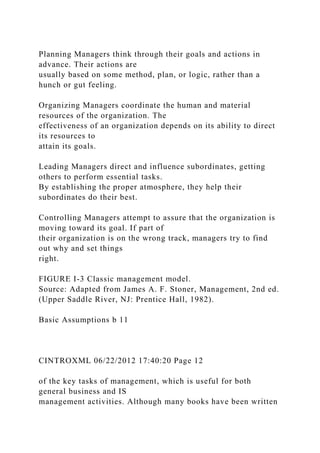
Planning Managers think through their goals and actions in
advance. Their actions are
usually based on some method, plan, or logic, rather than a
hunch or gut feeling.
Organizing Managers coordinate the human and material
resources of the organization. The
effectiveness of an organization depends on its ability to direct
its resources to
attain its goals.
Leading Managers direct and influence subordinates, getting
others to perform essential tasks.
By establishing the proper atmosphere, they help their
subordinates do their best.
Controlling Managers attempt to assure that the organization is
moving toward its goal. If part of
their organization is on the wrong track, managers try to find
out why and set things
right.
FIGURE I-3 Classic management model.
Source: Adapted from James A. F. Stoner, Management, 2nd ed.
(Upper Saddle River, NJ: Prentice Hall, 1982).
Basic Assumptions b 11
CINTROXML 06/22/2012 17:40:20 Page 12
of the key tasks of management, which is useful for both
general business and IS
management activities. Although many books have been written
describing each of these
activities, organizational theorist Henry Mintzberg offers a view
that most closely details
the perspective relevant to IS management.
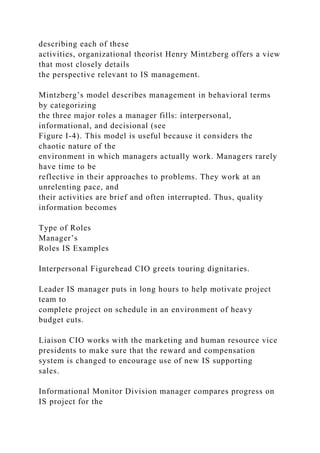
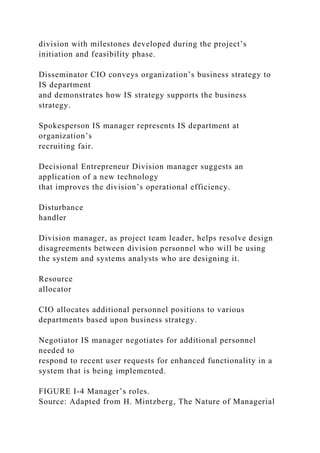
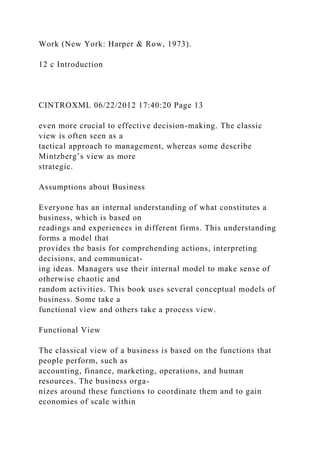
Mintzberg’s model describes management in behavioral terms
by categorizing
the three major roles a manager fills: interpersonal,
informational, and decisional (see
Figure I-4). This model is useful because it considers the
chaotic nature of the
environment in which managers actually work. Managers rarely
have time to be
reflective in their approaches to problems. They work at an
unrelenting pace, and
their activities are brief and often interrupted. Thus, quality
information becomes
Type of Roles
Manager’s
Roles IS Examples
Interpersonal Figurehead CIO greets touring dignitaries.
Leader IS manager puts in long hours to help motivate project
team to
complete project on schedule in an environment of heavy
budget cuts.
Liaison CIO works with the marketing and human resource vice
presidents to make sure that the reward and compensation
system is changed to encourage use of new IS supporting
sales.
Informational Monitor Division manager compares progress on
IS project for the
division with milestones developed during the project’s
initiation and feasibility phase.
Disseminator CIO conveys organization’s business strategy to
IS department
and demonstrates how IS strategy supports the business
strategy.
Spokesperson IS manager represents IS department at
organization’s
recruiting fair.
Decisional Entrepreneur Division manager suggests an
application of a new technology
that improves the division’s operational efficiency.
Disturbance
handler
Division manager, as project team leader, helps resolve design
disagreements between division personnel who will be using
the system and systems analysts who are designing it.
Resource
allocator
CIO allocates additional personnel positions to various
departments based upon business strategy.
Negotiator IS manager negotiates for additional personnel
needed to
respond to recent user requests for enhanced functionality in a
system that is being implemented.
FIGURE I-4 Manager’s roles.
Source: Adapted from H. Mintzberg, The Nature of Managerial
Work (New York: Harper & Row, 1973).
12 c Introduction
CINTROXML 06/22/2012 17:40:20 Page 13
even more crucial to effective decision-making. The classic
view is often seen as a
tactical approach to management, whereas some describe
Mintzberg’s view as more
strategic.
Assumptions about Business
Everyone has an internal understanding of what constitutes a
business, which is based on
readings and experiences in different firms. This understanding
forms a model that
provides the basis for comprehending actions, interpreting
decisions, and communicat-
ing ideas. Managers use their internal model to make sense of
otherwise chaotic and
random activities. This book uses several conceptual models of
business. Some take a
functional view and others take a process view.
Functional View
The classical view of a business is based on the functions that
people perform, such as
accounting, finance, marketing, operations, and human
resources. The business orga-
nizes around these functions to coordinate them and to gain
economies of scale within
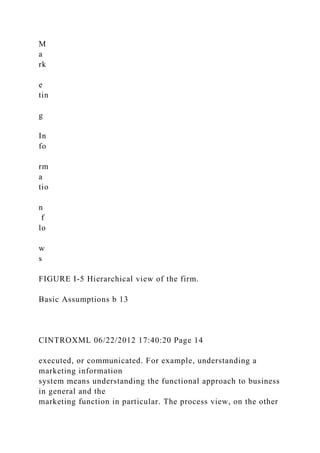
specialized sets of tasks. Information first flows vertically up
and down between line
positions and management; after analysis it may be transmitted
across other functions for
use elsewhere in the company (see Figure I-5).
Process View
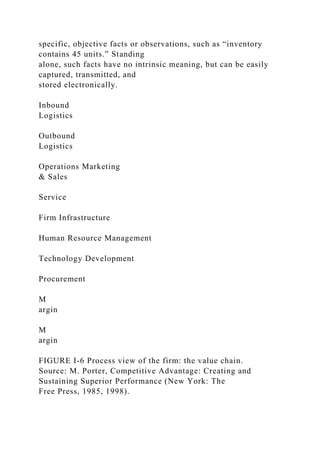
Michael Porter of Harvard Business School describes a business
in terms of the primary
and support activities that are performed to create, deliver, and
support a product or
service (see Figure I-6). The primary activities of inbound
logistics, operations, out-
bound logistics, marketing and sales, and service are chained
together in sequences that
describe how a business transforms its raw materials into value-
creating products. This
value chain is supported by common activities shared across all
the primary activities.
For example, general management and legal services are
distributed among the primary
activities. Improving coordination among activities increases
business profit. Organiza-
tions that effectively manage core processes across functional
boundaries will be winners
in the marketplace. IS are often the key to this process
improvement and cross-
functional coordination.
Both the process and functional views are important to
understanding IS. The
functional view is useful when similar activities must be
explained, coordinated,
O
p
e
ra
tio
n
s
A
cc
o
u
n
tin
g
S
a
le
s
a
n
d
S
u
p
p
o
rt
Executive Management
M
a
rk
e
tin
g
In
fo
rm
a
tio
n
f
lo
w
s
FIGURE I-5 Hierarchical view of the firm.
Basic Assumptions b 13
CINTROXML 06/22/2012 17:40:20 Page 14
executed, or communicated. For example, understanding a
marketing information
system means understanding the functional approach to business
in general and the
marketing function in particular. The process view, on the other
hand, is useful when
examining the flow of information throughout a business. For
example, understanding
the information associated with order fulfillment or product
development or customer
service means taking a process view of the business. This text
assumes that both views are
important for participating in IS decisions.
Assumptions about Information Systems
Consider the components of an information system from the
manager’s viewpoint,
rather than from the technologist’s viewpoint. Both the nature
of information (hierarchy
and economics) and the context of an information system must
be examined to
understand the basic assumptions of this text.
Information Hierarchy
The terms data, information, and knowledge are often used
interchangeably, but have
significant and discrete meanings within the knowledge
management domain (and are
more fully explored in Chapter 11). Tom Davenport, in his book
Information Ecology,
pointed out that getting everyone in any given organization to
agree on common
definitions is difficult. However, his work (summarized in
Figure I-7) provides a
nice starting point for understanding the subtle but important
differences.
The information hierarchy begins with data, or simple
observations, data are a set of
specific, objective facts or observations, such as “inventory
contains 45 units.” Standing
alone, such facts have no intrinsic meaning, but can be easily
captured, transmitted, and
stored electronically.
Inbound
Logistics
Outbound
Logistics
Operations Marketing
& Sales
Service
Firm Infrastructure
Human Resource Management
Technology Development
Procurement
M
argin
M
argin
FIGURE I-6 Process view of the firm: the value chain.
Source: M. Porter, Competitive Advantage: Creating and
Sustaining Superior Performance (New York: The
Free Press, 1985, 1998).
14 c Introduction
CINTROXML 06/22/2012 17:40:20 Page 15
Information is data endowed with relevance and purpose.7
People turn data into
information by organizing it into some unit of analysis (e.g.,
dollars, dates, or customers).
For example, a mashup of location data and housing prices adds
something beyond what
the data provides individually, and that makes it information. A
mashup is the term used
to for applications that combine data from different sources to
create a new application
on the Web. Deciding on the appropriate unit of analysis
involves interpreting the
context of the data and summarizing it into a more condensed
form. Consensus must be
reached on the unit of analysis.
To be relevant and have a purpose, information must be
considered within the
context that it is received and used. Because of differences in
context, information needs
vary across the function and hierarchical level. For example,
when considering func-
tional differences related to a sales transaction, a marketing
department manager may be
interested in the demographic characteristics of buyers, such as
their age, gender, and
home address. A manager in the accounting department
probably won’t be interested in
any of these details, but instead wants to know details about the
transaction itself, such as
method of payment and date of payment.
Similarly, information needs may vary across hierarchical
levels. These needs are
summarized in Figure I-8 and reflect the different activities
performed at each level. At
Data Information Knowledge
Definition Simple observations of
the state of the world
Data endowed with
relevance and purpose
Information from the
human mind (includes
reflection, synthesis,
context)
Characteristics � Easily structured
� Easily captured on
machines
� Often quantified
� Easily transferred
� Mere facts
� Requires unit of
analysis
� Data that have been
processed
� Human mediation
necessary
� Hard to structure
� Difficult to capture on
machines
� Often tacit
� Hard to transfer
Example Daily inventory report
of all inventory items
sent to the CEO of a
large manufacturing
company
Daily inventory report
of items that are below
economic order
quantity levels sent to
inventory manager
Inventory manager
knowing which items
need to be reordered in
light of daily inventory
report, anticipated
labor strikes, and a
flood in Brazil that
affects the supply of a
major component.
FIGURE I-7 Comparison of data, information, and knowledge.
Source: Adapted from Thomas Davenport, Information Ecology
(New York: Oxford University Press, 1997).
7 Peter F. Drucker, “The Coming of the New Organization,”
Harvard Business Review (January–February
1988), 45–53.
Basic Assumptions b 15
CINTROXML 06/22/2012 17:40:20 Page 16
the supervisory level, activities are narrow in scope and focused
on production or the
execution of the business’s basic transactions. At this level,
information is focused on
day-to-day activities that are internally oriented and accurately
defined in a detailed
manner. The activities of senior management are much broader
in scope. Senior
management performs long-term planning and needs
information that is aggregated,
externally oriented, and more subjective. The information needs
of middle managers in
terms of these characteristics fall between the needs of
supervisors and senior manage-
ment. Because information needs vary across levels, a daily
inventory report of a large
manufacturing firm may serve as information for a low-level
inventory manager, whereas
the CEO would consider such a report to be merely data. A
report does not necessarily
mean information. The context in which the report is used must
be considered in
determining if it is information.
Knowledge is information that is synthesized and contextualized
to provide
value. It is information with the most value. Knowledge consists
of a mix of contextual
information, values, experiences, and rules. For example, the
mashup of locations and
housing prices means one thing to a real estate agent, another
thing to a potential
buyer, and yet something else to an economist. It is richer and
deeper than
information and more valuable because someone thought deeply
about that informa-
tion and added his or her own unique experience, judgment, and
wisdom. Knowledge
also involves the synthesis of multiple sources of information
over time.8 The amount
of human contribution increases along the continuum from data
to information to
knowledge. Computers work well for managing data, but are
less efficient at managing
information.
Top
Management
Middle
Management
Supervisory and Lower-Level
Management
Time
Horizon
Long: years Medium: weeks, months,
years
Short: day to day
Level of
Detail
Highly
aggregated
Less accurate
More predictive
Summarized
Integrated
Often financial
Very detailed
Very accurate
Often nonfinancial
Orientation Primarily
external
Primarily internal with
limited external
Internal
Decision Extremely
judgmental
Uses creativity
and
analytical skills
Relatively judgmental Heavy reliance on rules
FIGURE I-8 Information characteristics across hierarchical
level.
8 Thomas H. Davenport, Information Ecology (New York:
Oxford University Press, 1997), 9–10.
16 c Introduction
CINTROXML 06/22/2012 17:40:20 Page 17
Some people think there is a fourth level in the information
hierarchy, wisdom. In
this context, wisdom is knowledge, fused with intuition and
judgment that facilitates the
ability to make decisions. Wisdom is that level of the
information hierarchy used by
subject matter experts, gurus, and individuals with a high level
of experience who seem
to “just know” what to do and how to apply the knowledge they
gain. This is consistent
with Aristotle’s view of wisdom as the ability to balance
different and conflicting
elements together in ways that are only learned through
experience.
c ECONOMICS OF INFORMATION VERSUS ECONOMICS
OF THINGS
In their book, Blown to Bits, Evans and Wurster argued that
every business is in the
information business.9 Even those businesses not typically
considered to be information
businesses have business strategies in which information plays a
critical role. The
physical world of manufacturing is shaped by information that
dominates products as
well as processes. For example, a high-end Mercedes
automobile contains as much
computing power as a midrange personal computer.
Information-intensive processes in
the manufacturing and marketing of the automobile include
design, market research,
logistics, advertising, and inventory management.
As our world is reshaped by information-intensive industries, it
becomes even more
important for business strategies to differentiate the timeworn
economics of things from
the evolving economics of information. Things wear out; things
can be replicated at the
expense of the manufacturer; things exist in a tangible location.
When sold, the seller no
longer owns the thing. The price of a thing is typically based on
production costs. In
contrast, information never wears out, though it can become
obsolete or untrue. Infor-
mation can be replicated at virtually no cost without limit;
information exists in the ether.
When sold, the seller still retains the information, but this
ownership provides little value if
the ability of others to copy it is not limited. Finally,
information is often costly to produce,
Things Information
Wear out Doesn’t wear out, can become obsolete or
untrue
Are replicated at the expense of the
manufacturer
Is replicated at almost zero cost without limit
Exist in a tangible location Does not physically exist
When sold, possession changes hands When sold, seller may
still possess and sell
again
Price based on production costs Price based on value to
consumer
FIGURE I-9 Comparison of the economics of things with the
economics of information.
9 Philip Evans and Thomas Wurster, Blown to Bits (Boston:
Harvard Business School Press, 2000).
Economics of Information Versus Economics of Things b 17
CINTROXML 06/22/2012 17:40:20 Page 18
but cheap to reproduce. Rather than pricing it to recover the
sunk cost of its
initial production, its price is typically based on the value to the
consumer. Figure I-9
summarizes the major differences between the economics of
goods and the economics of
information.
Evans and Wurster suggest that traditionally the economics of
information has been
bundled with the economics of things. However, in this
Information Age, firms are
vulnerable if they do not separate the two. The Encyclopedia
Britannica story serves as
an example. Bundling the economics of things with the
economics of information made it
difficult for Encyclopedia Britannica to gauge the threat posed
by Encarta, the
encyclopedia on CD-ROM that was given away to promote the
sale of computers
and peripherals. Britannica focused on its centuries-old
tradition of providing informa-
tion in richly bound tomes sold to the public through a well-
trained sales force. Only
when it was threatened with its very survival did Encyclopedia
Britannica grasp the need
to separate the economics of information from economics of
things and sell bits of
information online. Clearly, Encyclopedia Britannica’s business
strategy, like that of
many other companies, needed to reflect the difference between
the economics of things
from the economics of information.10
System Hierarchy
An information system comprises three main elements:
technology, people, and process
(see Figure I-10). When most people use the term information
system, they actually
refer only to the technology element as defined by the
organization’s infrastructure. In
this text the term infrastructure refers to everything that
supports the flow and
processing of information in an organization, including
hardware, software, data, and
network components, whereas architecture refers to the strategy
implicit in these
components. These ideas will be discussed in greater detail in
Chapter 6. Information
Management
Information Systems
People Technology Process
FIGURE I-10 System hierarchy.
10 Ibid.
18 c Introduction
CINTROXML 06/22/2012 17:40:21 Page 19
system (IS) is defined more broadly as the combination of
technology (the “what”),
people (the “who”), and process (the “how”) that an
organization uses to produce and
manage information. In contrast, information technology (IT)
focuses only on the
technical devices and tools used in the system. We define
information technology
as all forms of technology used to create, store, exchange, and
use information.
Above the information system itself is management, which
oversees the design and
structure of the system and monitors its overall performance.
Management develops the
business requirements and the business strategy that the
information system is meant to
satisfy. The system’s architecture provides a blueprint that
translates this strategy into
components, or infrastructure.11
c SUMMARY
Aligning information systems and business decisions is no
longer an option; it’s an imperative for
business. Every business operates as an information-based
enterprise. In addition, the explosive
growth of smart phones, tablets, social tools and Web-based
businesses provides all managers with
some experience in information systems, and some idea of the
complexity involved in providing
enterprise-level systems. This highlights the need for all
managers to be skilled in managing and
using IS.
It is no longer acceptable to delegate IS decisions to the
management information systems
(MIS) department alone. The general manager must be involved
to both execute business plans
and protect options for future business vision. IS and business
maturity must be aligned to provide
the right level of information resources to the business.
This chapter makes the case for general managers’ full
participation in strategic business
decisions concerning IS. It outlines the skills required for such
participation, and it makes explicit
certain key assumptions about the nature of business,
management, and IS that will underlie the
remaining discussions. Subsequent chapters are designed to
build on these concepts by addressing
the following questions.
Frameworks and Foundations
� How should information strategy be aligned with business
and organizational strategies?
(Chapter 1)
� How can a business achieve competitive advantages using its
IS? (Chapter 2)
� How do organizational decisions impact IS decisions?
(Chapter 3)
� How is the work of the individual in an organization affected
by decisions concerning IS?
(Chapter 4)
� How are information systems integrated with business
processes? (Chapter 5)
IS Management Issues
� What are the components of an IS architecture? (Chapter 6)
� How is the IT organization managed and funded? (Chapter 7)
� How are IS decisions made? (Chapter 8)
11 Gordon Hay and Rick Mu~noz, “Establishing an IT
Architecture Strategy,” Information Systems
Management 14 (Summer 1997), 67–69.
Summary b 19
CINTROXML 06/22/2012 17:40:21 Page 20
� What source should provide IS services? (Chapter 9)
� How are IS projects managed and risks from change
management mitigated? (Chapter 10)
� How is business intelligence managed within an
organization? (Chapter 11)
� What ethical and moral considerations bind the uses of
information in business? (Chapter 12)
c KEY TERMS
architecture (p. 18)
data (p. 14)
digital natives (p. 6)
information (p. 14)
information
system (p. 18)
information
technology (p. 19)
infrastructure (p. 18)
knowledge (p. 16)
mashup (p. 15)
social business (p. 8)
social IT (p. 8)
social media (p. 8)
social networking (p. 8)
Web 2.0 (p. 5)
wisdom (p. 16)
c DISCUSSION QUESTIONS
1. Why is it important for a general manager to be
knowledgeable about information technology?
2. Indicate whether each of the following is information, data,
or knowledge:
a. A daily sales report of each sales transaction that is sent to
the chief operating officer
b. A daily sales report of each sales transaction over $100,000
that is sent to the division
marketing manager
c. A monthly production report that is sent to shop floor
supervisors who don’t use the report
because they believe the figures reported are outdated and
inaccurate
d. An exception report of all accounts that are more than 90
days past-due, which is sent to the
Accounts Receivable Manager
e. A list of Social Security numbers
f. The contact list in an individual’s LinkedIn account
3. Why, in your opinion, did the term Web 2.0 emerge? What is
different in the way the Web is
used today from the “Web 1.0” world? What do you predict
Web 3.0 will mean?
CASE STUDY I-1
TERRY CANNON, MBA
12
Terry Cannon, a typical MBA, was about to receive an MBA
from a leading Business School,
fueling a desire to change the world while growing a significant
savings account. Terry was
debating among three job opportunities, each of which would be
a big step up the professional
ladder from the associate’s job held when working for
Impressive Consulting Group (ICG) prior to
returning to school to get an MBA. Terry wasn’t sure which job
to take.
Terry started business school after four years of experience at
Impressive Consulting Group
(ICG), a global consulting organization with practices in
virtually every major city in the world.
Terry worked in the Dallas office as an associate right out of
undergraduate school, with a degree in
business with a concentration in marketing. Terry had worked
on a number of interesting strategic
12 The names in this case are fictitious. This case is written to
highlight administrative issues relevant to
general managers, and any resemblance to real individuals or
organizations is coincidental.
20 c Introduction
CINTROXML 06/22/2012 17:40:21 Page 21
marketing projects while at ICG. The last one, before returning
to school, involved monitoring
Twitter for a large client, to make sure all mentions of the client
were known to the client.
Terry was completing a standard MBA program after two years
of full-time study and a summer
working for MFG Corporation, a large manufacturing company
in the Midwest. The internship at
MFG Corporation involved working with the new Web
marketing group, which Terry chose to see
just how a company like MFG takes advantage of the Web. At
the same time, Terry hoped to
become more proficient in using Web and Internet technologies.
The experience at MFG’s Web
marketing group, however, only made Terry more anxious,
highlighting how much more was
involved in information systems and the Web than Terry had
previously thought. Terry returned to
business school in the fall of the second year wondering just
how much information systems
knowledge would be needed in future jobs. Further, Terry felt
that becoming a knowledgeable
participant in information decisions was critical to success in
the fast-paced Internet-based
business world waiting after graduation.
Terry had three job offers as graduation closed in, and
wondered just what type of information
systems knowledge was needed for each of them. All three jobs
involved a competitive salary, a
signing bonus, and stock/retirement benefits, so the decision
came down to the knowledge needed
to be successful on the job. The three jobs are summarized as
follows.
1. Return to ICG as a consultant. This job was attractive to
Terry because it meant returning to
a former employer. Terry had left in good standing and liked the
company that rewarded
innovation and supported learning and growth among
consultants. Terry figured a partnership
was possible in the future. As a consultant, Terry could live
anywhere and travel to the client
site four days a week. The fifth day each week, Terry would be
able to work at home, or if
desired, in a company office. As a consultant, Terry initially
thought engagements in strategic
marketing would be the most interesting. ICG had a strong
programming group that was
brought into each engagement to do the programming and
systems analysis work. The
consultant role involved understanding client concerns and
assisting in building a
marketing strategy. Virtually all the projects would have some
social IT component and
might involve actually building and managing communities for
clients. This challenge
interested Terry, but based on the summer job experience, Terry
wondered just how much
technical skill would be required of the consultants in this
arena.
2. Join start-up InfoMicro. Several of Terry’s friends from
business school were joining together to
form a new start-up company on the Web. This business plan for
this company projected that
InfoMicro would be one of only two start-ups in their
marketplace, giving the company a good
position and great opportunity for growth. The business plan
showed the company intending to go
public through an IPO as early as three years after inception,
and Terry believed they could do it.
Terry would join as VP of marketing, supplementing the other
three friends who would hold
president, VP of finance, and VP of operations positions. The
friends who would be president and
finance VP were just completing a techno-MBA at Terry’s
school and would provide the technical
competence needed to get InfoMicro on the Web. Terry would
focus on developing customers and
setting marketing strategy, eventually building an organization
to support that operation as
necessary. Because InfoMicro was a Web-based business and
because social IT was critical to
successful marketing efforts, Terry felt a significant amount of
information systems knowledge
would be required of a successful marketing executive to both
understand the company’s business
and to talk with customers about how to use InfoMicro’s
products.
3. Return to MFG Corporation. The job would be to join the
marketing department as a manager
responsible for new customer development. Many of MFG
Corporation’s customers were older,
established companies like MFG Corporation itself, but new
customers were likely to be start-ups
and up-and-coming companies, or highly successful younger
companies like Google or Zappos.
Case Study I-1 b 21
CINTROXML 06/22/2012 17:40:21 Page 22
Terry felt that some knowledge of information systems would
be necessary simply to provide
innovative interaction mechanisms such as customer Web-based
communities. Terry knew that
discussions with the MFG information systems group would be
necessary to build these new
interfaces. How knowledgeable must Terry be on information
systems issues to hold this job?
As spring break approached, Terry knew a decision had to be
made. Recruiters from all three
companies had given Terry a deadline of the end of break week,
and Terry wasn’t at all sure which job to
take. All sounded interesting, and all were reasonable
alternatives for Terry’s next career move.
Discussion Questions
1. For each position Terry is considering, what types of
information systems knowledge do you
think Terry would need?
2. How could Terry be a knowledgeable participant in each of
the three jobs? What would it
mean to be a knowledgeable participant in each job? Give an
example for each job.
3. As a marketing major and an MBA, is Terry prepared for the
work world awaiting? Why or
why not?
CASE STUDY I-2
ANYGLOBAL COMPANY INC.
13
Memo
To: Chris Bytemaster, CIO
From: Hazel Hasslefree, CEO
The Board of Directors has been discussing an old article they
found in The Harvard Business
Review (May 2003) titled “IT Doesn’t Matter” by Nicholas
Carr. What particularly caught their
attention was this quote:
“Given the rapid pace of technology’s advance, delaying IT
investments can be another
powerful way to cut costs—while also reducing a firm’s chance
of being saddled with buggy
or soon-to-be-obsolete technology. . . Some managers may
worry that being stingy with IT
dollars will damage their competitive positions. But studies of
corporate IT spending
consistently show that greater expenditures rarely translate into
superior financial
results. . . The key to success, for the vast majority of
companies, is no longer to seek
advantage aggressively but to manage costs and risks
meticulously.”
I have been asked to prepare a short presentation about what the
article means to our company
and whether IT does, in fact, matter in our company. As you
know, we have proposed a significant
increase in our IT budget for next year and the Board is
concerned about this investment. I’m not
convinced that advantages from IT spending are no longer
available.
Would you please prepare a short report, about a page, that I
can use as a basis for
my presentation to them? You can find the article in our library
or online at Carr’s blog:
http://bit.ly/NCarrBlog
Thanks.
13 We appreciate the suggestions provided to us by Ron Murch
at the University of Calgary concerning this
case.
22 c Introduction
http://www.bit.ly/NCarrBlog
C01XML 06/22/2012 16:31:50 Page 23
cCHAPTER 1
THE INFORMATION
SYSTEMS STRATEGY
TRIANGLE
The information systems strategy triangle highlights the
alignment necessary between
decisions of business strategy, information systems, and
organizational design. This
chapter reviews models of business strategy including Porter’s
generic strategies,
and dynamic models such as hypercompetition. It suggests a
model for creating a social
business strategy and briefly discusses frameworks for
designing organizational
strategies including the Leavitt Business Diamond and the
Managerial Levers model.
It concludes with a simple framework for decoding information
systems strategy.
Over the course of 87 news-filled days, the 2010 Deepwater
Horizon oil spill became the
largest marine oil spill in human history. The spill quickly
became a public relations
nightmare for BP, which quickly focused its efforts toward
remedying its image by
spearheading the cleanup. At one point, and estimated four
million barrels per day
flowed freely into the gulf waters, straining the marine
ecosystem and threatening the
shoreline from Texas to Florida.
After a lengthy investigation, BP concluded in its internal
report that “a sequence of
failures involving multiple companies and work teams” caused
the explosion that
subsequently allowed oil to spill freely into the gulf. While
repeated failures to follow
safety procedures were at the heart of the catastrophe, when
looking at the timelines of
the accident rather than focusing on who was to blame, one
finds a series of IT failures
coupled with organizational misalignments that ultimately
catalyzed the accident.
This crisis highlighted the need for proper alignment of
business strategy, infor-
mation systems (IS) and organizational mechanisms and
practices when designing the
safety mechanism for an oilrig. When high pressure forced
methane gas to the surface of
the rig, causing it to ignite and explode, most workers evacuate
by lifeboat. However,
even with the lack of human control after the explosion, the
rig’s information systems and
organizational control mechanisms should have both prevented
the accident and the
resulting spill of oil. Automated systems failed, including a key
emergency disconnect
system that failed to initialize, and would have prevented oil
from escaping once the
blowout preventer proved ineffective. But the early monitoring
systems appeared to
23
C01XML 06/22/2012 16:31:50 Page 24
have worked. One indicated problems with oil flow almost an
hour before the explosion,
but an investigation indicated that managers and engineers on
the rig may have ignored
test results earlier that day. And the aftermath also highlighted
issues in organizational
culture, process, and leadership at BP.1
This case emphasizes the point made in the introduction:
General managers must
take a role in decisions about IS. Even though it is not
necessary for a general manager to
have a deep technical knowledge of their IS, it is necessary to
aggressively seek to
understand the consequences of using technologies relevant to
the business’s environ-
ment and to ask questions when it’s not clear. General managers
who leave IS decisions
solely to their IS professionals often put themselves and their
companies at a dis-
advantage. Although IS can facilitate the movement, exchange,
and processing of
information, an IS that is inappropriate for a given operating
environment can actually
inhibit and confuse things. This is especially true in crisis
environments, such as the oil
spill disaster at BP. The IS department is not an island within a
firm. The IS department
manages an infrastructure that is essential to the firm’s
functioning. Further, this case
illustrates that a firm’s IS must be aligned with the way it
manages its employees and
processes. In BP’s case, it became clear that personnel policies
needed to be adjusted to
insure engineers and crew followed all procedures associated
with monitoring results,
and additional processes were needed to insure quality
standards were appropriate and
met from vendor-supplied systems.
This chapter introduces a simple framework for describing the
alignment necessary
with business systems and for understanding the impact of IS on
organizations. This
framework is called the Information Systems Strategy Triangle
because it relates
business strategy with IS strategy and organizational strategy.
This chapter also presents
key frameworks from organization theory that describe the
context in which IS operate,
as well as the business imperatives that IS support. Students
with extensive background
in organizational behavior and business strategy will find this a
useful review of key
concepts. The Information Systems Strategy Triangle presented
in Figure 1.1 suggests
three key points about strategy.
Successful firms have an overriding business strategy that
drives both organizational
strategy and IS strategy. The decisions made regarding the
structure, hiring practices,
vendor policies, and other components of the organizational
strategy, as well as decisions
Business Strategy
Organizational Strategy Information Strategy
FIGURE 1.1 The Information Systems Strategy Triangle.
1 Michael K rigsma n, BP Oil Spill: Leadership and IT Failure,
June 11, 2010 (a ccessed a t http://www.
enterpriseirregulars.com/19782/bp-oil-spill-leadership-and-it-
failure/ on May 5, 2012); and Leo King, BP Oil
Spill ‘Slows’ but Serious IT Failures Come to Surface, May 28,
2010 (accessed at http://www.cio.com/article/
595620/BP_Oil_Spill_Slows_but_Serious_IT_Failures_Come_to
_Surface on May 5, 2012).
24 c Chapter 1 The Information Systems Strategy Triangle
http://www.enterpriseirregulars.com/19782/bp-oil-spill-
leadership-and-itfailure/
http://www.enterpriseirregulars.com/19782/bp-oil-spill-
leadership-and-itfailure/
http://www.cio.com/article/595620/BP_Oil_Spill_Slows_but_Se
rious_IT_Failures_Come_to_Surface
http://www.cio.com/article/595620/BP_Oil_Spill_Slows_but_Se
rious_IT_Failures_Come_to_Surface
C01XML 06/22/2012 16:31:50 Page 25
regarding applications, hardware, and other IS components, are
all driven by the firm’s
business objectives, strategies, and tactics. Successful firms
carefully balance these three
strategies—they purposely design their organization and their IS
strategies to comple-
ment their business strategy.
IS strategy can itself affect and is affected by changes in a
firm’s business and organiza-
tional strategies. To perpetuate the balance needed for
successful operation, changes in the
IS strategy must be accompanied by changes in the
organizational strategy and must
accommodate the overall business strategy. If a firm designs its
business strategy to use
IS to gain strategic advantage, the leadership position in IS can
only be sustained by constant
innovation. The business, IS, and organizational strategies must
constantly be adjusted.
IS strategy always involves consequences—intended or not—
within business and
organizational strategies. Avoiding harmful unintended
consequences means remem-
bering to consider business and organizational strategies when
designing IS deployment.
For example, deploying and expecting employees to use iPads
or tablets without an
accompanying set of changes to job descriptions, process
design, compensation plans,
and business tactics will fail to produce the anticipated
productivity improvements.
Success can only be achieved by specifically designing all three
components of the
strategy triangle.
In the BP case discussed earlier, the IS Strategy Triangle was
out of alignment at the
time of the explosion. The organizational strategy (e.g.,
personnel policies about
responding to monitoring tests, and safety policies and
practices) did not support the
IS strategy (e.g., dispersed network of systems that monitored,
managed, and aborted
automated drilling processes in a crisis situation). Both of these
strategies did not
adequately support their purported business strategy (creating
profits though, in part,
drilling in environmental-sensitive areas without disrupting the
ecosystem while also
protecting their reputation).
Of course, once a firm is out of alignment, it does not mean that
it has to stay that
way. To correct the misalignment described earlier, BP replaced
CEO Tony Hayward
with American Bob Dudley, changed its processes regarding
monitoring and test
systems, restructured its upstream business into three separate
divisions to provide
increased visibility into operations, risk management, standards,
processes, and “human
and technical capability.”2 Further, it changed its culture to
make sure checks and
balances are in place. The new systems realign people, process,
and technology to
decrease the risk of deep water drilling and most closely align
with the business’s goals of
environmental sustainability and oil/energy production.
What does alignment mean? A book entitled Winning the 3-
Legged Race defines
alignment as the situation in which a company’s current and
emerging business strategy
is enabled, supported, and unconstrained by technology. The
authors suggest that
although alignment is good, there are higher states, namely
synchronization and
convergence, toward which companies should strive. With
synchronization, technology
not only enables current business strategy but also anticipates
and shapes future
business strategy. Convergence goes one step further by
exhibiting a state in which
2 BP Web site,
http://www.bp.com/sectiongenericarticle800.do?categoryId=903
6149&contentId=7066886
(accessed on December 30, 2011).
The Information Systems Strategy Triangle b 25
http://www.bp.com/sectiongenericarticle800.do?categoryId=903
6149&contentId=7066886
C01XML 06/22/2012 16:31:50 Page 26
business strategy and technology strategy are intertwined and
the leadership team
members operate almost interchangeably. Although we
appreciate the distinction and
agree that firms should strive for synchronization and
convergence, alignment in this text
means any of these states, and it pertains to the balance between
organizational strategy,
IS strategy, and business strategy.3
A word of explanation is needed here. This chapter and
subsequent chapters
address questions of IS strategy squarely within the context of
business strategy.
Studying business strategy alone is something better done in
other texts and courses.
However, to provide foundation for IS discussions, this chapter
and the next summarize
several key business strategy frameworks and organizational
theories. Studying IS alone
does not provide general managers with the appropriate
perspective. To be effective,
managers need a solid sense of how IS are used and managed
within the organization.
Studying details of technologies is also outside the scope of this
text. Details of the
technologies are relevant, of course, and it is important that any
organization maintain a
sufficient knowledge base to plan for and adequately align with
business priorities.
However, because technologies change so rapidly, keeping a
text current is impossible.
Therefore, this text takes the perspective that understanding
what questions to ask and
having a framework for interpreting the answers are skills more
fundamental to the
general manager than understanding any particular technology.
This text provides
readers with an appreciation of the need to ask questions, a
framework from which
to derive the questions to ask, and a foundation sufficient to
understand the answers
received. The remaining book chapters build on the foundation
provided in the
Information Systems Strategy Triangle.
c BRIEF OVERVIEW OF BUSINESS STRATEGY
FRAMEWORKS
A strategy is a coordinated set of actions to fulfill objectives,
purposes, and goals. The
essence of a strategy is setting limits on what the business will
seek to accomplish.
Strategy starts with a mission. A mission is a clear and
compelling statement that unifies
an organization’s effort and describes what the firm is all about
(i.e., its purpose). For
example, Mark Zuckerberg, the CEO of Facebook, noted that he
initially built Facebook
as a product but what ended up “after we started hiring more
people and building out the
team is I began to get an appreciation that a company is a great
way to get a lot of people
involved in a mission you’re trying to push forward. Our
mission is getting people to
connect.”4
In a few words the mission statement sums up what is unique
about the firm.
Figure 1.2 demonstrates that even though Zappos, Amazon, and
L.L. Bean are all in the
retail industry, they view their missions quite differently. For
example, Zappos’ focus is
on customer service, Amazon is about customer sets, and L.L.
Bean is about the
merchandise and treating people the right way. It’s interesting
to note that while Zappos
3 F. Hogue, V. Sambamurthy, R. Zmud, T. Trainer, and C.
Wilson, Winning the 3-Legged Race (Upper
Saddle River, NJ: Prentice Hall, 2005).
4 Shayndi Raice, “Is Facebook Ready for the Big Time?” Wall
Street Journal (January 14–15, 2012), B1.
26 c Chapter 1 The Information Systems Strategy Triangle
C01XML 06/22/2012 16:31:50 Page 27
was purchased by Amazon, part of their agreement was to keep
Zappos running
independently. (In 2009, all the stockholders of Zappos agreed
to sell their stock to
Amazon, but the agreement included clauses to keep Zappos
independent, and it has
remained so both culturally and physically. Zappos is located
near Las Vegas, NV while
Amazon is in Seattle, WA.)
Are these companies accomplishing their missions? It is hard to
determine whether
Zappos customers are receiving the “best customer service.”
That is why Zappos, like
other firms, sets measurable objectives and performance targets.
Once the objectives
and performance targets are set, the measurable objectives and
performance targets can
help ensure that a firm is accomplishing its mission. And then
the firm needs to decide on
a business strategy to meet its objectives and performance
targets.
A business strategy is a plan articulating where a business seeks
to go and how it
expects to get there. It is the means by which a business
communicates its goals. Manage-
ment constructs this plan in response to market forces, customer
demands, and organiza-
tional capabilities. Market forces create the competitive context
for the business. Some
markets, such as those faced by delivering packages,
manufacturers of laptop computers, and
issuers of credit cards, are characterized by many competitors
and a high level of competition
such that product differentiation becomes increasingly difficult.
Other markets, such as
those for airlines and automobiles, are similarly characterized
by high competition, but
product differentiation is better established. Customer demands
comprise the wants and
needs of the individuals and companies who purchase the
products and services available in
the marketplace. Organizational capabilities include the skills
and experience that give the
corporation a currency that can add value in the marketplace.
Consider Dell, originally a personal computer company.
Initially Dell’s business
strategy was to sell personal computers directly to the customer
without going through a
middleman. Reaching customers in this way was less expensive
and time consuming than
selling the computers in retail stores. The Internet, combined
with Dell’s well-designed
IS infrastructure, allowed customers to electronically contact
Dell, who then designed a
PC for a customer’s specific needs. Dell’s ordering system was
integrated with its
Company Mission Statement
Zappos To provide the best customer service possible.
Internally we call this our WOW
philosophy.a
Amazon We seek to be Earth’s most customer-centric company
for three primary customer
sets: consumer customers, seller customers and developer
customers.b
L.L. Bean Sell good merchandise at a reasonable profit, treat
your customers like human
beings and they will always come back for more.c
a http://about.zappos.com (accessed on February 19, 2012).
b http://www.amazon.com, Mission Statement on Amazon
Investor Relations page (accessed on February 19,
2012).
c
http://www.llbean.com/customerService/aboutLLBean/company
_values.html (accessed on February 19,
2012).
FIGURE 1.2 Mission statements of three retail businesses.
Brief Overview of Business Strategy Frameworks b 27
http://www.amazon.com
http://www.about.zappos.com
http://www.llbean.com/customerService/aboutLLBean/company
_values.html
C01XML 06/22/2012 16:31:50 Page 28
production system and shared information automatically with
each supplier of PC
components. This IS enabled the assembly of the most current
computers without the
expense of storing large inventories. Cost savings were passed
on to the customer, and
the direct-to-customer model allowed Dell to focus its
production capacity on building
only the most current products. With small profit margins and
new products arriving
quickly to replace existing products, this creative use of IS
aligned with Dell’s business
strategy. The strategic use of IS ultimately results in cost
savings, reflected in the price of
systems. In addition, Dell executives achieve a strategic
advantage in reducing response
time, building custom computers for one of the industry’s
lowest costs, and eliminating
inventories that could become obsolete before they are sold.
Thus, this business strategy
was consistent with Dell’s mission of delivering the best
customer experience in the
markets it serves.
But things aren’t always as they seem. If the direct-to-customer
strategy was so
effective, why is Dell now also selling its computers at major
retail outlets such as
Walmart, Staples, and Best Buy? It is likely that the sales
figures and profit margins were
not measuring up to Dell’s stated objectives and performance
targets. Consequently,
Dell adjusted its business strategy and we can expect to see
changes in their organization
design and information systems to reflect their altered direction.
The classic, well-accepted model developed by Michael Porter
still frames most
discussions of business strategy. We review the Porter generic
strategies framework, as
well as dynamic environment strategies.5 The end of this
section introduces key
questions a general manager must answer to understand the
strategy of the business.
The Generic Strategies Framework
Companies sell their products and services in a marketplace
populated with competitors.
Michael Porter’s framework helps managers understand the
strategies they may choose
to build a competitive advantage. In his book Competitive
Advantage, Porter claims that
the “fundamental basis of above-average performance in the
long run is sustainable
competitive advantage.”6 Porter identified three primary
strategies for achieving com-
petitive advantage: (1) cost leadership, (2) differentiation, and
(3) focus. These advan-
tages derive from the company’s relative position in the
marketplace, and they depend
on the strategies and tactics used by competitors. Figure 1.3
summarizes these three
strategies for achieving competitive advantage.
Cost leadership results when the organization aims to be the
lowest-cost producer
in the marketplace. The organization enjoys above-average
performance by minimizing
costs. The product or service offered must be comparable in
quality to those offered by
others in the industry so that customers perceive its relative
value. Typically, only one
cost leader exists within an industry. If more than one
organization seeks an advantage
5 Another popular model by Michael Porter, the value chain,
provides a useful model for discussing internal
operations of an organization. Some find it a useful model for
understanding how to link two firms together.
This framework is used in Chapter 5 to examine business
process design. For further information, see
M. Porter, Competitive Advantage (New York: The Free Press,
1985).
6 M. Porter, Competitive Advantage: Creating and Sustaining
Superior Performance (New York: The Free
Press, 1985, 1998).
28 c Chapter 1 The Information Systems Strategy Triangle
C01XML 06/22/2012 16:31:50 Page 29
with this strategy, a price war ensues, which eventually may
drive the organization with
the higher cost structure out of the marketplace. Through mass
distribution, economies
of scale, and IS to generate operating efficiencies, Walmart
epitomizes the cost-
leadership strategy.
Through differentiation, the organization qualifies its product or
service in a way
that allows it to appear unique in the marketplace. The
organization identifies which
qualitative dimensions are most important to its customers and
then finds ways to add value
along one or more of those dimensions. For this strategy to
work, the price charged
customers by the differentiator must seem fair relative to the
price charged by competitors.
Typically, multiple firms in any given market employ this
strategy. Progressive Insurance is
able to differentiate itself from other automobile insurance
companies by breaking out of
the industry mold. Its representatives are available 24/7 (i.e., 24
hours a day, 7 days a week)
to respond to accident claims. They arrive at an accident scene
shortly after the accident
with powerful laptops, intelligent software, and the authority to
settle claims on the spot.
This strategy spurred Progressive’s growth and widened its
profit margins.
Focus allows an organization to limit its scope to a narrower
segment of the market
and tailor its offerings to that group of customers. This strategy
has two variants: (1) cost
focus, in which the organization seeks a cost advantage within
its segment, and (2)
differentiation focus, in which it seeks to distinguish its
products or services within the
segment. This strategy allows the organization to achieve a
local competitive advantage,
even if it does not achieve competitive advantage in the
marketplace overall. As Porter
explains how the focuser can achieve competitive advantage by
the way it focuses
exclusively on certain market segments:
Breadth of target is clearly a matter of degree, but the essence
of focus is the exploitation
of a narrow target’s differences from the balance of the
industry. Narrow focus in and of
itself is not sufficient for above-average performance.7
Differentiation
Overall Cost
Leadership
Focus
Uniqueness Perceived
by Customer Low Cost Position
Industry-wide
Particular
Segment Only
FIGURE 1.3 Three strategies for achieving competitive
advantage.
Source: M. Porter, Competitive Advantage: Creating and
Sustaining Superior Performance (New York: Free
Press, 1985, 1998).
7 M. Porter, Competitive Advantage: Creating and Sustaining
Superior Performance (New York: The Free
Press, 1985, 1998).
Brief Overview of Business Strategy Frameworks b 29
C01XML 06/22/2012 16:31:51 Page 30
Marriott International demonstrates focus in the business and
related IS strategies
of two of its hotel chains. To better serve its business travelers
and cut operational
expenses, Marriott properties have check-in kiosks that
interface with their Marriott
Rewards loyalty program. A guest can swipe a credit card or
Marriott Rewards card at
the kiosk in the lobby and receive a room assignment and
keycard from the machine. She
can also print airline boarding passes at the kiosks. Further, the
kiosks help the Marriott
chain implement its cost focus. The kiosk system is integrated
with other systems such as
billing and customer relationship management (CRM) to
generate operating efficiencies
and enhanced corporate standardization.
In contrast, stand-alone kiosks in the lobby would destroy the
feeling that the Ritz-
Carlton chain, acquired by Marriott in 1995, creates. To the
Ritz-Carlton chain, CRM
means capturing and using information about guests, such as
their preference for wines,
a hometown newspaper, or a sunny room. Each Ritz-Carlton
employee is expected to
promote personalized service by identifying and recording
individual guest preferences.
To demonstrate how this rule could be implemented, a waiter,
after hearing a guest
exclaim that she loves tulips, could log the guest’s comments
into the Ritz-Carlton CRM
system called “Class.” On her next visit to a Ritz-Carlton hotel,
tulips could be placed in
the guest’s room after querying Class to learn more about her as
her visit approaches.
Class, the CRM, is instrumental in implementing the
differentiation-focus strategy of
the Ritz-Carlton chain.8 Its strategy allows the Ritz-Carlton
chain to live up to its very
unique motto (mission): “We are ladies and gentlemen serving
ladies and gentlemen.”9
For example, airline JetBlue adopted a differentiation strategy
based on low-costs
coupled with unique customer experience. It might be called a
“value-based strategy.” It
is not the lowest cost carrier in the airline industry; at 9.80
cents per passenger seat mile,
JetBlue has one of the lowest costs but Virgin America, Spirit,
and Allegient had lower
per-seat mile costs in 2011. But JetBlue does manage its
operational costs carefully,
making decisions that keep its per passenger costs among the
lowest in the business such
as a limited number of airplane models in its fleet, gates at less
congested airports,
paperless cockpit and for other operations, and snacks instead
of meals on flights.
JetBlue has one of the longest stage length averages in the
industry and the longer the
flight the lower the unit costs. Network carriers, often larger
competitors, may have
different pay scales from having been in the business longer and
with a different
composition of staff, and higher maintenance costs for their
fleets, which may be older
and more diverse. Should its plans for growth be fully realized,
while maintaining its low
cost structure, JetBlue could move from its cost focus based on
serving a limited, but
growing, number of market segments to a cost leadership
strategy.10
While sustaining a cost focus, JetBlue’s chairman believes that
JetBlue can compete
on more than price and that is part of its unique differentiation
strategy. It is why the
airline continually strives to keep customers satisfied with frills
such as extra leg room,
8 Scott Berinato, “Room for Two,” CIO.com (May 15, 2002),
http://www.cio.com/archive/051502/
two_content.html.
9 http://corporate.ritzcarlton.com/en/About/GoldStandards.htm
(accessed on February 13, 2008).
10 http://www.oliverwyman.com/airline_analysis_2011.htm
(accessed on December 26, 2011).
30 c Chapter 1 The Information Systems Strategy Triangle
http://www.cio.com/archive/051502/two_content.html
http://corporate.ritzcarlton.com/en/About/GoldStandards.htm
http://www.oliverwyman.com/airline_analysis_2011.htm
C01XML 06/22/2012 16:31:51 Page 31
leather seats, prompt baggage delivery, DirectTV, and movies.
It has been recognized
with many awards for customer satisfaction in the North
American airlines industry.
Dynamic Environment Strategies
Porter’s generic strategies model is useful for diagnostics, or
understanding how a
business seeks to profit in its chosen marketplace, and for
prescriptions, or building new
opportunities for advantage. It reflects a careful balancing of
countervailing competitive
forces posed by buyers, suppliers, competitors, new entrants,
and substitute products
and services within an industry. As is the case with many
models, they offer managers
useful tools for thinking about strategy.
However, the Porter model was developed at a time when
competitive advantage
was sustainable because the rate of change in any given industry
was relatively slow and
manageable. Since the late 1980s when this framework was at
the height of its popularity,
newer models were developed to take into account the
increasing turbulence and
velocity of the marketplace. One example, the hypercompetition
model, offers managers
an especially useful tool for conceptualizing their
organization’s strategy in turbulent
environments. Organizations need to be able to respond
instantly and change rapidly,
which requires dynamic structures and processes.
Discussions of hypercompetition take a perspective different
from the previous
model. Porter’s model focus on creating competitive advantage,
whereas hypercom-
petition models suggest that the speed and aggressiveness of the
moves and counter-
moves in any given market create an environment in which
advantages are rapidly
created and eroded. Trying to sustain a specific competitive
advantage can be a deadly
distraction, since the environment and the marketplace change
rapidly. To manage the
rapid speed of change, firms focus on their capability to
dynamically adjust their
organizational resources, valuing agility itself as the
competitive advantage. Business
strategies based on hypercompetition still focus on customer
satisfaction, profit maxi-
mization, and other goals consistent with the business’s values
and beliefs, but build in
components of business intelligence. These components include
the ability to predict
new opportunities, organizational designs that can sense,
restructure and respond
quickly, and strategic signaling and actions that both surprise
and confuse competitors.
Since the 1990s a competitive dynamic has emerged in the
marketplace that is
characterized by wider gaps between industry leaders and
laggards, more concentrated
“winner-take-all” environments, and greater churn among sector
rivals. This pattern of
turbulent “creative destruction” was first predicted over 60
years ago by the economist
Joseph Schumpeter. Coincidentally (or maybe not), the
accelerated competition has
occurred concomitantly with sharp increases in the quality and
quantity of information
technology (IT) investment. The changes in competitive
dynamics are particularly
striking in sectors that spend the most on IT.11
An application of these dynamic models is the destroy your
business (DYB) (i.e.,
“creative destruction”) approach to strategic planning that was
implemented by leader-
ship guru Jack Welch at General Electric (GE). Welch
recognized that GE could only
11 Andrew McAfee and Erik Brynjolfsson, “Investing in the IT
That Makes a Competitive Difference,”
Harvard Business Review (July 2008),
http://harvardbusinessonline.hbsp.harvard.edu.
Brief Overview of Business Strategy Frameworks b 31
http://www.harvardbusinessonline.hbsp.harvard.edu
C01XML 06/22/2012 16:31:51 Page 32
sustain its competitive advantage for a limited time as
competitors attempted to
outmaneuver GE. He knew that if GE didn’t identify its
weaknesses, its competitors
would relish doing so. DYB is an approach that places GE
employees in the shoes of their
competitors.12 Through the DYB lenses, GE employees develop
strategies to destroy
GE’s competitive advantage. Then, in light of their revelations,
they apply the grow your
business (GYB) strategy to find fresh ways to reach new
customers and better serve
existing ones. The goal of the DYB planning approach is the
complete disruption of
current practices, so that GE can take actions to protect its
business before competitors
hone in on its weaknesses. The implicit assumption underlying
DYB is that GE would
not be able to sustain its position in the marketplace over the
long term.
A similar strategy of cannibalizing their own products was used
by Apple and
Gillette. Steve Jobs, the founder and CEO of Apple, felt
strongly that if a company was
not willing to cannibalize their own products, someone else will
come along and do it for
them. That was evident in the way Apple introduced the iPhone
while iPod sales were
brisk, and the iPad while its Macintosh sales were strong.13
Apple continues to exhibit
this strategy with subsequent releases of new models of all of
its products. Likewise
Gillette, known for its innovative razors and shaving products,
is famous for introducing
new razors while their current products are in demand. While
the Mach3 razor was
selling well, Gillette introduced the Fusion, and spent resources
to convince customers
to upgrade to the newer and more expensive product.
Why Are Strategic Advantage Models Essential to Planning
for Information Systems?
A general manager who relies solely on IS personnel to make IS
decisions may not only
give up any authority over IS strategy, but also may hamper
crucial future business
decisions. In fact, business strategy should drive IS decision
making, and changes in
business strategy should entail reassessments of IS. Moreover,
changes in IS potential
should trigger reassessments of business strategy—as in the
case of the Internet, where
companies that failed to understand or consider its implications
for the marketplace
were quickly outpaced by competitors who had. For the
purposes of our model, the
Information Systems Strategy Triangle, understanding business
strategy means answer-
ing the following questions:
1. What is the business goal or objective?
2. What is the plan for achieving it? What is the role of IS in
this plan?
3. Who are the crucial competitors and partners, and what is
required of a
successful player in this marketplace?
4. What are the industry forces in this marketplace?
12 M. Levinson, “GE Uses the Internet to Grow Business,” CIO
Magazine (October 15, 2001), http://www.cio.
com/article/30624/HOT_TOPIC_E_BUSINESS_GE_Uses_the_I
nternet_to_Grow_Business_ (accessed on
May 5, 2012).
13 Walter Isaacson, Steve Jobs (New York: Simon and Schuster,
2011).
32 c Chapter 1 The Information Systems Strategy Triangle
http://www.cio.com/article/30624/HOT_TOPIC_E_BUSINESS_
GE_Uses_the_Internet_to_Grow_Business_
http://www.cio.com/article/30624/HOT_TOPIC_E_BUSINESS_
GE_Uses_the_Internet_to_Grow_Business_
C01XML 06/22/2012 16:31:51 Page 33
Porter’s generic strategies framework and the dynamic
framework (summarized
in Figure 1.4) are revisited in the next few chapters. They are
especially helpful in
discussing the role of IS in building and sustaining competitive
advantages (Chapter 2)
and for incorporating IS into business strategy. The next section
of this chapter
establishes a foundation for understanding organizational
strategies.
c BRIEF OVERVIEW OF ORGANIZATIONAL STRATEGIES
Organizational strategy includes the organization’s design as
well as the choices it
makes to define, set up, coordinate, and control its work
processes. The organizational
strategy is a plan that answers the question: “How will the
company organize to achieve
its goals and implement its business strategy?” A few of the
many models of organiza-
tional strategy are reviewed in this section.
A classic framework for understanding the design of an
organization is the
business diamond, introduced by Harold Leavitt.14 Shown in
Figure 1.5 , the business
diamond identifies the crucial components of an organization’s
plan as its
14 H. J. Leavitt, Managerial Psychology (University of Chicago
Press, 1958, p. 286).
Structure
People
Task
Information
and control
FIGURE 1.5 The Leavitt Business Diamond.
Source: Adapted from H. J. Leavitt, Managerial Psychology
(University of Chicago Press, 1958, p. 286).
Strategic
Approach Key Idea Application to Information Systems
Porter’s
generic
strategies
Firms achieve competitive advantage
through cost leadership,
differentiation, or focus
Understanding which strategy is
chosen by a firm is critical to choosing
IS to complement the strategy
Dynamic
environment
strategies
Speed, agility, and aggressive moves
and countermoves by a firm create
competitive advantage
IS are critical to achieving the speed
needed for moves and countermoves.
IS are in a constant state of flux or
development.
FIGURE 1.4 Summary of strategic approaches and IT
applications.
Brief Overview of Organizational Strategies b 33
C01XML 06/22/2012 16:31:51 Page 34
information/control, people, structure, and tasks. All of the
components are inter-
related. Over the years, there have been variations on this
model, substituting terms
like business processes, culture, and management systems for
Leavitt’s original terms.
This simple framework is useful for designing new
organizations and for diagnosing
organizational troubles. For example, organizations that try to
change their people but
fail to change the way they manage and control cannot be
effective, since all of these
components impact each other.
Social Business Lens: Building a Social Business Strategy
Some companies use social IT as point solutions for business
opportunities, but
others build a social business strategy that looks at the
application of social IT tools
and capabilities to solve business opportunities holistically. A
social business
strategy is a plan of how the firm will use social IT, aligned
with organization
strategy and IS strategy. It includes a vision of how the business
would operate if it
seamlessly and thoroughly incorporated social and collaborative
capabilities
throughout the business model. It answers the same type of
questions of what,
how, and who, as any other business strategy.
Most of the social business opportunities fall into one of three
categories:
Collaboration—using social IT to extend the reach of
stakeholders, both
employees and those outside the enterprise walls. Social IT such
as social
networks enable individuals to find and connect with each other
to share
ideas, information, and expertise.
Engagement—using social IT to involve stakeholders in the
traditional business
of the enterprise. Social IT such as communities and blogs
provide a plat-
form for individuals to join in conversations, create new
conversations, offer
support to each other, and other activities that create a deeper
feeling of
connection to the company, brand, or enterprise.
Innovation—using social IT to identify, describe, prioritize, and
create new
ideas for the enterprise. Social IT offer the community members
a “super
idea box” where individuals suggest new ideas, comment on
other ideas, and
vote for their favorite idea, giving managers a new way to
generate and
decide on products and services.
National Instruments (ni.com) is an example of a company that
has embraced
social IT and created a social business strategy. Managers
developed a branded
community consisting of a number of social IT tools like
Facebook, Twitter, blogs,
forums, and more. Thinking holistically about all of the ways
customers and
employees might interact with each other, the branded
community has become
the hub of collaboration, engagement and idea generation.
Source: Adapted from Keri Pearlson, “Killer Apps for a Social
Business” (February 17, 2011), http://
instantlyresponsive.wordpress.com/2011/02/27/killer-apps-for-
a-social-business/ (accessed on
May 5, 2012).
34 c Chapter 1 The Information Systems Strategy Triangle
http://instantlyresponsive.wordpress.com/2011/02/27/killer-
apps-for-a-social-business/
http://instantlyresponsive.wordpress.com/2011/02/27/killer-
apps-for-a-social-business/
C01XML 06/22/2012 16:31:52 Page 35
A complementing framework to the business diamond for
organizational design can
be found in the book by Cash, Eccles, Nohria, and Nolan,
Building the Information Age
Organization.15 This framework, shown in Figure 1.6, suggests
that the successful
execution of a business’s organizational strategy comprises the
best combination of
organizational, control, and cultural variables. Organizational
variables include decision
rights, business processes, formal reporting relationships, and
informal networks.
Control variables include the availability of data, the nature and
quality of planning,
and the effectiveness of performance measurement and
evaluation systems, and
incentives to do good work. Cultural variables comprise the
values of the organization.
These organizational, control, and cultural variables are
managerial levers used by
decision makers to effect changes in their organizations. These
managerial levers are
discussed in detail in Chapter 3.
Our objective is to give the manager a set of frameworks to use
in evaluating various
aspects of organizational design. Using these frameworks, the
manager can review the
current organization and assess which components may be
missing and what options are
available looking forward. Understanding organizational
strategy means answering the
following questions:
1. What are the important structures and reporting relationships
within the
organization?
2. Who holds the decision rights to critical decisions?
Organizational
effectivenessStrategy
Organization Control
Culture
Performance
measurement
and
evaluation
Incentives
and rewardsValues
Formal
reporting
relationships
Planning
Business
processes
Decision
rights
Data
Informal
networks
People,
Information, and
Technology
Execution
FIGURE 1.6 Managerial levers model.
Source: J. Cash, R. G. Eccles, N. Nohria, and R. L. Nolan,
Building the Information Age Organization
(Homewood, IL: Richard D. Irwin, 1994).
15 James I. Cash, Robert G. Eccles, Nitin Nohria, and Richard
L. Nolan, Building the Information Age
Organization (Homewood, IL: Richard D. Irwin, 1994).
Brief Overview of Organizational Strategies b 35
C01XML 06/22/2012 16:31:52 Page 36
3. What are the important people-based networks (social and
informational) and
how can we use them to get work done better?
4. What are the characteristics, experiences, and skill levels of
the people within
the organization?
5. What are the key business processes?
6. What control systems (management and measurement
systems) are in place?
7. What are the culture, values, and beliefs of the organization?
The answers to these questions inform the assessment of the
organization’s use
of IS. Chapters 3, 4, and 5 use the organizational strategy
frameworks, summarized
in Figure 1.7, to assess the impact of information systems (IS)
on the firm. Chapters 7
and 8 use this same list to understand the business and
governance of the IS
organization.
c BRIEF OVERVIEW OF INFORMATION SYSTEMS
STRATEGY
IS strategy is the plan an organization uses to provide
information services. IS allows a
company to implement its business strategy. JetBlue’s vice
president for people explains
it nicely: “We define what the business needs and then go find
the technology to support
that.”16
Business strategy is a function of competition (What does the
customer want and
what does the competition do?), positioning (In what way does
the firm want to
compete?), and capabilities (What can the firm do?). IS help
determine the company’s
capabilities. An entire chapter is devoted to understanding key
issues facing general
managers concerning IT architecture, but for now a more basic
framework is used to
understand the decisions related to IS that an organization must
make.
Framework Key Idea Usefulness in IS Discussions
Business
Diamond
There are four key components to an
organization’s design: people,
structure, tasks, and information/
control.
Using IS in an organization will affect
each of these components. Use this
framework to identify where these
impacts are likely to occur.
Managerial
levers
Organizational variables, control
variables, and cultural variables are the
levers managers can use to affect
change in their organization.
This is a more detailed model than the
Business Diamond and gives specific
areas where IS can be used to manage
the organization and to change the
organization.
FIGURE 1.7 Summary of organizational strategy frameworks.
16 F. Hogue, V. Sambamurthy, R. Zmud, T. Trainer, and C.
Wilson, Winning the 3-Legged Race (Upper
Saddle River NJ: Prentice Hall, 2005), 111.
36 c Chapter 1 The Information Systems Strategy Triangle
C01XML 06/22/2012 16:31:52 Page 37
The purpose of the matrix in Figure 1.8 is to give the manager a
high-level view of
the relation between the four IS infrastructure components and
the other resource
considerations that are keys to IS strategy. Infrastructure
includes hardware, such as
desktop units and servers. It also includes software, such as the
programs used to do
business, to manage the computer itself, and to communicate
between systems. The
third component of IS infrastructure is the network, which is the
physical means by
which information is exchanged among hardware components,
such as through a
modem and dial-up network (in which case, the service is
actually provided by a vendor
such as AT&T), or through a private digital network (in which
case the service is
probably provided by an internal unit). Finally, the fourth part
of the infrastructure is the
data. The data includes the bits and bytes stored in the system.
In current systems, data
are not necessarily stored alongside the programs that use them;
hence, it is important to
understand what data are in the system and where they are
stored. Many more detailed
models of IS infrastructure exist, and interested readers may
refer to any of the dozens of
books that describe them. For the purposes of this text, the
matrix will provide sufficient
information to allow the general manager to assess the critical
issues in information
management.
c SUMMARY
The Information Systems Strategy Triangle represents a simple
framework for understanding the
impact of IS on businesses. It relates business strategy with IS
strategy and organizational strategy
and implies the balance that must be maintained in business
planning. The Information Systems
Strategy Triangle suggests the following management
principles.
What Who Where
Hardware List of physical
components of the
system
System users and
managers
Physical location of
components (cloud,
datacenter, etc.)
Software List of programs,
applications, and
utilities
System users and
managers
What hardware it resides on
and physical location of
hardware
Networking Diagram of how
hardware and software
components are
connected
System users and
managers; company
that provides the
service
Where the nodes are located,
and where the wires and other
transport media are located
Data Bits of information
stored in the system
Owners of data; data
administrators
Where the information resides
FIGURE 1.8 IS strategy matrix.
Summary b 37
C01XML 06/22/2012 16:31:52 Page 38
Business Strategy
Business strategy drives organizational strategy and IS strategy.
The organization and its IS should
clearly support defined business goals and objectives.
� Definition: A well-articulated vision of where a business
seeks to go and how it expects to
get there
� Models: Porter’s generic strategies model; dynamic
environment models
Organizational Strategy
Organizational strategy must complement business strategy. The
way a business is organized either
supports the implementation of its business strategy or it gets in
the way.
� Definition: The organization’s design, as well as the choices
it makes to define, set up,
coordinate, and control its work processes
� Models: Business Diamond; managerial levers
IS Strategy
IS strategy must complement business strategy. When IS
support business goals, the business
appears to be working well. IS strategy can itself affect and is
affected by changes in a firm’s
business and organizational strategies. Moreover, IS strategy
always has consequences—intended
or not—on business and organizational strategies.
� Definition: The plan the organization uses in providing
information systems and services
� Models: A basic framework for understanding IS decisions
relating architecture (the
“what”) and the other resource considerations (“who” and
“where”) that represent
important planning constraints
Strategic Relationships
Organizational strategy and information strategy must
complement each other. They must be
designed so that they support, rather than hinder each other. If a
decision is made to change one
corner of the triangle, it is necessary to evaluate the other two
corners to ensure that balance is
preserved. Changing business strategy without thinking through
the effects on the organizational
and IS strategies will cause the business to struggle until
balance is restored. Likewise, changing IS
or the organization alone will cause an imbalance.
c KEY TERMS
Business Diamond (p. 33)
business strategy (p. 27)
collaboration (p. 34)
cost leadership (p. 28)
differentiation (p. 29)
engagement (p. 34)
focus (p. 29)
hypercompetition (p. 31)
Information Systems
Strategy Triangle (p. 24)
innovation (p. 34)
IS strategy (p. 36)
managerial levers (p. 35)
mission (p. 26)
organizational strategy
(p. 33)
social business strategy
(p. 34)
strategy (p. 26)
38 c Chapter 1 The Information Systems Strategy Triangle
C01XML 06/22/2012 16:31:52 Page 39
c DISCUSSION QUESTIONS
1. Why is it important for business strategy to drive
organizational strategy and IS strategy? What
might happen if business strategy was not the driver?
2. Suppose managers in an organization decided to hand out
tablets (iPad) to all salespeople
without making any other formal changes in organizational
strategy or business strategy. What
might be the outcome? What unintended consequences might
occur?
3. Consider a traditional manufacturing company that wanted to
build a social business strategy.
What might be a reasonable business strategy, and how would
organizational and IS strategy need
to change? How would this differ for a restaurant chain? A
consumer-products company? A non-
profit?
4. This chapter describes key components of an IS strategy.
Describe the IS strategy of a consulting
firm using the matrix framework.
5. What does this tip from Fast Company mean: “The job of the
CIO is to provide organizational
and strategic flexibility”?17
CASE STUDY 1-1
LEGO
Lego has long been an industry leader in children’s toys with its
simple, yet unique building block-
style products. The privately held company was founded in 1932
by a Danish carpenter whose
family still owns Lego today. But by 2004, the company found
itself close to extinction, losing
$1 million a day. A new CEO was brought in, and five years
later, sales were strong, profits were up,
and naysayers who felt the new strategy was going to fail were
proved wrong.
With the advent of high-tech forms of entertainment such as the
iPod and PlayStation Lego
found itself more antique than cutting edge in the toy world.
When new CEO Jorgen Vig
Knudstorp, a father and former McKinsey consultant, took over,
the company struggled with poor
performance, missed deadlines, long development times, and
poor deliver record. The most
popular toys would run out and Lego was unable to ship enough
products or manage production of
its more complicated sets. Retail stores were frustrated, and that
translated into reduced shelf
space and ultimately to business losses.
Knudstorp changed all of that. He reached out to top retailers,
cut costs, and added missing
links to the supply chain. For example, prior to the new
strategy, 90% of the components were used
in just one design. Designers were encouraged to reuse
components in their new products, which
resulted in a reduction from about 13,000 different Lego
components to 7,000. Since each
component’s mold could cost up to 50,000 euros on average to
create, this reduction saved
significant expense.
Lego was known for their traditional blocks and components
that would allow children to build
just about anything their imagination could create. The new
strategy broadened the products,
targeting new customer segments. Lego managers created
products based on themes of popular
Case Study 1-1 b 39
17 “20 Technology Briefs: What’s New? What’s Next? What
Matters,” Fast Company (March 2002), http://
www.fastcompany.com/online/56/fasttalk.html.
http://www.fastcompany.com/online/56/fasttalk.html
C01XML 06/22/2012 16:31:52 Page 40
movies, such as Star Wars and Indiana Jones. They moved into
video games, which featured
animated Lego characters sometimes based on Hollywood
movies. They created a product strategy
for adults and engaged the communities who had already set up
thousands of Web sites and blogs
featuring Lego creations. They embraced the community who
thought of Lego as a way to create
art, rather than simply a building toy. And they designed a line
of Legos aimed at girls, since the
majority of their products had primarily targeted boys.
The culture of Lego changed to one where nonperformance was
unacceptable. The company’s
past showed a tendency to focus on innovation and creativity,
often at the expense of profits. But
that changed. “Knudstorp made it clear that results, not simply
feeling good about making the best
toys, would be essential if Lego was to succeed. . . Its business
may still be fun and games, but
working here isn’t,” describes the current culture at Lego.
Some of the most drastic changes came from within Lego’s
organizational structure. After
racking up massive losses in 2004, Lego switched its employee
pay structure, offering incentives
for appropriate product innovation and sales. Key Performance
Indicators encourage product
innovation that catalyzed sales while decreasing costs.
Development time dropped by 50% and
some manufacturing and distribution functions were moved to
less expensive locations, but the
focus on quality remained. The creation of reusable parts
alleviated some of the strain on Lego’s
supply chain, which in turn helped its bottom line.
Lego also expanded into the virtual world, extending into video
gaming and virtual-
interaction games on the Internet. Thinking outside their
previous product concepts cut costs
while encouraging real-time feedback from customers across a
global market. Additionally,
Lego created brand ambassadors who organized conventions
across the world to discuss
product innovation and building communities of fellow
customers. With increased revenue,
Lego managers considered entering the movie-making
business—a risky proposition for a toy
company. However, Lego’s success with Hollywood-type action
figures fueled its interest in a
movie-making endeavor.
The growth put strains on the information systems supporting
the business. Order management
and fulfillment were particularly affected, resulting in the
inability to meet customer demands.
Employee management systems were stretched as new
employees were added to support the
growth and additional locations. Product design and
development, especially the virtual and video
games, required new technology, too.
To solve some of these problems, Lego managers used the same
approach they used for
their blocks. They created a modularized and standardized
architecture for their information
systems, making it possible to expand more quickly and add
capacity and functionality as it
was needed. They implemented an integrated enterprise system
that gave them new
applications for human capital management, operations support,
product life cycle manage-
ment, and data management. The new systems and services,
purchased from vendors such as
SAP and IBM, simplified the IT architecture and the
management processes needed to
oversee the IS.
One manager at Lego summed it up nicely, “The toy world
moves onwards constantly, and
Lego needs to re-invent itself continuously. Significant
corporate re-shaping introduced new
energy to the company.” He went on to say that simplifying
Lego’s IT systems and implementing
an efficient product development process that was able to
maintain quality and cost favorably
positioned Lego to respond to the fast changing pace of the toy
industry.
Discussion Questions
1. How did the information systems and the organization design
changes implemented by
Knudstorp align with the changes in business strategy?
40 c Chapter 1 The Information Systems Strategy Triangle
C01XML 06/22/2012 16:31:52 Page 41
CASE STUDY 1-2
GOOGLE
Started in the late 1990s, Google grew rapidly to become one of
the leading companies in the
world. Google’s mission is “to organize the world’s information
and make it universally accessible
and useful.” It is operating on a simple but innovative business
model of attracting Internet users to
its free search services and earning revenue from targeted
advertising. In the winner-takes-all
business of Internet search, Google has captured considerably
more market share than its next
highest rival, Yahoo!. This has turned Google’s Web pages into
the Web’s most valuable real
(virtual) estate. Through its two flagship programs, AdWords
and AdSense, Google has capitalized
on this leadership position to capture the lion’s share in
advertisement spending. AdWords enables
businesses to place ads on Google and its network of publishing
partners for as low as 25 cents per
thousand impressions. On the other hand, it uses AdSense to
push advertisements on publishing
partners’ Web sites targeting specific audience and share ad
revenue with the publishing partner.
This creates a win–win situation for both advertisers and
publishers and developed Google into
one giant sucking machine for ad revenue.
Even as a large company, Google continues to take risks and
expand into new markets. It
currently offers over 120 products or services. Sergey Brin and
Larry Page, the founders, declared
in Google’s IPO prospectus, “We would fund projects that have
a 10% chance of earning a billion
dollars over the long term. . . We place smaller bets in areas
that seem very speculative or even
strange. As the ratio of reward to risk increases, we will accept
projects further outside our normal
areas.” They further add that they are especially likely to fund
new types of projects when the initial
investment is small.
Google promotes a culture of creativity and innovation in a
number of ways. IT encourages
innovation in all employees by allowing them to spend 20% of
their time on a project of their own
choosing. In addition, it offers benefits such as free meals, on-
site gym, on-site dentist, and even
washing machines at the company for busy employees.
Despite open and free work culture, a rigid and procedure-filled
structure is imposed for
making timely decisions and executing plans. For example,
when designing new features, the team
and senior managers meet in a large conference room. They use
the right side of the conference
room walls to digitally project new features and the left side to
project any transcribed critique with
a timer clock giving everyone 10 minutes to lay out ideas and
finalize features. Thus, Google
utilizes rigorous, data-driven procedures for evaluating new
ideas in the midst of a chaotic
innovation process.
2. Which of the generic strategies does Lego appear to be using
based on this case? Provide
support for your choice.
3. Are the changes implemented by Knudstorp an indication of
hypercompetition? Defend your
position.
4. What advice would you give Knudstorp to keep Lego
competitive, growing, and relevant?
Sources: Adapted from
http://www.nytimes.com/2009/09/06/business/global/06lego.htm
l; Brad Wieners,
“Lego is for Girls,” Bloomberg Businessweek (December 19,
2011), pp. 68–73; and http://www-01.ibm.
com/software/success/cssdb.nsf/CS/STRD-
85KGS6?OpenDocument.
Case Study 1-2 b 41
http://www.nytimes.com/2009/09/06/business/global/06lego.htm
l
http://www-01.ibm.com/software/success/cssdb.nsf/CS/STRD-
85KGS6?OpenDocument
http://www-01.ibm.com/software/success/cssdb.nsf/CS/STRD-
85KGS6?OpenDocument
C01XML 06/22/2012 16:31:53 Page 42
18 Chuck Slater, “Marissa Mayer’s Nine Principles of
Innovations,” Fast Company (February 19, 2008), http://
www.fastcompany.com/article/marissa-mayer039s-9-principles-
innovation (accessed on April 12, 2012).
Google’s vice president for search products and user
experience, Marissa Mayer, outlines nine
notions of innovations embedded in the organizational culture,
processes, and structure of
Google18:
1. “Innovation; not perfection”: Google employees can take a
good idea and experiment to
improve upon it.
2. “Ideas come from everywhere”: All Google employees can
innovate.
3. “A license to pursue dreams”: To help promote innovation,
Google employees get one “free”
day each week to work on their pet ideas.
4. “Morph projects, don’t kill them”: Google employees should
always to find something
salvageable in projects that aren’t pursued
5. “Share everything you can”: Google employees have a lot of
collective knowledge. To
encourage sharing, each employee writes an e-mail on Monday
with five to seven bullet points
of what they learned earlier and Google then consolidates this
information and makes it
available to the employees.
6. “Users, users, users”: Google will be successful if we can
please the users; advertisers (and
their money) will follow the users.
7. “Data is apolitical”: Design is a science at Google. Good
ideas must be supported with
evidence.
8. “Creativity loves constraints”: Google employees work best
when they are challenged and
have to think outside the box.
9. “You’re brilliant? We’re hiring”: Google likes to hire really
smart people—even if they may not
have a lot of experience.
10. Worry about usage and users, not money: Provide something
simple to use and easy to love.
The money will follow.
Keeping up with the organizational strategy of Google, its IT
department provides free and
open access to IT for all employees. Rather than keeping tight
control, Google allows employees to
choose from several options for computer and operating
systems, download software themselves,
and maintain official and unofficial blog sites. Google’s
intranet provides employees information
about every piece of work at any part of Google. In this way
employees can find and join hands with
others working on similar technologies or features.
In building the necessary IT infrastructure, Google’s IT
department balances buying and
making its own software depending on its needs and off-the-
shelf availability. For example, it
uses Oracle’s accounting software, whereas it built its own
customer relationship management
(CRM) software, which it then integrated with its ad systems. It
also supports open source
projects both by extensively using open source software within
the organization and by
paying college students to contribute to them through programs
like Summer of Code. In
addition, Google also develops generic applications such as
GoogleApps for both internal and
external use.
Given the nature of business, security of information resources
is critical for Google. For
instance, its master search algorithm is considered a more
valuable secret formula than Coca-
Cola’s. However, rather than improving IT security by stifling
freedom through preventive policy
controls, Google puts security in the infrastructure and focuses
more on detective and corrective
42 c Chapter 1 The Information Systems Strategy Triangle
http://www.fastcompany.com/article/marissa-mayer039s-9-
principles-innovation
http://www.fastcompany.com/article/marissa-mayer039s-9-
principles-innovation
C01XML 06/22/2012 16:31:53 Page 43
controls. Its network management software tools combined with
150 security engineers constantly
look for viruses and spyware, as well as strange network traffic
patterns associated with intrusion.
Discussion Questions
1. How is Google’s mission statement related to its business
strategy?
2. How does Google’s information systems strategy support its
business strategy?
3. How does Google’s organizational strategy support its
business strategy?
4. Which of Porter’s three generic strategies does Google
appear to be using based on this case?
Provide a rationale for your response.
5. Analyze Google’s strategy and the type of market disruption
it has created using a dynamic
environment perspective.
Sources: The Google Case is adapted from Michelle Colin,
“Champions of Innovation,” BusinessWeek
(June 19, 2006), Issue 3989, 18–26; and Vauhini Vara,
“Pleasing Google’s Tech-Savvy Staff,” Wall Street
Journal (March 18, 2008), B6.
Case Study 1-2 b 43
C02XML 06/22/2012 12:31:54 Page 44
cCHAPTER 2
STRATEGIC USE OF
INFORMATION RESOURCES
This chapter introduces the concept of building competitive
advantages using
information systems-based applications. It begins with a
discussion of the eras
showing how the use of information resources has been
historically viewed. It
then looks at information resources as strategic tools,
discussing information tech-
nology (IT) assets and IT capabilities. Michael Porter’s Five
Competitive Forces
model then provides a framework for discussing strategic
advantage, and his Value
Chain model addresses tactical ways organizations link their
business processes to
create strategic partnerships. The Resource-Based View is then
introduced to
underpin the discussion of maintaining competitive advantage
through information
and other resources of the firm. The chapter concludes with a
brief discussion of
strategic alliances, co-opetition, risks of strategic use of IT, and
co-creating IT and
business strategy.
Zara, a global retail and apparel manufacturer based in Arteixo,
Spain, needed a dynamic
business model to keep up with the ever-changing demands of
their customers and their
industry. At the heart of their model was a set of business
processes and an information
system that linked demand to manufacturing and manufacturing
to distribution. The
strategy at Zara stores was simply to have a continuous flow of
new products that were
typically in limited supply. As a result, regular customers
visited their stores often—on
an average of 17 times a year, whereas most stores only enticed
their customers inside on
an average of four times a year. When customers saw something
they liked, they bought
it on the spot because they knew it would probably be gone the
next time they visited the
store. The result was a very loyal and satisfied customer base
and a wildly profitable
business model.
How did they do it? It was possible, in part, because Zara
aligned its information
system strategy with its business strategy. The Zara corporate
Web site gave some
insight:
Zara’s approach to design is closely linked to our customers. A
non-stop flow of
information from stores conveys shoppers’ desires and demands,
inspiring our
200-person strong creative team.1
1 Inditex Web site,
http://www.inditex.com/en/who_we_are/concepts/zara (accessed
on February 20, 2012).
44
http://www.inditex.com/en/who_we_are/concepts/zara
C02XML 06/22/2012 12:31:54 Page 45
The entire process from factory to shop floor is coordinated
from Zara’s head-
quarters using information systems. The point-of-sale (POS)
system records the infor-
mation from each sale, and the information is transmitted to
headquarters at the end of
each business day. Using a handheld device, the Zara shop
managers also report back
daily to the designers at headquarters to let them know what has
sold and what the
customers wanted but couldn’t find. The information is used to
determine which
product lines and colors should be kept and which should be
altered or dropped.
The designers communicate directly with the production staff to
plan for the incredible
number of designs—more than 30,000—that will be
manufactured every year.2
The shop managers have the option of ordering new designs
twice a week using
handheld computers. Before ordering, they can use their
handheld computers to check
out the new designs. Once an order is received at the
manufacturing plant at head-
quarters, a large computer-controlled piece of equipment
calculates how to position
patterns to minimize scrap and cut up to 100 layers of fabric at
a time. The cut fabric is
then sent from Zara factories to external workshops for sewing.
The completed products
are sent to distribution centers, where miles of automated
conveyor belts are used to sort
the garments and recombine them into shipments for each store.
Zara’s Information
Systems (IS) department wrote the applications controlling the
conveyors, often in
collaboration with vendors of the conveyor equipment.
As the Zara example illustrates, innovative use of a firm’s
information resources can
provide companies with substantial and sustainable advantages
over competitors. Every
business depends on IS, making its use a necessary resource
every manager must
consider. But IS can create a strategic advantage for firms who
bring creativity, vision,
and innovation to their IS use. The Zara case is an example.
This chapter uses the
business strategy foundation from Chapter 1 to help general
managers visualize how to
use information resources for competitive advantage. This
chapter highlights the
difference between simply using IS and using IS strategically,
and explores the use
of information resources to support the strategic goals of an
organization.
The material in this chapter can enable a general manager to
understand the
linkages between business strategy and information strategy on
the Information Systems
Strategy Triangle. General managers want to find answers to
questions such as: Does
using information resources provide a sustainable and
defendable competitive advan-
tage? What tools are available to help shape strategic use of
information? What are the
risks of using information resources to gain strategic
advantage?
c EVOLUTION OF INFORMATION RESOURCES
The Eras model shows how organizations have used IS over the
past decades. Figure 2.1
summarizes this view and provides a road map for a general
manager to use in thinking
strategically about the current use of information resources
within the firm.
IS strategy from the 1960s to the 1990s was driven by internal
organizational needs.
First came the need to lower existing transaction costs. Next
was the need to provide
2 Shenay Kentish, Zara (October 18, 2011),
http://unilifemagazine.com.au/special-interest/zara/ (accessed
on
April 10, 2012).
Evolution of Information Resources b 45
http://unilifemagazine.com.au/special-interest/zara/
C02XML 06/22/2012 12:31:55 Page 46
support for managers by collecting and distributing information,
followed by the need to
redesign business processes. As competitors built similar
systems, organizations lost any
advantages they held from their IS, and competition within a
given industry once again
was driven by forces that existed prior to the new technology.
Most recently, enterprises
found that social IT platforms and capabilities drove a new
evolution of applications,
processes, and strategic opportunities.
Era I 1960s Era II 1970s Era III 1980s Era IV 1990s Era V
2000s Era VI 2010þ
Primary role
of IT
Efficiency Effectiveness Strategic Strategic Value
creation
Value
extension
Automate
existing
paper-based
processes
Solve problems
and create
opportunities
Increase
individual and
group
effectiveness
Transform
industry/
organization
Create
collaborative
partnerships
Community
and social
business
Justify IT
expenditures
ROI Increasing
productivity
and better
decision quality
Competitive
position
Competitive
position
Adding value Creating
relationships
Target of
systems
Organization Organization/
group
Individual
manager/group
Business
processes
ecosystem
Customer/
supplier
ecosystem
Customer/
employee/
supplier
ecosystem
Information
models
Application
specific
Data-driven User-driven Business-
driven
Knowledge-
driven
People-driven
(or
relationship-
driven)
Dominate
technology
Mainframe,
“centralized
intelligence”
Minicomputer,
mostly
“centralized
intelligence”
Microcomputer,
“decentralized
intelligence”
Client Server,
“distributed
intelligence”
Internet,
global
“ubiquitous
intelligence”
Social
platforms,
social
networks,
mobile, cloud
Basis of
value
Scarcity Scarcity Scarcity Plentitude Plentitude Plentitude
Underlying
economics
Economics
of
information
bundled with
economics of
things
Economics of
information
bundled with
economics of
things
Economics of
information
bundled with
economics of
things
Economics of
information
separated
from
economics of
things
Economics of
information
separated
from
economics of
things
Economics of
relationships
bundled with
economics of
information
FIGURE 2.1 Eras of information usage in organizations.
46 c Chapter 2 Strategic Use of Information Resources
C02XML 06/22/2012 12:31:55 Page 47
As each era begins, organizations adopt a strategic role for IS to
address not only the
firm’s internal circumstances but its external circumstances as
well. Thus, in the value-
creation era, companies seek those applications that again
provide them with an
advantage over competition. They also seek applications that
keep them from being
outgunned by start-ups with innovative business models or
traditional companies
entering new markets. For example, a plethora of “dot-coms”
challenged all industries
and traditional businesses by entering the marketplace armed
with Internet-based
innovative systems.
The Information System Strategy Triangle introduced in
Chapter 1 reflects the link
between IS strategy and organizational strategy and the internal
requirements of the
firm. The link between IS strategy and business strategy focuses
on the firm’s external
requirements. Maximizing the effectiveness of the firm’s
business strategy requires that
the general manager be able both to identify and use
information resources. This chapter
looks at how information resources can be used strategically by
general managers.
c INFORMATION RESOURCES AS STRATEGIC TOOLS
Crafting a strategic advantage requires the general manager to
cleverly combine all the
firm’s resources, including financial, production, human, and
information resources,
and to consider external resources such as the Internet and
opportunities in the global
arena. Information resources are more than just the
infrastructure. This generic term,
information resources, is defined as the available data,
technology, people, and
processes within an organization to be used by the manager to
perform business
processes and tasks. Information resources can either be assets
or capabilities. An IT
asset is anything, tangible or intangible, that can be used by a
firm in its processes for
creating, producing, and/or offering its products (goods or
services). An IT capability
is something that is learned or developed over time for the firm
to create, produce, or
offer its products. An IT capability makes it possible for a firm
to use its IT assets
effectively.3
An IS infrastructure (a concept that is discussed in detail in
Chapter 6) is an IT asset.
It includes each of an information resource’s constituent
components (i.e., data,
technology, people, and processes). The infrastructure provides
the foundation for
the delivery of a firm’s products or services. Another IT asset is
an information
repository, which is logically related data that is captured,
organized, and retrievable
by the firm. Some information repositories are filled with
internally oriented information
designed to improve the firm’s efficiency. Other repositories tap
the external environ-
ment and contain significant knowledge about the industry, the
competitors, and the
customers. Although most firms have these types of information
repositories, not all
firms use them effectively.
In the continually-expanding Web 2.0 space, the view of IT
assets is broadening to
include potential resources that are available to the firm, but
that are not necessarily
owned by the firm. These additional information resources are
often available as a
3 G. Piccoli and B. Ives, “IT-Dependent Strategic Initiatives
and Sustained Competitive Advantage: A Review
and Synthesis of the Literature,” MIS Quarterly (2003), 29(4),
747–776.
Information Resources as Strategic Tools b 47
C02XML 06/22/2012 12:31:55 Page 48
service, rather than as a system to be procured and implemented
internally. For
example, Internet-based software (also called Software as a
Service, or SAAS) such
as SalesForce.com offers managers the opportunity to find new
ways to manage their
customer information with an externally based IT resource.
Social networking systems
such as Facebook or LinkedIn offer managers the opportunity to
find expertise or an
entire network of individuals ready to participate in the
innovation processes of the
corporate using relatively little capital or expense.
The three major categories of IT capabilities are technical
skills, IT management
skills, and relationship skills. Technical skills are applied to
designing, developing, and
implementing information systems. IT management skills are
critical for managing the
IS department and IS projects. They include an understanding of
business processes,
the ability to oversee the development and maintenance of
systems to support these
processes effectively, and the ability to plan and work with the
business units in
undertaking change. Relationship skills can either be externally
focused or span across
departments. An externally focused relationship skill includes
the ability to respond to
the firm’s market and to work with customers and suppliers.
The relationship between
a firm’s IS managers and its business managers is a spanning
relationship skill and
includes the ability of IS to manage partnerships with the
business units. Even though
it focuses on relationships in the firm, it requires spanning
beyond the IS department.
Relationship skills develop over time and require mutual respect
and trust. They, like
the other information resources, can create a unique advantage
for a firm. Figure 2.2
summarizes the different types of information resources and
provides examples
of each.
Committing and developing information resources require
substantial financial
resources. A general manager evaluating an information
resource might consider the
following questions to better understand the type of advantage
the information resource
can create:4
� What makes the information resource valuable? In Eras I
through III, the value
of information was tied to the physical delivery mechanisms. In
these eras, value
was derived from scarcity reflected in the cost to produce the
information.
Information, like diamonds, gold, and MBA degrees, was more
valuable because
it was found in limited quantities. However, the networked
economy beginning
in Era IV drives a new model of value—value from plenitude.
Network effects
offer a reason for value derived from plenitude; the value of a
network node to a
person or organization in the network increases when others
join the network.
For example, an e-mail account has no value without another e-
mail account that
could receive the e-mail. As e-mail accounts become relatively
ubiquitous, the
value of having an e-mail account increases as its potential for
use increases.
Further, copying additional people on an e-mail is done at a
very low cost
(virtually zero). As the cost of producing an additional copy of
an information
product within a network becomes trivial, the value of that
network increases.
4 Adapted from David J. Collis and Cynthia A. Montgomery,
“Competing on Resources: Strategy in the
1990s,” Harvard Business Review (July–August 1995), reprint
no. 95403.
48 c Chapter 2 Strategic Use of Information Resources
C02XML 06/22/2012 12:31:55 Page 49
Therefore, rather than using production costs to guide the
determination of
price, information products might be priced to reflect their
value to the buyer.5
� Who appropriates the value created by the information
resource? Determining
where a resource’s value lies and how it can be improved in a
firm’s favor is part
of the analysis of determining the value. The attributes of
information resources
Type of
Information
Resource Definition Example
IT ASSET Anything that can be used by a firm in its processes
for creating, producing,
and/or offering its products (goods or services).
IT infrastructure Base foundation of the IT portfolio
shared through the firm5
Hardware, software, network, data
components, proprietary technology,
Web-based services
Information
repository
Data that is logically related and
organized in a structured form
accessible and usable for decision
making purposes.
Critical information about customers
that can be used to gain strategic
advantage. Much of this information is
increasingly available on the Web.
IT CAPABILITY Something that is learned or developed over
time and used by the firm to
create, produce, or offer its products using IT assets.
Technical skill Ability applied to designing,
developing, and implementing
information systems
Proficiency in systems analysis and
design; programming skills
IT management
skills
Ability to manage IT function and
IT projects
Being knowledgeable about business
processes and managing systems to
support them; evaluating technology
options; envisioning creative IT
solutions to business problems
Relationship skills Ability of IS specialists to work with
parties outside the IS department.
Spanning: having a good relationship
between IT and business managers.
Externally focused: have a good
relationship with an outsourcing
vendor.
Source: Adapted from G. Piccoli and B. Ives, “IT-Dependent
Strategic Initiatives and Sustained Competitive
Advantage: A Review and Synthesis of the Literature,” MIS
Quarterly (2003), 29(4), 755.
FIGURE 2.2 Information resources.
5 Adapted from M. Broadbent, P. Weill, and D. St. Clair. “The
Implications of Information Technology
Infrastructure for Business Process Redesign,” MIS Quarterly,
(1999), 23(2), 163.
Information Resources as Strategic Tools b 49
C02XML 06/22/2012 12:31:55 Page 50
that impact the value make it possible to create and sustain
competitive
advantage. For example, at Zara, the speed of information
sharing is the source
of the value to the firm. Information from the retail shops is
quickly sent and
analyzed by designers to identify future products.
� Is the information resource equally distributed across firms
now and in the
future? At the beginning of the life cycle of a new technology,
early adopters may
experience a competitive advantage from using an information
resource. For
example, a manager who has mastered the value from internal
wikis may find
uses for them that give his or her firm a momentary advantage.
However in the
longer term, these resources become more common and others
are able to gain
similar benefits. But the experience gained when using the
information resource
may cause inequities between firms. Within an industry, firms
likely have
different experiences with a resource, and that difference
creates value because
it can create strategic advantage. In addition, in some
industries, the value of
information mushrooms under conditions of information
asymmetries. Finally,
the possessor of information may use it against, or sell it to,
companies or
individuals who are not otherwise able to access the
information.
� Is the information resource highly mobile? A reliance on the
individual skills of
IT professionals exposes a firm to the risk that key individuals
will leave the firm,
taking their experience with them. Developing unique
knowledge-sharing
processes and creating an organizational memory can help
reduce the impact
of the loss of a mobile employee. Recording the lessons learned
from all team
members after the completion of each project and using social
technologies to
record interactions and activity streams are two examples of
ways to lower this
risk. At Zara, customer information is compiled centrally, so
any one store’s
experience, while valuable, is not likely to provide the same
information as the
consolidated information seen by the designers who analyze
data from thousands
of stores.
� How quickly does the information resource become obsolete?
While information
itself does not “wear out” like physical things, information can
become obsolete.
In the highly dynamic environment, information becomes
obsolete much faster
than ever before since like most other assets, information
resources lose value
over time. A general manager must understand the rate of
decline of value, as
well as factors that may speed or slow it. Consider, for example,
a database of
customer information. How long, on average, is the current
address of each
customer valid? What events in the economy might change their
purchasing
pattern and reduce the forecasting capability of the current
information? Are the
trends derived from analyzing past sales valid to predict future
sales patterns?
Information resources exist in a company alongside other
resources. The general
manager is responsible for organizing all resources so that
business goals are met.
Understanding the nature of the resources at hand is a
prerequisite to using them
effectively. By aligning IS strategy with business strategy, the
general manager maxi-
mizes its profit potential. Meanwhile, the firm’s competitors are
working to do the same.
50 c Chapter 2 Strategic Use of Information Resources
C02XML 06/22/2012 12:31:55 Page 51
In this competitive environment, how should the information
resources be organized
and applied to enable the organization to compete most
effectively?
c HOW CAN INFORMATION RESOURCES BE USED
STRATEGICALLY?
The general manager confronts many elements that influence the
competitive environment
of his or her enterprise. Overlooking a single element can bring
about disastrous results for
the firm. This slim tolerance for error requires the manager to
take multiple views of the
strategic landscape. Three such views can help a general
manager align IS strategy with
business strategy. The first view uses the five competitive
forces model by Michael Porter to
look at the major influences on a firm’s competitive
environment. Information resources
should be directed strategically to alter the competitive forces
to benefit the firm’s position
in the industry. The second view uses Porter’s value chain
model to assess the internal
operations of the organization and partners in its supply chain.
Information resources
should be directed at altering the value-creating or value-
supporting activities of the firm.
We extend this view further to consider the value chain of an
entire industry to identify
opportunities for the organization to gain competitive
advantage. The third view specifically
focuses on the types of IS resources needed to gain and sustain
competitive advantage.
These three views provide a general manager with varied
perspectives from which to
identify strategic opportunities to apply the firm’s information
resources.
Using Information Resources to Influence Competitive Forces
Porter provides the general manager with a classic view of the
major forces that shape
the competitive environment of a firm. These five competitive
forces are shown in
Figure 2.3, along with some examples of how information
resources can be applied to
influence each force. This view reminds the general manager
that competitive forces
result from more than just the actions of direct competitors.
Each force now will be
explored in detail from an IS perspective.
Potential Threat of New Entrants
Existing firms within an industry often try to reduce the threat
of new entrants to the
marketplace by erecting barriers to entry. Barriers to entry help
the firm create a
stronghold by offering products or services that are difficult to
displace in the eyes of
customers based on apparently unique features. Such barriers
include controlled access
to limited distribution channels, public image of a firm, and
government regulations of
an industry. Information resources also can be used to build
barriers that discourage
competitors from entering the industry. For example, Google’s
search algorithm is a
source of competitive advantage for the search company, and
it’s a barrier of entry for
new entrants, who would have to create something better to
compete against Google.
Walmart, another example, effectively blocked competition with
their inventory control
system, which helped them drive down expenses and ultimately
offer low costs to
customers. Any company entering Walmart’s marketplace would
have to spend millions
of dollars to build the inventory control system and IS required
to provide its operations
with the same competitive advantage. Therefore, the system at
Walmart may be a barrier
How Can Information Resources Be Used Strategically? b 51
C02XML 06/22/2012 12:31:55 Page 52
to entry for new companies. Twitter is another example of a
company that has erected a
barrier to entry for new microblogging sites in the United
States. Individuals wanting to
tweet with the largest number of others will gravitate to
Twitter, making it difficult for
another U.S. microblogging site to enter the industry. Facebook
has erected similar
barriers in the social networking marketplace.
Bargaining Power of Buyers
Customers often have substantial power to affect the
competitive environment. This
power can take the form of easy consumer access to several
retail outlets to purchase the
same product or the opportunity to purchase in large volumes at
superstores like
Walmart. Information resources can be used to build switching
costs that make it less
attractive for customers to purchase from competitors.
Switching costs can be any aspect
of a buyer’s purchasing decision that decreases the likelihood of
“switching” his or her
purchase to a competitor. Such an approach requires a deep
understanding of how a
customer obtains the product or service. For example,
Amazon.com’s One Click
encourages return purchases by making buying easier.
Amazon.com stores buyer
information, including contact information and credit card
numbers, so that it can
be accessed with one click, saving consumers the effort of data
reentry. Similarly, Apple’s
iTunes simple-to-use interface and proprietary software on the
iPod make it difficult for
Bargaining power
of suppliers
3
Bargaining power
of buyers
2
Strategic use
• Cost-effectiveness
• Market access
• Differentiation of
product or service
Strategic use
• Switching costs
• Access to distribution
channels
• Economies of scale
Strategic use
• Selection of supplier
• Threat of backward
integration
Strategic use
• Buyer selection
• Switching costs
• Differentiation
Strategic use
• Redefine products and
services
• Improve price/performance
Potential threat of
new entrants
1
Threat of substitute
products
4
Industry competitors
5
FIGURE 2.3 Five competitive forces with potential strategic use
of information resources.
Sources: Adapted from M. Porter, Competitive Strategy (New
York: The Free Press, 1998); and Lynda
M. Applegate, F. Warren McFarlan, and James L. McKenney,
Corporate Information Systems Management:
The Issues Facing Senior Executives, 4th ed. (Homewood, IL:
Richard D. Irwin, 1996).
52 c Chapter 2 Strategic Use of Information Resources
C02XML 06/22/2012 12:31:56 Page 53
customers to use other formats and technologies than the iPod,
effectively reducing the
power of the buyers, the customers.
Another good example of the power of buyers occurred at
Facebook. When Facebook
announced a new service, called Beacon, press releases from
Facebook shouted that “users
gain ability to share their actions from 44 participating sites
with their friends on
Facebook.” The concept was called “Social Distribution” and
gave Facebook information
from the participating sites that would be posted on the
Facebook customer’s page.
Customers erupted in protest, and one month later, CEO Mark
Zuckerberg, personally
issued an apology for the way Facebook handled the new
feature. “We simply did a bad job
with this release, and I apologize for it. While I’m disappointed
with our mistakes, we
appreciate all the feedback we have received from our users. I’d
like to discuss what we
have learned and how we have improved Beacon.” 6 Zuckerberg
continued by sharing why
they built Beacon in the first place (to let people share with
their friends a lot of information
across sites) and why it was designed the way it was (to be as
easy to use as possible and so
users “didn’t have to touch it to make it work”). But the
blogosphere quickly lit up with
issues of privacy, control, and security as well as general
dislike of the strategy, forcing the
company to respond. The power of the buyer community, the
users of Facebook, banded
together to force a change in the firm’s activity.
Bargaining Power of Suppliers
Suppliers’ bargaining power can reduce a firm’s options and
ultimately its profitability.
Suppliers often strive to “lock in” customers through the use of
systems (and other
mechanisms). For example, there are many options for
individuals to back up their laptop
data, including many service options. The power of any one
supplier is low, since there are
a number of options. But when Apple’s operating system makes
it simple to back up to
their iCloud, their power increases. Customers find it easy to
use the iCloud and they do.
This force is strongest when a firm has few suppliers from
which to choose, the
quality of supplier inputs is crucial to the finished product, or
the volume of purchases is
insignificant to the supplier. For example, steel firms lost some
of their bargaining power
over the automobile industry because car manufacturers
developed technologically
advanced quality control systems. Manufacturers can now reject
steel from suppliers
when it does not meet the required quality levels.
Through the Internet, firms continue to provide information for
free as they attempt to
increase their share of visitors to their Web sites and gather
information about them. This
decision reduces the power of information suppliers and
necessitates finding new ways for
content providers to develop and distribute information. Many
Internet firms are inte-
grating backward or sideways within the industry by creating
their own information supply
and reselling it to other Internet sites. Well-funded firms simply
acquire these content
providers, which is often quicker than building the capability
from scratch. One example is
eBay’s acquisition of PayPal, the system used to transact
payment for goods and services all
over the Web. Another is Amazon.com’s acquisition of Zappos,
the shoe retailer.
6 http://www.facebook.com/blog/blog.php?post=7584397130
posted on December 5, 2007 (accessed on June
3, 2012).
How Can Information Resources Be Used Strategically? b 53
http://www.facebook.com/blog/blog.php?post=7584397130
posted on December 5, 2007
C02XML 06/22/2012 12:31:56 Page 54
Threat of Substitute Products
The potential of a substitute product in the marketplace depends
on the buyers’
willingness to substitute, the relative price-to-performance of
the substitute, and the
level of switching costs a buyer faces. Information resources
can create advantages by
reducing the threat of substitution. For example, Internet
auction site eBay used
innovative IT to create a set of services for their small
businesses, a major source of
revenue for the online auctioneer. At a time when customers
were beginning to
complain, sellers were wondering about the fees, and
competition was trying to lure
them both away, eBay brought out ProStores, a service to help
all sellers build their own
Web site. eBay managers noticed that many sellers did not have
any Web presence other
than eBay, and the move was another way to lock in these
customers to the eBay
environment. “The more those sellers are locked into an eBay
environment, the less
likely they will work with rivals,” according to one Web site.7
It seemed to work. One
seller, a Tennessee-based, wholesale distributor of ball bearings
and chains, reportedly
doubled its eBay sales four months after its ProStores site was
launched.8 For
competitors to be successful, they need to offer not just a
substitute, but also a better
service to these sellers. So far none has.
Substitutes that cause a threat come from many sources. Internal
innovations can
cannibalize existing revenue streams for a firm. For example,
new iPhones motivate
current customers to upgrade, essentially cannibalizing the
older product line revenue.
Of course, this is also a preemptive move to keep customers in
the iPhone product
family, rather than switch to another competitor’s product. The
threat might come from
potentially new innovations that make the previous product
obsolete. Some argue that
the iPad is a substitute for laptops and personal computers.
Consider how digital
cameras have made film (and the cameras that use them)
obsolete. CDs and more
recently digitally based MP3 files have made vinyl records (and
the record players that
play them) obsolete. Free Web-based applications are a threat to
software vendors who
charge for their products and who do not have Web-based
delivery. Managers must
watch for potential substitutes from many different sources to
fully manage this
competitive threat.
Industry Competitors
Rivalry among the firms competing within an industry is high
when it is expensive for a
firm to leave the industry, the growth rate of the industry is
declining, or products have
lost di fferentia tion. Un der these circums tances, the firm mu
st focu s on the competitiv e
actions of a rival to protect market share. Intense rivalry in an
industry ensures that
competitors respond quickly to any strategic actions. Facebook
enjoys a competitive
advantage in the social networking industry. Other sites have
tried to compete with
Facebook by offering a different focus, either a different type of
interface, or additional
features. Competition is fierce and many start-ups hope to “be
the next Facebook.”
7 Evan Shumann, StorefrontBacktalk.com (June 26, 2005),
http://storefrontbacktalk.com/securityfraud/ebay-
pushes-to-be-everything-for-its-sellers/.
8 Gwen Moran, “The Pros of Opening an eBay ProStore”
(March 24, 2006), http://www.entrepreneur.com.
54 c Chapter 2 Strategic Use of Information Resources
http://storefrontbacktalk.com/securityfraud/ebaypushes-to-be-
everything-for-its-sellers/
http://storefrontbacktalk.com/securityfraud/ebaypushes-to-be-
everything-for-its-sellers/
http://www.entrepreneur.com
C02XML 06/22/2012 12:31:56 Page 55
However Facebook continues to lead the industry, in part by
continued innovation and
in part by its huge customer base, which continues to raise the
bar for competitors.
The processes firms use to manage their operations, and lower
costs or increase
efficiencies, can provide an advantage for cost-focus firms.
However as firms within an
industry begin to implement standard business processes and
technologies—often using
enterprise-wide systems such as those of SAP and Oracle—the
industry becomes more
attractive to consolidation through acquisition. Standardizing IS
lowers the coordination
costs of merging two enterprises and can result in a less-
competitive environment in the
industry.
One way competitors differentiate themselves with an otherwise
undifferentiated
product is through creative use of IS. Information provides
advantages in such
competition when added to an existing product. For example,
the iPod, iPhone, and
iPad are each differentiated in part because of the iTunes store
and the applications
available only to users of these devices. Competitors offer some
of the same information
services, but Apple was able to take an early lead by using
information systems to
differentiate their products.
The competitive forces identified by Porter’s model are each
acting on firms at all
times, but perhaps to a greater or lesser degree. There are forces
from potential new
entrants, buyers, sellers, substitutes and competitors at all
times, but their threat varies.
Consider Zara, the case discussed in at the beginning of this
chapter. Figure 2.4
summarizes these five forces working simultaneously at the
retailer and manufacturer.
General managers can use the five competitive forces model to
identify the key forces
currently affecting competition, to recognize uses of
information resources to influence
forces, and to consider likely changes in these forces over time.
The changing forces drive
both the business strategy and IS strategy, and this model
provides a way to think about
how information resources can create competitive advantage for
a business unit and, even
more broadly, for the firm. They also can reshape a whole
industry—compelling general
managers to take actions to help their firm gain or sustain
competitive advantage.
Consider an example of a large grocery retailer. Because of
many factors, including
the number of items on the shelves of the store, the complexity
of managing customers,
and the logistics necessary to keep inventory moving and
reordered as necessary, these
retailers are no longer are able to compete without information
systems. The basis of
competition has changed in part because of the innovative use
of information systems by
industry leaders. Keeping track of inventory is a given, but
large chains must also
intimately know their customers and find new ways to provide
innovative services to
keep their loyalties. The entire industry has changed from one
of locally providing
groceries to one of managing information about every aspect of
their business. The
alternative perspective presented in the next section provides
the general manager with
an opportunity to select the proper mix of information resources
and to apply them to
achieve strategic advantage by altering key activities.
Using Information Resources to Alter the Value Chain
The value chain model addresses the activities that create,
deliver, and support a
company’s product or service. Porter divided these activities
into two broad categories,
How Can Information Resources Be Used Strategically? b 55
C02XML 06/22/2012 12:31:56 Page 56
as shown in Figure 2.5: support and primary activities. Primary
activities relate directly
to the value created in a product or service, whereas support
activities make it possible
for the primary activities to exist and remain coordinated. Each
activity may affect how
other activities are performed, suggesting that information
resources should not be
applied in isolation. For example, more efficient IS for
repairing a product may increase
the possible number of repairs per week, but the customer does
not receive any value
Competitive Force IT Influence on Competitive Force
Threat of New
Entrant
Zara’s IT supports its tightly knit group of designers, market
specialists,
production managers, and production planners. New entrants are
unlikely to provide IT to support relationships that have been
built over
time. Further, it has a rich information repository about
customers that
would be hard to replicate.
Bargaining Power
of Buyers
With its constant infusion of new products, buyers are drawn to
Zara
stores. Zara boasts more than 30,000 new designs a year,
whereas
competitors typically offer only 2,000 to 4,000. Further,
because of the
low inventory that the Zara stores stock, the regular customers
buy
products they like when they see them because they are likely to
be gone
the next time they visit the store. More recently, Zara has
employed laser
technology to measure 10,000 women volunteers so that it can
add the
measurements of “real” customers into its information
repositories. This
means that the new products will be more likely to fit Zara
customers.
These are all strategies to reduce the bargaining power of Zara’s
buyers.
Bargaining Power
of Suppliers
Its computer-controlled cutting machine cuts up to 1,000 layers
at a time.
It then sends the cut materials to suppliers who sew the pieces
together.
The suppliers’ work is relatively simple, and many suppliers
can do the
sewing. Thus, the pool of suppliers is expanded, and Zara has
greater
flexibility in choosing the sewing companies. Further, because
Zara dyes
50% of the fabric in its plant, it is less dependent on suppliers
and can
respond more quickly to midseason changes in customer color
preferences. Hence, the bargaining power of Zara’s suppliers is
reduced.
Industry
Competitors
Industry competitors long marketed the desire of durable,
classic lines.
Zara focuses on meeting customer preferences for trendy, low-
cost
fashion. It has the highest sales per square foot of any of its
competitors.
It does so with virtually no advertising and only 10% of stock is
unsold. It
keeps its inventory levels very low and offers new products at
an amazing
pace for the industry (i.e., 15 days from idea to shelves). Zara
has
extremely efficient manufacturing and distribution operations.
Threat of Substitute
Products
IT helps Zara offer extremely fashionable lines that are only
expected to
last for approximately ten wears. IT enables Zara to offer
trendy,
appealing apparel at hard-to-beat prices, making substitutes
difficult.
FIGURE 2.4 Application of five competitive forces model for
Zara.
56 c Chapter 2 Strategic Use of Information Resources
C02XML 06/22/2012 12:31:56 Page 57
unless his or her product is repaired, which requires that the
spare parts be available.
Changing the rate of repair also affects the rate of spare parts
ordering. If information
resources are focused too narrowly on a specific activity, then
the expected value
increase may not be realized, as other parts of the chain are not
adjusted.
The value chain framework suggests that competition stems
from two sources:
lowering the cost to perform activities and adding value to a
product or service so that
buyers will pay more. To achieve true competitive advantage, a
firm requires accurate
information on elements outside itself. Lowering activity costs
only achieves an advan-
tage if the firm possesses information about its competitors’
cost structures. Even though
reducing isolated costs can improve profits temporarily, it does
not provide a clear
competitive advantage unless a firm can lower its costs below a
competitor’s. Doing so
enables the firm to lower its prices as a way to grow its market
share.
Adding value can be used to gain strategic advantage only if a
firm possesses
accurate information regarding its customer. Which product
attributes are valued, and
where can improvements be made? Improving customer service
when its products fail
was a goal behind Otis Elevator’s Otisline system, a classic
story about value-added
customer service. The customer’s elevator service call is
automatically routed to the field
technician with the skill and knowledge to complete the repair.
Otis Elevator managers
know that customers value a fast response to minimize the
downtime of the elevator.
This goal is achieved by using information resources to move
the necessary information
between activities. When customers call for service, their
requests are automatically and
accurately entered and stored in the customer service database
and communicated to
the technician linked to that account. This technician is then
contacted immediately over
the wireless handheld computer network and told of the
problem. That way the service
technician can make sure he or she has both the parts and
knowledge to make repairs.
This approach provides Otis with an advantage because the
response is fast, and the
technician arrives at the job properly prepared to fix the
problem.
Organization
Human Resources
Technology
Purchasing
Inbound
Logistics
Outbound
Logistics
Operations Marketing
and Sales
Service
Materials
handling
Delivery
Manufacturing
Assembly
Order
processing
Shipping
Product
Pricing
Promotion
Place
Customer service
Repair
P
ri
m
a
ry
a
c
ti
v
it
ie
s
S
u
p
p
o
rt
a
c
ti
v
it
ie
s
FIGURE 2.5 Value chain of the firm.
Source: Adapted from Michael Porter and Victor Millar, “How
Information Gives You Competitive
Advantage,” Harvard Business Review (July–August 1985),
reprint no. 85415.
How Can Information Resources Be Used Strategically? b 57
C02XML 06/22/2012 12:31:56 Page 58
Likewise, many Web sites sell memory to upgrade laptops. But
some sites, such as
crucial.com, have an option that automates the process prior to
the sales process. Their
site has the “Crucial System Scanner Tool,” which scans the
customer’s Mac, identifies
the current configuration and the capacity, then suggests
compatible memory upgrade
kits. The customer uses the scanner, which identifies the
configuration of the Mac, and
automatically opens up a Web page with the appropriate
memory upgrades. The
customer does not have to figure out the configuration or
requirements; it’s done
automatically. By combining a software program like their
configurator, with the sales
process, crucial.com has added value to the customer’s
experience by automating a key
part of the customer service process.
Although the value chain framework emphasizes the activities
of the individual firm,
it can be extended, as in Figure 2.6, to include the firm in a
larger value system. This value
system is a collection of firm value chains connected through a
business relationship and
through technology. From this perspective, a variety of strategic
opportunities exist to use
information resources to gain a competitive advantage.
Understanding how information
is used within each value chain of the system can lead to new
opportunities to change the
information component of value-added activities. It can also
lead to shakeouts within the
industry, as the firms that fail to provide value are forced out
and as new business models
are adopted by the surviving firms.
Opportunity also exists in the transfer of information across
value chains. For
example, sales forecasts generated by a manufacturer such as a
computer or automotive
company and linked to supplier systems, creates an order for the
manufacture of the
Supplier’s
value
chains
Firm’s
value
chain
Channel’s
value
chains
Buyer’s
value
chains
FIGURE 2.6 The value system: interconnecting relationships
between organizations.
58 c Chapter 2 Strategic Use of Information Resources
C02XML 06/22/2012 12:31:56 Page 59
necessary components for the computer or car. Often this
coupling is repeated from
manufacturing company to vendor/supplier for several layers,
linking the value chains of
multiple organizations. In this way, value is added by each
member of the supply chain
by directly linking the elements of their value chains together.
Optimizing a company’s internal processes, such as their supply
chain, operations,
and customer relationship processes, can be another source of
competitive advantage.
Tools such as supply chain management (SCM), an approach to
how companies
source materials for operations, enterprise resource planning
(ERP) systems, a tool
that automates functions of the operations activities of the value
chain, and customer
relationship management (CRM) systems, a tool to optimize the
processing of
customer information are routinely used to automate the internal
operations of a firm’s
value chain. These systems are discussed in more detail in
Chapter 5.
In an application of the value chain model to the Zara example
discussed earlier in
the chapter, Figure 2.7 describes the value added to primary and
support activities
provided by information systems at Zara. The focus in Figure
2.7 is on value added to
Zara’s processes, but suppliers and customers in its supply
chain also realize the value
added by information systems. Most notably, the customer is
better served as a result of
the information systems. For example, the stores place orders
twice a week over personal
digital assistants (PDAs). Each night, managers use their PDAs
to learn about newly
available garments. The orders are received and promptly
processed and delivered. In
this way Zara can be very timely in responding to customer
preferences.
Unlike the five competitive forces model, which focuses on
industry dynamics, the
focus of the value chain is on the firm’s activities. Yet, in
applying the value chain,
competitive forces may be affected to the extent that the
proposed technology may add
value to suppliers, customers, or even competitors and potential
new entrants.
Using the Resource-Based View (RBV)
The third framework, the resource-based view (RBV),9 is useful
in determining
whether a firm’s strategy has created value by using IT. Unlike
Porter’s competitive
forces framework, this view maintains that competitive
advantage comes from the
information and other resources of the firm. On the other hand,
Porter’s competitive
forces framework argues that aspects of the firm’s industry
create sources of competitive
advantage that remain relatively stable. Like the value chain
model, the resource-based
view concentrates on areas that add value to the firm. Whereas
the value chain model
focuses on a firm’s activities, the resource-based view focuses
on the resources that it can
manage strategically in a rapidly changing competitive
environment.
9 The resource-based view was originally proposed by
management researchers, most prominently Jay
Barney, “Firm Resources and Sustained Competitive
Advantage,” Journal of Management (1991), 17(1), 99–
120; J. Barney, “Is the Resource-Based ‘View’ a Useful
Perspective for Strategic Management Research? Yes,”
Academy of Management Review (2001), 26(1), 41–56; and M.
Wade and J. Hulland, “Review: The Resource-
Based View and Information Systems Research: Review,
Extension and Suggestions for Future Research,”
MIS Quarterly (2004), 28(1), 107–142, reviewed its application
in the MIS literature and derived a framework
to better understand its application to IS resources.
How Can Information Resources Be Used Strategically? b 59
C02XML 06/22/2012 12:31:56 Page 60
The RBV has been applied in the area of IS to help identify two
types of information
resources: those that enable a firm to attain competitive
advantage and those that enable
a firm to sustain the advantage over the long term. From the IS
perspective,10 some
Activity Zara’s Value Chain
PRIMARY ACTIVITIES
Inbound
Logistics
IT-enabled Just-in-Time (JIT) strategy results in inventory
being received when
needed. Most dyes are purchased from its own subsidiaries to
better support JIT
strategy and reduce costs. Many suppliers are located near its
production
facilities.
Operations Information systems support decisions about the
fabric, cut, and price points.
Cloth is ironed and products are packed on hangers so they
don’t need ironing
when they arrive at stores. Price tags are already on the
products. Zara produces
60% of its merchandise in-house. Fabric is cut and dyed by
robots in 23 highly
automated Spanish factories.
Outbound
Logistics
Clothes move on miles of automated conveyor belts at
distribution centers and
reach stores within 48 hours.
Marketing
and Sales
Limited inventory allows low percentage of unsold inventory
(10%); POS at
stores linked to headquarters to track how items are selling;
customers ask for
what they want, and this information is transmitted daily from
stores to designers
over handheld computers.
Service No focus on service on products
SUPPORT ACTIVITIES
Organization IT supports tightly knit collaboration among
designers, store managers, market
specialists, production managers, and production planners.
Human
Resources
Managers are trained to monitor what’s selling and report data
to designers every
day. The manager is key to making customers feel listened to,
and to
communicating with headquarters to keep each store and the
entire Zara
clothing line at the cutting edge of fashion.
Technology Technology is integrated to support all primary
activities. Zara’s IT staff works
with vendors to develop automated conveyor to support
distribution activities.
Purchasing Vertical integration reduces amount of purchasing
needed.
FIGURE 2.7 Application of value chain model to Zara.
10 http://www.minonline.com/best_of_web/Best-of-the-Web-
CommunitySocial-Networking_10185.html
(accessed on January 1, 2012).
60 c Chapter 2 Strategic Use of Information Resources
http://www.minonline.com/best_of_web/Best-of-the-Web-
CommunitySocial-Networking_10185.html
C02XML 06/22/2012 12:31:56 Page 61
types of resources are better than others for creating attributes
that enable a firm to
attain (i.e., value, rarity) competitive advantage while other
resources are better for
creating attributes to sustain competitive value (i.e., low
substitutability, low mobility,
low imitability).
Resources to Attain Competitive Advantage
Valuable and rare resources that firms must leverage to
establish a superior resource
position help companies attain competitive advantage. A
resource is considered valuable
when it enables the firm to become more efficient or effective.
It is rare when other firms
do not possess it. For example, many banks today would not
think of doing business
without ATMs. ATMs are very valuable to the banks in terms of
their operations. A
bank’s customers expect it to provide ATMs in many convenient
locations. However,
because many other banks also have ATMs, they are not a rare
resource, and they do not
offer a strategic advantage. Some call them table stakes or
resources required just to be
in the business. Many systems in Eras I and II, and especially
Era III, were justified on
their ability to provide a rare and valuable resource. In some
cases these very systems
have become table stakes.
Other examples of initially rare and valuable resources are the
communities many
companies implemented using social IT. People joined a
community because they had a
common interest with others and early on, they had only one or
possibly a few
communities to choose from. These communities were a
valuable resource for the
firms that sponsored them. For example, Rodale, Inc. Men’s
Health for Belly Off! Club
won an award in 2009 for demonstrating that online
communities can enhance a
traditional franchise when they offered readers a diet
supplemented with a program
that included user-generated content, profiles progress reports,
and additional tools for
managing user goals. The program attracted 20,000 members,
which was double the
goal, and members provided positive, encouraging and goal-
driven comments to each
other, giving Rodale a valuable resource. At the time, no other
community offered such a
valuable service.
Resources to Sustain Competitive Advantage
Many firms who invested in systems learned that gaining a
competitive advantage does
not automatically mean that you can sustain it over the long
term. The only way to do
that is to continue to innovate and to protect against resource
imitation, substitution,
or transfer. For example, Walmart’s complex logistics
management is deeply
embedded in both its own and its supplier’s operations that
imitations by other firms
is unlikely. It was not easy for eBay customers to find a
substitute for ProStores,
discussed earlier in this chapter. The Oakland A’s use of
information systems
propelled them to victory, as depicted in the movie
“Moneyball,” but as soon as
other teams learned about the secret success Oakland was
having with information
systems, they, too began to use similar techniques, reducing the
advantage Oakland
initially enjoyed. Finally, to sustain competitive advantage,
resources must be difficult
to transfer or replicate, or relatively immobile. Some resources
such as computer
hardware and software can be easily bought and sold. However,
technical knowledge,
How Can Information Resources Be Used Strategically? b 61
C02XML 06/22/2012 12:31:56 Page 62
especially that relates to the firm’s operation, a gung-ho
company culture, and
managerial experience in the firm’s environment is less easy to
obtain and, hence,
considered harder to transfer to other firms.
Some IT management skills are general enough in nature to
make them easier to
transfer and imitate relationship skills. Although it clearly is
important for IS executives
to manage internally oriented resources such as IS
infrastructure, systems development,
and running cost-effective IS operations, these skills can be
acquired in many different
forums. They are basic IT management skills possessed by
virtually all good IS managers.
Other skills, however, are unique to a firm and require
considerable time and resources
to develop. For example, it takes time to learn how the firm
operates and to understand
critical processes and socially complex working relationships.
However, the message
posed by the resource-based view is that IS executives must
look beyond their own IS
shop and concentrate on cultivating resources that help the firm
understand changing
business environments and allow them to work well with all
their external stakeholders.
Even when considering internally oriented information
resources, there are differences
in the extent to which they add value. Many argue that IS
personnel are willing to move,
especially when offered higher salaries by firms needing these
skills. Yet, some technical
skills, such as knowledge of a firm’s use of technology to
support business processes and
technology integration skills are not easily moved to another
firm. Further, hardware and
many software applications can be purchased or outsourced,
making them highly
imitable and transferrable. Because it is unlikely that two firms
will have exactly the
same strategic alternatives, resources at one firm have only
moderate substitutability in
the other firm.
Zara and RBV
Figure 2.8 indicates the extent to which the attributes of each
information resource
may add value to Zara, discussed earlier in the chapter. Zara’s
advantage did not come
from the specific hardware or software technologies it
employed. Its management
spent five to ten times less than its rivals on technology. Zara
skillfully uses the POS
equipment, handheld computers, automated conveyors, and the
large computer-
controlled equipment to cut patterns, but Zara could eventually
be purchased or
imitated by competitors. The IT infrastructure in terms of value
creation (i.e., value
and rarity) has a moderate rating. It is easy to imitate and
transfer and only moderately
difficult to substitute considering the automated conveyors;
hence Zara’s infra-
structure would not be a particularly good resource for
maintaining strategic value.
In contrast, Zara has created considerable value from the other
information asset—its
valuable information repository with customers’ preferences and
body types. The
information about customer preferences that the store managers
communicate daily is
captured and saved in Zara’s information repository. That
information is easily
retrievable by the designers, market specialists, procurement
planners, and produc-
tion managers. It would be a challenge for other companies to
develop and apply the
rich information not only because of the volume of data, but
also because of the
working relationships that leverage its use. Thus, the
information repository has great
value to Zara and is relatively rare because of its integration
with Zara’s operations and
62 c Chapter 2 Strategic Use of Information Resources
C02XML 06/22/2012 12:31:57 Page 63
personnel. It would be relatively difficult to imitate or transfer
and extremely difficult
to substitute.
In terms of information capability, much of Zara’s value
creation is from its valuable
and rare IT management skills. Zara’s technical skills, while not
exceptionally valuable or
rare, may offer some sustainable value because they are used to
integrate across Zara’s
range of systems, and would thus not be overly easy to imitate,
substitute or transfer.
However, its IT management skills are strong to the extent that
they can leverage the use
of IT resources, a skill that is not easily replicable,
transferrable, or substitutable. Zara’s
relationship skills also serve as a tool for value creation and
sustainablitility. The
spanning capabilities demonstrated by the tight-knit teams at
headquarters are very
unusual and are not easy to replicate, imitate, or purchase in the
market place. They
allow Zara the ability to correctly interpret and quickly respond
to customers’ needs.
IT is integrally involved in supporting the spanning. Zara is
also able to maintain and
sustain external reliationships with their suppliers. The
externally focused relationships
Zara maintains with manufacturers in Europe allow for a
turnaround time of under five
weeks from conception to distribution. Overall, Zara is able to
create high value from its
IT management and relationship skills. It would be moderately
to extremely difficult to
substitute, imitate, or transfer them.
Most firms don’t really have a choice of creating competitive
advantage by
manipulating industry forces either through their use of
information resources or
IT-enhanced activities. Yet, like Zara, they can leverage the IT
resources they do
have to create and sustain strategic value for their firms.
VALUE
CREATION
VALUE
SUSTAINABILITY
Value Rarity Imitation Substitution Transfer
IT ASSET
IT Infrastructure M M H M H
Information Repository H M M L M
IT CAPABILITY
Technical Skills M L M M M
IT Management Skills H H L L M
Relationship Skills—Externally Focused H M L M L-M
Relationship Skills—Spanning H H L L L
Source: Based on M. Wade and J. Hulland, “The Resource-
Based View and Information Systems research:
Review, Extension and Suggestions for Future Research,” MIS
Quarterly (2004), 28(1), 107–142.
FIGURE 2.8 Information resources at Zara, by attribute. (L ¼
low; M ¼ medium; H ¼ high).
How Can Information Resources Be Used Strategically? b 63
C02XML 06/22/2012 12:31:57 Page 64
Social Business Lens: Social Capital
A management theory that is gaining in popularity as a tool in
understanding a
social business is Social Capital Theory. Social capital is the
sum of the actual and
potential resources embedded within, available through, and
derived from the
network of relationships possessed by an individual or social
unit. Relationships
associated with networks have the potential of being a valuable
resource for
businesses. The focus on the theory is not on managing
individuals, but rather
managing relationships.
The value from networks may be derived in one of three
interrelated ways:
structural, relational, and cognitive. The structural dimension is
concerned with the
pattern of relationships in the network—who is connected to
whom. The relational
dimension looks at the nature of relationships among members
in the network (i.e.,
respect, friendship)—how do the connected people interact. The
third cognitive
dimension looks at the way people think about things in the
network, in particular
whether they have a shared language, system of meanings or
interpretations—how
do the connected people think. The unusual thing about social
capital is that no one
person owns it. Rather it is owned jointly by the people in the
relationship. Thus, it
can’t be traded easily, but it can be used to do certain things
more easily. In
particular, in social business applications, social capital may
make it easier to get the
information needed to perform a task or connect with certain
key people. In
information systems development teams it may improve the
willingness and ability
of team members to coordinate their tasks in completing a
project.
Source: J. Nahapiet and S. Ghosal, “Social Capital, Intellectual
Capital and the Organizational Value,”
Academy of Management Review (1998), 23(2), 242–266.
c STRATEGIC ALLIANCES
The value chain helps a firm focus on adding value to the areas
of most value to its
partners. The resource-based view suggests adding value using
externally oriented
relationships skills. The most recent eras of information usage
evolution emphasized the
importance of collaborative partnerships and relationships. The
increasing number of
Web applications focused on collaboration and social
networking only foreshadow even
more emphasis on alliances. These relationships can take many
forms, including joint
ventures, joint projects, trade associations, buyer–supplier
partnerships, or cartels.
Often such partnerships use information technologies to support
strategic alliances
and integrate data across partners’ information systems. A
strategic alliance is an
interorganizational relationship that affords one or more
companies in the relationship a
strategic advantage. An example was the strategic alliance
between game-maker Zynga
and Facebook. As documented in Facebook’s IPO filing in
January 2012, the relation-
ship is a mutually beneficial one. Zynga developed some of the
most popular games on
Facebook, including Mafia Wars, Farmville, and
WordsWithFriends. Facebook got
exclusive rights to Zynga’s games many of which generated
thousands of new members
64 c Chapter 2 Strategic Use of Information Resources
C02XML 06/22/2012 12:31:57 Page 65
of Facebook. The alliance generated significant revenue for
both parties. Zynga
accounted for 12% of Facebook’s revenue in 2011, according to
the IPO documents,
since players of these games purchase virtual goods with real
money and Zynga
purchases significant advertising space from Facebook to
promote its games. Zynga
benefits from the revenue resulting from its gamers on
Facebook community.11
IS can be the platform upon which a strategic alliance functions.
Technology can
help produce the product developed by the alliance, share
information resources across
the partners’ existing value systems, or facilitate
communication and coordination
among the partners. For example, Delta formed a strategic
alliance with e-Travel
Inc., a travel service software company that targets large
corporations, to promote
Delta’s online reservations system. The alliance was strategic
because it helped Delta
reduce agency reservation fees and offered e-Travel new
corporate leads. As introduced
earlier, linking value chains through SCM is another way firms
build an IT-facilitated
strategic alliance.
Co-opetition
Clearly, not all strategic alliances are formed with suppliers or
customers as partners.
Rather, co-opetition is an increasingly popular alternative
model. As defined by
Brandenburg and Nalebuff in their book of the same name, co-
opetition is a strategy
whereby companies cooperate and compete at the same time
with companies in its value
net.12 The value net includes a company and its competitors
and complementors, as well
as its customers and suppliers, and the interactions among all of
them. A complementor
is a company whose product or service is used in conjunction
with a particular product or
service to make a more useful set for the customer. For
example, Goodyear is a
complementor to Ford and GM because tires are a
complementary product to
automobiles. Likewise, Amazon is a complementor to Apple in
part because the Amazon
reading application, the Kindle, named after the reading tablet
Amazon sells, is one of
the most popular apps for the iPad.
Co-opetition, then, is the strategy for creating the best possible
outcome for a
business by optimally combining competition and cooperation.
It frequently creates
competitive advantage by giving power in the form of
information to other organizations
or groups. For example, Covisint, the auto industry’s e-
marketplace, grew out of a
consortium of competitors General Motors, Ford, and
DaimlerChrysler, Nissan, and
Renault. By addressing multiple automotive functional needs
across the entire product
life cycle, Covisint offers support for collaboration, supply
chain management, procure-
ment, and quality management. Thus, co-opetition as
demonstrated by Covisint, not
only streamlines the internal operations of its backers, but also
has the potential to
transform the automotive industry.
11 Adapted from N. Wingfield, “Virtual Products, Real Profits,”
Wall Street Journal (September 9, 2011), A1,
16; L. B. Baker, Zynga’s sales soar on Facebook connection,
http://news.yahoo.com/zynga-shares-soar-
facebook-connection-172923796.html; and Jackie Cohen, “So
Much For The Facebook Effect: Zynga Sees
$978.6 Million Loss In 2011” (February 14, 2012),
http://www.allfacebook.com/facebook-zynga-eps-2012-02
(accessed on February 20, 2012).
12 A. Brandenburg and B. Nalebuff, Co-opetition (New York:
Doubleday, 1996).
Strategic Alliances b 65
http://www.allfacebook.com/facebook-zynga-eps-2012-02
http://news.yahoo.com/zynga-shares-soarfacebook-connection-
172923796.html
http://news.yahoo.com/zynga-shares-soarfacebook-connection-
172923796.html
C02XML 06/22/2012 12:31:57 Page 66
c RISKS
As demonstrated throughout this chapter, information resources
may be used to gain
strategic advantage, even if that advantage is fleeting. When
information systems are
chosen as the tool to outpace their firm’s competitors,
executives should be aware of the
many risks that may surface. Some of theses risks include the
following:
� Awaking a sleeping giant. A firm can implement IS to gain
competitive advan-
tage, only to find that it nudged a larger competitor with deeper
pockets into
implementing an IS with even better features. FedEx offered its
customers the
ability to trace the transit and delivery of their packages online.
FedEx’s much
larger competitor, UPS, rose to the challenge. UPS not only
implemented the
same services, but also added a new set of features eroding
some of the
advantages FedEx enjoyed, and causing FedEx to update its
offerings. Both
the UPS and FedEx sites passed through multiple Web site
iterations as the
dueling delivery companies continue to struggle for competitive
advantage.
� Demonstrating bad timing. Sometimes customers are not
ready to use the
technology designed to gain strategic advantage. For example,
Grid Systems
created the GRiDPAD in 1989. It was a tablet computer
designed for businesses
to use in the field, and was well reviewed at its time. But it
didn’t get traction.
Three decades later, in 2010, Apple introduced the iPad, and
tablet computing
took off.
� Implementing IS poorly. Stories abound of information
systems that fail because
they are poorly implemented. Typically these systems are
complex and often
global in their reach. Web snafus plagued Virgin America’s
implementation of its
online reservation system. It had turned to Sabre Holdings Corp,
an industry
standard, to develop a reservations system to interface with
other airlines and
handle its future growth. But apparently, its other systems
aren’t compatible with
Sabre’s and systems problems still exist four months after the
installation was
supposed to be completed. During the lengthy installation
period, customers
were unable to book or modify their flights, check-in on-line.
These created a
huge amount of problems for Virgin America’s customers
during the busy flying
periods over the Thanksgiving and Christmas holidays.13
Another implementation fiasco took place at Hershey Foods,
when it
attempted to implement its supply and inventory system.
Hershey developers
brought the complex system up too quickly and then failed to
test it adequately.
Related systems problems crippled shipments during the critical
Halloween
shopping season, resulting in large declines in sales and net
income. More
recently, in 2012, more than 100,000 Austin Energy customers
received incorrect
utility bills due to problems with their vendor-supplied bill
collection system.
13 “Virgin America Still Having Major System Problems More
Than a Month After System Changes,” The
Cranky Flier, http://crankyflier.com/2011/12/20/virgin-america-
still-having-major-system-problems-more-
than-a-month-after-system-changes/; and J. Nicas, “Jet-Lagged:
Web Glitches Still Plague Virgin America,”
Wall Street Journal (November 23, 2011), B1.
66 c Chapter 2 Strategic Use of Information Resources
http://crankyflier.com/2011/12/20/virgin-america-still-having-
major-system-problems-morethan-a-month-after-system-
changes/
http://crankyflier.com/2011/12/20/virgin-america-still-having-
major-system-problems-morethan-a-month-after-system-
changes/
C02XML 06/22/2012 12:31:57 Page 67
Some customers went months without a bill, others were
incorrectly billed.
Some businesses that owed $3,000 were billed $300,000. Still
others tried to pay
their bill online, only to be told it wasn’t recorded when it was.
The utility
calculated that the problems cost it more than $8 million.14
� Failing to deliver what users want. Systems that do not meet
the needs of the
firm’s target market are likely to fail. For example, in 2011,
Netflix leadership
divided the company into two, calling the DVD-rental business
Qwikster, and
keeping the streaming business under Netflix. But customers
complained, and
worse, closed their accounts, and less than a month later,
Qwikster was gone.
Netflix reunited both businesses under the Netflix name.15
� Mobile-based alternative removes advantages. With
increasingly more applica-
tions moving to mobile-based platforms, managers must
consider the risk of losing
any advantage obtained by a Web-based information resource
that later becomes
available as a service on mobile platforms. The mobile-based
alternative may be
much simpler to use, be more easily available, and include a
similar set of
advantages. An example was iHeartRadio launched by Clear
Channel Communi-
cations, a mobile application that streamed live radio broadcasts
from more than
800 radio stations from all over the country on mobile devices.
It allowed listeners
to build customized channels of just the music or programming
they like, and to
share them with friends. It also had the ability to suggest new
music the listener
might like based on predictive software routines. These features
outweighed
advantages local radio stations enjoyed. Likewise, mobile
phones were able to
stream videos from YouTube and movie sites like Netflix,
offering advantages such
as portability and watching videos any place and any time.
� Running afoul of the law. Using IS strategically may promote
litigation if the IS
results in the violation of laws or regulations. Years ago,
American Airlines’
reservation system, Sabre, was challenged by American
Airlines’ competitors on
the grounds that it violated antitrust laws. More recently, in
2010, Google said it
was no longer willing to adhere to Chinese censorship. The
Chinese government
responded by banning searching via all Google search sites (not
only google.cn
but all languag e versions, e.g. google.c o.jp. goo gle.com.au ,
etc.), in cluding
Google Mobile. Google then created an automatic re-direct to
Google Hong
Kong, which stopped June 30, 2010 so that Google would not
lose its license to
operate in Chin a. Today, Goog le, Inc. is acting in complia nce
with the Chine se
governm ent’s censorsh ip laws and Chine se users of Google.cn
see filter ed resul ts
as before.
14 Marty Toohey, “More than 100,000 Austin Energy customers
hit by billing errors from $55 million IBM
system” (February 18, 2012),
http://www.statesman.com/news/local/more-than-100-000-
austin-energy-
customers-hit-2185031.html (accessed on February 20, 2012).
15 Qwikster = Gonester (October 10, 2011),
http://www.breakingcopy.com/netflix-kills-qwikster (accessed
on
February 20, 2012).
Risks b 67
http://www.statesman.com/news/local/more-than-100-000-
austin-energycustomers-hit-2185031.html
http://www.statesman.com/news/local/more-than-100-000-
austin-energycustomers-hit-2185031.html
http://www.breakingcopy.com/netflix-kills-qwikster
http://www.google.co.jp
http://www.google.com.au
http://www.Google.cn
C02XML 06/22/2012 12:31:57 Page 68
Geographic Box: Mobile-Only Internet Users Dominate
Emerging Countries
More than 25% of mobile Web users in emerging markets
connect to the
Internet solely through mobile devices. This is the case for 70%
of mobile Web
users in Egypt, 59% in India and 50% in Nigeria, but only for
25% of U.S. and
22% of U.K. mobile Web users. Malaysia is emerging as a test
case for mobile-
only Internet. It has rolled out a next-generation, high-speed
broadband net-
work that covers most of its population. This infrastructure
makes it possible to
make video calls with Apple’s FaceTime application in
locations throughout
the country using a tiny pocket router that accesses a WiMAX
wireless-
broadband network set up by a local conglomerate, YTL Corp.
Bhd. To further
encourage the spread of Internet, Malaysia’s leaders have
pledged not to
censor the Internet.
Sources: G. Dunaway, “Mobile-Only Internet Users Dominate
Emerging Markets” (October 24,
2011), http://www.adotas.com/201w1/10/mobile-only-internet-
users-dominate-emerging-markets/;
and J. Hookway, “Broadband in the tropics,” Wall Street
Journal (September 21, 2011), B6.
Every business decision has risks associated with it. However,
with the large
expenditure of IT resources needed to create sustainable,
strategic advantages, the
manager will want to carefully identify and then design a
mitigation strategy to manage
the associated risks.
c CO-CREATING IT AND BUSINESS STRATEGY
This chapter has discussed the alignment of IT strategy with
business strategy. Certainly
they must be carefully choreographed to ensure that maximum
value is achieved from IT
investments and the maximum opportunity to achieve the
business strategy. However in
the fast-paced business environment where information is
increasingly a core compo-
nent of the product or service offered by the firm, managers
must co-create IT and
business strategy. That is to say that IT strategy is business
strategy; one cannot be
created independent of the other. In many cases they are now
one in the same.
For companies whose main product is information, such as
financial services
companies, it’s clear that how information is managed is the
core of the business strategy
itself. How an investment firm manages the clients’ account,
how their clients interact
with the company, and how investments are made are all done
through the management
of information. A financial services company must co-create
business and IT strategy.
But consider a company like FedEx, most well known as the
package delivery
company. Are customers paying to have a package delivered or
to have information
about that package’s delivery route and timetable? One could
argue that they are one in
the same, and that increasingly the company’s business strategy
is its IS strategy.
Certainly there are components of the operation that are more
than just information.
68 c Chapter 2 Strategic Use of Information Resources
http://www.adotas.com/201w1/10/mobile-only-internet-users-
dominate-emerging-markets/
C02XML 06/22/2012 12:31:57 Page 69
There are actual packages to be loaded on actual trucks and
planes, which are then
actually delivered to their destinations. However, to make it all
work, the company must
rely on IS. Should the IS go down, FedEx would be unable to do
business. A company
like this must co-create IT strategy and business strategy.
This was not true a few years ago. Companies could often
separate IS strategy from
business strategy, in part because their products or services did
not have a large
information component. For example, a few years ago, should
the IS of a trucking
company stop working, the trucks would still be able to take
their shipments to their
destination and pick up new shipments. It might be slower or a
bit more chaotic, but the
business wouldn’t stop. Today, that’s not the case. Complicated
logistics are the norm,
and IS are the foundation of the business, such as seen at
FedEx.
With the increasing number of IS applications on the Web and
on mobile devices,
firm will increasingly need to co-create business and IT
strategy. Managers who think
they can build a business model without considering the
opportunities and impact of
information systems, both the resources owned by the firm and
those available on the
Web will find they have significant difficulties creating
business opportunities as well as
sustainable advantage in their marketplace.
c SUMMARY
� Information resources include data, technology, people, and
processes within an organi-
zation. Information resources can be either assets or
capabilities.
� IT infrastructure and information repositories are IT assets.
Three major categories of IT
capabilities are technical skills, IT management skills, and
relationship skills.
� Using IS for strategic advantage requires an awareness of the
many relationships that
affect both competitive business and information strategies.
� The five competitive forces model implies that more than just
the local competitors
influence the reality of the business situation. Analyzing the
five competitive forces—new
entrants, buyers, suppliers, industry competitors, and substitute
products—from both a
business view and an information systems view helps general
managers use information
resources to minimize the effect of these forces on the
organization.
� The value chain highlights how information systems add
value to the primary and support
activities of a firm’s internal operations, as well as to the
activities of its customers, and
other components of its supply chain.
� The resource-based view (RBV) helps a firm understand the
value created by their
strategy. RBV maintains that competitive advantage comes from
the information
resources of the firm. Resources enable a firm to attain and
sustain competitive advantage.
� IT can facilitate strategic alliances. Supply chain
management (SCM) is a mechanism that
may be used for creating strategic alliances.
� Co-opetition is the complex arrangement through which
companies cooperate and
compete at the same time with other companies in its value net.
� Numerous risks are associated with using information
systems to gain strategic advantage:
awaking a sleeping giant, demonstrating bad timing,
implementing poorly, failing
to deliver what customers want, avoiding mobile-based
alternatives, and running afoul
of the law.
Summary b 69
C02XML 06/22/2012 12:31:58 Page 70
c KEY TERMS
co-opetition (p. 65)
customer relationship
management
(CRM) (p. 59)
enterprise resource planning
(ERP) (p. 59)
information resources (p. 47)
IT asset (p. 47)
IT capability (p. 47)
network effects (p. 48)
resource-based view
(RBV) (p. 59)
strategic alliance (p. 64)
supply chain management
(SCM) (p. 59)
Web 2.0 (p. 47)
c DISCUSSION QUESTIONS
1. How can information itself provide a competitive advantage
to an organization? Give two or
three examples. For each example, describe its associated risks.
2. Use the five competitive forces model as described in this
chapter to describe how information
technology might be used to provide a winning position for each
of these businesses:
a. A global airline
b. A local dry cleaner
c. A mobile phone company
d. A bank
e. A Web-based wine retailer
3. Using the value chain model, describe how information
technology might be used to provide a
winning position for each of these businesses:
a. A global airline
b. A local dry cleaner
c. A mobile phone company
d. A bank
e. A Web-based wine retailer
4. Use the resource-based view as described in this chapter to
describe how information
technology might be used to provide and sustain a winning
position for each of these businesses:
a. A global airline
b. A local dry cleaner
c. A mobile phone company
d. A bank
e. A Web-based wine retailer
5. Some claim that no sustainable competitive advantages can
be gained from IT other than the
capability of the IS organization itself. Do you agree or
disagree? Defend your position.
6. Cisco Systems has a network of component suppliers,
distributors, and contract manufacturers
that are linked through Cisco’s extranet. When a customer
orders a Cisco product at Cisco’s Web
site, the order triggers contracts to manufacturers of printed
circuit board assemblies when
appropriate and alerts distributors and component suppliers.
Cisco’s contract manufacturers are
aware of the order because they can log on to Cisco’s extranet
and link with Cisco’s own
manufacturing execution systems. What are the advantages of
Cisco’s strategic alliances? Does
this Cisco example demonstrate SCM? Why or why not?
70 c Chapter 2 Strategic Use of Information Resources
C02XML 06/22/2012 12:31:58 Page 71
CASE STUDY 2-1
GROUPON
Groupon, Inc. raised $700 million at its IPO in the fall of 2011,
instantly providing a valuation of
almost $13 billion for a company that was only 3 years old at
the time. Some question the value
claiming Groupon has no sustainable competitive advantage.
Others see Groupon as an innovative
company with high potential.
Groupon sells Internet coupons for events, services, and other
popular items customers might
want to buy. Customers sign up for daily emails targeted to
their local market. The daily deal,
offered for one-day only and only if a pre-determined minimum
number of customers buy it, gives
customers 50% off the “retail” price. For example, a $100 3-
month health club membership would
sell for $50 on Groupon. The customer pays $50 to Groupon and
prints a certificate to redeem at
the health club. Groupon keeps 50% of the revenue, or $25 in
this case, and gives the rest to the
health club. Effectively, retailers are offering 75% off, with the
customer saving 50% and Groupon
taking the rest.
Groupon pays the retailer when the coupon is redeemed, making
money both on the float
between the time revenue is collected and the time the retailer is
paid, and on the certificates that
are never redeemed at all, which the industry calls “breakage.”
Retailers make money in the long
run by introducing customers to their products, selling them
additional products and services
when they come in to redeem their coupons, and turning them
into repeat customers. And
retailers benefit from the buzz created when their business is on
Groupon.
In August 2010, Groupon launched its first national deal, a
coupon worth $50 of Gap apparel
and accessories for $25. Over 440,000 coupons were sold,
netting Groupon and the Gap close to
$11 million. But not all vendors are the size of the Gap, and
smaller vendors have been
overwhelmed with too many coupons. One local business owner
said they lost $8,000 on their
Groupon promotion when too many coupons were issued. In fact
a study of 150 retailers showed
that only 66% found their deals profitable.
Around the time of the IPO, the analysts and observers alike
claimed that Groupon’s business
model was not sustainable. In addition to the large number of
retailers who found their deals
unprofitable, observers noted that Groupon does not produce
anything of value, and they are not
adding value to the retailers. Further, there are no barriers to
entry to stop competitors. In May
2011, there were over 450 competitors who offer discounts and
deals including LivingSocial,
another daily deal site, restaurant.com, a site for restaurant gift
certificates at a deep discount,
overstock.com and woot.com, sites offering discounted
merchandise, not to mention deep-
pocketed competitors like Amazon.com.
But Groupon added to its business strategy with mobile
capability and new services. In
February 2012, they purchased Kima Labs, a mobile payment
specialist, and Hyperpublic, a
company that builds databases of local information. In May
2011, in a few cities, the company
launched GrouponNow, a time-based local application that gives
customers instant deals at
merchants nearby using location-based software. CEO Andrew
Mason told Wall Street analysts in
February 2012 that he saw significant growth potential,
including working on new features that will
help customers personalize offers and avoid deals they don’t
want.
Discussion Questions
1. How does information technology help Groupon compete?
Case Study 2-1 b 71
C02XML 06/22/2012 12:31:58 Page 72
2. Do you agree or disagree with the statement that “Groupon
has no sustainable competitive
advantage?” Please explain your point of view.
3. How does Groupon add value to the companies whose offers
are sold on the site?
4. What impact, if any, will Groupon Now have on Groupon’s
competitive position? Explain.
5. What would you advise Groupon leaders to consider as their
next application?
6. Apply the Resource-Based View to Groupon’s business model
to show how information
resources may be used to gain and sustain competitive
advantage.
Sources: Adapted from http://mashable.com/2010/08/19/gap-
groupon/ (accessed on February 21, 2012); http://
www.forbes.com/sites/petercohan/2011/06/06/memo-to-sec-
groupon-has-no-competitive-advantage-stop-its-
ipo/ (accessed on February 21, 2012);
http://blogs.wsj.com/venturecapital/2010/09/29/rice-university-
study-
groupon-renewal-rate-not-so-hot/ (accessed on February 21,
2012); http://articles.chicagotribune.com/2011-
05-18/business/ct-biz-0519-groupon-now-20110518_1_groupon-
chief-executive-andrew-mason-first-phase
(accessed on February 21, 2012); and
http://www.reuters.com/article/2012/02/09/us-groupon-
idUSTRE81727
B20120209 (accessed on February 21, 2012).
CASE STUDY 2-2
ZIPCAR
Zipcar was an answer for customers who want to rent a car for a
few hours in their home city, rather
than for a few days from a traditional rental agency. Car
reservations were for a specific pick-up
time and location around the city, often in neighborhoods so the
customers need only to walk to
pick up their reserved car. Customers applied for a Zipcard,
which enabled them to reserve a car
online and unlock their car when they arrive at the car’s
location.
The company operated with a very small staff compared to
traditional rental agencies. Very
little human interaction was required between the customer and
Zipcar for a transaction. A
customer reserved a car online, entered into the reserved car by
waving the RFID-enabled
Zipcard against the card reader mounted behind the windshield
on the driver side, returned the
car to the same location, and was billed on the credit card
already on file. The customer could
check all rental records and print receipts from the online
reservation system. The system also had
a color-coded time chart showing availability and location of all
rental cars in the vicinity. This
transparent information exchange allows a customer to pick the
car he or she wants, if available, or
delay the reservation until the car was returned by another
customer. Zipcar also created and
installed a GPS-enabled wireless device in each car, which
allowed members to find and reserve a
nearest vehicle using a cell phone. Customers also can use an
iPhone or Android app on their
iPhone or Android mobile device to find and reserve a Zipcar on
a 24/7 basis. Zipcar sends text
alerts near the end of the rental period and customers can text
back if they want to extend their
rental time.
All the cars were outfitted with patented wireless technology.
Their proprietary IT platform
carried information flow between customers, vehicles, and the
company. It was used to monitor car
security, fulfill reservations, record hourly usage, and maintain
mileage information. It also relayed
vital technical information such as battery voltage and fuel
level. It even informed the central
system if a customer forgot to turn off headlights, which can
quickly drain battery power.
This business model provided unique advantages over
traditional car rentals. The customer did
not have to stand in line or fill out papers to rent a car. The
customer knew exactly which make and
model he or she would be getting. Unlike most off-airport rental
agency locations, which were only
72 c Chapter 2 Strategic Use of Information Resources
http://www.forbes.com/sites/petercohan/2011/06/06/memo-to-
sec-groupon-has-no-competitive-advantage-stop-itsipo/
http://www.forbes.com/sites/petercohan/2011/06/06/memo-to-
sec-groupon-has-no-competitive-advantage-stop-itsipo/
http://www.forbes.com/sites/petercohan/2011/06/06/memo-to-
sec-groupon-has-no-competitive-advantage-stop-itsipo/
http://blogs.wsj.com/venturecapital/2010/09/29/rice-university-
studygroupon-renewal-rate-not-so-hot/
http://blogs.wsj.com/venturecapital/2010/09/29/rice-university-
studygroupon-renewal-rate-not-so-hot/
http://articles.chicagotribune.com/2011-05-18/business/ct-biz-
0519-groupon-now-20110518_1_groupon-chief-executive-
andrew-mason-first-phase
http://articles.chicagotribune.com/2011-05-18/business/ct-biz-
0519-groupon-now-20110518_1_groupon-chief-executive-
andrew-mason-first-phase
http://www.reuters.com/article/2012/02/09/us-groupon-
idUSTRE81727B20120209
http://www.reuters.com/article/2012/02/09/us-groupon-
idUSTRE81727B20120209
http://mashable.com/2010/08/19/gap-groupon/
C02XML 06/22/2012 12:31:58 Page 73
open during business hours, Zipcar locations were open 24
hours. The Zipcar rates also included
the cost of gas and insurance, as well as reserved parking spots
at some locations.
Additionally, the company used social networking technologies
to develop an online commu-
nity of Zipcar members—Zipsters. It encouraged Zipsters to talk
about their Ziptrips (i.e., share
their personal experiences with Zipcar).
Thus, information technology was not only the key enabler of
this business model but also was a
facilitator in creating a buzz and encouraging community
development around the concept. Zipcar
changed the rules of the rental car industry by bringing the new
Web 2.0 mind-set of focusing on
automation, customer empowerment, transparency, and
community. Zipcar has been very
successful, with over 200,000 paying members and renting over
5,000 vehicles in 50 markets
in the United States, Canada, and the United Kingdom.
Discussion Questions
1. Analyze the business model of Zipcar using Porter’s five
forces model.
2. Discuss the synergy between the business strategy of Zipcar
and information technology.
3. What network effects are part of the strategy of Zipcar? How
do they add value?
4. As the CEO of Zipcar, where is your most threatening
competition? What would you do to
sustain a competitive advantage?
Sources: Adapted from Paul Boutin, “A Self-Service Rental
Car,” BusinessWeek (May 4, 2006); Mary K. Pratt,
“RFID: A Ticket to Ride,” ComputerWorld (December 18,
2006); and “Zipcar: Our technology downloaded,”
http://www.zipcar.com/how/technology.
Case Study 2-2 b 73
http://www.zipcar.com/how/technology
C03XML 06/29/2012 16:13:56 Page 74
cCHAPTER 3
ORGANIZATIONAL
STRATEGY AND
INFORMATION SYSTEMS
In order for Information Systems to support an organization in
achieving its goals,
they must reflect the business strategy and be coordinated with
the organizational
strategy. This chapter focuses on linking and coordinating the
IS strategy with the
three components of organizational strategy:
� organizational design (decision rights, formal reporting
relationships and
structure, informal networks)
� management control systems (planning, data collection,
performance
measurement, evaluation, incentives, and rewards)
� organizational culture (organizational, national)
Started in 1994, Cognizant Technology
Solution
s grew fast to become a $1.45 billion revenue
company providing IS outsourcing services. However, growing
at such a break-neck speed, it
had to reinvent its organization structure many times to make
sure that it facilitated the flow of
information which was supported by the development of IS and
the delivery of IS services.
Initially, its India-centric structure located the managers of each
group in India along with
software engineers. Employees at customer locations worldwide
reported to the managers.
As the company grew and its focus shifted from simple, cost-
based solutions to complex,
relationship-based solutions, this model had to be changed to be
more customer-oriented.
Under the redesigned reporting structure, the managers were
moved to customer locations,
while software engineers remained in India. This change
improved customer relations but
brought in new headaches on the technical side. Under the new
arrangement, managers had
to spend their days with customers and unexpectedly ended up
spending their nights with
software engineers to clarify customer requirements and fix
bugs. This created a tremendous
strain on managers, who threatened to quit. It also hampered
systems development. Thus,
neither of these organizational structures was working well.
Neither structure was well-
aligned with the business strategy and the IS strategy.
However, Cognizant found that despite these problems some
groups were working
and performing well. Upon an extensive analysis of those
groups, the company decided to
74
C03XML 06/29/2012 16:13:57 Page 75
adopt a matrix structure of co-management throughout the
company. In this matrix
structure, each project has two managers equally responsible for
the project. One manager
is in India and the other is at the client site. They work out
among themselves how and
when to deal with issues. And both managers are equally
responsible for customer
satisfaction, project deadlines, and group revenue. The new
structure, demonstrated in
Figure 3.1, enables Cognizant to “establish extremely close
partnerships that foster
continuous operational improvements and better bottom-line
results for clients.” That
is, the new matrix structure makes it possible to build IS that
the customers wanted.
During the same time period in 2008, the largest outsourcing
company and software
exporter in India, Tata Consultancy Services (TCS), chose a
different organization
structure designed to focus on customers and boost revenue
growth (see Figure 3.2), “As
we scale up over 100,000 employees, TCS needs a structure that
allows us to build a
nimble organization to capture new growth opportunities,” said
then TCS CEO and
Managing Director S. Ramadorai.1 That structure, which was
modified in 2011 by the
new TCS CEO N. Chandrasekaran, adds a new layer of leaders
to oversee the businesses
and free up his time to work on strategy.2
FIGURE 3.1 Example of possible cognizant matrix structure.
Source: Adapted from “For Cognizant, Two’s Company,”
BusinessWeek (January 17, 2008), http://www.
cognizant.com/RecentHighlights/Corporate_Overview.pdf
(accessed on December 17, 2011).
1 “Reinvented Blog by Prashanth Rai,” CIO (March 19, 2008),
http://cio-reinvented.typepad.com/
cioreinvented/2008/03/tcs---new-organ.html (accessed on
December 19, 2011).
2 N. Shivapriya, “TCS CEO N Chandrasekaran creates new
layer to oversee verticals,” India Times (May 25,
2011), http://articles.economictimes.indiatimes.com/2011-05-
25/news/29581999_1_tcs-ceo-n-
chandrasekaran-tcs-spokesperson-structure (accessed on
December 19, 2011).
Organizational Strategy and Information Systems b 75
http://www.cognizant.com/RecentHighlights/Corporate_Overvie
w.pdf
http://www.cognizant.com/RecentHighlights/Corporate_Overvie
w.pdf
http://cio-reinvented.typepad.com/cioreinvented/2008/03/tcs---
new-organ.html
http://cio-reinvented.typepad.com/cioreinvented/2008/03/tcs---
new-organ.html
http://articles.economictimes.indiatimes.com/2011-05-
25/news/29581999_1_tcs-ceo-nchandrasekaran-tcs-
spokesperson-structure
http://articles.economictimes.indiatimes.com/2011-05-
25/news/29581999_1_tcs-ceo-nchandrasekaran-tcs-
spokesperson-structure
C03XML 06/29/2012 16:14:0 Page 76
Both Cognizant and TCS are large Indian outsourcing
companies that found they
needed to reorganize to respond to problems resulting from
growth. Cognizant’s main
problem was its lack of necessary information flows between
the software engineers in
India and the customer service managers on the client location.
Its complex problems
resulted in a correspondingly complex matrix structure. Its
focus is on the delivery to its
customers of information systems that reflect refined technical
solutions to their
problems. Its organization structure both improves customer
responsiveness and
necessary information flows. It focuses on system development
and delivery and seeks
to address a problem that Cognizant experienced in buliding
systems.
In contrast, TCS’s organization chart reflects a focus not only
on current customers
but also on future markets. That is why it added major units
called “New Growth
Markets” and “Strategic Initiative Unit.” The Business Process
Outsourcing and Small
and Medium Enterprise solutions in this later major unit
indicate the strategic directions
TCS wants to take. The organization structure is designed to
emphasize these new
growth areas and facilitate information flows along these lines
in the organization. Its
focus is on building an ever bigger market for the IS that it
builds and the IS services that
it provides.
The point is that different organizational structures reflect
different organizational
strategies that are used by organizations to implement their
business strategies and
accomplish organizational goals. These organizational strategies
should be in agreement
with IS strategies. When used appropriately, IS leverage human
resources, capital, and
materials to create an organization that optimizes performance.
Companies that design
Chief Executive
Officer
Chief Operating
Officer
Director,
Industry

Dunkin Donuts I.  Technology1. Describe the core techn.docx

  • 1.
    Dunkin Donuts I. Technology 1.Describe the core technology of your organization. Be detailed in your descriptions. 2. Select 1 department within the organization and describe its technology. Give examples. 3. Assess interdepartmental technology and connections. Give examples. 4. Using the various concepts in the textbook, provide a strategy for current or future use that would allow the organization to develop and enhance its use of information technology. E.g., if the organization is currently at the operational level, what would enhance its effectiveness at that level and would decision-making and control tools would be appropriate to introduce at this stage? Alternatively, if it operates at the decision-making and control level, how effective is it at that level and what strategic applications should it be considering? Be detailed and specific in your answers BINDEXXML 06/22/2012 18:40:24 Page 402
  • 2.
    FFIRSXML 06/22/2012 18:37:30Page 1 5TH EDITION Managing and Using Information Systems A Strategic Approach KERI E. PEARLSON KP Partners CAROL S. SAUNDERS University of Central Florida Dr. Theo and Friedl Schoeller Research Center for Business and Society JOHN WILEY & SONS, INC. FFIRSXML 06/22/2012 18:37:30 Page 2 To Yale & Hana To Rusty, Russell & Kristin VP & EXECUTIVE PUBLISHER: Don Fowley EXECUTIVE EDITOR: Beth Lang Golub ASSISTANT EDITOR: Samantha Mandel PROGRAM ASSISTANT: Elizabeth Mills MARKETING MANAGER: Chris Ruel MARKETING ASSISTANT: Ashley Tomeck DESIGNER: Wendy Lai ASSOCIATE PRODUCTION MANAGER: Joyce Poh PRODUCTION EDITOR: Jolene Ling
  • 3.
    This book wasset in 10/12pt NewCaledonia by Thomson Digital and printed and bound by Courier Westford. The cover was printed by Courier Westford. This book is printed on acid free paper. Founded in 1807, John Wiley & Sons, Inc. has been a valued source of knowledge and understanding for more than 200 years, helping people around the world meet their needs and fulfill their aspirations. Our company is built on a foundation of principles that include responsibility to the communities we serve and where we live and work. In 2008, we launched a Corporate Citizenship Initiative, a global effort to address the environmental, social, economic, and ethical challenges we face in our business. Among the issues we are addressing are carbon impact, paper specifications and procurement, ethical conduct within our business and among our vendors, and community and charitable support. For more information, please visit our website: www.wiley.com/go/citizenship. Copyright # 2013, 2010, 2006, 2004 John Wiley & Sons, Inc. All rights reserved. No part of this publication may be reproduced, stored in a retrieval system or transmitted in any form or by any means, electronic, mechanical, photocopying, recording, scanning or otherwise, except as permitted under Sections 107 or 108 of the 1976 United States Copyright Act, without either the prior written permission of the Publisher, or authorization through payment of the appropriate per-copy fee to the Copyright Clearance Center, Inc., 222 Rosewood Drive, Danvers, MA 01923, website www.copyright.com. Requests to the Publisher for permission should be addressed to the Permissions Department, John Wiley & Sons, Inc., 111 River Street, Hoboken, NJ 07030-5774, (201)748-6011, fax (201)748-6008, website http://www.wiley.com/go/permissions.
  • 4.
    Evaluation copies areprovided to qualified academics and professionals for review purposes only, for use in their courses during the next academic year. These copies are licensed and may not be sold or transferred to a third party. Upon completion of the review period, please return the evaluation copy to Wiley. Return instructions and a free of charge return mailing label are available at www.wiley.com/go/returnlabel. If you have chosen to adopt this textbook for use in your course, please accept this book as your complimentary desk copy. Outside of the United States, please contact your local sales representative. Library of Congress Cataloging-in-Publication Data Pearlson, Keri. Managing and using information systems: a strategic approach/Keri E. Pearlson, Carol S. Saunders. – 5th ed. p. cm. Includes index. ISBN 978-1-118-28173-4 (pbk.) 1. Knowledge management. 2. Information technology– Management. 3. Management information systems. 4. Electronic commerce. I. Saunders, Carol S. II. Title. HD30.2.P4 2013 658.4 0038011—dc23 2012015379 Printed in the United States of America 10 9 8 7 6 5 4 3 2 1 http://www.copyright.com http://www.wiley.com/go/permissions http://www.wiley.com/go/returnlabel
  • 5.
    http://www.wiley.com/go/citizenship FPREFXML 06/14/2012 9:35:41Page 3 cPreface Information technology and business are becoming inextricably interwoven. I don’t think anybody can talk meaningfully about one without the talking about the other.1 Bill Gates Microsoft I’m not hiring MBA students for the technology you learn while in school, but for your ability to learn about, use and subsequently manage new technologies when you get out. IT Executive Federal Express Give me a fish and I eat for a day; teach me to fish and I eat for a lifetime. Proverb Managers do not have the luxury of abdicating participation in information systems decisions. Managers who choose to do so risk limiting their future business options. Information systems are at the heart of virtually every business interaction, process, and decision, especially when one considers the vast penetration of the Web in the last few years. Mobile and social technologies have brought information
  • 6.
    systems to anentirely new level within firms, and between individuals in their personal lives. Managers who let someone else make decisions about their informa- tion systems are letting someone else make decisions about the very foundation of their business. This is a textbook about managing and using information, written for current and future managers as a way of introducing the broader implications of the impact of information systems. The goal of this book is to assist managers in becoming knowledgeable partic- ipants in information systems decisions. Becoming a knowledgeable participant means learning the basics and feeling comfortable enough to ask questions. It does not mean having all the answers nor having a deep understanding of all the technologies out in the world today. No text will provide managers with everything they need to know to make important information systems decisions. Some texts instruct on the basic technical background of information systems. Others discuss applications and their life cycle. Some take a comprehensive view of the management information systems (MIS) field and offer readers snapshots of current systems along with chapters describing how those technologies are designed, used, and integrated into business life. This book takes a different approach. This text is intended to provide the reader with
  • 7.
    a foundation ofbasic concepts relevant to using and managing information. It is not intended to provide a comprehensive treatment on any one aspect of MIS, for certainly 1 http://www.woopidoo.com/business quotes/authors/bill-gates- quotes.htm. iii http://www.woopidoo.com/businessquotes/authors/bill-gates- quotes.htm FPREFXML 06/14/2012 9:35:41 Page 4 each aspect is itself a topic of many books. It is not intended to provide readers with enough technological knowledge to make them MIS experts. It is not intended to be a source of discussion of any particular technology. This textbook is written to help managers begin to form a point of view of how information systems will help, hinder, and create opportunities for their organizations. The idea for this text grew out of discussions with colleagues in the MIS area. Many faculties use a series of case studies, trade and popular press readings, and Web sites to teach their MIS courses. Others simply rely on one of the classic texts, which include dozens of pages of diagrams, frameworks, and technologies. The initial idea for this text emerged from a core MIS course taught at the business school at the University of
  • 8.
    Texas at Austin.That course was considered an “appetizer” course—a brief introduc- tion into the world of MIS for MBA students. The course had two main topics: using information and managing information. At the time, there was no text like this one, hence students had to purchase thick reading packets made up of articles and case studies to provide them with the basic concepts. The course was structured to provide the general MBA with enough knowledge of the field of MIS that they could recognize opportunities to use the rapidly changing technologies available to them. The course was an appetizer to the menu of specialty courses, each of which went much deeper into the various topics. But completion of the appetizer course meant that students were able to feel comfortable listening to, contributing to, and ultimately participating in information systems decisions. Today, many students are digital natives—people who have grown up using information technologies all of their lives. That means that students come to their courses with significantly more knowledge about things like tablets, apps, personal computers, smartphones, texting, the Web, social networking, file downloading, online purchasing, and social media than their counterparts in school just a few years ago. This is a significant trend that is projected to continue; students will be increasingly knowledgeable in personally using technologies. That knowledge has begun to change
  • 9.
    the corporate environment.Today’s digital natives expect to find information systems in corporations that provide at least the functionality they have at home. At the same time, they expect to be able to work in ways that take advantage of the technologies they have grown to depend on for social interaction, collaboration, and innovation. This edition of the text has been completely edited with this new group of students in mind. We believe the basic foundation is still needed for managing and using information systems, but we understand that the assumptions and knowledge base of today’s students is significantly different. Also different today is the vast amount of information amassed by firms, sometimes called the “Big Data Problem.” Not only have organizations figured out that there is a lot of data around their processes, their interactions with customers, their products, and their suppliers, but with the increase in communities and social interactions on the Web, there is an additional pressure to collect and analyze vast amounts of unstructured information contained in these conversations to identify trends, needs, and projections. We believe that today’s managers face an increasing amount of pressure to understand what is being said by those inside and outside their corporations and to join the iv c Preface
  • 10.
    FPREFXML 06/14/2012 9:35:42Page 5 conversations as much as reasonable. That is significantly different from just a few years ago. This book includes an introduction, twelve chapters of text and minicases, and a set of case studies and supplemental readings on a Web site. The introduction makes the argument introduced in this preface that managers must be knowledge- able participants in information systems decisions. The first few chapters build a basic framework of relationships between business strategy, information systems strategy, and organizational strategy and explore the links between these strategies. Readers will also find a chapter on how information systems relate to business transformation. Supplemental materials, including longer cases from all over the globe, can be found on the W eb. Please v isit http://www.wiley.com/ college/pearlson for more information. General managers also need some foundation on how IT is managed if they are to successfully discuss their next business needs with IT professionals who can help them. Therefore, the remaining chapters describe the basics of information architecture and infrastructure, the business of IT, the governance of the IS organization, the sourcing of information systems, project management, business intelligence,
  • 11.
    business analytics and knowledgemanagement, and relevant ethical issues. No text in the field of MIS is current. The process of writing the chapters, coupled with the publication process, makes a text somewhat out-of-date prior to delivery to its audience. With that in mind, this text is written to summarize the “timeless” elements of using and managing information. Although this text is complete in and of itself, learning is enhanced by coupling the chapters with the most current readings and cases. Students are encouraged to search the Web for examples and current events and bring them into the discussions of the issues at hand. The format of each chapter begins with a navigational guide, a short case study and the basic language for a set of important management issues. This is followed up with a set of managerial concerns related to the topic. The chapter concludes with a summary, a set of study questions, key words, and case studies. This is the fifth edition of this text, and this version includes several significant additions and revisions. Each chapter now has a Social Business Lens, a textbox that calls out one topic related to the main chapter, but that is enabled or fundamental to using social tools in the enterprise. Most chapters also have a Geographic Lens box, a single idea from a global issue related to the topic of the main chapter. Gone are the “food for thought” sections in each chapter. Some have been
  • 12.
    incorporated into the mainpart of the chapter, and others have been moved to the companion Web site available to instructors using this text. Each chapter has been significantly revised, with newer concepts added, discussions of more current topics fleshed out, and old, outdated topics removed or at least their discussion shortened. And every chapter now has a navigation box to help the reader understand the flow and key topics of the chapter. Who should read this book? General managers interested in participating in information systems decisions will find this a good reference resource for the language and concepts of IS. Managers in the information systems field will find this book a good Preface b v http://www.wiley.com/college/pearlson FPREFXML 06/14/2012 9:35:42 Page 6 resource for beginning to understand the general manager’s view of how information systems affect business decisions. And IS students will be able to use the readings and concepts in this book as the beginning point in their journey to become informed and successful business people. The information revolution is here. Where do you fit in?
  • 13.
    Keri E. Pearlsonand Carol S. Saunders vi c Preface FACKNWXML 06/22/2012 12:8:9 Page 7 cAcknowledgments Books of this nature are written only with the support of many individuals. We would like to personally thank several individuals who helped with this text. Although we’ve made every attempt to include everyone who helped make this book a reality, there is always the possibility of unintentionally leaving some out. We apologize in advance if that is the case here. Brandt Walker helped us with this edition by researching various topics, finding cases, and verifying examples from previous editions. We really appreciate his thoughtful efforts. We also appreciate the considerable efforts of Parul Acharya and Arturo Watlington III, students at the University of Central Florida who enthusiastically helped with proofreading, research and background checking of facts. Thank you also goes to Matthew Riley and Steve Kaplan of Presidio for help with the infrastructure and architecture concepts. We also want to acknowledge and thank pbwiki.com. Without their incredible and
  • 14.
    free wiki, wewould have been relegated to e-mailing drafts of chapters back and forth. For this edition, as with the fourth edition, we wanted to use Web 2.0 tools as we wrote about them. We found that having used the wiki for our previous edition, we were able to get up and running much faster than if we had to start over without the platform. We have been blessed with the help of our colleagues in this and in previous editions of the book. They helped us by writing cases and reviewing the text. Our thanks continue to go out to Dennis Galletta, Jonathan Trower, Espen Andersen, Janis Gogan, Ashok Rho, Yvonne Lederer Antonucci, E. Jose Proenca, Bruce Rollier, Dave Oliver, Celia Romm, Ed Watson, D. Guiter, S. Vaught, Kala Saravanamuthu, Ron Murch, John Greenwod, Tom Rohleder, Sam Lubbe, Thomas Kern, Mark Dekker, Anne Rutkowski, Kathy Hurtt, Kay Nelson, John Butler, Philip Russell Saunders, Mihir Parikh, and Craig Tidwell. In addition, the students of the spring 2008 Technology Management and summer 2008 Information Resource Management classes at the University of Central Florida provided comments that proved helpful in writing some cases and making revisions. Though we cannot thank them by name, we also greatly appreciate the comments of the anonymous reviewers who have made a mark on this edition. The book would not have been started were it not for the initial suggestion of a
  • 15.
    wonderful editor atJohn Wiley & Sons, Inc., Beth Lang Golub. Her persistence and patience have helped shepherd this book through many months of creation, modifica- tion, evaluation, and production, and she will shepherd it through translation into other languages. Special thanks go to Samantha Mandel, who very patiently helped us through the revision process. We also appreciate the help of all the staff at Wiley, who have made this edition a reality. From Keri: Thank you to my husband, Dr. Yale Pearlson, and my daughter, Hana Pearlson. Once again, their patience with me while I worked on this edition was incredibly supportive. They understood my manic moments, and celebrated the vii FACKNWXML 06/22/2012 12:8:9 Page 8 victories and completion with as much joy as if they had written this book themselves. They also provided some ideas and examples, especially around the social business topics. I love you guys! From Carol: Rusty, thank you for being my compass (always keeping me headed in the right direction) and my release valve (patiently walking me through stressful times— like writing revisions). I couldn’t do it without you. Every year
  • 16.
    I love youmore! I love you, Kristin, Russell, and Janel very much! viii c Acknowledgments FLAST01XML 06/14/2012 9:51:12 Page 9 cAbout the Authors Dr. Keri E. Pearlson is president of KP Partners, an advisory services firm specializing in creating business leaders skilled in the strategic use of information systems and organizational design in the Web 2.0 world. Dr. Pearlson is an entrepreneur, teacher, researcher, consultant, and thought leader. She has held various positions in academia and industry. She was a member of the information systems faculty at the Graduate School of Business at the University of Texas at Austin, where she taught management information systems courses to MBAs and executives. She held positions at the Harvard Business School, CSC, nGenera (formerly the Concours Group), AT&T, and Hughes Aircraft Company. While writing this edition, she was also an Adjunct faculty member at Babson College, in Wellesley, MA, and elected the first President of the Austin Area Society of Information Management chapter. She is co-author of Zero Time: Providing Instant Customer Value—Every Time, All the Time (John Wiley & Sons, 2000). Her work has been published in numerous places
  • 17.
    including Sloan ManagementReview, Academy of Management Executive, and Infor- mation Resources Management Journal. Many of her case studies have been published by Harvard Business School Publishing and are used all over the world. She currently writes a blog on issues at the intersection of IT and business strategy. It’s available at www.kp partners .com. Dr. Pearlson holds a Doctorate in Business Administration (DBA) in Management Information Systems from the Harvard Business School and both a Master’s Degree in Industrial Engineering Management and a Bachelor’s Degree in Applied Mathematics from Stanford University. Dr. Carol S. Saunders is professor of Management at the University of Central Florida in Orlando, Florida, and Schoeller Senior Fellow (2012) at the University of Erlangen- Nuremberg. She served as General Conference Chair of the International Conference on Information Systems (ICIS) in 1999 and Telecommuting in 1996. She was the chair of the ICIS Executive Committee in 2000. For three years, she served as editor-in-chief of MIS Quarterly. She has received the Association of Information Systems (AIS) LEO award for lifetime accomplishments and is a Fellow of the AIS. Her current research interests include the impact of information system on power and communication, overload, virtual teams, virtual worlds, time, sourcing, and inter-
  • 18.
    organizational linkages. Herresearch is published in a number of journals including MIS Quarterly, Information Systems Research, Journal of MIS, Communications of the ACM, Academy of Management Journal, Academy of Management Review, Communications Research, and Organization Science. ix http://www.kppartners.com FTOCXML 06/14/2012 8:54:4 Page 10 cContents Introduction 1 The Case for Participating in Decisions about Information Systems 3 What If a Manager Doesn’t Participate? 6 Social Business Lens 8 Skills Needed to Participate Effectively in Information Technology Decisions 9 Basic Assumptions 11 Economics of Information Versus Economics of Things 17 Summary 19 Key Terms 20 Discussion Questions 20 Case Study I-1: Terry Cannon, MBA 20 Case Study I-2: Anyglobal Company Inc. 22 c CHAPTER 1 The Information Systems Strategy Triangle 23 Brief Overview of Business Strategy Frameworks 26
  • 19.
    Brief Overview ofOrganizational Strategies 33 Social Business Lens: Building a Social Business Strategy 34 Brief Overview of Information Systems Strategy 36 Summary 37 Key Terms 38 Discussion Questions 39 Case Study 1-1: Lego 39 Case Study 1-2: Google 41 c CHAPTER 2 Strategic Use of Information Resources 44 Evolution of Information Resources 45 Information Resources as Strategic Tools 47 How Can Information Resources Be Used Strategically? 51 Social Business Lens: Social Capital 64 Strategic Alliances 64 Risks 66 Co-Creating IT and Business Strategy 68 Summary 69 Key Terms 70 x FTOCXML 06/14/2012 8:54:4 Page 11 Discussion Questions 70 Case Study 2-1: Groupon 71 Case Study 2-2: Zipcar 72 c CHAPTER 3 Organizational Strategy and Information Systems 74 Information Systems and Organizational Design 78 Social Business Lens: Social Networks 85
  • 20.
    Information Systems andManagement Control Systems 85 Information Systems and Culture 89 Summary 95 Key Terms 96 Discussion Questions 96 Case Study 3-1: The Merger of AirTran by Southwest Airlines: Will the Organizational Cultures Merge? 97 Case Study 3-2: The FBI 98 c CHAPTER 4 Information Systems and the Design of Work 100 Work Design Framework 102 How Information Technology Supports Communication and Collaboration 104 How Information Technology Changes the Nature of Work 104 Social Business Lens: Activity Streams 113 How Information Technology Changes Where and When Work Is Done and Who Does It 116 Gaining Acceptance for IT-Induced Change 128 Summary 130 Key Terms 131 Discussion Questions 132 Case Study 4-1: Trash and Waste Pickup Services, Inc. 132 Case Study 4-2: Social Networking: How does IBM Do It? 133 c CHAPTER 5 Information Systems for Managing Business Processes 135 Silo Perspective versus Business Process Perspective 137 Building Agile and Dynamic Business Processes 142 Changing Business Processes 143 Workflow and Mapping Processes 145 Enterprise Systems 148
  • 21.
    Social Business Lens:Crowdsourcing Changes Innovation Processes 161 Summary 162 Key Terms 163 Discussion Questions 163 Case Study 5-1: Santa Cruz Bicycles 164 Case Study 5-2: Boeing 787 Dreamliner 165 Contents b xi FTOCXML 06/14/2012 8:54:4 Page 12 c CHAPTER 6 Architecture and Infrastructure 167 From Vision to Implementation 168 The Leap from Strategy to Architecture to Infrastructure 170 From Strategy to Architecture to Infrastructure: An Example 177 Architectural Principles 180 Enterprise Architecture 180 Virtualization and Cloud Computing 183 Other Managerial Considerations 185 Social Business Lens: Building Social-Mobile Applications 192 Summary 192 Key Terms 193 Discussion Questions 193 Case Study 6-1: Enterprise Architecture at American Express 194 Case Study 6-2: The Case of Extreme Scientists 195 c CHAPTER 7 The Business of IT 197 Organizing to Respond to Business Demand: A Maturity Model 198
  • 22.
    Understanding the ITOrganization 199 What a Manager Can Expect from the IT Organization 199 Managing IT Activities Globally 203 What the IT Organization Does Not Do 205 Chief Information Officer 206 Social Business Lens: Community Management 208 Building a Business Case 209 IT Portfolio Management 213 Valuing IT Investments 215 Monitoring IT Investments 218 Funding IT Resources 222 How Much Does IT Cost? 226 Summary 231 Key Terms 233 Discussion Questions 233 Case Study 7-1: Troon Golf 234 Case Study 7-2: Balanced Scorecards at BIOCO 235 c CHAPTER 8 Governance of the Information Systems Organization 236 IT Governance 237 IT Governance and Security 244 Social Business Lens: The Consumerization of Technology 248 Decision-Making Mechanisms 248 Governance Frameworks for Control Decisions 251 Summary 257 xii c Contents FTOCXML 06/14/2012 8:54:5 Page 13 Key Terms 257 Discussion Questions 257
  • 23.
    Case Study 8-1:IT Governance at University of the Southeast 258 Case Study 8-2: The Big Fix at Toyota Motor Sales (TMS) 259 c CHAPTER 9 Information Systems Sourcing 261 Sourcing Decision Cycle Framework 262 Social Business Lens: iCloud 274 Outsourcing and Strategic Networks 283 Summary 284 Key Terms 285 Discussion Questions 285 Case Study 9-1: Crowdsourcing at AOL 285 Case Study 9-2: Altia Business Park 286 c CHAPTER 10 Managing IT Projects 288 What Defines a Project? 290 What is Project Management? 292 Project Elements 295 IT Projects 301 IT Project Development Methodologies and Approaches 303 Social Business Lens: Mashups 311 Managing IT Project Risk 312 Summary 319 Key Terms 320 Discussion Questions 320 Case Study 10-1: Implementing Enterprise Change Management at Southern Company 321 Case Study 10-2: Dealing with Traffic Jams in London 322 c CHAPTER 11 Knowledge Management, Business Intelligence, and Analytics 325
  • 24.
    Knowledge Management, BusinessIntelligence, and Business Analytics 327 Data, Information, and Knowledge 330 Knowledge Management Processes 335 Business Intelligence 335 Competing with Business Analytics 336 Components of Business Analytics 338 Big Data 340 Social Analytics 342 Contents b xiii FTOCXML 06/14/2012 8:54:5 Page 14 Social Business Lens: Social Graphs 344 Caveats for Managing Knowledge and Business Intelligence 345 Summary 345 Key Terms 346 Discussion Questions 346 Case Study 11-1: Stop & Shop’s Scan It! App 347 Case Study 11-2: Business Intelligence at CKE Restaurants 348 c CHAPTER 12 Using Information Ethically 350 Responsible Computing 352 Corporate Social Responsibility 356 PAPA: Privacy, Accuracy, Property, and Accessibility 359 Social Business Lens: Personal Data 363 Security and Controls 369 Summary 371 Key Terms 372 Discussion Questions 372
  • 25.
    Case Study 12-1:Ethical Decision Making 372 Case Study 12-2: Midwest Family Mutual Goes Green 375 Glossary 377 Index 387 xiv c Contents CINTROXML 06/22/2012 17:40:19 Page 1 cIntroduction This chapter introduces the perspectives that are used throughout this text. It begins by making the case for general manager participation in information systems decisions and the consequences that arise when managers do not participate in IS decisions. Basic assumptions about management, business, and information systems made by the authors are stated. The chapter concludes with a brief discussion about the difference between the economics of information versus things. Why do managers need to understand and participate in the information decisions of their organizations? After all, most corporations maintain entire departments dedicated to the management of information systems (IS). These departments are staffed with highly skilled professionals devoted to the field of technology. Shouldn’t managers rely on experts to analyze all the aspects of IS and to make the best
  • 26.
    decisions for the organization?The answer to that question is no. Managing information is a critical skill for success in today’s business environment. All decisions made by companies involve, at some level, the management and use of IS. Managers today need to know about their organization’s capabilities and uses of information as much as they need to understand how to obtain and budget financial resources. The ubiquity of personal devices such as smart phones, laptops and tablets, and access to apps within corporations and externally over the Internet, highlights this fact because today’s technologies form the backbone for virtually all business models. This backbone easily crosses the globe, adding the need for a global competency to the manager’s skill set. Further, the proliferation of supply chain partnerships and the vast amount of technology available to individuals outside of the corporation has extended the urgent need for business managers to be involved in technology decisions. In addition, the availability of seemingly free (or at least very inexpensive) applications, collaboration tools and innovation engines in the consumer area has changed the landscape once again, increasing the integration of IS and business processes. A manager who does not understand the basics of managing and using information cannot be successful in this business environment. The majority of U.S. adults own a smart phone, laptop, and
  • 27.
    access to onlineapps. According to the Pew Research Center, in 2011, 83% of U.S. adults had a cell phone of some kind, and of those who had a mobile phone, 42% had a smart phone.1 Individuals now have to manage a virtual “personal IS” and make decisions about applications to purchase. Doesn’t that give them insight into managing information systems in corpo- rations? Students often think that because of their personal experience with technology, they also are experts in corporate IS. There is some truth in that perspective, but it’s also a very dangerous perspective for managers to take. Certainly managing one’s own 1 Smartphone Adoption and Usage, July 2011, http://pewinternet.org/Reports/2011/Smartphones.aspx. 1 http://pewinternet.org/Reports/2011/Smartphones.aspx CINTROXML 06/22/2012 17:40:19 Page 2 information systems gives some experience that is useful in the corporate setting such as knowing about interesting apps, being able to use a variety of technologies for different purposes, and being familiar with the ups and downs of networking. But in a corporate setting, information systems must be enterprise-ready. They must be scalable for large number of employees; they must be delivered in an appropriate manner for the enterprise;
  • 28.
    they must bemanaged with corporate guidelines, and sometimes governmental regula- tions, in mind. Issues like security, privacy, risk, and architecture take on a new meaning within an enterprise, and someone has to manage them. A similar phenomenon occurred in the early days of database applications. Individuals who used a personal computer version of a database assumed they understood databases, but they ran into issues when they try to integrate enterprise-level data from multiple users. That required a different architecture and skill set. Enterprise-level managing and using information systems require a unique perspective managers develop over time. Consider the now-historic rise of companies such as Amazon.com, Google and Zappos. Amazon.com began as an online bookseller and rapidly outpaced traditional brick-and-mortar businesses like Barnes and Noble, Borders, and Waterstones. Man- agement at the traditional companies responded by having their IS support personnel build Web sites to compete. But upstart Amazon.com moved on ahead, keeping its leadership position on the Web by leveraging its new business model into other marketplaces, such as music, electronics, health and beauty products, lawn and garden products, auctions, tools and hardware, and more. It cleared the profitability hurdle by achieving a good mix of IS and business basics: capitalizing on operational efficiencies derived from inventory software and smarter storage, cost cutting, and effectively
  • 29.
    partnering with suchcompanies as Toys “R” Us Inc. and Target Corporation.2 More recently Amazon.com changed the basis of competition in another market, but this time it was the Web services business. Amazon.com Web services offers clients the extensive technology platform used for Amazon.com, but in an on-demand fashion for developing and running the client’s own applications. Shoe retailer Zappos.com challenged Ama- zon’s business model, in part by coupling a social business strategy with exemplary service and sales, and they were so successful that Amazon.com bought them. Likewise, Google played an important role in revolutionizing the way information is located, changing the playing field for advertising and publishing business models. Google began in 1999 as a basic search company but quickly learned that a unique business model was a critical factor for future success. The company changed the way people thought about Web content by making it available in a searchable format with an incredibly fast response time and in a host of languages. Further, Google’s keyword- targeted advertising program revolutionized the way companies advertise. By 2001, Google announced its first quarter of profitability, solidifying the way the world finds information, publishes, and advertises.3 More recently, Google expanded into a com- plete suite of Web-based applications, such as calendaring, e- mail, collaboration, shopping, and maps and then enhanced the applications by
  • 30.
    combining them withsocial 2 Robert Hof, “How Amazon Cleared the Profitability Hurdle,” BusinessWeek Online (February 4, 2002), http://www.businessweek.com/magazine/content/02_05/b376807 9.htm (accessed on May 23, 2002). 3 Adapted from information at www.google.com/corporate/history.html (accessed on June 17, 2005). 2 c Introduction http://www.businessweek.com/magazine/content/02_05/b376807 9.htm http://www.google.com/corporate/history.html CINTROXML 06/22/2012 17:40:19 Page 3 tools to increase collaboration. Further, like Amazon.com, Google also offers clients similar on-demand services.4 These and other online businesses are able to succeed where traditional companies have not, in part because their management understood the power of information, IS, and the Web. These exemplary online businesses did not succeed because their managers could build Web pages or assemble an IS network. Quite the contrary. The executives in these new businesses understood the fundamentals of managing and using information and could marry that knowledge with a sound, unique business vision to achieve domination of their intended market spaces.
  • 31.
    The goal ofthis book is to provide the foundation to help the general business manager become a knowledgeable participant in IS decisions because any IS decision in which the manager does not participate can greatly affect the organization’s ability to succeed in the future. This introduction outlines the fundamental reasons for taking the initiative to participate in IS decisions. Moreover, because effective participation requires a unique set of managerial skills, this introduction identifies the most important ones. These skills are helpful not just in making IS decisions, but all business decisions. We describe how managers should participate in the decision- making process and outline key topics to consider which develop this point of view. Finally, this introduction presents current models for understanding the nature of a business and an information system to provide a framework for the discussions that follow in subsequent chapters. c THE CASE FOR PARTICIPATING IN DECISIONS ABOUT INFORMATION SYSTEMS Experience shows that business managers have no problem participating in most organizational decisions, even those outside their normal business expertise. For example, ask a plant manager about marketing problems, and the result is likely to be a detailed opinion on both key issues and recommended solutions. Dialogue among managers routinely crosses all business functions in formal as
  • 32.
    well as informalsettings, with one general exception: IS. Management continues to tolerate ignorance in this area relative to other specialized business functions. Culturally, managers can claim igno- rance of IS issues without losing prestige among colleagues. On the other hand, admitting a lack of knowledge regarding marketing or financial aspects of the business earns colleagues’ contempt. These attitudes are attributable to the historic role that IS played in businesses. For many years, technology was regarded as a support function and treated as administrative overhead. Its value as a factor in important management decisions was minimal. It often took a great deal of technical knowledge to understand even the most basic concepts. However, in today’s business environment, maintaining this back-office view of technology is certain to cost market share and could ultimately lead to the failure of the organization. Technology has become entwined with all the classic functions of 4 For more information on the latest services by these two companies, see http://www.amazon.com and http:// www.google.com/enterprise/cloud/. The Case for Participating in Decisions about Information Systems b 3 http://www.amazon.com http://www.google.com/enterprise/cloud/
  • 33.
    http://www.google.com/enterprise/cloud/ CINTROXML 06/22/2012 17:40:19Page 4 business—operations, marketing, accounting, finance—to such an extent that under- standing its role is necessary for making intelligent and effective decisions about any of them. Furthermore, a general understanding of key IS concepts is possible without the extensive technological knowledge required just a few years ago. Most managers today have personal technology such as a smart phone or tablet that is more functional than many corporate-supported personal computers provided by enterprises just a few years ago. In fact, the proliferation of personal technologies makes everyone a “pseudo- expert.” Each individual must manage applications on smart phones, make decisions about applications to purchase, and procure technical support when the systems fail. Finally, with the robust number of consumer applications available on the Web, many decisions historically made by the IS group are increasingly being made by individuals outside the IS, sometimes at the detriment of corporate objectives. Therefore, understanding basic fundamentals about using and managing informa- tion is worth the investment of time. The reasons for this investment are summarized in Figure I-1 and are discussed next.
  • 34.
    A Business View Informationtechnology (IT) is a critical resource for today’s businesses. It both supports and consumes a significant amount of an organization’s resources. Just like the other three major types of business resources—people, money, and machines—it needs to be managed wisely. IT spends a significant portion of corporate budgets. Worldwide IT spending topped $3.7 trillion in 2011, a jump of almost 8% from the previous year. It’s projected to continue to increase.5 More than 350 companies each plan to invest more than $1 billion in IT, particularly in cloud, social, mobile and big data. Companies in a Gartner study reported that cloud services will grow five times faster than overall IT enterprise spending annually through 2015. These resources must return value, or they will be invested elsewhere. The business manager, not the IS specialist, decides which activities receive funding, estimates the risk associated with the investment, and develops metrics for evaluating the performance of the Reasons IS must be managed as a critical resource IS enable change in the way people work together IS are part of almost every aspect of business
  • 35.
    IS enable orinhibit business opportunities and new strategies IS can be used to combat business challenges from competitors FIGURE I-1 Reasons why business managers should participate in information systems decisions. 5 http://www.gartner.com/technology/research/it-spending- forecast/ (accessed on February 12, 2012). 4 c Introduction http://www.gartner.com/technology/research/it-spending- forecast/ CINTROXML 06/22/2012 17:40:19 Page 5 investment. Therefore, the business manager needs a basic grounding in managing and using information. On the flip side, IS managers need a business view to be able to explain how the technology will impact the business and what the tradeoffs are. People and Technology Work Together In addition to financial issues, a manager must know how to mesh technology and people to create effective work processes. Collaboration is increasingly common, especially with the rise of social networking. Companies are reaching out to individual customers using social technologies such as Facebook, Twitter, YouTube and numerous other tools. In
  • 36.
    fact, the termWeb 2.0 describes the use of World Wide Web (the Internet) applications that facilitate, information sharing, user-centered design, interoperability and collabo- ration among users. Technology facilitates the work that people do and the way they interact with each other. Appropriately incorporating IS into the design of a business model enables people to focus their time and resources on issues that bear directly on customer satisfaction and other revenue- and profit-generating activities. Adding a new IS to an existing organization, however, requires the ability to manage change. The skilled business manager must balance the benefits of introducing new technology with the costs associated with changing the existing behaviors of people in the workplace. There may be choices of technology solutions each with different impact and a decision must incorporate a clear understanding of the consequences. Making this assessment does not require detailed technical knowledge. It does require an under- standing of what the short-term and long-term consequences are likely to be, how to mitigate the risks associated with and why adopting new technology may be more appropriate in some instances than in others. Understanding these issues also helps managers know when it may prove effective to replace people with technology at certain steps in a process. Integrating Business with Information Systems
  • 37.
    IS are integratedwith almost every aspect of business and have been for quite some time. For example, as former CEO of Walmart Stores International, Bob Martin described IS’s role, “Today technology plays a role in almost everything we do, from every aspect of customer service to customizing our store formats or matching our merchandising strategies to individual markets in order to meet varied customer preferences.”6 IS place information in the hands of Walmart associates so that decisions can be made closer to the customer. IS help simplify organizational activities and processes such as moving goods, stocking shelves, or communicating with suppliers. For example, handheld scanners provide floor associates with immediate and real time access to inventory in their store and the ability to locate items in surrounding stores, if necessary. 6 “The End of Delegation? Information Technology and the CEO,” Harvard Business Review (September– October 1995), 161. The Case for Participating in Decisions about Information Systems b 5 CINTROXML 06/22/2012 17:40:19 Page 6 Rapid Change in Technology
  • 38.
    The proliferation ofnew technologies creates a business environment filled with opportunities. The changing demographics of the workforce and the integration of “digital natives,” individuals who have grown up completely fluent in the use of personal technologies and the Web, also increase the rate of adoption of new tech- nologies beyond the pace of traditional organizations. Even today, new uses of the Internet produce new types of online businesses that keep every manager and executive on alert. New business opportunities spring up with little advance warning. The manager’s role is to frame these opportunities so that others can understand them, to evaluate them against existing business needs and choices, and finally to pursue those that fit with an articulated business strategy. The quality of the information at hand affects the quality of both the decision and its implementation. Managers must develop an understanding of what information is crucial to the decision, how to get it, and how to use it. They must lead the changes driven by IS. Competitive Challenges Competitors come from both expected and unexpected places. General managers are in the best position to see the emerging threats and utilize IS effectively to combat ever- changing competitive challenges. Further, general managers are often called on to demonstrate a clear understanding of how their own technology programs and products
  • 39.
    compare with thoseof their competitors. A deep understanding of the capabilities of the organization coupled with existing IS can create a competitive advantage and change the competitive landscape for the entire industry. Customer Pull With the emergence of social networks such as Facebook and Renren, social microblogs such as Sina Weibo and Twitter, social media and the Web, businesses have had to redesign their existing business models to account for the change in power now yielded by customers and others in their communities. Social media have given powerful voices to customers and communities and businesses must listen. Redesigning the customer experience when interacting with a company is top of mind for many managers and the key driver is IS. Social IT enable new and often deeper relationships with a large number customers and companies are learning how to integrate and leverage this capability into existing and new business models. c WHAT IF A MANAGER DOESN’T PARTICIPATE? Decisions about IS directly affect the profits of a business. The basic formula Profit ¼ Revenue � Expenses can be used to evaluate the impact of these decisions. Adopting the wrong technologies can cause a company to miss business opportunities and any revenues those opportunities would generate. Inadequate IS can cause a breakdown in servicing
  • 40.
    customers, which hurtssales. Poorly deployed social IT resources can badly damage the reputation of a strong brand. On the expense side, a miscalculated investment in 6 c Introduction CINTROXML 06/22/2012 17:40:19 Page 7 technology can lead to overspending and excess capacity or under spending and restricted opportunity. Inefficient business processes sustained by ill- fitting IS also increase expenses. Lags in implementation or poor process adaptation each reduce profits and therefore growth. IS decisions can dramatically affect the bottom line. Failure to consider IS strategy when planning business strategy and organizational strategy leads to one of three business consequences: (1) IS that fail to support business goals, (2) IS that fail to support organizational systems, and (3) a misalignment between business goals and organizational capabilities. These consequences are discussed briefly in the following section and in more detail in later chapters. The driving questions to consider are the potential effects on an organization’s ability to achieve its business goals. How will the consequences impact the way people work? Will the organization still be able to implement its business strategy?
  • 41.
    Information Systems MustSupport Business Goals IS represent a major investment for any firm in today’s business environment. Yet poorly chosen IS can actually become an obstacle to achieving business goals. The results can be disastrous if the systems do not allow the organization to realize its goals. When IS lack the capacity needed to collect, store, and transfer critical information for the business, decisions can be impacted and options limited. Customers will be dissatisfied or even lost. Production costs may be excessive. Worst of all, management may not be able to pursue desired business directions that are blocked by inappropriate IS. Victoria’s Secret experienced this problem when a Superbowl ad promoting an online fashion show generated so many inquiries to its Web site that it crashed. After spending large amount of money on the advertisement, it was wasted when potential customers could not access the site. Likewise, Toys “R” Us experienced such a calamity when its well-publicized Web site was unable to process and fulfill orders fast enough one holiday season. It not only lost those customers, but it also had a major customer relations issue to manage as a result. Information Systems Must Support Organizational Systems Organizational systems represent the fundamental elements of a business—its people, work processes, tasks, structure and control systems—and the plan that enables them to work efficiently to achieve business goals. If the company’s IS
  • 42.
    fail to supportits organizational systems, the result is a misalignment of the resources needed to achieve its goals. For example, it seems odd to think that a manager might add functionality to a corporate Web site without providing the training these same employees need to use the tool effectively. Yet, this mistake—and many more costly ones—occur in businesses every day. Managers make major IS decisions without informing all the staff of resulting changes in their daily work. For example, an enterprise resource planning (ERP) system often dictates how many business processes are executed and the organization systems must change to reflect the new processes. Deploying technology without thinking through how it actually will be used in the organization—who will use it, how they will use it, how to make sure the applications chosen actually accomplish what is intended—results in significant expense. In another example, a company may decide to block access to the Internet, thinking that they are prohibiting employees from accessing What If a Manager Doesn’t Participate? b 7 CINTROXML 06/22/2012 17:40:19 Page 8 offensive or unsecure sites. But that decision also means that employees can’t access social networking sites, which may be useful for collaboration, or other Web-based
  • 43.
    applications that mayoffer functionality to make the business more efficient. The general manager, who, after all, is charged with ensuring that company resources are used effectively, must guarantee that the company’s IS support its organizational systems and that changes made in one system are reflected in the other. For example, a company that plans to allow workers to work remotely needs an information system strategy compatible with its organization strategy. Desktop PCs located within the corporate office are not the right solution for a telecommuting organization. Instead, laptop computers, applications that are accessible online anywhere and anytime, and Social Business Lens In this edition of the text, we introduce a new feature, the Social Business Lens. The explosion of consumer-based technologies, coupled with applications such as Facebook, Renren, Sina Weibo, Twitter, LinkedIn, YouTube, Foursquare, Skype, Pinterest, and more have brought into focus the concept of a social business. Some call this trend the consumerization of technology a term used to mean that technologies targeted at individual, personal users such as social tools, mobile phones, and Web applications are entering the corporation and pressuring the enterprise in new and unexpected ways. At the same time, technologies intended
  • 44.
    for the corporation,like cloud computing, are being retooled and “consumerized” to appeal to individuals outside the corporation. This phenomenon is permeating every facet of business. There are new business models based on a social IT platform, new ways of connecting with stakeholders, governing, collaborating, doing work, and measuring results. In this book, we are particular about the terminology we use. Social IT is the term we use for all technologies in this space. We define social IT as the technologies used for collaboration, networking, and the general interaction between people over the Web. These include social networks and other applications that provide for interaction between people. Enterprise use of social IT for business applications, activities and processes is called social business. Many use the term social media as an overarching term for this space, but increasingly social media refers to the marketing and sales applications of social IT, and we use it that way. Social networks are a specific type of tool, like Facebook, Ning, and similar tools. Social networking is the use of these types of social IT tools in a community. As of the writing of this text, the social space is still like the wild west; there are no widely accepted conventions about the terms and their meanings or the uses and their impact. But we have enough experience with
  • 45.
    social IT thatwe know it’s a major force bursting on the enterprise scene and it must be addressed in discussions of managing and using information systems. Look for the box “Social Business Lens” in each chapter. In that space, we explore one topic related to that chapter from a social business perspective. We look through the lens of a social business. 8 c Introduction CINTROXML 06/22/2012 17:40:19 Page 9 networks that facilitate information sharing are needed. Workers may want to use tablets or smart phones remotely, too, and those entail a different set of IS processes. If the organization only allows the purchase of desktop PCs and only builds systems accessible from desks within the office, the telecommuting program is doomed to failure. c SKILLS NEEDED TO PARTICIPATE EFFECTIVELY IN INFORMATION TECHNOLOGY DECISIONS Participating in IT decisions means bringing a clear set of skills to the table. All managers are asked to take on tasks that require different skills at different times. Those tasks can be divided into visionary tasks, or tasks that provide leadership and direction for the
  • 46.
    group; informational/interpersonal tasks,or tasks that provide information and knowl- edge the group needs to have to be successful; and structural tasks, tasks that organize the group. Figure I-2 lists basic skills required of managers who wish to participate successfully in key IT decisions. Not only does this list emphasize understanding, Managerial Role Skills Visionary Creativity—the ability to transform resources and create something new to the organization. Curiosity—the ability to question and learn about new ideas, applica- tions, technologies and business models. Confidence—the ability to believe in oneself and assert one’s ideas at the proper time. Focus on business solutions—the ability to bring experience and insight to bear on current business opportunities and challenges. Flexibility—the ability to change rapidly and effectively, such as by adapting processes, shifting perspectives, or adjusting a plan to achieve a new goal. Informational and Interpersonal Communication—the ability to share thoughts through speech, writing, text and images. Listening—the ability to hear and reflect back what others are saying.
  • 47.
    Information gathering—the abilityto gather thoughts of others through listening, reading, and observing. Interpersonal skills—the ability to cooperate and collaborate with others on a team, among groups, or across a change of command to achieve results. Structural Project management—the ability to plan, organize, direct and control company resources to effectively complete a project. Analytical skills—the ability to break down a problem into its elements for ease of understanding and analysis. Organizational skills—the ability to bring together distinct elements and combine them into an effective whole. Planning skills—the ability to develop objectives and to allocate resources to ensure objectives are met. FIGURE I-2 Skills of successful managers. Skills Needed to Participate Effectively in Information Technology Decisions b 9 CINTROXML 06/22/2012 17:40:19 Page 10 organizing, planning, and solving the business needs of the organization, but it also is an excellent checklist for all managers’ professional growth. These skills may not look much different from those required of any successful
  • 48.
    manager, which isthe main point of this book: General managers can be successful participants in IS decisions without an extensive technical background. General man- agers who understand a basic set of IS concepts and who have outstanding managerial skills, such as those listed in Figure I-2, are ready for the digital economy. How To Participate in Information Systems Decisions Technical wizardry is not required to become a knowledgeable participant in the IS decisions of a business. Managers need curiosity, creativity, and the confidence to ask questions in order to learn and understand. A solid framework that identifies key management issues and relates them to aspects of IS provides the background needed to participate. The goal of this book is to provide that framework. The way in which managers use and manage information is directly linked to business goals and the business strategy that drive both organizational and IS decisions. Aligning business and IS decisions together is critical. Business, organizational, and information strategies are fundamentally linked in what is called the Information Systems Strategy Triangle, discussed in the next chapter. Failing to understand this relationship is detrimental to a business. Failing to plan for the conse- quences in all three areas can cost a manager his or her job. This book provides a foundation for understanding business issues related to IS from a managerial perspective.
  • 49.
    Organization of theBook To be a knowledgeable participant, managers must know about both using information and managing information. The first five chapters offer basic frameworks to make this understanding easier. Chapter 1 uses the Information Systems Strategy Triangle frame- work to discuss alignment of IS and the business. This chapter also provides a brief overview of relevant frameworks for business strategy and organizational strategy. It is provided as background for those who have not formally studied organization theory or business strategy. For those who have studied these areas, this chapter is a brief refresher of major concepts used throughout the remaining chapters of the book. Subsequent chapters provide frameworks and sets of examples for understanding the links between IS and business strategy (Chapter 2), links between IS and organizational strategy (Chapter 3), collaboration and individual work (Chapter 4), and business processes (Chapter 5). The rest of the text looks at issues related to the business manager’s role in managing IS itself. These chapters are the building blocks of an IS strategy. Chapter 6 provides a framework for understanding the four components of IS architecture: hardware, software, networks, and data. Chapter 7 discusses the business of IT, with a look at IS organization, funding models, portfolios, and monitoring options. Chapter 8 looks at the governance of
  • 50.
    IS resources. Chapter9 explores sourcing and how companies provision IS resources. Chapter 10 focuses on project and change management. Chapter 11 dives into business intelligence, knowledge management, and analytics and provides an overview of how companies manage knowledge and create a competitive advantage using business ana- lytics. Finally, Chapter 12 discusses the ethical use of information, privacy, and security. 10 c Introduction CINTROXML 06/22/2012 17:40:20 Page 11 c BASIC ASSUMPTIONS Every book is based on certain assumptions, and understanding those assumptions makes a difference in interpreting the text. The first assumption made by this text is that managers must be knowledgeable participants in the IS decisions made within and affecting their organizations. That means that the general manager must have a basic understanding of the business and technology issues related to IS. Because technology changes rapidly, this text also assumes that the technology of today is different from the technology of yesterday, and most likely, the technology available to readers of this text today differs significantly from that available when the text was written. Therefore, this text focuses on generic concepts that are, to the extent possible, technology independent. It
  • 51.
    provides a frameworkon which to hang more current information, such as new uses of the Web, new social tools, or new networking technologies. It is assumed that the reader will seek out the most current sources to supplement the discussions of this text and to learn about the latest technology. Although some may debate this next assumption, a second assumption is that the role of a general manager and the role of an IS manager are distinct and their skill sets differ. The general manager must have a basic knowledge of IS to make decisions that may have serious implications for the business. Whereas in addition to general business knowledge, the IS manager must have more in-depth knowledge of technology to manage IS and to partner with general managers who must use the information. As digital natives take on increasingly more managerial roles in corporations, this second assumption may have to be altered. But for this text, we assume a different skill set for the IS manager and we do not attempt to provide that here. Assumptions are also made about how business is done and what IS are in general. Assumptions about Management The classic view of management includes four activities performed by managers to reach organizational goals and each dependent on the others: planning, organizing, leading, and controlling (see Figure I-3). Conceptually, this simple model provides a framework
  • 52.
    Planning Managers thinkthrough their goals and actions in advance. Their actions are usually based on some method, plan, or logic, rather than a hunch or gut feeling. Organizing Managers coordinate the human and material resources of the organization. The effectiveness of an organization depends on its ability to direct its resources to attain its goals. Leading Managers direct and influence subordinates, getting others to perform essential tasks. By establishing the proper atmosphere, they help their subordinates do their best. Controlling Managers attempt to assure that the organization is moving toward its goal. If part of their organization is on the wrong track, managers try to find out why and set things right. FIGURE I-3 Classic management model. Source: Adapted from James A. F. Stoner, Management, 2nd ed. (Upper Saddle River, NJ: Prentice Hall, 1982). Basic Assumptions b 11 CINTROXML 06/22/2012 17:40:20 Page 12 of the key tasks of management, which is useful for both general business and IS management activities. Although many books have been written
  • 53.
    describing each ofthese activities, organizational theorist Henry Mintzberg offers a view that most closely details the perspective relevant to IS management. Mintzberg’s model describes management in behavioral terms by categorizing the three major roles a manager fills: interpersonal, informational, and decisional (see Figure I-4). This model is useful because it considers the chaotic nature of the environment in which managers actually work. Managers rarely have time to be reflective in their approaches to problems. They work at an unrelenting pace, and their activities are brief and often interrupted. Thus, quality information becomes Type of Roles Manager’s Roles IS Examples Interpersonal Figurehead CIO greets touring dignitaries. Leader IS manager puts in long hours to help motivate project team to complete project on schedule in an environment of heavy budget cuts. Liaison CIO works with the marketing and human resource vice presidents to make sure that the reward and compensation system is changed to encourage use of new IS supporting sales. Informational Monitor Division manager compares progress on IS project for the
  • 54.
    division with milestonesdeveloped during the project’s initiation and feasibility phase. Disseminator CIO conveys organization’s business strategy to IS department and demonstrates how IS strategy supports the business strategy. Spokesperson IS manager represents IS department at organization’s recruiting fair. Decisional Entrepreneur Division manager suggests an application of a new technology that improves the division’s operational efficiency. Disturbance handler Division manager, as project team leader, helps resolve design disagreements between division personnel who will be using the system and systems analysts who are designing it. Resource allocator CIO allocates additional personnel positions to various departments based upon business strategy. Negotiator IS manager negotiates for additional personnel needed to respond to recent user requests for enhanced functionality in a system that is being implemented. FIGURE I-4 Manager’s roles. Source: Adapted from H. Mintzberg, The Nature of Managerial
  • 55.
    Work (New York:Harper & Row, 1973). 12 c Introduction CINTROXML 06/22/2012 17:40:20 Page 13 even more crucial to effective decision-making. The classic view is often seen as a tactical approach to management, whereas some describe Mintzberg’s view as more strategic. Assumptions about Business Everyone has an internal understanding of what constitutes a business, which is based on readings and experiences in different firms. This understanding forms a model that provides the basis for comprehending actions, interpreting decisions, and communicat- ing ideas. Managers use their internal model to make sense of otherwise chaotic and random activities. This book uses several conceptual models of business. Some take a functional view and others take a process view. Functional View The classical view of a business is based on the functions that people perform, such as accounting, finance, marketing, operations, and human resources. The business orga- nizes around these functions to coordinate them and to gain economies of scale within
  • 56.
    specialized sets oftasks. Information first flows vertically up and down between line positions and management; after analysis it may be transmitted across other functions for use elsewhere in the company (see Figure I-5). Process View Michael Porter of Harvard Business School describes a business in terms of the primary and support activities that are performed to create, deliver, and support a product or service (see Figure I-6). The primary activities of inbound logistics, operations, out- bound logistics, marketing and sales, and service are chained together in sequences that describe how a business transforms its raw materials into value- creating products. This value chain is supported by common activities shared across all the primary activities. For example, general management and legal services are distributed among the primary activities. Improving coordination among activities increases business profit. Organiza- tions that effectively manage core processes across functional boundaries will be winners in the marketplace. IS are often the key to this process improvement and cross- functional coordination. Both the process and functional views are important to understanding IS. The functional view is useful when similar activities must be explained, coordinated, O
  • 57.
  • 58.
    M a rk e tin g In fo rm a tio n f lo w s FIGURE I-5 Hierarchicalview of the firm. Basic Assumptions b 13 CINTROXML 06/22/2012 17:40:20 Page 14 executed, or communicated. For example, understanding a marketing information system means understanding the functional approach to business in general and the marketing function in particular. The process view, on the other
  • 59.
    hand, is usefulwhen examining the flow of information throughout a business. For example, understanding the information associated with order fulfillment or product development or customer service means taking a process view of the business. This text assumes that both views are important for participating in IS decisions. Assumptions about Information Systems Consider the components of an information system from the manager’s viewpoint, rather than from the technologist’s viewpoint. Both the nature of information (hierarchy and economics) and the context of an information system must be examined to understand the basic assumptions of this text. Information Hierarchy The terms data, information, and knowledge are often used interchangeably, but have significant and discrete meanings within the knowledge management domain (and are more fully explored in Chapter 11). Tom Davenport, in his book Information Ecology, pointed out that getting everyone in any given organization to agree on common definitions is difficult. However, his work (summarized in Figure I-7) provides a nice starting point for understanding the subtle but important differences. The information hierarchy begins with data, or simple observations, data are a set of
  • 60.
    specific, objective factsor observations, such as “inventory contains 45 units.” Standing alone, such facts have no intrinsic meaning, but can be easily captured, transmitted, and stored electronically. Inbound Logistics Outbound Logistics Operations Marketing & Sales Service Firm Infrastructure Human Resource Management Technology Development Procurement M argin M argin FIGURE I-6 Process view of the firm: the value chain. Source: M. Porter, Competitive Advantage: Creating and Sustaining Superior Performance (New York: The Free Press, 1985, 1998).
  • 61.
    14 c Introduction CINTROXML06/22/2012 17:40:20 Page 15 Information is data endowed with relevance and purpose.7 People turn data into information by organizing it into some unit of analysis (e.g., dollars, dates, or customers). For example, a mashup of location data and housing prices adds something beyond what the data provides individually, and that makes it information. A mashup is the term used to for applications that combine data from different sources to create a new application on the Web. Deciding on the appropriate unit of analysis involves interpreting the context of the data and summarizing it into a more condensed form. Consensus must be reached on the unit of analysis. To be relevant and have a purpose, information must be considered within the context that it is received and used. Because of differences in context, information needs vary across the function and hierarchical level. For example, when considering func- tional differences related to a sales transaction, a marketing department manager may be interested in the demographic characteristics of buyers, such as their age, gender, and home address. A manager in the accounting department probably won’t be interested in any of these details, but instead wants to know details about the transaction itself, such as
  • 62.
    method of paymentand date of payment. Similarly, information needs may vary across hierarchical levels. These needs are summarized in Figure I-8 and reflect the different activities performed at each level. At Data Information Knowledge Definition Simple observations of the state of the world Data endowed with relevance and purpose Information from the human mind (includes reflection, synthesis, context) Characteristics � Easily structured � Easily captured on machines � Often quantified � Easily transferred � Mere facts � Requires unit of analysis � Data that have been processed � Human mediation necessary
  • 63.
    � Hard tostructure � Difficult to capture on machines � Often tacit � Hard to transfer Example Daily inventory report of all inventory items sent to the CEO of a large manufacturing company Daily inventory report of items that are below economic order quantity levels sent to inventory manager Inventory manager knowing which items need to be reordered in light of daily inventory report, anticipated labor strikes, and a flood in Brazil that affects the supply of a major component. FIGURE I-7 Comparison of data, information, and knowledge. Source: Adapted from Thomas Davenport, Information Ecology (New York: Oxford University Press, 1997). 7 Peter F. Drucker, “The Coming of the New Organization,” Harvard Business Review (January–February
  • 64.
    1988), 45–53. Basic Assumptionsb 15 CINTROXML 06/22/2012 17:40:20 Page 16 the supervisory level, activities are narrow in scope and focused on production or the execution of the business’s basic transactions. At this level, information is focused on day-to-day activities that are internally oriented and accurately defined in a detailed manner. The activities of senior management are much broader in scope. Senior management performs long-term planning and needs information that is aggregated, externally oriented, and more subjective. The information needs of middle managers in terms of these characteristics fall between the needs of supervisors and senior manage- ment. Because information needs vary across levels, a daily inventory report of a large manufacturing firm may serve as information for a low-level inventory manager, whereas the CEO would consider such a report to be merely data. A report does not necessarily mean information. The context in which the report is used must be considered in determining if it is information. Knowledge is information that is synthesized and contextualized to provide value. It is information with the most value. Knowledge consists of a mix of contextual
  • 65.
    information, values, experiences,and rules. For example, the mashup of locations and housing prices means one thing to a real estate agent, another thing to a potential buyer, and yet something else to an economist. It is richer and deeper than information and more valuable because someone thought deeply about that informa- tion and added his or her own unique experience, judgment, and wisdom. Knowledge also involves the synthesis of multiple sources of information over time.8 The amount of human contribution increases along the continuum from data to information to knowledge. Computers work well for managing data, but are less efficient at managing information. Top Management Middle Management Supervisory and Lower-Level Management Time Horizon Long: years Medium: weeks, months, years Short: day to day Level of
  • 66.
    Detail Highly aggregated Less accurate More predictive Summarized Integrated Oftenfinancial Very detailed Very accurate Often nonfinancial Orientation Primarily external Primarily internal with limited external Internal Decision Extremely judgmental Uses creativity and analytical skills Relatively judgmental Heavy reliance on rules FIGURE I-8 Information characteristics across hierarchical level. 8 Thomas H. Davenport, Information Ecology (New York: Oxford University Press, 1997), 9–10.
  • 67.
    16 c Introduction CINTROXML06/22/2012 17:40:20 Page 17 Some people think there is a fourth level in the information hierarchy, wisdom. In this context, wisdom is knowledge, fused with intuition and judgment that facilitates the ability to make decisions. Wisdom is that level of the information hierarchy used by subject matter experts, gurus, and individuals with a high level of experience who seem to “just know” what to do and how to apply the knowledge they gain. This is consistent with Aristotle’s view of wisdom as the ability to balance different and conflicting elements together in ways that are only learned through experience. c ECONOMICS OF INFORMATION VERSUS ECONOMICS OF THINGS In their book, Blown to Bits, Evans and Wurster argued that every business is in the information business.9 Even those businesses not typically considered to be information businesses have business strategies in which information plays a critical role. The physical world of manufacturing is shaped by information that dominates products as well as processes. For example, a high-end Mercedes automobile contains as much computing power as a midrange personal computer.
  • 68.
    Information-intensive processes in themanufacturing and marketing of the automobile include design, market research, logistics, advertising, and inventory management. As our world is reshaped by information-intensive industries, it becomes even more important for business strategies to differentiate the timeworn economics of things from the evolving economics of information. Things wear out; things can be replicated at the expense of the manufacturer; things exist in a tangible location. When sold, the seller no longer owns the thing. The price of a thing is typically based on production costs. In contrast, information never wears out, though it can become obsolete or untrue. Infor- mation can be replicated at virtually no cost without limit; information exists in the ether. When sold, the seller still retains the information, but this ownership provides little value if the ability of others to copy it is not limited. Finally, information is often costly to produce, Things Information Wear out Doesn’t wear out, can become obsolete or untrue Are replicated at the expense of the manufacturer Is replicated at almost zero cost without limit Exist in a tangible location Does not physically exist
  • 69.
    When sold, possessionchanges hands When sold, seller may still possess and sell again Price based on production costs Price based on value to consumer FIGURE I-9 Comparison of the economics of things with the economics of information. 9 Philip Evans and Thomas Wurster, Blown to Bits (Boston: Harvard Business School Press, 2000). Economics of Information Versus Economics of Things b 17 CINTROXML 06/22/2012 17:40:20 Page 18 but cheap to reproduce. Rather than pricing it to recover the sunk cost of its initial production, its price is typically based on the value to the consumer. Figure I-9 summarizes the major differences between the economics of goods and the economics of information. Evans and Wurster suggest that traditionally the economics of information has been bundled with the economics of things. However, in this Information Age, firms are vulnerable if they do not separate the two. The Encyclopedia Britannica story serves as an example. Bundling the economics of things with the economics of information made it difficult for Encyclopedia Britannica to gauge the threat posed
  • 70.
    by Encarta, the encyclopediaon CD-ROM that was given away to promote the sale of computers and peripherals. Britannica focused on its centuries-old tradition of providing informa- tion in richly bound tomes sold to the public through a well- trained sales force. Only when it was threatened with its very survival did Encyclopedia Britannica grasp the need to separate the economics of information from economics of things and sell bits of information online. Clearly, Encyclopedia Britannica’s business strategy, like that of many other companies, needed to reflect the difference between the economics of things from the economics of information.10 System Hierarchy An information system comprises three main elements: technology, people, and process (see Figure I-10). When most people use the term information system, they actually refer only to the technology element as defined by the organization’s infrastructure. In this text the term infrastructure refers to everything that supports the flow and processing of information in an organization, including hardware, software, data, and network components, whereas architecture refers to the strategy implicit in these components. These ideas will be discussed in greater detail in Chapter 6. Information Management
  • 71.
    Information Systems People TechnologyProcess FIGURE I-10 System hierarchy. 10 Ibid. 18 c Introduction CINTROXML 06/22/2012 17:40:21 Page 19 system (IS) is defined more broadly as the combination of technology (the “what”), people (the “who”), and process (the “how”) that an organization uses to produce and manage information. In contrast, information technology (IT) focuses only on the technical devices and tools used in the system. We define information technology as all forms of technology used to create, store, exchange, and use information. Above the information system itself is management, which oversees the design and structure of the system and monitors its overall performance. Management develops the business requirements and the business strategy that the information system is meant to satisfy. The system’s architecture provides a blueprint that translates this strategy into components, or infrastructure.11 c SUMMARY
  • 72.
    Aligning information systemsand business decisions is no longer an option; it’s an imperative for business. Every business operates as an information-based enterprise. In addition, the explosive growth of smart phones, tablets, social tools and Web-based businesses provides all managers with some experience in information systems, and some idea of the complexity involved in providing enterprise-level systems. This highlights the need for all managers to be skilled in managing and using IS. It is no longer acceptable to delegate IS decisions to the management information systems (MIS) department alone. The general manager must be involved to both execute business plans and protect options for future business vision. IS and business maturity must be aligned to provide the right level of information resources to the business. This chapter makes the case for general managers’ full participation in strategic business decisions concerning IS. It outlines the skills required for such participation, and it makes explicit certain key assumptions about the nature of business, management, and IS that will underlie the remaining discussions. Subsequent chapters are designed to build on these concepts by addressing the following questions. Frameworks and Foundations � How should information strategy be aligned with business and organizational strategies? (Chapter 1)
  • 73.
    � How cana business achieve competitive advantages using its IS? (Chapter 2) � How do organizational decisions impact IS decisions? (Chapter 3) � How is the work of the individual in an organization affected by decisions concerning IS? (Chapter 4) � How are information systems integrated with business processes? (Chapter 5) IS Management Issues � What are the components of an IS architecture? (Chapter 6) � How is the IT organization managed and funded? (Chapter 7) � How are IS decisions made? (Chapter 8) 11 Gordon Hay and Rick Mu~noz, “Establishing an IT Architecture Strategy,” Information Systems Management 14 (Summer 1997), 67–69. Summary b 19 CINTROXML 06/22/2012 17:40:21 Page 20 � What source should provide IS services? (Chapter 9) � How are IS projects managed and risks from change management mitigated? (Chapter 10) � How is business intelligence managed within an organization? (Chapter 11) � What ethical and moral considerations bind the uses of information in business? (Chapter 12)
  • 74.
    c KEY TERMS architecture(p. 18) data (p. 14) digital natives (p. 6) information (p. 14) information system (p. 18) information technology (p. 19) infrastructure (p. 18) knowledge (p. 16) mashup (p. 15) social business (p. 8) social IT (p. 8) social media (p. 8) social networking (p. 8) Web 2.0 (p. 5) wisdom (p. 16) c DISCUSSION QUESTIONS 1. Why is it important for a general manager to be knowledgeable about information technology? 2. Indicate whether each of the following is information, data, or knowledge: a. A daily sales report of each sales transaction that is sent to the chief operating officer b. A daily sales report of each sales transaction over $100,000
  • 75.
    that is sentto the division marketing manager c. A monthly production report that is sent to shop floor supervisors who don’t use the report because they believe the figures reported are outdated and inaccurate d. An exception report of all accounts that are more than 90 days past-due, which is sent to the Accounts Receivable Manager e. A list of Social Security numbers f. The contact list in an individual’s LinkedIn account 3. Why, in your opinion, did the term Web 2.0 emerge? What is different in the way the Web is used today from the “Web 1.0” world? What do you predict Web 3.0 will mean? CASE STUDY I-1 TERRY CANNON, MBA 12 Terry Cannon, a typical MBA, was about to receive an MBA from a leading Business School, fueling a desire to change the world while growing a significant savings account. Terry was debating among three job opportunities, each of which would be a big step up the professional ladder from the associate’s job held when working for Impressive Consulting Group (ICG) prior to returning to school to get an MBA. Terry wasn’t sure which job to take.
  • 76.
    Terry started businessschool after four years of experience at Impressive Consulting Group (ICG), a global consulting organization with practices in virtually every major city in the world. Terry worked in the Dallas office as an associate right out of undergraduate school, with a degree in business with a concentration in marketing. Terry had worked on a number of interesting strategic 12 The names in this case are fictitious. This case is written to highlight administrative issues relevant to general managers, and any resemblance to real individuals or organizations is coincidental. 20 c Introduction CINTROXML 06/22/2012 17:40:21 Page 21 marketing projects while at ICG. The last one, before returning to school, involved monitoring Twitter for a large client, to make sure all mentions of the client were known to the client. Terry was completing a standard MBA program after two years of full-time study and a summer working for MFG Corporation, a large manufacturing company in the Midwest. The internship at MFG Corporation involved working with the new Web marketing group, which Terry chose to see just how a company like MFG takes advantage of the Web. At the same time, Terry hoped to become more proficient in using Web and Internet technologies. The experience at MFG’s Web marketing group, however, only made Terry more anxious,
  • 77.
    highlighting how muchmore was involved in information systems and the Web than Terry had previously thought. Terry returned to business school in the fall of the second year wondering just how much information systems knowledge would be needed in future jobs. Further, Terry felt that becoming a knowledgeable participant in information decisions was critical to success in the fast-paced Internet-based business world waiting after graduation. Terry had three job offers as graduation closed in, and wondered just what type of information systems knowledge was needed for each of them. All three jobs involved a competitive salary, a signing bonus, and stock/retirement benefits, so the decision came down to the knowledge needed to be successful on the job. The three jobs are summarized as follows. 1. Return to ICG as a consultant. This job was attractive to Terry because it meant returning to a former employer. Terry had left in good standing and liked the company that rewarded innovation and supported learning and growth among consultants. Terry figured a partnership was possible in the future. As a consultant, Terry could live anywhere and travel to the client site four days a week. The fifth day each week, Terry would be able to work at home, or if desired, in a company office. As a consultant, Terry initially thought engagements in strategic marketing would be the most interesting. ICG had a strong programming group that was brought into each engagement to do the programming and systems analysis work. The
  • 78.
    consultant role involvedunderstanding client concerns and assisting in building a marketing strategy. Virtually all the projects would have some social IT component and might involve actually building and managing communities for clients. This challenge interested Terry, but based on the summer job experience, Terry wondered just how much technical skill would be required of the consultants in this arena. 2. Join start-up InfoMicro. Several of Terry’s friends from business school were joining together to form a new start-up company on the Web. This business plan for this company projected that InfoMicro would be one of only two start-ups in their marketplace, giving the company a good position and great opportunity for growth. The business plan showed the company intending to go public through an IPO as early as three years after inception, and Terry believed they could do it. Terry would join as VP of marketing, supplementing the other three friends who would hold president, VP of finance, and VP of operations positions. The friends who would be president and finance VP were just completing a techno-MBA at Terry’s school and would provide the technical competence needed to get InfoMicro on the Web. Terry would focus on developing customers and setting marketing strategy, eventually building an organization to support that operation as necessary. Because InfoMicro was a Web-based business and because social IT was critical to successful marketing efforts, Terry felt a significant amount of information systems knowledge would be required of a successful marketing executive to both
  • 79.
    understand the company’sbusiness and to talk with customers about how to use InfoMicro’s products. 3. Return to MFG Corporation. The job would be to join the marketing department as a manager responsible for new customer development. Many of MFG Corporation’s customers were older, established companies like MFG Corporation itself, but new customers were likely to be start-ups and up-and-coming companies, or highly successful younger companies like Google or Zappos. Case Study I-1 b 21 CINTROXML 06/22/2012 17:40:21 Page 22 Terry felt that some knowledge of information systems would be necessary simply to provide innovative interaction mechanisms such as customer Web-based communities. Terry knew that discussions with the MFG information systems group would be necessary to build these new interfaces. How knowledgeable must Terry be on information systems issues to hold this job? As spring break approached, Terry knew a decision had to be made. Recruiters from all three companies had given Terry a deadline of the end of break week, and Terry wasn’t at all sure which job to take. All sounded interesting, and all were reasonable alternatives for Terry’s next career move. Discussion Questions
  • 80.
    1. For eachposition Terry is considering, what types of information systems knowledge do you think Terry would need? 2. How could Terry be a knowledgeable participant in each of the three jobs? What would it mean to be a knowledgeable participant in each job? Give an example for each job. 3. As a marketing major and an MBA, is Terry prepared for the work world awaiting? Why or why not? CASE STUDY I-2 ANYGLOBAL COMPANY INC. 13 Memo To: Chris Bytemaster, CIO From: Hazel Hasslefree, CEO The Board of Directors has been discussing an old article they found in The Harvard Business Review (May 2003) titled “IT Doesn’t Matter” by Nicholas Carr. What particularly caught their attention was this quote: “Given the rapid pace of technology’s advance, delaying IT investments can be another powerful way to cut costs—while also reducing a firm’s chance of being saddled with buggy or soon-to-be-obsolete technology. . . Some managers may worry that being stingy with IT
  • 81.
    dollars will damagetheir competitive positions. But studies of corporate IT spending consistently show that greater expenditures rarely translate into superior financial results. . . The key to success, for the vast majority of companies, is no longer to seek advantage aggressively but to manage costs and risks meticulously.” I have been asked to prepare a short presentation about what the article means to our company and whether IT does, in fact, matter in our company. As you know, we have proposed a significant increase in our IT budget for next year and the Board is concerned about this investment. I’m not convinced that advantages from IT spending are no longer available. Would you please prepare a short report, about a page, that I can use as a basis for my presentation to them? You can find the article in our library or online at Carr’s blog: http://bit.ly/NCarrBlog Thanks. 13 We appreciate the suggestions provided to us by Ron Murch at the University of Calgary concerning this case. 22 c Introduction http://www.bit.ly/NCarrBlog C01XML 06/22/2012 16:31:50 Page 23
  • 82.
    cCHAPTER 1 THE INFORMATION SYSTEMSSTRATEGY TRIANGLE The information systems strategy triangle highlights the alignment necessary between decisions of business strategy, information systems, and organizational design. This chapter reviews models of business strategy including Porter’s generic strategies, and dynamic models such as hypercompetition. It suggests a model for creating a social business strategy and briefly discusses frameworks for designing organizational strategies including the Leavitt Business Diamond and the Managerial Levers model. It concludes with a simple framework for decoding information systems strategy. Over the course of 87 news-filled days, the 2010 Deepwater Horizon oil spill became the largest marine oil spill in human history. The spill quickly became a public relations nightmare for BP, which quickly focused its efforts toward remedying its image by spearheading the cleanup. At one point, and estimated four million barrels per day flowed freely into the gulf waters, straining the marine ecosystem and threatening the shoreline from Texas to Florida. After a lengthy investigation, BP concluded in its internal report that “a sequence of failures involving multiple companies and work teams” caused
  • 83.
    the explosion that subsequentlyallowed oil to spill freely into the gulf. While repeated failures to follow safety procedures were at the heart of the catastrophe, when looking at the timelines of the accident rather than focusing on who was to blame, one finds a series of IT failures coupled with organizational misalignments that ultimately catalyzed the accident. This crisis highlighted the need for proper alignment of business strategy, infor- mation systems (IS) and organizational mechanisms and practices when designing the safety mechanism for an oilrig. When high pressure forced methane gas to the surface of the rig, causing it to ignite and explode, most workers evacuate by lifeboat. However, even with the lack of human control after the explosion, the rig’s information systems and organizational control mechanisms should have both prevented the accident and the resulting spill of oil. Automated systems failed, including a key emergency disconnect system that failed to initialize, and would have prevented oil from escaping once the blowout preventer proved ineffective. But the early monitoring systems appeared to 23 C01XML 06/22/2012 16:31:50 Page 24 have worked. One indicated problems with oil flow almost an
  • 84.
    hour before theexplosion, but an investigation indicated that managers and engineers on the rig may have ignored test results earlier that day. And the aftermath also highlighted issues in organizational culture, process, and leadership at BP.1 This case emphasizes the point made in the introduction: General managers must take a role in decisions about IS. Even though it is not necessary for a general manager to have a deep technical knowledge of their IS, it is necessary to aggressively seek to understand the consequences of using technologies relevant to the business’s environ- ment and to ask questions when it’s not clear. General managers who leave IS decisions solely to their IS professionals often put themselves and their companies at a dis- advantage. Although IS can facilitate the movement, exchange, and processing of information, an IS that is inappropriate for a given operating environment can actually inhibit and confuse things. This is especially true in crisis environments, such as the oil spill disaster at BP. The IS department is not an island within a firm. The IS department manages an infrastructure that is essential to the firm’s functioning. Further, this case illustrates that a firm’s IS must be aligned with the way it manages its employees and processes. In BP’s case, it became clear that personnel policies needed to be adjusted to insure engineers and crew followed all procedures associated with monitoring results, and additional processes were needed to insure quality
  • 85.
    standards were appropriateand met from vendor-supplied systems. This chapter introduces a simple framework for describing the alignment necessary with business systems and for understanding the impact of IS on organizations. This framework is called the Information Systems Strategy Triangle because it relates business strategy with IS strategy and organizational strategy. This chapter also presents key frameworks from organization theory that describe the context in which IS operate, as well as the business imperatives that IS support. Students with extensive background in organizational behavior and business strategy will find this a useful review of key concepts. The Information Systems Strategy Triangle presented in Figure 1.1 suggests three key points about strategy. Successful firms have an overriding business strategy that drives both organizational strategy and IS strategy. The decisions made regarding the structure, hiring practices, vendor policies, and other components of the organizational strategy, as well as decisions Business Strategy Organizational Strategy Information Strategy FIGURE 1.1 The Information Systems Strategy Triangle. 1 Michael K rigsma n, BP Oil Spill: Leadership and IT Failure, June 11, 2010 (a ccessed a t http://www.
  • 86.
    enterpriseirregulars.com/19782/bp-oil-spill-leadership-and-it- failure/ on May5, 2012); and Leo King, BP Oil Spill ‘Slows’ but Serious IT Failures Come to Surface, May 28, 2010 (accessed at http://www.cio.com/article/ 595620/BP_Oil_Spill_Slows_but_Serious_IT_Failures_Come_to _Surface on May 5, 2012). 24 c Chapter 1 The Information Systems Strategy Triangle http://www.enterpriseirregulars.com/19782/bp-oil-spill- leadership-and-itfailure/ http://www.enterpriseirregulars.com/19782/bp-oil-spill- leadership-and-itfailure/ http://www.cio.com/article/595620/BP_Oil_Spill_Slows_but_Se rious_IT_Failures_Come_to_Surface http://www.cio.com/article/595620/BP_Oil_Spill_Slows_but_Se rious_IT_Failures_Come_to_Surface C01XML 06/22/2012 16:31:50 Page 25 regarding applications, hardware, and other IS components, are all driven by the firm’s business objectives, strategies, and tactics. Successful firms carefully balance these three strategies—they purposely design their organization and their IS strategies to comple- ment their business strategy. IS strategy can itself affect and is affected by changes in a firm’s business and organiza- tional strategies. To perpetuate the balance needed for successful operation, changes in the IS strategy must be accompanied by changes in the organizational strategy and must accommodate the overall business strategy. If a firm designs its
  • 87.
    business strategy touse IS to gain strategic advantage, the leadership position in IS can only be sustained by constant innovation. The business, IS, and organizational strategies must constantly be adjusted. IS strategy always involves consequences—intended or not— within business and organizational strategies. Avoiding harmful unintended consequences means remem- bering to consider business and organizational strategies when designing IS deployment. For example, deploying and expecting employees to use iPads or tablets without an accompanying set of changes to job descriptions, process design, compensation plans, and business tactics will fail to produce the anticipated productivity improvements. Success can only be achieved by specifically designing all three components of the strategy triangle. In the BP case discussed earlier, the IS Strategy Triangle was out of alignment at the time of the explosion. The organizational strategy (e.g., personnel policies about responding to monitoring tests, and safety policies and practices) did not support the IS strategy (e.g., dispersed network of systems that monitored, managed, and aborted automated drilling processes in a crisis situation). Both of these strategies did not adequately support their purported business strategy (creating profits though, in part, drilling in environmental-sensitive areas without disrupting the ecosystem while also
  • 88.
    protecting their reputation). Ofcourse, once a firm is out of alignment, it does not mean that it has to stay that way. To correct the misalignment described earlier, BP replaced CEO Tony Hayward with American Bob Dudley, changed its processes regarding monitoring and test systems, restructured its upstream business into three separate divisions to provide increased visibility into operations, risk management, standards, processes, and “human and technical capability.”2 Further, it changed its culture to make sure checks and balances are in place. The new systems realign people, process, and technology to decrease the risk of deep water drilling and most closely align with the business’s goals of environmental sustainability and oil/energy production. What does alignment mean? A book entitled Winning the 3- Legged Race defines alignment as the situation in which a company’s current and emerging business strategy is enabled, supported, and unconstrained by technology. The authors suggest that although alignment is good, there are higher states, namely synchronization and convergence, toward which companies should strive. With synchronization, technology not only enables current business strategy but also anticipates and shapes future business strategy. Convergence goes one step further by exhibiting a state in which 2 BP Web site,
  • 89.
    http://www.bp.com/sectiongenericarticle800.do?categoryId=903 6149&contentId=7066886 (accessed on December30, 2011). The Information Systems Strategy Triangle b 25 http://www.bp.com/sectiongenericarticle800.do?categoryId=903 6149&contentId=7066886 C01XML 06/22/2012 16:31:50 Page 26 business strategy and technology strategy are intertwined and the leadership team members operate almost interchangeably. Although we appreciate the distinction and agree that firms should strive for synchronization and convergence, alignment in this text means any of these states, and it pertains to the balance between organizational strategy, IS strategy, and business strategy.3 A word of explanation is needed here. This chapter and subsequent chapters address questions of IS strategy squarely within the context of business strategy. Studying business strategy alone is something better done in other texts and courses. However, to provide foundation for IS discussions, this chapter and the next summarize several key business strategy frameworks and organizational theories. Studying IS alone does not provide general managers with the appropriate perspective. To be effective, managers need a solid sense of how IS are used and managed within the organization.
  • 90.
    Studying details oftechnologies is also outside the scope of this text. Details of the technologies are relevant, of course, and it is important that any organization maintain a sufficient knowledge base to plan for and adequately align with business priorities. However, because technologies change so rapidly, keeping a text current is impossible. Therefore, this text takes the perspective that understanding what questions to ask and having a framework for interpreting the answers are skills more fundamental to the general manager than understanding any particular technology. This text provides readers with an appreciation of the need to ask questions, a framework from which to derive the questions to ask, and a foundation sufficient to understand the answers received. The remaining book chapters build on the foundation provided in the Information Systems Strategy Triangle. c BRIEF OVERVIEW OF BUSINESS STRATEGY FRAMEWORKS A strategy is a coordinated set of actions to fulfill objectives, purposes, and goals. The essence of a strategy is setting limits on what the business will seek to accomplish. Strategy starts with a mission. A mission is a clear and compelling statement that unifies an organization’s effort and describes what the firm is all about (i.e., its purpose). For example, Mark Zuckerberg, the CEO of Facebook, noted that he initially built Facebook as a product but what ended up “after we started hiring more
  • 91.
    people and buildingout the team is I began to get an appreciation that a company is a great way to get a lot of people involved in a mission you’re trying to push forward. Our mission is getting people to connect.”4 In a few words the mission statement sums up what is unique about the firm. Figure 1.2 demonstrates that even though Zappos, Amazon, and L.L. Bean are all in the retail industry, they view their missions quite differently. For example, Zappos’ focus is on customer service, Amazon is about customer sets, and L.L. Bean is about the merchandise and treating people the right way. It’s interesting to note that while Zappos 3 F. Hogue, V. Sambamurthy, R. Zmud, T. Trainer, and C. Wilson, Winning the 3-Legged Race (Upper Saddle River, NJ: Prentice Hall, 2005). 4 Shayndi Raice, “Is Facebook Ready for the Big Time?” Wall Street Journal (January 14–15, 2012), B1. 26 c Chapter 1 The Information Systems Strategy Triangle C01XML 06/22/2012 16:31:50 Page 27 was purchased by Amazon, part of their agreement was to keep Zappos running independently. (In 2009, all the stockholders of Zappos agreed to sell their stock to Amazon, but the agreement included clauses to keep Zappos independent, and it has
  • 92.
    remained so bothculturally and physically. Zappos is located near Las Vegas, NV while Amazon is in Seattle, WA.) Are these companies accomplishing their missions? It is hard to determine whether Zappos customers are receiving the “best customer service.” That is why Zappos, like other firms, sets measurable objectives and performance targets. Once the objectives and performance targets are set, the measurable objectives and performance targets can help ensure that a firm is accomplishing its mission. And then the firm needs to decide on a business strategy to meet its objectives and performance targets. A business strategy is a plan articulating where a business seeks to go and how it expects to get there. It is the means by which a business communicates its goals. Manage- ment constructs this plan in response to market forces, customer demands, and organiza- tional capabilities. Market forces create the competitive context for the business. Some markets, such as those faced by delivering packages, manufacturers of laptop computers, and issuers of credit cards, are characterized by many competitors and a high level of competition such that product differentiation becomes increasingly difficult. Other markets, such as those for airlines and automobiles, are similarly characterized by high competition, but product differentiation is better established. Customer demands comprise the wants and needs of the individuals and companies who purchase the
  • 93.
    products and servicesavailable in the marketplace. Organizational capabilities include the skills and experience that give the corporation a currency that can add value in the marketplace. Consider Dell, originally a personal computer company. Initially Dell’s business strategy was to sell personal computers directly to the customer without going through a middleman. Reaching customers in this way was less expensive and time consuming than selling the computers in retail stores. The Internet, combined with Dell’s well-designed IS infrastructure, allowed customers to electronically contact Dell, who then designed a PC for a customer’s specific needs. Dell’s ordering system was integrated with its Company Mission Statement Zappos To provide the best customer service possible. Internally we call this our WOW philosophy.a Amazon We seek to be Earth’s most customer-centric company for three primary customer sets: consumer customers, seller customers and developer customers.b L.L. Bean Sell good merchandise at a reasonable profit, treat your customers like human beings and they will always come back for more.c a http://about.zappos.com (accessed on February 19, 2012). b http://www.amazon.com, Mission Statement on Amazon Investor Relations page (accessed on February 19,
  • 94.
    2012). c http://www.llbean.com/customerService/aboutLLBean/company _values.html (accessed onFebruary 19, 2012). FIGURE 1.2 Mission statements of three retail businesses. Brief Overview of Business Strategy Frameworks b 27 http://www.amazon.com http://www.about.zappos.com http://www.llbean.com/customerService/aboutLLBean/company _values.html C01XML 06/22/2012 16:31:50 Page 28 production system and shared information automatically with each supplier of PC components. This IS enabled the assembly of the most current computers without the expense of storing large inventories. Cost savings were passed on to the customer, and the direct-to-customer model allowed Dell to focus its production capacity on building only the most current products. With small profit margins and new products arriving quickly to replace existing products, this creative use of IS aligned with Dell’s business strategy. The strategic use of IS ultimately results in cost savings, reflected in the price of systems. In addition, Dell executives achieve a strategic advantage in reducing response time, building custom computers for one of the industry’s lowest costs, and eliminating
  • 95.
    inventories that couldbecome obsolete before they are sold. Thus, this business strategy was consistent with Dell’s mission of delivering the best customer experience in the markets it serves. But things aren’t always as they seem. If the direct-to-customer strategy was so effective, why is Dell now also selling its computers at major retail outlets such as Walmart, Staples, and Best Buy? It is likely that the sales figures and profit margins were not measuring up to Dell’s stated objectives and performance targets. Consequently, Dell adjusted its business strategy and we can expect to see changes in their organization design and information systems to reflect their altered direction. The classic, well-accepted model developed by Michael Porter still frames most discussions of business strategy. We review the Porter generic strategies framework, as well as dynamic environment strategies.5 The end of this section introduces key questions a general manager must answer to understand the strategy of the business. The Generic Strategies Framework Companies sell their products and services in a marketplace populated with competitors. Michael Porter’s framework helps managers understand the strategies they may choose to build a competitive advantage. In his book Competitive Advantage, Porter claims that the “fundamental basis of above-average performance in the
  • 96.
    long run issustainable competitive advantage.”6 Porter identified three primary strategies for achieving com- petitive advantage: (1) cost leadership, (2) differentiation, and (3) focus. These advan- tages derive from the company’s relative position in the marketplace, and they depend on the strategies and tactics used by competitors. Figure 1.3 summarizes these three strategies for achieving competitive advantage. Cost leadership results when the organization aims to be the lowest-cost producer in the marketplace. The organization enjoys above-average performance by minimizing costs. The product or service offered must be comparable in quality to those offered by others in the industry so that customers perceive its relative value. Typically, only one cost leader exists within an industry. If more than one organization seeks an advantage 5 Another popular model by Michael Porter, the value chain, provides a useful model for discussing internal operations of an organization. Some find it a useful model for understanding how to link two firms together. This framework is used in Chapter 5 to examine business process design. For further information, see M. Porter, Competitive Advantage (New York: The Free Press, 1985). 6 M. Porter, Competitive Advantage: Creating and Sustaining Superior Performance (New York: The Free Press, 1985, 1998). 28 c Chapter 1 The Information Systems Strategy Triangle
  • 97.
    C01XML 06/22/2012 16:31:50Page 29 with this strategy, a price war ensues, which eventually may drive the organization with the higher cost structure out of the marketplace. Through mass distribution, economies of scale, and IS to generate operating efficiencies, Walmart epitomizes the cost- leadership strategy. Through differentiation, the organization qualifies its product or service in a way that allows it to appear unique in the marketplace. The organization identifies which qualitative dimensions are most important to its customers and then finds ways to add value along one or more of those dimensions. For this strategy to work, the price charged customers by the differentiator must seem fair relative to the price charged by competitors. Typically, multiple firms in any given market employ this strategy. Progressive Insurance is able to differentiate itself from other automobile insurance companies by breaking out of the industry mold. Its representatives are available 24/7 (i.e., 24 hours a day, 7 days a week) to respond to accident claims. They arrive at an accident scene shortly after the accident with powerful laptops, intelligent software, and the authority to settle claims on the spot. This strategy spurred Progressive’s growth and widened its profit margins. Focus allows an organization to limit its scope to a narrower
  • 98.
    segment of themarket and tailor its offerings to that group of customers. This strategy has two variants: (1) cost focus, in which the organization seeks a cost advantage within its segment, and (2) differentiation focus, in which it seeks to distinguish its products or services within the segment. This strategy allows the organization to achieve a local competitive advantage, even if it does not achieve competitive advantage in the marketplace overall. As Porter explains how the focuser can achieve competitive advantage by the way it focuses exclusively on certain market segments: Breadth of target is clearly a matter of degree, but the essence of focus is the exploitation of a narrow target’s differences from the balance of the industry. Narrow focus in and of itself is not sufficient for above-average performance.7 Differentiation Overall Cost Leadership Focus Uniqueness Perceived by Customer Low Cost Position Industry-wide Particular Segment Only
  • 99.
    FIGURE 1.3 Threestrategies for achieving competitive advantage. Source: M. Porter, Competitive Advantage: Creating and Sustaining Superior Performance (New York: Free Press, 1985, 1998). 7 M. Porter, Competitive Advantage: Creating and Sustaining Superior Performance (New York: The Free Press, 1985, 1998). Brief Overview of Business Strategy Frameworks b 29 C01XML 06/22/2012 16:31:51 Page 30 Marriott International demonstrates focus in the business and related IS strategies of two of its hotel chains. To better serve its business travelers and cut operational expenses, Marriott properties have check-in kiosks that interface with their Marriott Rewards loyalty program. A guest can swipe a credit card or Marriott Rewards card at the kiosk in the lobby and receive a room assignment and keycard from the machine. She can also print airline boarding passes at the kiosks. Further, the kiosks help the Marriott chain implement its cost focus. The kiosk system is integrated with other systems such as billing and customer relationship management (CRM) to generate operating efficiencies and enhanced corporate standardization. In contrast, stand-alone kiosks in the lobby would destroy the feeling that the Ritz-
  • 100.
    Carlton chain, acquiredby Marriott in 1995, creates. To the Ritz-Carlton chain, CRM means capturing and using information about guests, such as their preference for wines, a hometown newspaper, or a sunny room. Each Ritz-Carlton employee is expected to promote personalized service by identifying and recording individual guest preferences. To demonstrate how this rule could be implemented, a waiter, after hearing a guest exclaim that she loves tulips, could log the guest’s comments into the Ritz-Carlton CRM system called “Class.” On her next visit to a Ritz-Carlton hotel, tulips could be placed in the guest’s room after querying Class to learn more about her as her visit approaches. Class, the CRM, is instrumental in implementing the differentiation-focus strategy of the Ritz-Carlton chain.8 Its strategy allows the Ritz-Carlton chain to live up to its very unique motto (mission): “We are ladies and gentlemen serving ladies and gentlemen.”9 For example, airline JetBlue adopted a differentiation strategy based on low-costs coupled with unique customer experience. It might be called a “value-based strategy.” It is not the lowest cost carrier in the airline industry; at 9.80 cents per passenger seat mile, JetBlue has one of the lowest costs but Virgin America, Spirit, and Allegient had lower per-seat mile costs in 2011. But JetBlue does manage its operational costs carefully, making decisions that keep its per passenger costs among the lowest in the business such as a limited number of airplane models in its fleet, gates at less
  • 101.
    congested airports, paperless cockpitand for other operations, and snacks instead of meals on flights. JetBlue has one of the longest stage length averages in the industry and the longer the flight the lower the unit costs. Network carriers, often larger competitors, may have different pay scales from having been in the business longer and with a different composition of staff, and higher maintenance costs for their fleets, which may be older and more diverse. Should its plans for growth be fully realized, while maintaining its low cost structure, JetBlue could move from its cost focus based on serving a limited, but growing, number of market segments to a cost leadership strategy.10 While sustaining a cost focus, JetBlue’s chairman believes that JetBlue can compete on more than price and that is part of its unique differentiation strategy. It is why the airline continually strives to keep customers satisfied with frills such as extra leg room, 8 Scott Berinato, “Room for Two,” CIO.com (May 15, 2002), http://www.cio.com/archive/051502/ two_content.html. 9 http://corporate.ritzcarlton.com/en/About/GoldStandards.htm (accessed on February 13, 2008). 10 http://www.oliverwyman.com/airline_analysis_2011.htm (accessed on December 26, 2011). 30 c Chapter 1 The Information Systems Strategy Triangle http://www.cio.com/archive/051502/two_content.html
  • 102.
    http://www.cio.com/archive/051502/two_content.html http://corporate.ritzcarlton.com/en/About/GoldStandards.htm http://www.oliverwyman.com/airline_analysis_2011.htm C01XML 06/22/2012 16:31:51Page 31 leather seats, prompt baggage delivery, DirectTV, and movies. It has been recognized with many awards for customer satisfaction in the North American airlines industry. Dynamic Environment Strategies Porter’s generic strategies model is useful for diagnostics, or understanding how a business seeks to profit in its chosen marketplace, and for prescriptions, or building new opportunities for advantage. It reflects a careful balancing of countervailing competitive forces posed by buyers, suppliers, competitors, new entrants, and substitute products and services within an industry. As is the case with many models, they offer managers useful tools for thinking about strategy. However, the Porter model was developed at a time when competitive advantage was sustainable because the rate of change in any given industry was relatively slow and manageable. Since the late 1980s when this framework was at the height of its popularity, newer models were developed to take into account the increasing turbulence and velocity of the marketplace. One example, the hypercompetition model, offers managers
  • 103.
    an especially usefultool for conceptualizing their organization’s strategy in turbulent environments. Organizations need to be able to respond instantly and change rapidly, which requires dynamic structures and processes. Discussions of hypercompetition take a perspective different from the previous model. Porter’s model focus on creating competitive advantage, whereas hypercom- petition models suggest that the speed and aggressiveness of the moves and counter- moves in any given market create an environment in which advantages are rapidly created and eroded. Trying to sustain a specific competitive advantage can be a deadly distraction, since the environment and the marketplace change rapidly. To manage the rapid speed of change, firms focus on their capability to dynamically adjust their organizational resources, valuing agility itself as the competitive advantage. Business strategies based on hypercompetition still focus on customer satisfaction, profit maxi- mization, and other goals consistent with the business’s values and beliefs, but build in components of business intelligence. These components include the ability to predict new opportunities, organizational designs that can sense, restructure and respond quickly, and strategic signaling and actions that both surprise and confuse competitors. Since the 1990s a competitive dynamic has emerged in the marketplace that is characterized by wider gaps between industry leaders and
  • 104.
    laggards, more concentrated “winner-take-all”environments, and greater churn among sector rivals. This pattern of turbulent “creative destruction” was first predicted over 60 years ago by the economist Joseph Schumpeter. Coincidentally (or maybe not), the accelerated competition has occurred concomitantly with sharp increases in the quality and quantity of information technology (IT) investment. The changes in competitive dynamics are particularly striking in sectors that spend the most on IT.11 An application of these dynamic models is the destroy your business (DYB) (i.e., “creative destruction”) approach to strategic planning that was implemented by leader- ship guru Jack Welch at General Electric (GE). Welch recognized that GE could only 11 Andrew McAfee and Erik Brynjolfsson, “Investing in the IT That Makes a Competitive Difference,” Harvard Business Review (July 2008), http://harvardbusinessonline.hbsp.harvard.edu. Brief Overview of Business Strategy Frameworks b 31 http://www.harvardbusinessonline.hbsp.harvard.edu C01XML 06/22/2012 16:31:51 Page 32 sustain its competitive advantage for a limited time as competitors attempted to outmaneuver GE. He knew that if GE didn’t identify its weaknesses, its competitors
  • 105.
    would relish doingso. DYB is an approach that places GE employees in the shoes of their competitors.12 Through the DYB lenses, GE employees develop strategies to destroy GE’s competitive advantage. Then, in light of their revelations, they apply the grow your business (GYB) strategy to find fresh ways to reach new customers and better serve existing ones. The goal of the DYB planning approach is the complete disruption of current practices, so that GE can take actions to protect its business before competitors hone in on its weaknesses. The implicit assumption underlying DYB is that GE would not be able to sustain its position in the marketplace over the long term. A similar strategy of cannibalizing their own products was used by Apple and Gillette. Steve Jobs, the founder and CEO of Apple, felt strongly that if a company was not willing to cannibalize their own products, someone else will come along and do it for them. That was evident in the way Apple introduced the iPhone while iPod sales were brisk, and the iPad while its Macintosh sales were strong.13 Apple continues to exhibit this strategy with subsequent releases of new models of all of its products. Likewise Gillette, known for its innovative razors and shaving products, is famous for introducing new razors while their current products are in demand. While the Mach3 razor was selling well, Gillette introduced the Fusion, and spent resources to convince customers to upgrade to the newer and more expensive product.
  • 106.
    Why Are StrategicAdvantage Models Essential to Planning for Information Systems? A general manager who relies solely on IS personnel to make IS decisions may not only give up any authority over IS strategy, but also may hamper crucial future business decisions. In fact, business strategy should drive IS decision making, and changes in business strategy should entail reassessments of IS. Moreover, changes in IS potential should trigger reassessments of business strategy—as in the case of the Internet, where companies that failed to understand or consider its implications for the marketplace were quickly outpaced by competitors who had. For the purposes of our model, the Information Systems Strategy Triangle, understanding business strategy means answer- ing the following questions: 1. What is the business goal or objective? 2. What is the plan for achieving it? What is the role of IS in this plan? 3. Who are the crucial competitors and partners, and what is required of a successful player in this marketplace? 4. What are the industry forces in this marketplace? 12 M. Levinson, “GE Uses the Internet to Grow Business,” CIO Magazine (October 15, 2001), http://www.cio. com/article/30624/HOT_TOPIC_E_BUSINESS_GE_Uses_the_I
  • 107.
    nternet_to_Grow_Business_ (accessed on May5, 2012). 13 Walter Isaacson, Steve Jobs (New York: Simon and Schuster, 2011). 32 c Chapter 1 The Information Systems Strategy Triangle http://www.cio.com/article/30624/HOT_TOPIC_E_BUSINESS_ GE_Uses_the_Internet_to_Grow_Business_ http://www.cio.com/article/30624/HOT_TOPIC_E_BUSINESS_ GE_Uses_the_Internet_to_Grow_Business_ C01XML 06/22/2012 16:31:51 Page 33 Porter’s generic strategies framework and the dynamic framework (summarized in Figure 1.4) are revisited in the next few chapters. They are especially helpful in discussing the role of IS in building and sustaining competitive advantages (Chapter 2) and for incorporating IS into business strategy. The next section of this chapter establishes a foundation for understanding organizational strategies. c BRIEF OVERVIEW OF ORGANIZATIONAL STRATEGIES Organizational strategy includes the organization’s design as well as the choices it makes to define, set up, coordinate, and control its work processes. The organizational strategy is a plan that answers the question: “How will the company organize to achieve its goals and implement its business strategy?” A few of the many models of organiza-
  • 108.
    tional strategy arereviewed in this section. A classic framework for understanding the design of an organization is the business diamond, introduced by Harold Leavitt.14 Shown in Figure 1.5 , the business diamond identifies the crucial components of an organization’s plan as its 14 H. J. Leavitt, Managerial Psychology (University of Chicago Press, 1958, p. 286). Structure People Task Information and control FIGURE 1.5 The Leavitt Business Diamond. Source: Adapted from H. J. Leavitt, Managerial Psychology (University of Chicago Press, 1958, p. 286). Strategic Approach Key Idea Application to Information Systems Porter’s generic strategies Firms achieve competitive advantage through cost leadership, differentiation, or focus Understanding which strategy is
  • 109.
    chosen by afirm is critical to choosing IS to complement the strategy Dynamic environment strategies Speed, agility, and aggressive moves and countermoves by a firm create competitive advantage IS are critical to achieving the speed needed for moves and countermoves. IS are in a constant state of flux or development. FIGURE 1.4 Summary of strategic approaches and IT applications. Brief Overview of Organizational Strategies b 33 C01XML 06/22/2012 16:31:51 Page 34 information/control, people, structure, and tasks. All of the components are inter- related. Over the years, there have been variations on this model, substituting terms like business processes, culture, and management systems for Leavitt’s original terms. This simple framework is useful for designing new organizations and for diagnosing organizational troubles. For example, organizations that try to change their people but fail to change the way they manage and control cannot be
  • 110.
    effective, since allof these components impact each other. Social Business Lens: Building a Social Business Strategy Some companies use social IT as point solutions for business opportunities, but others build a social business strategy that looks at the application of social IT tools and capabilities to solve business opportunities holistically. A social business strategy is a plan of how the firm will use social IT, aligned with organization strategy and IS strategy. It includes a vision of how the business would operate if it seamlessly and thoroughly incorporated social and collaborative capabilities throughout the business model. It answers the same type of questions of what, how, and who, as any other business strategy. Most of the social business opportunities fall into one of three categories: Collaboration—using social IT to extend the reach of stakeholders, both employees and those outside the enterprise walls. Social IT such as social networks enable individuals to find and connect with each other to share ideas, information, and expertise. Engagement—using social IT to involve stakeholders in the traditional business of the enterprise. Social IT such as communities and blogs provide a plat-
  • 111.
    form for individualsto join in conversations, create new conversations, offer support to each other, and other activities that create a deeper feeling of connection to the company, brand, or enterprise. Innovation—using social IT to identify, describe, prioritize, and create new ideas for the enterprise. Social IT offer the community members a “super idea box” where individuals suggest new ideas, comment on other ideas, and vote for their favorite idea, giving managers a new way to generate and decide on products and services. National Instruments (ni.com) is an example of a company that has embraced social IT and created a social business strategy. Managers developed a branded community consisting of a number of social IT tools like Facebook, Twitter, blogs, forums, and more. Thinking holistically about all of the ways customers and employees might interact with each other, the branded community has become the hub of collaboration, engagement and idea generation. Source: Adapted from Keri Pearlson, “Killer Apps for a Social Business” (February 17, 2011), http:// instantlyresponsive.wordpress.com/2011/02/27/killer-apps-for- a-social-business/ (accessed on May 5, 2012). 34 c Chapter 1 The Information Systems Strategy Triangle
  • 112.
    http://instantlyresponsive.wordpress.com/2011/02/27/killer- apps-for-a-social-business/ http://instantlyresponsive.wordpress.com/2011/02/27/killer- apps-for-a-social-business/ C01XML 06/22/2012 16:31:52Page 35 A complementing framework to the business diamond for organizational design can be found in the book by Cash, Eccles, Nohria, and Nolan, Building the Information Age Organization.15 This framework, shown in Figure 1.6, suggests that the successful execution of a business’s organizational strategy comprises the best combination of organizational, control, and cultural variables. Organizational variables include decision rights, business processes, formal reporting relationships, and informal networks. Control variables include the availability of data, the nature and quality of planning, and the effectiveness of performance measurement and evaluation systems, and incentives to do good work. Cultural variables comprise the values of the organization. These organizational, control, and cultural variables are managerial levers used by decision makers to effect changes in their organizations. These managerial levers are discussed in detail in Chapter 3. Our objective is to give the manager a set of frameworks to use in evaluating various aspects of organizational design. Using these frameworks, the manager can review the
  • 113.
    current organization andassess which components may be missing and what options are available looking forward. Understanding organizational strategy means answering the following questions: 1. What are the important structures and reporting relationships within the organization? 2. Who holds the decision rights to critical decisions? Organizational effectivenessStrategy Organization Control Culture Performance measurement and evaluation Incentives and rewardsValues Formal reporting relationships Planning Business processes
  • 114.
    Decision rights Data Informal networks People, Information, and Technology Execution FIGURE 1.6Managerial levers model. Source: J. Cash, R. G. Eccles, N. Nohria, and R. L. Nolan, Building the Information Age Organization (Homewood, IL: Richard D. Irwin, 1994). 15 James I. Cash, Robert G. Eccles, Nitin Nohria, and Richard L. Nolan, Building the Information Age Organization (Homewood, IL: Richard D. Irwin, 1994). Brief Overview of Organizational Strategies b 35 C01XML 06/22/2012 16:31:52 Page 36 3. What are the important people-based networks (social and informational) and how can we use them to get work done better? 4. What are the characteristics, experiences, and skill levels of
  • 115.
    the people within theorganization? 5. What are the key business processes? 6. What control systems (management and measurement systems) are in place? 7. What are the culture, values, and beliefs of the organization? The answers to these questions inform the assessment of the organization’s use of IS. Chapters 3, 4, and 5 use the organizational strategy frameworks, summarized in Figure 1.7, to assess the impact of information systems (IS) on the firm. Chapters 7 and 8 use this same list to understand the business and governance of the IS organization. c BRIEF OVERVIEW OF INFORMATION SYSTEMS STRATEGY IS strategy is the plan an organization uses to provide information services. IS allows a company to implement its business strategy. JetBlue’s vice president for people explains it nicely: “We define what the business needs and then go find the technology to support that.”16 Business strategy is a function of competition (What does the customer want and what does the competition do?), positioning (In what way does the firm want to compete?), and capabilities (What can the firm do?). IS help
  • 116.
    determine the company’s capabilities.An entire chapter is devoted to understanding key issues facing general managers concerning IT architecture, but for now a more basic framework is used to understand the decisions related to IS that an organization must make. Framework Key Idea Usefulness in IS Discussions Business Diamond There are four key components to an organization’s design: people, structure, tasks, and information/ control. Using IS in an organization will affect each of these components. Use this framework to identify where these impacts are likely to occur. Managerial levers Organizational variables, control variables, and cultural variables are the levers managers can use to affect change in their organization. This is a more detailed model than the Business Diamond and gives specific areas where IS can be used to manage the organization and to change the organization.
  • 117.
    FIGURE 1.7 Summaryof organizational strategy frameworks. 16 F. Hogue, V. Sambamurthy, R. Zmud, T. Trainer, and C. Wilson, Winning the 3-Legged Race (Upper Saddle River NJ: Prentice Hall, 2005), 111. 36 c Chapter 1 The Information Systems Strategy Triangle C01XML 06/22/2012 16:31:52 Page 37 The purpose of the matrix in Figure 1.8 is to give the manager a high-level view of the relation between the four IS infrastructure components and the other resource considerations that are keys to IS strategy. Infrastructure includes hardware, such as desktop units and servers. It also includes software, such as the programs used to do business, to manage the computer itself, and to communicate between systems. The third component of IS infrastructure is the network, which is the physical means by which information is exchanged among hardware components, such as through a modem and dial-up network (in which case, the service is actually provided by a vendor such as AT&T), or through a private digital network (in which case the service is probably provided by an internal unit). Finally, the fourth part of the infrastructure is the data. The data includes the bits and bytes stored in the system. In current systems, data are not necessarily stored alongside the programs that use them;
  • 118.
    hence, it isimportant to understand what data are in the system and where they are stored. Many more detailed models of IS infrastructure exist, and interested readers may refer to any of the dozens of books that describe them. For the purposes of this text, the matrix will provide sufficient information to allow the general manager to assess the critical issues in information management. c SUMMARY The Information Systems Strategy Triangle represents a simple framework for understanding the impact of IS on businesses. It relates business strategy with IS strategy and organizational strategy and implies the balance that must be maintained in business planning. The Information Systems Strategy Triangle suggests the following management principles. What Who Where Hardware List of physical components of the system System users and managers Physical location of components (cloud, datacenter, etc.) Software List of programs,
  • 119.
    applications, and utilities System usersand managers What hardware it resides on and physical location of hardware Networking Diagram of how hardware and software components are connected System users and managers; company that provides the service Where the nodes are located, and where the wires and other transport media are located Data Bits of information stored in the system Owners of data; data administrators Where the information resides FIGURE 1.8 IS strategy matrix. Summary b 37
  • 120.
    C01XML 06/22/2012 16:31:52Page 38 Business Strategy Business strategy drives organizational strategy and IS strategy. The organization and its IS should clearly support defined business goals and objectives. � Definition: A well-articulated vision of where a business seeks to go and how it expects to get there � Models: Porter’s generic strategies model; dynamic environment models Organizational Strategy Organizational strategy must complement business strategy. The way a business is organized either supports the implementation of its business strategy or it gets in the way. � Definition: The organization’s design, as well as the choices it makes to define, set up, coordinate, and control its work processes � Models: Business Diamond; managerial levers IS Strategy IS strategy must complement business strategy. When IS support business goals, the business appears to be working well. IS strategy can itself affect and is affected by changes in a firm’s
  • 121.
    business and organizationalstrategies. Moreover, IS strategy always has consequences—intended or not—on business and organizational strategies. � Definition: The plan the organization uses in providing information systems and services � Models: A basic framework for understanding IS decisions relating architecture (the “what”) and the other resource considerations (“who” and “where”) that represent important planning constraints Strategic Relationships Organizational strategy and information strategy must complement each other. They must be designed so that they support, rather than hinder each other. If a decision is made to change one corner of the triangle, it is necessary to evaluate the other two corners to ensure that balance is preserved. Changing business strategy without thinking through the effects on the organizational and IS strategies will cause the business to struggle until balance is restored. Likewise, changing IS or the organization alone will cause an imbalance. c KEY TERMS Business Diamond (p. 33) business strategy (p. 27) collaboration (p. 34) cost leadership (p. 28) differentiation (p. 29) engagement (p. 34) focus (p. 29)
  • 122.
    hypercompetition (p. 31) InformationSystems Strategy Triangle (p. 24) innovation (p. 34) IS strategy (p. 36) managerial levers (p. 35) mission (p. 26) organizational strategy (p. 33) social business strategy (p. 34) strategy (p. 26) 38 c Chapter 1 The Information Systems Strategy Triangle C01XML 06/22/2012 16:31:52 Page 39 c DISCUSSION QUESTIONS 1. Why is it important for business strategy to drive organizational strategy and IS strategy? What might happen if business strategy was not the driver? 2. Suppose managers in an organization decided to hand out tablets (iPad) to all salespeople without making any other formal changes in organizational strategy or business strategy. What might be the outcome? What unintended consequences might occur?
  • 123.
    3. Consider atraditional manufacturing company that wanted to build a social business strategy. What might be a reasonable business strategy, and how would organizational and IS strategy need to change? How would this differ for a restaurant chain? A consumer-products company? A non- profit? 4. This chapter describes key components of an IS strategy. Describe the IS strategy of a consulting firm using the matrix framework. 5. What does this tip from Fast Company mean: “The job of the CIO is to provide organizational and strategic flexibility”?17 CASE STUDY 1-1 LEGO Lego has long been an industry leader in children’s toys with its simple, yet unique building block- style products. The privately held company was founded in 1932 by a Danish carpenter whose family still owns Lego today. But by 2004, the company found itself close to extinction, losing $1 million a day. A new CEO was brought in, and five years later, sales were strong, profits were up, and naysayers who felt the new strategy was going to fail were proved wrong. With the advent of high-tech forms of entertainment such as the iPod and PlayStation Lego found itself more antique than cutting edge in the toy world. When new CEO Jorgen Vig
  • 124.
    Knudstorp, a fatherand former McKinsey consultant, took over, the company struggled with poor performance, missed deadlines, long development times, and poor deliver record. The most popular toys would run out and Lego was unable to ship enough products or manage production of its more complicated sets. Retail stores were frustrated, and that translated into reduced shelf space and ultimately to business losses. Knudstorp changed all of that. He reached out to top retailers, cut costs, and added missing links to the supply chain. For example, prior to the new strategy, 90% of the components were used in just one design. Designers were encouraged to reuse components in their new products, which resulted in a reduction from about 13,000 different Lego components to 7,000. Since each component’s mold could cost up to 50,000 euros on average to create, this reduction saved significant expense. Lego was known for their traditional blocks and components that would allow children to build just about anything their imagination could create. The new strategy broadened the products, targeting new customer segments. Lego managers created products based on themes of popular Case Study 1-1 b 39 17 “20 Technology Briefs: What’s New? What’s Next? What Matters,” Fast Company (March 2002), http:// www.fastcompany.com/online/56/fasttalk.html. http://www.fastcompany.com/online/56/fasttalk.html
  • 125.
    http://www.fastcompany.com/online/56/fasttalk.html C01XML 06/22/2012 16:31:52Page 40 movies, such as Star Wars and Indiana Jones. They moved into video games, which featured animated Lego characters sometimes based on Hollywood movies. They created a product strategy for adults and engaged the communities who had already set up thousands of Web sites and blogs featuring Lego creations. They embraced the community who thought of Lego as a way to create art, rather than simply a building toy. And they designed a line of Legos aimed at girls, since the majority of their products had primarily targeted boys. The culture of Lego changed to one where nonperformance was unacceptable. The company’s past showed a tendency to focus on innovation and creativity, often at the expense of profits. But that changed. “Knudstorp made it clear that results, not simply feeling good about making the best toys, would be essential if Lego was to succeed. . . Its business may still be fun and games, but working here isn’t,” describes the current culture at Lego. Some of the most drastic changes came from within Lego’s organizational structure. After racking up massive losses in 2004, Lego switched its employee pay structure, offering incentives for appropriate product innovation and sales. Key Performance Indicators encourage product innovation that catalyzed sales while decreasing costs. Development time dropped by 50% and some manufacturing and distribution functions were moved to
  • 126.
    less expensive locations,but the focus on quality remained. The creation of reusable parts alleviated some of the strain on Lego’s supply chain, which in turn helped its bottom line. Lego also expanded into the virtual world, extending into video gaming and virtual- interaction games on the Internet. Thinking outside their previous product concepts cut costs while encouraging real-time feedback from customers across a global market. Additionally, Lego created brand ambassadors who organized conventions across the world to discuss product innovation and building communities of fellow customers. With increased revenue, Lego managers considered entering the movie-making business—a risky proposition for a toy company. However, Lego’s success with Hollywood-type action figures fueled its interest in a movie-making endeavor. The growth put strains on the information systems supporting the business. Order management and fulfillment were particularly affected, resulting in the inability to meet customer demands. Employee management systems were stretched as new employees were added to support the growth and additional locations. Product design and development, especially the virtual and video games, required new technology, too. To solve some of these problems, Lego managers used the same approach they used for their blocks. They created a modularized and standardized architecture for their information systems, making it possible to expand more quickly and add
  • 127.
    capacity and functionalityas it was needed. They implemented an integrated enterprise system that gave them new applications for human capital management, operations support, product life cycle manage- ment, and data management. The new systems and services, purchased from vendors such as SAP and IBM, simplified the IT architecture and the management processes needed to oversee the IS. One manager at Lego summed it up nicely, “The toy world moves onwards constantly, and Lego needs to re-invent itself continuously. Significant corporate re-shaping introduced new energy to the company.” He went on to say that simplifying Lego’s IT systems and implementing an efficient product development process that was able to maintain quality and cost favorably positioned Lego to respond to the fast changing pace of the toy industry. Discussion Questions 1. How did the information systems and the organization design changes implemented by Knudstorp align with the changes in business strategy? 40 c Chapter 1 The Information Systems Strategy Triangle C01XML 06/22/2012 16:31:52 Page 41 CASE STUDY 1-2
  • 128.
    GOOGLE Started in thelate 1990s, Google grew rapidly to become one of the leading companies in the world. Google’s mission is “to organize the world’s information and make it universally accessible and useful.” It is operating on a simple but innovative business model of attracting Internet users to its free search services and earning revenue from targeted advertising. In the winner-takes-all business of Internet search, Google has captured considerably more market share than its next highest rival, Yahoo!. This has turned Google’s Web pages into the Web’s most valuable real (virtual) estate. Through its two flagship programs, AdWords and AdSense, Google has capitalized on this leadership position to capture the lion’s share in advertisement spending. AdWords enables businesses to place ads on Google and its network of publishing partners for as low as 25 cents per thousand impressions. On the other hand, it uses AdSense to push advertisements on publishing partners’ Web sites targeting specific audience and share ad revenue with the publishing partner. This creates a win–win situation for both advertisers and publishers and developed Google into one giant sucking machine for ad revenue. Even as a large company, Google continues to take risks and expand into new markets. It currently offers over 120 products or services. Sergey Brin and Larry Page, the founders, declared in Google’s IPO prospectus, “We would fund projects that have a 10% chance of earning a billion dollars over the long term. . . We place smaller bets in areas that seem very speculative or even
  • 129.
    strange. As theratio of reward to risk increases, we will accept projects further outside our normal areas.” They further add that they are especially likely to fund new types of projects when the initial investment is small. Google promotes a culture of creativity and innovation in a number of ways. IT encourages innovation in all employees by allowing them to spend 20% of their time on a project of their own choosing. In addition, it offers benefits such as free meals, on- site gym, on-site dentist, and even washing machines at the company for busy employees. Despite open and free work culture, a rigid and procedure-filled structure is imposed for making timely decisions and executing plans. For example, when designing new features, the team and senior managers meet in a large conference room. They use the right side of the conference room walls to digitally project new features and the left side to project any transcribed critique with a timer clock giving everyone 10 minutes to lay out ideas and finalize features. Thus, Google utilizes rigorous, data-driven procedures for evaluating new ideas in the midst of a chaotic innovation process. 2. Which of the generic strategies does Lego appear to be using based on this case? Provide support for your choice. 3. Are the changes implemented by Knudstorp an indication of hypercompetition? Defend your position.
  • 130.
    4. What advicewould you give Knudstorp to keep Lego competitive, growing, and relevant? Sources: Adapted from http://www.nytimes.com/2009/09/06/business/global/06lego.htm l; Brad Wieners, “Lego is for Girls,” Bloomberg Businessweek (December 19, 2011), pp. 68–73; and http://www-01.ibm. com/software/success/cssdb.nsf/CS/STRD- 85KGS6?OpenDocument. Case Study 1-2 b 41 http://www.nytimes.com/2009/09/06/business/global/06lego.htm l http://www-01.ibm.com/software/success/cssdb.nsf/CS/STRD- 85KGS6?OpenDocument http://www-01.ibm.com/software/success/cssdb.nsf/CS/STRD- 85KGS6?OpenDocument C01XML 06/22/2012 16:31:53 Page 42 18 Chuck Slater, “Marissa Mayer’s Nine Principles of Innovations,” Fast Company (February 19, 2008), http:// www.fastcompany.com/article/marissa-mayer039s-9-principles- innovation (accessed on April 12, 2012). Google’s vice president for search products and user experience, Marissa Mayer, outlines nine notions of innovations embedded in the organizational culture, processes, and structure of Google18: 1. “Innovation; not perfection”: Google employees can take a good idea and experiment to
  • 131.
    improve upon it. 2.“Ideas come from everywhere”: All Google employees can innovate. 3. “A license to pursue dreams”: To help promote innovation, Google employees get one “free” day each week to work on their pet ideas. 4. “Morph projects, don’t kill them”: Google employees should always to find something salvageable in projects that aren’t pursued 5. “Share everything you can”: Google employees have a lot of collective knowledge. To encourage sharing, each employee writes an e-mail on Monday with five to seven bullet points of what they learned earlier and Google then consolidates this information and makes it available to the employees. 6. “Users, users, users”: Google will be successful if we can please the users; advertisers (and their money) will follow the users. 7. “Data is apolitical”: Design is a science at Google. Good ideas must be supported with evidence. 8. “Creativity loves constraints”: Google employees work best when they are challenged and have to think outside the box. 9. “You’re brilliant? We’re hiring”: Google likes to hire really smart people—even if they may not have a lot of experience.
  • 132.
    10. Worry aboutusage and users, not money: Provide something simple to use and easy to love. The money will follow. Keeping up with the organizational strategy of Google, its IT department provides free and open access to IT for all employees. Rather than keeping tight control, Google allows employees to choose from several options for computer and operating systems, download software themselves, and maintain official and unofficial blog sites. Google’s intranet provides employees information about every piece of work at any part of Google. In this way employees can find and join hands with others working on similar technologies or features. In building the necessary IT infrastructure, Google’s IT department balances buying and making its own software depending on its needs and off-the- shelf availability. For example, it uses Oracle’s accounting software, whereas it built its own customer relationship management (CRM) software, which it then integrated with its ad systems. It also supports open source projects both by extensively using open source software within the organization and by paying college students to contribute to them through programs like Summer of Code. In addition, Google also develops generic applications such as GoogleApps for both internal and external use. Given the nature of business, security of information resources is critical for Google. For instance, its master search algorithm is considered a more
  • 133.
    valuable secret formulathan Coca- Cola’s. However, rather than improving IT security by stifling freedom through preventive policy controls, Google puts security in the infrastructure and focuses more on detective and corrective 42 c Chapter 1 The Information Systems Strategy Triangle http://www.fastcompany.com/article/marissa-mayer039s-9- principles-innovation http://www.fastcompany.com/article/marissa-mayer039s-9- principles-innovation C01XML 06/22/2012 16:31:53 Page 43 controls. Its network management software tools combined with 150 security engineers constantly look for viruses and spyware, as well as strange network traffic patterns associated with intrusion. Discussion Questions 1. How is Google’s mission statement related to its business strategy? 2. How does Google’s information systems strategy support its business strategy? 3. How does Google’s organizational strategy support its business strategy? 4. Which of Porter’s three generic strategies does Google appear to be using based on this case? Provide a rationale for your response.
  • 134.
    5. Analyze Google’sstrategy and the type of market disruption it has created using a dynamic environment perspective. Sources: The Google Case is adapted from Michelle Colin, “Champions of Innovation,” BusinessWeek (June 19, 2006), Issue 3989, 18–26; and Vauhini Vara, “Pleasing Google’s Tech-Savvy Staff,” Wall Street Journal (March 18, 2008), B6. Case Study 1-2 b 43 C02XML 06/22/2012 12:31:54 Page 44 cCHAPTER 2 STRATEGIC USE OF INFORMATION RESOURCES This chapter introduces the concept of building competitive advantages using information systems-based applications. It begins with a discussion of the eras showing how the use of information resources has been historically viewed. It then looks at information resources as strategic tools, discussing information tech- nology (IT) assets and IT capabilities. Michael Porter’s Five Competitive Forces model then provides a framework for discussing strategic advantage, and his Value Chain model addresses tactical ways organizations link their business processes to create strategic partnerships. The Resource-Based View is then introduced to
  • 135.
    underpin the discussionof maintaining competitive advantage through information and other resources of the firm. The chapter concludes with a brief discussion of strategic alliances, co-opetition, risks of strategic use of IT, and co-creating IT and business strategy. Zara, a global retail and apparel manufacturer based in Arteixo, Spain, needed a dynamic business model to keep up with the ever-changing demands of their customers and their industry. At the heart of their model was a set of business processes and an information system that linked demand to manufacturing and manufacturing to distribution. The strategy at Zara stores was simply to have a continuous flow of new products that were typically in limited supply. As a result, regular customers visited their stores often—on an average of 17 times a year, whereas most stores only enticed their customers inside on an average of four times a year. When customers saw something they liked, they bought it on the spot because they knew it would probably be gone the next time they visited the store. The result was a very loyal and satisfied customer base and a wildly profitable business model. How did they do it? It was possible, in part, because Zara aligned its information system strategy with its business strategy. The Zara corporate Web site gave some insight:
  • 136.
    Zara’s approach todesign is closely linked to our customers. A non-stop flow of information from stores conveys shoppers’ desires and demands, inspiring our 200-person strong creative team.1 1 Inditex Web site, http://www.inditex.com/en/who_we_are/concepts/zara (accessed on February 20, 2012). 44 http://www.inditex.com/en/who_we_are/concepts/zara C02XML 06/22/2012 12:31:54 Page 45 The entire process from factory to shop floor is coordinated from Zara’s head- quarters using information systems. The point-of-sale (POS) system records the infor- mation from each sale, and the information is transmitted to headquarters at the end of each business day. Using a handheld device, the Zara shop managers also report back daily to the designers at headquarters to let them know what has sold and what the customers wanted but couldn’t find. The information is used to determine which product lines and colors should be kept and which should be altered or dropped. The designers communicate directly with the production staff to plan for the incredible number of designs—more than 30,000—that will be manufactured every year.2
  • 137.
    The shop managershave the option of ordering new designs twice a week using handheld computers. Before ordering, they can use their handheld computers to check out the new designs. Once an order is received at the manufacturing plant at head- quarters, a large computer-controlled piece of equipment calculates how to position patterns to minimize scrap and cut up to 100 layers of fabric at a time. The cut fabric is then sent from Zara factories to external workshops for sewing. The completed products are sent to distribution centers, where miles of automated conveyor belts are used to sort the garments and recombine them into shipments for each store. Zara’s Information Systems (IS) department wrote the applications controlling the conveyors, often in collaboration with vendors of the conveyor equipment. As the Zara example illustrates, innovative use of a firm’s information resources can provide companies with substantial and sustainable advantages over competitors. Every business depends on IS, making its use a necessary resource every manager must consider. But IS can create a strategic advantage for firms who bring creativity, vision, and innovation to their IS use. The Zara case is an example. This chapter uses the business strategy foundation from Chapter 1 to help general managers visualize how to use information resources for competitive advantage. This chapter highlights the difference between simply using IS and using IS strategically, and explores the use
  • 138.
    of information resourcesto support the strategic goals of an organization. The material in this chapter can enable a general manager to understand the linkages between business strategy and information strategy on the Information Systems Strategy Triangle. General managers want to find answers to questions such as: Does using information resources provide a sustainable and defendable competitive advan- tage? What tools are available to help shape strategic use of information? What are the risks of using information resources to gain strategic advantage? c EVOLUTION OF INFORMATION RESOURCES The Eras model shows how organizations have used IS over the past decades. Figure 2.1 summarizes this view and provides a road map for a general manager to use in thinking strategically about the current use of information resources within the firm. IS strategy from the 1960s to the 1990s was driven by internal organizational needs. First came the need to lower existing transaction costs. Next was the need to provide 2 Shenay Kentish, Zara (October 18, 2011), http://unilifemagazine.com.au/special-interest/zara/ (accessed on April 10, 2012). Evolution of Information Resources b 45
  • 139.
    http://unilifemagazine.com.au/special-interest/zara/ C02XML 06/22/2012 12:31:55Page 46 support for managers by collecting and distributing information, followed by the need to redesign business processes. As competitors built similar systems, organizations lost any advantages they held from their IS, and competition within a given industry once again was driven by forces that existed prior to the new technology. Most recently, enterprises found that social IT platforms and capabilities drove a new evolution of applications, processes, and strategic opportunities. Era I 1960s Era II 1970s Era III 1980s Era IV 1990s Era V 2000s Era VI 2010þ Primary role of IT Efficiency Effectiveness Strategic Strategic Value creation Value extension Automate existing paper-based processes Solve problems
  • 140.
    and create opportunities Increase individual and group effectiveness Transform industry/ organization Create collaborative partnerships Community andsocial business Justify IT expenditures ROI Increasing productivity and better decision quality Competitive position Competitive position Adding value Creating relationships
  • 141.
  • 142.
  • 143.
    value Scarcity Scarcity ScarcityPlentitude Plentitude Plentitude Underlying economics Economics of information bundled with economics of things Economics of information bundled with economics of things Economics of information bundled with economics of things Economics of information separated from economics of things Economics of information separated
  • 144.
    from economics of things Economics of relationships bundledwith economics of information FIGURE 2.1 Eras of information usage in organizations. 46 c Chapter 2 Strategic Use of Information Resources C02XML 06/22/2012 12:31:55 Page 47 As each era begins, organizations adopt a strategic role for IS to address not only the firm’s internal circumstances but its external circumstances as well. Thus, in the value- creation era, companies seek those applications that again provide them with an advantage over competition. They also seek applications that keep them from being outgunned by start-ups with innovative business models or traditional companies entering new markets. For example, a plethora of “dot-coms” challenged all industries and traditional businesses by entering the marketplace armed with Internet-based innovative systems. The Information System Strategy Triangle introduced in Chapter 1 reflects the link
  • 145.
    between IS strategyand organizational strategy and the internal requirements of the firm. The link between IS strategy and business strategy focuses on the firm’s external requirements. Maximizing the effectiveness of the firm’s business strategy requires that the general manager be able both to identify and use information resources. This chapter looks at how information resources can be used strategically by general managers. c INFORMATION RESOURCES AS STRATEGIC TOOLS Crafting a strategic advantage requires the general manager to cleverly combine all the firm’s resources, including financial, production, human, and information resources, and to consider external resources such as the Internet and opportunities in the global arena. Information resources are more than just the infrastructure. This generic term, information resources, is defined as the available data, technology, people, and processes within an organization to be used by the manager to perform business processes and tasks. Information resources can either be assets or capabilities. An IT asset is anything, tangible or intangible, that can be used by a firm in its processes for creating, producing, and/or offering its products (goods or services). An IT capability is something that is learned or developed over time for the firm to create, produce, or offer its products. An IT capability makes it possible for a firm to use its IT assets effectively.3
  • 146.
    An IS infrastructure(a concept that is discussed in detail in Chapter 6) is an IT asset. It includes each of an information resource’s constituent components (i.e., data, technology, people, and processes). The infrastructure provides the foundation for the delivery of a firm’s products or services. Another IT asset is an information repository, which is logically related data that is captured, organized, and retrievable by the firm. Some information repositories are filled with internally oriented information designed to improve the firm’s efficiency. Other repositories tap the external environ- ment and contain significant knowledge about the industry, the competitors, and the customers. Although most firms have these types of information repositories, not all firms use them effectively. In the continually-expanding Web 2.0 space, the view of IT assets is broadening to include potential resources that are available to the firm, but that are not necessarily owned by the firm. These additional information resources are often available as a 3 G. Piccoli and B. Ives, “IT-Dependent Strategic Initiatives and Sustained Competitive Advantage: A Review and Synthesis of the Literature,” MIS Quarterly (2003), 29(4), 747–776. Information Resources as Strategic Tools b 47
  • 147.
    C02XML 06/22/2012 12:31:55Page 48 service, rather than as a system to be procured and implemented internally. For example, Internet-based software (also called Software as a Service, or SAAS) such as SalesForce.com offers managers the opportunity to find new ways to manage their customer information with an externally based IT resource. Social networking systems such as Facebook or LinkedIn offer managers the opportunity to find expertise or an entire network of individuals ready to participate in the innovation processes of the corporate using relatively little capital or expense. The three major categories of IT capabilities are technical skills, IT management skills, and relationship skills. Technical skills are applied to designing, developing, and implementing information systems. IT management skills are critical for managing the IS department and IS projects. They include an understanding of business processes, the ability to oversee the development and maintenance of systems to support these processes effectively, and the ability to plan and work with the business units in undertaking change. Relationship skills can either be externally focused or span across departments. An externally focused relationship skill includes the ability to respond to the firm’s market and to work with customers and suppliers. The relationship between a firm’s IS managers and its business managers is a spanning
  • 148.
    relationship skill and includesthe ability of IS to manage partnerships with the business units. Even though it focuses on relationships in the firm, it requires spanning beyond the IS department. Relationship skills develop over time and require mutual respect and trust. They, like the other information resources, can create a unique advantage for a firm. Figure 2.2 summarizes the different types of information resources and provides examples of each. Committing and developing information resources require substantial financial resources. A general manager evaluating an information resource might consider the following questions to better understand the type of advantage the information resource can create:4 � What makes the information resource valuable? In Eras I through III, the value of information was tied to the physical delivery mechanisms. In these eras, value was derived from scarcity reflected in the cost to produce the information. Information, like diamonds, gold, and MBA degrees, was more valuable because it was found in limited quantities. However, the networked economy beginning in Era IV drives a new model of value—value from plenitude. Network effects offer a reason for value derived from plenitude; the value of a network node to a person or organization in the network increases when others
  • 149.
    join the network. Forexample, an e-mail account has no value without another e- mail account that could receive the e-mail. As e-mail accounts become relatively ubiquitous, the value of having an e-mail account increases as its potential for use increases. Further, copying additional people on an e-mail is done at a very low cost (virtually zero). As the cost of producing an additional copy of an information product within a network becomes trivial, the value of that network increases. 4 Adapted from David J. Collis and Cynthia A. Montgomery, “Competing on Resources: Strategy in the 1990s,” Harvard Business Review (July–August 1995), reprint no. 95403. 48 c Chapter 2 Strategic Use of Information Resources C02XML 06/22/2012 12:31:55 Page 49 Therefore, rather than using production costs to guide the determination of price, information products might be priced to reflect their value to the buyer.5 � Who appropriates the value created by the information resource? Determining where a resource’s value lies and how it can be improved in a firm’s favor is part of the analysis of determining the value. The attributes of information resources
  • 150.
    Type of Information Resource DefinitionExample IT ASSET Anything that can be used by a firm in its processes for creating, producing, and/or offering its products (goods or services). IT infrastructure Base foundation of the IT portfolio shared through the firm5 Hardware, software, network, data components, proprietary technology, Web-based services Information repository Data that is logically related and organized in a structured form accessible and usable for decision making purposes. Critical information about customers that can be used to gain strategic advantage. Much of this information is increasingly available on the Web. IT CAPABILITY Something that is learned or developed over time and used by the firm to create, produce, or offer its products using IT assets. Technical skill Ability applied to designing, developing, and implementing information systems
  • 151.
    Proficiency in systemsanalysis and design; programming skills IT management skills Ability to manage IT function and IT projects Being knowledgeable about business processes and managing systems to support them; evaluating technology options; envisioning creative IT solutions to business problems Relationship skills Ability of IS specialists to work with parties outside the IS department. Spanning: having a good relationship between IT and business managers. Externally focused: have a good relationship with an outsourcing vendor. Source: Adapted from G. Piccoli and B. Ives, “IT-Dependent Strategic Initiatives and Sustained Competitive Advantage: A Review and Synthesis of the Literature,” MIS Quarterly (2003), 29(4), 755. FIGURE 2.2 Information resources. 5 Adapted from M. Broadbent, P. Weill, and D. St. Clair. “The Implications of Information Technology Infrastructure for Business Process Redesign,” MIS Quarterly, (1999), 23(2), 163.
  • 152.
    Information Resources asStrategic Tools b 49 C02XML 06/22/2012 12:31:55 Page 50 that impact the value make it possible to create and sustain competitive advantage. For example, at Zara, the speed of information sharing is the source of the value to the firm. Information from the retail shops is quickly sent and analyzed by designers to identify future products. � Is the information resource equally distributed across firms now and in the future? At the beginning of the life cycle of a new technology, early adopters may experience a competitive advantage from using an information resource. For example, a manager who has mastered the value from internal wikis may find uses for them that give his or her firm a momentary advantage. However in the longer term, these resources become more common and others are able to gain similar benefits. But the experience gained when using the information resource may cause inequities between firms. Within an industry, firms likely have different experiences with a resource, and that difference creates value because it can create strategic advantage. In addition, in some industries, the value of information mushrooms under conditions of information
  • 153.
    asymmetries. Finally, the possessorof information may use it against, or sell it to, companies or individuals who are not otherwise able to access the information. � Is the information resource highly mobile? A reliance on the individual skills of IT professionals exposes a firm to the risk that key individuals will leave the firm, taking their experience with them. Developing unique knowledge-sharing processes and creating an organizational memory can help reduce the impact of the loss of a mobile employee. Recording the lessons learned from all team members after the completion of each project and using social technologies to record interactions and activity streams are two examples of ways to lower this risk. At Zara, customer information is compiled centrally, so any one store’s experience, while valuable, is not likely to provide the same information as the consolidated information seen by the designers who analyze data from thousands of stores. � How quickly does the information resource become obsolete? While information itself does not “wear out” like physical things, information can become obsolete. In the highly dynamic environment, information becomes obsolete much faster than ever before since like most other assets, information resources lose value
  • 154.
    over time. Ageneral manager must understand the rate of decline of value, as well as factors that may speed or slow it. Consider, for example, a database of customer information. How long, on average, is the current address of each customer valid? What events in the economy might change their purchasing pattern and reduce the forecasting capability of the current information? Are the trends derived from analyzing past sales valid to predict future sales patterns? Information resources exist in a company alongside other resources. The general manager is responsible for organizing all resources so that business goals are met. Understanding the nature of the resources at hand is a prerequisite to using them effectively. By aligning IS strategy with business strategy, the general manager maxi- mizes its profit potential. Meanwhile, the firm’s competitors are working to do the same. 50 c Chapter 2 Strategic Use of Information Resources C02XML 06/22/2012 12:31:55 Page 51 In this competitive environment, how should the information resources be organized and applied to enable the organization to compete most effectively? c HOW CAN INFORMATION RESOURCES BE USED
  • 155.
    STRATEGICALLY? The general managerconfronts many elements that influence the competitive environment of his or her enterprise. Overlooking a single element can bring about disastrous results for the firm. This slim tolerance for error requires the manager to take multiple views of the strategic landscape. Three such views can help a general manager align IS strategy with business strategy. The first view uses the five competitive forces model by Michael Porter to look at the major influences on a firm’s competitive environment. Information resources should be directed strategically to alter the competitive forces to benefit the firm’s position in the industry. The second view uses Porter’s value chain model to assess the internal operations of the organization and partners in its supply chain. Information resources should be directed at altering the value-creating or value- supporting activities of the firm. We extend this view further to consider the value chain of an entire industry to identify opportunities for the organization to gain competitive advantage. The third view specifically focuses on the types of IS resources needed to gain and sustain competitive advantage. These three views provide a general manager with varied perspectives from which to identify strategic opportunities to apply the firm’s information resources. Using Information Resources to Influence Competitive Forces Porter provides the general manager with a classic view of the
  • 156.
    major forces thatshape the competitive environment of a firm. These five competitive forces are shown in Figure 2.3, along with some examples of how information resources can be applied to influence each force. This view reminds the general manager that competitive forces result from more than just the actions of direct competitors. Each force now will be explored in detail from an IS perspective. Potential Threat of New Entrants Existing firms within an industry often try to reduce the threat of new entrants to the marketplace by erecting barriers to entry. Barriers to entry help the firm create a stronghold by offering products or services that are difficult to displace in the eyes of customers based on apparently unique features. Such barriers include controlled access to limited distribution channels, public image of a firm, and government regulations of an industry. Information resources also can be used to build barriers that discourage competitors from entering the industry. For example, Google’s search algorithm is a source of competitive advantage for the search company, and it’s a barrier of entry for new entrants, who would have to create something better to compete against Google. Walmart, another example, effectively blocked competition with their inventory control system, which helped them drive down expenses and ultimately offer low costs to customers. Any company entering Walmart’s marketplace would
  • 157.
    have to spendmillions of dollars to build the inventory control system and IS required to provide its operations with the same competitive advantage. Therefore, the system at Walmart may be a barrier How Can Information Resources Be Used Strategically? b 51 C02XML 06/22/2012 12:31:55 Page 52 to entry for new companies. Twitter is another example of a company that has erected a barrier to entry for new microblogging sites in the United States. Individuals wanting to tweet with the largest number of others will gravitate to Twitter, making it difficult for another U.S. microblogging site to enter the industry. Facebook has erected similar barriers in the social networking marketplace. Bargaining Power of Buyers Customers often have substantial power to affect the competitive environment. This power can take the form of easy consumer access to several retail outlets to purchase the same product or the opportunity to purchase in large volumes at superstores like Walmart. Information resources can be used to build switching costs that make it less attractive for customers to purchase from competitors. Switching costs can be any aspect of a buyer’s purchasing decision that decreases the likelihood of “switching” his or her
  • 158.
    purchase to acompetitor. Such an approach requires a deep understanding of how a customer obtains the product or service. For example, Amazon.com’s One Click encourages return purchases by making buying easier. Amazon.com stores buyer information, including contact information and credit card numbers, so that it can be accessed with one click, saving consumers the effort of data reentry. Similarly, Apple’s iTunes simple-to-use interface and proprietary software on the iPod make it difficult for Bargaining power of suppliers 3 Bargaining power of buyers 2 Strategic use • Cost-effectiveness • Market access • Differentiation of product or service Strategic use • Switching costs • Access to distribution channels • Economies of scale Strategic use
  • 159.
    • Selection ofsupplier • Threat of backward integration Strategic use • Buyer selection • Switching costs • Differentiation Strategic use • Redefine products and services • Improve price/performance Potential threat of new entrants 1 Threat of substitute products 4 Industry competitors 5 FIGURE 2.3 Five competitive forces with potential strategic use of information resources. Sources: Adapted from M. Porter, Competitive Strategy (New York: The Free Press, 1998); and Lynda M. Applegate, F. Warren McFarlan, and James L. McKenney, Corporate Information Systems Management: The Issues Facing Senior Executives, 4th ed. (Homewood, IL: Richard D. Irwin, 1996).
  • 160.
    52 c Chapter2 Strategic Use of Information Resources C02XML 06/22/2012 12:31:56 Page 53 customers to use other formats and technologies than the iPod, effectively reducing the power of the buyers, the customers. Another good example of the power of buyers occurred at Facebook. When Facebook announced a new service, called Beacon, press releases from Facebook shouted that “users gain ability to share their actions from 44 participating sites with their friends on Facebook.” The concept was called “Social Distribution” and gave Facebook information from the participating sites that would be posted on the Facebook customer’s page. Customers erupted in protest, and one month later, CEO Mark Zuckerberg, personally issued an apology for the way Facebook handled the new feature. “We simply did a bad job with this release, and I apologize for it. While I’m disappointed with our mistakes, we appreciate all the feedback we have received from our users. I’d like to discuss what we have learned and how we have improved Beacon.” 6 Zuckerberg continued by sharing why they built Beacon in the first place (to let people share with their friends a lot of information across sites) and why it was designed the way it was (to be as easy to use as possible and so users “didn’t have to touch it to make it work”). But the
  • 161.
    blogosphere quickly litup with issues of privacy, control, and security as well as general dislike of the strategy, forcing the company to respond. The power of the buyer community, the users of Facebook, banded together to force a change in the firm’s activity. Bargaining Power of Suppliers Suppliers’ bargaining power can reduce a firm’s options and ultimately its profitability. Suppliers often strive to “lock in” customers through the use of systems (and other mechanisms). For example, there are many options for individuals to back up their laptop data, including many service options. The power of any one supplier is low, since there are a number of options. But when Apple’s operating system makes it simple to back up to their iCloud, their power increases. Customers find it easy to use the iCloud and they do. This force is strongest when a firm has few suppliers from which to choose, the quality of supplier inputs is crucial to the finished product, or the volume of purchases is insignificant to the supplier. For example, steel firms lost some of their bargaining power over the automobile industry because car manufacturers developed technologically advanced quality control systems. Manufacturers can now reject steel from suppliers when it does not meet the required quality levels. Through the Internet, firms continue to provide information for free as they attempt to
  • 162.
    increase their shareof visitors to their Web sites and gather information about them. This decision reduces the power of information suppliers and necessitates finding new ways for content providers to develop and distribute information. Many Internet firms are inte- grating backward or sideways within the industry by creating their own information supply and reselling it to other Internet sites. Well-funded firms simply acquire these content providers, which is often quicker than building the capability from scratch. One example is eBay’s acquisition of PayPal, the system used to transact payment for goods and services all over the Web. Another is Amazon.com’s acquisition of Zappos, the shoe retailer. 6 http://www.facebook.com/blog/blog.php?post=7584397130 posted on December 5, 2007 (accessed on June 3, 2012). How Can Information Resources Be Used Strategically? b 53 http://www.facebook.com/blog/blog.php?post=7584397130 posted on December 5, 2007 C02XML 06/22/2012 12:31:56 Page 54 Threat of Substitute Products The potential of a substitute product in the marketplace depends on the buyers’ willingness to substitute, the relative price-to-performance of the substitute, and the level of switching costs a buyer faces. Information resources
  • 163.
    can create advantagesby reducing the threat of substitution. For example, Internet auction site eBay used innovative IT to create a set of services for their small businesses, a major source of revenue for the online auctioneer. At a time when customers were beginning to complain, sellers were wondering about the fees, and competition was trying to lure them both away, eBay brought out ProStores, a service to help all sellers build their own Web site. eBay managers noticed that many sellers did not have any Web presence other than eBay, and the move was another way to lock in these customers to the eBay environment. “The more those sellers are locked into an eBay environment, the less likely they will work with rivals,” according to one Web site.7 It seemed to work. One seller, a Tennessee-based, wholesale distributor of ball bearings and chains, reportedly doubled its eBay sales four months after its ProStores site was launched.8 For competitors to be successful, they need to offer not just a substitute, but also a better service to these sellers. So far none has. Substitutes that cause a threat come from many sources. Internal innovations can cannibalize existing revenue streams for a firm. For example, new iPhones motivate current customers to upgrade, essentially cannibalizing the older product line revenue. Of course, this is also a preemptive move to keep customers in the iPhone product family, rather than switch to another competitor’s product. The
  • 164.
    threat might comefrom potentially new innovations that make the previous product obsolete. Some argue that the iPad is a substitute for laptops and personal computers. Consider how digital cameras have made film (and the cameras that use them) obsolete. CDs and more recently digitally based MP3 files have made vinyl records (and the record players that play them) obsolete. Free Web-based applications are a threat to software vendors who charge for their products and who do not have Web-based delivery. Managers must watch for potential substitutes from many different sources to fully manage this competitive threat. Industry Competitors Rivalry among the firms competing within an industry is high when it is expensive for a firm to leave the industry, the growth rate of the industry is declining, or products have lost di fferentia tion. Un der these circums tances, the firm mu st focu s on the competitiv e actions of a rival to protect market share. Intense rivalry in an industry ensures that competitors respond quickly to any strategic actions. Facebook enjoys a competitive advantage in the social networking industry. Other sites have tried to compete with Facebook by offering a different focus, either a different type of interface, or additional features. Competition is fierce and many start-ups hope to “be the next Facebook.”
  • 165.
    7 Evan Shumann,StorefrontBacktalk.com (June 26, 2005), http://storefrontbacktalk.com/securityfraud/ebay- pushes-to-be-everything-for-its-sellers/. 8 Gwen Moran, “The Pros of Opening an eBay ProStore” (March 24, 2006), http://www.entrepreneur.com. 54 c Chapter 2 Strategic Use of Information Resources http://storefrontbacktalk.com/securityfraud/ebaypushes-to-be- everything-for-its-sellers/ http://storefrontbacktalk.com/securityfraud/ebaypushes-to-be- everything-for-its-sellers/ http://www.entrepreneur.com C02XML 06/22/2012 12:31:56 Page 55 However Facebook continues to lead the industry, in part by continued innovation and in part by its huge customer base, which continues to raise the bar for competitors. The processes firms use to manage their operations, and lower costs or increase efficiencies, can provide an advantage for cost-focus firms. However as firms within an industry begin to implement standard business processes and technologies—often using enterprise-wide systems such as those of SAP and Oracle—the industry becomes more attractive to consolidation through acquisition. Standardizing IS lowers the coordination costs of merging two enterprises and can result in a less- competitive environment in the industry.
  • 166.
    One way competitorsdifferentiate themselves with an otherwise undifferentiated product is through creative use of IS. Information provides advantages in such competition when added to an existing product. For example, the iPod, iPhone, and iPad are each differentiated in part because of the iTunes store and the applications available only to users of these devices. Competitors offer some of the same information services, but Apple was able to take an early lead by using information systems to differentiate their products. The competitive forces identified by Porter’s model are each acting on firms at all times, but perhaps to a greater or lesser degree. There are forces from potential new entrants, buyers, sellers, substitutes and competitors at all times, but their threat varies. Consider Zara, the case discussed in at the beginning of this chapter. Figure 2.4 summarizes these five forces working simultaneously at the retailer and manufacturer. General managers can use the five competitive forces model to identify the key forces currently affecting competition, to recognize uses of information resources to influence forces, and to consider likely changes in these forces over time. The changing forces drive both the business strategy and IS strategy, and this model provides a way to think about how information resources can create competitive advantage for a business unit and, even more broadly, for the firm. They also can reshape a whole
  • 167.
    industry—compelling general managers totake actions to help their firm gain or sustain competitive advantage. Consider an example of a large grocery retailer. Because of many factors, including the number of items on the shelves of the store, the complexity of managing customers, and the logistics necessary to keep inventory moving and reordered as necessary, these retailers are no longer are able to compete without information systems. The basis of competition has changed in part because of the innovative use of information systems by industry leaders. Keeping track of inventory is a given, but large chains must also intimately know their customers and find new ways to provide innovative services to keep their loyalties. The entire industry has changed from one of locally providing groceries to one of managing information about every aspect of their business. The alternative perspective presented in the next section provides the general manager with an opportunity to select the proper mix of information resources and to apply them to achieve strategic advantage by altering key activities. Using Information Resources to Alter the Value Chain The value chain model addresses the activities that create, deliver, and support a company’s product or service. Porter divided these activities into two broad categories, How Can Information Resources Be Used Strategically? b 55
  • 168.
    C02XML 06/22/2012 12:31:56Page 56 as shown in Figure 2.5: support and primary activities. Primary activities relate directly to the value created in a product or service, whereas support activities make it possible for the primary activities to exist and remain coordinated. Each activity may affect how other activities are performed, suggesting that information resources should not be applied in isolation. For example, more efficient IS for repairing a product may increase the possible number of repairs per week, but the customer does not receive any value Competitive Force IT Influence on Competitive Force Threat of New Entrant Zara’s IT supports its tightly knit group of designers, market specialists, production managers, and production planners. New entrants are unlikely to provide IT to support relationships that have been built over time. Further, it has a rich information repository about customers that would be hard to replicate. Bargaining Power of Buyers With its constant infusion of new products, buyers are drawn to
  • 169.
    Zara stores. Zara boastsmore than 30,000 new designs a year, whereas competitors typically offer only 2,000 to 4,000. Further, because of the low inventory that the Zara stores stock, the regular customers buy products they like when they see them because they are likely to be gone the next time they visit the store. More recently, Zara has employed laser technology to measure 10,000 women volunteers so that it can add the measurements of “real” customers into its information repositories. This means that the new products will be more likely to fit Zara customers. These are all strategies to reduce the bargaining power of Zara’s buyers. Bargaining Power of Suppliers Its computer-controlled cutting machine cuts up to 1,000 layers at a time. It then sends the cut materials to suppliers who sew the pieces together. The suppliers’ work is relatively simple, and many suppliers can do the sewing. Thus, the pool of suppliers is expanded, and Zara has greater flexibility in choosing the sewing companies. Further, because Zara dyes 50% of the fabric in its plant, it is less dependent on suppliers and can respond more quickly to midseason changes in customer color
  • 170.
    preferences. Hence, thebargaining power of Zara’s suppliers is reduced. Industry Competitors Industry competitors long marketed the desire of durable, classic lines. Zara focuses on meeting customer preferences for trendy, low- cost fashion. It has the highest sales per square foot of any of its competitors. It does so with virtually no advertising and only 10% of stock is unsold. It keeps its inventory levels very low and offers new products at an amazing pace for the industry (i.e., 15 days from idea to shelves). Zara has extremely efficient manufacturing and distribution operations. Threat of Substitute Products IT helps Zara offer extremely fashionable lines that are only expected to last for approximately ten wears. IT enables Zara to offer trendy, appealing apparel at hard-to-beat prices, making substitutes difficult. FIGURE 2.4 Application of five competitive forces model for Zara. 56 c Chapter 2 Strategic Use of Information Resources
  • 171.
    C02XML 06/22/2012 12:31:56Page 57 unless his or her product is repaired, which requires that the spare parts be available. Changing the rate of repair also affects the rate of spare parts ordering. If information resources are focused too narrowly on a specific activity, then the expected value increase may not be realized, as other parts of the chain are not adjusted. The value chain framework suggests that competition stems from two sources: lowering the cost to perform activities and adding value to a product or service so that buyers will pay more. To achieve true competitive advantage, a firm requires accurate information on elements outside itself. Lowering activity costs only achieves an advan- tage if the firm possesses information about its competitors’ cost structures. Even though reducing isolated costs can improve profits temporarily, it does not provide a clear competitive advantage unless a firm can lower its costs below a competitor’s. Doing so enables the firm to lower its prices as a way to grow its market share. Adding value can be used to gain strategic advantage only if a firm possesses accurate information regarding its customer. Which product attributes are valued, and where can improvements be made? Improving customer service when its products fail was a goal behind Otis Elevator’s Otisline system, a classic
  • 172.
    story about value-added customerservice. The customer’s elevator service call is automatically routed to the field technician with the skill and knowledge to complete the repair. Otis Elevator managers know that customers value a fast response to minimize the downtime of the elevator. This goal is achieved by using information resources to move the necessary information between activities. When customers call for service, their requests are automatically and accurately entered and stored in the customer service database and communicated to the technician linked to that account. This technician is then contacted immediately over the wireless handheld computer network and told of the problem. That way the service technician can make sure he or she has both the parts and knowledge to make repairs. This approach provides Otis with an advantage because the response is fast, and the technician arrives at the job properly prepared to fix the problem. Organization Human Resources Technology Purchasing Inbound Logistics Outbound
  • 173.
  • 174.
    v it ie s S u p p o rt a c ti v it ie s FIGURE 2.5 Valuechain of the firm. Source: Adapted from Michael Porter and Victor Millar, “How Information Gives You Competitive Advantage,” Harvard Business Review (July–August 1985), reprint no. 85415. How Can Information Resources Be Used Strategically? b 57
  • 175.
    C02XML 06/22/2012 12:31:56Page 58 Likewise, many Web sites sell memory to upgrade laptops. But some sites, such as crucial.com, have an option that automates the process prior to the sales process. Their site has the “Crucial System Scanner Tool,” which scans the customer’s Mac, identifies the current configuration and the capacity, then suggests compatible memory upgrade kits. The customer uses the scanner, which identifies the configuration of the Mac, and automatically opens up a Web page with the appropriate memory upgrades. The customer does not have to figure out the configuration or requirements; it’s done automatically. By combining a software program like their configurator, with the sales process, crucial.com has added value to the customer’s experience by automating a key part of the customer service process. Although the value chain framework emphasizes the activities of the individual firm, it can be extended, as in Figure 2.6, to include the firm in a larger value system. This value system is a collection of firm value chains connected through a business relationship and through technology. From this perspective, a variety of strategic opportunities exist to use information resources to gain a competitive advantage. Understanding how information is used within each value chain of the system can lead to new opportunities to change the information component of value-added activities. It can also lead to shakeouts within the
  • 176.
    industry, as thefirms that fail to provide value are forced out and as new business models are adopted by the surviving firms. Opportunity also exists in the transfer of information across value chains. For example, sales forecasts generated by a manufacturer such as a computer or automotive company and linked to supplier systems, creates an order for the manufacture of the Supplier’s value chains Firm’s value chain Channel’s value chains Buyer’s value chains FIGURE 2.6 The value system: interconnecting relationships between organizations. 58 c Chapter 2 Strategic Use of Information Resources
  • 177.
    C02XML 06/22/2012 12:31:56Page 59 necessary components for the computer or car. Often this coupling is repeated from manufacturing company to vendor/supplier for several layers, linking the value chains of multiple organizations. In this way, value is added by each member of the supply chain by directly linking the elements of their value chains together. Optimizing a company’s internal processes, such as their supply chain, operations, and customer relationship processes, can be another source of competitive advantage. Tools such as supply chain management (SCM), an approach to how companies source materials for operations, enterprise resource planning (ERP) systems, a tool that automates functions of the operations activities of the value chain, and customer relationship management (CRM) systems, a tool to optimize the processing of customer information are routinely used to automate the internal operations of a firm’s value chain. These systems are discussed in more detail in Chapter 5. In an application of the value chain model to the Zara example discussed earlier in the chapter, Figure 2.7 describes the value added to primary and support activities provided by information systems at Zara. The focus in Figure 2.7 is on value added to Zara’s processes, but suppliers and customers in its supply chain also realize the value
  • 178.
    added by informationsystems. Most notably, the customer is better served as a result of the information systems. For example, the stores place orders twice a week over personal digital assistants (PDAs). Each night, managers use their PDAs to learn about newly available garments. The orders are received and promptly processed and delivered. In this way Zara can be very timely in responding to customer preferences. Unlike the five competitive forces model, which focuses on industry dynamics, the focus of the value chain is on the firm’s activities. Yet, in applying the value chain, competitive forces may be affected to the extent that the proposed technology may add value to suppliers, customers, or even competitors and potential new entrants. Using the Resource-Based View (RBV) The third framework, the resource-based view (RBV),9 is useful in determining whether a firm’s strategy has created value by using IT. Unlike Porter’s competitive forces framework, this view maintains that competitive advantage comes from the information and other resources of the firm. On the other hand, Porter’s competitive forces framework argues that aspects of the firm’s industry create sources of competitive advantage that remain relatively stable. Like the value chain model, the resource-based view concentrates on areas that add value to the firm. Whereas the value chain model
  • 179.
    focuses on afirm’s activities, the resource-based view focuses on the resources that it can manage strategically in a rapidly changing competitive environment. 9 The resource-based view was originally proposed by management researchers, most prominently Jay Barney, “Firm Resources and Sustained Competitive Advantage,” Journal of Management (1991), 17(1), 99– 120; J. Barney, “Is the Resource-Based ‘View’ a Useful Perspective for Strategic Management Research? Yes,” Academy of Management Review (2001), 26(1), 41–56; and M. Wade and J. Hulland, “Review: The Resource- Based View and Information Systems Research: Review, Extension and Suggestions for Future Research,” MIS Quarterly (2004), 28(1), 107–142, reviewed its application in the MIS literature and derived a framework to better understand its application to IS resources. How Can Information Resources Be Used Strategically? b 59 C02XML 06/22/2012 12:31:56 Page 60 The RBV has been applied in the area of IS to help identify two types of information resources: those that enable a firm to attain competitive advantage and those that enable a firm to sustain the advantage over the long term. From the IS perspective,10 some Activity Zara’s Value Chain PRIMARY ACTIVITIES
  • 180.
    Inbound Logistics IT-enabled Just-in-Time (JIT)strategy results in inventory being received when needed. Most dyes are purchased from its own subsidiaries to better support JIT strategy and reduce costs. Many suppliers are located near its production facilities. Operations Information systems support decisions about the fabric, cut, and price points. Cloth is ironed and products are packed on hangers so they don’t need ironing when they arrive at stores. Price tags are already on the products. Zara produces 60% of its merchandise in-house. Fabric is cut and dyed by robots in 23 highly automated Spanish factories. Outbound Logistics Clothes move on miles of automated conveyor belts at distribution centers and reach stores within 48 hours. Marketing and Sales Limited inventory allows low percentage of unsold inventory (10%); POS at stores linked to headquarters to track how items are selling; customers ask for what they want, and this information is transmitted daily from
  • 181.
    stores to designers overhandheld computers. Service No focus on service on products SUPPORT ACTIVITIES Organization IT supports tightly knit collaboration among designers, store managers, market specialists, production managers, and production planners. Human Resources Managers are trained to monitor what’s selling and report data to designers every day. The manager is key to making customers feel listened to, and to communicating with headquarters to keep each store and the entire Zara clothing line at the cutting edge of fashion. Technology Technology is integrated to support all primary activities. Zara’s IT staff works with vendors to develop automated conveyor to support distribution activities. Purchasing Vertical integration reduces amount of purchasing needed. FIGURE 2.7 Application of value chain model to Zara. 10 http://www.minonline.com/best_of_web/Best-of-the-Web- CommunitySocial-Networking_10185.html (accessed on January 1, 2012).
  • 182.
    60 c Chapter2 Strategic Use of Information Resources http://www.minonline.com/best_of_web/Best-of-the-Web- CommunitySocial-Networking_10185.html C02XML 06/22/2012 12:31:56 Page 61 types of resources are better than others for creating attributes that enable a firm to attain (i.e., value, rarity) competitive advantage while other resources are better for creating attributes to sustain competitive value (i.e., low substitutability, low mobility, low imitability). Resources to Attain Competitive Advantage Valuable and rare resources that firms must leverage to establish a superior resource position help companies attain competitive advantage. A resource is considered valuable when it enables the firm to become more efficient or effective. It is rare when other firms do not possess it. For example, many banks today would not think of doing business without ATMs. ATMs are very valuable to the banks in terms of their operations. A bank’s customers expect it to provide ATMs in many convenient locations. However, because many other banks also have ATMs, they are not a rare resource, and they do not offer a strategic advantage. Some call them table stakes or resources required just to be in the business. Many systems in Eras I and II, and especially Era III, were justified on
  • 183.
    their ability toprovide a rare and valuable resource. In some cases these very systems have become table stakes. Other examples of initially rare and valuable resources are the communities many companies implemented using social IT. People joined a community because they had a common interest with others and early on, they had only one or possibly a few communities to choose from. These communities were a valuable resource for the firms that sponsored them. For example, Rodale, Inc. Men’s Health for Belly Off! Club won an award in 2009 for demonstrating that online communities can enhance a traditional franchise when they offered readers a diet supplemented with a program that included user-generated content, profiles progress reports, and additional tools for managing user goals. The program attracted 20,000 members, which was double the goal, and members provided positive, encouraging and goal- driven comments to each other, giving Rodale a valuable resource. At the time, no other community offered such a valuable service. Resources to Sustain Competitive Advantage Many firms who invested in systems learned that gaining a competitive advantage does not automatically mean that you can sustain it over the long term. The only way to do that is to continue to innovate and to protect against resource imitation, substitution,
  • 184.
    or transfer. Forexample, Walmart’s complex logistics management is deeply embedded in both its own and its supplier’s operations that imitations by other firms is unlikely. It was not easy for eBay customers to find a substitute for ProStores, discussed earlier in this chapter. The Oakland A’s use of information systems propelled them to victory, as depicted in the movie “Moneyball,” but as soon as other teams learned about the secret success Oakland was having with information systems, they, too began to use similar techniques, reducing the advantage Oakland initially enjoyed. Finally, to sustain competitive advantage, resources must be difficult to transfer or replicate, or relatively immobile. Some resources such as computer hardware and software can be easily bought and sold. However, technical knowledge, How Can Information Resources Be Used Strategically? b 61 C02XML 06/22/2012 12:31:56 Page 62 especially that relates to the firm’s operation, a gung-ho company culture, and managerial experience in the firm’s environment is less easy to obtain and, hence, considered harder to transfer to other firms. Some IT management skills are general enough in nature to make them easier to transfer and imitate relationship skills. Although it clearly is
  • 185.
    important for ISexecutives to manage internally oriented resources such as IS infrastructure, systems development, and running cost-effective IS operations, these skills can be acquired in many different forums. They are basic IT management skills possessed by virtually all good IS managers. Other skills, however, are unique to a firm and require considerable time and resources to develop. For example, it takes time to learn how the firm operates and to understand critical processes and socially complex working relationships. However, the message posed by the resource-based view is that IS executives must look beyond their own IS shop and concentrate on cultivating resources that help the firm understand changing business environments and allow them to work well with all their external stakeholders. Even when considering internally oriented information resources, there are differences in the extent to which they add value. Many argue that IS personnel are willing to move, especially when offered higher salaries by firms needing these skills. Yet, some technical skills, such as knowledge of a firm’s use of technology to support business processes and technology integration skills are not easily moved to another firm. Further, hardware and many software applications can be purchased or outsourced, making them highly imitable and transferrable. Because it is unlikely that two firms will have exactly the same strategic alternatives, resources at one firm have only moderate substitutability in the other firm.
  • 186.
    Zara and RBV Figure2.8 indicates the extent to which the attributes of each information resource may add value to Zara, discussed earlier in the chapter. Zara’s advantage did not come from the specific hardware or software technologies it employed. Its management spent five to ten times less than its rivals on technology. Zara skillfully uses the POS equipment, handheld computers, automated conveyors, and the large computer- controlled equipment to cut patterns, but Zara could eventually be purchased or imitated by competitors. The IT infrastructure in terms of value creation (i.e., value and rarity) has a moderate rating. It is easy to imitate and transfer and only moderately difficult to substitute considering the automated conveyors; hence Zara’s infra- structure would not be a particularly good resource for maintaining strategic value. In contrast, Zara has created considerable value from the other information asset—its valuable information repository with customers’ preferences and body types. The information about customer preferences that the store managers communicate daily is captured and saved in Zara’s information repository. That information is easily retrievable by the designers, market specialists, procurement planners, and produc- tion managers. It would be a challenge for other companies to develop and apply the rich information not only because of the volume of data, but
  • 187.
    also because ofthe working relationships that leverage its use. Thus, the information repository has great value to Zara and is relatively rare because of its integration with Zara’s operations and 62 c Chapter 2 Strategic Use of Information Resources C02XML 06/22/2012 12:31:57 Page 63 personnel. It would be relatively difficult to imitate or transfer and extremely difficult to substitute. In terms of information capability, much of Zara’s value creation is from its valuable and rare IT management skills. Zara’s technical skills, while not exceptionally valuable or rare, may offer some sustainable value because they are used to integrate across Zara’s range of systems, and would thus not be overly easy to imitate, substitute or transfer. However, its IT management skills are strong to the extent that they can leverage the use of IT resources, a skill that is not easily replicable, transferrable, or substitutable. Zara’s relationship skills also serve as a tool for value creation and sustainablitility. The spanning capabilities demonstrated by the tight-knit teams at headquarters are very unusual and are not easy to replicate, imitate, or purchase in the market place. They allow Zara the ability to correctly interpret and quickly respond to customers’ needs.
  • 188.
    IT is integrallyinvolved in supporting the spanning. Zara is also able to maintain and sustain external reliationships with their suppliers. The externally focused relationships Zara maintains with manufacturers in Europe allow for a turnaround time of under five weeks from conception to distribution. Overall, Zara is able to create high value from its IT management and relationship skills. It would be moderately to extremely difficult to substitute, imitate, or transfer them. Most firms don’t really have a choice of creating competitive advantage by manipulating industry forces either through their use of information resources or IT-enhanced activities. Yet, like Zara, they can leverage the IT resources they do have to create and sustain strategic value for their firms. VALUE CREATION VALUE SUSTAINABILITY Value Rarity Imitation Substitution Transfer IT ASSET IT Infrastructure M M H M H Information Repository H M M L M IT CAPABILITY
  • 189.
    Technical Skills ML M M M IT Management Skills H H L L M Relationship Skills—Externally Focused H M L M L-M Relationship Skills—Spanning H H L L L Source: Based on M. Wade and J. Hulland, “The Resource- Based View and Information Systems research: Review, Extension and Suggestions for Future Research,” MIS Quarterly (2004), 28(1), 107–142. FIGURE 2.8 Information resources at Zara, by attribute. (L ¼ low; M ¼ medium; H ¼ high). How Can Information Resources Be Used Strategically? b 63 C02XML 06/22/2012 12:31:57 Page 64 Social Business Lens: Social Capital A management theory that is gaining in popularity as a tool in understanding a social business is Social Capital Theory. Social capital is the sum of the actual and potential resources embedded within, available through, and derived from the network of relationships possessed by an individual or social unit. Relationships associated with networks have the potential of being a valuable resource for businesses. The focus on the theory is not on managing individuals, but rather
  • 190.
    managing relationships. The valuefrom networks may be derived in one of three interrelated ways: structural, relational, and cognitive. The structural dimension is concerned with the pattern of relationships in the network—who is connected to whom. The relational dimension looks at the nature of relationships among members in the network (i.e., respect, friendship)—how do the connected people interact. The third cognitive dimension looks at the way people think about things in the network, in particular whether they have a shared language, system of meanings or interpretations—how do the connected people think. The unusual thing about social capital is that no one person owns it. Rather it is owned jointly by the people in the relationship. Thus, it can’t be traded easily, but it can be used to do certain things more easily. In particular, in social business applications, social capital may make it easier to get the information needed to perform a task or connect with certain key people. In information systems development teams it may improve the willingness and ability of team members to coordinate their tasks in completing a project. Source: J. Nahapiet and S. Ghosal, “Social Capital, Intellectual Capital and the Organizational Value,” Academy of Management Review (1998), 23(2), 242–266. c STRATEGIC ALLIANCES
  • 191.
    The value chainhelps a firm focus on adding value to the areas of most value to its partners. The resource-based view suggests adding value using externally oriented relationships skills. The most recent eras of information usage evolution emphasized the importance of collaborative partnerships and relationships. The increasing number of Web applications focused on collaboration and social networking only foreshadow even more emphasis on alliances. These relationships can take many forms, including joint ventures, joint projects, trade associations, buyer–supplier partnerships, or cartels. Often such partnerships use information technologies to support strategic alliances and integrate data across partners’ information systems. A strategic alliance is an interorganizational relationship that affords one or more companies in the relationship a strategic advantage. An example was the strategic alliance between game-maker Zynga and Facebook. As documented in Facebook’s IPO filing in January 2012, the relation- ship is a mutually beneficial one. Zynga developed some of the most popular games on Facebook, including Mafia Wars, Farmville, and WordsWithFriends. Facebook got exclusive rights to Zynga’s games many of which generated thousands of new members 64 c Chapter 2 Strategic Use of Information Resources
  • 192.
    C02XML 06/22/2012 12:31:57Page 65 of Facebook. The alliance generated significant revenue for both parties. Zynga accounted for 12% of Facebook’s revenue in 2011, according to the IPO documents, since players of these games purchase virtual goods with real money and Zynga purchases significant advertising space from Facebook to promote its games. Zynga benefits from the revenue resulting from its gamers on Facebook community.11 IS can be the platform upon which a strategic alliance functions. Technology can help produce the product developed by the alliance, share information resources across the partners’ existing value systems, or facilitate communication and coordination among the partners. For example, Delta formed a strategic alliance with e-Travel Inc., a travel service software company that targets large corporations, to promote Delta’s online reservations system. The alliance was strategic because it helped Delta reduce agency reservation fees and offered e-Travel new corporate leads. As introduced earlier, linking value chains through SCM is another way firms build an IT-facilitated strategic alliance. Co-opetition Clearly, not all strategic alliances are formed with suppliers or customers as partners. Rather, co-opetition is an increasingly popular alternative
  • 193.
    model. As definedby Brandenburg and Nalebuff in their book of the same name, co- opetition is a strategy whereby companies cooperate and compete at the same time with companies in its value net.12 The value net includes a company and its competitors and complementors, as well as its customers and suppliers, and the interactions among all of them. A complementor is a company whose product or service is used in conjunction with a particular product or service to make a more useful set for the customer. For example, Goodyear is a complementor to Ford and GM because tires are a complementary product to automobiles. Likewise, Amazon is a complementor to Apple in part because the Amazon reading application, the Kindle, named after the reading tablet Amazon sells, is one of the most popular apps for the iPad. Co-opetition, then, is the strategy for creating the best possible outcome for a business by optimally combining competition and cooperation. It frequently creates competitive advantage by giving power in the form of information to other organizations or groups. For example, Covisint, the auto industry’s e- marketplace, grew out of a consortium of competitors General Motors, Ford, and DaimlerChrysler, Nissan, and Renault. By addressing multiple automotive functional needs across the entire product life cycle, Covisint offers support for collaboration, supply chain management, procure- ment, and quality management. Thus, co-opetition as
  • 194.
    demonstrated by Covisint,not only streamlines the internal operations of its backers, but also has the potential to transform the automotive industry. 11 Adapted from N. Wingfield, “Virtual Products, Real Profits,” Wall Street Journal (September 9, 2011), A1, 16; L. B. Baker, Zynga’s sales soar on Facebook connection, http://news.yahoo.com/zynga-shares-soar- facebook-connection-172923796.html; and Jackie Cohen, “So Much For The Facebook Effect: Zynga Sees $978.6 Million Loss In 2011” (February 14, 2012), http://www.allfacebook.com/facebook-zynga-eps-2012-02 (accessed on February 20, 2012). 12 A. Brandenburg and B. Nalebuff, Co-opetition (New York: Doubleday, 1996). Strategic Alliances b 65 http://www.allfacebook.com/facebook-zynga-eps-2012-02 http://news.yahoo.com/zynga-shares-soarfacebook-connection- 172923796.html http://news.yahoo.com/zynga-shares-soarfacebook-connection- 172923796.html C02XML 06/22/2012 12:31:57 Page 66 c RISKS As demonstrated throughout this chapter, information resources may be used to gain strategic advantage, even if that advantage is fleeting. When information systems are chosen as the tool to outpace their firm’s competitors, executives should be aware of the
  • 195.
    many risks thatmay surface. Some of theses risks include the following: � Awaking a sleeping giant. A firm can implement IS to gain competitive advan- tage, only to find that it nudged a larger competitor with deeper pockets into implementing an IS with even better features. FedEx offered its customers the ability to trace the transit and delivery of their packages online. FedEx’s much larger competitor, UPS, rose to the challenge. UPS not only implemented the same services, but also added a new set of features eroding some of the advantages FedEx enjoyed, and causing FedEx to update its offerings. Both the UPS and FedEx sites passed through multiple Web site iterations as the dueling delivery companies continue to struggle for competitive advantage. � Demonstrating bad timing. Sometimes customers are not ready to use the technology designed to gain strategic advantage. For example, Grid Systems created the GRiDPAD in 1989. It was a tablet computer designed for businesses to use in the field, and was well reviewed at its time. But it didn’t get traction. Three decades later, in 2010, Apple introduced the iPad, and tablet computing took off. � Implementing IS poorly. Stories abound of information systems that fail because
  • 196.
    they are poorlyimplemented. Typically these systems are complex and often global in their reach. Web snafus plagued Virgin America’s implementation of its online reservation system. It had turned to Sabre Holdings Corp, an industry standard, to develop a reservations system to interface with other airlines and handle its future growth. But apparently, its other systems aren’t compatible with Sabre’s and systems problems still exist four months after the installation was supposed to be completed. During the lengthy installation period, customers were unable to book or modify their flights, check-in on-line. These created a huge amount of problems for Virgin America’s customers during the busy flying periods over the Thanksgiving and Christmas holidays.13 Another implementation fiasco took place at Hershey Foods, when it attempted to implement its supply and inventory system. Hershey developers brought the complex system up too quickly and then failed to test it adequately. Related systems problems crippled shipments during the critical Halloween shopping season, resulting in large declines in sales and net income. More recently, in 2012, more than 100,000 Austin Energy customers received incorrect utility bills due to problems with their vendor-supplied bill collection system. 13 “Virgin America Still Having Major System Problems More
  • 197.
    Than a MonthAfter System Changes,” The Cranky Flier, http://crankyflier.com/2011/12/20/virgin-america- still-having-major-system-problems-more- than-a-month-after-system-changes/; and J. Nicas, “Jet-Lagged: Web Glitches Still Plague Virgin America,” Wall Street Journal (November 23, 2011), B1. 66 c Chapter 2 Strategic Use of Information Resources http://crankyflier.com/2011/12/20/virgin-america-still-having- major-system-problems-morethan-a-month-after-system- changes/ http://crankyflier.com/2011/12/20/virgin-america-still-having- major-system-problems-morethan-a-month-after-system- changes/ C02XML 06/22/2012 12:31:57 Page 67 Some customers went months without a bill, others were incorrectly billed. Some businesses that owed $3,000 were billed $300,000. Still others tried to pay their bill online, only to be told it wasn’t recorded when it was. The utility calculated that the problems cost it more than $8 million.14 � Failing to deliver what users want. Systems that do not meet the needs of the firm’s target market are likely to fail. For example, in 2011, Netflix leadership divided the company into two, calling the DVD-rental business Qwikster, and keeping the streaming business under Netflix. But customers complained, and worse, closed their accounts, and less than a month later,
  • 198.
    Qwikster was gone. Netflixreunited both businesses under the Netflix name.15 � Mobile-based alternative removes advantages. With increasingly more applica- tions moving to mobile-based platforms, managers must consider the risk of losing any advantage obtained by a Web-based information resource that later becomes available as a service on mobile platforms. The mobile-based alternative may be much simpler to use, be more easily available, and include a similar set of advantages. An example was iHeartRadio launched by Clear Channel Communi- cations, a mobile application that streamed live radio broadcasts from more than 800 radio stations from all over the country on mobile devices. It allowed listeners to build customized channels of just the music or programming they like, and to share them with friends. It also had the ability to suggest new music the listener might like based on predictive software routines. These features outweighed advantages local radio stations enjoyed. Likewise, mobile phones were able to stream videos from YouTube and movie sites like Netflix, offering advantages such as portability and watching videos any place and any time. � Running afoul of the law. Using IS strategically may promote litigation if the IS results in the violation of laws or regulations. Years ago, American Airlines’ reservation system, Sabre, was challenged by American
  • 199.
    Airlines’ competitors on thegrounds that it violated antitrust laws. More recently, in 2010, Google said it was no longer willing to adhere to Chinese censorship. The Chinese government responded by banning searching via all Google search sites (not only google.cn but all languag e versions, e.g. google.c o.jp. goo gle.com.au , etc.), in cluding Google Mobile. Google then created an automatic re-direct to Google Hong Kong, which stopped June 30, 2010 so that Google would not lose its license to operate in Chin a. Today, Goog le, Inc. is acting in complia nce with the Chine se governm ent’s censorsh ip laws and Chine se users of Google.cn see filter ed resul ts as before. 14 Marty Toohey, “More than 100,000 Austin Energy customers hit by billing errors from $55 million IBM system” (February 18, 2012), http://www.statesman.com/news/local/more-than-100-000- austin-energy- customers-hit-2185031.html (accessed on February 20, 2012). 15 Qwikster = Gonester (October 10, 2011), http://www.breakingcopy.com/netflix-kills-qwikster (accessed on February 20, 2012). Risks b 67 http://www.statesman.com/news/local/more-than-100-000- austin-energycustomers-hit-2185031.html http://www.statesman.com/news/local/more-than-100-000- austin-energycustomers-hit-2185031.html
  • 200.
    http://www.breakingcopy.com/netflix-kills-qwikster http://www.google.co.jp http://www.google.com.au http://www.Google.cn C02XML 06/22/2012 12:31:57Page 68 Geographic Box: Mobile-Only Internet Users Dominate Emerging Countries More than 25% of mobile Web users in emerging markets connect to the Internet solely through mobile devices. This is the case for 70% of mobile Web users in Egypt, 59% in India and 50% in Nigeria, but only for 25% of U.S. and 22% of U.K. mobile Web users. Malaysia is emerging as a test case for mobile- only Internet. It has rolled out a next-generation, high-speed broadband net- work that covers most of its population. This infrastructure makes it possible to make video calls with Apple’s FaceTime application in locations throughout the country using a tiny pocket router that accesses a WiMAX wireless- broadband network set up by a local conglomerate, YTL Corp. Bhd. To further encourage the spread of Internet, Malaysia’s leaders have pledged not to censor the Internet. Sources: G. Dunaway, “Mobile-Only Internet Users Dominate Emerging Markets” (October 24, 2011), http://www.adotas.com/201w1/10/mobile-only-internet-
  • 201.
    users-dominate-emerging-markets/; and J. Hookway,“Broadband in the tropics,” Wall Street Journal (September 21, 2011), B6. Every business decision has risks associated with it. However, with the large expenditure of IT resources needed to create sustainable, strategic advantages, the manager will want to carefully identify and then design a mitigation strategy to manage the associated risks. c CO-CREATING IT AND BUSINESS STRATEGY This chapter has discussed the alignment of IT strategy with business strategy. Certainly they must be carefully choreographed to ensure that maximum value is achieved from IT investments and the maximum opportunity to achieve the business strategy. However in the fast-paced business environment where information is increasingly a core compo- nent of the product or service offered by the firm, managers must co-create IT and business strategy. That is to say that IT strategy is business strategy; one cannot be created independent of the other. In many cases they are now one in the same. For companies whose main product is information, such as financial services companies, it’s clear that how information is managed is the core of the business strategy itself. How an investment firm manages the clients’ account, how their clients interact with the company, and how investments are made are all done
  • 202.
    through the management ofinformation. A financial services company must co-create business and IT strategy. But consider a company like FedEx, most well known as the package delivery company. Are customers paying to have a package delivered or to have information about that package’s delivery route and timetable? One could argue that they are one in the same, and that increasingly the company’s business strategy is its IS strategy. Certainly there are components of the operation that are more than just information. 68 c Chapter 2 Strategic Use of Information Resources http://www.adotas.com/201w1/10/mobile-only-internet-users- dominate-emerging-markets/ C02XML 06/22/2012 12:31:57 Page 69 There are actual packages to be loaded on actual trucks and planes, which are then actually delivered to their destinations. However, to make it all work, the company must rely on IS. Should the IS go down, FedEx would be unable to do business. A company like this must co-create IT strategy and business strategy. This was not true a few years ago. Companies could often separate IS strategy from business strategy, in part because their products or services did not have a large information component. For example, a few years ago, should
  • 203.
    the IS ofa trucking company stop working, the trucks would still be able to take their shipments to their destination and pick up new shipments. It might be slower or a bit more chaotic, but the business wouldn’t stop. Today, that’s not the case. Complicated logistics are the norm, and IS are the foundation of the business, such as seen at FedEx. With the increasing number of IS applications on the Web and on mobile devices, firm will increasingly need to co-create business and IT strategy. Managers who think they can build a business model without considering the opportunities and impact of information systems, both the resources owned by the firm and those available on the Web will find they have significant difficulties creating business opportunities as well as sustainable advantage in their marketplace. c SUMMARY � Information resources include data, technology, people, and processes within an organi- zation. Information resources can be either assets or capabilities. � IT infrastructure and information repositories are IT assets. Three major categories of IT capabilities are technical skills, IT management skills, and relationship skills. � Using IS for strategic advantage requires an awareness of the many relationships that
  • 204.
    affect both competitivebusiness and information strategies. � The five competitive forces model implies that more than just the local competitors influence the reality of the business situation. Analyzing the five competitive forces—new entrants, buyers, suppliers, industry competitors, and substitute products—from both a business view and an information systems view helps general managers use information resources to minimize the effect of these forces on the organization. � The value chain highlights how information systems add value to the primary and support activities of a firm’s internal operations, as well as to the activities of its customers, and other components of its supply chain. � The resource-based view (RBV) helps a firm understand the value created by their strategy. RBV maintains that competitive advantage comes from the information resources of the firm. Resources enable a firm to attain and sustain competitive advantage. � IT can facilitate strategic alliances. Supply chain management (SCM) is a mechanism that may be used for creating strategic alliances. � Co-opetition is the complex arrangement through which companies cooperate and compete at the same time with other companies in its value net. � Numerous risks are associated with using information systems to gain strategic advantage:
  • 205.
    awaking a sleepinggiant, demonstrating bad timing, implementing poorly, failing to deliver what customers want, avoiding mobile-based alternatives, and running afoul of the law. Summary b 69 C02XML 06/22/2012 12:31:58 Page 70 c KEY TERMS co-opetition (p. 65) customer relationship management (CRM) (p. 59) enterprise resource planning (ERP) (p. 59) information resources (p. 47) IT asset (p. 47) IT capability (p. 47) network effects (p. 48) resource-based view (RBV) (p. 59) strategic alliance (p. 64) supply chain management (SCM) (p. 59) Web 2.0 (p. 47)
  • 206.
    c DISCUSSION QUESTIONS 1.How can information itself provide a competitive advantage to an organization? Give two or three examples. For each example, describe its associated risks. 2. Use the five competitive forces model as described in this chapter to describe how information technology might be used to provide a winning position for each of these businesses: a. A global airline b. A local dry cleaner c. A mobile phone company d. A bank e. A Web-based wine retailer 3. Using the value chain model, describe how information technology might be used to provide a winning position for each of these businesses: a. A global airline b. A local dry cleaner c. A mobile phone company d. A bank e. A Web-based wine retailer 4. Use the resource-based view as described in this chapter to describe how information technology might be used to provide and sustain a winning position for each of these businesses: a. A global airline b. A local dry cleaner c. A mobile phone company
  • 207.
    d. A bank e.A Web-based wine retailer 5. Some claim that no sustainable competitive advantages can be gained from IT other than the capability of the IS organization itself. Do you agree or disagree? Defend your position. 6. Cisco Systems has a network of component suppliers, distributors, and contract manufacturers that are linked through Cisco’s extranet. When a customer orders a Cisco product at Cisco’s Web site, the order triggers contracts to manufacturers of printed circuit board assemblies when appropriate and alerts distributors and component suppliers. Cisco’s contract manufacturers are aware of the order because they can log on to Cisco’s extranet and link with Cisco’s own manufacturing execution systems. What are the advantages of Cisco’s strategic alliances? Does this Cisco example demonstrate SCM? Why or why not? 70 c Chapter 2 Strategic Use of Information Resources C02XML 06/22/2012 12:31:58 Page 71 CASE STUDY 2-1 GROUPON Groupon, Inc. raised $700 million at its IPO in the fall of 2011, instantly providing a valuation of almost $13 billion for a company that was only 3 years old at the time. Some question the value
  • 208.
    claiming Groupon hasno sustainable competitive advantage. Others see Groupon as an innovative company with high potential. Groupon sells Internet coupons for events, services, and other popular items customers might want to buy. Customers sign up for daily emails targeted to their local market. The daily deal, offered for one-day only and only if a pre-determined minimum number of customers buy it, gives customers 50% off the “retail” price. For example, a $100 3- month health club membership would sell for $50 on Groupon. The customer pays $50 to Groupon and prints a certificate to redeem at the health club. Groupon keeps 50% of the revenue, or $25 in this case, and gives the rest to the health club. Effectively, retailers are offering 75% off, with the customer saving 50% and Groupon taking the rest. Groupon pays the retailer when the coupon is redeemed, making money both on the float between the time revenue is collected and the time the retailer is paid, and on the certificates that are never redeemed at all, which the industry calls “breakage.” Retailers make money in the long run by introducing customers to their products, selling them additional products and services when they come in to redeem their coupons, and turning them into repeat customers. And retailers benefit from the buzz created when their business is on Groupon. In August 2010, Groupon launched its first national deal, a coupon worth $50 of Gap apparel and accessories for $25. Over 440,000 coupons were sold,
  • 209.
    netting Groupon andthe Gap close to $11 million. But not all vendors are the size of the Gap, and smaller vendors have been overwhelmed with too many coupons. One local business owner said they lost $8,000 on their Groupon promotion when too many coupons were issued. In fact a study of 150 retailers showed that only 66% found their deals profitable. Around the time of the IPO, the analysts and observers alike claimed that Groupon’s business model was not sustainable. In addition to the large number of retailers who found their deals unprofitable, observers noted that Groupon does not produce anything of value, and they are not adding value to the retailers. Further, there are no barriers to entry to stop competitors. In May 2011, there were over 450 competitors who offer discounts and deals including LivingSocial, another daily deal site, restaurant.com, a site for restaurant gift certificates at a deep discount, overstock.com and woot.com, sites offering discounted merchandise, not to mention deep- pocketed competitors like Amazon.com. But Groupon added to its business strategy with mobile capability and new services. In February 2012, they purchased Kima Labs, a mobile payment specialist, and Hyperpublic, a company that builds databases of local information. In May 2011, in a few cities, the company launched GrouponNow, a time-based local application that gives customers instant deals at merchants nearby using location-based software. CEO Andrew Mason told Wall Street analysts in February 2012 that he saw significant growth potential,
  • 210.
    including working onnew features that will help customers personalize offers and avoid deals they don’t want. Discussion Questions 1. How does information technology help Groupon compete? Case Study 2-1 b 71 C02XML 06/22/2012 12:31:58 Page 72 2. Do you agree or disagree with the statement that “Groupon has no sustainable competitive advantage?” Please explain your point of view. 3. How does Groupon add value to the companies whose offers are sold on the site? 4. What impact, if any, will Groupon Now have on Groupon’s competitive position? Explain. 5. What would you advise Groupon leaders to consider as their next application? 6. Apply the Resource-Based View to Groupon’s business model to show how information resources may be used to gain and sustain competitive advantage. Sources: Adapted from http://mashable.com/2010/08/19/gap- groupon/ (accessed on February 21, 2012); http:// www.forbes.com/sites/petercohan/2011/06/06/memo-to-sec- groupon-has-no-competitive-advantage-stop-its-
  • 211.
    ipo/ (accessed onFebruary 21, 2012); http://blogs.wsj.com/venturecapital/2010/09/29/rice-university- study- groupon-renewal-rate-not-so-hot/ (accessed on February 21, 2012); http://articles.chicagotribune.com/2011- 05-18/business/ct-biz-0519-groupon-now-20110518_1_groupon- chief-executive-andrew-mason-first-phase (accessed on February 21, 2012); and http://www.reuters.com/article/2012/02/09/us-groupon- idUSTRE81727 B20120209 (accessed on February 21, 2012). CASE STUDY 2-2 ZIPCAR Zipcar was an answer for customers who want to rent a car for a few hours in their home city, rather than for a few days from a traditional rental agency. Car reservations were for a specific pick-up time and location around the city, often in neighborhoods so the customers need only to walk to pick up their reserved car. Customers applied for a Zipcard, which enabled them to reserve a car online and unlock their car when they arrive at the car’s location. The company operated with a very small staff compared to traditional rental agencies. Very little human interaction was required between the customer and Zipcar for a transaction. A customer reserved a car online, entered into the reserved car by waving the RFID-enabled Zipcard against the card reader mounted behind the windshield on the driver side, returned the car to the same location, and was billed on the credit card
  • 212.
    already on file.The customer could check all rental records and print receipts from the online reservation system. The system also had a color-coded time chart showing availability and location of all rental cars in the vicinity. This transparent information exchange allows a customer to pick the car he or she wants, if available, or delay the reservation until the car was returned by another customer. Zipcar also created and installed a GPS-enabled wireless device in each car, which allowed members to find and reserve a nearest vehicle using a cell phone. Customers also can use an iPhone or Android app on their iPhone or Android mobile device to find and reserve a Zipcar on a 24/7 basis. Zipcar sends text alerts near the end of the rental period and customers can text back if they want to extend their rental time. All the cars were outfitted with patented wireless technology. Their proprietary IT platform carried information flow between customers, vehicles, and the company. It was used to monitor car security, fulfill reservations, record hourly usage, and maintain mileage information. It also relayed vital technical information such as battery voltage and fuel level. It even informed the central system if a customer forgot to turn off headlights, which can quickly drain battery power. This business model provided unique advantages over traditional car rentals. The customer did not have to stand in line or fill out papers to rent a car. The customer knew exactly which make and model he or she would be getting. Unlike most off-airport rental agency locations, which were only
  • 213.
    72 c Chapter2 Strategic Use of Information Resources http://www.forbes.com/sites/petercohan/2011/06/06/memo-to- sec-groupon-has-no-competitive-advantage-stop-itsipo/ http://www.forbes.com/sites/petercohan/2011/06/06/memo-to- sec-groupon-has-no-competitive-advantage-stop-itsipo/ http://www.forbes.com/sites/petercohan/2011/06/06/memo-to- sec-groupon-has-no-competitive-advantage-stop-itsipo/ http://blogs.wsj.com/venturecapital/2010/09/29/rice-university- studygroupon-renewal-rate-not-so-hot/ http://blogs.wsj.com/venturecapital/2010/09/29/rice-university- studygroupon-renewal-rate-not-so-hot/ http://articles.chicagotribune.com/2011-05-18/business/ct-biz- 0519-groupon-now-20110518_1_groupon-chief-executive- andrew-mason-first-phase http://articles.chicagotribune.com/2011-05-18/business/ct-biz- 0519-groupon-now-20110518_1_groupon-chief-executive- andrew-mason-first-phase http://www.reuters.com/article/2012/02/09/us-groupon- idUSTRE81727B20120209 http://www.reuters.com/article/2012/02/09/us-groupon- idUSTRE81727B20120209 http://mashable.com/2010/08/19/gap-groupon/ C02XML 06/22/2012 12:31:58 Page 73 open during business hours, Zipcar locations were open 24 hours. The Zipcar rates also included the cost of gas and insurance, as well as reserved parking spots at some locations. Additionally, the company used social networking technologies to develop an online commu- nity of Zipcar members—Zipsters. It encouraged Zipsters to talk
  • 214.
    about their Ziptrips(i.e., share their personal experiences with Zipcar). Thus, information technology was not only the key enabler of this business model but also was a facilitator in creating a buzz and encouraging community development around the concept. Zipcar changed the rules of the rental car industry by bringing the new Web 2.0 mind-set of focusing on automation, customer empowerment, transparency, and community. Zipcar has been very successful, with over 200,000 paying members and renting over 5,000 vehicles in 50 markets in the United States, Canada, and the United Kingdom. Discussion Questions 1. Analyze the business model of Zipcar using Porter’s five forces model. 2. Discuss the synergy between the business strategy of Zipcar and information technology. 3. What network effects are part of the strategy of Zipcar? How do they add value? 4. As the CEO of Zipcar, where is your most threatening competition? What would you do to sustain a competitive advantage? Sources: Adapted from Paul Boutin, “A Self-Service Rental Car,” BusinessWeek (May 4, 2006); Mary K. Pratt, “RFID: A Ticket to Ride,” ComputerWorld (December 18, 2006); and “Zipcar: Our technology downloaded,” http://www.zipcar.com/how/technology.
  • 215.
    Case Study 2-2b 73 http://www.zipcar.com/how/technology C03XML 06/29/2012 16:13:56 Page 74 cCHAPTER 3 ORGANIZATIONAL STRATEGY AND INFORMATION SYSTEMS In order for Information Systems to support an organization in achieving its goals, they must reflect the business strategy and be coordinated with the organizational strategy. This chapter focuses on linking and coordinating the IS strategy with the three components of organizational strategy: � organizational design (decision rights, formal reporting relationships and structure, informal networks) � management control systems (planning, data collection, performance measurement, evaluation, incentives, and rewards) � organizational culture (organizational, national) Started in 1994, Cognizant Technology Solution
  • 216.
    s grew fastto become a $1.45 billion revenue company providing IS outsourcing services. However, growing at such a break-neck speed, it had to reinvent its organization structure many times to make sure that it facilitated the flow of information which was supported by the development of IS and the delivery of IS services. Initially, its India-centric structure located the managers of each group in India along with software engineers. Employees at customer locations worldwide reported to the managers. As the company grew and its focus shifted from simple, cost- based solutions to complex, relationship-based solutions, this model had to be changed to be more customer-oriented. Under the redesigned reporting structure, the managers were moved to customer locations, while software engineers remained in India. This change improved customer relations but brought in new headaches on the technical side. Under the new arrangement, managers had to spend their days with customers and unexpectedly ended up spending their nights with software engineers to clarify customer requirements and fix bugs. This created a tremendous
  • 217.
    strain on managers,who threatened to quit. It also hampered systems development. Thus, neither of these organizational structures was working well. Neither structure was well- aligned with the business strategy and the IS strategy. However, Cognizant found that despite these problems some groups were working and performing well. Upon an extensive analysis of those groups, the company decided to 74 C03XML 06/29/2012 16:13:57 Page 75 adopt a matrix structure of co-management throughout the company. In this matrix structure, each project has two managers equally responsible for the project. One manager is in India and the other is at the client site. They work out among themselves how and when to deal with issues. And both managers are equally responsible for customer
  • 218.
    satisfaction, project deadlines,and group revenue. The new structure, demonstrated in Figure 3.1, enables Cognizant to “establish extremely close partnerships that foster continuous operational improvements and better bottom-line results for clients.” That is, the new matrix structure makes it possible to build IS that the customers wanted. During the same time period in 2008, the largest outsourcing company and software exporter in India, Tata Consultancy Services (TCS), chose a different organization structure designed to focus on customers and boost revenue growth (see Figure 3.2), “As we scale up over 100,000 employees, TCS needs a structure that allows us to build a nimble organization to capture new growth opportunities,” said then TCS CEO and Managing Director S. Ramadorai.1 That structure, which was modified in 2011 by the new TCS CEO N. Chandrasekaran, adds a new layer of leaders to oversee the businesses and free up his time to work on strategy.2
  • 219.
    FIGURE 3.1 Exampleof possible cognizant matrix structure. Source: Adapted from “For Cognizant, Two’s Company,” BusinessWeek (January 17, 2008), http://www. cognizant.com/RecentHighlights/Corporate_Overview.pdf (accessed on December 17, 2011). 1 “Reinvented Blog by Prashanth Rai,” CIO (March 19, 2008), http://cio-reinvented.typepad.com/ cioreinvented/2008/03/tcs---new-organ.html (accessed on December 19, 2011). 2 N. Shivapriya, “TCS CEO N Chandrasekaran creates new layer to oversee verticals,” India Times (May 25, 2011), http://articles.economictimes.indiatimes.com/2011-05- 25/news/29581999_1_tcs-ceo-n- chandrasekaran-tcs-spokesperson-structure (accessed on December 19, 2011). Organizational Strategy and Information Systems b 75 http://www.cognizant.com/RecentHighlights/Corporate_Overvie w.pdf http://www.cognizant.com/RecentHighlights/Corporate_Overvie w.pdf http://cio-reinvented.typepad.com/cioreinvented/2008/03/tcs--- new-organ.html
  • 220.
    http://cio-reinvented.typepad.com/cioreinvented/2008/03/tcs--- new-organ.html http://articles.economictimes.indiatimes.com/2011-05- 25/news/29581999_1_tcs-ceo-nchandrasekaran-tcs- spokesperson-structure http://articles.economictimes.indiatimes.com/2011-05- 25/news/29581999_1_tcs-ceo-nchandrasekaran-tcs- spokesperson-structure C03XML 06/29/2012 16:14:0Page 76 Both Cognizant and TCS are large Indian outsourcing companies that found they needed to reorganize to respond to problems resulting from growth. Cognizant’s main problem was its lack of necessary information flows between the software engineers in India and the customer service managers on the client location. Its complex problems resulted in a correspondingly complex matrix structure. Its focus is on the delivery to its customers of information systems that reflect refined technical solutions to their problems. Its organization structure both improves customer
  • 221.
    responsiveness and necessary informationflows. It focuses on system development and delivery and seeks to address a problem that Cognizant experienced in buliding systems. In contrast, TCS’s organization chart reflects a focus not only on current customers but also on future markets. That is why it added major units called “New Growth Markets” and “Strategic Initiative Unit.” The Business Process Outsourcing and Small and Medium Enterprise solutions in this later major unit indicate the strategic directions TCS wants to take. The organization structure is designed to emphasize these new growth areas and facilitate information flows along these lines in the organization. Its focus is on building an ever bigger market for the IS that it builds and the IS services that it provides. The point is that different organizational structures reflect different organizational strategies that are used by organizations to implement their
  • 222.
    business strategies and accomplishorganizational goals. These organizational strategies should be in agreement with IS strategies. When used appropriately, IS leverage human resources, capital, and materials to create an organization that optimizes performance. Companies that design Chief Executive Officer Chief Operating Officer Director, Industry