Requirements Workshop Agenda
eGrants Project
Date, Time & Location
Objective and Scope
To …
Item
Person/Role
Minutes
1
2
3
4
5
6
Adjust your audio
This is a narrated slide show. Please adjust your audio so you
can hear the lecture.
If you have problems hearing the narration on any slide show
please let me know.
Managing and Using Information Systems:
A Strategic Approach – Sixth Edition
Keri Pearlson, Carol Saunders,
and Dennis Galletta
© Copyright 2016
John Wiley & Sons, Inc.
Introduction
Why Should a Manager Study Information Systems?
--After all, an entire department is in charge of IT.
Nearly all decisions in organizations rely on information
systems at some level.
Personal devices are ubiquitous.
In 2014, 90% of US adults had a cell phone and 87% used the
Internet.
Personal experience with technology helps but the corporate
setting has many different requirements in the areas of:
Security, Privacy, Risks
Support
Architecture
Firms use IT to enhance their business models or change entire
industries.
Managers need to know the basics.
4
© 2016 John Wiley & Sons, Inc.
4
Why Should you Participate in IT Decisions in your Firms?
IT permeates almost every aspect of business
IT enables change in how people work
IT is at the heart of Internet-based solutions
IT enables or inhibits opportunities/strategies
IT combats competitors’ business challenges
IT provides customers with a voice
IT supports data-driven decision-making
IT can help secure key assets
© 2016 John Wiley & Sons, Inc.
5
A Business View of Critical Resources
Spending is quite high: Worldwide $3.7 trillion in 2014
Expenditures span 5 categories
Devices (e.g., PCs, tablets, mobile phones)
Data centers (e.g., servers, storage equipment)
Enterprise (companywide) software
IT Services (e.g., support and consulting services)
Telecommunications (e.g., voice and data services)
If these expenditures do not return value, they will dwindle over
time
6
© 2016 John Wiley & Sons, Inc.
People and Technology Work Together
Some of the most-used sites focus on Web 2.0
In Web 2.0, significant content comes from users
Information Sharing
User-centered design
Interoperability
Collaboration
Skilled business managers must balance:
The benefits of introducing new technology
The costs associated with changing the existing behaviors of
people in the workplace
Does not require deep technical knowledge
Requires understanding the consequences of the choices made
© 2016 John Wiley & Sons, Inc.
7
CTO of @Walmart Labs
What did Jeremy King say in his blog (pg. 4)?
“Every company is a tech company”
Do you believe this is true for most firms, or is Wal-Mart
somehow different? Why?
Can you name firms that do not receive key impacts or benefits
from technology?
© 2016 John Wiley & Sons, Inc.
8
Quote from Jeremy King: There used to be a big distinction
between tech companies: those that develop enterprise
technology for businesses, and the global companies that
depend on those products. But that distinction is now
diminishing for this simple reason: every global company is
becoming a tech company…. we’re seeing technology as a
critical component for business success
8
Opportunities and New Strategies from IT
New business opportunities spring up with little warning
Managers must:
Frame the opportunities in an understandable way for business
leaders
Evaluate them against business needs and choices
Pursue those that fit into an articulated business strategy.
The quality of available information will impact the quality of
their decisions and their implementation
Managers will therefore lead the changes driven by information
systems
© 2016 John Wiley & Sons, Inc.
9
Competitive Challenges
Competitors spring up—sometimes unexpectedly
General managers are in the best position to
See those threats
Attempt to combat them, using technology as a tool
They need an understanding of
The capabilities of the organization
How those capabilities, together with IS, can
Create competitive advantage
Change the competitive landscape for an entire industry
© 2016 John Wiley & Sons, Inc.
10
Managers Need to be Aware of the importance of:
Customer pull
Customers now have power using social media
Entire business models sometimes need to be redesigned
Data-driven decision making
Now available: more data than ever before
From social media
From large data stores in firms
Predictive analytics tools can help with analysis of that data
Securing key assets
A balance is needed
Too little security endangers assets of the firm and its
customers
Too much reduces operational convenience
© 2016 John Wiley & Sons, Inc.
11
What Happens if Management Doesn’t Participate?
Breakdown in servicing customers
Sales decline
Damaged reputation
Poor spending:
Overspending and excess capacity, or
Underspending and restricted opportunity
Inefficient business processes
© 2016 John Wiley & Sons, Inc.
12
Failing to Consider IS Strategy
Leads to:
IS that fail to support business goals (e.g., Victoria’s Secret site
overload)
IS that fail to support organizational systems (e.g., workers
buying mobile devices but the IT department only supports
desktop PCs)
Misalignment between business goals and organizational
systems
© 2016 John Wiley & Sons, Inc.
13
Skills Managers Need for Their IT Decisions
Visionary role
Creativity
Curiosity
Confidence
Focus on business solutions
Flexibility
Informational and Interpersonal
Communication
Listening
Information gathering
Interpersonal skills
Structural
Project management
Analytical
Organizational
Planning
Leading
Controlling
© 2016 John Wiley & Sons, Inc.
14
Upcoming Material
Information Systems Strategy Triangle: Alignment of IT and the
business
Links between IS and business strategy
Links between IS and organizational strategy
Collaboration and individual work
Business processes
Architecture and infrastructure
Participating in decisions about IS security
The business of IS
Governance of IS resources
Sourcing
Project and change management
Business intelligence
Ethical use of information
© 2016 John Wiley & Sons, Inc.
15
Assumptions
16
© 2016 John Wiley & Sons, Inc.
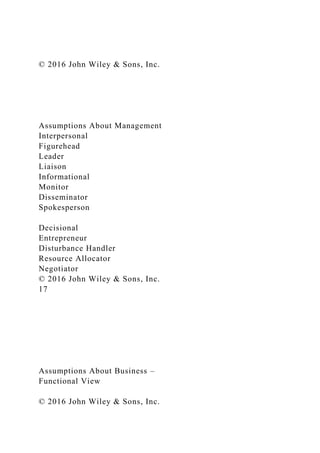
Assumptions About Management
Interpersonal
Figurehead
Leader
Liaison
Informational
Monitor
Disseminator
Spokesperson
Decisional
Entrepreneur
Disturbance Handler
Resource Allocator
Negotiator
© 2016 John Wiley & Sons, Inc.
17
Assumptions About Business –
Functional View
© 2016 John Wiley & Sons, Inc.
18
Process View
© 2016 John Wiley & Sons, Inc.
19
Assumptions about the Nature of Information
Data – simple observations
Information – data + relevance + purpose
Knowledge – information + context + synthesis + reflection
© 2016 John Wiley & Sons, Inc.
20
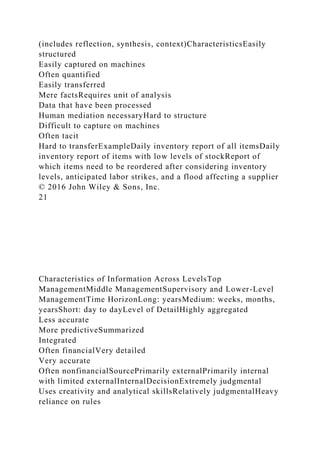
Data, Information, and
KnowledgeDataInformationKnowledgeDefinitionSimple
observations of the state of the worldData endowed with
relevance and purposeInformation from the human mind
(includes reflection, synthesis, context)CharacteristicsEasily
structured
Easily captured on machines
Often quantified
Easily transferred
Mere factsRequires unit of analysis
Data that have been processed
Human mediation necessaryHard to structure
Difficult to capture on machines
Often tacit
Hard to transferExampleDaily inventory report of all itemsDaily
inventory report of items with low levels of stockReport of
which items need to be reordered after considering inventory
levels, anticipated labor strikes, and a flood affecting a supplier
© 2016 John Wiley & Sons, Inc.
21
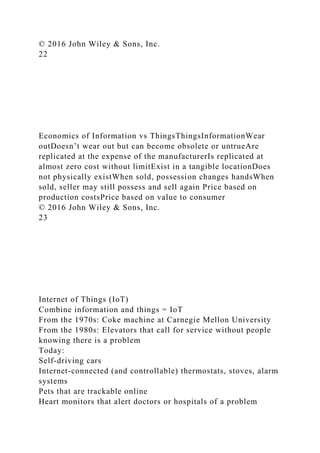
Characteristics of Information Across LevelsTop
ManagementMiddle ManagementSupervisory and Lower-Level
ManagementTime HorizonLong: yearsMedium: weeks, months,
yearsShort: day to dayLevel of DetailHighly aggregated
Less accurate
More predictiveSummarized
Integrated
Often financialVery detailed
Very accurate
Often nonfinancialSourcePrimarily externalPrimarily internal
with limited externalInternalDecisionExtremely judgmental
Uses creativity and analytical skillsRelatively judgmentalHeavy
reliance on rules
© 2016 John Wiley & Sons, Inc.
22
Economics of Information vs ThingsThingsInformationWear
outDoesn’t wear out but can become obsolete or untrueAre
replicated at the expense of the manufacturerIs replicated at
almost zero cost without limitExist in a tangible locationDoes
not physically existWhen sold, possession changes handsWhen
sold, seller may still possess and sell again Price based on
production costsPrice based on value to consumer
© 2016 John Wiley & Sons, Inc.
23
Internet of Things (IoT)
Combine information and things = IoT
From the 1970s: Coke machine at Carnegie Mellon University
From the 1980s: Elevators that call for service without people
knowing there is a problem
Today:
Self-driving cars
Internet-connected (and controllable) thermostats, stoves, alarm
systems
Pets that are trackable online
Heart monitors that alert doctors or hospitals of a problem
Digital video recorders that can be controlled around the world
Quad-copters (drones) that can
Record video marked with location data
Return to the point of origin if it goes out of range of the
“pilot”
Notify regarding its location and avoid objects in a database
© 2016 John Wiley & Sons, Inc.
24
The Term “Information Systems”
Composed of:
Technology
People
Processes
Information Technology vs Information Systems
The term “IT” tends to be more fashionable
But IT actually refers to just the technology
Many people interchange the terms
© 2016 John Wiley & Sons, Inc.
25
Summary
This has been a brief introduction to some of the topics you will
encounter throughout our course.
I anticipate a lively and interesting class!
26
© 2016 John Wiley & Sons, Inc.
Summary
After you have listened to this lecture and read the Introduction
Chapter in your text
Go to Discussion Board 1.2 and answer the discussion prompt
There is no quiz this week.
© 2016 John Wiley & Sons, Inc.
27
Customer Request for the eGrants Project
The state government currently has a variety of grants
management systems across several agencies. The individual
agencies sought an enterprise approach to meet their
requirements that includes a single application for all agency
grant management programs and that meets the legal
requirements of PA Management Directive 107.3. The
Governor’s Office created an inter-agency Grants Management
Advisory Group to re-engineer agency grant management
processes into one streamlined state-wide approach to provide a
single, secure, simplified and paperless process that local
governments, businesses, non-profits and individuals can use to
learn about and apply for grants online.
The new system will include a grants management portal (a web
site) that will serve as an entry point to all grants management
applications and information about grants maintained within
the individual customer state agencies. The system will further
automate much of the traditional manual and time consuming
handling of applications by enabling the SMEs in each agency
to separately apply their own business rules using standardized
templates and scoring mechanisms to evaluate and approve the
automated applications. This system will not include any
federal grant programs or funds. The web site should be user-
friendly and intuitive so citizens can navigate to find what they
are looking for quickly with just a few clicks of the mouse (the
text on the web pages should accommodate the needs of the
visually impaired). A citizen should not have to be an IT expert
to find the information he or she needs.
Then, upon approval of the completed applications made and
recorded in the system, grant funds can be awarded
electronically to a successful applicant, which will shorten the
time an applicant has to wait to learn about his or her
application status and finally receive the grant money. If
possible, this should be done through some kind of secure,
encrypted electronic funds transfer into the applicant’s bank
account within 60 minutes after the grant application is
approved. The evaluation and approval of grant applications
must be able to be audited by state quality inspectors and
federal oversight officials.
Sheet1Project GoalBusiness RequirementUser
RequirementSystem RequirementNon-Functional
RequirementsAttributeDesign & developmentProject
CharterProject ScopeSimple sentences or use cases by
referenceStatus select onePriority
select oneFeature select oneDesign SpecTest
SpecTest Case(s)Test VerifyModify Req.Not
StartedHighAssignIn
ProcessMediumAssignCompletedLowAssignNot
StartedHighAssignNot StartedHighAssignNot
StartedHighAssign
&"Arial,Italic"&14Requirements Traceability FULL Matrix
&P &F
Sheet2
Sheet3

Requirements Workshop Agenda eGrants ProjectDa.docx

  • 1.
    Requirements Workshop Agenda eGrantsProject Date, Time & Location Objective and Scope To … Item Person/Role Minutes 1 2 3 4
  • 2.
    5 6 Adjust your audio Thisis a narrated slide show. Please adjust your audio so you can hear the lecture. If you have problems hearing the narration on any slide show please let me know. Managing and Using Information Systems: A Strategic Approach – Sixth Edition Keri Pearlson, Carol Saunders, and Dennis Galletta
  • 3.
    © Copyright 2016 JohnWiley & Sons, Inc. Introduction Why Should a Manager Study Information Systems? --After all, an entire department is in charge of IT. Nearly all decisions in organizations rely on information systems at some level. Personal devices are ubiquitous. In 2014, 90% of US adults had a cell phone and 87% used the Internet. Personal experience with technology helps but the corporate setting has many different requirements in the areas of: Security, Privacy, Risks Support Architecture Firms use IT to enhance their business models or change entire industries. Managers need to know the basics.
  • 4.
    4 © 2016 JohnWiley & Sons, Inc. 4 Why Should you Participate in IT Decisions in your Firms? IT permeates almost every aspect of business IT enables change in how people work IT is at the heart of Internet-based solutions IT enables or inhibits opportunities/strategies IT combats competitors’ business challenges IT provides customers with a voice IT supports data-driven decision-making IT can help secure key assets © 2016 John Wiley & Sons, Inc. 5 A Business View of Critical Resources Spending is quite high: Worldwide $3.7 trillion in 2014 Expenditures span 5 categories Devices (e.g., PCs, tablets, mobile phones) Data centers (e.g., servers, storage equipment)
  • 5.
    Enterprise (companywide) software ITServices (e.g., support and consulting services) Telecommunications (e.g., voice and data services) If these expenditures do not return value, they will dwindle over time 6 © 2016 John Wiley & Sons, Inc. People and Technology Work Together Some of the most-used sites focus on Web 2.0 In Web 2.0, significant content comes from users Information Sharing User-centered design Interoperability Collaboration Skilled business managers must balance: The benefits of introducing new technology The costs associated with changing the existing behaviors of people in the workplace Does not require deep technical knowledge Requires understanding the consequences of the choices made © 2016 John Wiley & Sons, Inc. 7
  • 6.
    CTO of @WalmartLabs What did Jeremy King say in his blog (pg. 4)? “Every company is a tech company” Do you believe this is true for most firms, or is Wal-Mart somehow different? Why? Can you name firms that do not receive key impacts or benefits from technology? © 2016 John Wiley & Sons, Inc. 8 Quote from Jeremy King: There used to be a big distinction between tech companies: those that develop enterprise technology for businesses, and the global companies that depend on those products. But that distinction is now diminishing for this simple reason: every global company is becoming a tech company…. we’re seeing technology as a critical component for business success 8 Opportunities and New Strategies from IT New business opportunities spring up with little warning Managers must: Frame the opportunities in an understandable way for business leaders Evaluate them against business needs and choices Pursue those that fit into an articulated business strategy. The quality of available information will impact the quality of
  • 7.
    their decisions andtheir implementation Managers will therefore lead the changes driven by information systems © 2016 John Wiley & Sons, Inc. 9 Competitive Challenges Competitors spring up—sometimes unexpectedly General managers are in the best position to See those threats Attempt to combat them, using technology as a tool They need an understanding of The capabilities of the organization How those capabilities, together with IS, can Create competitive advantage Change the competitive landscape for an entire industry © 2016 John Wiley & Sons, Inc. 10 Managers Need to be Aware of the importance of: Customer pull Customers now have power using social media Entire business models sometimes need to be redesigned
  • 8.
    Data-driven decision making Nowavailable: more data than ever before From social media From large data stores in firms Predictive analytics tools can help with analysis of that data Securing key assets A balance is needed Too little security endangers assets of the firm and its customers Too much reduces operational convenience © 2016 John Wiley & Sons, Inc. 11 What Happens if Management Doesn’t Participate? Breakdown in servicing customers Sales decline Damaged reputation Poor spending: Overspending and excess capacity, or Underspending and restricted opportunity Inefficient business processes © 2016 John Wiley & Sons, Inc. 12
  • 9.
    Failing to ConsiderIS Strategy Leads to: IS that fail to support business goals (e.g., Victoria’s Secret site overload) IS that fail to support organizational systems (e.g., workers buying mobile devices but the IT department only supports desktop PCs) Misalignment between business goals and organizational systems © 2016 John Wiley & Sons, Inc. 13 Skills Managers Need for Their IT Decisions Visionary role Creativity Curiosity Confidence Focus on business solutions Flexibility Informational and Interpersonal Communication Listening Information gathering Interpersonal skills Structural Project management Analytical Organizational Planning Leading
  • 10.
    Controlling © 2016 JohnWiley & Sons, Inc. 14 Upcoming Material Information Systems Strategy Triangle: Alignment of IT and the business Links between IS and business strategy Links between IS and organizational strategy Collaboration and individual work Business processes Architecture and infrastructure Participating in decisions about IS security The business of IS Governance of IS resources Sourcing Project and change management Business intelligence Ethical use of information © 2016 John Wiley & Sons, Inc. 15 Assumptions 16
  • 11.
    © 2016 JohnWiley & Sons, Inc. Assumptions About Management Interpersonal Figurehead Leader Liaison Informational Monitor Disseminator Spokesperson Decisional Entrepreneur Disturbance Handler Resource Allocator Negotiator © 2016 John Wiley & Sons, Inc. 17 Assumptions About Business – Functional View © 2016 John Wiley & Sons, Inc.
  • 12.
    18 Process View © 2016John Wiley & Sons, Inc. 19 Assumptions about the Nature of Information Data – simple observations Information – data + relevance + purpose Knowledge – information + context + synthesis + reflection © 2016 John Wiley & Sons, Inc. 20 Data, Information, and KnowledgeDataInformationKnowledgeDefinitionSimple observations of the state of the worldData endowed with relevance and purposeInformation from the human mind
  • 13.
    (includes reflection, synthesis,context)CharacteristicsEasily structured Easily captured on machines Often quantified Easily transferred Mere factsRequires unit of analysis Data that have been processed Human mediation necessaryHard to structure Difficult to capture on machines Often tacit Hard to transferExampleDaily inventory report of all itemsDaily inventory report of items with low levels of stockReport of which items need to be reordered after considering inventory levels, anticipated labor strikes, and a flood affecting a supplier © 2016 John Wiley & Sons, Inc. 21 Characteristics of Information Across LevelsTop ManagementMiddle ManagementSupervisory and Lower-Level ManagementTime HorizonLong: yearsMedium: weeks, months, yearsShort: day to dayLevel of DetailHighly aggregated Less accurate More predictiveSummarized Integrated Often financialVery detailed Very accurate Often nonfinancialSourcePrimarily externalPrimarily internal with limited externalInternalDecisionExtremely judgmental Uses creativity and analytical skillsRelatively judgmentalHeavy reliance on rules
  • 14.
    © 2016 JohnWiley & Sons, Inc. 22 Economics of Information vs ThingsThingsInformationWear outDoesn’t wear out but can become obsolete or untrueAre replicated at the expense of the manufacturerIs replicated at almost zero cost without limitExist in a tangible locationDoes not physically existWhen sold, possession changes handsWhen sold, seller may still possess and sell again Price based on production costsPrice based on value to consumer © 2016 John Wiley & Sons, Inc. 23 Internet of Things (IoT) Combine information and things = IoT From the 1970s: Coke machine at Carnegie Mellon University From the 1980s: Elevators that call for service without people knowing there is a problem Today: Self-driving cars Internet-connected (and controllable) thermostats, stoves, alarm systems Pets that are trackable online Heart monitors that alert doctors or hospitals of a problem
  • 15.
    Digital video recordersthat can be controlled around the world Quad-copters (drones) that can Record video marked with location data Return to the point of origin if it goes out of range of the “pilot” Notify regarding its location and avoid objects in a database © 2016 John Wiley & Sons, Inc. 24 The Term “Information Systems” Composed of: Technology People Processes Information Technology vs Information Systems The term “IT” tends to be more fashionable But IT actually refers to just the technology Many people interchange the terms © 2016 John Wiley & Sons, Inc. 25 Summary This has been a brief introduction to some of the topics you will
  • 16.
    encounter throughout ourcourse. I anticipate a lively and interesting class! 26 © 2016 John Wiley & Sons, Inc. Summary After you have listened to this lecture and read the Introduction Chapter in your text Go to Discussion Board 1.2 and answer the discussion prompt There is no quiz this week. © 2016 John Wiley & Sons, Inc. 27 Customer Request for the eGrants Project The state government currently has a variety of grants management systems across several agencies. The individual agencies sought an enterprise approach to meet their requirements that includes a single application for all agency grant management programs and that meets the legal requirements of PA Management Directive 107.3. The Governor’s Office created an inter-agency Grants Management Advisory Group to re-engineer agency grant management
  • 17.
    processes into onestreamlined state-wide approach to provide a single, secure, simplified and paperless process that local governments, businesses, non-profits and individuals can use to learn about and apply for grants online. The new system will include a grants management portal (a web site) that will serve as an entry point to all grants management applications and information about grants maintained within the individual customer state agencies. The system will further automate much of the traditional manual and time consuming handling of applications by enabling the SMEs in each agency to separately apply their own business rules using standardized templates and scoring mechanisms to evaluate and approve the automated applications. This system will not include any federal grant programs or funds. The web site should be user- friendly and intuitive so citizens can navigate to find what they are looking for quickly with just a few clicks of the mouse (the text on the web pages should accommodate the needs of the visually impaired). A citizen should not have to be an IT expert to find the information he or she needs. Then, upon approval of the completed applications made and recorded in the system, grant funds can be awarded electronically to a successful applicant, which will shorten the time an applicant has to wait to learn about his or her application status and finally receive the grant money. If possible, this should be done through some kind of secure, encrypted electronic funds transfer into the applicant’s bank account within 60 minutes after the grant application is approved. The evaluation and approval of grant applications must be able to be audited by state quality inspectors and federal oversight officials. Sheet1Project GoalBusiness RequirementUser RequirementSystem RequirementNon-Functional RequirementsAttributeDesign & developmentProject CharterProject ScopeSimple sentences or use cases by referenceStatus select onePriority
  • 18.
    select oneFeature selectoneDesign SpecTest SpecTest Case(s)Test VerifyModify Req.Not StartedHighAssignIn ProcessMediumAssignCompletedLowAssignNot StartedHighAssignNot StartedHighAssignNot StartedHighAssign &"Arial,Italic"&14Requirements Traceability FULL Matrix &P &F Sheet2 Sheet3