HVAC Ins. Eg.
HVAC Insulation
Thermal Insulation
• Technical Requirements
• Definitions
• Condensation
• Q/A
HVAC Ins. 01
HVAC Insulation
Thermal
Thermal
Insulation
HVAC Ins. 02
HVAC Insulation
Thermal Insulation, in principal,
is the resistance to reduce the heat transfer in a
considerable amount.
• cold lines prevents heat loss
• heating lines prevents heat gains
HVAC Ins.
→
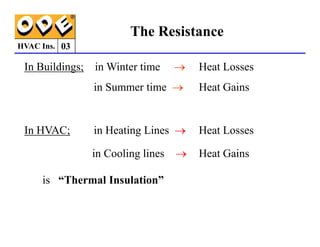
In Buildings; in Winter time →
→ Heat Losses
in Summer time →
→ Heat Gains
The Resistance
03
In HVAC; in Heating Lines → Heat Losses
in Cooling lines → Heat Gains
is “Thermal Insulation”
HVAC Ins.
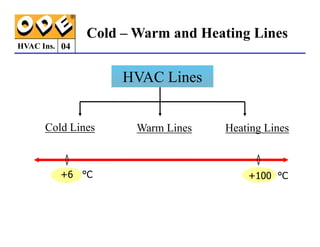
Cold Lines
HVAC Lines
Warm Lines Heating Lines
Cold – Warm and Heating Lines
04
Cold Lines
+6 °C
Warm Lines Heating Lines
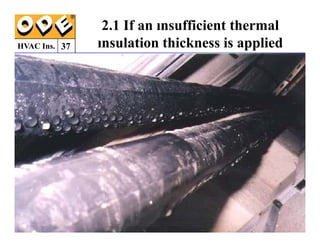
+100 °C
HVAC Ins.
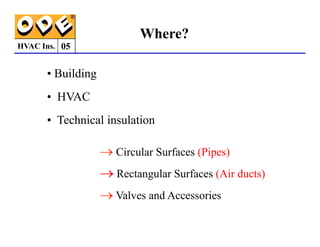
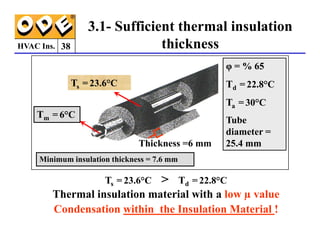
Where?
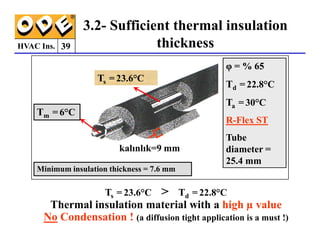
• Building
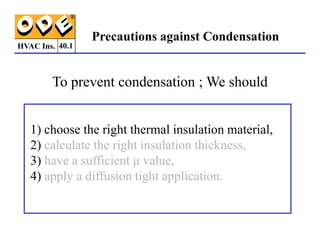
• HVAC
• Technical insulation
05
→ Circular Surfaces (Pipes)
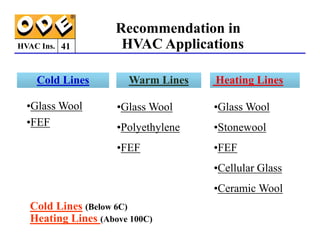
→ Rectangular Surfaces (Air ducts)
→ Valves and Accessories
• Technical insulation
HVAC Ins.
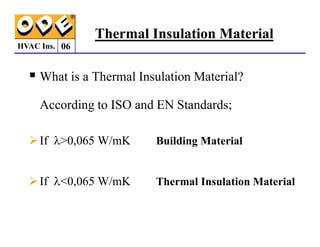
Thermal Insulation Material
06
 What is a Thermal Insulation Material?
According to ISO and EN Standards;
If λ0,065 W/mK Building Material
If λ0,065 W/mK Thermal Insulation Material
HVAC Ins.
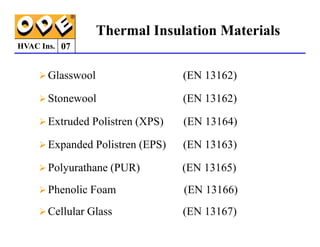
 Glasswool (EN 13162)
 Stonewool (EN 13162)
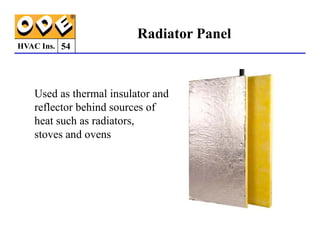
 Extruded Polistren (XPS) (EN 13164)
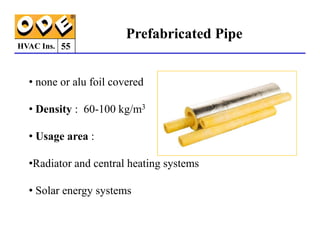
Thermal Insulation Materials
07
 Extruded Polistren (XPS) (EN 13164)
 Expanded Polistren (EPS) (EN 13163)
 Polyurathane (PUR) (EN 13165)
 Phenolic Foam (EN 13166)
 Cellular Glass (EN 13167)
HVAC Ins.
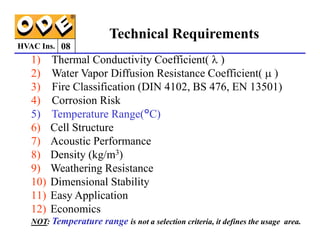
1) Thermal Conductivity Coefficient( λ )
2) Water Vapor Diffusion Resistance Coefficient( µ )
3) Fire Classification (DIN 4102, BS 476, EN 13501)
4) Corrosion Risk
5) Temperature Range(°C)
6) Cell Structure
Technical Requirements
08
6) Cell Structure
7) Acoustic Performance
8) Density (kg/m3)
9) Weathering Resistance
10) Dimensional Stability
11) Easy Application
12) Economics
NOT: Temperature range is not a selection criteria, it defines the usage area.
HVAC Ins.
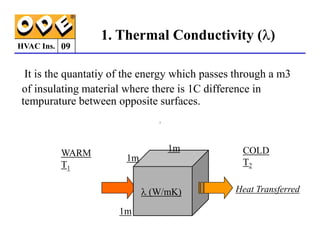
It is the quantatiy of the energy which passes through a m3
of insulating material where there is 1C difference in
tempurature between opposite surfaces.
09
1. Thermal Conductivity (λ
λ
λ
λ)
3
1m
1m
1m
WARM
T1
COLD
T2
λ (W/mK) Heat Transferred
3
HVAC Ins. 10
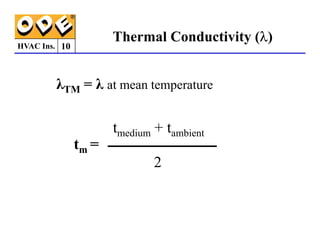
λTM = λ at mean temperature
t + t
Thermal Conductivity (λ
λ
λ
λ)
tm =
tmedium + tambient
2
HVAC Ins. 11
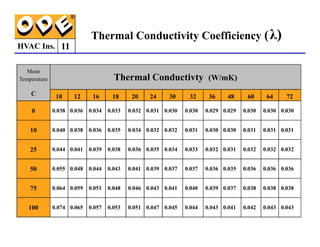
Thermal Conductivity Coefficiency (
Mean
Temperature
C
Thermal Conductivty (W/mK)
10 12 16 18 20 24 30 32 36 48 60 64 72
0 0.038 0.036 0.034 0.033 0.032 0.031 0.030 0.030 0.029 0.029 0.030 0.030 0.030
λ)
10 0.040 0.038 0.036 0.035 0.034 0.032 0.032 0.031 0.030 0.030 0.031 0.031 0.031
25 0.044 0.041 0.039 0.038 0.036 0.035 0.034 0.033 0.032 0.031 0.032 0.032 0.032
50 0.055 0.048 0.044 0.043 0.041 0.039 0.037 0.037 0.036 0.035 0.036 0.036 0.036
75 0.064 0.059 0.051 0.048 0.046 0.043 0.041 0.040 0.039 0.037 0.038 0.038 0.038
100 0.074 0.065 0.057 0.053 0.051 0.047 0.045 0.044 0.043 0.041 0.042 0.043 0.043
HVAC Ins.
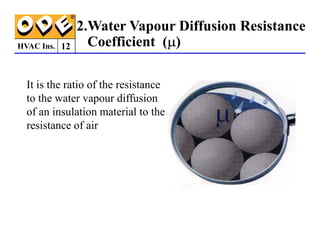
It is the ratio of the resistance
to the water vapour diffusion
of an insulation material to the
resistance of air
12
2.Water Vapour Diffusion Resistance
Coefficient (µ
µ
µ
µ)
resistance of air
HVAC Ins. 13
µ = 1 ( no resistance to diffusion )
µ = ∞
∞
∞
∞ ( no diffusion )
Water Vapour Diffusion Resistance
Coefficient (µ
µ
µ
µ)
µ = 10.000 - 100.000
For e.g ; Aluminium ( µ = ∞ )
Diffusion tight materials
HVAC Ins. 14
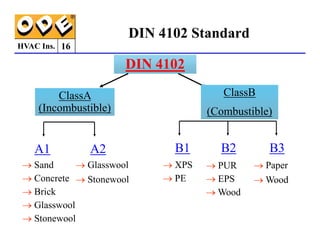
3. Fire Classification
• DIN 4102
• BS 476
• BS 476
• EN 13501
Thermal
A Incombustible materials
A1 That does not contain combustible materials
A2 That contains combustible materials
DIN 4102 Standard
15
A2 That contains combustible materials
B Combustible materials
B1 Hardly combustible materials
B2 Normal combustible materials
B3 Easily combustible materials
HVAC Ins.
DIN 4102
ClassA
(Incombustible)
ClassB
(Combustible)
16
DIN 4102 Standard
A1 A2 B1 B2 B3
→ PUR
→ EPS
→ Wood
→ Paper
→ Wood
→ Sand
→ Concrete
→ Brick
→ Glasswool
→ Stonewool
→ Glasswool
→ Stonewool
→ XPS
→ PE
HVAC Ins.
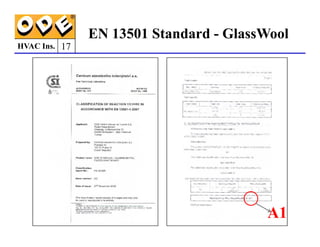
EN 13501 Standard - GlassWool
17
A1
Thermal 18
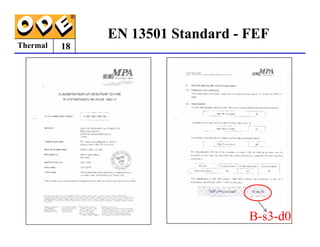
EN 13501 Standard - FEF
B-s3-d0
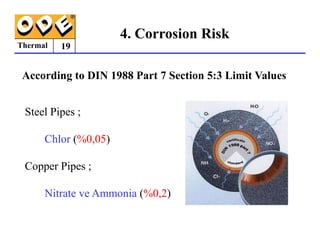
Thermal
Steel Pipes ;
According to DIN 1988 Part 7 Section 5:3 Limit Values
4. Corrosion Risk
19
Chlor (%0,05)
Copper Pipes ;
Nitrate ve Ammonia (%0,2)
HVAC Ins.
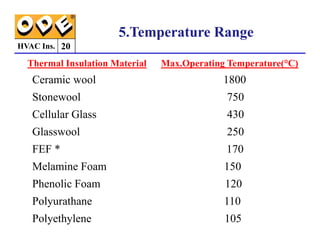
Thermal Insulation Material Max.Operating Temperature(°C)
Ceramic wool 1800
Stonewool 750
Cellular Glass 430
5.Temperature Range
20
Glasswool 250
FEF * 170
Melamine Foam 150
Phenolic Foam 120
Polyurathane 110
Polyethylene 105
HVAC Ins. 21
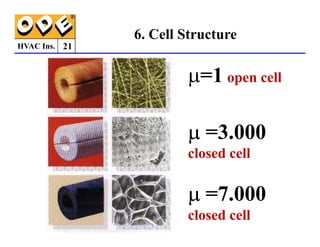
µ=1 open cell
µ
µ
µ
µ =3.000
6. Cell Structure
µ
µ
µ
µ =3.000
closed cell
µ
µ
µ
µ =7.000
closed cell
HVAC Ins.
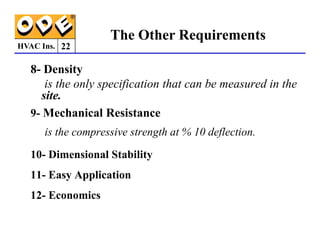
8- Density
is the only specification that can be measured in the
site.
9- Mechanical Resistance
The Other Requirements
22
is the compressive strength at % 10 deflection.
10- Dimensional Stability
11- Easy Application
12- Economics
HVAC Ins.
Which Thermal Insulation Materials are used
Question-1
23
in
HVAC Applications ?
HVAC Ins.
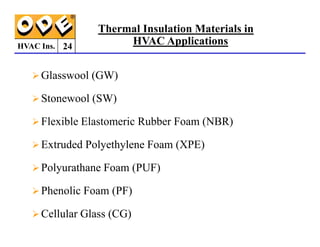
 Glasswool (GW)
 Stonewool (SW)
 Flexible Elastomeric Rubber Foam (NBR)
Thermal Insulation Materials in
HVAC Applications
24
 Flexible Elastomeric Rubber Foam (NBR)
 Extruded Polyethylene Foam (XPE)
 Polyurathane Foam (PUF)
 Phenolic Foam (PF)
 Cellular Glass (CG)
HVAC Ins. 25
Question-2
Which thickness should be used ?
HVAC Ins. 26.1
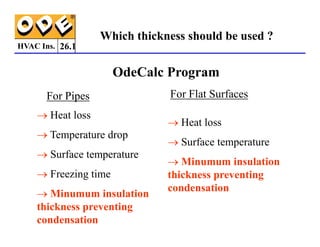
OdeCalc Program
For Pipes For Flat Surfaces
→ Heat loss
→ Heat loss
Which thickness should be used ?
→ Temperature drop
→ Surface temperature
→ Freezing time
→ Minumum insulation
thickness preventing
condensation
→ Heat loss
→ Surface temperature
→ Minumum insulation
thickness preventing
condensation
HVAC Ins. 26.2
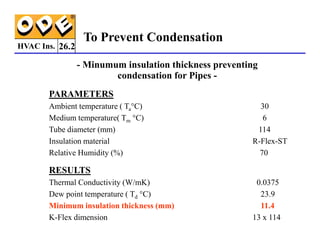
- Minumum insulation thickness preventing
condensation for Pipes -
PARAMETERS
Ambient temperature ( Ta°C) 30
Medium temperature( Tm °C) 6
To Prevent Condensation
m
Tube diameter (mm) 114
Insulation material R-Flex-ST
Relative Humidity (%) 70
RESULTS
Thermal Conductivity (W/mK) 0.0375
Dew point temperature ( Td °C) 23.9
Minimum insulation thickness (mm) 11.4
K-Flex dimension 13 x 114
HVAC Ins.
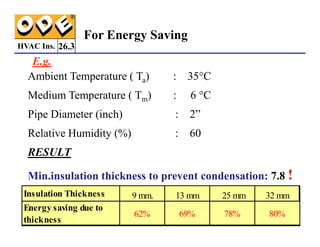
Ambient Temperature ( Ta) : 35°C
Medium Temperature ( Tm) : 6 °C
Pipe Diameter (inch) : 2”
E.g.
26.3
For Energy Saving
Relative Humidity (%) : 60
RESULT
Min.insulation thickness to prevent condensation: 7.8 !
Insulation Thickness 9 mm. 13 mm 25 mm 32 mm
Energy saving due to
thickness
62% 69% 78% 80%
HVAC Ins. 27
Question-3
How is possible to prevent condensation ?
HVAC Ins. 28
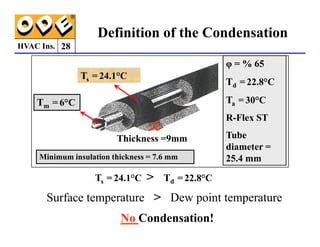
Definition of the Condensation
Tm = 6°C
Ts = 24.1°C
φ = % 65
Td = 22.8°C
Ta = 30°C
R-Flex ST
Surface temperature  Dew point temperature
No Condensation!
Thickness =9mm
Ts = 24.1°C  Td = 22.8°C
Tube
diameter =
25.4 mm
Minimum insulation thickness = 7.6 mm
HVAC Ins. 29
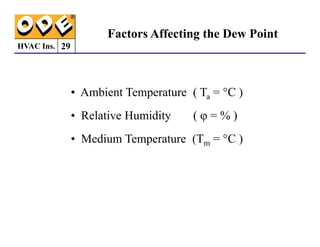
Factors Affecting the Dew Point
• Ambient Temperature ( Ta = °C )
• Relative Humidity ( φ = % )
• Medium Temperature (Tm = °C )
HVAC Ins. 30
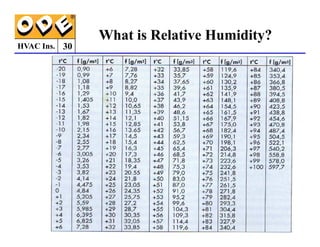
What is Relative Humidity?
HVAC Ins. 31
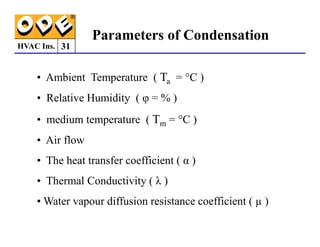
Parameters of Condensation
• Ambient Temperature ( Ta = °C )
• Relative Humidity ( φ = % )
• medium temperature ( Tm = °C )
• Air flow
• The heat transfer coefficient ( α )
• Thermal Conductivity ( λ )
• Water vapour diffusion resistance coefficient ( µ )
HVAC Ins. 32
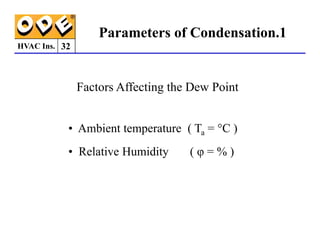
Parameters of Condensation.1
Factors Affecting the Dew Point
• Ambient temperature ( T = °C )
• Ambient temperature ( Ta = °C )
• Relative Humidity ( φ = % )
HVAC Ins. 33
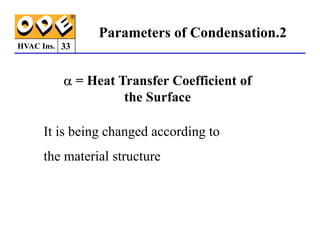
α
α
α
α = Heat Transfer Coefficient of
the Surface
Parameters of Condensation.2
It is being changed according to
the material structure
HVAC Ins.
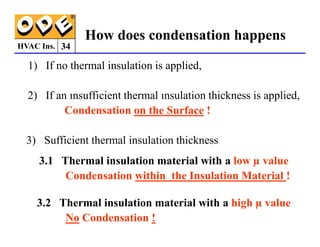
1) If no thermal insulation is applied,
2) If an ınsufficient thermal ınsulation thickness is applied,
Condensation on the Surface !
34
How does condensation happens
3) Sufficient thermal insulation thickness
3.1 Thermal insulation material with a low µ value
Condensation within the Insulation Material !
3.2 Thermal insulation material with a high µ value
No Condensation !
HVAC Ins. 35
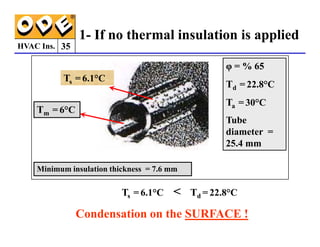
1- If no thermal insulation is applied
Ts = 6.1°C
Tm = 6°C
φ = % 65
Td = 22.8°C
Ta = 30°C
Tube
Ts = 6.1°C  Td = 22.8°C
Condensation on the SURFACE !
Minimum insulation thickness = 7.6 mm
Tube
diameter =
25.4 mm
HVAC Ins. 36
18
Isı Yalıtımı Yapılmazsa
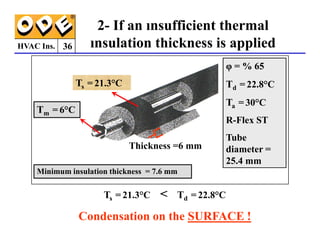
2- If an ınsufficient thermal
ınsulation thickness is applied
Ts = 21.3°C
Tm = 6°C
φ = % 65
Td = 22.8°C
Ta = 30°C
R-Flex ST
Thickness =6 mm
Ts = 21.3°C  Td = 22.8°C
Condensation on the SURFACE !
Minimum insulation thickness = 7.6 mm
R-Flex ST
Tube
diameter =
25.4 mm
HVAC Ins. 37
2.1 If an ınsufficient thermal
ınsulation thickness is applied
HVAC Ins.
Isı Yalıtımı Yapılmazsa
38
Ts = 23.6°C
3.1- Sufficient thermal insulation
thickness
Tm = 6°C
φ = % 65
Td = 22.8°C
Ta = 30°C
Tube
Thickness =6 mm
Ts = 23.6°C  Td = 22.8°C
Thermal insulation material with a low µ value
Condensation within the Insulation Material !
Minimum insulation thickness = 7.6 mm
Tube
diameter =
25.4 mm
HVAC Ins.
Isı Yalıtımı Yapılmazsa
39
Ts = 23.6°C
3.2- Sufficient thermal insulation
thickness
Tm = 6°C
φ = % 65
Td = 22.8°C
Ta = 30°C
R-Flex ST
kalınlık=9 mm
Ts = 23.6°C  Td = 22.8°C
Thermal insulation material with a high µ value
No Condensation ! (a diffusion tight application is a must !)
Minimum insulation thickness = 7.6 mm
R-Flex ST
Tube
diameter =
25.4 mm
HVAC Ins. 40.1
Precautions against Condensation
To prevent condensation ; We should
1) choose the right thermal insulation material,
2) calculate the right insulation thickness,
3) have a sufficient µ value,
4) apply a diffusion tight application.
HVAC Ins.
Precautions against Condensation
To prevent condensation ; We should
1) choose the right thermal insulation material,
40.2
1) choose the right thermal insulation material,
2) calculate the right insulation thickness,
3) have a sufficient µ value,
4) apply a diffusion tight application.
HVAC Ins.
Precautions against Condensation
To prevent condensation ; We should
1) choose the right thermal insulation material,
40.3
1) choose the right thermal insulation material,
2) calculate the right insulation thickness,
3) have a sufficient µ value,
4) apply a diffusion tight application.
HVAC Ins.
Precautions against Condensation
To prevent condensation ; We should
1) choose the right thermal insulation material,
40.4
1) choose the right thermal insulation material,
2) calculate the right insulation thickness,
3) have a sufficient µ value,
4) apply a diffusion tight application.
HVAC Ins.
•Glass Wool
•FEF
Warm Lines Heating Lines
Cold Lines
•Glass Wool
•Polyethylene
•Glass Wool
•Stonewool
Recommendation in
HVAC Applications
41
•FEF •Polyethylene
•FEF
•Stonewool
•FEF
•Cellular Glass
•Ceramic Wool
Cold Lines (Below 6C)
Heating Lines (Above 100C)
HVAC Ins.
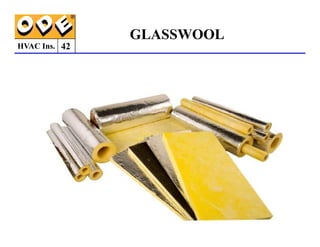
GLASSWOOL
42
HVAC Ins.
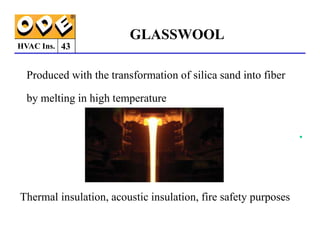
Produced with the transformation of silica sand into fiber
by melting in high temperature
43
GLASSWOOL
•
Thermal insulation, acoustic insulation, fire safety purposes
HVAC Ins.
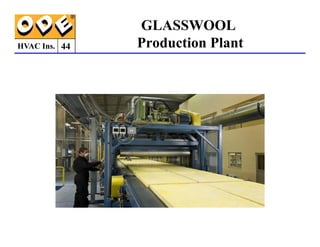
GLASSWOOL
Production Plant
44
HVAC Ins.
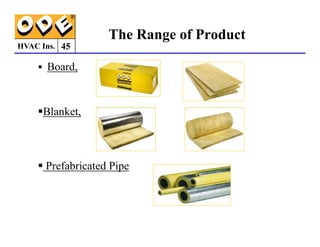
 Board,
Blanket,
The Range of Product
45
 Prefabricated Pipe
HVAC Ins.
The Lamination Types of
Glasswool
46
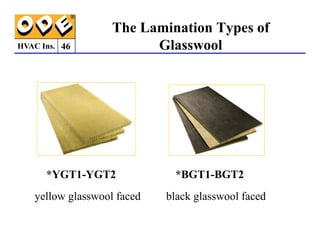
*YGT1-YGT2 *BGT1-BGT2
yellow glasswool faced black glasswool faced
HVAC Ins.
The Lamination Types of
Glasswool
47
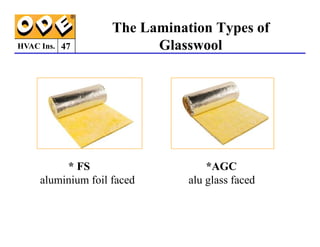
* FS *AGC
aluminium foil faced alu glass faced
HVAC Ins.
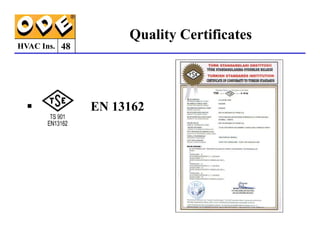
 EN 13162
Quality Certificates
48
HVAC Ins.
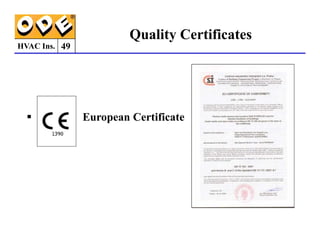
 European Certificate
Quality Certificates
49
HVAC Ins.
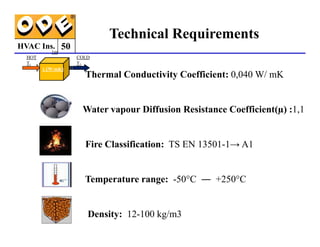
Thermal Conductivity Coefficient: 0,040 W/ mK
Water vapour Diffusion Resistance Coefficient(µ) :1,1
λ
λ
λ
λ (W/mK)
HOT
T1
COLD
T2
1m
Technical Requirements
50
Fire Classification: TS EN 13501-1→ A1
Temperature range: -50°C ― +250°C
Density: 12-100 kg/m3
HVAC Ins.
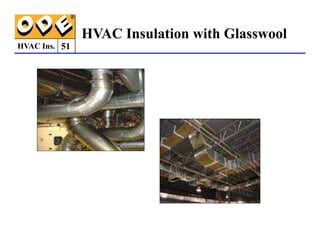
HVAC Insulation with Glasswool
51
HVAC Ins.
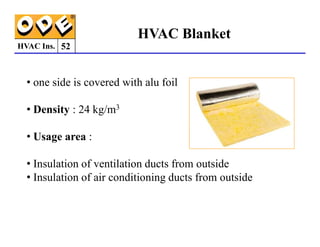
• one side is covered with alu foil
• Density : 24 kg/m3
52
HVAC Blanket
• Usage area :
• Insulation of ventilation ducts from outside
• Insulation of air conditioning ducts from outside
HVAC Ins.
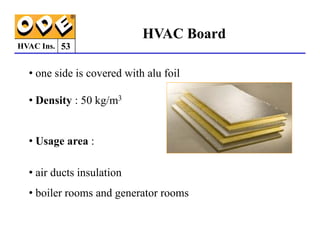
• one side is covered with alu foil
• Density : 50 kg/m3
HVAC Board
53
• Usage area :
• air ducts insulation
• boiler rooms and generator rooms
HVAC Ins.
Used as thermal insulator and
reflector behind sources of
heat such as radiators,
54
Radiator Panel
heat such as radiators,
stoves and ovens
HVAC Ins.
• none or alu foil covered
• Density : 60-100 kg/m3
Prefabricated Pipe
55
• Usage area :
•Radiator and central heating systems
• Solar energy systems
Thermal
FEF- Elastomeric Rubber Foam
56
Thermal
FEF- Product Range
57
HVAC Ins.
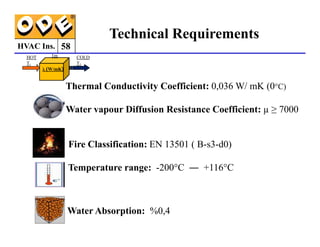
Thermal Conductivity Coefficient: 0,036 W/ mK (0°C)
Water vapour Diffusion Resistance Coefficient: µ ≥ 7000
λ
λ
λ
λ (W/mK)
HOT
T1
COLD
T2
1m
Technical Requirements
58
Fire Classification: EN 13501 ( B-s3-d0)
Temperature range: -200°C ― +116°C
Water Absorption: %0,4
HVAC Ins. 59
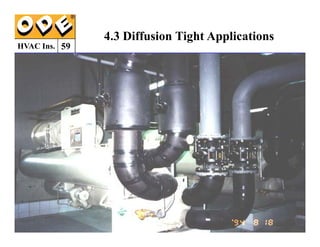
4.3 Diffusion Tight Applications
HVAC Ins. 60
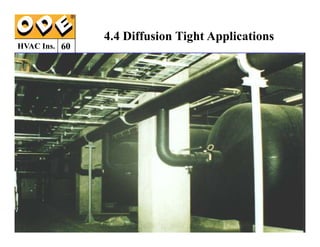
4.4 Diffusion Tight Applications
HVAC Ins.
Valves and Accessories
61
Insulation
HVAC Ins.
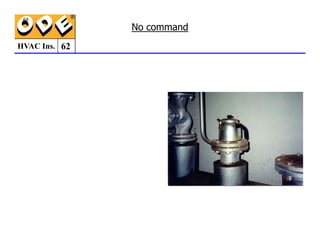
68
No command
62
HVAC Ins.
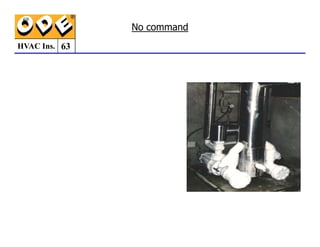
69
No command
63
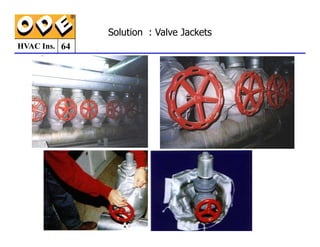
HVAC Ins.
Solution : Valve Jackets
64
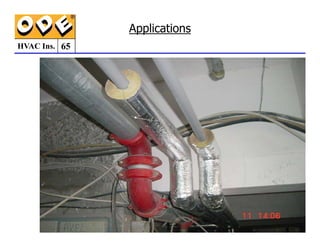
HVAC Ins.
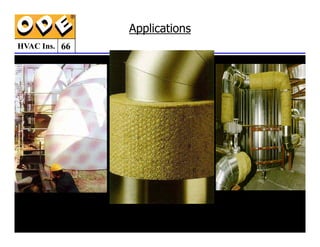
Applications
65
71
HVAC Ins.
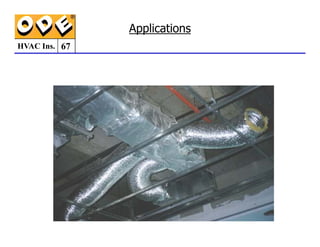
Applications
66
72
HVAC Ins.
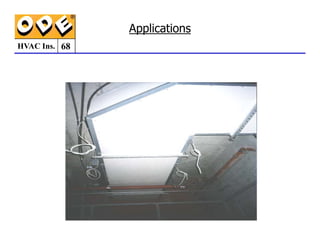
Applications
67
HVAC Ins.
Applications
68
HVAC Ins.
Thanks For
Your Attention!
Your Attention!
Q  A

duct thermal Insulation hvac standard.pdf

  • 1.
    HVAC Ins. Eg. HVACInsulation Thermal Insulation • Technical Requirements • Definitions • Condensation • Q/A
  • 2.
    HVAC Ins. 01 HVACInsulation Thermal Thermal Insulation
  • 3.
    HVAC Ins. 02 HVACInsulation Thermal Insulation, in principal, is the resistance to reduce the heat transfer in a considerable amount. considerable amount. • cold lines prevents heat loss • heating lines prevents heat gains
  • 4.
    HVAC Ins. → In Buildings;in Winter time → → Heat Losses in Summer time → → Heat Gains The Resistance 03 In HVAC; in Heating Lines → Heat Losses in Cooling lines → Heat Gains is “Thermal Insulation”
  • 5.
    HVAC Ins. Cold Lines HVACLines Warm Lines Heating Lines Cold – Warm and Heating Lines 04 Cold Lines +6 °C Warm Lines Heating Lines +100 °C
  • 6.
    HVAC Ins. Where? • Building •HVAC • Technical insulation 05 → Circular Surfaces (Pipes) → Rectangular Surfaces (Air ducts) → Valves and Accessories • Technical insulation
  • 7.
    HVAC Ins. Thermal InsulationMaterial 06 What is a Thermal Insulation Material? According to ISO and EN Standards; If λ0,065 W/mK Building Material If λ0,065 W/mK Thermal Insulation Material
  • 8.
    HVAC Ins. Glasswool(EN 13162) Stonewool (EN 13162) Extruded Polistren (XPS) (EN 13164) Thermal Insulation Materials 07 Extruded Polistren (XPS) (EN 13164) Expanded Polistren (EPS) (EN 13163) Polyurathane (PUR) (EN 13165) Phenolic Foam (EN 13166) Cellular Glass (EN 13167)
  • 9.
    HVAC Ins. 1) ThermalConductivity Coefficient( λ ) 2) Water Vapor Diffusion Resistance Coefficient( µ ) 3) Fire Classification (DIN 4102, BS 476, EN 13501) 4) Corrosion Risk 5) Temperature Range(°C) 6) Cell Structure Technical Requirements 08 6) Cell Structure 7) Acoustic Performance 8) Density (kg/m3) 9) Weathering Resistance 10) Dimensional Stability 11) Easy Application 12) Economics NOT: Temperature range is not a selection criteria, it defines the usage area.
  • 10.
    HVAC Ins. It isthe quantatiy of the energy which passes through a m3 of insulating material where there is 1C difference in tempurature between opposite surfaces. 09 1. Thermal Conductivity (λ λ λ λ) 3 1m 1m 1m WARM T1 COLD T2 λ (W/mK) Heat Transferred 3
  • 11.
    HVAC Ins. 10 λTM= λ at mean temperature t + t Thermal Conductivity (λ λ λ λ) tm = tmedium + tambient 2
  • 12.
    HVAC Ins. 11 ThermalConductivity Coefficiency ( Mean Temperature C Thermal Conductivty (W/mK) 10 12 16 18 20 24 30 32 36 48 60 64 72 0 0.038 0.036 0.034 0.033 0.032 0.031 0.030 0.030 0.029 0.029 0.030 0.030 0.030 λ) 10 0.040 0.038 0.036 0.035 0.034 0.032 0.032 0.031 0.030 0.030 0.031 0.031 0.031 25 0.044 0.041 0.039 0.038 0.036 0.035 0.034 0.033 0.032 0.031 0.032 0.032 0.032 50 0.055 0.048 0.044 0.043 0.041 0.039 0.037 0.037 0.036 0.035 0.036 0.036 0.036 75 0.064 0.059 0.051 0.048 0.046 0.043 0.041 0.040 0.039 0.037 0.038 0.038 0.038 100 0.074 0.065 0.057 0.053 0.051 0.047 0.045 0.044 0.043 0.041 0.042 0.043 0.043
  • 13.
    HVAC Ins. It isthe ratio of the resistance to the water vapour diffusion of an insulation material to the resistance of air 12 2.Water Vapour Diffusion Resistance Coefficient (µ µ µ µ) resistance of air
  • 14.
    HVAC Ins. 13 µ= 1 ( no resistance to diffusion ) µ = ∞ ∞ ∞ ∞ ( no diffusion ) Water Vapour Diffusion Resistance Coefficient (µ µ µ µ) µ = 10.000 - 100.000 For e.g ; Aluminium ( µ = ∞ ) Diffusion tight materials
  • 15.
    HVAC Ins. 14 3.Fire Classification • DIN 4102 • BS 476 • BS 476 • EN 13501
  • 16.
    Thermal A Incombustible materials A1That does not contain combustible materials A2 That contains combustible materials DIN 4102 Standard 15 A2 That contains combustible materials B Combustible materials B1 Hardly combustible materials B2 Normal combustible materials B3 Easily combustible materials
  • 17.
    HVAC Ins. DIN 4102 ClassA (Incombustible) ClassB (Combustible) 16 DIN4102 Standard A1 A2 B1 B2 B3 → PUR → EPS → Wood → Paper → Wood → Sand → Concrete → Brick → Glasswool → Stonewool → Glasswool → Stonewool → XPS → PE
  • 18.
    HVAC Ins. EN 13501Standard - GlassWool 17 A1
  • 19.
    Thermal 18 EN 13501Standard - FEF B-s3-d0
  • 20.
    Thermal Steel Pipes ; Accordingto DIN 1988 Part 7 Section 5:3 Limit Values 4. Corrosion Risk 19 Chlor (%0,05) Copper Pipes ; Nitrate ve Ammonia (%0,2)
  • 21.
    HVAC Ins. Thermal InsulationMaterial Max.Operating Temperature(°C) Ceramic wool 1800 Stonewool 750 Cellular Glass 430 5.Temperature Range 20 Glasswool 250 FEF * 170 Melamine Foam 150 Phenolic Foam 120 Polyurathane 110 Polyethylene 105
  • 22.
    HVAC Ins. 21 µ=1open cell µ µ µ µ =3.000 6. Cell Structure µ µ µ µ =3.000 closed cell µ µ µ µ =7.000 closed cell
  • 23.
    HVAC Ins. 8- Density isthe only specification that can be measured in the site. 9- Mechanical Resistance The Other Requirements 22 is the compressive strength at % 10 deflection. 10- Dimensional Stability 11- Easy Application 12- Economics
  • 24.
    HVAC Ins. Which ThermalInsulation Materials are used Question-1 23 in HVAC Applications ?
  • 25.
    HVAC Ins. Glasswool(GW) Stonewool (SW) Flexible Elastomeric Rubber Foam (NBR) Thermal Insulation Materials in HVAC Applications 24 Flexible Elastomeric Rubber Foam (NBR) Extruded Polyethylene Foam (XPE) Polyurathane Foam (PUF) Phenolic Foam (PF) Cellular Glass (CG)
  • 26.
    HVAC Ins. 25 Question-2 Whichthickness should be used ? Which thickness should be used ?
  • 27.
    HVAC Ins. 26.1 OdeCalcProgram For Pipes For Flat Surfaces → Heat loss → Heat loss Which thickness should be used ? → Temperature drop → Surface temperature → Freezing time → Minumum insulation thickness preventing condensation → Heat loss → Surface temperature → Minumum insulation thickness preventing condensation
  • 28.
    HVAC Ins. 26.2 -Minumum insulation thickness preventing condensation for Pipes - PARAMETERS Ambient temperature ( Ta°C) 30 Medium temperature( Tm °C) 6 To Prevent Condensation m Tube diameter (mm) 114 Insulation material R-Flex-ST Relative Humidity (%) 70 RESULTS Thermal Conductivity (W/mK) 0.0375 Dew point temperature ( Td °C) 23.9 Minimum insulation thickness (mm) 11.4 K-Flex dimension 13 x 114
  • 29.
    HVAC Ins. Ambient Temperature( Ta) : 35°C Medium Temperature ( Tm) : 6 °C Pipe Diameter (inch) : 2” E.g. 26.3 For Energy Saving Relative Humidity (%) : 60 RESULT Min.insulation thickness to prevent condensation: 7.8 ! Insulation Thickness 9 mm. 13 mm 25 mm 32 mm Energy saving due to thickness 62% 69% 78% 80%
  • 30.
    HVAC Ins. 27 Question-3 Howis possible to prevent condensation ? How is possible to prevent condensation ?
  • 31.
    HVAC Ins. 28 Definitionof the Condensation Tm = 6°C Ts = 24.1°C φ = % 65 Td = 22.8°C Ta = 30°C R-Flex ST Surface temperature Dew point temperature No Condensation! Thickness =9mm Ts = 24.1°C Td = 22.8°C Tube diameter = 25.4 mm Minimum insulation thickness = 7.6 mm
  • 32.
    HVAC Ins. 29 FactorsAffecting the Dew Point • Ambient Temperature ( Ta = °C ) • Relative Humidity ( φ = % ) • Medium Temperature (Tm = °C )
  • 33.
    HVAC Ins. 30 Whatis Relative Humidity?
  • 34.
    HVAC Ins. 31 Parametersof Condensation • Ambient Temperature ( Ta = °C ) • Relative Humidity ( φ = % ) • medium temperature ( Tm = °C ) • medium temperature ( Tm = °C ) • Air flow • The heat transfer coefficient ( α ) • Thermal Conductivity ( λ ) • Water vapour diffusion resistance coefficient ( µ )
  • 35.
    HVAC Ins. 32 Parametersof Condensation.1 Factors Affecting the Dew Point • Ambient temperature ( T = °C ) • Ambient temperature ( Ta = °C ) • Relative Humidity ( φ = % )
  • 36.
    HVAC Ins. 33 α α α α= Heat Transfer Coefficient of the Surface Parameters of Condensation.2 It is being changed according to the material structure
  • 37.
    HVAC Ins. 1) Ifno thermal insulation is applied, 2) If an ınsufficient thermal ınsulation thickness is applied, Condensation on the Surface ! 34 How does condensation happens 3) Sufficient thermal insulation thickness 3.1 Thermal insulation material with a low µ value Condensation within the Insulation Material ! 3.2 Thermal insulation material with a high µ value No Condensation !
  • 38.
    HVAC Ins. 35 1-If no thermal insulation is applied Ts = 6.1°C Tm = 6°C φ = % 65 Td = 22.8°C Ta = 30°C Tube Ts = 6.1°C Td = 22.8°C Condensation on the SURFACE ! Minimum insulation thickness = 7.6 mm Tube diameter = 25.4 mm
  • 39.
    HVAC Ins. 36 18 IsıYalıtımı Yapılmazsa 2- If an ınsufficient thermal ınsulation thickness is applied Ts = 21.3°C Tm = 6°C φ = % 65 Td = 22.8°C Ta = 30°C R-Flex ST Thickness =6 mm Ts = 21.3°C Td = 22.8°C Condensation on the SURFACE ! Minimum insulation thickness = 7.6 mm R-Flex ST Tube diameter = 25.4 mm
  • 40.
    HVAC Ins. 37 2.1If an ınsufficient thermal ınsulation thickness is applied
  • 41.
    HVAC Ins. Isı YalıtımıYapılmazsa 38 Ts = 23.6°C 3.1- Sufficient thermal insulation thickness Tm = 6°C φ = % 65 Td = 22.8°C Ta = 30°C Tube Thickness =6 mm Ts = 23.6°C Td = 22.8°C Thermal insulation material with a low µ value Condensation within the Insulation Material ! Minimum insulation thickness = 7.6 mm Tube diameter = 25.4 mm
  • 42.
    HVAC Ins. Isı YalıtımıYapılmazsa 39 Ts = 23.6°C 3.2- Sufficient thermal insulation thickness Tm = 6°C φ = % 65 Td = 22.8°C Ta = 30°C R-Flex ST kalınlık=9 mm Ts = 23.6°C Td = 22.8°C Thermal insulation material with a high µ value No Condensation ! (a diffusion tight application is a must !) Minimum insulation thickness = 7.6 mm R-Flex ST Tube diameter = 25.4 mm
  • 43.
    HVAC Ins. 40.1 Precautionsagainst Condensation To prevent condensation ; We should 1) choose the right thermal insulation material, 1) choose the right thermal insulation material, 2) calculate the right insulation thickness, 3) have a sufficient µ value, 4) apply a diffusion tight application.
  • 44.
    HVAC Ins. Precautions againstCondensation To prevent condensation ; We should 1) choose the right thermal insulation material, 40.2 1) choose the right thermal insulation material, 2) calculate the right insulation thickness, 3) have a sufficient µ value, 4) apply a diffusion tight application.
  • 45.
    HVAC Ins. Precautions againstCondensation To prevent condensation ; We should 1) choose the right thermal insulation material, 40.3 1) choose the right thermal insulation material, 2) calculate the right insulation thickness, 3) have a sufficient µ value, 4) apply a diffusion tight application.
  • 46.
    HVAC Ins. Precautions againstCondensation To prevent condensation ; We should 1) choose the right thermal insulation material, 40.4 1) choose the right thermal insulation material, 2) calculate the right insulation thickness, 3) have a sufficient µ value, 4) apply a diffusion tight application.
  • 47.
    HVAC Ins. •Glass Wool •FEF WarmLines Heating Lines Cold Lines •Glass Wool •Polyethylene •Glass Wool •Stonewool Recommendation in HVAC Applications 41 •FEF •Polyethylene •FEF •Stonewool •FEF •Cellular Glass •Ceramic Wool Cold Lines (Below 6C) Heating Lines (Above 100C)
  • 48.
  • 49.
    HVAC Ins. Produced withthe transformation of silica sand into fiber by melting in high temperature 43 GLASSWOOL • Thermal insulation, acoustic insulation, fire safety purposes
  • 50.
  • 51.
    HVAC Ins. Board, Blanket, TheRange of Product 45 Prefabricated Pipe
  • 52.
    HVAC Ins. The LaminationTypes of Glasswool 46 *YGT1-YGT2 *BGT1-BGT2 yellow glasswool faced black glasswool faced
  • 53.
    HVAC Ins. The LaminationTypes of Glasswool 47 * FS *AGC aluminium foil faced alu glass faced
  • 54.
    HVAC Ins. EN13162 Quality Certificates 48
  • 55.
    HVAC Ins. EuropeanCertificate Quality Certificates 49
  • 56.
    HVAC Ins. Thermal ConductivityCoefficient: 0,040 W/ mK Water vapour Diffusion Resistance Coefficient(µ) :1,1 λ λ λ λ (W/mK) HOT T1 COLD T2 1m Technical Requirements 50 Fire Classification: TS EN 13501-1→ A1 Temperature range: -50°C ― +250°C Density: 12-100 kg/m3
  • 57.
    HVAC Ins. HVAC Insulationwith Glasswool 51
  • 58.
    HVAC Ins. • oneside is covered with alu foil • Density : 24 kg/m3 52 HVAC Blanket • Usage area : • Insulation of ventilation ducts from outside • Insulation of air conditioning ducts from outside
  • 59.
    HVAC Ins. • oneside is covered with alu foil • Density : 50 kg/m3 HVAC Board 53 • Usage area : • air ducts insulation • boiler rooms and generator rooms
  • 60.
    HVAC Ins. Used asthermal insulator and reflector behind sources of heat such as radiators, 54 Radiator Panel heat such as radiators, stoves and ovens
  • 61.
    HVAC Ins. • noneor alu foil covered • Density : 60-100 kg/m3 Prefabricated Pipe 55 • Usage area : •Radiator and central heating systems • Solar energy systems
  • 62.
  • 63.
  • 64.
    HVAC Ins. Thermal ConductivityCoefficient: 0,036 W/ mK (0°C) Water vapour Diffusion Resistance Coefficient: µ ≥ 7000 λ λ λ λ (W/mK) HOT T1 COLD T2 1m Technical Requirements 58 Fire Classification: EN 13501 ( B-s3-d0) Temperature range: -200°C ― +116°C Water Absorption: %0,4
  • 65.
    HVAC Ins. 59 4.3Diffusion Tight Applications
  • 66.
    HVAC Ins. 60 4.4Diffusion Tight Applications
  • 67.
    HVAC Ins. Valves andAccessories 61 Insulation
  • 68.
  • 69.
  • 70.
    HVAC Ins. Solution :Valve Jackets 64
  • 71.
  • 72.
  • 73.
  • 74.
  • 75.
    HVAC Ins. Thanks For YourAttention! Your Attention! Q A