TheLocalMedia&AdvertisingExperts
Pricing Native Advertising
Rick Ducey
Managing Director
BIA/Kelsey
2
© 2014 BIA/Kelsey. All Rights Reserved.
Topics
 Native ad ecosystem
 Forecast and drivers
 Does native advertising work?
 Pricing metrics and strategies
 Case study
 Recommendations
3
© 2014 BIA/Kelsey. All Rights Reserved.
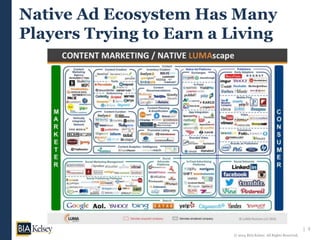
Native Ad Ecosystem Has Many
Players Trying to Earn a Living
4
© 2014 BIA/Kelsey. All Rights Reserved.
Where Do Native Ads Occur?
Social networks. Facebook’s News Feed ads, YouTube’s
Promoted Videos and Twitter’s Promoted Tweets are among the
most popular formats, but others such as Pinterest, LinkedIn,
Google+ and StumbleUpon are ramping up in this area.
Mobile. A key driver behind the success of native advertising has
been the growth of mobile usage on platforms such as Facebook,
Twitter and Pandora.
Digital media. Native implementations include BuzzFeed lists,
sponsored articles on Mashable and The Huffington Post, videos
on CollegeHumor and real estate listings on Trulia.com.
Traditional media. Publishers with active native ad programs
include The New York Times, The Atlantic, Hearst, The Guardian
and Vanity Fair.
5
© 2014 BIA/Kelsey. All Rights Reserved.
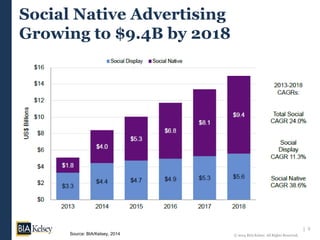
Social Native Advertising
Growing to $9.4B by 2018
Source: BIA/Kelsey, 2014
6
© 2014 BIA/Kelsey. All Rights Reserved.
7
© 2014 BIA/Kelsey. All Rights Reserved.
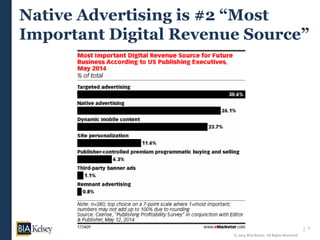
Native Advertising is #2 “Most
Important Digital Revenue Source”
8
© 2014 BIA/Kelsey. All Rights Reserved.
9
© 2014 BIA/Kelsey. All Rights Reserved.
10
© 2014 BIA/Kelsey. All Rights Reserved.
11
© 2014 BIA/Kelsey. All Rights Reserved.© 2014 BIA/Kelsey. All Rights Reserved.
So

Does native advertising work?
11.
12
© 2014 BIA/Kelsey. All Rights Reserved.
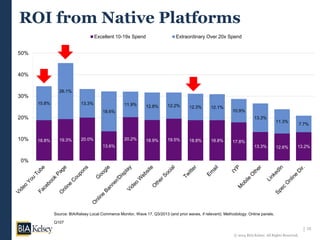
Source: BIA/Kelsey Local Commerce Monitor, Wave 17, Q3/2013 (and prior waves, if relevant). Methodology: Online panels.
ROI Assessment of Media Used For Advertising
(1 of 2)
18.8% 19.3% 20.0%
13.6%
20.2% 18.9% 19.5% 18.8% 18.8% 17.8%
13.3% 12.6% 13.2%
15.8%
26.1%
13.3%
18.6%
11.9% 12.8% 12.2% 12.3% 12.1%
10.9%
13.3%
11.3%
7.7%
0%
10%
20%
30%
40%
50%
Excellent 10-19x Spend Extraordinary Over 20x Spend
Q107
ROI from Native Platforms
13
© 2014 BIA/Kelsey. All Rights Reserved.© 2014 BIA/Kelsey. All Rights Reserved.
13
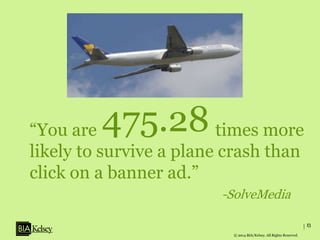
“You are times more
likely to survive a plane crash than
click on a banner ad.”
-SolveMedia
475.28
14
© 2014 BIA/Kelsey. All Rights Reserved.© 2014 BIA/Kelsey. All Rights Reserved.
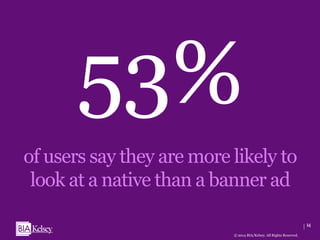
53%
of users say they are more likely to
look at a native than a banner ad
14
15
© 2014 BIA/Kelsey. All Rights Reserved.© 2014 BIA/Kelsey. All Rights Reserved.
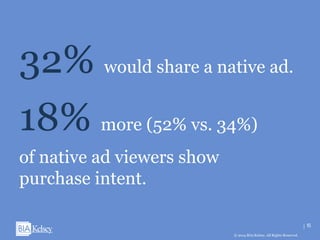
32% would share a native ad.
18% more (52% vs. 34%)
of native ad viewers show
purchase intent.
15
16
© 2014 BIA/Kelsey. All Rights Reserved.
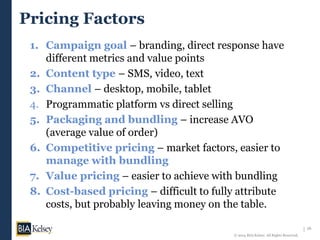
Pricing Factors
1. Campaign goal – branding, direct response have
different metrics and value points
2. Content type – SMS, video, text
3. Channel – desktop, mobile, tablet
4. Programmatic platform vs direct selling
5. Packaging and bundling – increase AVO
(average value of order)
6. Competitive pricing – market factors, easier to
manage with bundling
7. Value pricing – easier to achieve with bundling
8. Cost-based pricing – difficult to fully attribute
costs, but probably leaving money on the table.
17
© 2014 BIA/Kelsey. All Rights Reserved.
Pricing Metrics and Strategies
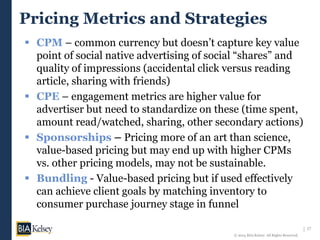
 CPM – common currency but doesn’t capture key value
point of social native advertising of social “shares” and
quality of impressions (accidental click versus reading
article, sharing with friends)
 CPE – engagement metrics are higher value for
advertiser but need to standardize on these (time spent,
amount read/watched, sharing, other secondary actions)
 Sponsorships – Pricing more of an art than science,
value-based pricing but may end up with higher CPMs
vs. other pricing models, may not be sustainable.
 Bundling - Value-based pricing but if used effectively
can achieve client goals by matching inventory to
consumer purchase journey stage in funnel
18
© 2014 BIA/Kelsey. All Rights Reserved.
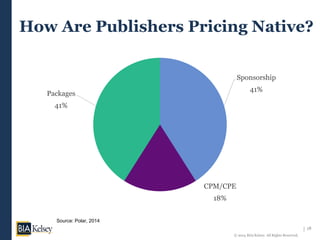
How Are Publishers Pricing Native?
Sponsorship
41%
CPM/CPE
18%
Packages
41%
Source: Polar, 2014
19
© 2014 BIA/Kelsey. All Rights Reserved.© 2014 BIA/Kelsey. All Rights Reserved.
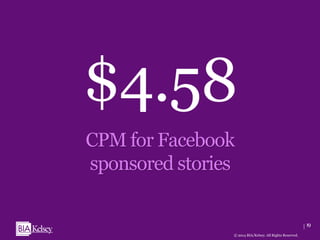
$4.58
CPM for Facebook
sponsored stories
19
20
© 2014 BIA/Kelsey. All Rights Reserved.© 2014 BIA/Kelsey. All Rights Reserved.
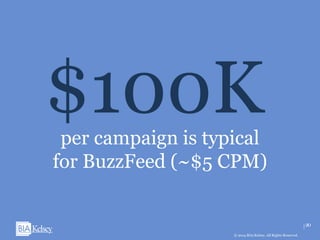
per campaign is typical
for BuzzFeed (~$5 CPM)
20
$100K
21
© 2014 BIA/Kelsey. All Rights Reserved.
Case Study: Houston Chronicle
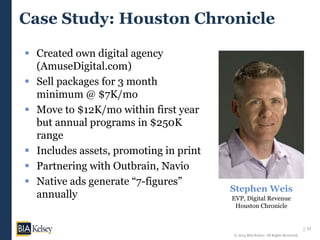
 Created own digital agency
(AmuseDigital.com)
 Sell packages for 3 month
minimum @ $7K/mo
 Move to $12K/mo within first year
but annual programs in $250K
range
 Includes assets, promoting in print
 Partnering with Outbrain, Navio
 Native ads generate “7-figures”
annually
Stephen Weis
EVP, Digital Revenue
Houston Chronicle
22
© 2014 BIA/Kelsey. All Rights Reserved.
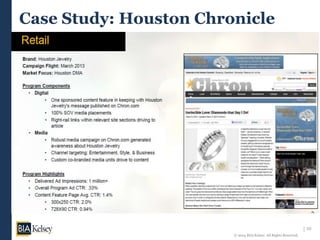
Case Study: Houston Chronicle
23
© 2014 BIA/Kelsey. All Rights Reserved.
Recommendations
1. Go for Life Time Value (LTV) with clients by bundling
inventory to match their campaign goals to
 Your inventory and its capabilities
 Creative execution related to stage (e.g, branding vs direct
response)
 Long term contracts with committed clients
 Appropriate calls to action for low funnel native ads
 Appropriate metrics to funnel stage
2. Appropriate pricing metrics for stage in funnel
 CPM more for branding
 CPE for lower funnel ads
 Sponsorships for higher funnel
3. Check back with the client – is it working?
 A/B testing
 Fine tune the campaign
TheLocalMedia&AdvertisingExperts
Questions & Comments:
Rick Ducey
Managing Director
rducey@biakelsey.com
(703) 818-2425
© 2014 BIA/Kelsey. All Rights Reserved.
This published material is for internal client use only. It may not be duplicated or distributed in any manner not permitted by contract. Any unauthorized distribution could result
in termination of the client relationship, fines and other civil or criminal penalties under federal law. BIA/Kelsey disclaims all warranties regarding the accuracy of the
information herein and similarly disclaims any liability for direct, indirect or consequential damages that may result from the use or interpretation of this information.

Pricing Native Advertising - BIA/Kelsey Presentation to LMA Native Advertising Summit

  • 1.
  • 2.
    2 © 2014 BIA/Kelsey.All Rights Reserved. Topics  Native ad ecosystem  Forecast and drivers  Does native advertising work?  Pricing metrics and strategies  Case study  Recommendations
  • 3.
    3 © 2014 BIA/Kelsey.All Rights Reserved. Native Ad Ecosystem Has Many Players Trying to Earn a Living
  • 4.
    4 © 2014 BIA/Kelsey.All Rights Reserved. Where Do Native Ads Occur? Social networks. Facebook’s News Feed ads, YouTube’s Promoted Videos and Twitter’s Promoted Tweets are among the most popular formats, but others such as Pinterest, LinkedIn, Google+ and StumbleUpon are ramping up in this area. Mobile. A key driver behind the success of native advertising has been the growth of mobile usage on platforms such as Facebook, Twitter and Pandora. Digital media. Native implementations include BuzzFeed lists, sponsored articles on Mashable and The Huffington Post, videos on CollegeHumor and real estate listings on Trulia.com. Traditional media. Publishers with active native ad programs include The New York Times, The Atlantic, Hearst, The Guardian and Vanity Fair.
  • 5.
    5 © 2014 BIA/Kelsey.All Rights Reserved. Social Native Advertising Growing to $9.4B by 2018 Source: BIA/Kelsey, 2014
  • 6.
    6 © 2014 BIA/Kelsey.All Rights Reserved.
  • 7.
    7 © 2014 BIA/Kelsey.All Rights Reserved. Native Advertising is #2 “Most Important Digital Revenue Source”
  • 8.
    8 © 2014 BIA/Kelsey.All Rights Reserved.
  • 9.
    9 © 2014 BIA/Kelsey.All Rights Reserved.
  • 10.
    10 © 2014 BIA/Kelsey.All Rights Reserved.
  • 11.
    11 © 2014 BIA/Kelsey.All Rights Reserved.© 2014 BIA/Kelsey. All Rights Reserved. So
 Does native advertising work? 11.
  • 12.
    12 © 2014 BIA/Kelsey.All Rights Reserved. Source: BIA/Kelsey Local Commerce Monitor, Wave 17, Q3/2013 (and prior waves, if relevant). Methodology: Online panels. ROI Assessment of Media Used For Advertising (1 of 2) 18.8% 19.3% 20.0% 13.6% 20.2% 18.9% 19.5% 18.8% 18.8% 17.8% 13.3% 12.6% 13.2% 15.8% 26.1% 13.3% 18.6% 11.9% 12.8% 12.2% 12.3% 12.1% 10.9% 13.3% 11.3% 7.7% 0% 10% 20% 30% 40% 50% Excellent 10-19x Spend Extraordinary Over 20x Spend Q107 ROI from Native Platforms
  • 13.
    13 © 2014 BIA/Kelsey.All Rights Reserved.© 2014 BIA/Kelsey. All Rights Reserved. 13 “You are times more likely to survive a plane crash than click on a banner ad.” -SolveMedia 475.28
  • 14.
    14 © 2014 BIA/Kelsey.All Rights Reserved.© 2014 BIA/Kelsey. All Rights Reserved. 53% of users say they are more likely to look at a native than a banner ad 14
  • 15.
    15 © 2014 BIA/Kelsey.All Rights Reserved.© 2014 BIA/Kelsey. All Rights Reserved. 32% would share a native ad. 18% more (52% vs. 34%) of native ad viewers show purchase intent. 15
  • 16.
    16 © 2014 BIA/Kelsey.All Rights Reserved. Pricing Factors 1. Campaign goal – branding, direct response have different metrics and value points 2. Content type – SMS, video, text 3. Channel – desktop, mobile, tablet 4. Programmatic platform vs direct selling 5. Packaging and bundling – increase AVO (average value of order) 6. Competitive pricing – market factors, easier to manage with bundling 7. Value pricing – easier to achieve with bundling 8. Cost-based pricing – difficult to fully attribute costs, but probably leaving money on the table.
  • 17.
    17 © 2014 BIA/Kelsey.All Rights Reserved. Pricing Metrics and Strategies  CPM – common currency but doesn’t capture key value point of social native advertising of social “shares” and quality of impressions (accidental click versus reading article, sharing with friends)  CPE – engagement metrics are higher value for advertiser but need to standardize on these (time spent, amount read/watched, sharing, other secondary actions)  Sponsorships – Pricing more of an art than science, value-based pricing but may end up with higher CPMs vs. other pricing models, may not be sustainable.  Bundling - Value-based pricing but if used effectively can achieve client goals by matching inventory to consumer purchase journey stage in funnel
  • 18.
    18 © 2014 BIA/Kelsey.All Rights Reserved. How Are Publishers Pricing Native? Sponsorship 41% CPM/CPE 18% Packages 41% Source: Polar, 2014
  • 19.
    19 © 2014 BIA/Kelsey.All Rights Reserved.© 2014 BIA/Kelsey. All Rights Reserved. $4.58 CPM for Facebook sponsored stories 19
  • 20.
    20 © 2014 BIA/Kelsey.All Rights Reserved.© 2014 BIA/Kelsey. All Rights Reserved. per campaign is typical for BuzzFeed (~$5 CPM) 20 $100K
  • 21.
    21 © 2014 BIA/Kelsey.All Rights Reserved. Case Study: Houston Chronicle  Created own digital agency (AmuseDigital.com)  Sell packages for 3 month minimum @ $7K/mo  Move to $12K/mo within first year but annual programs in $250K range  Includes assets, promoting in print  Partnering with Outbrain, Navio  Native ads generate “7-figures” annually Stephen Weis EVP, Digital Revenue Houston Chronicle
  • 22.
    22 © 2014 BIA/Kelsey.All Rights Reserved. Case Study: Houston Chronicle
  • 23.
    23 © 2014 BIA/Kelsey.All Rights Reserved. Recommendations 1. Go for Life Time Value (LTV) with clients by bundling inventory to match their campaign goals to  Your inventory and its capabilities  Creative execution related to stage (e.g, branding vs direct response)  Long term contracts with committed clients  Appropriate calls to action for low funnel native ads  Appropriate metrics to funnel stage 2. Appropriate pricing metrics for stage in funnel  CPM more for branding  CPE for lower funnel ads  Sponsorships for higher funnel 3. Check back with the client – is it working?  A/B testing  Fine tune the campaign
  • 24.
    TheLocalMedia&AdvertisingExperts Questions & Comments: RickDucey Managing Director rducey@biakelsey.com (703) 818-2425 © 2014 BIA/Kelsey. All Rights Reserved. This published material is for internal client use only. It may not be duplicated or distributed in any manner not permitted by contract. Any unauthorized distribution could result in termination of the client relationship, fines and other civil or criminal penalties under federal law. BIA/Kelsey disclaims all warranties regarding the accuracy of the information herein and similarly disclaims any liability for direct, indirect or consequential damages that may result from the use or interpretation of this information.