Click to editMaster title style
1
BASIC OF ROBOTICS
TECHNOLOGY
P O W E R S U P P LY A N D P R I M A RY E L E M E N T
2.
Click to editMaster title style
2 2
What is the first thing that
comes to your mind when
you hear the word robot?
3.
Click to editMaster title style
3 3
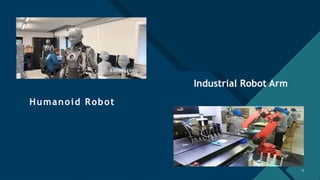
Humanoid Robot
Industrial Robot Arm
4.
Click to editMaster title style
4 4
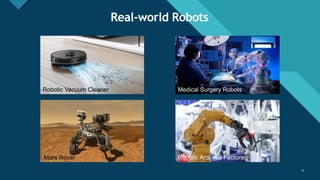
Real-world Robots
Robotic Vacuum Cleaner
Mars Rover
Medical Surgery Robots
Robotic Arm in a Factories
5.
Click to editMaster title style
5 5
Define Robotics Technology
Robotics technology is the field focused on designing,
constructing, operating, and utilizing robots. It encompasses the
creation of intelligent machines that can perform tasks traditionally
done by humans, often in hazardous environments or for
repetitive, mundane jobs. Robotics involves various disciplines
like engineering, computer science, and artificial intelligence to
develop robots with capabilities like sensing, manipulation, and
decision-making.
6.
Click to editMaster title style
6 6
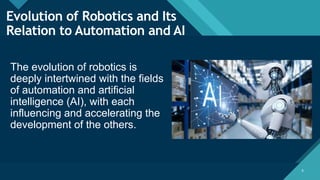
Evolution of Robotics and Its
Relation to Automation and AI
The evolution of robotics is
deeply intertwined with the fields
of automation and artificial
intelligence (AI), with each
influencing and accelerating the
development of the others.
7.
Click to editMaster title style
7 7
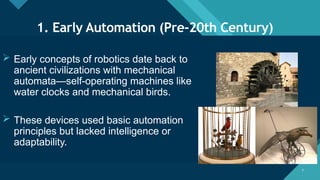
1. Early Automation (Pre-20th Century)
Early concepts of robotics date back to
ancient civilizations with mechanical
automata—self-operating machines like
water clocks and mechanical birds.
These devices used basic automation
principles but lacked intelligence or
adaptability.
8.
Click to editMaster title style
8 8
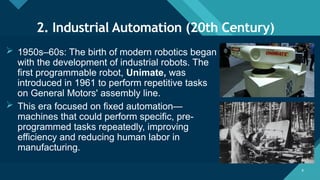
2. Industrial Automation (20th Century)
1950s–60s: The birth of modern robotics began
with the development of industrial robots. The
first programmable robot, Unimate, was
introduced in 1961 to perform repetitive tasks
on General Motors' assembly line.
This era focused on fixed automation—
machines that could perform specific, pre-
programmed tasks repeatedly, improving
efficiency and reducing human labor in
manufacturing.
9.
Click to editMaster title style
9 9
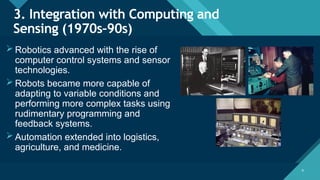
3. Integration with Computing and
Sensing (1970s–90s)
Robotics advanced with the rise of
computer control systems and sensor
technologies.
Robots became more capable of
adapting to variable conditions and
performing more complex tasks using
rudimentary programming and
feedback systems.
Automation extended into logistics,
agriculture, and medicine.
10.
Click to editMaster title style
10
10
4. Rise of Artificial Intelligence (2000s–Present)
The integration of AI transformed robotics from purely mechanical tools
into intelligent systems capable of learning, perception, and decision-
making.
AI-powered robots now perform tasks like:
Navigating unpredictable environments (e.g., autonomous vehicles)
Recognizing speech and images
Interacting socially with humans (e.g., service robots)
11.
Click to editMaster title style
11
11
5. Current and Future Trends
Robotics is increasingly defined by collaborative robots (cobots),
machine learning, and cloud robotics
Advances in AI are enabling robots to:
Learn from experience
Adapt in real-time
Operate in unstructured environments
Robotics is expanding into personal assistance, healthcare, space
exploration, and disaster response.
12.
Click to editMaster title style
12
12
Relationship Among Robotics, Automation, and AI
Automation refers to the use of technology to perform tasks with
minimal human intervention.
Robotics provides the physical form or machinery for automation.
AI gives robots the "brain"—enabling them to make decisions,
recognize patterns, and learn.
Together, they form a powerful triad driving innovation across industries—
from manufacturing and transportation to medicine and beyond.
13.
Click to editMaster title style
13
13
Five Main Components of a Robot
Sensors (input devices)
Actuators/Motors (movement/output)
Controller (brain/microcontroller)
Power Supply (batteries/electricity)
Chassis/Structure (physical form)
14.
Click to editMaster title style
14
14
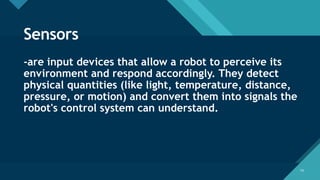
Sensors
-are input devices that allow a robot to perceive its
environment and respond accordingly. They detect
physical quantities (like light, temperature, distance,
pressure, or motion) and convert them into signals the
robot's control system can understand.
15.
Click to editMaster title style
15
15
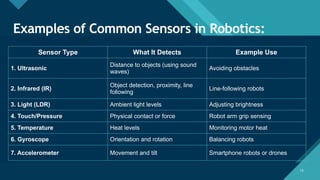
Examples of Common Sensors in Robotics:
Sensor Type What It Detects Example Use
1. Ultrasonic
Distance to objects (using sound
waves)
Avoiding obstacles
2. Infrared (IR)
Object detection, proximity, line
following
Line-following robots
3. Light (LDR) Ambient light levels Adjusting brightness
4. Touch/Pressure Physical contact or force Robot arm grip sensing
5. Temperature Heat levels Monitoring motor heat
6. Gyroscope Orientation and rotation Balancing robots
7. Accelerometer Movement and tilt Smartphone robots or drones
16.
Click to editMaster title style
16
16
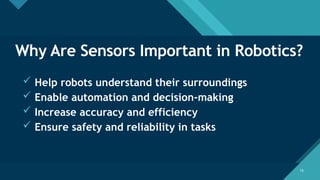
Why Are Sensors Important in Robotics?
Help robots understand their surroundings
Enable automation and decision-making
Increase accuracy and efficiency
Ensure safety and reliability in tasks
17.
Click to editMaster title style
17
17
Why Are Sensors Important in Robotics?
Help robots understand their surroundings
Enable automation and decision-making
Increase accuracy and efficiency
Ensure safety and reliability in tasks
#3 They can perform tasks in hazardous environments, such as nuclear power plants or underwater, reducing human risk. Robots work continuously without breaks, increasing productivity and allowing humans to focus on more complex tasks. Their precision and consistency improve product quality and efficiency.
#4 Ask students to identify which examples they have encountered or heard about.
#12 Ask students to give their own definitions in their own words.
#13 Ask students to give their own definitions in their own words.
#14 Key Points:
Sensors = Robot’s “Senses”
Just like humans use eyes, ears, and skin to sense the world, robots use sensors.
Input Devices
They collect data from the environment and send it to the microcontroller or processor.
Essential for Smart Behavior
Sensors help robots navigate, make decisions, and interact safely and accurately with the world.
#15 Key Points:
Sensors = Robot’s “Senses”
Just like humans use eyes, ears, and skin to sense the world, robots use sensors.
Input Devices
They collect data from the environment and send it to the microcontroller or processor.
Essential for Smart Behavior
Sensors help robots navigate, make decisions, and interact safely and accurately with the world.
#16 Key Points:
Sensors = Robot’s “Senses”
Just like humans use eyes, ears, and skin to sense the world, robots use sensors.
Input Devices
They collect data from the environment and send it to the microcontroller or processor.
Essential for Smart Behavior
Sensors help robots navigate, make decisions, and interact safely and accurately with the world.
#17 Key Points:
Sensors = Robot’s “Senses”
Just like humans use eyes, ears, and skin to sense the world, robots use sensors.
Input Devices
They collect data from the environment and send it to the microcontroller or processor.
Essential for Smart Behavior
Sensors help robots navigate, make decisions, and interact safely and accurately with the world.