Dubbing in Germany Introduction What do Germans think about Dubbing? A few theoretical facts Arguments for Dubbing Arguments against Dubbing Difficulties of Dubbing Example 1 and Explanation Example 2 and Explanation Example 3 and Explanation Solutions
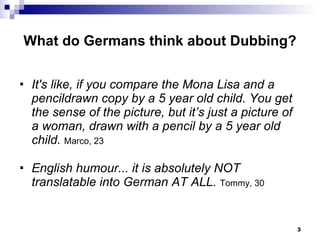
What do Germans think about Dubbing? It's like, if you compare the Mona Lisa and a pencildrawn copy by a 5 year old child. You get the sense of the picture, but it’s just a picture of a woman, drawn with a pencil by a 5 year old child.   Marco, 23 English humour... it is absolutely NOT translatable into German AT ALL.   Tommy, 30
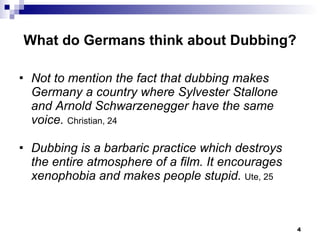
What do Germans think about Dubbing? Not to mention the fact that dubbing makes Germany a country where Sylvester Stallone and Arnold Schwarzenegger have the same voice.   Christian, 24 Dubbing is a barbaric practice which destroys the entire atmosphere of a film. It encourages xenophobia and makes people stupid.  Ute, 25
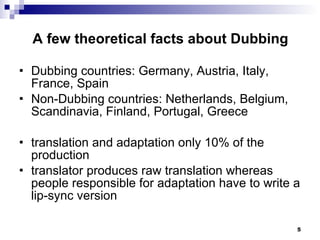
A few theoretical facts about Dubbing Dubbing countries: Germany, Austria, Italy, France, Spain Non-Dubbing countries: Netherlands, Belgium, Scandinavia, Finland, Portugal, Greece translation and adaptation only 10% of the production translator produces raw translation whereas people responsible for adaptation have to write a lip-sync version
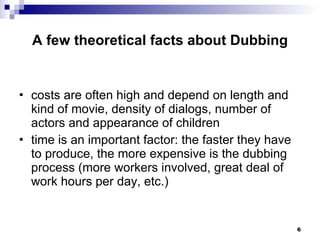
A few theoretical facts about Dubbing costs are often high and depend on length and kind of movie, density of dialogs, number of actors and appearance of children time is an important factor: the faster they have to produce, the more expensive is the dubbing process (more workers involved, great deal of work hours per day, etc.)
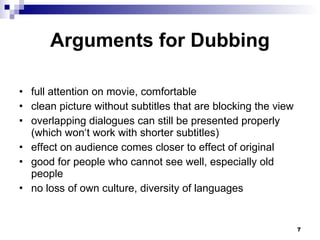
Arguments for Dubbing full attention on movie, comfortable clean picture without subtitles that are blocking the view overlapping dialogues can still be presented properly (which won‘t work with shorter subtitles) effect on audience comes closer to effect of original good for people who cannot see well, especially old people no loss of own culture, diversity of languages
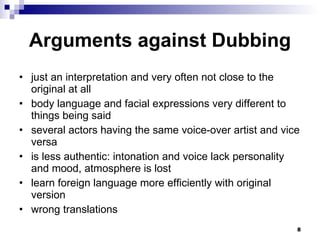
Arguments against Dubbing just an interpretation and very often not close to the original at all body language and facial expressions very different to things being said several actors having the same voice-over artist and vice versa is less authentic: intonation and voice lack personality and mood, atmosphere is lost learn foreign language more efficiently with original version wrong translations
Difficulties of Dubbing German has not the same quantity of words when translating a sentence properly Bill Bryson:  English speakers can often draw shades of distinction unavailable to non-English speakers due to the wealth of synonyms and richness of vocabulary very expensive and time consuming hard to keep surrounding sounds when using an overlaying sound track ( factory hall, beach or forest all turns into flat studio sound)  Untranslatability
Explanation Example 1 English version:  gum is a homonym for TV series, chewing gum and gingiva (background: The word  Twin  in Twin Peaks stands for the ambiguity of the series.) German version : gum is translated with the German word for TV series, other meanings are ignored, concept of ambiguity is lost I used to chew it when I was a kid  is left out, instead Leland tries to explain that the chewing gum has the same name as his favourite TV series back then
Explanation Example 2 English version:   catch up  (as you would say to someone who is lagging behind) and  ketchup  (squished tomatoes) have a similar pronunciation    punchline of the joke German version :  catch up  does not exist in the German language, whereas the word  ketchup  does, this is ruling out the ambiguity and ruining the punchline of the joke
Explanation Example 3 English version:  Chandler accidentally says  black  instead of  back , in English both words make sense in context to the rest of the sentence, which is why Rachel is confused German version : translated with  back  version of the sentence, which negates Chandler‘s mistake (his puzzled facial expression is now senseless), German words for back (zurück) and black (schwarz) don‘t sound similar / Rachel now says  Why would the blazer belong to Trump? What has Joey to do with him?    ruins the point of language possibilites, makes her less stupid than intended
Solutions Subtitles:  used in non-Dubbing countries, are cheaper in production and can be provided in both foreign language (for learning purposes) or native tongue (for better understanding), time savings allow movies and TV series to be released earlier, preventing pirate copies SAP (Secondary Audio Programming):  transmitting TV programs with two audio tracks, viewer can decide which language he prefers Adaptation:  taking the idea of a series (e.g. The Office) and rewriting it, using different characters and local habits but keeping the original concept alive (Stromberg)
Thank you for your attention! For further information we highly recommend  against-dubbing.com

Dubbing In Germany - Blog Version

  • 1.
  • 2.
    Dubbing in GermanyIntroduction What do Germans think about Dubbing? A few theoretical facts Arguments for Dubbing Arguments against Dubbing Difficulties of Dubbing Example 1 and Explanation Example 2 and Explanation Example 3 and Explanation Solutions
  • 3.
    What do Germansthink about Dubbing? It's like, if you compare the Mona Lisa and a pencildrawn copy by a 5 year old child. You get the sense of the picture, but it’s just a picture of a woman, drawn with a pencil by a 5 year old child. Marco, 23 English humour... it is absolutely NOT translatable into German AT ALL. Tommy, 30
  • 4.
    What do Germansthink about Dubbing? Not to mention the fact that dubbing makes Germany a country where Sylvester Stallone and Arnold Schwarzenegger have the same voice. Christian, 24 Dubbing is a barbaric practice which destroys the entire atmosphere of a film. It encourages xenophobia and makes people stupid. Ute, 25
  • 5.
    A few theoreticalfacts about Dubbing Dubbing countries: Germany, Austria, Italy, France, Spain Non-Dubbing countries: Netherlands, Belgium, Scandinavia, Finland, Portugal, Greece translation and adaptation only 10% of the production translator produces raw translation whereas people responsible for adaptation have to write a lip-sync version
  • 6.
    A few theoreticalfacts about Dubbing costs are often high and depend on length and kind of movie, density of dialogs, number of actors and appearance of children time is an important factor: the faster they have to produce, the more expensive is the dubbing process (more workers involved, great deal of work hours per day, etc.)
  • 7.
    Arguments for Dubbingfull attention on movie, comfortable clean picture without subtitles that are blocking the view overlapping dialogues can still be presented properly (which won‘t work with shorter subtitles) effect on audience comes closer to effect of original good for people who cannot see well, especially old people no loss of own culture, diversity of languages
  • 8.
    Arguments against Dubbingjust an interpretation and very often not close to the original at all body language and facial expressions very different to things being said several actors having the same voice-over artist and vice versa is less authentic: intonation and voice lack personality and mood, atmosphere is lost learn foreign language more efficiently with original version wrong translations
  • 9.
    Difficulties of DubbingGerman has not the same quantity of words when translating a sentence properly Bill Bryson: English speakers can often draw shades of distinction unavailable to non-English speakers due to the wealth of synonyms and richness of vocabulary very expensive and time consuming hard to keep surrounding sounds when using an overlaying sound track ( factory hall, beach or forest all turns into flat studio sound) Untranslatability
  • 10.
    Explanation Example 1English version: gum is a homonym for TV series, chewing gum and gingiva (background: The word Twin in Twin Peaks stands for the ambiguity of the series.) German version : gum is translated with the German word for TV series, other meanings are ignored, concept of ambiguity is lost I used to chew it when I was a kid is left out, instead Leland tries to explain that the chewing gum has the same name as his favourite TV series back then
  • 11.
    Explanation Example 2English version: catch up (as you would say to someone who is lagging behind) and ketchup (squished tomatoes) have a similar pronunciation  punchline of the joke German version : catch up does not exist in the German language, whereas the word ketchup does, this is ruling out the ambiguity and ruining the punchline of the joke
  • 12.
    Explanation Example 3English version: Chandler accidentally says black instead of back , in English both words make sense in context to the rest of the sentence, which is why Rachel is confused German version : translated with back version of the sentence, which negates Chandler‘s mistake (his puzzled facial expression is now senseless), German words for back (zurück) and black (schwarz) don‘t sound similar / Rachel now says Why would the blazer belong to Trump? What has Joey to do with him?  ruins the point of language possibilites, makes her less stupid than intended
  • 13.
    Solutions Subtitles: used in non-Dubbing countries, are cheaper in production and can be provided in both foreign language (for learning purposes) or native tongue (for better understanding), time savings allow movies and TV series to be released earlier, preventing pirate copies SAP (Secondary Audio Programming): transmitting TV programs with two audio tracks, viewer can decide which language he prefers Adaptation: taking the idea of a series (e.g. The Office) and rewriting it, using different characters and local habits but keeping the original concept alive (Stromberg)
  • 14.
    Thank you foryour attention! For further information we highly recommend against-dubbing.com