ISS Sindelfingen
Towards a dual language
programme
Sarah Kupke
September 2013
AMSTERDAM ECIS
WE PLACE LEARNING AT THE CORE OF
ALL WE DO
Learning at the International School of Stuttgart combines an individual’s
predisposition and experience with the acquisition of knowledge, skills
and understanding to nurture and develop character and intellect.

Wir stellen das Lernen in den Mittelpunkt
all dessen, was wir tun .
Das Lernen an der Internationalen Schule Stuttgart verbindet die
individuelle Begabung und Erfahrungen mit dem Erwerb von
Fähigkeiten, Wissen und Verstehen, indem Charakter und Verstand
gepflegt und entwickelt wird.
Herausragende Ausbildung für
international-denkende Familien.
Unsere Mission ist es, unsere Schüler und
einander zu inspirieren, zu fordern und aktiv zu
unterstützen, um positiv in einer sich ändernde
Welt mitzuwirken.

Leading education for internationallyminded families
Our mission is to inspire, challenge and actively
support our students and each other to become
positive participants in a changing world.
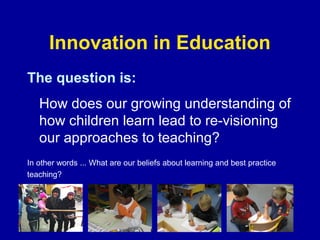
Innovation in Education
The question is:
How does our growing understanding of
how children learn lead to re-visioning
our approaches to teaching?
In other words ... What are our beliefs about learning and best practice
teaching?
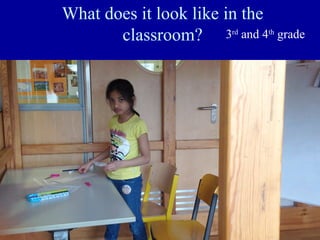
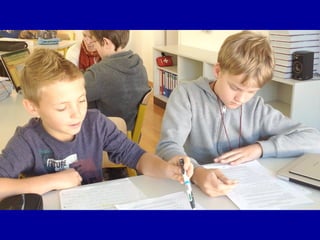
What does it look like in the
classroom? 3rd and 4th grade
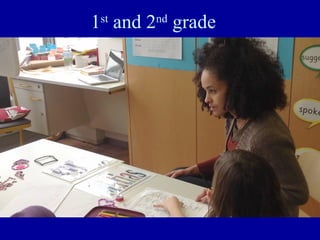
1st and 2nd grade
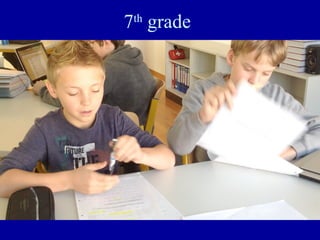
7th grade
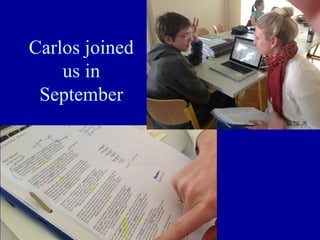
Carlos joined
us in
September
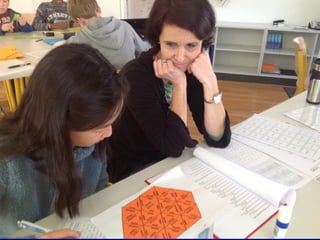
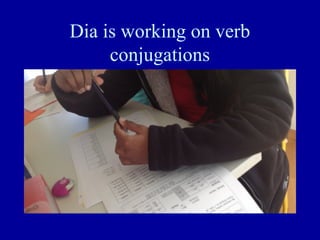
Dia is working on verb
conjugations
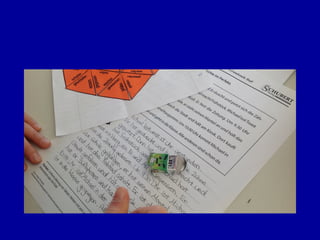
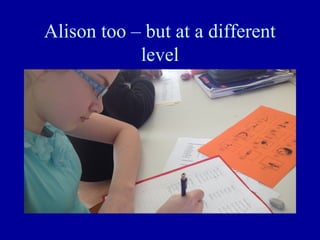
Alison too – but at a different
level
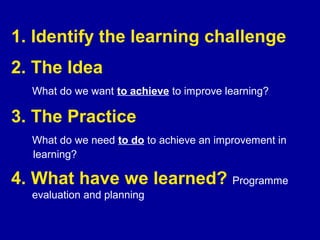
1. Identify the learning challenge
2. The Idea
What do we want to achieve to improve learning?

3. The Practice
What do we need to do to achieve an improvement in
learning?

4. What have we learned? Programme
evaluation and planning
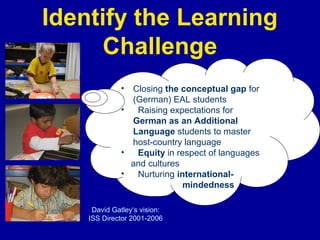
Identify the Learning
Challenge
David

•

Closing the conceptual gap for
(German) EAL students
•
Raising expectations for
German as an Additional
Language students to master
host-country language
•
Equity in respect of languages
and cultures
•
Nurturing internationalmindedness
David Gatley‘s vision:
ISS Director 2001-2006
Myths
• Additional language fluency in 3
months
• Total immersion is effortless
learning
• Young children learn additional
languages much more quickly
than others
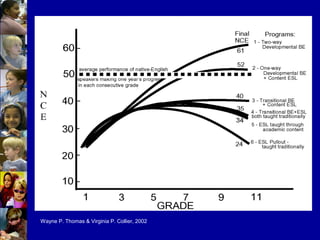
Wayne P. Thomas & Virginia P. Collier, 2002
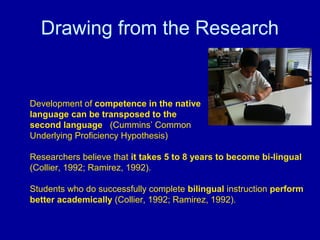
Drawing from the Research

Development of competence in the native
language can be transposed to the
second language (Cummins’ Common
Underlying Proficiency Hypothesis)
Researchers believe that it takes 5 to 8 years to become bi-lingual
(Collier, 1992; Ramirez, 1992).
Students who do successfully complete bilingual instruction perform
better academically (Collier, 1992; Ramirez, 1992).
The Idea

What do we want to
achieve to improve
learning?

We want an educational model that
will:
… support conceptual as well as language
development in the individual child
… address issues of language equity in
education and promote international mindedness
… support educational innovation and reform
... Encourage English–speakers to learn
German with the same vitality that Germanspeakers learn
English
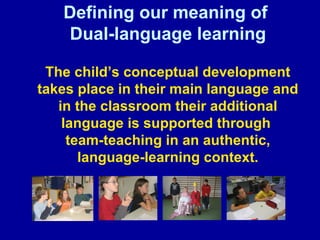
Defining our meaning of
Dual-language learning
The child’s conceptual development
takes place in their main language and
in the classroom their additional
language is supported through
team-teaching in an authentic,
language-learning context.
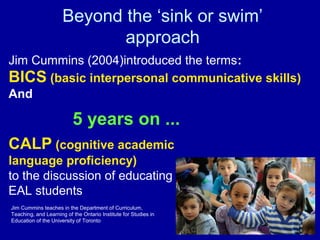
Beyond the ‘sink or swim’
approach
Jim Cummins (2004)introduced the terms:
BICS (basic interpersonal communicative skills)
And

5 years on ...
CALP (cognitive academic
language proficiency)
to the discussion of educating
EAL students
Jim Cummins teaches in the Department of Curriculum,
Teaching, and Learning of the Ontario Institute for Studies in
Education of the University of Toronto
What’s in a comma?
A panda walks into a cafe. He orders a sandwich, eats
it, then draws a gun and fires two shots in the air.
“Why?“ asks the confused waiter as the panda makes
towards the exit. The panda produces a badly punctuated
wildlife manual and tosses it over his shoulder.
“I‘m a panda,“ He says, at the door. “Look it up.“
The waiter turns to the relevant entry and, sure enough,
finds an explanation.
“Panda. Large black-and-white bear-like mammal, natural
to China. Eats, shoots and leaves.”
“Eats, Shoots and Leaves“ Lynne Truss 2004
The Practice – what do we need to do
to achieve an improvement in learning?

How does it work?
• 90/10% to 50/50%
• Team teaching
• Assessing, goal-setting,
monitoring and
reporting
The definition of the ISS Sindelfingen
dual language model encompasses the
following 4 critical components:
• Where possible, the child’s conceptual
development takes place in their mother
tongue.
• the integration of main and second language
learners for instruction in and through two
languages.
• periods of instruction during which only one
language is used.
• both native English speakers and native
German speakers are participants.
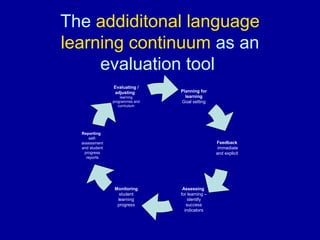
The addiditonal language
learning continuum as an
evaluation tool
Evaluating /
adjusting
learning
programmes and
curriculum

Planning for
learning
Goal setting

Reporting
selfassessment
and student
progress
reports

Feedback
immediate
and explicit

Monitoring
student
learning
progress

Assessing
for learning –
identify
success
indicators
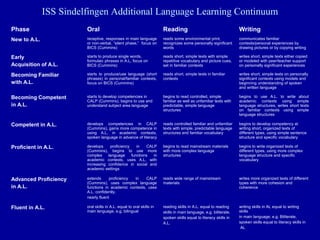
ISS Sindelfingen Additional Language Learning Continuum
Phase

Oral

Reading

Writing

New to A.L.

receptive, responses in main language
or non-verbal, “silent phase,” focus on
BICS (Cummins)

reads some environmental print,
recognizes some personally significant
words

communicates familiar
contexts/personal experiences by
drawing pictures or by copying writing

Early
Acquisition of A.L.

starts to produce single words,
formulaic phrases in A.L, focus on
BICS (Cummins)

reads short, simple texts with simple
repetitive vocabulary and picture cues,
set in familiar contexts

writes short, simple texts either copied
or modeled with peer/teacher support
on personally significant experiences

Becoming Familiar
with A.L.

starts to produce/use language (short
phrases) in personal/familiar contexts,
focus on BICS (Cummins)

reads short, simple texts in familiar
contexts

writes short, simple texts on personally
significant contexts using models and
beginning understanding of spoken
and written language

Becoming Competent
in A.L.

starts to develop competencies in
CALP (Cummins), begins to use and
understand subject area language

begins to read controlled, simple
familiar as well as unfamiliar texts with
predictable, simple language
structures

begins to use A.L. to write about
academic contexts using simple
language structures, writes short texts
on familiar contexts using simple
language structures

Competent in A.L.

develops competencies in CALP
(Cummins), gains more competence in
using A.L. in academic contexts,
spoken language in advance of literacy

reads controlled familiar and unfamiliar
texts with simple, predictable language
structures and familiar vocabulary

begins to develop competency at
writing short, organized texts of
different types, using simple sentence
structure and specific vocabulary

Proficient in A.L.

develops
proficiency
in
CALP
(Cummins), begins to use more
complex
language
functions
in
academic contexts, uses A.L. with
increasing confidence in social and
academic settings

begins to read mainstream materials
with more complex language
structures

begins to write organized texts of
different types, using more complex
language structure and specific
vocabulary

Advanced Proficiency
in A.L.

extends
proficiency
in
CALP
(Cummins), uses complex language
functions in academic contexts, uses
A.L. confidently,
nearly fluent

reads wide range of mainstream
materials

writes more organized texts of different
types with more cohesion and
coherence

Fluent in A.L.

oral skills in A.L. equal to oral skills in
main language, e.g. bilingual

reading skills in A.L. equal to reading
skills in main language, e.g. biliterate,
spoken skills equal to literacy skills in
A.L.

writing skills in AL equal to writing
skills
in main language; e.g. Biliterate,
spoken skills equal to literacy skills in
AL
Reflection for planning:
Programme Evaluation
What the students say …
Quinn: I like learning another language because
it makes it easier to communicate with other
people and learn. It is hard to learn it
sometimes. It takes a lot of effort and
thinking.
Liana: I like learning because if you get stuck on
a word, no one laughs and it’s fun with
language buddies.
What the teachers say …
• The use of the two languages is a natural feature of
class discourse, children function simultaneously in
main and additional language, the two languages are
constantly "switched on". You can truly use the
children as a language resource and create
opportunities for the children to learn with and from
each other, e.g. language "buddy" projects. Jennifer king
• It is much more natural to have language lessons
during class than having a regular “pull-out” session
and the children “shutting down” beforehand.
• Children have the native speakers as models and
hear the correct language from peers, and not only
from teachers. Stephanie Langer
Self-evaluating our programme
Questions we are still playing with:
•

Does our programme have the flexibility required to foster the
language learning needs of every child from beginning additional
language learners to mother tongue learners?
• What are the characteristics in effective Dual Language teachers?
• Is there such a thing as a student who is not talented in learning
languages?
• What professional development can best support dual language
teachers’ needs?
• What do the language experts say who are not supporting duallanguage teaching or mother-tongue support?
• What do the parents need to know in order to best support their
children’s needs?
• How will we self-appraise and objectively reflect upon our
programme so that it is research-based and not just a beliefsystem?
• What evidence of effectiveness supports the dual language model?
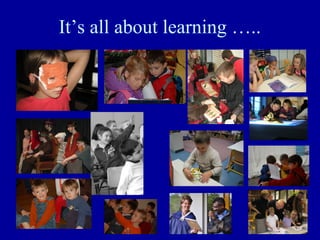
It’s all about learning …..
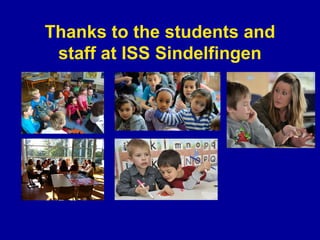
Thanks to the students and
staff at ISS Sindelfingen
Thank you for your interest
References
•Bilingual Children’s Mother Tongue: Why is it important for Education
http://www.iteachilearn.com/cummins/mother.htm
•Website with a large number of books on bilingualism
www.multilingual-matters
•Wayne P. Thomas & Virginia P. Collier, 1997/98 The National
Clearinghouse for Bilingual Education (NCBE) School Effectiveness for
Language Minority Students
•Cummins, J. (1996). Negotiating identities: Education for empowerment in
a diverse society. Ontario, CA: California Association for Bilingual
Education.
•Krashen, S. (1999). Condemned without a trial: Bogus arguments against
bilingual education. Portsmouth, NH: Heinemann.
•Torres-Guzmán M (2002) Dual language Programs: Key Features and
Results. Directions. Spring 2002. No 14
•Denby J. Fieldwork Summer School 2006.

•The Case for Bilingual Education Why Bilingual Education? by Stephen Krashen
ERIC® Clearinghouse on Assessment and Evaluation
•How effective is bilingual education?
Elizabeth Howard, Center for Applied Linguistics.
•James Crawford's Language Policy Web
Possibly the most in-depth bilingual education site on the web.
•Rethinking Schools: Online Urban Educational Journal. The Case for Bilingual Education
•Why Bilingual Education? by Stephen Krashen ERIC® Clearinghouse on Assessment and
Evaluation

Sarah Kupke ISS Sindelfingen September 2013

Dual language nov 13 amsterdam

  • 1.
    ISS Sindelfingen Towards adual language programme Sarah Kupke September 2013 AMSTERDAM ECIS
  • 2.
    WE PLACE LEARNINGAT THE CORE OF ALL WE DO Learning at the International School of Stuttgart combines an individual’s predisposition and experience with the acquisition of knowledge, skills and understanding to nurture and develop character and intellect. Wir stellen das Lernen in den Mittelpunkt all dessen, was wir tun . Das Lernen an der Internationalen Schule Stuttgart verbindet die individuelle Begabung und Erfahrungen mit dem Erwerb von Fähigkeiten, Wissen und Verstehen, indem Charakter und Verstand gepflegt und entwickelt wird.
  • 3.
    Herausragende Ausbildung für international-denkendeFamilien. Unsere Mission ist es, unsere Schüler und einander zu inspirieren, zu fordern und aktiv zu unterstützen, um positiv in einer sich ändernde Welt mitzuwirken. Leading education for internationallyminded families Our mission is to inspire, challenge and actively support our students and each other to become positive participants in a changing world.
  • 4.
    Innovation in Education Thequestion is: How does our growing understanding of how children learn lead to re-visioning our approaches to teaching? In other words ... What are our beliefs about learning and best practice teaching?
  • 5.
    What does itlook like in the classroom? 3rd and 4th grade
  • 6.
  • 7.
  • 9.
  • 12.
    Dia is workingon verb conjugations
  • 13.
    Alison too –but at a different level
  • 14.
    1. Identify thelearning challenge 2. The Idea What do we want to achieve to improve learning? 3. The Practice What do we need to do to achieve an improvement in learning? 4. What have we learned? Programme evaluation and planning
  • 15.
    Identify the Learning Challenge David • Closingthe conceptual gap for (German) EAL students • Raising expectations for German as an Additional Language students to master host-country language • Equity in respect of languages and cultures • Nurturing internationalmindedness David Gatley‘s vision: ISS Director 2001-2006
  • 16.
    Myths • Additional languagefluency in 3 months • Total immersion is effortless learning • Young children learn additional languages much more quickly than others
  • 17.
    Wayne P. Thomas& Virginia P. Collier, 2002
  • 18.
    Drawing from theResearch Development of competence in the native language can be transposed to the second language (Cummins’ Common Underlying Proficiency Hypothesis) Researchers believe that it takes 5 to 8 years to become bi-lingual (Collier, 1992; Ramirez, 1992). Students who do successfully complete bilingual instruction perform better academically (Collier, 1992; Ramirez, 1992).
  • 19.
    The Idea What dowe want to achieve to improve learning? We want an educational model that will: … support conceptual as well as language development in the individual child … address issues of language equity in education and promote international mindedness … support educational innovation and reform ... Encourage English–speakers to learn German with the same vitality that Germanspeakers learn English
  • 20.
    Defining our meaningof Dual-language learning The child’s conceptual development takes place in their main language and in the classroom their additional language is supported through team-teaching in an authentic, language-learning context.
  • 21.
    Beyond the ‘sinkor swim’ approach Jim Cummins (2004)introduced the terms: BICS (basic interpersonal communicative skills) And 5 years on ... CALP (cognitive academic language proficiency) to the discussion of educating EAL students Jim Cummins teaches in the Department of Curriculum, Teaching, and Learning of the Ontario Institute for Studies in Education of the University of Toronto
  • 22.
    What’s in acomma? A panda walks into a cafe. He orders a sandwich, eats it, then draws a gun and fires two shots in the air. “Why?“ asks the confused waiter as the panda makes towards the exit. The panda produces a badly punctuated wildlife manual and tosses it over his shoulder. “I‘m a panda,“ He says, at the door. “Look it up.“ The waiter turns to the relevant entry and, sure enough, finds an explanation. “Panda. Large black-and-white bear-like mammal, natural to China. Eats, shoots and leaves.” “Eats, Shoots and Leaves“ Lynne Truss 2004
  • 23.
    The Practice –what do we need to do to achieve an improvement in learning? How does it work? • 90/10% to 50/50% • Team teaching • Assessing, goal-setting, monitoring and reporting
  • 24.
    The definition ofthe ISS Sindelfingen dual language model encompasses the following 4 critical components: • Where possible, the child’s conceptual development takes place in their mother tongue. • the integration of main and second language learners for instruction in and through two languages. • periods of instruction during which only one language is used. • both native English speakers and native German speakers are participants.
  • 25.
    The addiditonal language learningcontinuum as an evaluation tool Evaluating / adjusting learning programmes and curriculum Planning for learning Goal setting Reporting selfassessment and student progress reports Feedback immediate and explicit Monitoring student learning progress Assessing for learning – identify success indicators
  • 26.
    ISS Sindelfingen AdditionalLanguage Learning Continuum Phase Oral Reading Writing New to A.L. receptive, responses in main language or non-verbal, “silent phase,” focus on BICS (Cummins) reads some environmental print, recognizes some personally significant words communicates familiar contexts/personal experiences by drawing pictures or by copying writing Early Acquisition of A.L. starts to produce single words, formulaic phrases in A.L, focus on BICS (Cummins) reads short, simple texts with simple repetitive vocabulary and picture cues, set in familiar contexts writes short, simple texts either copied or modeled with peer/teacher support on personally significant experiences Becoming Familiar with A.L. starts to produce/use language (short phrases) in personal/familiar contexts, focus on BICS (Cummins) reads short, simple texts in familiar contexts writes short, simple texts on personally significant contexts using models and beginning understanding of spoken and written language Becoming Competent in A.L. starts to develop competencies in CALP (Cummins), begins to use and understand subject area language begins to read controlled, simple familiar as well as unfamiliar texts with predictable, simple language structures begins to use A.L. to write about academic contexts using simple language structures, writes short texts on familiar contexts using simple language structures Competent in A.L. develops competencies in CALP (Cummins), gains more competence in using A.L. in academic contexts, spoken language in advance of literacy reads controlled familiar and unfamiliar texts with simple, predictable language structures and familiar vocabulary begins to develop competency at writing short, organized texts of different types, using simple sentence structure and specific vocabulary Proficient in A.L. develops proficiency in CALP (Cummins), begins to use more complex language functions in academic contexts, uses A.L. with increasing confidence in social and academic settings begins to read mainstream materials with more complex language structures begins to write organized texts of different types, using more complex language structure and specific vocabulary Advanced Proficiency in A.L. extends proficiency in CALP (Cummins), uses complex language functions in academic contexts, uses A.L. confidently, nearly fluent reads wide range of mainstream materials writes more organized texts of different types with more cohesion and coherence Fluent in A.L. oral skills in A.L. equal to oral skills in main language, e.g. bilingual reading skills in A.L. equal to reading skills in main language, e.g. biliterate, spoken skills equal to literacy skills in A.L. writing skills in AL equal to writing skills in main language; e.g. Biliterate, spoken skills equal to literacy skills in AL
  • 27.
  • 28.
    What the studentssay … Quinn: I like learning another language because it makes it easier to communicate with other people and learn. It is hard to learn it sometimes. It takes a lot of effort and thinking. Liana: I like learning because if you get stuck on a word, no one laughs and it’s fun with language buddies.
  • 29.
    What the teacherssay … • The use of the two languages is a natural feature of class discourse, children function simultaneously in main and additional language, the two languages are constantly "switched on". You can truly use the children as a language resource and create opportunities for the children to learn with and from each other, e.g. language "buddy" projects. Jennifer king • It is much more natural to have language lessons during class than having a regular “pull-out” session and the children “shutting down” beforehand. • Children have the native speakers as models and hear the correct language from peers, and not only from teachers. Stephanie Langer
  • 30.
    Self-evaluating our programme Questionswe are still playing with: • Does our programme have the flexibility required to foster the language learning needs of every child from beginning additional language learners to mother tongue learners? • What are the characteristics in effective Dual Language teachers? • Is there such a thing as a student who is not talented in learning languages? • What professional development can best support dual language teachers’ needs? • What do the language experts say who are not supporting duallanguage teaching or mother-tongue support? • What do the parents need to know in order to best support their children’s needs? • How will we self-appraise and objectively reflect upon our programme so that it is research-based and not just a beliefsystem? • What evidence of effectiveness supports the dual language model?
  • 31.
    It’s all aboutlearning …..
  • 32.
    Thanks to thestudents and staff at ISS Sindelfingen
  • 33.
    Thank you foryour interest References •Bilingual Children’s Mother Tongue: Why is it important for Education http://www.iteachilearn.com/cummins/mother.htm •Website with a large number of books on bilingualism www.multilingual-matters •Wayne P. Thomas & Virginia P. Collier, 1997/98 The National Clearinghouse for Bilingual Education (NCBE) School Effectiveness for Language Minority Students •Cummins, J. (1996). Negotiating identities: Education for empowerment in a diverse society. Ontario, CA: California Association for Bilingual Education. •Krashen, S. (1999). Condemned without a trial: Bogus arguments against bilingual education. Portsmouth, NH: Heinemann. •Torres-Guzmán M (2002) Dual language Programs: Key Features and Results. Directions. Spring 2002. No 14 •Denby J. Fieldwork Summer School 2006. •The Case for Bilingual Education Why Bilingual Education? by Stephen Krashen ERIC® Clearinghouse on Assessment and Evaluation •How effective is bilingual education? Elizabeth Howard, Center for Applied Linguistics. •James Crawford's Language Policy Web Possibly the most in-depth bilingual education site on the web. •Rethinking Schools: Online Urban Educational Journal. The Case for Bilingual Education •Why Bilingual Education? by Stephen Krashen ERIC® Clearinghouse on Assessment and Evaluation Sarah Kupke ISS Sindelfingen September 2013