[Title to come]
[Sub-Title to come]
Strictly for Intended Recipients Only
Date
* DSP India Fund is the Company incorporated in Mauritius, under which ILSF is the corresponding share class
DSP Value Fund
November 2021
2
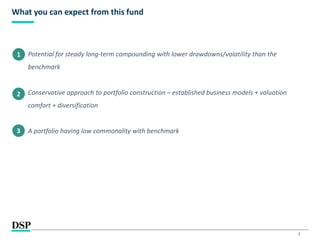
What you can expect from this fund
Potential for steady long-term compounding with lower drawdowns/volatility than the
benchmark
Conservative approach to portfolio construction – established business models + valuation
comfort + diversification
A portfolio having low commonality with benchmark
1
2
3
3
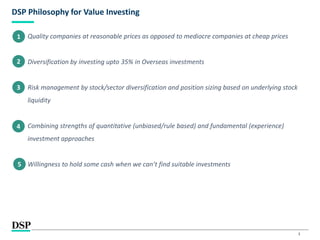
DSP Philosophy for Value Investing
Quality companies at reasonable prices as opposed to mediocre companies at cheap prices
Diversification by investing upto 35% in Overseas investments
Risk management by stock/sector diversification and position sizing based on underlying stock
liquidity
Combining strengths of quantitative (unbiased/rule based) and fundamental (experience)
investment approaches
Willingness to hold some cash when we can’t find suitable investments
1
2
3
4
5
4
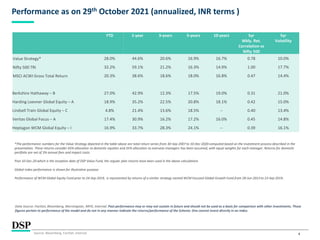
Performance as on 29th October 2021 (annualized, INR terms )
Source: Bloomberg, FactSet, Internal
YTD 1-year 3-years 5-years 10-years 5yr
Wkly. Ret.
Correlation vs
Nifty 500
5yr
Volatility
Value Strategy* 28.0% 44.6% 20.6% 16.9% 16.7% 0.78 10.0%
Nifty 500 TRI 32.2% 59.1% 21.2% 16.3% 14.9% 1.00 17.7%
MSCI ACWI Gross Total Return 20.3% 38.6% 18.6% 18.0% 16.8% 0.47 14.4%
Berkshire Hathaway – B 27.0% 42.9% 12.3% 17.5% 19.0% 0.31 21.0%
Harding Loevner Global Equity – A 18.9% 35.2% 22.5% 20.8% 18.1% 0.42 15.0%
Lindsell Train Global Equity – C 4.8% 21.4% 13.6% 18.5% -- 0.40 13.4%
Veritas Global Focus – A 17.4% 30.9% 16.2% 17.2% 16.0% 0.45 14.8%
Heptagon WCM Global Equity – I 16.9% 33.7% 28.3% 24.1% -- 0.39 16.1%
Data Source: FactSet, Bloomberg, Morningstar, MFIE, Internal. Past performance may or may not sustain in future and should not be used as a basis for comparison with other investments. These
figures pertain to performance of the model and do not in any manner indicate the returns/performance of the Scheme. One cannot invest directly in an index.
*The performance numbers for the Value Strategy depicted in the table above are total return series from 30-Sep-2007 to 10-Dec-2020 computed based on the investment process described in the
presentation. These returns consider 65% allocation to domestic equities and.35% allocation to overseas managers has been assumed, with equal weights for each manager. Returns for domestic
portfolio are net of 3% annual fees and impact costs.
Post 10-Dec-20 which is the inception date of DSP Value Fund, the regular plan returns have been used in the above calculations
Global index performance is shown for illustrative purpose
Performance of WCM Global Equity Fund prior to 24-Sep-2019, is represented by returns of a similar strategy named WCM Focused Global Growth Fund from 28-Jun-2013 to 23-Sep-2019.
5
3-year Rolling Return Range (annualized, INR term )
Source: Bloomberg, FactSet, Internal
Data Source: FactSet, MFIE, Internal. Past performance may or may not sustain in future and should not be used as a basis for comparison with other investments. These figures pertain to performance
of the model and do not in any manner indicate the returns/performance of the Scheme. One cannot invest directly in an index.
*The performance numbers depicted in the table above are total return series for the Value Strategy computed based on the investment process described in the presentation. These returns consider 65%
allocation to domestic equities and.35% allocation to overseas managers has been assumed, with equal weights for each manager. Returns for domestic portfolio are net of 3% annual fees and impact costs.
Post 10-Dec-20 which is the inception date of DSP Value Fund, the regular plan returns have been used in the above calculations
Performance has been depicted for the period where comparable returns data for all above overseas holdings was available. The first data point refers to 3 year annualized returns from 30-Jun-2014 to 30-
Jun-2017
Global index performance is shown for illustrative purpose
Performance of WCM Global Equity Fund prior to 24-Sep-2019, is represented by returns of a similar strategy named WCM Focused Global Growth Fund from 28-Jun-2013 to 23-Sep-2019.
[Period: 30-Jun-2017 to 29-Oct-2021]
0.1%
-6.3%
2.6%
3.6%
6.0%
9.2%
5.4%
8.2%
22.3%
23.9%
19.8%
24.4%
23.6%
24.1%
20.0%
30.4%
-10% -5% 0% 5% 10% 15% 20% 25% 30% 35% 40%
Value Strategy
Nifty 500 TRI
MSCI ACWI TR Gross
Berkshire Hathaway – B
Harding Loevner Global Equity – A
Lindsell Train Global Equity – C
Veritas Global Focus – A
WCM Global Equity – I
6
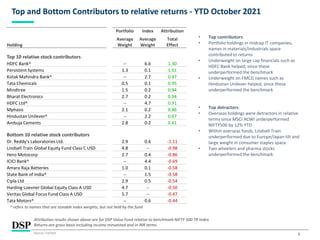
Top and Bottom Contributors to relative returns - YTD October 2021
Portfolio Index Attribution
Holding
Average
Weight
Average
Weight
Total
Effect
Top 10 relative stock contributors
HDFC Bank^ -- 6.6 1.30
Persistent Systems 1.3 0.1 1.01
Kotak Mahindra Bank^ -- 2.7 0.97
Tata Chemicals 0.5 0.1 0.95
Mindtree 1.5 0.2 0.94
Bharat Electronics 2.7 0.2 0.94
HDFC Ltd^ -- 4.7 0.91
Mphasis 2.1 0.2 0.86
Hindustan Unilever^ -- 2.2 0.67
Ambuja Cements 2.8 0.2 0.61
Bottom 10 relative stock contributors
Dr. Reddy's Laboratories Ltd. 2.9 0.6 -1.11
Lindsell Train Global Equity Fund Class C USD 4.8 -- -0.98
Hero Motocorp 2.7 0.4 -0.86
ICICI Bank^ -- 4.4 -0.69
Amara Raja Batteries 1.0 0.1 -0.58
State Bank of India^ -- 1.5 -0.58
Cipla Ltd 2.9 0.5 -0.54
Harding Loevner Global Equity Class A USD 4.7 -- -0.50
Veritas Global Focus Fund Class A USD 5.7 -- -0.47
Tata Motors^ -- 0.6 -0.44
Attribution results shown above are for DSP Value Fund relative to benchmark NIFTY 500 TR Index
Returns are gross basis including income reinvested and in INR terms
Source: FactSet
• Top contributors:
• Portfolio holdings in midcap IT companies,
names in materials/industrials space
contributed to returns
• Underweight on large cap financials such as
HDFC Bank helped, since these
underperformed the benchmark
• Underweight on FMCG names such as
Hindustan Unilever helped, since these
underperformed the benchmark
• Top detractors:
• Overseas holdings were detractors in relative
terms since MSCI ACWI underperformed
NIFTY500 by 12% YTD
• Within overseas funds, Lindsell Train
underperformed due to Europe/Japan tilt and
large weight in consumer staples space
• Two wheelers and pharma stocks
underperformed the benchmark
^ refers to names that are sizeable index weights, but not held by the fund
7
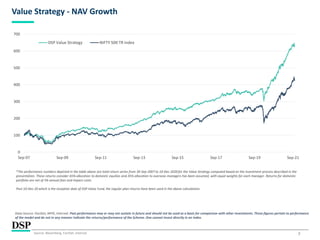
Value Strategy - NAV Growth
Source: Bloomberg, FactSet, Internal
Data Source: FactSet, MFIE, Internal. Past performance may or may not sustain in future and should not be used as a basis for comparison with other investments. These figures pertain to performance
of the model and do not in any manner indicate the returns/performance of the Scheme. One cannot invest directly in an index.
*The performance numbers depicted in the table above are total return series from 30-Sep-2007 to 10-Dec-2020 for the Value Strategy computed based on the investment process described in the
presentation. These returns consider 65% allocation to domestic equities and.35% allocation to overseas managers has been assumed, with equal weights for each manager. Returns for domestic
portfolio are net of 3% annual fees and impact costs.
Post 10-Dec-20 which is the inception date of DSP Value Fund, the regular plan returns have been used in the above calculations
0
100
200
300
400
500
600
700
Sep-07 Sep-09 Sep-11 Sep-13 Sep-15 Sep-17 Sep-19 Sep-21
DSP Value Strategy NIFTY 500 TR Index
8
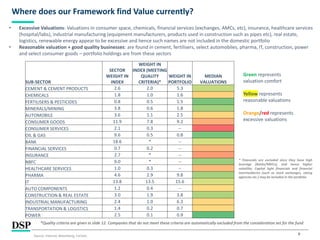
Where does our Framework find Value currently?
Source: Internal, Bloomberg, Factset.
• Excessive Valuations: Valuations in consumer space, chemicals, financial services (exchanges, AMCs, etc), insurance, healthcare services
(hospital/labs), industrial manufacturing (equipment manufacturers, products used in construction such as pipes etc), real estate,
logistics, renewable energy appear to be excessive and hence such names are not included in the domestic portfolio
• Reasonable valuation + good quality businesses: are found in cement, fertilisers, select automobiles, pharma, IT, construction, power
and select consumer goods – portfolio holdings are from these sectors
Green represents
valuation comfort
Yellow represents
reasonable valuations
Orange/red represents
excessive valuations
SUB-SECTOR
SECTOR
WEIGHT IN
INDEX
WEIGHT IN
INDEX (MEETING
QUALITY
CRITERIA)*
WEIGHT IN
PORTFOLIO
MEDIAN
VALUATIONS
CEMENT & CEMENT PRODUCTS 2.6 2.0 5.3
CHEMICALS 1.8 1.0 1.6
FERTILISERS & PESTICIDES 0.8 0.5 1.5
MINERALS/MINING 3.8 0.6 1.8
AUTOMOBILE 3.6 1.1 2.5
CONSUMER GOODS 11.9 7.8 9.2
CONSUMER SERVICES 2.1 0.3 --
OIL & GAS 9.6 0.5 0.8
BANK 18.6 * --
FINANCIAL SERVICES 0.7 0.2 --
INSURANCE 2.7 * --
NBFC 9.0 * --
HEALTHCARE SERVICES 1.0 0.3 --
PHARMA 4.6 2.9 9.8
IT 13.8 13.5 15.6
AUTO COMPONENTS 1.2 0.4 --
CONSTRUCTION & REAL ESTATE 3.0 1.9 3.8
INDUSTRIAL MANUFACTURING 2.4 1.0 6.3
TRANSPORTATION & LOGISTICS 1.4 0.2 0.7
POWER 2.5 0.1 0.9
*Quality criteria are given in slide 12. Companies that do not meet these criteria are automatically excluded from the consideration set for the fund
* Financials are excluded since they have high
leverage (Banks/NBFCs), and hence higher
volatility. Capital light financials and financial
intermediaries (such as stock exchanges, rating
agencies etc.) may be included in the portfolio
9
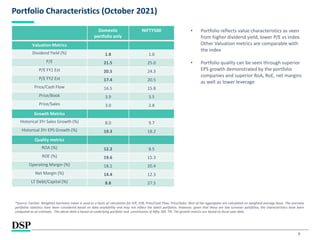
Portfolio Characteristics (October 2021)
Domestic
portfolio only
NIFTY500
Valuation Metrics
Dividend Yield (%) 1.8 1.0
P/E 21.5 25.0
P/E FY1 Est 20.5 24.3
P/E FY2 Est 17.4 20.5
Price/Cash Flow 16.5 15.8
Price/Book 3.9 3.5
Price/Sales 3.0 2.8
Growth Metrics
Historical 3Yr Sales Growth (%) 8.0 9.7
Historical 3Yr EPS Growth (%) 19.3 18.2
Quality metrics
ROA (%) 12.2 8.5
ROE (%) 19.6 15.3
Operating Margin (%) 18.1 20.4
Net Margin (%) 14.4 12.3
LT Debt/Capital (%) 8.8 27.5
*Source: FactSet. Weighted harmonic mean is used as a basis of calculation for P/E, P/B, Price/Cash Flow, Price/Sales. Rest of the aggregates are calculated on weighted average basis. The overseas
portfolios statistics have been considered based on data availability and may not reflect the latest portfolios. However, given that these are low turnover portfolios, the characteristics have been
computed as an estimate.. The above data is based on underlying portfolio and constituents of Nifty 500 TRI. The growth metrics are based on fiscal year data.
• Portfolio reflects value characteristics as seen
from higher dividend yield, lower P/E vs index.
Other Valuation metrics are comparable with
the index
• Portfolio quality can be seen through superior
EPS growth demonstrated by the portfolio
companies and superior RoA, RoE, net margins
as well as lower leverage
10
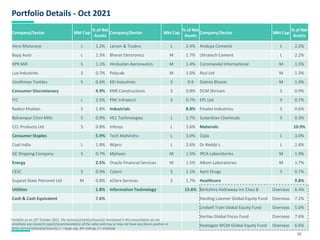
Portfolio Details - Oct 2021
Company/Sector Mkt Cap
% of Net
Assets
Company/Sector Mkt Cap
% of Net
Assets
Company/Sector Mkt Cap
% of Net
Assets
Hero Motocorp L 1.2% Larsen & Toubro L 2.4% Ambuja Cements L 2.2%
Bajaj Auto L 1.3% Bharat Electronics M 1.7% Ultratech Cement L 2.2%
KPR Mill S 1.1% Hindustan Aeronautics M 1.4% Coromandel International M 1.5%
Lux Industries S 0.7% Polycab M 1.0% Atul Ltd M 1.3%
Vardhman Textiles S 0.6% KEI Industries S 0.9 Dalmia Bharat M 1.0%
Consumer Discretionary 4.9% KNR Constructions S 0.8% DCM Shriram S 0.9%
ITC L 2.5% PNC Infratech S 0.7% EPL Ltd. S 0.7%
Radico Khaitan S 1.8% Industrials 8.8% Finolex Industries S 0.6%
Balrampur Chini Mills S 0.9% HCL Technologies L 2.7% Sudarshan Chemicals S 0.3%
CCL Products Ltd. S 0.8% Infosys L 2.6% Materials 10.9%
Consumer Staples 5.9% Tech Mahindra L 3.0% Cipla L 3.0%
Coal India L 1.8% Wipro L 2.6% Dr Reddy’s L 2.4%
GE Shipping Company S 0.7% Mphasis M 1.5% IPCA Laboratories M 1.9%
Energy 2.5% Oracle Financial Services M 1.5% Alkem Laboratories M 1.7%
CESC S 0.9% Cyient S 1.1% Aarti Drugs S 0.7%
Gujarat State Petronet Ltd M 0.8% eClerx Services S 1.7% Healthcare 9.8%
Utilities 1.8% Information Technology 15.6% Berkshire Hathaway Inc Class B Overseas 6.4%
Cash & Cash Equivalent 7.6% Harding Loevner Global Equity Fund Overseas 7.2%
Lindsell Train Global Equity Fund Overseas 5.0%
Veritas Global Focus Fund Overseas 7.6%
Heptagon WCM Global Equity Fund Overseas 6.6%
Portfolio as on 29th October 2021. The sector(s)/stock(s)/issuer(s) mentioned in this presentation do not
constitute any research report/recommendation of the same and may or may not have any future position in
these sector(s)/stock(s)/issuer(s). L = large cap, M= midcap, S = smallcap
INVESTMENT PROCESS
12
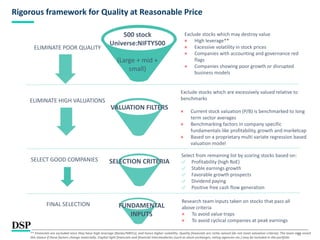
Rigorous framework for Quality at Reasonable Price
ELIMINATE POOR QUALITY
ELIMINATE HIGH VALUATIONS
500 stock
Universe:NIFTY500
(Large + mid +
small)
VALUATION FILTERS
Exclude stocks which may destroy value
× High leverage**
× Excessive volatility in stock prices
× Companies with accounting and governance red
flags
× Companies showing poor growth or disrupted
business models
Select from remaining list by scoring stocks based on:
✅ Profitability (high RoE)
✅ Stable earnings growth
✅ Favorable growth prospects
✅ Dividend paying
✅ Positive free cash flow generation
Exclude stocks which are excessively valued relative to
benchmarks
× Current stock valuation (P/B) is benchmarked to long
term sector averages
× Benchmarking factors in company specific
fundamentals like profitability, growth and marketcap
× Based on a proprietary multi variate regression based
valuation model
SELECTION CRITERIA
SELECT GOOD COMPANIES
FUNDAMENTAL
INPUTS
FINAL SELECTION
Research team inputs taken on stocks that pass all
above criteria
× To avoid value traps
× To avoid cyclical companies at peak earnings
** Financials are excluded since they have high leverage (Banks/NBFCs), and hence higher volatility. Quality financials are richly valued (do not meet valuation criteria). The team may revisit
this stance if these factors change materially. Capital light financials and financial intermediaries (such as stock exchanges, rating agencies etc.) may be included in the portfolio
13
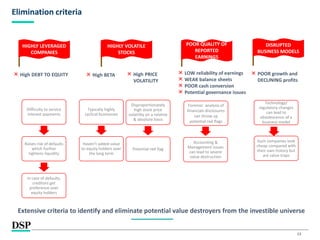
Elimination criteria
Difficulty to service
interest payments
Raises risk of defaults
which further
tightens liquidity
In case of defaults,
creditors get
preference over
equity holders
× High DEBT TO EQUITY
HIGHLY LEVERAGED
COMPANIES
× High BETA
HIGHLY VOLATILE
STOCKS
POOR QUALITY OF
REPORTED
EARNINGS
× High PRICE
VOLATILITY
Typically highly
cyclical businesses
Disproportionately
high stock price
volatility on a relative
& absolute basis
Potential red flag
Haven’t added value
to equity holders over
the long term
× LOW reliability of earnings
× WEAK balance sheets
× POOR cash conversion
× Potential governance issues
Accounting &
Management issues
can lead to severe
value destruction
Forensic analysis of
financials disclosures
can throw up
potential red flags
Extensive criteria to identify and eliminate potential value destroyers from the investible universe
DISRUPTED
BUSINESS MODELS
× POOR growth and
DECLINING profits
Technology/
regulatory changes
can lead to
obsolescence of a
business model
Such companies look
cheap compared with
their own history but
are value traps
14
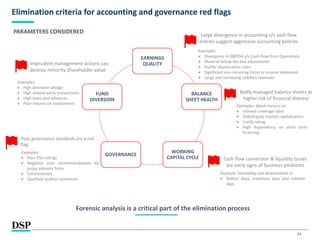
Elimination criteria for accounting and governance red flags
PARAMETERS CONSIDERED
EARNINGS
QUALITY
BALANCE
SHEET HEALTH
WORKING
CAPITAL CYCLE
GOVERNANCE
FUND
DIVERSION
Large divergence in accounting v/s cash flow
entries suggest aggressive accounting policies
Examples:
× Divergence in EBITDA v/s Cash Flow from Operations
× Material below the line adjustments
× Outlier depreciation rates
× Significant non-recurring items in income statement
× Large and increasing unbilled revenues
Badly managed balance sheets at
higher risk of financial distress
Examples: Weak metrics on
× Interest coverage ratio
× Debt/Equity market capitalization
× Credit rating
× High dependency on short term
financing
Cash flow conversion & liquidity issues
are early signs of business problems
Example: Variability and deterioration in
× Debtor days, inventory days and creditor
days
Poor governance standards are a red
flag
Examples:
× Poor ESG ratings
× Negative vote recommendations by
proxy advisory firms
× Controversies
× Qualified auditor comments
Imprudent management actions can
destroy minority shareholder value
Examples:
× High promoter pledge
× High related party transactions
× High loans and advances
× Poor returns on investments
Forensic analysis is a critical part of the elimination process
HCL Technologies
Infosys
TCS
OFSS
LT Infotech
Tech Mahindra
Mphasis
Cyient
Tata Elxsi
Coforge
Persistent
Systems
KPIT
Technologies
Mindtree
Wipro
eClerx
-
5
10
15
20
25
30
- 10 20 30 40 50
Price
to
book
RoE
Illustration: Information Technology Sector, P/B vs RoE
0
2
4
6
8
10
12
14
16
18
20
-6 0 6 12 18 24 30 36 42 48 54 60
Price
to
book
RoE
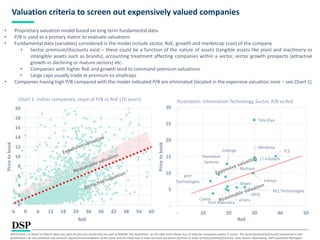
Chart 1: Indian companies, slope of P/B vs RoE (10 years)
Valuation criteria to screen out expensively valued companies
• Proprietary valuation model based on long term fundamental data
• P/B is used as a primary metric to evaluate valuations
• Fundamental data (variables) considered in the model include sector, RoE, growth and marketcap (size) of the company
• Sector premium/discounts exist – these could be a function of the nature of assets (tangible assets like plant and machinery vs
intangible assets such as brands), accounting treatment affecting companies within a sector, sector growth prospects (attractive
growth vs declining or mature sectors) etc.
• Companies with higher RoE and growth tend to command premium valuations
• Large caps usually trade at premium to smallcaps
• Companies having high P/B compared with the model indicated P/B are eliminated (located in the expensive valuation zone – see Chart 1)
NOTE:Chart 1 is Based on March data over past 10 years for stocks that are part of BSE200. The illustration on the right chart shows Sep-21 data for companies within IT sector. The sector(s)/stock(s)/issuer(s) mentioned in this
presentation do not constitute any research report/recommendation of the same and the Fund may or may not have any future position in these sector(s)/stock(s)/issuer(s). Data Source: Bloomberg, DSP Investment Managers
16
Deep focus on risk management
 No sector concentration (sector weights capped at 20%)
 No stock concentration (stock weights capped at 6 % and stock active weights also capped)
 Stocks with limited/low liquidity assigned weights of no more than 1% (measured through days
taken to liquidate the position using average market volumes)
 Avoiding stocks with high leverage, forensic red flags, high price volatility – highly volatile stocks
 Avoiding stocks that show weakening growth, profits and margins – disrupted business models
 Valuation risk managed by eliminating excessively valued companies
 Avoiding loss making companies
Disclaimer: The presentation indicates the strategy/investment approach currently followed by the scheme and the same may change in future depending on market conditions and other factors
INVESTING OVERSEAS
18
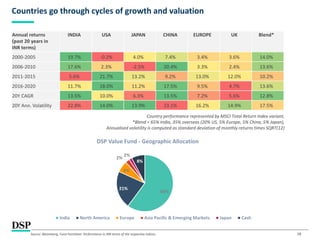
Countries go through cycles of growth and valuation
Source: Bloomberg, Fund Factsheet. Performance in INR terms of the respective indices
Country performance represented by MSCI Total Return Index variant,
*Blend = 65% India, 35% overseas (20% US, 5% Europe, 5% China, 5% Japan),
Annualised volatility is computed as standard deviation of monthly returns times SQRT(12)
Annual returns
(past 20 years in
INR terms)
INDIA USA JAPAN CHINA EUROPE UK Blend*
2000-2005 19.7% -0.2% 4.0% 7.4% 3.4% 3.6% 14.0%
2006-2010 17.6% 2.3% -2.5% 20.4% 3.3% 2.4% 13.6%
2011-2015 5.6% 21.7% 13.2% 9.2% 13.0% 12.0% 10.2%
2016-2020 11.7% 18.0% 11.2% 17.5% 9.5% 4.7% 13.6%
20Y CAGR 13.5% 10.0% 6.3% 13.5% 7.2% 5.6% 12.8%
20Y Ann. Volatility 22.8% 14.0% 13.9% 23.1% 16.2% 14.9% 17.5%
60%
21%
6%
2%
2%
8%
DSP Value Fund - Geographic Allocation
India North America Europe Asia Pacific & Emerging Markets Japan Cash
19
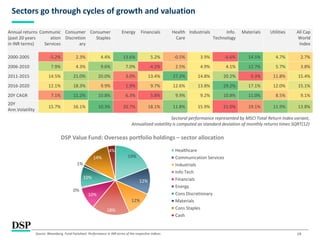
Sectors go through cycles of growth and valuation
DSP Value Fund: Overseas portfolio holdings – sector allocation
19%
12%
12%
18%
10%
0%
10%
1%
14%
4% Healthcare
Communication Services
Industrials
Info Tech
Financials
Energy
Cons Discretionary
Materials
Cons Staples
Cash
Source: Bloomberg, Fund Factsheet. Performance in INR terms of the respective indices
Sectoral performance represented by MSCI Total Return Index variant,
Annualised volatility is computed as standard deviation of monthly returns times SQRT(12)
Annual returns
(past 20 years
in INR terms)
Communic
ation
Services
Consumer
Discretion
ary
Consumer
Staples
Energy Financials Health
Care
Industrials Info.
Technology
Materials Utilities All Cap
World
Index
2000-2005 -5.2% 2.3% 4.4% 13.6% 5.2% -0.5% 3.9% -6.6% 14.5% 4.7% 2.7%
2006-2010 7.9% 4.3% 9.6% 7.0% -4.2% 2.5% 4.9% 4.1% 12.7% 5.7% 3.8%
2011-2015 14.5% 21.0% 20.0% 3.0% 13.4% 27.2% 14.8% 20.2% 0.3% 11.8% 15.4%
2016-2020 12.1% 18.3% 9.9% 1.9% 9.7% 12.6% 13.8% 29.2% 17.1% 12.0% 15.1%
20Y CAGR 7.1% 11.2% 10.8% 6.3% 5.8% 9.9% 9.2% 10.8% 11.0% 8.5% 9.1%
20Y
Ann.Volatility
15.7% 16.1% 10.3% 20.7% 18.1% 11.8% 15.9% 21.0% 19.1% 11.9% 13.8%
20
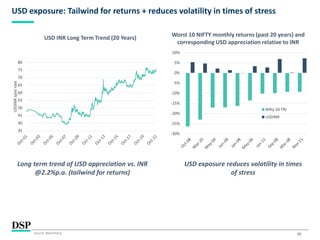
USD exposure: Tailwind for returns + reduces volatility in times of stress
Long term trend of USD appreciation vs. INR
@2.2%p.a. (tailwind for returns)
USD exposure reduces volatility in times
of stress
-30%
-25%
-20%
-15%
-10%
-5%
0%
5%
10%
Nifty 50 TRI
USDINR
35
40
45
50
55
60
65
70
75
80
USDINR
spot
rate
Source: Bloomberg,
USD INR Long Term Trend (20 Years) Worst 10 NIFTY monthly returns (past 20 years) and
corresponding USD appreciation relative to INR
21
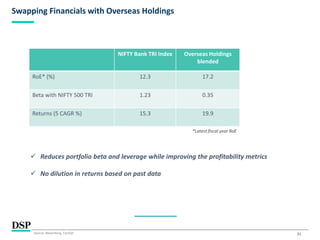
Swapping Financials with Overseas Holdings
 Reduces portfolio beta and leverage while improving the profitability metrics
 No dilution in returns based on past data
NIFTY Bank TRI Index Overseas Holdings
blended
RoE* (%) 12.3 17.2
Beta with NIFTY 500 TRI 1.23 0.35
Returns (5 CAGR %) 15.3 19.9
Source: Bloomberg, FactSet
*Latest fiscal year RoE
22
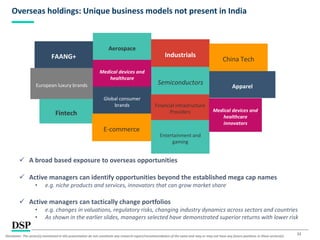
Overseas holdings: Unique business models not present in India
 A broad based exposure to overseas opportunities
 Active managers can identify opportunities beyond the established mega cap names
• e.g. niche products and services, innovators that can grow market share
 Active managers can tactically change portfolios
• e.g. changes in valuations, regulatory risks, changing industry dynamics across sectors and countries
• As shown in the earlier slides, managers selected have demonstrated superior returns with lower risk
FAANG+
European luxury brands
Fintech
Aerospace
Global consumer
brands
Medical devices and
healthcare
Financial infrastructure
Providers
Industrials
Semiconductors
China Tech
Apparel
E-commerce
Entertainment and
gaming
Medical devices and
healthcare
innovators
Disclaimer: The sector(s) mentioned in this presentation do not constitute any research report/recommendation of the same and may or may not have any future positions in these sectors(s)
OVERSEAS HOLDINGS
24
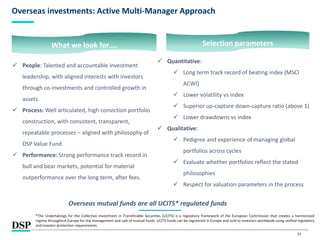
Overseas investments: Active Multi-Manager Approach
 People: Talented and accountable investment
leadership, with aligned interests with investors
through co-investments and controlled growth in
assets
 Process: Well articulated, high conviction portfolio
construction, with consistent, transparent,
repeatable processes – aligned with philosophy of
DSP Value Fund
 Performance: Strong performance track record in
bull and bear markets, potential for material
outperformance over the long term, after fees.
What we look for….
Overseas mutual funds are all UCITS* regulated funds
*The Undertakings for the Collective Investment in Transferable Securities (UCITS) is a regulatory framework of the European Commission that creates a harmonized
regime throughout Europe for the management and sale of mutual funds. UCITS funds can be registered in Europe and sold to investors worldwide using unified regulatory
and investor protection requirements.
 Quantitative:
 Long term track record of beating index (MSCI
ACWI)
 Lower volatility vs index
 Superior up-capture down-capture ratio (above 1)
 Lower drawdowns vs index
 Qualitative:
 Pedigree and experience of managing global
portfolios across cycles
 Evaluate whether portfolios reflect the stated
philosophies
 Respect for valuation parameters in the process
Selection parameters
25
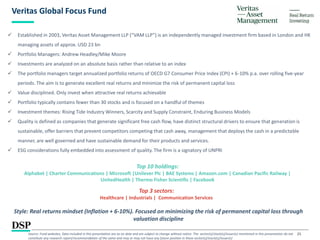
Veritas Global Focus Fund
Style: Real returns mindset (Inflation + 6-10%). Focused on minimizing the risk of permanent capital loss through
valuation discipline
 Established in 2003, Veritas Asset Management LLP (“VAM LLP”) is an independently managed investment firm based in London and HK
managing assets of approx. USD 23 bn
 Portfolio Managers: Andrew Headley/Mike Moore
 Investments are analyzed on an absolute basis rather than relative to an index
 The portfolio managers target annualized portfolio returns of OECD G7 Consumer Price Index (CPI) + 6-10% p.a. over rolling five-year
periods. The aim is to generate excellent real returns and minimize the risk of permanent capital loss
 Value disciplined. Only invest when attractive real returns achievable
 Portfolio typically contains fewer than 30 stocks and is focused on a handful of themes
 Investment themes: Rising Tide Industry Winners, Scarcity and Supply Constraint, Enduring Business Models
 Quality is defined as companies that generate significant free cash flow, have distinct structural drivers to ensure that generation is
sustainable, offer barriers that prevent competitors competing that cash away, management that deploys the cash in a predictable
manner, are well governed and have sustainable demand for their products and services.
 ESG considerations fully embedded into assessment of quality. The firm is a signatory of UNPRI
Top 10 holdings:
Alphabet | Charter Communications | Microsoft |Unilever Plc | BAE Systems | Amazon.com | Canadian Pacific Railway |
UnitedHealth | Thermo Fisher Scientific | Facebook
Top 3 sectors:
Healthcare | Industrials | Communication Services
Source: Fund websites, Data included in this presentation are as on date and are subject to change without notice. The sector(s)/stock(s)/issuer(s) mentioned in this presentation do not
constitute any research report/recommendation of the same and may or may not have any future position in these sector(s)/stock(s)/issuer(s)
26
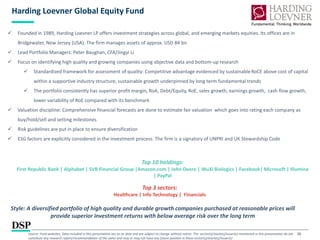
Harding Loevner Global Equity Fund
Style: A diversified portfolio of high quality and durable growth companies purchased at reasonable prices will
provide superior investment returns with below average risk over the long term
 Founded in 1989, Harding Loevner LP offers investment strategies across global, and emerging markets equities. Its offices are in
Bridgewater, New Jersey (USA). The firm manages assets of approx. USD 84 bn
 Lead Portfolio Managers: Peter Baughan, CFA/Jingyi Li
 Focus on identifying high quality and growing companies using objective data and bottom-up research
 Standardized framework for assessment of quality: Competitive advantage evidenced by sustainableRoCE above cost of capital
within a supportive industry structure, sustainable growth underpinned by long term fundamental trends
 The portfolio consistently has superior profit margin, RoA, Debt/Equity, RoE, sales growth, earnings growth, cash flow growth,
lower variability of RoE compared with its benchmark
 Valuation discipline: Comprehensive financial forecasts are done to estimate fair valuation which goes into rating each company as
buy/hold/sell and setting milestones
 Risk guidelines are put in place to ensure diversification
 ESG factors are explicitly considered in the investment process. The firm is a signatory of UNPRI and UK Stewardship Code
Top 10 holdings:
First Republic Bank | Alphabet | SVB Financial Group |Amazon.com | John Deere | WuXi Biologics | Facebook| Microsoft | Illumina
| PayPal
Top 3 sectors:
Healthcare | Info Technology | Financials
Source: Fund websites, Data included in this presentation are as on date and are subject to change without notice. The sector(s)/stock(s)/issuer(s) mentioned in this presentation do not
constitute any research report/recommendation of the same and may or may not have any future position in these sector(s)/stock(s)/issuer(s)
27
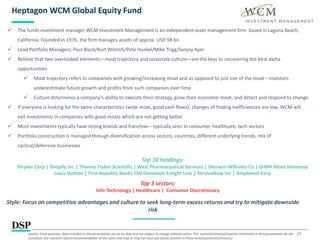
Heptagon WCM Global Equity Fund
Style: Focus on competitive advantages and culture to seek long-term excess returns and try to mitigate downside
risk
 The funds investment manager WCM Investment Management is an independent asset management firm based in Laguna Beach,
California. Founded in 1976, the firm manages assets of approx. USD 98 bn
 Lead Portfolio Managers: Paul Black/Kurt Winrich/Pete Hunkel/Mike Trigg/Sanjoy Ayer
 Believe that two overlooked elements—moat trajectory and corporate culture—are the keys to uncovering the best alpha
opportunities
 Moat trajectory refers to companies with growing/increasing moat and as opposed to just size of the moat – investors
underestimate future growth and profits from such companies over time
 Culture determines a company’s ability to execute their strategy, grow their economic moat, and detect and respond to change
 If everyone is looking for the same characteristics (wide moat, good cash flows), changes of finding inefficiencies are low. WCM will
exit investments in companies with good moats which are not getting better
 Most investments typically have strong brands and franchise – typically seen in consumer, healthcare, tech sectors
 Portfolio construction is managed through diversification across sectors, countries, different underlying trends, mix of
cyclical/defensive businesses
Top 10 holdings:
Stryker Corp | Shopify Inc | Thermo Fisher Scientific | West Pharmaceutical Services | Sherwin-Williams Co | LVMH Moet Hennessy
Louis Vuitton | First Republic Bank| Old Dominion Freight Line | ServiceNow Inc | Amphenol Corp
Top 3 sectors:
Info Technology | Healthcare | Consumer Discretionary
Source: Fund websites, Data included in this presentation are as on date and are subject to change without notice. The sector(s)/stock(s)/issuer(s) mentioned in this presentation do not
constitute any research report/recommendation of the same and may or may not have any future position in these sector(s)/stock(s)/issuer(s)
28
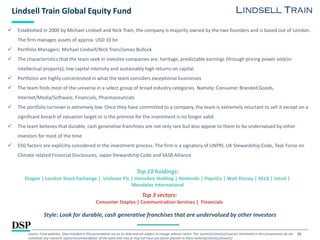
Lindsell Train Global Equity Fund
 Established in 2000 by Michael Lindsell and Nick Train, the company is majority owned by the two founders and is based out of London.
The firm manages assets of approx. USD 33 bn
 Portfolio Managers: Michael Lindsell/Nick Train/James Bullock
 The characteristics that the team seek in investee companies are: heritage, predictable earnings (through pricing power and/or
intellectual property), low capital intensity and sustainably high returns on capital.
 Portfolios are highly concentrated in what the team considers exceptional businesses
 The team finds most of the universe in a select group of broad industry categories. Namely; Consumer Branded Goods,
Internet/Media/Software, Financials, Pharmaceuticals
 The portfolio turnover is extremely low. Once they have committed to a company, the team is extremely reluctant to sell it except on a
significant breach of valuation target or is the premise for the investment is no longer valid.
 The team believes that durable, cash generative franchises are not only rare but also appear to them to be undervalued by other
investors for most of the time
 ESG factors are explicitly considered in the investment process. The firm is a signatory of UNPRI, UK Stewardship Code, Task Force on
Climate related Financial Disclosures, Japan Stewardship Code and SASB Alliance
Style: Look for durable, cash generative franchises that are undervalued by other investors
Top 10 holdings:
Diageo | London Stock Exchange | Unilever Plc | Heineken Holding | Nintendo | PepsiCo | Walt Disney | RELX | Intuit |
Mondelez International
Top 3 sectors:
Consumer Staples | Communication Services | Financials
Source: Fund websites, Data included in this presentation are as on date and are subject to change without notice. The sector(s)/stock(s)/issuer(s) mentioned in this presentation do not
constitute any research report/recommendation of the same and may or may not have any future position in these sector(s)/stock(s)/issuer(s)
TEAM
30
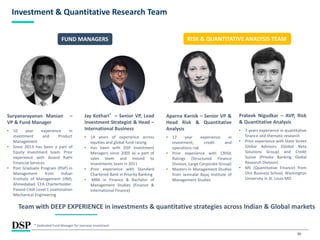
Investment & Quantitative Research Team
FUND MANAGERS
Aparna Karnik – Senior VP &
Head Risk & Quantitative
Analysis
• 17 year experience in
investment, credit and
operations risk
• Prior experience with CRISIL
Ratings (Structured Finance
Division, Large Corporate Group)
• Masters in Management Studies
from Jamnalal Bajaj Institute of
Management Studies
Prateek Nigudkar – AVP, Risk
& Quantitative Analysis
• 7 years experience in quantitative
finance and thematic research
• Prior experience with State Street
Global Advisors (Global Beta
Solutions Group) and Credit
Suisse (Private Banking Global
Research Division)
• MS (Quantitative Finance) from
Olin Business School, Washington
University in St. Louis MO
Team with DEEP EXPERIENCE in investments & quantitative strategies across Indian & Global markets
Suryanarayanan Manian –
VP & Fund Manager
• 10 year experience in
investment and Product
Management
• Since 2013 has been a part of
Equity Investment team. Prior
experience with Anand Rathi
Financial Services
• Post Graduate Program (PGP) in
Management from Indian
Institute of Management (IIM),
Ahmedabad. CFA Charterholder.
Passed CAIA Level 1 examination
Mechanical Engineering
RISK & QUANTITATIVE ANALYSIS TEAM
Jay Kothari* – Senior VP, Lead
Investment Strategist & Head –
International Business
• 14 years of experience across
equities and global fund raising
• Has been with DSP Investment
Managers since 2005 as a part of
sales team and moved to
Investments team in 2011
• Prior experience with Standard
Chartered Bank in Priority Banking
• MBA in Finance & Bachelor of
Management Studies (Finance &
International Finance)
* Dedicated Fund Manager for overseas investment
31
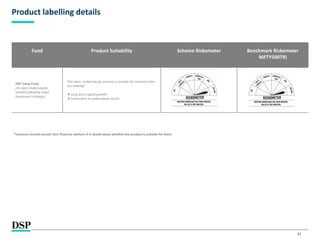
Product labelling details
*Investors should consult their financial advisors if in doubt about whether the product is suitable for them.
Fund Product Suitability Scheme Riskometer Benchmark Riskometer
NIFTY500TRI
DSP Value Fund
(An open ended equity
scheme following value
investment strategy)
This open ended equity scheme is suitable for investors who
are seeking*
Long term capital growth
Investment in undervalued stocks
32
Disclaimer
In this material DSP Investment Managers Private Ltd. (the AMC) has used information that is publicly available, including information developed in-house.
Information gathered and used in this material is believed to be from reliable sources. The AMC however does not warrant the accuracy, reasonableness and /
or completeness of any information. The data/statistics are given to explain general market trends in the securities market, it should not be construed as any
research report/research recommendation. We have included statements / opinions / recommendations in this document, which contain words, or phrases
such as “will”, “expect”, “should”, “believe” and similar expressions or variations of such expressions that are “forward looking statements”. Actual results may
differ materially from those suggested by the forward looking statements due to risk or uncertainties associated with our expectations with respect to, but not
limited to, exposure to market risks, general economic and political conditions in India and other countries globally, which have an impact on our services and /
or investments, the monetary and interest policies of India, inflation, deflation, unanticipated turbulence in interest rates, foreign exchange rates, equity prices
or other rates or prices etc.
The sector(s)/stock(s)/issuer(s) mentioned in this presentation do not constitute any research report/recommendation of the same and the Fund may or
may not have any future position in these sector(s)/stock(s)/issuer(s). The portfolio of the scheme is subject to changes within the provisions of the Scheme
Information document of the scheme. Past performance may or may not sustain in future and should not be used as a basis for comparison with other
investments. The figures pertain to performance of the index and do not in any manner indicate the returns/performance of the Scheme. It is not possible to
invest directly in an index. All opinions, figures, charts/graphs and data included in this presentation are as on date and are subject to change without notice.
There is no assurance of any returns/capital protection/capital guarantee to the investors in the Scheme.
The distribution of this material in certain jurisdictions may be restricted or subject to registration requirements and, accordingly, persons who come into
possession of this material in such jurisdictions are required to in form themselves about, and to observe, any such restrictions.
The strategy mentioned has been currently followed by the Scheme and the same may change in future depending on market conditions and other factors.
There is no guarantee/assurances of returns/income generation/ capital protection in the Scheme. Please refer to the SID for investment pattern, strategy,
risk factors and other details which is available at www.dspim.com.
Investors are advised to consult their own legal, tax and financial advisors to determine possible tax, legal and other financial implication or consequence of
subscribing to the units of DSP Mutual Fund.
For complete details on investment objective, investment strategy, asset allocation, scheme specific risk factors and more details, please read the Scheme
Information Document, Statement of Additional Information and Key Information Memorandum of respective scheme available on ISC of AMC and also
available on www.dspim.com
Click here for performance in SEBI prescribed format and of other schemes managed by same Fund Manager.
Mutual Fund investments are subject to market risks, read all scheme related documents carefully.
INVESTMENT MANAGERS

DSP Value Fund

  • 1.
    [Title to come] [Sub-Titleto come] Strictly for Intended Recipients Only Date * DSP India Fund is the Company incorporated in Mauritius, under which ILSF is the corresponding share class DSP Value Fund November 2021
  • 2.
    2 What you canexpect from this fund Potential for steady long-term compounding with lower drawdowns/volatility than the benchmark Conservative approach to portfolio construction – established business models + valuation comfort + diversification A portfolio having low commonality with benchmark 1 2 3
  • 3.
    3 DSP Philosophy forValue Investing Quality companies at reasonable prices as opposed to mediocre companies at cheap prices Diversification by investing upto 35% in Overseas investments Risk management by stock/sector diversification and position sizing based on underlying stock liquidity Combining strengths of quantitative (unbiased/rule based) and fundamental (experience) investment approaches Willingness to hold some cash when we can’t find suitable investments 1 2 3 4 5
  • 4.
    4 Performance as on29th October 2021 (annualized, INR terms ) Source: Bloomberg, FactSet, Internal YTD 1-year 3-years 5-years 10-years 5yr Wkly. Ret. Correlation vs Nifty 500 5yr Volatility Value Strategy* 28.0% 44.6% 20.6% 16.9% 16.7% 0.78 10.0% Nifty 500 TRI 32.2% 59.1% 21.2% 16.3% 14.9% 1.00 17.7% MSCI ACWI Gross Total Return 20.3% 38.6% 18.6% 18.0% 16.8% 0.47 14.4% Berkshire Hathaway – B 27.0% 42.9% 12.3% 17.5% 19.0% 0.31 21.0% Harding Loevner Global Equity – A 18.9% 35.2% 22.5% 20.8% 18.1% 0.42 15.0% Lindsell Train Global Equity – C 4.8% 21.4% 13.6% 18.5% -- 0.40 13.4% Veritas Global Focus – A 17.4% 30.9% 16.2% 17.2% 16.0% 0.45 14.8% Heptagon WCM Global Equity – I 16.9% 33.7% 28.3% 24.1% -- 0.39 16.1% Data Source: FactSet, Bloomberg, Morningstar, MFIE, Internal. Past performance may or may not sustain in future and should not be used as a basis for comparison with other investments. These figures pertain to performance of the model and do not in any manner indicate the returns/performance of the Scheme. One cannot invest directly in an index. *The performance numbers for the Value Strategy depicted in the table above are total return series from 30-Sep-2007 to 10-Dec-2020 computed based on the investment process described in the presentation. These returns consider 65% allocation to domestic equities and.35% allocation to overseas managers has been assumed, with equal weights for each manager. Returns for domestic portfolio are net of 3% annual fees and impact costs. Post 10-Dec-20 which is the inception date of DSP Value Fund, the regular plan returns have been used in the above calculations Global index performance is shown for illustrative purpose Performance of WCM Global Equity Fund prior to 24-Sep-2019, is represented by returns of a similar strategy named WCM Focused Global Growth Fund from 28-Jun-2013 to 23-Sep-2019.
  • 5.
    5 3-year Rolling ReturnRange (annualized, INR term ) Source: Bloomberg, FactSet, Internal Data Source: FactSet, MFIE, Internal. Past performance may or may not sustain in future and should not be used as a basis for comparison with other investments. These figures pertain to performance of the model and do not in any manner indicate the returns/performance of the Scheme. One cannot invest directly in an index. *The performance numbers depicted in the table above are total return series for the Value Strategy computed based on the investment process described in the presentation. These returns consider 65% allocation to domestic equities and.35% allocation to overseas managers has been assumed, with equal weights for each manager. Returns for domestic portfolio are net of 3% annual fees and impact costs. Post 10-Dec-20 which is the inception date of DSP Value Fund, the regular plan returns have been used in the above calculations Performance has been depicted for the period where comparable returns data for all above overseas holdings was available. The first data point refers to 3 year annualized returns from 30-Jun-2014 to 30- Jun-2017 Global index performance is shown for illustrative purpose Performance of WCM Global Equity Fund prior to 24-Sep-2019, is represented by returns of a similar strategy named WCM Focused Global Growth Fund from 28-Jun-2013 to 23-Sep-2019. [Period: 30-Jun-2017 to 29-Oct-2021] 0.1% -6.3% 2.6% 3.6% 6.0% 9.2% 5.4% 8.2% 22.3% 23.9% 19.8% 24.4% 23.6% 24.1% 20.0% 30.4% -10% -5% 0% 5% 10% 15% 20% 25% 30% 35% 40% Value Strategy Nifty 500 TRI MSCI ACWI TR Gross Berkshire Hathaway – B Harding Loevner Global Equity – A Lindsell Train Global Equity – C Veritas Global Focus – A WCM Global Equity – I
  • 6.
    6 Top and BottomContributors to relative returns - YTD October 2021 Portfolio Index Attribution Holding Average Weight Average Weight Total Effect Top 10 relative stock contributors HDFC Bank^ -- 6.6 1.30 Persistent Systems 1.3 0.1 1.01 Kotak Mahindra Bank^ -- 2.7 0.97 Tata Chemicals 0.5 0.1 0.95 Mindtree 1.5 0.2 0.94 Bharat Electronics 2.7 0.2 0.94 HDFC Ltd^ -- 4.7 0.91 Mphasis 2.1 0.2 0.86 Hindustan Unilever^ -- 2.2 0.67 Ambuja Cements 2.8 0.2 0.61 Bottom 10 relative stock contributors Dr. Reddy's Laboratories Ltd. 2.9 0.6 -1.11 Lindsell Train Global Equity Fund Class C USD 4.8 -- -0.98 Hero Motocorp 2.7 0.4 -0.86 ICICI Bank^ -- 4.4 -0.69 Amara Raja Batteries 1.0 0.1 -0.58 State Bank of India^ -- 1.5 -0.58 Cipla Ltd 2.9 0.5 -0.54 Harding Loevner Global Equity Class A USD 4.7 -- -0.50 Veritas Global Focus Fund Class A USD 5.7 -- -0.47 Tata Motors^ -- 0.6 -0.44 Attribution results shown above are for DSP Value Fund relative to benchmark NIFTY 500 TR Index Returns are gross basis including income reinvested and in INR terms Source: FactSet • Top contributors: • Portfolio holdings in midcap IT companies, names in materials/industrials space contributed to returns • Underweight on large cap financials such as HDFC Bank helped, since these underperformed the benchmark • Underweight on FMCG names such as Hindustan Unilever helped, since these underperformed the benchmark • Top detractors: • Overseas holdings were detractors in relative terms since MSCI ACWI underperformed NIFTY500 by 12% YTD • Within overseas funds, Lindsell Train underperformed due to Europe/Japan tilt and large weight in consumer staples space • Two wheelers and pharma stocks underperformed the benchmark ^ refers to names that are sizeable index weights, but not held by the fund
  • 7.
    7 Value Strategy -NAV Growth Source: Bloomberg, FactSet, Internal Data Source: FactSet, MFIE, Internal. Past performance may or may not sustain in future and should not be used as a basis for comparison with other investments. These figures pertain to performance of the model and do not in any manner indicate the returns/performance of the Scheme. One cannot invest directly in an index. *The performance numbers depicted in the table above are total return series from 30-Sep-2007 to 10-Dec-2020 for the Value Strategy computed based on the investment process described in the presentation. These returns consider 65% allocation to domestic equities and.35% allocation to overseas managers has been assumed, with equal weights for each manager. Returns for domestic portfolio are net of 3% annual fees and impact costs. Post 10-Dec-20 which is the inception date of DSP Value Fund, the regular plan returns have been used in the above calculations 0 100 200 300 400 500 600 700 Sep-07 Sep-09 Sep-11 Sep-13 Sep-15 Sep-17 Sep-19 Sep-21 DSP Value Strategy NIFTY 500 TR Index
  • 8.
    8 Where does ourFramework find Value currently? Source: Internal, Bloomberg, Factset. • Excessive Valuations: Valuations in consumer space, chemicals, financial services (exchanges, AMCs, etc), insurance, healthcare services (hospital/labs), industrial manufacturing (equipment manufacturers, products used in construction such as pipes etc), real estate, logistics, renewable energy appear to be excessive and hence such names are not included in the domestic portfolio • Reasonable valuation + good quality businesses: are found in cement, fertilisers, select automobiles, pharma, IT, construction, power and select consumer goods – portfolio holdings are from these sectors Green represents valuation comfort Yellow represents reasonable valuations Orange/red represents excessive valuations SUB-SECTOR SECTOR WEIGHT IN INDEX WEIGHT IN INDEX (MEETING QUALITY CRITERIA)* WEIGHT IN PORTFOLIO MEDIAN VALUATIONS CEMENT & CEMENT PRODUCTS 2.6 2.0 5.3 CHEMICALS 1.8 1.0 1.6 FERTILISERS & PESTICIDES 0.8 0.5 1.5 MINERALS/MINING 3.8 0.6 1.8 AUTOMOBILE 3.6 1.1 2.5 CONSUMER GOODS 11.9 7.8 9.2 CONSUMER SERVICES 2.1 0.3 -- OIL & GAS 9.6 0.5 0.8 BANK 18.6 * -- FINANCIAL SERVICES 0.7 0.2 -- INSURANCE 2.7 * -- NBFC 9.0 * -- HEALTHCARE SERVICES 1.0 0.3 -- PHARMA 4.6 2.9 9.8 IT 13.8 13.5 15.6 AUTO COMPONENTS 1.2 0.4 -- CONSTRUCTION & REAL ESTATE 3.0 1.9 3.8 INDUSTRIAL MANUFACTURING 2.4 1.0 6.3 TRANSPORTATION & LOGISTICS 1.4 0.2 0.7 POWER 2.5 0.1 0.9 *Quality criteria are given in slide 12. Companies that do not meet these criteria are automatically excluded from the consideration set for the fund * Financials are excluded since they have high leverage (Banks/NBFCs), and hence higher volatility. Capital light financials and financial intermediaries (such as stock exchanges, rating agencies etc.) may be included in the portfolio
  • 9.
    9 Portfolio Characteristics (October2021) Domestic portfolio only NIFTY500 Valuation Metrics Dividend Yield (%) 1.8 1.0 P/E 21.5 25.0 P/E FY1 Est 20.5 24.3 P/E FY2 Est 17.4 20.5 Price/Cash Flow 16.5 15.8 Price/Book 3.9 3.5 Price/Sales 3.0 2.8 Growth Metrics Historical 3Yr Sales Growth (%) 8.0 9.7 Historical 3Yr EPS Growth (%) 19.3 18.2 Quality metrics ROA (%) 12.2 8.5 ROE (%) 19.6 15.3 Operating Margin (%) 18.1 20.4 Net Margin (%) 14.4 12.3 LT Debt/Capital (%) 8.8 27.5 *Source: FactSet. Weighted harmonic mean is used as a basis of calculation for P/E, P/B, Price/Cash Flow, Price/Sales. Rest of the aggregates are calculated on weighted average basis. The overseas portfolios statistics have been considered based on data availability and may not reflect the latest portfolios. However, given that these are low turnover portfolios, the characteristics have been computed as an estimate.. The above data is based on underlying portfolio and constituents of Nifty 500 TRI. The growth metrics are based on fiscal year data. • Portfolio reflects value characteristics as seen from higher dividend yield, lower P/E vs index. Other Valuation metrics are comparable with the index • Portfolio quality can be seen through superior EPS growth demonstrated by the portfolio companies and superior RoA, RoE, net margins as well as lower leverage
  • 10.
    10 Portfolio Details -Oct 2021 Company/Sector Mkt Cap % of Net Assets Company/Sector Mkt Cap % of Net Assets Company/Sector Mkt Cap % of Net Assets Hero Motocorp L 1.2% Larsen & Toubro L 2.4% Ambuja Cements L 2.2% Bajaj Auto L 1.3% Bharat Electronics M 1.7% Ultratech Cement L 2.2% KPR Mill S 1.1% Hindustan Aeronautics M 1.4% Coromandel International M 1.5% Lux Industries S 0.7% Polycab M 1.0% Atul Ltd M 1.3% Vardhman Textiles S 0.6% KEI Industries S 0.9 Dalmia Bharat M 1.0% Consumer Discretionary 4.9% KNR Constructions S 0.8% DCM Shriram S 0.9% ITC L 2.5% PNC Infratech S 0.7% EPL Ltd. S 0.7% Radico Khaitan S 1.8% Industrials 8.8% Finolex Industries S 0.6% Balrampur Chini Mills S 0.9% HCL Technologies L 2.7% Sudarshan Chemicals S 0.3% CCL Products Ltd. S 0.8% Infosys L 2.6% Materials 10.9% Consumer Staples 5.9% Tech Mahindra L 3.0% Cipla L 3.0% Coal India L 1.8% Wipro L 2.6% Dr Reddy’s L 2.4% GE Shipping Company S 0.7% Mphasis M 1.5% IPCA Laboratories M 1.9% Energy 2.5% Oracle Financial Services M 1.5% Alkem Laboratories M 1.7% CESC S 0.9% Cyient S 1.1% Aarti Drugs S 0.7% Gujarat State Petronet Ltd M 0.8% eClerx Services S 1.7% Healthcare 9.8% Utilities 1.8% Information Technology 15.6% Berkshire Hathaway Inc Class B Overseas 6.4% Cash & Cash Equivalent 7.6% Harding Loevner Global Equity Fund Overseas 7.2% Lindsell Train Global Equity Fund Overseas 5.0% Veritas Global Focus Fund Overseas 7.6% Heptagon WCM Global Equity Fund Overseas 6.6% Portfolio as on 29th October 2021. The sector(s)/stock(s)/issuer(s) mentioned in this presentation do not constitute any research report/recommendation of the same and may or may not have any future position in these sector(s)/stock(s)/issuer(s). L = large cap, M= midcap, S = smallcap
  • 11.
  • 12.
    12 Rigorous framework forQuality at Reasonable Price ELIMINATE POOR QUALITY ELIMINATE HIGH VALUATIONS 500 stock Universe:NIFTY500 (Large + mid + small) VALUATION FILTERS Exclude stocks which may destroy value × High leverage** × Excessive volatility in stock prices × Companies with accounting and governance red flags × Companies showing poor growth or disrupted business models Select from remaining list by scoring stocks based on: ✅ Profitability (high RoE) ✅ Stable earnings growth ✅ Favorable growth prospects ✅ Dividend paying ✅ Positive free cash flow generation Exclude stocks which are excessively valued relative to benchmarks × Current stock valuation (P/B) is benchmarked to long term sector averages × Benchmarking factors in company specific fundamentals like profitability, growth and marketcap × Based on a proprietary multi variate regression based valuation model SELECTION CRITERIA SELECT GOOD COMPANIES FUNDAMENTAL INPUTS FINAL SELECTION Research team inputs taken on stocks that pass all above criteria × To avoid value traps × To avoid cyclical companies at peak earnings ** Financials are excluded since they have high leverage (Banks/NBFCs), and hence higher volatility. Quality financials are richly valued (do not meet valuation criteria). The team may revisit this stance if these factors change materially. Capital light financials and financial intermediaries (such as stock exchanges, rating agencies etc.) may be included in the portfolio
  • 13.
    13 Elimination criteria Difficulty toservice interest payments Raises risk of defaults which further tightens liquidity In case of defaults, creditors get preference over equity holders × High DEBT TO EQUITY HIGHLY LEVERAGED COMPANIES × High BETA HIGHLY VOLATILE STOCKS POOR QUALITY OF REPORTED EARNINGS × High PRICE VOLATILITY Typically highly cyclical businesses Disproportionately high stock price volatility on a relative & absolute basis Potential red flag Haven’t added value to equity holders over the long term × LOW reliability of earnings × WEAK balance sheets × POOR cash conversion × Potential governance issues Accounting & Management issues can lead to severe value destruction Forensic analysis of financials disclosures can throw up potential red flags Extensive criteria to identify and eliminate potential value destroyers from the investible universe DISRUPTED BUSINESS MODELS × POOR growth and DECLINING profits Technology/ regulatory changes can lead to obsolescence of a business model Such companies look cheap compared with their own history but are value traps
  • 14.
    14 Elimination criteria foraccounting and governance red flags PARAMETERS CONSIDERED EARNINGS QUALITY BALANCE SHEET HEALTH WORKING CAPITAL CYCLE GOVERNANCE FUND DIVERSION Large divergence in accounting v/s cash flow entries suggest aggressive accounting policies Examples: × Divergence in EBITDA v/s Cash Flow from Operations × Material below the line adjustments × Outlier depreciation rates × Significant non-recurring items in income statement × Large and increasing unbilled revenues Badly managed balance sheets at higher risk of financial distress Examples: Weak metrics on × Interest coverage ratio × Debt/Equity market capitalization × Credit rating × High dependency on short term financing Cash flow conversion & liquidity issues are early signs of business problems Example: Variability and deterioration in × Debtor days, inventory days and creditor days Poor governance standards are a red flag Examples: × Poor ESG ratings × Negative vote recommendations by proxy advisory firms × Controversies × Qualified auditor comments Imprudent management actions can destroy minority shareholder value Examples: × High promoter pledge × High related party transactions × High loans and advances × Poor returns on investments Forensic analysis is a critical part of the elimination process
  • 15.
    HCL Technologies Infosys TCS OFSS LT Infotech TechMahindra Mphasis Cyient Tata Elxsi Coforge Persistent Systems KPIT Technologies Mindtree Wipro eClerx - 5 10 15 20 25 30 - 10 20 30 40 50 Price to book RoE Illustration: Information Technology Sector, P/B vs RoE 0 2 4 6 8 10 12 14 16 18 20 -6 0 6 12 18 24 30 36 42 48 54 60 Price to book RoE Chart 1: Indian companies, slope of P/B vs RoE (10 years) Valuation criteria to screen out expensively valued companies • Proprietary valuation model based on long term fundamental data • P/B is used as a primary metric to evaluate valuations • Fundamental data (variables) considered in the model include sector, RoE, growth and marketcap (size) of the company • Sector premium/discounts exist – these could be a function of the nature of assets (tangible assets like plant and machinery vs intangible assets such as brands), accounting treatment affecting companies within a sector, sector growth prospects (attractive growth vs declining or mature sectors) etc. • Companies with higher RoE and growth tend to command premium valuations • Large caps usually trade at premium to smallcaps • Companies having high P/B compared with the model indicated P/B are eliminated (located in the expensive valuation zone – see Chart 1) NOTE:Chart 1 is Based on March data over past 10 years for stocks that are part of BSE200. The illustration on the right chart shows Sep-21 data for companies within IT sector. The sector(s)/stock(s)/issuer(s) mentioned in this presentation do not constitute any research report/recommendation of the same and the Fund may or may not have any future position in these sector(s)/stock(s)/issuer(s). Data Source: Bloomberg, DSP Investment Managers
  • 16.
    16 Deep focus onrisk management  No sector concentration (sector weights capped at 20%)  No stock concentration (stock weights capped at 6 % and stock active weights also capped)  Stocks with limited/low liquidity assigned weights of no more than 1% (measured through days taken to liquidate the position using average market volumes)  Avoiding stocks with high leverage, forensic red flags, high price volatility – highly volatile stocks  Avoiding stocks that show weakening growth, profits and margins – disrupted business models  Valuation risk managed by eliminating excessively valued companies  Avoiding loss making companies Disclaimer: The presentation indicates the strategy/investment approach currently followed by the scheme and the same may change in future depending on market conditions and other factors
  • 17.
  • 18.
    18 Countries go throughcycles of growth and valuation Source: Bloomberg, Fund Factsheet. Performance in INR terms of the respective indices Country performance represented by MSCI Total Return Index variant, *Blend = 65% India, 35% overseas (20% US, 5% Europe, 5% China, 5% Japan), Annualised volatility is computed as standard deviation of monthly returns times SQRT(12) Annual returns (past 20 years in INR terms) INDIA USA JAPAN CHINA EUROPE UK Blend* 2000-2005 19.7% -0.2% 4.0% 7.4% 3.4% 3.6% 14.0% 2006-2010 17.6% 2.3% -2.5% 20.4% 3.3% 2.4% 13.6% 2011-2015 5.6% 21.7% 13.2% 9.2% 13.0% 12.0% 10.2% 2016-2020 11.7% 18.0% 11.2% 17.5% 9.5% 4.7% 13.6% 20Y CAGR 13.5% 10.0% 6.3% 13.5% 7.2% 5.6% 12.8% 20Y Ann. Volatility 22.8% 14.0% 13.9% 23.1% 16.2% 14.9% 17.5% 60% 21% 6% 2% 2% 8% DSP Value Fund - Geographic Allocation India North America Europe Asia Pacific & Emerging Markets Japan Cash
  • 19.
    19 Sectors go throughcycles of growth and valuation DSP Value Fund: Overseas portfolio holdings – sector allocation 19% 12% 12% 18% 10% 0% 10% 1% 14% 4% Healthcare Communication Services Industrials Info Tech Financials Energy Cons Discretionary Materials Cons Staples Cash Source: Bloomberg, Fund Factsheet. Performance in INR terms of the respective indices Sectoral performance represented by MSCI Total Return Index variant, Annualised volatility is computed as standard deviation of monthly returns times SQRT(12) Annual returns (past 20 years in INR terms) Communic ation Services Consumer Discretion ary Consumer Staples Energy Financials Health Care Industrials Info. Technology Materials Utilities All Cap World Index 2000-2005 -5.2% 2.3% 4.4% 13.6% 5.2% -0.5% 3.9% -6.6% 14.5% 4.7% 2.7% 2006-2010 7.9% 4.3% 9.6% 7.0% -4.2% 2.5% 4.9% 4.1% 12.7% 5.7% 3.8% 2011-2015 14.5% 21.0% 20.0% 3.0% 13.4% 27.2% 14.8% 20.2% 0.3% 11.8% 15.4% 2016-2020 12.1% 18.3% 9.9% 1.9% 9.7% 12.6% 13.8% 29.2% 17.1% 12.0% 15.1% 20Y CAGR 7.1% 11.2% 10.8% 6.3% 5.8% 9.9% 9.2% 10.8% 11.0% 8.5% 9.1% 20Y Ann.Volatility 15.7% 16.1% 10.3% 20.7% 18.1% 11.8% 15.9% 21.0% 19.1% 11.9% 13.8%
  • 20.
    20 USD exposure: Tailwindfor returns + reduces volatility in times of stress Long term trend of USD appreciation vs. INR @2.2%p.a. (tailwind for returns) USD exposure reduces volatility in times of stress -30% -25% -20% -15% -10% -5% 0% 5% 10% Nifty 50 TRI USDINR 35 40 45 50 55 60 65 70 75 80 USDINR spot rate Source: Bloomberg, USD INR Long Term Trend (20 Years) Worst 10 NIFTY monthly returns (past 20 years) and corresponding USD appreciation relative to INR
  • 21.
    21 Swapping Financials withOverseas Holdings  Reduces portfolio beta and leverage while improving the profitability metrics  No dilution in returns based on past data NIFTY Bank TRI Index Overseas Holdings blended RoE* (%) 12.3 17.2 Beta with NIFTY 500 TRI 1.23 0.35 Returns (5 CAGR %) 15.3 19.9 Source: Bloomberg, FactSet *Latest fiscal year RoE
  • 22.
    22 Overseas holdings: Uniquebusiness models not present in India  A broad based exposure to overseas opportunities  Active managers can identify opportunities beyond the established mega cap names • e.g. niche products and services, innovators that can grow market share  Active managers can tactically change portfolios • e.g. changes in valuations, regulatory risks, changing industry dynamics across sectors and countries • As shown in the earlier slides, managers selected have demonstrated superior returns with lower risk FAANG+ European luxury brands Fintech Aerospace Global consumer brands Medical devices and healthcare Financial infrastructure Providers Industrials Semiconductors China Tech Apparel E-commerce Entertainment and gaming Medical devices and healthcare innovators Disclaimer: The sector(s) mentioned in this presentation do not constitute any research report/recommendation of the same and may or may not have any future positions in these sectors(s)
  • 23.
  • 24.
    24 Overseas investments: ActiveMulti-Manager Approach  People: Talented and accountable investment leadership, with aligned interests with investors through co-investments and controlled growth in assets  Process: Well articulated, high conviction portfolio construction, with consistent, transparent, repeatable processes – aligned with philosophy of DSP Value Fund  Performance: Strong performance track record in bull and bear markets, potential for material outperformance over the long term, after fees. What we look for…. Overseas mutual funds are all UCITS* regulated funds *The Undertakings for the Collective Investment in Transferable Securities (UCITS) is a regulatory framework of the European Commission that creates a harmonized regime throughout Europe for the management and sale of mutual funds. UCITS funds can be registered in Europe and sold to investors worldwide using unified regulatory and investor protection requirements.  Quantitative:  Long term track record of beating index (MSCI ACWI)  Lower volatility vs index  Superior up-capture down-capture ratio (above 1)  Lower drawdowns vs index  Qualitative:  Pedigree and experience of managing global portfolios across cycles  Evaluate whether portfolios reflect the stated philosophies  Respect for valuation parameters in the process Selection parameters
  • 25.
    25 Veritas Global FocusFund Style: Real returns mindset (Inflation + 6-10%). Focused on minimizing the risk of permanent capital loss through valuation discipline  Established in 2003, Veritas Asset Management LLP (“VAM LLP”) is an independently managed investment firm based in London and HK managing assets of approx. USD 23 bn  Portfolio Managers: Andrew Headley/Mike Moore  Investments are analyzed on an absolute basis rather than relative to an index  The portfolio managers target annualized portfolio returns of OECD G7 Consumer Price Index (CPI) + 6-10% p.a. over rolling five-year periods. The aim is to generate excellent real returns and minimize the risk of permanent capital loss  Value disciplined. Only invest when attractive real returns achievable  Portfolio typically contains fewer than 30 stocks and is focused on a handful of themes  Investment themes: Rising Tide Industry Winners, Scarcity and Supply Constraint, Enduring Business Models  Quality is defined as companies that generate significant free cash flow, have distinct structural drivers to ensure that generation is sustainable, offer barriers that prevent competitors competing that cash away, management that deploys the cash in a predictable manner, are well governed and have sustainable demand for their products and services.  ESG considerations fully embedded into assessment of quality. The firm is a signatory of UNPRI Top 10 holdings: Alphabet | Charter Communications | Microsoft |Unilever Plc | BAE Systems | Amazon.com | Canadian Pacific Railway | UnitedHealth | Thermo Fisher Scientific | Facebook Top 3 sectors: Healthcare | Industrials | Communication Services Source: Fund websites, Data included in this presentation are as on date and are subject to change without notice. The sector(s)/stock(s)/issuer(s) mentioned in this presentation do not constitute any research report/recommendation of the same and may or may not have any future position in these sector(s)/stock(s)/issuer(s)
  • 26.
    26 Harding Loevner GlobalEquity Fund Style: A diversified portfolio of high quality and durable growth companies purchased at reasonable prices will provide superior investment returns with below average risk over the long term  Founded in 1989, Harding Loevner LP offers investment strategies across global, and emerging markets equities. Its offices are in Bridgewater, New Jersey (USA). The firm manages assets of approx. USD 84 bn  Lead Portfolio Managers: Peter Baughan, CFA/Jingyi Li  Focus on identifying high quality and growing companies using objective data and bottom-up research  Standardized framework for assessment of quality: Competitive advantage evidenced by sustainableRoCE above cost of capital within a supportive industry structure, sustainable growth underpinned by long term fundamental trends  The portfolio consistently has superior profit margin, RoA, Debt/Equity, RoE, sales growth, earnings growth, cash flow growth, lower variability of RoE compared with its benchmark  Valuation discipline: Comprehensive financial forecasts are done to estimate fair valuation which goes into rating each company as buy/hold/sell and setting milestones  Risk guidelines are put in place to ensure diversification  ESG factors are explicitly considered in the investment process. The firm is a signatory of UNPRI and UK Stewardship Code Top 10 holdings: First Republic Bank | Alphabet | SVB Financial Group |Amazon.com | John Deere | WuXi Biologics | Facebook| Microsoft | Illumina | PayPal Top 3 sectors: Healthcare | Info Technology | Financials Source: Fund websites, Data included in this presentation are as on date and are subject to change without notice. The sector(s)/stock(s)/issuer(s) mentioned in this presentation do not constitute any research report/recommendation of the same and may or may not have any future position in these sector(s)/stock(s)/issuer(s)
  • 27.
    27 Heptagon WCM GlobalEquity Fund Style: Focus on competitive advantages and culture to seek long-term excess returns and try to mitigate downside risk  The funds investment manager WCM Investment Management is an independent asset management firm based in Laguna Beach, California. Founded in 1976, the firm manages assets of approx. USD 98 bn  Lead Portfolio Managers: Paul Black/Kurt Winrich/Pete Hunkel/Mike Trigg/Sanjoy Ayer  Believe that two overlooked elements—moat trajectory and corporate culture—are the keys to uncovering the best alpha opportunities  Moat trajectory refers to companies with growing/increasing moat and as opposed to just size of the moat – investors underestimate future growth and profits from such companies over time  Culture determines a company’s ability to execute their strategy, grow their economic moat, and detect and respond to change  If everyone is looking for the same characteristics (wide moat, good cash flows), changes of finding inefficiencies are low. WCM will exit investments in companies with good moats which are not getting better  Most investments typically have strong brands and franchise – typically seen in consumer, healthcare, tech sectors  Portfolio construction is managed through diversification across sectors, countries, different underlying trends, mix of cyclical/defensive businesses Top 10 holdings: Stryker Corp | Shopify Inc | Thermo Fisher Scientific | West Pharmaceutical Services | Sherwin-Williams Co | LVMH Moet Hennessy Louis Vuitton | First Republic Bank| Old Dominion Freight Line | ServiceNow Inc | Amphenol Corp Top 3 sectors: Info Technology | Healthcare | Consumer Discretionary Source: Fund websites, Data included in this presentation are as on date and are subject to change without notice. The sector(s)/stock(s)/issuer(s) mentioned in this presentation do not constitute any research report/recommendation of the same and may or may not have any future position in these sector(s)/stock(s)/issuer(s)
  • 28.
    28 Lindsell Train GlobalEquity Fund  Established in 2000 by Michael Lindsell and Nick Train, the company is majority owned by the two founders and is based out of London. The firm manages assets of approx. USD 33 bn  Portfolio Managers: Michael Lindsell/Nick Train/James Bullock  The characteristics that the team seek in investee companies are: heritage, predictable earnings (through pricing power and/or intellectual property), low capital intensity and sustainably high returns on capital.  Portfolios are highly concentrated in what the team considers exceptional businesses  The team finds most of the universe in a select group of broad industry categories. Namely; Consumer Branded Goods, Internet/Media/Software, Financials, Pharmaceuticals  The portfolio turnover is extremely low. Once they have committed to a company, the team is extremely reluctant to sell it except on a significant breach of valuation target or is the premise for the investment is no longer valid.  The team believes that durable, cash generative franchises are not only rare but also appear to them to be undervalued by other investors for most of the time  ESG factors are explicitly considered in the investment process. The firm is a signatory of UNPRI, UK Stewardship Code, Task Force on Climate related Financial Disclosures, Japan Stewardship Code and SASB Alliance Style: Look for durable, cash generative franchises that are undervalued by other investors Top 10 holdings: Diageo | London Stock Exchange | Unilever Plc | Heineken Holding | Nintendo | PepsiCo | Walt Disney | RELX | Intuit | Mondelez International Top 3 sectors: Consumer Staples | Communication Services | Financials Source: Fund websites, Data included in this presentation are as on date and are subject to change without notice. The sector(s)/stock(s)/issuer(s) mentioned in this presentation do not constitute any research report/recommendation of the same and may or may not have any future position in these sector(s)/stock(s)/issuer(s)
  • 29.
  • 30.
    30 Investment & QuantitativeResearch Team FUND MANAGERS Aparna Karnik – Senior VP & Head Risk & Quantitative Analysis • 17 year experience in investment, credit and operations risk • Prior experience with CRISIL Ratings (Structured Finance Division, Large Corporate Group) • Masters in Management Studies from Jamnalal Bajaj Institute of Management Studies Prateek Nigudkar – AVP, Risk & Quantitative Analysis • 7 years experience in quantitative finance and thematic research • Prior experience with State Street Global Advisors (Global Beta Solutions Group) and Credit Suisse (Private Banking Global Research Division) • MS (Quantitative Finance) from Olin Business School, Washington University in St. Louis MO Team with DEEP EXPERIENCE in investments & quantitative strategies across Indian & Global markets Suryanarayanan Manian – VP & Fund Manager • 10 year experience in investment and Product Management • Since 2013 has been a part of Equity Investment team. Prior experience with Anand Rathi Financial Services • Post Graduate Program (PGP) in Management from Indian Institute of Management (IIM), Ahmedabad. CFA Charterholder. Passed CAIA Level 1 examination Mechanical Engineering RISK & QUANTITATIVE ANALYSIS TEAM Jay Kothari* – Senior VP, Lead Investment Strategist & Head – International Business • 14 years of experience across equities and global fund raising • Has been with DSP Investment Managers since 2005 as a part of sales team and moved to Investments team in 2011 • Prior experience with Standard Chartered Bank in Priority Banking • MBA in Finance & Bachelor of Management Studies (Finance & International Finance) * Dedicated Fund Manager for overseas investment
  • 31.
    31 Product labelling details *Investorsshould consult their financial advisors if in doubt about whether the product is suitable for them. Fund Product Suitability Scheme Riskometer Benchmark Riskometer NIFTY500TRI DSP Value Fund (An open ended equity scheme following value investment strategy) This open ended equity scheme is suitable for investors who are seeking* Long term capital growth Investment in undervalued stocks
  • 32.
    32 Disclaimer In this materialDSP Investment Managers Private Ltd. (the AMC) has used information that is publicly available, including information developed in-house. Information gathered and used in this material is believed to be from reliable sources. The AMC however does not warrant the accuracy, reasonableness and / or completeness of any information. The data/statistics are given to explain general market trends in the securities market, it should not be construed as any research report/research recommendation. We have included statements / opinions / recommendations in this document, which contain words, or phrases such as “will”, “expect”, “should”, “believe” and similar expressions or variations of such expressions that are “forward looking statements”. Actual results may differ materially from those suggested by the forward looking statements due to risk or uncertainties associated with our expectations with respect to, but not limited to, exposure to market risks, general economic and political conditions in India and other countries globally, which have an impact on our services and / or investments, the monetary and interest policies of India, inflation, deflation, unanticipated turbulence in interest rates, foreign exchange rates, equity prices or other rates or prices etc. The sector(s)/stock(s)/issuer(s) mentioned in this presentation do not constitute any research report/recommendation of the same and the Fund may or may not have any future position in these sector(s)/stock(s)/issuer(s). The portfolio of the scheme is subject to changes within the provisions of the Scheme Information document of the scheme. Past performance may or may not sustain in future and should not be used as a basis for comparison with other investments. The figures pertain to performance of the index and do not in any manner indicate the returns/performance of the Scheme. It is not possible to invest directly in an index. All opinions, figures, charts/graphs and data included in this presentation are as on date and are subject to change without notice. There is no assurance of any returns/capital protection/capital guarantee to the investors in the Scheme. The distribution of this material in certain jurisdictions may be restricted or subject to registration requirements and, accordingly, persons who come into possession of this material in such jurisdictions are required to in form themselves about, and to observe, any such restrictions. The strategy mentioned has been currently followed by the Scheme and the same may change in future depending on market conditions and other factors. There is no guarantee/assurances of returns/income generation/ capital protection in the Scheme. Please refer to the SID for investment pattern, strategy, risk factors and other details which is available at www.dspim.com. Investors are advised to consult their own legal, tax and financial advisors to determine possible tax, legal and other financial implication or consequence of subscribing to the units of DSP Mutual Fund. For complete details on investment objective, investment strategy, asset allocation, scheme specific risk factors and more details, please read the Scheme Information Document, Statement of Additional Information and Key Information Memorandum of respective scheme available on ISC of AMC and also available on www.dspim.com Click here for performance in SEBI prescribed format and of other schemes managed by same Fund Manager. Mutual Fund investments are subject to market risks, read all scheme related documents carefully.
  • 33.