XML DTD, XMLSchema XSL, Xquery Web Services SOAP, WSDL RESTful Web Services Semantic Web Introduction RDF, RDF Schema, OWL, SPARQL Unit 10: XML and Web and Beyond
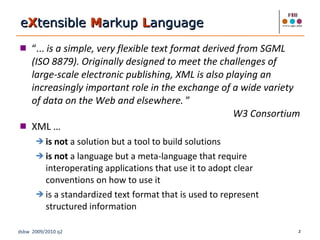
“ ...  is a simple, very flexible text format derived from SGML (ISO 8879). Originally designed to meet the challenges of large-scale electronic publishing, XML is also playing an increasingly important role in the exchange of a wide variety of data on the Web and elsewhere.  ”  W3 Consortium XML …  is not  a solution but a tool to build solutions is not  a language but a meta-language that require interoperating applications that use it to adopt clear conventions on how to use it is a standardized text format that is used to represent structured information e X tensible  M arkup  L anguage
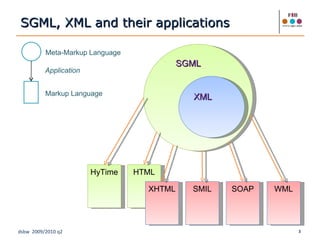
SGML, XML and their applications HyTime HTML XHTML SMIL SOAP WML SGML XML Meta-Markup Language Markup Language Application
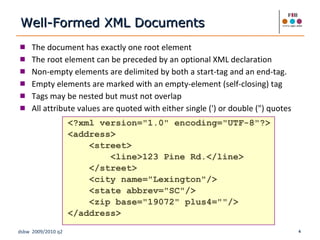
The document has exactly one root element The root element can be preceded by an optional XML declaration Non-empty elements are delimited by both a start-tag and an end-tag. Empty elements are marked with an empty-element (self-closing) tag Tags may be nested but must not overlap  All attribute values are quoted with either single (') or double (&quot;) quotes <?xml version=&quot;1.0&quot; encoding=&quot;UTF-8&quot;?> <address> <street> <line>123 Pine Rd.</line> </street> <city name=&quot;Lexington&quot;/> <state abbrev=&quot;SC&quot;/> <zip base=&quot;19072&quot; plus4=&quot;&quot;/> </address> Well-Formed XML Documents
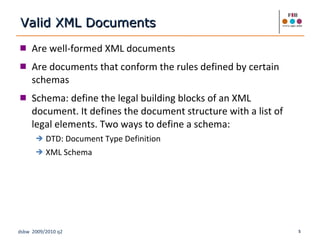
Are well-formed XML documents Are documents that conform the rules defined by certain schemas Schema: define the legal building blocks of an XML document. It defines the document structure with a list of legal elements. Two ways to define a schema: DTD: Document Type Definition  XML Schema Valid XML Documents
<?xml version=&quot;1.0&quot; encoding=&quot;UTF-8&quot;?> <!DOCTYPE address [ <!ELEMENT address (street, city, state, zip)> <!ELEMENT street line+> <!ELEMENT line (#PCDATA)> <!ELEMENT city (#PCDATA)> <!ELEMENT state (#PCDATA)> <!ELEMENT zip (#PCDATA)> ]> <address> ... </address> <?xml version=&quot;1.0&quot; encoding=&quot;UTF-8&quot;?> <!DOCTYPE address SYSTEM &quot;http://dtd.mycompany.com/address.dtd&quot;> <address> ... </address> DTD Example: Embedded and External Definitions
DTD is not integrated with Namespace technology so users cannot import and reuse code DTD does not support data types other than character data DTD syntax is not XML compliant DTD language constructs are no extensible DTD Limitations
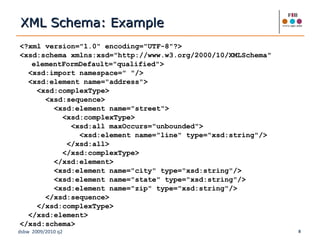
<?xml version=&quot;1.0&quot; encoding=&quot;UTF-8&quot;?> <xsd:schema xmlns:xsd=&quot;http://www.w3.org/2000/10/XMLSchema&quot; elementFormDefault=&quot;qualified&quot;> <xsd:import namespace=&quot; &quot;/> <xsd:element name=&quot;address&quot;> <xsd:complexType> <xsd:sequence> <xsd:element name=&quot;street&quot;> <xsd:complexType> <xsd:all maxOccurs=&quot;unbounded&quot;> <xsd:element name=&quot;line&quot; type=&quot;xsd:string&quot;/> </xsd:all> </xsd:complexType> </xsd:element> <xsd:element name=&quot;city&quot; type=&quot;xsd:string&quot;/> <xsd:element name=&quot;state&quot; type=&quot;xsd:string&quot;/> <xsd:element name=&quot;zip&quot; type=&quot;xsd:string&quot;/> </xsd:sequence> </xsd:complexType> </xsd:element> </xsd:schema> XML Schema: Example
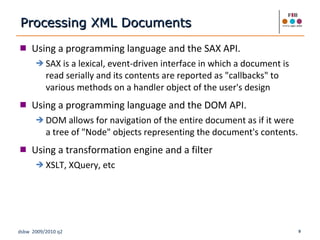
Using a programming language and the SAX API. SAX is a lexical, event-driven interface in which a document is read serially and its contents are reported as &quot;callbacks&quot; to various methods on a handler object of the user's design Using a programming language and the DOM API. DOM allows for navigation of the entire document as if it were a tree of &quot;Node&quot; objects representing the document's contents. Using a transformation engine and a filter XSLT, XQuery, etc Processing XML Documents
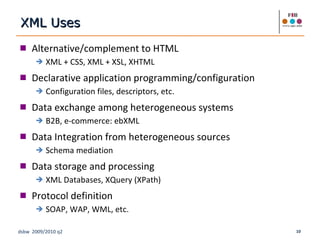
Alternative/complement to HTML XML + CSS, XML + XSL, XHTML Declarative application programming/configuration Configuration files, descriptors, etc. Data exchange among heterogeneous systems B2B, e-commerce: ebXML Data Integration from heterogeneous sources Schema mediation Data storage and processing XML Databases, XQuery (XPath) Protocol definition SOAP, WAP, WML, etc. XML Uses
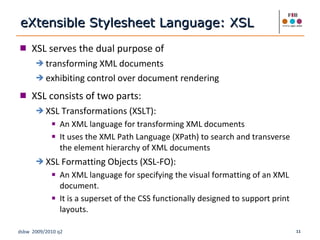
XSL serves the dual purpose of transforming XML documents exhibiting control over document rendering XSL consists of two parts: XSL Transformations (XSLT):  An XML language for transforming XML documents It uses the XML Path Language (XPath) to search and transverse the element hierarchy of XML documents XSL Formatting Objects (XSL-FO):  An XML language for specifying the visual formatting of an XML document. It is a superset of the CSS functionally designed to support print layouts. eXtensible Stylesheet Language: XSL
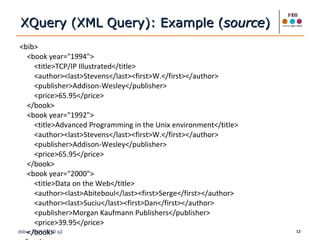
<bib> <book year=&quot;1994&quot;> <title>TCP/IP Illustrated</title> <author><last>Stevens</last><first>W.</first></author> <publisher>Addison-Wesley</publisher> <price>65.95</price> </book> <book year=&quot;1992&quot;> <title>Advanced Programming in the Unix environment</title> <author><last>Stevens</last><first>W.</first></author> <publisher>Addison-Wesley</publisher> <price>65.95</price> </book> <book year=&quot;2000&quot;> <title>Data on the Web</title> <author><last>Abiteboul</last><first>Serge</first></author> <author><last>Suciu</last><first>Dan</first></author> <publisher>Morgan Kaufmann Publishers</publisher> <price>39.95</price> </book> </book> </bib> XQuery (XML Query): Example ( source )
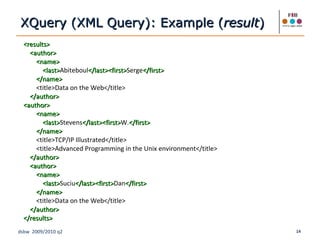
<results> { let $a := doc(&quot;http://bstore1.example.com/bib/bib.xml&quot;)//author for $last in distinct-values($a/last), $first in distinct-values($a[last=$last]/first) order by $last, $first return <author> <name> <last> { $last } </last><first> { $first } </first> </name> {  for $b in doc(&quot;http://bstore1.example.com/bib.xml&quot;)/bib/book where some $ba in $b/author  satisfies ($ba/last = $last and $ba/first=$first) return $b/title } </author>  } </results>   XQuery (XML Query): Example ( query ) For each author, retrieve its last, first names as well as the title of its books, ordered by last, first names
<results> <author> <name> <last> Abiteboul </last><first> Serge </first> </name> <title>Data on the Web</title> </author> <author> <name> <last> Stevens </last><first> W. </first> </name> <title>TCP/IP Illustrated</title> <title>Advanced Programming in the Unix environment</title> </author> <author> <name> <last> Suciu </last><first> Dan </first> </name> <title>Data on the Web</title> </author> </results> XQuery (XML Query): Example ( result )
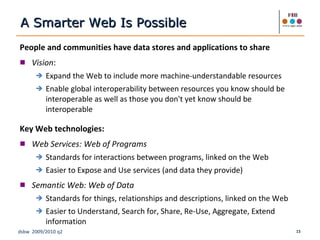
People and communities have data stores and applications to share Vision : Expand the Web to include more machine-understandable resources Enable global interoperability between resources you know should be interoperable as well as those you don't yet know should be interoperable Key Web technologies: Web Services: Web of Programs   Standards for interactions between programs, linked on the Web Easier to Expose and Use services (and data they provide) Semantic Web: Web of Data   Standards for things, relationships and descriptions, linked on the Web Easier to Understand, Search for, Share, Re-Use, Aggregate, Extend information A Smarter Web Is Possible
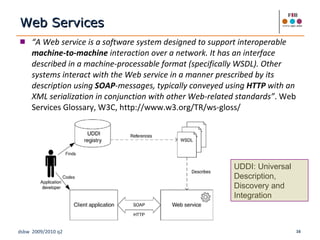
Web Services “ A Web service is a software system designed to support interoperable  machine-to-machine  interaction over a network. It has an interface described in a machine-processable format (specifically WSDL). Other systems interact with the Web service in a manner prescribed by its description using  SOAP -messages, typically conveyed using  HTTP  with an XML serialization in conjunction with other Web-related standards” . Web Services Glossary, W3C, http://www.w3.org/TR/ws-gloss/ UDDI: Universal Description, Discovery and Integration
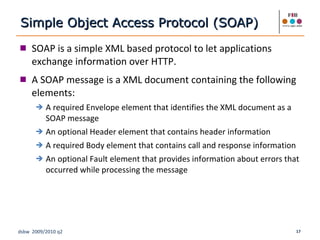
SOAP is a simple XML based protocol to let applications exchange information over HTTP. A SOAP message is a XML document containing the following elements: A required Envelope element that identifies the XML document as a SOAP message An optional Header element that contains header information A required Body element that contains call and response information An optional Fault element that provides information about errors that occurred while processing the message Simple Object Access Protocol (SOAP)
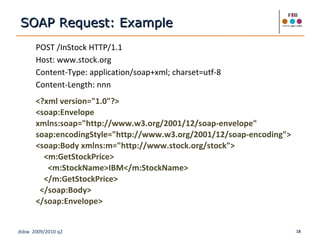
POST /InStock HTTP/1.1 Host: www.stock.org Content-Type: application/soap+xml; charset=utf-8 Content-Length: nnn <?xml version=&quot;1.0&quot;?> <soap:Envelope xmlns:soap=&quot;http://www.w3.org/2001/12/soap-envelope&quot; soap:encodingStyle=&quot;http://www.w3.org/2001/12/soap-encoding&quot;> <soap:Body xmlns:m=&quot;http://www.stock.org/stock&quot;> <m:GetStockPrice> <m:StockName>IBM</m:StockName> </m:GetStockPrice> </soap:Body> </soap:Envelope> SOAP Request: Example
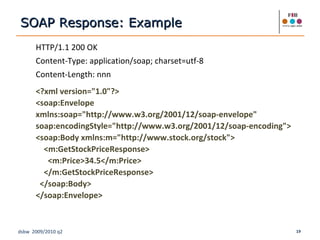
HTTP/1.1 200 OK Content-Type: application/soap; charset=utf-8 Content-Length: nnn <?xml version=&quot;1.0&quot;?> <soap:Envelope xmlns:soap=&quot;http://www.w3.org/2001/12/soap-envelope&quot; soap:encodingStyle=&quot;http://www.w3.org/2001/12/soap-encoding&quot;> <soap:Body xmlns:m=&quot;http://www.stock.org/stock&quot;> <m:GetStockPriceResponse> <m:Price>34.5</m:Price> </m:GetStockPriceResponse> </soap:Body> </soap:Envelope> SOAP Response: Example
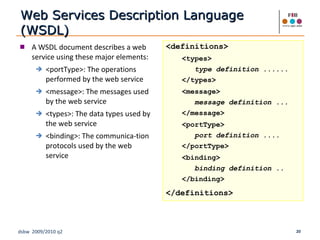
Web Services Description Language (WSDL) A WSDL document describes a web service using these major elements: <portType>: The operations performed by the web service <message>: The messages used by the web service  <types>: The data types used by the web service <binding>: The communica-tion protocols used by the web service <definitions> <types> type definition ...... </types> <message> message definition ... </message> <portType> port definition .... </portType> <binding> binding definition .. </binding> </definitions>
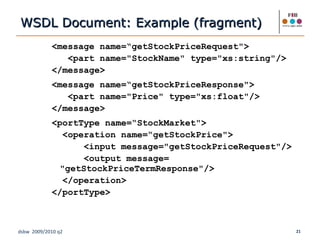
<message name=“getStockPriceRequest&quot;> <part name=&quot;StockName&quot; type=&quot;xs:string&quot;/> </message> <message name=“getStockPriceResponse&quot;> <part name=&quot;Price&quot; type=&quot;xs:float&quot;/> </message> <portType name=“StockMarket&quot;> <operation name=“getStockPrice&quot;> <input message=&quot;getStockPriceRequest&quot;/> <output message=  &quot;getStockPriceTermResponse&quot;/> </operation> </portType> WSDL Document: Example (fragment)
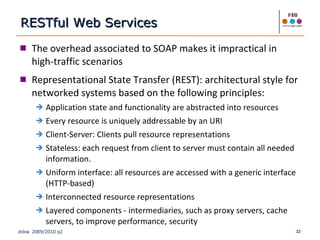
The overhead associated to SOAP makes it impractical in high-traffic scenarios Representational State Transfer (REST): architectural style for networked systems based on the following principles: Application state and functionality are abstracted into resources Every resource is uniquely addressable by an URI Client-Server: Clients pull resource representations Stateless: each request from client to server must contain all needed information.  Uniform interface: all resources are accessed with a generic interface (HTTP-based) Interconnected resource representations Layered components - intermediaries, such as proxy servers, cache servers, to improve performance, security RESTful Web Services
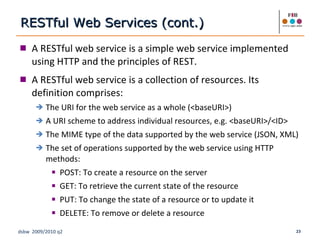
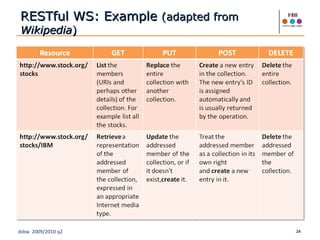
A RESTful web service is a simple web service implemented using HTTP and the principles of REST. A RESTful web service is a collection of resources. Its definition comprises: The URI for the web service as a whole (<baseURI>) A URI scheme to address individual resources, e.g. <baseURI>/<ID> The MIME type of the data supported by the web service (JSON, XML) The set of operations supported by the web service using HTTP methods: POST: To create a resource on the server GET: To retrieve the current state of the resource PUT: To change the state of a resource or to update it DELETE: To remove or delete a resource RESTful Web Services (cont.)
RESTful WS: Example  (adapted from  Wikipedia )
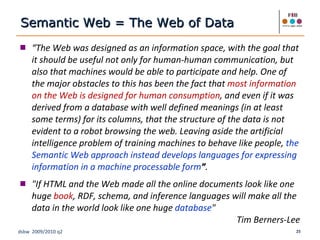
“ The Web was designed as an information space, with the goal that it should be useful not only for human-human communication, but also that machines would be able to participate and help. One of the major obstacles to this has been the fact that   most information on the Web is designed for human consumption , and even if it was derived from a database with well defined meanings (in at least some terms) for its columns, that the structure of the data is not evident to a robot browsing the web. Leaving aside the artificial intelligence problem of training machines to behave like people,   the Semantic Web approach instead develops languages for expressing information in a machine processable form ” .  &quot;If HTML and the Web made all the online documents look like one huge  book , RDF, schema, and inference languages will make all the data in the world look like one huge  database &quot; Tim Berners-Lee Semantic Web = The Web of Data
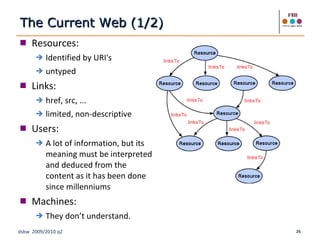
The Current Web (1/2) Resources:  Identified by URI's  untyped  Links:  href, src, ...  limited, non-descriptive Users:  A lot of information, but its meaning must be interpreted and deduced from the content as it has been done since millenniums Machines:  They don’t understand.
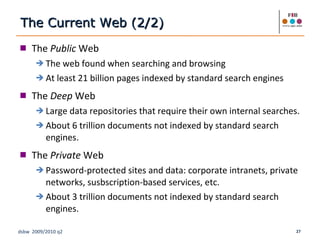
The  Public  Web The web found when searching and browsing At least 21 billion pages indexed by standard search engines The  Deep  Web Large data repositories that require their own internal searches. About 6 trillion documents not indexed by standard search engines. The  Private  Web Password-protected sites and data: corporate intranets, private networks, susbscription-based services, etc. About 3 trillion documents not indexed by standard search engines. The Current Web (2/2)
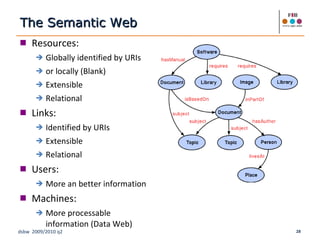
The Semantic Web Resources:  Globally identified by URIs  or locally (Blank)  Extensible Relational  Links:  Identified by URIs  Extensible  Relational  Users:  More an better information Machines:  More processable information (Data Web)
Make web resources more accessible to automated processes Extend existing rendering markup with  semantic markup Metadata  (data about data)  annotations  that describe content/function of web accessible resources Use Ontologies to provide  vocabulary  for annotations “ Formal specification” accessible to machines A prerequisite is a standard web ontology language Need to agree common  syntax  before we can share semantics Syntactic web based on  standards  such as  HTTP  and  HTML Semantic Web: How?
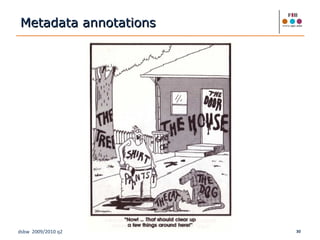
Metadata annotations
Is it semantic? Are the terms unambiguous and tagged in royalty-free format, governed by a nonprofit organization, that all software programs can understand? Is it on the web? Is it online using a common name space that makes it easily findable? Is it shared among collaborators or companies? Does it use the information already online to get smarter as more people use the system? The Semantic Web “Acid Test” (by D. Siegel)
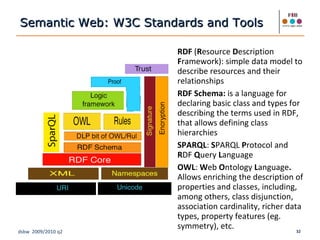
Semantic Web: W3C Standards and Tools RDF  ( R esource  D escription  F ramework): simple data model to describe resources and their relationships RDF Schema:  is a language for declaring basic class and types for describing the terms used in RDF, that allows defining class hierarchies  SPARQL :  S PARQL  P rotocol   and  R DF  Q uery  L anguage  OWL :  W eb  O ntology  L anguage .  Allows enriching the description of properties and classes, including, among others, class disjunction, association cardinality, richer data types, property features (eg. symmetry), etc.
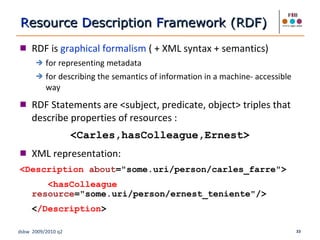
RDF is  graphical formalism  ( + XML syntax + semantics) for representing metadata for describing the semantics of information in a machine- accessible way RDF Statements are <subject, predicate, object> triples that describe properties of resources :  <Carles,hasColleague,Ernest> XML representation: <Description  about =&quot;some.uri/person/carles_farre&quot;>   <hasColleague  resource =&quot;some.uri/person/ernest_teniente&quot;/> < /Description > R esource  D escription  F ramework (RDF)
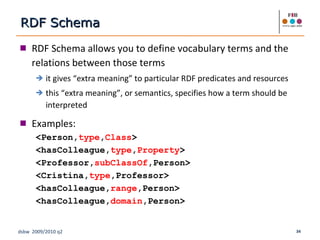
RDF Schema allows you to define vocabulary terms and the relations between those terms it gives “extra meaning” to particular RDF predicates and resources this “extra meaning”, or semantics, specifies how a term should be interpreted Examples: <Person, type , Class > <hasColleague, type , Property > <Professor, subClassOf ,Person> <Cristina, type ,Professor> <hasColleague, range ,Person> <hasColleague, domain ,Person> RDF Schema
RDFS  too weak  to describe resources in sufficient detail No  localized range and domain  constraints Can’t say that the range of hasChild is person when applied to persons and elephant when applied to elephants No  existence/cardinality  constraints Can’t say that all  instances  of person have a mother that is also a person, or that persons have exactly 2 parents No  transitive, inverse or symmetrical  properties Can’t say that isPartOf is a transitive property, that hasPart is the inverse of isPartOf or that touches is symmetrical … Difficult to provide  reasoning support No “native” reasoners for non-standard semantics May be possible to reason via FO axiomatization Problems with RDFS
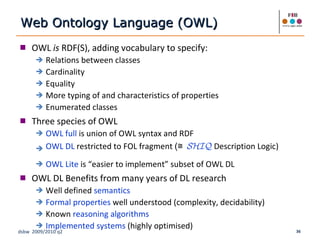
OWL  is  RDF(S), adding vocabulary to specify: Relations between classes Cardinality Equality More typing of and characteristics of properties Enumerated classes Three species of OWL OWL full  is union of OWL syntax and RDF OWL DL  restricted to FOL fragment  (≅   SHIQ   Description Logic) OWL Lite  is “easier to implement” subset of OWL DL  OWL DL Benefits from many years of DL research Well defined  semantics Formal properties  well understood (complexity, decidability) Known  reasoning algorithms Implemented systems  (highly optimised) Web Ontology Language (OWL)
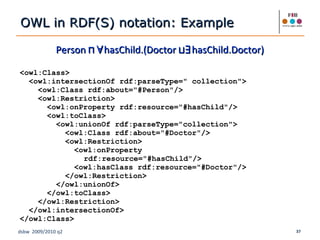
Person  ⊓   ∀ hasChild.(Doctor  ⊔   ∃ hasChild.Doctor) <owl:Class> <owl:intersectionOf rdf:parseType=&quot; collection&quot;> <owl:Class rdf:about=&quot;#Person&quot;/> <owl:Restriction> <owl:onProperty rdf:resource=&quot;#hasChild&quot;/> <owl:toClass> <owl:unionOf rdf:parseType=&quot;collection&quot;> <owl:Class rdf:about=&quot;#Doctor&quot;/> <owl:Restriction> <owl:onProperty  rdf:resource=&quot;#hasChild&quot;/> <owl:hasClass rdf:resource=&quot;#Doctor&quot;/> </owl:Restriction> </owl:unionOf> </owl:toClass> </owl:Restriction> </owl:intersectionOf> </owl:Class> OWL in RDF(S) notation: Example
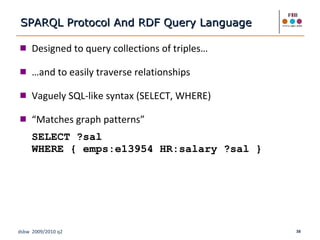
Designed to query collections of triples… … and to easily traverse relationships Vaguely SQL-like syntax (SELECT, WHERE) “ Matches graph patterns” SELECT ?sal WHERE { emps:e13954 HR:salary ?sal } SPARQL Protocol And RDF Query Language
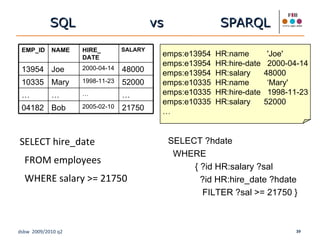
SQL  vs  SPARQL SELECT hire_date FROM employees WHERE salary >= 21750 emps:e13954  HR:name  'Joe' emps:e13954  HR:hire-date  2000-04-14 emps:e13954  HR:salary  48000 emps:e10335  HR:name  ‘Mary' emps:e10335  HR:hire-date  1998-11-23 emps:e10335  HR:salary  52000 … SELECT ?hdate WHERE  { ?id HR:salary ?sal ?id HR:hire_date ?hdate FILTER ?sal >= 21750 } EMP_ID NAME HIRE_ DATE SALARY 13954 Joe 2000-04-14 48000 10335 Mary 1998-11-23 52000 … … … … 04182 Bob 2005-02-10 21750
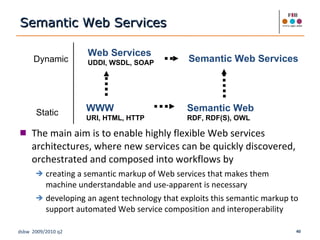
Semantic Web Services The main aim is to enable highly flexible Web services architectures, where new services can be quickly discovered, orchestrated and composed into workflows by  creating a semantic markup of Web services that makes them machine understandable and use-apparent is necessary developing an agent technology that exploits this semantic markup to support automated Web service composition and interoperability WWW URI, HTML, HTTP Semantic Web RDF, RDF(S), OWL Dynamic Web Services UDDI, WSDL, SOAP Static Semantic Web Services
KAPPEL, Gerti et al.  Web Engineering , John Wiley & Sons, 2006. Chapter 14. SHKLAR, Leon and ROSEN, Rich.  Web Application Architecture: Principles, Protocols and Practices, 2 nd  Edition . John Wiley & Sons, 2009. Chapters 5 and 13. SIEGEL, David.  Pull.  The Power of the Semantic Web to Transform Your Business . Portfolio (Penguin Group), 2009. RAY, Kate.  Web 3.0  (video)  http://vimeo.com/11529540 www.w3.org www.w3schools.com References

[DSBW Spring 2010] Unit 10: XML and Web And beyond

  • 1.
    XML DTD, XMLSchemaXSL, Xquery Web Services SOAP, WSDL RESTful Web Services Semantic Web Introduction RDF, RDF Schema, OWL, SPARQL Unit 10: XML and Web and Beyond
  • 2.
    “ ... is a simple, very flexible text format derived from SGML (ISO 8879). Originally designed to meet the challenges of large-scale electronic publishing, XML is also playing an increasingly important role in the exchange of a wide variety of data on the Web and elsewhere. ” W3 Consortium XML … is not a solution but a tool to build solutions is not a language but a meta-language that require interoperating applications that use it to adopt clear conventions on how to use it is a standardized text format that is used to represent structured information e X tensible M arkup L anguage
  • 3.
    SGML, XML andtheir applications HyTime HTML XHTML SMIL SOAP WML SGML XML Meta-Markup Language Markup Language Application
  • 4.
    The document hasexactly one root element The root element can be preceded by an optional XML declaration Non-empty elements are delimited by both a start-tag and an end-tag. Empty elements are marked with an empty-element (self-closing) tag Tags may be nested but must not overlap All attribute values are quoted with either single (') or double (&quot;) quotes <?xml version=&quot;1.0&quot; encoding=&quot;UTF-8&quot;?> <address> <street> <line>123 Pine Rd.</line> </street> <city name=&quot;Lexington&quot;/> <state abbrev=&quot;SC&quot;/> <zip base=&quot;19072&quot; plus4=&quot;&quot;/> </address> Well-Formed XML Documents
  • 5.
    Are well-formed XMLdocuments Are documents that conform the rules defined by certain schemas Schema: define the legal building blocks of an XML document. It defines the document structure with a list of legal elements. Two ways to define a schema: DTD: Document Type Definition XML Schema Valid XML Documents
  • 6.
    <?xml version=&quot;1.0&quot; encoding=&quot;UTF-8&quot;?><!DOCTYPE address [ <!ELEMENT address (street, city, state, zip)> <!ELEMENT street line+> <!ELEMENT line (#PCDATA)> <!ELEMENT city (#PCDATA)> <!ELEMENT state (#PCDATA)> <!ELEMENT zip (#PCDATA)> ]> <address> ... </address> <?xml version=&quot;1.0&quot; encoding=&quot;UTF-8&quot;?> <!DOCTYPE address SYSTEM &quot;http://dtd.mycompany.com/address.dtd&quot;> <address> ... </address> DTD Example: Embedded and External Definitions
  • 7.
    DTD is notintegrated with Namespace technology so users cannot import and reuse code DTD does not support data types other than character data DTD syntax is not XML compliant DTD language constructs are no extensible DTD Limitations
  • 8.
    <?xml version=&quot;1.0&quot; encoding=&quot;UTF-8&quot;?><xsd:schema xmlns:xsd=&quot;http://www.w3.org/2000/10/XMLSchema&quot; elementFormDefault=&quot;qualified&quot;> <xsd:import namespace=&quot; &quot;/> <xsd:element name=&quot;address&quot;> <xsd:complexType> <xsd:sequence> <xsd:element name=&quot;street&quot;> <xsd:complexType> <xsd:all maxOccurs=&quot;unbounded&quot;> <xsd:element name=&quot;line&quot; type=&quot;xsd:string&quot;/> </xsd:all> </xsd:complexType> </xsd:element> <xsd:element name=&quot;city&quot; type=&quot;xsd:string&quot;/> <xsd:element name=&quot;state&quot; type=&quot;xsd:string&quot;/> <xsd:element name=&quot;zip&quot; type=&quot;xsd:string&quot;/> </xsd:sequence> </xsd:complexType> </xsd:element> </xsd:schema> XML Schema: Example
  • 9.
    Using a programminglanguage and the SAX API. SAX is a lexical, event-driven interface in which a document is read serially and its contents are reported as &quot;callbacks&quot; to various methods on a handler object of the user's design Using a programming language and the DOM API. DOM allows for navigation of the entire document as if it were a tree of &quot;Node&quot; objects representing the document's contents. Using a transformation engine and a filter XSLT, XQuery, etc Processing XML Documents
  • 10.
    Alternative/complement to HTMLXML + CSS, XML + XSL, XHTML Declarative application programming/configuration Configuration files, descriptors, etc. Data exchange among heterogeneous systems B2B, e-commerce: ebXML Data Integration from heterogeneous sources Schema mediation Data storage and processing XML Databases, XQuery (XPath) Protocol definition SOAP, WAP, WML, etc. XML Uses
  • 11.
    XSL serves thedual purpose of transforming XML documents exhibiting control over document rendering XSL consists of two parts: XSL Transformations (XSLT): An XML language for transforming XML documents It uses the XML Path Language (XPath) to search and transverse the element hierarchy of XML documents XSL Formatting Objects (XSL-FO): An XML language for specifying the visual formatting of an XML document. It is a superset of the CSS functionally designed to support print layouts. eXtensible Stylesheet Language: XSL
  • 12.
    <bib> <book year=&quot;1994&quot;><title>TCP/IP Illustrated</title> <author><last>Stevens</last><first>W.</first></author> <publisher>Addison-Wesley</publisher> <price>65.95</price> </book> <book year=&quot;1992&quot;> <title>Advanced Programming in the Unix environment</title> <author><last>Stevens</last><first>W.</first></author> <publisher>Addison-Wesley</publisher> <price>65.95</price> </book> <book year=&quot;2000&quot;> <title>Data on the Web</title> <author><last>Abiteboul</last><first>Serge</first></author> <author><last>Suciu</last><first>Dan</first></author> <publisher>Morgan Kaufmann Publishers</publisher> <price>39.95</price> </book> </book> </bib> XQuery (XML Query): Example ( source )
  • 13.
    <results> { let$a := doc(&quot;http://bstore1.example.com/bib/bib.xml&quot;)//author for $last in distinct-values($a/last), $first in distinct-values($a[last=$last]/first) order by $last, $first return <author> <name> <last> { $last } </last><first> { $first } </first> </name> { for $b in doc(&quot;http://bstore1.example.com/bib.xml&quot;)/bib/book where some $ba in $b/author satisfies ($ba/last = $last and $ba/first=$first) return $b/title } </author> } </results> XQuery (XML Query): Example ( query ) For each author, retrieve its last, first names as well as the title of its books, ordered by last, first names
  • 14.
    <results> <author> <name><last> Abiteboul </last><first> Serge </first> </name> <title>Data on the Web</title> </author> <author> <name> <last> Stevens </last><first> W. </first> </name> <title>TCP/IP Illustrated</title> <title>Advanced Programming in the Unix environment</title> </author> <author> <name> <last> Suciu </last><first> Dan </first> </name> <title>Data on the Web</title> </author> </results> XQuery (XML Query): Example ( result )
  • 15.
    People and communitieshave data stores and applications to share Vision : Expand the Web to include more machine-understandable resources Enable global interoperability between resources you know should be interoperable as well as those you don't yet know should be interoperable Key Web technologies: Web Services: Web of Programs Standards for interactions between programs, linked on the Web Easier to Expose and Use services (and data they provide) Semantic Web: Web of Data Standards for things, relationships and descriptions, linked on the Web Easier to Understand, Search for, Share, Re-Use, Aggregate, Extend information A Smarter Web Is Possible
  • 16.
    Web Services “A Web service is a software system designed to support interoperable machine-to-machine interaction over a network. It has an interface described in a machine-processable format (specifically WSDL). Other systems interact with the Web service in a manner prescribed by its description using SOAP -messages, typically conveyed using HTTP with an XML serialization in conjunction with other Web-related standards” . Web Services Glossary, W3C, http://www.w3.org/TR/ws-gloss/ UDDI: Universal Description, Discovery and Integration
  • 17.
    SOAP is asimple XML based protocol to let applications exchange information over HTTP. A SOAP message is a XML document containing the following elements: A required Envelope element that identifies the XML document as a SOAP message An optional Header element that contains header information A required Body element that contains call and response information An optional Fault element that provides information about errors that occurred while processing the message Simple Object Access Protocol (SOAP)
  • 18.
    POST /InStock HTTP/1.1Host: www.stock.org Content-Type: application/soap+xml; charset=utf-8 Content-Length: nnn <?xml version=&quot;1.0&quot;?> <soap:Envelope xmlns:soap=&quot;http://www.w3.org/2001/12/soap-envelope&quot; soap:encodingStyle=&quot;http://www.w3.org/2001/12/soap-encoding&quot;> <soap:Body xmlns:m=&quot;http://www.stock.org/stock&quot;> <m:GetStockPrice> <m:StockName>IBM</m:StockName> </m:GetStockPrice> </soap:Body> </soap:Envelope> SOAP Request: Example
  • 19.
    HTTP/1.1 200 OKContent-Type: application/soap; charset=utf-8 Content-Length: nnn <?xml version=&quot;1.0&quot;?> <soap:Envelope xmlns:soap=&quot;http://www.w3.org/2001/12/soap-envelope&quot; soap:encodingStyle=&quot;http://www.w3.org/2001/12/soap-encoding&quot;> <soap:Body xmlns:m=&quot;http://www.stock.org/stock&quot;> <m:GetStockPriceResponse> <m:Price>34.5</m:Price> </m:GetStockPriceResponse> </soap:Body> </soap:Envelope> SOAP Response: Example
  • 20.
    Web Services DescriptionLanguage (WSDL) A WSDL document describes a web service using these major elements: <portType>: The operations performed by the web service <message>: The messages used by the web service <types>: The data types used by the web service <binding>: The communica-tion protocols used by the web service <definitions> <types> type definition ...... </types> <message> message definition ... </message> <portType> port definition .... </portType> <binding> binding definition .. </binding> </definitions>
  • 21.
    <message name=“getStockPriceRequest&quot;> <partname=&quot;StockName&quot; type=&quot;xs:string&quot;/> </message> <message name=“getStockPriceResponse&quot;> <part name=&quot;Price&quot; type=&quot;xs:float&quot;/> </message> <portType name=“StockMarket&quot;> <operation name=“getStockPrice&quot;> <input message=&quot;getStockPriceRequest&quot;/> <output message= &quot;getStockPriceTermResponse&quot;/> </operation> </portType> WSDL Document: Example (fragment)
  • 22.
    The overhead associatedto SOAP makes it impractical in high-traffic scenarios Representational State Transfer (REST): architectural style for networked systems based on the following principles: Application state and functionality are abstracted into resources Every resource is uniquely addressable by an URI Client-Server: Clients pull resource representations Stateless: each request from client to server must contain all needed information. Uniform interface: all resources are accessed with a generic interface (HTTP-based) Interconnected resource representations Layered components - intermediaries, such as proxy servers, cache servers, to improve performance, security RESTful Web Services
  • 23.
    A RESTful webservice is a simple web service implemented using HTTP and the principles of REST. A RESTful web service is a collection of resources. Its definition comprises: The URI for the web service as a whole (<baseURI>) A URI scheme to address individual resources, e.g. <baseURI>/<ID> The MIME type of the data supported by the web service (JSON, XML) The set of operations supported by the web service using HTTP methods: POST: To create a resource on the server GET: To retrieve the current state of the resource PUT: To change the state of a resource or to update it DELETE: To remove or delete a resource RESTful Web Services (cont.)
  • 24.
    RESTful WS: Example (adapted from Wikipedia )
  • 25.
    “ The Webwas designed as an information space, with the goal that it should be useful not only for human-human communication, but also that machines would be able to participate and help. One of the major obstacles to this has been the fact that most information on the Web is designed for human consumption , and even if it was derived from a database with well defined meanings (in at least some terms) for its columns, that the structure of the data is not evident to a robot browsing the web. Leaving aside the artificial intelligence problem of training machines to behave like people, the Semantic Web approach instead develops languages for expressing information in a machine processable form ” . &quot;If HTML and the Web made all the online documents look like one huge book , RDF, schema, and inference languages will make all the data in the world look like one huge database &quot; Tim Berners-Lee Semantic Web = The Web of Data
  • 26.
    The Current Web(1/2) Resources: Identified by URI's untyped Links: href, src, ... limited, non-descriptive Users: A lot of information, but its meaning must be interpreted and deduced from the content as it has been done since millenniums Machines: They don’t understand.
  • 27.
    The Public Web The web found when searching and browsing At least 21 billion pages indexed by standard search engines The Deep Web Large data repositories that require their own internal searches. About 6 trillion documents not indexed by standard search engines. The Private Web Password-protected sites and data: corporate intranets, private networks, susbscription-based services, etc. About 3 trillion documents not indexed by standard search engines. The Current Web (2/2)
  • 28.
    The Semantic WebResources: Globally identified by URIs or locally (Blank) Extensible Relational Links: Identified by URIs Extensible Relational Users: More an better information Machines: More processable information (Data Web)
  • 29.
    Make web resourcesmore accessible to automated processes Extend existing rendering markup with semantic markup Metadata (data about data) annotations that describe content/function of web accessible resources Use Ontologies to provide vocabulary for annotations “ Formal specification” accessible to machines A prerequisite is a standard web ontology language Need to agree common syntax before we can share semantics Syntactic web based on standards such as HTTP and HTML Semantic Web: How?
  • 30.
  • 31.
    Is it semantic?Are the terms unambiguous and tagged in royalty-free format, governed by a nonprofit organization, that all software programs can understand? Is it on the web? Is it online using a common name space that makes it easily findable? Is it shared among collaborators or companies? Does it use the information already online to get smarter as more people use the system? The Semantic Web “Acid Test” (by D. Siegel)
  • 32.
    Semantic Web: W3CStandards and Tools RDF ( R esource D escription F ramework): simple data model to describe resources and their relationships RDF Schema: is a language for declaring basic class and types for describing the terms used in RDF, that allows defining class hierarchies SPARQL : S PARQL P rotocol and R DF Q uery L anguage OWL : W eb O ntology L anguage . Allows enriching the description of properties and classes, including, among others, class disjunction, association cardinality, richer data types, property features (eg. symmetry), etc.
  • 33.
    RDF is graphical formalism ( + XML syntax + semantics) for representing metadata for describing the semantics of information in a machine- accessible way RDF Statements are <subject, predicate, object> triples that describe properties of resources : <Carles,hasColleague,Ernest> XML representation: <Description about =&quot;some.uri/person/carles_farre&quot;> <hasColleague resource =&quot;some.uri/person/ernest_teniente&quot;/> < /Description > R esource D escription F ramework (RDF)
  • 34.
    RDF Schema allowsyou to define vocabulary terms and the relations between those terms it gives “extra meaning” to particular RDF predicates and resources this “extra meaning”, or semantics, specifies how a term should be interpreted Examples: <Person, type , Class > <hasColleague, type , Property > <Professor, subClassOf ,Person> <Cristina, type ,Professor> <hasColleague, range ,Person> <hasColleague, domain ,Person> RDF Schema
  • 35.
    RDFS tooweak to describe resources in sufficient detail No localized range and domain constraints Can’t say that the range of hasChild is person when applied to persons and elephant when applied to elephants No existence/cardinality constraints Can’t say that all instances of person have a mother that is also a person, or that persons have exactly 2 parents No transitive, inverse or symmetrical properties Can’t say that isPartOf is a transitive property, that hasPart is the inverse of isPartOf or that touches is symmetrical … Difficult to provide reasoning support No “native” reasoners for non-standard semantics May be possible to reason via FO axiomatization Problems with RDFS
  • 36.
    OWL is RDF(S), adding vocabulary to specify: Relations between classes Cardinality Equality More typing of and characteristics of properties Enumerated classes Three species of OWL OWL full is union of OWL syntax and RDF OWL DL restricted to FOL fragment (≅ SHIQ Description Logic) OWL Lite is “easier to implement” subset of OWL DL OWL DL Benefits from many years of DL research Well defined semantics Formal properties well understood (complexity, decidability) Known reasoning algorithms Implemented systems (highly optimised) Web Ontology Language (OWL)
  • 37.
    Person ⊓ ∀ hasChild.(Doctor ⊔ ∃ hasChild.Doctor) <owl:Class> <owl:intersectionOf rdf:parseType=&quot; collection&quot;> <owl:Class rdf:about=&quot;#Person&quot;/> <owl:Restriction> <owl:onProperty rdf:resource=&quot;#hasChild&quot;/> <owl:toClass> <owl:unionOf rdf:parseType=&quot;collection&quot;> <owl:Class rdf:about=&quot;#Doctor&quot;/> <owl:Restriction> <owl:onProperty rdf:resource=&quot;#hasChild&quot;/> <owl:hasClass rdf:resource=&quot;#Doctor&quot;/> </owl:Restriction> </owl:unionOf> </owl:toClass> </owl:Restriction> </owl:intersectionOf> </owl:Class> OWL in RDF(S) notation: Example
  • 38.
    Designed to querycollections of triples… … and to easily traverse relationships Vaguely SQL-like syntax (SELECT, WHERE) “ Matches graph patterns” SELECT ?sal WHERE { emps:e13954 HR:salary ?sal } SPARQL Protocol And RDF Query Language
  • 39.
    SQL vs SPARQL SELECT hire_date FROM employees WHERE salary >= 21750 emps:e13954 HR:name 'Joe' emps:e13954 HR:hire-date 2000-04-14 emps:e13954 HR:salary 48000 emps:e10335 HR:name ‘Mary' emps:e10335 HR:hire-date 1998-11-23 emps:e10335 HR:salary 52000 … SELECT ?hdate WHERE { ?id HR:salary ?sal ?id HR:hire_date ?hdate FILTER ?sal >= 21750 } EMP_ID NAME HIRE_ DATE SALARY 13954 Joe 2000-04-14 48000 10335 Mary 1998-11-23 52000 … … … … 04182 Bob 2005-02-10 21750
  • 40.
    Semantic Web ServicesThe main aim is to enable highly flexible Web services architectures, where new services can be quickly discovered, orchestrated and composed into workflows by creating a semantic markup of Web services that makes them machine understandable and use-apparent is necessary developing an agent technology that exploits this semantic markup to support automated Web service composition and interoperability WWW URI, HTML, HTTP Semantic Web RDF, RDF(S), OWL Dynamic Web Services UDDI, WSDL, SOAP Static Semantic Web Services
  • 41.
    KAPPEL, Gerti etal. Web Engineering , John Wiley & Sons, 2006. Chapter 14. SHKLAR, Leon and ROSEN, Rich. Web Application Architecture: Principles, Protocols and Practices, 2 nd Edition . John Wiley & Sons, 2009. Chapters 5 and 13. SIEGEL, David. Pull. The Power of the Semantic Web to Transform Your Business . Portfolio (Penguin Group), 2009. RAY, Kate. Web 3.0 (video) http://vimeo.com/11529540 www.w3.org www.w3schools.com References