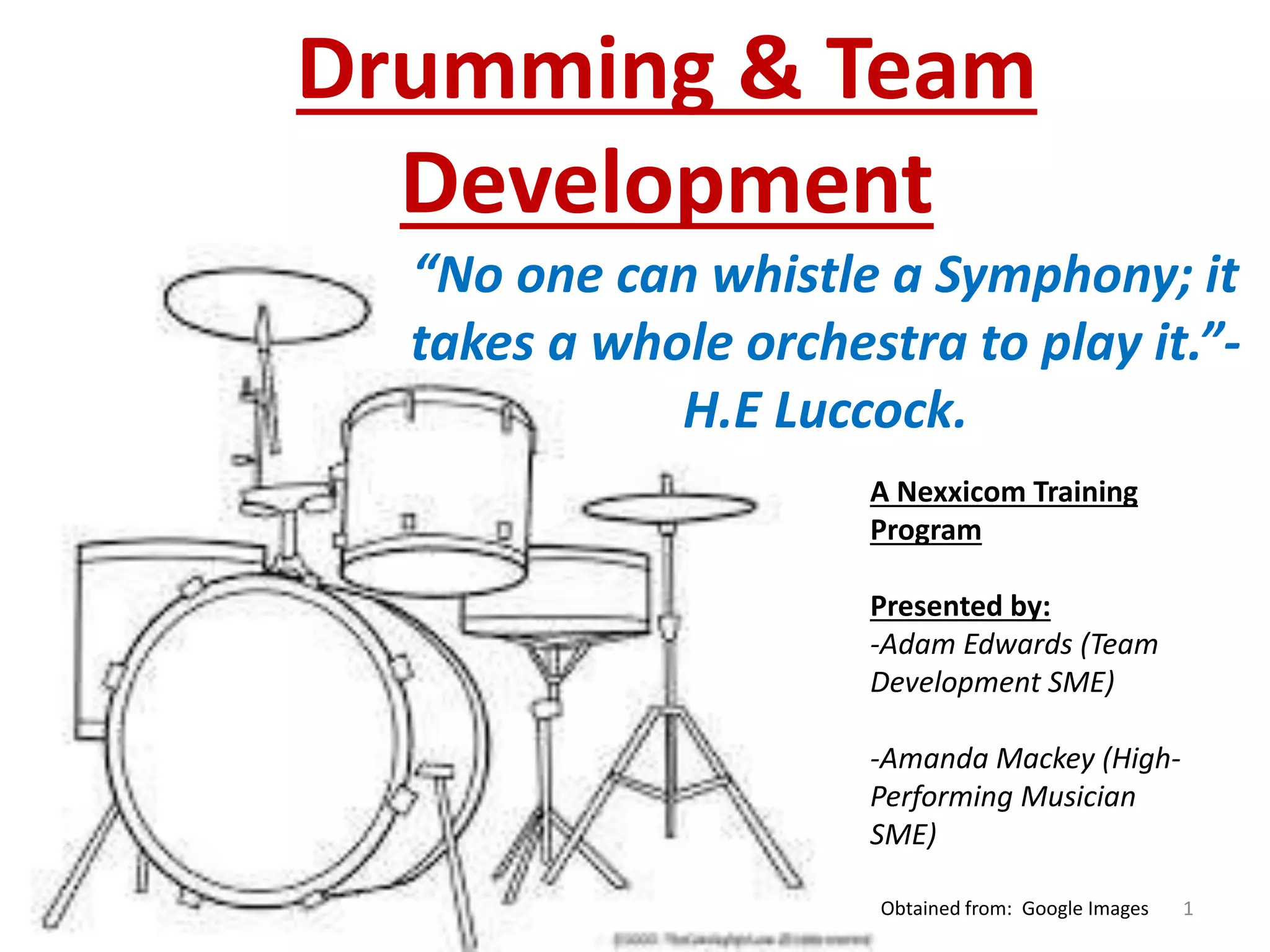
Drumming & Team
Development
“No one can whistle a Symphony; it
takes a whole orchestra to play it.”-
H.E Luccock.
1
A Nexxicom Training
Program
Presented by:
-Adam Edwards (Team
Development SME)
-Amanda Mackey (High-
Performing Musician
SME)
Obtained from: Google Images
Agenda
1-1:05 Introduction
1:05-1:10 Quiz/Objectives Forming
1:10-1:15 Practice #1 Storming
1:15-1:20 Practice #2 Norming
1:20-1:25 Performing & Adjourning
1:25-1:30 Conclusion/
Recommendations/ Discssion
2
Section B in
Handout
Obtained from: Google
Images
So What?
• 37% of projects fail
• Practice team work skills
• Reinvent your approach to teams
• Practice stages and roles in team
development
• Get more from your project
teams
• Be the leader/ member high
performing teams want!
3Obtained from: “Contemporary Project Management.” (2012) Kloppenborg, T.,J., (357-358) , Google Images & Michael
Krigsman .
Program Objectives
At the end of this training program each
participant will be able to:
1.) Distinguish the different parts of a drum kit.
2.) Demonstrate the steps to building a drum beat.
3.) Reproduce a rhythm as a part and a whole.
4.) Show ability to persevere despite challenges in
teams.
5.) Display team morale and enjoyment from working in
teams.
4
Program Objectives
6.) Practice flexible methods on how team members
contribute to projects.
7.) Take value in the ability to share risks with team
mates.
8. )Demonstrate compassion for others and a
constant focus on team improvement.
9.) Practice the ability to over come communication
barriers in teams
10.) Solve problems by considering alternative views,
and being open to change. 5
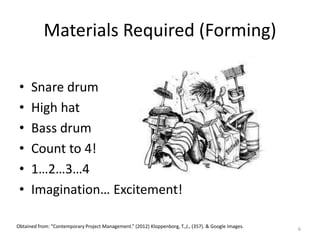
Materials Required (Forming)
• Snare drum
• High hat
• Bass drum
• Count to 4!
• 1…2…3…4
• Imagination… Excitement!
6
Obtained from: “Contemporary Project Management.” (2012) Kloppenborg, T.,J., (357). & Google Images.
Quiz #1 (Forming)
1. I feel excited when put into a team
situation.
2. I have high achievement needs when put
into a team.
3. I have a tendency to accept responsibility
in teams.
4. I have a commitment to self
development.
5. I put the needs of the team before my
own needs.
6. I can adapt very well to change.
7. I have a tendency to not feel concerned
about team situations.
8. It is easy for me to share risks with the
team.
7
Obtained from: “Contemporary Project Management.” (2012) Kloppenborg, T.,J., (357) & Google Images.
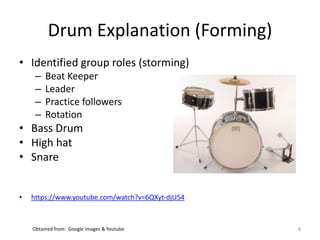
Drum Explanation (Forming)
• Identified group roles (storming)
– Beat Keeper
– Leader
– Practice followers
– Rotation
• Bass Drum
• High hat
• Snare
• https://www.youtube.com/watch?v=6QXyt-djU54
8Obtained from: Google Images & Youtube
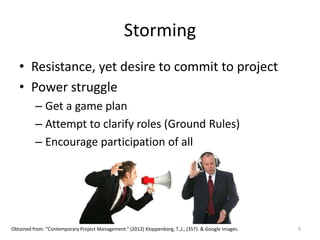
Storming
• Resistance, yet desire to commit to project
• Power struggle
– Get a game plan
– Attempt to clarify roles (Ground Rules)
– Encourage participation of all
9Obtained from: “Contemporary Project Management.” (2012) Kloppenborg, T.,J., (357). & Google Images.
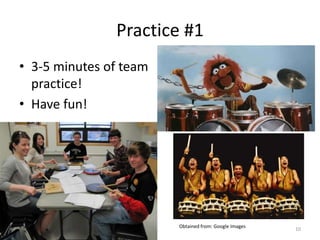
Practice #1
• 3-5 minutes of team
practice!
• Have fun!
10
Obtained from: Google Images
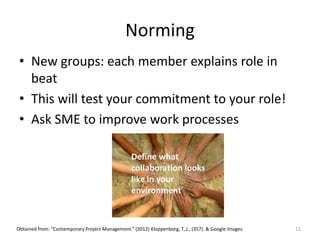
Norming
• New groups: each member explains role in
beat
• This will test your commitment to your role!
• Ask SME to improve work processes
11Obtained from: “Contemporary Project Management.” (2012) Kloppenborg, T.,J., (357). & Google Images.
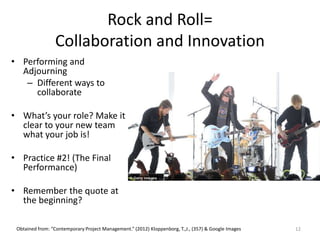
Rock and Roll=
Collaboration and Innovation
• Performing and
Adjourning
– Different ways to
collaborate
• What’s your role? Make it
clear to your new team
what your job is!
• Practice #2! (The Final
Performance)
• Remember the quote at
the beginning?
12Obtained from: “Contemporary Project Management.” (2012) Kloppenborg, T.,J., (357) & Google Images
Team Work
• Who made it to the performing stage?
– Teams sometimes fail this stage and go to
Adjourning
• Were ground rules formed and enforced?
• Was there excitement or concern about
the work?
• Could all members see the bigger
picture?
• Do you feel sad to leave the team? Want
a celebration?
13Obtained from: “Contemporary Project Management.” (2012) Kloppenborg, T.,J., (357) & Google Images
Characteristics of High Performing
Teams
• Always room for
improvement
• Starts with personal values:
– Achievement needs
– Accountability
– Commitment to self
development
– Put needs of project before
own
– Willingness to change
– Project commitment
14Obtained from: “Contemporary Project Management.” (2012) Kloppenborg, T.,J., (357-358) & Google Images
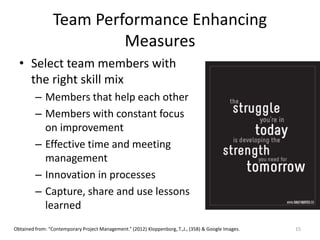
Team Performance Enhancing
Measures
• Select team members with
the right skill mix
– Members that help each other
– Members with constant focus
on improvement
– Effective time and meeting
management
– Innovation in processes
– Capture, share and use lessons
learned
15Obtained from: “Contemporary Project Management.” (2012) Kloppenborg, T.,J., (358) & Google Images.
Further Improvement in Teams
• Share information freely
• Discuss topics openly
• Conflict, not personal; process
• Proactively report problems
• Share risks with team
• Share leadership roles
16Obtained from: “Contemporary Project Management.” (2012) Kloppenborg, T.,J., (358) & Google Images
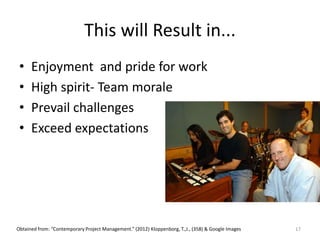
This will Result in...
• Enjoyment and pride for work
• High spirit- Team morale
• Prevail challenges
• Exceed expectations
17Obtained from: “Contemporary Project Management.” (2012) Kloppenborg, T.,J., (358) & Google Images
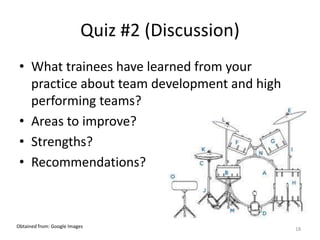
Quiz #2 (Discussion)
• What trainees have learned from your
practice about team development and high
performing teams?
• Areas to improve?
• Strengths?
• Recommendations?
18
Obtained from: Google Images
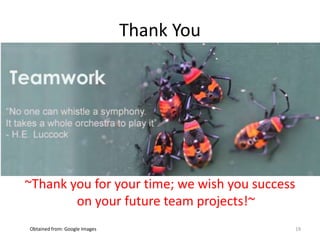
Thank You
~Thank you for your time; we wish you success
on your future team projects!~
19Obtained from: Google Images
Sources Used
• “Contemporary Project Management.” (2012)
Kloppenborg, T.,J., (357-359).
• Google Images
• Youtube
• http://www.zdnet.com/blog/projectfailures/cio-
analysis-why-37-percent-of-projects-fail/12565
• Haccoun., R, Robert & Saks., M, Alan (2013).
Managing Performance through Training and
Development (6th ed.). Toronto: Nelson Education
[For Training objectives, needs analysis and
training plan- See training plan for details]
20

Drum Training Presentation

  • 1.
    Drumming & Team Development “Noone can whistle a Symphony; it takes a whole orchestra to play it.”- H.E Luccock. 1 A Nexxicom Training Program Presented by: -Adam Edwards (Team Development SME) -Amanda Mackey (High- Performing Musician SME) Obtained from: Google Images
  • 2.
    Agenda 1-1:05 Introduction 1:05-1:10 Quiz/ObjectivesForming 1:10-1:15 Practice #1 Storming 1:15-1:20 Practice #2 Norming 1:20-1:25 Performing & Adjourning 1:25-1:30 Conclusion/ Recommendations/ Discssion 2 Section B in Handout Obtained from: Google Images
  • 3.
    So What? • 37%of projects fail • Practice team work skills • Reinvent your approach to teams • Practice stages and roles in team development • Get more from your project teams • Be the leader/ member high performing teams want! 3Obtained from: “Contemporary Project Management.” (2012) Kloppenborg, T.,J., (357-358) , Google Images & Michael Krigsman .
  • 4.
    Program Objectives At theend of this training program each participant will be able to: 1.) Distinguish the different parts of a drum kit. 2.) Demonstrate the steps to building a drum beat. 3.) Reproduce a rhythm as a part and a whole. 4.) Show ability to persevere despite challenges in teams. 5.) Display team morale and enjoyment from working in teams. 4
  • 5.
    Program Objectives 6.) Practiceflexible methods on how team members contribute to projects. 7.) Take value in the ability to share risks with team mates. 8. )Demonstrate compassion for others and a constant focus on team improvement. 9.) Practice the ability to over come communication barriers in teams 10.) Solve problems by considering alternative views, and being open to change. 5
  • 6.
    Materials Required (Forming) •Snare drum • High hat • Bass drum • Count to 4! • 1…2…3…4 • Imagination… Excitement! 6 Obtained from: “Contemporary Project Management.” (2012) Kloppenborg, T.,J., (357). & Google Images.
  • 7.
    Quiz #1 (Forming) 1.I feel excited when put into a team situation. 2. I have high achievement needs when put into a team. 3. I have a tendency to accept responsibility in teams. 4. I have a commitment to self development. 5. I put the needs of the team before my own needs. 6. I can adapt very well to change. 7. I have a tendency to not feel concerned about team situations. 8. It is easy for me to share risks with the team. 7 Obtained from: “Contemporary Project Management.” (2012) Kloppenborg, T.,J., (357) & Google Images.
  • 8.
    Drum Explanation (Forming) •Identified group roles (storming) – Beat Keeper – Leader – Practice followers – Rotation • Bass Drum • High hat • Snare • https://www.youtube.com/watch?v=6QXyt-djU54 8Obtained from: Google Images & Youtube
  • 9.
    Storming • Resistance, yetdesire to commit to project • Power struggle – Get a game plan – Attempt to clarify roles (Ground Rules) – Encourage participation of all 9Obtained from: “Contemporary Project Management.” (2012) Kloppenborg, T.,J., (357). & Google Images.
  • 10.
    Practice #1 • 3-5minutes of team practice! • Have fun! 10 Obtained from: Google Images
  • 11.
    Norming • New groups:each member explains role in beat • This will test your commitment to your role! • Ask SME to improve work processes 11Obtained from: “Contemporary Project Management.” (2012) Kloppenborg, T.,J., (357). & Google Images.
  • 12.
    Rock and Roll= Collaborationand Innovation • Performing and Adjourning – Different ways to collaborate • What’s your role? Make it clear to your new team what your job is! • Practice #2! (The Final Performance) • Remember the quote at the beginning? 12Obtained from: “Contemporary Project Management.” (2012) Kloppenborg, T.,J., (357) & Google Images
  • 13.
    Team Work • Whomade it to the performing stage? – Teams sometimes fail this stage and go to Adjourning • Were ground rules formed and enforced? • Was there excitement or concern about the work? • Could all members see the bigger picture? • Do you feel sad to leave the team? Want a celebration? 13Obtained from: “Contemporary Project Management.” (2012) Kloppenborg, T.,J., (357) & Google Images
  • 14.
    Characteristics of HighPerforming Teams • Always room for improvement • Starts with personal values: – Achievement needs – Accountability – Commitment to self development – Put needs of project before own – Willingness to change – Project commitment 14Obtained from: “Contemporary Project Management.” (2012) Kloppenborg, T.,J., (357-358) & Google Images
  • 15.
    Team Performance Enhancing Measures •Select team members with the right skill mix – Members that help each other – Members with constant focus on improvement – Effective time and meeting management – Innovation in processes – Capture, share and use lessons learned 15Obtained from: “Contemporary Project Management.” (2012) Kloppenborg, T.,J., (358) & Google Images.
  • 16.
    Further Improvement inTeams • Share information freely • Discuss topics openly • Conflict, not personal; process • Proactively report problems • Share risks with team • Share leadership roles 16Obtained from: “Contemporary Project Management.” (2012) Kloppenborg, T.,J., (358) & Google Images
  • 17.
    This will Resultin... • Enjoyment and pride for work • High spirit- Team morale • Prevail challenges • Exceed expectations 17Obtained from: “Contemporary Project Management.” (2012) Kloppenborg, T.,J., (358) & Google Images
  • 18.
    Quiz #2 (Discussion) •What trainees have learned from your practice about team development and high performing teams? • Areas to improve? • Strengths? • Recommendations? 18 Obtained from: Google Images
  • 19.
    Thank You ~Thank youfor your time; we wish you success on your future team projects!~ 19Obtained from: Google Images
  • 20.
    Sources Used • “ContemporaryProject Management.” (2012) Kloppenborg, T.,J., (357-359). • Google Images • Youtube • http://www.zdnet.com/blog/projectfailures/cio- analysis-why-37-percent-of-projects-fail/12565 • Haccoun., R, Robert & Saks., M, Alan (2013). Managing Performance through Training and Development (6th ed.). Toronto: Nelson Education [For Training objectives, needs analysis and training plan- See training plan for details] 20

Editor's Notes

  • #8 “Contemporary Project Management.” (2012) Kloppenborg, T.,J., (357).