




DRUG FORMULARY
Presented by Suraj Mungase
Department of Pharmacy Practice
M Pharm 2nd Sem
Flow of presentation
• What is a formulary?
• Reasons to develop formulary
• Types of formulary
• Hospital formulary
• NFI
• NLEM
What is the Formulary?
• Formulary is a continually updated, official, or authorized
publication of an approved list of medicines for use in
hospitals
Reasons to develop a formulary system
• To ensure quality & appropriateness of drug
used in a particular practice.
• To teach appropriate drug therapy especially
relevant to junior doctors.
• To promote evidence based& cost-effective
drug therapy
• To encourage the use of therapeutic
protocols
Types of formulary
International formulary: Used in more than
one country.
National formulary :For one nation only
eg.NFI,BNF,USP NF
Hospital formulary: specific for particular
hospital.
Open formulary: No limitation to access to
medication, generally large.
Closed formulary: limited list of medication
limits drug to specific physicians, disease.
Hospital formulary
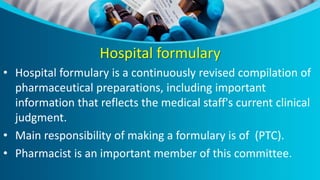
• Hospital formulary is a continuously revised compilation of
pharmaceutical preparations, including important
information that reflects the medical staff's current clinical
judgment.
• Main responsibility of making a formulary is of (PTC).
• Pharmacist is an important member of this committee.
Origin
• The 1st scientific hospital formulary in India was published
in 1968 by the pharmacy department of CMC Vellore.
• The 1st hospital formulary for a gov teaching hospital in
India was published in 1997 at GMC Trivandrum.
Hospital formulary
 Advantages
1. Therapeutic
2. Economic
3. Educational
4. Rational drug use.
 Disadvantage
1. Physician includes the
brand of his choice
2. Pharmacists act as the
sole judge which drug is
purchased & dispensed
Preparation of hospital formulary
• It should be pocket size.
• Binding: loose leaf allows flexible adaptations.
• Use color to make it attractive.
• Availability in electronic format.
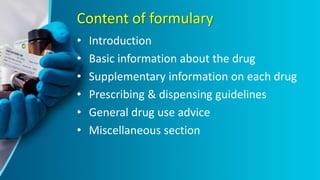
Content of formulary
• Introduction
• Basic information about the drug
• Supplementary information on each drug
• Prescribing & dispensing guidelines
• General drug use advice
• Miscellaneous section
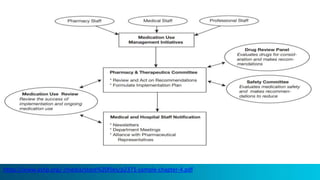
https://www.ashp.org/-/media/store%20files/p2371-sample-chapter-4.pdf
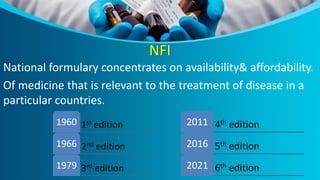
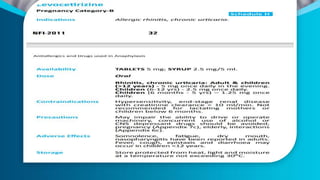
NFI
National formulary concentrates on availability& affordability.
Of medicine that is relevant to the treatment of disease in a
particular countries.
1st edition
1960
2nd edition
1966
3rd edition
1979
4th edition
2011
5th edition
2016
6th edition
2021
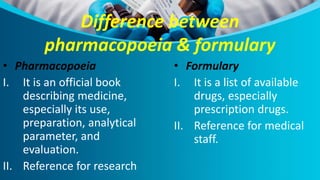
Difference between
pharmacopoeia & formulary
• Pharmacopoeia
I. It is an official book
describing medicine,
especially its use,
preparation, analytical
parameter, and
evaluation.
II. Reference for research
• Formulary
I. It is a list of available
drugs, especially
prescription drugs.
II. Reference for medical
staff.
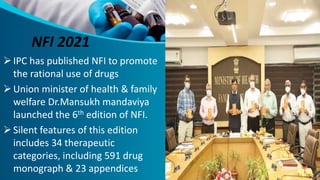
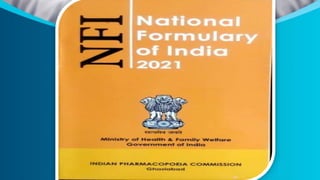
NFI 2021
IPC has published NFI to promote
the rational use of drugs
Union minister of health & family
welfare Dr.Mansukh mandaviya
launched the 6th edition of NFI.
Silent features of this edition
includes 34 therapeutic
categories, including 591 drug
monograph & 23 appendices
What are the Criteria for including drugs in NFI ?
• Drugs in NLEM
• Drugs used in national health programs
• Drug listed in IP
• Drug considers appropriate by IPC
What are the criteria for exclusion of drugs from NFI?
• Drugs banned in India
• Obsolete drugs
• Drugs consider inappropriate by IPC
Contents of NFI
• Introduction
• List of medicine monographs in NFI
• List of deleted medicine from NFI
• Common abbreviations
• General advice to prescribers
• Appendices
NLEM
Essential
medicine
Quality
medical
care
Affordabi
lity
Inclusion
Rational
use
Safe &
effective
treatmen
t
Origin
• 1970-Tanzania
• 1977-WHO
• 1996-NLEM
NLEM
MOHFW
•List is made by
MOCF
(DPCO)
•Price fixing
MOCF
(NPPA)
•Monitoring of NLEM
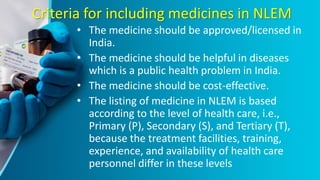
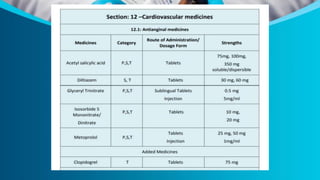
Criteria for including medicines in NLEM
• The medicine should be approved/licensed in
India.
• The medicine should be helpful in diseases
which is a public health problem in India.
• The medicine should be cost-effective.
• The listing of medicine in NLEM is based
according to the level of health care, i.e.,
Primary (P), Secondary (S), and Tertiary (T),
because the treatment facilities, training,
experience, and availability of health care
personnel differ in these levels
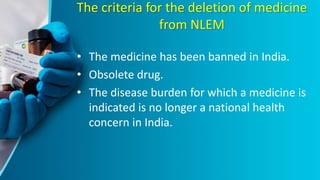
The criteria for the deletion of medicine
from NLEM
• The medicine has been banned in India.
• Obsolete drug.
• The disease burden for which a medicine is
indicated is no longer a national health
concern in India.
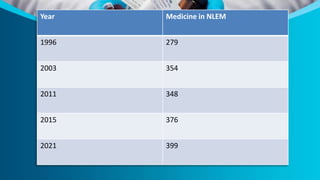
Year Medicine in NLEM
1996 279
2003 354
2011 348
2015 376
2021 399
NFI& NLEM
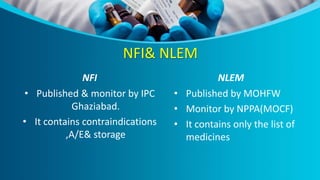
NFI
• Published & monitor by IPC
Ghaziabad.
• It contains contraindications
,A/E& storage
NLEM
• Published by MOHFW
• Monitor by NPPA(MOCF)
• It contains only the list of
medicines
Refrence
1) https://main.mohfw.gov.in/sites/default/files/Reco
mmendations.pdf
2) https://main.mohfw.gov.in/sites/default/files/7966
072180.pdf
3) https://www.ashp.org/-
/media/store%20files/p2371-sample-chapter-4.pdf
4) http://ipc.gov.in/mandates/nfi/salient-features-
of-nfi-2016.html
Thank you

drug formulary.pptx

  • 1.
    DRUG FORMULARY Presented bySuraj Mungase Department of Pharmacy Practice M Pharm 2nd Sem
  • 2.
    Flow of presentation •What is a formulary? • Reasons to develop formulary • Types of formulary • Hospital formulary • NFI • NLEM
  • 3.
    What is theFormulary? • Formulary is a continually updated, official, or authorized publication of an approved list of medicines for use in hospitals
  • 4.
    Reasons to developa formulary system • To ensure quality & appropriateness of drug used in a particular practice. • To teach appropriate drug therapy especially relevant to junior doctors. • To promote evidence based& cost-effective drug therapy • To encourage the use of therapeutic protocols
  • 5.
    Types of formulary Internationalformulary: Used in more than one country. National formulary :For one nation only eg.NFI,BNF,USP NF Hospital formulary: specific for particular hospital. Open formulary: No limitation to access to medication, generally large. Closed formulary: limited list of medication limits drug to specific physicians, disease.
  • 6.
    Hospital formulary • Hospitalformulary is a continuously revised compilation of pharmaceutical preparations, including important information that reflects the medical staff's current clinical judgment. • Main responsibility of making a formulary is of (PTC). • Pharmacist is an important member of this committee.
  • 7.
    Origin • The 1stscientific hospital formulary in India was published in 1968 by the pharmacy department of CMC Vellore. • The 1st hospital formulary for a gov teaching hospital in India was published in 1997 at GMC Trivandrum.
  • 8.
    Hospital formulary  Advantages 1.Therapeutic 2. Economic 3. Educational 4. Rational drug use.  Disadvantage 1. Physician includes the brand of his choice 2. Pharmacists act as the sole judge which drug is purchased & dispensed
  • 9.
    Preparation of hospitalformulary • It should be pocket size. • Binding: loose leaf allows flexible adaptations. • Use color to make it attractive. • Availability in electronic format.
  • 10.
    Content of formulary •Introduction • Basic information about the drug • Supplementary information on each drug • Prescribing & dispensing guidelines • General drug use advice • Miscellaneous section
  • 11.
  • 12.
    NFI National formulary concentrateson availability& affordability. Of medicine that is relevant to the treatment of disease in a particular countries. 1st edition 1960 2nd edition 1966 3rd edition 1979 4th edition 2011 5th edition 2016 6th edition 2021
  • 13.
    Difference between pharmacopoeia &formulary • Pharmacopoeia I. It is an official book describing medicine, especially its use, preparation, analytical parameter, and evaluation. II. Reference for research • Formulary I. It is a list of available drugs, especially prescription drugs. II. Reference for medical staff.
  • 14.
    NFI 2021 IPC haspublished NFI to promote the rational use of drugs Union minister of health & family welfare Dr.Mansukh mandaviya launched the 6th edition of NFI. Silent features of this edition includes 34 therapeutic categories, including 591 drug monograph & 23 appendices
  • 15.
    What are theCriteria for including drugs in NFI ? • Drugs in NLEM • Drugs used in national health programs • Drug listed in IP • Drug considers appropriate by IPC
  • 16.
    What are thecriteria for exclusion of drugs from NFI? • Drugs banned in India • Obsolete drugs • Drugs consider inappropriate by IPC
  • 17.
    Contents of NFI •Introduction • List of medicine monographs in NFI • List of deleted medicine from NFI • Common abbreviations • General advice to prescribers • Appendices
  • 19.
  • 20.
  • 21.
    NLEM MOHFW •List is madeby MOCF (DPCO) •Price fixing MOCF (NPPA) •Monitoring of NLEM
  • 22.
    Criteria for includingmedicines in NLEM • The medicine should be approved/licensed in India. • The medicine should be helpful in diseases which is a public health problem in India. • The medicine should be cost-effective. • The listing of medicine in NLEM is based according to the level of health care, i.e., Primary (P), Secondary (S), and Tertiary (T), because the treatment facilities, training, experience, and availability of health care personnel differ in these levels
  • 23.
    The criteria forthe deletion of medicine from NLEM • The medicine has been banned in India. • Obsolete drug. • The disease burden for which a medicine is indicated is no longer a national health concern in India.
  • 24.
    Year Medicine inNLEM 1996 279 2003 354 2011 348 2015 376 2021 399
  • 26.
    NFI& NLEM NFI • Published& monitor by IPC Ghaziabad. • It contains contraindications ,A/E& storage NLEM • Published by MOHFW • Monitor by NPPA(MOCF) • It contains only the list of medicines
  • 27.
    Refrence 1) https://main.mohfw.gov.in/sites/default/files/Reco mmendations.pdf 2) https://main.mohfw.gov.in/sites/default/files/7966 072180.pdf 3)https://www.ashp.org/- /media/store%20files/p2371-sample-chapter-4.pdf 4) http://ipc.gov.in/mandates/nfi/salient-features- of-nfi-2016.html
  • 29.