


DRIVINGSOCIALMEDIAANALYTICS
AUGUST 17, 2015
PERRY D. DRAKE
ASSISTANT PROFESSOR OF DIGITAL AND SOCIAL MEDIA MARKETING
UNIVERSITY OF MISSOURI – ST. LOUIS
Social Media Analytics Defined
 The first step in a social media analytics initiative is to determine
which business goals you wish to address and the data needed to do
that.
 Typical objectives include increasing revenues, reducing customer
service costs, getting feedback on products and services and improving
public opinion of a particular product or business division.
 Once the business goals have been identified, key performance
indicators (KPIs) for objectively evaluating the data should be defined.
 There are a number of types of software tools for analyzing
unstructured data found in tweets and Facebook posts through listening
and sentiment analysis. There are also many tools that use data to help
produce the right content at the right time to elicit the most
engagement.
Agenda
1. The Right Tools
2. Content is Key
3. Listening
4. Tracking
5. The Right Metrics
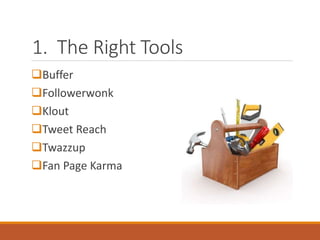
1. The Right Tools
Buffer
Followerwonk
Klout
Tweet Reach
Twazzup
Fan Page Karma
Followerwonk
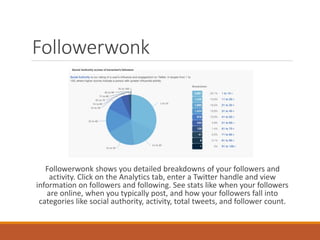
Followerwonk shows you detailed breakdowns of your followers and
activity. Click on the Analytics tab, enter a Twitter handle and view
information on followers and following. See stats like when your followers
are online, when you typically post, and how your followers fall into
categories like social authority, activity, total tweets, and follower count.
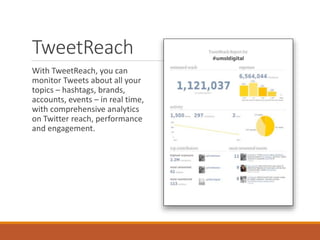
TweetReach
With TweetReach, you can
monitor Tweets about all your
topics – hashtags, brands,
accounts, events – in real time,
with comprehensive analytics
on Twitter reach, performance
and engagement.
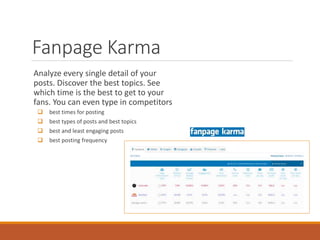
Fanpage Karma
Analyze every single detail of your
posts. Discover the best topics. See
which time is the best to get to your
fans. You can even type in competitors
 best times for posting
 best types of posts and best topics
 best and least engaging posts
 best posting frequency
2. Content is Key
To achieve social media success today you must
have great content.
A Personalized Experience
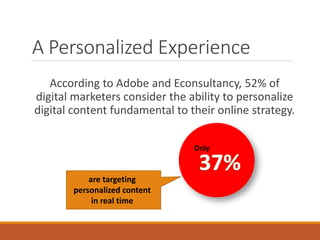
According to Adobe and Econsultancy, 52% of
digital marketers consider the ability to personalize
digital content fundamental to their online strategy.
are targeting
personalized content
in real time
Only
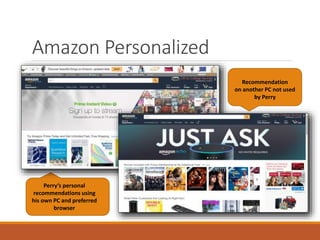
Amazon Personalized
Perry’s personal
recommendations using
his own PC and preferred
browser
Recommendation
on another PC not used
by Perry
The convergence of off and
online data.
“I predict 2014 will become the year of social
data integration and data alignment - a “Grand Aligned
Convergence" of sorts - something we've never seen
till now.”
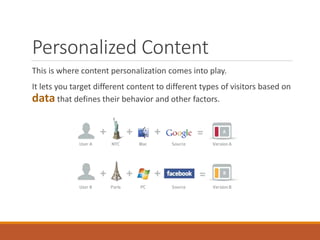
Personalized Content
This is where content personalization comes into play.
It lets you target different content to different types of visitors based on
data that defines their behavior and other factors.
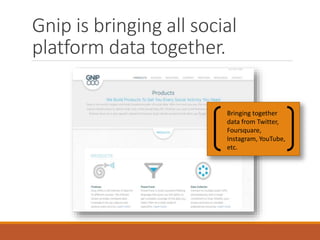
Gnip is bringing all social
platform data together.
Bringing together
data from Twitter,
Foursquare,
Instagram, YouTube,
etc.
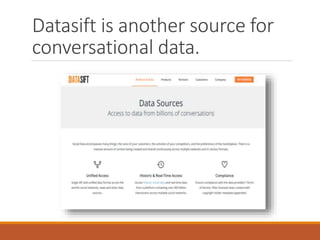
Datasift is another source for
conversational data.
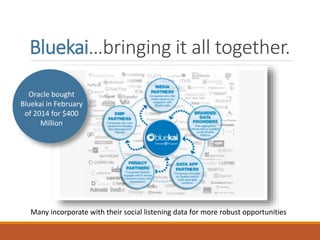
Bluekai…bringing it all together.
Many incorporate with their social listening data for more robust opportunities
Oracle bought
Bluekai in February
of 2014 for $400
Million
Companies Offering Content
Personalization are Abundant
 Disque
 Personyze
 Monoloop
 Monetate
 Apptus
 Gravity (content personalization for publishers)
 Avail (ecommerce personalization)
 Apsalar (mobile behavioral targeting)
 Vero (targeted emails based on user behavior)
 Runa (personalized offers)
 OneSpot (personalized content ads)
 PersuasionAPI
And many will
contract with the
data companies on
the prior slides such
as Monetate.
To Help You Decide.
http://content.monetate.com/h/i/27697627-9-must-ask-questions-when-evaluating-personalization-platforms
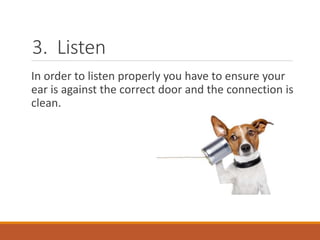
3. Listen
In order to listen properly you have to ensure your
ear is against the correct door and the connection is
clean.
Get the Right Data
 One inherent challenge in this is filtering out the useful parts from the
rest of the noise. Different technologies will provide a variety of
solutions to help you find the stuff that matters (and ideally not much
else), but ensuring that you know how to take advantage of these tools
is a must.
 If you have a tricky brand name like Tide, it’s crucial that you tailor
your search to gather the right data as there can be so much extra info
that is of little to no use.
 Listening tools include: Netbase, Brandwatch, Radian6, CrimsonTide,
Sysomos, etc.
Dig in
 Just like with traditional data, you must spend the time to prep the
data to ensure you glean as much from the data is possible.
 Roll up your sleeves and get intimate with the data.
 The most interesting findings will likely not sit at the top of the data
pile.
4. Tracking
 When appropriate, establish tracking of your
social media.
 But of course not all social media posts are to
drive a conversion.
 For example, a B2B marketer will mostly use
Facebook to create the “face” of the company
showing behind the scenes. And not drive a sale.
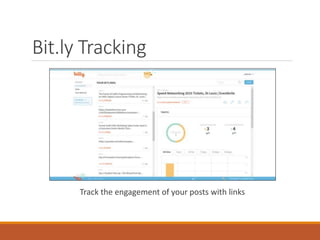
Bit.ly Tracking
Track the engagement of your posts with links
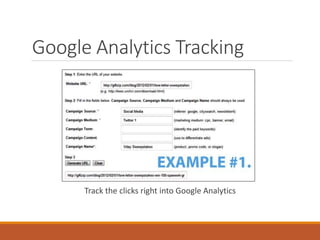
Google Analytics Tracking
Track the clicks right into Google Analytics
5. Examining the Right Metrics
As said at the start of this presentation, the first step
in a social media analytics initiative is to determine which
business goals you wish to address. And once identified,
KPI’s for objectively evaluating those goals and the data
needed can then be defined...but not before.
Building Awareness
If buildingawareness is the goal…
1. Look at web traffic patterns and branded search queries
2. Examine social media shares and mentions
3. Count your backlinks
4. Look at those referral URL’s
Driving Conversions
If drivingconversions is the goal…
1. How long do they stay
2. How much content do they consume
3. And, what is it that they are consuming so you can give them more
Retention
If retaining customers is your goal…
1. Examine new versus returning customers
2. Is time on site going up?
3. What are your overall satisfaction scores
It’s Not All About Likes
The brand awareness created by social media such as “likes” and “Retweets” is valuable
but it is not enough.
According to Altimeter, only 34% of businesses feel that their social strategy is connected
to business outcomes. To demonstrate social media’s value, you need to measure social
media ROI as it relates to your broader business goals. Key examples of social media
metrics to track include:
 Reach
 Site traffic
 Leads generated
 Sign-ups and conversions
 Revenue generated
It’s important for your social media data to be relevant to the stakeholders and not just
social media practitioners. Tying social media to the “big picture” by linking it to
organizational and departmental goals will help you achieve that goal.
Remember, a Facebook like is worth nothing until you nurture that relationship!
But…
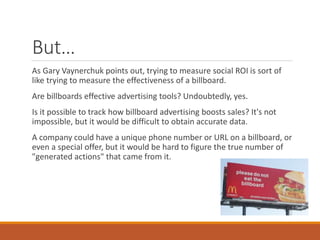
As Gary Vaynerchuk points out, trying to measure social ROI is sort of
like trying to measure the effectiveness of a billboard.
Are billboards effective advertising tools? Undoubtedly, yes.
Is it possible to track how billboard advertising boosts sales? It's not
impossible, but it would be difficult to obtain accurate data.
A company could have a unique phone number or URL on a billboard, or
even a special offer, but it would be hard to figure the true number of
"generated actions" that came from it.
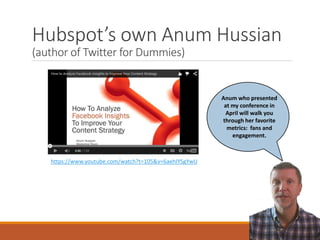
Hubspot’s own Anum Hussian
(author of Twitter for Dummies)
https://www.youtube.com/watch?t=105&v=6aehIYSgYwU
Anum who presented
at my conference in
April will walk you
through her favorite
metrics: fans and
engagement.
Measure Returning Consumers
We all want returning consumers. And, that is no
different regarding our Facebook Fans.
Consumers Defined
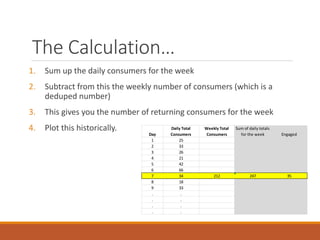
The Calculation…
1. Sum up the daily consumers for the week
2. Subtract from this the weekly number of consumers (which is a
deduped number)
3. This gives you the number of returning consumers for the week
4. Plot this historically.
Day
Daily Total
Consumers
Weekly Total
Consumers
Sum of daily totals
for the week Engaged
1 25
2 33
3 26
4 21
5 42
6 66
7 34 212 247 35
8 18
9 33
. .
. .
. .
. .
No Correlation Between
Retweets and Clicks...
HubSpot Social Media Scientist Dan Zarrella analyzed 2.7 million link-
containing tweets and found something interesting...
He discovered that there is no correlation between retweets and clicks.
In fact, he found many people will retweet a tweet with a link without
even clicking on that link and vice versa.
So capture tweet link clicks using tools such as bit.ly as another key
metric of interest in your content.
Say What!!
Perry D. Drake
Assistant Teaching Professor, College of Business Administration, University of Missouri – St. Louis
& Academic Director of Business, School of Professional and Continuing Studies, University of Missouri – St. Louis
---------------------------------------------------------------------------------------------------------------------
Follow me on Twitter: http://www.twitter.com/pddrake
Follow UMSL|Digital on Twitter: http://www.tiwtter.com/umsldigital
Friend me on Facebook: http://www.facebook.com/perry.drake
View my Blog: http://www.drakedirect.blogspot.com
Delicious Handle: http://www.delicious.com/pddrake
Foursquare Handle: http://www.foursquare.com/pddrake
Linkedin Profile: http://www.linkedin.com/pub/perry-drake/40/47/936
YouTube Channel: http://www.youtube.com/user/profpddrake
Vine Handle: http://vine.co/perry.drake
Instagram Handle: www.instagram.com/pddrake
Tumblr Account: http://profpddrake.tumblr.com
Bitly Account: http://bitly.com/u/pddrake
About.me Profile: http://about.me/perrydrake
Professional Appearances/Publicatons: http://bit.ly/UnlJTq
UMSL Digital MindShare Blog: http://www.umsldigitalmindshare.com
All about UMSL| Digital Press: http://professordrake.wordpress.com
Drake Company Website: www.drakedirect.com
Book Website: www.optimaldm.com
UMSL Email: drakep@umsl.edu
Secondary Email: perry@drakedirect.com
Mobile (best): 914-299-4879
UMSL Direct Line: 314-516-6490
UMSL Fax: 314-516-6827

Driving social media analytics

  • 1.
    DRIVINGSOCIALMEDIAANALYTICS AUGUST 17, 2015 PERRYD. DRAKE ASSISTANT PROFESSOR OF DIGITAL AND SOCIAL MEDIA MARKETING UNIVERSITY OF MISSOURI – ST. LOUIS
  • 2.
    Social Media AnalyticsDefined  The first step in a social media analytics initiative is to determine which business goals you wish to address and the data needed to do that.  Typical objectives include increasing revenues, reducing customer service costs, getting feedback on products and services and improving public opinion of a particular product or business division.  Once the business goals have been identified, key performance indicators (KPIs) for objectively evaluating the data should be defined.  There are a number of types of software tools for analyzing unstructured data found in tweets and Facebook posts through listening and sentiment analysis. There are also many tools that use data to help produce the right content at the right time to elicit the most engagement.
  • 3.
    Agenda 1. The RightTools 2. Content is Key 3. Listening 4. Tracking 5. The Right Metrics
  • 4.
    1. The RightTools Buffer Followerwonk Klout Tweet Reach Twazzup Fan Page Karma
  • 5.
    Followerwonk Followerwonk shows youdetailed breakdowns of your followers and activity. Click on the Analytics tab, enter a Twitter handle and view information on followers and following. See stats like when your followers are online, when you typically post, and how your followers fall into categories like social authority, activity, total tweets, and follower count.
  • 6.
    TweetReach With TweetReach, youcan monitor Tweets about all your topics – hashtags, brands, accounts, events – in real time, with comprehensive analytics on Twitter reach, performance and engagement.
  • 7.
    Fanpage Karma Analyze everysingle detail of your posts. Discover the best topics. See which time is the best to get to your fans. You can even type in competitors  best times for posting  best types of posts and best topics  best and least engaging posts  best posting frequency
  • 8.
    2. Content isKey To achieve social media success today you must have great content.
  • 9.
    A Personalized Experience Accordingto Adobe and Econsultancy, 52% of digital marketers consider the ability to personalize digital content fundamental to their online strategy. are targeting personalized content in real time Only
  • 10.
    Amazon Personalized Perry’s personal recommendationsusing his own PC and preferred browser Recommendation on another PC not used by Perry
  • 11.
    The convergence ofoff and online data. “I predict 2014 will become the year of social data integration and data alignment - a “Grand Aligned Convergence" of sorts - something we've never seen till now.”
  • 12.
    Personalized Content This iswhere content personalization comes into play. It lets you target different content to different types of visitors based on data that defines their behavior and other factors.
  • 13.
    Gnip is bringingall social platform data together. Bringing together data from Twitter, Foursquare, Instagram, YouTube, etc.
  • 14.
    Datasift is anothersource for conversational data.
  • 15.
    Bluekai…bringing it alltogether. Many incorporate with their social listening data for more robust opportunities Oracle bought Bluekai in February of 2014 for $400 Million
  • 16.
    Companies Offering Content Personalizationare Abundant  Disque  Personyze  Monoloop  Monetate  Apptus  Gravity (content personalization for publishers)  Avail (ecommerce personalization)  Apsalar (mobile behavioral targeting)  Vero (targeted emails based on user behavior)  Runa (personalized offers)  OneSpot (personalized content ads)  PersuasionAPI And many will contract with the data companies on the prior slides such as Monetate.
  • 17.
    To Help YouDecide. http://content.monetate.com/h/i/27697627-9-must-ask-questions-when-evaluating-personalization-platforms
  • 18.
    3. Listen In orderto listen properly you have to ensure your ear is against the correct door and the connection is clean.
  • 19.
    Get the RightData  One inherent challenge in this is filtering out the useful parts from the rest of the noise. Different technologies will provide a variety of solutions to help you find the stuff that matters (and ideally not much else), but ensuring that you know how to take advantage of these tools is a must.  If you have a tricky brand name like Tide, it’s crucial that you tailor your search to gather the right data as there can be so much extra info that is of little to no use.  Listening tools include: Netbase, Brandwatch, Radian6, CrimsonTide, Sysomos, etc.
  • 20.
    Dig in  Justlike with traditional data, you must spend the time to prep the data to ensure you glean as much from the data is possible.  Roll up your sleeves and get intimate with the data.  The most interesting findings will likely not sit at the top of the data pile.
  • 21.
    4. Tracking  Whenappropriate, establish tracking of your social media.  But of course not all social media posts are to drive a conversion.  For example, a B2B marketer will mostly use Facebook to create the “face” of the company showing behind the scenes. And not drive a sale.
  • 22.
    Bit.ly Tracking Track theengagement of your posts with links
  • 23.
    Google Analytics Tracking Trackthe clicks right into Google Analytics
  • 24.
    5. Examining theRight Metrics As said at the start of this presentation, the first step in a social media analytics initiative is to determine which business goals you wish to address. And once identified, KPI’s for objectively evaluating those goals and the data needed can then be defined...but not before.
  • 25.
    Building Awareness If buildingawarenessis the goal… 1. Look at web traffic patterns and branded search queries 2. Examine social media shares and mentions 3. Count your backlinks 4. Look at those referral URL’s
  • 26.
    Driving Conversions If drivingconversionsis the goal… 1. How long do they stay 2. How much content do they consume 3. And, what is it that they are consuming so you can give them more
  • 27.
    Retention If retaining customersis your goal… 1. Examine new versus returning customers 2. Is time on site going up? 3. What are your overall satisfaction scores
  • 28.
    It’s Not AllAbout Likes The brand awareness created by social media such as “likes” and “Retweets” is valuable but it is not enough. According to Altimeter, only 34% of businesses feel that their social strategy is connected to business outcomes. To demonstrate social media’s value, you need to measure social media ROI as it relates to your broader business goals. Key examples of social media metrics to track include:  Reach  Site traffic  Leads generated  Sign-ups and conversions  Revenue generated It’s important for your social media data to be relevant to the stakeholders and not just social media practitioners. Tying social media to the “big picture” by linking it to organizational and departmental goals will help you achieve that goal. Remember, a Facebook like is worth nothing until you nurture that relationship!
  • 29.
    But… As Gary Vaynerchukpoints out, trying to measure social ROI is sort of like trying to measure the effectiveness of a billboard. Are billboards effective advertising tools? Undoubtedly, yes. Is it possible to track how billboard advertising boosts sales? It's not impossible, but it would be difficult to obtain accurate data. A company could have a unique phone number or URL on a billboard, or even a special offer, but it would be hard to figure the true number of "generated actions" that came from it.
  • 30.
    Hubspot’s own AnumHussian (author of Twitter for Dummies) https://www.youtube.com/watch?t=105&v=6aehIYSgYwU Anum who presented at my conference in April will walk you through her favorite metrics: fans and engagement.
  • 32.
    Measure Returning Consumers Weall want returning consumers. And, that is no different regarding our Facebook Fans.
  • 33.
  • 34.
    The Calculation… 1. Sumup the daily consumers for the week 2. Subtract from this the weekly number of consumers (which is a deduped number) 3. This gives you the number of returning consumers for the week 4. Plot this historically. Day Daily Total Consumers Weekly Total Consumers Sum of daily totals for the week Engaged 1 25 2 33 3 26 4 21 5 42 6 66 7 34 212 247 35 8 18 9 33 . . . . . . . .
  • 35.
    No Correlation Between Retweetsand Clicks... HubSpot Social Media Scientist Dan Zarrella analyzed 2.7 million link- containing tweets and found something interesting... He discovered that there is no correlation between retweets and clicks. In fact, he found many people will retweet a tweet with a link without even clicking on that link and vice versa. So capture tweet link clicks using tools such as bit.ly as another key metric of interest in your content. Say What!!
  • 36.
    Perry D. Drake AssistantTeaching Professor, College of Business Administration, University of Missouri – St. Louis & Academic Director of Business, School of Professional and Continuing Studies, University of Missouri – St. Louis --------------------------------------------------------------------------------------------------------------------- Follow me on Twitter: http://www.twitter.com/pddrake Follow UMSL|Digital on Twitter: http://www.tiwtter.com/umsldigital Friend me on Facebook: http://www.facebook.com/perry.drake View my Blog: http://www.drakedirect.blogspot.com Delicious Handle: http://www.delicious.com/pddrake Foursquare Handle: http://www.foursquare.com/pddrake Linkedin Profile: http://www.linkedin.com/pub/perry-drake/40/47/936 YouTube Channel: http://www.youtube.com/user/profpddrake Vine Handle: http://vine.co/perry.drake Instagram Handle: www.instagram.com/pddrake Tumblr Account: http://profpddrake.tumblr.com Bitly Account: http://bitly.com/u/pddrake About.me Profile: http://about.me/perrydrake Professional Appearances/Publicatons: http://bit.ly/UnlJTq UMSL Digital MindShare Blog: http://www.umsldigitalmindshare.com All about UMSL| Digital Press: http://professordrake.wordpress.com Drake Company Website: www.drakedirect.com Book Website: www.optimaldm.com UMSL Email: drakep@umsl.edu Secondary Email: perry@drakedirect.com Mobile (best): 914-299-4879 UMSL Direct Line: 314-516-6490 UMSL Fax: 314-516-6827