Dorset Renewable Industries Pty Ltd
Community Update: 29 October 2014
Dorset Renewable Industries Pty Ltd
“DRI aims to develop new industries for the Dorset region of
North East Tasmania.
Our community focussed enterprise will use the region’s
renewable resources to improve the environment and build
community resilience.”
Who we are
We developed as a Community group well over two years
ago from within the Dorset municipality in response to the
economic situation in the region.
We are one of the focus points for the community’s desire to
help itself.
Our group
David Hamilton, Chairman
Lives in Lilydale
Has extensive experience in
environmental health and safety
in the oil industry
Karen and Ken Hall, Michael Brill,
Dale Jessop
Live in the Scottsdale area
Represent community interests,
forestry, saw milling, and forest
products industries
Wendy Mitchell
Lives in Launceston
Brings environmental
management, and economic
development and small business
experience
John Beattie Has many years of operational
experience in food processing
Alan Davenport, Heath Blair,
Peter Bird
Other North Easterners assisting
Objectives
 Establish a new forestry-related enterprise in Dorset to make
the best use of existing resources.
 Deliver positive social, economic and environmental
outcomes to the Dorset community.
 Use feedstocks that can be produced on an ongoing and
reliable basis and give fair payment for them.
 Make innovation an important component of the enterprise.
 Collaborate and share knowledge and expertise.
 Create long term jobs and develop skills.
Program
Ling Siding: vision for the site, grant application,
and next steps
Wendy
Mitchell
Ling Siding: refurbishment project Dale Jessup
Volunteers, assistance and staying involved Ken Hall
Establishing the integrated timber processing hub Michael Brill
Ethanol plant update David
Hamilton
Ethanol plant resource assessment Jeremy Wilson
Ethanol plant pre-feasibility study Martin Rees
Funding new timber businesses David
Hamilton
Questions
Grant application
The start of our vision becoming a reality – Wendy Mitchell
Grant timeline: June to Aug 2013
June 2013 DRI applies for two grants under the Tasmanian
Forestry Agreement economic diversification
process - $2.8M for Ling Siding and $1.6M for the
ethanol plant..
July 2013 DRI attempts to prevent Korda Mentha from further
dismembering of the Ling Siding site.
25 July, 2013 Prime Minister Kevin Rudd announces that DRI’s
application for $2.8M to purchase and refurbish
Ling Siding is successful, subject to a “value for
money” test.
August 2013 Korda Mentha starts sale process for Ling Siding.
DRI places indicative offer, dependent upon grant
funding.
Grant timeline: Sep 2013 – August 2014
September
2013
DRI submits final bid for Ling Siding, together with
letter from Tony Abbott promising not to cut the
grant if elected.
September
2013
Korda Mentha rejects DRI’s offer because of
funding uncertainty.
October 2013 RNG Property Developments agree to sell most of
the industrial land at Ling Siding to DRI, subject to
grant funding.
December
2013
Details of “value for money test” for the grant
released.
October 2014 DRI submits over 400 pages of documentation for
value for money test.
25 Aug 2014 Assistant Minister for Infrastructure writes to DRI
confirming grant, subject to negotiation of a grant
deed (draft grant deed is 46 pages).
About our grant
 Federal Grant - $2.8 Million plus GST.
 Strong oversight and management by the Federal
Government.
 Grant can only be used for:
 refurbishment of the Ling Site.
 preparing the site for a timber integrated processing hub.
 Funding is:
 tied to milestones.
 cannot be used to secure or help set up new businesses.
 cannot be used for any purpose except refurbishment.
What does this mean?
Once the site is made ready, it’s up to the community,
private enterprise, state government, DRI, or a community
co-operative to:
 encourage
 develop
 establish
new enterprises at this site.
Summary
 DRI needs to:
 stay focussed on the proper acquittal of $2.8 million.
 ensure that the refurbishment funds are spent in
accordance with the Deed.
 make the site ready to receive timber businesses that can
mutually benefit by being on such a collaborative site.
 improve work opportunities and skills in the North East.
 increase economic hope and activity in the North East
Region.
Ling Siding Refurbishment
Dale Jessup
Ling Siding refurbishment
Current condition of site
Ling Siding refurbishment
Previous transformer yard
Ling Siding refurbishment
Kiln and boiler area
Ling Siding refurbishment
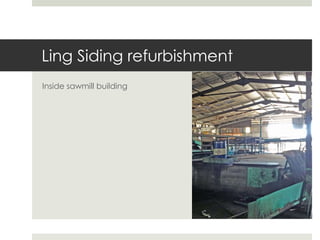
Inside sawmill building
Ling Siding refurbishment
Condition of buildings
Ling Siding refurbishment
Weighbridge foundation
Ling Siding refurbishment: project
Major project components are:
 restoration of power to the site.
 making good all buildings.
 restoration of communication and IT systems.
 restoration of potable water and effluent systems.
 installation of a public weighbridge.
 restoration of site fencing and erection of new fencing.
 re-sealing 27,000 m2 hardstand area.
Ling Siding refurbishment: project
management
Project management requires:
 engagement of Project Manager.
 establishment of safety system.
 finalisation of scope of works.
 drafting of contracts for each project component.
 engagement of utility providers.
 selection of contractors.
Ling Siding refurbishment: key areas
Key project areas are:
 occupational health and safety of all people involved in
the project.
 management of environmental issues specific to the site.
 maximising value of grant funding.
 minimising economic leakage of funding by using of
local contractors.
 consideration of rail trail traversing site.
Ling Siding refurbishment: not funded
What the grant does not fund:
 refurbishment of the 20 MW boiler.
 activities to attract business to the site.
 replacement of buildings that have been removed.
 any components of the ethanol plant project.
Ling Siding refurbishment: outcome
An industrial site that:
 has separately metered
power to each area.
 has good road surfaces.
 has weighbridge
capability.
 has scope for further
expansion.
 is connected to the
internet.
 is secure.
 has water and effluent
systems.
 will provide ongoing
opportunities for our
community.
Establishing the hub
Michael Brill
Future opportunities
 The opportunity taken:
 Ling Siding will again be available
as a site where people are
employed processing timber.
 What the grant funding achieves:
 Ling Siding as infrastructure.
Future opportunities - continued
 Hub concept offers increased resilience through:
 businesses working together, sharing common resources and
services.
 minimising waste:
maximum value is achieved from every log, regardless of its
quality.
 many baskets for our economic eggs.
 Renewable relationship with timber and industry.
Potential timber industries
 timber preservation
 timber posts
 log peeling for veneer
 cross-laminated timber
 orientated strand
 pellets
 ethanol
 saw milling
 associated enterprises:
 engineering
 wood waste for steam
enterprises
 soil conditioning:
composting and/or
biochar
Ethanol plant update
David Hamilton
Overview
 Ethtec are developing a process to convert woody material to ethanol
 one of several “cellulosic ethanol” processes being developed world-wide.
 Ethtec’s approach suits smaller plants
 can use a range of feedstocks.
 DRI is considering the opportunity of a plant using Ethtec’s technology:
 located at Ling Siding.
 producing 30 million litres of ethanol per year.
 using 150,000 tonnes of feedstock per year from:
 waste.
 logs from local tree growers.
Local ethanol plant: advantages
 Provides local employment and
uses local support services.
 Pays local suppliers for feedstock.
 Ethanol product is a renewable liquid fuel which:
 is able to be blended into gasoline and diesel.
 can totally (100%) fuel some engines.
 can be used to reduce reliance on fossil fuels.
Local ethanol plant: advantages
 Reduces reliance on petroleum imported into Tasmania:
 improved security of supply.
 reduction in economic leakage.
 Provides possibilities for non-fuel products:
 ethanol as a solvent.
 sugars for bio-plastics.
Status of ethanol plant
 Tasmanian Government (Department of State Growth)
paid for a resource study by Esk Mapping and GIS.
 Tasmanian Government and Dorset Council jointly funded a
prefeasibility study which was performed by KPMG.
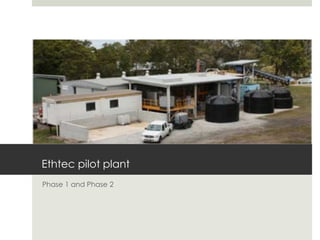
 Ethtec are continuing technology development:
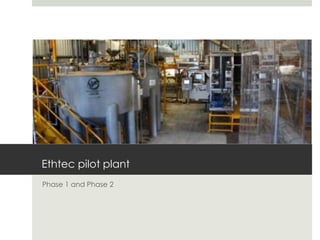
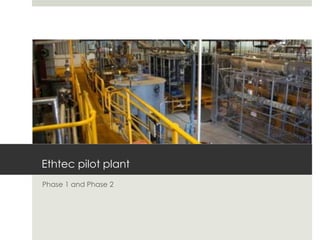
 pilot plant at Harwood in NSW has successfully completed
Phases 1 and 2.
 preliminary work for Phase 3 well underway.
 DRI has a current Memorandum of Understanding with Ethtec
giving us access to their technology.
Ethtec pilot plant
Phase 1 and Phase 2
Ethtec pilot plant
Phase 1 and Phase 2
Ethtec pilot plant
Phase 1 and Phase 2
Ethtec pilot plant
Phase 1 and Phase 2
Next steps
 Ethtec to:
 successfully complete their pilot plant project.
 decide whether process is commercially feasible.
 DRI or co-operative to negotiate agreement with Ethtec
for detailed information about:
 the plant.
 the process
(payment is likely to be required).
 Engineering and environmental studies leading to final
plant design.
Next steps - Cont
 Set up arrangements to:
 buy feedstocks.
 sell the products.
 Formal, detailed feasibility study.
 If everything looks OK then money would need to be
raised/borrowed to build the plant and Government
approvals obtained.
Funding
David Hamilton
Funding
Establishing any new business requires money.
Money will need to be raised to continue to develop the
ethanol project.
If the Dorset community wants to establish a new enterprise,
then the community will need to contribute funds to help make
that happen.
The usual way for people to contribute to establishing a new
enterprise is to buy shares in it:
 a way for the community to invest in itself.
 a way for profits to be distributed to investors in the form of
dividends.
Co-operative
 DRI has considered KPMG’s advice about a suitable corporate
structure that will enable:
 control of enterprises to remain in the community.
 funds to be raised from members of the community at reasonable cost.
 DRI has decided that it will seek to start a co-operative, with the
objectives of:
 looking for timber-related opportunities (not just the ethanol plant) that
would provide local employment and local economic development.
 getting wider community involvement in developing opportunities.
 We expect to kick off the process for starting a cooperative
sometime next year after the Tasmanian legislation regulating co-
operatives has been upgraded to a new national model.
Conclusions
As a community we need to take charge of our own destiny.
DRI have worked hard and achieved a lot since our previous community update.
There are many opportunities in the wood, wood products and energy from wood
area.
The Ling Siding site gives us an excellent place to start the rebuilding, but we need:
 participation of locally owned businesses.
 a range of products, processes and enterprises to make the new timber economy
as resilient as possible.
A cooperative is the ideal structure for the community to use to build a better future.

DRI Slide Presentation June 2015

  • 1.
    Dorset Renewable IndustriesPty Ltd Community Update: 29 October 2014
  • 2.
    Dorset Renewable IndustriesPty Ltd “DRI aims to develop new industries for the Dorset region of North East Tasmania. Our community focussed enterprise will use the region’s renewable resources to improve the environment and build community resilience.”
  • 3.
    Who we are Wedeveloped as a Community group well over two years ago from within the Dorset municipality in response to the economic situation in the region. We are one of the focus points for the community’s desire to help itself.
  • 4.
    Our group David Hamilton,Chairman Lives in Lilydale Has extensive experience in environmental health and safety in the oil industry Karen and Ken Hall, Michael Brill, Dale Jessop Live in the Scottsdale area Represent community interests, forestry, saw milling, and forest products industries Wendy Mitchell Lives in Launceston Brings environmental management, and economic development and small business experience John Beattie Has many years of operational experience in food processing Alan Davenport, Heath Blair, Peter Bird Other North Easterners assisting
  • 5.
    Objectives  Establish anew forestry-related enterprise in Dorset to make the best use of existing resources.  Deliver positive social, economic and environmental outcomes to the Dorset community.  Use feedstocks that can be produced on an ongoing and reliable basis and give fair payment for them.  Make innovation an important component of the enterprise.  Collaborate and share knowledge and expertise.  Create long term jobs and develop skills.
  • 6.
    Program Ling Siding: visionfor the site, grant application, and next steps Wendy Mitchell Ling Siding: refurbishment project Dale Jessup Volunteers, assistance and staying involved Ken Hall Establishing the integrated timber processing hub Michael Brill Ethanol plant update David Hamilton Ethanol plant resource assessment Jeremy Wilson Ethanol plant pre-feasibility study Martin Rees Funding new timber businesses David Hamilton Questions
  • 7.
    Grant application The startof our vision becoming a reality – Wendy Mitchell
  • 8.
    Grant timeline: Juneto Aug 2013 June 2013 DRI applies for two grants under the Tasmanian Forestry Agreement economic diversification process - $2.8M for Ling Siding and $1.6M for the ethanol plant.. July 2013 DRI attempts to prevent Korda Mentha from further dismembering of the Ling Siding site. 25 July, 2013 Prime Minister Kevin Rudd announces that DRI’s application for $2.8M to purchase and refurbish Ling Siding is successful, subject to a “value for money” test. August 2013 Korda Mentha starts sale process for Ling Siding. DRI places indicative offer, dependent upon grant funding.
  • 9.
    Grant timeline: Sep2013 – August 2014 September 2013 DRI submits final bid for Ling Siding, together with letter from Tony Abbott promising not to cut the grant if elected. September 2013 Korda Mentha rejects DRI’s offer because of funding uncertainty. October 2013 RNG Property Developments agree to sell most of the industrial land at Ling Siding to DRI, subject to grant funding. December 2013 Details of “value for money test” for the grant released. October 2014 DRI submits over 400 pages of documentation for value for money test. 25 Aug 2014 Assistant Minister for Infrastructure writes to DRI confirming grant, subject to negotiation of a grant deed (draft grant deed is 46 pages).
  • 10.
    About our grant Federal Grant - $2.8 Million plus GST.  Strong oversight and management by the Federal Government.  Grant can only be used for:  refurbishment of the Ling Site.  preparing the site for a timber integrated processing hub.  Funding is:  tied to milestones.  cannot be used to secure or help set up new businesses.  cannot be used for any purpose except refurbishment.
  • 11.
    What does thismean? Once the site is made ready, it’s up to the community, private enterprise, state government, DRI, or a community co-operative to:  encourage  develop  establish new enterprises at this site.
  • 12.
    Summary  DRI needsto:  stay focussed on the proper acquittal of $2.8 million.  ensure that the refurbishment funds are spent in accordance with the Deed.  make the site ready to receive timber businesses that can mutually benefit by being on such a collaborative site.  improve work opportunities and skills in the North East.  increase economic hope and activity in the North East Region.
  • 13.
  • 14.
  • 15.
  • 16.
  • 17.
  • 18.
  • 19.
  • 20.
    Ling Siding refurbishment:project Major project components are:  restoration of power to the site.  making good all buildings.  restoration of communication and IT systems.  restoration of potable water and effluent systems.  installation of a public weighbridge.  restoration of site fencing and erection of new fencing.  re-sealing 27,000 m2 hardstand area.
  • 21.
    Ling Siding refurbishment:project management Project management requires:  engagement of Project Manager.  establishment of safety system.  finalisation of scope of works.  drafting of contracts for each project component.  engagement of utility providers.  selection of contractors.
  • 22.
    Ling Siding refurbishment:key areas Key project areas are:  occupational health and safety of all people involved in the project.  management of environmental issues specific to the site.  maximising value of grant funding.  minimising economic leakage of funding by using of local contractors.  consideration of rail trail traversing site.
  • 23.
    Ling Siding refurbishment:not funded What the grant does not fund:  refurbishment of the 20 MW boiler.  activities to attract business to the site.  replacement of buildings that have been removed.  any components of the ethanol plant project.
  • 24.
    Ling Siding refurbishment:outcome An industrial site that:  has separately metered power to each area.  has good road surfaces.  has weighbridge capability.  has scope for further expansion.  is connected to the internet.  is secure.  has water and effluent systems.  will provide ongoing opportunities for our community.
  • 25.
  • 26.
    Future opportunities  Theopportunity taken:  Ling Siding will again be available as a site where people are employed processing timber.  What the grant funding achieves:  Ling Siding as infrastructure.
  • 27.
    Future opportunities -continued  Hub concept offers increased resilience through:  businesses working together, sharing common resources and services.  minimising waste: maximum value is achieved from every log, regardless of its quality.  many baskets for our economic eggs.  Renewable relationship with timber and industry.
  • 28.
    Potential timber industries timber preservation  timber posts  log peeling for veneer  cross-laminated timber  orientated strand  pellets  ethanol  saw milling  associated enterprises:  engineering  wood waste for steam enterprises  soil conditioning: composting and/or biochar
  • 29.
  • 30.
    Overview  Ethtec aredeveloping a process to convert woody material to ethanol  one of several “cellulosic ethanol” processes being developed world-wide.  Ethtec’s approach suits smaller plants  can use a range of feedstocks.  DRI is considering the opportunity of a plant using Ethtec’s technology:  located at Ling Siding.  producing 30 million litres of ethanol per year.  using 150,000 tonnes of feedstock per year from:  waste.  logs from local tree growers.
  • 31.
    Local ethanol plant:advantages  Provides local employment and uses local support services.  Pays local suppliers for feedstock.  Ethanol product is a renewable liquid fuel which:  is able to be blended into gasoline and diesel.  can totally (100%) fuel some engines.  can be used to reduce reliance on fossil fuels.
  • 32.
    Local ethanol plant:advantages  Reduces reliance on petroleum imported into Tasmania:  improved security of supply.  reduction in economic leakage.  Provides possibilities for non-fuel products:  ethanol as a solvent.  sugars for bio-plastics.
  • 33.
    Status of ethanolplant  Tasmanian Government (Department of State Growth) paid for a resource study by Esk Mapping and GIS.  Tasmanian Government and Dorset Council jointly funded a prefeasibility study which was performed by KPMG.  Ethtec are continuing technology development:  pilot plant at Harwood in NSW has successfully completed Phases 1 and 2.  preliminary work for Phase 3 well underway.  DRI has a current Memorandum of Understanding with Ethtec giving us access to their technology.
  • 34.
  • 35.
  • 36.
  • 37.
  • 38.
    Next steps  Ethtecto:  successfully complete their pilot plant project.  decide whether process is commercially feasible.  DRI or co-operative to negotiate agreement with Ethtec for detailed information about:  the plant.  the process (payment is likely to be required).  Engineering and environmental studies leading to final plant design.
  • 39.
    Next steps -Cont  Set up arrangements to:  buy feedstocks.  sell the products.  Formal, detailed feasibility study.  If everything looks OK then money would need to be raised/borrowed to build the plant and Government approvals obtained.
  • 40.
  • 41.
    Funding Establishing any newbusiness requires money. Money will need to be raised to continue to develop the ethanol project. If the Dorset community wants to establish a new enterprise, then the community will need to contribute funds to help make that happen. The usual way for people to contribute to establishing a new enterprise is to buy shares in it:  a way for the community to invest in itself.  a way for profits to be distributed to investors in the form of dividends.
  • 42.
    Co-operative  DRI hasconsidered KPMG’s advice about a suitable corporate structure that will enable:  control of enterprises to remain in the community.  funds to be raised from members of the community at reasonable cost.  DRI has decided that it will seek to start a co-operative, with the objectives of:  looking for timber-related opportunities (not just the ethanol plant) that would provide local employment and local economic development.  getting wider community involvement in developing opportunities.  We expect to kick off the process for starting a cooperative sometime next year after the Tasmanian legislation regulating co- operatives has been upgraded to a new national model.
  • 43.
    Conclusions As a communitywe need to take charge of our own destiny. DRI have worked hard and achieved a lot since our previous community update. There are many opportunities in the wood, wood products and energy from wood area. The Ling Siding site gives us an excellent place to start the rebuilding, but we need:  participation of locally owned businesses.  a range of products, processes and enterprises to make the new timber economy as resilient as possible. A cooperative is the ideal structure for the community to use to build a better future.