Drama
What is Drama?
• Drama is the literary from designed for the
theater
• Actors take the roles of the characters and
perform the indicated action.
• Drama both entertains and instructs.
Elements of Drama
• All plays share some basic elements with
which playwrights and producers work;
Plot Character
Setting
Dialogue
Spectacle
Theme
Plot
• Plot is the term for the action of a drama.
• Its function is to give action a form that helps
reader or audience understand relation of
the drama in relation to one another.
Plot
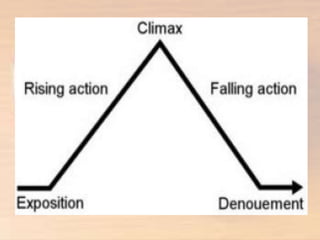
• 1. Exposition
- It is an explanation of what happened
before the play began
- To show how the characters arrived at
their present situation
Plot
2. Complication (rising action)
• Events which make the situation become
complicated.
• Also, it gradually intensify the conflict
• As the plot progress, it arouses expectations in
the audience of the future events.
• Uncertain about what will happen is called
“Suspense”
• If what in fact happens violates our
expectations, it is known as “surprise”
Plot
3. Climax
- It is the high point of tension or emotion in
the plot.
- It is the moments of stability and adjustment
in between
4. Crisis
- Climax and crisis may occur at the same time
- Crisis is considered a time of decision or a
turning point
- The character is faced with choices which will
determine his fate
• 5. Falling action
Once the climax has been reached, the
plot moves, the action will move to its
conclusion.
6. Denouement/Resolution
The end of the play
The solution to the problems
Character
• Character is the person endowed with moral
and dispositional qualities that expressed in
what he says------ dialogue
what he does----- the action
• 1. Character is revealed by speech.
– His manner of speaking, his voice quality
– The playwright take good care of dialogue because
it make immediate effect upon character’s
personality
2. Character is established by action.
3. Character maybe revealed by what other say
about him.
Setting
• Time and Place where the action occurs
• Scenery and physical elements appear on
stage to vivify the author’s stage direction
Dialogue
• Plays depend for their unfolding on dialogue
• The dialogue is the verbal exchange between
the characters
• The dialogue must tell the whole story
• Talk alone to reveal motives, intentions, state
of mind – “Soliloquy”
• Talk to one another, who then responds
“Soliloquy”
• Soliloquy is a speech that one gives to oneself.
In a play, a character delivering a soliloquy
talks to herself – thinking out loud, as it were
– so that the audience better understands
what is happening to the character internally.
“Example of Soliloquy”
• The most well-known soliloquy in the English
language appears in Act III, Scene 1 of Hamlet:
• To be, or not to be, — that is the question:
Whether 'tis nobler in the mind to suffer
The slings and arrows of outrageous fortune
Or to take arms against a sea of troubles,
And by opposing end them? (etc.)
Monologue
• A monologue is an extended, uninterrupted
speech by a single person. The person may be
speaking his or her thoughts aloud or directly
addressing other persons, e.g. an audience, a
character, or a reader.
Example of Monologue
• Marc Antony delivers a well-known monologue to
the people of Rome in Shakespeare's Julius
Caesar. You probably know how it starts:
• “Friends, Romans, countrymen, lend me your
ears;
I come to bury Caesar, not to praise him.
The evil that men do lives after them;
The good is oft interred with their bones:
So let it be with Caesar. (etc.)
• A monologue might be delivered to an
audience within a play, as it is with Antony's
speech, or it might be delivered directly to the
audience sitting in the theater and watching
the play.
Theme
• The theme of a play is its message, its central
idea
in short, what it is about
Spectacle
• Visual aspects of production scenery,
lighting, costume, make-up and the
business and movement of the
actors
Genre of Drama
• Tragedy
• Tragedy is kind of drama that presents a
serious subject matter about human suffering
and corresponding terrible events in a
dignified manner.
• Comedy
• Comedy is a literary genre and a type of dramatic
work that is amusing and satirical in its tone,
mostly having cheerful ending.
• This dramatic work is triumph over unpleasant
circumstance by which to create comic effects,
resulting in happy or successful conclusion.
• The purpose of comedy is to amuse the audience.
• Romantic Comedy
Involves the theme of love leading to happy
conclusion
Romantic comedy in Shakespearean plays
These plays are concerned with idealized love
affairs.
It is a fact that the true love never runs smooth;
however, love overcomes the difficulties.
• Comedy of Humors
• ‘humor’ that means liquid
• It explains that when human beings have
balance of these humors in their bodies, they
remain healthy.
• Tragicomedy
• It contains both tragedy and comedy. There
might be a happy ending after a series of
unfortunate events.
• It is incorporated with jokes throughout the
story just to lighten the tone.

Drama

  • 1.
  • 2.
    What is Drama? •Drama is the literary from designed for the theater • Actors take the roles of the characters and perform the indicated action. • Drama both entertains and instructs.
  • 3.
    Elements of Drama •All plays share some basic elements with which playwrights and producers work; Plot Character Setting Dialogue Spectacle Theme
  • 4.
    Plot • Plot isthe term for the action of a drama. • Its function is to give action a form that helps reader or audience understand relation of the drama in relation to one another.
  • 5.
    Plot • 1. Exposition -It is an explanation of what happened before the play began - To show how the characters arrived at their present situation
  • 6.
    Plot 2. Complication (risingaction) • Events which make the situation become complicated. • Also, it gradually intensify the conflict • As the plot progress, it arouses expectations in the audience of the future events. • Uncertain about what will happen is called “Suspense”
  • 7.
    • If whatin fact happens violates our expectations, it is known as “surprise”
  • 8.
    Plot 3. Climax - Itis the high point of tension or emotion in the plot. - It is the moments of stability and adjustment in between
  • 9.
    4. Crisis - Climaxand crisis may occur at the same time - Crisis is considered a time of decision or a turning point - The character is faced with choices which will determine his fate
  • 10.
    • 5. Fallingaction Once the climax has been reached, the plot moves, the action will move to its conclusion.
  • 11.
    6. Denouement/Resolution The endof the play The solution to the problems
  • 13.
    Character • Character isthe person endowed with moral and dispositional qualities that expressed in what he says------ dialogue what he does----- the action
  • 14.
    • 1. Characteris revealed by speech. – His manner of speaking, his voice quality – The playwright take good care of dialogue because it make immediate effect upon character’s personality 2. Character is established by action. 3. Character maybe revealed by what other say about him.
  • 15.
    Setting • Time andPlace where the action occurs • Scenery and physical elements appear on stage to vivify the author’s stage direction
  • 16.
    Dialogue • Plays dependfor their unfolding on dialogue • The dialogue is the verbal exchange between the characters • The dialogue must tell the whole story • Talk alone to reveal motives, intentions, state of mind – “Soliloquy” • Talk to one another, who then responds
  • 17.
    “Soliloquy” • Soliloquy isa speech that one gives to oneself. In a play, a character delivering a soliloquy talks to herself – thinking out loud, as it were – so that the audience better understands what is happening to the character internally.
  • 18.
    “Example of Soliloquy” •The most well-known soliloquy in the English language appears in Act III, Scene 1 of Hamlet: • To be, or not to be, — that is the question: Whether 'tis nobler in the mind to suffer The slings and arrows of outrageous fortune Or to take arms against a sea of troubles, And by opposing end them? (etc.)
  • 19.
    Monologue • A monologueis an extended, uninterrupted speech by a single person. The person may be speaking his or her thoughts aloud or directly addressing other persons, e.g. an audience, a character, or a reader.
  • 20.
    Example of Monologue •Marc Antony delivers a well-known monologue to the people of Rome in Shakespeare's Julius Caesar. You probably know how it starts: • “Friends, Romans, countrymen, lend me your ears; I come to bury Caesar, not to praise him. The evil that men do lives after them; The good is oft interred with their bones: So let it be with Caesar. (etc.)
  • 21.
    • A monologuemight be delivered to an audience within a play, as it is with Antony's speech, or it might be delivered directly to the audience sitting in the theater and watching the play.
  • 22.
    Theme • The themeof a play is its message, its central idea in short, what it is about
  • 23.
    Spectacle • Visual aspectsof production scenery, lighting, costume, make-up and the business and movement of the actors
  • 24.
    Genre of Drama •Tragedy • Tragedy is kind of drama that presents a serious subject matter about human suffering and corresponding terrible events in a dignified manner.
  • 25.
    • Comedy • Comedyis a literary genre and a type of dramatic work that is amusing and satirical in its tone, mostly having cheerful ending. • This dramatic work is triumph over unpleasant circumstance by which to create comic effects, resulting in happy or successful conclusion. • The purpose of comedy is to amuse the audience.
  • 26.
    • Romantic Comedy Involvesthe theme of love leading to happy conclusion Romantic comedy in Shakespearean plays These plays are concerned with idealized love affairs. It is a fact that the true love never runs smooth; however, love overcomes the difficulties.
  • 27.
    • Comedy ofHumors • ‘humor’ that means liquid • It explains that when human beings have balance of these humors in their bodies, they remain healthy.
  • 28.
    • Tragicomedy • Itcontains both tragedy and comedy. There might be a happy ending after a series of unfortunate events. • It is incorporated with jokes throughout the story just to lighten the tone.