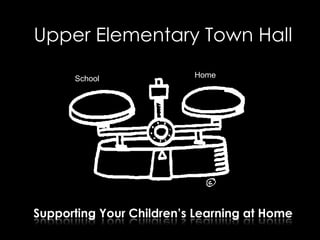
Upper Elementary Town Hall
School

Home

Supporting Your Children’s Learning at Home
GOALS FOR THIS EVENING
1. Reflection on the mission of the school
2. Exploration of our opportunities to support the
children’s learning
3. Reminder of our shared hopes for the children
4. Insight into current faculty initiatives
5. Experience of Question Formulation Technique
6. Analysis of shared goals as parents
7. Strategies for parents from parents
Mission
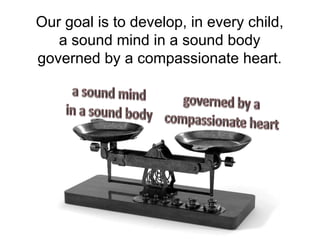
Our goal is to develop, in every child,
a sound mind in a sound body
governed by a compassionate heart.
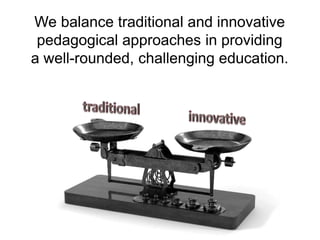
We balance traditional and innovative
pedagogical approaches in providing
a well-rounded, challenging education.
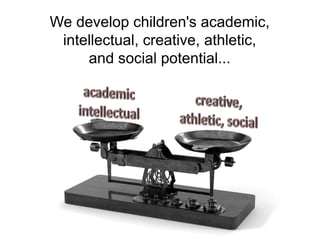
We develop children's academic,
intellectual, creative, athletic,
and social potential...
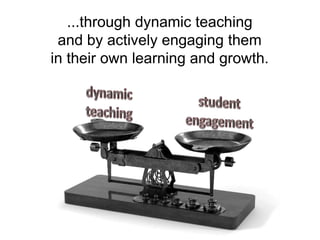
...through dynamic teaching
and by actively engaging them
in their own learning and growth.
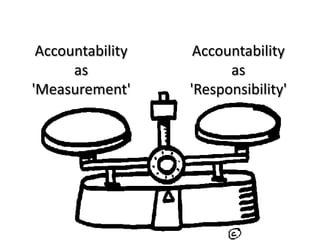
Accountability
as
'Measurement'

Accountability
as
'Responsibility'
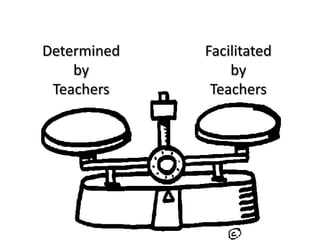
Determined
by
Teachers

Facilitated
by
Teachers
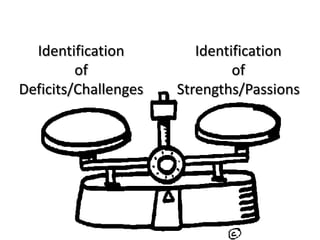
Identification
of
Deficits/Challenges

Identification
of
Strengths/Passions
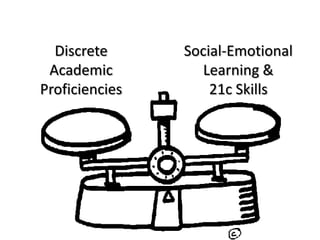
Discrete
Academic
Proficiencies

Social-Emotional
Learning &
21c Skills
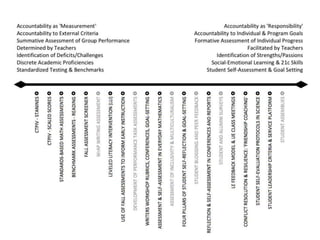
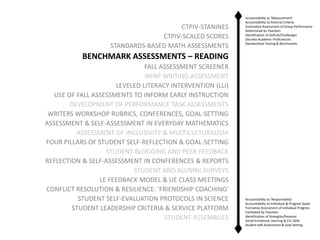
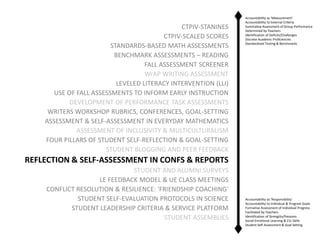
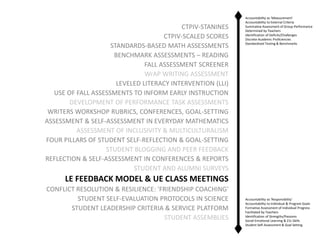
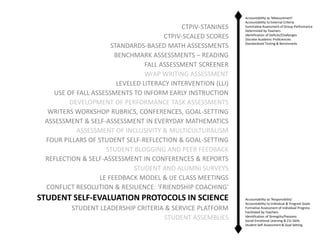
A Continuum of Assessment:

Intentional Culture
CTPIV-STANINES
CTPIV-SCALED SCORES
STANDARDS-BASED MATH ASSESSMENTS
BENCHMARK ASSESSMENTS – READING
FALL ASSESSMENT SCREENER
WrAP WRITING ASSESSMENT
LEVELED LITERACY INTERVENTION (LLI)
USE OF FALL ASSESSMENTS TO INFORM EARLY INSTRUCTION
DEVELOPMENT OF PERFORMANCE TASK ASSESSMENTS
WRITERS WORKSHOP RUBRICS, CONFERENCES, GOAL-SETTING
ASSESSMENT & SELF-ASSESSMENT IN EVERYDAY MATHEMATICS
ASSESSMENT OF INCLUSIVITY & MULTICULTURALISM
FOUR PILLARS OF STUDENT SELF-REFLECTION & GOAL-SETTING
STUDENT BLOGGING AND PEER FEEDBACK
REFLECTION & SELF-ASSESSMENT IN CONFERENCES & REPORTS
STUDENT AND ALUMNI SURVEYS
LE FEEDBACK MODEL & UE CLASS MEETINGS
CONFLICT RESOLUTION & RESILIENCE: 'FRIENDSHIP COACHING'
STUDENT SELF-EVALUATION PROTOCOLS IN SCIENCE
STUDENT LEADERSHIP CRITERIA & SERVICE PLATFORM
STUDENT ASSEMBLIES

Accountability as 'Measurement'
Accountability to External Criteria
Summative Assessment of Group Performance
Determined by Teachers
Identification of Deficits/Challenges
Discrete Academic Proficiencies
Standardized Testing & Benchmarks

Accountability as 'Responsibility'
Accountability to Individual & Program Goals
Formative Assessment of Individual Progress
Facilitated by Teachers
Identification of Strengths/Passions
Social-Emotional Learning & 21c Skills
Student Self-Assessment & Goal Setting
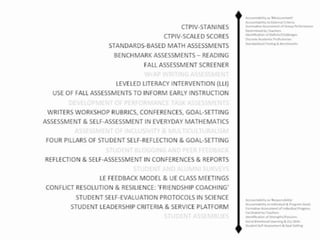
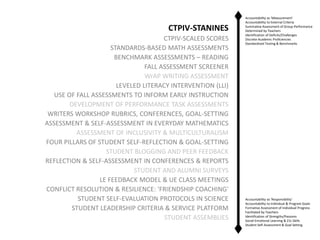
CTPIV-STANINES
CTPIV-SCALED SCORES
STANDARDS-BASED MATH ASSESSMENTS

Accountability as 'Measurement'
Accountability to External Criteria
Summative Assessment of Group Performance
Determined by Teachers
Identification of Deficits/Challenges
Discrete Academic Proficiencies
Standardized Testing & Benchmarks

BENCHMARK ASSESSMENTS – READING
FALL ASSESSMENT SCREENER
WrAP WRITING ASSESSMENT
LEVELED LITERACY INTERVENTION (LLI)
USE OF FALL ASSESSMENTS TO INFORM EARLY INSTRUCTION
DEVELOPMENT OF PERFORMANCE TASK ASSESSMENTS
WRITERS WORKSHOP RUBRICS, CONFERENCES, GOAL-SETTING
ASSESSMENT & SELF-ASSESSMENT IN EVERYDAY MATHEMATICS
ASSESSMENT OF INCLUSIVITY & MULTICULTURALISM
FOUR PILLARS OF STUDENT SELF-REFLECTION & GOAL-SETTING
STUDENT BLOGGING AND PEER FEEDBACK
REFLECTION & SELF-ASSESSMENT IN CONFERENCES & REPORTS
STUDENT AND ALUMNI SURVEYS
LE FEEDBACK MODEL & UE CLASS MEETINGS
CONFLICT RESOLUTION & RESILIENCE: 'FRIENDSHIP COACHING'
STUDENT SELF-EVALUATION PROTOCOLS IN SCIENCE
STUDENT LEADERSHIP CRITERIA & SERVICE PLATFORM
STUDENT ASSEMBLIES

Accountability as 'Responsibility'
Accountability to Individual & Program Goals
Formative Assessment of Individual Progress
Facilitated by Teachers
Identification of Strengths/Passions
Social-Emotional Learning & 21c Skills
Student Self-Assessment & Goal Setting
CTPIV-STANINES
CTPIV-SCALED SCORES
STANDARDS-BASED MATH ASSESSMENTS
BENCHMARK ASSESSMENTS – READING
FALL ASSESSMENT SCREENER
WrAP WRITING ASSESSMENT
LEVELED LITERACY INTERVENTION (LLI)
USE OF FALL ASSESSMENTS TO INFORM EARLY INSTRUCTION
DEVELOPMENT OF PERFORMANCE TASK ASSESSMENTS
WRITERS WORKSHOP RUBRICS, CONFERENCES, GOAL-SETTING
ASSESSMENT & SELF-ASSESSMENT IN EVERYDAY MATHEMATICS
ASSESSMENT OF INCLUSIVITY & MULTICULTURALISM
FOUR PILLARS OF STUDENT SELF-REFLECTION & GOAL-SETTING
STUDENT BLOGGING AND PEER FEEDBACK

Accountability as 'Measurement'
Accountability to External Criteria
Summative Assessment of Group Performance
Determined by Teachers
Identification of Deficits/Challenges
Discrete Academic Proficiencies
Standardized Testing & Benchmarks

REFLECTION & SELF-ASSESSMENT IN CONFS & REPORTS
STUDENT AND ALUMNI SURVEYS
LE FEEDBACK MODEL & UE CLASS MEETINGS
CONFLICT RESOLUTION & RESILIENCE: 'FRIENDSHIP COACHING'
STUDENT SELF-EVALUATION PROTOCOLS IN SCIENCE
STUDENT LEADERSHIP CRITERIA & SERVICE PLATFORM
STUDENT ASSEMBLIES

Accountability as 'Responsibility'
Accountability to Individual & Program Goals
Formative Assessment of Individual Progress
Facilitated by Teachers
Identification of Strengths/Passions
Social-Emotional Learning & 21c Skills
Student Self-Assessment & Goal Setting
CTPIV-STANINES
CTPIV-SCALED SCORES
STANDARDS-BASED MATH ASSESSMENTS
BENCHMARK ASSESSMENTS – READING
FALL ASSESSMENT SCREENER
WrAP WRITING ASSESSMENT
LEVELED LITERACY INTERVENTION (LLI)
USE OF FALL ASSESSMENTS TO INFORM EARLY INSTRUCTION
DEVELOPMENT OF PERFORMANCE TASK ASSESSMENTS
WRITERS WORKSHOP RUBRICS, CONFERENCES, GOAL-SETTING
ASSESSMENT & SELF-ASSESSMENT IN EVERYDAY MATHEMATICS
ASSESSMENT OF INCLUSIVITY & MULTICULTURALISM
FOUR PILLARS OF STUDENT SELF-REFLECTION & GOAL-SETTING
STUDENT BLOGGING AND PEER FEEDBACK
REFLECTION & SELF-ASSESSMENT IN CONFERENCES & REPORTS
STUDENT AND ALUMNI SURVEYS

Accountability as 'Measurement'
Accountability to External Criteria
Summative Assessment of Group Performance
Determined by Teachers
Identification of Deficits/Challenges
Discrete Academic Proficiencies
Standardized Testing & Benchmarks

LE FEEDBACK MODEL & UE CLASS MEETINGS
CONFLICT RESOLUTION & RESILIENCE: 'FRIENDSHIP COACHING'
STUDENT SELF-EVALUATION PROTOCOLS IN SCIENCE
STUDENT LEADERSHIP CRITERIA & SERVICE PLATFORM
STUDENT ASSEMBLIES

Accountability as 'Responsibility'
Accountability to Individual & Program Goals
Formative Assessment of Individual Progress
Facilitated by Teachers
Identification of Strengths/Passions
Social-Emotional Learning & 21c Skills
Student Self-Assessment & Goal Setting
CTPIV-STANINES
CTPIV-SCALED SCORES
STANDARDS-BASED MATH ASSESSMENTS
BENCHMARK ASSESSMENTS – READING
FALL ASSESSMENT SCREENER
WrAP WRITING ASSESSMENT
LEVELED LITERACY INTERVENTION (LLI)
USE OF FALL ASSESSMENTS TO INFORM EARLY INSTRUCTION
DEVELOPMENT OF PERFORMANCE TASK ASSESSMENTS
WRITERS WORKSHOP RUBRICS, CONFERENCES, GOAL-SETTING
ASSESSMENT & SELF-ASSESSMENT IN EVERYDAY MATHEMATICS
ASSESSMENT OF INCLUSIVITY & MULTICULTURALISM
FOUR PILLARS OF STUDENT SELF-REFLECTION & GOAL-SETTING
STUDENT BLOGGING AND PEER FEEDBACK
REFLECTION & SELF-ASSESSMENT IN CONFERENCES & REPORTS
STUDENT AND ALUMNI SURVEYS
LE FEEDBACK MODEL & UE CLASS MEETINGS
CONFLICT RESOLUTION & RESILIENCE: 'FRIENDSHIP COACHING'

STUDENT SELF-EVALUATION PROTOCOLS IN SCIENCE
STUDENT LEADERSHIP CRITERIA & SERVICE PLATFORM
STUDENT ASSEMBLIES

Accountability as 'Measurement'
Accountability to External Criteria
Summative Assessment of Group Performance
Determined by Teachers
Identification of Deficits/Challenges
Discrete Academic Proficiencies
Standardized Testing & Benchmarks

Accountability as 'Responsibility'
Accountability to Individual & Program Goals
Formative Assessment of Individual Progress
Facilitated by Teachers
Identification of Strengths/Passions
Social-Emotional Learning & 21c Skills
Student Self-Assessment & Goal Setting
Last Year’s Engagement
with
Parents, Students, and
Teachers
Driving Questions – Fall 2012

[ For details see: http://bit.ly/UETownHalls2012 ]
Driving Questions – Fall 2012
What words would describe the successful and
empowered child who will emerge from the
best school we can continue to create together?

[ For details see: http://bit.ly/UETownHalls2012 ]
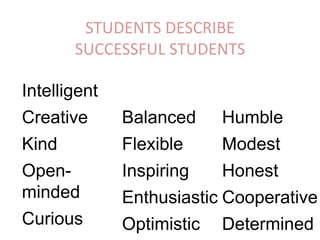
STUDENTS DESCRIBE
SUCCESSFUL STUDENTS
Intelligent
Creative

Balanced

Humble

Kind

Flexible

Modest

Openminded

Inspiring

Honest

Curious

Optimistic

Enthusiastic Cooperative
Determined
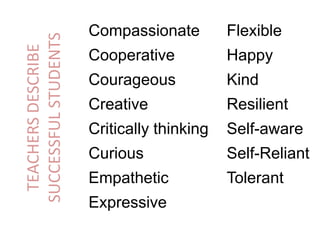
TEACHERS DESCRIBE
SUCCESSFUL STUDENTS

Compassionate

Flexible

Cooperative

Happy

Courageous

Kind

Creative

Resilient

Critically thinking

Self-aware

Curious

Self-Reliant

Empathetic

Tolerant

Expressive
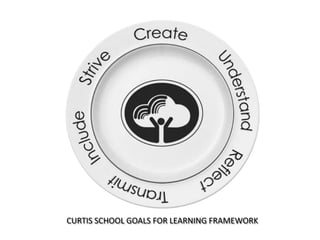
CURTIS SCHOOL GOALS FOR LEARNING FRAMEWORK
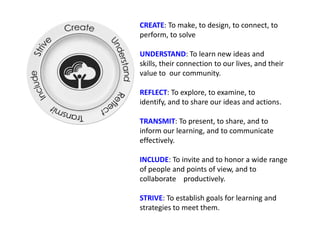
CREATE: To make, to design, to connect, to
perform, to solve
UNDERSTAND: To learn new ideas and
skills, their connection to our lives, and their
value to our community.

REFLECT: To explore, to examine, to
identify, and to share our ideas and actions.
TRANSMIT: To present, to share, and to
inform our learning, and to communicate
effectively.
INCLUDE: To invite and to honor a wide range
of people and points of view, and to
collaborate productively.

STRIVE: To establish goals for learning and
strategies to meet them.
This Year’s Engagement
with
Parents, Students, and
Teachers
How Might a Teacher . . .
1. CREATE an environment and climate conducive to learning?
2. UNDERSTAND and support the needs of each learner?
3. REFLECT with students on the purpose/objectives of instruction?
4. TRANSMIT new skills and understandings using a variety of instructional
strategies?
5. INCLUDE all learners as active participants in their learning and community?
6. STRIVE to balance traditional and innovative pedagogical approaches?
How do teachers create
an environment and climate
conducive to learning?
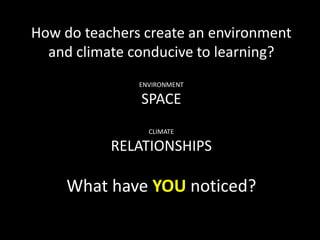
How do teachers create an environment
and climate conducive to learning?
ENVIRONMENT

SPACE
CLIMATE

RELATIONSHIPS

What have YOU noticed?
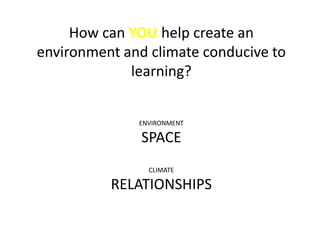
How can YOU help create an
environment and climate conducive to
learning?
ENVIRONMENT

SPACE
CLIMATE

RELATIONSHIPS
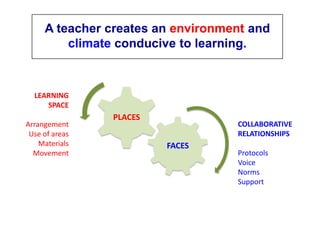
A teacher creates an environment and
climate conducive to learning.

LEARNING
SPACE
Arrangement
Use of areas
Materials
Movement

PLACES

COLLABORATIVE
RELATIONSHIPS

FACES

Protocols
Voice
Norms
Support
#LearningCommunity
This Evening’s Goals
THE QUESTION FORMULATION
TECHNIQUE™

www.rightquestion.org
© 2001- 2012
www.rightquestion.org
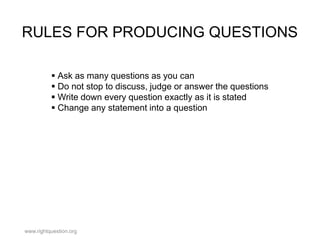
RULES FOR PRODUCING QUESTIONS
 Ask as many questions as you can
 Do not stop to discuss, judge or answer the questions
 Write down every question exactly as it is stated
 Change any statement into a question

www.rightquestion.org
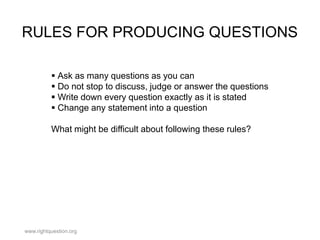
RULES FOR PRODUCING QUESTIONS
 Ask as many questions as you can
 Do not stop to discuss, judge or answer the questions
 Write down every question exactly as it is stated
 Change any statement into a question
What might be difficult about following these rules?

www.rightquestion.org
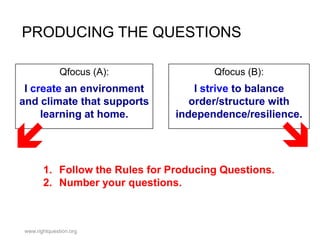
PRODUCING THE QUESTIONS
Qfocus (A):

Qfocus (B):

I create an environment
and climate that supports
learning at home.

I strive to balance
order/structure with
independence/resilience.



1. Follow the Rules for Producing Questions.
2. Number your questions.

www.rightquestion.org


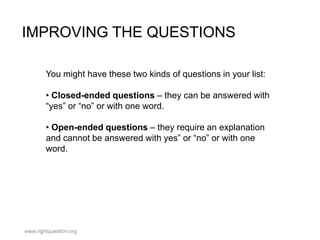
IMPROVING THE QUESTIONS
You might have these two kinds of questions in your list:
• Closed-ended questions – they can be answered with
“yes” or “no” or with one word.
• Open-ended questions – they require an explanation
and cannot be answered with yes” or “no” or with one
word.

www.rightquestion.org
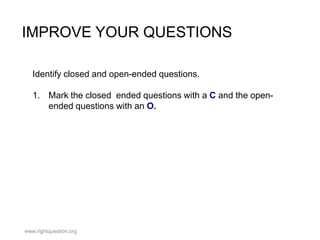
IMPROVE YOUR QUESTIONS
Identify closed and open-ended questions.
1. Mark the closed ended questions with a C and the openended questions with an O.

www.rightquestion.org
IMPROVE YOUR QUESTIONS
2. Name advantages of asking closed-ended questions.

www.rightquestion.org
IMPROVE YOUR QUESTIONS
2. Name disadvantages of asking closed-ended questions.

www.rightquestion.org
IMPROVE YOUR QUESTIONS
2. Name advantages of asking open-ended questions.

www.rightquestion.org
IMPROVE YOUR QUESTIONS
2. Name disadvantages of asking open-ended questions.

www.rightquestion.org
IMPROVE YOUR QUESTIONS

3. Review your list of questions and change one closed-ended
question into an open-ended.
Then, change one open-ended question into a closed-ended
one.

www.rightquestion.org
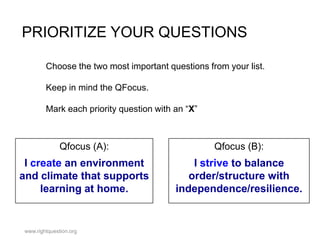
PRIORITIZE YOUR QUESTIONS
Choose the two most important questions from your list.
Keep in mind the QFocus.
Mark each priority question with an “X”

Qfocus (A):

Qfocus (B):

I create an environment
and climate that supports
learning at home.

I strive to balance
order/structure with
independence/resilience.

www.rightquestion.org
SHARE YOUR QUESTIONS
Please share:
• the questions you changed from closed to open-ended
and from open-ended to closed. Read each question
as originally written and how it was changed,
•

your two priority questions,

•

your rationale for selecting those three.

www.rightquestion.org
NEXT STEPS

1. How are you going to use your two priority questions?

www.rightquestion.org
REFLECTION
1. What did you learn?

2. What value does it have?

www.rightquestion.org
Next Steps
1. Exploring your driving questions
(2 x 7min)

Reflect on the reasons you chose these driving
questions.
What are some of the opportunities or
obstacles?
Name important core principles or criteria that
should inform parents’ choices at home.
2. From ideas to examples
(10 min)

Based on this discussion, look back at your
group’s QFocus.
What does supporting your child’s learning at
home ‘look like’? What have you done that has
been successful? What could you do?

Name concrete solutions/strategies for other
families to consider.
3. Report back
(10 min)

Please share (1-2 min each) highlights of your
group’s conclusions.
DRAFT FOR REVISION - Town Halls 2013_Workbook

DRAFT FOR REVISION - Town Halls 2013_Workbook

  • 1.
    Upper Elementary TownHall School Home Supporting Your Children’s Learning at Home
  • 3.
    GOALS FOR THISEVENING 1. Reflection on the mission of the school 2. Exploration of our opportunities to support the children’s learning 3. Reminder of our shared hopes for the children 4. Insight into current faculty initiatives 5. Experience of Question Formulation Technique 6. Analysis of shared goals as parents 7. Strategies for parents from parents
  • 4.
  • 5.
    Our goal isto develop, in every child, a sound mind in a sound body governed by a compassionate heart.
  • 6.
    We balance traditionaland innovative pedagogical approaches in providing a well-rounded, challenging education.
  • 7.
    We develop children'sacademic, intellectual, creative, athletic, and social potential...
  • 8.
    ...through dynamic teaching andby actively engaging them in their own learning and growth.
  • 10.
  • 11.
  • 12.
  • 13.
  • 14.
    A Continuum ofAssessment: Intentional Culture
  • 17.
    CTPIV-STANINES CTPIV-SCALED SCORES STANDARDS-BASED MATHASSESSMENTS BENCHMARK ASSESSMENTS – READING FALL ASSESSMENT SCREENER WrAP WRITING ASSESSMENT LEVELED LITERACY INTERVENTION (LLI) USE OF FALL ASSESSMENTS TO INFORM EARLY INSTRUCTION DEVELOPMENT OF PERFORMANCE TASK ASSESSMENTS WRITERS WORKSHOP RUBRICS, CONFERENCES, GOAL-SETTING ASSESSMENT & SELF-ASSESSMENT IN EVERYDAY MATHEMATICS ASSESSMENT OF INCLUSIVITY & MULTICULTURALISM FOUR PILLARS OF STUDENT SELF-REFLECTION & GOAL-SETTING STUDENT BLOGGING AND PEER FEEDBACK REFLECTION & SELF-ASSESSMENT IN CONFERENCES & REPORTS STUDENT AND ALUMNI SURVEYS LE FEEDBACK MODEL & UE CLASS MEETINGS CONFLICT RESOLUTION & RESILIENCE: 'FRIENDSHIP COACHING' STUDENT SELF-EVALUATION PROTOCOLS IN SCIENCE STUDENT LEADERSHIP CRITERIA & SERVICE PLATFORM STUDENT ASSEMBLIES Accountability as 'Measurement' Accountability to External Criteria Summative Assessment of Group Performance Determined by Teachers Identification of Deficits/Challenges Discrete Academic Proficiencies Standardized Testing & Benchmarks Accountability as 'Responsibility' Accountability to Individual & Program Goals Formative Assessment of Individual Progress Facilitated by Teachers Identification of Strengths/Passions Social-Emotional Learning & 21c Skills Student Self-Assessment & Goal Setting
  • 18.
    CTPIV-STANINES CTPIV-SCALED SCORES STANDARDS-BASED MATHASSESSMENTS Accountability as 'Measurement' Accountability to External Criteria Summative Assessment of Group Performance Determined by Teachers Identification of Deficits/Challenges Discrete Academic Proficiencies Standardized Testing & Benchmarks BENCHMARK ASSESSMENTS – READING FALL ASSESSMENT SCREENER WrAP WRITING ASSESSMENT LEVELED LITERACY INTERVENTION (LLI) USE OF FALL ASSESSMENTS TO INFORM EARLY INSTRUCTION DEVELOPMENT OF PERFORMANCE TASK ASSESSMENTS WRITERS WORKSHOP RUBRICS, CONFERENCES, GOAL-SETTING ASSESSMENT & SELF-ASSESSMENT IN EVERYDAY MATHEMATICS ASSESSMENT OF INCLUSIVITY & MULTICULTURALISM FOUR PILLARS OF STUDENT SELF-REFLECTION & GOAL-SETTING STUDENT BLOGGING AND PEER FEEDBACK REFLECTION & SELF-ASSESSMENT IN CONFERENCES & REPORTS STUDENT AND ALUMNI SURVEYS LE FEEDBACK MODEL & UE CLASS MEETINGS CONFLICT RESOLUTION & RESILIENCE: 'FRIENDSHIP COACHING' STUDENT SELF-EVALUATION PROTOCOLS IN SCIENCE STUDENT LEADERSHIP CRITERIA & SERVICE PLATFORM STUDENT ASSEMBLIES Accountability as 'Responsibility' Accountability to Individual & Program Goals Formative Assessment of Individual Progress Facilitated by Teachers Identification of Strengths/Passions Social-Emotional Learning & 21c Skills Student Self-Assessment & Goal Setting
  • 19.
    CTPIV-STANINES CTPIV-SCALED SCORES STANDARDS-BASED MATHASSESSMENTS BENCHMARK ASSESSMENTS – READING FALL ASSESSMENT SCREENER WrAP WRITING ASSESSMENT LEVELED LITERACY INTERVENTION (LLI) USE OF FALL ASSESSMENTS TO INFORM EARLY INSTRUCTION DEVELOPMENT OF PERFORMANCE TASK ASSESSMENTS WRITERS WORKSHOP RUBRICS, CONFERENCES, GOAL-SETTING ASSESSMENT & SELF-ASSESSMENT IN EVERYDAY MATHEMATICS ASSESSMENT OF INCLUSIVITY & MULTICULTURALISM FOUR PILLARS OF STUDENT SELF-REFLECTION & GOAL-SETTING STUDENT BLOGGING AND PEER FEEDBACK Accountability as 'Measurement' Accountability to External Criteria Summative Assessment of Group Performance Determined by Teachers Identification of Deficits/Challenges Discrete Academic Proficiencies Standardized Testing & Benchmarks REFLECTION & SELF-ASSESSMENT IN CONFS & REPORTS STUDENT AND ALUMNI SURVEYS LE FEEDBACK MODEL & UE CLASS MEETINGS CONFLICT RESOLUTION & RESILIENCE: 'FRIENDSHIP COACHING' STUDENT SELF-EVALUATION PROTOCOLS IN SCIENCE STUDENT LEADERSHIP CRITERIA & SERVICE PLATFORM STUDENT ASSEMBLIES Accountability as 'Responsibility' Accountability to Individual & Program Goals Formative Assessment of Individual Progress Facilitated by Teachers Identification of Strengths/Passions Social-Emotional Learning & 21c Skills Student Self-Assessment & Goal Setting
  • 20.
    CTPIV-STANINES CTPIV-SCALED SCORES STANDARDS-BASED MATHASSESSMENTS BENCHMARK ASSESSMENTS – READING FALL ASSESSMENT SCREENER WrAP WRITING ASSESSMENT LEVELED LITERACY INTERVENTION (LLI) USE OF FALL ASSESSMENTS TO INFORM EARLY INSTRUCTION DEVELOPMENT OF PERFORMANCE TASK ASSESSMENTS WRITERS WORKSHOP RUBRICS, CONFERENCES, GOAL-SETTING ASSESSMENT & SELF-ASSESSMENT IN EVERYDAY MATHEMATICS ASSESSMENT OF INCLUSIVITY & MULTICULTURALISM FOUR PILLARS OF STUDENT SELF-REFLECTION & GOAL-SETTING STUDENT BLOGGING AND PEER FEEDBACK REFLECTION & SELF-ASSESSMENT IN CONFERENCES & REPORTS STUDENT AND ALUMNI SURVEYS Accountability as 'Measurement' Accountability to External Criteria Summative Assessment of Group Performance Determined by Teachers Identification of Deficits/Challenges Discrete Academic Proficiencies Standardized Testing & Benchmarks LE FEEDBACK MODEL & UE CLASS MEETINGS CONFLICT RESOLUTION & RESILIENCE: 'FRIENDSHIP COACHING' STUDENT SELF-EVALUATION PROTOCOLS IN SCIENCE STUDENT LEADERSHIP CRITERIA & SERVICE PLATFORM STUDENT ASSEMBLIES Accountability as 'Responsibility' Accountability to Individual & Program Goals Formative Assessment of Individual Progress Facilitated by Teachers Identification of Strengths/Passions Social-Emotional Learning & 21c Skills Student Self-Assessment & Goal Setting
  • 21.
    CTPIV-STANINES CTPIV-SCALED SCORES STANDARDS-BASED MATHASSESSMENTS BENCHMARK ASSESSMENTS – READING FALL ASSESSMENT SCREENER WrAP WRITING ASSESSMENT LEVELED LITERACY INTERVENTION (LLI) USE OF FALL ASSESSMENTS TO INFORM EARLY INSTRUCTION DEVELOPMENT OF PERFORMANCE TASK ASSESSMENTS WRITERS WORKSHOP RUBRICS, CONFERENCES, GOAL-SETTING ASSESSMENT & SELF-ASSESSMENT IN EVERYDAY MATHEMATICS ASSESSMENT OF INCLUSIVITY & MULTICULTURALISM FOUR PILLARS OF STUDENT SELF-REFLECTION & GOAL-SETTING STUDENT BLOGGING AND PEER FEEDBACK REFLECTION & SELF-ASSESSMENT IN CONFERENCES & REPORTS STUDENT AND ALUMNI SURVEYS LE FEEDBACK MODEL & UE CLASS MEETINGS CONFLICT RESOLUTION & RESILIENCE: 'FRIENDSHIP COACHING' STUDENT SELF-EVALUATION PROTOCOLS IN SCIENCE STUDENT LEADERSHIP CRITERIA & SERVICE PLATFORM STUDENT ASSEMBLIES Accountability as 'Measurement' Accountability to External Criteria Summative Assessment of Group Performance Determined by Teachers Identification of Deficits/Challenges Discrete Academic Proficiencies Standardized Testing & Benchmarks Accountability as 'Responsibility' Accountability to Individual & Program Goals Formative Assessment of Individual Progress Facilitated by Teachers Identification of Strengths/Passions Social-Emotional Learning & 21c Skills Student Self-Assessment & Goal Setting
  • 22.
  • 23.
    Driving Questions –Fall 2012 [ For details see: http://bit.ly/UETownHalls2012 ]
  • 24.
    Driving Questions –Fall 2012 What words would describe the successful and empowered child who will emerge from the best school we can continue to create together? [ For details see: http://bit.ly/UETownHalls2012 ]
  • 26.
  • 27.
  • 29.
    CURTIS SCHOOL GOALSFOR LEARNING FRAMEWORK
  • 30.
    CREATE: To make,to design, to connect, to perform, to solve UNDERSTAND: To learn new ideas and skills, their connection to our lives, and their value to our community. REFLECT: To explore, to examine, to identify, and to share our ideas and actions. TRANSMIT: To present, to share, and to inform our learning, and to communicate effectively. INCLUDE: To invite and to honor a wide range of people and points of view, and to collaborate productively. STRIVE: To establish goals for learning and strategies to meet them.
  • 31.
  • 32.
    How Might aTeacher . . . 1. CREATE an environment and climate conducive to learning? 2. UNDERSTAND and support the needs of each learner? 3. REFLECT with students on the purpose/objectives of instruction? 4. TRANSMIT new skills and understandings using a variety of instructional strategies? 5. INCLUDE all learners as active participants in their learning and community? 6. STRIVE to balance traditional and innovative pedagogical approaches?
  • 33.
    How do teacherscreate an environment and climate conducive to learning?
  • 35.
    How do teacherscreate an environment and climate conducive to learning? ENVIRONMENT SPACE CLIMATE RELATIONSHIPS What have YOU noticed?
  • 36.
    How can YOUhelp create an environment and climate conducive to learning? ENVIRONMENT SPACE CLIMATE RELATIONSHIPS
  • 37.
    A teacher createsan environment and climate conducive to learning. LEARNING SPACE Arrangement Use of areas Materials Movement PLACES COLLABORATIVE RELATIONSHIPS FACES Protocols Voice Norms Support
  • 38.
  • 39.
  • 40.
  • 41.
    RULES FOR PRODUCINGQUESTIONS  Ask as many questions as you can  Do not stop to discuss, judge or answer the questions  Write down every question exactly as it is stated  Change any statement into a question www.rightquestion.org
  • 42.
    RULES FOR PRODUCINGQUESTIONS  Ask as many questions as you can  Do not stop to discuss, judge or answer the questions  Write down every question exactly as it is stated  Change any statement into a question What might be difficult about following these rules? www.rightquestion.org
  • 43.
    PRODUCING THE QUESTIONS Qfocus(A): Qfocus (B): I create an environment and climate that supports learning at home. I strive to balance order/structure with independence/resilience.  1. Follow the Rules for Producing Questions. 2. Number your questions. www.rightquestion.org 
  • 44.
    IMPROVING THE QUESTIONS Youmight have these two kinds of questions in your list: • Closed-ended questions – they can be answered with “yes” or “no” or with one word. • Open-ended questions – they require an explanation and cannot be answered with yes” or “no” or with one word. www.rightquestion.org
  • 45.
    IMPROVE YOUR QUESTIONS Identifyclosed and open-ended questions. 1. Mark the closed ended questions with a C and the openended questions with an O. www.rightquestion.org
  • 46.
    IMPROVE YOUR QUESTIONS 2.Name advantages of asking closed-ended questions. www.rightquestion.org
  • 47.
    IMPROVE YOUR QUESTIONS 2.Name disadvantages of asking closed-ended questions. www.rightquestion.org
  • 48.
    IMPROVE YOUR QUESTIONS 2.Name advantages of asking open-ended questions. www.rightquestion.org
  • 49.
    IMPROVE YOUR QUESTIONS 2.Name disadvantages of asking open-ended questions. www.rightquestion.org
  • 50.
    IMPROVE YOUR QUESTIONS 3.Review your list of questions and change one closed-ended question into an open-ended. Then, change one open-ended question into a closed-ended one. www.rightquestion.org
  • 51.
    PRIORITIZE YOUR QUESTIONS Choosethe two most important questions from your list. Keep in mind the QFocus. Mark each priority question with an “X” Qfocus (A): Qfocus (B): I create an environment and climate that supports learning at home. I strive to balance order/structure with independence/resilience. www.rightquestion.org
  • 52.
    SHARE YOUR QUESTIONS Pleaseshare: • the questions you changed from closed to open-ended and from open-ended to closed. Read each question as originally written and how it was changed, • your two priority questions, • your rationale for selecting those three. www.rightquestion.org
  • 53.
    NEXT STEPS 1. Howare you going to use your two priority questions? www.rightquestion.org
  • 54.
    REFLECTION 1. What didyou learn? 2. What value does it have? www.rightquestion.org
  • 55.
  • 56.
    1. Exploring yourdriving questions (2 x 7min) Reflect on the reasons you chose these driving questions. What are some of the opportunities or obstacles? Name important core principles or criteria that should inform parents’ choices at home.
  • 57.
    2. From ideasto examples (10 min) Based on this discussion, look back at your group’s QFocus. What does supporting your child’s learning at home ‘look like’? What have you done that has been successful? What could you do? Name concrete solutions/strategies for other families to consider.
  • 58.
    3. Report back (10min) Please share (1-2 min each) highlights of your group’s conclusions.