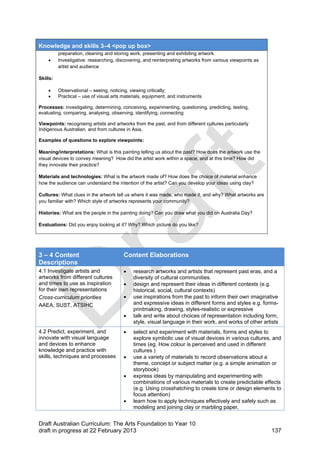
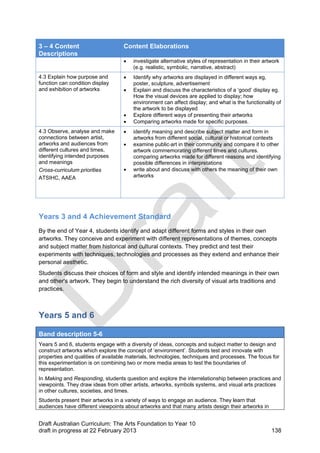
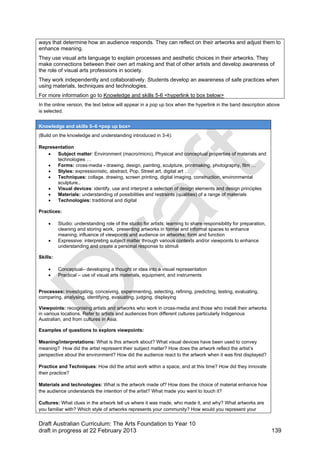
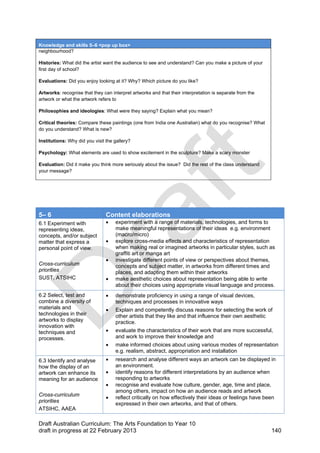
Revised Draft Australian 
Curriculum: The Arts 
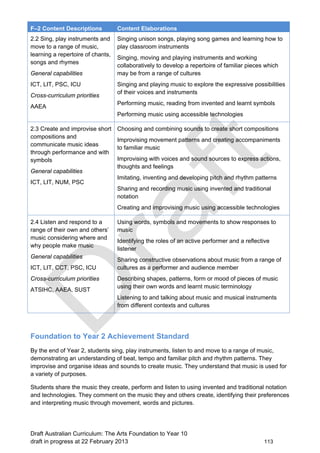
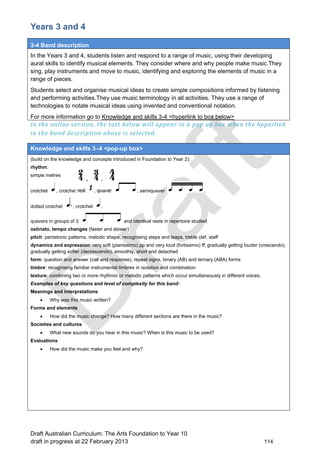
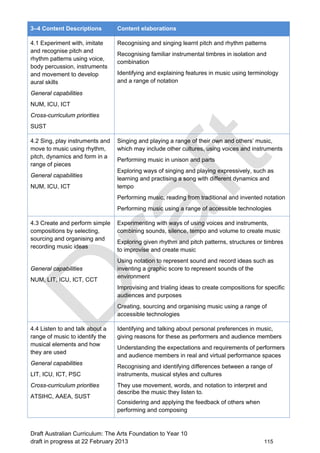
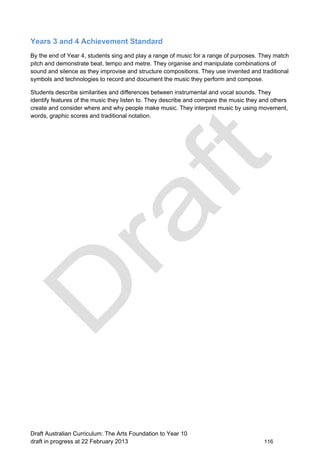
Foundation to Year 10 
Draft work in progress 
February 
2013 
www.acara.edu.au
xxix 
© Australian Curriculum, Assessment and 
Reporting Authority 2013 
This work is copyright. You may download, 
display, print and reproduce this material in 
unaltered form only (retaining this notice) for 
your personal, non-commercial use or use 
within your organisation. 
All other rights are reserved. Requests 
and inquiries concerning reproduction 
and rights should be addressed to: 
ACARA Copyright Administration, 
ACARA Level 10, 255 Pitt Street 
Sydney 
NSW 
2000
Contents 
The Arts Learning Area 1 
Dance 24 
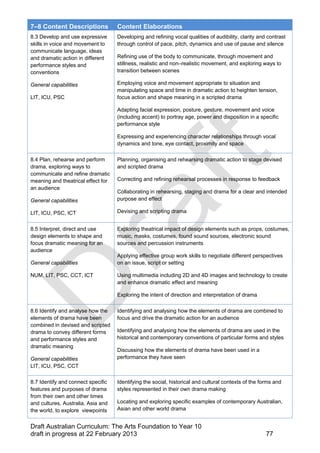
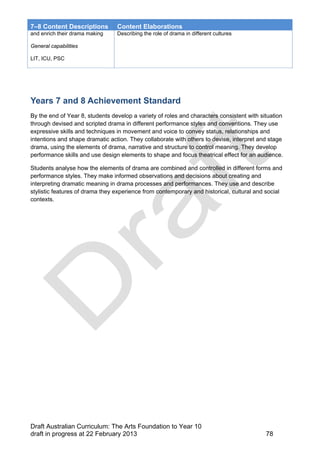
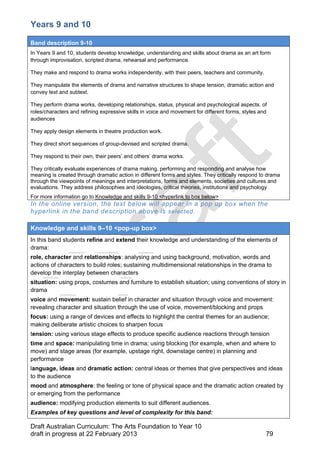
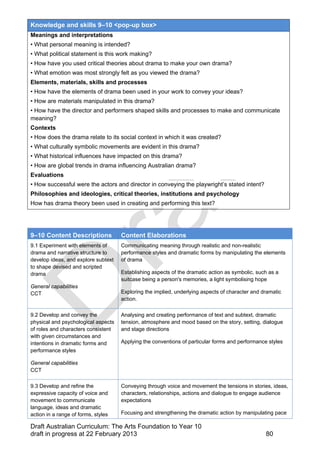
Drama 60 
Media Arts 83 
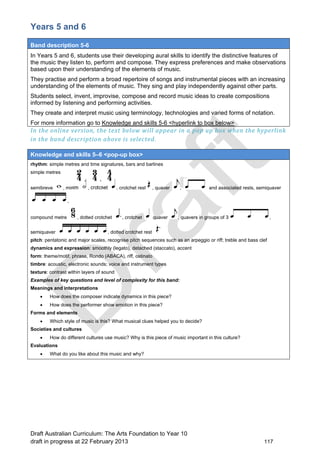
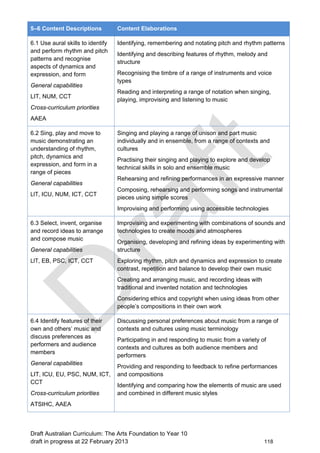
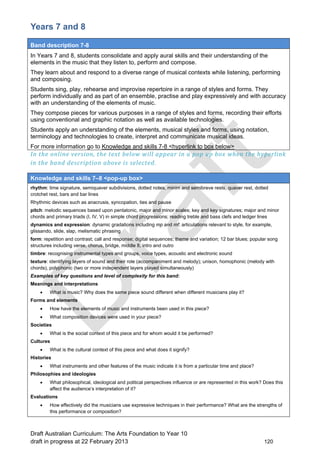
Music 107 
Visual Arts 126 
Draft work in progress
The Arts Learning Area 
Rationale 
The Arts have the capacity to engage, inspire and enrich all students, exciting the 
imagination and encouraging them to reach their creative and expressive potential. The five 
distinct but related Arts subjects in the Australian Curriculum — Dance, Drama, Media Arts, 
Music and Visual Arts — all provide opportunities for students to create, share and 
communicate ideas, emotions, experiences and imagination. Rich in tradition, the Arts play a 
major role in the development and expression of contemporary cultures and communities, 
locally, nationally and globally. 
In the Arts, students learn as artists and audience through the intellectual, emotional and 
sensory experiences of the arts. They acquire skills specific to the Arts subjects and develop 
critical understanding that informs decision-making and aesthetic choices. Through the Arts, 
students learn to express their ideas, thoughts and opinions as they discover and interpret 
the world. Students develop their Arts knowledge and aesthetic understanding through a 
growing comprehension of the distinct and related language, symbols, techniques, 
processes and skills of the Arts subjects. They communicate ideas in current, traditional and 
emerging forms and use arts knowledge and understanding to make sense of their world. 
The Arts entertain, challenge, provoke responses and enrich our knowledge of self, 
communities, cultures and histories. The Arts contribute to the development of confident and 
creative individuals, nurturing and challenging, active and informed citizens. Through 
engagement with Arts practice students learn about what artists know and do, how they do 
it, where they do it, with and for whom they do it and why they do it. Learning and practising 
arts traditions fosters social competencies and aids the development of personal identity, 
views of the world and global citizenship. Arts learning is based on cognitive, affective and 
sensory/kinaesthetic response to practice as students revisit increasingly complex content, 
skills, techniques and processes with developing confidence and sophistication across their 
years of learning. 
This rationale for the Arts learning area is complemented and extended by specific rationales 
for each of the five Arts subjects. 
Aims 
The Australian Curriculum: The Arts aims to develop students’: 
 creativity, imagination, aesthetic understanding and critical thinking and Arts 
practices with increasing self-confidence through engagement in making and 
responding to artworks 
 Arts knowledge and communication: valuing and sharing experience, 
representing, expressing and communicating ideas about their individual and 
collective worlds to others in meaningful ways 
 Use of innovative arts practices and available and emerging technologies to 
express ideas and develop empathy with multiple viewpoints 
Draft Australian Curriculum: The Arts Foundation to Year 10 
draft in progress at 22 February 2013 1
 Insights into and understanding of local, regional and global cultures, histories 
and Arts traditions through engaging with the worlds of artists, art forms, practices 
and professions. 
These aims are extended and complemented by specific aims for each Arts subject. 
Organisation 
Introduction 
In the Australian Curriculum, the Arts is a learning area that draws together related but 
distinct art forms. While these art forms have close relationships and are often used in 
interrelated ways, practice in each involves different approaches to practical and critical 
thinking and reflects distinct bodies of knowledge and understanding. 
The Australian Curriculum: The Arts Foundation to Year 10 comprises five subjects: 
• Dance 
• Drama 
• Media Arts 
• Music 
• Visual Arts 
Each subject focuses on its own practice and unique ways of looking at the world. 
In Dance, students use the body to communicate and express meaning through purposeful 
movement. Dance practice integrates choreography, performance, appreciation of and 
responses to dance and dance-making. Students develop awareness of, and use knowledge 
of dance and dance practitioners in their own and other cultures and communities. 
In Drama, students explore and depict real and fictional worlds through the body language, 
gesture and space to make meaning as performers and audience. They create, rehearse, 
perform and respond to drama individually and collaboratively. They explore the diversity of 
drama in the contemporary world and other times, places and traditions through various 
theatrical contexts, styles and forms. 
In Media Arts, students use communications technologies to explore, interpret and create 
stories about people, ideas and the world around them. They engage their senses, 
imagination and intellect through works that respond to diverse and dynamic cultural, social 
and institutional factors that shape contemporary communication. Students connect with 
audiences, purposes and ideas, exploring concepts and viewpoints through the creative use 
of materials and technologies. 
In Music, students listen to, compose and perform music from a broad range of styles, 
traditions and contexts. They create, shape and share sounds in time and space and 
critically analyse music they listen to, make and perform Music practice is aurally based and 
focuses on acquiring and using knowledge and understanding about music and musicians 
from their own experience and other times and places. 
In Visual Arts, students engage with the concepts of artists, artworks and audience. Visual 
Arts practice involves experiences, practical and critical thinking, conceptual and spatial 
inquiry and the analysis of artworks from a range of viewpoints as artist and audience. 
Draft Australian Curriculum: The Arts Foundation to Year 10 
draft in progress at 22 February 2013 2
Students make individual and collaborative artworks that communicate their artistic 
intentions and use skills of observation, interpretation and analysis to critically evaluate their 
own and others’ artworks. 
The Arts subjects are also interconnected, particularly through hybrid (combination) and 
contemporary arts. The curriculum enables exploration of the dynamic relationships between 
Arts subjects. This might involve students making artworks in traditional or contemporary 
forms or using material from one Arts subject to support learning in another. 
Design in the Arts 
Design links creativity and innovation. Within all Arts subjects, design facilitates the creative 
and practical realisation of ideas and processes. Design thinking is a fundamental strategy in 
the experimentation, refinement and resolution of an artwork and is sensitive to logical, 
critical and aesthetic considerations. In the Arts, many different words describe the design 
process such as composing, choreographing, narrating, devising, constructing, sculpting and 
visually designing. 
Designing in the Arts specifically considers the relational ways art forms can inform each 
other. This includes music and dance, visual design and drama, sculpture and architecture 
or for instance, in media arts, the combination of multiple art forms and technologies. Design 
in the Arts may also consider the contribution and opportunities afforded by other forms of 
thinking such as environmental, aesthetic, mathematical, scientific, geographical, historical, 
technological, socio-cultural, kinaesthetic or material thinking. 
Content structure 
The Australian Curriculum: The Arts is written for each of the five subjects across bands of 
year levels: Foundation to Year 2; Years 3 and 4; Years 5 and 6; Years 7 and 8 and Years 9 
and 10. 
Strands 
Content descriptions in each Arts subject are organised through two interrelated strands 
that, across the bands, present a sequence of development of knowledge, understanding 
and skills. 
The strands are: 
 Making – learning about and using knowledge, techniques, skills and processes to 
explore Arts practices and to make artworks 
 Responding – exploring, responding to, analysing and interpreting artworks. 
Making 
Making involves learning about and using knowledge, techniques, skills and processes to 
explore arts practices and to make artworks which they present, perform or produce. As the 
artist and as audience for their own work and for the works of others, students learn through 
actions such as experimenting, conceptualising, reflecting, performing, communicating and 
evaluating. The ongoing process of reflecting, refining and resolving their work is essential to 
learning in the Arts as much as is creating a finished artwork. 
Draft Australian Curriculum: The Arts Foundation to Year 10 
draft in progress at 22 February 2013 3
Making in the Arts involves engaging the senses, the emotions, cognition and imagination, 
and thinking critically and creatively. To make an artwork, students work from an idea, an 
intention, particular resources, an expressive or imaginative impulse, or an external stimulus. 
They learn to explore possibilities, solve problems and ask questions when making decisions 
and interpreting meaning. 
Learning through making is interrelated with and dependent upon responding. Students 
learn by reflecting on their making and critically responding to the making of others. 
Responding 
As artists and audiences, students explore, respond to, analyse and interpret the artworks 
they experience in the five Arts subjects. They learn that meanings can be generated from 
different viewpoints and that these shift according to different world encounters. 
Responding involves reflective and analytical processes as students learn about, acquire 
and apply knowledge and skills in the individual Arts subjects. Students learn to understand, 
appreciate and critique the Arts through the critical and contextual study of artworks and by 
making their own artworks. 
Relationship between the strands 
Together, the two organising strands, Making and Responding, provide students with 
knowledge, understanding and skills as artists <link to artists in Content Structure> as well 
as skills in critical and creative thinking <link to General Capabilities Critical and creative 
thinking>. They learn to analyse and generate ideas, create artworks and express emotions 
through art form specific skills and techniques. The curriculum examines the contemporary 
practice of each art form and how the world can be interpreted through the social, cultural 
and historical contexts of an artwork. The strands of Making and Responding are intrinsically 
interconnected with each promoting students’ learning as artists and as audience. Teaching 
and learning programs balance and integrate both strands. 
Students learn to use and manipulate the practices of an art form, and manage relevant 
materials, instruments and skills to prepare, develop, produce and present artworks. They 
learn to reflect upon and communicate about their art making. Together, making and 
responding enable students to develop knowledge, understanding and skills as artists and 
audience, expanding their skills in critical and creative thinking. They learn to analyse and 
generate ideas as they make artworks and respond to artworks. They express ideas, 
opinions and responses. They learn and use Arts subject specific skills and techniques. The 
curriculum enables students to examine traditional and contemporary practices in each Arts 
subject and to consider how their world can be interpreted through social, cultural and 
historical contexts. 
 Within each strand, key concepts and processes as outlined in the table 
below provide the focus for content and present a developmental sequence of 
knowledge, understanding and skills across the bands in the five Arts subjects. 
Draft Australian Curriculum: The Arts Foundation to Year 10 
draft in progress at 22 February 2013 4
Band descriptions 
Band descriptions provide an overview of content at each level. They also emphasise the 
interrelated nature of the two strands. Knowledge and skills particular to each band in each 
Arts subject are identified in the hyperlink at the end of the band description. 
Content descriptions 
The Australian Curriculum: The Arts includes content descriptions at each band. These 
describe the knowledge, understanding, skills and processes that teachers are expected to 
teach and students are expected to learn. Content descriptions do not prescribe approaches 
to teaching and do not prescribe forms within the Arts subject. Content descriptions have 
been written to ensure that learning is appropriately ordered and that unnecessary repetition 
is avoided. However, a concept or skill introduced at one year level may be revisited, 
strengthened and extended at later year levels as needed. 
Content elaborations 
Content elaborations are provided for Foundation to Year 10 as support material to illustrate 
and exemplify content and assist teachers in developing a common understanding of how 
the content descriptions might be interpreted in the classroom. They are not intended to be 
comprehensive content points that all students need to be taught. 
Glossary 
A glossary is provided to support a common understanding of key terms in the content 
descriptions. There are similarities in terminology used in the Arts but the definitions are 
often specific to each subject. 
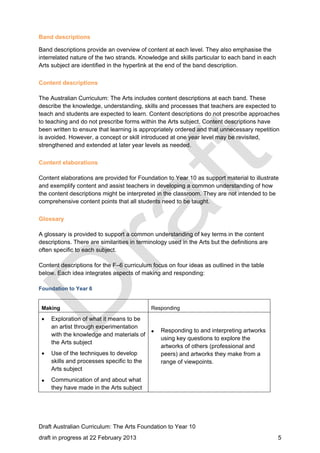
Content descriptions for the F–6 curriculum focus on four ideas as outlined in the table 
below. Each idea integrates aspects of making and responding: 
Foundation to Year 6 
Making Responding 
 Exploration of what it means to be 
an artist through experimentation 
with the knowledge and materials of 
the Arts subject 
 Use of the techniques to develop 
skills and processes specific to the 
Arts subject 
 Communication of and about what 
they have made in the Arts subject 
 Responding to and interpreting artworks 
using key questions to explore the 
artworks of others (professional and 
peers) and artworks they make from a 
range of viewpoints. 
Draft Australian Curriculum: The Arts Foundation to Year 10 
draft in progress at 22 February 2013 5
Years 7 to 10 
The focus of content descriptions in Years 7 to 10 have some commonality across Arts 
subjects but are more subject specific than the ideas used to structure the Foundation to 
Year 6 curriculum. This more detailed structure enables students to extend their learning and 
to develop their Arts knowledge, understanding and skills in a more critical and sustained 
way. 
Arts knowledge 
Arts knowledge refers to understanding developed when learning in, through and about the 
Arts. The interactive and information qualities of making and responding develop students’ 
abilities to make aesthetic choices. Arts knowledge is accumulated over time and allows the 
student, as the artist, to clarify, intensify and interpret human experiences for communicative 
purposes. In each Arts subject, students’ initial aesthetic knowledge – the combination of 
cognitive, affective and sensory experience stems from early experiences at home and in 
their community. These experiences are nurtured by an increasing range of influences. 
Through the Arts students learn to reflect critically on their own experiences and responses. 
They develop a breadth of understanding and analytical skills which they intuitively combine 
when considering personal interpretations, the possible intentions of the artist, and the 
potential understandings of other audiences. 
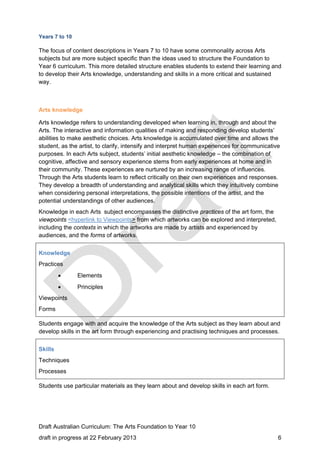
Knowledge in each Arts subject encompasses the distinctive practices of the art form, the 
viewpoints <hyperlink to Viewpoints> from which artworks can be explored and interpreted, 
including the contexts in which the artworks are made by artists and experienced by 
audiences, and the forms of artworks. 
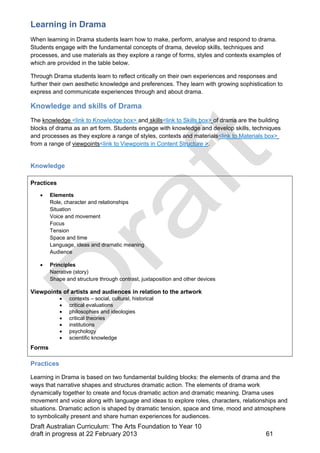
Knowledge 
Practices 
 Elements 
 Principles 
Viewpoints 
Forms 
Students engage with and acquire the knowledge of the Arts subject as they learn about and 
develop skills in the art form through experiencing and practising techniques and processes. 
Skills 
Techniques 
Processes 
Students use particular materials as they learn about and develop skills in each art form. 
Draft Australian Curriculum: The Arts Foundation to Year 10 
draft in progress at 22 February 2013 6
Materials 
Terminology in the Arts 
Students learn to communicate their understanding using arts terminology. The terminology 
of each Arts subject is used to communicate understandings in Making and Responding in 
the particular art form. Arts terminology is introduced in the primary years where students 
learn that vocabulary is used in specific ways in each Arts subject. From Years 7 to 8 more 
Arts subject-specific terminology is introduced to develop students’ vocabulary in the 
learning of each Arts subject. Definitions of arts-specific terminology used in this curriculum 
are included in the glossary. 
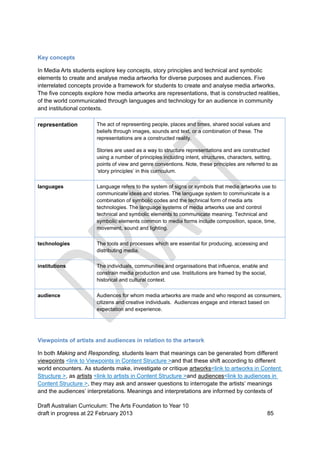
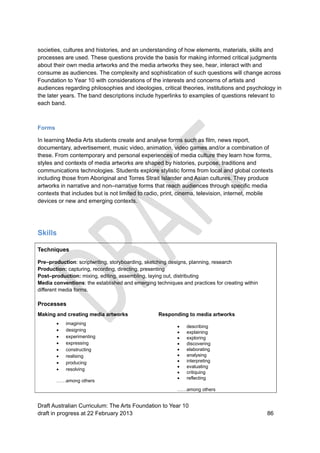
The terms artists, artworks, audiences, and viewpoints are used throughout the curriculum. 
The definitions below apply across the Arts subjects. Each subject will also use the terms in 
more specific ways. 
Artists 
Artist is used as a generic term for the maker of an artwork in each of the five Arts subjects. 
For example artists in: 
 Dance include choreographers, dancers, designers 
 Drama include actors, directors, playwrights, designers 
 Media Arts include producers, media artists, designers 
 Music include composers, performers, arrangers 
 Visual Arts include painters, sculptors, designers 
Students think about themselves as artists. They consider their artist’s relationship to an 
audience and also consider the artist as audience for their own artwork. 
Artworks 
Artwork is used as a generic term for a work in each of the five Arts subjects. For example 
artworks in: 
 Dance include dances for performance, choreographed dances in any style 
 Drama include devised or scripted drama in any style for performance 
 Media Arts include print, audio, screen-based or a combination of image, text and 
sound 
 Music include composition, improvisation, arrangement of music in any style for 
performance 
 Visual Arts include two dimensional works, for example, paintings; three dimensional 
works, for example, sculpture; and four dimensional works which include the element 
of time, for example, an installation which includes video footage. 
Draft Australian Curriculum: The Arts Foundation to Year 10 
draft in progress at 22 February 2013 7
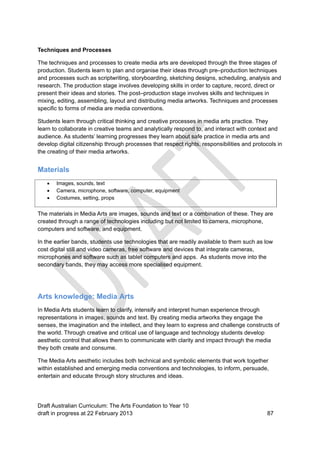
Audiences 
Students think about themselves as members of an audience and that as the artist they are 
audience to their own artwork. They recognise that in societies many people are interested 
in looking at, experiencing and talking about the Arts. As part of Making and Responding 
students consider the artist’s relationship to an audience. They reflect on their own 
experiences as audience members and begin to understand how artworks communicate 
ideas. 
Students, are artists and audience for their own developing artworks. Individually and/or 
collaboratively they evaluate and reflect upon the work they are making. For example, this 
may be in choreographing a dance, composing a piece of music, devising a group drama 
work, making an animation or painting a landscape. 
Students’ practice in each of the Arts subjects is enhanced by school visits from artists and 
by visiting physical and virtual art galleries and museums, theatres and performance venues. 
These experiences contribute to students’ understanding of the value of the Arts in times 
past and in contemporary societies. These opportunities also lead to culturally rich and 
imaginative learning experiences that assist students to enjoy and value the Arts in their own 
lives. 
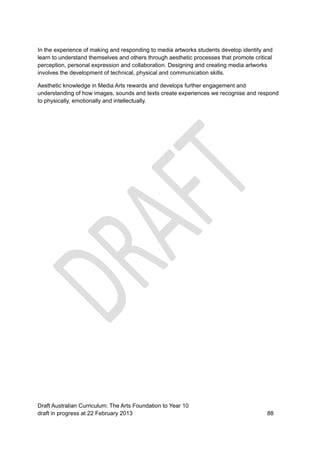
Viewpoints 
In the Australian Curriculum: The Arts, the term ‘viewpoints’ is used to broadly encompass 
the different perspectives from which a person can consider an artwork. This may be the 
artist or any audience. In each Arts subject students investigation of artworks or research 
helps them to make meaning of their own world and to understand the views of others. In 
both Making and Responding, students learn that considering artworks from different 
viewpoints will offer different meanings or ways of understanding the work. These viewpoints 
shift according to different world encounters. As students make, investigate or critique 
artworks, they ask and answer questions to interrogate the artists’ meanings and audiences’ 
interpretations. These questions may be based on different viewpoints, such as the contexts 
of societies, cultures and histories, or the use of elements, materials, skills and processes 
and the answers provide the basis for making evaluations and developing informed opinions. 
In the Years 7 to 10 curriculum students consider a wider and more complex range of 
viewpoints such as philosophies and ideologies, critical theories, institutions, scientific 
knowledge and psychology. This allows them to delve further into critical and creative 
thinking and consider more sophisticated possibilities, meanings and interpretations. 
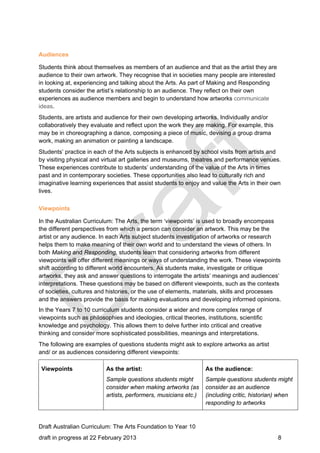
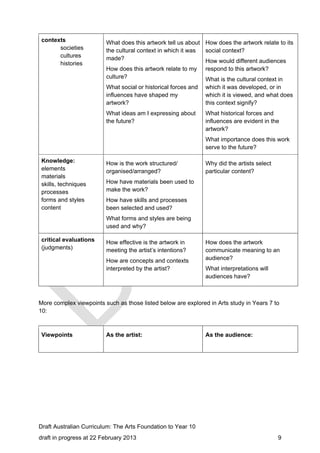
The following are examples of questions students might ask to explore artworks as artist 
and/ or as audiences considering different viewpoints: 
Viewpoints As the artist: 
Sample questions students might 
consider when making artworks (as 
artists, performers, musicians etc.) 
As the audience: 
Sample questions students might 
consider as an audience 
(including critic, historian) when 
responding to artworks 
Draft Australian Curriculum: The Arts Foundation to Year 10 
draft in progress at 22 February 2013 8
contexts 
societies 
cultures 
histories 
What does this artwork tell us about 
the cultural context in which it was 
made? 
How does this artwork relate to my 
culture? 
What social or historical forces and 
influences have shaped my 
artwork? 
What ideas am I expressing about 
the future? 
How does the artwork relate to its 
social context? 
How would different audiences 
respond to this artwork? 
What is the cultural context in 
which it was developed, or in 
which it is viewed, and what does 
this context signify? 
What historical forces and 
influences are evident in the 
artwork? 
What importance does this work 
serve to the future? 
Knowledge: 
elements 
materials 
skills, techniques 
processes 
forms and styles 
content 
How is the work structured/ 
organised/arranged? 
How have materials been used to 
make the work? 
How have skills and processes 
been selected and used? 
What forms and styles are being 
used and why? 
Why did the artists select 
particular content? 
critical evaluations 
(judgments) 
How effective is the artwork in 
meeting the artist’s intentions? 
How are concepts and contexts 
interpreted by the artist? 
How does the artwork 
communicate meaning to an 
audience? 
What interpretations will 
audiences have? 
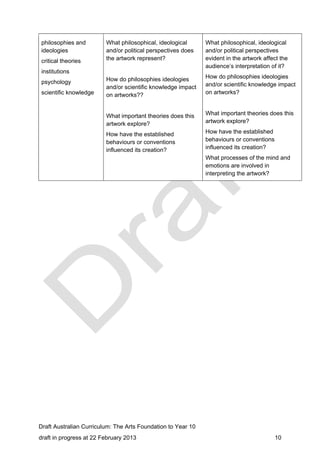
More complex viewpoints such as those listed below are explored in Arts study in Years 7 to 
10: 
Viewpoints As the artist: As the audience: 
Draft Australian Curriculum: The Arts Foundation to Year 10 
draft in progress at 22 February 2013 9
philosophies and 
ideologies 
critical theories 
institutions 
psychology 
scientific knowledge 
What philosophical, ideological 
and/or political perspectives does 
the artwork represent? 
How do philosophies ideologies 
and/or scientific knowledge impact 
on artworks?? 
What important theories does this 
artwork explore? 
How have the established 
behaviours or conventions 
influenced its creation? 
What philosophical, ideological 
and/or political perspectives 
evident in the artwork affect the 
audience’s interpretation of it? 
How do philosophies ideologies 
and/or scientific knowledge impact 
on artworks? 
What important theories does this 
artwork explore? 
How have the established 
behaviours or conventions 
influenced its creation? 
What processes of the mind and 
emotions are involved in 
interpreting the artwork? 
Draft Australian Curriculum: The Arts Foundation to Year 10 
draft in progress at 22 February 2013 10
The Arts across Foundation to Year 10 
The Australian Curriculum: The Arts is based on the principle that all young Australians are 
entitled to engage fully in all the major art forms and to be given a balanced and substantial 
foundation in the special knowledge and skills base of each. 
Complementing the band descriptions of the curriculum, this advice describes the nature of 
learners and the curriculum across the following year-groupings: 
Foundation to Year 2: typically students from 5 to 8 years of age 
Years 3 to 6: typically students from 8 to 12 years of age 
Years 7 to 10: typically students from 12 to 15 years of age. 
Foundation to Year 2 
Students bring to school diverse backgrounds and a range of experiences in the arts. The 
Arts curriculum builds on these as rich resources for further learning about each of the art 
forms. 
In Foundation to Year 2, The Arts curriculum builds on the Early Years Learning Framework 
and its key learning outcomes, namely: children have a strong sense of identity; children are 
connected with, and contribute to, their world; children have a strong sense of wellbeing; 
children are confident and involved learners; and children are effective communicators. 
In the early years play is important in how children learn; it provides engagement, then 
purpose and form. In The Arts, students have opportunities to learn through purposeful play 
and to develop their sensory, cognitive and affective appreciation of the world around them 
through exploratory and creative learning. Students will learn about and experience 
connections between the art forms. 
Years 3 to 6 
Through the primary years, students draw on their growing experience of family, school and 
the wider community to develop their understanding of the world and their relationships with 
others. During these years of schooling, students’ thought processes become more logical 
and consistent, and they gradually become more independent as learners. Students talk 
about changes in their own thinking, performance or making, giving reasons for their actions 
and explaining and demonstrating their organisation of ideas. They begin to recognise, 
appreciate and value the different ways in which others think, act and respond to art works. 
In these years, learning in The Arts occurs both through integrated curriculum and The Arts 
subject-specific approaches. Some of the instinct to play from the early years becomes 
formalised into both experimentation and artistic practice. Students in these years 
increasingly recognise the connections between The Arts and with other learning areas. 
Years 7 to 10 
As students move into adolescence, they undergo a range of important physical, cognitive, 
emotional and social changes. Students often begin to question established conventions, 
Draft Australian Curriculum: The Arts Foundation to Year 10 
draft in progress at 22 February 2013 11
practices and values. Their interests extend well beyond their own communities and they 
begin to develop concerns about wider issues. Students in this age range increasingly look 
for and value learning that is perceived to be relevant, is consistent with personal goals, 
and/or leads to important outcomes. Increasingly they are able to work with more abstract 
concepts and are keen to explore the nature of evidence and the contestability of ideas. 
In these years, learning in The Arts enables students to explore and question their own 
immediate experience and their understanding of the wider world. The experience of 
learning through and about The Arts enables students to build on their own experiences, 
dispositions and characteristics. Students explore and engage with art works including visual 
arts works, music, dance, theatre and media arts works made by others. They make their 
own art works drawing on their developing knowledge, understanding and skills. 
Through this Arts curriculum, students in Years 7–10 pursue broad questions such as: What 
meaning is intended in an art work? What does the audience understand from this art work? 
What is the cultural context of the art work and of the audience engaging with it? What key 
beliefs and values are reflected in art works and how did artists influence societies of their 
time? How do audiences today perceive and understand art works? What does the 
advancement of technology mean to the presentation of and audience engagement with 
different art works? This curriculum also provides opportunities to engage students through 
contexts that are meaningful and relevant to them and through past and present debates. 
Achievement standards 
Across Foundation to Year 10, achievement standards indicate the quality of learning that 
students should typically demonstrate by a particular point in their schooling. 
The sequence of achievement standards in each Arts subject describes progress in the 
learning area, demonstrating a broad sequence of expected learning. This sequence 
provides teachers with a framework of growth and development in The Arts subject. 
An achievement standard describes the quality of learning (the depth of conceptual 
understanding and the sophistication of skills) that would indicate the student is well placed 
to commence the learning required at the next level of achievement. 
The achievement standards for The Arts reflect the distinctive practices of each subject 
along with aspects of learning that are common to all Arts subjects. Subject-specific 
terminology and organisation reflect the essential characteristics of learning in each subject. 
The achievement standards also reflect differences in the nature and scope of the learning in 
each Arts subject, as well as the relationship between the interrelated strands: Making and 
Responding. 
Achievement standards will be accompanied by portfolios of annotated student work 
samples that illustrate the expected learning and help teachers to make judgments about 
whether students have achieved the standard. 
Draft Australian Curriculum: The Arts Foundation to Year 10 
draft in progress at 22 February 2013 12
Diversity of learners 
ACARA is committed to the development of a high-quality curriculum for all Australian 
students that promotes excellence and equity in education. 
All students are entitled to rigorous, relevant and engaging learning programs drawn from 
the Australian Curriculum: The Arts. Teachers take account of the range of their students’ 
current levels of learning, strengths, goals and interests and make adjustments where 
necessary. The three-dimensional design of the Australian Curriculum, comprising learning 
areas, general capabilities and cross-curriculum priorities, provides teachers with flexibility to 
cater for the diverse needs of students across Australia and to personalise their learning. 
More detailed advice has been developed for schools and teachers on using the Australian 
Curriculum to meet diverse learning needs and is available under Student Diversity on the 
Australian Curriculum website. 
Students with disability 
The Disability Discrimination Act 1992 and the Disability Standards for Education 2005 
require education and training service providers to support the rights of students with 
disability to access the curriculum on the same basis as students without disability. 
Many students with disability are able to achieve educational standards commensurate with 
their peers, as long as the necessary adjustments are made to the way in which they are 
taught and to the means through which they demonstrate their learning. 
In some cases curriculum adjustments are necessary to provide equitable opportunities for 
students to access age-equivalent content in the Australian Curriculum: The Arts. Teachers 
can draw from content at different levels along the Foundation to Year 10 sequence. 
Teachers can also use the extended general capabilities learning continua in Literacy, 
Numeracy and Personal and social capability to adjust the focus of learning according to 
individual student need. 
Gifted and talented students 
Teachers can use the Australian Curriculum: The Arts flexibly to meet the individual learning 
needs of gifted and talented students. 
Teachers can enrich student learning by providing students with opportunities to work with 
learning area content in more depth or breadth; emphasising specific aspects of the general 
capabilities learning continua (for example, the higher order cognitive skills of the Critical and 
creative thinking capability); and/or focusing on cross-curriculum priorities. Teachers can 
also accelerate student learning by drawing on content from later levels in the Australian 
Curriculum: The Arts and/or from local state and territory teaching and learning materials. 
Draft Australian Curriculum: The Arts Foundation to Year 10 
draft in progress at 22 February 2013 13
English as an additional language or dialect 
Students for whom English as an additional language or dialect (EAL/D) enter Australian 
schools at different ages and at different stages of English language learning and have 
various educational backgrounds in their first languages. Whilst many EAL/D students bring 
already highly developed literacy (and numeracy) skills in their own language to their 
learning of Standard Australian English, there is a significant number of students who are not 
literate in their first language, and have had little or no formal schooling. 
While the aims of the Australian Curriculum: The Arts are ultimately the same for all 
students, EAL/D students must achieve these aims while simultaneously learning a new 
language and learning content and skills through that new language. These students may 
require additional time and support, along with teaching that explicitly addresses their 
language needs. Students who have had no formal schooling will need additional time and 
support in order to acquire skills for effective learning in formal settings. 
A national English as an Additional Language or Dialect: Teacher Resource has been 
developed to support teachers in making the Australian Curriculum: Foundation to Year 10 in 
each learning area accessible to EAL/D students. 
Draft Australian Curriculum: The Arts Foundation to Year 10 
draft in progress at 22 February 2013 14
General capabilities 
In the Australian Curriculum, the general capabilities encompass the knowledge, skills, 
behaviours and dispositions that, together with curriculum content in each learning area and 
the cross-curriculum priorities, will assist students to live and work successfully in the twenty-first 
century. 
There are seven general capabilities: 
 Literacy (LIT) 
 Numeracy (NUM) 
 Information and communication technology (ICT) capability 
 Critical and creative thinking (CCT) 
 Personal and social capability (PSC) 
 Ethical understanding (EU) 
 Intercultural understanding (ICU). 
In the Australian Curriculum: The Arts, general capabilities are identified wherever they are 
developed or applied in content descriptions. They are also identified where they offer 
opportunities to add depth and richness to student learning through content elaborations. 
Initials or abbreviations of titles indicate where general capabilities have been identified in 
The Arts content descriptions and elaborations. Teachers may find further opportunities to 
incorporate explicit teaching of general capabilities depending on their choice of activities. 
Students may also be encouraged to develop capabilities through personally relevant 
initiatives of their own design. 
The following descriptions provide an overview of how general capabilities are addressed in 
the Australian Curriculum: The Arts, noting that the emphasis on each general capability will 
vary from one Arts subject to another. Detailed general capabilities materials, including 
learning continua, can be found at http://www.australiancurriculum.edu.au 
Literacy (LIT) 
Students become literate as they develop the knowledge, skills and dispositions to interpret 
and use language confidently for learning and communicating in and out of school and for 
participating effectively in society. Literacy involves students in listening to, reading, viewing, 
speaking, writing and creating oral, print, visual and digital texts, and using and modifying 
language for different purposes in a range of contexts. In The Arts, students use literacy 
along with the kinetic, symbolic, verbal and visual languages of the different Arts subjects. 
This enables students to develop, apply and communicate their knowledge and skills as 
artists and audiences. Students use and develop literacy skills as they describe, appraise 
and document their own art works and those of their peers, responding to, interpreting and 
analysing increasingly complex works made by others. They use their literacy skills to 
access knowledge, make meaning, express thoughts, emotions and ideas, interact with and 
challenge others. 
Opportunities to use literacy might occur when students 
Draft Australian Curriculum: The Arts Foundation to Year 10 
draft in progress at 22 February 2013 15
 share ideas, discussing concepts, work collaboratively, participate in class 
discussions, write/talk about their work or other peoples’ work, present or introduce 
work 
 use words as stimulus 
 research the context of a work 
 ask questions about a work 
Numeracy (NUM) 
Students become numerate as they develop the knowledge and skills to use mathematics 
confidently across all learning areas at school and in their lives more broadly. Numeracy 
involves students in recognising and understanding the role of mathematics in the world and 
having the dispositions and capacities to use mathematical knowledge and skills 
purposefully. In The Arts, students select and use relevant numeracy knowledge and skills to 
plan, design, make, interpret, analyse and evaluate art works. Across the Arts subjects, this 
can include using number to calculate and estimate or using spatial reasoning to recognise, 
create and use patterns, recognise and visualise shapes, consider scale and proportion, 
show and describe positions, pathways and movements or to explore the effects of different 
angles. Students can use ratios and rates when choreographing dance, recording music 
compositions or considering how to build and manipulate tension in dance, drama, media 
arts or music works or time-based visual artworks. They might use measurement skills when 
composing music, managing time and space in Drama and Dance or working with design, 
animation and effects software in Media Arts and Visual Arts. Students work with a range of 
numerical concepts to organise, analyse and create representations of data relevant to their 
own or others’ artworks, such as diagrams, charts, tables, graphs and motion capture. 
Opportunities to use numeracy might occur when students 
 combine dance movements to create sequences or sequences to create sections 
 decide where to place actors in a performance space 
 analyse audience responses to a media artwork 
 compose a film-score or to accompany dance or drama 
 explore concepts such as repetition in visual arts 
Information and communication technology (ICT) capability 
In the Arts, ICT capability enables students to use digital technologies when making and 
responding to art works, for example, using multimedia, notation or mind-mapping software, 
to plan, create and distribute art works. They use their ICT capability to increase the range of 
forms for personal expression as they generate and extend ideas or explore concepts and 
possibilities. They use digital tools and environments to represent their ideas and art works 
Students learn to apply social and ethical protocols and practices in a digital environment, 
particularly in relation to the appropriate acknowledgment of intellectual property and the 
safeguarding of personal security when using ICT. They use digital technologies to locate, 
access, select and evaluate information, work collaboratively, share and exchange 
information, and communicate with a variety of audiences. 
Opportunities to use their ICT capability might occur when students 
Draft Australian Curriculum: The Arts Foundation to Year 10 
draft in progress at 22 February 2013 16
 use a mobile device to document movement ideas for a dance work 
 use a mind-map to describe a character or situation when devising drama 
 use a digital tool or app to make a comic or stop-motion animation 
 compose and record a backing track to accompany a song 
 upload images or ideas for a collaborative visual arts work to a class blog 
Critical and creative thinking (CCT) 
In the Arts, critical and creative thinking is integral to the processes and strategies students 
develop and apply as they make and respond to art. In creating art works, students draw on 
their curiosity, imagination and thinking skills to pose questions and explore ideas, spaces, 
materials and technologies. They generate and analyse art forms consider possibilities and 
processes and make choices that assist them to take risks and express their ideas, 
concepts, thoughts and feelings creatively. In responding to art, students learn to analyse 
traditional and contemporary art works and identify possible meanings and connections with 
self and community. They consider and analyse artists’ motivations and intentions and 
possible influencing factors and biases. They reflect critically and creatively on the thinking 
and processes that underpin art making, both individually and collectively. They offer and 
receive effective feedback about past and present art works and performances, and 
communicate and share their thinking, visualisation and innovations to a variety of 
audiences. 
Opportunities to use their CCT capability might occur when students 
 express their understanding of an idea or concept through dance 
 ask ‘what if’ questions to create a scene in drama 
 synthesise ideas to communicate a message in a media arts work 
 explore the effect of different choices about tempo, dynamics or articulations 
 brainstorm responses to an image 
Ethical understanding (EU) 
In the Arts, ethical understanding assists students to bring a personal and socially-oriented 
outlook when making and responding to art. Students develop and apply ethical 
understanding when they encounter or create art works that require ethical consideration, 
such as work that is controversial, involves a moral dilemma or presents a biased point of 
view. Students develop their understanding of values and ethical principles as they use an 
increasing range of thinking skills to explore and use ideas, spaces, materials and 
technologies. They apply an ethical outlook to evaluate art works their meaning, and roles in 
societies, and the actions and motivations of artists. Students actively engage in ethical 
decision making when reflecting on their own and others’ art works and when creating art 
works that involve the intellectual and cultural property rights of others. 
Opportunities to develop and apply ethical understanding might occur when students 
 value diverse responses to their work 
 acknowledge sources of images, text, sound etc. they appropriate 
 consider different positions when responding to a prompt in process drama 
 perform a music work in the way the class has agreed 
Draft Australian Curriculum: The Arts Foundation to Year 10 
draft in progress at 22 February 2013 17
 demonstrate respect for the environment by using recycled materials 
Personal and social capability (PSC) 
In the Arts, personal and social capability assists students to work to, both individually and 
collaboratively, make and respond to artworks. Arts learning provides students with regular 
opportunities to recognise, name and express their emotions while developing art form-specific 
skills and techniques. As they think about ideas and concepts in their own and 
others art works students identify and assess personal strengths, interests and challenges. 
As art-makers, performers and audience students develop and apply personal skills and 
dispositions such as self-discipline, goal setting, working independently and showing 
initiative, confidence, resilience and adaptability. They learn to empathise with the emotions, 
needs and situations of others, to appreciate diverse perspectives, and to understand and 
negotiate different types of relationships. When working with others, students develop and 
practise social skills that assist them to communicate effectively, work collaboratively, make 
considered group decisions and show leadership. 
Opportunities to develop and apply personal and social capability might occur when students 
 discuss options and make decisions collaboratively when deciding on pathways in a 
dance 
 show adaptability when participating in a group improvisation exercise in drama 
 share personal responses to media arts works such ‘I felt …’ 
 set personal goals to build vocal or instrumental skills, for example, controlling 
breathing to sustain a long note or vary dynamics 
 describe their immediate response to a visual artwork 
Intercultural understanding (ICU) 
In the Arts, intercultural understanding assists students to move beyond known worlds to 
explore new ideas, media and practices from diverse local, national, regional and global 
cultural contexts. Intercultural understanding enables students to explore the influence and 
impact of cultural identities and traditions on the practice and thinking of artists and 
audiences. Students might explore forms and structures, use of materials, techniques and 
processes or treatment of concepts, ideas, themes and characters. They develop and act 
with intercultural understanding in making art works that explore their own cultural identities 
and those of others, interpreting and comparing their experiences and worlds, and seeking 
to represent increasingly complex relationships. 
Students are encouraged to demonstrate empathy for others and open-mindedness to 
perspectives that differ from their own and to appreciate the diversity of cultures and 
contexts in which artists and audiences lives. Through engaging with art works from diverse 
cultural sources, students are challenged to consider taken-for-granted roles, images, 
objects, sounds, beliefs and practices in new ways. 
Opportunities to develop and apply ICU capability might occur when students 
 research dances from different cultures that tell similar stories 
 describe the role of drama in different cultures 
Draft Australian Curriculum: The Arts Foundation to Year 10 
draft in progress at 22 February 2013 18
 explore cultural issues represented in media 
 learn and share music using practices from different cultural traditions 
 explore the meaning of visual symbols from different cultures 
Draft Australian Curriculum: The Arts Foundation to Year 10 
draft in progress at 22 February 2013 19
Cross-curriculum priorities 
The Australian Curriculum gives special attention to three cross-curriculum priorities: 
 Aboriginal and Torres Strait Islander histories and cultures (ATSIHC) 
 Asia and Australia’s engagement with Asia (AAEA) 
 Sustainability (SUST) 
In the Australian Curriculum: The Arts, these priorities will have a strong but varying 
presence, depending on the subject. Initials or abbreviations of titles indicate where cross-curriculum 
priorities have been identified in The Arts content descriptions and elaborations. 
Teachers may find further opportunities to incorporate explicit teaching of the priorities 
depending on their choice of activities. 
Aboriginal and Torres Strait Islander histories and cultures (ATSIHC) 
In the Australian Curriculum: The Arts, the Aboriginal and Torres Strait Islander histories and 
cultures priority enriches understanding of the diversity of art-making practices in Australia 
and develops appreciation of the need to respond to art works in ways that are culturally 
sensitive and responsible. 
The Australian Curriculum: The Arts enables the exploration of art forms produced by 
Aboriginal and Torres Strait Islander people and the way the relationships between peoples, 
culture and country/place for Aboriginal and Torres Strait Islander peoples can be conveyed 
through a combination of art forms and their expression in living communities, and the way 
these build Identity. It develops understanding of the way Aboriginal and Torres Strait 
Islander artists work through and within communities. 
In this learning area, students learn that the oral histories and belief systems of Aboriginal 
and Torres Strait Islander Peoples are contained in and communicated through cultural 
expression in story, movement, song and visual traditions. They recognise that those 
histories and cultural expressions in a diversity of contemporary, mediated and culturally 
endorsed ways enable artists to affirm connection with Country/Place, People and Culture. 
They appreciate the intrinsic value of the art works and artists’ practices of Aboriginal and 
Torres Strait Islander people as well as their place and value within broader social, cultural, 
historical and political contexts. 
Asia and Australia’s engagement with Asia (AAEA) 
In the Australian Curriculum: The Arts, the Asia and Australia’s engagement with Asia 
priority provides rich, engaging and diverse contexts in which to investigate making and 
responding art works as well as the related cultural, social, and ethical interests and 
responsibilities. 
The Australian Curriculum: The Arts enables the exploration of art forms of the Asia region 
and the way these have arisen from the rich and diverse cultures, belief systems and 
traditions of the peoples of the region. It enables students to examine their significance 
aesthetically and their regional and global impact. The Arts curriculum provides opportunities 
Draft Australian Curriculum: The Arts Foundation to Year 10 
draft in progress at 22 February 2013 20
to investigate collaborations between people of the Asia region and Australia in a variety of 
art making. 
It enables the examination of collective cultural memories and the way they are represented 
in a diversity of art forms in Australia. 
In this learning area students explore, engage with and respond to the art forms, media, 
instruments and technologies of the Asia region. They learn the intrinsic value of these art 
works and artists’ practices in each of The Arts subjects, as well as their place and value 
within broader social, cultural, historical and political contexts. 
Sustainability (SUST) 
In the Australian Curriculum: The Arts, the sustainability priority provides engaging and 
thought-provoking contexts in which to explore the nature of art making and responding. 
The Australian Curriculum: The Arts enables the investigation of the interrelated nature of 
social, economic and ecological systems through art making and responding. It investigates 
the significance of this for the sustainability of practice, resource use and traditions in each 
of The Arts subjects. The importance of accepting a range of world views, attitudes and 
values is developed and with it the need to collaborate within and between communities for 
effective action. 
In this learning area, students use the exploratory and creative platform of The Arts, to 
develop world views that recognise the importance of social justice, healthy ecosystems and 
effective action for sustainability. They choose suitable art forms to communicate their 
developing understanding of the concept of sustainability and persuade others to take action 
for sustainable futures. 
Draft Australian Curriculum: The Arts Foundation to Year 10 
draft in progress at 22 February 2013 21
Links to other learning areas 
Learning in and through The Arts involves the development of understanding and knowledge 
for informed and effective participation not only in The Arts but also in other learning areas. 
The most obvious learning area connections occur with English, History and Geography 
because The Arts embody some of the most significant and recognisable products and 
records of all cultures. The Arts can provide a range of pedagogies for use across learning 
areas in the curriculum. 
Some Arts subjects have direct relationships with particular subjects. Drama and Media Arts 
have a strong focus on language, texts and narrative, and aspects of these two Arts subjects 
are taught as part of English. Dance has links to Health and Physical Education. Media Arts 
and Visual Arts have links to the Technologies learning area. Numeracy is present in each of 
The Arts subjects at different times, as described in the general capabilities section. From 
time to time there may be opportunity to directly connect The Arts subjects with 
Mathematics. 
It is important that students can see connections to other learning areas within the 
curriculum. 
English 
The Arts and English complement each other and strengthen student learning in many ways. 
Skills developed in English and the Arts include exploring, interpreting and responding to 
texts and art works, and creating texts/works using a variety of media and forms. Through 
the study of The Arts, students learn how to engage with art works with critical discernment 
and how to create their own art works as ways of understanding and communicating about 
the world. In their studies of both English and the Arts, they encounter representations of the 
past, the present and the future that demonstrate the power of language and symbol, and 
they learn to extend the range of their own expression. These skills are developed across a 
range of forms, including art, dance, photography, film, music, media arts works and theatre. 
Drama and Media Arts have a strong focus on language, texts and narrative, and aspects of 
these two Arts subjects are taught as part of English. With the convergence of different 
textual forms and the growing importance for students to be able to create and critique new c 
Media Arts helps students understand the codes and conventions that are used to 
communicate meaning. 
Health and Physical Education 
The Arts and Health and Physical Education most obviously intersect in Dance where 
students explore the body, movement, relationships and interactions in space. 
Humanities and Social Sciences 
The learning areas of the Arts and Humanities and Social Sciences are closely aligned. 
Each provides stimulus and material for consideration in the other. 
Draft Australian Curriculum: The Arts Foundation to Year 10 
draft in progress at 22 February 2013 22
Civics and Citizenship 
Civics and Citizenship education, as with the Arts, provides opportunities for young 
Australians to become active and informed citizens in a global context. The Arts enable 
students to explore and express concepts of individual identity and a sense of belonging that 
they consider in the Civics and Citizenship curriculum. 
Economics and business 
Economics and Business education involves the development of the knowledge, skills, 
attitudes, beliefs and values that will inform and encourage students to participate in 
economic and business activities personally, locally, nationally, regionally and globally. The 
Arts provides students a unique avenue for exploring and challenging systems and 
structures in the past and the present as they learn about the challenges and successes of 
economic systems and the impact on society in terms of living standards and economic 
growth. 
Geography 
Students are curious about their personal world and are interested in exploring it. Through 
The Arts, as in Geography, students explore their immediate experience and their own 
sense of place, space and environment. Learning about their own place, and building a 
connection with it, also contributes to their sense of identity and belonging. The Australian 
Curriculum: The Arts supports the approach of Geography using local place as the initial 
focus for learning, recognising that young students are also aware of and interested in more 
distant places. The curriculum provides opportunities to build on this curiosity. Through 
engaging with The Arts, students find out about the ways they are connected to places 
throughout the world through art works from other places, family and cultural groups in their 
community, the origin of familiar products, travel and world events. 
History 
The skills taught in The Arts include communicating with others about, comprehending and 
researching artworks from the past, reinforcing learning in History. Studying artworks from a 
range of historical, social and cultural contexts, helps students understand the perspectives 
and contributions of people from the past. Students undertake research, read texts with 
critical discernment and create texts that present the results of historical understanding. 
Languages 
The Arts are frequently a starting point for exploring language, providing diverse visual and 
aural stimuli that encompass cultural, social and historical contexts. Equally artworks 
<hyperlink to artworks in Content structure>. may be representative of particular times, 
places and peoples and connect the exploration of the art form with the learning of 
language. Although continually evolving some art forms use a particular language to denote 
style and provide instructions to artists, such as the use of Italian, German and French terms 
in music, French terms in classical dance, German terms in the language of Design in visual 
arts establish by the Bauhaus, Japanese terms in Drama and contemporary dance 
stemming from Kabuki and Butoh styles. 
Draft Australian Curriculum: The Arts Foundation to Year 10 
draft in progress at 22 February 2013 23
Mathematics 
In the Arts and Mathematics students build their understanding of relationships between time 
and space, rhythm and line through engagement with a variety of arts forms and 
mathematical ideas. Art-making requires the use and understanding of measurement in the 
manipulation of space, time and form. Creating patterns in the Arts involves counting, 
measurement and design in different ways across the various art forms. 
In both visual arts and mathematics students learn about size, scale, shape, pattern, 
proportion and orientation. These concepts are also explored in dance, drama and media 
arts through Design in these art forms. Links between music and mathematics initially focus 
on time and rhythm. 
Science 
There is a strong relationship between the development of observational skills, imaginative 
speculation and encouragement of curiosity and questioning within the scientific and artistic 
explorations of real and imagined worlds. The Arts provide opportunities for students to 
explore and communicate scientific ideas and to develop and practise techniques, such as 
making visual arts works that present an understanding of how systems in plants and 
animals work together or using the materials, techniques and processes of photography to 
investigate light and the properties of matter; music, drama and dance may be utilised to 
challenge thinking about scientific issues which affect society; design may be employed 
when developing new products or solutions to problems. 
Technologies 
The Technologies curriculum complements The Arts curriculum. Through the Technologies 
curriculum aspects of aesthetics such as line, shape, form, colour, texture, proportion and 
balance are incorporated into the design processes in Technologies learning activities. This 
occurs when students design products and environments. Knowledge of materials, tools and 
equipment and the ways they can be used to create designed solutions provides links 
between Technologies and two and three dimensional design in Visual Arts. Skills developed 
in Visual Arts such as representing and exploring creative ideas through sketching and 
drawing complement processes used in Design and Technologies to generate ideas to 
create solutions. 
Students learn about multimedia across the Australian Curriculum. In Digital Technologies 
the focus is on the technical aspects of multimedia, and privacy and intellectual property 
concerns. In Media Arts students use digital technologies to tell stories, represent and 
communicate ideas and explore concepts. Making in Media Arts involves designing, 
planning, producing, capturing and recording, choosing, combining and editing, and 
representing and distributing. 
Draft Australian Curriculum: The Arts Foundation to Year 10 
draft in progress at 22 February 2013 24
Implications for implementation 
In the Australian Curriculum: The Arts, the two strands of Making and Responding are interrelated 
and inform and support each other. When developing teaching and learning programs, teachers 
combine aspects of the strands in different ways to provide students with learning experiences that 
meet their needs and interests. There are opportunities for integration of learning between Arts 
subjects and with other learning areas. 
Engaging learning programs will provide opportunities for students to: 
 develop skills and dispositions such as curiosity, imagination, creativity and evaluation 
 engage all aspects of perception: sensory, emotional, cognitive, physical and spiritual 
 work individually and collaboratively. 
Although Dance, Drama, Media Arts, Music and Visual Arts are described individually in the 
Australian Curriculum, students require opportunities to study and make artworks that feature 
fusion of traditional art forms and practices to create artworks that merge or combine art forms. 
This learning involves exploration of traditional and contemporary arts practices from different 
cultures, including works from Aboriginal and Torres Strait Islander cultures. Such works might: 
 combine performance, audio and/or visual aspects 
 combine processes typical of the different Arts subjects 
 involve other learning areas 
 exist in physical or virtual spaces 
 combine traditional, contemporary and emerging media and materials 
 be created individually or collaboratively. 
While content descriptions do not repeat key skills across the bands, it should be noted that many 
aspects of The Arts curriculum are recursive, and teachers need to provide ample opportunity for 
revision, ongoing practice and consolidation of previously introduced knowledge and skills. 
Students learn at different rates and in different stages. Depending on each student’s rate of 
learning or the prior experience they bring to the classroom, not all of the content descriptions for a 
particular band may be relevant to a student in those year levels. 
Some students may have already learned a concept or skill, in which case it will not have to be 
explicitly taught to them in the band stipulated. Other students may need to be taught concepts or 
skills stipulated for earlier bands. The content descriptions in the Australian Curriculum: The Arts 
enable teachers to develop a variety of learning experiences that are relevant, rigorous and 
meaningful and allow for different rates of development, in particular for younger students and for 
those who require additional support. 
Some students will require additional support to develop their skills in specific Arts subjects. In the 
Australian Curriculum: The Arts it is expected that appropriate adjustments will be made for some 
students to enable them to access and participate in meaningful learning, and demonstrate their 
knowledge, understanding and skills across the five Arts subjects. To provide the required flexibility 
teachers need to consider the abilities of each student and adopt options for curriculum 
implementation that allow all students to participate. 
Draft Australian Curriculum: The Arts Foundation to Year 10 
draft in progress at 22 February 2013 25
This might involve students using modified tools, materials or instruments to create or perform 
works; varying the form in which students respond to a work, moving or drawing, for example, 
rather than writing or speaking or working collaboratively rather than individually. 
Teachers use the Australian Curriculum content and achievement standards first to identify current 
levels of learning and achievement and then to select the most appropriate content (possibly from 
across several year levels) to teach individual students and/or groups of students. This takes into 
account that in each class there may be students with a range of prior achievement (below, at or 
above the year level expectations) and that teachers plan to build on current learning. Organisation 
of the curriculum in bands provides an additional level of flexibility that supports teachers to plan 
and implement learning programs that are appropriate for all students and make best possible use 
of available resources. 
Teachers also use the achievement standards at the end of a period of teaching to make on-balance 
judgments about the quality of learning demonstrated by the students – that is, whether 
they have achieved below, at or above the standard. To make these judgments, teachers draw on 
assessment data that they have collected as evidence during the course of the teaching period. 
These judgments about the quality of learning are one source of feedback to students and their 
parents and inform formal reporting processes. 
If a teacher judges that a student’s achievement is below the expected standard, this suggests that 
the teaching programs and practice should be reviewed to better assist individual students in their 
learning in the future. It also suggests that additional support and targeted teaching will be needed 
to ensure that students are appropriately prepared for future studies in specific Arts subjects. 
Assessment of the Australian Curriculum: The Arts takes place at different levels and for different 
purposes, including: 
ongoing formative assessment within classrooms for the purposes of monitoring learning and 
providing feedback to teachers to inform their teaching, and for students to inform their learning 
summative assessment for the purposes of twice-yearly reporting by schools to parents and carers 
on the progress and achievement of students 
Draft Australian Curriculum: The Arts Foundation to Year 10 
draft in progress at 22 February 2013 26
Dance 
Rationale 
This rationale complements and extends the rationale for the Arts learning area. 
Dance is expressive movement with purpose and form. Through Dance, students represent, 
question and celebrate human experience, using the body as the instrument and movement 
as the medium for personal, social, emotional, spiritual and physical communication. Like all 
art forms dance has the capacity to engage, inspire and enrich all students, exciting the 
imagination and encouraging students to reach their creative and expressive potential. 
Dance enables students to develop a movement vocabulary with which to explore and refine 
imaginative ways of moving both individually and collaboratively. They choreograph, 
rehearse, perform and respond as they engage with dance practice and practitioners in their 
own and other cultures and communities. 
Students use the elements of dance to explore choreography and performance and to 
practise compositional, technical and expressive skills. Students respond to their own and 
others’ dances using physical and verbal communication. 
Active participation as dancers, choreographers and audiences promotes wellbeing and 
social inclusion. Learning in and through dance enhances students’ knowledge and 
understanding of diverse cultures and contexts developing their personal, social and cultural 
identity. 
Aims 
In addition to the overarching aims of the Australian Curriculum: The Arts, Dance knowledge, 
understanding and skills ensure that individually and collaboratively students develop: 
 body awareness and technical and expressive skills to communicate through 
movement, confidently, creatively and intelligently 
knowledge, understanding and skills in choreographing, performing and appreciating 
their own and others' dances 
 aesthetic, artistic and cultural understanding of dance in past and contemporary 
contexts as choreographers, performers and audiences 
 respect for and knowledge of the diverse purposes, traditions, histories and cultures 
of dance by making and responding as active participants and informed audiences. 
Draft Australian Curriculum: The Arts Foundation to Year 10 
draft in progress at 22 February 2013 27
Learning in Dance 
In Dance, students explore elements, skills and processes through the integrated practices 
of choreography, performance and appreciation. The body is the instrument of expression 
and uses combinations of the elements of dance (space, time, dynamics and relationships) 
to communicate and express meaning through expressive and purposeful movement. 
Through Dance students learn to appreciate by reflection, analysis and evaluation of their 
own and others’ dance works. Safe dance practices underlie all experiences in the study of 
dance. With an understanding of the body’s capabilities applied to their own body, they 
develop kinaesthetic intelligence, spatial intelligence, critical thinking and awareness of how 
the body moves in dance. 
Knowledge and skills of Dance 
The knowledge <link to Knowledge box> and skills<link to Skills box> of dance are the 
building blocks of dance as an art form. Students engage with the key concepts, elements, 
principles and forms and develop skills, techniques and processes as they explore a range 
of contexts, styles and materials <link to Materials box> from a range of viewpoints. 
Draft Australian Curriculum: The Arts Foundation to Year 10 
draft in progress at 22 February 2013 28
Knowledge 
Practices 
Choreography, Performance, Appreciation 
 Elements 
Space 
Time 
Dynamics 
Relationships 
Safe dance 
Viewpoints of artists and audiences in relation to the artwork 
 contexts – social, cultural, historical 
 critical evaluations 
 philosophies and ideologies 
 critical theories 
 institutions 
 psychology 
 scientific knowledge 
Forms include: 
 Theatrical dance 
 Traditional dance 
 Social dance 
 Ritual dance 
 Current styles of dance 
Practices 
In Dance, students learn through the integrated practices of choreography, performance and 
appreciation, engaging with the elements of dance and using safe dance practices. Through 
these practices they examine dance from diverse viewpoints and engage with a range of 
dance forms to build their knowledge and understanding. Dance skills, techniques and 
processes are developed through their engagement with dance practices that draw on the 
materials of dance – the body and movement. 
The elements of dance 
Students work with the elements of dance in combination to create structure and interpret 
movement safely. 
space where the body moves, including level, dimension, direction, shape, active 
space, positive space, negative space, planes, pathways, general space, 
personal space and performance space 
time when dance occurs (how long it takes), including metre, tempo, momentum, 
accent, duration, phrasing, rhythmic patterns, stillness, beat 
dynamics how dance is performed, including weight, force, energy and movement 
qualities 
Draft Australian Curriculum: The Arts Foundation to Year 10 
draft in progress at 22 February 2013 29
relationships relationships are always occurring when the body dances with regard to 
associations or connections; relationships between body parts (for example, 
right arm to left arm, hand to face), the body and the floor (for example, close 
to, away from), the body and objects (for example, a chair, fan, stick, scarf), 
the body and space (for example, an expansive or limited relationship), the 
body and others (for example, dance to one other or more dancers) 
Viewpoints of artists and audiences in relation to the artwork 
In both Making and Responding, students learn that meanings can be generated from 
different viewpoints <link to Viewpoints in Content Structure >and that these shift according 
to different world encounters. As students make, investigate or critique art works <link to 
artworks in Content Structure > as artists <link to artists in Content Structure >and 
audiences <link to audience in Content Structure >, they may ask and answer questions to 
interrogate the artists’ meanings and the audiences’ interpretations. Meanings and 
interpretations are informed by an understanding of how the elements, materials, skills and 
processes are used in differing contexts of societies, cultures and histories. These questions 
provide the basis for making informed critical judgments about their own dance and the 
dance they see as audiences <link to audience in Content Structure >. The complexity and 
sophistication of such questions will develop across Foundation to Year 10 with 
considerations of the interests and concerns of artists <link to artists in Content Structure > 
and audiences <link to audience in Content Structure > regarding philosophies and 
ideologies, critical theories, institutions and psychology in the Years 7 to 10 bands. The band 
descriptions include hyperlinks to examples of questions relevant to each band. 
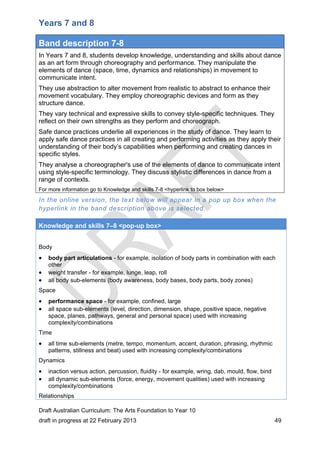
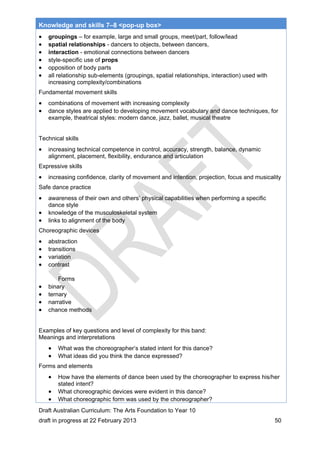
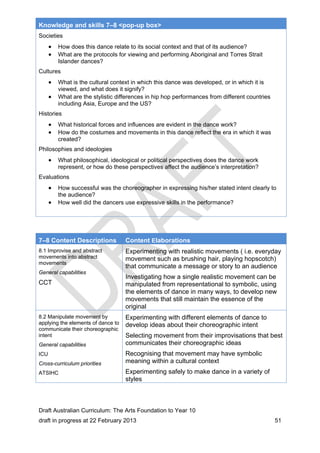
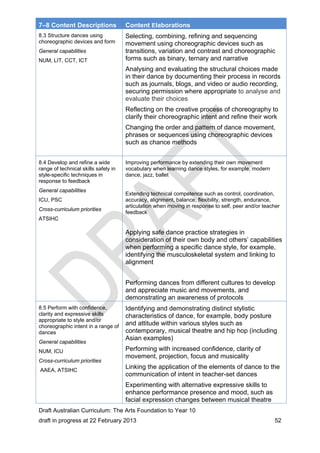
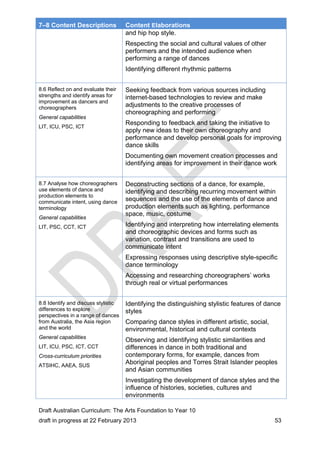
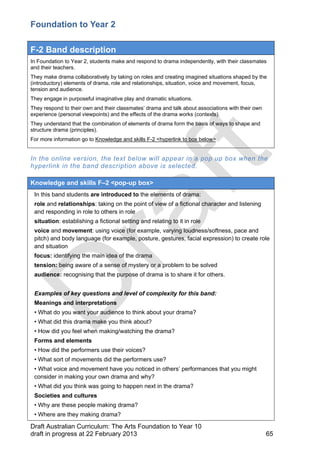
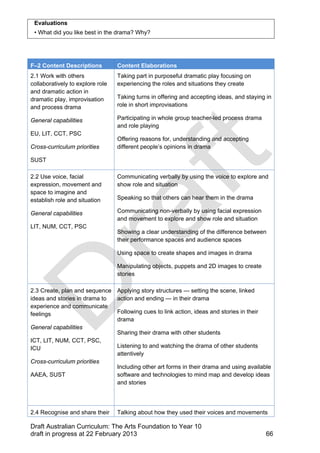
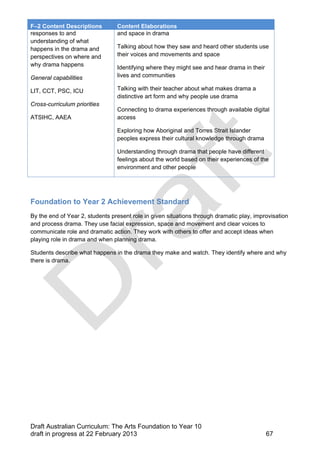
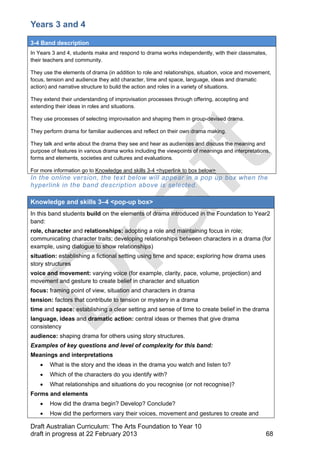
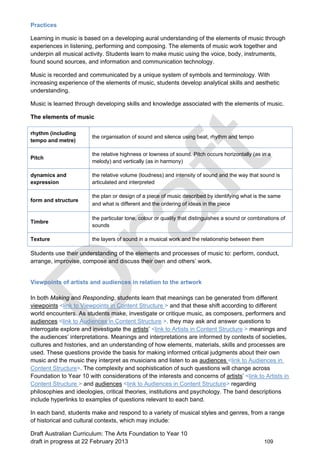
Forms 
Learning in Dance involves students in dance experiences drawing on theatrical, traditional, 
social, ritual and other current styles of dance. 
In all years, students explore dance from a range of historical and cultural contexts. They 
begin with their experiences of dance from their immediate lives and community and identify 
the reasons why people dance. They draw on the histories, traditions and styles of dance 
from a range of places and times including dance from Australia, Aboriginal and Torres Strait 
Islander cultures, Asia, Western Europe and world cultures. As students learn about dance, 
from the primary to secondary years, they broaden their experiences of particular styles as a 
springboard for their making and responding. 
In their dance making students use a variety of stimuli to create movements to express ideas 
and communicate meaning. They also draw on their experiences in other Arts subjects and 
curriculum learning areas. 
Skills 
Techniques 
 Fundamental movement 
 Technical skills 
Draft Australian Curriculum: The Arts Foundation to Year 10 
draft in progress at 22 February 2013 30
 Expressive skills 
 Style specific techniques 
Processes 
Making Responding to dances 
Choreographing 
 improvising 
 exploring 
 selecting 
 manipulating 
 refining 
 structuring 
……among others 
Performing 
 acquiring skills 
 practising 
 rehearsing 
 refining 
 applying 
techniques 
……among others 
appreciating 
 describing 
 explaining 
 exploring 
 discovering 
 elaborating 
 analysing 
 interpreting 
 evaluating 
 critiquing 
 reflecting 
……among others 
Techniques 
Learning in Dance provides students with the capacity to develop skills that enable them to 
perform meaningful and safe movement. . These include fundamental movements 
(locomotor, non-locomotor, gross and fine motor movements) along with technical (control, 
coordination, accuracy, alignment, balance, flexibility, strength, endurance and articulation) 
and expressive skills (confidence, focus, eye line and concentration, projection, facial 
expression, clarity of movement and musicality). 
In Dance learning, students combine and apply fundamental movements and technical and 
expressive skills. As students progress, particularly in the secondary bands, they add 
increasingly complex skills and techniques to build their movement vocabulary. Teachers will 
select styles and techniques that are appropriate to the students’ experience, their own 
experience and the school context. 
Processes 
As students make and respond to dance, they shape their movement ideas through 
choreographing and performing and appreciating dance. Choreographic processes include 
students drawing on their developing movement vocabulary as they engage in the creative 
process of making dance; 
improvising, exploring, selecting, creating and structuring movement to communicate their 
ideas. Performing processes involve the students practising, rehearsing and refining to build 
their dance skills and techniques. Students transfer their knowledge and understanding from 
choreographing and performing to inform the appreciating processes as they respond to 
their own and others’ dance works, including describing, analysing, evaluating and critiquing 
their dance and those of others. 
Materials 
Body 
Draft Australian Curriculum: The Arts Foundation to Year 10 
draft in progress at 22 February 2013 31
 body awareness 
 body bases 
 body parts 
 body zones 
Movement 
 vocabulary for expressing and giving form to feelings and ideas 
Production elements 
 performance spaces, costume, props, lighting, sets, multimedia, sound 
 dancers (number, gender, role, anatomical structures, abilities or capacities) 
Body 
Students work with the body as the instrument of expression and movement as the medium 
of dance. The body, including body awareness, body bases, body parts and body zones, is 
manipulated using the elements of dance in both choreography and performance. 
Movement 
Students develop and extend their movement vocabulary to express and give form to their 
feelings and ideas. As they explore, improvise and learn specific dance skills, dance 
techniques, and apply dance processes they understand that dance movement is expressive 
and purposeful 
Production elements 
Students may draw on production elements such as performance spaces, costume, props, 
lighting, sets, multimedia, sound and dancers to support their work. 
Dance in schools does not necessarily require formal dedicated theatres or stages. The 
performance spaces may be informal indoor or outdoor settings appropriate to the school 
context with safety as a prime consideration. 
Arts Knowledge: Dance 
Through the development of dance knowledge and skills and their engagement with the 
materials of dance, students develop kinaesthetic knowledge. Early sensory experience 
using the body as the instrument of expression and movement as the medium is 
fundamental to the development of this kinaesthetic knowledge in dance and contributes to 
students’ overall aesthetic understanding. 
Draft Australian Curriculum: The Arts Foundation to Year 10 
draft in progress at 22 February 2013 32
Dances may have a particular ‘look’, ‘sound’ and ‘feel’ that students respond to positively, 
negatively or with indifference according to the engagement of their senses, emotions and 
cognition. They consider their perceptions of different dances and their notions of what is 
appealing or not appealing in the bodies, movement, sounds, aural and visual settings of 
dances they participate in or view. 
From early family experiences, students’ aesthetic preferences are nurtured by an increasing 
range of cultural influences. The wider social, historical and cultural contexts for dance 
present students with differing aesthetic preferences and tastes determined by people and 
their cultures, drawn together in the field of dance as a human activity. 
Through dance, students learn to reflect critically on their own aesthetic preferences by 
considering the social, historical and cultural influences and on the effects of local and global 
cultures upon their tastes and decision-making. 
Draft Australian Curriculum: The Arts Foundation to Year 10 
draft in progress at 22 February 2013 33
Foundation to Year 2 
F-2 Band description 
In Foundation to Year 2, students make and respond to dance independently, with their classmates 
and their teachers. They learn that the elements of dance (space, time, dynamics and relationships) 
are used to communicate ideas. 
Students become aware of their bodies as an instrument of expression as they respond playfully to 
imagery and stimuli with improvised movement. They control fundamental movements and apply 
expressive skills to dances to share and communicate their ideas to familiar audiences. They 
recognise that safe dance practices underlie all experiences in the study of dance. 
They explore, organise and refine movement in creating and performing dance sequences and 
dances and learn that dance exists in various contexts. They view, discuss and listen to opinions 
about their own and others' dances, using dance terminology and the elements of dance to describe 
movements and production elements. 
In Foundation, students undertake dance suitable to their level of development. 
For more information go to Knowledge and skills F-2 <hyperlink to box below> 
In the online version, the text below will appear in a pop up box when the 
hyperlink in the band description above is selected. 
Knowledge and skills F–2 <pop-up box> 
Body 
 body awareness – awareness of body in space in relation to objects in class, awareness of 
position 
 body zones/parts/actions – whole body/parts of the body 
 body bases (what supports the body) – feet, hands or knees 
Space 
 levels – for example, move through low (ground level), medium (standing level) and high 
(head height) 
 directions – for example, forwards, backwards, sideways 
 shapes – for example, angular, twisted, curved, straight, closed circular shapes 
 dimension – for example, big, small 
 general and personal - for example, moving within the space around the body, extending as 
far as the body and body parts can reach without travelling, then sharing the dance space 
with other students 
 pathways – for example, tracing patterns in the air with the arms or on the floor by moving 
around, under, over 
Time 
 tempo – for example, fast/slow, slowing down, speeding up, movement versus freeze 
 rhythm – for example, even, uneven 
Dynamics 
Draft Australian Curriculum: The Arts Foundation to Year 10 
draft in progress at 22 February 2013 34
Knowledge and skills F–2 <pop-up box> 
 gaining control over own energy levels 
 moving through different environments, for example, melting ice, windy weather 
 using different dynamics, for example, heavy/ light, sharp/soft movements 
 movement qualities – melting, jerky, percussive 
 force – bouncing, exploding, shaking 
Relationships 
 groupings – dancing as an individual within a group (link to personal space, kinesphere) 
 spatial relationships – around, side-by-side 
 interaction – mirroring movement with a partner 
 use of simple objects/props – movements in and around 
Fundamental movement skills 
 locomotor movements – for example, walking, running, marching, galloping, skipping, 
crawling, rolling 
 non-locomotor movements – for example, bending, stretching, twisting, turning, growing, 
melting to the ground 
Technical skills 
 teacher guidance to develop body control, posture, strength, balance and coordination 
Expressive skills 
 facing the audience, looking out to audience (as appropriate) and using facial expression 
Safe dance practice 
 awareness of, care, respect and responsibility of other students dancing in the dance space 
 awareness of the boundaries of the dance space 
 awareness of their bodies’ needs, for example getting a drink after dance activities for 
hydration 
Choreographic devices 
 selecting meaningful movements 
 combining movements 
Examples of key questions and level of complexity for this band: 
Meanings and interpretations 
 What did this dance make you think about? 
 Did the dance movements remind you of anything? 
Draft Australian Curriculum: The Arts Foundation to Year 10 
draft in progress at 22 February 2013 35
Knowledge and skills F–2 <pop-up box> 
Forms and elements 
 What sort of movements did the dancers perform? 
 What are they wearing? 
 What kind of music are they dancing to? 
Societies and cultures 
 Why are these people dancing? 
 Where are they dancing? 
 Where is this dance from? 
Evaluations 
 Which parts of your dance/their dance did you like best? Why? 
F–2 Content Descriptions Content Elaborations 
2.1 Explore, improvise and 
organise ideas to make dance 
sequences using fundamental 
movement skills and the 
elements of dance 
General capabilities 
ICT, CCT, PSC 
Cross-curriculum priorities 
SUST, ATSIHC, AAEA 
Engaging in purposeful play to create movement in 
response to a stimulus, using, for example: 
 imagery, music and shared stories (told orally, from 
books, digital sources or experiences) 
 their environment (a breeze, a thunderstorm) 
 texts about a country, for example, texts from the Asia 
region 
 ideas from traditional dance of Aboriginal peoples and 
Torres Strait Islander peoples, for example, 
representing an animal in its environment 
Using fundamental movements safely to explore and 
improvise dance ideas, for example, running in a race, 
jumping like a frog, stomping like a giant, rolling like a log, 
falling like an autumn leaf, floating like a cloud, gliding like 
a bird 
Experimenting with the elements of space, time, dynamics 
and relationships through movement, for example: 
 Which level might you move in if you were sad and 
lonely — high or low? 
 How fast do you need to move to this piece of music? 
 Can you move as quietly as a mouse? 
 Can you skip around your partner? 
Connecting a series of improvised movements from 
focused play activities into a sequence with a clear 
beginning, middle and end that communicates ideas in 
response to stimulus 
Draft Australian Curriculum: The Arts Foundation to Year 10 
draft in progress at 22 February 2013 36
F–2 Content Descriptions Content Elaborations 
Taking photos or videoing dance sequences to look at and 
extend their dance ideas 
2.2 Practise and refine dance 
sequences using fundamental 
movement skills safely 
General capabilities 
EU, LIT, PSC 
Cross-curriculum priorities 
ATSIHC 
Performing a range of fundamental movements to music, 
for example, walking, running, marching, galloping, 
skipping, crawling (locomotor); bending, stretching, 
twisting, turning (non-locomotor) 
Practising fundamental movements to begin to develop 
technical skills of body control, posture, strength, balance 
and coordination in response to teacher’s feedback 
Developing awareness of and taking responsibility for 
safe dance practices, for example, being aware of self 
and others in the dance space, moving with care, 
respecting others dancing in the space; awareness of 
the boundaries of the dance space; awareness of their 
bodies’ needs, for example, getting a drink after dance 
activities for hydration 
Recognising and accepting a teacher’s or classmates’ 
constructive feedback 
2.3 Share and present dances to 
familiar audiences to 
communicate ideas and 
experiences 
General capabilities 
ICT, LIT, PSC, ICU 
Cross-curriculum priorities 
ATSIHC, SUST 
Engaging the audience, for example, using expressive 
skills, such as facing the audience, looking out to audience 
(as appropriate) and using facial expression 
Expressing ideas to an audience, for example, showing 
contrasting dynamics by stamping heavily and tip-toeing 
lightly, or using movement qualities such as slow controlled 
sinking to the floor to express melting ice and sharp jerky 
movement to express a robot 
Presenting a learned sequence of movements or simple 
dances, individually or as a group, to classmates, teachers 
and parents 
Respecting other students’ dancing by remaining calm and 
quiet and applauding at appropriate times 
Presenting their dance digitally 
Draft Australian Curriculum: The Arts Foundation to Year 10 
draft in progress at 22 February 2013 37
F–2 Content Descriptions Content Elaborations 
Demonstrating respect and seeking permission when 
performing and viewing specific dances from different 
cultures including Aboriginal, Torres Strait Islander and 
Asian cultures 
2.4 Describe the movements 
and production elements of 
their own and others' dance 
recognising where and why 
people dance 
General capabilities 
PSC, CCT 
Cross-curriculum priorities 
ATSIHC, AAEA, SUST 
Exploring and responding to their own and others’ dance, 
for example: 
 Which parts of your dance did you like best? 
 Did you feel excited when you watched that dance? 
 What did you think about as you danced or watched 
the dance? 
Using basic dance terminology to identify and describe the 
elements of space, time, dynamics and relationships in 
their own dances and those of others, for example: 
crawling at a low level, tip-toeing quietly, stretching arm or 
legs while in a seated position 
Describing movements and production elements in a 
dance, for example, costumes, number of dancers, gender, 
and music used in Aboriginal and Torres Strait Islander 
peoples’ dances, or a group dragon dance from China, for 
example: 
 What sort of movements did the dancer perform? 
 What are they wearing? 
 Where are they dancing? 
 What does the music sound like? 
Exploring perspectives of a dance, for example, the use of 
animals and environment as stimulus in Aboriginal dance 
and Torres Strait Islander dance, a folk dance from India 
that celebrates an event such as a wedding, or a harvest 
dance from China. Discuss: 
 Where is this dance from? 
 Why are they dancing? 
Where is this dance from? Why do you think 
people from different cultures dance? 
Observing and describing dance using various methods, for 
example, talking, writing, making diagrams, moving, 
drawing, sculpting, filming or taking photos 
Respecting cultural diversity when viewing and talking 
about dance 
Draft Australian Curriculum: The Arts Foundation to Year 10 
draft in progress at 22 February 2013 38
F–2 Content Descriptions Content Elaborations 
Recognising patterns of movement in own and others’ 
dances 
Foundation to Year 2 Achievement Standard 
By the end of Year 2, students identify how, where and why people dance, using basic 
dance terminology to describe movements and production elements. 
They make short sequences using the elements of dance to communicate their ideas. They 
perform dances safely and confidently with appropriate facial expression. 
Draft Australian Curriculum: The Arts Foundation to Year 10 
draft in progress at 22 February 2013 39
Years 3 and 4 
3-4 Band description 
In Years 3 and 4, students make and respond to dance independently, with their classmates and their 
teachers. They use the elements of dance (space, time, dynamics and relationships) as tools to 
express their ideas. 
Students learn to make decisions about their dance making as they create, practise and perform 
dances. They generate movement, building their movement vocabulary to communicate their own 
ideas including those derived from a stimulus. They work through a creative process and use 
choreographic devices to manipulate movement and structure their dances. 
They refine their dance performances through the application of technical and expressive skills and 
communicate their ideas to familiar audiences. They understand that safe dance practices underlie all 
experiences in the study of dance. 
They reflect on and respond to their own and others' dances using dance terminology with reference 
to the elements of dance. Students use reflective practices as they link their dance experiences to 
their own and others' cultural traditions 
For more information go to Knowledge and skills 3-4 <hyperlink to box below> 
In the online version, the text below will appear in a pop up box when the 
hyperlink in the band description above is selected. 
Knowledge and skills 3–4 <pop-up box> 
Body 
 body parts/actions – gestures 
 body zones – for example, body areas of front and back; cross-lateral – left arm and 
right leg 
 body bases – seat as base 
Space 
 directions – for example, diagonal, circular 
 shapes – for example, symmetry versus asymmetry, organic versus geometric 
shape, angular versus curved shape 
 dimension – size of movement for example, large, small, narrow, wide 
 positive and negative space 
 pathways – for example, in air, on floor 
Time 
 tempo – for example, sustained, increasing and decreasing speeds 
 rhythm – for example, regular, irregular 
 stillness – for example, pause, freeze, holding a shape for a moment, then 
continuing on with a dance sequence 
Dynamics 
 controlling and combining different movement qualities, for example, a smooth, 
sustained movement followed by a percussive, jagged movement; limp, floppy 
movements followed by stiff, sharp movements 
Draft Australian Curriculum: The Arts Foundation to Year 10 
draft in progress at 22 February 2013 40
Knowledge and skills 3–4 <pop-up box> 
 Force – lightness/strength 
Relationships 
 groupings – solo; connected; group formations, for example, conga line dances, making 
group shapes (link to space) 
 spatial relationships – over, under, near, far 
 interaction – lead/follow, meet/part with a partner/group 
 relationship between different body parts 
 use of objects/props to communicate dance ideas 
Fundamental movement skills 
 locomotor movements – adding and combining more complex movements, for example, 
running, galloping, sliding, crawling 
 non-locomotor movements – for example, rising, pulling, swinging, spinning, twisting, 
collapsing, curling 
Technical skills 
 body control, accuracy, body awareness, alignment, strength, balance and coordination 
Expressive skills 
 projection and focus 
Safe dance practice 
 warming up their bodies before executing more complex and contrasting movement 
patterns in dance sequences and cooling/calming down afterwards 
 removing socks if the floor surface is slippery (and clean) 
Choreographic devices 
• contrast 
• repetition 
Examples of key questions and level of complexity for this band: 
Meanings and interpretations 
 Is there a story in the dance? 
Forms and elements 
 How did the dance begin? Was there a middle part? How did the dance end? 
 What shapes did you see? (individual and group) 
Societies and cultures 
 Do you recognise new movements in the dance? Why do you think people from all 
different cultures dance? 
 Where are these dances performed? 
Evaluations 
 What movements made you feel sad, happy, excited, unsure? 
Draft Australian Curriculum: The Arts Foundation to Year 10 
draft in progress at 22 February 2013 41
3–4 Content Descriptions Content Elaborations 
4.1 Investigate, improvise and 
structure movement ideas for 
short dance using the elements of 
dance and simple choreographic 
devices 
General capabilities 
CCT, ICU 
Cross-curriculum priorities 
AAEA, SUST 
Exploring and generating new movement in response to a 
stimulus such as stories, memories and the environment 
Exploring known movements to find alternative ways of 
performing them, for example, waving hello or shaking 
hands and then doing the same action at a different level, 
in a different direction, bigger/smaller, using a different 
body part 
Altering movements in a set, teacher-directed or student-devised 
dance using the elements of space, time, 
dynamics and relationships to express ideas, for example, 
increasing the size of a movement to represent growth 
Selecting and combining movements using choreographic 
devices such as contrast and repetition, for example, combining 
movements learned in a dance from Asia with other dance 
movements, or repeating movement to create interest 
Learning about culture by experimenting with ideas from dances 
from different times and places 
4.2 Practise to develop technical 
skills in fundamental movements 
safely to improve their dancing 
General capabilities 
PSC, LIT 
Practising combinations of fundamental locomotor and non-locomotor 
movements to a range of musical 
accompaniment, for example, running and sliding; bending 
and stretching; running, swinging, walking and stretching 
Developing and refining technical skills of body control, 
accuracy, body awareness, alignment, strength, balance 
and coordination in fundamental movements in response to 
teacher’s feedback 
Demonstrating safe dance practices, for example, warming 
up their bodies before executing more complex movement 
patterns in dance sequences and cooling/calming down 
afterwards; removing socks if the floor surface is slippery 
(and clean) 
Building confidence and resilience through practising 
technical skills 
4.3 Perform a variety of dances to 
a familiar audience using 
expressive skills to communicate 
ideas 
General capabilities 
ICT, ICU, LIT 
Using expressive skills of projection and focus to 
communicate dance ideas to an audience (a school 
assembly, a community festival, etc.); for example, looking 
out and up to the ceiling and extending movements 
outwards to express a feeling of joy 
Exploring the elements of dance to communicate ideas 
clearly in a dance with and without music, individually, with 
partners or in groups, for example: 
 travelling lightly using hands and feet to 
represent a bilby 
 skipping vigorously and high to express joy 
 rolling softly on the floor using different body 
shapes to represent shells washed by the sea 
 jumping low to the ground to represent 
raindrops splashing 
Draft Australian Curriculum: The Arts Foundation to Year 10 
draft in progress at 22 February 2013 42
3–4 Content Descriptions Content Elaborations 
 rocking back and forth on the floor with sharp 
arm gestures to indicate a machine 
 pushing and sliding on the floor to represent a 
crocodile 
Learning about, rehearsing and presenting an appropriate 
dance to celebrate and appreciate diversity of cultures in 
the school or at a local community event 
Presenting their dance using internet-based technologies 
Respecting other students’ dancing by being an attentive 
audience member 
4.4 Identify and comment on how 
the elements of dance and 
production elements express 
ideas and explore perspectives of 
their own and others' dance 
General capabilities 
CCT, ICT, ICU, LIT 
Cross-curriculum priorities 
AAEA, ATSIHC, SUST 
Commenting on how the elements of space, time, 
dynamics and relationships are used in dances from their 
own and other cultures or times, including dances from the 
Asia region, and Aboriginal peoples’ and Torres Strait 
Islander peoples’ dances, for example: 
 Is there a story in the dance? 
 How did the movements and speed of the 
dancers express a coming thunderstorm? (for 
example, with slow/gentle movements building 
to fast/strong movements) 
Identifying and discussing how elements of space, time, 
dynamics and relationships are used in their work and the 
work of others to express ideas, for example: 
 Which movements expressed something you 
recognised? 
 What have you learnt about expressing ideas in 
a dance? 
 Do you recognise new movements in the 
dance? 
 What movement made you feel sad/happy? 
Developing specific dance terminology to describe what 
they see, such as movements, production elements 
(costumes, sets), and what they hear, such as music and 
sounds 
Viewing and commenting on dance accessed through 
virtual spaces 
Understanding that social and cultural backgrounds can 
explain how and why the dance of different groups relate to 
the group’s local environment and other people 
Years 3 and 4 Achievement Standard 
By the end of Year 4, students discuss using dance terminology how the elements of dance, 
production elements and simple choreographic devices communicate ideas in their own, 
their peers and dances from communities and other times and places. 
Draft Australian Curriculum: The Arts Foundation to Year 10 
draft in progress at 22 February 2013 43
Students structure movement into sequences using elements of dance and simple 
choreographic devices to communicate ideas. They perform dances with control and 
accuracy. They use projection and focus to communicate ideas to an audience. 
Years 5 and 6 
Band description 5-6 
In Years 5 and 6, students make and respond to dance works independently, with their classmates, 
teachers, communities and other cultures. 
They select the elements of dance (space, time dynamics and relationships) as they find solutions to 
movement problems and extend their movement vocabulary. They organise and refine movement 
using choreographic devices to make short dances. 
They refine technical and expressive skills in rehearsing and performing dance from a variety of 
contexts including social, theatrical and popular dance. 
They know that safe dance practices underlie all their experiences in the study of dance. They learn 
to apply safe dance practices in all creating and performing activities as they develop an awareness 
of their own body capabilities. 
Students reflect on and respond to how the elements of dance are used to create meaning in their 
own and others' dances. They discuss content and meaning in dances they perform and view from 
differing social and cultural contexts 
For more information go to Knowledge and skills 5-6 <hyperlink to box below> 
In the online version, the text below will appear in a pop up box when the 
hyperlink in the band description above is selected. 
Knowledge and skills 5–6 <pop-up box> 
Body 
 body zones/parts/actions – arm and leg gestures that lead toward, away from 
and around own body 
Space 
 shapes –complementary and contrasting, centred and off-centre. 
 dimension – amount of space, for example, big/little, narrow/wide 
 group formations (various) – for example, small or large groups of dancers in 
lines, circles, diagonals, clusters, squares throughout the space 
 pathways –patterns on the floor (feet on ground) for example, curved, straight, 
zigzag, random; patterns in the air for example, straight, angular, twisting, etc. 
Time 
 rhythm – for example, combinations of regular, irregular 
 duration – for example, short, long movements 
 acceleration/deceleration 
 accent – emphasis placed on a movement 
Dynamics 
 varying dynamics within a sequence/dance 
Draft Australian Curriculum: The Arts Foundation to Year 10 
draft in progress at 22 February 2013 44
Knowledge and skills 5–6 <pop-up box> 
 force – for example, slash, press, flick 
Relationships 
 groupings – solo, connections between one or more dancers (duet, ensemble) 
 spatial relationships – using a partner as support 
 interaction – performing movement in canon in a group (link to form), meeting 
and parting 
 manipulation of objects/props 
Fundamental movement skills 
 combinations of locomotor movements and non-locomotor movements 
incorporating spatial and dynamic changes, for example, galloping, jumping, 
sliding, rolling, slithering, spinning, shrinking, exploding, collapsing 
Technical skills 
 increasing body control, accuracy, alignment, strength, balance and 
coordination 
Expressive skills 
 projection, focus, clarity of movement, confidence and facial 
expression/character 
Safe dance practice 
 identifying appropriate warm-up and cool-down procedures 
 performing dance movement with an awareness of own body capabilities 
 developing an understanding of body alignment when dancing 
 working safely in groups 
 prepare for dance by bringing appropriate clothing for moving 
Choreographic devices 
 canon 
unison 
Examples of key questions and level of complexity for this band: 
Meanings and interpretations 
 How is the movement of the body used to represent a story, character or 
idea? 
 Why did they make this dance? 
Forms and elements 
 How did the dancers use space and energy to create a feeling of 
strength/isolation/happiness? 
 What is the relationship between the dancers and the audience? 
Societies and cultures 
 What are the traditions, customs and conventions of this dance? 
 What different performance spaces are used for dances and why? 
Draft Australian Curriculum: The Arts Foundation to Year 10 
draft in progress at 22 February 2013 45
Knowledge and skills 5–6 <pop-up box> 
Evaluations 
 Which dance elements were used well and for which purpose? 
 How was your mood changed by this dance? (refer to: the energy, shapes, 
tempo, music, staging in your answer) 
5–6 Content Descriptions Content Elaborations 
6.1 Experiment with and 
manipulate movement for dance 
using the elements of dance and 
choreographic devices to create 
dances that communicate 
meaning 
General capabilities 
ICU, PSC, LIT, NUM, CCT 
Choosing specific elements of dance when improvising 
new movement, in response to a stimulus to extend 
movement vocabulary and communicate ideas for 
short dances, for example: 
 How might exploring the relationship of close 
proximity of dancers grouped together be 
used to represent a current issue of 
overcrowded cities? 
Exploring stimulus to devise a variety of movement possibilities, 
for example: 
 How many ways can you jump and land, roll 
and stand, spiral down to the ground? 
 Can you create a shape that is like the 
shapes in this painting? 
Making a new dance by experimenting with elements 
in a range of set, teacher-directed or student-devised 
dance 
Selecting, combining, arranging and refining movement using 
choreographic devices such as canon and unison 
6.2 Develop and perform 
technical skills in fundamental 
movements safely to enhance 
their dancing 
General capabilities 
PSC, CCT 
Cross-curriculum priorities 
ATSIHC 
Performing an extensive range and combination of 
fundamental movements with or without 
accompaniment, for example, galloping, jumping, 
sliding, rolling, slithering, spinning, shrinking, 
exploding, collapsing 
Practising and refining technical skills in movements 
with increasing body control, accuracy, alignment, 
strength, balance and coordination in response to 
teacher’s and peers’ feedback 
Performing a range of learnt and own dances with an 
awareness and appreciation of their body capabilities 
6.3 Perform dances using 
expressive skills to communicate 
a choreographer’s ideas for a 
range of contexts and audiences 
General capabilities 
Developing expressive skills of focus, clarity of the 
movement, confidence and facial expression/character 
to present dance ideas for an intended audience 
Applying the elements of dance in dance contexts to 
Draft Australian Curriculum: The Arts Foundation to Year 10 
draft in progress at 22 February 2013 46
5–6 Content Descriptions Content Elaborations 
ICU, PSC, LIT, ICT 
Cross-curriculum priorities 
ATSIHC, AAEA 
communicate ideas to audience, for example: 
 stop and start/percussive arm and upper 
body movements to express basketball 
actions in a game 
 rhythmic and accented movement to express 
the passage of time or the actions of a clock 
 creating a class tableau to represent a 
family, using different groupings and 
relationships between students 
Presenting dances, utilising costumes and/or props 
where appropriate to enhance different contexts of 
dance, to classmates or parents 
Presenting their performances using internet-based 
technologies, including social media 
Respecting other students’ dancing by being an 
attentive audience member 
6.4 Describe and explain how the 
elements of dance and 
production elements 
communicate meaning and 
examine perspectives in different 
contexts 
General capabilities 
ICU, PSC, LIT, CCT, ICT 
Cross-curriculum priorities 
ATSIHC, AAEA, SUST 
Discussing the movements, elements of dance and 
production elements such as: 
 Which dance elements were used well and 
for which purpose? 
 How was your mood changed by this dance? 
(consider the energy, shapes, tempo, music, 
lighting, staging, etc.) 
 What is the relationship between the dancers 
and the audience? 
Identifying and discussing meanings intended by the 
choreographer referring to their knowledge of the 
context in which the dance was created, for example, 
an Aboriginal or Torres Strait Islander dance, a 
Chinese ribbon dance, or a Sumatran tambourine 
dance. Discuss: 
 How is the movement of the body used to 
represent a story, character or idea? 
 How did they use space and energy to 
create a feeling of strength/joy 
 What is the significance of this dance? 
Discussing social and cultural influences to recognise 
the role of dance and dancers in societies, cultures, 
environments and times, for example: 
 What are the traditions, customs and 
conventions of a Kecak dance from Bali? 
 What are the protocols when using 
performance spaces for an Aboriginal and 
Draft Australian Curriculum: The Arts Foundation to Year 10 
draft in progress at 22 February 2013 47
5–6 Content Descriptions Content Elaborations 
Torres Strait Islander dance? 
 Why is Bhangra style (Bollywood dance) 
performed traditionally by men and Giddha 
style performed traditionally by women? 
 Why is some Aboriginal dance not able to be 
viewed? (Consider the intellectual and 
cultural property rights of others) 
Accessing real or virtual performances 
Years 5 and 6 Achievement Standard 
By the end of Year 6, students explain, using dance terminology, how the elements of 
dance, choreographic devices and production elements communicate meaning in their own 
dance and the dance of different societies and cultures. 
Students create short dances by using the elements of dance, choreographic devices and 
production elements (where appropriate) to communicate meaning. They perform dances 
with coordination, balance, alignment and accuracy. They demonstrate focus, projection and 
clarity of movement to communicate a choreographer’s ideas. 
. 
Draft Australian Curriculum: The Arts Foundation to Year 10 
draft in progress at 22 February 2013 48
Years 7 and 8 
Band description 7-8 
In Years 7 and 8, students develop knowledge, understanding and skills about dance 
as an art form through choreography and performance. They manipulate the 
elements of dance (space, time, dynamics and relationships) in movement to 
communicate intent. 
They use abstraction to alter movement from realistic to abstract to enhance their 
movement vocabulary. They employ choreographic devices and form as they 
structure dance. 
They vary technical and expressive skills to convey style-specific techniques. They 
reflect on their own strengths as they perform and choreograph. 
Safe dance practices underlie all experiences in the study of dance. They learn to 
apply safe dance practices in all creating and performing activities as they apply their 
understanding of their body’s capabilities when performing and creating dances in 
specific styles. 
They analyse a choreographer's use of the elements of dance to communicate intent 
using style-specific terminology. They discuss stylistic differences in dance from a 
range of contexts. 
For more information go to Knowledge and skills 7-8 <hyperlink to box below> 
In the online version, the text below will appear in a pop up box when the 
hyperlink in the band description above is selected. 
Knowledge and skills 7–8 <pop-up box> 
Body 
 body part articulations - for example, isolation of body parts in combination with each 
other 
 weight transfer - for example, lunge, leap, roll 
 all body sub-elements (body awareness, body bases, body parts, body zones) 
Space 
 performance space - for example, confined, large 
 all space sub-elements (level, direction, dimension, shape, positive space, negative 
space, planes, pathways, general and personal space) used with increasing 
complexity/combinations 
Time 
 all time sub-elements (metre, tempo, momentum, accent, duration, phrasing, rhythmic 
patterns, stillness and beat) used with increasing complexity/combinations 
Dynamics 
 inaction versus action, percussion, fluidity - for example, wring, dab, mould, flow, bind 
 all dynamic sub-elements (force, energy, movement qualities) used with increasing 
complexity/combinations 
Relationships 
Draft Australian Curriculum: The Arts Foundation to Year 10 
draft in progress at 22 February 2013 49
Knowledge and skills 7–8 <pop-up box> 
 groupings – for example, large and small groups, meet/part, follow/lead 
 spatial relationships - dancers to objects, between dancers, 
 interaction - emotional connections between dancers 
 style-specific use of props 
 opposition of body parts 
 all relationship sub-elements (groupings, spatial relationships, interaction) used with 
increasing complexity/combinations 
Fundamental movement skills 
 combinations of movement with increasing complexity 
 dance styles are applied to developing movement vocabulary and dance techniques, for 
example, theatrical styles: modern dance, jazz, ballet, musical theatre 
Technical skills 
 increasing technical competence in control, accuracy, strength, balance, dynamic 
alignment, placement, flexibility, endurance and articulation 
Expressive skills 
 increasing confidence, clarity of movement and intention, projection, focus and musicality 
Safe dance practice 
 awareness of their own and others’ physical capabilities when performing a specific 
dance style 
 knowledge of the musculoskeletal system 
 links to alignment of the body 
Choreographic devices 
 abstraction 
 transitions 
 variation 
 contrast 
Forms 
 binary 
 ternary 
 narrative 
 chance methods 
Examples of key questions and level of complexity for this band: 
Meanings and interpretations 
 What was the choreographer’s stated intent for this dance? 
 What ideas did you think the dance expressed? 
Forms and elements 
 How have the elements of dance been used by the choreographer to express his/her 
stated intent? 
 What choreographic devices were evident in this dance? 
 What choreographic form was used by the choreographer? 
Draft Australian Curriculum: The Arts Foundation to Year 10 
draft in progress at 22 February 2013 50
Knowledge and skills 7–8 <pop-up box> 
Societies 
 How does this dance relate to its social context and that of its audience? 
 What are the protocols for viewing and performing Aboriginal and Torres Strait 
Islander dances? 
Cultures 
 What is the cultural context in which this dance was developed, or in which it is 
viewed, and what does it signify? 
 What are the stylistic differences in hip hop performances from different countries 
including Asia, Europe and the US? 
Histories 
 What historical forces and influences are evident in the dance work? 
 How do the costumes and movements in this dance reflect the era in which it was 
created? 
Philosophies and ideologies 
 What philosophical, ideological or political perspectives does the dance work 
represent, or how do these perspectives affect the audience’s interpretation? 
Evaluations 
 How successful was the choreographer in expressing his/her stated intent clearly to 
the audience? 
 How well did the dancers use expressive skills in the performance? 
7–8 Content Descriptions Content Elaborations 
8.1 Improvise and abstract 
movements into abstract 
movements 
General capabilities 
CCT 
Experimenting with realistic movements ( i.e. everyday 
movement such as brushing hair, playing hopscotch) 
that communicate a message or story to an audience 
Investigating how a single realistic movement can be 
manipulated from representational to symbolic, using 
the elements of dance in many ways, to develop new 
movements that still maintain the essence of the 
original 
8.2 Manipulate movement by 
applying the elements of dance to 
communicate their choreographic 
intent 
General capabilities 
ICU 
Cross-curriculum priorities 
ATSIHC 
Experimenting with different elements of dance to 
develop ideas about their choreographic intent 
Selecting movement from their improvisations that best 
communicates their choreographic ideas 
Recognising that movement may have symbolic 
meaning within a cultural context 
Experimenting safely to make dance in a variety of 
styles 
Draft Australian Curriculum: The Arts Foundation to Year 10 
draft in progress at 22 February 2013 51
7–8 Content Descriptions Content Elaborations 
8.3 Structure dances using 
choreographic devices and form 
General capabilities 
NUM, LIT, CCT, ICT 
Selecting, combining, refining and sequencing 
movement using choreographic devices such as 
transitions, variation and contrast and choreographic 
forms such as binary, ternary and narrative 
Analysing and evaluating the structural choices made 
in their dance by documenting their process in records 
such as journals, blogs, and video or audio recording, 
securing permission where appropriate to analyse and 
evaluate their choices 
Reflecting on the creative process of choreography to 
clarify their choreographic intent and refine their work 
Changing the order and pattern of dance movement, 
phrases or sequences using choreographic devices 
such as chance methods 
8.4 Develop and refine a wide 
range of technical skills safely in 
style-specific techniques in 
response to feedback 
General capabilities 
ICU, PSC 
Cross-curriculum priorities 
ATSIHC 
Improving performance by extending their own movement 
vocabulary when learning dance styles, for example, modern 
dance, jazz, ballet 
Extending technical competence such as control, coordination, 
accuracy, alignment, balance, flexibility, strength, endurance, 
articulation when moving in response to self, peer and/or teacher 
feedback 
Applying safe dance practice strategies in 
consideration of their own body and others’ capabilities 
when performing a specific dance style, for example, 
identifying the musculoskeletal system and linking to 
alignment 
Performing dances from different cultures to develop 
and appreciate music and movements, and 
demonstrating an awareness of protocols 
8.5 Perform with confidence, 
clarity and expressive skills 
appropriate to style and/or 
choreographic intent in a range of 
dances 
General capabilities 
NUM, ICU 
Cross-curriculum priorities 
AAEA, ATSIHC 
Identifying and demonstrating distinct stylistic 
characteristics of dance, for example, body posture 
and attitude within various styles such as 
contemporary, musical theatre and hip hop (including 
Asian examples) 
Performing with increased confidence, clarity of 
movement, projection, focus and musicality 
Linking the application of the elements of dance to the 
communication of intent in teacher-set dances 
Experimenting with alternative expressive skills to 
enhance performance presence and mood, such as 
facial expression changes between musical theatre 
Draft Australian Curriculum: The Arts Foundation to Year 10 
draft in progress at 22 February 2013 52
7–8 Content Descriptions Content Elaborations 
and hip hop style. 
Respecting the social and cultural values of other 
performers and the intended audience when 
performing a range of dances 
Identifying different rhythmic patterns 
8.6 Reflect on and evaluate their 
strengths and identify areas for 
improvement as dancers and 
choreographers 
General capabilities 
LIT, ICU, PSC, ICT 
Seeking feedback from various sources including 
internet-based technologies to review and make 
adjustments to the creative processes of 
choreographing and performing 
Responding to feedback and taking the initiative to 
apply new ideas to their own choreography and 
performance and develop personal goals for improving 
dance skills 
Documenting own movement creation processes and 
identifying areas for improvement in their dance work 
8.7 Analyse how choreographers 
use elements of dance and 
production elements to 
communicate intent, using dance 
terminology 
General capabilities 
LIT, PSC, CCT, ICT 
Deconstructing sections of a dance, for example, 
identifying and describing recurring movement within 
sequences and the use of the elements of dance and 
production elements such as lighting, performance 
space, music, costume 
Identifying and interpreting how interrelating elements 
and choreographic devices and forms such as 
variation, contrast and transitions are used to 
communicate intent 
Expressing responses using descriptive style-specific 
dance terminology 
Accessing and researching choreographers’ works 
through real or virtual performances 
8.8 Identify and discuss stylistic 
differences to explore 
perspectives in a range of dances 
from Australia, the Asia region 
and the world 
General capabilities 
LIT, ICU, PSC, ICT, CCT 
Cross-curriculum priorities 
ATSIHC, AAEA, SUS 
Identifying the distinguishing stylistic features of dance 
styles 
Comparing dance styles in different artistic, social, 
environmental, historical and cultural contexts 
Observing and identifying stylistic similarities and 
differences in dance in both traditional and 
contemporary forms, for example, dances from 
Aboriginal peoples and Torres Strait Islander peoples 
and Asian communities 
Investigating the development of dance styles and the 
influence of histories, societies, cultures and 
environments 
Draft Australian Curriculum: The Arts Foundation to Year 10 
draft in progress at 22 February 2013 53
7–8 Content Descriptions Content Elaborations 
Recognising ethical issues including acknowledging 
sources and respecting the intellectual property rights 
of others in dance 
Years 7 and 8 Achievement Standard 
By the end of Year 8, students analyse and evaluate, using dance terminology, 
choreographers’ use of the elements of dance, choreographic devices, form and production 
elements to communicate intent. 
Students manipulate the elements of dance, choreographic devices, form and production 
elements to abstract movement and to structure dances that communicate their 
choreographic intent. They demonstrate strength, balance, alignment, flexibility, endurance 
and articulation when performing different dance styles. They communicate choreographic 
intent demonstrating confidence, clarity of movement, projection, focus and musicality in 
performance. 
. 
Draft Australian Curriculum: The Arts Foundation to Year 10 
draft in progress at 22 February 2013 54
Years 9 and 10 
Band description 9-10 
In Years 9 and 10, students develop knowledge, understanding and skills of dance as 
an art form through choreography and performance. They make and respond to dance 
works, working independently or in small groups. 
They manipulate combinations of the elements of dance to communicate intent. They 
discover new movement possibilities and explore personal style to build on their 
movement vocabulary. They create and develop movement motifs and structure dances 
using choreographic devices and form to communicate their intent. 
They develop proficiency as they refine technical and expressive skills to convey style-specific 
techniques. 
Safe dance practices underlie all experiences in the study of dance. 
They develop evaluative skills as they reflect on their own and other choreographers' 
use of the elements of dance to communicate intent using style-specific terminology. 
They investigate dance in Australia and make connections to international contexts. 
For more information go to Knowledge and skills 9-10 <hyperlink to box below> 
In the online version, the text below will appear in a pop up box when the 
hyperlink in the band description above is selected. 
Knowledge and skills 9–10 <pop-up box> 
Body 
 body sub-elements applied to specific dance styles 
Space 
 spatial sub-elements (level, direction, dimension, shape, positive space, negative space, 
planes, pathways, general and personal space, performance space) applied to specific 
dance styles used with increasing complexity/combinations and contexts 
Time 
 time sub-elements (metre, tempo, momentum, accent, duration, phrasing, rhythmic patterns, 
stillness and beat) applied to specific dance styles and contexts 
Dynamics 
 dynamic sub-elements (force, energy, movement qualities) applied to specific dance styles 
and contexts 
Relationships 
 relationship sub-elements (groupings, spatial relationships, interaction) applied to specific 
dance styles and contexts 
Style-specific movement skills 
 dance techniques from different genres and styles 
Technical skills 
 extending technical competence in control, accuracy, strength, balance, dynamic alignment, 
placement, flexibility, endurance and articulation 
Draft Australian Curriculum: The Arts Foundation to Year 10 
draft in progress at 22 February 2013 55
Knowledge and skills 9–10 <pop-up box> 
Expressive skills 
 extending confidence, clarity of movement and intention, projection, focus and musicality 
Safe dance practice 
 knowledge of the structure and function of the musculoskeletal system 
 explaining the cause and prevention of common dance injuries 
 identifying potential safety hazards in a dance studio or venue 
Choreographic devices 
 motif 
 as appropriate to choreographic intent 
Form 
 as appropriate to choreographic intent 
Examples of key questions and level of complexity for this band: 
Meanings and interpretations 
 What meanings are intended by the choreographer? 
Forms and elements 
 How have the elements of space and dynamics been manipulated in your work to convey 
your ideas? 
Societies 
 How does the dance relate to the social context in which it was created? 
Cultures 
 What culturally symbolic movements are evident in this dance? 
Histories 
 What historical influences have impacted on this dance? 
Philosophies and ideologies 
 What political statement is this dance work making? 
Critical theories 
 How are global trends in street dance influencing Australian dance? 
 How effectively have ballet conventions been manipulated in this work to communicate 
meaning? 
Psychology 
 What emotion did you feel most strongly as you viewed the dance? 
Evaluations 
 How successful were the dancers in conveying the choreographer’s stated intent? 
Draft Australian Curriculum: The Arts Foundation to Year 10 
draft in progress at 22 February 2013 56
9–10 Content Descriptions Content Elaborations 
10.1 Improvise to find new 
movement possibilities and explore 
personal style 
General capabilities 
PSC, CCT, ICU 
Cross-curriculum priorities 
AAEA 
Extending their movement vocabulary to explore their own 
stylistic preferences and personal identity 
Exploring different dance styles including those from other 
cultures and times as a stimulus for improvisation 
Developing a personal movement vocabulary by displaying 
motivation, confidence and commitment to finding new ways 
of moving combined with personal movement preferences 
Investigating the work of artists including those from the Asia 
region and adapting their ideas to create movements that 
represent a synthesis of influences 
10.2 Manipulate combinations of 
the elements of dance to 
communicate their choreographic 
intent and develop a personal style 
General capabilities 
PSC, CCT, ICU 
Exploring different combinations of the elements of dance to 
communicate choreographic intent 
Making movement choices to reflect their individuality and to 
clarify their choreographic intent 
Manipulating a variety of style-specific movements safely to 
support their intent 
Regulating own learning and working confidently and 
independently to set choreographic goals and develop own 
movement vocabulary and style 
10.3 Structure dances using 
movement motifs, choreographic 
devices and form 
General capabilities 
NUM, CCT 
Developing movement motifs by manipulating the elements of 
dance to communicate their choreographic intent 
Selecting choreographic devices and form appropriate to their 
choreographic intent 
Documenting their creative process in reflective records 
Responding to feedback through self-evaluation to vary and 
modify motifs, structure and form 
Structuring dance using devices such as chance theory (for 
example, dice) and changing the order and pattern of dance 
movement, phrases or sequences 
10.4 Refine technical skills to 
develop proficiency in a variety of 
genre and style-specific techniques 
in response to feedback 
Performing increasingly complex dances of different genres 
and styles 
Refining performance in response to audience feedback and 
self-reflection through control, accuracy, strength, balance, 
alignment, flexibility, endurance and articulation 
Identifying and applying knowledge of the structure and 
function of the musculoskeletal system to execute 
movements safely and prevent injury to themselves and 
others 
10.5 Refine expressive skills to 
interpret and perform a 
choreographer’s intent in a range 
of genre and style-specific 
techniques 
Performing dances with an awareness of a choreographer's 
intent and style 
Focusing on confidence, clarity of the movement, projection 
and focus to communicate the choreographer's intent 
Draft Australian Curriculum: The Arts Foundation to Year 10 
draft in progress at 22 February 2013 57
9–10 Content Descriptions Content Elaborations 
General capabilities 
NUM, CCT, PST 
Manipulating the elements of dance to interpret a 
choreographer’s style and intent 
Identifying how expressive skills influence performance, and 
selecting appropriate expressive skills to sensitively connect 
with varying social and cultural contexts and audiences 
Applying different rhythmic patterns 
Respecting other students’ dancing by being an attentive 
audience member 
10.6 Evaluate their own 
choreography and performance 
and that of others to inform and 
refine future work 
General capabilities 
CCT, PSC, ICT, LIT, EU 
Considering the differences between their own subjective 
evaluations and the feedback received from others to develop 
objective self-evaluation skills; analysing and evaluating if 
they have been successful in conveying their choreographic 
intent 
Recognising personal capabilities and identifying next steps 
needed to improve and refine choreographing and performing 
Responding to feedback from a variety of sources including 
internet-based technologies to make more informed decisions 
when evaluating their own dance work 
Refining their ability to evaluate the quality of their own and 
others' choreography and performance 
10.7 Evaluate a choreographer’s 
use of the elements of dance and 
production elements to 
communicate intent using style-specific 
terminology 
General capabilities 
PSC, CCT, ICT, LIT, ICU 
Creating aesthetic criteria to make evaluations of dance 
Making objective judgments using criteria 
Evaluating a choreographer’s ability to use the elements 
effectively to communicate intent 
Considering the choreographic choices made in relation to 
movement, costume, music and performance spaces in the 
dance of different cultures 
10.8 Analyse and evaluate a range 
of past and present dances from 
Australia and international contexts 
to explore differing perspectives 
and enrich their dance making 
General capabilities 
PSC, CCT, ICT, LIT, ICU 
Cross-curriculum priorities 
AAEA, SUST 
Investigating the influence of Australian dance artists, 
companies and practices, including Australians of Asian 
heritage 
Considering how global trends in dance influence the 
development of dance in Australia 
Identifying the impact of media, social and technological 
changes on dance 
Identifying how research and new ideas might enhance their 
own creating and performing practices 
Exploring dance from different perspectives, for example, 
analysing philosophies and ideologies that inform dance 
making in various societies and cultures 
Investigating the practices and traditions in dance and how 
people are influenced by their histories, societies, cultures 
and environments 
Draft Australian Curriculum: The Arts Foundation to Year 10 
draft in progress at 22 February 2013 58
9–10 Content Descriptions Content Elaborations 
Years 9 and 10 Achievement Standard 
By the end of Year 10, students evaluate and reflect on, using genre- and style-specific 
terminology, their own and other choreographers' use of the elements of dance and 
production elements to communicate choreographic intent. They analyse and evaluate the 
impact of international trends on Australian dance in a range of past and present contexts. 
Students manipulate combinations of the elements of dance to communicate their 
choreographic intent. They abstract movement to create movement motifs. They structure 
dances using choreographic devices, forms and production elements to communicate their 
choreographic intent. They perform dances with strength, balance, alignment, flexibility, 
endurance and articulation appropriate to the genre and style. They perform with clarity of 
movement, projection, focus and musicality to communicate the choreographer’s intent. 
Draft Australian Curriculum: The Arts Foundation to Year 10 
draft in progress at 22 February 2013 59
Drama 
Rationale 
This rationale complements and extends the rationale for the Arts learning area. 
Drama is the expression and exploration of personal, cultural and social worlds through role and 
situation that engages, entertains and challenges. Students create meaning as drama makers, 
performers and audiences as they enjoy and analyse their own and others’ stories and points of 
view. Like all art forms drama has the capacity to engage, inspire and enrich all students, exciting 
the imagination and encouraging students to reach their creative and expressive potential. 
Drama enables students to imagine and participate in exploration of their worlds actively using 
body, gesture, movement, voice and language, individually and collaboratively, taking on roles to 
explore and depict real and imagined worlds. They create, rehearse, perform and respond using 
the elements and conventions of drama and emerging and existing technologies available to them. 
Students learn to think, move, speak and act with confidence. In making and staging drama they 
learn how to be focused, innovative and resourceful, collaborate and take on responsibilities for 
drama presentations. They are excited by exploring their imagination and taking risks in storytelling 
through role and dramatic action. 
Students develop a sense of inquiry and empathy exploring the diversity of drama in the 
contemporary world and other times, traditions, places and cultures. 
Aims 
In addition to the overarching aims of the Australian Curriculum: The Arts, Drama knowledge, 
understanding and skills ensure that individually and collaboratively students develop: 
 confidence and self-esteem to explore, depict and celebrate human experience, take risks 
and challenge their own creativity through drama 
 knowledge and understanding in controlling, applying and analysing the elements, skills, 
processes, forms, styles and techniques of drama to engage audiences and create 
meaning 
 a sense of curiosity, aesthetic knowledge, joy and achievement through exploring and 
playing roles, and imagining situations, actions and ideas as drama makers and audiences 
 knowledge and understanding of traditional and contemporary drama as critical and active 
participants and audiences. 
Draft Australian Curriculum: The Arts Foundation to Year 10 
draft in progress at 22 February 2013 60
Learning in Drama 
When learning in Drama students learn how to make, perform, analyse and respond to drama. 
Students engage with the fundamental concepts of drama, develop skills, techniques and 
processes, and use materials as they explore a range of forms, styles and contexts examples of 
which are provided in the table below. 
Through Drama students learn to reflect critically on their own experiences and responses and 
further their own aesthetic knowledge and preferences. They learn with growing sophistication to 
express and communicate experiences through and about drama. 
Knowledge and skills of Drama 
The knowledge <link to Knowledge box> and skills<link to Skills box> of drama are the building 
blocks of drama as an art form. Students engage with knowledge and develop skills, techniques 
and processes as they explore a range of styles, contexts and materials<link to Materials box> 
from a range of viewpoints<link to Viewpoints in Content Structure >. 
Knowledge 
Practices 
 Elements 
Role, character and relationships 
Situation 
Voice and movement 
Focus 
Tension 
Space and time 
Language, ideas and dramatic meaning 
Audience 
 Principles 
Narrative (story) 
Shape and structure through contrast, juxtaposition and other devices 
Viewpoints of artists and audiences in relation to the artwork 
 contexts – social, cultural, historical 
 critical evaluations 
 philosophies and ideologies 
 critical theories 
 institutions 
 psychology 
 scientific knowledge 
Forms 
Practices 
Learning in Drama is based on two fundamental building blocks: the elements of drama and the 
ways that narrative shapes and structures dramatic action. The elements of drama work 
dynamically together to create and focus dramatic action and dramatic meaning. Drama uses 
movement and voice along with language and ideas to explore roles, characters, relationships and 
situations. Dramatic action is shaped by dramatic tension, space and time, mood and atmosphere 
to symbolically present and share human experiences for audiences. 
Draft Australian Curriculum: The Arts Foundation to Year 10 
draft in progress at 22 February 2013 61
The elements of drama 
role, character 
and relationships 
role and character: identification and portrayal of a person’s values and attitudes, 
intentions and actions as imagined relationships, situations and ideas in dramatic 
action 
relationships: the connections and interactions between people that affect the 
dramatic action 
situation the setting and circumstances of the dramatic action – the who, what, where, when 
and what’s at stake of the roles/characters 
voice and 
movement 
voice: using voice expressively to create roles, situations, relationships, atmosphere 
and symbols 
movement: using facial expression, posture and action in space and time 
expressively to create roles, situations, relationships, atmosphere and symbols 
focus directing and intensifying attention and framing moments of dramatic action 
tension 
sense of anticipation or conflict within characters or character relationships or 
problems, surprise and mystery in stories and ideas to propel dramatic action and 
create audience engagement 
space and time 
space: the physical space of the performance and audience, fictional space of the 
dramatic action and the emotional space between characters 
time: fictional time in the narrative or setting; timing of one moment to the next 
contributing to the tension and rhythm of dramatic action 
language, ideas, 
dramatic 
meaning, mood 
and atmosphere 
and symbol 
language, ideas and dramatic meaning: the choice of linguistic expression and ideas 
in drama used to create dramatic action 
mood and atmosphere: the feeling or tone of physical space and the dramatic action 
created by or emerging from the performance 
symbol: associations that occur when something is used to represent something 
else to reinforce or extend dramatic meaning 
audience experience of participating in the drama as a watcher and listener 
The elements of drama are combined to shape the narrative and in turn these elements contribute 
to the aesthetic effect and dramatic meaning.There is a range of ways of shaping and structuring 
drama including use of contrast, juxtaposition, cause and effect, linear and episodic plot forms. 
Narrative is the primary shaping force of drama. 
Draft Australian Curriculum: The Arts Foundation to Year 10 
draft in progress at 22 February 2013 62
Viewpoints of artists and audiences in relation to the artwork 
In both Making and Responding, students learn that meanings can be generated from different 
viewpoints <link to Viewpoints in Content Structure >and that these shift according to different 
world encounters. As students make, investigate or critique art work <link to artworks in Content 
Structure> as artists <link to artists in Content Structure> and audiences<link to audiences in 
Content Structure>, they may ask and answer questions to interrogate the artists’ meanings and 
the audiences’ interpretations. Meanings and interpretations are informed by contexts of societies, 
cultures and histories, and an understanding of how elements, materials, skills and processes are 
used. These questions provide the basis for making informed critical judgments about their own 
drama and the drama they see as audiences <link to audiences in Content Structure>. The 
complexity and sophistication of such questions will change across Foundation to Year 10 as 
students consider the interests and concerns of artists and audiences <link to audiences in 
Content Structure> regarding philosophies and ideologies, critical theories, institutions and 
psychology. The band descriptions include hyperlinks to examples of questions relevant to each 
band. 
Forms 
In Drama students are taught the forms of devised and scripted drama. 
In all years, students draw on, use and analyse drama forms and styles from a range of historical 
and cultural contexts. They begin with the forms of drama in their immediate lives and community 
and identify the purposes of drama. They draw on the histories, traditions and conventions of 
drama from other places and times including drama from Australia, Aboriginal and Torres Strait 
Islander cultures, Asia, Western Europe and world cultures. As students learn drama, particularly 
in secondary schools, they broaden their experiences of particular places and times, forms and 
representational and presentational styles as a springboard for their making and responding. 
In their drama, students use a variety of sources including stories, personal experiences and 
historical and current events to create meaningful situations and characters. They also draw on 
their experiences in other Arts subjects and curriculum learning areas. 
Skills 
Skills 
Collaboration and teamwork 
Applying principles of design 
Interpreting texts, devising and developing scripts 
Techniques 
Voice – dynamic variation in loudness/softness; pace of speaking; use of pause; pitch appropriate to role, 
character and dramatic action 
Movement – dynamic variation in posture, facial expression; movement using weight, space, time and 
energy appropriate to role, character and dramatic action 
Processes 
Dramatic playing 
Role playing 
Improvising 
Draft Australian Curriculum: The Arts Foundation to Year 10 
draft in progress at 22 February 2013 63
Play building/devising 
Interpreting scripts 
Rehearsing and directing, 
Responding to drama as audience 
The fundamental skills of drama are the capacity to use voice, movement and collaboration to 
create and sustain roles, characters, relationships and situations that communicate dramatic action 
and meaning. Students learn to work collaboratively, recognising how imaginative, creative and 
critically analytic teamwork is central to drama. They interpret texts, devise drama and develop 
scripts. 
In their drama, students develop their understanding of the processes of dramatic playing, role– 
playing, improvising, process drama, play building, interpreting scripts, rehearsing and directing, 
and responding to drama as audience. As students progress, particularly in the secondary school, 
they add specific skills and processes of drama practice: acting, directing, scriptwriting, 
dramaturgy, designing, producing and managing and critical analysis. 
Materials 
Voice 
Body 
Production elements: Props, costumes, lighting, sound and staging equipment, performance spaces 
The fundamental materials of drama are the voice and body in a performance space. Spaces of 
performance, in schools, begin with a simple marking out of the space for the actors and space for 
the audience and do not rely, particularly in the primary years, on dedicated theatre spaces. As 
students work in drama they use design elements including props (properties), costumes, lighting, 
sound and staging equipment. 
Arts Knowledge: Drama 
In Drama, students physically inhabit an imagined role in a situation. By being in role and 
responding to role, students explore behaviour in the symbolic form of dramatic storytelling and 
dramatic action. In purposeful play students’ exploration of role sharpens their perceptions, and 
enables personal expression and response and the growth of intellectual and emotional capacity, 
specifically to feel and manage empathy. As audiences students learn to critically respond to and 
contextualise the dramatic action and stories they view and perceive. 
Creating, performing and viewing drama enables the exploration of ideas and feelings. The 
exploration of dramatic forms and styles and associated cultural, social and historical contexts 
diversifies students’ expression and understanding of their experience of their world. 
Draft Australian Curriculum: The Arts Foundation to Year 10 
draft in progress at 22 February 2013 64
Foundation to Year 2 
F-2 Band description 
In Foundation to Year 2, students make and respond to drama independently, with their classmates 
and their teachers. 
They make drama collaboratively by taking on roles and creating imagined situations shaped by the 
(introductory) elements of drama, role and relationships, situation, voice and movement, focus, 
tension and audience. 
They engage in purposeful imaginative play and dramatic situations. 
They respond to their own and their classmates’ drama and talk about associations with their own 
experience (personal viewpoints) and the effects of the drama works (contexts). 
They understand that the combination of elements of drama form the basis of ways to shape and 
structure drama (principles). 
For more information go to Knowledge and skills F-2 <hyperlink to box below> 
In the online version, the text below will appear in a pop up box when the 
hyperlink in the band description above is selected. 
Knowledge and skills F–2 <pop-up box> 
In this band students are introduced to the elements of drama: 
role and relationships: taking on the point of view of a fictional character and listening 
and responding in role to others in role 
situation: establishing a fictional setting and relating to it in role 
voice and movement: using voice (for example, varying loudness/softness, pace and 
pitch) and body language (for example, posture, gestures, facial expression) to create role 
and situation 
focus: identifying the main idea of the drama 
tension: being aware of a sense of mystery or a problem to be solved 
audience: recognising that the purpose of drama is to share it for others. 
Examples of key questions and level of complexity for this band: 
Meanings and interpretations 
• What do you want your audience to think about your drama? 
• What did this drama make you think about? 
• How did you feel when making/watching the drama? 
Forms and elements 
• How did the performers use their voices? 
• What sort of movements did the performers use? 
• What voice and movement have you noticed in others’ performances that you might 
consider in making your own drama and why? 
• What did you think was going to happen next in the drama? 
Societies and cultures 
• Why are these people making drama? 
• Where are they making drama? 
Draft Australian Curriculum: The Arts Foundation to Year 10 
draft in progress at 22 February 2013 65
Evaluations 
• What did you like best in the drama? Why? 
F–2 Content Descriptions Content Elaborations 
2.1 Work with others 
collaboratively to explore role 
and dramatic action in 
dramatic play, improvisation 
and process drama 
General capabilities 
EU, LIT, CCT, PSC 
Cross-curriculum priorities 
SUST 
Taking part in purposeful dramatic play focusing on 
experiencing the roles and situations they create 
Taking turns in offering and accepting ideas, and staying in 
role in short improvisations 
Participating in whole group teacher-led process drama 
and role playing 
Offering reasons for, understanding and accepting 
different people’s opinions in drama 
2.2 Use voice, facial 
expression, movement and 
space to imagine and 
establish role and situation 
General capabilities 
LIT, NUM, CCT, PSC 
Communicating verbally by using the voice to explore and 
show role and situation 
Speaking so that others can hear them in the drama 
Communicating non-verbally by using facial expression 
and movement to explore and show role and situation 
Showing a clear understanding of the difference between 
their performance spaces and audience spaces 
Using space to create shapes and images in drama 
Manipulating objects, puppets and 2D images to create 
stories 
2.3 Create, plan and sequence 
ideas and stories in drama to 
experience and communicate 
feelings 
General capabilities 
ICT, LIT, NUM, CCT, PSC, 
ICU 
Cross-curriculum priorities 
AAEA, SUST 
Applying story structures — setting the scene, linked 
action and ending — in their drama 
Following cues to link action, ideas and stories in their 
drama 
Sharing their drama with other students 
Listening to and watching the drama of other students 
attentively 
Including other art forms in their drama and using available 
software and technologies to mind map and develop ideas 
and stories 
2.4 Recognise and share their Talking about how they used their voices and movements 
Draft Australian Curriculum: The Arts Foundation to Year 10 
draft in progress at 22 February 2013 66
F–2 Content Descriptions Content Elaborations 
responses to and 
understanding of what 
happens in the drama and 
perspectives on where and 
why drama happens 
General capabilities 
LIT, CCT, PSC, ICU 
Cross-curriculum priorities 
ATSIHC, AAEA 
and space in drama 
Talking about how they saw and heard other students use 
their voices and movements and space 
Identifying where they might see and hear drama in their 
lives and communities 
Talking with their teacher about what makes drama a 
distinctive art form and why people use drama 
Connecting to drama experiences through available digital 
access 
Exploring how Aboriginal and Torres Strait Islander 
peoples express their cultural knowledge through drama 
Understanding through drama that people have different 
feelings about the world based on their experiences of the 
environment and other people 
Foundation to Year 2 Achievement Standard 
By the end of Year 2, students present role in given situations through dramatic play, improvisation 
and process drama. They use facial expression, space and movement and clear voices to 
communicate role and dramatic action. They work with others to offer and accept ideas when 
playing role in drama and when planning drama. 
Students describe what happens in the drama they make and watch. They identify where and why 
there is drama. 
Draft Australian Curriculum: The Arts Foundation to Year 10 
draft in progress at 22 February 2013 67
Years 3 and 4 
3-4 Band description 
In Years 3 and 4, students make and respond to drama works independently, with their classmates, 
their teachers and community. 
They use the elements of drama (in addition to role and relationships, situation, voice and movement, 
focus, tension and audience they add character, time and space, language, ideas and dramatic 
action) and narrative structure to build the action and roles in a variety of situations. 
They extend their understanding of improvisation processes through offering, accepting and 
extending their ideas in roles and situations. 
They use processes of selecting improvisation and shaping them in group-devised drama. 
They perform drama for familiar audiences and reflect on their own drama making. 
They talk and write about the drama they see and hear as audiences and discuss the meaning and 
purpose of features in various drama works including the viewpoints of meanings and interpretations, 
forms and elements, societies and cultures and evaluations. 
For more information go to Knowledge and skills 3-4 <hyperlink to box below> 
In the online version, the text below will appear in a pop up box when the 
hyperlink in the band description above is selected. 
Knowledge and skills 3–4 <pop-up box> 
In this band students build on the elements of drama introduced in the Foundation to Year2 
band: 
role, character and relationships: adopting a role and maintaining focus in role; 
communicating character traits; developing relationships between characters in a drama (for 
example, using dialogue to show relationships) 
situation: establishing a fictional setting using time and space; exploring how drama uses 
story structures 
voice and movement: varying voice (for example, clarity, pace, volume, projection) and 
movement and gesture to create belief in character and situation 
focus: framing point of view, situation and characters in drama 
tension: factors that contribute to tension or mystery in a drama 
time and space: establishing a clear setting and sense of time to create belief in the drama 
language, ideas and dramatic action: central ideas or themes that give drama 
consistency 
audience: shaping drama for others using story structures. 
Examples of key questions and level of complexity for this band: 
Meanings and interpretations 
 What is the story and the ideas in the drama you watch and listen to? 
 Which of the characters do you identify with? 
 What relationships and situations do you recognise (or not recognise)? 
Forms and elements 
 How did the drama begin? Develop? Conclude? 
 How did the performers vary their voices, movement and gestures to create and 
Draft Australian Curriculum: The Arts Foundation to Year 10 
draft in progress at 22 February 2013 68
share believable characters? 
 How are elements of drama such as role, situation, time and place part of the 
action? 
 What is the dramatic tension developed in the drama? 
Societies and cultures 
 What features and ideas in the drama come from other cultures, times and places? 
How have you used these ideas and features in your own drama? 
 Why do you think people from all different cultures make and respond to drama? 
Evaluations 
How well did you collaborate to make drama? 
What worked best in the drama? 
3–4 Content Descriptions Content Elaborations 
4.1 Offer, accept and negotiate 
roles and situations using 
empathy in improvisations and 
devised drama to explore and 
focus ideas and narrative 
structures 
General capabilities 
PSC, CCT, ICU, LIT 
Taking on and experiencing a range of roles and situations that 
they initiate and develop 
Making improvisations that explore issues and ideas using 
empathy 
Shaping improvisations using elements of drama and the 
principles of stories — establishing time and place and the roles 
and characters in the drama 
Sustaining improvisations and process dramas including 
managing tension, and creating dramatic meaning 
4.2 Use voice, body, movement 
and language to sustain role and 
relationships and create dramatic 
action with a sense of time and 
place 
General capabilities 
ICU, NUM, LIT 
Varying the loudness/softness, pace and pitch of their voices to 
create role and situations, time and place 
Varying their facial expressions and movements to create roles 
and situations 
Varying language — choice of words, expressions and tone — to 
create roles and situations 
Showing sensory and spatial awareness when creating dramatic 
action 
Exploring and understanding personal and cultural body language 
and gesture 
Exploring their cultural body language and gestures 
4.3 Shape and perform dramatic 
action using narrative structures 
and tension in devised and short 
scripted drama 
General capabilities 
CCT, ICT, NUM, LIT 
Cross-curriculum priorities 
Applying story structures in their drama— roles and events linked 
through cause and effect and dramatic tension 
Performing their improvised sections of process drama and play 
building 
Sharing with others dramatic action that is structured through 
dramatic tension in real and virtual spaces 
Performing short scripted drama with a sense of role, situation and 
Draft Australian Curriculum: The Arts Foundation to Year 10 
draft in progress at 22 February 2013 69
3–4 Content Descriptions Content Elaborations 
AAEA dramatic tension 
Planning and rehearsing their drama for a live or virtual 
performance 
Exploring dramatic traditions and practices from one or more 
Asian societies in their drama 
Responding as an audience member 
4.4 Identify and comment on 
intended meanings and features 
of the dramatic action, 
characters, ideas and viewpoints 
of their own drama and drama 
from other contexts 
General capabilities 
PSC, CCT, ICT, ICU, LIT 
Cross-curriculum priorities 
ATSIHC 
Talking and writing about their intended meanings in their own 
drama 
Talking and writing about the ideas and features of their own 
drama and the drama of others 
Identifying the use of the elements of drama to make dramatic 
action, characters and ideas 
Talking and writing about their understanding of the meanings of 
other people’s drama — including drama they see performed by 
other students in real and virtual spaces and by visiting theatre 
performers 
Identifying features and use of the elements of drama from other 
places and times — including Aboriginal and Torres Strait Islander 
drama 
Understanding that social and cultural backgrounds explain how 
and why different groups identify with their local environment, 
other people and particular cultural celebrations to create drama 
Identifying how role and building and maintaining personal 
relationships are explored and established in drama 
Years 3 and 4 Achievement Standard 
By the end of Year 4, students present and maintain role for a range of roles and relationships in 
situations in improvisations, devised and scripted drama. They demonstrate varied use of 
movement, voice and language. They communicate roles and dramatic action that demonstrate a 
sense of time and place. They negotiate with others to shape and perform dramatic action that 
includes introduced and resolved tension and narrative structures. 
Students identify the features of their own and others’ drama and drama from other contexts. 
Draft Australian Curriculum: The Arts Foundation to Year 10 
draft in progress at 22 February 2013 70
Years 5 and 6 
Band description 5-6 
In Years 5 and 6, students make and respond to drama works independently, with their classmates, 
teachers and community. 
They use the elements of drama (role, character and relationships, situation, voice and movement, 
focus, tension, time and space, language, ideas and dramatic action, mood and atmosphere and 
audience), and skills and techniques of movement and voice to sustain characters and dramatic 
action. 
They extend their understanding of the forms of improvisation and group devising processes through 
offering, accepting and extending their ideas to shape dramatic action. 
They interpret and perform scripted drama with clear intention and rehearse to develop and refine 
drama for performance. 
They discuss features, content and meaning in drama they perform and view including the viewpoints 
of meanings and interpretations, forms and elements, societies and cultures and evaluations. 
They identify how the elements of drama are used to create meaning in their own and others' drama 
works. 
For more information go to Knowledge and skills 5-6 <hyperlink to box below> 
In the online version, the text below will appear in a pop up box when the hyperlink in the band description above is 
selected. 
Knowledge and skills 5–6 <pop-up box> 
In this band students extend their knowledge and understanding of the elements of drama: 
role, character and relationships: creating the inner and outer world of a character; 
differentiating between characters and stereotypes; analysing and portraying how 
relationships influence character development 
situation: sustaining a fictional setting using time and space 
voice and movement: varying voice (for example, clarity, pace, volume, projection) and 
movement, facial expression and gestures to create and sustain belief in character and 
situation 
focus: framing drama to highlight and communicate key story elements and characters’ 
motivations 
tension: factors that contribute to tension or suspense in stories and tension in characters’ 
relationships using sound, light and technology to heighten tension/suspense 
time and space: sustaining a clear setting and sense of time to create belief in the drama 
language, ideas and dramatic action: central ideas or themes that give perspectives and 
ideas to the audience 
mood and atmosphere: the feeling or tone of physical space and the dramatic action 
created by or emerging from the performance 
audience: shaping and sustaining drama for others using the conventions of story within 
drama to communicate meanings. 
Examples of key questions and level of complexity for this band: 
Meanings and interpretations 
• What did the performer intend audiences to experience and understand from the drama? 
Draft Australian Curriculum: The Arts Foundation to Year 10 
draft in progress at 22 February 2013 71
Knowledge and skills 5–6 <pop-up box> 
• Why did you make this drama? 
Forms and elements 
• How is the voice, movement, gesture and the body used to represent a character, situation 
or idea? 
• How did the performers use the elements of drama? 
• How can the devised drama be developed to communicate meaning? 
Societies and cultures 
• What are the traditions, customs and conventions of this drama? 
• How does this drama draw from other cultures, times and places? 
• How have you used drama of other times, places and cultures in your own drama? 
Evaluations 
• How did the performers use the elements of drama effectively? 
• For what purposes did they make drama? 
• What evidence supports your judgment about the drama? 
5–6 Content Descriptions Content Elaborations 
6.1 Develop characters and 
situations using empathy and 
distance, to explore dramatic 
action in improvisations, play 
building and scripted drama 
General capabilities 
ICU, EU, PSC, LIT, ICT, CCT 
Cross-curriculum priorities 
ATSIHC, AAEA 
Moving from creating roles to developing characters and 
relationships in drama 
Leading improvisation and process dramas through collaboration 
and inclusion 
Exploring characters and situations and imagined feelings with 
empathy and distance in improvisations, play building and scripted 
drama 
Identifying and exploring different ways that dramatic action is 
created 
Comparing different ways improvisation and scripted drama create 
characters and action 
Exploring intercultural communication by considering 
perspectives, exploring responses and challenging stereotypes 
Using available software and applications to plan for play building 
and to create scripts 
6.2 Make choices about skills and 
techniques of voice and 
movement to create character, 
mood and atmosphere and focus 
dramatic action 
General capabilities 
ICU, PSC, LIT, CCT 
Varying use of voice — projection, use of dynamics, pace, pause 
and pitch — to create and communicate characters’ intentions 
Varying the way students move in character and situations 
Adjusting the weight (heaviness or lightness of movement), speed, 
use of stillness, levels and movement through space to focus 
character, situation and create dramatic action 
Varying voice and movement to show mood and atmosphere, and 
to create images, effects and an engaging delivery 
Draft Australian Curriculum: The Arts Foundation to Year 10 
draft in progress at 22 February 2013 72
5–6 Content Descriptions Content Elaborations 
Using voice and movement in drama to identify possibilities for 
characters, explain different perspectives, elicit empathy and 
illustrate the impact of stereotypes in drama 
Writing down ideas, notes and moves in shorthand as a blueprint 
for interpreting text, character and dramatic action 
Creating characters and their relationships by interacting and 
negotiating with others and interpreting scripts 
6.3 Rehearse and perform drama 
that develops narrative, drives 
dramatic tension, and uses 
performance styles and simple 
design elements to engage an 
audience of classmates and 
others 
General capabilities 
ICU, EU, PSC, LIT, NUM, ICT, 
CCT 
Cross-curriculum priorities 
SUST 
Creating narrative and tension to communicate dramatic meaning 
Exploring and applying different performance styles, and drawing 
on drama from other places and times as sources of ideas in their 
own drama, with consideration of any protocols for example use of 
stock characters in farce 
Remembering lines, moves and cues 
Showing understanding of the purpose of rehearsing drama and 
the need for collaboration and group work 
Choosing props, costumes, instruments and available 
technologies such as light, sound and multimedia to enhance 
dramatic action 
Interpreting diagrams and locations, and using proximity and 
directional stage language in performance spaces, and costing 
aspects of production 
Considering the place of a real or virtual audience and their effect 
on the performance 
Considering protocols for particular performance styles and 
traditions such as Aboriginal and Torres Strait Islander customary 
practices 
6.4 Make judgments and describe 
how dramatic action is created 
and analyse how performance 
styles, perspectives and contexts 
contribute to their own drama and 
drama from other cultures, times 
and places 
General capabilities 
ICU, EU, PSC, LIT, CCT 
Cross-curriculum priorities 
AAEA 
Reviewing their own drama, outlining how they used elements of 
drama and narrative structures and the consequences of 
collaborative processes 
Identifying and discussing different performance styles and the 
portrayal of different roles and relationships in the drama 
Talking and writing about drama from other places and times and 
how it might or does contribute to their own drama and how 
cultural understandings shape meanings in drama 
Identifying the features of drama from other contexts — including 
investigating traditional and contemporary drama from Asia 
Understanding the drama of Aboriginal and Torres Strait Islander 
peoples is unique to the country and/or place of a particular group 
or groups, and are diverse in their response to multiple influences 
Draft Australian Curriculum: The Arts Foundation to Year 10 
draft in progress at 22 February 2013 73
Years 5 and 6 Achievement Standard 
By the end of Year 6, students develop and present roles and characters in situations through 
improvisations, playbuilding and scripted drama. They make choices about movement and voice 
techniques to communicate characters, and mood and atmosphere to create dramatic action. They 
collaborate with others to create, focus, and perform dramatic action using tension and narrative to 
engage an audience. 
Students analyse and make judgments about how dramatic action is created in their own and 
others’ drama, and how drama from other cultures, times and places is part of their own drama 
making. 
Draft Australian Curriculum: The Arts Foundation to Year 10 
draft in progress at 22 February 2013 74
Years 7 and 8 
Band description 7-8 
In Years 7 and 8, students develop knowledge, understanding and skills about drama through the 
processes of improvisation, devising drama, working with scripted drama, rehearsal and performance. 
They make and respond to drama works independently and collaboratively with their classmates, 
teachers and community. 
They explore and combine the elements of drama (role, character and relationships, situation, voice 
and movement, focus, tension, time and space, language, ideas and dramatic action, mood and 
atmosphere and audience) to develop tension, focus dramatic action and shape meaning. 
They perform drama, developing expressive skills and techniques in voice and movement. 
They explore how dramatic forms and performance styles create meaning. 
They understand the rudiments of direction. 
They describe and explain how the elements of drama are used to create meaning in their own and 
others’ drama works. 
They discuss their observations about features of their own and others’ drama works and 
performances and develop awareness of cultural, social and ethical contexts for drama. They address 
the viewpoints of meanings and interpretations, forms and elements, societies and cultures and 
evaluations. 
For more information go to Knowledge and skills 7-8 <hyperlink to box below> 
In the online version, the text below will appear in a pop up box when the hyperlink in the band description above is 
selected. 
Knowledge and skills 7–8 <pop-up box> 
In this band students consolidate and extend their knowledge and understanding of the elements 
of drama: 
role, character and relationships: maintaining commitment to role; exploring motivations and 
various facets of multidimensional characters; developing and analysing multidimensional 
relationships in the drama 
situation: improvising with/adapting available materials to establish setting; using conventions of 
story in drama 
voice and movement: sustain belief in character and situation through voice and movement; 
revealing character and situation through the use of voice, movement/blocking and props 
focus: using a range of devices and effects to highlight specific aspects of the performance for the 
audience 
tension: using foreshadowing and information withholding to create suspense focus and emphasis 
time and space: using rhythm and pace to enhance drama; using proxemics, blocking (for 
example, when and where to move) and stage areas (for example, upstage right, downstage 
centre) in planning and performance 
language, ideas and dramatic action: central ideas or themes that give perspectives and ideas to 
the audience 
mood and atmosphere: the feeling or tone of physical space and the dramatic action created by or 
emerging from the performance 
audience: using narrative and non-narrative dramatic forms and production elements to shape and 
Draft Australian Curriculum: The Arts Foundation to Year 10 
draft in progress at 22 February 2013 75
Knowledge and skills 7–8 <pop-up box> 
sustain drama for formal and informal audiences. 
Examples of key questions and level of complexity for this band: 
Meanings and interpretations 
• What were the actor/director’s intentions in this drama? 
• What are your intentions in the drama you are making? 
• What ideas did you think the drama expressed? 
• How did you engage with the drama? 
Elements, materials, skills and processes 
• What elements, forms and styles have been used? 
• How have the elements and materials been used and organised to create meaning in different 
forms and styles? 
• What elements, forms and styles are you using in your drama and why? 
Contexts 
• What is the cultural context in which the drama was developed, or in which it is viewed, and what 
does it signify? 
• How does this drama relate to its social context and that of its makers and audiences? 
• What are the appropriate protocols for viewing Aboriginal and Torres Strait Islander drama and 
other culturally specific performance? 
• What historical forces and influences are evident in the drama? 
• How does this style of drama vary from those seen in other traditions and other parts of the 
world? 
Evaluations 
• How successful was the director in expressing the intent clearly to the audience? 
• How well did the performers create role or character and use expressive skills? 
7–8 Content Descriptions Content Elaborations 
8.1 Combine the elements of 
drama in devised and scripted 
drama to explore and develop 
issues, ideas and themes, 
General capabilities 
LIT, ICU, CCT 
Investigating and researching as starting points for drama 
Working with different combinations of elements to create and sustain 
dramatic situations and show contrast 
Experimenting with linear and non–linear narrative to focus dramatic 
action and tension 
8.2 Develop roles and characters 
consistent with situation, dramatic 
forms and performance styles to 
convey status, relationships and 
intentions 
General capabilities 
LIT, ICU, PSC, CCT 
Developing performance styles and conventions of dramatic forms 
according to their established conventions and traditions 
Managing emotions and empathy 
Understanding and managing the underlying dramatic structure 
Understanding human behaviour, emotions and empathy to convey 
roles and characters 
Create role and character by understanding and managing the 
underlying structure and intent of the drama 
Draft Australian Curriculum: The Arts Foundation to Year 10 
draft in progress at 22 February 2013 76
7–8 Content Descriptions Content Elaborations 
8.3 Develop and use expressive 
skills in voice and movement to 
communicate language, ideas 
and dramatic action in different 
performance styles and 
conventions 
General capabilities 
LIT, ICU, PSC 
Developing and refining vocal qualities of audibility, clarity and contrast 
through control of pace, pitch, dynamics and use of pause and silence 
Refining use of the body to communicate, through movement and 
stillness, realistic and non–realistic movement, and exploring ways to 
transition between scenes 
Employing voice and movement appropriate to situation and 
manipulating space and time in dramatic action to heighten tension, 
focus action and shape meaning in a scripted drama 
Adapting facial expression, posture, gesture, movement and voice 
(including accent) to portray age, power and disposition in a specific 
performance style 
Expressing and experiencing character relationships through vocal 
dynamics and tone, eye contact, proximity and space 
8.4 Plan, rehearse and perform 
drama, exploring ways to 
communicate and refine dramatic 
meaning and theatrical effect for 
an audience 
General capabilities 
LIT, ICU, PSC, ICT 
Planning, organising and rehearsing dramatic action to stage devised 
and scripted drama 
Correcting and refining rehearsal processes in response to feedback 
Collaborating in rehearsing, staging and drama for a clear and intended 
purpose and effect 
Devising and scripting drama 
8.5 Interpret, direct and use 
design elements to shape and 
focus dramatic meaning for an 
audience 
General capabilities 
NUM, LIT, PSC, CCT, ICT 
Exploring theatrical impact of design elements such as props, costumes, 
music, masks, costumes, found sound sources, electronic sound 
sources and percussion instruments 
Applying effective group work skills to negotiate different perspectives 
on an issue, script or setting 
Using multimedia including 2D and 4D images and technology to create 
and enhance dramatic effect and meaning 
Exploring the intent of direction and interpretation of drama 
8.6 Identify and analyse how the 
elements of drama have been 
combined in devised and scripted 
drama to convey different forms 
and performance styles and 
dramatic meaning 
General capabilities 
LIT, ICU, PSC, CCT 
Identifying and analysing how the elements of drama are combined to 
focus and drive the dramatic action for an audience 
Identifying and analysing how the elements of drama are used in the 
historical and contemporary conventions of particular forms and styles 
Discussing how the elements of drama have been used in a 
performance they have seen 
8.7 Identify and connect specific 
features and purposes of drama 
from their own and other times 
and cultures, Australia, Asia and 
the world, to explore viewpoints 
Identifying the social, historical and cultural contexts of the forms and 
styles represented in their own drama making 
Locating and exploring specific examples of contemporary Australian, 
Asian and other world drama 
Draft Australian Curriculum: The Arts Foundation to Year 10 
draft in progress at 22 February 2013 77
7–8 Content Descriptions Content Elaborations 
and enrich their drama making 
General capabilities 
LIT, ICU, PSC 
Describing the role of drama in different cultures 
Years 7 and 8 Achievement Standard 
By the end of Year 8, students develop a variety of roles and characters consistent with situation 
through devised and scripted drama in different performance styles and conventions. They use 
expressive skills and techniques in movement and voice to convey status, relationships and 
intentions and shape dramatic action. They collaborate with others to devise, interpret and stage 
drama, using the elements of drama, narrative and structure to control meaning. They develop 
performance skills and use design elements to shape and focus theatrical effect for an audience. 
Students analyse how the elements of drama are combined and controlled in different forms and 
performance styles. They make informed observations and decisions about creating and 
interpreting dramatic meaning in drama processes and performances. They use and describe 
stylistic features of drama they experience from contemporary and historical, cultural and social 
contexts. 
Draft Australian Curriculum: The Arts Foundation to Year 10 
draft in progress at 22 February 2013 78
Years 9 and 10 
Band description 9-10 
In Years 9 and 10, students develop knowledge, understanding and skills about drama as an art form 
through improvisation, scripted drama, rehearsal and performance. 
They make and respond to drama works independently, with their peers, teachers and community. 
They manipulate the elements of drama and narrative structures to shape tension, dramatic action and 
convey text and subtext. 
They perform drama works, developing relationships, status, physical and psychological aspects. of 
roles/characters and refining expressive skills in voice and movement for different forms, styles and 
audiences 
They apply design elements in theatre production work. 
They direct short sequences of group-devised and scripted drama. 
They respond to their own, their peers’ and others’ drama works. 
They critically evaluate experiences of drama making, performing and responding and analyse how 
meaning is created through dramatic action in different forms and styles. They critically respond to drama 
through the viewpoints of meanings and interpretations, forms and elements, societies and cultures and 
evaluations. They address philosophies and ideologies, critical theories, institutions and psychology 
For more information go to Knowledge and skills 9-10 <hyperlink to box below> 
In the online version, the text below will appear in a pop up box when the 
hyperlink in the band description above is selected. 
Knowledge and skills 9–10 <pop-up box> 
In this band students refine and extend their knowledge and understanding of the elements of 
drama: 
role, character and relationships: analysing and using background, motivation, words and 
actions of characters to build roles; sustaining multidimensional relationships in the drama to 
develop the interplay between characters 
situation: using props, costumes and furniture to establish situation; using conventions of story in 
drama 
voice and movement: sustain belief in character and situation through voice and movement: 
revealing character and situation through the use of voice, movement/blocking and props 
focus: using a range of devices and effects to highlight the central themes for an audience; 
making deliberate artistic choices to sharpen focus 
tension: using various stage effects to produce specific audience reactions through tension 
time and space: manipulating time in drama; using blocking (for example, when and where to 
move) and stage areas (for example, upstage right, downstage centre) in planning and 
performance 
language, ideas and dramatic action: central ideas or themes that give perspectives and ideas 
to the audience 
mood and atmosphere: the feeling or tone of physical space and the dramatic action created by 
or emerging from the performance 
audience: modifying production elements to suit different audiences. 
Examples of key questions and level of complexity for this band: 
Draft Australian Curriculum: The Arts Foundation to Year 10 
draft in progress at 22 February 2013 79
Knowledge and skills 9–10 <pop-up box> 
Meanings and interpretations 
• What personal meaning is intended? 
• What political statement is this work making? 
• How have you used critical theories about drama to make your own drama? 
• What emotion was most strongly felt as you viewed the drama? 
Elements, materials, skills and processes 
• How have the elements of drama been used in your work to convey your ideas? 
• How are materials manipulated in this drama? 
• How have the director and performers shaped skills and processes to make and communicate 
meaning? 
Contexts 
• How does the drama relate to its social context in which it was created? 
• What culturally symbolic movements are evident in this drama? 
• What historical influences have impacted on this drama? 
• How are global trends in drama influencing Australian drama? 
Evaluations 
• How successful were the actors and director in conveying the playwright’s stated intent? 
Philosophies and ideologies, critical theories, institutions and psychology 
How has drama theory been used in creating and performing this text? 
9–10 Content Descriptions Content Elaborations 
9.1 Experiment with elements of 
drama and narrative structure to 
develop ideas, and explore subtext 
to shape devised and scripted 
drama 
General capabilities 
CCT 
Communicating meaning through realistic and non-realistic 
performance styles and dramatic forms by manipulating the elements 
of drama 
Establishing aspects of the dramatic action as symbolic, such as a 
suitcase being a person's memories, a light symbolising hope 
Exploring the implied, underlying aspects of character and dramatic 
action. 
9.2 Develop and convey the 
physical and psychological aspects 
of roles and characters consistent 
with given circumstances and 
intentions in dramatic forms and 
performance styles 
General capabilities 
CCT 
Analysing and creating performance of text and subtext, dramatic 
tension, atmosphere and mood based on the story, setting, dialogue 
and stage directions 
Applying the conventions of particular forms and performance styles 
9.3 Develop and refine the 
expressive capacity of voice and 
movement to communicate 
language, ideas and dramatic 
action in a range of forms, styles 
Conveying through voice and movement the tensions in stories, ideas, 
characters, relationships, actions and dialogue to engage audience 
expectations 
Focusing and strengthening the dramatic action by manipulating pace 
Draft Australian Curriculum: The Arts Foundation to Year 10 
draft in progress at 22 February 2013 80
9–10 Content Descriptions Content Elaborations 
and performance spaces 
General capabilities 
PSC, CCT 
in movement and dialogue, cues, vocal tone, physical proximity 
between characters and transitions 
Learning the basic components of interpreting texts and contexts and 
directing 
9.4 Rehearse and perform drama 
to refine performance skills and 
engage an audience with the 
meaning, structure, tension and 
aesthetic effect of dramatic action, 
forms and performance styles 
General capabilities 
PSC, CCT 
Adapting expressive voice and movement skills for performance of 
different forms and styles and to enhance actor-audience relationships 
Manipulating the performance space to communicate dramatic 
meaning and sense of style for an audience 
Exploring realistic, non-realistic, innovative and hybrid dramatic forms 
and performance styles 
Exploring, reworking and refining the dramatic action through 
rehearsal and honing expressive performance skills for effective 
audience engagement 
9.5 Interpret text, direct actors and 
shape design elements to unify 
dramatic meaning for an audience 
General capabilities 
PSC, CCT, ICT 
Collaborating as a member of a drama team by directing the blocking 
and staging of dramatic action to communicate intended meaning(s) 
for an audience 
Collaborating to undertake responsibilities in interpreting, rehearsing 
and performing drama such as stage manager, designer, etc. 
Exploring the impact of design elements and technology on dramatic 
meaning using costumes, props, sound, multimedia and lighting 
Taking part in a range of roles in sustained production work 
9.6 Analyse and evaluate how the 
elements of drama, forms and 
performance styles in devised and 
scripted drama convey meaning 
and aesthetic effect 
General capabilities 
CCT 
Analysing and evaluating how the elements of drama are manipulated 
to focus the dramatic action for audiences 
Analysing and evaluating how the features and conventions of forms 
and styles of drama create dramatic meaning and theatrical effect 
Evaluating how ideas and emotions shape the expressive qualities 
and staging of forms and styles in their own and others’ drama 
9.7 Analyse and evaluate specific 
practices and contexts of drama 
from their own and other times and 
cultures, Australia, Asia and the 
world, to explore viewpoints and 
enrich their drama making 
General capabilities 
CCT 
Relating conventions from past forms and styles to their own drama 
ideas and contemporary practice 
Identifying and describing the actor–audience relationship in different 
dramatic contexts, forms and styles 
Linking drama conventions of different forms and styles with purposes, 
origins and contexts 
Years 9 and 10 Achievement Standard 
By the end of Year 10, students develop a range of roles and characters consistent with given 
circumstances and intentions through devised and scripted drama in a range of forms, styles and 
Draft Australian Curriculum: The Arts Foundation to Year 10 
draft in progress at 22 February 2013 81
performance spaces. They refine expressive skills in voice and movement to convey physical and 
psychological understandings and control of the dramatic action. They collaborate with others to 
plan, direct, produce, rehearse and refine performances, using the elements of drama, narrative 
and structures to manipulate meaning. They refine performance skills, shape design elements, and 
interpret and make choices in directing and acting to engage audiences with unified dramatic 
meaning. 
Students critically analyse how effectively the elements of drama, forms and performance styles 
convey meaning and aesthetic effect. They justify and explain choices when creating and 
interpreting dramatic meaning in drama processes, forms and performances. They use and 
evaluate drama practices they experience from a variety of contemporary and historical, cultural 
and social contexts. 
Draft Australian Curriculum: The Arts Foundation to Year 10 
draft in progress at 22 February 2013 82
Media Arts 
Rationale 
This rationale complements and extends the rationale for the Arts learning area. 
Media Arts involves creating representations of the world and telling stories through 
communications technologies such as television, film, video, newspapers, radio, video games, 
the internet and mobile media. Media Arts connects audiences, purposes and ideas exploring 
concepts and viewpoints through the creative use of materials and technologies. Like all art 
forms media arts has the capacity to engage, inspire and enrich all students, exciting the 
imagination and encouraging students to reach their creative and expressive potential. 
Media Arts enables students to create and communicate representations of diverse worlds and 
investigate the impact and influence of media artworks on those worlds, both individually and 
collaboratively. As an art form evolving in the twenty–first century Media Arts enables students 
to use existing and emerging technologies as they explore the language of imagery, text and 
sound to create and communicate meaning as they participate in, experiment with and interpret 
diverse cultures and communications practices. 
Students learn to be critically aware of ways that the media are culturally used and negotiated, 
dynamic and central to the way they make sense of the world and of themselves. They learn to 
interpret, analyse and develop media practice through their media arts making experiences. 
They are inspired to imagine, collaborate and take on responsibilities in planning, designing and 
producing media artworks. 
Students explore and interpret diverse and dynamic cultural, social, historical and institutional 
factors that shape contemporary communication through media technologies and globally 
networked communications. 
Aims 
In addition to the overarching aims for the Australian Curriculum: The Arts, Media Arts more 
specifically aims to develop the knowledge, understanding and skills to ensure that, individually 
and collaboratively, students develop: 
 enjoyment and confidence to participate in, experiment with and interpret the media rich 
culture and communications practices that surround them 
 knowledge, understanding and skills in media arts through creative and critical thinking, 
exploring perspectives in media as producers and consumers 
 aesthetic knowledge and a sense of curiosity and discovery as they explore imagery, 
text and sound to express ideas, concepts and stories for different audiences 
 knowledge and understanding of their active role across existing and evolving local and 
global media cultures. 
Draft Australian Curriculum: The Arts Foundation to Year 10 
draft in progress at 22 February 2013 83
Learning in Media Arts 
In Media Arts students learn to engage with communication technologies and cross–disciplinary 
art–forms to design, produce, distribute and interact with a range of print, audio, screen–based 
or hybrid artworks. Students explore, view, analyse and participate in media culture from a 
range of viewpoints and contexts. They acquire skills and processes to work in a range of forms 
and styles. Students learn to reflect critically on their own and others’ media arts experiences 
and evaluate media artworks, cultures and contexts. They express, conceptualise and 
communicate through their media artworks with increasing complexity and aesthetic 
understanding. 
Knowledge and skills of media arts 
The knowledge <link to Knowledge box> and skills <link to skills box> of media arts are the 
building blocks of media arts as an art form. Students engage with the key concepts, technical 
and symbolic elements and story principles and develop skills, techniques and processes as 
they explore a range of styles, contexts and materials from a range of viewpoints <link to 
Viewpoints in Content Structure >. 
Knowledge 
Key concepts 
Viewpoints of artists and audiences in 
relation to the artwork 
Representation 
Languages 
 contexts – social, cultural, historical 
Technologies 
 critical evaluations 
Audience 
 philosophies and ideologies 
Institutions 
 critical theories 
 institutions 
Technical and symbolic elements 
 psychology 
 scientific knowledge 
composition 
space 
time 
Forms 
movement 
include: 
sound 
lighting 
 film 
 news report 
Story Principles 
 documentary 
 advertisement 
structure 
 music video 
intent 
 animation 
characters 
 video games 
setting 
points of view 
and/or a convergence of these 
genre conventions 
Draft Australian Curriculum: The Arts Foundation to Year 10 
draft in progress at 22 February 2013 84
Key concepts 
In Media Arts students explore key concepts, story principles and technical and symbolic 
elements to create and analyse media artworks for diverse purposes and audiences. Five 
interrelated concepts provide a framework for students to create and analyse media artworks. 
The five concepts explore how media artworks are representations, that is constructed realities, 
of the world communicated through languages and technology for an audience in community 
and institutional contexts. 
representation The act of representing people, places and times, shared social values and 
beliefs through images, sounds and text, or a combination of these. The 
representations are a constructed reality. 
Stories are used as a way to structure representations and are constructed 
using a number of principles including intent, structures, characters, setting, 
points of view and genre conventions. Note, these principles are referred to as 
‘story principles’ in this curriculum. 
languages Language refers to the system of signs or symbols that media artworks use to 
communicate ideas and stories. The language system to communicate is a 
combination of symbolic codes and the technical form of media arts 
technologies. The language systems of media artworks use and control 
technical and symbolic elements to communicate meaning. Technical and 
symbolic elements common to media forms include composition, space, time, 
movement, sound and lighting. 
technologies The tools and processes which are essential for producing, accessing and 
distributing media. 
institutions The individuals, communities and organisations that influence, enable and 
constrain media production and use. Institutions are framed by the social, 
historical and cultural context. 
audience Audiences for whom media artworks are made and who respond as consumers, 
citizens and creative individuals. Audiences engage and interact based on 
expectation and experience. 
Viewpoints of artists and audiences in relation to the artwork 
In both Making and Responding, students learn that meanings can be generated from different 
viewpoints <link to Viewpoints in Content Structure >and that these shift according to different 
world encounters. As students make, investigate or critique artworks<link to artworks in Content 
Structure >, as artists <link to artists in Content Structure >and audiences<link to audiences in 
Content Structure >, they may ask and answer questions to interrogate the artists’ meanings 
and the audiences’ interpretations. Meanings and interpretations are informed by contexts of 
Draft Australian Curriculum: The Arts Foundation to Year 10 
draft in progress at 22 February 2013 85
societies, cultures and histories, and an understanding of how elements, materials, skills and 
processes are used. These questions provide the basis for making informed critical judgments 
about their own media artworks and the media artworks they see, hear, interact with and 
consume as audiences. The complexity and sophistication of such questions will change across 
Foundation to Year 10 with considerations of the interests and concerns of artists and 
audiences regarding philosophies and ideologies, critical theories, institutions and psychology in 
the later years. The band descriptions include hyperlinks to examples of questions relevant to 
each band. 
Forms 
In learning Media Arts students create and analyse forms such as film, news report, 
documentary, advertisement, music video, animation, video games and/or a combination of 
these. From contemporary and personal experiences of media culture they learn how forms, 
styles and contexts of media artworks are shaped by histories, purpose, traditions and 
communications technologies. Students explore stylistic forms from local and global contexts 
including those from Aboriginal and Torres Strait Islander and Asian cultures. They produce 
artworks in narrative and non–narrative forms that reach audiences through specific media 
contexts that includes but is not limited to radio, print, cinema, television, internet, mobile 
devices or new and emerging contexts. 
Skills 
Techniques 
Pre–production: scriptwriting, storyboarding, sketching designs, planning, research 
Production: capturing, recording, directing, presenting 
Post–production: mixing, editing, assembling, laying out, distributing 
Media conventions: the established and emerging techniques and practices for creating within 
different media forms. 
Processes 
Making and creating media artworks 
 imagining 
 designing 
 experimenting 
 expressing 
 constructing 
 realising 
 producing 
 resolving 
……among others 
Responding to media artworks 
 describing 
 explaining 
 exploring 
 discovering 
 elaborating 
 analysing 
 interpreting 
 evaluating 
 critiquing 
 reflecting 
……among others 
Draft Australian Curriculum: The Arts Foundation to Year 10 
draft in progress at 22 February 2013 86
Techniques and Processes 
The techniques and processes to create media arts are developed through the three stages of 
production. Students learn to plan and organise their ideas through pre–production techniques 
and processes such as scriptwriting, storyboarding, sketching designs, scheduling, analysis and 
research. The production stage involves developing skills in order to capture, record, direct or 
present their ideas and stories. The post–production stage involves skills and techniques in 
mixing, editing, assembling, layout and distributing media artworks. Techniques and processes 
specific to forms of media are media conventions. 
Students learn through critical thinking and creative processes in media arts practice. They 
learn to collaborate in creative teams and analytically respond to, and interact with context and 
audience. As students’ learning progresses they learn about safe practice in media arts and 
develop digital citizenship through processes that respect rights, responsibilities and protocols in 
the creating of their media artworks. 
Materials 
 Images, sounds, text 
 Camera, microphone, software, computer, equipment 
 Costumes, setting, props 
The materials in Media Arts are images, sounds and text or a combination of these. They are 
created through a range of technologies including but not limited to camera, microphone, 
computers and software, and equipment. 
In the earlier bands, students use technologies that are readily available to them such as low 
cost digital still and video cameras, free software and devices that integrate cameras, 
microphones and software such as tablet computers and apps. As students move into the 
secondary bands, they may access more specialised equipment. 
Arts knowledge: Media Arts 
In Media Arts students learn to clarify, intensify and interpret human experience through 
representations in images, sounds and text. By creating media artworks they engage the 
senses, the imagination and the intellect, and they learn to express and challenge constructs of 
the world. Through creative and critical use of language and technology students develop 
aesthetic control that allows them to communicate with clarity and impact through the media 
they both create and consume. 
The Media Arts aesthetic includes both technical and symbolic elements that work together 
within established and emerging media conventions and technologies, to inform, persuade, 
entertain and educate through story structures and ideas. 
Draft Australian Curriculum: The Arts Foundation to Year 10 
draft in progress at 22 February 2013 87
In the experience of making and responding to media artworks students develop identity and 
learn to understand themselves and others through aesthetic processes that promote critical 
perception, personal expression and collaboration. Designing and creating media artworks 
involves the development of technical, physical and communication skills. 
Aesthetic knowledge in Media Arts rewards and develops further engagement and 
understanding of how images, sounds and texts create experiences we recognise and respond 
to physically, emotionally and intellectually. 
Draft Australian Curriculum: The Arts Foundation to Year 10 
draft in progress at 22 February 2013 88
Foundation to Year 2 
F-2 Band description 
In Foundation to Year 2, students make and respond to media arts independently, with their 
peers and their teachers. 
They work together to make and share media artworks about imagined and real worlds. 
They use available equipment and technologies to make media artworks in forms such as 
print, still and moving images, and sound recordings. 
They use and understand the purpose of story principles, composition and sound to create 
media artworks. 
They respond to their own and other’s media artworks and talk about associations with their 
own experience and the reason media artworks are made. 
They develop an awareness of safe practice when using technology. 
For more information go to Knowledge and skills F-2 <hyperlink to box below> 
In the online version, the text below will appear in a pop up box when the hyperlink 
in the band description above is selected. 
Knowledge and skills F–2 <Pop-up box> 
Representation and Story principles 
Story: representing experience through the construction of stories and ideas 
Intent: ideas from their imagination or experience 
Character: the characteristics of fictional and non–fictional people such as story characters, newsreaders, 
presenters, actors 
Settings: familiar, local and imagined environments and situations 
Language Technical and symbolic elements 
Composition: the selection and arrangement of images, sounds and texts to highlight and organise important 
features of an idea or story such as deciding what is in the frame, audio sequence and lay out. 
Sound: loudness, softness, back ground noise. 
Technologies: Capture images, sounds and text or a combination of these with available technology. 
Audience: Identify themselves as an audience and recognize different audience groups and how meaning is 
made for and by an audience. 
Examples of key questions and level of complexity for this band: 
Forms and Elements 
What images will represent my story or the ideas in the song? 
Societies and Cultures 
What images will I use to tell my traditional story? 
Evaluations 
What images will I keep or delete? 
Which image interests me and why? 
Draft Australian Curriculum: The Arts Foundation to Year 10 
draft in progress at 22 February 2013 89
F – 2 Content Descriptions Content Elaborations 
2.1 Explore ideas, characters 
and settings through stories in 
images, sounds and text. 
Cross-curriculum priorities 
SUST, AAEA, ATSHC 
 selecting and editing images and or sounds to create 
the characters in well-known stories or songs 
 creating sound effects to enhance the mood, or main 
idea of a story 
 retelling a story of the school day in a series of 
captioned images 
2.2 Use media technology to 
capture and edit images, 
sounds and text for a purpose. 
 exploring and managing a digital camera to capture 
still or moving images; reviewing captured images, 
zooming in and out and deleting unwanted images 
 Experimenting with sound recording technology and 
found objects to create and record sound effects to 
support a narration 
 Using computer software to add captions to images to 
enhance meaning in a photo story 
2.3 Work together to create and 
share media artworks that 
communicate ideas, aware of 
safe practice. 
Cross-curriculum priorities 
SUST 
 capturing and sequencing images and text to create 
comic books that retell familiar and traditional stories 
to share with the class 
 collecting and sharing, with permission of the people 
involved, class stories presented in the form of a class 
news bulletin. 
 creating, rehearsing and recording a radio play and 
seeking permission to share it with another class 
 producing an advertisement that recommends 
appropriate behaviour when using cameras in the 
room 
2.4 Express ideas and feelings 
about the effect of media 
artworks, the reasons they have 
been made and how they 
portray characters, situations, 
settings and story. 
Cross-curriculum priorities 
SUST, ATSIHC 
 viewing and comparing different media works to 
identify forms, similarities and differences 
 surveying the class to identify interests and 
preferences in media artworks 
 identifying shot types, including long shot, mid shot 
and close up in media texts and discussing what the 
shots tell the audience about the story 
 discussing what permission means and creating a 
class set of rules for using and creating images 
sounds and text for media artworks 
Draft Australian Curriculum: The Arts Foundation to Year 10 
draft in progress at 22 February 2013 90
Foundation to Year 2 Achievement Standard 
By the end of Year 2, students create media artworks that communicate ideas and stories. They 
use story structures and compose and select images, sounds or text to communicate real and 
imagined characters, situations and settings. They work with others, using technologies safely, 
to create and share media artworks for different purposes and familiar audiences. 
Students talk about the stories, ideas and processes used in their own and others’ media 
artworks. They identify literal and implied meaning in images, sounds and text and the reasons 
why people make media artworks. 
Draft Australian Curriculum: The Arts Foundation to Year 10 
draft in progress at 22 February 2013 91
Years 3 and 4 
Band description 
In Years 3 and 4, students make and respond to media arts independently, with their peers 
and their teachers. 
They collaborate and plan to create media artworks about themselves and others, places 
and ideas. 
They use available equipment and technologies to make media artworks in forms such as 
comics, still and moving images, podcasts and advertisements. 
They use and understand the purpose of story principles, composition, time, space and 
sound to create media artworks for an audience 
They discuss their own and other’s media artworks and explain how ideas are represented 
and for what purpose. 
They develop an awareness of responsible practice when using technology. 
For more information go to Knowledge and skills 3-4 <hyperlink to box below> 
In the online version, the text below will appear in a pop up box when the hyperlink 
in the band description above is selected. 
Knowledge and skills 3-4 <Pop-up box> 
Representation and Story principles 
Structure: using story structures and organizing ideas to make clear meaning for an audience 
Intent: conveying ideas about self, others and stereotypes 
Character: the characteristics and portrayal of self and others in fictional and non–fictional roles identified often 
through physicality, the voice, costumes and props. 
Settings: the familiar, local and imagined environments and situations for characters. 
Language: Technical and symbolic elements 
Composition: the arrangement and sequence of images, sounds and texts to organise events in stories, 
relationships between ideas and focus on important features using framing, audio effects, editing and lay out. 
Time: the order and duration of events and ideas 
Space: the distance between objects, sounds or text, or the depiction of place 
Sound: loudness, softness, back ground noise and sound effects 
Technologies 
Compose and edit images, sounds and text or a combination of these with available technology 
Audience 
Identify themselves as a target audience group, recognise the different interests of audience groups and how 
meaning is made for audiences. 
Institutions: Individuals, Communities and Organisations 
Understand purposes and processes to produce media artworks and recognise appropriate and inappropriate 
use of other peoples’ images and works in the making of media artworks. 
Examples of key questions and level of complexity for this band: 
Forms and Elements 
What images will I use and in what order? 
Draft Australian Curriculum: The Arts Foundation to Year 10 
draft in progress at 22 February 2013 92
Knowledge and skills 3-4 <Pop-up box> 
Societies and Cultures 
What school event could I make an advertisement for? 
Evaluations 
What is similar or different to my school /home in a television representation of school/home? 
3 – 4 Content Descriptions Content elaborations 
4.1 Create representations of 
self and others through settings, 
ideas and story structures in 
images, sounds and text. 
Cross-curriculum priorities 
AAEA, ATSIHC 
 creating a sequence of images, sounds and text or a 
combination of these to clearly establish the 
beginning middle and end of a story or event. 
 taking a series of photographs that show themselves 
and their friends as comic super heroes and villains 
through setting, costume and body language. 
 constructing realistic representations of the 
classroom, and then constructing fictional versions of 
the same space. 
4.2 Use media technology to 
create space and time through 
the composition of images, 
sounds and text for a purpose. 
 using the camera to frame the subject with awareness 
of basic shot types, angles and lighting to control 
picture space 
 applying text in the form of credits in a title sequence 
and selecting appropriate fonts, colour and length for 
the purpose of the work 
 recording sound on a variety of devices to explore 
volume, layering and the use of voice to create a 
sense of environment 
 formatting and laying out a story using available 
software and appropriate text conventions for a front 
page news story 
4.3 Collaborate to plan, create 
and present media artworks for 
specific purposes with 
awareness of responsible 
media practice. 
Cross-curriculum priorities 
SUST, AAEA, ATSIHC 
 storyboarding and filming a short sequence showing a 
conflict, selecting camera angles, lighting and 
costume to convey meaning without dialogue 
 planning and scripting a radio advertisement for a 
school event with respect for the rules and image the 
school seeks to promote 
 seeking permission to take photos of class members, 
to document a school excursion, for publication on the 
school intranet 
4.4 Discuss and express 
opinions about the purpose of 
media artworks and responsible 
 comparing story forms from different contexts and 
discussing similarities and differences within a form or 
example manga and superhero comics. 
Draft Australian Curriculum: The Arts Foundation to Year 10 
draft in progress at 22 February 2013 93
3 – 4 Content Descriptions Content elaborations 
media practice and how they 
communicate and portray 
people, places and ideas. 
Cross-curriculum priorities 
AAEA 
 identifying and describing the intended audience for a 
media arts work, using information such as characters 
age ranges, subject or targeted advertising 
 viewing a segment of a popular children's program 
that depicts school or home and investigating the 
similarities and differences in relation to their real 
school and home 
 identifying acceptable and unacceptable use of 
borrowed material and creating a class set of 
guidelines for respecting right to privacy and seeking 
appropriate permissions when making and sharing 
media artworks 
Years 3 and 4 Achievement Standard 
By the end of Year 4, students create media artworks that represent the self and others for 
different audiences and purposes. They use story structures and compose and organise 
images, sounds and text to construct and communicate time and space in media artworks. They 
interact and negotiate with others to plan and shape their media artworks using responsible 
media arts practice. 
Students discuss the purpose of their own and others’ media artworks, and how people, places 
and ideas are portrayed. They discuss the responsibilities of makers and users of media. 
Draft Australian Curriculum: The Arts Foundation to Year 10 
draft in progress at 22 February 2013 94
Years 5 and 6 
Band description 5-6 
In Years 5 and 6, students make and respond to media arts independently, with their peers, teachers 
and within the community. 
They produce media artworks that represent people, places and ideas through points of view and 
genre conventions for a variety of purposes and audiences. 
They use available equipment and technologies and media processes to make media artworks in 
forms such as: web pages, print, still and moving images, animations and webcasts. 
They use and understand the purpose of story principles and compose space, time, lighting and 
movement to create media artworks for an audience. 
They describe and explain their own and other’s media artworks and consider how ideas are 
represented and perceived by audiences. 
They develop an awareness of regulations regarding permissions and responsibilities when using 
technology. 
For more information go to Knowledge and skills 5-6 <hyperlink to box below> 
In the online version, the text below will appear in a pop up box when the hyperlink 
in the band description above is selected. 
Knowledge and skills 5-6 <Pop-up box> 
Representation and Story principles 
Structure: organising ideas, using story structures and tension to engage an audience 
Intent: communicating ideas and stories with a purpose 
Points of view: the perspective of who tells the stories or constructs the ideas 
Character: the characteristics of fictional and non–fictional roles portrayed through physicality, the voice, 
costumes and props. 
Settings: the real or imagined environments and situations for characters and ideas Genre conventions: the 
established and accepted rules for constructing stories and ideas in a particular style 
Language Technical and symbolic elements 
Composition: the arrangement and sequence of images, sounds and texts to support the purpose of 
communicating ideas or stories from different points of view using framing, audio effects, editing and lay out. 
Time: the order, duration and depiction of events and ideas 
Space: the distance and relationship between objects, sounds or text or the depiction of place 
Sound: loudness, softness, ambient noise and music for effect 
Movement: the way the eye discovers image or text, the suggestion of movement through sound, and the 
perception and depiction of moving action 
Lighting: light, shade and colour for effect 
Technologies 
Compose, edit and produce images, sounds and text or a combination of these with selected media technologies 
Draft Australian Curriculum: The Arts Foundation to Year 10 
draft in progress at 22 February 2013 95
Audience 
Explain a variety of audiences and purposes for which media artworks are made. 
Institutions: individuals, communities and organisations 
Identify purpose and processes to produce media artworks and consider individual ethical behaviour and the role 
of communities and organisations in regulating access to media artworks. 
Examples of key questions and level of complexity for this band: 
Forms and Elements 
How can I change the meaning of a story by using music with my images? 
How can I use framing to demonstrate a power relationship? 
Societies and Cultures 
How are values demonstrated in this media representation? 
Evaluations 
What cultural images can or cannot be used when making and publishing my artwork? 
5– 6 Content Descriptions Content Elaborations 
6.1 Create representations 
through characterization and 
points of view using settings, 
ideas, stories and genre 
structures in images, sounds 
and text. 
 applying the conventions of an established genre to 
an ordinary everyday event to create humour; for 
example a visit to the library as an action movie or 
lunch as a sports commentary on the radio 
 framing images of self and others, exploring different 
power relationships and showing different 
perspectives on character 
 designing and drawing a game character for a 
particular genre, considering the appropriate 
costume, mannerisms and typical dialogue 
 selecting combinations of media materials to 
represent the same person, place or idea in different 
ways, for example using different music to change 
the meaning of a story 
6.2 Select media technology to 
shape space, time, lighting, 
and movement through the 
composition of images, 
sounds and text for a purpose. 
 creating a short digital sequence that uses camera 
angles like close ups and medium close ups to focus 
on character relationships, power or mood 
 designing and creating an animated sequence that 
personifies inanimate objects and creates smooth 
action 
 identifying and applying the conventions and layout 
of web page design to engage and interact with a 
particular audience 
 editing a chase sequence, adding music to heighten 
the action and tension 
Draft Australian Curriculum: The Arts Foundation to Year 10 
draft in progress at 22 February 2013 96
5– 6 Content Descriptions Content Elaborations 
6.3 Use processes to plan and 
produce media artworks for a 
variety of purposes and 
audiences using responsible 
media practice. 
Cross-curriculum priorities 
AAEA 
 designing a storyboard that reflects a key scene in a 
sequence; for example an opening scene of a film 
that shows the important camera angles, transitions, 
edits, voice and soundtrack. 
 designing a navigational plan for a game, using 
multiple levels and obstacles; for example creating 
and designing problems to be solved in order to 
progress to a new level 
 creating a script for a radio production and 
documenting the appropriate permissions required 
for music and voice talents if it were to be aired on 
community radio 
6.4 Discuss and explain how 
different points of view of 
people, places, ideas and 
stories are communicated and 
portrayed for a variety of 
purposes, and audiences 
within regulatory media 
practices. 
Cross-curriculum priorities 
SUST, AAEA, ATSIHC 
 identifying story structures or particular technical or 
symbolic elements, such as shot type, sound quality, 
lighting or setting that contribute to formation of 
genre in media artworks 
 researching and comparing historical and 
contemporary media representations and explaining 
how context influences the characters, stories and 
values portrayed in the media artworks; for example 
comparing tv representations of family 
 describing protocols about acceptable and 
unacceptable use of borrowed material in making 
and publishing media artworks 
 discussing issues around safety and sensitivity in 
relation to acceptable and unacceptable use and/or 
reference to personal and cultural images, sounds 
and texts when making and publishing media 
artworks 
Years 5 and 6 Achievement Standard 
By the end of Year 6, students create media artworks that represent points of view about 
people, places and ideas for a variety of audiences and purposes. They use story and genre 
structures, and compose space, time, lighting and movement in media artworks. They plan use 
of specific features of technologies and equipment to produce media artworks for an intended 
audience. They use production processes and collaborate using responsible media practice. 
Students explain and make judgements about how points of view, ideas and stories are shaped 
and portrayed in their own and others’ media artworks. They identify the purpose and audience 
of media artworks and the responsibilities required of those who create and engage with media 
art works. 
Draft Australian Curriculum: The Arts Foundation to Year 10 
draft in progress at 22 February 2013 97
Years 7 and 8 
Band description 7-8 
In Years 7 and 8, students make and respond to media arts works independently, with their peers, 
teachers and community. 
They produce media artworks that represent values and points of view in ideas and stories through 
media conventions and genres for particular purposes and audiences. 
They use production processes and control equipment and technologies to make media artworks with 
a specific intent. 
They make choices as they shape representations and technical and symbolic elements to create 
media artworks that audiences interact or engage with. 
They examine their own and other’s media artworks and consider how representations are created for 
particular audiences and contexts. 
They develop ethical practices, and consider regulatory issues when using technology. 
For more information go to Knowledge and skills 7-8 <hyperlink to box below> 
In the online version, the text below will appear in a pop up box when the hyperlink 
in the band description above is selected. 
Knowledge and skills 7-8 <Pop-up box> 
Representation and Story principles 
Structure: developing ideas and story structures through media and genre conventions to shape understanding 
and experience for a particular audience 
Intent: imagining and communicating representations within a local context or popular culture for a specific 
purpose 
Points of view: perceiving and constructing stories and ideas from different perspectives. 
Character: the characteristics and motivations of fictional and non–fictional subjects portrayed through their 
physicality, voice, costumes and props and/or acting 
Settings: the real or imagined environments and situations, and their relationship to characters and ideas 
Genre conventions: the established and accepted patterns for constructing meaning in a particular form or 
style 
Media conventions: the established techniques for creating within different media forms 
Language: Technical and symbolic elements 
Composition: the arrangement, weight and focus, of components in images, sounds and texts that are 
sequenced to communicate ideas and stories using juxtaposition in framing, audio effects, editing and lay out. 
Time: the experience and construction of time through the ordering , duration, and depiction of action, ideas 
and events, 
Space: The depiction of place and environment through the relationship between subjects, objects, sounds or 
text and the surrounding or negative space in a two or three dimensional context 
Sound: dynamics and selection of sounds, ambient noises, voices and music for effect 
Movement: the navigation of images and text, the perception and depiction of moving action, and the creation 
of movement through sound, rhythm and editing. 
Lighting: intensity and direction of light, shade and colour for texture, focus and mood 
Technologies 
Plan, control, edit and produce images, sounds and text or a combination of these with selected media 
technologies, processes and equipment. 
Draft Australian Curriculum: The Arts Foundation to Year 10 
draft in progress at 22 February 2013 98
Knowledge and skills 7-8 <Pop-up box> 
Audience 
Examine the ways in which audiences make meaning and how particular audiences engage, interact and share 
different media artworks.. 
Institutions: individuals, communities and organisations 
The local and cultural contexts shaping purpose and processes to produce media artworks. The role and ethical 
behaviour of individuals, communities and organisations making, using and sharing media artworks, and the 
associated regulatory issues. 
Examples of key questions and level of complexity for this band: 
Forms and Elements 
How can I create mood and setting through images/sound/framing? 
Societies and Cultures 
What features have been omitted or exaggerated in a stereotype? 
What are the differences between the private sector and the public sector television programming? 
Evaluations 
How effective is my image construction in terms of making meaning to me and to others? 
Philosophies and Ideologies 
What ideological or political perspectives are evident in my artwork to engage a particular audience? 
What established behaviours or conventions have influenced the design of my artwork for a particular audience? 
7– 8 Content Descriptions Content elaborations 
8.1 Develop ideas and 
structure stories through 
established media conventions 
and genres to create points of 
view in images, sounds and 
texts. 
Cross-curriculum priorities 
AAEA, ATSIHC 
 creating multiple representations of the same person, 
place or concept in different mediums and for different 
intentions 
 collaborating to create media arts works to challenge 
existing stereotypes of groups in society 
8.2 Explore media 
representations that identify 
and reflect familiar or shared 
social values within a local 
context or popular culture. 
Cross-curriculum priorities 
AAEA, ATSIHC, SUST 
 acknowledging the cultural perspectives of different 
audiences by designing a media arts work that 
incorporates a particular cultural, social and 
environmental perspective 
8.3 Control media technology 
to develop and shape the 
technical and symbolic 
 selecting footage that has been captured on a camera, 
editing the footage into a sequence and applying a 
soundtrack that matches the edited sequence's pace, 
Draft Australian Curriculum: The Arts Foundation to Year 10 
draft in progress at 22 February 2013 99
7– 8 Content Descriptions Content elaborations 
elements of images, sounds 
and text for a specific purpose 
and meaning. 
rhythm and style 
 collaborating with others to manipulate sound and 
camera angles to create mood and setting 
 applying image manipulation software to manipulate 
contrast, colour correction and adding filters or text to 
an image 
8.4 Use production processes 
to design and communicate 
media artworks that particular 
audiences engage and interact 
with. 
 creating their own media artworks that fulfill audience 
expectations because of the way the story is 
structured, including a point of conflict, how the 
characters are established and how the story achieves 
resolution 
 making connections between genres such as narrative, 
non–narrative, experimental and documentary and 
making a media artwork in a similar style 
 telling a news story in print and for online publishing 
and discussing the differences in the content, meaning 
and delivery between the two forms 
8.5 Create media artworks for 
different community and 
institutional contexts and 
consider ethical and regulatory 
issues. 
Cross-curriculum priorities 
AAEA, ATSIHC, SUST 
 promoting a school event through different media and 
online formats making decisions about time, 
technological access, ethical and economic constraints 
 creating a visual representation to accompany a 
chosen piece of music designed to engage a specific 
audience and using appropriate rights and permissions 
to upload to the internet 
8.6 Identify and examine how 
technical and symbolic 
elements are used in media 
artworks to create 
representations influenced by 
story and genre, values and 
points of view for particular 
audiences. 
Cross-curriculum priorities 
AAEA, ATSIHC 
 analysing stereotypes looking at what features have 
been omitted or exaggerated 
 investigating character types in fictional representations 
in comedies to see how selected features allow for 
quick communication 
 deconstructing a magazine cover explaining how each 
of its elements, for example font, masthead, positioning 
of imagery, contribute to the overall reading 
 analysing a still image on the basis of photographic 
composition, image effects (digital and non–digital), 
and framing on meaning 
8.7 Examine how different 
types of community and 
institutional contexts affect 
 surveying the programming of public sector versus 
private sector television and commenting on 
differences 
Draft Australian Curriculum: The Arts Foundation to Year 10 
draft in progress at 22 February 2013 100
7– 8 Content Descriptions Content elaborations 
media arts production and 
use, and consider the social 
and ethical role of makers and 
users of media. 
 comparing a media arts work (such as an animation) 
from a sole producer with one from an international 
organisation and commenting on differences in style 
 conducting a case study of how the story from a 
Hollywood blockbuster film is adapted across media 
platforms to reach different audiences; for example, 
games players, social media users, television viewers. 
 debating an issue like the media’s intrusion on the 
individual’s right to privacy. 
Years 7 and 8 Achievement Standard 
By the end of Year 8, students create media artworks that represent social values and points of 
view for particular audiences and different contexts. They use media and genre conventions, 
and shape the technical and symbolic elements for specific purposes and meaning. They work 
confidently with others in design and production processes, and control equipment and 
technologies to achieve their intentions. They create media artworks for different community and 
institutional contexts. They demonstrate an awareness of the issues and regulations shaping 
ethical and responsible practice to produce media artworks. 
Students identify and analyse how social values and points of view are portrayed in their own 
and others’ media artworks. They interpret how genre and media conventions, and technical 
and symbolic elements create representations and meaning. They examine media arts 
production and use in different community and institutional contexts. They analyse how social 
and ethical factors influence the making and using of media artworks. 
Draft Australian Curriculum: The Arts Foundation to Year 10 
draft in progress at 22 February 2013 101
Years 9 and 10 
Band description 9-10 
In Years 9 and 10, students make and respond to media arts works independently, with their peers, 
teachers and community. 
They produce media artworks that represent values and alternative points of view in ideas and stories 
by manipulating media conventions and genres for a range of audiences. 
They use production and distribution processes and manipulate equipment and technologies to 
communicate media artworks with a specific intent and style. 
They shape and integrate technical and symbolic elements in media artworks to create media 
representations and expectations and experiences for audiences. 
They analyse their own and other’s media artworks and consider how representations are created 
and challenged by media conventions, audiences and contexts. 
They develop ethical practices, and consider social and regulatory issues when using technology. 
For more information go to Knowledge and skills 9-10 <hyperlink to box below> 
In the online version, the text below will appear in a pop up box when the 
hyperlink in the band description above is selected. 
Knowledge and skills 9-10 <pop-up box> 
Representation and Story principles 
Structure: developing ideas and story structures through the manipulation of media and genre conventions for a 
specific audience experience and expectation 
Intent: constructing and communicating ideas, beliefs and values through representations in a personal, social 
and cultural context for a specific purpose 
Points of view: perceiving and constructing stories and ideas from an alternative, objective or subjective 
perspective. 
Character: the characteristics and motivations of fictional and non–fictional identities portrayed through the 
manipulation of physicality, voice, costumes and props through direction, design or actuality 
Settings: the chosen or constructed environment and the impact of that environment on situations and 
characters 
Genre conventions: the established and accepted system for constructing and deconstructing meaning in a 
particular form or style 
Media conventions: manipulating techniques within established media forms to create new and hybrid media 
artworks 
Language: Technical and symbolic elements 
Composition: the manipulation and combination of the elements in images, sounds and texts to affect audience 
expectation and experience through the control of production. 
Time: the manipulation of the experience and perception of time through the ordering, duration and depiction of 
action, ideas and events 
Space: the depiction of place and environment through the manipulation of subjects, objects, sounds or text and 
the surrounding or negative space in a two or three dimensional context 
Sound: manipulation of sounds, voice, dialogue, music and motifs for impact and effect 
Movement: the expression, perception and depiction of moving action and rhythm or design flow for effect 
The design of navigation and interaction with images and text, the perception and depiction of moving action, 
and the creation of movement through sound, continuity and rhythm. 
Draft Australian Curriculum: The Arts Foundation to Year 10 
draft in progress at 22 February 2013 102
Knowledge and skills 9-10 <pop-up box> 
Lighting: intensity and quality of light, shadow and colour to create surface, perspective, highlighting and 
atmosphere. 
Technologies 
Design, manipulate, edit and produce images, sounds and text or a combination of these with selected media 
technologies, processes and equipment. 
Audience 
Analyse the ways audiences make meaning and how a range of audiences engage, interact and share different 
media artworks. 
Institutions: individuals, communities and organisations 
The local and global, social and cultural contexts shaping purpose and processes to produce media artworks. 
The social and ethical role and behaviour of individuals, communities and organisations making, using and 
sharing media artworks, and the associated regulatory issues in a networked culture. 
Examples of key questions and level of complexity for this band: 
Forms and Elements 
What genres and styles can I edit together to create a new genre or style? 
Societies and Cultures 
What social or cultural issue can I represent in my computer game? 
Evaluations 
How do the technical and symbolic elements in an artwork evoke a personal response? 
How can I change meaning through ‘cultural jamming’? 
Critical Theory/ Psychology 
What are the social and ethical implications of a viral marketing campaign? 
9– 10 Content Descriptions Content Elaborations 
10.1 Conceptualise and create 
ideas and stories that use and 
manipulate media conventions 
and genres to construct new and 
alternative points of view through 
image, sounds and texts 
 combining different film trailers from different genres 
or styles, and editing them together to create a new 
film genre or style 
 constructing characters for a computer game that 
appeals to diverse audiences who use it for different 
purposes 
10.2 Experiment with media 
representations that identify and 
examine social and cultural 
values and beliefs within a local 
and global context. 
Cross-curriculum priorities 
AAEA, ATSIHC 
 exploring cultural, social and environmental issues 
represented in the media and re–imagining and 
remixing alternate versions to present a variety of 
viewpoints 
 utilising the techniques of 'culture jamming' to 
change the meanings of well–known media arts 
works such as popular advertisements 
10.3 Manipulate media 
technology to integrate and 
 creating media artworks that reflect a refined 
understanding of how lenses, exposure and 
Draft Australian Curriculum: The Arts Foundation to Year 10 
draft in progress at 22 February 2013 103
9– 10 Content Descriptions Content Elaborations 
shape the technical and symbolic 
elements of images, sounds and 
text for a specific purpose, 
meaning and style. 
aperture work in photography and applying this 
knowledge in different lighting conditions 
 creating and editing a soundscape for a specific 
audience and intention and creating their own foley 
tracks to evoke a response in an intended audience 
 using software to create the layout for a magazine 
and selecting which fonts, colours, titles, 
photographs and articles are to be used and, 
depending on the magazine's genre, style and 
audience. 
10.4 Use production processes to 
design, communicate and 
distribute media artworks that 
meet the expectations and 
experiences of a range of 
audiences. 
 collaborating in small groups where individuals 
specialise in particular production roles that 
correspond to industry expectations, such as a brief 
developed by in–school clients 
 producing media arts works for safe posting on 
suitable social media sharing sites, taking account of 
ethical and legal responsibilities 
 organising and curating a school media arts festival 
or exhibition 
 trialing and refining different layouts, designs and 
platforms for a website or virtual world, keeping the 
content consistent with the expectations of the end 
user and with awareness of appropriate internet 
protocols 
 creating fan remixes of popular video games to 
introduce the games to new audiences or creating 
mashups of existing media to comment on issues for 
different audiences. 
 creating media artworks in a particular genre that 
intend to meet or manipulate the expectations of an 
audience. 
10.5 Create media artworks for a 
range of community and 
institutional contexts and 
consider social, ethical and 
regulatory issues. 
 producing media arts works for safe posting on 
suitable social media sharing sites, taking account of 
ethical and legal responsibilities 
 investigating the production context of a media arts 
work and producing the work within a specified 
budget and timeline 
10.6 Analyse and evaluate how 
technical and symbolic elements 
are manipulated in media 
 viewing and discussing their own film work and the 
film work of others to identify and explain how 
technical and symbolic elements, such as camera 
Draft Australian Curriculum: The Arts Foundation to Year 10 
draft in progress at 22 February 2013 104
9– 10 Content Descriptions Content Elaborations 
artworks to create and challenge 
representations framed by media 
conventions, social beliefs and 
values for a range of audiences. 
Cross-curriculum priorities 
AAEA, ATSIHC, SUST 
techniques, editing, sound rhythm and mise–en– 
scène, evoke a personal response such as 
excitement or fear, or convey an issue or idea, such 
as presenting differing opinions about climate 
change 
 reviewing a media artwork and adding to, disputing 
or endorsing the opinions expressed in another 
source 
 comparing and presenting the same idea, event or 
story in two artworks in different media, explaining 
how different technical and symbolic elements are 
used to engage audiences and influence personal 
perceptions, for example, comparing media arts 
works dealing with current news event 
10.7 Analyse and evaluate how a 
range of community and 
institutional contexts affect media 
arts production and use, and 
consider the social and ethical 
role of makers and users of 
media. 
 researching Australia’s classification system and its 
relationship to audience and explaining how it 
affects themselves and the production and reception 
of media artworks 
 investigating the differences between government 
regulation and self–regulation 
 research viral marketing campaigns and examine 
the social and ethical implication in the drivers of 
distribution from one to many 
 identifying a variety of ways in which media can be 
produced, including through sole digital producers, 
cross–media media organisations, public and private 
sector and multi–national organisations 
Years 9 and 10 Achievement Standard 
By the end of Year 10, students create media artworks that communicate social and cultural 
representations and alternative points of view for a range of audiences and contexts. They 
manipulate media conventions and genre, and integrate and shape the technical and symbolic 
elements for specific purposes, meaning and style. They collaborate in design, production and 
distribution processes. They manipulate equipment and technologies to meet an intended 
audience expectation and experience. They create media artworks for a range of community 
and institutional contexts. They demonstrate understanding of values and regulations that shape 
ethical and responsible practice to produce media artworks. 
Students analyse and evaluate how social and cultural values and alternative points of view are 
portrayed in their own and others’ media artworks. They interpret how genre and media 
conventions, and technical and symbolic elements are manipulated to create representations 
Draft Australian Curriculum: The Arts Foundation to Year 10 
draft in progress at 22 February 2013 105
and meaning. They analyse media arts production and use in a range of community and 
institutional contexts. They evaluate how social and ethical issues influence the making and 
using of media artworks. 
Draft Australian Curriculum: The Arts Foundation to Year 10 
draft in progress at 22 February 2013 106
Music 
Rationale 
This rationale complements and extends the rationale for the Arts learning area. 
Music is uniquely an aural art form. The essential nature of music is abstract. Music encompasses 
existing sounds that are selected and shaped, new sounds created by composers and performers, 
and the placement of sounds in time and space. Composers, performers and listeners perceive 
and define these sounds as music. 
Music exists distinctively in every culture and is a basic expression of human experience. Students’ 
active participation in music fosters understanding of other times, places, cultures and contexts. 
Through continuous sequential music learning students listen to, compose and perform with 
increasing depth and complexity. Through, performing, composing, and listening with intent to 
music, students have access to knowledge, skills and understanding which can be gained in no 
other way. Learning in Music is aurally based and can be understood without any recourse to 
notation. Learning to read and write music in traditional and graphic forms enables students to 
access a wide range of music as independent learners. 
Music has the capacity to engage, inspire and enrich all students, exciting the imagination and 
encouraging students to reach their creative and expressive potential. Skills and techniques 
developed through participation in music learning allow students to manipulate, express and share 
sound as listeners, composers and performers. Music learning has a significant impact on the 
cognitive, affective, motor, social and personal competencies of students. 
As independent learners, students integrate listening, performing and composing activities. These 
activities, developed sequentially, enhance their capacity to perceive and understand music. As 
students’ progress through studying Music they learn to value and appreciate the power of music 
to transform the heart, soul, mind and spirit of the individual. In this way students develop an 
aesthetic appreciation and enjoyment of music. 
Aims 
In addition to the overarching aims of the Australian Curriculum: The Arts, Music knowledge, 
understanding and skills ensure that individually and collaboratively students develop: 
 the confidence to be creative, innovative, thoughtful, skillful and informed musicians, 
 knowledge, understanding and skills through composing, performing, improvising, 
responding and listening with intent and purpose 
 aesthetic knowledge and respect for music and music practices across global communities, 
cultures and musical traditions 
 an understanding of music as an aural art form as they acquire skills to become 
independent music learners. 
Draft Australian Curriculum: The Arts Foundation to Year 10 
draft in progress at 22 February 2013 107
Learning in Music 
Students listen, perform and compose while learning music. They learn about the elements of 
music including rhythm, pitch, form and structure, dynamics and expression, timbre and texture. 
Aural skills refer to ear training, particular listening skills students develop to identify and 
interpret the elements of music. Aural skills development is essential as they respond to a range of 
music while listening, composing, and performing. Learning through music is a continuous and 
sequential process, enabling the acquisition, development and revisiting of skills, techniques and 
knowledge with increasing depth and complexity. 
Making in Music involves listening, imitating, improvising, composing, arranging, conducting, 
singing, playing, comparing and contrasting, refining, interpreting, notating, practising, rehearsing, 
presenting and performing. 
Responding in Music involves students being audience members listening to, enjoying, reflecting, 
analysing, appreciating and evaluating their own and others’ musical works. 
Knowledge and skills of Music 
Music, as an art form, is created using knowledge <link to Knowledge box> and skills <link to skills 
box>. Students engage with the practices of listening, performing, composing and the elements of 
music to develop musical knowledge, skills, techniques and processes as they explore a range of 
contexts, styles and materials<link to Materials box>. from a range of viewpoints <link to 
Viewpoints in Content Structure>. 
Knowledge 
Practices 
Listening, Performing, Composing 
Elements: 
Rhythm 
Pitch 
*Form and structure 
Dynamics and expression 
Timbre 
Texture 
Viewpoints of artists and audiences in relation to the artwork 
 contexts – social, cultural, historical 
 critical evaluations 
 philosophies and ideologies 
 critical theories 
 institutions 
 psychology 
 scientific knowledge 
Forms *(see above) 
Draft Australian Curriculum: The Arts Foundation to Year 10 
draft in progress at 22 February 2013 108
Practices 
Learning in music is based on a developing aural understanding of the elements of music through 
experiences in listening, performing and composing. The elements of music work together and 
underpin all musical activity. Students learn to make music using the voice, body, instruments, 
found sound sources, and information and communication technology. 
Music is recorded and communicated by a unique system of symbols and terminology. With 
increasing experience of the elements of music, students develop analytical skills and aesthetic 
understanding. 
Music is learned through developing skills and knowledge associated with the elements of music. 
The elements of music 
rhythm (including 
tempo and metre) the organisation of sound and silence using beat, rhythm and tempo 
Pitch the relative highness or lowness of sound. Pitch occurs horizontally (as in a 
melody) and vertically (as in harmony) 
dynamics and 
expression 
the relative volume (loudness) and intensity of sound and the way that sound is 
articulated and interpreted 
form and structure 
the plan or design of a piece of music described by identifying what is the same 
and what is different and the ordering of ideas in the piece 
Timbre the particular tone, colour or quality that distinguishes a sound or combinations of 
sounds 
Texture the layers of sound in a musical work and the relationship between them 
Students use their understanding of the elements and processes of music to: perform, conduct, 
arrange, improvise, compose and discuss their own and others’ work. 
Viewpoints of artists and audiences in relation to the artwork 
In both Making and Responding, students learn that meanings can be generated from different 
viewpoints <link to Viewpoints in Content Structure > and that these shift according to different 
world encounters. As students make, investigate or critique music, as composers, performers and 
audiences <link to Audiences in Content Structure >, they may ask and answer questions to 
interrogate explore and investigate the artists’ <link to Artists in Content Structure > meanings and 
the audiences’ interpretations. Meanings and interpretations are informed by contexts of societies, 
cultures and histories, and an understanding of how elements, materials, skills and processes are 
used. These questions provide the basis for making informed critical judgments about their own 
music and the music they interpret as musicians and listen to as audiences <link to Audiences in 
Content Structure>. The complexity and sophistication of such questions will change across 
Foundation to Year 10 with considerations of the interests and concerns of artists’ <link to Artists in 
Content Structure > and audiences <link to Audiences in Content Structure> regarding 
philosophies and ideologies, critical theories, institutions and psychology. The band descriptions 
include hyperlinks to examples of questions relevant to each band. 
In each band, students make and respond to a variety of musical styles and genres, from a range 
of historical and cultural contexts, which may include: 
Draft Australian Curriculum: The Arts Foundation to Year 10 
draft in progress at 22 February 2013 109
 different types of songs and instrumental genres 
 popular styles including music in film and media, contemporary and new music trends 
 folk and art music from a range of cultures, traditions and times. 
They begin with the music experienced in their own lives and community, and identify the purposes 
of music. Later they draw on the histories, traditions and conventions of music from other places 
and times including Australia, Aboriginal and Torres Strait Islander cultures, Asia, Western Europe 
and other world cultures. 
Skills 
Techniques and processes 
Listening 
composing 
performing 
ear training (aural skills) 
recording 
Skills are best developed through activities which integrate the techniques particular to each of the 
processes of music: listening, composing, and performing. 
Listening is the process through which music is experienced and learnt. This includes listening to, 
analysing and comparing a range of repertoire . The development of aural skills (ear training) is the 
essential tool used in all listening, performing and composition activities. 
Composing is a broad term for creating original music. In the classroom this involves improvising, 
organising musical ideas, creating accompaniment patterns, arranging and writing original works 
either individually or collaboratively. 
Performing involves playing instruments, singing or manipulating sound using technology as an 
individual or ensemble member. This includes learning songs, instrumental pieces, 
accompaniments, and works composed by self and others. Audiences can include the teacher, 
peers in class, the wider school community and public audiences. 
These learning experiences are supported by additional activities including: 
 using movement to interpret or represent the elements of music 
 learning and creating forms of notation to record and communicate musical ideas 
 reading, writing and interpreting a range of notation and scores 
 learning about a range of music styles, contexts and traditions, and developing skills and 
techniques to discuss their own music and the music of others. 
Materials 
Voice 
Body (as an instrument) 
Instruments 
Sound sources 
Recorded music 
Technologies 
Draft Australian Curriculum: The Arts Foundation to Year 10 
draft in progress at 22 February 2013 110
The initial materials of music are the voice and body, instruments and sound sources. Additional 
materials include recorded music and scores, technologies such as recording and playback 
devices and software, and spaces for creating, performing and moving. 
Arts knowledge: Music 
Students’ understanding of the elements and an exploration and understanding of musical 
conventions, styles and forms expands with their continued active engagement with music. 
In listening to, performing and composing music from a broad range of styles, practices, traditions 
and contexts, students learn to recognise their subjective preferences and consider diverse 
perspectives of music. This, in turn, informs the way in which they interpret music as performers 
and how they respond to the music they listen to. Additionally students develop their own musical 
voice as composers and their own style as musicians. 
Draft Australian Curriculum: The Arts Foundation to Year 10 
draft in progress at 22 February 2013 111
Foundation to Year 2 
F-2 Band description 
In Foundation to Year 2, students listen to and explore sound. They imitate pitch and rhythm 
patterns using voice, body percussion and movement.They listen and respond to a range of their 
own and others’ music considering where and why people make music.They sing, play 
instruments and move to a range of music, learning a repertoire of chants, songs and rhymes. 
Students create and improvise their own simple compositions informed by their listening and 
performing activities.They begin to use music notation and terminology in all music activities with 
reference to the elements of music. 
For more information go to Knowledge and skills F-2 <hyperlink to box below> 
In the online version, the text below will appear in a pop up box when the hyperlink 
in the band description above is selected. 
Knowledge and skills F–2 <pop-up box> 
rhythm: sound/silence, long/short, fast/slow, beat and rhythm, rest, ostinato, tempo, crotchet , crotchet rest , 
quavers in pairs , experience of duple and triple metres 
pitch: high/low, pitch direction (going up or down), pitch matching, unison 
dynamics and expression: loud (forte) f and soft (piano) p 
form: same/different, patterns, repetition, echo, introduction, verse, chorus, round 
timbre: every voice and instrument has its own distinct sound; how sound is produced including hit, blown, plucked and 
shaken 
texture: unison, melody and accompaniment, round, drone 
Examples of key questions and level of complexity for this band: 
Meanings and interpretations 
 What did this music make you think about and why? 
Forms and elements 
 What sounds or musical phrases are in my composition? 
 What instruments were used in the music and how was their sound different? How was their sound made? 
Societies and cultures 
 Where is this music from and why was it made? 
Evaluations 
 What did you like about the music you listened to/played or sang? Why? 
F–2 Content Descriptions Content Elaborations 
2.1 Explore sound and imitate 
pitch and rhythm patterns 
using voice, body percussion 
and movement to develop 
aural skills 
General capabilities 
ICT, LIT, NUM, ICU 
Using voices and body percussion to experiment with and 
identify the elements of music, for example, sound and silence, 
fast and slow, long and short, high and low, same and different, 
loud and soft 
Singing in tune, matching pitch and recognising the difference 
between their speaking and singing voices 
Echoing pitch and rhythm patterns to develop aural recognition 
skills 
Using symbols and words to describe the elements of music 
Draft Australian Curriculum: The Arts Foundation to Year 10 
draft in progress at 22 February 2013 112
F–2 Content Descriptions Content Elaborations 
2.2 Sing, play instruments and 
move to a range of music, 
learning a repertoire of chants, 
songs and rhymes 
General capabilities 
ICT, LIT, PSC, ICU 
Cross-curriculum priorities 
AAEA 
Singing unison songs, playing song games and learning how to 
play classroom instruments 
Singing, moving and playing instruments and working 
collaboratively to develop a repertoire of familiar pieces which 
may be from a range of cultures 
Singing and playing music to explore the expressive possibilities 
of their voices and instruments 
Performing music, reading from invented and learnt symbols 
Performing music using accessible technologies 
2.3 Create and improvise short 
compositions and 
communicate music ideas 
through performance and with 
symbols 
General capabilities 
ICT, LIT, NUM, PSC 
Choosing and combining sounds to create short compositions 
Improvising movement patterns and creating accompaniments 
to familiar music 
Improvising with voices and sound sources to express actions, 
thoughts and feelings 
Imitating, inventing and developing pitch and rhythm patterns 
Sharing and recording music using invented and traditional 
notation 
Creating and improvising music using accessible technologies 
2.4 Listen and respond to a 
range of their own and others’ 
music considering where and 
why people make music 
General capabilities 
ICT, LIT, CCT, PSC, ICU 
Cross-curriculum priorities 
ATSIHC, AAEA, SUST 
Using words, symbols and movements to show responses to 
music 
Identifying the roles of an active performer and a reflective 
listener 
Sharing constructive observations about music from a range of 
cultures as a performer and audience member 
Describing shapes, patterns, form or mood of pieces of music 
using their own words and learnt music terminology 
Listening to and talking about music and musical instruments 
from different contexts and cultures 
Foundation to Year 2 Achievement Standard 
By the end of Year 2, students sing, play instruments, listen to and move to a range of music, 
demonstrating an understanding of beat, tempo and familiar pitch and rhythm patterns. They 
improvise and organise ideas and sounds to create music. They understand that music is used for 
a variety of purposes. 
Students share the music they create, perform and listen to using invented and traditional notation 
and technologies. They comment on the music they and others create, identifying their preferences 
and interpreting music through movement, words and pictures. 
Draft Australian Curriculum: The Arts Foundation to Year 10 
draft in progress at 22 February 2013 113
Years 3 and 4 
3-4 Band description 
In the Years 3 and 4, students listen and respond to a range of music, using their developing 
aural skills to identify musical elements. They consider where and why people make music.They 
sing, play instruments and move to music, identifying and exploring the elements of music in a 
range of pieces. 
Students select and organise musical ideas to create simple compositions informed by listening 
and performing activities.They use music terminology in all activities. They use a range of 
technologies to notate musical ideas using invented and conventional notation. 
For more information go to Knowledge and skills 3-4 <hyperlink to box below> 
In the online version, the text below will appear in a pop up box when the hyperlink 
in the band description above is selected. 
Knowledge and skills 3–4 <pop-up box> 
(build on the knowledge and concepts introduced in Foundation to Year 2): 
rhythm: 
simple metres 
crotchet , crotchet rest , quaver , semiquaver , 
dotted crotchet , crotchet , 
quavers in groups of 3 and identical rests in repertoire studied 
ostinato, tempo changes (faster and slower) 
pitch: pentatonic patterns, melodic shape, recognising steps and leaps, treble clef, staff 
dynamics and expression: very soft (pianissimo) pp and very loud (fortissimo) ff, gradually getting louder (crescendo), 
gradually getting softer (decrescendo), smoothly, short and detached 
form: question and answer (call and response), repeat signs, binary (AB) and ternary (ABA) forms 
timbre: recognising familiar instrumental timbres in isolation and combination 
texture: combining two or more rhythmic or melodic patterns which occur simultaneously in different voices. 
Examples of key questions and level of complexity for this band: 
Meanings and interpretations 
 Why was this music written? 
Forms and elements 
 How did the music change? How many different sections are there in the music? 
Societies and cultures 
 What new sounds do you hear in this music? When is this music to be used? 
Evaluations 
 How did the music make you feel and why? 
Draft Australian Curriculum: The Arts Foundation to Year 10 
draft in progress at 22 February 2013 114
3–4 Content Descriptions Content elaborations 
4.1 Experiment with, imitate 
and recognise pitch and 
rhythm patterns using voice, 
body percussion, instruments 
and movement to develop 
aural skills 
General capabilities 
NUM, ICU, ICT 
Cross-curriculum priorities 
SUST 
Recognising and singing learnt pitch and rhythm patterns 
Recognising familiar instrumental timbres in isolation and 
combination 
Identifying and explaining features in music using terminology 
and a range of notation 
4.2 Sing, play instruments and 
move to music using rhythm, 
pitch, dynamics and form in a 
range of pieces 
General capabilities 
NUM, ICU, ICT 
Singing and playing a range of their own and others’ music, 
which may include other cultures, using voices and instruments 
Performing music in unison and parts 
Exploring ways of singing and playing expressively, such as 
learning and practising a song with different dynamics and 
tempo 
Performing music, reading from traditional and invented notation 
Performing music using a range of accessible technologies 
4.3 Create and perform simple 
compositions by selecting, 
sourcing and organising and 
recording music ideas 
General capabilities 
NUM, LIT, ICU, ICT, CCT 
Experimenting with ways of using voices and instruments, 
combining sounds, silence, tempo and volume to create music 
Exploring given rhythm and pitch patterns, structures or timbres 
to improvise and create music 
Using notation to represent sound and record ideas such as 
inventing a graphic score to represent sounds of the 
environment 
Improvising and trialing ideas to create compositions for specific 
audiences and purposes 
Creating, sourcing and organising music using a range of 
accessible technologies 
4.4 Listen to and talk about a 
range of music to identify the 
musical elements and how 
they are used 
General capabilities 
LIT, ICU, ICT, PSC 
Cross-curriculum priorities 
ATSIHC, AAEA, SUST 
Identifying and talking about personal preferences in music, 
giving reasons for these as performers and audience members 
Understanding the expectations and requirements of performers 
and audience members in real and virtual performance spaces 
Recognising and identifying differences between a range of 
instruments, musical styles and cultures 
They use movement, words, and notation to interpret and 
describe the music they listen to. 
Considering and applying the feedback of others when 
performing and composing 
Draft Australian Curriculum: The Arts Foundation to Year 10 
draft in progress at 22 February 2013 115
Years 3 and 4 Achievement Standard 
By the end of Year 4, students sing and play a range of music for a range of purposes. They match 
pitch and demonstrate beat, tempo and metre. They organise and manipulate combinations of 
sound and silence as they improvise and structure compositions. They use invented and traditional 
symbols and technologies to record and document the music they perform and compose. 
Students describe similarities and differences between instrumental and vocal sounds. They 
identify features of the music they listen to. They describe and compare the music they and others 
create and consider where and why people make music. They interpret music by using movement, 
words, graphic scores and traditional notation. 
Draft Australian Curriculum: The Arts Foundation to Year 10 
draft in progress at 22 February 2013 116
Years 5 and 6 
Band description 5-6 
In Years 5 and 6, students use their developing aural skills to identify the distinctive features of 
the music they listen to, perform and compose. They express preferences and make observations 
based upon their understanding of the elements of music. 
They practise and perform a broad repertoire of songs and instrumental pieces with an increasing 
understanding of the elements of music. They sing and play independently against other parts. 
Students select, invent, improvise, compose and record music ideas to create compositions 
informed by listening and performing activities. 
They create and interpret music using terminology, technologies and varied forms of notation. 
For more information go to Knowledge and skills 5-6 <hyperlink to box below> 
In the online version, the text below will appear in a pop up box when the hyperlink 
in the band description above is selected. 
Knowledge and skills 5–6 <pop-up box> 
rhythm: simple metres and time signatures, bars and barlines 
simple metres , 
semibreve , minim , crotchet , crotchet rest , quaver , and associated rests, semiquaver 
, 
compound metre , dotted crotchet , crotchet quaver , quavers in groups of 3 , 
semiquaver , dotted crotchet rest 
pitch: pentatonic and major scales, recognise pitch sequences such as an arpeggio or riff; treble and bass clef 
dynamics and expression: smoothly (legato), detached (staccato), accent 
form: theme/motif, phrase, Rondo (ABACA), riff, ostinato 
timbre: acoustic, electronic sounds; voice and instrument types 
texture: contrast within layers of sound 
Examples of key questions and level of complexity for this band: 
Meanings and interpretations 
 How does the composer indicate dynamics in this piece? 
 How does the performer show emotion in this piece? 
Forms and elements 
 Which style of music is this? What musical clues helped you to decide? 
Societies and cultures 
 How do different cultures use music? Why is this piece of music important in this culture? 
Evaluations 
 What do you like about this music and why? 
Draft Australian Curriculum: The Arts Foundation to Year 10 
draft in progress at 22 February 2013 117
5–6 Content Descriptions Content Elaborations 
6.1 Use aural skills to identify 
and perform rhythm and pitch 
patterns and recognise 
aspects of dynamics and 
expression, and form 
General capabilities 
LIT, NUM, CCT 
Cross-curriculum priorities 
AAEA 
Identifying, remembering and notating pitch and rhythm patterns 
Identifying and describing features of rhythm, melody and 
structure 
Recognising the timbre of a range of instruments and voice 
types 
Reading and interpreting a range of notation when singing, 
playing, improvising and listening to music 
6.2 Sing, play and move to 
music demonstrating an 
understanding of rhythm, 
pitch, dynamics and 
expression, and form in a 
range of pieces 
General capabilities 
LIT, ICU, NUM, ICT, CCT 
Singing and playing a range of unison and part music 
individually and in ensemble, from a range of contexts and 
cultures 
Practising their singing and playing to explore and develop 
technical skills in solo and ensemble music 
Rehearsing and refining performances in an expressive manner 
Composing, rehearsing and performing songs and instrumental 
pieces using simple scores 
Improvising and performing using accessible technologies 
6.3 Select, invent, organise 
and record ideas to arrange 
and compose music 
General capabilities 
LIT, EB, PSC, ICT, CCT 
Improvising and experimenting with combinations of sounds and 
technologies to create moods and atmospheres 
Organising, developing and refining ideas by experimenting with 
structure 
Exploring rhythm, pitch and dynamics and expression to create 
contrast, repetition and balance to develop their own music 
Creating and arranging music, and recording ideas with 
traditional and invented notation and technologies 
Considering ethics and copyright when using ideas from other 
people’s compositions in their own work 
6.4 Identify features of their 
own and others’ music and 
discuss preferences as 
performers and audience 
members 
General capabilities 
LIT, ICU, EU, PSC, NUM, ICT, 
CCT 
Cross-curriculum priorities 
ATSIHC, AAEA 
Discussing personal preferences about music from a range of 
contexts and cultures using music terminology 
Participating in and responding to music from a variety of 
contexts and cultures as both audience members and 
performers 
Providing and responding to feedback to refine performances 
and compositions 
Identifying and comparing how the elements of music are used 
and combined in different music styles 
Draft Australian Curriculum: The Arts Foundation to Year 10 
draft in progress at 22 February 2013 118
Years 5 and 6 Achievement Standard 
By the end of Year 6, students rehearse and perform a range of songs and instrumental pieces. 
They sing and play independently, in unison and in different parts, such as a melody against an 
accompaniment, and harmony. They improvise, organise and structure musical ideas to create 
arrangements and original compositions. They share and document their musical ideas using 
notation, terminology and technologies. 
Students describe the use of the elements of music in a broad range of musical contexts. They 
discriminate between a range of timbres, identifying familiar instrumental and vocal sounds. They 
recognise and identify distinctive stylistic features in the music they perform, compose and listen 
to. They express opinions about music. 
Draft Australian Curriculum: The Arts Foundation to Year 10 
draft in progress at 22 February 2013 119
Years 7 and 8 
Band description 7-8 
In Years 7 and 8, students consolidate and apply aural skills and their understanding of the 
elements in the music that they listen to, perform and compose. 
They learn about and respond to a diverse range of musical contexts while listening, performing 
and composing. 
Students sing, play, rehearse and improvise repertoire in a range of styles and forms. They 
perform individually and as part of an ensemble, practise and play expressively and with accuracy 
with an understanding of the elements of music. 
They compose pieces for various purposes in a range of styles and forms, recording their efforts 
using conventional and graphic notation as well as available technologies. 
Students apply an understanding of the elements, musical styles and forms, using notation, 
terminology and technologies to create, interpret and communicate musical ideas. 
For more information go to Knowledge and skills 7-8 <hyperlink to box below> 
In the online version, the text below will appear in a pop up box when the hyperlink 
in the band description above is selected. 
Knowledge and skills 7–8 <pop-up box> 
rhythm: time signature, semiquaver subdivisions, dotted notes, minim and semibreve rests, quaver rest, dotted 
crotchet rest, bars and bar lines 
Rhythmic devices such as anacrusis, syncopation, ties and pause 
pitch: melodic sequences based upon pentatonic, major and minor scales; key and key signatures; major and minor 
chords and primary triads (I, IV, V) in simple chord progressions; reading treble and bass clefs and ledger lines 
dynamics and expression: dynamic gradations including mp and mf; articulations relevant to style, for example, 
glissando, slide, slap, melismatic phrasing 
form: repetition and contrast; call and response; digital sequences; theme and variation; 12 bar blues; popular song 
structures including verse, chorus, bridge, middle 8, intro and outro 
timbre: recognising instrumental types and groups, voice types, acoustic and electronic sound 
texture: identifying layers of sound and their role (accompaniment and melody); unison, homophonic (melody with 
chords), polyphonic (two or more independent layers played simultaneously) 
Examples of key questions and level of complexity for this band: 
Meanings and interpretations 
 What is music? Why does the same piece sound different when different musicians play it? 
Forms and elements 
 How have the elements of music and instruments been used in this piece? 
 What composition devices were used in your piece? 
Societies 
 What is the social context of this piece and for whom would it be performed? 
Cultures 
 What is the cultural context of this piece and what does it signify? 
Histories 
 What instruments and other features of the music indicate it is from a particular time and place? 
Philosophies and ideologies 
 What philosophical, ideological and political perspectives influence or are represented in this work? Does this 
affect the audience’s interpretation of it? 
Evaluations 
 How effectively did the musicians use expressive techniques in their performance? What are the strengths of 
this performance or composition? 
Draft Australian Curriculum: The Arts Foundation to Year 10 
draft in progress at 22 February 2013 120
7–8 Content Descriptions Content Elaborations 
8.1 Use aural skills to identify 
and describe elements of 
music and to shape musical 
ideas in listening, performing, 
composing and notating music 
General capabilities 
NUM, LIT, PSC, ICT 
Identifying and transcribing pitch and rhythm sequences 
Singing and recognising pitch patterns in different tonalities 
Identifying chords in isolation and in combination as part of a 
series 
Recognising instrument and voice types and how the sound is 
produced, for example, if it is acoustic or digital 
Identifying texture by describing layers of sound 
Using aural skills to evaluate and improve interpretation of music 
they read and perform 
8.2 Rehearse, improvise and 
perform a range of music to 
develop technical and 
ensemble skills 
General capabilities 
NUM, ICU, PSC, CCT, ICT 
Rehearsing and performing a range of music in solo and 
ensemble activities for a variety of audiences 
Improvising, practising and performing a range of music 
expressively and with attention to technique 
Considering stylistic features when developing a musical 
performance 
Performing a range of known and unknown repertoire from 
notation 
8.3 Combine and manipulate 
the elements of music to 
create and refine different 
styles which they record and 
share 
General capabilities 
NUM, LIT, ICU, PSC, CCT, 
ICT 
Exploring and manipulating the elements of music within given 
parameters to create new music 
Combining and manipulating the elements of music to imitate a 
range of styles 
Selecting, combining and manipulating sounds using 
technologies to create, generate and record music ideas 
Exploring technology as a tool for creating, notating, recording 
and sharing music ideas 
8.4 Reflect upon the elements 
of music and stylistic features 
when listening to and 
interpreting a range of music 
General capabilities 
LIT, NUM, ICU, PSC, CCT, 
ICT 
Identifying and discussing how the elements of music, musical 
techniques and devices are used and manipulated to create a 
style 
Identifying and comparing similarities and differences between 
musical works from a range of contexts 
Understanding why and how different traditions, styles and 
contexts affect the experience and interpretation of a piece of 
music 
Discussing and evaluating their response to a range of music 
using appropriate terminology 
8.5 Develop and express 
opinions about a range of 
music while listening, 
performing and composing 
General capabilities 
Identifying roles and responsibilities in music making activities 
and contexts as both performer and audience member 
Identifying personal preferences in the music they listen to and 
the reasons for them 
Recognising, interpreting and creating different types of scores 
Draft Australian Curriculum: The Arts Foundation to Year 10 
draft in progress at 22 February 2013 121
7–8 Content Descriptions Content Elaborations 
LIT, ICU, PSC, CCT, ICT and notation across a range of styles 
Discussing differing opinions and perspectives about music and 
strategies to improve and inform music making 
Years 7 and 8 Achievement Standard 
By the end of Year 8, students rehearse and perform songs and instrumental pieces in unison and 
in parts accurately and expressively. They investigate and apply techniques relevant to the musical 
styles they perform. Students transcribe the shape of melodic phrases and recognise rhythmic 
sequences and beat groupings. They manipulate the elements of music to create and refine 
arrangements and compositions within given stylistic frameworks. Students read and write music 
using traditional and graphic notation and technologies when listening, performing and composing. 
Students recognise and distinguish between the characteristics of musical styles from a range of 
contexts. They reflect, offer and accept feedback to improve and refine their music making. 
Students justify musical choices when composing and performing. They compare and discuss the 
music they listen to explaining their musical preferences. 
Draft Australian Curriculum: The Arts Foundation to Year 10 
draft in progress at 22 February 2013 122
Years 9 and 10 
Band description 9-10 
In Years 9 and 10, students use aural skills to analyse and respond to music through its elements. 
They use research strategies and critical study as they develop knowledge of musical contexts, 
works and practices. 
Students sing and play a wide range of repertoire with an understanding of rhythm, pitch, 
dynamics and expression, structure, timbre and texture. As performers they demonstrate 
technical skills and knowledge on their instrument both as soloists and ensemble members, with a 
developing sense of interpretation and style. 
As composers they create, shape and refine musical ideas in a range of forms and styles with 
consideration of the needs and practices of performers. 
Students apply understanding of the elements, practices and techniques in all activities, using 
technologies, terminology and notation as tools to create, interpret and communicate musical 
ideas. 
For more information go to Knowledge and skills 9-10 <hyperlink to box below> 
In the online version, the text below will appear in a pop up box when the hyperlink 
in the band description above is selected. 
Knowledge and skills 9–10 <pop-up box> 
rhythm: regular and irregular time signature and beat subdivisions; triplets and duplets; further time signature 
complex metres, required note groupings: 
rhythmic devices including syncopation, rhythmic motif, rhythmic augmentation and diminution 
pitch: melodies and chords based on major, minor and modal scales; tonal centres; modulation; consonance and 
dissonance; chromaticism; pitch devices including riff, ostinato and pedal note 
dynamics and expression: dynamic gradations; expressive devices and articulations relevant to style such as rubato, 
ornamentation, terraced dynamics, pitch bending, vibrato, oscillation, filters and pedals etc. 
form: structures appropriate to style and repertoire studied including theme, hook, motivic development, head, sonata 
form, interlude and improvisation 
timbre: identify instruments and voice types by name and method of sound production; use of mutes, pedals, 
harmonics, digitally manipulated sound, distortion, techniques appropriate to style 
texture: horizontal and vertical layers appropriate to styles and repertoire studied; homophonic and polyphonic writing, 
countermelody and white noise 
Examples of key questions and level of complexity for this band: 
Meanings and interpretations 
 How do changes in instrumentation and orchestration affect the interpretation of this piece? 
Forms and elements 
 How have the elements of music been used in your work to convey your ideas? 
Societies 
 How is this piece typical of the social context in which it was created? 
Cultures 
 How are the elements of music used in this piece to convey a cultural identity? 
Histories 
 What historical forces and influences are evident in this work? 
Philosophies and ideologies 
 What — if any — statement is this work making? Does music convey meaning or do we impose meaning on 
music? 
Critical theories 
Draft Australian Curriculum: The Arts Foundation to Year 10 
draft in progress at 22 February 2013 123
Knowledge and skills 9–10 <pop-up box> 
 How has the rise of technology changed the nature of music? How has technology impacted on audiences, the 
music industry and the way we consume music?? 
Psychology 
 How does media music including film influence and stimulate an emotional response in an audience? 
Evaluations 
 How are these two performances different? Which one was more successful with audiences and why? 
9–10 Content Descriptions Content Elaborations 
10.1 Use aural skills to 
respond to and analyse 
musical features and to shape 
and refine performances and 
compositions 
General capabilities 
NUM, CCT, LIT, ICU 
Singing, improvising, and transcribing music using aural skills to 
identify and notate pitch, rhythm and harmonic configurations 
Improvising, performing, arranging and composing with an 
understanding of key and tonality 
Identifying instrumentation, dynamics and expressive techniques 
within the texture of a work 
Using aural skills to evaluate interpretation as they read known 
and unknown repertoire in a range of styles 
10.2 Rehearse, improvise and 
refine performances as they 
sing and play a range of 
repertoire with increasing 
technical and interpretive skill 
General capabilities 
NUM, CCT, ICT, LIT 
Rehearsing, refining and performing solo and ensemble 
repertoire from a range of styles and contexts, developing 
technical skill, control and musical sensitivity 
Performing a range of solo and ensemble music applying 
understanding of a range of styles 
Manipulating sounds and sound sources to suggest or replicate 
style 
Generating and manipulating sounds and sound qualities, using 
technologies and a range of notations to plan, record and 
communicate performance ideas 
Recording and evaluating compositions and performances using 
digital technologies 
10.3 Compose, refine, record 
and communicate musical 
ideas with increasing 
understanding of style and 
convention 
General capabilities 
PSC, NUM, CCT, ICT, LIT, 
ICU 
Combining and manipulating the elements of music using 
repetition, variation and contrast to shape compositions 
Composing and arranging music with an increasing awareness 
and application of stylistic features and traditional conventions 
Exploring and manipulating combinations of electronic and 
acoustic sounds to create new works, using technology as a 
composition tool and sound source 
Transcribing, planning and communicating music ideas using a 
variety of tools, technologies, techniques and notation when 
improvising, performing, arranging and composing 
Experimenting with contemporary media and recording 
techniques to create and refine original compositions and 
arrangements 
Draft Australian Curriculum: The Arts Foundation to Year 10 
draft in progress at 22 February 2013 124
9–10 Content Descriptions Content Elaborations 
10.4 Differentiate between 
subjective and objective 
responses to music and 
express personal preferences 
General capabilities 
PSC, CCT, LIT, ICU 
Evaluating and comparing stylistic interpretations of a range of 
music to develop aesthetic awareness 
Providing and considering formal and informal feedback on their 
own and others’ works to improve performance and 
compositions using musical terminology 
Evaluating their own and others’ music, discussing the influence 
of music on the development of personal and cultural identity 
Comparing and evaluating audience responses and performer 
roles across a broad range of formal, informal, virtual and 
interactive settings 
Sourcing a range of media files from the internet to reflect upon, 
analyse and inform their own compositions and performances 
10.5 Reflect on musical 
contexts, works and practices 
using research strategies and 
critical study 
General capabilities 
PSC, CCT, ICT, LIT, ICU 
Analysing and discussing musical features of the works they 
listen to, perform and compose across a range of styles and 
contexts 
Analysing how the use and combination of the elements of 
music define stylistic characteristics and cultural and historical 
features 
Understanding the influence of social, cultural and historical 
developments and the connections between them on music 
Interpreting and comparing different forms of notation used in a 
range of printed and electronic musical scores from a range of 
contexts 
Sourcing a range of media files from the internet to analyse and 
compare a range of music 
Years 9 and 10 Achievement Standard 
By the end of Year 10, students practise, refine and perform an expanding range of solo and 
ensemble repertoire with technical control, expression and stylistic understanding. They recognise 
and transcribe pitch and rhythm sequences. They improvise, arrange and compose works 
demonstrating knowledge of the elements of music, style and structure. Students use notation and 
technologies to record and share their music. 
Students aurally identify and discuss tone, timbre, harmony, dynamics, structure, expressive 
techniques and texture. Students recognise uses of the elements of music and describe defining 
characteristics of musical styles from a range of contexts. They critically analyse and evaluate the 
music they listen to, create and perform. Students evaluate their own and others’ music practices 
to inform and shape their own music making. They articulate and justify their opinions and 
preferences about music. 
Draft Australian Curriculum: The Arts Foundation to Year 10 
draft in progress at 22 February 2013 125
Visual Arts 
Rationale 
This rationale complements and extends the rationale for the Arts learning area. 
The Visual Arts includes the fields of art, craft and Design. Learning in and through these 
fields, students engage with visual forms of communication, challenging and expressing their 
own and others’ ideas, developing practical skills and critical reasoning. Students explore 
and expand their understanding of their world and other worlds, and contribute and 
participate as artist and audience. They learn about the significance of visual artists, their 
artworks, and their practices. Similarly with the other arts forms, the visual arts has the 
capacity to engage, inspire and enrich the lives of students, encouraging them to reach their 
creative and intellectual potential by igniting informed, imaginative, and innovative thinking. 
Through the Visual Arts, students make and respond using visual arts knowledge and skills 
to represent meaning relevant to personal and communal perspectives, intrinsic and 
extrinsic worlds. Visual Arts provides students with opportunities to discover, interpret, 
comprehend and use visual language, skills, techniques, technologies and processes. These 
opportunities also contribute to students’ creative and interpretive achievements informed by 
the making and responding of their visual arts works. 
Visual Arts gives students opportunities to explore and respond to social, cultural and 
historical contexts of artists’ works and apply visual arts knowledge in order to understand 
and make critical judgements about their importance as artists and audiences. Learning in 
the Visual arts helps students to develop understanding of world culture and their 
responsibilities as global citizens. 
Aims 
In addition to the overarching aims for the Australian Curriculum: The Arts, Visual Arts more 
specifically aims to develop the knowledge, understanding and skills to ensure that, 
individually and collaboratively, students develop: 
 confidence, curiosity, imagination and enjoyment to develop a personal voice through 
engagement with visual arts-making and ways of communicating visually 
 visual arts knowledge, understanding, skills, inquiry processes and critical and 
creative thinking to shape ideas and apply visual arts techniques, languages, 
materials, processes and technologies 
 understanding of visual arts in human experience, applying skills of critical analysis, 
evaluation and aesthetic understanding 
 respect for and knowledge of the diverse roles, traditions, histories and cultures of 
visual arts and artists, and visual arts as a field of practice and understanding, as 
they become critical and innovative artists and audiences. 
Draft Australian Curriculum: The Arts Foundation to Year 10 
draft in progress at 22 February 2013 126
Learning in Visual Arts 
When learning in and through the Visual Arts students engage with the concepts of artists 
<link to artists in Organisation of the Arts learning area>, artworks <link to artworks> and 
audience <link to audiences>. They develop knowledge, understanding and skills as they 
make and respond to artworks. Students learn to represent meanings and interpretations 
through experiences with visual arts practices, undertaken as artist and audience in real 
world situations. They extent and test their ideas to realise their creative thinking and 
expression. 
As students make and respond in the Visual Arts they focus on asking and answering 
questions about how artworks are shaped by Visual Arts practices, and viewpoints <link to 
Viewpoints (in Content Structure)>. Visual Arts practices involve students as artists and 
audiences working across and between knowledge, understanding and skills. 
Making and Responding in visual arts involves students creating individual and collaborative 
artworks informed by knowledge, understanding and skills. Students investigate and 
translate an understanding of their world through unique and expressive forms that 
recognise the integral relationship between artists, artworks, and audiences. 
Knowledge and skills of Visual Arts 
The knowledge<link to Knowledge box> and skills <link to Skills box> of Visual Arts are the 
building blocks of Visual Arts as an art form. Students make new knowledge and develop 
their skills, technical experience, and processes as they explore a diversity of artists, 
artworks, viewpoints <link to Viewpoints in Content Structure> and practices. 
Knowledge and understanding, and skills are intrinsically linked and interact with each other 
constantly through Making and Responding. The following information serves to articulate 
the main parts of the broader conceptual areas of Knowledge and Skills. These are not 
exclusive, exhaustive lists, but indications of the breath of study. 
Draft Australian Curriculum: The Arts Foundation to Year 10 
draft in progress at 22 February 2013 127
Knowledge 
Practices 
 Studio: working as an artist within a given environment conducive to visual arts making and 
responding; displaying and exhibiting artworks to enhance meaning for an audience 
 Expressive: Interpreting subject matter through various contexts and/or viewpoints to enhance 
understanding and create a personal response to stimuli 
 Critical: deconstructing and interpreting the meaning and messages of an artwork, and 
responding to it through different contexts and/or viewpoints 
 Investigative: researching, discovering and reinterpreting artworks from various viewpoints as 
artist and audience 
 Technological: selecting, combining and exploiting traditional, digital and virtual technologies to 
enhance meaning and communicate ideas 
Visual language: 
 Representation 
 Forms – e.g. printmaking, painting, sculpture, etc. 
 Styles – e.g. figurative, abstract, etc. 
 Materials and technologies: e.g. clay, paint, stone, computer, digital camera, etc. 
 Subject matter – what the artwork is about, using symbolic codes and conventions 
 Composition – the interrelationship of all representational elements, selected visual 
devices, skills, techniques, and practices 
 Visual devices: 
 Design elements –: line, shape, colour, tone, texture, space, value, and time 
 Design principles - repetition, direction, rhythm, contrast, variety, emphasis, proportion, 
balance, harmony, movement, unity, proportion, perspective, juxtaposition 
Viewpoints of artists, artworks and audiences 
 social, cultural, historical, geographical, philosophical, psychological, institutional, 
scientific, theoretical, ideological 
Knowledge 
As students develop their knowledge and understanding as artist and audience across a 
range of viewpoints and contexts, they apply visual devices, practices, and representation 
components that form the basis of visual arts language. As they make and investigate 
artworks, students consider the critical and affective potential of artworks and use this 
analysis to refine their own artistic endeavours, developing increasing expertise. 
Knowledge and understanding in the visual arts is also related to concepts, addressing 
contexts, formulating ideas, adopting practices, and selecting and defining subject matter. 
Each of these aspects of visual arts knowledge may change and be adapted over time and 
place. Artworks can be constructed, arranged or displayed in ways that accentuate different 
focuses, for example to persuade the audience. 
Draft Australian Curriculum: The Arts Foundation to Year 10 
draft in progress at 22 February 2013 128
.Artists and audiences are shaped by the places, spaces, objects, people, events, societies, 
cultures and histories that inform and bind them through various worlds. Learning in Visual 
Arts asks students to consider how cultures and societies shape visual arts practice; how 
artists and audiences contribute to a creative society and how historical forces and critical 
commentators recount the contribution of artistic ideas to society and culture. Formative 
contexts such as family, education system, culture, class and society shape visual arts 
practices of artists and audiences. 
Practices 
Visual Arts practices involve students critically thinking and responding as an informed 
participant. The practices contextualise how they respond as artist and/or audience. 
Students use their senses, feelings, minds and bodies cognitively, expressively and 
practically. In Making and Responding, students consider and select the effects they are 
creating and make decisions about the effective use of skills, technologies, materials, 
techniques and processes to achieve their intentions and represent ideas and/or concepts. 
Their work is informed by the study of other artworks from a variety of contexts for art 
making. 
Visual Arts practice is typically carried out in a studio space, which can be a literal space, 
virtual space or inner space (consciousness). Students develop an understanding of their 
relationship to the space they are working in and how it can influence an artist’s practice. 
Representation 
Representation incorporates what the artwork looks like in relation to what it means, how it is 
designed to suit a purpose or idea, its form and style, and the selection of materials and 
techniques within the media area of choice. Subject matter defines what the art work is 
about, and how an artist interprets it, particularly what the artist wants to say. Composition is 
how the artist combines all aspects of representation, the interrelationship of the parts, and 
the use of skills, materials, techniques and technologies. 
In Visual Arts, students learn about representing 2D forms such as drawing, painting, 
printmaking, digital manipulation, 3D forms such as construction, sculpture, installation and 
ceramics and 4D forms such as time-based constructions or moving image. Forms and 
selection of media areas are intrinsically linked. 
In all bands, students draw on, use and analyse styles from a range of historical and cultural 
contexts to make their artworks. They learn about and respond to the histories, traditions 
and conventions of producing artworks from other places and times including visual arts from 
Australia, Aboriginal and Torres Strait Islander cultures, Asia, Western Europe and world 
cultures. As students learn visual arts, particularly in secondary schools, they broaden their 
experiences of particular forms, media areas and styles as a springboard for their making 
and responding. 
In Making, students create 2D, 3D and 4D images and objects from a diversity of natural and 
manmade materials. These include physical materials such as clay, watercolours, paint and 
digital and virtual technologies such as computer graphics or sound and light. They develop 
Draft Australian Curriculum: The Arts Foundation to Year 10 
draft in progress at 22 February 2013 129
proficiency in selecting, manipulating and adapting materials and techniques to support their 
conceptual and artistic intentions. This involves exploring and experimenting with the 
physical properties and qualities of the materials used and the affective qualities of materials 
and the way they evoke a sensory response. 
Visual devices 
Students learn to employ and analyse the components of representation and visual devices 
(design elements and principles) in their compositions to enhance the meaning of artworks in 
other works to understand the intention of the artist. Visual language encapsulates detailed 
elements within the composition that can be read separately or combined as principles. 
Design elements and principles are the interrelated details of the composition. Students 
learn how each of these elements and principles are produced, and the physical and 
symbolic effect they have on a composition. The style of representation and effective use of 
each is conditioned by the form, media area, style and materials selected and used within 
the composition. 
Students learn to employ elements and principles of art in the composition of their artworks 
and in developing an understanding of the intention of other artists. Questions about 
relationships among the parts of the composition lead to a hierarchy of answers about what 
the artist wanted to emphasise and for the audience to respond to the subject matter. 
Viewpoints of artists, artworks and audiences 
Knowledge is contextualised by when, where, by whom, and for what reasons an artwork is 
conceived and produced. Viewpoints can be expressed either as an artist or as an audience. 
They can be personal, communal, or global 
In both Making and Responding, students learn that meanings can be generated from 
different viewpoints <link to Viewpoints in Content Structure >and that these shift according 
to different world encounters. As students make, investigate or critique artworks<link to 
artworks in Content Structure >, as artists <link to artists in Content Structure >and 
audiences<link to audiences in Content Structure >, they may ask and answer questions to 
interrogate the artists’ meanings and the audiences’ interpretations. Meanings and 
interpretations are informed by contexts of societies, cultures and histories, and an 
understanding of how visual arts language, practice, materials, technologies, skills and 
processes are used. These questions provide the basis for making informed critical 
judgments about their own art and design works and other artworks they see, hear, and 
interact with as audiences. The complexity and sophistication of such questions will change 
across Foundation to Year 10 with considerations of the interests and concerns of artists and 
audiences regarding time, place, philosophies and ideologies, critical theories, institutions 
and psychology in the later years. The band descriptions include hyperlinks to examples of 
questions relevant to each band. 
Draft Australian Curriculum: The Arts Foundation to Year 10 
draft in progress at 22 February 2013 130
Skills 
Skills 
 Conceptual – developing a thought or idea into a visual representation 
 Observational – seeing, noticing, viewing critically 
 Practical – use of visual arts materials, technologies, equipment, and instruments 
 Multi-modal – to use a combination of two or more sensory modes 
Techniques 
 expertise and technical proficiency in visual arts designing and making, for 
example but not limited to crosshatching, sfumato, carving, etching, among 
others 
Processes 
Thinking and responding to artworks: 
 Describing 
 Explaining 
 Exploring 
 Discovering 
 Elaborating 
 Analysing 
 Interpreting 
 Evaluating 
 Critiquing 
 Reflecting 
.. among others 
Making and creating artworks: 
 Imagining 
 Designing 
 Experimenting 
 Expressing 
 Constructing 
 Realising 
 Producing 
 Resolving 
.. among others 
Through Making and Responding, students develop the skills of art making by becoming 
increasingly proficient with art, craft and Design techniques, technologies and processes. 
They create artworks by manipulating forms, styles, and natural and manmade materials. 
Students explore and apply techniques and processes drawn from media areas such as 
painting and printmaking and emerging technological applications such as digital 
manipulation. Students learn to apply appropriate visual arts terminology when describing 
techniques, technologies and processes in their visual arts practice. 
As they learn in Visual Arts and enhance their practice, students develop conceptual, 
practical, observational and multi-modal skills as they apply techniques, technologies and 
processes relevant to particular forms and styles. 
Techniques 
Visual arts techniques relate to the selected media area and the style of representation. 
Traditional techniques and contemporary techniques can be challenged, manipulated and 
Draft Australian Curriculum: The Arts Foundation to Year 10 
draft in progress at 22 February 2013 131
changed by students to suit an individual purpose. Techniques are always evolving as 
technologies become accessible. 
Processes 
Processes articulate the ways are artist or audience makes and responds to an artwork. 
Processes are hierarchical and apply across Making and Responding. Visual arts students 
engage with and demonstrate increasingly higher order processes, developing deeper 
knowledge and skills of art, craft and Design as they progress through the levels of 
schooling. 
Materials and technologies 
Physical (for example) 
 Painting/ Drawing 
- Pencils 
- Acrylic 
- Gouache 
- Watercolour 
- Oil paint 
- Encaustic 
- Ink 
- Canvas 
- Paper/board 
 Print making 
- Lino 
- Woodcut blocks 
- Rollers 
- Print screen 
 Sculpture 
- Clay 
- Wood 
- Stone 
- Chisel 
- lathe 
Digital and virtual (for example) 
 Photo media 
- Film, TV, video, and animation 
- digital camera 
- Photo paper 
 Interactive media – games, software, virtual 
spaces 
 Cross and multimedia displays 
An individual work or series of works documenting time-based 
events, happenings, performances and site-specific 
installations. 
In Visual Arts students create two-dimensional, three-dimensional, and four-dimensional 
images and objects from a diversity of physical, digital, and virtual materials and 
technologies. Physical materials include clay, watercolours, paint. Digital and virtual 
materials include computer designs and graphics, or sound and light. Learning in Visual Arts 
assists students to develop proficiency in selecting, manipulating and adapting materials, 
techniques and technologies to support their conceptual and artistic intentions. This involves 
exploring, experimenting, testing and challenging the properties and qualities of the 
materials and techniques combined with an innovative use of a variety of technologies. 
Visual arts technologies are interrelated with forms, media areas, techniques and materials. 
Technologies are the tools necessary to realise an artwork as artist or audience. Traditional 
technologies may include drawing tools such as pencils, or pottery wheels, or etching tools, 
Digital technologies include, but are not limited to, digital cameras, or film, or sound editing 
Draft Australian Curriculum: The Arts Foundation to Year 10 
draft in progress at 22 February 2013 132
software. Virtual technologies include, but are not limited to, computer programs that control 
effects within sound and light artworks. 
Arts Knowledge: Visual Arts 
Students inquire conceptually, spatially and temporally as they acquire knowledge, 
understanding and skills of visual arts. They perceive, interpret and critically evaluate the 
application of this knowledge when making and responding to visual imagery and 
representations in different viewpoints. 
As they make their artworks students use a variety of subject matter observational skills, 
imagination, stories, works of other artists and designers, personal experiences, historical 
and contemporary issues, and events enriched through other arts and curriculum subjects. 
In both Making and Responding students engage with the language, practices and 
viewpoints of the visual arts developing their visual arts knowledge and aesthetic expression. 
This involves becoming keenly aware of all sensory experiences as artist and as audience 
and promotes critical thinking habits and meaningful lifelong learning. 
Draft Australian Curriculum: The Arts Foundation to Year 10 
draft in progress at 22 February 2013 133
Foundation to Year 2 
F-2 Band description 
From Foundation to Year 2, students make representations of their experiences, imagination and 
observations. Through cognitive and sensory exploration they share, explain and interpret their 
artworks to others. 
Through Making and Responding, they explore subject matter, materials, techniques and processes 
used to create artwork in different forms. They work independently and collaboratively. Students 
develop an awareness of safe practices when using materials, techniques and technologies. 
They learn to notice detail as they examine and represent familiar and new objects, and events in 
their lives. They think about how the subject matter, materials, techniques and processes of their 
visual artworks communicate theirs and other’s ideas, observations, imagination and perceptions of 
familiar and personal worlds. As they make and respond to artworks students will learn to consider 
the role of the artist and audience (including self and world). 
For more information go to Knowledge and skills F-2 <hyperlink to box below> 
In the online version, the text below will appear in a pop up box when the hyperlink in the band description above 
is selected. 
Knowledge and skills F–2 <pop up box> 
Representation: 
 Subject matter: personal observations, sensory expression, imagination 
 Forms: drawing, painting, sculpture, printmaking, digital imaging, 
 Techniques: overlapping, patterns, colour mixing, collage, mixed media, wrapping, paper mache, … 
 Visual devices: identify, use and interpret line, shape , texture, space, time, colour, tone and value 
 Materials: understanding of possibilities and restraints (qualities) of a range of materials for example which 
material is good for making tall thin animals 
 Technologies: traditional and digital 
Practices: Studio: recognise meaning of studio, and behavior in studio, specialised space, cleaning up, 
organising, naming work, exhibiting work 
Skills: Observational – seeing, noticing, viewing critically 
Processes: describing, explaining, exploring, questioning, selecting, interpreting, imagining, designing, 
experimenting, constructing, creating, displaying 
Viewpoints: recognising artworks from different cultures particularly Indigenous Australian, and works from 
cultures in Asia, and from different times 
Examples of questions to explore viewpoints: 
Meaning/Interpretation: What did this artwork make you think about and why? What objects can you see in the 
artwork? How important are these objects to the artist’s intention? 
Forms/elements: What colours were used? What is it made of? How is the colour used, and why is it used in 
this way? 
Societies/Cultures: Where is this artwork from and why was it made? Who makes artworks? Where are they 
displayed? 
Evaluations: What did you like about the artwork? Why? 
Draft Australian Curriculum: The Arts Foundation to Year 10 
draft in progress at 22 February 2013 134
F – 2 Content 
Descriptions 
Content Elaborations 
2.1 Represent their ideas 
visually by creating art and 
design works based on their 
experiences, imagination and 
observations. 
 design and produce images and objects related to self, others, 
and personal environments in different visual arts forms (e.g. 
drawing, painting, sculpture, photography) 
 explore points of view through representations by different 
artists of a theme, concept or subject matter, such as a ‘circus’, 
and make their own interpretation based on their experiences, 
imagination and/or observations 
 identify and use line, texture, pattern and colour in their 
artworks after investigating art and design works of different 
styles, and from different cultures, such as Expressionism, 
Fauvism, or Indigenous artworks 
 compare the qualities and properties of materials such as paint, 
crayons, clay, found objects and select appropriate applications 
to represent something or someone they like 
2.2 Explore and experiment 
with a diversity of materials, 
techniques, technologies and 
processes to make their 
artworks using safe practices. 
Cross-curriculum priorities 
SUST, AAEA 
 explore a range of natural and man-made materials, and 
technologies, to visually express their experiences e.g. paint, 
pencils, ink, in sand, photography, and graphically. 
 Observe and record the visual qualities of people, objects and 
concepts they experience in their daily lives e.g. drawing 
insects, plants, food and noticing shapes, colours and textures 
 use techniques such as overlapping or pattern to demonstrate 
various compositional effects 
 follow technical processes and safe practices to make artworks 
e.g. drawing in Styrofoam to print on paper 
2.3 Explain and share their 
artworks with others 
Cross-curriculum priorities 
ATSIHC, AAEA 
 choose their work for display 
 talk about the representational choices they made 
 make a decision how best to display the work, appropriate for 
the form of the work, 
 acknowledge how artists and audiences respond differently to 
artworks. 
2.4 Pose questions about 
themselves as artist and 
describe other artists’ art 
works, and their practices, 
using visual language 
Cross-curriculum priorities 
SUST, ATSIHC, AAEA 
 investigate, describe, and talk about the artist, where and when 
the artwork was made 
 identify how visual devices are used, such as colour, line or 
texture, in their artworks and the art works of others 
 describe and interpret the subject matter, style, techniques of a 
selection of art works, and how the artworks make them think 
and feel, 
 acknowledge the role of artist and audience as they start to 
interpret meaning in artworks 
Draft Australian Curriculum: The Arts Foundation to Year 10 
draft in progress at 22 February 2013 135
Foundation to Year 2 Achievement Standard 
By the end of Year 2, students represent their ideas by exploring, experimenting with and 
selecting materials, technologies, techniques and processes to make artworks that express 
themes, concepts or subject matter related to their observations, experiences, and 
imagination. 
Students talk about artists, questioning and identifying how and why their artworks were 
made. They consider the intention of art works as artist and audience. Students describe 
and share their visual arts works, recognising their appropriate use of visual language 
Years 3 and 4 
3-4 Band description 
In Years 3 and 4, students make representations based on their investigations of past histories, their 
heritage, and significant events and celebrations within their community. Through cognitive and 
sensory investigations, they become more knowledgeable about visual arts practices and can 
determine and execute an individual approach to a theme, concept, or subject matter. 
In Making and Responding they extend their knowledge of visual arts practices, languages, and 
processes and learn new ways of representation through a diversity of styles and forms. They work 
independently and collaboratively to conceive and experiment with innovative ways of using materials, 
technologies and techniques to realise their ideas and inspirations. They pose questions, predict 
outcomes, test and evaluate their experimentation. 
Students respond by comparing and analysing artworks made for specific purposes and audiences. 
They observe and identify the ideas and symbols used and adapted by artists in their artworks which 
represent other past histories, their heritage, and significant community events and celebrations. They 
make connections between their own artistic intentions and that of other artists, and the contribution 
of visual arts to society. 
They work independently and collaboratively. Students develop an awareness of safe practices when 
using materials, techniques and technologies. 
For more information go to Knowledge and skills 3-4 <hyperlink to box below> 
In the online version, the text below will appear in a pop up box when the hyperlink in the band description above 
is selected. 
Knowledge and skills 3–4 <pop up box> 
(build on the knowledge and understanding introduced in F–2): 
Representation 
 Subject matter: past histories, heritage, significant events , community celebrations 
 Forms: drawing, design, painting, sculpture, printmaking, photography, film , 
 Styles: figurative, realism, expressionistic, Pop, … 
 Techniques: photo-montage, weaving, block printing, digital imaging, wrapping, pottery, … 
 Visual devices: identify, use and interpret a selection of design elements and design principles 
 Materials: understanding of possibilities and restraints (qualities) of a range of materials 
 Technologies: traditional and digital 
Practices: 
 Studio: understanding role of the studio for artists: learning to share responsibility for 
Draft Australian Curriculum: The Arts Foundation to Year 10 
draft in progress at 22 February 2013 136
Knowledge and skills 3–4 <pop up box> 
preparation, cleaning and storing work, presenting and exhibiting artwork. 
 Investigative: researching, discovering, and reinterpreting artworks from various viewpoints as 
artist and audience 
Skills: 
 Observational – seeing, noticing, viewing critically; 
 Practical – use of visual arts materials, equipment, and instruments 
Processes: investigating, determining, conceiving, experimenting, questioning, predicting, testing, 
evaluating, comparing, analysing, observing, identifying, connecting 
Viewpoints: recognising artists and artworks from the past, and from different cultures particularly 
Indigenous Australian, and from cultures in Asia, 
Examples of questions to explore viewpoints: 
Meaning/interpretations: What is this painting telling us about the past? How does the artwork use the 
visual devices to convey meaning? How did the artist work within a space, and at this time? How did 
they innovate their practice? 
Materials and technologies: What is the artwork made of? How does the choice of material enhance 
how the audience can understand the intention of the artist? Can you develop your ideas using clay? 
Cultures: What clues in the artwork tell us where it was made, who made it, and why? What artworks are 
you familiar with? Which style of artworks represents your community? 
Histories: What are the people in the painting doing? Can you draw what you did on Australia Day? 
Evaluations: Did you enjoy looking at it? Why? Which picture do you like? 
3 – 4 Content 
Descriptions 
Content Elaborations 
4.1 Investigate artists and 
artworks from different cultures 
and times to use as inspiration 
for their own representations 
Cross-curriculum priorities 
AAEA, SUST, ATSIHC 
 research artworks and artists that represent past eras, and a 
diversity of cultural communities. 
 design and represent their ideas in different contexts (e.g. 
historical, social, cultural contexts) 
 use inspirations from the past to inform their own imaginative 
and expressive ideas in different forms and styles e.g. forms-printmaking, 
drawing, styles-realistic or expressive 
 talk and write about choices of representation including form, 
style, visual language in their work, and works of other artists 
4.2 Predict, experiment, and 
innovate with visual language 
and devices to enhance 
knowledge and practice with 
skills, techniques and processes 
 select and experiment with materials, forms and styles to 
explore symbolic use of visual devices in various cultures, and 
times (eg. How colour is perceived and used in different 
cultures ) 
 use a variety of materials to record observations about a 
theme, concept or subject matter (e.g. a simple animation or 
storybook) 
 express ideas by manipulating and experimenting with 
combinations of various materials to create predictable effects 
(e.g. Using crosshatching to create tone or design elements to 
focus attention) 
 learn how to apply techniques effectively and safely such as 
modeling and joining clay or marbling paper, 
Draft Australian Curriculum: The Arts Foundation to Year 10 
draft in progress at 22 February 2013 137
3 – 4 Content 
Descriptions 
Content Elaborations 
 investigate alternative styles of representation in their artwork 
(e.g. realistic, symbolic, narrative, abstract) 
4.3 Explain how purpose and 
function can condition display 
and exhibition of artworks 
 Identify why artworks are displayed in different ways eg, 
poster, sculpture, advertisement 
 Explain and discuss the characteristics of a ‘good’ display eg. 
How the visual devices are applied to display; how 
environment can affect display; and what is the functionality of 
the artwork to be displayed 
 Explore different ways of presenting their artworks 
 Comparing artworks made for specific purposes. 
4.3 Observe, analyse and make 
connections between artist, 
artworks and audiences from 
different cultures and times, 
identifying intended purposes 
and meanings 
Cross-curriculum priorities 
ATSIHC, AAEA 
 identify meaning and describe subject matter and form in 
artworks from different social, cultural or historical contexts 
 examine public art in their community and compare it to other 
artwork commemorating different times and cultures. 
comparing artworks made for different reasons and identifying 
possible differences in interpretations 
 write about and discuss with others the meaning of their own 
artworks 
Years 3 and 4 Achievement Standard 
By the end of Year 4, students identify and adapt different forms and styles in their own 
artworks. They conceive and experiment with different representations of themes, concepts 
and subject matter from historical and cultural contexts. They predict and test their 
experiments with techniques, technologies and processes as they extend and enhance their 
personal aesthetic. 
Students discuss their choices of form and style and identify intended meanings in their own 
and other's artwork. They begin to understand the rich diversity of visual arts traditions and 
practices. 
Years 5 and 6 
Band description 5-6 
Years 5 and 6, students engage with a diversity of ideas, concepts and subject matter to design and 
construct artworks which explore the concept of ‘environment’. Students test and innovate with 
properties and qualities of available materials, technologies, techniques and processes. The focus for 
this experimentation is on combining two or more media areas to test the boundaries of 
representation. 
In Making and Responding, students question and explore the interrelationship between practices and 
viewpoints. They draw ideas from other artists, artworks, symbols systems, and visual arts practices 
in other cultures, societies, and times. 
Students present their artworks in a variety of ways to engage an audience. They learn that 
audiences have different viewpoints about artworks and that many artists design their artworks in 
Draft Australian Curriculum: The Arts Foundation to Year 10 
draft in progress at 22 February 2013 138
ways that determine how an audience responds. They can reflect on their artworks and adjust them to 
enhance meaning. 
They use visual arts language to explain processes and aesthetic choices in their artworks. They 
make connections between their own art making and that of other artists and develop awareness of 
the role of visual arts professions in society. 
They work independently and collaboratively. Students develop an awareness of safe practices when 
using materials, techniques and technologies. 
For more information go to Knowledge and skills 5-6 <hyperlink to box below> 
In the online version, the text below will appear in a pop up box when the hyperlink in the band description above 
is selected. 
Knowledge and skills 5–6 <pop up box> 
(Build on the knowledge and understanding introduced in 3-4): 
Representation 
 Subject matter: Environment (macro/micro), Physical and conceptual properties of materials and 
technologies … 
 Forms: cross-media - drawing, design, painting, sculpture, printmaking, photography, film … 
 Styles: expressionistic, abstract, Pop, Street art, digital art … 
 Techniques: collage, drawing, screen printing, digital imaging, construction, environmental 
sculpture.. 
 Visual devices: identify, use and interpret a selection of design elements and design principles 
 Materials: understanding of possibilities and restraints (qualities) of a range of materials 
 Technologies: traditional and digital 
Practices: 
 Studio: understanding role of the studio for artists: learning to share responsibility for preparation, 
cleaning and storing work, presenting artworks in formal and informal spaces to enhance 
meaning; influence of viewpoints and audience on artworks; form and function 
 Expressive: interpreting subject matter through various contexts and/or viewpoints to enhance 
understanding and create a personal response to stimuli 
Skills: 
 Conceptual– developing a thought or idea into a visual representation 
 Practical – use of visual arts materials, equipment, and instruments 
Processes: investigating, conceiving, experimenting, selecting, refining, predicting, testing, evaluating, 
comparing, analysing, identifying, evaluating, judging, displaying 
Viewpoints: recognising artists and artworks who work in cross-media and those who install their artworks 
in various locations. Refer to artists and audiences from different cultures particularly Indigenous 
Australian, and from cultures in Asia. 
Examples of questions to explore viewpoints: 
Meaning/interpretations: What is this artwork about? What visual devices have been used to convey 
meaning? How did the artist represent their subject matter? How does the artwork reflect the artist’s 
perspective about the environment? How did the audience react to the artwork when it was first displayed? 
Practice and Techniques: How did the artist work within a space, and at this time? How did they innovate 
their practice? 
Materials and technologies: What is the artwork made of? How does the choice of material enhance how 
the audience understands the intention of the artist? What made you want to touch it? 
Cultures: What clues in the artwork tell us where it was made, who made it, and why? What artworks are 
you familiar with? Which style of artworks represents your community? How would you represent your 
Draft Australian Curriculum: The Arts Foundation to Year 10 
draft in progress at 22 February 2013 139
Knowledge and skills 5–6 <pop up box> 
neighbourhood? 
Histories: What did the artist want the audience to see and understand? Can you make a picture of your 
first day of school? 
Evaluations: Did you enjoy looking at it? Why? Which picture do you like? 
Artworks: recognise that they can interpret artworks and that their interpretation is separate from the 
artwork or what the artwork refers to 
Philosophies and ideologies: What were they saying? Explain what you mean? 
Critical theories: Compare these paintings (one from India one Australian) what do you recognise? What 
do you understand? What is new? 
Institutions: Why did you visit the gallery? 
Psychology: What elements are used to show excitement in the sculpture? Make a scary monster 
Evaluation: Did it make you think more seriously about the issue? Did the rest of the class understand 
your message? 
5– 6 Content elaborations 
6.1 Experiment with 
representing ideas, 
concepts, and/or subject 
matter that express a 
personal point of view. 
Cross-curriculum 
priorities 
SUST, ATSIHC 
 experiment with a range of materials, technologies, and forms to 
make meaningful representations of their ideas e.g. environment 
(macro/micro) 
 explore cross-media effects and characteristics of representation 
when making real or imagined artworks in particular styles, such as 
graffiti art or manga art 
 investigate different points of view or perspectives about themes, 
concepts and subject matter, in artworks from different times and 
places, and adapting them within their artworks 
 make aesthetic choices about representation being able to write 
about their choices using appropriate visual language and process. 
6.2 Select, test and 
combine a diversity of 
materials and 
technologies in their 
artworks to display 
innovation with 
techniques and 
processes. 
 demonstrate proficiency in using a range of visual devices, 
techniques and processes in innovative ways 
 Explain and competently discuss reasons for selecting the work of 
other artists that they like and that influence their own aesthetic 
practice. 
 evaluate the characteristics of their work that are more successful, 
and work to improve their knowledge and 
 make informed choices about using various modes of representation 
e.g. realism, abstract, appropriation and installation 
6.3 Identify and analyse 
how the display of an 
artwork can enhance its 
meaning for an audience 
Cross-curriculum 
priorities 
ATSIHC, AAEA 
 research and analyse different ways an artwork can be displayed in 
an environment. 
 identify reasons for different interpretations by an audience when 
responding to artworks 
 recognise and evaluate how culture, gender, age, time and place, 
among others, impact on how an audience reads and artwork 
 reflect critically on how effectively their ideas or feelings have been 
expressed in their own artworks, and that of others. 
Draft Australian Curriculum: The Arts Foundation to Year 10 
draft in progress at 22 February 2013 140
5– 6 Content elaborations 
6.4 Use appropriate 
visual language to 
describe, explain and 
justify their 
representational choices 
and point of view. 
Cross-curriculum 
priorities 
ATSIHC 
 make discerning judgments about how they work and what they 
create in reference to a prescribed criteria e.g. a sculpture that 
expresses movement 
 explain the artistic vision of artists from different contexts and the 
meaning their works covey, e.g. Aboriginal rock art, graffiti art. 
 discuss constructed meaning in their own artworks and those of 
others 
 express an informed opinion about the way numerous artists 
communicate a point of view through their work 
Years 5 and 6 Achievement Standard 
By the end of Year 6, students make informed choices about the materials, technologies and 
styles of their artworks and demonstrate skillful and appropriate use of visual language, 
techniques and processes. 
Students identify and analyse point of view within artworks to explain and discuss how 
context can affect artist and audience. They make judgments about their own visual arts 
practice and the representations of other's. 
Years 7 and 8 
Band description 7-8 
In Years 7 and 8, students research and identify artists and artworks that reflect popular culture, 
within their own world and globally. They investigate and elaborate on concepts reflective of popular 
culture through a variety of visual arts forms, practices, styles, techniques and processes. 
Through Making and Responding, students document the evolution of selected art styles and reflect 
on the ‘cause and effect’ of how periods, artists and art styles have influenced later artists and their 
artworks. They enhance their knowledge and understanding that artists have different reasons and 
motivations in their artworks. They acknowledge that artworks are judged by artists and audiences 
differently given contexts of time and place, and established institutions and ideologies. 
Students develop their own visual arts practice reflective of representations regarding popular culture. 
They work individually and collaboratively to develop appropriate ideas and manipulate 
representational components to create artworks. 
They account for the relationship between artists, artworks and audiences both personally and 
globally. Students use terminology of visual arts to analyse and evaluate various responses to their 
artworks and the work of others. 
Students develop an awareness of safe practices when using materials, techniques and technologies. 
For more information go to Knowledge and skills 7-8 <hyperlink to box below> 
Draft Australian Curriculum: The Arts Foundation to Year 10 
draft in progress at 22 February 2013 141
In the online version, the text below will appear in a pop up box when the hyperlink in the band description above 
is selected. 
Knowledge and skills 7–8 <pop up box> 
(Build on the knowledge and understanding introduced in 5-6): 
Representation 
 Subject matter: Popular culture, historical and cultural histories of art and design 
 Forms: art, craft and Design: including painting, sculpture, printmaking, photography, film … 
 Styles: Post modernism, contemporary constructivism, Pop, Street art, animation, digital art … 
 Techniques: manga, drawing, installation, digital imaging, graffiti, environmental sculpture.. 
 Visual devices: select, apply and evaluate a selection of design elements and design principles 
 Materials: combining and manipulating a range of physical and digital materials 
 Technologies: traditional and digital 
Practices: 
 Studio: understanding role of the studio for artists: learning to share responsibility for 
preparation, cleaning and storing work, presenting artworks in formal and informal spaces to 
enhance meaning; influence of viewpoints and audience on artworks; form and function 
 Expressive: interpreting subject matter through various contexts and/or viewpoints to enhance 
understanding and create a personal response to stimuli 
Skills: 
 Conceptual– developing a thought or idea into a visual representation 
 Practical – use of visual arts materials, equipment, and instruments 
 Multi-modal – to use a combination of two or more sensory modes 
Processes: investigating, elaborating, researching, experimenting, manipulating, documenting, 
enhancing, reflecting, acknowledging, comparing, analysing, identifying, evaluating, judging, displaying 
Viewpoints: recognising artists, artworks, and audiences that promote a conceptual understanding of 
popular culture. Refer to artists, artworks and audiences from different cultures particularly Indigenous 
Australian, and from cultures in Asia. 
Examples of questions to explore viewpoints: 
Studio practice: understand the importance of a studio for artists. Compare different artists’ attitudes to 
studio space, and identify the requirements for safe studio practice. 
Contexts: compare the ‘cause and effect’ of how artist, artworks and audience influence the 
development of new style of understandings of visual arts practices. 
Artist/Audience: understand the role of art critics; compare different critical reviews of artworks. 
Examples of questions to explore viewpoints: 
Meanings: Can you identify implied meaning the symbols and codes within the artwork? What is a 
universal symbol that reflects popular culture as you understand it? How important are symbols to 
translate across language? 
Forms: Why did the popular artist choose this style of representation? What other forms and styles suit 
this message? 
Societies: Design a mural for a local space. How does the context of time and place, culture and 
ideology influence the look and meaning of street art? 
Cultures: How do artists from different cultures represent the concepts of popular culture? Compare 
examples of street art found in Australia to street art form another country 
Histories: How did one artist influence the work of another? What is your favourite art style? When and 
where did it originate? Document the history of your favourite art style. 
Philosophies and ideologies: Do the artist’s past experiences influence the work? Why do you prefer 
Draft Australian Curriculum: The Arts Foundation to Year 10 
draft in progress at 22 February 2013 142
Knowledge and skills 7–8 <pop up box> 
this form? 
Critical theories: Can you identify explicit and implicit meanings in artworks? What metaphor could you 
use to enhance the meaning of your artwork? 
Institutions: Where have you seen this before? How do politics, society and time influence popular 
culture? 
Psychology: Why and how does an artwork make you feel emotional? Can you apply a similar technique 
to your artwork? 
Evaluation: Can you analyse why you respond to an artwork in a certain way? How did you assist the 
audience to react to your artwork in a certain way? 
7– 8 Content elaborations 
8.1 Adapt and manipulate 
representational ideas, 
techniques and styles by 
researching artists, 
artworks and practices 
reflective of selected 
concepts 
 Combining, adapting, and exploiting materials, techniques, 
technologies, and processes to represent the intended meaning 
 discussing and documenting their and others’ choices of 
representation to strengthen meaning in their artwork for a specific 
audience 
 selecting and applying a range of practices and art visual art forms 
reflective of popular culture 
 combining and adapting images from several sources based on 
interpreted experiences derived from personal and global worlds 
8.2 Analyse and evaluate 
how artists and 
audiences respond 
differently to artworks 
and their meaning given 
contexts of time and 
place, established 
institutions and 
ideologies 
Cross-curriculum 
priorities 
ATSIHC 
 investigating several viewpoints when making decisions about forms 
and styles 
 refining their visual and spatial representation of content in relation to 
past and present contexts 
 imagining and refining their visual and spatial representations of the 
world combining a variety of technologies 
 combining and adapting images from several sources based on 
interpreting research of different styles and practices. 
8.3 Document and 
evaluate visual arts 
practices for manipulating 
materials, techniques, 
technologies and 
processes in order to 
invent new ways of 
expressing meaning 
Cross-curriculum 
priorities 
SUST 
 understanding that the use of images, text, styles and genres relate 
to ethical responsibilities, viewpoints and sustainable practices 
 reflecting critically on and refining intentions and viewpoints when 
making visual art works 
 researching and demonstrating how aesthetic practices are linked to 
the selection of sustainable materials and processes 
 annotating their own and others’ art making intentions through, for 
example, keeping a written or digital journal portfolio 
8.4 Develop and produce 
curatorial representations 
 understanding that the use of images, text, styles and genres relate 
to ethical responsibilities, viewpoints and sustainable practices 
Draft Australian Curriculum: The Arts Foundation to Year 10 
draft in progress at 22 February 2013 143
7– 8 Content elaborations 
for exhibition or display of 
a series of artworks 
linked to the same 
concept. 
Cross-curriculum 
priorities 
SUST 
 reflecting critically on and refining intentions and viewpoints when 
making visual art works 
 researching and demonstrating how aesthetic practices are linked to 
the selection of sustainable materials and processes 
 annotating their own and others’ art making intentions through, for 
example, keeping a written or digital journal portfolio 
8.5 Apply refined 
technical skills and 
sensitive use of media, 
techniques, technologies, 
and processes to 
communicate visual 
ideas in works of art or 
design 
Cross-curriculum 
priorities 
SUST, ATSIHC, AAEA 
 drawing on their increasing repertoire of visual arts practices and 
skills when problem-solving and predicting outcomes 
 demonstrating awareness of safe studio practices, for example by 
designing safety posters or film clips 
 developing and refining technical skills and techniques when 
designing, fabricating and constructing visual arts works employing 
safe and sustainable practices 
 researching the use of images, text, styles, genres and cultures as a 
source of ideas when problem solving 
8.6 Evaluate their use of 
visual arts practices 
when creating artworks 
for a particular audience 
Cross-curriculum 
priorities 
SUST, ATSIHC 
 documenting and evaluating the processes involved when making 
artworks for a purpose 
 justifying mode of presentation of visual artwork or design to a 
particular audience (for example mounted and framed, as a digital 
presentation, in a book) 
 applying ethical, environmental and sustainable dimensions when 
making their collection of visual arts works for display 
 comparing their choice of organising structures to express a 
particular intent with choices of artists from different times 
8.7 Identify and analyse a 
variety of works from 
different contexts using 
visual arts viewpoints and 
interpret purpose and 
meaning in their own and 
others’ artworks 
Cross-curriculum 
priorities 
ATSIHC, AAEA 
 comparing and contrasting representation of an event from different 
viewpoints such as Indigenous interpretation compared to colonial 
viewpoint. 
 respecting cultural practices and ethical responsibilities as they 
research and analyse the way the artist’s cultural experiences have 
influenced their work 
 recognising how different factors contribute to the ways in which 
visual art works are judged to be meaningful 
 analysing how visual arts practices and technologies shape art, craft, 
design and architecture in historical and contemporary cultural 
contexts 
Years 7 and 8 Achievement Standard 
By the end of Year 8, students research, analyse, compare and evaluate visual arts 
practices when making artworks in a range of styles, forms and contexts. They evaluate and 
Draft Australian Curriculum: The Arts Foundation to Year 10 
draft in progress at 22 February 2013 144
discuss their use of materials, processes and techniques and demonstrate the ability to 
manipulate forms and styles to communicate meaning. 
Students analyse and discuss the interrelationship between practices and viewpoints. They 
reflect on and articulate reasons for aesthetic choices for particular contexts. 
Years 9 and 10 
Band description 9-10 
In Years 9 and 10, students develop a personal aesthetic through their art making. They refine technical 
and conceptual properties in their work and critically reflect on their own and other’s visual arts practices. 
They research and analyse characteristics and constraints of materials and processes across a range of 
forms, styles and contexts. 
They present artworks to an audience and use historical and conceptual explanations to critically reflect on 
the contribution of visual arts practitioners. 
Students use materials, media and technologies to make visual artworks. They develop autonomy in a 
range of forms and can make judgments informed by their understandings of traditional and emerging 
visual art practices. They identify and discuss characteristics and restraints in the techniques and 
processes of art making and develop innovative and challenging approaches to art making. 
They investigate the way techniques and processes are embedded in contemporary and traditional visual 
arts practice. They apply their understanding of aspects of practice to critical and historical interpretations of 
art. They identify and explain how artists and audiences interpret artworks through explorations of different 
viewpoints. 
For more information go to Knowledge and skills 9-10 <hyperlink to box below> 
In the online version, the text below will appear in a pop up box when the hyperlink in the band description above 
is selected. 
Knowledge and skills 9–10 <pop-up box> 
(Build on the knowledge and understanding introduced in 7-8): 
Artwork: they are able to produce a body of work around a particular theme or issue 
Forms: they demonstrate refined skills and techniques in a range of forms 
Styles: understand visual art practices in many contexts and are able to make their own innovative 
representations 
Elements, and Principles: as for 7-8 
Materials: demonstrate informed use of techniques and procedures and understands aesthetics 
traditions, manipulation of images and objects, 
Studio practice: understands real and imagined ‘authority’ of studio, different spaces as studio e.g. 
domestic spaces, knows how to catalogue, professional presentation and preparation for public 
exhibition, understanding importance of articulating intent (artist statement) 
Contexts: make comparisons between their own and historical and contextual intentions 
Artist/Audience: understand the relationship between artist, artwork and audience in a global world 
Examples of questions to explore viewpoints 
Draft Australian Curriculum: The Arts Foundation to Year 10 
draft in progress at 22 February 2013 145
Knowledge and skills 9–10 <pop-up box> 
Meanings 
 Has the artist used visual metaphors to express meaning? 
 What metaphor could you use to express your ideas? 
Forms 
 If it was made from different material would the meaning change? 
 Experiment with your representation in a different medium 
Societies 
 If you can’t identify what is in the art does it still have meaning? 
 How can you represent homelessness in a way that is globally recognised? 
Cultures 
 Identify different viewpoints in these two interpretations of an historical event. 
 How would you use symbols to pass on advice about the environment to your future 
children? 
Histories 
 How has the artist utilised an artwork from another time? 
 Research the recent recipients of government grants for art exhibitions. What do they have 
in common? 
Philosophies and ideologies 
 How does this artwork change your view about this issue? 
 What art theory would you use to analyse this work? 
Critical theories 
 Do you agree with the artist’s point of view? 
 Justify your theoretical position 
Institutions 
 Who sponsored this work? 
 If you were commissioned to make an artwork for a big business what would you want to 
know? 
Psychology 
 Why do you feel empathy for the character? 
 How far could you reduce your work without losing meaning? 
Evaluation 
 Who would you like to judge the success of your artwork? Why? 
9– 10 Content Descriptions Content Elaborations 
10.1 Refine intentional aesthetic 
properties in their artworks and 
critically reflect on the 
relationship between themselves 
as artist, their artworks and 
audience. 
Cross-curriculum priorities 
 manipulating and/or appropriating a range of images, objects 
and spaces to synthesise concepts, purposes and meanings 
 synthesising and analysing their use of selected forms, 
styles and genre to explore personal representation of 
subject matter 
 applying and critically analysing a range of strategies and 
procedures when refining and producing a body of work 
 developing technical accomplishment in the resolution of 
Draft Australian Curriculum: The Arts Foundation to Year 10 
draft in progress at 22 February 2013 146
9– 10 Content Descriptions Content Elaborations 
SUST designed, fabricated and constructed art works using safe 
and sustainable practices 
10.2 Conceptualise and develop 
representations of subject matter 
that challenge traditional 
conventions 
Cross-curriculum priorities 
ATSIHC, AAEA 
 investigating and analysing the influences and intentions in 
the arts’ practices of other artists in relation to their own 
practice 
 exploring and reflecting on the connections between their 
own artwork and the artworks of others from different 
contexts 
 drawing on the viewpoints and practices of artists and 
designers when considering audience, and experimenting 
with past and contemporary technologies during imaginative 
problem-solving 
 reflecting on documenting their deepening aesthetic and 
conceptual strengths 
10.3 Research and analyse 
characteristics and constraints of 
materials, processes and 
techniques 
ATSIHC, AAEA, SUST 
 analysing and documenting the practices of artists and 
designers when refining and annotating their own intentions 
 using innovative ways to apply aesthetic and conceptual 
ideas when manipulating and/or appropriating images, 
objects and spaces 
 applying their understanding of historical aspects of practice 
to investigate traditional materials and processes 
 using innovative thinking as they explore the capabilities of 
contemporary technologies to resolve design problems 
10.4 Develop critical arguments 
using historical and contextual 
explanations of intention in 
artwork 
 applying ethical dimensions of originality and invention of 
subject matter and objects when making their collection of 
visual arts works for display 
 appropriating respectfully traditional and contemporary art, 
craft and design conventions, to persuade audiences 
 documenting the practices of artists and designers when 
refining and annotating their own intentions 
 experimenting with, reflecting on and refining the 
connections in their own work between viewpoints, materials, 
practices, mediums, techniques and processes 
10.5 Research and analyse the 
impact and contribution of visual 
artists, artworks and audiences 
globally 
Cross-curriculum priorities 
SUST, ATSIHC, AAEA 
 tracing and analysing the development of sustainable arts 
practice locally and globally 
 identifying how visual arts works embed values and beliefs 
and have been interpreted differently by audiences across 
time and in different social and cultural contexts 
 considering the responsibilities of visual arts practitioners 
when appropriating commentaries about social, 
environmental and sustainability issues 
 interrogating the societal roles and responsibilities of arts 
industries and 
recognising the power of the Arts in advocating for and 
bringing about change over time 
Draft Australian Curriculum: The Arts Foundation to Year 10 
draft in progress at 22 February 2013 147
9– 10 Content Descriptions Content Elaborations 
10.6 Analyse and reflect on 
development of a personal 
aesthetic through visual arts 
making 
 articulating and reflecting on their motivation to influence or 
affect an intended audience 
 identifying and analysing aspects of other's artworks that 
make connections to their own art making 
 explaining and justifying how the role of aesthetic and critical 
knowing assists the exploration of subject matter and making 
meaning in their visual arts works 
 articulating and reflecting on personal beliefs, values and 
viewpoints and discuss motivations and structural 
orientations in their artworks 
Years 9 and 10 Achievement Standard 
By the end of Year 10, students competently conceptualise ideas in their art making. They 
demonstrate refined skills in manipulating materials, processes and techniques as they 
complete artworks. They knowledgeably discuss characteristics and constraints identified in 
the process of art making. 
Students research and analyse connections between practices and. They reflect on and 
discuss the development of a personal aesthetic making critical comparisons to the work of 
others. 
Draft Australian Curriculum: The Arts Foundation to Year 10 
draft in progress at 22 February 2013 148

Arts curriculum

  • 1.
    Revised Draft Australian Curriculum: The Arts Foundation to Year 10 Draft work in progress February 2013 www.acara.edu.au
  • 2.
    xxix © AustralianCurriculum, Assessment and Reporting Authority 2013 This work is copyright. You may download, display, print and reproduce this material in unaltered form only (retaining this notice) for your personal, non-commercial use or use within your organisation. All other rights are reserved. Requests and inquiries concerning reproduction and rights should be addressed to: ACARA Copyright Administration, ACARA Level 10, 255 Pitt Street Sydney NSW 2000
  • 3.
    Contents The ArtsLearning Area 1 Dance 24 Drama 60 Media Arts 83 Music 107 Visual Arts 126 Draft work in progress
  • 4.
    The Arts LearningArea Rationale The Arts have the capacity to engage, inspire and enrich all students, exciting the imagination and encouraging them to reach their creative and expressive potential. The five distinct but related Arts subjects in the Australian Curriculum — Dance, Drama, Media Arts, Music and Visual Arts — all provide opportunities for students to create, share and communicate ideas, emotions, experiences and imagination. Rich in tradition, the Arts play a major role in the development and expression of contemporary cultures and communities, locally, nationally and globally. In the Arts, students learn as artists and audience through the intellectual, emotional and sensory experiences of the arts. They acquire skills specific to the Arts subjects and develop critical understanding that informs decision-making and aesthetic choices. Through the Arts, students learn to express their ideas, thoughts and opinions as they discover and interpret the world. Students develop their Arts knowledge and aesthetic understanding through a growing comprehension of the distinct and related language, symbols, techniques, processes and skills of the Arts subjects. They communicate ideas in current, traditional and emerging forms and use arts knowledge and understanding to make sense of their world. The Arts entertain, challenge, provoke responses and enrich our knowledge of self, communities, cultures and histories. The Arts contribute to the development of confident and creative individuals, nurturing and challenging, active and informed citizens. Through engagement with Arts practice students learn about what artists know and do, how they do it, where they do it, with and for whom they do it and why they do it. Learning and practising arts traditions fosters social competencies and aids the development of personal identity, views of the world and global citizenship. Arts learning is based on cognitive, affective and sensory/kinaesthetic response to practice as students revisit increasingly complex content, skills, techniques and processes with developing confidence and sophistication across their years of learning. This rationale for the Arts learning area is complemented and extended by specific rationales for each of the five Arts subjects. Aims The Australian Curriculum: The Arts aims to develop students’:  creativity, imagination, aesthetic understanding and critical thinking and Arts practices with increasing self-confidence through engagement in making and responding to artworks  Arts knowledge and communication: valuing and sharing experience, representing, expressing and communicating ideas about their individual and collective worlds to others in meaningful ways  Use of innovative arts practices and available and emerging technologies to express ideas and develop empathy with multiple viewpoints Draft Australian Curriculum: The Arts Foundation to Year 10 draft in progress at 22 February 2013 1
  • 5.
     Insights intoand understanding of local, regional and global cultures, histories and Arts traditions through engaging with the worlds of artists, art forms, practices and professions. These aims are extended and complemented by specific aims for each Arts subject. Organisation Introduction In the Australian Curriculum, the Arts is a learning area that draws together related but distinct art forms. While these art forms have close relationships and are often used in interrelated ways, practice in each involves different approaches to practical and critical thinking and reflects distinct bodies of knowledge and understanding. The Australian Curriculum: The Arts Foundation to Year 10 comprises five subjects: • Dance • Drama • Media Arts • Music • Visual Arts Each subject focuses on its own practice and unique ways of looking at the world. In Dance, students use the body to communicate and express meaning through purposeful movement. Dance practice integrates choreography, performance, appreciation of and responses to dance and dance-making. Students develop awareness of, and use knowledge of dance and dance practitioners in their own and other cultures and communities. In Drama, students explore and depict real and fictional worlds through the body language, gesture and space to make meaning as performers and audience. They create, rehearse, perform and respond to drama individually and collaboratively. They explore the diversity of drama in the contemporary world and other times, places and traditions through various theatrical contexts, styles and forms. In Media Arts, students use communications technologies to explore, interpret and create stories about people, ideas and the world around them. They engage their senses, imagination and intellect through works that respond to diverse and dynamic cultural, social and institutional factors that shape contemporary communication. Students connect with audiences, purposes and ideas, exploring concepts and viewpoints through the creative use of materials and technologies. In Music, students listen to, compose and perform music from a broad range of styles, traditions and contexts. They create, shape and share sounds in time and space and critically analyse music they listen to, make and perform Music practice is aurally based and focuses on acquiring and using knowledge and understanding about music and musicians from their own experience and other times and places. In Visual Arts, students engage with the concepts of artists, artworks and audience. Visual Arts practice involves experiences, practical and critical thinking, conceptual and spatial inquiry and the analysis of artworks from a range of viewpoints as artist and audience. Draft Australian Curriculum: The Arts Foundation to Year 10 draft in progress at 22 February 2013 2
  • 6.
    Students make individualand collaborative artworks that communicate their artistic intentions and use skills of observation, interpretation and analysis to critically evaluate their own and others’ artworks. The Arts subjects are also interconnected, particularly through hybrid (combination) and contemporary arts. The curriculum enables exploration of the dynamic relationships between Arts subjects. This might involve students making artworks in traditional or contemporary forms or using material from one Arts subject to support learning in another. Design in the Arts Design links creativity and innovation. Within all Arts subjects, design facilitates the creative and practical realisation of ideas and processes. Design thinking is a fundamental strategy in the experimentation, refinement and resolution of an artwork and is sensitive to logical, critical and aesthetic considerations. In the Arts, many different words describe the design process such as composing, choreographing, narrating, devising, constructing, sculpting and visually designing. Designing in the Arts specifically considers the relational ways art forms can inform each other. This includes music and dance, visual design and drama, sculpture and architecture or for instance, in media arts, the combination of multiple art forms and technologies. Design in the Arts may also consider the contribution and opportunities afforded by other forms of thinking such as environmental, aesthetic, mathematical, scientific, geographical, historical, technological, socio-cultural, kinaesthetic or material thinking. Content structure The Australian Curriculum: The Arts is written for each of the five subjects across bands of year levels: Foundation to Year 2; Years 3 and 4; Years 5 and 6; Years 7 and 8 and Years 9 and 10. Strands Content descriptions in each Arts subject are organised through two interrelated strands that, across the bands, present a sequence of development of knowledge, understanding and skills. The strands are:  Making – learning about and using knowledge, techniques, skills and processes to explore Arts practices and to make artworks  Responding – exploring, responding to, analysing and interpreting artworks. Making Making involves learning about and using knowledge, techniques, skills and processes to explore arts practices and to make artworks which they present, perform or produce. As the artist and as audience for their own work and for the works of others, students learn through actions such as experimenting, conceptualising, reflecting, performing, communicating and evaluating. The ongoing process of reflecting, refining and resolving their work is essential to learning in the Arts as much as is creating a finished artwork. Draft Australian Curriculum: The Arts Foundation to Year 10 draft in progress at 22 February 2013 3
  • 7.
    Making in theArts involves engaging the senses, the emotions, cognition and imagination, and thinking critically and creatively. To make an artwork, students work from an idea, an intention, particular resources, an expressive or imaginative impulse, or an external stimulus. They learn to explore possibilities, solve problems and ask questions when making decisions and interpreting meaning. Learning through making is interrelated with and dependent upon responding. Students learn by reflecting on their making and critically responding to the making of others. Responding As artists and audiences, students explore, respond to, analyse and interpret the artworks they experience in the five Arts subjects. They learn that meanings can be generated from different viewpoints and that these shift according to different world encounters. Responding involves reflective and analytical processes as students learn about, acquire and apply knowledge and skills in the individual Arts subjects. Students learn to understand, appreciate and critique the Arts through the critical and contextual study of artworks and by making their own artworks. Relationship between the strands Together, the two organising strands, Making and Responding, provide students with knowledge, understanding and skills as artists <link to artists in Content Structure> as well as skills in critical and creative thinking <link to General Capabilities Critical and creative thinking>. They learn to analyse and generate ideas, create artworks and express emotions through art form specific skills and techniques. The curriculum examines the contemporary practice of each art form and how the world can be interpreted through the social, cultural and historical contexts of an artwork. The strands of Making and Responding are intrinsically interconnected with each promoting students’ learning as artists and as audience. Teaching and learning programs balance and integrate both strands. Students learn to use and manipulate the practices of an art form, and manage relevant materials, instruments and skills to prepare, develop, produce and present artworks. They learn to reflect upon and communicate about their art making. Together, making and responding enable students to develop knowledge, understanding and skills as artists and audience, expanding their skills in critical and creative thinking. They learn to analyse and generate ideas as they make artworks and respond to artworks. They express ideas, opinions and responses. They learn and use Arts subject specific skills and techniques. The curriculum enables students to examine traditional and contemporary practices in each Arts subject and to consider how their world can be interpreted through social, cultural and historical contexts.  Within each strand, key concepts and processes as outlined in the table below provide the focus for content and present a developmental sequence of knowledge, understanding and skills across the bands in the five Arts subjects. Draft Australian Curriculum: The Arts Foundation to Year 10 draft in progress at 22 February 2013 4
  • 8.
    Band descriptions Banddescriptions provide an overview of content at each level. They also emphasise the interrelated nature of the two strands. Knowledge and skills particular to each band in each Arts subject are identified in the hyperlink at the end of the band description. Content descriptions The Australian Curriculum: The Arts includes content descriptions at each band. These describe the knowledge, understanding, skills and processes that teachers are expected to teach and students are expected to learn. Content descriptions do not prescribe approaches to teaching and do not prescribe forms within the Arts subject. Content descriptions have been written to ensure that learning is appropriately ordered and that unnecessary repetition is avoided. However, a concept or skill introduced at one year level may be revisited, strengthened and extended at later year levels as needed. Content elaborations Content elaborations are provided for Foundation to Year 10 as support material to illustrate and exemplify content and assist teachers in developing a common understanding of how the content descriptions might be interpreted in the classroom. They are not intended to be comprehensive content points that all students need to be taught. Glossary A glossary is provided to support a common understanding of key terms in the content descriptions. There are similarities in terminology used in the Arts but the definitions are often specific to each subject. Content descriptions for the F–6 curriculum focus on four ideas as outlined in the table below. Each idea integrates aspects of making and responding: Foundation to Year 6 Making Responding  Exploration of what it means to be an artist through experimentation with the knowledge and materials of the Arts subject  Use of the techniques to develop skills and processes specific to the Arts subject  Communication of and about what they have made in the Arts subject  Responding to and interpreting artworks using key questions to explore the artworks of others (professional and peers) and artworks they make from a range of viewpoints. Draft Australian Curriculum: The Arts Foundation to Year 10 draft in progress at 22 February 2013 5
  • 9.
    Years 7 to10 The focus of content descriptions in Years 7 to 10 have some commonality across Arts subjects but are more subject specific than the ideas used to structure the Foundation to Year 6 curriculum. This more detailed structure enables students to extend their learning and to develop their Arts knowledge, understanding and skills in a more critical and sustained way. Arts knowledge Arts knowledge refers to understanding developed when learning in, through and about the Arts. The interactive and information qualities of making and responding develop students’ abilities to make aesthetic choices. Arts knowledge is accumulated over time and allows the student, as the artist, to clarify, intensify and interpret human experiences for communicative purposes. In each Arts subject, students’ initial aesthetic knowledge – the combination of cognitive, affective and sensory experience stems from early experiences at home and in their community. These experiences are nurtured by an increasing range of influences. Through the Arts students learn to reflect critically on their own experiences and responses. They develop a breadth of understanding and analytical skills which they intuitively combine when considering personal interpretations, the possible intentions of the artist, and the potential understandings of other audiences. Knowledge in each Arts subject encompasses the distinctive practices of the art form, the viewpoints <hyperlink to Viewpoints> from which artworks can be explored and interpreted, including the contexts in which the artworks are made by artists and experienced by audiences, and the forms of artworks. Knowledge Practices  Elements  Principles Viewpoints Forms Students engage with and acquire the knowledge of the Arts subject as they learn about and develop skills in the art form through experiencing and practising techniques and processes. Skills Techniques Processes Students use particular materials as they learn about and develop skills in each art form. Draft Australian Curriculum: The Arts Foundation to Year 10 draft in progress at 22 February 2013 6
  • 10.
    Materials Terminology inthe Arts Students learn to communicate their understanding using arts terminology. The terminology of each Arts subject is used to communicate understandings in Making and Responding in the particular art form. Arts terminology is introduced in the primary years where students learn that vocabulary is used in specific ways in each Arts subject. From Years 7 to 8 more Arts subject-specific terminology is introduced to develop students’ vocabulary in the learning of each Arts subject. Definitions of arts-specific terminology used in this curriculum are included in the glossary. The terms artists, artworks, audiences, and viewpoints are used throughout the curriculum. The definitions below apply across the Arts subjects. Each subject will also use the terms in more specific ways. Artists Artist is used as a generic term for the maker of an artwork in each of the five Arts subjects. For example artists in:  Dance include choreographers, dancers, designers  Drama include actors, directors, playwrights, designers  Media Arts include producers, media artists, designers  Music include composers, performers, arrangers  Visual Arts include painters, sculptors, designers Students think about themselves as artists. They consider their artist’s relationship to an audience and also consider the artist as audience for their own artwork. Artworks Artwork is used as a generic term for a work in each of the five Arts subjects. For example artworks in:  Dance include dances for performance, choreographed dances in any style  Drama include devised or scripted drama in any style for performance  Media Arts include print, audio, screen-based or a combination of image, text and sound  Music include composition, improvisation, arrangement of music in any style for performance  Visual Arts include two dimensional works, for example, paintings; three dimensional works, for example, sculpture; and four dimensional works which include the element of time, for example, an installation which includes video footage. Draft Australian Curriculum: The Arts Foundation to Year 10 draft in progress at 22 February 2013 7
  • 11.
    Audiences Students thinkabout themselves as members of an audience and that as the artist they are audience to their own artwork. They recognise that in societies many people are interested in looking at, experiencing and talking about the Arts. As part of Making and Responding students consider the artist’s relationship to an audience. They reflect on their own experiences as audience members and begin to understand how artworks communicate ideas. Students, are artists and audience for their own developing artworks. Individually and/or collaboratively they evaluate and reflect upon the work they are making. For example, this may be in choreographing a dance, composing a piece of music, devising a group drama work, making an animation or painting a landscape. Students’ practice in each of the Arts subjects is enhanced by school visits from artists and by visiting physical and virtual art galleries and museums, theatres and performance venues. These experiences contribute to students’ understanding of the value of the Arts in times past and in contemporary societies. These opportunities also lead to culturally rich and imaginative learning experiences that assist students to enjoy and value the Arts in their own lives. Viewpoints In the Australian Curriculum: The Arts, the term ‘viewpoints’ is used to broadly encompass the different perspectives from which a person can consider an artwork. This may be the artist or any audience. In each Arts subject students investigation of artworks or research helps them to make meaning of their own world and to understand the views of others. In both Making and Responding, students learn that considering artworks from different viewpoints will offer different meanings or ways of understanding the work. These viewpoints shift according to different world encounters. As students make, investigate or critique artworks, they ask and answer questions to interrogate the artists’ meanings and audiences’ interpretations. These questions may be based on different viewpoints, such as the contexts of societies, cultures and histories, or the use of elements, materials, skills and processes and the answers provide the basis for making evaluations and developing informed opinions. In the Years 7 to 10 curriculum students consider a wider and more complex range of viewpoints such as philosophies and ideologies, critical theories, institutions, scientific knowledge and psychology. This allows them to delve further into critical and creative thinking and consider more sophisticated possibilities, meanings and interpretations. The following are examples of questions students might ask to explore artworks as artist and/ or as audiences considering different viewpoints: Viewpoints As the artist: Sample questions students might consider when making artworks (as artists, performers, musicians etc.) As the audience: Sample questions students might consider as an audience (including critic, historian) when responding to artworks Draft Australian Curriculum: The Arts Foundation to Year 10 draft in progress at 22 February 2013 8
  • 12.
    contexts societies cultures histories What does this artwork tell us about the cultural context in which it was made? How does this artwork relate to my culture? What social or historical forces and influences have shaped my artwork? What ideas am I expressing about the future? How does the artwork relate to its social context? How would different audiences respond to this artwork? What is the cultural context in which it was developed, or in which it is viewed, and what does this context signify? What historical forces and influences are evident in the artwork? What importance does this work serve to the future? Knowledge: elements materials skills, techniques processes forms and styles content How is the work structured/ organised/arranged? How have materials been used to make the work? How have skills and processes been selected and used? What forms and styles are being used and why? Why did the artists select particular content? critical evaluations (judgments) How effective is the artwork in meeting the artist’s intentions? How are concepts and contexts interpreted by the artist? How does the artwork communicate meaning to an audience? What interpretations will audiences have? More complex viewpoints such as those listed below are explored in Arts study in Years 7 to 10: Viewpoints As the artist: As the audience: Draft Australian Curriculum: The Arts Foundation to Year 10 draft in progress at 22 February 2013 9
  • 13.
    philosophies and ideologies critical theories institutions psychology scientific knowledge What philosophical, ideological and/or political perspectives does the artwork represent? How do philosophies ideologies and/or scientific knowledge impact on artworks?? What important theories does this artwork explore? How have the established behaviours or conventions influenced its creation? What philosophical, ideological and/or political perspectives evident in the artwork affect the audience’s interpretation of it? How do philosophies ideologies and/or scientific knowledge impact on artworks? What important theories does this artwork explore? How have the established behaviours or conventions influenced its creation? What processes of the mind and emotions are involved in interpreting the artwork? Draft Australian Curriculum: The Arts Foundation to Year 10 draft in progress at 22 February 2013 10
  • 14.
    The Arts acrossFoundation to Year 10 The Australian Curriculum: The Arts is based on the principle that all young Australians are entitled to engage fully in all the major art forms and to be given a balanced and substantial foundation in the special knowledge and skills base of each. Complementing the band descriptions of the curriculum, this advice describes the nature of learners and the curriculum across the following year-groupings: Foundation to Year 2: typically students from 5 to 8 years of age Years 3 to 6: typically students from 8 to 12 years of age Years 7 to 10: typically students from 12 to 15 years of age. Foundation to Year 2 Students bring to school diverse backgrounds and a range of experiences in the arts. The Arts curriculum builds on these as rich resources for further learning about each of the art forms. In Foundation to Year 2, The Arts curriculum builds on the Early Years Learning Framework and its key learning outcomes, namely: children have a strong sense of identity; children are connected with, and contribute to, their world; children have a strong sense of wellbeing; children are confident and involved learners; and children are effective communicators. In the early years play is important in how children learn; it provides engagement, then purpose and form. In The Arts, students have opportunities to learn through purposeful play and to develop their sensory, cognitive and affective appreciation of the world around them through exploratory and creative learning. Students will learn about and experience connections between the art forms. Years 3 to 6 Through the primary years, students draw on their growing experience of family, school and the wider community to develop their understanding of the world and their relationships with others. During these years of schooling, students’ thought processes become more logical and consistent, and they gradually become more independent as learners. Students talk about changes in their own thinking, performance or making, giving reasons for their actions and explaining and demonstrating their organisation of ideas. They begin to recognise, appreciate and value the different ways in which others think, act and respond to art works. In these years, learning in The Arts occurs both through integrated curriculum and The Arts subject-specific approaches. Some of the instinct to play from the early years becomes formalised into both experimentation and artistic practice. Students in these years increasingly recognise the connections between The Arts and with other learning areas. Years 7 to 10 As students move into adolescence, they undergo a range of important physical, cognitive, emotional and social changes. Students often begin to question established conventions, Draft Australian Curriculum: The Arts Foundation to Year 10 draft in progress at 22 February 2013 11
  • 15.
    practices and values.Their interests extend well beyond their own communities and they begin to develop concerns about wider issues. Students in this age range increasingly look for and value learning that is perceived to be relevant, is consistent with personal goals, and/or leads to important outcomes. Increasingly they are able to work with more abstract concepts and are keen to explore the nature of evidence and the contestability of ideas. In these years, learning in The Arts enables students to explore and question their own immediate experience and their understanding of the wider world. The experience of learning through and about The Arts enables students to build on their own experiences, dispositions and characteristics. Students explore and engage with art works including visual arts works, music, dance, theatre and media arts works made by others. They make their own art works drawing on their developing knowledge, understanding and skills. Through this Arts curriculum, students in Years 7–10 pursue broad questions such as: What meaning is intended in an art work? What does the audience understand from this art work? What is the cultural context of the art work and of the audience engaging with it? What key beliefs and values are reflected in art works and how did artists influence societies of their time? How do audiences today perceive and understand art works? What does the advancement of technology mean to the presentation of and audience engagement with different art works? This curriculum also provides opportunities to engage students through contexts that are meaningful and relevant to them and through past and present debates. Achievement standards Across Foundation to Year 10, achievement standards indicate the quality of learning that students should typically demonstrate by a particular point in their schooling. The sequence of achievement standards in each Arts subject describes progress in the learning area, demonstrating a broad sequence of expected learning. This sequence provides teachers with a framework of growth and development in The Arts subject. An achievement standard describes the quality of learning (the depth of conceptual understanding and the sophistication of skills) that would indicate the student is well placed to commence the learning required at the next level of achievement. The achievement standards for The Arts reflect the distinctive practices of each subject along with aspects of learning that are common to all Arts subjects. Subject-specific terminology and organisation reflect the essential characteristics of learning in each subject. The achievement standards also reflect differences in the nature and scope of the learning in each Arts subject, as well as the relationship between the interrelated strands: Making and Responding. Achievement standards will be accompanied by portfolios of annotated student work samples that illustrate the expected learning and help teachers to make judgments about whether students have achieved the standard. Draft Australian Curriculum: The Arts Foundation to Year 10 draft in progress at 22 February 2013 12
  • 16.
    Diversity of learners ACARA is committed to the development of a high-quality curriculum for all Australian students that promotes excellence and equity in education. All students are entitled to rigorous, relevant and engaging learning programs drawn from the Australian Curriculum: The Arts. Teachers take account of the range of their students’ current levels of learning, strengths, goals and interests and make adjustments where necessary. The three-dimensional design of the Australian Curriculum, comprising learning areas, general capabilities and cross-curriculum priorities, provides teachers with flexibility to cater for the diverse needs of students across Australia and to personalise their learning. More detailed advice has been developed for schools and teachers on using the Australian Curriculum to meet diverse learning needs and is available under Student Diversity on the Australian Curriculum website. Students with disability The Disability Discrimination Act 1992 and the Disability Standards for Education 2005 require education and training service providers to support the rights of students with disability to access the curriculum on the same basis as students without disability. Many students with disability are able to achieve educational standards commensurate with their peers, as long as the necessary adjustments are made to the way in which they are taught and to the means through which they demonstrate their learning. In some cases curriculum adjustments are necessary to provide equitable opportunities for students to access age-equivalent content in the Australian Curriculum: The Arts. Teachers can draw from content at different levels along the Foundation to Year 10 sequence. Teachers can also use the extended general capabilities learning continua in Literacy, Numeracy and Personal and social capability to adjust the focus of learning according to individual student need. Gifted and talented students Teachers can use the Australian Curriculum: The Arts flexibly to meet the individual learning needs of gifted and talented students. Teachers can enrich student learning by providing students with opportunities to work with learning area content in more depth or breadth; emphasising specific aspects of the general capabilities learning continua (for example, the higher order cognitive skills of the Critical and creative thinking capability); and/or focusing on cross-curriculum priorities. Teachers can also accelerate student learning by drawing on content from later levels in the Australian Curriculum: The Arts and/or from local state and territory teaching and learning materials. Draft Australian Curriculum: The Arts Foundation to Year 10 draft in progress at 22 February 2013 13
  • 17.
    English as anadditional language or dialect Students for whom English as an additional language or dialect (EAL/D) enter Australian schools at different ages and at different stages of English language learning and have various educational backgrounds in their first languages. Whilst many EAL/D students bring already highly developed literacy (and numeracy) skills in their own language to their learning of Standard Australian English, there is a significant number of students who are not literate in their first language, and have had little or no formal schooling. While the aims of the Australian Curriculum: The Arts are ultimately the same for all students, EAL/D students must achieve these aims while simultaneously learning a new language and learning content and skills through that new language. These students may require additional time and support, along with teaching that explicitly addresses their language needs. Students who have had no formal schooling will need additional time and support in order to acquire skills for effective learning in formal settings. A national English as an Additional Language or Dialect: Teacher Resource has been developed to support teachers in making the Australian Curriculum: Foundation to Year 10 in each learning area accessible to EAL/D students. Draft Australian Curriculum: The Arts Foundation to Year 10 draft in progress at 22 February 2013 14
  • 18.
    General capabilities Inthe Australian Curriculum, the general capabilities encompass the knowledge, skills, behaviours and dispositions that, together with curriculum content in each learning area and the cross-curriculum priorities, will assist students to live and work successfully in the twenty-first century. There are seven general capabilities:  Literacy (LIT)  Numeracy (NUM)  Information and communication technology (ICT) capability  Critical and creative thinking (CCT)  Personal and social capability (PSC)  Ethical understanding (EU)  Intercultural understanding (ICU). In the Australian Curriculum: The Arts, general capabilities are identified wherever they are developed or applied in content descriptions. They are also identified where they offer opportunities to add depth and richness to student learning through content elaborations. Initials or abbreviations of titles indicate where general capabilities have been identified in The Arts content descriptions and elaborations. Teachers may find further opportunities to incorporate explicit teaching of general capabilities depending on their choice of activities. Students may also be encouraged to develop capabilities through personally relevant initiatives of their own design. The following descriptions provide an overview of how general capabilities are addressed in the Australian Curriculum: The Arts, noting that the emphasis on each general capability will vary from one Arts subject to another. Detailed general capabilities materials, including learning continua, can be found at http://www.australiancurriculum.edu.au Literacy (LIT) Students become literate as they develop the knowledge, skills and dispositions to interpret and use language confidently for learning and communicating in and out of school and for participating effectively in society. Literacy involves students in listening to, reading, viewing, speaking, writing and creating oral, print, visual and digital texts, and using and modifying language for different purposes in a range of contexts. In The Arts, students use literacy along with the kinetic, symbolic, verbal and visual languages of the different Arts subjects. This enables students to develop, apply and communicate their knowledge and skills as artists and audiences. Students use and develop literacy skills as they describe, appraise and document their own art works and those of their peers, responding to, interpreting and analysing increasingly complex works made by others. They use their literacy skills to access knowledge, make meaning, express thoughts, emotions and ideas, interact with and challenge others. Opportunities to use literacy might occur when students Draft Australian Curriculum: The Arts Foundation to Year 10 draft in progress at 22 February 2013 15
  • 19.
     share ideas,discussing concepts, work collaboratively, participate in class discussions, write/talk about their work or other peoples’ work, present or introduce work  use words as stimulus  research the context of a work  ask questions about a work Numeracy (NUM) Students become numerate as they develop the knowledge and skills to use mathematics confidently across all learning areas at school and in their lives more broadly. Numeracy involves students in recognising and understanding the role of mathematics in the world and having the dispositions and capacities to use mathematical knowledge and skills purposefully. In The Arts, students select and use relevant numeracy knowledge and skills to plan, design, make, interpret, analyse and evaluate art works. Across the Arts subjects, this can include using number to calculate and estimate or using spatial reasoning to recognise, create and use patterns, recognise and visualise shapes, consider scale and proportion, show and describe positions, pathways and movements or to explore the effects of different angles. Students can use ratios and rates when choreographing dance, recording music compositions or considering how to build and manipulate tension in dance, drama, media arts or music works or time-based visual artworks. They might use measurement skills when composing music, managing time and space in Drama and Dance or working with design, animation and effects software in Media Arts and Visual Arts. Students work with a range of numerical concepts to organise, analyse and create representations of data relevant to their own or others’ artworks, such as diagrams, charts, tables, graphs and motion capture. Opportunities to use numeracy might occur when students  combine dance movements to create sequences or sequences to create sections  decide where to place actors in a performance space  analyse audience responses to a media artwork  compose a film-score or to accompany dance or drama  explore concepts such as repetition in visual arts Information and communication technology (ICT) capability In the Arts, ICT capability enables students to use digital technologies when making and responding to art works, for example, using multimedia, notation or mind-mapping software, to plan, create and distribute art works. They use their ICT capability to increase the range of forms for personal expression as they generate and extend ideas or explore concepts and possibilities. They use digital tools and environments to represent their ideas and art works Students learn to apply social and ethical protocols and practices in a digital environment, particularly in relation to the appropriate acknowledgment of intellectual property and the safeguarding of personal security when using ICT. They use digital technologies to locate, access, select and evaluate information, work collaboratively, share and exchange information, and communicate with a variety of audiences. Opportunities to use their ICT capability might occur when students Draft Australian Curriculum: The Arts Foundation to Year 10 draft in progress at 22 February 2013 16
  • 20.
     use amobile device to document movement ideas for a dance work  use a mind-map to describe a character or situation when devising drama  use a digital tool or app to make a comic or stop-motion animation  compose and record a backing track to accompany a song  upload images or ideas for a collaborative visual arts work to a class blog Critical and creative thinking (CCT) In the Arts, critical and creative thinking is integral to the processes and strategies students develop and apply as they make and respond to art. In creating art works, students draw on their curiosity, imagination and thinking skills to pose questions and explore ideas, spaces, materials and technologies. They generate and analyse art forms consider possibilities and processes and make choices that assist them to take risks and express their ideas, concepts, thoughts and feelings creatively. In responding to art, students learn to analyse traditional and contemporary art works and identify possible meanings and connections with self and community. They consider and analyse artists’ motivations and intentions and possible influencing factors and biases. They reflect critically and creatively on the thinking and processes that underpin art making, both individually and collectively. They offer and receive effective feedback about past and present art works and performances, and communicate and share their thinking, visualisation and innovations to a variety of audiences. Opportunities to use their CCT capability might occur when students  express their understanding of an idea or concept through dance  ask ‘what if’ questions to create a scene in drama  synthesise ideas to communicate a message in a media arts work  explore the effect of different choices about tempo, dynamics or articulations  brainstorm responses to an image Ethical understanding (EU) In the Arts, ethical understanding assists students to bring a personal and socially-oriented outlook when making and responding to art. Students develop and apply ethical understanding when they encounter or create art works that require ethical consideration, such as work that is controversial, involves a moral dilemma or presents a biased point of view. Students develop their understanding of values and ethical principles as they use an increasing range of thinking skills to explore and use ideas, spaces, materials and technologies. They apply an ethical outlook to evaluate art works their meaning, and roles in societies, and the actions and motivations of artists. Students actively engage in ethical decision making when reflecting on their own and others’ art works and when creating art works that involve the intellectual and cultural property rights of others. Opportunities to develop and apply ethical understanding might occur when students  value diverse responses to their work  acknowledge sources of images, text, sound etc. they appropriate  consider different positions when responding to a prompt in process drama  perform a music work in the way the class has agreed Draft Australian Curriculum: The Arts Foundation to Year 10 draft in progress at 22 February 2013 17
  • 21.
     demonstrate respectfor the environment by using recycled materials Personal and social capability (PSC) In the Arts, personal and social capability assists students to work to, both individually and collaboratively, make and respond to artworks. Arts learning provides students with regular opportunities to recognise, name and express their emotions while developing art form-specific skills and techniques. As they think about ideas and concepts in their own and others art works students identify and assess personal strengths, interests and challenges. As art-makers, performers and audience students develop and apply personal skills and dispositions such as self-discipline, goal setting, working independently and showing initiative, confidence, resilience and adaptability. They learn to empathise with the emotions, needs and situations of others, to appreciate diverse perspectives, and to understand and negotiate different types of relationships. When working with others, students develop and practise social skills that assist them to communicate effectively, work collaboratively, make considered group decisions and show leadership. Opportunities to develop and apply personal and social capability might occur when students  discuss options and make decisions collaboratively when deciding on pathways in a dance  show adaptability when participating in a group improvisation exercise in drama  share personal responses to media arts works such ‘I felt …’  set personal goals to build vocal or instrumental skills, for example, controlling breathing to sustain a long note or vary dynamics  describe their immediate response to a visual artwork Intercultural understanding (ICU) In the Arts, intercultural understanding assists students to move beyond known worlds to explore new ideas, media and practices from diverse local, national, regional and global cultural contexts. Intercultural understanding enables students to explore the influence and impact of cultural identities and traditions on the practice and thinking of artists and audiences. Students might explore forms and structures, use of materials, techniques and processes or treatment of concepts, ideas, themes and characters. They develop and act with intercultural understanding in making art works that explore their own cultural identities and those of others, interpreting and comparing their experiences and worlds, and seeking to represent increasingly complex relationships. Students are encouraged to demonstrate empathy for others and open-mindedness to perspectives that differ from their own and to appreciate the diversity of cultures and contexts in which artists and audiences lives. Through engaging with art works from diverse cultural sources, students are challenged to consider taken-for-granted roles, images, objects, sounds, beliefs and practices in new ways. Opportunities to develop and apply ICU capability might occur when students  research dances from different cultures that tell similar stories  describe the role of drama in different cultures Draft Australian Curriculum: The Arts Foundation to Year 10 draft in progress at 22 February 2013 18
  • 22.
     explore culturalissues represented in media  learn and share music using practices from different cultural traditions  explore the meaning of visual symbols from different cultures Draft Australian Curriculum: The Arts Foundation to Year 10 draft in progress at 22 February 2013 19
  • 23.
    Cross-curriculum priorities TheAustralian Curriculum gives special attention to three cross-curriculum priorities:  Aboriginal and Torres Strait Islander histories and cultures (ATSIHC)  Asia and Australia’s engagement with Asia (AAEA)  Sustainability (SUST) In the Australian Curriculum: The Arts, these priorities will have a strong but varying presence, depending on the subject. Initials or abbreviations of titles indicate where cross-curriculum priorities have been identified in The Arts content descriptions and elaborations. Teachers may find further opportunities to incorporate explicit teaching of the priorities depending on their choice of activities. Aboriginal and Torres Strait Islander histories and cultures (ATSIHC) In the Australian Curriculum: The Arts, the Aboriginal and Torres Strait Islander histories and cultures priority enriches understanding of the diversity of art-making practices in Australia and develops appreciation of the need to respond to art works in ways that are culturally sensitive and responsible. The Australian Curriculum: The Arts enables the exploration of art forms produced by Aboriginal and Torres Strait Islander people and the way the relationships between peoples, culture and country/place for Aboriginal and Torres Strait Islander peoples can be conveyed through a combination of art forms and their expression in living communities, and the way these build Identity. It develops understanding of the way Aboriginal and Torres Strait Islander artists work through and within communities. In this learning area, students learn that the oral histories and belief systems of Aboriginal and Torres Strait Islander Peoples are contained in and communicated through cultural expression in story, movement, song and visual traditions. They recognise that those histories and cultural expressions in a diversity of contemporary, mediated and culturally endorsed ways enable artists to affirm connection with Country/Place, People and Culture. They appreciate the intrinsic value of the art works and artists’ practices of Aboriginal and Torres Strait Islander people as well as their place and value within broader social, cultural, historical and political contexts. Asia and Australia’s engagement with Asia (AAEA) In the Australian Curriculum: The Arts, the Asia and Australia’s engagement with Asia priority provides rich, engaging and diverse contexts in which to investigate making and responding art works as well as the related cultural, social, and ethical interests and responsibilities. The Australian Curriculum: The Arts enables the exploration of art forms of the Asia region and the way these have arisen from the rich and diverse cultures, belief systems and traditions of the peoples of the region. It enables students to examine their significance aesthetically and their regional and global impact. The Arts curriculum provides opportunities Draft Australian Curriculum: The Arts Foundation to Year 10 draft in progress at 22 February 2013 20
  • 24.
    to investigate collaborationsbetween people of the Asia region and Australia in a variety of art making. It enables the examination of collective cultural memories and the way they are represented in a diversity of art forms in Australia. In this learning area students explore, engage with and respond to the art forms, media, instruments and technologies of the Asia region. They learn the intrinsic value of these art works and artists’ practices in each of The Arts subjects, as well as their place and value within broader social, cultural, historical and political contexts. Sustainability (SUST) In the Australian Curriculum: The Arts, the sustainability priority provides engaging and thought-provoking contexts in which to explore the nature of art making and responding. The Australian Curriculum: The Arts enables the investigation of the interrelated nature of social, economic and ecological systems through art making and responding. It investigates the significance of this for the sustainability of practice, resource use and traditions in each of The Arts subjects. The importance of accepting a range of world views, attitudes and values is developed and with it the need to collaborate within and between communities for effective action. In this learning area, students use the exploratory and creative platform of The Arts, to develop world views that recognise the importance of social justice, healthy ecosystems and effective action for sustainability. They choose suitable art forms to communicate their developing understanding of the concept of sustainability and persuade others to take action for sustainable futures. Draft Australian Curriculum: The Arts Foundation to Year 10 draft in progress at 22 February 2013 21
  • 25.
    Links to otherlearning areas Learning in and through The Arts involves the development of understanding and knowledge for informed and effective participation not only in The Arts but also in other learning areas. The most obvious learning area connections occur with English, History and Geography because The Arts embody some of the most significant and recognisable products and records of all cultures. The Arts can provide a range of pedagogies for use across learning areas in the curriculum. Some Arts subjects have direct relationships with particular subjects. Drama and Media Arts have a strong focus on language, texts and narrative, and aspects of these two Arts subjects are taught as part of English. Dance has links to Health and Physical Education. Media Arts and Visual Arts have links to the Technologies learning area. Numeracy is present in each of The Arts subjects at different times, as described in the general capabilities section. From time to time there may be opportunity to directly connect The Arts subjects with Mathematics. It is important that students can see connections to other learning areas within the curriculum. English The Arts and English complement each other and strengthen student learning in many ways. Skills developed in English and the Arts include exploring, interpreting and responding to texts and art works, and creating texts/works using a variety of media and forms. Through the study of The Arts, students learn how to engage with art works with critical discernment and how to create their own art works as ways of understanding and communicating about the world. In their studies of both English and the Arts, they encounter representations of the past, the present and the future that demonstrate the power of language and symbol, and they learn to extend the range of their own expression. These skills are developed across a range of forms, including art, dance, photography, film, music, media arts works and theatre. Drama and Media Arts have a strong focus on language, texts and narrative, and aspects of these two Arts subjects are taught as part of English. With the convergence of different textual forms and the growing importance for students to be able to create and critique new c Media Arts helps students understand the codes and conventions that are used to communicate meaning. Health and Physical Education The Arts and Health and Physical Education most obviously intersect in Dance where students explore the body, movement, relationships and interactions in space. Humanities and Social Sciences The learning areas of the Arts and Humanities and Social Sciences are closely aligned. Each provides stimulus and material for consideration in the other. Draft Australian Curriculum: The Arts Foundation to Year 10 draft in progress at 22 February 2013 22
  • 26.
    Civics and Citizenship Civics and Citizenship education, as with the Arts, provides opportunities for young Australians to become active and informed citizens in a global context. The Arts enable students to explore and express concepts of individual identity and a sense of belonging that they consider in the Civics and Citizenship curriculum. Economics and business Economics and Business education involves the development of the knowledge, skills, attitudes, beliefs and values that will inform and encourage students to participate in economic and business activities personally, locally, nationally, regionally and globally. The Arts provides students a unique avenue for exploring and challenging systems and structures in the past and the present as they learn about the challenges and successes of economic systems and the impact on society in terms of living standards and economic growth. Geography Students are curious about their personal world and are interested in exploring it. Through The Arts, as in Geography, students explore their immediate experience and their own sense of place, space and environment. Learning about their own place, and building a connection with it, also contributes to their sense of identity and belonging. The Australian Curriculum: The Arts supports the approach of Geography using local place as the initial focus for learning, recognising that young students are also aware of and interested in more distant places. The curriculum provides opportunities to build on this curiosity. Through engaging with The Arts, students find out about the ways they are connected to places throughout the world through art works from other places, family and cultural groups in their community, the origin of familiar products, travel and world events. History The skills taught in The Arts include communicating with others about, comprehending and researching artworks from the past, reinforcing learning in History. Studying artworks from a range of historical, social and cultural contexts, helps students understand the perspectives and contributions of people from the past. Students undertake research, read texts with critical discernment and create texts that present the results of historical understanding. Languages The Arts are frequently a starting point for exploring language, providing diverse visual and aural stimuli that encompass cultural, social and historical contexts. Equally artworks <hyperlink to artworks in Content structure>. may be representative of particular times, places and peoples and connect the exploration of the art form with the learning of language. Although continually evolving some art forms use a particular language to denote style and provide instructions to artists, such as the use of Italian, German and French terms in music, French terms in classical dance, German terms in the language of Design in visual arts establish by the Bauhaus, Japanese terms in Drama and contemporary dance stemming from Kabuki and Butoh styles. Draft Australian Curriculum: The Arts Foundation to Year 10 draft in progress at 22 February 2013 23
  • 27.
    Mathematics In theArts and Mathematics students build their understanding of relationships between time and space, rhythm and line through engagement with a variety of arts forms and mathematical ideas. Art-making requires the use and understanding of measurement in the manipulation of space, time and form. Creating patterns in the Arts involves counting, measurement and design in different ways across the various art forms. In both visual arts and mathematics students learn about size, scale, shape, pattern, proportion and orientation. These concepts are also explored in dance, drama and media arts through Design in these art forms. Links between music and mathematics initially focus on time and rhythm. Science There is a strong relationship between the development of observational skills, imaginative speculation and encouragement of curiosity and questioning within the scientific and artistic explorations of real and imagined worlds. The Arts provide opportunities for students to explore and communicate scientific ideas and to develop and practise techniques, such as making visual arts works that present an understanding of how systems in plants and animals work together or using the materials, techniques and processes of photography to investigate light and the properties of matter; music, drama and dance may be utilised to challenge thinking about scientific issues which affect society; design may be employed when developing new products or solutions to problems. Technologies The Technologies curriculum complements The Arts curriculum. Through the Technologies curriculum aspects of aesthetics such as line, shape, form, colour, texture, proportion and balance are incorporated into the design processes in Technologies learning activities. This occurs when students design products and environments. Knowledge of materials, tools and equipment and the ways they can be used to create designed solutions provides links between Technologies and two and three dimensional design in Visual Arts. Skills developed in Visual Arts such as representing and exploring creative ideas through sketching and drawing complement processes used in Design and Technologies to generate ideas to create solutions. Students learn about multimedia across the Australian Curriculum. In Digital Technologies the focus is on the technical aspects of multimedia, and privacy and intellectual property concerns. In Media Arts students use digital technologies to tell stories, represent and communicate ideas and explore concepts. Making in Media Arts involves designing, planning, producing, capturing and recording, choosing, combining and editing, and representing and distributing. Draft Australian Curriculum: The Arts Foundation to Year 10 draft in progress at 22 February 2013 24
  • 28.
    Implications for implementation In the Australian Curriculum: The Arts, the two strands of Making and Responding are interrelated and inform and support each other. When developing teaching and learning programs, teachers combine aspects of the strands in different ways to provide students with learning experiences that meet their needs and interests. There are opportunities for integration of learning between Arts subjects and with other learning areas. Engaging learning programs will provide opportunities for students to:  develop skills and dispositions such as curiosity, imagination, creativity and evaluation  engage all aspects of perception: sensory, emotional, cognitive, physical and spiritual  work individually and collaboratively. Although Dance, Drama, Media Arts, Music and Visual Arts are described individually in the Australian Curriculum, students require opportunities to study and make artworks that feature fusion of traditional art forms and practices to create artworks that merge or combine art forms. This learning involves exploration of traditional and contemporary arts practices from different cultures, including works from Aboriginal and Torres Strait Islander cultures. Such works might:  combine performance, audio and/or visual aspects  combine processes typical of the different Arts subjects  involve other learning areas  exist in physical or virtual spaces  combine traditional, contemporary and emerging media and materials  be created individually or collaboratively. While content descriptions do not repeat key skills across the bands, it should be noted that many aspects of The Arts curriculum are recursive, and teachers need to provide ample opportunity for revision, ongoing practice and consolidation of previously introduced knowledge and skills. Students learn at different rates and in different stages. Depending on each student’s rate of learning or the prior experience they bring to the classroom, not all of the content descriptions for a particular band may be relevant to a student in those year levels. Some students may have already learned a concept or skill, in which case it will not have to be explicitly taught to them in the band stipulated. Other students may need to be taught concepts or skills stipulated for earlier bands. The content descriptions in the Australian Curriculum: The Arts enable teachers to develop a variety of learning experiences that are relevant, rigorous and meaningful and allow for different rates of development, in particular for younger students and for those who require additional support. Some students will require additional support to develop their skills in specific Arts subjects. In the Australian Curriculum: The Arts it is expected that appropriate adjustments will be made for some students to enable them to access and participate in meaningful learning, and demonstrate their knowledge, understanding and skills across the five Arts subjects. To provide the required flexibility teachers need to consider the abilities of each student and adopt options for curriculum implementation that allow all students to participate. Draft Australian Curriculum: The Arts Foundation to Year 10 draft in progress at 22 February 2013 25
  • 29.
    This might involvestudents using modified tools, materials or instruments to create or perform works; varying the form in which students respond to a work, moving or drawing, for example, rather than writing or speaking or working collaboratively rather than individually. Teachers use the Australian Curriculum content and achievement standards first to identify current levels of learning and achievement and then to select the most appropriate content (possibly from across several year levels) to teach individual students and/or groups of students. This takes into account that in each class there may be students with a range of prior achievement (below, at or above the year level expectations) and that teachers plan to build on current learning. Organisation of the curriculum in bands provides an additional level of flexibility that supports teachers to plan and implement learning programs that are appropriate for all students and make best possible use of available resources. Teachers also use the achievement standards at the end of a period of teaching to make on-balance judgments about the quality of learning demonstrated by the students – that is, whether they have achieved below, at or above the standard. To make these judgments, teachers draw on assessment data that they have collected as evidence during the course of the teaching period. These judgments about the quality of learning are one source of feedback to students and their parents and inform formal reporting processes. If a teacher judges that a student’s achievement is below the expected standard, this suggests that the teaching programs and practice should be reviewed to better assist individual students in their learning in the future. It also suggests that additional support and targeted teaching will be needed to ensure that students are appropriately prepared for future studies in specific Arts subjects. Assessment of the Australian Curriculum: The Arts takes place at different levels and for different purposes, including: ongoing formative assessment within classrooms for the purposes of monitoring learning and providing feedback to teachers to inform their teaching, and for students to inform their learning summative assessment for the purposes of twice-yearly reporting by schools to parents and carers on the progress and achievement of students Draft Australian Curriculum: The Arts Foundation to Year 10 draft in progress at 22 February 2013 26
  • 30.
    Dance Rationale Thisrationale complements and extends the rationale for the Arts learning area. Dance is expressive movement with purpose and form. Through Dance, students represent, question and celebrate human experience, using the body as the instrument and movement as the medium for personal, social, emotional, spiritual and physical communication. Like all art forms dance has the capacity to engage, inspire and enrich all students, exciting the imagination and encouraging students to reach their creative and expressive potential. Dance enables students to develop a movement vocabulary with which to explore and refine imaginative ways of moving both individually and collaboratively. They choreograph, rehearse, perform and respond as they engage with dance practice and practitioners in their own and other cultures and communities. Students use the elements of dance to explore choreography and performance and to practise compositional, technical and expressive skills. Students respond to their own and others’ dances using physical and verbal communication. Active participation as dancers, choreographers and audiences promotes wellbeing and social inclusion. Learning in and through dance enhances students’ knowledge and understanding of diverse cultures and contexts developing their personal, social and cultural identity. Aims In addition to the overarching aims of the Australian Curriculum: The Arts, Dance knowledge, understanding and skills ensure that individually and collaboratively students develop:  body awareness and technical and expressive skills to communicate through movement, confidently, creatively and intelligently knowledge, understanding and skills in choreographing, performing and appreciating their own and others' dances  aesthetic, artistic and cultural understanding of dance in past and contemporary contexts as choreographers, performers and audiences  respect for and knowledge of the diverse purposes, traditions, histories and cultures of dance by making and responding as active participants and informed audiences. Draft Australian Curriculum: The Arts Foundation to Year 10 draft in progress at 22 February 2013 27
  • 31.
    Learning in Dance In Dance, students explore elements, skills and processes through the integrated practices of choreography, performance and appreciation. The body is the instrument of expression and uses combinations of the elements of dance (space, time, dynamics and relationships) to communicate and express meaning through expressive and purposeful movement. Through Dance students learn to appreciate by reflection, analysis and evaluation of their own and others’ dance works. Safe dance practices underlie all experiences in the study of dance. With an understanding of the body’s capabilities applied to their own body, they develop kinaesthetic intelligence, spatial intelligence, critical thinking and awareness of how the body moves in dance. Knowledge and skills of Dance The knowledge <link to Knowledge box> and skills<link to Skills box> of dance are the building blocks of dance as an art form. Students engage with the key concepts, elements, principles and forms and develop skills, techniques and processes as they explore a range of contexts, styles and materials <link to Materials box> from a range of viewpoints. Draft Australian Curriculum: The Arts Foundation to Year 10 draft in progress at 22 February 2013 28
  • 32.
    Knowledge Practices Choreography,Performance, Appreciation  Elements Space Time Dynamics Relationships Safe dance Viewpoints of artists and audiences in relation to the artwork  contexts – social, cultural, historical  critical evaluations  philosophies and ideologies  critical theories  institutions  psychology  scientific knowledge Forms include:  Theatrical dance  Traditional dance  Social dance  Ritual dance  Current styles of dance Practices In Dance, students learn through the integrated practices of choreography, performance and appreciation, engaging with the elements of dance and using safe dance practices. Through these practices they examine dance from diverse viewpoints and engage with a range of dance forms to build their knowledge and understanding. Dance skills, techniques and processes are developed through their engagement with dance practices that draw on the materials of dance – the body and movement. The elements of dance Students work with the elements of dance in combination to create structure and interpret movement safely. space where the body moves, including level, dimension, direction, shape, active space, positive space, negative space, planes, pathways, general space, personal space and performance space time when dance occurs (how long it takes), including metre, tempo, momentum, accent, duration, phrasing, rhythmic patterns, stillness, beat dynamics how dance is performed, including weight, force, energy and movement qualities Draft Australian Curriculum: The Arts Foundation to Year 10 draft in progress at 22 February 2013 29
  • 33.
    relationships relationships arealways occurring when the body dances with regard to associations or connections; relationships between body parts (for example, right arm to left arm, hand to face), the body and the floor (for example, close to, away from), the body and objects (for example, a chair, fan, stick, scarf), the body and space (for example, an expansive or limited relationship), the body and others (for example, dance to one other or more dancers) Viewpoints of artists and audiences in relation to the artwork In both Making and Responding, students learn that meanings can be generated from different viewpoints <link to Viewpoints in Content Structure >and that these shift according to different world encounters. As students make, investigate or critique art works <link to artworks in Content Structure > as artists <link to artists in Content Structure >and audiences <link to audience in Content Structure >, they may ask and answer questions to interrogate the artists’ meanings and the audiences’ interpretations. Meanings and interpretations are informed by an understanding of how the elements, materials, skills and processes are used in differing contexts of societies, cultures and histories. These questions provide the basis for making informed critical judgments about their own dance and the dance they see as audiences <link to audience in Content Structure >. The complexity and sophistication of such questions will develop across Foundation to Year 10 with considerations of the interests and concerns of artists <link to artists in Content Structure > and audiences <link to audience in Content Structure > regarding philosophies and ideologies, critical theories, institutions and psychology in the Years 7 to 10 bands. The band descriptions include hyperlinks to examples of questions relevant to each band. Forms Learning in Dance involves students in dance experiences drawing on theatrical, traditional, social, ritual and other current styles of dance. In all years, students explore dance from a range of historical and cultural contexts. They begin with their experiences of dance from their immediate lives and community and identify the reasons why people dance. They draw on the histories, traditions and styles of dance from a range of places and times including dance from Australia, Aboriginal and Torres Strait Islander cultures, Asia, Western Europe and world cultures. As students learn about dance, from the primary to secondary years, they broaden their experiences of particular styles as a springboard for their making and responding. In their dance making students use a variety of stimuli to create movements to express ideas and communicate meaning. They also draw on their experiences in other Arts subjects and curriculum learning areas. Skills Techniques  Fundamental movement  Technical skills Draft Australian Curriculum: The Arts Foundation to Year 10 draft in progress at 22 February 2013 30
  • 34.
     Expressive skills  Style specific techniques Processes Making Responding to dances Choreographing  improvising  exploring  selecting  manipulating  refining  structuring ……among others Performing  acquiring skills  practising  rehearsing  refining  applying techniques ……among others appreciating  describing  explaining  exploring  discovering  elaborating  analysing  interpreting  evaluating  critiquing  reflecting ……among others Techniques Learning in Dance provides students with the capacity to develop skills that enable them to perform meaningful and safe movement. . These include fundamental movements (locomotor, non-locomotor, gross and fine motor movements) along with technical (control, coordination, accuracy, alignment, balance, flexibility, strength, endurance and articulation) and expressive skills (confidence, focus, eye line and concentration, projection, facial expression, clarity of movement and musicality). In Dance learning, students combine and apply fundamental movements and technical and expressive skills. As students progress, particularly in the secondary bands, they add increasingly complex skills and techniques to build their movement vocabulary. Teachers will select styles and techniques that are appropriate to the students’ experience, their own experience and the school context. Processes As students make and respond to dance, they shape their movement ideas through choreographing and performing and appreciating dance. Choreographic processes include students drawing on their developing movement vocabulary as they engage in the creative process of making dance; improvising, exploring, selecting, creating and structuring movement to communicate their ideas. Performing processes involve the students practising, rehearsing and refining to build their dance skills and techniques. Students transfer their knowledge and understanding from choreographing and performing to inform the appreciating processes as they respond to their own and others’ dance works, including describing, analysing, evaluating and critiquing their dance and those of others. Materials Body Draft Australian Curriculum: The Arts Foundation to Year 10 draft in progress at 22 February 2013 31
  • 35.
     body awareness  body bases  body parts  body zones Movement  vocabulary for expressing and giving form to feelings and ideas Production elements  performance spaces, costume, props, lighting, sets, multimedia, sound  dancers (number, gender, role, anatomical structures, abilities or capacities) Body Students work with the body as the instrument of expression and movement as the medium of dance. The body, including body awareness, body bases, body parts and body zones, is manipulated using the elements of dance in both choreography and performance. Movement Students develop and extend their movement vocabulary to express and give form to their feelings and ideas. As they explore, improvise and learn specific dance skills, dance techniques, and apply dance processes they understand that dance movement is expressive and purposeful Production elements Students may draw on production elements such as performance spaces, costume, props, lighting, sets, multimedia, sound and dancers to support their work. Dance in schools does not necessarily require formal dedicated theatres or stages. The performance spaces may be informal indoor or outdoor settings appropriate to the school context with safety as a prime consideration. Arts Knowledge: Dance Through the development of dance knowledge and skills and their engagement with the materials of dance, students develop kinaesthetic knowledge. Early sensory experience using the body as the instrument of expression and movement as the medium is fundamental to the development of this kinaesthetic knowledge in dance and contributes to students’ overall aesthetic understanding. Draft Australian Curriculum: The Arts Foundation to Year 10 draft in progress at 22 February 2013 32
  • 36.
    Dances may havea particular ‘look’, ‘sound’ and ‘feel’ that students respond to positively, negatively or with indifference according to the engagement of their senses, emotions and cognition. They consider their perceptions of different dances and their notions of what is appealing or not appealing in the bodies, movement, sounds, aural and visual settings of dances they participate in or view. From early family experiences, students’ aesthetic preferences are nurtured by an increasing range of cultural influences. The wider social, historical and cultural contexts for dance present students with differing aesthetic preferences and tastes determined by people and their cultures, drawn together in the field of dance as a human activity. Through dance, students learn to reflect critically on their own aesthetic preferences by considering the social, historical and cultural influences and on the effects of local and global cultures upon their tastes and decision-making. Draft Australian Curriculum: The Arts Foundation to Year 10 draft in progress at 22 February 2013 33
  • 37.
    Foundation to Year2 F-2 Band description In Foundation to Year 2, students make and respond to dance independently, with their classmates and their teachers. They learn that the elements of dance (space, time, dynamics and relationships) are used to communicate ideas. Students become aware of their bodies as an instrument of expression as they respond playfully to imagery and stimuli with improvised movement. They control fundamental movements and apply expressive skills to dances to share and communicate their ideas to familiar audiences. They recognise that safe dance practices underlie all experiences in the study of dance. They explore, organise and refine movement in creating and performing dance sequences and dances and learn that dance exists in various contexts. They view, discuss and listen to opinions about their own and others' dances, using dance terminology and the elements of dance to describe movements and production elements. In Foundation, students undertake dance suitable to their level of development. For more information go to Knowledge and skills F-2 <hyperlink to box below> In the online version, the text below will appear in a pop up box when the hyperlink in the band description above is selected. Knowledge and skills F–2 <pop-up box> Body  body awareness – awareness of body in space in relation to objects in class, awareness of position  body zones/parts/actions – whole body/parts of the body  body bases (what supports the body) – feet, hands or knees Space  levels – for example, move through low (ground level), medium (standing level) and high (head height)  directions – for example, forwards, backwards, sideways  shapes – for example, angular, twisted, curved, straight, closed circular shapes  dimension – for example, big, small  general and personal - for example, moving within the space around the body, extending as far as the body and body parts can reach without travelling, then sharing the dance space with other students  pathways – for example, tracing patterns in the air with the arms or on the floor by moving around, under, over Time  tempo – for example, fast/slow, slowing down, speeding up, movement versus freeze  rhythm – for example, even, uneven Dynamics Draft Australian Curriculum: The Arts Foundation to Year 10 draft in progress at 22 February 2013 34
  • 38.
    Knowledge and skillsF–2 <pop-up box>  gaining control over own energy levels  moving through different environments, for example, melting ice, windy weather  using different dynamics, for example, heavy/ light, sharp/soft movements  movement qualities – melting, jerky, percussive  force – bouncing, exploding, shaking Relationships  groupings – dancing as an individual within a group (link to personal space, kinesphere)  spatial relationships – around, side-by-side  interaction – mirroring movement with a partner  use of simple objects/props – movements in and around Fundamental movement skills  locomotor movements – for example, walking, running, marching, galloping, skipping, crawling, rolling  non-locomotor movements – for example, bending, stretching, twisting, turning, growing, melting to the ground Technical skills  teacher guidance to develop body control, posture, strength, balance and coordination Expressive skills  facing the audience, looking out to audience (as appropriate) and using facial expression Safe dance practice  awareness of, care, respect and responsibility of other students dancing in the dance space  awareness of the boundaries of the dance space  awareness of their bodies’ needs, for example getting a drink after dance activities for hydration Choreographic devices  selecting meaningful movements  combining movements Examples of key questions and level of complexity for this band: Meanings and interpretations  What did this dance make you think about?  Did the dance movements remind you of anything? Draft Australian Curriculum: The Arts Foundation to Year 10 draft in progress at 22 February 2013 35
  • 39.
    Knowledge and skillsF–2 <pop-up box> Forms and elements  What sort of movements did the dancers perform?  What are they wearing?  What kind of music are they dancing to? Societies and cultures  Why are these people dancing?  Where are they dancing?  Where is this dance from? Evaluations  Which parts of your dance/their dance did you like best? Why? F–2 Content Descriptions Content Elaborations 2.1 Explore, improvise and organise ideas to make dance sequences using fundamental movement skills and the elements of dance General capabilities ICT, CCT, PSC Cross-curriculum priorities SUST, ATSIHC, AAEA Engaging in purposeful play to create movement in response to a stimulus, using, for example:  imagery, music and shared stories (told orally, from books, digital sources or experiences)  their environment (a breeze, a thunderstorm)  texts about a country, for example, texts from the Asia region  ideas from traditional dance of Aboriginal peoples and Torres Strait Islander peoples, for example, representing an animal in its environment Using fundamental movements safely to explore and improvise dance ideas, for example, running in a race, jumping like a frog, stomping like a giant, rolling like a log, falling like an autumn leaf, floating like a cloud, gliding like a bird Experimenting with the elements of space, time, dynamics and relationships through movement, for example:  Which level might you move in if you were sad and lonely — high or low?  How fast do you need to move to this piece of music?  Can you move as quietly as a mouse?  Can you skip around your partner? Connecting a series of improvised movements from focused play activities into a sequence with a clear beginning, middle and end that communicates ideas in response to stimulus Draft Australian Curriculum: The Arts Foundation to Year 10 draft in progress at 22 February 2013 36
  • 40.
    F–2 Content DescriptionsContent Elaborations Taking photos or videoing dance sequences to look at and extend their dance ideas 2.2 Practise and refine dance sequences using fundamental movement skills safely General capabilities EU, LIT, PSC Cross-curriculum priorities ATSIHC Performing a range of fundamental movements to music, for example, walking, running, marching, galloping, skipping, crawling (locomotor); bending, stretching, twisting, turning (non-locomotor) Practising fundamental movements to begin to develop technical skills of body control, posture, strength, balance and coordination in response to teacher’s feedback Developing awareness of and taking responsibility for safe dance practices, for example, being aware of self and others in the dance space, moving with care, respecting others dancing in the space; awareness of the boundaries of the dance space; awareness of their bodies’ needs, for example, getting a drink after dance activities for hydration Recognising and accepting a teacher’s or classmates’ constructive feedback 2.3 Share and present dances to familiar audiences to communicate ideas and experiences General capabilities ICT, LIT, PSC, ICU Cross-curriculum priorities ATSIHC, SUST Engaging the audience, for example, using expressive skills, such as facing the audience, looking out to audience (as appropriate) and using facial expression Expressing ideas to an audience, for example, showing contrasting dynamics by stamping heavily and tip-toeing lightly, or using movement qualities such as slow controlled sinking to the floor to express melting ice and sharp jerky movement to express a robot Presenting a learned sequence of movements or simple dances, individually or as a group, to classmates, teachers and parents Respecting other students’ dancing by remaining calm and quiet and applauding at appropriate times Presenting their dance digitally Draft Australian Curriculum: The Arts Foundation to Year 10 draft in progress at 22 February 2013 37
  • 41.
    F–2 Content DescriptionsContent Elaborations Demonstrating respect and seeking permission when performing and viewing specific dances from different cultures including Aboriginal, Torres Strait Islander and Asian cultures 2.4 Describe the movements and production elements of their own and others' dance recognising where and why people dance General capabilities PSC, CCT Cross-curriculum priorities ATSIHC, AAEA, SUST Exploring and responding to their own and others’ dance, for example:  Which parts of your dance did you like best?  Did you feel excited when you watched that dance?  What did you think about as you danced or watched the dance? Using basic dance terminology to identify and describe the elements of space, time, dynamics and relationships in their own dances and those of others, for example: crawling at a low level, tip-toeing quietly, stretching arm or legs while in a seated position Describing movements and production elements in a dance, for example, costumes, number of dancers, gender, and music used in Aboriginal and Torres Strait Islander peoples’ dances, or a group dragon dance from China, for example:  What sort of movements did the dancer perform?  What are they wearing?  Where are they dancing?  What does the music sound like? Exploring perspectives of a dance, for example, the use of animals and environment as stimulus in Aboriginal dance and Torres Strait Islander dance, a folk dance from India that celebrates an event such as a wedding, or a harvest dance from China. Discuss:  Where is this dance from?  Why are they dancing? Where is this dance from? Why do you think people from different cultures dance? Observing and describing dance using various methods, for example, talking, writing, making diagrams, moving, drawing, sculpting, filming or taking photos Respecting cultural diversity when viewing and talking about dance Draft Australian Curriculum: The Arts Foundation to Year 10 draft in progress at 22 February 2013 38
  • 42.
    F–2 Content DescriptionsContent Elaborations Recognising patterns of movement in own and others’ dances Foundation to Year 2 Achievement Standard By the end of Year 2, students identify how, where and why people dance, using basic dance terminology to describe movements and production elements. They make short sequences using the elements of dance to communicate their ideas. They perform dances safely and confidently with appropriate facial expression. Draft Australian Curriculum: The Arts Foundation to Year 10 draft in progress at 22 February 2013 39
  • 43.
    Years 3 and4 3-4 Band description In Years 3 and 4, students make and respond to dance independently, with their classmates and their teachers. They use the elements of dance (space, time, dynamics and relationships) as tools to express their ideas. Students learn to make decisions about their dance making as they create, practise and perform dances. They generate movement, building their movement vocabulary to communicate their own ideas including those derived from a stimulus. They work through a creative process and use choreographic devices to manipulate movement and structure their dances. They refine their dance performances through the application of technical and expressive skills and communicate their ideas to familiar audiences. They understand that safe dance practices underlie all experiences in the study of dance. They reflect on and respond to their own and others' dances using dance terminology with reference to the elements of dance. Students use reflective practices as they link their dance experiences to their own and others' cultural traditions For more information go to Knowledge and skills 3-4 <hyperlink to box below> In the online version, the text below will appear in a pop up box when the hyperlink in the band description above is selected. Knowledge and skills 3–4 <pop-up box> Body  body parts/actions – gestures  body zones – for example, body areas of front and back; cross-lateral – left arm and right leg  body bases – seat as base Space  directions – for example, diagonal, circular  shapes – for example, symmetry versus asymmetry, organic versus geometric shape, angular versus curved shape  dimension – size of movement for example, large, small, narrow, wide  positive and negative space  pathways – for example, in air, on floor Time  tempo – for example, sustained, increasing and decreasing speeds  rhythm – for example, regular, irregular  stillness – for example, pause, freeze, holding a shape for a moment, then continuing on with a dance sequence Dynamics  controlling and combining different movement qualities, for example, a smooth, sustained movement followed by a percussive, jagged movement; limp, floppy movements followed by stiff, sharp movements Draft Australian Curriculum: The Arts Foundation to Year 10 draft in progress at 22 February 2013 40
  • 44.
    Knowledge and skills3–4 <pop-up box>  Force – lightness/strength Relationships  groupings – solo; connected; group formations, for example, conga line dances, making group shapes (link to space)  spatial relationships – over, under, near, far  interaction – lead/follow, meet/part with a partner/group  relationship between different body parts  use of objects/props to communicate dance ideas Fundamental movement skills  locomotor movements – adding and combining more complex movements, for example, running, galloping, sliding, crawling  non-locomotor movements – for example, rising, pulling, swinging, spinning, twisting, collapsing, curling Technical skills  body control, accuracy, body awareness, alignment, strength, balance and coordination Expressive skills  projection and focus Safe dance practice  warming up their bodies before executing more complex and contrasting movement patterns in dance sequences and cooling/calming down afterwards  removing socks if the floor surface is slippery (and clean) Choreographic devices • contrast • repetition Examples of key questions and level of complexity for this band: Meanings and interpretations  Is there a story in the dance? Forms and elements  How did the dance begin? Was there a middle part? How did the dance end?  What shapes did you see? (individual and group) Societies and cultures  Do you recognise new movements in the dance? Why do you think people from all different cultures dance?  Where are these dances performed? Evaluations  What movements made you feel sad, happy, excited, unsure? Draft Australian Curriculum: The Arts Foundation to Year 10 draft in progress at 22 February 2013 41
  • 45.
    3–4 Content DescriptionsContent Elaborations 4.1 Investigate, improvise and structure movement ideas for short dance using the elements of dance and simple choreographic devices General capabilities CCT, ICU Cross-curriculum priorities AAEA, SUST Exploring and generating new movement in response to a stimulus such as stories, memories and the environment Exploring known movements to find alternative ways of performing them, for example, waving hello or shaking hands and then doing the same action at a different level, in a different direction, bigger/smaller, using a different body part Altering movements in a set, teacher-directed or student-devised dance using the elements of space, time, dynamics and relationships to express ideas, for example, increasing the size of a movement to represent growth Selecting and combining movements using choreographic devices such as contrast and repetition, for example, combining movements learned in a dance from Asia with other dance movements, or repeating movement to create interest Learning about culture by experimenting with ideas from dances from different times and places 4.2 Practise to develop technical skills in fundamental movements safely to improve their dancing General capabilities PSC, LIT Practising combinations of fundamental locomotor and non-locomotor movements to a range of musical accompaniment, for example, running and sliding; bending and stretching; running, swinging, walking and stretching Developing and refining technical skills of body control, accuracy, body awareness, alignment, strength, balance and coordination in fundamental movements in response to teacher’s feedback Demonstrating safe dance practices, for example, warming up their bodies before executing more complex movement patterns in dance sequences and cooling/calming down afterwards; removing socks if the floor surface is slippery (and clean) Building confidence and resilience through practising technical skills 4.3 Perform a variety of dances to a familiar audience using expressive skills to communicate ideas General capabilities ICT, ICU, LIT Using expressive skills of projection and focus to communicate dance ideas to an audience (a school assembly, a community festival, etc.); for example, looking out and up to the ceiling and extending movements outwards to express a feeling of joy Exploring the elements of dance to communicate ideas clearly in a dance with and without music, individually, with partners or in groups, for example:  travelling lightly using hands and feet to represent a bilby  skipping vigorously and high to express joy  rolling softly on the floor using different body shapes to represent shells washed by the sea  jumping low to the ground to represent raindrops splashing Draft Australian Curriculum: The Arts Foundation to Year 10 draft in progress at 22 February 2013 42
  • 46.
    3–4 Content DescriptionsContent Elaborations  rocking back and forth on the floor with sharp arm gestures to indicate a machine  pushing and sliding on the floor to represent a crocodile Learning about, rehearsing and presenting an appropriate dance to celebrate and appreciate diversity of cultures in the school or at a local community event Presenting their dance using internet-based technologies Respecting other students’ dancing by being an attentive audience member 4.4 Identify and comment on how the elements of dance and production elements express ideas and explore perspectives of their own and others' dance General capabilities CCT, ICT, ICU, LIT Cross-curriculum priorities AAEA, ATSIHC, SUST Commenting on how the elements of space, time, dynamics and relationships are used in dances from their own and other cultures or times, including dances from the Asia region, and Aboriginal peoples’ and Torres Strait Islander peoples’ dances, for example:  Is there a story in the dance?  How did the movements and speed of the dancers express a coming thunderstorm? (for example, with slow/gentle movements building to fast/strong movements) Identifying and discussing how elements of space, time, dynamics and relationships are used in their work and the work of others to express ideas, for example:  Which movements expressed something you recognised?  What have you learnt about expressing ideas in a dance?  Do you recognise new movements in the dance?  What movement made you feel sad/happy? Developing specific dance terminology to describe what they see, such as movements, production elements (costumes, sets), and what they hear, such as music and sounds Viewing and commenting on dance accessed through virtual spaces Understanding that social and cultural backgrounds can explain how and why the dance of different groups relate to the group’s local environment and other people Years 3 and 4 Achievement Standard By the end of Year 4, students discuss using dance terminology how the elements of dance, production elements and simple choreographic devices communicate ideas in their own, their peers and dances from communities and other times and places. Draft Australian Curriculum: The Arts Foundation to Year 10 draft in progress at 22 February 2013 43
  • 47.
    Students structure movementinto sequences using elements of dance and simple choreographic devices to communicate ideas. They perform dances with control and accuracy. They use projection and focus to communicate ideas to an audience. Years 5 and 6 Band description 5-6 In Years 5 and 6, students make and respond to dance works independently, with their classmates, teachers, communities and other cultures. They select the elements of dance (space, time dynamics and relationships) as they find solutions to movement problems and extend their movement vocabulary. They organise and refine movement using choreographic devices to make short dances. They refine technical and expressive skills in rehearsing and performing dance from a variety of contexts including social, theatrical and popular dance. They know that safe dance practices underlie all their experiences in the study of dance. They learn to apply safe dance practices in all creating and performing activities as they develop an awareness of their own body capabilities. Students reflect on and respond to how the elements of dance are used to create meaning in their own and others' dances. They discuss content and meaning in dances they perform and view from differing social and cultural contexts For more information go to Knowledge and skills 5-6 <hyperlink to box below> In the online version, the text below will appear in a pop up box when the hyperlink in the band description above is selected. Knowledge and skills 5–6 <pop-up box> Body  body zones/parts/actions – arm and leg gestures that lead toward, away from and around own body Space  shapes –complementary and contrasting, centred and off-centre.  dimension – amount of space, for example, big/little, narrow/wide  group formations (various) – for example, small or large groups of dancers in lines, circles, diagonals, clusters, squares throughout the space  pathways –patterns on the floor (feet on ground) for example, curved, straight, zigzag, random; patterns in the air for example, straight, angular, twisting, etc. Time  rhythm – for example, combinations of regular, irregular  duration – for example, short, long movements  acceleration/deceleration  accent – emphasis placed on a movement Dynamics  varying dynamics within a sequence/dance Draft Australian Curriculum: The Arts Foundation to Year 10 draft in progress at 22 February 2013 44
  • 48.
    Knowledge and skills5–6 <pop-up box>  force – for example, slash, press, flick Relationships  groupings – solo, connections between one or more dancers (duet, ensemble)  spatial relationships – using a partner as support  interaction – performing movement in canon in a group (link to form), meeting and parting  manipulation of objects/props Fundamental movement skills  combinations of locomotor movements and non-locomotor movements incorporating spatial and dynamic changes, for example, galloping, jumping, sliding, rolling, slithering, spinning, shrinking, exploding, collapsing Technical skills  increasing body control, accuracy, alignment, strength, balance and coordination Expressive skills  projection, focus, clarity of movement, confidence and facial expression/character Safe dance practice  identifying appropriate warm-up and cool-down procedures  performing dance movement with an awareness of own body capabilities  developing an understanding of body alignment when dancing  working safely in groups  prepare for dance by bringing appropriate clothing for moving Choreographic devices  canon unison Examples of key questions and level of complexity for this band: Meanings and interpretations  How is the movement of the body used to represent a story, character or idea?  Why did they make this dance? Forms and elements  How did the dancers use space and energy to create a feeling of strength/isolation/happiness?  What is the relationship between the dancers and the audience? Societies and cultures  What are the traditions, customs and conventions of this dance?  What different performance spaces are used for dances and why? Draft Australian Curriculum: The Arts Foundation to Year 10 draft in progress at 22 February 2013 45
  • 49.
    Knowledge and skills5–6 <pop-up box> Evaluations  Which dance elements were used well and for which purpose?  How was your mood changed by this dance? (refer to: the energy, shapes, tempo, music, staging in your answer) 5–6 Content Descriptions Content Elaborations 6.1 Experiment with and manipulate movement for dance using the elements of dance and choreographic devices to create dances that communicate meaning General capabilities ICU, PSC, LIT, NUM, CCT Choosing specific elements of dance when improvising new movement, in response to a stimulus to extend movement vocabulary and communicate ideas for short dances, for example:  How might exploring the relationship of close proximity of dancers grouped together be used to represent a current issue of overcrowded cities? Exploring stimulus to devise a variety of movement possibilities, for example:  How many ways can you jump and land, roll and stand, spiral down to the ground?  Can you create a shape that is like the shapes in this painting? Making a new dance by experimenting with elements in a range of set, teacher-directed or student-devised dance Selecting, combining, arranging and refining movement using choreographic devices such as canon and unison 6.2 Develop and perform technical skills in fundamental movements safely to enhance their dancing General capabilities PSC, CCT Cross-curriculum priorities ATSIHC Performing an extensive range and combination of fundamental movements with or without accompaniment, for example, galloping, jumping, sliding, rolling, slithering, spinning, shrinking, exploding, collapsing Practising and refining technical skills in movements with increasing body control, accuracy, alignment, strength, balance and coordination in response to teacher’s and peers’ feedback Performing a range of learnt and own dances with an awareness and appreciation of their body capabilities 6.3 Perform dances using expressive skills to communicate a choreographer’s ideas for a range of contexts and audiences General capabilities Developing expressive skills of focus, clarity of the movement, confidence and facial expression/character to present dance ideas for an intended audience Applying the elements of dance in dance contexts to Draft Australian Curriculum: The Arts Foundation to Year 10 draft in progress at 22 February 2013 46
  • 50.
    5–6 Content DescriptionsContent Elaborations ICU, PSC, LIT, ICT Cross-curriculum priorities ATSIHC, AAEA communicate ideas to audience, for example:  stop and start/percussive arm and upper body movements to express basketball actions in a game  rhythmic and accented movement to express the passage of time or the actions of a clock  creating a class tableau to represent a family, using different groupings and relationships between students Presenting dances, utilising costumes and/or props where appropriate to enhance different contexts of dance, to classmates or parents Presenting their performances using internet-based technologies, including social media Respecting other students’ dancing by being an attentive audience member 6.4 Describe and explain how the elements of dance and production elements communicate meaning and examine perspectives in different contexts General capabilities ICU, PSC, LIT, CCT, ICT Cross-curriculum priorities ATSIHC, AAEA, SUST Discussing the movements, elements of dance and production elements such as:  Which dance elements were used well and for which purpose?  How was your mood changed by this dance? (consider the energy, shapes, tempo, music, lighting, staging, etc.)  What is the relationship between the dancers and the audience? Identifying and discussing meanings intended by the choreographer referring to their knowledge of the context in which the dance was created, for example, an Aboriginal or Torres Strait Islander dance, a Chinese ribbon dance, or a Sumatran tambourine dance. Discuss:  How is the movement of the body used to represent a story, character or idea?  How did they use space and energy to create a feeling of strength/joy  What is the significance of this dance? Discussing social and cultural influences to recognise the role of dance and dancers in societies, cultures, environments and times, for example:  What are the traditions, customs and conventions of a Kecak dance from Bali?  What are the protocols when using performance spaces for an Aboriginal and Draft Australian Curriculum: The Arts Foundation to Year 10 draft in progress at 22 February 2013 47
  • 51.
    5–6 Content DescriptionsContent Elaborations Torres Strait Islander dance?  Why is Bhangra style (Bollywood dance) performed traditionally by men and Giddha style performed traditionally by women?  Why is some Aboriginal dance not able to be viewed? (Consider the intellectual and cultural property rights of others) Accessing real or virtual performances Years 5 and 6 Achievement Standard By the end of Year 6, students explain, using dance terminology, how the elements of dance, choreographic devices and production elements communicate meaning in their own dance and the dance of different societies and cultures. Students create short dances by using the elements of dance, choreographic devices and production elements (where appropriate) to communicate meaning. They perform dances with coordination, balance, alignment and accuracy. They demonstrate focus, projection and clarity of movement to communicate a choreographer’s ideas. . Draft Australian Curriculum: The Arts Foundation to Year 10 draft in progress at 22 February 2013 48
  • 52.
    Years 7 and8 Band description 7-8 In Years 7 and 8, students develop knowledge, understanding and skills about dance as an art form through choreography and performance. They manipulate the elements of dance (space, time, dynamics and relationships) in movement to communicate intent. They use abstraction to alter movement from realistic to abstract to enhance their movement vocabulary. They employ choreographic devices and form as they structure dance. They vary technical and expressive skills to convey style-specific techniques. They reflect on their own strengths as they perform and choreograph. Safe dance practices underlie all experiences in the study of dance. They learn to apply safe dance practices in all creating and performing activities as they apply their understanding of their body’s capabilities when performing and creating dances in specific styles. They analyse a choreographer's use of the elements of dance to communicate intent using style-specific terminology. They discuss stylistic differences in dance from a range of contexts. For more information go to Knowledge and skills 7-8 <hyperlink to box below> In the online version, the text below will appear in a pop up box when the hyperlink in the band description above is selected. Knowledge and skills 7–8 <pop-up box> Body  body part articulations - for example, isolation of body parts in combination with each other  weight transfer - for example, lunge, leap, roll  all body sub-elements (body awareness, body bases, body parts, body zones) Space  performance space - for example, confined, large  all space sub-elements (level, direction, dimension, shape, positive space, negative space, planes, pathways, general and personal space) used with increasing complexity/combinations Time  all time sub-elements (metre, tempo, momentum, accent, duration, phrasing, rhythmic patterns, stillness and beat) used with increasing complexity/combinations Dynamics  inaction versus action, percussion, fluidity - for example, wring, dab, mould, flow, bind  all dynamic sub-elements (force, energy, movement qualities) used with increasing complexity/combinations Relationships Draft Australian Curriculum: The Arts Foundation to Year 10 draft in progress at 22 February 2013 49
  • 53.
    Knowledge and skills7–8 <pop-up box>  groupings – for example, large and small groups, meet/part, follow/lead  spatial relationships - dancers to objects, between dancers,  interaction - emotional connections between dancers  style-specific use of props  opposition of body parts  all relationship sub-elements (groupings, spatial relationships, interaction) used with increasing complexity/combinations Fundamental movement skills  combinations of movement with increasing complexity  dance styles are applied to developing movement vocabulary and dance techniques, for example, theatrical styles: modern dance, jazz, ballet, musical theatre Technical skills  increasing technical competence in control, accuracy, strength, balance, dynamic alignment, placement, flexibility, endurance and articulation Expressive skills  increasing confidence, clarity of movement and intention, projection, focus and musicality Safe dance practice  awareness of their own and others’ physical capabilities when performing a specific dance style  knowledge of the musculoskeletal system  links to alignment of the body Choreographic devices  abstraction  transitions  variation  contrast Forms  binary  ternary  narrative  chance methods Examples of key questions and level of complexity for this band: Meanings and interpretations  What was the choreographer’s stated intent for this dance?  What ideas did you think the dance expressed? Forms and elements  How have the elements of dance been used by the choreographer to express his/her stated intent?  What choreographic devices were evident in this dance?  What choreographic form was used by the choreographer? Draft Australian Curriculum: The Arts Foundation to Year 10 draft in progress at 22 February 2013 50
  • 54.
    Knowledge and skills7–8 <pop-up box> Societies  How does this dance relate to its social context and that of its audience?  What are the protocols for viewing and performing Aboriginal and Torres Strait Islander dances? Cultures  What is the cultural context in which this dance was developed, or in which it is viewed, and what does it signify?  What are the stylistic differences in hip hop performances from different countries including Asia, Europe and the US? Histories  What historical forces and influences are evident in the dance work?  How do the costumes and movements in this dance reflect the era in which it was created? Philosophies and ideologies  What philosophical, ideological or political perspectives does the dance work represent, or how do these perspectives affect the audience’s interpretation? Evaluations  How successful was the choreographer in expressing his/her stated intent clearly to the audience?  How well did the dancers use expressive skills in the performance? 7–8 Content Descriptions Content Elaborations 8.1 Improvise and abstract movements into abstract movements General capabilities CCT Experimenting with realistic movements ( i.e. everyday movement such as brushing hair, playing hopscotch) that communicate a message or story to an audience Investigating how a single realistic movement can be manipulated from representational to symbolic, using the elements of dance in many ways, to develop new movements that still maintain the essence of the original 8.2 Manipulate movement by applying the elements of dance to communicate their choreographic intent General capabilities ICU Cross-curriculum priorities ATSIHC Experimenting with different elements of dance to develop ideas about their choreographic intent Selecting movement from their improvisations that best communicates their choreographic ideas Recognising that movement may have symbolic meaning within a cultural context Experimenting safely to make dance in a variety of styles Draft Australian Curriculum: The Arts Foundation to Year 10 draft in progress at 22 February 2013 51
  • 55.
    7–8 Content DescriptionsContent Elaborations 8.3 Structure dances using choreographic devices and form General capabilities NUM, LIT, CCT, ICT Selecting, combining, refining and sequencing movement using choreographic devices such as transitions, variation and contrast and choreographic forms such as binary, ternary and narrative Analysing and evaluating the structural choices made in their dance by documenting their process in records such as journals, blogs, and video or audio recording, securing permission where appropriate to analyse and evaluate their choices Reflecting on the creative process of choreography to clarify their choreographic intent and refine their work Changing the order and pattern of dance movement, phrases or sequences using choreographic devices such as chance methods 8.4 Develop and refine a wide range of technical skills safely in style-specific techniques in response to feedback General capabilities ICU, PSC Cross-curriculum priorities ATSIHC Improving performance by extending their own movement vocabulary when learning dance styles, for example, modern dance, jazz, ballet Extending technical competence such as control, coordination, accuracy, alignment, balance, flexibility, strength, endurance, articulation when moving in response to self, peer and/or teacher feedback Applying safe dance practice strategies in consideration of their own body and others’ capabilities when performing a specific dance style, for example, identifying the musculoskeletal system and linking to alignment Performing dances from different cultures to develop and appreciate music and movements, and demonstrating an awareness of protocols 8.5 Perform with confidence, clarity and expressive skills appropriate to style and/or choreographic intent in a range of dances General capabilities NUM, ICU Cross-curriculum priorities AAEA, ATSIHC Identifying and demonstrating distinct stylistic characteristics of dance, for example, body posture and attitude within various styles such as contemporary, musical theatre and hip hop (including Asian examples) Performing with increased confidence, clarity of movement, projection, focus and musicality Linking the application of the elements of dance to the communication of intent in teacher-set dances Experimenting with alternative expressive skills to enhance performance presence and mood, such as facial expression changes between musical theatre Draft Australian Curriculum: The Arts Foundation to Year 10 draft in progress at 22 February 2013 52
  • 56.
    7–8 Content DescriptionsContent Elaborations and hip hop style. Respecting the social and cultural values of other performers and the intended audience when performing a range of dances Identifying different rhythmic patterns 8.6 Reflect on and evaluate their strengths and identify areas for improvement as dancers and choreographers General capabilities LIT, ICU, PSC, ICT Seeking feedback from various sources including internet-based technologies to review and make adjustments to the creative processes of choreographing and performing Responding to feedback and taking the initiative to apply new ideas to their own choreography and performance and develop personal goals for improving dance skills Documenting own movement creation processes and identifying areas for improvement in their dance work 8.7 Analyse how choreographers use elements of dance and production elements to communicate intent, using dance terminology General capabilities LIT, PSC, CCT, ICT Deconstructing sections of a dance, for example, identifying and describing recurring movement within sequences and the use of the elements of dance and production elements such as lighting, performance space, music, costume Identifying and interpreting how interrelating elements and choreographic devices and forms such as variation, contrast and transitions are used to communicate intent Expressing responses using descriptive style-specific dance terminology Accessing and researching choreographers’ works through real or virtual performances 8.8 Identify and discuss stylistic differences to explore perspectives in a range of dances from Australia, the Asia region and the world General capabilities LIT, ICU, PSC, ICT, CCT Cross-curriculum priorities ATSIHC, AAEA, SUS Identifying the distinguishing stylistic features of dance styles Comparing dance styles in different artistic, social, environmental, historical and cultural contexts Observing and identifying stylistic similarities and differences in dance in both traditional and contemporary forms, for example, dances from Aboriginal peoples and Torres Strait Islander peoples and Asian communities Investigating the development of dance styles and the influence of histories, societies, cultures and environments Draft Australian Curriculum: The Arts Foundation to Year 10 draft in progress at 22 February 2013 53
  • 57.
    7–8 Content DescriptionsContent Elaborations Recognising ethical issues including acknowledging sources and respecting the intellectual property rights of others in dance Years 7 and 8 Achievement Standard By the end of Year 8, students analyse and evaluate, using dance terminology, choreographers’ use of the elements of dance, choreographic devices, form and production elements to communicate intent. Students manipulate the elements of dance, choreographic devices, form and production elements to abstract movement and to structure dances that communicate their choreographic intent. They demonstrate strength, balance, alignment, flexibility, endurance and articulation when performing different dance styles. They communicate choreographic intent demonstrating confidence, clarity of movement, projection, focus and musicality in performance. . Draft Australian Curriculum: The Arts Foundation to Year 10 draft in progress at 22 February 2013 54
  • 58.
    Years 9 and10 Band description 9-10 In Years 9 and 10, students develop knowledge, understanding and skills of dance as an art form through choreography and performance. They make and respond to dance works, working independently or in small groups. They manipulate combinations of the elements of dance to communicate intent. They discover new movement possibilities and explore personal style to build on their movement vocabulary. They create and develop movement motifs and structure dances using choreographic devices and form to communicate their intent. They develop proficiency as they refine technical and expressive skills to convey style-specific techniques. Safe dance practices underlie all experiences in the study of dance. They develop evaluative skills as they reflect on their own and other choreographers' use of the elements of dance to communicate intent using style-specific terminology. They investigate dance in Australia and make connections to international contexts. For more information go to Knowledge and skills 9-10 <hyperlink to box below> In the online version, the text below will appear in a pop up box when the hyperlink in the band description above is selected. Knowledge and skills 9–10 <pop-up box> Body  body sub-elements applied to specific dance styles Space  spatial sub-elements (level, direction, dimension, shape, positive space, negative space, planes, pathways, general and personal space, performance space) applied to specific dance styles used with increasing complexity/combinations and contexts Time  time sub-elements (metre, tempo, momentum, accent, duration, phrasing, rhythmic patterns, stillness and beat) applied to specific dance styles and contexts Dynamics  dynamic sub-elements (force, energy, movement qualities) applied to specific dance styles and contexts Relationships  relationship sub-elements (groupings, spatial relationships, interaction) applied to specific dance styles and contexts Style-specific movement skills  dance techniques from different genres and styles Technical skills  extending technical competence in control, accuracy, strength, balance, dynamic alignment, placement, flexibility, endurance and articulation Draft Australian Curriculum: The Arts Foundation to Year 10 draft in progress at 22 February 2013 55
  • 59.
    Knowledge and skills9–10 <pop-up box> Expressive skills  extending confidence, clarity of movement and intention, projection, focus and musicality Safe dance practice  knowledge of the structure and function of the musculoskeletal system  explaining the cause and prevention of common dance injuries  identifying potential safety hazards in a dance studio or venue Choreographic devices  motif  as appropriate to choreographic intent Form  as appropriate to choreographic intent Examples of key questions and level of complexity for this band: Meanings and interpretations  What meanings are intended by the choreographer? Forms and elements  How have the elements of space and dynamics been manipulated in your work to convey your ideas? Societies  How does the dance relate to the social context in which it was created? Cultures  What culturally symbolic movements are evident in this dance? Histories  What historical influences have impacted on this dance? Philosophies and ideologies  What political statement is this dance work making? Critical theories  How are global trends in street dance influencing Australian dance?  How effectively have ballet conventions been manipulated in this work to communicate meaning? Psychology  What emotion did you feel most strongly as you viewed the dance? Evaluations  How successful were the dancers in conveying the choreographer’s stated intent? Draft Australian Curriculum: The Arts Foundation to Year 10 draft in progress at 22 February 2013 56
  • 60.
    9–10 Content DescriptionsContent Elaborations 10.1 Improvise to find new movement possibilities and explore personal style General capabilities PSC, CCT, ICU Cross-curriculum priorities AAEA Extending their movement vocabulary to explore their own stylistic preferences and personal identity Exploring different dance styles including those from other cultures and times as a stimulus for improvisation Developing a personal movement vocabulary by displaying motivation, confidence and commitment to finding new ways of moving combined with personal movement preferences Investigating the work of artists including those from the Asia region and adapting their ideas to create movements that represent a synthesis of influences 10.2 Manipulate combinations of the elements of dance to communicate their choreographic intent and develop a personal style General capabilities PSC, CCT, ICU Exploring different combinations of the elements of dance to communicate choreographic intent Making movement choices to reflect their individuality and to clarify their choreographic intent Manipulating a variety of style-specific movements safely to support their intent Regulating own learning and working confidently and independently to set choreographic goals and develop own movement vocabulary and style 10.3 Structure dances using movement motifs, choreographic devices and form General capabilities NUM, CCT Developing movement motifs by manipulating the elements of dance to communicate their choreographic intent Selecting choreographic devices and form appropriate to their choreographic intent Documenting their creative process in reflective records Responding to feedback through self-evaluation to vary and modify motifs, structure and form Structuring dance using devices such as chance theory (for example, dice) and changing the order and pattern of dance movement, phrases or sequences 10.4 Refine technical skills to develop proficiency in a variety of genre and style-specific techniques in response to feedback Performing increasingly complex dances of different genres and styles Refining performance in response to audience feedback and self-reflection through control, accuracy, strength, balance, alignment, flexibility, endurance and articulation Identifying and applying knowledge of the structure and function of the musculoskeletal system to execute movements safely and prevent injury to themselves and others 10.5 Refine expressive skills to interpret and perform a choreographer’s intent in a range of genre and style-specific techniques Performing dances with an awareness of a choreographer's intent and style Focusing on confidence, clarity of the movement, projection and focus to communicate the choreographer's intent Draft Australian Curriculum: The Arts Foundation to Year 10 draft in progress at 22 February 2013 57
  • 61.
    9–10 Content DescriptionsContent Elaborations General capabilities NUM, CCT, PST Manipulating the elements of dance to interpret a choreographer’s style and intent Identifying how expressive skills influence performance, and selecting appropriate expressive skills to sensitively connect with varying social and cultural contexts and audiences Applying different rhythmic patterns Respecting other students’ dancing by being an attentive audience member 10.6 Evaluate their own choreography and performance and that of others to inform and refine future work General capabilities CCT, PSC, ICT, LIT, EU Considering the differences between their own subjective evaluations and the feedback received from others to develop objective self-evaluation skills; analysing and evaluating if they have been successful in conveying their choreographic intent Recognising personal capabilities and identifying next steps needed to improve and refine choreographing and performing Responding to feedback from a variety of sources including internet-based technologies to make more informed decisions when evaluating their own dance work Refining their ability to evaluate the quality of their own and others' choreography and performance 10.7 Evaluate a choreographer’s use of the elements of dance and production elements to communicate intent using style-specific terminology General capabilities PSC, CCT, ICT, LIT, ICU Creating aesthetic criteria to make evaluations of dance Making objective judgments using criteria Evaluating a choreographer’s ability to use the elements effectively to communicate intent Considering the choreographic choices made in relation to movement, costume, music and performance spaces in the dance of different cultures 10.8 Analyse and evaluate a range of past and present dances from Australia and international contexts to explore differing perspectives and enrich their dance making General capabilities PSC, CCT, ICT, LIT, ICU Cross-curriculum priorities AAEA, SUST Investigating the influence of Australian dance artists, companies and practices, including Australians of Asian heritage Considering how global trends in dance influence the development of dance in Australia Identifying the impact of media, social and technological changes on dance Identifying how research and new ideas might enhance their own creating and performing practices Exploring dance from different perspectives, for example, analysing philosophies and ideologies that inform dance making in various societies and cultures Investigating the practices and traditions in dance and how people are influenced by their histories, societies, cultures and environments Draft Australian Curriculum: The Arts Foundation to Year 10 draft in progress at 22 February 2013 58
  • 62.
    9–10 Content DescriptionsContent Elaborations Years 9 and 10 Achievement Standard By the end of Year 10, students evaluate and reflect on, using genre- and style-specific terminology, their own and other choreographers' use of the elements of dance and production elements to communicate choreographic intent. They analyse and evaluate the impact of international trends on Australian dance in a range of past and present contexts. Students manipulate combinations of the elements of dance to communicate their choreographic intent. They abstract movement to create movement motifs. They structure dances using choreographic devices, forms and production elements to communicate their choreographic intent. They perform dances with strength, balance, alignment, flexibility, endurance and articulation appropriate to the genre and style. They perform with clarity of movement, projection, focus and musicality to communicate the choreographer’s intent. Draft Australian Curriculum: The Arts Foundation to Year 10 draft in progress at 22 February 2013 59
  • 63.
    Drama Rationale Thisrationale complements and extends the rationale for the Arts learning area. Drama is the expression and exploration of personal, cultural and social worlds through role and situation that engages, entertains and challenges. Students create meaning as drama makers, performers and audiences as they enjoy and analyse their own and others’ stories and points of view. Like all art forms drama has the capacity to engage, inspire and enrich all students, exciting the imagination and encouraging students to reach their creative and expressive potential. Drama enables students to imagine and participate in exploration of their worlds actively using body, gesture, movement, voice and language, individually and collaboratively, taking on roles to explore and depict real and imagined worlds. They create, rehearse, perform and respond using the elements and conventions of drama and emerging and existing technologies available to them. Students learn to think, move, speak and act with confidence. In making and staging drama they learn how to be focused, innovative and resourceful, collaborate and take on responsibilities for drama presentations. They are excited by exploring their imagination and taking risks in storytelling through role and dramatic action. Students develop a sense of inquiry and empathy exploring the diversity of drama in the contemporary world and other times, traditions, places and cultures. Aims In addition to the overarching aims of the Australian Curriculum: The Arts, Drama knowledge, understanding and skills ensure that individually and collaboratively students develop:  confidence and self-esteem to explore, depict and celebrate human experience, take risks and challenge their own creativity through drama  knowledge and understanding in controlling, applying and analysing the elements, skills, processes, forms, styles and techniques of drama to engage audiences and create meaning  a sense of curiosity, aesthetic knowledge, joy and achievement through exploring and playing roles, and imagining situations, actions and ideas as drama makers and audiences  knowledge and understanding of traditional and contemporary drama as critical and active participants and audiences. Draft Australian Curriculum: The Arts Foundation to Year 10 draft in progress at 22 February 2013 60
  • 64.
    Learning in Drama When learning in Drama students learn how to make, perform, analyse and respond to drama. Students engage with the fundamental concepts of drama, develop skills, techniques and processes, and use materials as they explore a range of forms, styles and contexts examples of which are provided in the table below. Through Drama students learn to reflect critically on their own experiences and responses and further their own aesthetic knowledge and preferences. They learn with growing sophistication to express and communicate experiences through and about drama. Knowledge and skills of Drama The knowledge <link to Knowledge box> and skills<link to Skills box> of drama are the building blocks of drama as an art form. Students engage with knowledge and develop skills, techniques and processes as they explore a range of styles, contexts and materials<link to Materials box> from a range of viewpoints<link to Viewpoints in Content Structure >. Knowledge Practices  Elements Role, character and relationships Situation Voice and movement Focus Tension Space and time Language, ideas and dramatic meaning Audience  Principles Narrative (story) Shape and structure through contrast, juxtaposition and other devices Viewpoints of artists and audiences in relation to the artwork  contexts – social, cultural, historical  critical evaluations  philosophies and ideologies  critical theories  institutions  psychology  scientific knowledge Forms Practices Learning in Drama is based on two fundamental building blocks: the elements of drama and the ways that narrative shapes and structures dramatic action. The elements of drama work dynamically together to create and focus dramatic action and dramatic meaning. Drama uses movement and voice along with language and ideas to explore roles, characters, relationships and situations. Dramatic action is shaped by dramatic tension, space and time, mood and atmosphere to symbolically present and share human experiences for audiences. Draft Australian Curriculum: The Arts Foundation to Year 10 draft in progress at 22 February 2013 61
  • 65.
    The elements ofdrama role, character and relationships role and character: identification and portrayal of a person’s values and attitudes, intentions and actions as imagined relationships, situations and ideas in dramatic action relationships: the connections and interactions between people that affect the dramatic action situation the setting and circumstances of the dramatic action – the who, what, where, when and what’s at stake of the roles/characters voice and movement voice: using voice expressively to create roles, situations, relationships, atmosphere and symbols movement: using facial expression, posture and action in space and time expressively to create roles, situations, relationships, atmosphere and symbols focus directing and intensifying attention and framing moments of dramatic action tension sense of anticipation or conflict within characters or character relationships or problems, surprise and mystery in stories and ideas to propel dramatic action and create audience engagement space and time space: the physical space of the performance and audience, fictional space of the dramatic action and the emotional space between characters time: fictional time in the narrative or setting; timing of one moment to the next contributing to the tension and rhythm of dramatic action language, ideas, dramatic meaning, mood and atmosphere and symbol language, ideas and dramatic meaning: the choice of linguistic expression and ideas in drama used to create dramatic action mood and atmosphere: the feeling or tone of physical space and the dramatic action created by or emerging from the performance symbol: associations that occur when something is used to represent something else to reinforce or extend dramatic meaning audience experience of participating in the drama as a watcher and listener The elements of drama are combined to shape the narrative and in turn these elements contribute to the aesthetic effect and dramatic meaning.There is a range of ways of shaping and structuring drama including use of contrast, juxtaposition, cause and effect, linear and episodic plot forms. Narrative is the primary shaping force of drama. Draft Australian Curriculum: The Arts Foundation to Year 10 draft in progress at 22 February 2013 62
  • 66.
    Viewpoints of artistsand audiences in relation to the artwork In both Making and Responding, students learn that meanings can be generated from different viewpoints <link to Viewpoints in Content Structure >and that these shift according to different world encounters. As students make, investigate or critique art work <link to artworks in Content Structure> as artists <link to artists in Content Structure> and audiences<link to audiences in Content Structure>, they may ask and answer questions to interrogate the artists’ meanings and the audiences’ interpretations. Meanings and interpretations are informed by contexts of societies, cultures and histories, and an understanding of how elements, materials, skills and processes are used. These questions provide the basis for making informed critical judgments about their own drama and the drama they see as audiences <link to audiences in Content Structure>. The complexity and sophistication of such questions will change across Foundation to Year 10 as students consider the interests and concerns of artists and audiences <link to audiences in Content Structure> regarding philosophies and ideologies, critical theories, institutions and psychology. The band descriptions include hyperlinks to examples of questions relevant to each band. Forms In Drama students are taught the forms of devised and scripted drama. In all years, students draw on, use and analyse drama forms and styles from a range of historical and cultural contexts. They begin with the forms of drama in their immediate lives and community and identify the purposes of drama. They draw on the histories, traditions and conventions of drama from other places and times including drama from Australia, Aboriginal and Torres Strait Islander cultures, Asia, Western Europe and world cultures. As students learn drama, particularly in secondary schools, they broaden their experiences of particular places and times, forms and representational and presentational styles as a springboard for their making and responding. In their drama, students use a variety of sources including stories, personal experiences and historical and current events to create meaningful situations and characters. They also draw on their experiences in other Arts subjects and curriculum learning areas. Skills Skills Collaboration and teamwork Applying principles of design Interpreting texts, devising and developing scripts Techniques Voice – dynamic variation in loudness/softness; pace of speaking; use of pause; pitch appropriate to role, character and dramatic action Movement – dynamic variation in posture, facial expression; movement using weight, space, time and energy appropriate to role, character and dramatic action Processes Dramatic playing Role playing Improvising Draft Australian Curriculum: The Arts Foundation to Year 10 draft in progress at 22 February 2013 63
  • 67.
    Play building/devising Interpretingscripts Rehearsing and directing, Responding to drama as audience The fundamental skills of drama are the capacity to use voice, movement and collaboration to create and sustain roles, characters, relationships and situations that communicate dramatic action and meaning. Students learn to work collaboratively, recognising how imaginative, creative and critically analytic teamwork is central to drama. They interpret texts, devise drama and develop scripts. In their drama, students develop their understanding of the processes of dramatic playing, role– playing, improvising, process drama, play building, interpreting scripts, rehearsing and directing, and responding to drama as audience. As students progress, particularly in the secondary school, they add specific skills and processes of drama practice: acting, directing, scriptwriting, dramaturgy, designing, producing and managing and critical analysis. Materials Voice Body Production elements: Props, costumes, lighting, sound and staging equipment, performance spaces The fundamental materials of drama are the voice and body in a performance space. Spaces of performance, in schools, begin with a simple marking out of the space for the actors and space for the audience and do not rely, particularly in the primary years, on dedicated theatre spaces. As students work in drama they use design elements including props (properties), costumes, lighting, sound and staging equipment. Arts Knowledge: Drama In Drama, students physically inhabit an imagined role in a situation. By being in role and responding to role, students explore behaviour in the symbolic form of dramatic storytelling and dramatic action. In purposeful play students’ exploration of role sharpens their perceptions, and enables personal expression and response and the growth of intellectual and emotional capacity, specifically to feel and manage empathy. As audiences students learn to critically respond to and contextualise the dramatic action and stories they view and perceive. Creating, performing and viewing drama enables the exploration of ideas and feelings. The exploration of dramatic forms and styles and associated cultural, social and historical contexts diversifies students’ expression and understanding of their experience of their world. Draft Australian Curriculum: The Arts Foundation to Year 10 draft in progress at 22 February 2013 64
  • 68.
    Foundation to Year2 F-2 Band description In Foundation to Year 2, students make and respond to drama independently, with their classmates and their teachers. They make drama collaboratively by taking on roles and creating imagined situations shaped by the (introductory) elements of drama, role and relationships, situation, voice and movement, focus, tension and audience. They engage in purposeful imaginative play and dramatic situations. They respond to their own and their classmates’ drama and talk about associations with their own experience (personal viewpoints) and the effects of the drama works (contexts). They understand that the combination of elements of drama form the basis of ways to shape and structure drama (principles). For more information go to Knowledge and skills F-2 <hyperlink to box below> In the online version, the text below will appear in a pop up box when the hyperlink in the band description above is selected. Knowledge and skills F–2 <pop-up box> In this band students are introduced to the elements of drama: role and relationships: taking on the point of view of a fictional character and listening and responding in role to others in role situation: establishing a fictional setting and relating to it in role voice and movement: using voice (for example, varying loudness/softness, pace and pitch) and body language (for example, posture, gestures, facial expression) to create role and situation focus: identifying the main idea of the drama tension: being aware of a sense of mystery or a problem to be solved audience: recognising that the purpose of drama is to share it for others. Examples of key questions and level of complexity for this band: Meanings and interpretations • What do you want your audience to think about your drama? • What did this drama make you think about? • How did you feel when making/watching the drama? Forms and elements • How did the performers use their voices? • What sort of movements did the performers use? • What voice and movement have you noticed in others’ performances that you might consider in making your own drama and why? • What did you think was going to happen next in the drama? Societies and cultures • Why are these people making drama? • Where are they making drama? Draft Australian Curriculum: The Arts Foundation to Year 10 draft in progress at 22 February 2013 65
  • 69.
    Evaluations • Whatdid you like best in the drama? Why? F–2 Content Descriptions Content Elaborations 2.1 Work with others collaboratively to explore role and dramatic action in dramatic play, improvisation and process drama General capabilities EU, LIT, CCT, PSC Cross-curriculum priorities SUST Taking part in purposeful dramatic play focusing on experiencing the roles and situations they create Taking turns in offering and accepting ideas, and staying in role in short improvisations Participating in whole group teacher-led process drama and role playing Offering reasons for, understanding and accepting different people’s opinions in drama 2.2 Use voice, facial expression, movement and space to imagine and establish role and situation General capabilities LIT, NUM, CCT, PSC Communicating verbally by using the voice to explore and show role and situation Speaking so that others can hear them in the drama Communicating non-verbally by using facial expression and movement to explore and show role and situation Showing a clear understanding of the difference between their performance spaces and audience spaces Using space to create shapes and images in drama Manipulating objects, puppets and 2D images to create stories 2.3 Create, plan and sequence ideas and stories in drama to experience and communicate feelings General capabilities ICT, LIT, NUM, CCT, PSC, ICU Cross-curriculum priorities AAEA, SUST Applying story structures — setting the scene, linked action and ending — in their drama Following cues to link action, ideas and stories in their drama Sharing their drama with other students Listening to and watching the drama of other students attentively Including other art forms in their drama and using available software and technologies to mind map and develop ideas and stories 2.4 Recognise and share their Talking about how they used their voices and movements Draft Australian Curriculum: The Arts Foundation to Year 10 draft in progress at 22 February 2013 66
  • 70.
    F–2 Content DescriptionsContent Elaborations responses to and understanding of what happens in the drama and perspectives on where and why drama happens General capabilities LIT, CCT, PSC, ICU Cross-curriculum priorities ATSIHC, AAEA and space in drama Talking about how they saw and heard other students use their voices and movements and space Identifying where they might see and hear drama in their lives and communities Talking with their teacher about what makes drama a distinctive art form and why people use drama Connecting to drama experiences through available digital access Exploring how Aboriginal and Torres Strait Islander peoples express their cultural knowledge through drama Understanding through drama that people have different feelings about the world based on their experiences of the environment and other people Foundation to Year 2 Achievement Standard By the end of Year 2, students present role in given situations through dramatic play, improvisation and process drama. They use facial expression, space and movement and clear voices to communicate role and dramatic action. They work with others to offer and accept ideas when playing role in drama and when planning drama. Students describe what happens in the drama they make and watch. They identify where and why there is drama. Draft Australian Curriculum: The Arts Foundation to Year 10 draft in progress at 22 February 2013 67
  • 71.
    Years 3 and4 3-4 Band description In Years 3 and 4, students make and respond to drama works independently, with their classmates, their teachers and community. They use the elements of drama (in addition to role and relationships, situation, voice and movement, focus, tension and audience they add character, time and space, language, ideas and dramatic action) and narrative structure to build the action and roles in a variety of situations. They extend their understanding of improvisation processes through offering, accepting and extending their ideas in roles and situations. They use processes of selecting improvisation and shaping them in group-devised drama. They perform drama for familiar audiences and reflect on their own drama making. They talk and write about the drama they see and hear as audiences and discuss the meaning and purpose of features in various drama works including the viewpoints of meanings and interpretations, forms and elements, societies and cultures and evaluations. For more information go to Knowledge and skills 3-4 <hyperlink to box below> In the online version, the text below will appear in a pop up box when the hyperlink in the band description above is selected. Knowledge and skills 3–4 <pop-up box> In this band students build on the elements of drama introduced in the Foundation to Year2 band: role, character and relationships: adopting a role and maintaining focus in role; communicating character traits; developing relationships between characters in a drama (for example, using dialogue to show relationships) situation: establishing a fictional setting using time and space; exploring how drama uses story structures voice and movement: varying voice (for example, clarity, pace, volume, projection) and movement and gesture to create belief in character and situation focus: framing point of view, situation and characters in drama tension: factors that contribute to tension or mystery in a drama time and space: establishing a clear setting and sense of time to create belief in the drama language, ideas and dramatic action: central ideas or themes that give drama consistency audience: shaping drama for others using story structures. Examples of key questions and level of complexity for this band: Meanings and interpretations  What is the story and the ideas in the drama you watch and listen to?  Which of the characters do you identify with?  What relationships and situations do you recognise (or not recognise)? Forms and elements  How did the drama begin? Develop? Conclude?  How did the performers vary their voices, movement and gestures to create and Draft Australian Curriculum: The Arts Foundation to Year 10 draft in progress at 22 February 2013 68
  • 72.
    share believable characters?  How are elements of drama such as role, situation, time and place part of the action?  What is the dramatic tension developed in the drama? Societies and cultures  What features and ideas in the drama come from other cultures, times and places? How have you used these ideas and features in your own drama?  Why do you think people from all different cultures make and respond to drama? Evaluations How well did you collaborate to make drama? What worked best in the drama? 3–4 Content Descriptions Content Elaborations 4.1 Offer, accept and negotiate roles and situations using empathy in improvisations and devised drama to explore and focus ideas and narrative structures General capabilities PSC, CCT, ICU, LIT Taking on and experiencing a range of roles and situations that they initiate and develop Making improvisations that explore issues and ideas using empathy Shaping improvisations using elements of drama and the principles of stories — establishing time and place and the roles and characters in the drama Sustaining improvisations and process dramas including managing tension, and creating dramatic meaning 4.2 Use voice, body, movement and language to sustain role and relationships and create dramatic action with a sense of time and place General capabilities ICU, NUM, LIT Varying the loudness/softness, pace and pitch of their voices to create role and situations, time and place Varying their facial expressions and movements to create roles and situations Varying language — choice of words, expressions and tone — to create roles and situations Showing sensory and spatial awareness when creating dramatic action Exploring and understanding personal and cultural body language and gesture Exploring their cultural body language and gestures 4.3 Shape and perform dramatic action using narrative structures and tension in devised and short scripted drama General capabilities CCT, ICT, NUM, LIT Cross-curriculum priorities Applying story structures in their drama— roles and events linked through cause and effect and dramatic tension Performing their improvised sections of process drama and play building Sharing with others dramatic action that is structured through dramatic tension in real and virtual spaces Performing short scripted drama with a sense of role, situation and Draft Australian Curriculum: The Arts Foundation to Year 10 draft in progress at 22 February 2013 69
  • 73.
    3–4 Content DescriptionsContent Elaborations AAEA dramatic tension Planning and rehearsing their drama for a live or virtual performance Exploring dramatic traditions and practices from one or more Asian societies in their drama Responding as an audience member 4.4 Identify and comment on intended meanings and features of the dramatic action, characters, ideas and viewpoints of their own drama and drama from other contexts General capabilities PSC, CCT, ICT, ICU, LIT Cross-curriculum priorities ATSIHC Talking and writing about their intended meanings in their own drama Talking and writing about the ideas and features of their own drama and the drama of others Identifying the use of the elements of drama to make dramatic action, characters and ideas Talking and writing about their understanding of the meanings of other people’s drama — including drama they see performed by other students in real and virtual spaces and by visiting theatre performers Identifying features and use of the elements of drama from other places and times — including Aboriginal and Torres Strait Islander drama Understanding that social and cultural backgrounds explain how and why different groups identify with their local environment, other people and particular cultural celebrations to create drama Identifying how role and building and maintaining personal relationships are explored and established in drama Years 3 and 4 Achievement Standard By the end of Year 4, students present and maintain role for a range of roles and relationships in situations in improvisations, devised and scripted drama. They demonstrate varied use of movement, voice and language. They communicate roles and dramatic action that demonstrate a sense of time and place. They negotiate with others to shape and perform dramatic action that includes introduced and resolved tension and narrative structures. Students identify the features of their own and others’ drama and drama from other contexts. Draft Australian Curriculum: The Arts Foundation to Year 10 draft in progress at 22 February 2013 70
  • 74.
    Years 5 and6 Band description 5-6 In Years 5 and 6, students make and respond to drama works independently, with their classmates, teachers and community. They use the elements of drama (role, character and relationships, situation, voice and movement, focus, tension, time and space, language, ideas and dramatic action, mood and atmosphere and audience), and skills and techniques of movement and voice to sustain characters and dramatic action. They extend their understanding of the forms of improvisation and group devising processes through offering, accepting and extending their ideas to shape dramatic action. They interpret and perform scripted drama with clear intention and rehearse to develop and refine drama for performance. They discuss features, content and meaning in drama they perform and view including the viewpoints of meanings and interpretations, forms and elements, societies and cultures and evaluations. They identify how the elements of drama are used to create meaning in their own and others' drama works. For more information go to Knowledge and skills 5-6 <hyperlink to box below> In the online version, the text below will appear in a pop up box when the hyperlink in the band description above is selected. Knowledge and skills 5–6 <pop-up box> In this band students extend their knowledge and understanding of the elements of drama: role, character and relationships: creating the inner and outer world of a character; differentiating between characters and stereotypes; analysing and portraying how relationships influence character development situation: sustaining a fictional setting using time and space voice and movement: varying voice (for example, clarity, pace, volume, projection) and movement, facial expression and gestures to create and sustain belief in character and situation focus: framing drama to highlight and communicate key story elements and characters’ motivations tension: factors that contribute to tension or suspense in stories and tension in characters’ relationships using sound, light and technology to heighten tension/suspense time and space: sustaining a clear setting and sense of time to create belief in the drama language, ideas and dramatic action: central ideas or themes that give perspectives and ideas to the audience mood and atmosphere: the feeling or tone of physical space and the dramatic action created by or emerging from the performance audience: shaping and sustaining drama for others using the conventions of story within drama to communicate meanings. Examples of key questions and level of complexity for this band: Meanings and interpretations • What did the performer intend audiences to experience and understand from the drama? Draft Australian Curriculum: The Arts Foundation to Year 10 draft in progress at 22 February 2013 71
  • 75.
    Knowledge and skills5–6 <pop-up box> • Why did you make this drama? Forms and elements • How is the voice, movement, gesture and the body used to represent a character, situation or idea? • How did the performers use the elements of drama? • How can the devised drama be developed to communicate meaning? Societies and cultures • What are the traditions, customs and conventions of this drama? • How does this drama draw from other cultures, times and places? • How have you used drama of other times, places and cultures in your own drama? Evaluations • How did the performers use the elements of drama effectively? • For what purposes did they make drama? • What evidence supports your judgment about the drama? 5–6 Content Descriptions Content Elaborations 6.1 Develop characters and situations using empathy and distance, to explore dramatic action in improvisations, play building and scripted drama General capabilities ICU, EU, PSC, LIT, ICT, CCT Cross-curriculum priorities ATSIHC, AAEA Moving from creating roles to developing characters and relationships in drama Leading improvisation and process dramas through collaboration and inclusion Exploring characters and situations and imagined feelings with empathy and distance in improvisations, play building and scripted drama Identifying and exploring different ways that dramatic action is created Comparing different ways improvisation and scripted drama create characters and action Exploring intercultural communication by considering perspectives, exploring responses and challenging stereotypes Using available software and applications to plan for play building and to create scripts 6.2 Make choices about skills and techniques of voice and movement to create character, mood and atmosphere and focus dramatic action General capabilities ICU, PSC, LIT, CCT Varying use of voice — projection, use of dynamics, pace, pause and pitch — to create and communicate characters’ intentions Varying the way students move in character and situations Adjusting the weight (heaviness or lightness of movement), speed, use of stillness, levels and movement through space to focus character, situation and create dramatic action Varying voice and movement to show mood and atmosphere, and to create images, effects and an engaging delivery Draft Australian Curriculum: The Arts Foundation to Year 10 draft in progress at 22 February 2013 72
  • 76.
    5–6 Content DescriptionsContent Elaborations Using voice and movement in drama to identify possibilities for characters, explain different perspectives, elicit empathy and illustrate the impact of stereotypes in drama Writing down ideas, notes and moves in shorthand as a blueprint for interpreting text, character and dramatic action Creating characters and their relationships by interacting and negotiating with others and interpreting scripts 6.3 Rehearse and perform drama that develops narrative, drives dramatic tension, and uses performance styles and simple design elements to engage an audience of classmates and others General capabilities ICU, EU, PSC, LIT, NUM, ICT, CCT Cross-curriculum priorities SUST Creating narrative and tension to communicate dramatic meaning Exploring and applying different performance styles, and drawing on drama from other places and times as sources of ideas in their own drama, with consideration of any protocols for example use of stock characters in farce Remembering lines, moves and cues Showing understanding of the purpose of rehearsing drama and the need for collaboration and group work Choosing props, costumes, instruments and available technologies such as light, sound and multimedia to enhance dramatic action Interpreting diagrams and locations, and using proximity and directional stage language in performance spaces, and costing aspects of production Considering the place of a real or virtual audience and their effect on the performance Considering protocols for particular performance styles and traditions such as Aboriginal and Torres Strait Islander customary practices 6.4 Make judgments and describe how dramatic action is created and analyse how performance styles, perspectives and contexts contribute to their own drama and drama from other cultures, times and places General capabilities ICU, EU, PSC, LIT, CCT Cross-curriculum priorities AAEA Reviewing their own drama, outlining how they used elements of drama and narrative structures and the consequences of collaborative processes Identifying and discussing different performance styles and the portrayal of different roles and relationships in the drama Talking and writing about drama from other places and times and how it might or does contribute to their own drama and how cultural understandings shape meanings in drama Identifying the features of drama from other contexts — including investigating traditional and contemporary drama from Asia Understanding the drama of Aboriginal and Torres Strait Islander peoples is unique to the country and/or place of a particular group or groups, and are diverse in their response to multiple influences Draft Australian Curriculum: The Arts Foundation to Year 10 draft in progress at 22 February 2013 73
  • 77.
    Years 5 and6 Achievement Standard By the end of Year 6, students develop and present roles and characters in situations through improvisations, playbuilding and scripted drama. They make choices about movement and voice techniques to communicate characters, and mood and atmosphere to create dramatic action. They collaborate with others to create, focus, and perform dramatic action using tension and narrative to engage an audience. Students analyse and make judgments about how dramatic action is created in their own and others’ drama, and how drama from other cultures, times and places is part of their own drama making. Draft Australian Curriculum: The Arts Foundation to Year 10 draft in progress at 22 February 2013 74
  • 78.
    Years 7 and8 Band description 7-8 In Years 7 and 8, students develop knowledge, understanding and skills about drama through the processes of improvisation, devising drama, working with scripted drama, rehearsal and performance. They make and respond to drama works independently and collaboratively with their classmates, teachers and community. They explore and combine the elements of drama (role, character and relationships, situation, voice and movement, focus, tension, time and space, language, ideas and dramatic action, mood and atmosphere and audience) to develop tension, focus dramatic action and shape meaning. They perform drama, developing expressive skills and techniques in voice and movement. They explore how dramatic forms and performance styles create meaning. They understand the rudiments of direction. They describe and explain how the elements of drama are used to create meaning in their own and others’ drama works. They discuss their observations about features of their own and others’ drama works and performances and develop awareness of cultural, social and ethical contexts for drama. They address the viewpoints of meanings and interpretations, forms and elements, societies and cultures and evaluations. For more information go to Knowledge and skills 7-8 <hyperlink to box below> In the online version, the text below will appear in a pop up box when the hyperlink in the band description above is selected. Knowledge and skills 7–8 <pop-up box> In this band students consolidate and extend their knowledge and understanding of the elements of drama: role, character and relationships: maintaining commitment to role; exploring motivations and various facets of multidimensional characters; developing and analysing multidimensional relationships in the drama situation: improvising with/adapting available materials to establish setting; using conventions of story in drama voice and movement: sustain belief in character and situation through voice and movement; revealing character and situation through the use of voice, movement/blocking and props focus: using a range of devices and effects to highlight specific aspects of the performance for the audience tension: using foreshadowing and information withholding to create suspense focus and emphasis time and space: using rhythm and pace to enhance drama; using proxemics, blocking (for example, when and where to move) and stage areas (for example, upstage right, downstage centre) in planning and performance language, ideas and dramatic action: central ideas or themes that give perspectives and ideas to the audience mood and atmosphere: the feeling or tone of physical space and the dramatic action created by or emerging from the performance audience: using narrative and non-narrative dramatic forms and production elements to shape and Draft Australian Curriculum: The Arts Foundation to Year 10 draft in progress at 22 February 2013 75
  • 79.
    Knowledge and skills7–8 <pop-up box> sustain drama for formal and informal audiences. Examples of key questions and level of complexity for this band: Meanings and interpretations • What were the actor/director’s intentions in this drama? • What are your intentions in the drama you are making? • What ideas did you think the drama expressed? • How did you engage with the drama? Elements, materials, skills and processes • What elements, forms and styles have been used? • How have the elements and materials been used and organised to create meaning in different forms and styles? • What elements, forms and styles are you using in your drama and why? Contexts • What is the cultural context in which the drama was developed, or in which it is viewed, and what does it signify? • How does this drama relate to its social context and that of its makers and audiences? • What are the appropriate protocols for viewing Aboriginal and Torres Strait Islander drama and other culturally specific performance? • What historical forces and influences are evident in the drama? • How does this style of drama vary from those seen in other traditions and other parts of the world? Evaluations • How successful was the director in expressing the intent clearly to the audience? • How well did the performers create role or character and use expressive skills? 7–8 Content Descriptions Content Elaborations 8.1 Combine the elements of drama in devised and scripted drama to explore and develop issues, ideas and themes, General capabilities LIT, ICU, CCT Investigating and researching as starting points for drama Working with different combinations of elements to create and sustain dramatic situations and show contrast Experimenting with linear and non–linear narrative to focus dramatic action and tension 8.2 Develop roles and characters consistent with situation, dramatic forms and performance styles to convey status, relationships and intentions General capabilities LIT, ICU, PSC, CCT Developing performance styles and conventions of dramatic forms according to their established conventions and traditions Managing emotions and empathy Understanding and managing the underlying dramatic structure Understanding human behaviour, emotions and empathy to convey roles and characters Create role and character by understanding and managing the underlying structure and intent of the drama Draft Australian Curriculum: The Arts Foundation to Year 10 draft in progress at 22 February 2013 76
  • 80.
    7–8 Content DescriptionsContent Elaborations 8.3 Develop and use expressive skills in voice and movement to communicate language, ideas and dramatic action in different performance styles and conventions General capabilities LIT, ICU, PSC Developing and refining vocal qualities of audibility, clarity and contrast through control of pace, pitch, dynamics and use of pause and silence Refining use of the body to communicate, through movement and stillness, realistic and non–realistic movement, and exploring ways to transition between scenes Employing voice and movement appropriate to situation and manipulating space and time in dramatic action to heighten tension, focus action and shape meaning in a scripted drama Adapting facial expression, posture, gesture, movement and voice (including accent) to portray age, power and disposition in a specific performance style Expressing and experiencing character relationships through vocal dynamics and tone, eye contact, proximity and space 8.4 Plan, rehearse and perform drama, exploring ways to communicate and refine dramatic meaning and theatrical effect for an audience General capabilities LIT, ICU, PSC, ICT Planning, organising and rehearsing dramatic action to stage devised and scripted drama Correcting and refining rehearsal processes in response to feedback Collaborating in rehearsing, staging and drama for a clear and intended purpose and effect Devising and scripting drama 8.5 Interpret, direct and use design elements to shape and focus dramatic meaning for an audience General capabilities NUM, LIT, PSC, CCT, ICT Exploring theatrical impact of design elements such as props, costumes, music, masks, costumes, found sound sources, electronic sound sources and percussion instruments Applying effective group work skills to negotiate different perspectives on an issue, script or setting Using multimedia including 2D and 4D images and technology to create and enhance dramatic effect and meaning Exploring the intent of direction and interpretation of drama 8.6 Identify and analyse how the elements of drama have been combined in devised and scripted drama to convey different forms and performance styles and dramatic meaning General capabilities LIT, ICU, PSC, CCT Identifying and analysing how the elements of drama are combined to focus and drive the dramatic action for an audience Identifying and analysing how the elements of drama are used in the historical and contemporary conventions of particular forms and styles Discussing how the elements of drama have been used in a performance they have seen 8.7 Identify and connect specific features and purposes of drama from their own and other times and cultures, Australia, Asia and the world, to explore viewpoints Identifying the social, historical and cultural contexts of the forms and styles represented in their own drama making Locating and exploring specific examples of contemporary Australian, Asian and other world drama Draft Australian Curriculum: The Arts Foundation to Year 10 draft in progress at 22 February 2013 77
  • 81.
    7–8 Content DescriptionsContent Elaborations and enrich their drama making General capabilities LIT, ICU, PSC Describing the role of drama in different cultures Years 7 and 8 Achievement Standard By the end of Year 8, students develop a variety of roles and characters consistent with situation through devised and scripted drama in different performance styles and conventions. They use expressive skills and techniques in movement and voice to convey status, relationships and intentions and shape dramatic action. They collaborate with others to devise, interpret and stage drama, using the elements of drama, narrative and structure to control meaning. They develop performance skills and use design elements to shape and focus theatrical effect for an audience. Students analyse how the elements of drama are combined and controlled in different forms and performance styles. They make informed observations and decisions about creating and interpreting dramatic meaning in drama processes and performances. They use and describe stylistic features of drama they experience from contemporary and historical, cultural and social contexts. Draft Australian Curriculum: The Arts Foundation to Year 10 draft in progress at 22 February 2013 78
  • 82.
    Years 9 and10 Band description 9-10 In Years 9 and 10, students develop knowledge, understanding and skills about drama as an art form through improvisation, scripted drama, rehearsal and performance. They make and respond to drama works independently, with their peers, teachers and community. They manipulate the elements of drama and narrative structures to shape tension, dramatic action and convey text and subtext. They perform drama works, developing relationships, status, physical and psychological aspects. of roles/characters and refining expressive skills in voice and movement for different forms, styles and audiences They apply design elements in theatre production work. They direct short sequences of group-devised and scripted drama. They respond to their own, their peers’ and others’ drama works. They critically evaluate experiences of drama making, performing and responding and analyse how meaning is created through dramatic action in different forms and styles. They critically respond to drama through the viewpoints of meanings and interpretations, forms and elements, societies and cultures and evaluations. They address philosophies and ideologies, critical theories, institutions and psychology For more information go to Knowledge and skills 9-10 <hyperlink to box below> In the online version, the text below will appear in a pop up box when the hyperlink in the band description above is selected. Knowledge and skills 9–10 <pop-up box> In this band students refine and extend their knowledge and understanding of the elements of drama: role, character and relationships: analysing and using background, motivation, words and actions of characters to build roles; sustaining multidimensional relationships in the drama to develop the interplay between characters situation: using props, costumes and furniture to establish situation; using conventions of story in drama voice and movement: sustain belief in character and situation through voice and movement: revealing character and situation through the use of voice, movement/blocking and props focus: using a range of devices and effects to highlight the central themes for an audience; making deliberate artistic choices to sharpen focus tension: using various stage effects to produce specific audience reactions through tension time and space: manipulating time in drama; using blocking (for example, when and where to move) and stage areas (for example, upstage right, downstage centre) in planning and performance language, ideas and dramatic action: central ideas or themes that give perspectives and ideas to the audience mood and atmosphere: the feeling or tone of physical space and the dramatic action created by or emerging from the performance audience: modifying production elements to suit different audiences. Examples of key questions and level of complexity for this band: Draft Australian Curriculum: The Arts Foundation to Year 10 draft in progress at 22 February 2013 79
  • 83.
    Knowledge and skills9–10 <pop-up box> Meanings and interpretations • What personal meaning is intended? • What political statement is this work making? • How have you used critical theories about drama to make your own drama? • What emotion was most strongly felt as you viewed the drama? Elements, materials, skills and processes • How have the elements of drama been used in your work to convey your ideas? • How are materials manipulated in this drama? • How have the director and performers shaped skills and processes to make and communicate meaning? Contexts • How does the drama relate to its social context in which it was created? • What culturally symbolic movements are evident in this drama? • What historical influences have impacted on this drama? • How are global trends in drama influencing Australian drama? Evaluations • How successful were the actors and director in conveying the playwright’s stated intent? Philosophies and ideologies, critical theories, institutions and psychology How has drama theory been used in creating and performing this text? 9–10 Content Descriptions Content Elaborations 9.1 Experiment with elements of drama and narrative structure to develop ideas, and explore subtext to shape devised and scripted drama General capabilities CCT Communicating meaning through realistic and non-realistic performance styles and dramatic forms by manipulating the elements of drama Establishing aspects of the dramatic action as symbolic, such as a suitcase being a person's memories, a light symbolising hope Exploring the implied, underlying aspects of character and dramatic action. 9.2 Develop and convey the physical and psychological aspects of roles and characters consistent with given circumstances and intentions in dramatic forms and performance styles General capabilities CCT Analysing and creating performance of text and subtext, dramatic tension, atmosphere and mood based on the story, setting, dialogue and stage directions Applying the conventions of particular forms and performance styles 9.3 Develop and refine the expressive capacity of voice and movement to communicate language, ideas and dramatic action in a range of forms, styles Conveying through voice and movement the tensions in stories, ideas, characters, relationships, actions and dialogue to engage audience expectations Focusing and strengthening the dramatic action by manipulating pace Draft Australian Curriculum: The Arts Foundation to Year 10 draft in progress at 22 February 2013 80
  • 84.
    9–10 Content DescriptionsContent Elaborations and performance spaces General capabilities PSC, CCT in movement and dialogue, cues, vocal tone, physical proximity between characters and transitions Learning the basic components of interpreting texts and contexts and directing 9.4 Rehearse and perform drama to refine performance skills and engage an audience with the meaning, structure, tension and aesthetic effect of dramatic action, forms and performance styles General capabilities PSC, CCT Adapting expressive voice and movement skills for performance of different forms and styles and to enhance actor-audience relationships Manipulating the performance space to communicate dramatic meaning and sense of style for an audience Exploring realistic, non-realistic, innovative and hybrid dramatic forms and performance styles Exploring, reworking and refining the dramatic action through rehearsal and honing expressive performance skills for effective audience engagement 9.5 Interpret text, direct actors and shape design elements to unify dramatic meaning for an audience General capabilities PSC, CCT, ICT Collaborating as a member of a drama team by directing the blocking and staging of dramatic action to communicate intended meaning(s) for an audience Collaborating to undertake responsibilities in interpreting, rehearsing and performing drama such as stage manager, designer, etc. Exploring the impact of design elements and technology on dramatic meaning using costumes, props, sound, multimedia and lighting Taking part in a range of roles in sustained production work 9.6 Analyse and evaluate how the elements of drama, forms and performance styles in devised and scripted drama convey meaning and aesthetic effect General capabilities CCT Analysing and evaluating how the elements of drama are manipulated to focus the dramatic action for audiences Analysing and evaluating how the features and conventions of forms and styles of drama create dramatic meaning and theatrical effect Evaluating how ideas and emotions shape the expressive qualities and staging of forms and styles in their own and others’ drama 9.7 Analyse and evaluate specific practices and contexts of drama from their own and other times and cultures, Australia, Asia and the world, to explore viewpoints and enrich their drama making General capabilities CCT Relating conventions from past forms and styles to their own drama ideas and contemporary practice Identifying and describing the actor–audience relationship in different dramatic contexts, forms and styles Linking drama conventions of different forms and styles with purposes, origins and contexts Years 9 and 10 Achievement Standard By the end of Year 10, students develop a range of roles and characters consistent with given circumstances and intentions through devised and scripted drama in a range of forms, styles and Draft Australian Curriculum: The Arts Foundation to Year 10 draft in progress at 22 February 2013 81
  • 85.
    performance spaces. Theyrefine expressive skills in voice and movement to convey physical and psychological understandings and control of the dramatic action. They collaborate with others to plan, direct, produce, rehearse and refine performances, using the elements of drama, narrative and structures to manipulate meaning. They refine performance skills, shape design elements, and interpret and make choices in directing and acting to engage audiences with unified dramatic meaning. Students critically analyse how effectively the elements of drama, forms and performance styles convey meaning and aesthetic effect. They justify and explain choices when creating and interpreting dramatic meaning in drama processes, forms and performances. They use and evaluate drama practices they experience from a variety of contemporary and historical, cultural and social contexts. Draft Australian Curriculum: The Arts Foundation to Year 10 draft in progress at 22 February 2013 82
  • 86.
    Media Arts Rationale This rationale complements and extends the rationale for the Arts learning area. Media Arts involves creating representations of the world and telling stories through communications technologies such as television, film, video, newspapers, radio, video games, the internet and mobile media. Media Arts connects audiences, purposes and ideas exploring concepts and viewpoints through the creative use of materials and technologies. Like all art forms media arts has the capacity to engage, inspire and enrich all students, exciting the imagination and encouraging students to reach their creative and expressive potential. Media Arts enables students to create and communicate representations of diverse worlds and investigate the impact and influence of media artworks on those worlds, both individually and collaboratively. As an art form evolving in the twenty–first century Media Arts enables students to use existing and emerging technologies as they explore the language of imagery, text and sound to create and communicate meaning as they participate in, experiment with and interpret diverse cultures and communications practices. Students learn to be critically aware of ways that the media are culturally used and negotiated, dynamic and central to the way they make sense of the world and of themselves. They learn to interpret, analyse and develop media practice through their media arts making experiences. They are inspired to imagine, collaborate and take on responsibilities in planning, designing and producing media artworks. Students explore and interpret diverse and dynamic cultural, social, historical and institutional factors that shape contemporary communication through media technologies and globally networked communications. Aims In addition to the overarching aims for the Australian Curriculum: The Arts, Media Arts more specifically aims to develop the knowledge, understanding and skills to ensure that, individually and collaboratively, students develop:  enjoyment and confidence to participate in, experiment with and interpret the media rich culture and communications practices that surround them  knowledge, understanding and skills in media arts through creative and critical thinking, exploring perspectives in media as producers and consumers  aesthetic knowledge and a sense of curiosity and discovery as they explore imagery, text and sound to express ideas, concepts and stories for different audiences  knowledge and understanding of their active role across existing and evolving local and global media cultures. Draft Australian Curriculum: The Arts Foundation to Year 10 draft in progress at 22 February 2013 83
  • 87.
    Learning in MediaArts In Media Arts students learn to engage with communication technologies and cross–disciplinary art–forms to design, produce, distribute and interact with a range of print, audio, screen–based or hybrid artworks. Students explore, view, analyse and participate in media culture from a range of viewpoints and contexts. They acquire skills and processes to work in a range of forms and styles. Students learn to reflect critically on their own and others’ media arts experiences and evaluate media artworks, cultures and contexts. They express, conceptualise and communicate through their media artworks with increasing complexity and aesthetic understanding. Knowledge and skills of media arts The knowledge <link to Knowledge box> and skills <link to skills box> of media arts are the building blocks of media arts as an art form. Students engage with the key concepts, technical and symbolic elements and story principles and develop skills, techniques and processes as they explore a range of styles, contexts and materials from a range of viewpoints <link to Viewpoints in Content Structure >. Knowledge Key concepts Viewpoints of artists and audiences in relation to the artwork Representation Languages  contexts – social, cultural, historical Technologies  critical evaluations Audience  philosophies and ideologies Institutions  critical theories  institutions Technical and symbolic elements  psychology  scientific knowledge composition space time Forms movement include: sound lighting  film  news report Story Principles  documentary  advertisement structure  music video intent  animation characters  video games setting points of view and/or a convergence of these genre conventions Draft Australian Curriculum: The Arts Foundation to Year 10 draft in progress at 22 February 2013 84
  • 88.
    Key concepts InMedia Arts students explore key concepts, story principles and technical and symbolic elements to create and analyse media artworks for diverse purposes and audiences. Five interrelated concepts provide a framework for students to create and analyse media artworks. The five concepts explore how media artworks are representations, that is constructed realities, of the world communicated through languages and technology for an audience in community and institutional contexts. representation The act of representing people, places and times, shared social values and beliefs through images, sounds and text, or a combination of these. The representations are a constructed reality. Stories are used as a way to structure representations and are constructed using a number of principles including intent, structures, characters, setting, points of view and genre conventions. Note, these principles are referred to as ‘story principles’ in this curriculum. languages Language refers to the system of signs or symbols that media artworks use to communicate ideas and stories. The language system to communicate is a combination of symbolic codes and the technical form of media arts technologies. The language systems of media artworks use and control technical and symbolic elements to communicate meaning. Technical and symbolic elements common to media forms include composition, space, time, movement, sound and lighting. technologies The tools and processes which are essential for producing, accessing and distributing media. institutions The individuals, communities and organisations that influence, enable and constrain media production and use. Institutions are framed by the social, historical and cultural context. audience Audiences for whom media artworks are made and who respond as consumers, citizens and creative individuals. Audiences engage and interact based on expectation and experience. Viewpoints of artists and audiences in relation to the artwork In both Making and Responding, students learn that meanings can be generated from different viewpoints <link to Viewpoints in Content Structure >and that these shift according to different world encounters. As students make, investigate or critique artworks<link to artworks in Content Structure >, as artists <link to artists in Content Structure >and audiences<link to audiences in Content Structure >, they may ask and answer questions to interrogate the artists’ meanings and the audiences’ interpretations. Meanings and interpretations are informed by contexts of Draft Australian Curriculum: The Arts Foundation to Year 10 draft in progress at 22 February 2013 85
  • 89.
    societies, cultures andhistories, and an understanding of how elements, materials, skills and processes are used. These questions provide the basis for making informed critical judgments about their own media artworks and the media artworks they see, hear, interact with and consume as audiences. The complexity and sophistication of such questions will change across Foundation to Year 10 with considerations of the interests and concerns of artists and audiences regarding philosophies and ideologies, critical theories, institutions and psychology in the later years. The band descriptions include hyperlinks to examples of questions relevant to each band. Forms In learning Media Arts students create and analyse forms such as film, news report, documentary, advertisement, music video, animation, video games and/or a combination of these. From contemporary and personal experiences of media culture they learn how forms, styles and contexts of media artworks are shaped by histories, purpose, traditions and communications technologies. Students explore stylistic forms from local and global contexts including those from Aboriginal and Torres Strait Islander and Asian cultures. They produce artworks in narrative and non–narrative forms that reach audiences through specific media contexts that includes but is not limited to radio, print, cinema, television, internet, mobile devices or new and emerging contexts. Skills Techniques Pre–production: scriptwriting, storyboarding, sketching designs, planning, research Production: capturing, recording, directing, presenting Post–production: mixing, editing, assembling, laying out, distributing Media conventions: the established and emerging techniques and practices for creating within different media forms. Processes Making and creating media artworks  imagining  designing  experimenting  expressing  constructing  realising  producing  resolving ……among others Responding to media artworks  describing  explaining  exploring  discovering  elaborating  analysing  interpreting  evaluating  critiquing  reflecting ……among others Draft Australian Curriculum: The Arts Foundation to Year 10 draft in progress at 22 February 2013 86
  • 90.
    Techniques and Processes The techniques and processes to create media arts are developed through the three stages of production. Students learn to plan and organise their ideas through pre–production techniques and processes such as scriptwriting, storyboarding, sketching designs, scheduling, analysis and research. The production stage involves developing skills in order to capture, record, direct or present their ideas and stories. The post–production stage involves skills and techniques in mixing, editing, assembling, layout and distributing media artworks. Techniques and processes specific to forms of media are media conventions. Students learn through critical thinking and creative processes in media arts practice. They learn to collaborate in creative teams and analytically respond to, and interact with context and audience. As students’ learning progresses they learn about safe practice in media arts and develop digital citizenship through processes that respect rights, responsibilities and protocols in the creating of their media artworks. Materials  Images, sounds, text  Camera, microphone, software, computer, equipment  Costumes, setting, props The materials in Media Arts are images, sounds and text or a combination of these. They are created through a range of technologies including but not limited to camera, microphone, computers and software, and equipment. In the earlier bands, students use technologies that are readily available to them such as low cost digital still and video cameras, free software and devices that integrate cameras, microphones and software such as tablet computers and apps. As students move into the secondary bands, they may access more specialised equipment. Arts knowledge: Media Arts In Media Arts students learn to clarify, intensify and interpret human experience through representations in images, sounds and text. By creating media artworks they engage the senses, the imagination and the intellect, and they learn to express and challenge constructs of the world. Through creative and critical use of language and technology students develop aesthetic control that allows them to communicate with clarity and impact through the media they both create and consume. The Media Arts aesthetic includes both technical and symbolic elements that work together within established and emerging media conventions and technologies, to inform, persuade, entertain and educate through story structures and ideas. Draft Australian Curriculum: The Arts Foundation to Year 10 draft in progress at 22 February 2013 87
  • 91.
    In the experienceof making and responding to media artworks students develop identity and learn to understand themselves and others through aesthetic processes that promote critical perception, personal expression and collaboration. Designing and creating media artworks involves the development of technical, physical and communication skills. Aesthetic knowledge in Media Arts rewards and develops further engagement and understanding of how images, sounds and texts create experiences we recognise and respond to physically, emotionally and intellectually. Draft Australian Curriculum: The Arts Foundation to Year 10 draft in progress at 22 February 2013 88
  • 92.
    Foundation to Year2 F-2 Band description In Foundation to Year 2, students make and respond to media arts independently, with their peers and their teachers. They work together to make and share media artworks about imagined and real worlds. They use available equipment and technologies to make media artworks in forms such as print, still and moving images, and sound recordings. They use and understand the purpose of story principles, composition and sound to create media artworks. They respond to their own and other’s media artworks and talk about associations with their own experience and the reason media artworks are made. They develop an awareness of safe practice when using technology. For more information go to Knowledge and skills F-2 <hyperlink to box below> In the online version, the text below will appear in a pop up box when the hyperlink in the band description above is selected. Knowledge and skills F–2 <Pop-up box> Representation and Story principles Story: representing experience through the construction of stories and ideas Intent: ideas from their imagination or experience Character: the characteristics of fictional and non–fictional people such as story characters, newsreaders, presenters, actors Settings: familiar, local and imagined environments and situations Language Technical and symbolic elements Composition: the selection and arrangement of images, sounds and texts to highlight and organise important features of an idea or story such as deciding what is in the frame, audio sequence and lay out. Sound: loudness, softness, back ground noise. Technologies: Capture images, sounds and text or a combination of these with available technology. Audience: Identify themselves as an audience and recognize different audience groups and how meaning is made for and by an audience. Examples of key questions and level of complexity for this band: Forms and Elements What images will represent my story or the ideas in the song? Societies and Cultures What images will I use to tell my traditional story? Evaluations What images will I keep or delete? Which image interests me and why? Draft Australian Curriculum: The Arts Foundation to Year 10 draft in progress at 22 February 2013 89
  • 93.
    F – 2Content Descriptions Content Elaborations 2.1 Explore ideas, characters and settings through stories in images, sounds and text. Cross-curriculum priorities SUST, AAEA, ATSHC  selecting and editing images and or sounds to create the characters in well-known stories or songs  creating sound effects to enhance the mood, or main idea of a story  retelling a story of the school day in a series of captioned images 2.2 Use media technology to capture and edit images, sounds and text for a purpose.  exploring and managing a digital camera to capture still or moving images; reviewing captured images, zooming in and out and deleting unwanted images  Experimenting with sound recording technology and found objects to create and record sound effects to support a narration  Using computer software to add captions to images to enhance meaning in a photo story 2.3 Work together to create and share media artworks that communicate ideas, aware of safe practice. Cross-curriculum priorities SUST  capturing and sequencing images and text to create comic books that retell familiar and traditional stories to share with the class  collecting and sharing, with permission of the people involved, class stories presented in the form of a class news bulletin.  creating, rehearsing and recording a radio play and seeking permission to share it with another class  producing an advertisement that recommends appropriate behaviour when using cameras in the room 2.4 Express ideas and feelings about the effect of media artworks, the reasons they have been made and how they portray characters, situations, settings and story. Cross-curriculum priorities SUST, ATSIHC  viewing and comparing different media works to identify forms, similarities and differences  surveying the class to identify interests and preferences in media artworks  identifying shot types, including long shot, mid shot and close up in media texts and discussing what the shots tell the audience about the story  discussing what permission means and creating a class set of rules for using and creating images sounds and text for media artworks Draft Australian Curriculum: The Arts Foundation to Year 10 draft in progress at 22 February 2013 90
  • 94.
    Foundation to Year2 Achievement Standard By the end of Year 2, students create media artworks that communicate ideas and stories. They use story structures and compose and select images, sounds or text to communicate real and imagined characters, situations and settings. They work with others, using technologies safely, to create and share media artworks for different purposes and familiar audiences. Students talk about the stories, ideas and processes used in their own and others’ media artworks. They identify literal and implied meaning in images, sounds and text and the reasons why people make media artworks. Draft Australian Curriculum: The Arts Foundation to Year 10 draft in progress at 22 February 2013 91
  • 95.
    Years 3 and4 Band description In Years 3 and 4, students make and respond to media arts independently, with their peers and their teachers. They collaborate and plan to create media artworks about themselves and others, places and ideas. They use available equipment and technologies to make media artworks in forms such as comics, still and moving images, podcasts and advertisements. They use and understand the purpose of story principles, composition, time, space and sound to create media artworks for an audience They discuss their own and other’s media artworks and explain how ideas are represented and for what purpose. They develop an awareness of responsible practice when using technology. For more information go to Knowledge and skills 3-4 <hyperlink to box below> In the online version, the text below will appear in a pop up box when the hyperlink in the band description above is selected. Knowledge and skills 3-4 <Pop-up box> Representation and Story principles Structure: using story structures and organizing ideas to make clear meaning for an audience Intent: conveying ideas about self, others and stereotypes Character: the characteristics and portrayal of self and others in fictional and non–fictional roles identified often through physicality, the voice, costumes and props. Settings: the familiar, local and imagined environments and situations for characters. Language: Technical and symbolic elements Composition: the arrangement and sequence of images, sounds and texts to organise events in stories, relationships between ideas and focus on important features using framing, audio effects, editing and lay out. Time: the order and duration of events and ideas Space: the distance between objects, sounds or text, or the depiction of place Sound: loudness, softness, back ground noise and sound effects Technologies Compose and edit images, sounds and text or a combination of these with available technology Audience Identify themselves as a target audience group, recognise the different interests of audience groups and how meaning is made for audiences. Institutions: Individuals, Communities and Organisations Understand purposes and processes to produce media artworks and recognise appropriate and inappropriate use of other peoples’ images and works in the making of media artworks. Examples of key questions and level of complexity for this band: Forms and Elements What images will I use and in what order? Draft Australian Curriculum: The Arts Foundation to Year 10 draft in progress at 22 February 2013 92
  • 96.
    Knowledge and skills3-4 <Pop-up box> Societies and Cultures What school event could I make an advertisement for? Evaluations What is similar or different to my school /home in a television representation of school/home? 3 – 4 Content Descriptions Content elaborations 4.1 Create representations of self and others through settings, ideas and story structures in images, sounds and text. Cross-curriculum priorities AAEA, ATSIHC  creating a sequence of images, sounds and text or a combination of these to clearly establish the beginning middle and end of a story or event.  taking a series of photographs that show themselves and their friends as comic super heroes and villains through setting, costume and body language.  constructing realistic representations of the classroom, and then constructing fictional versions of the same space. 4.2 Use media technology to create space and time through the composition of images, sounds and text for a purpose.  using the camera to frame the subject with awareness of basic shot types, angles and lighting to control picture space  applying text in the form of credits in a title sequence and selecting appropriate fonts, colour and length for the purpose of the work  recording sound on a variety of devices to explore volume, layering and the use of voice to create a sense of environment  formatting and laying out a story using available software and appropriate text conventions for a front page news story 4.3 Collaborate to plan, create and present media artworks for specific purposes with awareness of responsible media practice. Cross-curriculum priorities SUST, AAEA, ATSIHC  storyboarding and filming a short sequence showing a conflict, selecting camera angles, lighting and costume to convey meaning without dialogue  planning and scripting a radio advertisement for a school event with respect for the rules and image the school seeks to promote  seeking permission to take photos of class members, to document a school excursion, for publication on the school intranet 4.4 Discuss and express opinions about the purpose of media artworks and responsible  comparing story forms from different contexts and discussing similarities and differences within a form or example manga and superhero comics. Draft Australian Curriculum: The Arts Foundation to Year 10 draft in progress at 22 February 2013 93
  • 97.
    3 – 4Content Descriptions Content elaborations media practice and how they communicate and portray people, places and ideas. Cross-curriculum priorities AAEA  identifying and describing the intended audience for a media arts work, using information such as characters age ranges, subject or targeted advertising  viewing a segment of a popular children's program that depicts school or home and investigating the similarities and differences in relation to their real school and home  identifying acceptable and unacceptable use of borrowed material and creating a class set of guidelines for respecting right to privacy and seeking appropriate permissions when making and sharing media artworks Years 3 and 4 Achievement Standard By the end of Year 4, students create media artworks that represent the self and others for different audiences and purposes. They use story structures and compose and organise images, sounds and text to construct and communicate time and space in media artworks. They interact and negotiate with others to plan and shape their media artworks using responsible media arts practice. Students discuss the purpose of their own and others’ media artworks, and how people, places and ideas are portrayed. They discuss the responsibilities of makers and users of media. Draft Australian Curriculum: The Arts Foundation to Year 10 draft in progress at 22 February 2013 94
  • 98.
    Years 5 and6 Band description 5-6 In Years 5 and 6, students make and respond to media arts independently, with their peers, teachers and within the community. They produce media artworks that represent people, places and ideas through points of view and genre conventions for a variety of purposes and audiences. They use available equipment and technologies and media processes to make media artworks in forms such as: web pages, print, still and moving images, animations and webcasts. They use and understand the purpose of story principles and compose space, time, lighting and movement to create media artworks for an audience. They describe and explain their own and other’s media artworks and consider how ideas are represented and perceived by audiences. They develop an awareness of regulations regarding permissions and responsibilities when using technology. For more information go to Knowledge and skills 5-6 <hyperlink to box below> In the online version, the text below will appear in a pop up box when the hyperlink in the band description above is selected. Knowledge and skills 5-6 <Pop-up box> Representation and Story principles Structure: organising ideas, using story structures and tension to engage an audience Intent: communicating ideas and stories with a purpose Points of view: the perspective of who tells the stories or constructs the ideas Character: the characteristics of fictional and non–fictional roles portrayed through physicality, the voice, costumes and props. Settings: the real or imagined environments and situations for characters and ideas Genre conventions: the established and accepted rules for constructing stories and ideas in a particular style Language Technical and symbolic elements Composition: the arrangement and sequence of images, sounds and texts to support the purpose of communicating ideas or stories from different points of view using framing, audio effects, editing and lay out. Time: the order, duration and depiction of events and ideas Space: the distance and relationship between objects, sounds or text or the depiction of place Sound: loudness, softness, ambient noise and music for effect Movement: the way the eye discovers image or text, the suggestion of movement through sound, and the perception and depiction of moving action Lighting: light, shade and colour for effect Technologies Compose, edit and produce images, sounds and text or a combination of these with selected media technologies Draft Australian Curriculum: The Arts Foundation to Year 10 draft in progress at 22 February 2013 95
  • 99.
    Audience Explain avariety of audiences and purposes for which media artworks are made. Institutions: individuals, communities and organisations Identify purpose and processes to produce media artworks and consider individual ethical behaviour and the role of communities and organisations in regulating access to media artworks. Examples of key questions and level of complexity for this band: Forms and Elements How can I change the meaning of a story by using music with my images? How can I use framing to demonstrate a power relationship? Societies and Cultures How are values demonstrated in this media representation? Evaluations What cultural images can or cannot be used when making and publishing my artwork? 5– 6 Content Descriptions Content Elaborations 6.1 Create representations through characterization and points of view using settings, ideas, stories and genre structures in images, sounds and text.  applying the conventions of an established genre to an ordinary everyday event to create humour; for example a visit to the library as an action movie or lunch as a sports commentary on the radio  framing images of self and others, exploring different power relationships and showing different perspectives on character  designing and drawing a game character for a particular genre, considering the appropriate costume, mannerisms and typical dialogue  selecting combinations of media materials to represent the same person, place or idea in different ways, for example using different music to change the meaning of a story 6.2 Select media technology to shape space, time, lighting, and movement through the composition of images, sounds and text for a purpose.  creating a short digital sequence that uses camera angles like close ups and medium close ups to focus on character relationships, power or mood  designing and creating an animated sequence that personifies inanimate objects and creates smooth action  identifying and applying the conventions and layout of web page design to engage and interact with a particular audience  editing a chase sequence, adding music to heighten the action and tension Draft Australian Curriculum: The Arts Foundation to Year 10 draft in progress at 22 February 2013 96
  • 100.
    5– 6 ContentDescriptions Content Elaborations 6.3 Use processes to plan and produce media artworks for a variety of purposes and audiences using responsible media practice. Cross-curriculum priorities AAEA  designing a storyboard that reflects a key scene in a sequence; for example an opening scene of a film that shows the important camera angles, transitions, edits, voice and soundtrack.  designing a navigational plan for a game, using multiple levels and obstacles; for example creating and designing problems to be solved in order to progress to a new level  creating a script for a radio production and documenting the appropriate permissions required for music and voice talents if it were to be aired on community radio 6.4 Discuss and explain how different points of view of people, places, ideas and stories are communicated and portrayed for a variety of purposes, and audiences within regulatory media practices. Cross-curriculum priorities SUST, AAEA, ATSIHC  identifying story structures or particular technical or symbolic elements, such as shot type, sound quality, lighting or setting that contribute to formation of genre in media artworks  researching and comparing historical and contemporary media representations and explaining how context influences the characters, stories and values portrayed in the media artworks; for example comparing tv representations of family  describing protocols about acceptable and unacceptable use of borrowed material in making and publishing media artworks  discussing issues around safety and sensitivity in relation to acceptable and unacceptable use and/or reference to personal and cultural images, sounds and texts when making and publishing media artworks Years 5 and 6 Achievement Standard By the end of Year 6, students create media artworks that represent points of view about people, places and ideas for a variety of audiences and purposes. They use story and genre structures, and compose space, time, lighting and movement in media artworks. They plan use of specific features of technologies and equipment to produce media artworks for an intended audience. They use production processes and collaborate using responsible media practice. Students explain and make judgements about how points of view, ideas and stories are shaped and portrayed in their own and others’ media artworks. They identify the purpose and audience of media artworks and the responsibilities required of those who create and engage with media art works. Draft Australian Curriculum: The Arts Foundation to Year 10 draft in progress at 22 February 2013 97
  • 101.
    Years 7 and8 Band description 7-8 In Years 7 and 8, students make and respond to media arts works independently, with their peers, teachers and community. They produce media artworks that represent values and points of view in ideas and stories through media conventions and genres for particular purposes and audiences. They use production processes and control equipment and technologies to make media artworks with a specific intent. They make choices as they shape representations and technical and symbolic elements to create media artworks that audiences interact or engage with. They examine their own and other’s media artworks and consider how representations are created for particular audiences and contexts. They develop ethical practices, and consider regulatory issues when using technology. For more information go to Knowledge and skills 7-8 <hyperlink to box below> In the online version, the text below will appear in a pop up box when the hyperlink in the band description above is selected. Knowledge and skills 7-8 <Pop-up box> Representation and Story principles Structure: developing ideas and story structures through media and genre conventions to shape understanding and experience for a particular audience Intent: imagining and communicating representations within a local context or popular culture for a specific purpose Points of view: perceiving and constructing stories and ideas from different perspectives. Character: the characteristics and motivations of fictional and non–fictional subjects portrayed through their physicality, voice, costumes and props and/or acting Settings: the real or imagined environments and situations, and their relationship to characters and ideas Genre conventions: the established and accepted patterns for constructing meaning in a particular form or style Media conventions: the established techniques for creating within different media forms Language: Technical and symbolic elements Composition: the arrangement, weight and focus, of components in images, sounds and texts that are sequenced to communicate ideas and stories using juxtaposition in framing, audio effects, editing and lay out. Time: the experience and construction of time through the ordering , duration, and depiction of action, ideas and events, Space: The depiction of place and environment through the relationship between subjects, objects, sounds or text and the surrounding or negative space in a two or three dimensional context Sound: dynamics and selection of sounds, ambient noises, voices and music for effect Movement: the navigation of images and text, the perception and depiction of moving action, and the creation of movement through sound, rhythm and editing. Lighting: intensity and direction of light, shade and colour for texture, focus and mood Technologies Plan, control, edit and produce images, sounds and text or a combination of these with selected media technologies, processes and equipment. Draft Australian Curriculum: The Arts Foundation to Year 10 draft in progress at 22 February 2013 98
  • 102.
    Knowledge and skills7-8 <Pop-up box> Audience Examine the ways in which audiences make meaning and how particular audiences engage, interact and share different media artworks.. Institutions: individuals, communities and organisations The local and cultural contexts shaping purpose and processes to produce media artworks. The role and ethical behaviour of individuals, communities and organisations making, using and sharing media artworks, and the associated regulatory issues. Examples of key questions and level of complexity for this band: Forms and Elements How can I create mood and setting through images/sound/framing? Societies and Cultures What features have been omitted or exaggerated in a stereotype? What are the differences between the private sector and the public sector television programming? Evaluations How effective is my image construction in terms of making meaning to me and to others? Philosophies and Ideologies What ideological or political perspectives are evident in my artwork to engage a particular audience? What established behaviours or conventions have influenced the design of my artwork for a particular audience? 7– 8 Content Descriptions Content elaborations 8.1 Develop ideas and structure stories through established media conventions and genres to create points of view in images, sounds and texts. Cross-curriculum priorities AAEA, ATSIHC  creating multiple representations of the same person, place or concept in different mediums and for different intentions  collaborating to create media arts works to challenge existing stereotypes of groups in society 8.2 Explore media representations that identify and reflect familiar or shared social values within a local context or popular culture. Cross-curriculum priorities AAEA, ATSIHC, SUST  acknowledging the cultural perspectives of different audiences by designing a media arts work that incorporates a particular cultural, social and environmental perspective 8.3 Control media technology to develop and shape the technical and symbolic  selecting footage that has been captured on a camera, editing the footage into a sequence and applying a soundtrack that matches the edited sequence's pace, Draft Australian Curriculum: The Arts Foundation to Year 10 draft in progress at 22 February 2013 99
  • 103.
    7– 8 ContentDescriptions Content elaborations elements of images, sounds and text for a specific purpose and meaning. rhythm and style  collaborating with others to manipulate sound and camera angles to create mood and setting  applying image manipulation software to manipulate contrast, colour correction and adding filters or text to an image 8.4 Use production processes to design and communicate media artworks that particular audiences engage and interact with.  creating their own media artworks that fulfill audience expectations because of the way the story is structured, including a point of conflict, how the characters are established and how the story achieves resolution  making connections between genres such as narrative, non–narrative, experimental and documentary and making a media artwork in a similar style  telling a news story in print and for online publishing and discussing the differences in the content, meaning and delivery between the two forms 8.5 Create media artworks for different community and institutional contexts and consider ethical and regulatory issues. Cross-curriculum priorities AAEA, ATSIHC, SUST  promoting a school event through different media and online formats making decisions about time, technological access, ethical and economic constraints  creating a visual representation to accompany a chosen piece of music designed to engage a specific audience and using appropriate rights and permissions to upload to the internet 8.6 Identify and examine how technical and symbolic elements are used in media artworks to create representations influenced by story and genre, values and points of view for particular audiences. Cross-curriculum priorities AAEA, ATSIHC  analysing stereotypes looking at what features have been omitted or exaggerated  investigating character types in fictional representations in comedies to see how selected features allow for quick communication  deconstructing a magazine cover explaining how each of its elements, for example font, masthead, positioning of imagery, contribute to the overall reading  analysing a still image on the basis of photographic composition, image effects (digital and non–digital), and framing on meaning 8.7 Examine how different types of community and institutional contexts affect  surveying the programming of public sector versus private sector television and commenting on differences Draft Australian Curriculum: The Arts Foundation to Year 10 draft in progress at 22 February 2013 100
  • 104.
    7– 8 ContentDescriptions Content elaborations media arts production and use, and consider the social and ethical role of makers and users of media.  comparing a media arts work (such as an animation) from a sole producer with one from an international organisation and commenting on differences in style  conducting a case study of how the story from a Hollywood blockbuster film is adapted across media platforms to reach different audiences; for example, games players, social media users, television viewers.  debating an issue like the media’s intrusion on the individual’s right to privacy. Years 7 and 8 Achievement Standard By the end of Year 8, students create media artworks that represent social values and points of view for particular audiences and different contexts. They use media and genre conventions, and shape the technical and symbolic elements for specific purposes and meaning. They work confidently with others in design and production processes, and control equipment and technologies to achieve their intentions. They create media artworks for different community and institutional contexts. They demonstrate an awareness of the issues and regulations shaping ethical and responsible practice to produce media artworks. Students identify and analyse how social values and points of view are portrayed in their own and others’ media artworks. They interpret how genre and media conventions, and technical and symbolic elements create representations and meaning. They examine media arts production and use in different community and institutional contexts. They analyse how social and ethical factors influence the making and using of media artworks. Draft Australian Curriculum: The Arts Foundation to Year 10 draft in progress at 22 February 2013 101
  • 105.
    Years 9 and10 Band description 9-10 In Years 9 and 10, students make and respond to media arts works independently, with their peers, teachers and community. They produce media artworks that represent values and alternative points of view in ideas and stories by manipulating media conventions and genres for a range of audiences. They use production and distribution processes and manipulate equipment and technologies to communicate media artworks with a specific intent and style. They shape and integrate technical and symbolic elements in media artworks to create media representations and expectations and experiences for audiences. They analyse their own and other’s media artworks and consider how representations are created and challenged by media conventions, audiences and contexts. They develop ethical practices, and consider social and regulatory issues when using technology. For more information go to Knowledge and skills 9-10 <hyperlink to box below> In the online version, the text below will appear in a pop up box when the hyperlink in the band description above is selected. Knowledge and skills 9-10 <pop-up box> Representation and Story principles Structure: developing ideas and story structures through the manipulation of media and genre conventions for a specific audience experience and expectation Intent: constructing and communicating ideas, beliefs and values through representations in a personal, social and cultural context for a specific purpose Points of view: perceiving and constructing stories and ideas from an alternative, objective or subjective perspective. Character: the characteristics and motivations of fictional and non–fictional identities portrayed through the manipulation of physicality, voice, costumes and props through direction, design or actuality Settings: the chosen or constructed environment and the impact of that environment on situations and characters Genre conventions: the established and accepted system for constructing and deconstructing meaning in a particular form or style Media conventions: manipulating techniques within established media forms to create new and hybrid media artworks Language: Technical and symbolic elements Composition: the manipulation and combination of the elements in images, sounds and texts to affect audience expectation and experience through the control of production. Time: the manipulation of the experience and perception of time through the ordering, duration and depiction of action, ideas and events Space: the depiction of place and environment through the manipulation of subjects, objects, sounds or text and the surrounding or negative space in a two or three dimensional context Sound: manipulation of sounds, voice, dialogue, music and motifs for impact and effect Movement: the expression, perception and depiction of moving action and rhythm or design flow for effect The design of navigation and interaction with images and text, the perception and depiction of moving action, and the creation of movement through sound, continuity and rhythm. Draft Australian Curriculum: The Arts Foundation to Year 10 draft in progress at 22 February 2013 102
  • 106.
    Knowledge and skills9-10 <pop-up box> Lighting: intensity and quality of light, shadow and colour to create surface, perspective, highlighting and atmosphere. Technologies Design, manipulate, edit and produce images, sounds and text or a combination of these with selected media technologies, processes and equipment. Audience Analyse the ways audiences make meaning and how a range of audiences engage, interact and share different media artworks. Institutions: individuals, communities and organisations The local and global, social and cultural contexts shaping purpose and processes to produce media artworks. The social and ethical role and behaviour of individuals, communities and organisations making, using and sharing media artworks, and the associated regulatory issues in a networked culture. Examples of key questions and level of complexity for this band: Forms and Elements What genres and styles can I edit together to create a new genre or style? Societies and Cultures What social or cultural issue can I represent in my computer game? Evaluations How do the technical and symbolic elements in an artwork evoke a personal response? How can I change meaning through ‘cultural jamming’? Critical Theory/ Psychology What are the social and ethical implications of a viral marketing campaign? 9– 10 Content Descriptions Content Elaborations 10.1 Conceptualise and create ideas and stories that use and manipulate media conventions and genres to construct new and alternative points of view through image, sounds and texts  combining different film trailers from different genres or styles, and editing them together to create a new film genre or style  constructing characters for a computer game that appeals to diverse audiences who use it for different purposes 10.2 Experiment with media representations that identify and examine social and cultural values and beliefs within a local and global context. Cross-curriculum priorities AAEA, ATSIHC  exploring cultural, social and environmental issues represented in the media and re–imagining and remixing alternate versions to present a variety of viewpoints  utilising the techniques of 'culture jamming' to change the meanings of well–known media arts works such as popular advertisements 10.3 Manipulate media technology to integrate and  creating media artworks that reflect a refined understanding of how lenses, exposure and Draft Australian Curriculum: The Arts Foundation to Year 10 draft in progress at 22 February 2013 103
  • 107.
    9– 10 ContentDescriptions Content Elaborations shape the technical and symbolic elements of images, sounds and text for a specific purpose, meaning and style. aperture work in photography and applying this knowledge in different lighting conditions  creating and editing a soundscape for a specific audience and intention and creating their own foley tracks to evoke a response in an intended audience  using software to create the layout for a magazine and selecting which fonts, colours, titles, photographs and articles are to be used and, depending on the magazine's genre, style and audience. 10.4 Use production processes to design, communicate and distribute media artworks that meet the expectations and experiences of a range of audiences.  collaborating in small groups where individuals specialise in particular production roles that correspond to industry expectations, such as a brief developed by in–school clients  producing media arts works for safe posting on suitable social media sharing sites, taking account of ethical and legal responsibilities  organising and curating a school media arts festival or exhibition  trialing and refining different layouts, designs and platforms for a website or virtual world, keeping the content consistent with the expectations of the end user and with awareness of appropriate internet protocols  creating fan remixes of popular video games to introduce the games to new audiences or creating mashups of existing media to comment on issues for different audiences.  creating media artworks in a particular genre that intend to meet or manipulate the expectations of an audience. 10.5 Create media artworks for a range of community and institutional contexts and consider social, ethical and regulatory issues.  producing media arts works for safe posting on suitable social media sharing sites, taking account of ethical and legal responsibilities  investigating the production context of a media arts work and producing the work within a specified budget and timeline 10.6 Analyse and evaluate how technical and symbolic elements are manipulated in media  viewing and discussing their own film work and the film work of others to identify and explain how technical and symbolic elements, such as camera Draft Australian Curriculum: The Arts Foundation to Year 10 draft in progress at 22 February 2013 104
  • 108.
    9– 10 ContentDescriptions Content Elaborations artworks to create and challenge representations framed by media conventions, social beliefs and values for a range of audiences. Cross-curriculum priorities AAEA, ATSIHC, SUST techniques, editing, sound rhythm and mise–en– scène, evoke a personal response such as excitement or fear, or convey an issue or idea, such as presenting differing opinions about climate change  reviewing a media artwork and adding to, disputing or endorsing the opinions expressed in another source  comparing and presenting the same idea, event or story in two artworks in different media, explaining how different technical and symbolic elements are used to engage audiences and influence personal perceptions, for example, comparing media arts works dealing with current news event 10.7 Analyse and evaluate how a range of community and institutional contexts affect media arts production and use, and consider the social and ethical role of makers and users of media.  researching Australia’s classification system and its relationship to audience and explaining how it affects themselves and the production and reception of media artworks  investigating the differences between government regulation and self–regulation  research viral marketing campaigns and examine the social and ethical implication in the drivers of distribution from one to many  identifying a variety of ways in which media can be produced, including through sole digital producers, cross–media media organisations, public and private sector and multi–national organisations Years 9 and 10 Achievement Standard By the end of Year 10, students create media artworks that communicate social and cultural representations and alternative points of view for a range of audiences and contexts. They manipulate media conventions and genre, and integrate and shape the technical and symbolic elements for specific purposes, meaning and style. They collaborate in design, production and distribution processes. They manipulate equipment and technologies to meet an intended audience expectation and experience. They create media artworks for a range of community and institutional contexts. They demonstrate understanding of values and regulations that shape ethical and responsible practice to produce media artworks. Students analyse and evaluate how social and cultural values and alternative points of view are portrayed in their own and others’ media artworks. They interpret how genre and media conventions, and technical and symbolic elements are manipulated to create representations Draft Australian Curriculum: The Arts Foundation to Year 10 draft in progress at 22 February 2013 105
  • 109.
    and meaning. Theyanalyse media arts production and use in a range of community and institutional contexts. They evaluate how social and ethical issues influence the making and using of media artworks. Draft Australian Curriculum: The Arts Foundation to Year 10 draft in progress at 22 February 2013 106
  • 110.
    Music Rationale Thisrationale complements and extends the rationale for the Arts learning area. Music is uniquely an aural art form. The essential nature of music is abstract. Music encompasses existing sounds that are selected and shaped, new sounds created by composers and performers, and the placement of sounds in time and space. Composers, performers and listeners perceive and define these sounds as music. Music exists distinctively in every culture and is a basic expression of human experience. Students’ active participation in music fosters understanding of other times, places, cultures and contexts. Through continuous sequential music learning students listen to, compose and perform with increasing depth and complexity. Through, performing, composing, and listening with intent to music, students have access to knowledge, skills and understanding which can be gained in no other way. Learning in Music is aurally based and can be understood without any recourse to notation. Learning to read and write music in traditional and graphic forms enables students to access a wide range of music as independent learners. Music has the capacity to engage, inspire and enrich all students, exciting the imagination and encouraging students to reach their creative and expressive potential. Skills and techniques developed through participation in music learning allow students to manipulate, express and share sound as listeners, composers and performers. Music learning has a significant impact on the cognitive, affective, motor, social and personal competencies of students. As independent learners, students integrate listening, performing and composing activities. These activities, developed sequentially, enhance their capacity to perceive and understand music. As students’ progress through studying Music they learn to value and appreciate the power of music to transform the heart, soul, mind and spirit of the individual. In this way students develop an aesthetic appreciation and enjoyment of music. Aims In addition to the overarching aims of the Australian Curriculum: The Arts, Music knowledge, understanding and skills ensure that individually and collaboratively students develop:  the confidence to be creative, innovative, thoughtful, skillful and informed musicians,  knowledge, understanding and skills through composing, performing, improvising, responding and listening with intent and purpose  aesthetic knowledge and respect for music and music practices across global communities, cultures and musical traditions  an understanding of music as an aural art form as they acquire skills to become independent music learners. Draft Australian Curriculum: The Arts Foundation to Year 10 draft in progress at 22 February 2013 107
  • 111.
    Learning in Music Students listen, perform and compose while learning music. They learn about the elements of music including rhythm, pitch, form and structure, dynamics and expression, timbre and texture. Aural skills refer to ear training, particular listening skills students develop to identify and interpret the elements of music. Aural skills development is essential as they respond to a range of music while listening, composing, and performing. Learning through music is a continuous and sequential process, enabling the acquisition, development and revisiting of skills, techniques and knowledge with increasing depth and complexity. Making in Music involves listening, imitating, improvising, composing, arranging, conducting, singing, playing, comparing and contrasting, refining, interpreting, notating, practising, rehearsing, presenting and performing. Responding in Music involves students being audience members listening to, enjoying, reflecting, analysing, appreciating and evaluating their own and others’ musical works. Knowledge and skills of Music Music, as an art form, is created using knowledge <link to Knowledge box> and skills <link to skills box>. Students engage with the practices of listening, performing, composing and the elements of music to develop musical knowledge, skills, techniques and processes as they explore a range of contexts, styles and materials<link to Materials box>. from a range of viewpoints <link to Viewpoints in Content Structure>. Knowledge Practices Listening, Performing, Composing Elements: Rhythm Pitch *Form and structure Dynamics and expression Timbre Texture Viewpoints of artists and audiences in relation to the artwork  contexts – social, cultural, historical  critical evaluations  philosophies and ideologies  critical theories  institutions  psychology  scientific knowledge Forms *(see above) Draft Australian Curriculum: The Arts Foundation to Year 10 draft in progress at 22 February 2013 108
  • 112.
    Practices Learning inmusic is based on a developing aural understanding of the elements of music through experiences in listening, performing and composing. The elements of music work together and underpin all musical activity. Students learn to make music using the voice, body, instruments, found sound sources, and information and communication technology. Music is recorded and communicated by a unique system of symbols and terminology. With increasing experience of the elements of music, students develop analytical skills and aesthetic understanding. Music is learned through developing skills and knowledge associated with the elements of music. The elements of music rhythm (including tempo and metre) the organisation of sound and silence using beat, rhythm and tempo Pitch the relative highness or lowness of sound. Pitch occurs horizontally (as in a melody) and vertically (as in harmony) dynamics and expression the relative volume (loudness) and intensity of sound and the way that sound is articulated and interpreted form and structure the plan or design of a piece of music described by identifying what is the same and what is different and the ordering of ideas in the piece Timbre the particular tone, colour or quality that distinguishes a sound or combinations of sounds Texture the layers of sound in a musical work and the relationship between them Students use their understanding of the elements and processes of music to: perform, conduct, arrange, improvise, compose and discuss their own and others’ work. Viewpoints of artists and audiences in relation to the artwork In both Making and Responding, students learn that meanings can be generated from different viewpoints <link to Viewpoints in Content Structure > and that these shift according to different world encounters. As students make, investigate or critique music, as composers, performers and audiences <link to Audiences in Content Structure >, they may ask and answer questions to interrogate explore and investigate the artists’ <link to Artists in Content Structure > meanings and the audiences’ interpretations. Meanings and interpretations are informed by contexts of societies, cultures and histories, and an understanding of how elements, materials, skills and processes are used. These questions provide the basis for making informed critical judgments about their own music and the music they interpret as musicians and listen to as audiences <link to Audiences in Content Structure>. The complexity and sophistication of such questions will change across Foundation to Year 10 with considerations of the interests and concerns of artists’ <link to Artists in Content Structure > and audiences <link to Audiences in Content Structure> regarding philosophies and ideologies, critical theories, institutions and psychology. The band descriptions include hyperlinks to examples of questions relevant to each band. In each band, students make and respond to a variety of musical styles and genres, from a range of historical and cultural contexts, which may include: Draft Australian Curriculum: The Arts Foundation to Year 10 draft in progress at 22 February 2013 109
  • 113.
     different typesof songs and instrumental genres  popular styles including music in film and media, contemporary and new music trends  folk and art music from a range of cultures, traditions and times. They begin with the music experienced in their own lives and community, and identify the purposes of music. Later they draw on the histories, traditions and conventions of music from other places and times including Australia, Aboriginal and Torres Strait Islander cultures, Asia, Western Europe and other world cultures. Skills Techniques and processes Listening composing performing ear training (aural skills) recording Skills are best developed through activities which integrate the techniques particular to each of the processes of music: listening, composing, and performing. Listening is the process through which music is experienced and learnt. This includes listening to, analysing and comparing a range of repertoire . The development of aural skills (ear training) is the essential tool used in all listening, performing and composition activities. Composing is a broad term for creating original music. In the classroom this involves improvising, organising musical ideas, creating accompaniment patterns, arranging and writing original works either individually or collaboratively. Performing involves playing instruments, singing or manipulating sound using technology as an individual or ensemble member. This includes learning songs, instrumental pieces, accompaniments, and works composed by self and others. Audiences can include the teacher, peers in class, the wider school community and public audiences. These learning experiences are supported by additional activities including:  using movement to interpret or represent the elements of music  learning and creating forms of notation to record and communicate musical ideas  reading, writing and interpreting a range of notation and scores  learning about a range of music styles, contexts and traditions, and developing skills and techniques to discuss their own music and the music of others. Materials Voice Body (as an instrument) Instruments Sound sources Recorded music Technologies Draft Australian Curriculum: The Arts Foundation to Year 10 draft in progress at 22 February 2013 110
  • 114.
    The initial materialsof music are the voice and body, instruments and sound sources. Additional materials include recorded music and scores, technologies such as recording and playback devices and software, and spaces for creating, performing and moving. Arts knowledge: Music Students’ understanding of the elements and an exploration and understanding of musical conventions, styles and forms expands with their continued active engagement with music. In listening to, performing and composing music from a broad range of styles, practices, traditions and contexts, students learn to recognise their subjective preferences and consider diverse perspectives of music. This, in turn, informs the way in which they interpret music as performers and how they respond to the music they listen to. Additionally students develop their own musical voice as composers and their own style as musicians. Draft Australian Curriculum: The Arts Foundation to Year 10 draft in progress at 22 February 2013 111
  • 115.
    Foundation to Year2 F-2 Band description In Foundation to Year 2, students listen to and explore sound. They imitate pitch and rhythm patterns using voice, body percussion and movement.They listen and respond to a range of their own and others’ music considering where and why people make music.They sing, play instruments and move to a range of music, learning a repertoire of chants, songs and rhymes. Students create and improvise their own simple compositions informed by their listening and performing activities.They begin to use music notation and terminology in all music activities with reference to the elements of music. For more information go to Knowledge and skills F-2 <hyperlink to box below> In the online version, the text below will appear in a pop up box when the hyperlink in the band description above is selected. Knowledge and skills F–2 <pop-up box> rhythm: sound/silence, long/short, fast/slow, beat and rhythm, rest, ostinato, tempo, crotchet , crotchet rest , quavers in pairs , experience of duple and triple metres pitch: high/low, pitch direction (going up or down), pitch matching, unison dynamics and expression: loud (forte) f and soft (piano) p form: same/different, patterns, repetition, echo, introduction, verse, chorus, round timbre: every voice and instrument has its own distinct sound; how sound is produced including hit, blown, plucked and shaken texture: unison, melody and accompaniment, round, drone Examples of key questions and level of complexity for this band: Meanings and interpretations  What did this music make you think about and why? Forms and elements  What sounds or musical phrases are in my composition?  What instruments were used in the music and how was their sound different? How was their sound made? Societies and cultures  Where is this music from and why was it made? Evaluations  What did you like about the music you listened to/played or sang? Why? F–2 Content Descriptions Content Elaborations 2.1 Explore sound and imitate pitch and rhythm patterns using voice, body percussion and movement to develop aural skills General capabilities ICT, LIT, NUM, ICU Using voices and body percussion to experiment with and identify the elements of music, for example, sound and silence, fast and slow, long and short, high and low, same and different, loud and soft Singing in tune, matching pitch and recognising the difference between their speaking and singing voices Echoing pitch and rhythm patterns to develop aural recognition skills Using symbols and words to describe the elements of music Draft Australian Curriculum: The Arts Foundation to Year 10 draft in progress at 22 February 2013 112
  • 116.
    F–2 Content DescriptionsContent Elaborations 2.2 Sing, play instruments and move to a range of music, learning a repertoire of chants, songs and rhymes General capabilities ICT, LIT, PSC, ICU Cross-curriculum priorities AAEA Singing unison songs, playing song games and learning how to play classroom instruments Singing, moving and playing instruments and working collaboratively to develop a repertoire of familiar pieces which may be from a range of cultures Singing and playing music to explore the expressive possibilities of their voices and instruments Performing music, reading from invented and learnt symbols Performing music using accessible technologies 2.3 Create and improvise short compositions and communicate music ideas through performance and with symbols General capabilities ICT, LIT, NUM, PSC Choosing and combining sounds to create short compositions Improvising movement patterns and creating accompaniments to familiar music Improvising with voices and sound sources to express actions, thoughts and feelings Imitating, inventing and developing pitch and rhythm patterns Sharing and recording music using invented and traditional notation Creating and improvising music using accessible technologies 2.4 Listen and respond to a range of their own and others’ music considering where and why people make music General capabilities ICT, LIT, CCT, PSC, ICU Cross-curriculum priorities ATSIHC, AAEA, SUST Using words, symbols and movements to show responses to music Identifying the roles of an active performer and a reflective listener Sharing constructive observations about music from a range of cultures as a performer and audience member Describing shapes, patterns, form or mood of pieces of music using their own words and learnt music terminology Listening to and talking about music and musical instruments from different contexts and cultures Foundation to Year 2 Achievement Standard By the end of Year 2, students sing, play instruments, listen to and move to a range of music, demonstrating an understanding of beat, tempo and familiar pitch and rhythm patterns. They improvise and organise ideas and sounds to create music. They understand that music is used for a variety of purposes. Students share the music they create, perform and listen to using invented and traditional notation and technologies. They comment on the music they and others create, identifying their preferences and interpreting music through movement, words and pictures. Draft Australian Curriculum: The Arts Foundation to Year 10 draft in progress at 22 February 2013 113
  • 117.
    Years 3 and4 3-4 Band description In the Years 3 and 4, students listen and respond to a range of music, using their developing aural skills to identify musical elements. They consider where and why people make music.They sing, play instruments and move to music, identifying and exploring the elements of music in a range of pieces. Students select and organise musical ideas to create simple compositions informed by listening and performing activities.They use music terminology in all activities. They use a range of technologies to notate musical ideas using invented and conventional notation. For more information go to Knowledge and skills 3-4 <hyperlink to box below> In the online version, the text below will appear in a pop up box when the hyperlink in the band description above is selected. Knowledge and skills 3–4 <pop-up box> (build on the knowledge and concepts introduced in Foundation to Year 2): rhythm: simple metres crotchet , crotchet rest , quaver , semiquaver , dotted crotchet , crotchet , quavers in groups of 3 and identical rests in repertoire studied ostinato, tempo changes (faster and slower) pitch: pentatonic patterns, melodic shape, recognising steps and leaps, treble clef, staff dynamics and expression: very soft (pianissimo) pp and very loud (fortissimo) ff, gradually getting louder (crescendo), gradually getting softer (decrescendo), smoothly, short and detached form: question and answer (call and response), repeat signs, binary (AB) and ternary (ABA) forms timbre: recognising familiar instrumental timbres in isolation and combination texture: combining two or more rhythmic or melodic patterns which occur simultaneously in different voices. Examples of key questions and level of complexity for this band: Meanings and interpretations  Why was this music written? Forms and elements  How did the music change? How many different sections are there in the music? Societies and cultures  What new sounds do you hear in this music? When is this music to be used? Evaluations  How did the music make you feel and why? Draft Australian Curriculum: The Arts Foundation to Year 10 draft in progress at 22 February 2013 114
  • 118.
    3–4 Content DescriptionsContent elaborations 4.1 Experiment with, imitate and recognise pitch and rhythm patterns using voice, body percussion, instruments and movement to develop aural skills General capabilities NUM, ICU, ICT Cross-curriculum priorities SUST Recognising and singing learnt pitch and rhythm patterns Recognising familiar instrumental timbres in isolation and combination Identifying and explaining features in music using terminology and a range of notation 4.2 Sing, play instruments and move to music using rhythm, pitch, dynamics and form in a range of pieces General capabilities NUM, ICU, ICT Singing and playing a range of their own and others’ music, which may include other cultures, using voices and instruments Performing music in unison and parts Exploring ways of singing and playing expressively, such as learning and practising a song with different dynamics and tempo Performing music, reading from traditional and invented notation Performing music using a range of accessible technologies 4.3 Create and perform simple compositions by selecting, sourcing and organising and recording music ideas General capabilities NUM, LIT, ICU, ICT, CCT Experimenting with ways of using voices and instruments, combining sounds, silence, tempo and volume to create music Exploring given rhythm and pitch patterns, structures or timbres to improvise and create music Using notation to represent sound and record ideas such as inventing a graphic score to represent sounds of the environment Improvising and trialing ideas to create compositions for specific audiences and purposes Creating, sourcing and organising music using a range of accessible technologies 4.4 Listen to and talk about a range of music to identify the musical elements and how they are used General capabilities LIT, ICU, ICT, PSC Cross-curriculum priorities ATSIHC, AAEA, SUST Identifying and talking about personal preferences in music, giving reasons for these as performers and audience members Understanding the expectations and requirements of performers and audience members in real and virtual performance spaces Recognising and identifying differences between a range of instruments, musical styles and cultures They use movement, words, and notation to interpret and describe the music they listen to. Considering and applying the feedback of others when performing and composing Draft Australian Curriculum: The Arts Foundation to Year 10 draft in progress at 22 February 2013 115
  • 119.
    Years 3 and4 Achievement Standard By the end of Year 4, students sing and play a range of music for a range of purposes. They match pitch and demonstrate beat, tempo and metre. They organise and manipulate combinations of sound and silence as they improvise and structure compositions. They use invented and traditional symbols and technologies to record and document the music they perform and compose. Students describe similarities and differences between instrumental and vocal sounds. They identify features of the music they listen to. They describe and compare the music they and others create and consider where and why people make music. They interpret music by using movement, words, graphic scores and traditional notation. Draft Australian Curriculum: The Arts Foundation to Year 10 draft in progress at 22 February 2013 116
  • 120.
    Years 5 and6 Band description 5-6 In Years 5 and 6, students use their developing aural skills to identify the distinctive features of the music they listen to, perform and compose. They express preferences and make observations based upon their understanding of the elements of music. They practise and perform a broad repertoire of songs and instrumental pieces with an increasing understanding of the elements of music. They sing and play independently against other parts. Students select, invent, improvise, compose and record music ideas to create compositions informed by listening and performing activities. They create and interpret music using terminology, technologies and varied forms of notation. For more information go to Knowledge and skills 5-6 <hyperlink to box below> In the online version, the text below will appear in a pop up box when the hyperlink in the band description above is selected. Knowledge and skills 5–6 <pop-up box> rhythm: simple metres and time signatures, bars and barlines simple metres , semibreve , minim , crotchet , crotchet rest , quaver , and associated rests, semiquaver , compound metre , dotted crotchet , crotchet quaver , quavers in groups of 3 , semiquaver , dotted crotchet rest pitch: pentatonic and major scales, recognise pitch sequences such as an arpeggio or riff; treble and bass clef dynamics and expression: smoothly (legato), detached (staccato), accent form: theme/motif, phrase, Rondo (ABACA), riff, ostinato timbre: acoustic, electronic sounds; voice and instrument types texture: contrast within layers of sound Examples of key questions and level of complexity for this band: Meanings and interpretations  How does the composer indicate dynamics in this piece?  How does the performer show emotion in this piece? Forms and elements  Which style of music is this? What musical clues helped you to decide? Societies and cultures  How do different cultures use music? Why is this piece of music important in this culture? Evaluations  What do you like about this music and why? Draft Australian Curriculum: The Arts Foundation to Year 10 draft in progress at 22 February 2013 117
  • 121.
    5–6 Content DescriptionsContent Elaborations 6.1 Use aural skills to identify and perform rhythm and pitch patterns and recognise aspects of dynamics and expression, and form General capabilities LIT, NUM, CCT Cross-curriculum priorities AAEA Identifying, remembering and notating pitch and rhythm patterns Identifying and describing features of rhythm, melody and structure Recognising the timbre of a range of instruments and voice types Reading and interpreting a range of notation when singing, playing, improvising and listening to music 6.2 Sing, play and move to music demonstrating an understanding of rhythm, pitch, dynamics and expression, and form in a range of pieces General capabilities LIT, ICU, NUM, ICT, CCT Singing and playing a range of unison and part music individually and in ensemble, from a range of contexts and cultures Practising their singing and playing to explore and develop technical skills in solo and ensemble music Rehearsing and refining performances in an expressive manner Composing, rehearsing and performing songs and instrumental pieces using simple scores Improvising and performing using accessible technologies 6.3 Select, invent, organise and record ideas to arrange and compose music General capabilities LIT, EB, PSC, ICT, CCT Improvising and experimenting with combinations of sounds and technologies to create moods and atmospheres Organising, developing and refining ideas by experimenting with structure Exploring rhythm, pitch and dynamics and expression to create contrast, repetition and balance to develop their own music Creating and arranging music, and recording ideas with traditional and invented notation and technologies Considering ethics and copyright when using ideas from other people’s compositions in their own work 6.4 Identify features of their own and others’ music and discuss preferences as performers and audience members General capabilities LIT, ICU, EU, PSC, NUM, ICT, CCT Cross-curriculum priorities ATSIHC, AAEA Discussing personal preferences about music from a range of contexts and cultures using music terminology Participating in and responding to music from a variety of contexts and cultures as both audience members and performers Providing and responding to feedback to refine performances and compositions Identifying and comparing how the elements of music are used and combined in different music styles Draft Australian Curriculum: The Arts Foundation to Year 10 draft in progress at 22 February 2013 118
  • 122.
    Years 5 and6 Achievement Standard By the end of Year 6, students rehearse and perform a range of songs and instrumental pieces. They sing and play independently, in unison and in different parts, such as a melody against an accompaniment, and harmony. They improvise, organise and structure musical ideas to create arrangements and original compositions. They share and document their musical ideas using notation, terminology and technologies. Students describe the use of the elements of music in a broad range of musical contexts. They discriminate between a range of timbres, identifying familiar instrumental and vocal sounds. They recognise and identify distinctive stylistic features in the music they perform, compose and listen to. They express opinions about music. Draft Australian Curriculum: The Arts Foundation to Year 10 draft in progress at 22 February 2013 119
  • 123.
    Years 7 and8 Band description 7-8 In Years 7 and 8, students consolidate and apply aural skills and their understanding of the elements in the music that they listen to, perform and compose. They learn about and respond to a diverse range of musical contexts while listening, performing and composing. Students sing, play, rehearse and improvise repertoire in a range of styles and forms. They perform individually and as part of an ensemble, practise and play expressively and with accuracy with an understanding of the elements of music. They compose pieces for various purposes in a range of styles and forms, recording their efforts using conventional and graphic notation as well as available technologies. Students apply an understanding of the elements, musical styles and forms, using notation, terminology and technologies to create, interpret and communicate musical ideas. For more information go to Knowledge and skills 7-8 <hyperlink to box below> In the online version, the text below will appear in a pop up box when the hyperlink in the band description above is selected. Knowledge and skills 7–8 <pop-up box> rhythm: time signature, semiquaver subdivisions, dotted notes, minim and semibreve rests, quaver rest, dotted crotchet rest, bars and bar lines Rhythmic devices such as anacrusis, syncopation, ties and pause pitch: melodic sequences based upon pentatonic, major and minor scales; key and key signatures; major and minor chords and primary triads (I, IV, V) in simple chord progressions; reading treble and bass clefs and ledger lines dynamics and expression: dynamic gradations including mp and mf; articulations relevant to style, for example, glissando, slide, slap, melismatic phrasing form: repetition and contrast; call and response; digital sequences; theme and variation; 12 bar blues; popular song structures including verse, chorus, bridge, middle 8, intro and outro timbre: recognising instrumental types and groups, voice types, acoustic and electronic sound texture: identifying layers of sound and their role (accompaniment and melody); unison, homophonic (melody with chords), polyphonic (two or more independent layers played simultaneously) Examples of key questions and level of complexity for this band: Meanings and interpretations  What is music? Why does the same piece sound different when different musicians play it? Forms and elements  How have the elements of music and instruments been used in this piece?  What composition devices were used in your piece? Societies  What is the social context of this piece and for whom would it be performed? Cultures  What is the cultural context of this piece and what does it signify? Histories  What instruments and other features of the music indicate it is from a particular time and place? Philosophies and ideologies  What philosophical, ideological and political perspectives influence or are represented in this work? Does this affect the audience’s interpretation of it? Evaluations  How effectively did the musicians use expressive techniques in their performance? What are the strengths of this performance or composition? Draft Australian Curriculum: The Arts Foundation to Year 10 draft in progress at 22 February 2013 120
  • 124.
    7–8 Content DescriptionsContent Elaborations 8.1 Use aural skills to identify and describe elements of music and to shape musical ideas in listening, performing, composing and notating music General capabilities NUM, LIT, PSC, ICT Identifying and transcribing pitch and rhythm sequences Singing and recognising pitch patterns in different tonalities Identifying chords in isolation and in combination as part of a series Recognising instrument and voice types and how the sound is produced, for example, if it is acoustic or digital Identifying texture by describing layers of sound Using aural skills to evaluate and improve interpretation of music they read and perform 8.2 Rehearse, improvise and perform a range of music to develop technical and ensemble skills General capabilities NUM, ICU, PSC, CCT, ICT Rehearsing and performing a range of music in solo and ensemble activities for a variety of audiences Improvising, practising and performing a range of music expressively and with attention to technique Considering stylistic features when developing a musical performance Performing a range of known and unknown repertoire from notation 8.3 Combine and manipulate the elements of music to create and refine different styles which they record and share General capabilities NUM, LIT, ICU, PSC, CCT, ICT Exploring and manipulating the elements of music within given parameters to create new music Combining and manipulating the elements of music to imitate a range of styles Selecting, combining and manipulating sounds using technologies to create, generate and record music ideas Exploring technology as a tool for creating, notating, recording and sharing music ideas 8.4 Reflect upon the elements of music and stylistic features when listening to and interpreting a range of music General capabilities LIT, NUM, ICU, PSC, CCT, ICT Identifying and discussing how the elements of music, musical techniques and devices are used and manipulated to create a style Identifying and comparing similarities and differences between musical works from a range of contexts Understanding why and how different traditions, styles and contexts affect the experience and interpretation of a piece of music Discussing and evaluating their response to a range of music using appropriate terminology 8.5 Develop and express opinions about a range of music while listening, performing and composing General capabilities Identifying roles and responsibilities in music making activities and contexts as both performer and audience member Identifying personal preferences in the music they listen to and the reasons for them Recognising, interpreting and creating different types of scores Draft Australian Curriculum: The Arts Foundation to Year 10 draft in progress at 22 February 2013 121
  • 125.
    7–8 Content DescriptionsContent Elaborations LIT, ICU, PSC, CCT, ICT and notation across a range of styles Discussing differing opinions and perspectives about music and strategies to improve and inform music making Years 7 and 8 Achievement Standard By the end of Year 8, students rehearse and perform songs and instrumental pieces in unison and in parts accurately and expressively. They investigate and apply techniques relevant to the musical styles they perform. Students transcribe the shape of melodic phrases and recognise rhythmic sequences and beat groupings. They manipulate the elements of music to create and refine arrangements and compositions within given stylistic frameworks. Students read and write music using traditional and graphic notation and technologies when listening, performing and composing. Students recognise and distinguish between the characteristics of musical styles from a range of contexts. They reflect, offer and accept feedback to improve and refine their music making. Students justify musical choices when composing and performing. They compare and discuss the music they listen to explaining their musical preferences. Draft Australian Curriculum: The Arts Foundation to Year 10 draft in progress at 22 February 2013 122
  • 126.
    Years 9 and10 Band description 9-10 In Years 9 and 10, students use aural skills to analyse and respond to music through its elements. They use research strategies and critical study as they develop knowledge of musical contexts, works and practices. Students sing and play a wide range of repertoire with an understanding of rhythm, pitch, dynamics and expression, structure, timbre and texture. As performers they demonstrate technical skills and knowledge on their instrument both as soloists and ensemble members, with a developing sense of interpretation and style. As composers they create, shape and refine musical ideas in a range of forms and styles with consideration of the needs and practices of performers. Students apply understanding of the elements, practices and techniques in all activities, using technologies, terminology and notation as tools to create, interpret and communicate musical ideas. For more information go to Knowledge and skills 9-10 <hyperlink to box below> In the online version, the text below will appear in a pop up box when the hyperlink in the band description above is selected. Knowledge and skills 9–10 <pop-up box> rhythm: regular and irregular time signature and beat subdivisions; triplets and duplets; further time signature complex metres, required note groupings: rhythmic devices including syncopation, rhythmic motif, rhythmic augmentation and diminution pitch: melodies and chords based on major, minor and modal scales; tonal centres; modulation; consonance and dissonance; chromaticism; pitch devices including riff, ostinato and pedal note dynamics and expression: dynamic gradations; expressive devices and articulations relevant to style such as rubato, ornamentation, terraced dynamics, pitch bending, vibrato, oscillation, filters and pedals etc. form: structures appropriate to style and repertoire studied including theme, hook, motivic development, head, sonata form, interlude and improvisation timbre: identify instruments and voice types by name and method of sound production; use of mutes, pedals, harmonics, digitally manipulated sound, distortion, techniques appropriate to style texture: horizontal and vertical layers appropriate to styles and repertoire studied; homophonic and polyphonic writing, countermelody and white noise Examples of key questions and level of complexity for this band: Meanings and interpretations  How do changes in instrumentation and orchestration affect the interpretation of this piece? Forms and elements  How have the elements of music been used in your work to convey your ideas? Societies  How is this piece typical of the social context in which it was created? Cultures  How are the elements of music used in this piece to convey a cultural identity? Histories  What historical forces and influences are evident in this work? Philosophies and ideologies  What — if any — statement is this work making? Does music convey meaning or do we impose meaning on music? Critical theories Draft Australian Curriculum: The Arts Foundation to Year 10 draft in progress at 22 February 2013 123
  • 127.
    Knowledge and skills9–10 <pop-up box>  How has the rise of technology changed the nature of music? How has technology impacted on audiences, the music industry and the way we consume music?? Psychology  How does media music including film influence and stimulate an emotional response in an audience? Evaluations  How are these two performances different? Which one was more successful with audiences and why? 9–10 Content Descriptions Content Elaborations 10.1 Use aural skills to respond to and analyse musical features and to shape and refine performances and compositions General capabilities NUM, CCT, LIT, ICU Singing, improvising, and transcribing music using aural skills to identify and notate pitch, rhythm and harmonic configurations Improvising, performing, arranging and composing with an understanding of key and tonality Identifying instrumentation, dynamics and expressive techniques within the texture of a work Using aural skills to evaluate interpretation as they read known and unknown repertoire in a range of styles 10.2 Rehearse, improvise and refine performances as they sing and play a range of repertoire with increasing technical and interpretive skill General capabilities NUM, CCT, ICT, LIT Rehearsing, refining and performing solo and ensemble repertoire from a range of styles and contexts, developing technical skill, control and musical sensitivity Performing a range of solo and ensemble music applying understanding of a range of styles Manipulating sounds and sound sources to suggest or replicate style Generating and manipulating sounds and sound qualities, using technologies and a range of notations to plan, record and communicate performance ideas Recording and evaluating compositions and performances using digital technologies 10.3 Compose, refine, record and communicate musical ideas with increasing understanding of style and convention General capabilities PSC, NUM, CCT, ICT, LIT, ICU Combining and manipulating the elements of music using repetition, variation and contrast to shape compositions Composing and arranging music with an increasing awareness and application of stylistic features and traditional conventions Exploring and manipulating combinations of electronic and acoustic sounds to create new works, using technology as a composition tool and sound source Transcribing, planning and communicating music ideas using a variety of tools, technologies, techniques and notation when improvising, performing, arranging and composing Experimenting with contemporary media and recording techniques to create and refine original compositions and arrangements Draft Australian Curriculum: The Arts Foundation to Year 10 draft in progress at 22 February 2013 124
  • 128.
    9–10 Content DescriptionsContent Elaborations 10.4 Differentiate between subjective and objective responses to music and express personal preferences General capabilities PSC, CCT, LIT, ICU Evaluating and comparing stylistic interpretations of a range of music to develop aesthetic awareness Providing and considering formal and informal feedback on their own and others’ works to improve performance and compositions using musical terminology Evaluating their own and others’ music, discussing the influence of music on the development of personal and cultural identity Comparing and evaluating audience responses and performer roles across a broad range of formal, informal, virtual and interactive settings Sourcing a range of media files from the internet to reflect upon, analyse and inform their own compositions and performances 10.5 Reflect on musical contexts, works and practices using research strategies and critical study General capabilities PSC, CCT, ICT, LIT, ICU Analysing and discussing musical features of the works they listen to, perform and compose across a range of styles and contexts Analysing how the use and combination of the elements of music define stylistic characteristics and cultural and historical features Understanding the influence of social, cultural and historical developments and the connections between them on music Interpreting and comparing different forms of notation used in a range of printed and electronic musical scores from a range of contexts Sourcing a range of media files from the internet to analyse and compare a range of music Years 9 and 10 Achievement Standard By the end of Year 10, students practise, refine and perform an expanding range of solo and ensemble repertoire with technical control, expression and stylistic understanding. They recognise and transcribe pitch and rhythm sequences. They improvise, arrange and compose works demonstrating knowledge of the elements of music, style and structure. Students use notation and technologies to record and share their music. Students aurally identify and discuss tone, timbre, harmony, dynamics, structure, expressive techniques and texture. Students recognise uses of the elements of music and describe defining characteristics of musical styles from a range of contexts. They critically analyse and evaluate the music they listen to, create and perform. Students evaluate their own and others’ music practices to inform and shape their own music making. They articulate and justify their opinions and preferences about music. Draft Australian Curriculum: The Arts Foundation to Year 10 draft in progress at 22 February 2013 125
  • 129.
    Visual Arts Rationale This rationale complements and extends the rationale for the Arts learning area. The Visual Arts includes the fields of art, craft and Design. Learning in and through these fields, students engage with visual forms of communication, challenging and expressing their own and others’ ideas, developing practical skills and critical reasoning. Students explore and expand their understanding of their world and other worlds, and contribute and participate as artist and audience. They learn about the significance of visual artists, their artworks, and their practices. Similarly with the other arts forms, the visual arts has the capacity to engage, inspire and enrich the lives of students, encouraging them to reach their creative and intellectual potential by igniting informed, imaginative, and innovative thinking. Through the Visual Arts, students make and respond using visual arts knowledge and skills to represent meaning relevant to personal and communal perspectives, intrinsic and extrinsic worlds. Visual Arts provides students with opportunities to discover, interpret, comprehend and use visual language, skills, techniques, technologies and processes. These opportunities also contribute to students’ creative and interpretive achievements informed by the making and responding of their visual arts works. Visual Arts gives students opportunities to explore and respond to social, cultural and historical contexts of artists’ works and apply visual arts knowledge in order to understand and make critical judgements about their importance as artists and audiences. Learning in the Visual arts helps students to develop understanding of world culture and their responsibilities as global citizens. Aims In addition to the overarching aims for the Australian Curriculum: The Arts, Visual Arts more specifically aims to develop the knowledge, understanding and skills to ensure that, individually and collaboratively, students develop:  confidence, curiosity, imagination and enjoyment to develop a personal voice through engagement with visual arts-making and ways of communicating visually  visual arts knowledge, understanding, skills, inquiry processes and critical and creative thinking to shape ideas and apply visual arts techniques, languages, materials, processes and technologies  understanding of visual arts in human experience, applying skills of critical analysis, evaluation and aesthetic understanding  respect for and knowledge of the diverse roles, traditions, histories and cultures of visual arts and artists, and visual arts as a field of practice and understanding, as they become critical and innovative artists and audiences. Draft Australian Curriculum: The Arts Foundation to Year 10 draft in progress at 22 February 2013 126
  • 130.
    Learning in VisualArts When learning in and through the Visual Arts students engage with the concepts of artists <link to artists in Organisation of the Arts learning area>, artworks <link to artworks> and audience <link to audiences>. They develop knowledge, understanding and skills as they make and respond to artworks. Students learn to represent meanings and interpretations through experiences with visual arts practices, undertaken as artist and audience in real world situations. They extent and test their ideas to realise their creative thinking and expression. As students make and respond in the Visual Arts they focus on asking and answering questions about how artworks are shaped by Visual Arts practices, and viewpoints <link to Viewpoints (in Content Structure)>. Visual Arts practices involve students as artists and audiences working across and between knowledge, understanding and skills. Making and Responding in visual arts involves students creating individual and collaborative artworks informed by knowledge, understanding and skills. Students investigate and translate an understanding of their world through unique and expressive forms that recognise the integral relationship between artists, artworks, and audiences. Knowledge and skills of Visual Arts The knowledge<link to Knowledge box> and skills <link to Skills box> of Visual Arts are the building blocks of Visual Arts as an art form. Students make new knowledge and develop their skills, technical experience, and processes as they explore a diversity of artists, artworks, viewpoints <link to Viewpoints in Content Structure> and practices. Knowledge and understanding, and skills are intrinsically linked and interact with each other constantly through Making and Responding. The following information serves to articulate the main parts of the broader conceptual areas of Knowledge and Skills. These are not exclusive, exhaustive lists, but indications of the breath of study. Draft Australian Curriculum: The Arts Foundation to Year 10 draft in progress at 22 February 2013 127
  • 131.
    Knowledge Practices Studio: working as an artist within a given environment conducive to visual arts making and responding; displaying and exhibiting artworks to enhance meaning for an audience  Expressive: Interpreting subject matter through various contexts and/or viewpoints to enhance understanding and create a personal response to stimuli  Critical: deconstructing and interpreting the meaning and messages of an artwork, and responding to it through different contexts and/or viewpoints  Investigative: researching, discovering and reinterpreting artworks from various viewpoints as artist and audience  Technological: selecting, combining and exploiting traditional, digital and virtual technologies to enhance meaning and communicate ideas Visual language:  Representation  Forms – e.g. printmaking, painting, sculpture, etc.  Styles – e.g. figurative, abstract, etc.  Materials and technologies: e.g. clay, paint, stone, computer, digital camera, etc.  Subject matter – what the artwork is about, using symbolic codes and conventions  Composition – the interrelationship of all representational elements, selected visual devices, skills, techniques, and practices  Visual devices:  Design elements –: line, shape, colour, tone, texture, space, value, and time  Design principles - repetition, direction, rhythm, contrast, variety, emphasis, proportion, balance, harmony, movement, unity, proportion, perspective, juxtaposition Viewpoints of artists, artworks and audiences  social, cultural, historical, geographical, philosophical, psychological, institutional, scientific, theoretical, ideological Knowledge As students develop their knowledge and understanding as artist and audience across a range of viewpoints and contexts, they apply visual devices, practices, and representation components that form the basis of visual arts language. As they make and investigate artworks, students consider the critical and affective potential of artworks and use this analysis to refine their own artistic endeavours, developing increasing expertise. Knowledge and understanding in the visual arts is also related to concepts, addressing contexts, formulating ideas, adopting practices, and selecting and defining subject matter. Each of these aspects of visual arts knowledge may change and be adapted over time and place. Artworks can be constructed, arranged or displayed in ways that accentuate different focuses, for example to persuade the audience. Draft Australian Curriculum: The Arts Foundation to Year 10 draft in progress at 22 February 2013 128
  • 132.
    .Artists and audiencesare shaped by the places, spaces, objects, people, events, societies, cultures and histories that inform and bind them through various worlds. Learning in Visual Arts asks students to consider how cultures and societies shape visual arts practice; how artists and audiences contribute to a creative society and how historical forces and critical commentators recount the contribution of artistic ideas to society and culture. Formative contexts such as family, education system, culture, class and society shape visual arts practices of artists and audiences. Practices Visual Arts practices involve students critically thinking and responding as an informed participant. The practices contextualise how they respond as artist and/or audience. Students use their senses, feelings, minds and bodies cognitively, expressively and practically. In Making and Responding, students consider and select the effects they are creating and make decisions about the effective use of skills, technologies, materials, techniques and processes to achieve their intentions and represent ideas and/or concepts. Their work is informed by the study of other artworks from a variety of contexts for art making. Visual Arts practice is typically carried out in a studio space, which can be a literal space, virtual space or inner space (consciousness). Students develop an understanding of their relationship to the space they are working in and how it can influence an artist’s practice. Representation Representation incorporates what the artwork looks like in relation to what it means, how it is designed to suit a purpose or idea, its form and style, and the selection of materials and techniques within the media area of choice. Subject matter defines what the art work is about, and how an artist interprets it, particularly what the artist wants to say. Composition is how the artist combines all aspects of representation, the interrelationship of the parts, and the use of skills, materials, techniques and technologies. In Visual Arts, students learn about representing 2D forms such as drawing, painting, printmaking, digital manipulation, 3D forms such as construction, sculpture, installation and ceramics and 4D forms such as time-based constructions or moving image. Forms and selection of media areas are intrinsically linked. In all bands, students draw on, use and analyse styles from a range of historical and cultural contexts to make their artworks. They learn about and respond to the histories, traditions and conventions of producing artworks from other places and times including visual arts from Australia, Aboriginal and Torres Strait Islander cultures, Asia, Western Europe and world cultures. As students learn visual arts, particularly in secondary schools, they broaden their experiences of particular forms, media areas and styles as a springboard for their making and responding. In Making, students create 2D, 3D and 4D images and objects from a diversity of natural and manmade materials. These include physical materials such as clay, watercolours, paint and digital and virtual technologies such as computer graphics or sound and light. They develop Draft Australian Curriculum: The Arts Foundation to Year 10 draft in progress at 22 February 2013 129
  • 133.
    proficiency in selecting,manipulating and adapting materials and techniques to support their conceptual and artistic intentions. This involves exploring and experimenting with the physical properties and qualities of the materials used and the affective qualities of materials and the way they evoke a sensory response. Visual devices Students learn to employ and analyse the components of representation and visual devices (design elements and principles) in their compositions to enhance the meaning of artworks in other works to understand the intention of the artist. Visual language encapsulates detailed elements within the composition that can be read separately or combined as principles. Design elements and principles are the interrelated details of the composition. Students learn how each of these elements and principles are produced, and the physical and symbolic effect they have on a composition. The style of representation and effective use of each is conditioned by the form, media area, style and materials selected and used within the composition. Students learn to employ elements and principles of art in the composition of their artworks and in developing an understanding of the intention of other artists. Questions about relationships among the parts of the composition lead to a hierarchy of answers about what the artist wanted to emphasise and for the audience to respond to the subject matter. Viewpoints of artists, artworks and audiences Knowledge is contextualised by when, where, by whom, and for what reasons an artwork is conceived and produced. Viewpoints can be expressed either as an artist or as an audience. They can be personal, communal, or global In both Making and Responding, students learn that meanings can be generated from different viewpoints <link to Viewpoints in Content Structure >and that these shift according to different world encounters. As students make, investigate or critique artworks<link to artworks in Content Structure >, as artists <link to artists in Content Structure >and audiences<link to audiences in Content Structure >, they may ask and answer questions to interrogate the artists’ meanings and the audiences’ interpretations. Meanings and interpretations are informed by contexts of societies, cultures and histories, and an understanding of how visual arts language, practice, materials, technologies, skills and processes are used. These questions provide the basis for making informed critical judgments about their own art and design works and other artworks they see, hear, and interact with as audiences. The complexity and sophistication of such questions will change across Foundation to Year 10 with considerations of the interests and concerns of artists and audiences regarding time, place, philosophies and ideologies, critical theories, institutions and psychology in the later years. The band descriptions include hyperlinks to examples of questions relevant to each band. Draft Australian Curriculum: The Arts Foundation to Year 10 draft in progress at 22 February 2013 130
  • 134.
    Skills Skills Conceptual – developing a thought or idea into a visual representation  Observational – seeing, noticing, viewing critically  Practical – use of visual arts materials, technologies, equipment, and instruments  Multi-modal – to use a combination of two or more sensory modes Techniques  expertise and technical proficiency in visual arts designing and making, for example but not limited to crosshatching, sfumato, carving, etching, among others Processes Thinking and responding to artworks:  Describing  Explaining  Exploring  Discovering  Elaborating  Analysing  Interpreting  Evaluating  Critiquing  Reflecting .. among others Making and creating artworks:  Imagining  Designing  Experimenting  Expressing  Constructing  Realising  Producing  Resolving .. among others Through Making and Responding, students develop the skills of art making by becoming increasingly proficient with art, craft and Design techniques, technologies and processes. They create artworks by manipulating forms, styles, and natural and manmade materials. Students explore and apply techniques and processes drawn from media areas such as painting and printmaking and emerging technological applications such as digital manipulation. Students learn to apply appropriate visual arts terminology when describing techniques, technologies and processes in their visual arts practice. As they learn in Visual Arts and enhance their practice, students develop conceptual, practical, observational and multi-modal skills as they apply techniques, technologies and processes relevant to particular forms and styles. Techniques Visual arts techniques relate to the selected media area and the style of representation. Traditional techniques and contemporary techniques can be challenged, manipulated and Draft Australian Curriculum: The Arts Foundation to Year 10 draft in progress at 22 February 2013 131
  • 135.
    changed by studentsto suit an individual purpose. Techniques are always evolving as technologies become accessible. Processes Processes articulate the ways are artist or audience makes and responds to an artwork. Processes are hierarchical and apply across Making and Responding. Visual arts students engage with and demonstrate increasingly higher order processes, developing deeper knowledge and skills of art, craft and Design as they progress through the levels of schooling. Materials and technologies Physical (for example)  Painting/ Drawing - Pencils - Acrylic - Gouache - Watercolour - Oil paint - Encaustic - Ink - Canvas - Paper/board  Print making - Lino - Woodcut blocks - Rollers - Print screen  Sculpture - Clay - Wood - Stone - Chisel - lathe Digital and virtual (for example)  Photo media - Film, TV, video, and animation - digital camera - Photo paper  Interactive media – games, software, virtual spaces  Cross and multimedia displays An individual work or series of works documenting time-based events, happenings, performances and site-specific installations. In Visual Arts students create two-dimensional, three-dimensional, and four-dimensional images and objects from a diversity of physical, digital, and virtual materials and technologies. Physical materials include clay, watercolours, paint. Digital and virtual materials include computer designs and graphics, or sound and light. Learning in Visual Arts assists students to develop proficiency in selecting, manipulating and adapting materials, techniques and technologies to support their conceptual and artistic intentions. This involves exploring, experimenting, testing and challenging the properties and qualities of the materials and techniques combined with an innovative use of a variety of technologies. Visual arts technologies are interrelated with forms, media areas, techniques and materials. Technologies are the tools necessary to realise an artwork as artist or audience. Traditional technologies may include drawing tools such as pencils, or pottery wheels, or etching tools, Digital technologies include, but are not limited to, digital cameras, or film, or sound editing Draft Australian Curriculum: The Arts Foundation to Year 10 draft in progress at 22 February 2013 132
  • 136.
    software. Virtual technologiesinclude, but are not limited to, computer programs that control effects within sound and light artworks. Arts Knowledge: Visual Arts Students inquire conceptually, spatially and temporally as they acquire knowledge, understanding and skills of visual arts. They perceive, interpret and critically evaluate the application of this knowledge when making and responding to visual imagery and representations in different viewpoints. As they make their artworks students use a variety of subject matter observational skills, imagination, stories, works of other artists and designers, personal experiences, historical and contemporary issues, and events enriched through other arts and curriculum subjects. In both Making and Responding students engage with the language, practices and viewpoints of the visual arts developing their visual arts knowledge and aesthetic expression. This involves becoming keenly aware of all sensory experiences as artist and as audience and promotes critical thinking habits and meaningful lifelong learning. Draft Australian Curriculum: The Arts Foundation to Year 10 draft in progress at 22 February 2013 133
  • 137.
    Foundation to Year2 F-2 Band description From Foundation to Year 2, students make representations of their experiences, imagination and observations. Through cognitive and sensory exploration they share, explain and interpret their artworks to others. Through Making and Responding, they explore subject matter, materials, techniques and processes used to create artwork in different forms. They work independently and collaboratively. Students develop an awareness of safe practices when using materials, techniques and technologies. They learn to notice detail as they examine and represent familiar and new objects, and events in their lives. They think about how the subject matter, materials, techniques and processes of their visual artworks communicate theirs and other’s ideas, observations, imagination and perceptions of familiar and personal worlds. As they make and respond to artworks students will learn to consider the role of the artist and audience (including self and world). For more information go to Knowledge and skills F-2 <hyperlink to box below> In the online version, the text below will appear in a pop up box when the hyperlink in the band description above is selected. Knowledge and skills F–2 <pop up box> Representation:  Subject matter: personal observations, sensory expression, imagination  Forms: drawing, painting, sculpture, printmaking, digital imaging,  Techniques: overlapping, patterns, colour mixing, collage, mixed media, wrapping, paper mache, …  Visual devices: identify, use and interpret line, shape , texture, space, time, colour, tone and value  Materials: understanding of possibilities and restraints (qualities) of a range of materials for example which material is good for making tall thin animals  Technologies: traditional and digital Practices: Studio: recognise meaning of studio, and behavior in studio, specialised space, cleaning up, organising, naming work, exhibiting work Skills: Observational – seeing, noticing, viewing critically Processes: describing, explaining, exploring, questioning, selecting, interpreting, imagining, designing, experimenting, constructing, creating, displaying Viewpoints: recognising artworks from different cultures particularly Indigenous Australian, and works from cultures in Asia, and from different times Examples of questions to explore viewpoints: Meaning/Interpretation: What did this artwork make you think about and why? What objects can you see in the artwork? How important are these objects to the artist’s intention? Forms/elements: What colours were used? What is it made of? How is the colour used, and why is it used in this way? Societies/Cultures: Where is this artwork from and why was it made? Who makes artworks? Where are they displayed? Evaluations: What did you like about the artwork? Why? Draft Australian Curriculum: The Arts Foundation to Year 10 draft in progress at 22 February 2013 134
  • 138.
    F – 2Content Descriptions Content Elaborations 2.1 Represent their ideas visually by creating art and design works based on their experiences, imagination and observations.  design and produce images and objects related to self, others, and personal environments in different visual arts forms (e.g. drawing, painting, sculpture, photography)  explore points of view through representations by different artists of a theme, concept or subject matter, such as a ‘circus’, and make their own interpretation based on their experiences, imagination and/or observations  identify and use line, texture, pattern and colour in their artworks after investigating art and design works of different styles, and from different cultures, such as Expressionism, Fauvism, or Indigenous artworks  compare the qualities and properties of materials such as paint, crayons, clay, found objects and select appropriate applications to represent something or someone they like 2.2 Explore and experiment with a diversity of materials, techniques, technologies and processes to make their artworks using safe practices. Cross-curriculum priorities SUST, AAEA  explore a range of natural and man-made materials, and technologies, to visually express their experiences e.g. paint, pencils, ink, in sand, photography, and graphically.  Observe and record the visual qualities of people, objects and concepts they experience in their daily lives e.g. drawing insects, plants, food and noticing shapes, colours and textures  use techniques such as overlapping or pattern to demonstrate various compositional effects  follow technical processes and safe practices to make artworks e.g. drawing in Styrofoam to print on paper 2.3 Explain and share their artworks with others Cross-curriculum priorities ATSIHC, AAEA  choose their work for display  talk about the representational choices they made  make a decision how best to display the work, appropriate for the form of the work,  acknowledge how artists and audiences respond differently to artworks. 2.4 Pose questions about themselves as artist and describe other artists’ art works, and their practices, using visual language Cross-curriculum priorities SUST, ATSIHC, AAEA  investigate, describe, and talk about the artist, where and when the artwork was made  identify how visual devices are used, such as colour, line or texture, in their artworks and the art works of others  describe and interpret the subject matter, style, techniques of a selection of art works, and how the artworks make them think and feel,  acknowledge the role of artist and audience as they start to interpret meaning in artworks Draft Australian Curriculum: The Arts Foundation to Year 10 draft in progress at 22 February 2013 135
  • 139.
    Foundation to Year2 Achievement Standard By the end of Year 2, students represent their ideas by exploring, experimenting with and selecting materials, technologies, techniques and processes to make artworks that express themes, concepts or subject matter related to their observations, experiences, and imagination. Students talk about artists, questioning and identifying how and why their artworks were made. They consider the intention of art works as artist and audience. Students describe and share their visual arts works, recognising their appropriate use of visual language Years 3 and 4 3-4 Band description In Years 3 and 4, students make representations based on their investigations of past histories, their heritage, and significant events and celebrations within their community. Through cognitive and sensory investigations, they become more knowledgeable about visual arts practices and can determine and execute an individual approach to a theme, concept, or subject matter. In Making and Responding they extend their knowledge of visual arts practices, languages, and processes and learn new ways of representation through a diversity of styles and forms. They work independently and collaboratively to conceive and experiment with innovative ways of using materials, technologies and techniques to realise their ideas and inspirations. They pose questions, predict outcomes, test and evaluate their experimentation. Students respond by comparing and analysing artworks made for specific purposes and audiences. They observe and identify the ideas and symbols used and adapted by artists in their artworks which represent other past histories, their heritage, and significant community events and celebrations. They make connections between their own artistic intentions and that of other artists, and the contribution of visual arts to society. They work independently and collaboratively. Students develop an awareness of safe practices when using materials, techniques and technologies. For more information go to Knowledge and skills 3-4 <hyperlink to box below> In the online version, the text below will appear in a pop up box when the hyperlink in the band description above is selected. Knowledge and skills 3–4 <pop up box> (build on the knowledge and understanding introduced in F–2): Representation  Subject matter: past histories, heritage, significant events , community celebrations  Forms: drawing, design, painting, sculpture, printmaking, photography, film ,  Styles: figurative, realism, expressionistic, Pop, …  Techniques: photo-montage, weaving, block printing, digital imaging, wrapping, pottery, …  Visual devices: identify, use and interpret a selection of design elements and design principles  Materials: understanding of possibilities and restraints (qualities) of a range of materials  Technologies: traditional and digital Practices:  Studio: understanding role of the studio for artists: learning to share responsibility for Draft Australian Curriculum: The Arts Foundation to Year 10 draft in progress at 22 February 2013 136
  • 140.
    Knowledge and skills3–4 <pop up box> preparation, cleaning and storing work, presenting and exhibiting artwork.  Investigative: researching, discovering, and reinterpreting artworks from various viewpoints as artist and audience Skills:  Observational – seeing, noticing, viewing critically;  Practical – use of visual arts materials, equipment, and instruments Processes: investigating, determining, conceiving, experimenting, questioning, predicting, testing, evaluating, comparing, analysing, observing, identifying, connecting Viewpoints: recognising artists and artworks from the past, and from different cultures particularly Indigenous Australian, and from cultures in Asia, Examples of questions to explore viewpoints: Meaning/interpretations: What is this painting telling us about the past? How does the artwork use the visual devices to convey meaning? How did the artist work within a space, and at this time? How did they innovate their practice? Materials and technologies: What is the artwork made of? How does the choice of material enhance how the audience can understand the intention of the artist? Can you develop your ideas using clay? Cultures: What clues in the artwork tell us where it was made, who made it, and why? What artworks are you familiar with? Which style of artworks represents your community? Histories: What are the people in the painting doing? Can you draw what you did on Australia Day? Evaluations: Did you enjoy looking at it? Why? Which picture do you like? 3 – 4 Content Descriptions Content Elaborations 4.1 Investigate artists and artworks from different cultures and times to use as inspiration for their own representations Cross-curriculum priorities AAEA, SUST, ATSIHC  research artworks and artists that represent past eras, and a diversity of cultural communities.  design and represent their ideas in different contexts (e.g. historical, social, cultural contexts)  use inspirations from the past to inform their own imaginative and expressive ideas in different forms and styles e.g. forms-printmaking, drawing, styles-realistic or expressive  talk and write about choices of representation including form, style, visual language in their work, and works of other artists 4.2 Predict, experiment, and innovate with visual language and devices to enhance knowledge and practice with skills, techniques and processes  select and experiment with materials, forms and styles to explore symbolic use of visual devices in various cultures, and times (eg. How colour is perceived and used in different cultures )  use a variety of materials to record observations about a theme, concept or subject matter (e.g. a simple animation or storybook)  express ideas by manipulating and experimenting with combinations of various materials to create predictable effects (e.g. Using crosshatching to create tone or design elements to focus attention)  learn how to apply techniques effectively and safely such as modeling and joining clay or marbling paper, Draft Australian Curriculum: The Arts Foundation to Year 10 draft in progress at 22 February 2013 137
  • 141.
    3 – 4Content Descriptions Content Elaborations  investigate alternative styles of representation in their artwork (e.g. realistic, symbolic, narrative, abstract) 4.3 Explain how purpose and function can condition display and exhibition of artworks  Identify why artworks are displayed in different ways eg, poster, sculpture, advertisement  Explain and discuss the characteristics of a ‘good’ display eg. How the visual devices are applied to display; how environment can affect display; and what is the functionality of the artwork to be displayed  Explore different ways of presenting their artworks  Comparing artworks made for specific purposes. 4.3 Observe, analyse and make connections between artist, artworks and audiences from different cultures and times, identifying intended purposes and meanings Cross-curriculum priorities ATSIHC, AAEA  identify meaning and describe subject matter and form in artworks from different social, cultural or historical contexts  examine public art in their community and compare it to other artwork commemorating different times and cultures. comparing artworks made for different reasons and identifying possible differences in interpretations  write about and discuss with others the meaning of their own artworks Years 3 and 4 Achievement Standard By the end of Year 4, students identify and adapt different forms and styles in their own artworks. They conceive and experiment with different representations of themes, concepts and subject matter from historical and cultural contexts. They predict and test their experiments with techniques, technologies and processes as they extend and enhance their personal aesthetic. Students discuss their choices of form and style and identify intended meanings in their own and other's artwork. They begin to understand the rich diversity of visual arts traditions and practices. Years 5 and 6 Band description 5-6 Years 5 and 6, students engage with a diversity of ideas, concepts and subject matter to design and construct artworks which explore the concept of ‘environment’. Students test and innovate with properties and qualities of available materials, technologies, techniques and processes. The focus for this experimentation is on combining two or more media areas to test the boundaries of representation. In Making and Responding, students question and explore the interrelationship between practices and viewpoints. They draw ideas from other artists, artworks, symbols systems, and visual arts practices in other cultures, societies, and times. Students present their artworks in a variety of ways to engage an audience. They learn that audiences have different viewpoints about artworks and that many artists design their artworks in Draft Australian Curriculum: The Arts Foundation to Year 10 draft in progress at 22 February 2013 138
  • 142.
    ways that determinehow an audience responds. They can reflect on their artworks and adjust them to enhance meaning. They use visual arts language to explain processes and aesthetic choices in their artworks. They make connections between their own art making and that of other artists and develop awareness of the role of visual arts professions in society. They work independently and collaboratively. Students develop an awareness of safe practices when using materials, techniques and technologies. For more information go to Knowledge and skills 5-6 <hyperlink to box below> In the online version, the text below will appear in a pop up box when the hyperlink in the band description above is selected. Knowledge and skills 5–6 <pop up box> (Build on the knowledge and understanding introduced in 3-4): Representation  Subject matter: Environment (macro/micro), Physical and conceptual properties of materials and technologies …  Forms: cross-media - drawing, design, painting, sculpture, printmaking, photography, film …  Styles: expressionistic, abstract, Pop, Street art, digital art …  Techniques: collage, drawing, screen printing, digital imaging, construction, environmental sculpture..  Visual devices: identify, use and interpret a selection of design elements and design principles  Materials: understanding of possibilities and restraints (qualities) of a range of materials  Technologies: traditional and digital Practices:  Studio: understanding role of the studio for artists: learning to share responsibility for preparation, cleaning and storing work, presenting artworks in formal and informal spaces to enhance meaning; influence of viewpoints and audience on artworks; form and function  Expressive: interpreting subject matter through various contexts and/or viewpoints to enhance understanding and create a personal response to stimuli Skills:  Conceptual– developing a thought or idea into a visual representation  Practical – use of visual arts materials, equipment, and instruments Processes: investigating, conceiving, experimenting, selecting, refining, predicting, testing, evaluating, comparing, analysing, identifying, evaluating, judging, displaying Viewpoints: recognising artists and artworks who work in cross-media and those who install their artworks in various locations. Refer to artists and audiences from different cultures particularly Indigenous Australian, and from cultures in Asia. Examples of questions to explore viewpoints: Meaning/interpretations: What is this artwork about? What visual devices have been used to convey meaning? How did the artist represent their subject matter? How does the artwork reflect the artist’s perspective about the environment? How did the audience react to the artwork when it was first displayed? Practice and Techniques: How did the artist work within a space, and at this time? How did they innovate their practice? Materials and technologies: What is the artwork made of? How does the choice of material enhance how the audience understands the intention of the artist? What made you want to touch it? Cultures: What clues in the artwork tell us where it was made, who made it, and why? What artworks are you familiar with? Which style of artworks represents your community? How would you represent your Draft Australian Curriculum: The Arts Foundation to Year 10 draft in progress at 22 February 2013 139
  • 143.
    Knowledge and skills5–6 <pop up box> neighbourhood? Histories: What did the artist want the audience to see and understand? Can you make a picture of your first day of school? Evaluations: Did you enjoy looking at it? Why? Which picture do you like? Artworks: recognise that they can interpret artworks and that their interpretation is separate from the artwork or what the artwork refers to Philosophies and ideologies: What were they saying? Explain what you mean? Critical theories: Compare these paintings (one from India one Australian) what do you recognise? What do you understand? What is new? Institutions: Why did you visit the gallery? Psychology: What elements are used to show excitement in the sculpture? Make a scary monster Evaluation: Did it make you think more seriously about the issue? Did the rest of the class understand your message? 5– 6 Content elaborations 6.1 Experiment with representing ideas, concepts, and/or subject matter that express a personal point of view. Cross-curriculum priorities SUST, ATSIHC  experiment with a range of materials, technologies, and forms to make meaningful representations of their ideas e.g. environment (macro/micro)  explore cross-media effects and characteristics of representation when making real or imagined artworks in particular styles, such as graffiti art or manga art  investigate different points of view or perspectives about themes, concepts and subject matter, in artworks from different times and places, and adapting them within their artworks  make aesthetic choices about representation being able to write about their choices using appropriate visual language and process. 6.2 Select, test and combine a diversity of materials and technologies in their artworks to display innovation with techniques and processes.  demonstrate proficiency in using a range of visual devices, techniques and processes in innovative ways  Explain and competently discuss reasons for selecting the work of other artists that they like and that influence their own aesthetic practice.  evaluate the characteristics of their work that are more successful, and work to improve their knowledge and  make informed choices about using various modes of representation e.g. realism, abstract, appropriation and installation 6.3 Identify and analyse how the display of an artwork can enhance its meaning for an audience Cross-curriculum priorities ATSIHC, AAEA  research and analyse different ways an artwork can be displayed in an environment.  identify reasons for different interpretations by an audience when responding to artworks  recognise and evaluate how culture, gender, age, time and place, among others, impact on how an audience reads and artwork  reflect critically on how effectively their ideas or feelings have been expressed in their own artworks, and that of others. Draft Australian Curriculum: The Arts Foundation to Year 10 draft in progress at 22 February 2013 140
  • 144.
    5– 6 Contentelaborations 6.4 Use appropriate visual language to describe, explain and justify their representational choices and point of view. Cross-curriculum priorities ATSIHC  make discerning judgments about how they work and what they create in reference to a prescribed criteria e.g. a sculpture that expresses movement  explain the artistic vision of artists from different contexts and the meaning their works covey, e.g. Aboriginal rock art, graffiti art.  discuss constructed meaning in their own artworks and those of others  express an informed opinion about the way numerous artists communicate a point of view through their work Years 5 and 6 Achievement Standard By the end of Year 6, students make informed choices about the materials, technologies and styles of their artworks and demonstrate skillful and appropriate use of visual language, techniques and processes. Students identify and analyse point of view within artworks to explain and discuss how context can affect artist and audience. They make judgments about their own visual arts practice and the representations of other's. Years 7 and 8 Band description 7-8 In Years 7 and 8, students research and identify artists and artworks that reflect popular culture, within their own world and globally. They investigate and elaborate on concepts reflective of popular culture through a variety of visual arts forms, practices, styles, techniques and processes. Through Making and Responding, students document the evolution of selected art styles and reflect on the ‘cause and effect’ of how periods, artists and art styles have influenced later artists and their artworks. They enhance their knowledge and understanding that artists have different reasons and motivations in their artworks. They acknowledge that artworks are judged by artists and audiences differently given contexts of time and place, and established institutions and ideologies. Students develop their own visual arts practice reflective of representations regarding popular culture. They work individually and collaboratively to develop appropriate ideas and manipulate representational components to create artworks. They account for the relationship between artists, artworks and audiences both personally and globally. Students use terminology of visual arts to analyse and evaluate various responses to their artworks and the work of others. Students develop an awareness of safe practices when using materials, techniques and technologies. For more information go to Knowledge and skills 7-8 <hyperlink to box below> Draft Australian Curriculum: The Arts Foundation to Year 10 draft in progress at 22 February 2013 141
  • 145.
    In the onlineversion, the text below will appear in a pop up box when the hyperlink in the band description above is selected. Knowledge and skills 7–8 <pop up box> (Build on the knowledge and understanding introduced in 5-6): Representation  Subject matter: Popular culture, historical and cultural histories of art and design  Forms: art, craft and Design: including painting, sculpture, printmaking, photography, film …  Styles: Post modernism, contemporary constructivism, Pop, Street art, animation, digital art …  Techniques: manga, drawing, installation, digital imaging, graffiti, environmental sculpture..  Visual devices: select, apply and evaluate a selection of design elements and design principles  Materials: combining and manipulating a range of physical and digital materials  Technologies: traditional and digital Practices:  Studio: understanding role of the studio for artists: learning to share responsibility for preparation, cleaning and storing work, presenting artworks in formal and informal spaces to enhance meaning; influence of viewpoints and audience on artworks; form and function  Expressive: interpreting subject matter through various contexts and/or viewpoints to enhance understanding and create a personal response to stimuli Skills:  Conceptual– developing a thought or idea into a visual representation  Practical – use of visual arts materials, equipment, and instruments  Multi-modal – to use a combination of two or more sensory modes Processes: investigating, elaborating, researching, experimenting, manipulating, documenting, enhancing, reflecting, acknowledging, comparing, analysing, identifying, evaluating, judging, displaying Viewpoints: recognising artists, artworks, and audiences that promote a conceptual understanding of popular culture. Refer to artists, artworks and audiences from different cultures particularly Indigenous Australian, and from cultures in Asia. Examples of questions to explore viewpoints: Studio practice: understand the importance of a studio for artists. Compare different artists’ attitudes to studio space, and identify the requirements for safe studio practice. Contexts: compare the ‘cause and effect’ of how artist, artworks and audience influence the development of new style of understandings of visual arts practices. Artist/Audience: understand the role of art critics; compare different critical reviews of artworks. Examples of questions to explore viewpoints: Meanings: Can you identify implied meaning the symbols and codes within the artwork? What is a universal symbol that reflects popular culture as you understand it? How important are symbols to translate across language? Forms: Why did the popular artist choose this style of representation? What other forms and styles suit this message? Societies: Design a mural for a local space. How does the context of time and place, culture and ideology influence the look and meaning of street art? Cultures: How do artists from different cultures represent the concepts of popular culture? Compare examples of street art found in Australia to street art form another country Histories: How did one artist influence the work of another? What is your favourite art style? When and where did it originate? Document the history of your favourite art style. Philosophies and ideologies: Do the artist’s past experiences influence the work? Why do you prefer Draft Australian Curriculum: The Arts Foundation to Year 10 draft in progress at 22 February 2013 142
  • 146.
    Knowledge and skills7–8 <pop up box> this form? Critical theories: Can you identify explicit and implicit meanings in artworks? What metaphor could you use to enhance the meaning of your artwork? Institutions: Where have you seen this before? How do politics, society and time influence popular culture? Psychology: Why and how does an artwork make you feel emotional? Can you apply a similar technique to your artwork? Evaluation: Can you analyse why you respond to an artwork in a certain way? How did you assist the audience to react to your artwork in a certain way? 7– 8 Content elaborations 8.1 Adapt and manipulate representational ideas, techniques and styles by researching artists, artworks and practices reflective of selected concepts  Combining, adapting, and exploiting materials, techniques, technologies, and processes to represent the intended meaning  discussing and documenting their and others’ choices of representation to strengthen meaning in their artwork for a specific audience  selecting and applying a range of practices and art visual art forms reflective of popular culture  combining and adapting images from several sources based on interpreted experiences derived from personal and global worlds 8.2 Analyse and evaluate how artists and audiences respond differently to artworks and their meaning given contexts of time and place, established institutions and ideologies Cross-curriculum priorities ATSIHC  investigating several viewpoints when making decisions about forms and styles  refining their visual and spatial representation of content in relation to past and present contexts  imagining and refining their visual and spatial representations of the world combining a variety of technologies  combining and adapting images from several sources based on interpreting research of different styles and practices. 8.3 Document and evaluate visual arts practices for manipulating materials, techniques, technologies and processes in order to invent new ways of expressing meaning Cross-curriculum priorities SUST  understanding that the use of images, text, styles and genres relate to ethical responsibilities, viewpoints and sustainable practices  reflecting critically on and refining intentions and viewpoints when making visual art works  researching and demonstrating how aesthetic practices are linked to the selection of sustainable materials and processes  annotating their own and others’ art making intentions through, for example, keeping a written or digital journal portfolio 8.4 Develop and produce curatorial representations  understanding that the use of images, text, styles and genres relate to ethical responsibilities, viewpoints and sustainable practices Draft Australian Curriculum: The Arts Foundation to Year 10 draft in progress at 22 February 2013 143
  • 147.
    7– 8 Contentelaborations for exhibition or display of a series of artworks linked to the same concept. Cross-curriculum priorities SUST  reflecting critically on and refining intentions and viewpoints when making visual art works  researching and demonstrating how aesthetic practices are linked to the selection of sustainable materials and processes  annotating their own and others’ art making intentions through, for example, keeping a written or digital journal portfolio 8.5 Apply refined technical skills and sensitive use of media, techniques, technologies, and processes to communicate visual ideas in works of art or design Cross-curriculum priorities SUST, ATSIHC, AAEA  drawing on their increasing repertoire of visual arts practices and skills when problem-solving and predicting outcomes  demonstrating awareness of safe studio practices, for example by designing safety posters or film clips  developing and refining technical skills and techniques when designing, fabricating and constructing visual arts works employing safe and sustainable practices  researching the use of images, text, styles, genres and cultures as a source of ideas when problem solving 8.6 Evaluate their use of visual arts practices when creating artworks for a particular audience Cross-curriculum priorities SUST, ATSIHC  documenting and evaluating the processes involved when making artworks for a purpose  justifying mode of presentation of visual artwork or design to a particular audience (for example mounted and framed, as a digital presentation, in a book)  applying ethical, environmental and sustainable dimensions when making their collection of visual arts works for display  comparing their choice of organising structures to express a particular intent with choices of artists from different times 8.7 Identify and analyse a variety of works from different contexts using visual arts viewpoints and interpret purpose and meaning in their own and others’ artworks Cross-curriculum priorities ATSIHC, AAEA  comparing and contrasting representation of an event from different viewpoints such as Indigenous interpretation compared to colonial viewpoint.  respecting cultural practices and ethical responsibilities as they research and analyse the way the artist’s cultural experiences have influenced their work  recognising how different factors contribute to the ways in which visual art works are judged to be meaningful  analysing how visual arts practices and technologies shape art, craft, design and architecture in historical and contemporary cultural contexts Years 7 and 8 Achievement Standard By the end of Year 8, students research, analyse, compare and evaluate visual arts practices when making artworks in a range of styles, forms and contexts. They evaluate and Draft Australian Curriculum: The Arts Foundation to Year 10 draft in progress at 22 February 2013 144
  • 148.
    discuss their useof materials, processes and techniques and demonstrate the ability to manipulate forms and styles to communicate meaning. Students analyse and discuss the interrelationship between practices and viewpoints. They reflect on and articulate reasons for aesthetic choices for particular contexts. Years 9 and 10 Band description 9-10 In Years 9 and 10, students develop a personal aesthetic through their art making. They refine technical and conceptual properties in their work and critically reflect on their own and other’s visual arts practices. They research and analyse characteristics and constraints of materials and processes across a range of forms, styles and contexts. They present artworks to an audience and use historical and conceptual explanations to critically reflect on the contribution of visual arts practitioners. Students use materials, media and technologies to make visual artworks. They develop autonomy in a range of forms and can make judgments informed by their understandings of traditional and emerging visual art practices. They identify and discuss characteristics and restraints in the techniques and processes of art making and develop innovative and challenging approaches to art making. They investigate the way techniques and processes are embedded in contemporary and traditional visual arts practice. They apply their understanding of aspects of practice to critical and historical interpretations of art. They identify and explain how artists and audiences interpret artworks through explorations of different viewpoints. For more information go to Knowledge and skills 9-10 <hyperlink to box below> In the online version, the text below will appear in a pop up box when the hyperlink in the band description above is selected. Knowledge and skills 9–10 <pop-up box> (Build on the knowledge and understanding introduced in 7-8): Artwork: they are able to produce a body of work around a particular theme or issue Forms: they demonstrate refined skills and techniques in a range of forms Styles: understand visual art practices in many contexts and are able to make their own innovative representations Elements, and Principles: as for 7-8 Materials: demonstrate informed use of techniques and procedures and understands aesthetics traditions, manipulation of images and objects, Studio practice: understands real and imagined ‘authority’ of studio, different spaces as studio e.g. domestic spaces, knows how to catalogue, professional presentation and preparation for public exhibition, understanding importance of articulating intent (artist statement) Contexts: make comparisons between their own and historical and contextual intentions Artist/Audience: understand the relationship between artist, artwork and audience in a global world Examples of questions to explore viewpoints Draft Australian Curriculum: The Arts Foundation to Year 10 draft in progress at 22 February 2013 145
  • 149.
    Knowledge and skills9–10 <pop-up box> Meanings  Has the artist used visual metaphors to express meaning?  What metaphor could you use to express your ideas? Forms  If it was made from different material would the meaning change?  Experiment with your representation in a different medium Societies  If you can’t identify what is in the art does it still have meaning?  How can you represent homelessness in a way that is globally recognised? Cultures  Identify different viewpoints in these two interpretations of an historical event.  How would you use symbols to pass on advice about the environment to your future children? Histories  How has the artist utilised an artwork from another time?  Research the recent recipients of government grants for art exhibitions. What do they have in common? Philosophies and ideologies  How does this artwork change your view about this issue?  What art theory would you use to analyse this work? Critical theories  Do you agree with the artist’s point of view?  Justify your theoretical position Institutions  Who sponsored this work?  If you were commissioned to make an artwork for a big business what would you want to know? Psychology  Why do you feel empathy for the character?  How far could you reduce your work without losing meaning? Evaluation  Who would you like to judge the success of your artwork? Why? 9– 10 Content Descriptions Content Elaborations 10.1 Refine intentional aesthetic properties in their artworks and critically reflect on the relationship between themselves as artist, their artworks and audience. Cross-curriculum priorities  manipulating and/or appropriating a range of images, objects and spaces to synthesise concepts, purposes and meanings  synthesising and analysing their use of selected forms, styles and genre to explore personal representation of subject matter  applying and critically analysing a range of strategies and procedures when refining and producing a body of work  developing technical accomplishment in the resolution of Draft Australian Curriculum: The Arts Foundation to Year 10 draft in progress at 22 February 2013 146
  • 150.
    9– 10 ContentDescriptions Content Elaborations SUST designed, fabricated and constructed art works using safe and sustainable practices 10.2 Conceptualise and develop representations of subject matter that challenge traditional conventions Cross-curriculum priorities ATSIHC, AAEA  investigating and analysing the influences and intentions in the arts’ practices of other artists in relation to their own practice  exploring and reflecting on the connections between their own artwork and the artworks of others from different contexts  drawing on the viewpoints and practices of artists and designers when considering audience, and experimenting with past and contemporary technologies during imaginative problem-solving  reflecting on documenting their deepening aesthetic and conceptual strengths 10.3 Research and analyse characteristics and constraints of materials, processes and techniques ATSIHC, AAEA, SUST  analysing and documenting the practices of artists and designers when refining and annotating their own intentions  using innovative ways to apply aesthetic and conceptual ideas when manipulating and/or appropriating images, objects and spaces  applying their understanding of historical aspects of practice to investigate traditional materials and processes  using innovative thinking as they explore the capabilities of contemporary technologies to resolve design problems 10.4 Develop critical arguments using historical and contextual explanations of intention in artwork  applying ethical dimensions of originality and invention of subject matter and objects when making their collection of visual arts works for display  appropriating respectfully traditional and contemporary art, craft and design conventions, to persuade audiences  documenting the practices of artists and designers when refining and annotating their own intentions  experimenting with, reflecting on and refining the connections in their own work between viewpoints, materials, practices, mediums, techniques and processes 10.5 Research and analyse the impact and contribution of visual artists, artworks and audiences globally Cross-curriculum priorities SUST, ATSIHC, AAEA  tracing and analysing the development of sustainable arts practice locally and globally  identifying how visual arts works embed values and beliefs and have been interpreted differently by audiences across time and in different social and cultural contexts  considering the responsibilities of visual arts practitioners when appropriating commentaries about social, environmental and sustainability issues  interrogating the societal roles and responsibilities of arts industries and recognising the power of the Arts in advocating for and bringing about change over time Draft Australian Curriculum: The Arts Foundation to Year 10 draft in progress at 22 February 2013 147
  • 151.
    9– 10 ContentDescriptions Content Elaborations 10.6 Analyse and reflect on development of a personal aesthetic through visual arts making  articulating and reflecting on their motivation to influence or affect an intended audience  identifying and analysing aspects of other's artworks that make connections to their own art making  explaining and justifying how the role of aesthetic and critical knowing assists the exploration of subject matter and making meaning in their visual arts works  articulating and reflecting on personal beliefs, values and viewpoints and discuss motivations and structural orientations in their artworks Years 9 and 10 Achievement Standard By the end of Year 10, students competently conceptualise ideas in their art making. They demonstrate refined skills in manipulating materials, processes and techniques as they complete artworks. They knowledgeably discuss characteristics and constraints identified in the process of art making. Students research and analyse connections between practices and. They reflect on and discuss the development of a personal aesthetic making critical comparisons to the work of others. Draft Australian Curriculum: The Arts Foundation to Year 10 draft in progress at 22 February 2013 148