Downloaded 40 times
![Definition: Negligence is failure to exercise the care that reasonable man would exercise in that
situation. In negligence a person is obligated to take reasonable care in regards to other people in
situation where it is foreseeable that other people could be harmed by his actions on omission.
Negligence deals with our responsibilities towards other people, and allows someone to sue if they are
injured or loss out financially because someone else behaved carelessly. In negligence the harm that
caused to the defendant by carelessly not intentionally. When a person drives at the road instead of his
not having any intention to cause an accident, it may be occurred if he drive carelessly. In BLYTH v
BIRMINGHUM WATERWORKS CO. [1856] ,Baron Alderson held that :
"Negligence is the omission to do something with which a reasonable man, guided upon those
consideration which ordinarily regulate the conduct of human affairs, would do or doing something
which a prudent and reasonable man would not do "
In order to realize the meaning of the term "Negligence "there exist two competing theories. These are
known as subjective theory and objective theory :
Subjective theory : This theory has the merit of making clear the distinction between intention and
negligence. According to this theory negligence is a state of mind - indifference or inadvertence as to
conduct and consequence. The intentional wrong -doer does not desire the harmful consequences .
Though Salmond is the chief support of this theory, it has been also supported by Wharton, Street and
Winfield.
Objective theory : According to this theory negligence is not a state of mind but a conduct which falls
below the standard of reasonable man. So negligence it failure to achieve the objective standard of a
reasonable man. If a defendant failed to achieve that standard and caused damage to another his
utmost care or anxiousness about avoiding harm would not be regarded as a defense . This theory is the
generally accepted view and it has been also supported by Terry, Edgerton, Bevan, Holmes, and Pullock.
Elements of a Negligence action : Unlike other torts negligence is not actionable per se. In order to
compensate the defendant, the plaintiff has to prove the damage. Without damage it will not be treated
as negligence and no compensation will be provided by the defendant. The plaintiff must have shown
the four elements of negligence are given below :-](https://image.slidesharecdn.com/definitionneg-170319172455/85/Negligence-1-320.jpg)
![Definition: Negligence is failure to exercise the care that reasonable man would exercise in that
situation. In negligence a person is obligated to take reasonable care in regards to other people in
situation where it is foreseeable that other people could be harmed by his actions on omission.
Negligence deals with our responsibilities towards other people, and allows someone to sue if they are
injured or loss out financially because someone else behaved carelessly. In negligence the harm that
caused to the defendant by carelessly not intentionally. When a person drives at the road instead of his
not having any intention to cause an accident, it may be occurred if he drive carelessly. In BLYTH v
BIRMINGHUM WATERWORKS CO. [1856] ,Baron Alderson held that :
"Negligence is the omission to do something with which a reasonable man, guided upon those
consideration which ordinarily regulate the conduct of human affairs, would do or doing something
which a prudent and reasonable man would not do "
In order to realize the meaning of the term "Negligence "there exist two competing theories. These are
known as subjective theory and objective theory :
Subjective theory : This theory has the merit of making clear the distinction between intention and
negligence. According to this theory negligence is a state of mind - indifference or inadvertence as to
conduct and consequence. The intentional wrong -doer does not desire the harmful consequences .
Though Salmond is the chief support of this theory, it has been also supported by Wharton, Street and
Winfield.
Objective theory : According to this theory negligence is not a state of mind but a conduct which falls
below the standard of reasonable man. So negligence it failure to achieve the objective standard of a
reasonable man. If a defendant failed to achieve that standard and caused damage to another his
utmost care or anxiousness about avoiding harm would not be regarded as a defense . This theory is the
generally accepted view and it has been also supported by Terry, Edgerton, Bevan, Holmes, and Pullock.
Elements of a Negligence action : Unlike other torts negligence is not actionable per se. In order to
compensate the defendant, the plaintiff has to prove the damage. Without damage it will not be treated
as negligence and no compensation will be provided by the defendant. The plaintiff must have shown
the four elements of negligence are given below :-](https://image.slidesharecdn.com/definitionneg-170319172455/75/Negligence-1-2048.jpg)
![Duty : The defendant owed a duty of care to the plaintiff ;
Breach:The defendant breached that duty;
Injury:The plaintiff suffered a legally recognizable injury ;
Causation : The defendants breach caused the plaintiff's injury. Both the "cause in fact" and "proximate
cause " must be shown.
Duty of care : When bringing an action for negligence it must be proved that the person who was
negligent owed a duty of care to the person injured. This is referred to as the duty of care. For example,
a driver has a duty of care to other road users and pedestrian not to cause them injury by driving
carelessly.
This means that negligence does not usually apply just because someone did not do something to
prevent an injury. For example, it is not normally regarded as negligent to fail to rescue someone who is
drowning. There are some test to prove duty of care are given below :
Neighbour Principle: Neighbour principle is a test to determine the existence of a duty of care whereby
if a person does not take the usual degree of precaution, another person or his property may be injured
or damaged.
"Would a reasonable man, who is in the same circumstances as the D, foresee that his conduct will
adversely affect the P.
Example :A negligence of security guard on a certain students hall would resulted in danger to the
students live in that hall.
In this case, the security guard has the duty of care.towards the students of the hall.
Lord Atkins has used the "Neighbour Principle " to solve the DONOGHUE v STEVENSON [1932] case. In
this case Lord Atkins held,
"A duty was owed to'persons who are so closely and directly affected by my act that I ought
reasonably to have them contemplation as being so affected when I am directing my mind to the acts or
omissions which are called in question."
He described such people as " My Neighbour ".
Example :The restaurant owners have the duty of care to make sure that the restaurant is always clean
especially in the kitchen as it can be foresee that their negligence in their services may effect or causing
injuries to the customers (Neighbour).
Revised test / Two stages test : This test is also used to determine the existence of a duty of care
whether the defendant used the care or not in a negligent case.
Lord Wilberforce 's two stages test is :-](https://image.slidesharecdn.com/definitionneg-170319172455/85/Negligence-2-320.jpg)
!["In order to establish that a duty of care arises in a particular situation, it is not necessary to bring
the facts of that situation within those of previous situation in which a duty of care has been held to
exist. Rather the question has to be approached in two stages. First one has to ask whether, as between
the alleged wrongdoer and the person who has suffered damage there is a sufficient relationship of
proximity or neighbourhood such that, in the reasonable contemplation of the former, carelessness on
his part may be likely to cause damage to the later - in which case a prima facie duty of care arises.
Secondly, if the first question is answered affirmatively, it is necessary to consider whether there are any
considerations which ought to negative or to reduce or limit the scope of the duty or the class of person
to whom it is owed or the damage to which a breach of it may give rise."
Current test / The three -stages test : The current test to determine whether a duty of care exist is
governed by the House of Lords decision in CAPARO INDUSTRIES PLC v DICKMAN [1990]. This involves
three question asking the court :
1. Was the risk of injuring or harm to the claimant reasonably foreseeable?
2. Was there sufficient proximity betrayed
between the parties?
3.Is it fair, just and reasonable on public policy grounds to impose a duty of care?
If the above three question are answered affirmatively the defendant will be liable. But the defendant
will not be held liable if any of the above three questions answered negatively .
The Caparo test is now accepted as the basic test to be applied when a court is presented with a new
factual situation in which it needs to decide whether a duty of care exists.The three stages test are now
discussed below :-
Reasonable foreseeability : The elements of current test has its foundations in the "Neighbour Principle
"applied in DONOGHUE v STEVENSON. Essentially, the courts have to ask whether a reasonable person
in the defendants position would have foreseen the risk of damage. A case shows how this part of the
test works in LANGLEY v. DRAY [1998], where the claimant was a policeman who was injured in a car
crash when he was chasing the defendant, who was driving a stolen car. The Court of Appeal held that
the defendant knew or ought have known that he was being pursued by the claimant, and therefore in
increasing his speed he knew or should have known that the claimant would also drive faster and so risk
injury. The defendant had a duty not to create risks and he was in breach of that duty.
In order for a duty to exist, it must be reasonably foreseeable that injury would be caused to the
defendant in the case.
Proximity :In normal language proximity means closeness, interns of physical position but in law it has a
wider meaning which essentially concerns the relationship between the defendant and the claimant . In
MUIRHEAD v INDUSTRIAL TANK SPECIALITIES [1985], Goff L.J held that this does not mean that the
defendant and claimant have to know each other, but that this situations they were both in meant that](https://image.slidesharecdn.com/definitionneg-170319172455/85/Negligence-3-320.jpg)
![the defendant could reasonably be expected to foresee that his actions could cause damage to the
claimant.
Justice and Reasonableness: Sometimes, even when damage is foreseeable and there is a sufficient
degree of proximity between claimant and defendant, the court refuse to impose a duty of care as a
matter of policy. For, example, if a bank robber escaping from the scene of his crime and is injured
through the careless driving of his accomplice, his injury would be foreseeable and there would be
proximity of relationship between the parties but an action in negligence would fail on the grounds of
public policy, it would not be just and reasonable to impose liability.
Duty of care for the act of the third party : Generally liability on negligence impose upon those who
have caused damage and so it does not usually impose liability on one person for damaged caused by
another. There is no general duty to take care to prevent third parties from doing damage -mere
foreseeability of damage is not enough. In P PERL (Exporters )v CAMDEN LONDON BOROUGH COUNCIL
[1984], the Court of Appeal held that the council was not liable for negligence, they might have foreseen
the risk of harm in leaving the property without a lock, but that was not sufficient to make them
responsible for the acts of the burglars. In LAMB v LONDON BOROUGH OF CAMDEN [1981], the Court of
Appeal held that the defendants were not held liable for the acts of the squatters. It was not
foreseeable that squatters would move into an empty house in Camden and cause damage despite the
prevalence of such behavior in Camden at the time.
However, there are five circumstances where a duty of care regarding the acts of the third parties may
arise. The first and perhaps most common is where the law imposes vicarious liability. The other four
are:
1. Where there is a relationship of proximity between the claimant and the defendant.
2.Where there is a relationship of proximity between the defendant and a third party who causes
damage to the claimant.
3.Where the defendant has negligently created a sources of danger, and
4.Where the defendant knew or shaft reason to know that a third party was creating a risk to others or
the defendants property.
Defendant in control of the third party : where a defendant knows that a third party has created a risk
to others or the plaintiff's property, if the third party is under the defendant 's control, then he will be
held liable for the act of the third party .In HOME OFFICE v DORSET YACHT CLUB [1970], the House of
Lords found that the Home Office was liable for the acts of the boys because the boys were under the
officers control. However, that didn't mean that the Home office owed a duty to anyone who might
suffer damage caused by the boys, only those at particular risk ;the yacht were held to come into this
category because it was clearly foreseeable that if the boys escaped, they would try to get off the island
by stealing boats. In SMITH AND OTHERS v LITTLEWOODS ORGANIZATION LTD [1987], the House of Lord
held that an occupier of land could owe a duty to prevent risks caused on it by third parties, although on](https://image.slidesharecdn.com/definitionneg-170319172455/85/Negligence-4-320.jpg)
![the facts of the case Littlewoods had not been negligent, since they had known about the Vandals and
the precautions they had taken to keep trespassers out were reasonable.
Economic loss and Duty of care : The defendant will be held liable to pay damage to the plaintiff for
causing economic loss. In order to claims for economic loss the plaintiff must have proved that there
exist special relationship between him and the defendant such as solicitor and beneficiary or takeover
bidder and accountant. In CAPARO INDUSTRIES PLC v DICKMAN AND OTHERS [1990], the House of Lords
found that the defendant did not owe a duty of care to the plaintiff because the necessary special
relationship could not be established. A defendant will have assumed a responsibility towards the
plaintiff and a special relationship established if the following four stages satisfied :
• The adviser knew the purpose for which the advice was required.
• The adviser knew that the advice would be communicated to the advisee, either especially or as
a member of an ascertainable class.
• The adviser knew that the advisee was likely to act or the advice without further independent
inquiry.
The advice was acted on by the advisee to his detriment.
Negligent Mis-statement and economic loss : There is a duty of care of the defendant not to cause
economic loss by giving mis-statement negligently . When the person giving information foresees that
the person to whom he gives the information, may be relied on his information and act thereby and
doing so he will be suffered economic loss. Then the person giving information has a duty of care not to
give mis-statement negligently .There must be a special relationship between him and the person
seeking information.
Special relationship : Special relationship means the relationship between the parties, where the one
party suffered economic loss by relying on there's information on advice. In order to establish a special
relationship between the parties, the party who makes the statement must do so in some professional
or expert capacity which makes it likely that the other party seeking information will rely on his what he
says. In ESSO PETROLEUM CO LTD v MARDON [1976], the Court of Appeal held that, in making the
prediction the petrol company had undertaken a responsibility to Mr. Mardon, and he had relied on
their skill in the petrol market his claim was allowed.
This principle has been also used in a friendly relationship in which the parties regarded as friends. If one
friend gives the other a mis-statement negligently and relying in it the other suffered economic loss,
there arises a duty of care of the first friend not to give negligent mis-statement. In CHAUDRY v
PRABHAKAR [1989], Stuart L.J said,
"When considering the question of whether a duty of care arises, the relationship between the
parties is marital. If they are friends, the true view may be that the advice or representation is made on
a purely social occasion and the circumstances show that there has not been a voluntary assumption of
responsibility.](https://image.slidesharecdn.com/definitionneg-170319172455/85/Negligence-5-320.jpg)
![Mis-statement : The defendant has a duty of care not to cause economic loss to the plaintiff by
negligent mis-statement to which he relied on. In making mis-statement he must foresee that it is likely
to be relied on by the enquirer. In HEFLEY BYRNE &CO LTD v HELLER & PARTNERS LTD [1964] Lord morris
held that "bankers would have been liable if they had not expressly excluded liability in the contract
where in a sphere in which a person is so placed that others could reasonably rely on his judgment or his
skill or on his ability to make careful inquiry, a person take it on himself to give information or advice to
be passed on to, another, who, as he knows or should knew, will place reliance on it, then a duty of care
will arise. "
Assumption of Responsibility : Although in English law people generally have no duty to actively help
each other. Such a duty will be implied where the courts find that one of the parties has assumed
responsibility for the other in some way. A common reason for finding such an assumption is where a
contract implying such responsibility exist or where such responsibility arise from the defendants job. In
COSTELLO v CHIEF CONSTABLE OF NORTHUMBRIA POLICE [1999], the Court of Appeal agreed ;as a
police officer the inspector had assumed a responsibility to help fellow officer in circumstances where
he was attached by a prisoner, there was a positive duty to act.
Voluntary assumption of responsibility : Voluntary assumption of responsibility is where one party
voluntarily gives the other advice, by relying on his advice the other party suffered economic loss. As
Lord Reid pointed out in Hedley Byrne t
"A person asked for advice in a business contest has three choices ; they can opt to give no advice ;
choose to give advice, but warm that it should not be relied on ;or give the advice without giving any
such warning. In general, someone who choose the third option will be considered to have voluntarily
assumed responsibility of that advice. "
Higher standard of Duty for certain professionals : When the defendant has a professional skill, and the
case involves the exercise of that skill, in such case, the law will expect the defendant to show the
degree of competence what an average members of that profession render when doing their duties. A
defendant who falls short of that level of competence with the result that damage is done, is likely to be
held negligent.
In VOWELS v EVANS [2003], rugby player was injured as a result of a decision made by the referee. The
Court of Appeal said that the degree of care a referee was legally expected to exercise would depend on
his grade, and that of the match he was refereeing, less skill would be expected of an amateur stepping
into help out, than of a professional referee. This means that the same accident might amount to a
breach of duty of the referee was a trained professional, but not if he was an amateur. The referee in
this case was professional and was found liable.
Negligence :Breach of Duty When someone failed to carry out his duty of care or not is based on
what an average person could be expected to do, then a breach of duty occur. This means that he is not
expected to notice every possible danger, or to be able to prevent them entirely.](https://image.slidesharecdn.com/definitionneg-170319172455/85/Negligence-6-320.jpg)
![The test changes in some circumstances, a car mechanic, for example, is held to higher standard when
repairing a car than an average person would be.
Reasonable man : In the law of negligence "Reasonable man "is a creation of legal function. Such a
"person " is really an ideal ; focusing on how a typical person, with ordinary prudence, would act in
certain circumstances. The test as to whether a person has low intelligence or is chronically careless is
held to be the same standard as a person of higher intelligence. A jury generally decides whether a
defendant has acted as a reasonable person would have acted. In making decision, the jury generally
considers the defendants conduct in light of what the defendant actually knows, has experienced .
For example, a person caused an accident when he was driving motor cycle negligently . It would not be
regarded as defense that he was a new driver or trainee. As the other average driver he will be treated
as a well trained and become liable because a reasonable driver would not caused accident in the
situation.
Medical Negligence: In medical negligence, the doctor who caused damage to patient by providing mis-
treatment is to be compared with a reasonable doctor of the same specialism and status. A general
practitioner is not judged by the same standard as a consultant cardiologist and so on.If the doctor falls
below the standard what a reasonable doctor of same specialism, then he will be held liable.
The Bolam test : Sine 1957, the Bolam test has been benchmark by which professional negligence has
been assessed. It is based on the direction to the jury of high court judge, McNeir J, in BOLAM v FRIERN
HOSPITAL MANAGEMENT COMMITTEE [1957],
"A doctor is not guilty of negligence if he has acted in accordance with a practice accepted as
proper by a responsible body of medical men skilled in that particular art. Putting it another way round,
a doctor is not negligent if he is acting in accordance with such a practice "merely because there is a
body of opinion that takes a contrary view.
This statement of law has been subsequently approved by the House of Lords in a number of
important test cases as the basis of liability in medical negligence cases :-
• MAYNARD v WEST MIDLANDS REGIONAL HEALTH AUTHORITY (diagnosis)
• WHITE HOUSE v JONDAN (treatment)
SIDEWAY v ROYAL HOSPITAL GOVERNORS (disclose of information)
In BOLITHO v CITY & HACKNEY HEALTH AUTHORITY [1997] the Court upfront Appeal held that In
applying the Bolam test where evidence is given that other practitioners would have adopted the
method employed by the defendant, it must be demonstrated that the method was based on
logic and was defensible.
Causation :To demonstrate causation, the claimant must establish that the loss they have suffered](https://image.slidesharecdn.com/definitionneg-170319172455/85/Negligence-7-320.jpg)
![was caused by defendant. In most cases a simple application of the "but for "test will resolve the
question of causation in negligence. "But for "the defendants actions, would the claimant have
suffered the loss? If yes, the defendant is not liable. If no, the defendant will be liable. Causation
may be problematic where there exist more than one possible cause.
The "But for "test :" But for "requires the plaintiff to show that the injury wouldn't have occurred
but for the negligence of the defendant.It is a traditional principle in the law of torts and apply
equally in the law of contract also, at least insofar as non-disclosure is concerned. A "but for "cause
has also been referred to as a "proximate "cause. It has been traditionally applicable even in cases
where the hypothetical question requires prediction of human reaction. The "but for" test has been
applied in BARNETT v CHELSEA AND KENSINGTON HOSPITAL MANAGEMENT COMMITTEE [1969], it
was held, that on the "but for" test even if the deceased had been examined and admitted for
treatment, there was little or no chance that the only effective antidote would have been
administered to him in time. Although the hospital had been negligent, because it was more likely
than not that he would have died anyway, the negligence was not cause the death.
Loss of chance : Where the claimants submits the defendants conduct lost them a chance of
avoiding harm or injury as opposed to causing the harm or injury itself, the courts have been
reluctant ay imposing liability. This most commonly comes up in relation to medical negligence
whereby a failure to diagnose a condition correctly may prevent the claimant from recovering vital
treatment which may have saved their life or avoided a deterioration in their condition. The House
of Lords has twice considered this issue of causation and on each occasion has refused to impose
liability. In HOTSON v EAST BARKSHIRE AREA HEALTH AUTHORITY [1987], the trial judge held that
the claimant had failed to established on the balanced of probabilities that the defendant breach of
duty caused the necrosis since there was a 75% chance that it was caused by the fall. Therefore, the
claimant wasn't entitled to receive anything in respect of the necrosis.
Remoteness of damage : Remoteness of damage relates to the requirement that the damage must
be of a foreseeable type. In negligence claims, once the claimant has established that the defendant
owes them a duty of care and is in breach of that duty which has caused damage, they must also
demonstrate that the damage was not two remote. In THE WAGON MOUND NO 1 [1961], a test of
remoteness of damage was substituted for the direct consequence test. The test is whether the
damage is of a kind that was foreseeable. If a foreseeable type of damage is present, the defendant
is liable for the full extent of the damage, no matter whether the extent of damage was foreseeable.
Special Negligence Doctrine :
Doctrine of Res ispa Loquitur In establishing an action for negligence the plaintiff has to establish
that the defendant has owed a duty of care, breach of duty and damage causes because of his
negligence. But there are certain situations where the doctrine of res ispa loquitur applies. In such
situation the plaintiff has to only prove that the accident happened while things were under the
defendants control.
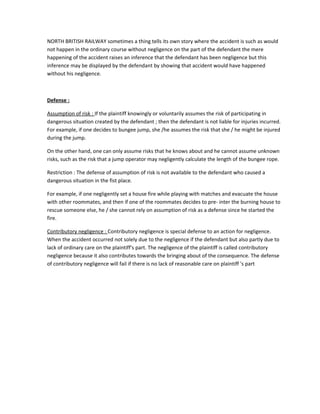
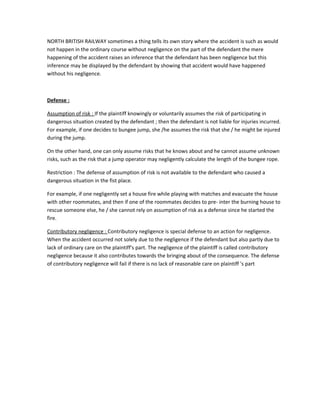
"Res ispa loquitur " means that the thing speaks for itself. According to Lord Shaw in BALLARD v](https://image.slidesharecdn.com/definitionneg-170319172455/85/Negligence-8-320.jpg)

Negligence refers to the failure to exercise reasonable care that results in harm to another person. There are two theories of negligence - the subjective theory which views negligence as a state of mind, and the objective theory which is now generally accepted and views negligence as a failure to meet the standard of a reasonable person. To prove negligence, a plaintiff must show that the defendant owed them a duty of care, that duty was breached, injury resulted, and the breach caused the injury. There are tests to determine if a duty of care exists between the parties, such as foreseeability of harm, proximity of the relationship, and whether it is fair, just and reasonable to impose liability. Professionals may have a higher standard of


![NEGLIGENCE17[2].ppt](https://cdn.slidesharecdn.com/ss_thumbnails/negligence172-230805153451-8f20aec3-thumbnail.jpg?width=640&height=640&fit=bounds)


