Qualifications
frameworks and
qualifications standards
Bryan Maguire
Quality and Qualifications Ireland
Conference on National Qualifications Framework
Astana, June 8-9, 2015
2
Overview
• Qualifications frameworks
• Quality assurance
• Learning outcomes as the key organising construct
• Linking learning outcomes with quality assurance
Dublin Descriptors
• knowledge and understanding
• applying knowledge and understanding
• making judgements
• communications skills
• learning skills
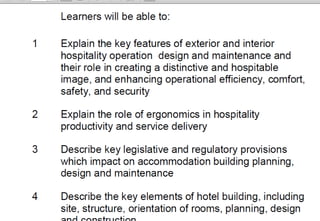
Learning outcomes
• Learning outcomes are statements of what a learner is expected to know,
understand and/or be able to demonstrate at the end of a period of learning.
They are explicit statements about the outcomes of learning – the results of
learning.
• They are usually defined in terms of a mixture of knowledge, skills, abilities,
attitudes and understanding that an individual will attain as a result of his or
her successful engagement in a particular set of higher education
experiences.
• In reality, they represent much more than this. They exemplify a particular
methodological approach for the expression and description of the
curriculum (modules, units and qualifications) and levels, cycles,
subject/sectoral statements and the ‘new style’ Bologna qualifications
frameworks.
4
5
Learning outcomes as shared language
among stakeholders
• Are they necessary pedagogically?
• Are they necessary politically?
• Actors
• Higher education institutions
• Academic staff
• Academic governance
• Institutional management
• Learners
• Employers
• Policy makers
6
Mechanisms of linking quality with
qualifications
• Standard setting
• Accreditation/validation of programmes
• Internal or external
• Research/evaluation activities
• Sharing of good practice through documentation,
conferences, formal staff development programmes,
etc.
7
Standard setting
• Programme
• Institutional
• Sectoral
• National
• European
8
Programme design
• Specify learning outcomes for programme
• Specify assessment processes linked with learning
outcomes
• Identify learning opportunities, resources and
pedagogic practices supporting the achievement of
learning outcomes
• Link module outcomes to programme outcomes
9
Programme accreditation
• Based on interrogation of programme design by peers
• Probe the identification of learning outcomes
• Probe the alignment of assessment and pedagogy with
outcomes
10
An example: transition to NFQ awards in
Irish HEIs
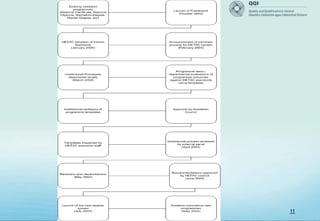
• HETAC - a “big-bang” approach in Spring 2004
• All programmes (1000 approx) were migrated to the
framework
• Programme team identified learning outcomes in their
own programme and mapped these against the
framework award-type descriptors
• Verified by institution’s academic council
• Audited by HETAC review panels
11
12
Outcomes
• Worked surprisingly well
• Non-trivial understanding of NFQ and learning
outcomes penetrated deep into the system
• Disciplinary language fleshed out descriptors
• Strong basis for subsequent programmatic review and
new programme development
• Revised pedagogic and assessment approaches followed
• More gradual approaches in other systems
National standards/guidelines HE
• UK subject benchmark statements
• 70+ subjects at bachelors, few masters
• HETAC standards
• Broad fields, e.g. business, science, art and design
• Professional standards agreed with regulatory bodies, e.g.
nursing, architecture
13
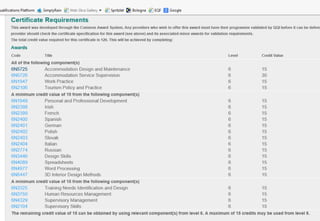
Another Irish approach
• Further Education and Training Awards Council 2001-
2102
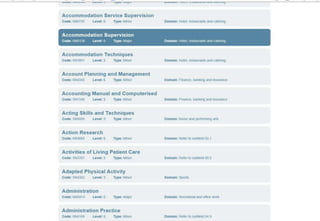
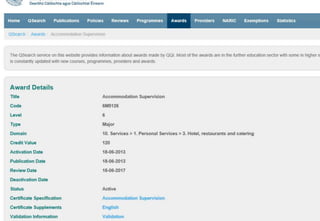
• Common Awards System 2008
• Detailed mapping of former qualifications
• 220 major awards at EQF levels 1-5
• 1987 component, supplemental and special purpose awards
• Major awards constructed from components
• Detailed standards specified at component level
19
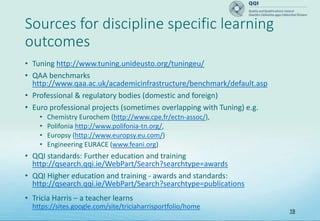
Sources for discipline specific learning
outcomes
• Tuning http://www.tuning.unideusto.org/tuningeu/
• QAA benchmarks
http://www.qaa.ac.uk/academicinfrastructure/benchmark/default.asp
• Professional & regulatory bodies (domestic and foreign)
• Euro professional projects (sometimes overlapping with Tuning) e.g.
• Chemistry Eurochem (http://www.cpe.fr/ectn-assoc/),
• Polifonia http://www.polifonia-tn.org/,
• Europsy (http://www.europsy.eu.com/)
• Engineering EURACE (www.feani.org)
• QQI standards: Further education and training
http://qsearch.qqi.ie/WebPart/Search?searchtype=awards
• QQI Higher education and training - awards and standards:
http://qsearch.qqi.ie/WebPart/Search?searchtype=publications
• Tricia Harris – a teacher learns
https://sites.google.com/site/triciaharrisportfolio/home

Qualifications frameworks and qualifications standards workshop 2 astana 9.6.15

  • 1.
    Qualifications frameworks and qualifications standards BryanMaguire Quality and Qualifications Ireland Conference on National Qualifications Framework Astana, June 8-9, 2015
  • 2.
    2 Overview • Qualifications frameworks •Quality assurance • Learning outcomes as the key organising construct • Linking learning outcomes with quality assurance
  • 3.
    Dublin Descriptors • knowledgeand understanding • applying knowledge and understanding • making judgements • communications skills • learning skills
  • 4.
    Learning outcomes • Learningoutcomes are statements of what a learner is expected to know, understand and/or be able to demonstrate at the end of a period of learning. They are explicit statements about the outcomes of learning – the results of learning. • They are usually defined in terms of a mixture of knowledge, skills, abilities, attitudes and understanding that an individual will attain as a result of his or her successful engagement in a particular set of higher education experiences. • In reality, they represent much more than this. They exemplify a particular methodological approach for the expression and description of the curriculum (modules, units and qualifications) and levels, cycles, subject/sectoral statements and the ‘new style’ Bologna qualifications frameworks. 4
  • 5.
    5 Learning outcomes asshared language among stakeholders • Are they necessary pedagogically? • Are they necessary politically? • Actors • Higher education institutions • Academic staff • Academic governance • Institutional management • Learners • Employers • Policy makers
  • 6.
    6 Mechanisms of linkingquality with qualifications • Standard setting • Accreditation/validation of programmes • Internal or external • Research/evaluation activities • Sharing of good practice through documentation, conferences, formal staff development programmes, etc.
  • 7.
    7 Standard setting • Programme •Institutional • Sectoral • National • European
  • 8.
    8 Programme design • Specifylearning outcomes for programme • Specify assessment processes linked with learning outcomes • Identify learning opportunities, resources and pedagogic practices supporting the achievement of learning outcomes • Link module outcomes to programme outcomes
  • 9.
    9 Programme accreditation • Basedon interrogation of programme design by peers • Probe the identification of learning outcomes • Probe the alignment of assessment and pedagogy with outcomes
  • 10.
    10 An example: transitionto NFQ awards in Irish HEIs • HETAC - a “big-bang” approach in Spring 2004 • All programmes (1000 approx) were migrated to the framework • Programme team identified learning outcomes in their own programme and mapped these against the framework award-type descriptors • Verified by institution’s academic council • Audited by HETAC review panels
  • 11.
  • 12.
    12 Outcomes • Worked surprisinglywell • Non-trivial understanding of NFQ and learning outcomes penetrated deep into the system • Disciplinary language fleshed out descriptors • Strong basis for subsequent programmatic review and new programme development • Revised pedagogic and assessment approaches followed • More gradual approaches in other systems
  • 13.
    National standards/guidelines HE •UK subject benchmark statements • 70+ subjects at bachelors, few masters • HETAC standards • Broad fields, e.g. business, science, art and design • Professional standards agreed with regulatory bodies, e.g. nursing, architecture 13
  • 14.
    Another Irish approach •Further Education and Training Awards Council 2001- 2102 • Common Awards System 2008 • Detailed mapping of former qualifications • 220 major awards at EQF levels 1-5 • 1987 component, supplemental and special purpose awards • Major awards constructed from components • Detailed standards specified at component level
  • 19.
    19 Sources for disciplinespecific learning outcomes • Tuning http://www.tuning.unideusto.org/tuningeu/ • QAA benchmarks http://www.qaa.ac.uk/academicinfrastructure/benchmark/default.asp • Professional & regulatory bodies (domestic and foreign) • Euro professional projects (sometimes overlapping with Tuning) e.g. • Chemistry Eurochem (http://www.cpe.fr/ectn-assoc/), • Polifonia http://www.polifonia-tn.org/, • Europsy (http://www.europsy.eu.com/) • Engineering EURACE (www.feani.org) • QQI standards: Further education and training http://qsearch.qqi.ie/WebPart/Search?searchtype=awards • QQI Higher education and training - awards and standards: http://qsearch.qqi.ie/WebPart/Search?searchtype=publications • Tricia Harris – a teacher learns https://sites.google.com/site/triciaharrisportfolio/home