The National
Economic Outlook

2013 Arkansas Economic Forecast
Conference
Little Rock, Arkansas
November 6, 2013
Monetary Policy: SOSO
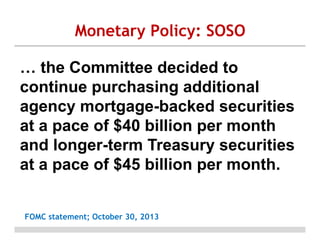
… the Committee decided to
continue purchasing additional
agency mortgage-backed securities
at a pace of $40 billion per month
and longer-term Treasury securities
at a pace of $45 billion per month.
FOMC statement; October 30, 2013
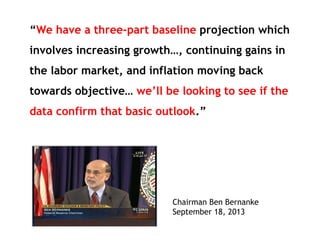
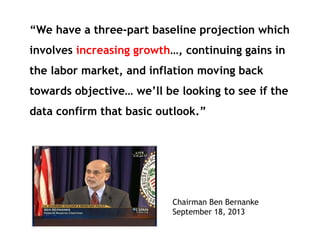
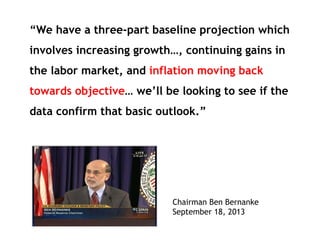
“We have a three-part baseline projection which
involves increasing growth…, continuing gains in
the labor market, and inflation moving back
towards objective… we’ll be looking to see if the
data confirm that basic outlook.”

Chairman Ben Bernanke
September 18, 2013
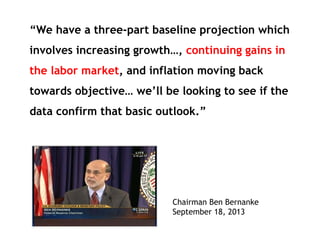
“We have a three-part baseline projection which
involves increasing growth…, continuing gains in
the labor market, and inflation moving back
towards objective… we’ll be looking to see if the
data confirm that basic outlook.”

Chairman Ben Bernanke
September 18, 2013
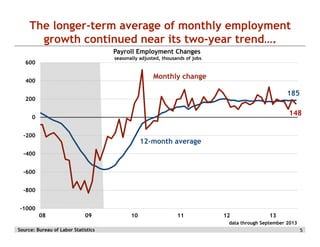
The longer-term average of monthly employment
growth continued near its two-year trend….
Payroll Employment Changes
seasonally adjusted, thousands of jobs

600

Monthly change

400

185

200

148

0
-200

12-month average

-400
-600
-800
-1000
08

09

10

11

12

13

data through September 2013
Source: Bureau of Labor Statistics

5
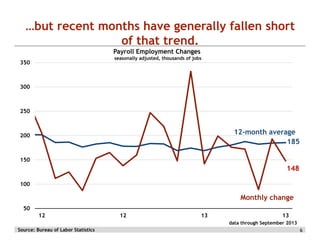
…but recent months have generally fallen short
of that trend.
Payroll Employment Changes
seasonally adjusted, thousands of jobs

350

300

250

12-month average
185

200

150

148
100

Monthly change
50
12

12

13

13
data through September 2013

Source: Bureau of Labor Statistics

6
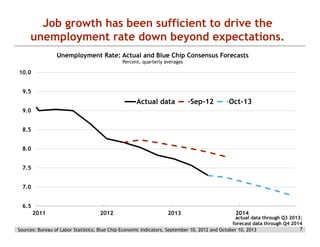
Job growth has been sufficient to drive the
unemployment rate down beyond expectations.
Unemployment Rate: Actual and Blue Chip Consensus Forecasts
Percent, quarterly averages

10.0
9.5

Actual data

Sep-12

Oct-13

9.0
8.5
8.0
7.5
7.0
6.5
2011

2012

2013

2014

actual data through Q3 2013;
forecast data through Q4 2014
7
Sources: Bureau of Labor Statistics; Blue Chip Economic Indicators, September 10, 2012 and October 10, 2013
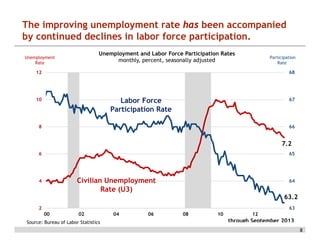
The improving unemployment rate has been accompanied
by continued declines in labor force participation.
Unemployment and Labor Force Participation Rates
monthly, percent, seasonally adjusted

Unemployment
Rate

Participation
Rate

12

68

Labor Force
Participation Rate

10

67

8

66

7.2
6

65

Civilian Unemployment
Rate (U3)

4

64

63.2

2

63
00

02

Source: Bureau of Labor Statistics

04

06

08

10

12

through September 2013
8
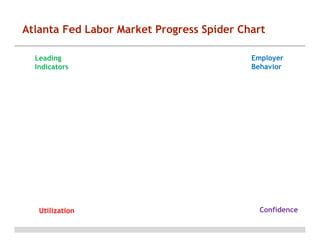
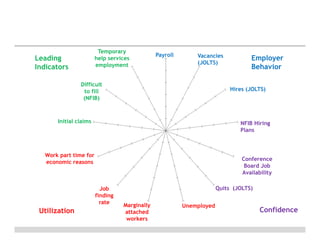
Atlanta Fed Labor Market Progress Spider Chart
1/1/1900

Leading
Indicators

Employer
Behavior

1/2/1900

1/13/1900

1/3/1900

1/12/1900

1/4/1900

1/11/1900

1/5/1900

1/10/1900

1/9/1900

1/6/1900

1/8/1900

Utilization

1/7/1900

Confidence
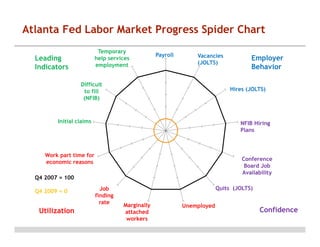
Atlanta Fed Labor Market Progress Spider Chart
Temporary
help services
1/13/1900
employment

Leading
Indicators

1/1/1900
Payroll

Vacancies
(JOLTS)
1/2/1900

Difficult
1/12/1900
to fill
(NFIB)

Hires (JOLTS)

1/3/1900

1/11/1900
Initial claims

1/4/1900
NFIB Hiring
Plans

Work part time for
1/10/1900
economic reasons

1/9/1900
Job
finding
rate

Utilization

Employer
Behavior

1/5/1900

Conference
Board Job
Availability

1/6/1900
Quits (JOLTS)

1/8/1900
Marginally
attached
workers

1/7/1900
Unemployed

Confidence
Atlanta Fed Labor Market Progress Spider Chart
Temporary
help services
Temp
employment

Leading
Indicators

PayrollExCensus

Payroll

Vacancies
(JOLTS)
JOLTSOpens

Difficult
NFIBCantFill
to fill
(NFIB)

Hires (JOLTS)

JOLTSHires

InitialInitialClaims
claims

NFIBHiringPlans
NFIB Hiring
Plans

Work part time for
PTER
economic reasons

ConfBoardJobAvail

Conference
Board Job
Availability

Q4 2007 = 100
Q4 2009 = 0

Utilization

Employer
Behavior

UtoErate
Job
finding
rate

JOLTSQuits
Quits (JOLTS)

MarginAttachSA
Marginally
attached
workers

Unemployed
Unemployed

Confidence
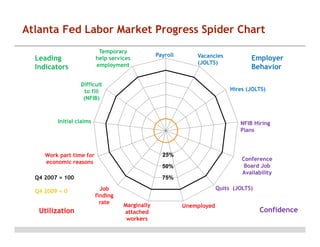
Atlanta Fed Labor Market Progress Spider Chart
Temporary
help services
Temp
employment

Leading
Indicators

PayrollExCensus

Payroll

Vacancies
(JOLTS)
JOLTSOpens

Difficult
NFIBCantFill
to fill
(NFIB)

Hires (JOLTS)

JOLTSHires

InitialInitialClaims
claims

NFIBHiringPlans
NFIB Hiring
Plans

Work part time for
PTER
economic reasons

25%

Utilization

ConfBoardJobAvail

Conference
Board Job
Availability

50%

Q4 2007 = 100
Q4 2009 = 0

Employer
Behavior

75%
UtoErate
Job
finding
rate

JOLTSQuits
Quits (JOLTS)

MarginAttachSA
Marginally
attached
workers

Unemployed
Unemployed

Confidence
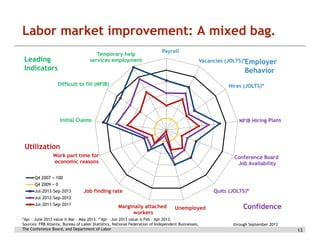
Atlanta market Market Progress Spider Chart: bag.
Labor Fed Labor improvement: A mixedViewed as
a whole, the labor market picture is uneven.
Temporary help
services employment

Leading
Indicators

Payroll
Vacancies (JOLTS)*Employer

Behavior
Difficult to fill (NFIB)

Hires (JOLTS)*

Initial Claims

Utilization
Work part time for
economic reasons

Conference Board
Job Availability

Q4 2007 = 100
Q4 2009 = 0
Jul-2013-Sep-2013

Job finding rate

Quits (JOLTS)*

Jul-2012-Sep-2012
Jul-2011-Sep-2011

Marginally attached
workers

Unemployed

*Apr – June 2013 value is Mar – May 2013. **Apr – Jun 2013 value is Feb – Apr 2013.
Sources: FRB Atlanta, Bureau of Labor Statistics, National Federation of Independent Businesses,
The Conference Board, and Department of Labor

Confidence
through September 2013

13
“We have a three-part baseline projection which
involves increasing growth…, continuing gains in
the labor market, and inflation moving back
towards objective… we’ll be looking to see if the
data confirm that basic outlook.”

Chairman Ben Bernanke
September 18, 2013
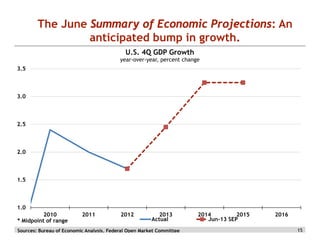
The June Summary of Economic Projections: An
anticipated bump in growth.
U.S. 4Q GDP Growth

year-over-year, percent change
3.5

3.0

2.5

2.0

1.5

1.0
2010
* Midpoint of range

2011

2012

2013
Actual

Sources: Bureau of Economic Analysis, Federal Open Market Committee

2014
2015
Jun-13 SEP

2016
15
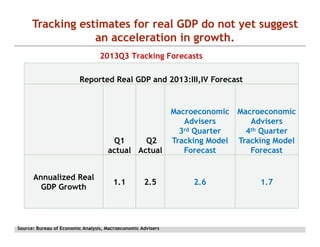
Tracking estimates for real GDP do not yet suggest
an acceleration in growth.
2013Q3 Tracking Forecasts
Reported Real GDP and 2013:III,IV Forecast

Q1
Q2
actual Actual
Annualized Real
GDP Growth

1.1

2.5

Source: Bureau of Economic Analysis, Macroeconomic Advisers

Macroeconomic Macroeconomic
Advisers
Advisers
4th Quarter
3rd Quarter
Tracking Model Tracking Model
Forecast
Forecast

2.6

1.7
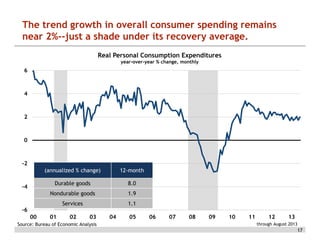
The trend growth in overall consumer spending remains
near 2%--just a shade under its recovery average.
Real Personal Consumption Expenditures
year-over-year % change, monthly

6

4

2

0

-2
(annualized % change)
Durable goods

8.0

Nondurable goods

1.9

Services

-4

12-month

1.1

-6
00

01

02

03

Source: Bureau of Economic Analysis

04

05

06

07

08

09

10

11

12

13

through August 2013

17
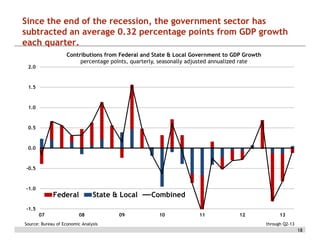
Since the end of the recession, the government sector has
subtracted an average 0.32 percentage points from GDP growth
each quarter.
Contributions from Federal and State & Local Government to GDP Growth
percentage points, quarterly, seasonally adjusted annualized rate

2.0

1.5

1.0

0.5

0.0

-0.5

-1.0

Federal

State & Local

Combined

-1.5
07

08

Source: Bureau of Economic Analysis

09

10

11

12

13
through Q2-13

18
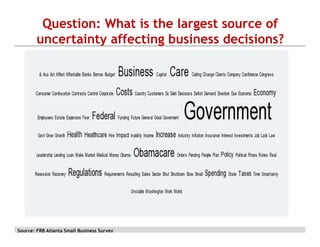
Question: What is the largest source of
uncertainty affecting business decisions?

Source: FRB Atlanta Small Business Survey
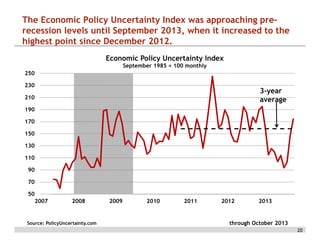
The Economic Policy Uncertainty Index was approaching prerecession levels until September 2013, when it increased to the
highest point since December 2012.
Economic Policy Uncertainty Index
September 1985 = 100 monthly

250
230

3-year
average

210
190
170
150
130
110
90
70
50
2007

2008

Source: PolicyUncertainty.com

2009

2010

2011

2012

2013

through October 2013
20
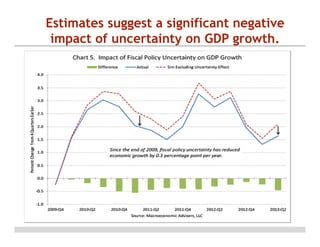
Estimates suggest a significant negative
impact of uncertainty on GDP growth.
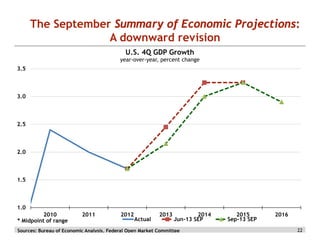
The September Summary of Economic Projections:
A downward revision
U.S. 4Q GDP Growth

year-over-year, percent change
3.5

3.0

2.5

2.0

1.5

1.0
2010
* Midpoint of range

2011

2012

Actual

2013

2014
Jun-13 SEP

Sources: Bureau of Economic Analysis, Federal Open Market Committee

2015
Sep-13 SEP

2016
22
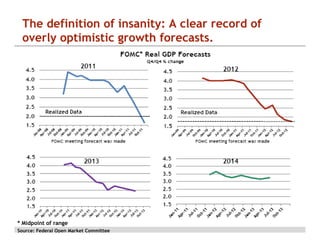
The definition of insanity: A clear record of
overly optimistic growth forecasts.

* Midpoint of range
Source: Federal Open Market Committee
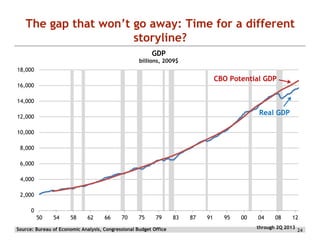
The gap that won’t go away: Time for a different
storyline?
GDP

billions, 2009$
18,000

CBO Potential GDP

16,000
14,000

Real GDP

12,000
10,000
8,000
6,000
4,000
2,000
0
50

54

58

62

66

70

75

79

Source: Bureau of Economic Analysis, Congressional Budget Office

83

87

91

95

00

04

08

12

through 2Q 2013

24
“We have a three-part baseline projection which
involves increasing growth…, continuing gains in
the labor market, and inflation moving back
towards objective… we’ll be looking to see if the
data confirm that basic outlook.”

Chairman Ben Bernanke
September 18, 2013
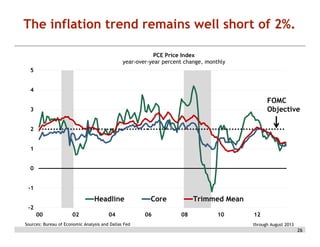
The inflation trend remains well short of 2%.
PCE Price Index
year-over-year percent change, monthly
5
4

FOMC
Objective

3
2
1
0
-1

Headline

Core

Trimmed Mean

-2
00

02

04

Sources: Bureau of Economic Analysis and Dallas Fed

06

08

10

12
through August 2013

26
The National
Economic Outlook

Dr. David Altig - 2013 National Economic Forecast

  • 1.
    The National Economic Outlook 2013Arkansas Economic Forecast Conference Little Rock, Arkansas November 6, 2013
  • 2.
    Monetary Policy: SOSO …the Committee decided to continue purchasing additional agency mortgage-backed securities at a pace of $40 billion per month and longer-term Treasury securities at a pace of $45 billion per month. FOMC statement; October 30, 2013
  • 3.
    “We have athree-part baseline projection which involves increasing growth…, continuing gains in the labor market, and inflation moving back towards objective… we’ll be looking to see if the data confirm that basic outlook.” Chairman Ben Bernanke September 18, 2013
  • 4.
    “We have athree-part baseline projection which involves increasing growth…, continuing gains in the labor market, and inflation moving back towards objective… we’ll be looking to see if the data confirm that basic outlook.” Chairman Ben Bernanke September 18, 2013
  • 5.
    The longer-term averageof monthly employment growth continued near its two-year trend…. Payroll Employment Changes seasonally adjusted, thousands of jobs 600 Monthly change 400 185 200 148 0 -200 12-month average -400 -600 -800 -1000 08 09 10 11 12 13 data through September 2013 Source: Bureau of Labor Statistics 5
  • 6.
    …but recent monthshave generally fallen short of that trend. Payroll Employment Changes seasonally adjusted, thousands of jobs 350 300 250 12-month average 185 200 150 148 100 Monthly change 50 12 12 13 13 data through September 2013 Source: Bureau of Labor Statistics 6
  • 7.
    Job growth hasbeen sufficient to drive the unemployment rate down beyond expectations. Unemployment Rate: Actual and Blue Chip Consensus Forecasts Percent, quarterly averages 10.0 9.5 Actual data Sep-12 Oct-13 9.0 8.5 8.0 7.5 7.0 6.5 2011 2012 2013 2014 actual data through Q3 2013; forecast data through Q4 2014 7 Sources: Bureau of Labor Statistics; Blue Chip Economic Indicators, September 10, 2012 and October 10, 2013
  • 8.
    The improving unemploymentrate has been accompanied by continued declines in labor force participation. Unemployment and Labor Force Participation Rates monthly, percent, seasonally adjusted Unemployment Rate Participation Rate 12 68 Labor Force Participation Rate 10 67 8 66 7.2 6 65 Civilian Unemployment Rate (U3) 4 64 63.2 2 63 00 02 Source: Bureau of Labor Statistics 04 06 08 10 12 through September 2013 8
  • 9.
    Atlanta Fed LaborMarket Progress Spider Chart 1/1/1900 Leading Indicators Employer Behavior 1/2/1900 1/13/1900 1/3/1900 1/12/1900 1/4/1900 1/11/1900 1/5/1900 1/10/1900 1/9/1900 1/6/1900 1/8/1900 Utilization 1/7/1900 Confidence
  • 10.
    Atlanta Fed LaborMarket Progress Spider Chart Temporary help services 1/13/1900 employment Leading Indicators 1/1/1900 Payroll Vacancies (JOLTS) 1/2/1900 Difficult 1/12/1900 to fill (NFIB) Hires (JOLTS) 1/3/1900 1/11/1900 Initial claims 1/4/1900 NFIB Hiring Plans Work part time for 1/10/1900 economic reasons 1/9/1900 Job finding rate Utilization Employer Behavior 1/5/1900 Conference Board Job Availability 1/6/1900 Quits (JOLTS) 1/8/1900 Marginally attached workers 1/7/1900 Unemployed Confidence
  • 11.
    Atlanta Fed LaborMarket Progress Spider Chart Temporary help services Temp employment Leading Indicators PayrollExCensus Payroll Vacancies (JOLTS) JOLTSOpens Difficult NFIBCantFill to fill (NFIB) Hires (JOLTS) JOLTSHires InitialInitialClaims claims NFIBHiringPlans NFIB Hiring Plans Work part time for PTER economic reasons ConfBoardJobAvail Conference Board Job Availability Q4 2007 = 100 Q4 2009 = 0 Utilization Employer Behavior UtoErate Job finding rate JOLTSQuits Quits (JOLTS) MarginAttachSA Marginally attached workers Unemployed Unemployed Confidence
  • 12.
    Atlanta Fed LaborMarket Progress Spider Chart Temporary help services Temp employment Leading Indicators PayrollExCensus Payroll Vacancies (JOLTS) JOLTSOpens Difficult NFIBCantFill to fill (NFIB) Hires (JOLTS) JOLTSHires InitialInitialClaims claims NFIBHiringPlans NFIB Hiring Plans Work part time for PTER economic reasons 25% Utilization ConfBoardJobAvail Conference Board Job Availability 50% Q4 2007 = 100 Q4 2009 = 0 Employer Behavior 75% UtoErate Job finding rate JOLTSQuits Quits (JOLTS) MarginAttachSA Marginally attached workers Unemployed Unemployed Confidence
  • 13.
    Atlanta market MarketProgress Spider Chart: bag. Labor Fed Labor improvement: A mixedViewed as a whole, the labor market picture is uneven. Temporary help services employment Leading Indicators Payroll Vacancies (JOLTS)*Employer Behavior Difficult to fill (NFIB) Hires (JOLTS)* Initial Claims Utilization Work part time for economic reasons Conference Board Job Availability Q4 2007 = 100 Q4 2009 = 0 Jul-2013-Sep-2013 Job finding rate Quits (JOLTS)* Jul-2012-Sep-2012 Jul-2011-Sep-2011 Marginally attached workers Unemployed *Apr – June 2013 value is Mar – May 2013. **Apr – Jun 2013 value is Feb – Apr 2013. Sources: FRB Atlanta, Bureau of Labor Statistics, National Federation of Independent Businesses, The Conference Board, and Department of Labor Confidence through September 2013 13
  • 14.
    “We have athree-part baseline projection which involves increasing growth…, continuing gains in the labor market, and inflation moving back towards objective… we’ll be looking to see if the data confirm that basic outlook.” Chairman Ben Bernanke September 18, 2013
  • 15.
    The June Summaryof Economic Projections: An anticipated bump in growth. U.S. 4Q GDP Growth year-over-year, percent change 3.5 3.0 2.5 2.0 1.5 1.0 2010 * Midpoint of range 2011 2012 2013 Actual Sources: Bureau of Economic Analysis, Federal Open Market Committee 2014 2015 Jun-13 SEP 2016 15
  • 16.
    Tracking estimates forreal GDP do not yet suggest an acceleration in growth. 2013Q3 Tracking Forecasts Reported Real GDP and 2013:III,IV Forecast Q1 Q2 actual Actual Annualized Real GDP Growth 1.1 2.5 Source: Bureau of Economic Analysis, Macroeconomic Advisers Macroeconomic Macroeconomic Advisers Advisers 4th Quarter 3rd Quarter Tracking Model Tracking Model Forecast Forecast 2.6 1.7
  • 17.
    The trend growthin overall consumer spending remains near 2%--just a shade under its recovery average. Real Personal Consumption Expenditures year-over-year % change, monthly 6 4 2 0 -2 (annualized % change) Durable goods 8.0 Nondurable goods 1.9 Services -4 12-month 1.1 -6 00 01 02 03 Source: Bureau of Economic Analysis 04 05 06 07 08 09 10 11 12 13 through August 2013 17
  • 18.
    Since the endof the recession, the government sector has subtracted an average 0.32 percentage points from GDP growth each quarter. Contributions from Federal and State & Local Government to GDP Growth percentage points, quarterly, seasonally adjusted annualized rate 2.0 1.5 1.0 0.5 0.0 -0.5 -1.0 Federal State & Local Combined -1.5 07 08 Source: Bureau of Economic Analysis 09 10 11 12 13 through Q2-13 18
  • 19.
    Question: What isthe largest source of uncertainty affecting business decisions? Source: FRB Atlanta Small Business Survey
  • 20.
    The Economic PolicyUncertainty Index was approaching prerecession levels until September 2013, when it increased to the highest point since December 2012. Economic Policy Uncertainty Index September 1985 = 100 monthly 250 230 3-year average 210 190 170 150 130 110 90 70 50 2007 2008 Source: PolicyUncertainty.com 2009 2010 2011 2012 2013 through October 2013 20
  • 21.
    Estimates suggest asignificant negative impact of uncertainty on GDP growth.
  • 22.
    The September Summaryof Economic Projections: A downward revision U.S. 4Q GDP Growth year-over-year, percent change 3.5 3.0 2.5 2.0 1.5 1.0 2010 * Midpoint of range 2011 2012 Actual 2013 2014 Jun-13 SEP Sources: Bureau of Economic Analysis, Federal Open Market Committee 2015 Sep-13 SEP 2016 22
  • 23.
    The definition ofinsanity: A clear record of overly optimistic growth forecasts. * Midpoint of range Source: Federal Open Market Committee
  • 24.
    The gap thatwon’t go away: Time for a different storyline? GDP billions, 2009$ 18,000 CBO Potential GDP 16,000 14,000 Real GDP 12,000 10,000 8,000 6,000 4,000 2,000 0 50 54 58 62 66 70 75 79 Source: Bureau of Economic Analysis, Congressional Budget Office 83 87 91 95 00 04 08 12 through 2Q 2013 24
  • 25.
    “We have athree-part baseline projection which involves increasing growth…, continuing gains in the labor market, and inflation moving back towards objective… we’ll be looking to see if the data confirm that basic outlook.” Chairman Ben Bernanke September 18, 2013
  • 26.
    The inflation trendremains well short of 2%. PCE Price Index year-over-year percent change, monthly 5 4 FOMC Objective 3 2 1 0 -1 Headline Core Trimmed Mean -2 00 02 04 Sources: Bureau of Economic Analysis and Dallas Fed 06 08 10 12 through August 2013 26
  • 27.