World Bank & Government of The Netherlands funded
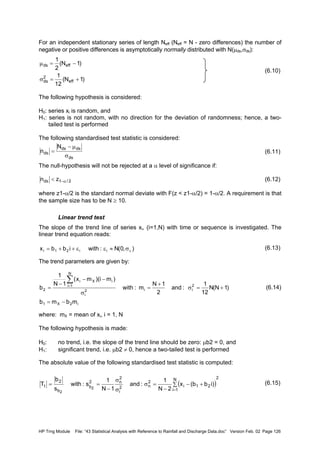
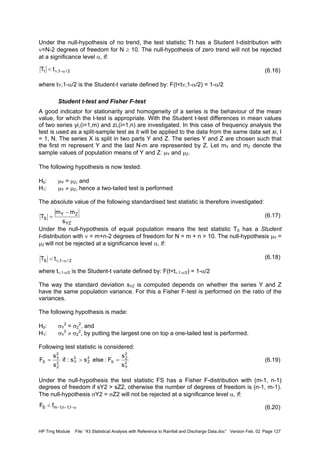
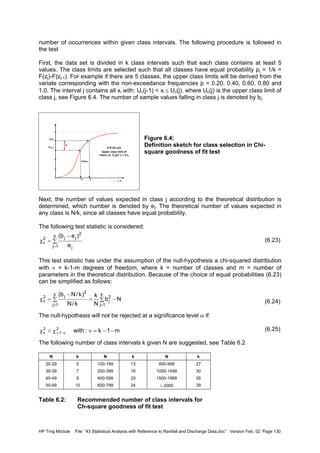
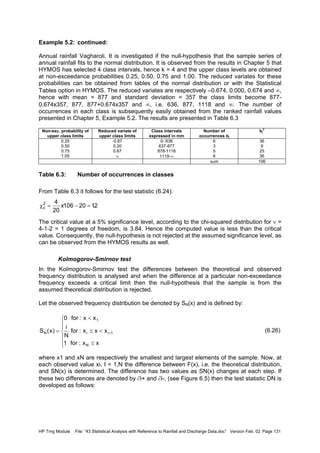
Training module # SWDP - 43
Statistical Analysis with
Reference to Rainfall and
Discharge Data
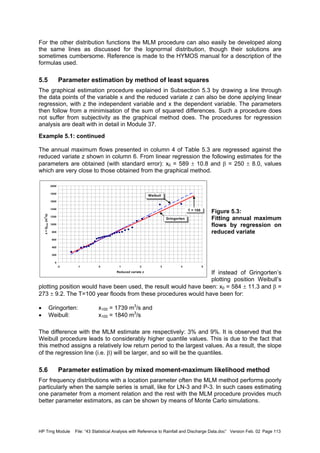
New Delhi, February 2002
CSMRS Building, 4th Floor, Olof Palme Marg, Hauz Khas,
New Delhi – 11 00 16 India
Tel: 68 61 681 / 84 Fax: (+ 91 11) 68 61 685
E-Mail: hydrologyproject@vsnl.com
DHV Consultants BV & DELFT HYDRAULICS
with
HALCROW, TAHAL, CES, ORG & JPS
HP Trng Module File: “43 Statistical Analysis with Reference to Rainfall and Discharge Data.doc” Version Feb. 02 Page 1
Table of contents
Page
1. Module context 2
2. Module profile 3
3. Session plan 4
4. Overhead/flipchart master 5
5. Handout 6
6. Additional handout 8
7. Main text 9
HP Trng Module File: “43 Statistical Analysis with Reference to Rainfall and Discharge Data.doc” Version Feb. 02 Page 2
1. Module context
While designing a training course, the relationship between this module and the others,
would be maintained by keeping them close together in the syllabus and place them in a
logical sequence. The actual selection of the topics and the depth of training would, of
course, depend on the training needs of the participants, i.e. their knowledge level and skills
performance upon the start of the course.
HP Trng Module File: “43 Statistical Analysis with Reference to Rainfall and Discharge Data.doc” Version Feb. 02 Page 3
2. Module profile
Title : Statistical Analysis with Reference to Rainfall and Discharge Data
Target group : HIS function(s): ……
Duration : x session of y min
Objectives : After the training the participants will be able to:
Key concepts : •
Training methods : Lecture, exercises
Training tools
required
: Board, flipchart
Handouts : As provided in this module
Further reading
and references
:
HP Trng Module File: “43 Statistical Analysis with Reference to Rainfall and Discharge Data.doc” Version Feb. 02 Page 4
3. Session plan
No Activities Time Tools
1 Preparations
2 Introduction: min OHS x
Exercise min
Wrap up min
HP Trng Module File: “43 Statistical Analysis with Reference to Rainfall and Discharge Data.doc” Version Feb. 02 Page 5
4. Overhead/flipchart master
HP Trng Module File: “43 Statistical Analysis with Reference to Rainfall and Discharge Data.doc” Version Feb. 02 Page 6
5. Handout
HP Trng Module File: “43 Statistical Analysis with Reference to Rainfall and Discharge Data.doc” Version Feb. 02 Page 7
Add copy of the main text in chapter 7, for all participants
HP Trng Module File: “43 Statistical Analysis with Reference to Rainfall and Discharge Data.doc” Version Feb. 02 Page 8
6. Additional handout
These handouts are distributed during delivery and contain test questions, answers to
questions, special worksheets, optional information, and other matters you would not like to
be seen in the regular handouts.
It is a good practice to pre-punch these additional handouts, so the participants can easily
insert them in the main handout folder.
HP Trng Module File: “43 Statistical Analysis with Reference to Rainfall and Discharge Data.doc” Version Feb. 02 Page 9
7. Main text
Contents
1 Introduction 1
2 Description of Datasets 4
3 Fundamental Concepts of Possibility 19
4 Theoretical Distribution Functions 40
5 Estimation of Statistical Parameters 100
6 Hypothesis Testing 121
HP Trng Module File: “43 Statistical Analysis with Reference to Rainfall and Discharge Data.doc” Version Feb. 02 Page 1
Statistical Analysis with Reference to Rainfall and Discharge Data
1 Introduction
Terminology
A hydrologic process is defined as any phenomenon concerning the occurrence and
movement of water near the earth’s surface continuously changing in time and/or space. If
these phenomena are observed at intervals or continuously, discrete, respectively,
continuous series are created, → with time: discrete and continuous time series. One
single series element is an outcome of the process. A set of outcomes is called a
realisation, while the set of all possible outcomes is the ensemble.
The variation within hydrological processes may be deterministic or stochastic. In a
deterministic process a definite relation exists between the hydrologic variable and time (or
space). The functional equation defines the process for the entire time (or space) of its
existence. Each successive observation does not represent new information about the
process. This, in contrast to a stochastic process, which evolves, entirely or in part,
according to a random mechanism. It means that future outcomes of the process are not
exactly predictable. The hydrologic variable in such cases is called a stochastic variable,
i.e. a variable whose values are governed by the laws of chance. Its behaviour is
mathematically described by probability theory.
The elements, creating a stochastic process, may be dependent or independent, resulting
in a non-pure random, respectively, a pure random process.
A stochastic process can either be stationary or non-stationary, i.e. homogeneous or non-
homogeneous in time and/or space. Stationary processes are distinguished into strictly and
weakly stationary processes.
A process is said to be strictly stationary if all its statistical properties which characterise
the process, are unaffected by a change in the origin (time and or space). For a time-
process this reads: the joint probability distribution of x(t1), x(t2), …, x(tn) is identical to the
joint probability distribution of x(t1+τ), x(t2+τ), …, x(tn+τ) for any n and τ, where τ is a time lag.
If instead of the joint probability density function only the first m-moments of that function are
independent of time (space) the process is called mth
order stationary.
Weak stationarity means that only the lower order moments of the distribution function
(order ≤ 2, i.e. the mean and the covariance function) fulfil the property of being independent
of time. This is also called stationarity in a wide sense. (Note that the terminology
stationary/non-stationary is used when dealing with homogeneity or non-homogeneity in
time).
In practice only a limited set of outcomes, a limited series, is available. Based on this sample
set the behaviour of the process is estimated: sample versus population. The elements in a
hydrological series may be analysed according to rank of magnitude and according to the
sequence of occurrence. Ranking of elements forms the basis of statistics, the classical
frequency analysis, thereby ignoring the order of occurrence. In contrast to ranking, the
study of the sequence of occurrence presumes that past outcomes of the process may
influence the magnitude of the present and the future outcomes. Hence the dependency
between successive elements in the series is not ignored: time series analysis.
HP Trng Module File: “43 Statistical Analysis with Reference to Rainfall and Discharge Data.doc” Version Feb. 02 Page 2
About this module
In this module a review is presented of statistics as applied to hydrology to analyse e.g.
rainfall or discharge data. With statistics one describes rather than explains features of
hydrological processes. Statements are made based on a sample from the entire population
of the hydrological variable of concern. With statistics one describes variables only in
probabilistic terms for reasons that the cause and effect relation of the physical process is
insufficiently known and also because our description is based on a small part of the entire
range of outcomes on the variable.
Statistics provides powerful tools to describe hydrological variables, but one should apply it
with care. An important condition the series to be subjected to statistical analysis should fulfil
is stationarity. To judge whether this condition is fulfilled, knowledge is required of the
nature of the hydrological variable(s) of concern. The following components are generally
distinguished in hydrological time series, see also Figure 1.1:
• Deterministic components, including:
− Transient component, due to natural or man made changes, which can be a jump,
in case of a sudden change in the conditions or a trend, linear or non-linear, due to
a gradual change
− Periodic component, e.g. due to the annual solar cycle
• Stochastic component:
− Stochastic dependent part, where the new value is related to one or more
predecessors, e.g. due to storage effects
− Stochastic independent or random part.
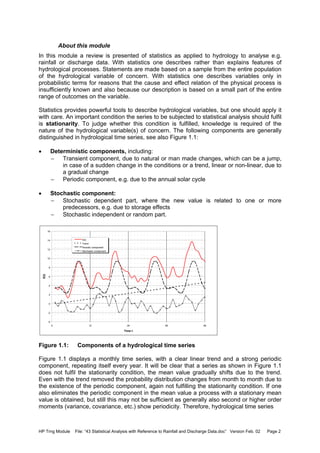
Figure 1.1: Components of a hydrological time series
Figure 1.1 displays a monthly time series, with a clear linear trend and a strong periodic
component, repeating itself every year. It will be clear that a series as shown in Figure 1.1
does not fulfil the stationarity condition, the mean value gradually shifts due to the trend.
Even with the trend removed the probability distribution changes from month to month due to
the existence of the periodic component, again not fulfilling the stationarity condition. If one
also eliminates the periodic component in the mean value a process with a stationary mean
value is obtained, but still this may not be sufficient as generally also second or higher order
moments (variance, covariance, etc.) show periodicity. Therefore, hydrological time series
-4
-2
0
2
4
6
8
10
12
14
16
0 12 24 36 48
Time t
X(t)
X(t)
Trend
Periodic component
Stochastic component
HP Trng Module File: “43 Statistical Analysis with Reference to Rainfall and Discharge Data.doc” Version Feb. 02 Page 3
with time intervals less than a year should not be subjected to statistical analysis. Annual
values generally do not have the problem of periodicity (unless spectral analysis shows
otherwise due to some over-annual effect) and are fit for statistical analysis, provided that
transient components are not present or have been eliminated.
Now, returning to our monthly series, periodicity is avoided if the months are considered
separately, that is e.g. if only the values of July of successive years are considered.
Similarly, if seasonal series are available, one should consider one season at a time for
statistical analysis, i.e. the same season for a number of years.
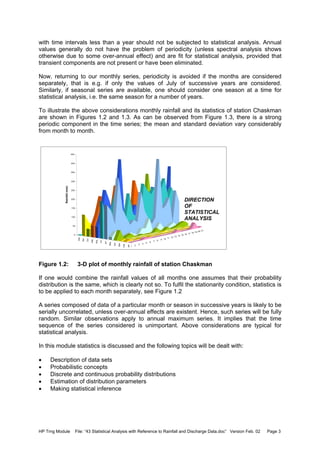
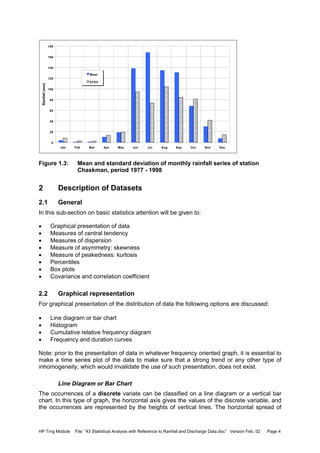
To illustrate the above considerations monthly rainfall and its statistics of station Chaskman
are shown in Figures 1.2 and 1.3. As can be observed from Figure 1.3, there is a strong
periodic component in the time series; the mean and standard deviation vary considerably
from month to month.
Figure 1.2: 3-D plot of monthly rainfall of station Chaskman
If one would combine the rainfall values of all months one assumes that their probability
distribution is the same, which is clearly not so. To fulfil the stationarity condition, statistics is
to be applied to each month separately, see Figure 1.2
A series composed of data of a particular month or season in successive years is likely to be
serially uncorrelated, unless over-annual effects are existent. Hence, such series will be fully
random. Similar observations apply to annual maximum series. It implies that the time
sequence of the series considered is unimportant. Above considerations are typical for
statistical analysis.
In this module statistics is discussed and the following topics will be dealt with:
• Description of data sets
• Probabilistic concepts
• Discrete and continuous probability distributions
• Estimation of distribution parameters
• Making statistical inference
1 2 3 4 5 6 7 8 9 10 11 12 13 14 15 16 17 18 19 20 21
Jan
Feb
Mar
Apr
May
Jun
Jul
Aug
Sep
Oct
Nov
Dec
0
50
100
150
200
250
300
350
400
450
Rainfall(mm)
DIRECTION
OF
STATISTICAL
ANALYSIS
HP Trng Module File: “43 Statistical Analysis with Reference to Rainfall and Discharge Data.doc” Version Feb. 02 Page 4
Figure 1.3: Mean and standard deviation of monthly rainfall series of station
Chaskman, period 1977 - 1998
2 Description of Datasets
2.1 General
In this sub-section on basic statistics attention will be given to:
• Graphical presentation of data
• Measures of central tendency
• Measures of dispersion
• Measure of asymmetry: skewness
• Measure of peakedness: kurtosis
• Percentiles
• Box plots
• Covariance and correlation coefficient
2.2 Graphical representation
For graphical presentation of the distribution of data the following options are discussed:
• Line diagram or bar chart
• Histogram
• Cumulative relative frequency diagram
• Frequency and duration curves
Note: prior to the presentation of data in whatever frequency oriented graph, it is essential to
make a time series plot of the data to make sure that a strong trend or any other type of
inhomogeneity, which would invalidate the use of such presentation, does not exist.
Line Diagram or Bar Chart
The occurrences of a discrete variate can be classified on a line diagram or a vertical bar
chart. In this type of graph, the horizontal axis gives the values of the discrete variable, and
the occurrences are represented by the heights of vertical lines. The horizontal spread of
0
20
40
60
80
100
120
140
160
180
Jan Feb Mar Apr May Jun Jul Aug Sep Oct Nov Dec
Rainfall(mm)
Mean
STDV
HP Trng Module File: “43 Statistical Analysis with Reference to Rainfall and Discharge Data.doc” Version Feb. 02 Page 5
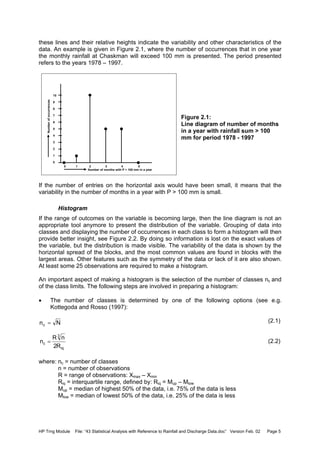
these lines and their relative heights indicate the variability and other characteristics of the
data. An example is given in Figure 2.1, where the number of occurrences that in one year
the monthly rainfall at Chaskman will exceed 100 mm is presented. The period presented
refers to the years 1978 – 1997.
Figure 2.1:
Line diagram of number of months
in a year with rainfall sum > 100
mm for period 1978 - 1997
If the number of entries on the horizontal axis would have been small, it means that the
variability in the number of months in a year with P > 100 mm is small.
Histogram
If the range of outcomes on the variable is becoming large, then the line diagram is not an
appropriate tool anymore to present the distribution of the variable. Grouping of data into
classes and displaying the number of occurrences in each class to form a histogram will then
provide better insight, see Figure 2.2. By doing so information is lost on the exact values of
the variable, but the distribution is made visible. The variability of the data is shown by the
horizontal spread of the blocks, and the most common values are found in blocks with the
largest areas. Other features such as the symmetry of the data or lack of it are also shown.
At least some 25 observations are required to make a histogram.
An important aspect of making a histogram is the selection of the number of classes nc and
of the class limits. The following steps are involved in preparing a histogram:
• The number of classes is determined by one of the following options (see e.g.
Kottegoda and Rosso (1997):
(2.1)
(2.2)
where: nc = number of classes
n = number of observations
R = range of observations: Xmax – Xmin
Riq = interquartile range, defined by: Riq = Mup – Mlow
Mup = median of highest 50% of the data, i.e. 75% of the data is less
Mlow = median of lowest 50% of the data, i.e. 25% of the data is less
10
9
8
7
6
5
4
3
2
1
0
0 1 2 3 4 5
Number of months with P > 100 mm in a year
Numberofoccurrences
Nnc =
iq
3
c
R2
nR
n =
HP Trng Module File: “43 Statistical Analysis with Reference to Rainfall and Discharge Data.doc” Version Feb. 02 Page 6
• To obtain rounded numbers for the class limits convenient lower and upper limits below
Xmin and above Xmax respectively the lowest and highest value have to be selected.
• Count the occurrences within each class: class frequency
• Present the results in a histogram
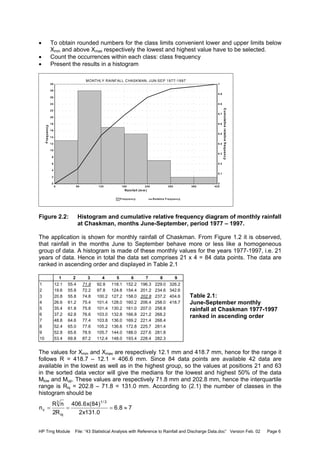
Figure 2.2: Histogram and cumulative relative frequency diagram of monthly rainfall
at Chaskman, months June-September, period 1977 – 1997.
The application is shown for monthly rainfall of Chaskman. From Figure 1.2 it is observed,
that rainfall in the months June to September behave more or less like a homogeneous
group of data. A histogram is made of these monthly values for the years 1977-1997, i.e. 21
years of data. Hence in total the data set comprises 21 x 4 = 84 data points. The data are
ranked in ascending order and displayed in Table 2.1
1 2 3 4 5 6 7 8 9
1 12.1 55.4 71.8 92.8 118.1 152.2 196.3 229.0 326.2
2 19.6 55.8 72.2 97.8 124.8 154.4 201.2 234.6 342.6
3 20.8 55.8 74.8 100.2 127.2 158.0 202.8 237.2 404.6
4 26.6 61.2 75.4 101.4 128.0 160.2 206.4 258.0 418.7
5 35.4 61.8 75.8 101.4 130.2 161.0 207.0 258.8
6 37.2 62.8 76.6 103.0 132.8 166.8 221.2 268.2
7 48.8 64.6 77.4 103.8 136.0 169.2 221.4 268.4
8 52.4 65.0 77.6 105.2 136.6 172.8 225.7 281.4
9 52.8 65.6 78.9 105.7 144.0 188.0 227.6 281.8
10 53.4 69.8 87.2 112.4 148.0 193.4 228.4 282.3
The values for Xmin and Xmax are respectively 12.1 mm and 418.7 mm, hence for the range it
follows R = 418.7 – 12.1 = 406.6 mm. Since 84 data points are available 42 data are
available in the lowest as well as in the highest group, so the values at positions 21 and 63
in the sorted data vector will give the medians for the lowest and highest 50% of the data
Mlow and Mup. These values are respectively 71.8 mm and 202.8 mm, hence the interquartile
range is Riq = 202.8 – 71.8 = 131.0 mm. According to (2.1) the number of classes in the
histogram should be
MONTHLY RAINFALL CHASKMAN, JUN-SEP 1977-1997
Frequency R elative Frequency
Rainfall (m m)
420360300240180120600
Frequency
30
28
26
24
22
20
18
16
14
12
10
8
6
4
2
0
Cumulativerelativefrequency
1
0.9
0.8
0.7
0.6
0.5
0.4
0.3
0.2
0.1
0
78.6
0.131x2
)84(x6.406
R2
nR
n
3/1
iq
3
c ≈===
Table 2.1:
June-September monthly
rainfall at Chaskman 1977-1997
ranked in ascending order
HP Trng Module File: “43 Statistical Analysis with Reference to Rainfall and Discharge Data.doc” Version Feb. 02 Page 7
Now, with 7 classes, R = 406.6 mm a class interval should be ≥ R/7 ≈ 58 mm, which is
rounded to 60 mm. Using this class-interval and since Xmin = 12.1 mm and Xmax = 418.7 mm
appropriate overall lower and upper class limits would be 0 mm and 420 mm. The result is
displayed in Figure 2.2. The data points in a class are > the lower class limit and ≤ the upper
class limit, with the exception of the lowest class, where the lowest value may be = lower
class limit.
Note that if one uses (2.1) the result would have been √84 ≈ 9 classes, which is a slightly
higher value. It follows that the guidelines given in (2.1) and (2.2) are indicative rather than
compulsory. In general, at least 5 and at maximum 25 classes are advocated. Equation (2.2)
has preference over equation (2.1) as it adapts its number of classes dependent on the
peakedness of the distribution. If the histogram is strongly peaked then the inter-quantile
range will be small. Consequently, the number of classes will increase, giving a better
picture of the peaked zone.
Cumulative Relative Frequency Diagram
By dividing the frequency in each class of the histogram by the total number of data, the
relative frequency diagram is obtained. By accumulating the relative frequencies, starting off
from the lower limit of the lowest class up to the upper limit of the highest class the
cumulative relative frequency diagram is obtained. For the data considered in the above
example, the cumulative relative frequency diagram is shown with the histogram in Figure
2.2. The computational procedure is shown in Table 2.2.
Class LCL UCL Freq. Rel.
Freq.
Cum.R.
Fr.
1 0 60 13 0.155 0.155
2 60 120 28 0.333 0.488
3 120 180 17 0.202 0.690
4 180 240 15 0.179 0.869
5 240 300 7 0.083 0.952
6 300 360 2 0.024 0.976
7 360 420 2 0.024 1.000
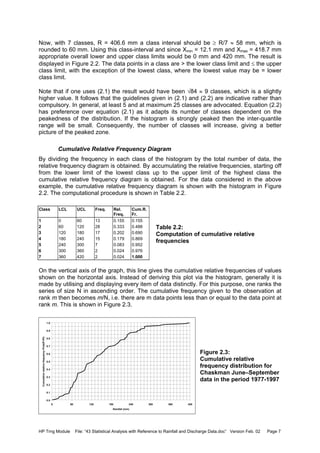
On the vertical axis of the graph, this line gives the cumulative relative frequencies of values
shown on the horizontal axis. Instead of deriving this plot via the histogram, generally it is
made by utilising and displaying every item of data distinctly. For this purpose, one ranks the
series of size N in ascending order. The cumulative frequency given to the observation at
rank m then becomes m/N, i.e. there are m data points less than or equal to the data point at
rank m. This is shown in Figure 2.3.
Figure 2.3:
Cumulative relative
frequency distribution for
Chaskman June–September
data in the period 1977-1997
0.0
0.1
0.2
0.3
0.4
0.5
0.6
0.7
0.8
0.9
1.0
0 60 120 180 240 300 360 420
Rainfall (mm)
CumulativerelativefrequencyProb(P<Pi)
Table 2.2:
Computation of cumulative relative
frequencies
HP Trng Module File: “43 Statistical Analysis with Reference to Rainfall and Discharge Data.doc” Version Feb. 02 Page 8
In Figure 2.3 the highest ranked data point (m = N) gets a cumulative relative frequency of
m/N = N/N = 1. To describe the distribution of the data in that particular sample series this
statement is correct. No observation exceeded the maximum value. However, in statistics
one wants to say something about the distribution of data in the population of which the N
observations are just one of many possible samples series. The cumulative relative
frequency (crf) is then replaced by the non-exceedance probability. A non-exceedance
probability of 1 for the maximum observed in the sample series would then imply that all
possible outcomes would be less than or equal to that maximum. Unless there is a physical
limit to the data such a statement is not justified. The non-exceedance probability of the
maximum in the sample series will be less than 1. The non-exceedance probability to be
given to the data point with rank m can be determined by viewing the series of ranked
observations as order statistics: X(1), X(2), X(3), …,,X(m),…X(N). The expected value of
order statistic X(m) depends first of all on the rank of X(m) relative to X(N). Furthermore is
the expected value of X(m) a function of the probability distribution of the process from which
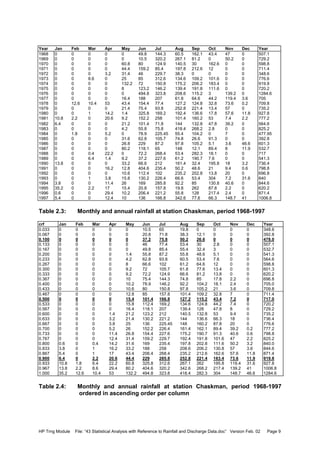
the sample points are drawn. This will be discussed in more detail in Section 4.
Frequency Curves
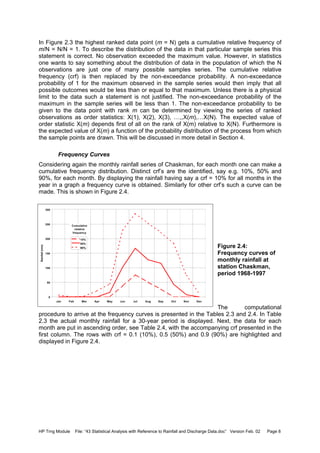
Considering again the monthly rainfall series of Chaskman, for each month one can make a
cumulative frequency distribution. Distinct crf’s are the identified, say e.g. 10%, 50% and
90%, for each month. By displaying the rainfall having say a crf = 10% for all months in the
year in a graph a frequency curve is obtained. Similarly for other crf’s such a curve can be
made. This is shown in Figure 2.4.
Figure 2.4:
Frequency curves of
monthly rainfall at
station Chaskman,
period 1968-1997
The computational
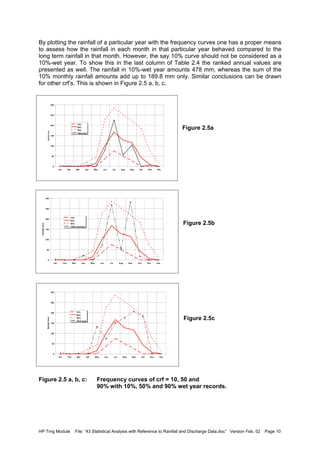
procedure to arrive at the frequency curves is presented in the Tables 2.3 and 2.4. In Table
2.3 the actual monthly rainfall for a 30-year period is displayed. Next, the data for each
month are put in ascending order, see Table 2.4, with the accompanying crf presented in the
first column. The rows with crf = 0.1 (10%), 0.5 (50%) and 0.9 (90%) are highlighted and
displayed in Figure 2.4.
0
50
100
150
200
250
300
Jan Feb Mar Apr May Jun Jul Aug Sep Oct Nov Dec
Rainfall(mm)
10%
50%
90%
Cumulative
relative
frequency
HP Trng Module File: “43 Statistical Analysis with Reference to Rainfall and Discharge Data.doc” Version Feb. 02 Page 9
Year Jan Feb Mar Apr May Jun Jul Aug Sep Oct Nov Dec Year
1968 0 0 0 0 0 49.8 144.3 60.5 162.1 43.4 47 0 507.1
1969 0 0 0 0 0 10.5 320.2 267.1 81.2 0 50.2 0 729.2
1970 0 0 0 0 60.8 80 124.9 140.5 30 162.6 0 0 598.8
1971 0 0 0 0 44.4 159.2 85.4 197.8 212.6 12 0 0 711.4
1972 0 0 0 3.2 31.4 46 229.7 38.3 0 0 0 0 348.6
1973 0 0 8.6 0 25 85 312.6 134.6 109.2 101.6 0 0 776.6
1974 0 0 0 0 132.2 72 150.8 175.2 206.2 183.4 0 0 919.8
1975 0 0 0 0 8 123.2 146.2 139.4 191.8 111.6 0 0 720.2
1976 0 0 0 0 0 494.8 323.8 208.6 115.2 3 139.2 0 1284.6
1977 0 0 0 0 16.4 188 207 61.8 64.6 44.2 119.4 3.6 705
1978 0 12.6 10.4 53 43.4 154.4 77.4 127.2 124.8 32.8 73.6 0.2 709.8
1979 0 0 0 0 21.4 75.4 93.8 252.8 221.4 13.4 57 0 735.2
1980 0 0 1 14.2 1.4 325.8 169.2 192.4 136.6 17.8 57.6 11.8 927.8
1981 10.8 2.2 0 20.6 9.2 152.2 258 101.4 160.2 53 7.4 2.2 777.2
1982 6.4 0 0 0 21.2 101.4 71.8 144 132.8 47.8 39.2 0 564.6
1983 0 0 0 0 4.2 55.8 75.8 418.4 268.2 2.8 0 0 825.2
1984 0 1.8 0 5.2 0 78.9 225.45 55.4 104.2 0 7 0 477.95
1985 0 0 0 0 31.6 62.8 105.7 74.8 26.6 91.3 0 0 392.8
1986 0 0 0 0 26.8 229 87.2 97.8 105.2 5.1 3.6 46.6 601.3
1987 0 0 0 0 80.2 118.1 65 148 12.1 89.4 8 11.9 532.7
1988 0 0 0.4 22.2 0 72.2 268.4 53.4 282.3 18.1 0 0 717
1989 0 0 6.4 1.4 9.2 37.2 227.6 61.2 190.7 7.6 0 0 541.3
1990 13.8 0 0 0 33.2 66.6 212 161.4 32.4 195.8 18 3.2 736.4
1991 0 0 0 16.2 12.8 404.6 235.4 50.2 48.6 21 9.4 0.6 798.8
1992 0 0 0 0 10.6 112.4 102 235.2 202.8 13.8 20 0 696.8
1993 0 0 1 3.8 15.8 130.2 226.4 66.6 53.4 304 7.2 31.6 840
1994 3.8 0 0 11.4 26 169 285.8 92.2 85 130.8 40.6 0 844.6
1995 35.2 0 2.2 17 15.4 20.8 157.8 19.8 262 87.8 2.2 0 620.2
1996 0.6 0 0 29.4 10.2 206.4 221.2 55.8 128 217.4 2.4 0 871.4
1997 5.4 0 0 12.4 10 136 166.8 342.6 77.6 66.3 148.7 41 1006.8
Table 2.3: Monthly and annual rainfall at station Chaskman, period 1968-1997
crf Jan Feb Mar Apr May Jun Jul Aug Sep Oct Nov Dec Year
0.033 0 0 0 0 0 10.5 65 19.8 0 0 0 0 348.6
0.067 0 0 0 0 0 20.8 71.8 38.3 12.1 0 0 0 392.8
0.100 0 0 0 0 0 37.2 75.8 50.2 26.6 0 0 0 478.0
0.133 0 0 0 0 0 46 77.4 53.4 30 2.8 0 0 507.1
0.167 0 0 0 0 0 49.8 85.4 55.4 32.4 3 0 0 532.7
0.200 0 0 0 0 1.4 55.8 87.2 55.8 48.6 5.1 0 0 541.3
0.233 0 0 0 0 4.2 62.8 93.8 60.5 53.4 7.6 0 0 564.6
0.267 0 0 0 0 8 66.6 102 61.2 64.6 12 0 0 598.8
0.300 0 0 0 0 9.2 72 105.7 61.8 77.6 13.4 0 0 601.3
0.333 0 0 0 0 9.2 72.2 124.9 66.6 81.2 13.8 0 0 620.2
0.367 0 0 0 0 10 75.4 144.3 74.8 85 17.8 2.2 0 696.8
0.400 0 0 0 0 10.2 78.9 146.2 92.2 104.2 18.1 2.4 0 705.0
0.433 0 0 0 0 10.6 80 150.8 97.8 105.2 21 3.6 0 709.8
0.467 0 0 0 0 12.8 85 157.8 101.4 109.2 32.8 7 0 711.4
0.500 0 0 0 0 15.4 101.4 166.8 127.2 115.2 43.4 7.2 0 717.0
0.533 0 0 0 0 15.8 112.4 169.2 134.6 124.8 44.2 7.4 0 720.2
0.567 0 0 0 0 16.4 118.1 207 139.4 128 47.8 8 0 729.2
0.600 0 0 0 1.4 21.2 123.2 212 140.5 132.8 53 9.4 0 735.2
0.633 0 0 0 3.2 21.4 130.2 221.2 144 136.6 66.3 18 0 736.4
0.667 0 0 0 3.8 25 136 225.45 148 160.2 87.8 20 0 776.6
0.700 0 0 0 5.2 26 152.2 226.4 161.4 162.1 89.4 39.2 0.2 777.2
0.733 0 0 0 11.4 26.8 154.4 227.6 175.2 190.7 91.3 40.6 0.6 798.8
0.767 0 0 0 12.4 31.4 159.2 229.7 192.4 191.8 101.6 47 2.2 825.2
0.800 0.6 0 0.4 14.2 31.6 169 235.4 197.8 202.8 111.6 50.2 3.2 840.0
0.833 3.8 0 1 16.2 33.2 188 258 208.6 206.2 130.8 57 3.6 844.6
0.867 5.4 0 1 17 43.4 206.4 268.4 235.2 212.6 162.6 57.6 11.8 871.4
0.900 6.4 0 2.2 20.6 44.4 229 285.8 252.8 221.4 183.4 73.6 11.9 919.8
0.933 10.8 1.8 6.4 22.2 60.8 325.8 312.6 267.1 262 195.8 119.4 31.6 927.8
0.967 13.8 2.2 8.6 29.4 80.2 404.6 320.2 342.6 268.2 217.4 139.2 41 1006.8
1.000 35.2 12.6 10.4 53 132.2 494.8 323.8 418.4 282.3 304 148.7 46.6 1284.6
Table 2.4: Monthly and annual rainfall at station Chaskman, period 1968-1997
ordered in ascending order per column
HP Trng Module File: “43 Statistical Analysis with Reference to Rainfall and Discharge Data.doc” Version Feb. 02 Page 10
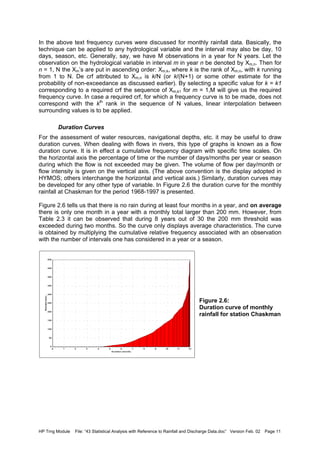
By plotting the rainfall of a particular year with the frequency curves one has a proper means
to assess how the rainfall in each month in that particular year behaved compared to the
long term rainfall in that month. However, the say 10% curve should not be considered as a
10%-wet year. To show this in the last column of Table 2.4 the ranked annual values are
presented as well. The rainfall in 10%-wet year amounts 478 mm, whereas the sum of the
10% monthly rainfall amounts add up to 189.8 mm only. Similar conclusions can be drawn
for other crf’s. This is shown in Figure 2.5 a, b, c.
Figure 2.5a
Figure 2.5b
Figure 2.5c
Figure 2.5 a, b, c: Frequency curves of crf = 10, 50 and
90% with 10%, 50% and 90% wet year records.
0
50
100
150
200
250
300
Jan Feb Mar Apr May Jun Jul Aug Sep Oct Nov Dec
Rainfall(mm)
10%
50%
90%
1984 (dry)
0
50
100
150
200
250
300
Jan Feb Mar Apr May Jun Jul Aug Sep Oct Nov Dec
Rainfall(mm)
10%
50%
90%
1988 (medium)
0
50
100
150
200
250
300
Jan Feb Mar Apr May Jun Jul Aug Sep Oct Nov Dec
Rainfall(mm)
10%
50%
90%
1974 (wet)
HP Trng Module File: “43 Statistical Analysis with Reference to Rainfall and Discharge Data.doc” Version Feb. 02 Page 11
In the above text frequency curves were discussed for monthly rainfall data. Basically, the
technique can be applied to any hydrological variable and the interval may also be day, 10
days, season, etc. Generally, say, we have M observations in a year for N years. Let the
observation on the hydrological variable in interval m in year n be denoted by Xm,n. Then for
n = 1, N the Xm’s are put in ascending order: Xm,k, where k is the rank of Xm,n, with k running
from 1 to N. De crf attributed to Xm,n is k/N (or k/(N+1) or some other estimate for the
probability of non-exceedance as discussed earlier). By selecting a specific value for k = k1
corresponding to a required crf the sequence of Xm,k1 for m = 1,M will give us the required
frequency curve. In case a required crf, for which a frequency curve is to be made, does not
correspond with the kth
rank in the sequence of N values, linear interpolation between
surrounding values is to be applied.
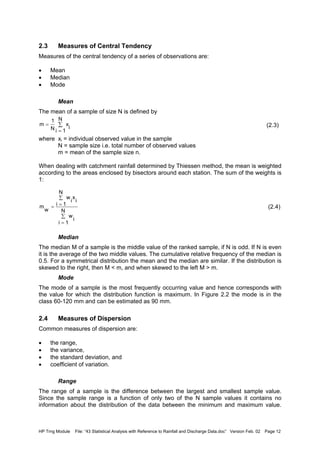
Duration Curves
For the assessment of water resources, navigational depths, etc. it may be useful to draw
duration curves. When dealing with flows in rivers, this type of graphs is known as a flow
duration curve. It is in effect a cumulative frequency diagram with specific time scales. On
the horizontal axis the percentage of time or the number of days/months per year or season
during which the flow is not exceeded may be given. The volume of flow per day/month or
flow intensity is given on the vertical axis. (The above convention is the display adopted in
HYMOS; others interchange the horizontal and vertical axis.) Similarly, duration curves may
be developed for any other type of variable. In Figure 2.6 the duration curve for the monthly
rainfall at Chaskman for the period 1968-1997 is presented.
Figure 2.6 tells us that there is no rain during at least four months in a year, and on average
there is only one month in a year with a monthly total larger than 200 mm. However, from
Table 2.3 it can be observed that during 8 years out of 30 the 200 mm threshold was
exceeded during two months. So the curve only displays average characteristics. The curve
is obtained by multiplying the cumulative relative frequency associated with an observation
with the number of intervals one has considered in a year or a season.
Figure 2.6:
Duration curve of monthly
rainfall for station Chaskman
D uration (month)
1211109876543210
Rainfall(mm)
500
450
400
350
300
250
200
150
100
50
0
HP Trng Module File: “43 Statistical Analysis with Reference to Rainfall and Discharge Data.doc” Version Feb. 02 Page 12
2.3 Measures of Central Tendency
Measures of the central tendency of a series of observations are:
• Mean
• Median
• Mode
Mean
The mean of a sample of size N is defined by
(2.3)
where xi = individual observed value in the sample
N = sample size i.e. total number of observed values
m = mean of the sample size n.
When dealing with catchment rainfall determined by Thiessen method, the mean is weighted
according to the areas enclosed by bisectors around each station. The sum of the weights is
1:
(2.4)
Median
The median M of a sample is the middle value of the ranked sample, if N is odd. If N is even
it is the average of the two middle values. The cumulative relative frequency of the median is
0.5. For a symmetrical distribution the mean and the median are similar. If the distribution is
skewed to the right, then M < m, and when skewed to the left M > m.
Mode
The mode of a sample is the most frequently occurring value and hence corresponds with
the value for which the distribution function is maximum. In Figure 2.2 the mode is in the
class 60-120 mm and can be estimated as 90 mm.
2.4 Measures of Dispersion
Common measures of dispersion are:
• the range,
• the variance,
• the standard deviation, and
• coefficient of variation.
Range
The range of a sample is the difference between the largest and smallest sample value.
Since the sample range is a function of only two of the N sample values it contains no
information about the distribution of the data between the minimum and maximum value.
∑
=
=
N
1i
i
x
N
1
m
∑
=
∑
==
N
1i
i
w
N
1i
i
x
i
w
w
m
HP Trng Module File: “43 Statistical Analysis with Reference to Rainfall and Discharge Data.doc” Version Feb. 02 Page 13
The population range of a hydrological variable is in many cases, the interval from 0 to ∞,
and as such displays no information about the process.
In hydrology the word ‘range’ is also used to quantify the range of accumulative departures
from the mean (also indicated as partial sums). That value has important implications when
dealing with water storage. It is a measure for the required storage when the average flow is
to be drawn from a reservoir.
Variance
The most common measure of dispersion used in statistical analysis is the variance,
estimated by s2
:
. (2.5)
The reason for using the divisor N-1 instead of N is that it will result in an unbiased estimate
for the variance. The units of the variance are the same as the units of x2
.
Standard deviation
The standard deviation s is the root of the variance and provides as such a measure for the
dispersion of the data in the sample set in the same dimension as the sample data. It is
estimated by:
(2.6)
Coefficient of Variation
A dimensionless measure of dispersion is the coefficient of variation Cv defined as the
standard deviation divided by the mean:
(2.7)
Note that when m = 0 the coefficient of variation Cv becomes undefined; hence for
normalised distributions this measure cannot be applied.
From Figure 1.3 it is observed that the coefficient of variation of the monthly rainfall at
Chaskman is > 1 for the dry period, but < 1 during the monsoon.
2.5 Measure of Symmetry: Skewness
Distributions of hydrological variables are often skewed, i.e. non-symmetrical. The
distributions are generally skewed to the right, like daily rainfall. By aggregation of data, the
distribution of the aggregate will approach normality, i.e. will become symmetrical. Positively
and negatively skewed distributions and symmetrical distributions are shown in Figure 2.7.
∑
=
−
−
=
N
1i
2
i
2
m)(x
1N
1
s
s =
1
N-1
(x m)i
2
i 1
N
−
=
∑
m
s
Cv =
HP Trng Module File: “43 Statistical Analysis with Reference to Rainfall and Discharge Data.doc” Version Feb. 02 Page 14
Figure 2.7:
Examples of symmetrical and positively
and negatively skewed distributions, with
locations of mean, median and mode
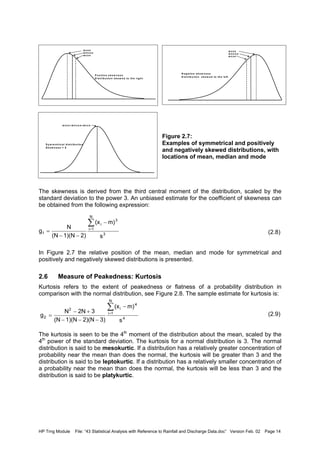
The skewness is derived from the third central moment of the distribution, scaled by the
standard deviation to the power 3. An unbiased estimate for the coefficient of skewness can
be obtained from the following expression:
(2.8)
In Figure 2.7 the relative position of the mean, median and mode for symmetrical and
positively and negatively skewed distributions is presented.
2.6 Measure of Peakedness: Kurtosis
Kurtosis refers to the extent of peakedness or flatness of a probability distribution in
comparison with the normal distribution, see Figure 2.8. The sample estimate for kurtosis is:
(2.9)
The kurtosis is seen to be the 4th
moment of the distribution about the mean, scaled by the
4th
power of the standard deviation. The kurtosis for a normal distribution is 3. The normal
distribution is said to be mesokurtic. If a distribution has a relatively greater concentration of
probability near the mean than does the normal, the kurtosis will be greater than 3 and the
distribution is said to be leptokurtic. If a distribution has a relatively smaller concentration of
a probability near the mean than does the normal, the kurtosis will be less than 3 and the
distribution is said to be platykurtic.
P o s itiv e s k e w n e s s
D is trib u tio n s k e w e d to th e rig h t
M O D E
M E D IA N
M E A N
M O D E
M E D IA N
M E A N
N e g a tiv e s k e w n e s s
D is trib u tio n s k e w e d to th e le ft
S y m m e tric a l d is trib u tio n
S k e w n e s s = 0
M O D E = M E D IA N = M E A N
3
N
1i
3
i
1
s
m)(x
2)1)(N(N
N
g
∑
=
−
−−
=
4
N
1i
4
i2
2
s
m)(x
3)2)(N1)(N(N
32NN
g
∑
=
−
−−−
+−
=
HP Trng Module File: “43 Statistical Analysis with Reference to Rainfall and Discharge Data.doc” Version Feb. 02 Page 15
Figure 2.8:
Illustration of Kurtosis
The coefficient of excess e is defined as g2 – 3. Therefore for a normal distribution e is 0,
for a leptokurtic distribution e is positive and for a platykurtic distribution e is negative.
2.7 Quantiles, percentile, deciles and quartiles
The cumulative relative frequency axis of the cumulative relative frequency curve running
from 0 to 1 or from 0 to 100% can be split into equal parts. Generally, if the division is in n
equal parts, one will generate (n-1) quantiles. The pth quantile, xp, is the value that is larger
than 100p% of all data. When n = 100, i.e. the division is done in 100 equal parts (percents),
then the value of the hydrological variable read from the x-axis corresponding with a crf of
p% is called the pth
percentile. If the frequency axis is divided into 10 equal parts then the
corresponding value on the x-axis is called a decile. Thus the 10th
percentile (also called the
first decile) would mean that 10% of the observed values are less than or equal to the
percentile. Conversely, the 90th
percentile (or 9th
decile) would mean that 90% of the
observed values are lying below that or 10% of the observed values are lying above that.
The median would be the 50th
percentile (or fifth decile). Similarly, if the frequency axis is
divided in 4 equal parts then one speaks of quartiles. The first quartile corresponds with the
25th
percentile, i.e. 25% of the values are less or equal than the first quartile; the second
quartile is equal to the median and the third quartile equals the 75th
percentile.
2.8 Box plot and box and whiskers plot
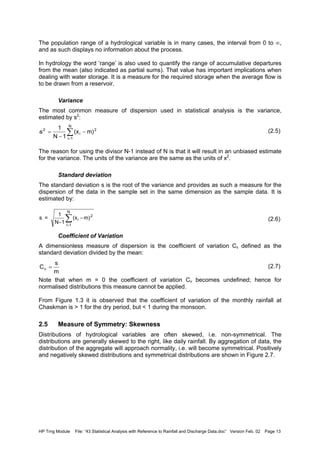
A box plot displays the three quartiles of a distribution in the form of a box, see Figure 2.9.
If in addition also the minimum and the maximum values are displayed by bars extending
the box on either side, the plot is called a box and whiskers plot. Sometimes also the mean
is indicated in the plot. Hence the plot is a 5 or 6 points summary of the actual frequency
distribution. Such plots are made for the data in a season or a year or any other selected
time interval.
Leptokurtic g2>3
Normal g2=3
Platykurtic g2<3
HP Trng Module File: “43 Statistical Analysis with Reference to Rainfall and Discharge Data.doc” Version Feb. 02 Page 16
Figure 2.9:
Features of a box and
whiskers plot
By displaying the box and bars for successive years a quick insight is provided into the
variation of the process from year to year. This form is very popular for displaying the
behaviour of water quality variables. For that purpose the plot is extended with threshold
values on a particular water quality variable.
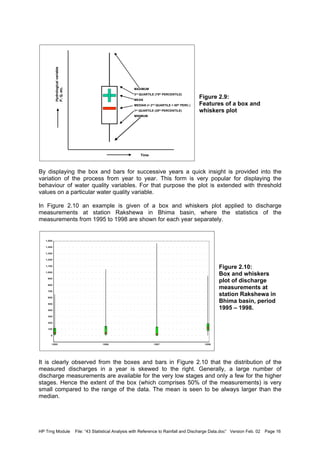
In Figure 2.10 an example is given of a box and whiskers plot applied to discharge
measurements at station Rakshewa in Bhima basin, where the statistics of the
measurements from 1995 to 1998 are shown for each year separately.
Figure 2.10:
Box and whiskers
plot of discharge
measurements at
station Rakshewa in
Bhima basin, period
1995 – 1998.
It is clearly observed from the boxes and bars in Figure 2.10 that the distribution of the
measured discharges in a year is skewed to the right. Generally, a large number of
discharge measurements are available for the very low stages and only a few for the higher
stages. Hence the extent of the box (which comprises 50% of the measurements) is very
small compared to the range of the data. The mean is seen to be always larger than the
median.
1998199719961995
1,500
1,400
1,300
1,200
1,100
1,000
900
800
700
600
500
400
300
200
100
0
Hydrologicalvariable
P,Q,etc.
Time
MAXIMUM
3rd QUARTILE (75th PERCENTILE)
MEAN
MEDIAN (= 2nd QUARTILE = 50th PERC.)
1st QUARTILE (25th PERCENTILE)
MINIMUM
HP Trng Module File: “43 Statistical Analysis with Reference to Rainfall and Discharge Data.doc” Version Feb. 02 Page 17
2.9 Covariance and Correlation Coefficient
When simultaneous observations on hydrological variables are available then one may be
interested in the linear association between the variables. This is expressed by the
covariance and correlation coefficient.
If there are N pairs of observations (x1, y1), (x2, y2), …, (xN, yN), of two variables X and Y, the
sample covariance is obtained from the following expression:
(2.10)
where: mX, mY = sample means of X and Y respectively:
The correlation coefficient rXY is obtained by scaling the covariance by the standard
deviations of X and Y:
(2.11)
where: sX , sY = sample standard deviations of X and Y.
To get the limits of rXY consider the case that X and Y have a perfect linear correlation. Then
the relationship between X and Y is given by :
Y = a + bX
and hence:
mY = a + bmX and: sY
2
= b2
sX
2
or: sY = |b|sX
Substituting above relations in (2.11) gives:
(2.12)
If Y increases for increasing X, i.e. they are positively correlated, then b > 0 and rXY is seen
to be 1. If on the other hand Y decreases when X is increasing, they are negatively
correlated; then b < 0 and rXY is –1. So rXY is seen to vary between ±1:
–1 ≤ rXY ≤ 1.
If there is no linear association between X and Y then rXY is 0. If rXY is 0 it does not mean that
X and Y are independent or that there is no association between X and Y. It only means that
the linear association is not existing. Still, there may be for example a circular association.
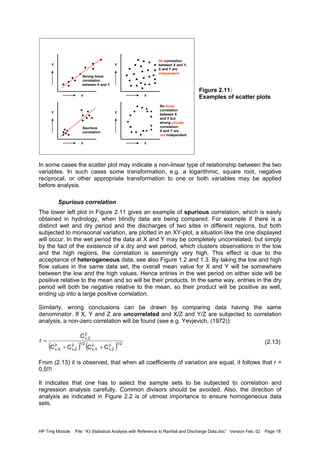
A convenient means to investigate the existence of linear association is by making a XY-
scatter plot of the samples. Typical examples of scatter plots are shown in Figure 2.11.
∑
=
−−
−
=
N
1i
YiXiXY )m)(ym(x
1N
1
Cˆ
YX
YiX
N
1i
i
YX
XY
XY
ss
)m)(ym(x
1N
1
ss
Cˆ
r
−−
−
==
∑
=
b
b
s
)m(x
1N
1
b
b
sbs
))bm(abx)(am(x
1N
1
r 2
X
2
Xi
XX
XiXi
XY =
−
−
=
+−+−
−
=
∑∑
HP Trng Module File: “43 Statistical Analysis with Reference to Rainfall and Discharge Data.doc” Version Feb. 02 Page 18
Figure 2.11:
Examples of scatter plots
In some cases the scatter plot may indicate a non-linear type of relationship between the two
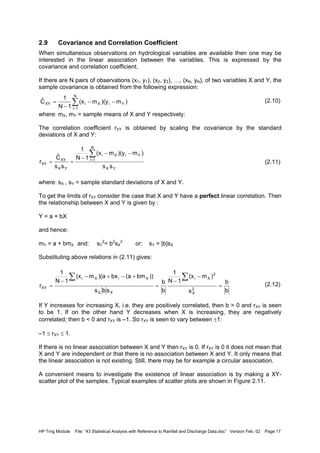
variables. In such cases some transformation, e.g. a logarithmic, square root, negative
reciprocal, or other appropriate transformation to one or both variables may be applied
before analysis.
Spurious correlation
The lower left plot in Figure 2.11 gives an example of spurious correlation, which is easily
obtained in hydrology, when blindly data are being compared. For example if there is a
distinct wet and dry period and the discharges of two sites in different regions, but both
subjected to monsoonal variation, are plotted in an XY-plot, a situation like the one displayed
will occur. In the wet period the data at X and Y may be completely uncorrelated, but simply
by the fact of the existence of a dry and wet period, which clusters observations in the low
and the high regions, the correlation is seemingly very high. This effect is due to the
acceptance of heterogeneous data, see also Figure 1.2 and 1.3. By taking the low and high
flow values in the same data set, the overall mean value for X and Y will be somewhere
between the low and the high values. Hence entries in the wet period on either side will be
positive relative to the mean and so will be their products. In the same way, entries in the dry
period will both be negative relative to the mean, so their product will be positive as well,
ending up into a large positive correlation.
Similarly, wrong conclusions can be drawn by comparing data having the same
denominator. If X, Y and Z are uncorrelated and X/Z and Y/Z are subjected to correlation
analysis, a non-zero correlation will be found (see e.g. Yevjevich, (1972)):
(2.13)
From (2.13) it is observed, that when all coefficients of variation are equal, it follows that r =
0.5!!!
It indicates that one has to select the sample sets to be subjected to correlation and
regression analysis carefully. Common divisors should be avoided. Also, the direction of
analysis as indicated in Figure 2.2 is of utmost importance to ensure homogeneous data
sets.
Y
X
Y
X
Y
X
Y
X
Strong linear
correlation
between X and Y
No correlation
between X and Y;
X and Y are
independent
No linear
correlation
between X
and Y but
strong circular
correlation:
X and Y are
not independent
Spurious
correlation
( ) ( )1/22
v,Z
2
Yv,
1/22
v,Z
2
Xv,
2
v,Z
CCCC
C
r
++
=
HP Trng Module File: “43 Statistical Analysis with Reference to Rainfall and Discharge Data.doc” Version Feb. 02 Page 19
3 Fundamental Concepts of Probability
3.1 3.1 Axioms and Theorems
Sample and Space Events
The sample space denoted by Ω, is defined here as the collection of all possible outcomes
of sampling on a hydrological variable.
An event is a collection of sample points in the sample space Ω of an experiment. An event
can consists of a single sample point called a simple or elementary event, or it can be made
up of two or more sample points known as a compound event. An event is (denoted by a
capital letter A (or any other letter)) is thus a subset of sample space Ω.
The Null Event, Intersection and Union
Two events A1 and A2 are mutually exclusive or disjoint if the occurrence of A1 excludes
A2, i.e. none of the points contained in A1 is contained in A2. and vice versa.
The intersection of the events A1 and A2 is that part of the sample space they have in
common. This is denoted by A1∩A2 or A1A2.
If A1 and A2 are mutually exclusive then their intersection constitutes a null event: A1∩A2 =
A1A2 = ∅.
The union of two events A1 and A2 represents their joint occurrences, and it comprises the
event containing the entire sample in A1 and A2. This is denoted by A1∪A2, or simply A1+ A2.
With the latter notation one has to be careful as the sum of the two has to be corrected for
the space in common (i.e. the intersection.
The intersection is equivalent to the “and” logical statement, whereas the union equivalent to
“and/or”.
The above definitions have been visualised in Figure 3.1 by means of Venn diagrams.
Figure 3.1:
Definition sketch by Venn
diagrams
The definitions are illustrated in the following example:
Ω
ΩΩ
Ω
A1 A
A1
A1
A2
A2
A2
B
A1 and A2
mutually
exclusive
intersection
A1
∩A2
A1
∪A2
A∩B
Union
Conditional
probability
HP Trng Module File: “43 Statistical Analysis with Reference to Rainfall and Discharge Data.doc” Version Feb. 02 Page 20
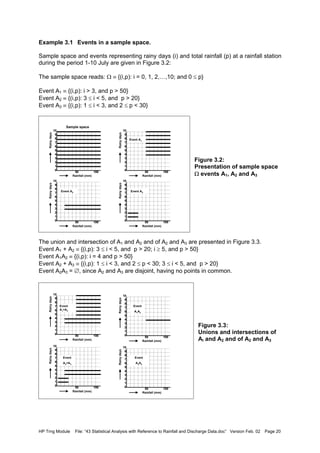
Example 3.1 Events in a sample space.
Sample space and events representing rainy days (i) and total rainfall (p) at a rainfall station
during the period 1-10 July are given in Figure 3.2:
The sample space reads: Ω ≡ {(i,p): i = 0, 1, 2,…,10; and 0 ≤ p}
Event A1 ≡ {(i,p): i > 3, and p > 50}
Event A2 ≡ {(i,p): 3 ≤ i < 5, and p > 20}
Event A3 ≡ {(i,p): 1 ≤ i < 3, and 2 ≤ p < 30}
Figure 3.2:
Presentation of sample space
Ω events A1, A2 and A3
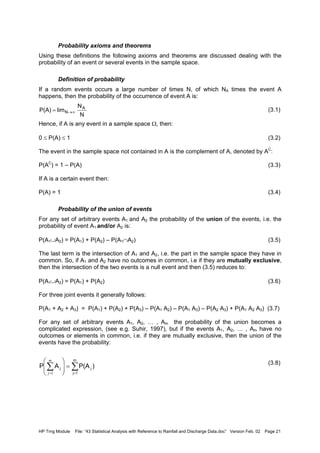
The union and intersection of A1 and A2 and of A2 and A3 are presented in Figure 3.3.
Event A1 + A2 ≡ {(i,p): 3 ≤ i < 5, and p > 20; i ≥ 5, and p > 50}
Event A1A2 ≡ {(i,p): i = 4 and p > 50}
Event A2 + A3 ≡ {(i,p): 1 ≤ i < 3, and 2 ≤ p < 30; 3 ≤ i < 5, and p > 20}
Event A2A3 = ∅, since A2 and A3 are disjoint, having no points in common.
Figure 3.3:
Unions and intersections of
AI and A2 and of A2 and A3
Rainydays
10
9
8
7
6
5
4
3
2
1
0
50 100
Rainfall (mm)
10
9
8
7
6
5
4
3
2
1
0
50 100
Rainydays
10
9
8
7
6
5
4
3
2
1
0
50 100
Rainfall (mm)
10
9
8
7
6
5
4
3
2
1
0
50 100
Rainydays
10
9
8
7
6
5
4
3
2
1
0
50 100
Rainfall (mm)
10
9
8
7
6
5
4
3
2
1
0
50 100
Rainydays
10
9
8
7
6
5
4
3
2
1
0
50 100
Rainfall (mm)
10
9
8
7
6
5
4
3
2
1
0
50 100
Sample space
Event A1
Event A2 Event A3
Rainydays
10
9
8
7
6
5
4
3
2
1
0
50 100
Rainfall (mm)
10
9
8
7
6
5
4
3
2
1
0
50 100
Rainydays
10
9
8
7
6
5
4
3
2
1
0
50 100
Rainfall (mm)
10
9
8
7
6
5
4
3
2
1
0
50 100
Rainydays
10
9
8
7
6
5
4
3
2
1
0
50 100
Rainfall (mm)
10
9
8
7
6
5
4
3
2
1
0
50 100
Event
A1+A2
Event
A2A3
Rainydays
10
9
8
7
6
5
4
3
2
1
0
50 100
Rainfall (mm)
10
9
8
7
6
5
4
3
2
1
0
50 100
Event
A1A2
Event
A2+A3
HP Trng Module File: “43 Statistical Analysis with Reference to Rainfall and Discharge Data.doc” Version Feb. 02 Page 21
Probability axioms and theorems
Using these definitions the following axioms and theorems are discussed dealing with the
probability of an event or several events in the sample space.
Definition of probability
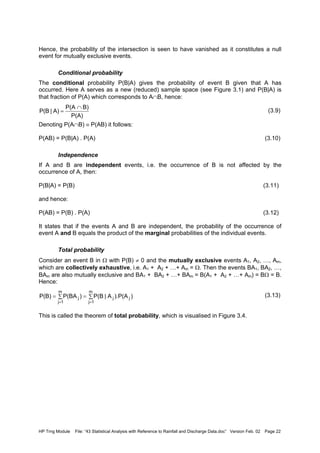
If a random events occurs a large number of times N, of which NA times the event A
happens, then the probability of the occurrence of event A is:
(3.1)
Hence, if A is any event in a sample space Ω, then:
0 ≤ P(A) ≤ 1 (3.2)
The event in the sample space not contained in A is the complement of A, denoted by AC
:
P(AC
) = 1 – P(A) (3.3)
If A is a certain event then:
P(A) = 1 (3.4)
Probability of the union of events
For any set of arbitrary events A1 and A2 the probability of the union of the events, i.e. the
probability of event A1 and/or A2 is:
P(A1∪A2) = P(A1) + P(A2) – P(A1∩A2) (3.5)
The last term is the intersection of A1 and A2, i.e. the part in the sample space they have in
common. So, if A1 and A2 have no outcomes in common, i.e if they are mutually exclusive,
then the intersection of the two events is a null event and then (3.5) reduces to:
P(A1∪A2) = P(A1) + P(A2) (3.6)
For three joint events it generally follows:
P(A1 + A2 + A3) = P(A1) + P(A2) + P(A3) – P(A1 A2) – P(A1 A3) – P(A2 A3) + P(A1 A2 A3) (3.7)
For any set of arbitrary events A1, A2, … , Am the probability of the union becomes a
complicated expression, (see e.g. Suhir, 1997), but if the events A1, A2, … , Am have no
outcomes or elements in common, i.e. if they are mutually exclusive, then the union of the
events have the probability:
(3.8)
N
N
limP(A) A
N ∞→=
∑∑ ==
=






 m
1j
jj )P(AAP
m
j 1
HP Trng Module File: “43 Statistical Analysis with Reference to Rainfall and Discharge Data.doc” Version Feb. 02 Page 22
Hence, the probability of the intersection is seen to have vanished as it constitutes a null
event for mutually exclusive events.
Conditional probability
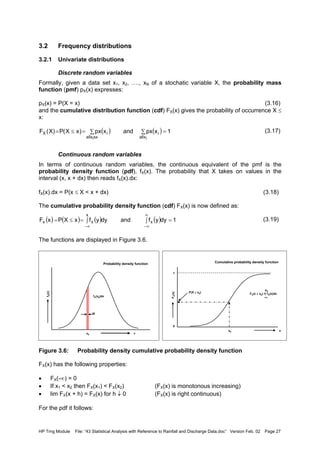
The conditional probability P(B|A) gives the probability of event B given that A has
occurred. Here A serves as a new (reduced) sample space (see Figure 3.1) and P(B|A) is
that fraction of P(A) which corresponds to A∩B, hence:
(3.9)
Denoting P(A∩B) ≡ P(AB) it follows:
P(AB) = P(B|A) . P(A) (3.10)
Independence
If A and B are independent events, i.e. the occurrence of B is not affected by the
occurrence of A, then:
P(B|A) = P(B) (3.11)
and hence:
P(AB) = P(B) . P(A) (3.12)
It states that if the events A and B are independent, the probability of the occurrence of
event A and B equals the product of the marginal probabilities of the individual events.
Total probability
Consider an event B in Ω with P(B) ≠ 0 and the mutually exclusive events A1, A2, …, Am,
which are collectively exhaustive, i.e. A1 + A2 + …+ Am = Ω. Then the events BA1, BA2, …,
BAm are also mutually exclusive and BA1 + BA2 + …+ BAm = B(A1 + A2 + …+ Am) = BΩ = B.
Hence:
(3.13)
This is called the theorem of total probability, which is visualised in Figure 3.4.
P(A)
B)P(A
A)|P(B
∩
=
∑=∑=
==
m
1j
jj
m
1j
j )).P(AA|P(B)P(BAP(B)
HP Trng Module File: “43 Statistical Analysis with Reference to Rainfall and Discharge Data.doc” Version Feb. 02 Page 23
Figure 3.4:
Concept of total probability
Bayes theorem
Observe now the following conditional probability:
The numerator reads according to (3.10) P(BAi) = P(B|Ai) . P(Ai). The denominator is given
by (3.13). It then follows for P(Ai|B), Bayes rule:
(3.14)
Bayes rule provides a method to update the probabilities about the true state of a system
(A), by sampling (B) in stages. The probabilities P(Ai)’s on the right hand side of (3.14) are
the probabilities about the state of the system before the sample is taken (prior
probabilities). After each sampling the prior probabilities P(Ai)’s are updated, by replacing
them with the posterior probability (= left hand side of the equation), found through the
outcome of the sampling: B. The conditional probabilities P(B|Aj) represent basically the
quality of the sampling method or equipment: the probability of getting a particular sample B
given that the true state of the system is Ai. Bayes rule can therefore be interpreted as
follows:
(3.15)
To illustrate the above axioms and theorems the following examples are given.
Example 3.2 Annual monthly maximum rainfall
The annual monthly maximum rainfall for station Chaskman is presented in Table 3.2 and
Figure 3.5.
B
Am
A5
A4
A3A2
A1
AjA6
P(B)
)P(BA
B)|P(A i
i =
∑
=
=
m
1j
)j).P(AjA|P(B
)i).P(AiA|P(B
B)|iP(A
∑
=
statesall prior
prior
posterior
)tatestate).P(s|P(sample
sample)|P(state
HP Trng Module File: “43 Statistical Analysis with Reference to Rainfall and Discharge Data.doc” Version Feb. 02 Page 24
Year Pmax (mm) Year Pmax (mm) Year Pmax (mm)
1968 162.1 1978 154.4 1988 282.3
1969 320.2 1979 252.8 1989 227.6
1970 162.6 1980 325.8 1990 212.0
1971 212.6 1981 258.0 1991 404.6
1972 229.7 1982 144.0 1992 235.2
1973 312.6 1983 418.4 1993 304.0
1974 206.2 1984 225.5 1994 285.8
1975 191.8 1985 105.7 1995 262.0
1976 494.8 1986 229.0 1996 221.2
1977 207.0 1987 148.0 1997 342.6
Figure 3.5:
Annual monthly maximum
rainfall for Chaksman,
period 1968-1997
From the table and figure it is observed that a monthly maximum > 260 mm has occurred 11
times in a period of 30 years, hence Pmax > 260 mm = 11/30 = 0.367 in any one year.
Assuming that the elements of the annual monthly maximum series are independent, it
follows that the probability of having two annual maximum values in sequence > 260 mm =
0.367 x 0.367 = 0.135. From the series one observes that this event happened only 2 times
in 30 years, that is 2 out of 29, i.e. having a probability of 2/29 = 0.069. If event A is the
occurrence that Pmax > 260 mm and B is the event that Pmax > 260 mm in a second
successive year then: P(B|A) = P(A∩B)/P(A)=(2/29)/(11/30) = 0.19.
Example 3.3 Daily rainfall Balasinor (Gujarat)
Based on daily rainfall data of station Balasinor for the month of July in the period 1961 to
1970, the following probabilities have been determined:
Probability of a rainy day following a rainy day = 0.34
Probability of a rainy day following a dry day = 0.17
Probability of a dry day following a rainy day = 0.16
Probability of a dry day following a dry day = 0.33
Given that a particular day is dry, what is the probability the next two days are (1) dry and (2)
wet?
(1) Call event A = dry day 1 after a dry day and event B = dry day 2 after a dry day.
Hence required is P(A∩B) = P(B|A) . P(A). The probability of having a dry day after a
dry day is P(A) = 0.33 and the probability of a dry day given that the previous day
was dry P(B|A) = 0.33. So, P(A∩B) = P(B|A) . P(A) = 0.33 . 0.33 = 0.11.
0
100
200
300
400
500
600
1965 1970 1975 1980 1985 1990 1995 2000
P
ma
x
(m
m)
Table 3.1:
Annual monthly maximum
rainfall for Chaksman, period
1968-1997
HP Trng Module File: “43 Statistical Analysis with Reference to Rainfall and Discharge Data.doc” Version Feb. 02 Page 25
(2) Call event A = wet day 1 after a dry day and event B = wet day 2 after a dry day. Now
we require again P(A∩B) = P(B|A) . P(A). The probability of a wet day after a dry day
is P(A) = 0.17 and the probability of a wet day given that the previous day was also
wet = P(B|A) = 0.34. Hence, P(A∩B) = P(B|A). P(A) = 0.34 . 0.17 = 0.06. This
probability is seen to be about half the probability of having two dry days in a row
after a dry day. This is due to the fact that for Balasinor the probability of having a
wet day followed by a dry day or vice versa is about half the probability of having two
wet or two dry days sequentially.
Example 3.4 Prior and posterior probabilities, using Bayes rule
In a basin for a considerable period of time rainfall was measured using a dense network.
Based on these values for the month July the following classification is used for the basin
rainfall.
Class Rainfall (mm) Probability
Dry
Moderate
Wet
Extremely wet
P < 50
50 ≤ P < 200
200 ≤ P < 400
P ≥ 400
P[A1] = 0.15
P[A2] = 0.50
P[A3] = 0.30
P[A4] = 0.05
Table 3.2: Rainfall classes and probability.
The probabilities presented in Table 3.2 refer to prior probabilities. Furthermore, from the
historical record it has been deduced that the percentage of gauges, which gave a rainfall
amount in a certain class given that the basin rainfall felt in a certain class is given in Table
3.3.
Percentage of gaugesBasin rainfall
P < 50 50 ≤ P < 200 200 ≤ P < 400 P ≥ 400
P < 50
50 ≤ P < 200
200 ≤ P < 400
P ≥ 400
80
25
5
0
15
65
20
10
5
8
60
25
0
2
15
65
Table 3.3: Conditional probabilities for gauge value given the basin rainfall
Note that the conditional probabilities in the rows add up to 100%.
For a particular year a gauge gives a rainfall amount for July of 230 mm. Given that sample
value of 230 mm, what is the class of the basin rainfall in July for that year.
Note that the point rainfall falls in class III. The posterior probability of the actual basin
rainfall in July of that year becomes:
The denominator becomes:
The denominator expresses the probability of getting sample 1 when the prior probabilities
are as given in Table 3.2, which is of course very low.
∑
=
= 4
1i
ii
ii
i
]].P[AA|1P[sample
]].P[AA|1P[sample
1]sample|P[A
0.2950.15x0.050.60x0.300.20x0.500.05x0.15]A|[sample1
4
1i
i =+++=∑
=
HP Trng Module File: “43 Statistical Analysis with Reference to Rainfall and Discharge Data.doc” Version Feb. 02 Page 26
Hence,
Note that the sum of posterior probabilities adds up to 1.
Now, for the same month in the same year from another gauge a rainfall of 280 mm is
obtained. Based on this second sample the posterior probability of the actual July basin
rainfall in that particular year can be obtained by using the above posterior probabilities as
revised prior probabilities for the July rainfall:
Note that the denominator has increased from 0.240 to 0.478.
Again note that the posterior probabilities add up to 1. From the above it is seen how the
probability on the state of July rainfall changes with the two sample values:
Class Prior probability After sample 1 After sample 2
I
II
III
IV
0.15
0.50
0.30
0.05
0.025
0.340
0.610
0.025
0.003
0.155
0.834
0.008
Table 3.4: Updating of state probabilities by sampling
Given the two samples, the probability that the rainfall in July for that year is of class III has
increased from 0.30 to 0.834.
Question: What will be the change in the last column of Table 3.4 if the third sample
gives a value of 180 mm?
0.025
0.295
0.15x0.05
sample1]|P[A
0.610
0.295
0.60x0.30
sample1]|P[A
0.340
0.295
0.20x0.50
sample1]|P[A
0.025
0.295
0.05x0.15
sample1]|P[A
4
3
2
1
==
==
==
==
∑
=
=+++=
4
1i
i 0.4390.15x0.0250.60x0.6100.20x0.3400.05x0.025]A|2[sample
0.008
0.439
0.15x0.025
2]sample|P[A
0.834
0.439
0.60x0.610
2]sample|P[A
0.155
0.439
0.20x0.340
2]sample|P[A
0.003
0.439
0.05x0.025
2]sample|P[A
4
3
2
1
==
==
==
==
HP Trng Module File: “43 Statistical Analysis with Reference to Rainfall and Discharge Data.doc” Version Feb. 02 Page 27
3.2 Frequency distributions
3.2.1 Univariate distributions
Discrete random variables
Formally, given a data set x1, x2, …., xN of a stochatic variable X, the probability mass
function (pmf) pX(x) expresses:
pX(x) = P(X = x) (3.16)
and the cumulative distribution function (cdf) FX(x) gives the probability of occurrence X ≤
x:
(3.17)
Continuous random variables
In terms of continuous random variables, the continuous equivalent of the pmf is the
probability density function (pdf), fX(x). The probability that X takes on values in the
interval (x, x + dx) then reads fX(x).dx:
fX(x).dx = P(x ≤ X < x + dx) (3.18)
The cumulative probability density function (cdf) FX(x) is now defined as:
(3.19)
The functions are displayed in Figure 3.6.
Figure 3.6: Probability density cumulative probability density function
FX(x) has the following properties:
• FX(-∞) = 0
• If x1 < x2 then FX(x1) < FX(x2) (FX(x) is monotonous increasing)
• lim FX(x + h) = FX(x) for h ↓ 0 (FX(x) is right continuous)
For the pdf it follows:
( ) ( ) 1xpxandxpx)xX(P)X(F
ii allx
i
sxallx
iX =∑∑=≤=
( ) ( ) ( ) ( )∫ =∫=≤=
∞
∞−∞−
1dyyfanddyyfxXPxF x
x
xx
dx
fX(x)
x
fX(x0)dx
x0
Probability density function
FX(x)
P(X ≤ x0)
1
0
x0 x
x0
FX(x ≤ x0) =∫ fX(x)dx
-∞
Cumulative probability density function
HP Trng Module File: “43 Statistical Analysis with Reference to Rainfall and Discharge Data.doc” Version Feb. 02 Page 28
(3.20)
Example 3.5 Exponential pdf and cdf
The exponential pdf reads:
fX(x) = λexp(-λx) for x ≥ 0
Hence, the exponential cdf becomes with (3.19):
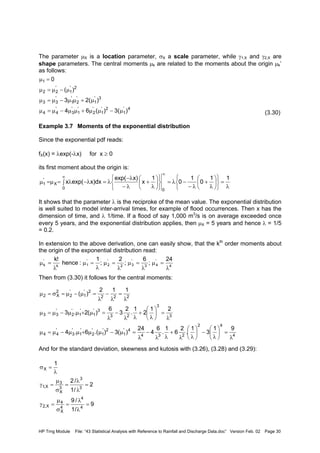
The exponential pdf and cdf for λ = 0.2 is shown in Figure 3.7. For example (P(X≤7) = Fx(7)
= 1 – exp(-0.2 x 7) = 0.75 as shown in Figure 3.7.
Figure 3.7:
Exponential pdf and cdf for λ=0.2
3.2.2 Features of distributions
In Chapter 2 some features of relative distribution functions were discussed. Here in a
similar fashion this will be done for the pdf and the cdf. The following features of distributions
are discussed:
• parameters
• return period
• mathematical expectation
• moments
Parameters
The distribution functions commonly used in hydrology are not specified uniquely by the
functional form; the parameters together with the functional form describe the distribution.
The parameters determine the location, scale and shape of the distribution.
Return period
The cdf gives the non-exceedance probability P(X ≤ x). Hence, the exceedance probability
follows from: P(X > x) = 1 – FX(x) is. Its reciproke is called the return period. So if T is the
return period and xT is its corresponding quantile, then:
dx
(x)dF
(x)f X
X =
x)exp(1z)exp(z)dzexp((x)F
x
0
x
0
X λ−−=λ−−=∫ λ−λ=
0.00
0.02
0.04
0.06
0.08
0.10
0.12
0.14
0.16
0.18
0.20
0 5 10 15 20 25
x
fX(x)
0.0
0.1
0.2
0.3
0.4
0.5
0.6
0.7
0.8
0.9
1.0
FX(x)
pdf
cdf
HP Trng Module File: “43 Statistical Analysis with Reference to Rainfall and Discharge Data.doc” Version Feb. 02 Page 29
(3.21)
Note that in the above the notation for the quantile xT or x(T) is used. Others use the notation
xp for quantile where p = Fx(xp), i.e. non-exceedance probability.
Mathematical expectation
If X is any continuous random variable with pdf fX(x), and if g(X) is any real-valued function,
defined for all real x for which fX(x) is not zero, then the mathematical expectation of the
function g(X) reads:
(3.22)
Moments
If one chooses g(X) = Xk
, where k = 1, 2, …. Then the kth
moment of X about the origin is
defined by:
(3.23)
Note that an (‘) is used to indicate moments about the origin. Of special interest is the first
moment about the origin, i.e. the mean:
(3.24)
If instead of the origin, the moment is taken around the mean, then the central moment
follows (µk). Note that the accent (‘) is omitted here to denote a central moment. The second
central moment is the variance:
(3.25)
With the above one defines:
• the standard deviation σX, which expresses the spread around the mean in the same
dimension as the original variate:
(3.26)
• the coefficient of variation Cv:
(3.27)
• the skewness coefficient γ1,x of the distribution is defined by:
(3.28)
• the peakedness of the distribution, expressed by the kurtosis γ2,X:
(3.29)
[ ] ∫=
+∞
∞−
(x)dxg(x)fg(X)E X
[ ] ∫==µ
+∞
∞−
(x)dxfxXE X
kk'
k
[ ] ( )∫==µ=µ′
+∞
∞−
dxxxfXE xx1
[ ][ ] [ ] ∫ µ−=µ−=−==µ
+∞
∞−
(x)dxf)(x)(XE)XE(XEVar(X) X
2
X
2
X
2
2
2X Var(X) µ==σ
X
X
'
1
2
vC
µ
σ
=
µ
µ
=
∫
+∞
∞−
µ−
σ
=
σ
µ
=γ (x)dxf)(x
1
X
3
X3
X
3
X
3
X1,
∫
+∞
∞−
µ−
σ
=
σ
µ
=γ (x)dxf)(x
1
X
4
X4
X
4
X
4
X2,
)(xF1
1
)xP(X1
1
)xP(X
1
T
TXTT −
=
≤−
=
>
=
HP Trng Module File: “43 Statistical Analysis with Reference to Rainfall and Discharge Data.doc” Version Feb. 02 Page 30
The parameter µX is a location parameter, σX a scale parameter, while γ1,X and γ2,X are
shape parameters. The central moments µk are related to the moments about the origin µk’
as follows:
(3.30)
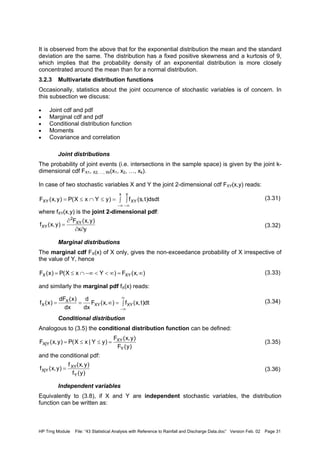
Example 3.7 Moments of the exponential distribution
Since the exponential pdf reads:
fX(x) = λexp(-λx) for x ≥ 0
its first moment about the origin is:
It shows that the parameter λ is the reciproke of the mean value. The exponential distribution
is well suited to model inter-arrival times, for example of flood occurrences. Then x has the
dimension of time, and λ 1/time. If a flood of say 1,000 m3
/s is on average exceeded once
every 5 years, and the exponential distribution applies, then µX = 5 years and hence λ = 1/5
= 0.2.
In extension to the above derivation, one can easily show, that the kth
order moments about
the origin of the exponential distribution read:
Then from (3.30) it follows for the central moments:
And for the standard deviation, skewness and kutosis with (3.26), (3.28) and (3.29):
4'
1
2'
1
'
2
'
1
'
3
'
44
3'
1
'
2
'
1
'
33
2'
1
'
22
1
)3()(64
)2(3
)(
0
µ−µµ+µµ−µ=µ
µ+µµ−µ=µ
µ−µ=µ
=µ
λ
=












λ
+
λ−
−λ=












λ
+
λ−
λ−
λ=∫ λ−λ=µ=µ
∞
∞ 11
0
1
0
1
x
x)exp(
x)dxexp(x
00
X
'
1
4
'
43
'
32
'
2
'
1k
'
k
24
;
6
;
2
;
1
:hence
!k
λ
=µ
λ
=µ
λ
=µ
λ
=µ
λ
=µ
4
42
234
4'
1
2'
1
'
2
'
1
'
3
'
44
3
3
23
3'
1
'
1
'
2
'
33
222
2'
1
'
2
2
X2
91
3
1
.
2
6
1
.
6
4
24
)(3).(6.4
21
2
1
.
2
3
6
)(2.3
112
)(
λ
=





λ
−





λλ
+
λλ
−
λ
=µ−µµ+µµ−µ=µ
λ
=





λ
+
λλ
−
λ
=µ+µµ−µ=µ
λ
=
λ
−
λ
=µ−µ=σ=µ
9
/1
/9
2
/1
/2
1
4
4
4
X
4
X,2
3
3
3
X
3
X,1
X
=
λ
λ
=
σ
µ
=γ
=
λ
λ
=
σ
µ
=γ
λ
=σ
HP Trng Module File: “43 Statistical Analysis with Reference to Rainfall and Discharge Data.doc” Version Feb. 02 Page 31
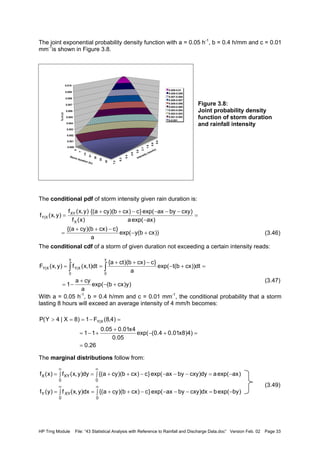
It is observed from the above that for the exponential distribution the mean and the standard
deviation are the same. The distribution has a fixed positive skewness and a kurtosis of 9,
which implies that the probability density of an exponential distribution is more closely
concentrated around the mean than for a normal distribution.
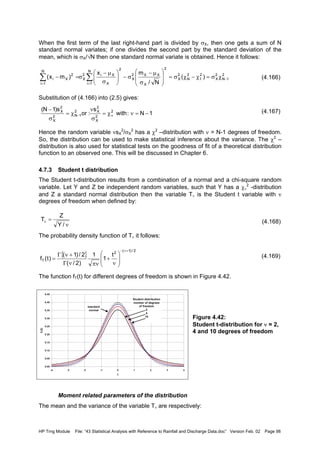
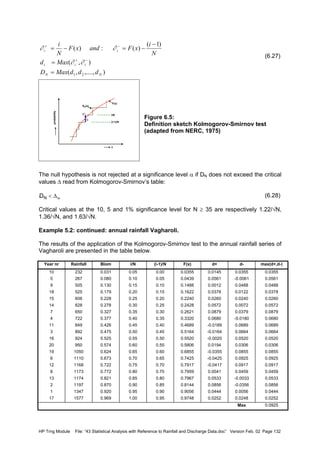
3.2.3 Multivariate distribution functions
Occasionally, statistics about the joint occurrence of stochastic variables is of concern. In
this subsection we discuss:
• Joint cdf and pdf
• Marginal cdf and pdf
• Conditional distribution function
• Moments
• Covariance and correlation
Joint distributions
The probability of joint events (i.e. intersections in the sample space) is given by the joint k-
dimensional cdf FX1, X2, …, Xk(x1, x2, …, xk).
In case of two stochastic variables X and Y the joint 2-dimensional cdf FXY(x,y) reads:
(3.31)
where fXY(x,y) is the joint 2-dimensional pdf:
(3.32)
Marginal distributions
The marginal cdf FX(x) of X only, gives the non-exceedance probability of X irrespective of
the value of Y, hence
(3.33)
and similarly the marginal pdf fX(x) reads:
(3.34)
Conditional distribution
Analogous to (3.5) the conditional distribution function can be defined:
(3.35)
and the conditional pdf:
(3.36)
Independent variables
Equivalently to (3.8), if X and Y are independent stochastic variables, the distribution
function can be written as:
∫ ∫=≤∩≤=
∞− ∞−
x y
XYXY dsdt)t,s(f)yYxX(P)y,x(F
yx
)y,x(F
)y,x(f XY
2
XY
∂∂
∂
=
),x(F)YxX(P)x(F XYX ∞=∞<<−∞∩≤=
∫=∞==
∞
∞−
dt)t,x(f),x(F
dx
d
dx
)x(dF
)x(f XYXY
X
X
)y(F
)y,x(F
)yY|xX(P)y,x(F
Y
XY
Y|X =≤≤=
)y(f
)y,x(f
)y,x(f
Y
XY
Y|X =
HP Trng Module File: “43 Statistical Analysis with Reference to Rainfall and Discharge Data.doc” Version Feb. 02 Page 32
(3.37)
and similarly for the density function:
(3.38)
Moments
In addition to the moments for univariate distributions the moments for bivariate distributions
are defined as follows:
(3.39)
Covariance and correlation function
Of special interest is the central moment expressing the linear dependency between X and
Y, i.e. the covariance:
(3.40)
Note that if X is independent of Y, then with (3.38) it follows:
(3.41)
As discussed in Chapter 2, a standardised representation of the covariance is given by the
correlation coefficient ρXY:
(3.42)
In Chapter 2 it was shown that ρXY varies between +1 (positive correlation) and –1 (negative
correlation). If X and Y are independent, then with (3.41) it follows ρXY = 0.
Example 3.6: Bivariate exponential and normal distribution
Assume that storm duration and intensity, (X and Y), are both distributed according to an
exponential distribution (see Kottegoda and Rosso, 1997):
FX(x) = 1 – exp(-ax), x ≥ 0; a > 0 FY(y) = 1 - exp(-by), y ≥ 0; b > 0 (3.43)
Their joint cdf given as a bivariate exponential distribution reads:
(3.44)
Hence, with (3.32), the joint pdf becomes:
(3.45)
)y(F).x(F)yY(P).xX(P)yYxX(PF YXXY =≤≤=≤∩≤=
)y(f).x(f)y,x(f YXXY =
[ ] dxdy)y,x(fyxYXE XY
mkmk'
m,k ∫∫==µ
∞
∞−
∞
∞−
( )( )[ ] ∫ ∫ µ−µ−=−−=
∞
∞−
∞
∞−
dxdy)y,x(f)y)(x(]Y[EY]X[EXEC XYYXXY
0dy)y(f)y(dx)x(f)x(C YYXXXY =∫ µ−∫ µ−=
∞
∞−
∞
∞−
YX
XY
YYXX
XY
XY
C
CC
C
σσ
==ρ
abc0and0b,0a;0y,x:with
)cxybyaxexp()byexp()axexp(1)y,x(FXY
≤≤>>≥
−−−+−−−−=
)cxybyaxexp(}c)cxb)(cya{(
)}cxybyaxexp()cya()axexp(a{
y
x
)y,x(F
yyx
)y,x(F
)y,x(f XYXY
2
XY
−−−−++=
=−−−+−−
∂
∂
=
=





∂
∂
∂
∂
=
∂∂
∂
=
HP Trng Module File: “43 Statistical Analysis with Reference to Rainfall and Discharge Data.doc” Version Feb. 02 Page 33
The joint exponential probability density function with a = 0.05 h-1
, b = 0.4 h/mm and c = 0.01
mm-1
is shown in Figure 3.8.
Figure 3.8:
Joint probability density
function of storm duration
and rainfall intensity
The conditional pdf of storm intensity given rain duration is:
(3.46)
The conditional cdf of a storm of given duration not exceeding a certain intensity reads:
(3.47)
With a = 0.05 h-1
, b = 0.4 h/mm and c = 0.01 mm-1
, the conditional probability that a storm
lasting 8 hours will exceed an average intensity of 4 mm/h becomes:
The marginal distributions follow from:
(3.49)
))cxb(yexp(
a
}c)cxb)(cya{(
)axexp(a
)cxybyaxexp(}c)cxb)(cya{(
)x(f
)y,x(f
)y,x(f
X
XY
X|Y
+−
−++
=
=
−
−−−−++
=
)y)cxb(exp(
a
cya
1
dt))cxb(texp(
a
}c)cxb)(cta{
dt)t,x(f)y,x(F
y
0
y
0
X|YX|Y
+−
+
−=
=+−
−++
== ∫∫
26.0
)4)8x01.04.0(exp(
05.0
4x01.005.0
11
)4,8(F1)8X|4Y(P X|Y
=
=+−
+
+−=
=−==>
∫ −=−−−−++=∫=
∫ −=−−−−++=∫=
∞∞
∞∞
00
XYY
00
XYX
)byexp(bdx)cxybyaxexp(}c)cxb)(cya{(dx)y,x(f)y(f
)axexp(ady)cxybyaxexp(}c)cxb)(cya{(dy)y,x(f)x(f
0.0
0.9
1.8
2.7
3.6
4.5
5.4
6.3
7.2
0
7
14
21
28
35
42
0.000
0.001
0.002
0.003
0.004
0.005
0.006
0.007
0.008
0.009
0.010
fXY(x,y)
Intensity (mm/hr)
Storm duration (hr)
0.009-0.01
0.008-0.009
0.007-0.008
0.006-0.007
0.005-0.006
0.004-0.005
0.003-0.004
0.002-0.003
0.001-0.002
0-0.001
HP Trng Module File: “43 Statistical Analysis with Reference to Rainfall and Discharge Data.doc” Version Feb. 02 Page 34
If X and Y are independent, then c = 0 and it follows from (3.45):
(3.50)
Other examples of joint probability density functions are given in Figures 3.9 and 3.10, with
the effect of correlation. In Figure 3.9 the joint standard normal pdf is given when the
variables are independent, whereas in Figure 3.10 the variables are positively correlated (ρ
= 0.8)
Figure 3.9: Bivariate standard normal distribution (ρ=0)
Figure 3.10: Bivariate standard normal distribution (ρ=08)
The effect of correlation on the probability density function is clearly observed from the
density contours in the right hand side representations of the joint pdf’s.
3.2.4 Moment generating function
In some cases the moments as discussed before, cannot be computed in a simple manner.
Then, often, use can be made of an auxiliary function, called the moment generating
)y(f).x(f)byexp(b).axexp(a)byaxexp(ab)y,x(f YXXY =−−=−−=-3.0
-2.3
-1.6
-0.9
-0.2
0.5
1.2
1.9
2.6
-3.0
-2.2
-1.4
-0.6
0.2
1.0
1.8
2.6
0.00
0.02
0.04
0.06
0.08
0.10
0.12
0.14
0.16
-3.0
-2.6
-2.2
-1.8
-1.4
-1.0
-0.6
-0.2
0.2
0.6
1.0
1.4
1.8
2.2
2.6
3.0
-3.0
-2.6
-2.2
-1.8
-1.4
-1.0
-0.6
-0.2
0.2
0.6
1.0
1.4
1.8
2.2
2.6
3.0
0.14-0.16
0.12-0.14
0.1-0.12
0.08-0.1
0.06-0.08
0.04-0.06
0.02-0.04
0-0.02
X
Y
-3.0
-1.7
-0.4
0.9
2.2
-3.0
-2.6
-2.2
-1.8
-1.4
-1.0
-0.6
-0.2
0.2
0.6
1.0
1.4
1.8
2.2
2.6
3.0
0.00
0.02
0.04
0.06
0.08
0.10
0.12
0.14
0.16
0.18
0.20
0.22
0.24
0.26
0.28
-3.0
-2.6
-2.2
-1.8
-1.4
-1.0
-0.6
-0.2
0.2
0.6
1.0
1.4
1.8
2.2
2.6
3.0
-3.0
-2.6
-2.2
-1.8
-1.4
-1.0
-0.6
-0.2
0.2
0.6
1.0
1.4
1.8
2.2
2.6
3.0
0.26-0.28
0.24-0.26
0.22-0.24
0.2-0.22
0.18-0.2
0.16-0.18
0.14-0.16
0.12-0.14
0.1-0.12
0.08-0.1
0.06-0.08
0.04-0.06
0.02-0.04
0-0.02
X
Y
HP Trng Module File: “43 Statistical Analysis with Reference to Rainfall and Discharge Data.doc” Version Feb. 02 Page 35
function G(s), which is the expectation of exp(sX): G(s) = E[exp(sX)]. In case of a
continuous distribution:
(3.50)
Assuming that differentiation under the integral sign is permitted one obtains:
(3.51)
For s = 0 it follows: exp(sx) = 1, and the right hand side of (3.51) is seen to equal the kth
moment about the origin:
(3.52)
Of course this method can only be applied to distributions for which the integral exists.
Similar to the one-dimensional case, the moment generating function for bivariate
distributions is defined by:
(3.53)
of which by partial differentiation to s and t the moments are found.
Example 3.7: Moment generating function for exponential distribution
The moment generating function for an exponential distribution and the k-th moments are
according to (3.50) and (3.52):
(3.54)
3.2.5 Derived distributions
Consider the variables X and Y and their one to one relationship Y = h(X). Let the pdf of X
be fX(x), then what is the pdf of Y? For this, consider Figure 3.11. It is observed that the
probability that X falls in the interval x, x + dx equals the probability that Y falls in the interval
y, y + dy. Hence,
fY(y)dy = fX(x)dx (3.55)
[ ] ∫==
∞
∞−
dx)x(f)sxexp()sXexp(E)s(G X
∫=
∞
∞−
dx)x(f)sxexp(x
ds
)s(Gd
X
k
k
k
[ ]
0s
k
k
)k()k(k
ds
Gd
)0(G:where)0(GXE
=
==
[ ] ∫ +∫=+= dxdy)y,x(f)tysxexp((tysxexp(E)t,s(H XY
k
0s
1k
0s
k
k
k
33
0s
4
0s
3
3
3
2
0s
3
0s
2
2
2
0s
2
0s
0
!k
)s(
xk...x3x2
ds
Gd
]X[E
........
63x2
)s(
3x2
ds
Gd
]X[E
2
)s(
2
ds
Gd
]X[E
1
)s(ds
dG
]X[E
s
dx)xexp()sxexp()s(G
λ
=
−λ
λ
==
λ
=
λ
=
−λ
λ
==
λ
=
−λ
λ
==
λ
=
−λ
λ
==
∫
−λ
λ
=λ−λ=
=
+
=
==
==
==
∞
HP Trng Module File: “43 Statistical Analysis with Reference to Rainfall and Discharge Data.doc” Version Feb. 02 Page 36
Since fY(y) cannot be negative, it follows:
(3.56)
where the first derivative is called the Jacobian of the transformation, denoted by J.
In a similar manner bivariate distributions can be transformed.
Figure 3.11:
Definition sketch for derived
distributions
Example 3.8: Transformation of normal to lognormal pdf
A variable Y is said to have a logarithmic normal or shortly log-normal distribution if its
logarithm is normally distributed, hence ln(Y) = X. So:
3.2.6 Transformation of stochastic variables
Consider the function Z = a + bX + cY, where X, Y and Z are stochastic variables and a, b
and c are coefficients. Then for the mean and the variance of Z it follows:
E[Z] = E[a + bX + cY] = a + bE[X] + cE[Y] (3.57)
E[(Z – E[Z])2
] = E[(a + bX + cY – a – bE[X] – cE[Y])2
] =
= E[b2
(X - E[X])2
+ c2
(Y - E[Y])2
+ 2bc(X - E[X])(Y - E[Y])] =
= b2
E[(X - E[X])2
] + c2
E[(Y - E[Y])2
] + 2bcE[(X - E[X])(Y - E[Y])]
)x(fJ)y(for
dy
dx
)x(f)y(f XYXY ==
Y=h(X)
XfY(y)
YfX(x)
fY(y)
fX(x)
Shaded areas
are equal
Shaded areas
are equal
dy
dx
∞<<














σ
µ−
−
σπ
=
=
=
∞<<∞−














σ
µ−
−
σπ
=
Y0
yln
2
1
exp
y2
1
)y(f
y
1
dy
dx
)Yln(X
X
x
2
1
exp
2
1
)x(f
2
Yln
Yln
)Yln(
Y
2
X
X
X
X
HP Trng Module File: “43 Statistical Analysis with Reference to Rainfall and Discharge Data.doc” Version Feb. 02 Page 37
or:
Var(Z) = b2
Var(X) + c2
Var(Y) + 2bcCov(X,Y) (3.58)
Equations (3.57) and (3.58) are easily extendible for any linear function Z of n-random
variables:
(3.59)
(3.60)
Or in matrix notation by considering the vectors:
(3.61)
(3.62)
The matrix [V] contains the following elements:
(3.63)
This matrix is seen to be symmetric, since Cov(Xi,Xj) = Cov(Xj,Xi). This implies [V] = [V]T
.
Furthermore, since the variance of a random variable is always positive, so is Var([a]T
[X]).
Taylor’s series expansion
For non-linear relationships it is generally difficult to derive the moments of the dependent
variable. In such cases with the aid of Taylor’s series expansion approximate expressions for
the mean and the variance can be obtained. If Z = g(X,Y), then (see e.g. Kottegoda and
Rosso (1997)):
∑∑∑
∑ ∑
∑
= ==
= =
=
==
µ==
=
n
1i
n
1j
jiji
n
1i
ii
n
1i
n
1i
iiii
n
1i
ii
)XX(Covaa)Xa(Var)Z(Var
a]X[Ea]Z[E
XaZ
)])[]])([[](([E][:where
]][[][])[])[]])([[]([]([E])[]([Var)(Var
][])([E:where
][][])([E][])[]([E][E
X
.
.
X
X
X
][
a
.
.
a
a
a
][
T
TTTT
TTT
n
3
2
1
n
3
2
1
µ−µ−=
=µ−µ−==
µ=
µ===




















=




















=
XXV
aVaaXXaXaZ
X
aXaXaZ
Xa




















=
)X(Var.............)X,X(Cov)X,X(Cov
.
.
.
)X,X(Cov..................)X(Var)X,X(Cov
)X,X(Cov...................)X,X(Cov)X(Var
][
n2n1n
n2221
n1211
V
HP Trng Module File: “43 Statistical Analysis with Reference to Rainfall and Discharge Data.doc” Version Feb. 02 Page 38
(3.64)
Above expressions are easily extendable to more variables. Often the variables in g(..) can
be considered to be independent, i.e. Cov(..) = 0. Then (3.64) reduces to:
(3.65)
Example 3.9
Given a function Z = X/Y, where X and Y are independent. Required are the mean and the
variance of Z.
Use is made of equation (3.65). The coefficients read:
(3.66)
Hence:
(3.67)
Example 3.10: Joint cumulative distribution function
The joint pdf of X and Y reads:
Q: determine the probability that 2<X<5 and 1<Y<7
A: the requested probability is obtained from:
)Y,X(Cov
y
g
x
g
2)Y(Var
y
g
)X(Var
x
g
)Z(Var
)Y,X(Cov
yx
g
)Y(Var
y
g
2
1
)X(Var
x
g
2
1
),(g]Z[E
22
2
2
2
2
2
YX






∂
∂
∂
∂
+





∂
∂
+





∂
∂
≈
∂∂
∂
+
∂
∂
+
∂
∂
+µµ≈
)Y(Var
y
g
)X(Var
x
g
)Z(Var
)Y(Var
y
g
2
1
)X(Var
x
g
2
1
),(g]Z[E
22
2
2
2
2
YX






∂
∂
+





∂
∂
≈
∂
∂
+
∂
∂
+µµ≈
32
2
2
2
2
y
x2
y
g
y
x
y
g
0
x
g
y
1
x
g
=
∂
∂
−=
∂
∂
=
∂
∂
=
∂
∂
( )
( )2
vY
2
vX
2
Y
X
2
Y
2
Y
2
X
2
X
2
Y
X2
Y
2
2
Y
X2
X
2
Y
2
vY
Y
X2
Y3
Y
X
Y
X
CC
1
)Z(Var
C1]Z[E
+





µ
µ
=








µ
σ
+
µ
σ






µ
µ
=σ








µ
µ
+σ





µ
≈
+
µ
µ
=σ
µ
µ
+
µ
µ
≈
0y,0x:for0)y,x(f
0y,0x:for)2/yxexp()y,x(f
XY
XY
≤≤=
>>−−=
0741.0))6065.0(0302.0))(1353.0(0067.0(
))2/yexp(2)()xexp((dy)2/yexp(dx)xexp(dxdy)y,x(f)7Y15X2(P
7
1
5
2
7
1
5
2
7
1
5
2XY
=−−−−−−=
=−−−−=−−==<<∩<< ∫∫ ∫ ∫
HP Trng Module File: “43 Statistical Analysis with Reference to Rainfall and Discharge Data.doc” Version Feb. 02 Page 39
Example 3.11: Marginal distributions and independence (from: Reddy, 1997)
Given is the joint pdf of the variables X and Y:
Q: a. find the marginal distributions of X and Y and
b. are X and Y independent?
A: a. the marginal distributions are obtained from:
b. if X and Y are independent, then their conditional distributions should be equal to
their marginal distributions. Hence is fX|Y(x,y) = fX(x) or is fY|X(x,y) = fY(y)?
So: fX|Y(x,y) ≠ fX(x), i.e. X and Y are not independent. A similar answer would of
course have been obtained while examining fY|X(x,y) relative to fY(y).
Example 3.12: Joint pdf and independence (adapted from: Reddy, 1997)
Given are two variables X and Y who’s marginal distributions read:
Q: a. find the joint pdf of X and Y if X and Y are independent
b. find the probability that X is always larger than Y
A: a. If X and Y are independent then their joint pdf is the product of their marginal
distributions:
b. the probability that X is always larger than Y can be obtained from the answer
under a:
1y,0y,1x,0x:for0)y,x(f
1y0,1x0:for)y2x(
3
2
)y,x(f
XY
XY
≥≤≥≤=
<<<<+=
{ }
1y,0y:for0)y(f
1y0:for)y41(
3
1
)}0()y2
2
1
{(
3
2
)xy2
2
x
(
3
2
dx)y2x(
3
2
dx)y,x(f)y(f
1x,0x:for0)x(f
1x0:for)1x(
3
2
)0()1x(
3
2
)
2
y
2xy(
3
2
dy)y2x(
3
2
dy)y,x(f)x(f
Y
1
0
1
0
2
XYY
X
1
0
1
0
2
XYX
≥≤=
<<+=−+=+=+==
≥≤=
<<+=−+=+=+==
∫∫
∫ ∫
∞
∞−
∞
∞−
)1x(
3
2
)y41(
)yx(
2
)y41(
3
1
)yx(
3
2
)y(f
)y,x(f
)y,x(f
Y
XY
Y|X +≠
+
+
=
+
+
==
∞<≤−=
∞<≤−=
y0:for)byexp(a2)y(f
x0:for)bxexp(a2)x(f
Y
X
)yx(bexp(a4)y(f).x(f)y,x(f 2
YXXY +−==
∫∫ ∫ ∫
∞ ∞
=








−−==<≤∩∞<≤
0
x
0 0
x
0
2
XY dxdy)byexp()bxexp(a4dydx)y,x(f)xY0X0(P
HP Trng Module File: “43 Statistical Analysis with Reference to Rainfall and Discharge Data.doc” Version Feb. 02 Page 40
4 Theoretical Distribution Functions
4.1 General
A number of theoretical (analytical) frequency distributions has been developed to model or
represent the relative frequency distributions found in practice. In this chapter a summary is
given of the distribution functions commonly used in hydrology and included in HYMOS.
A distinction is made between:
• Discrete distributions, and
• Continuous distributions.
A discrete distribution is used to model a random variable that has integer-valued outcomes,
like the number of times an event occurs (successes) out of a number of trials. In contrast to
this are the continuous distributions where the random variable is real-valued.
The discrete distributions (Section 4.2), which will be discussed, include:
• Binomial distribution
• Poisson distribution
The continuous distribution models comprise:
• Uniform distribution (Section 4.3),
• Distributions related to the normal distribution(Section 4.4), including:
− Normal distribution
− Log-normal distribution
− Box-Cox transformations to normality
• Distributions related to Gamma or Pearson distribution, (Section 4.5), including:
− Exponential distribution
− Gamma distribution
− Pearson Type 3 distribution or 3 parameter gamma distribution
− Log-Pearson Type 3 distribution
− Weibull distribution
− Rayleigh distribution
• Distributions for extreme values(Section 4.6), including:
− Generalised Extreme Value distributions, including the EV-1, EV-2 and EV-3
distributions for largest and smallest value
− Generalised Pareto distributions, including Pareto Type 1, 2 and 3 distributions
• Sampling distributions(Section 4.7),:
− Chi-square distribution
− Student’s t-distribution
− Fisher F-distribution
{ }
222
00
2
0 0
2
0
2
0
2
0
x
0
2
b
a
2
b2
1
b
1
b
a4
b2
1
0
b
1
0
b
a4
b2
)bx2exp(
b
)bxexp(
b
a4
dx)bx2exp(dx)bxexp(
b
a4
dx)bxexp(1)bxexp(
b
a4
dx)
b
1
())bxexp(
b
1
()bxexp(a4dx
b
)bxexp(
)bxexp(a4






=





−=












−
−−





−
−=








−
−
−
−
−
=








−−−=−−−
=






−−−−−=








−
−
−
∞∞
∞ ∞∞
∞∞
∫ ∫∫
∫∫
HP Trng Module File: “43 Statistical Analysis with Reference to Rainfall and Discharge Data.doc” Version Feb. 02 Page 41
It is stressed here that none of the theoretical distributions do have a physical background.
They do not explain the physical phenomenon behind a population, but rather describe the
behaviour of its frequency distribution. In this sub-section a short description of the various
distributions is given.
Binomial distribution
The binomial distribution applies to a series of Bernoulli trials. In a Bernoulli trial there are
two possible outcomes, that is an event occurs or does not occur. If the event occurs one
speaks of a success (probability p) and if it does not occur it is a failure (probability 1 - p). If
the probability of a success in each trial is constant, then the binomial distribution gives the
distribution of the number successes in a series of independent trials. For example, the trial
outcome could be that the water level in the river exceeds the crest of the embankment in a
year and the other possible outcome that it does not. Let’s call the event of an exceedance
(how unfortunate for the designers) a “success”. If the climatic conditions and the drainage
characteristics in the basin do not vary one can assume that the success probability is
constant from year to year. Knowing this success probability, then the Bernoulli distribution
can be used to determine the probability of having exactly 0, 1, 2,…, or ≤1, ≤2,
≤…exceedances (“successes”) during the next say 75 years (or any other number of years =
number of trials). The distribution is therefore of extreme importance in risk analysis.
Poisson distribution
The Poisson distribution is a limiting case of the binomial distribution when the number of
trials becomes large and the probability of success small, but their product finite. The
distribution describes the number of occurrences of an event (a success) in a period of time
(or space). Occurrences in a period of time (space) form a Poisson process if they are
random, independent, and occur at some constant average rate. Essential is that the time
(space) interval between the last occurrence and the next one is independent of past
occurrences; a Poisson process, therefore, is memory-less.
Uniform distribution
The uniform distribution describes a random variable having equal probability density in a
given interval. The distribution is particularly of importance for data generation, where the
non-exceedance probability is a random variable with constant probability density in the
interval 0,1.
Normal distribution
The normal distribution has a bell shaped probability density function, which is an
appropriate model for a random variable being the sum of a large number of smaller
components. Apart from being used as a sampling distribution or error model, the distribution
applies particularly to the modelling of the frequency of aggregated data like monthly and
annual rainfall or runoff. Direct application to model hydrological measurements is limited in
view of its range from - ∞ to + ∞.
Lognormal distribution
If Y = ln X has normal distribution, then X is said to have a 2-parameter lognormal
distribution. In view of its definition and with reference to the normal distribution, X can be
seen as the product of a large number of small components. Its range from 0 to + ∞ is more
appropriate to model hydrological series, whereas the logarithmic transformation reduces the
positive skewness often found in hydrological data sets. Its applicability in hydrology is
HP Trng Module File: “43 Statistical Analysis with Reference to Rainfall and Discharge Data.doc” Version Feb. 02 Page 42
further enhanced by introducing a shift parameter x0 to X to allow a data range from x0 to +
∞. Then, if Y = ln(X – x0) has normal distribution it follows that X has a 3-parameter
lognormal distribution
Box-Cox transformation
The Box-Cox transformation is a suitable, effective two-parameter transformation to data
sets to normality. Such transformations may be desired in view of the extensive tabulation of
the normal distribution.
Exponential distribution
The time interval between occurrences of events in a Poisson process or inter-arrival time is
described by the exponential distribution, where the distribution parameter represents the
average occurrence rate of the events.
Gamma distribution
The distribution of the time until the γth occurrence in a Poisson process has a gamma
distribution. In view of the definition of the exponential distribution the gamma distribution
models the sum of γ independent, identical exponentially distributed random variables. Note
that γ may be a non-integer positive value. The gamma distribution is capable of modelling
skewed hydrological data series as well as the lognormal distribution is capable of. The
gamma distribution has a zero lower bound and is therefore not applicable to phenomena
with a non-zero lower bound, unless a shift parameter is introduced.
Pearson Type 3 or 3-parameter gamma distribution
The gamma distribution with a shift parameter to increase the flexibility on the lower bound is
called the Pearson Type 3 distribution. Sometimes it is also called 3-parameter gamma
distribution, though in literature the name gamma distribution is generally related to the 2-
parameter case. The distribution can take on variety of shapes like the 3-parameter
lognormal distribution and is therefore often used to model the distribution of hydrological
variables. A large number of distributions are related to the Pearson Type 3 distribution. For
this, consider the standard incomplete gamma function ratio:
Note that the distribution reduces to an exponential function when γ = 1. In the above
distribution x0 = location parameter, β = scale parameter and γ and k are shape parameters.
The following distributions are included:
• k = 1, γ = 1: exponential distribution
• k = 1, x0 = 0: gamma distribution
• k = 1, x0 = 0, β = 2, γ = ν/2: chi-squared distribution
• k = 1: 3-parameter gamma or Pearson Type 3 distribution
• k = 1, Z = (ln(X - x0)-y0)/β)k
: log-Pearson Type 3 distribution
• k = -1: Pearson Type 5 distribution
• k = 2, γ = 1: Rayleigh distribution
• k = 2, γ = 3/2: Maxwell distribution
• γ = 1: Weibull distribution
∫ 





β
−
=−
γΓ
= −γ
z
0
k
01 xX
Z:whereds)sexp(s
)(
1
)z(F
HP Trng Module File: “43 Statistical Analysis with Reference to Rainfall and Discharge Data.doc” Version Feb. 02 Page 43
Log-Pearson Type 3 distribution
If X = ln(Y – y0) has a Pearson Type 3 distribution, then Y follows a log-Pearson Type 3
distribution. The distribution is often used to model annual maximum floods when the
skewness is high.
Weibull distribution
The Weibull distribution is a special type of exponential or Pearson Type 3 distribution. The
Weibull distribution is often used to model distributions of annual minimum values and as
such it equals the Extreme Value Type III distribution for smallest values.
Rayleigh distribution
The Rayleigh distribution is a special case of the Weibull distribution. By comparison with the
definition of the chi-squared distribution it is observed that a random variable is Rayleigh
distributed if it is the root of the sum of two squared normal random variables. The
distribution is often used to model distributions of maximum wind speed but also for annual
maximum flows, if the skewness is limited.
Generalised Extreme Value distributions
Three types of Extreme Value distributions have been developed as asymptotic distributions
for the largest or the smallest values. It depends on the parent distribution which type
applies. The distributions are often called Fisher-Tippett Type I, II and III or shortly EV-1, EV-
2 and EV-3 distributions for largest and smallest value. EV-1 for largest is known as the
Gumbel distribution, EV-2 for largest as Fréchet distribution and EV-3 for smallest value as
Weibull or Goodrich distribution. Above models apply typically to annual maximum or
minimum series. Despite the fact that these distributions have particularly been derived for
extreme values, it does not mean that one of the types always applies. Often the lognormal,
Pearson and log-Pearson Type 3, Weibull or Rayleigh distributions may provide a good fit.
Generalised Pareto distributions
The Pareto distributions are particularly suited to model the distribution of partial duration
series or annual exceedance series. The Extreme Value distributions for the annual
maximum value can be shown to be related to the Pareto distributions with an appropriate
model for the number of exceedances. Consequently as for the Extreme Value distributions
also for the generalised Pareto distributions three types are distinguished: Pareto Type 1, 2
and 3 distributions.
Sampling distributions
An estimate is thought of as a single value from the imaginary distribution of all possible
estimates, called the sampling distribution. Sampling distributions are introduced to be able
to give the likely range of the true value of a parameter for which an estimate is made.
Chi-squared distribution
The sum of ν squared normally distributed random variables has a chi-squared distribution,
where ν is the number of degrees of freedom. The distribution is a special case of the
gamma distribution. The distribution is used to describe the sampling distribution of the
variance; also, it finds application in goodness of fit tests for frequency distributions.
HP Trng Module File: “43 Statistical Analysis with Reference to Rainfall and Discharge Data.doc” Version Feb. 02 Page 44
Student’s t-distribution
The sampling distribution of many statistics is approximately standard normal if the statistic
is scaled by its standard deviation. If the latter is replaced by its sample estimate with ν
degrees of freedom then the sampling distribution of the statistic becomes a Student’s
t-distribution with the same number of degrees of freedom. When the number of degrees of
freedom is sufficiently large, the Student distribution can be replaced by the normal
distribution. The t variable is the ratio of a normal and the root of a chi-distributed variable
divided by the number of degrees of freedom.
Fisher F-distribution
The ratio of two chi-squared variables divided by their degrees of freedom has a Fisher F-
distribution. The distribution is used in significance tests on difference between variances of
two series.
4.2 Discrete distribution functions
4.2.1 Binomial distribution
Distribution and cumulative distribution function
A Bernoulli trial is defined as a trial with only two possible outcomes: a success or a
failure, with constant probability p and (1-p) respectively. The outcomes of a series of such
trials are independent. Let X be the random variable for the number of successes out of n
trials. Its probability distribution pX(x) is then given by the binomial distribution:
(4.1)
The cdf reads:
(4.2)
Moment related distribution parameters
The mean, variance and skewness are given by:
(4.3a)
(4.3b)
From the skewness it is observed that only for p = 0.5 a symmetrical distribution function is
obtained. For p < 0.5 the distribution is skewed to the right and for p > 0.5 skewed to the left.
A few examples are given in Figure 4.1
)!xn(!x
!n
x
n
:andn,...,2,1,0x:with)p1(p
x
n
)p,n;xX(P)x(p xnx
X
−
=





=−





==≡ −
∑ −





=≤≡
=
−
x
0k
knk
X )p1(p
k
n
)p;n;xX(P)x(F
)p1(np
np
2
X
X
−=σ
=µ
)p1(np
)p1(p61
3
)p1(np
)p21(
X,2
X,1
−
−−
+=γ
−
−
=γ
HP Trng Module File: “43 Statistical Analysis with Reference to Rainfall and Discharge Data.doc” Version Feb. 02 Page 45
Figure 4.1:
Binomial distributions for n = 20 and p
= 0.1, 0.5 and 0.9
From (4.3b) and Figure 4.2 it is observed that for large n, the skewness γ1,X gradually tends
to 0 and the kurtosis γ2,X becomes close to 3. Then, the distribution approaches the normal
distribution with same mean and variance (see Subsection 4.3.2).
Figure 4.2:
Skewness and kurtosis of binomial
distribution as function of n and p
Example 4.1 Number of rainy days in a week
Let the probability of a rainy day in a particular week in the year be 0.3, then:
• what is the probability of having exactly 4 rainy days in that week, and
• what is the probability of having at least 4 rainy days in that week?
Assuming that the occurrence of rainy days are independent, then the random variable X
being the number of rainy days in that week follows a binomial distribution with n = 7 and p =
0.3. From (4.1) it then follows:
Note that this is different from the probability of having 4 successive rainy days, which
probability is 0.3 x 0.3 x 0.3 x 0.3 = 0.008, which is of course much less.
The probability of having at least 4 rainy days in that week of the year should be larger than
0.097, because also the probabilities of having 5, 6 or 7 days of rain should be included. The
solution is obtained from (4.2):
From the above it is observed that in case n and X are big numbers the elaboration of the
sum will require some effort. In such cases the normal approximation is a better less
cumbersome approach.
0.0
0.2
0.4
0.6
0.8
1.0
1.2
1.4
1.6
1.8
2.0
0 10 20 30 40 50 60 70 80 90 100
number of data n
Skewness
2.0
2.2
2.4
2.6
2.8
3.0
3.2
3.4
3.6
3.8
4.0
Kurtosis
skewness
p
0.1
0.2
0.3
0.4
0.5
values for p > 0.5 are negative but
symmetrical about p = 0.5
kurtosis
p
0.1 & 0.9
0.2 & 0.8
0.3 & 0.7
0.4 & 0.6
0.5
097.07.03.0
!3x!4
!7
)3.01(3.0
4
7
)3.0,7;4X(P)x(p 34474
X ==−





==≡ −
127.0)226.0318.0247.0082.0(1)3.01(3.0
k
7
1)3X(F1)4X(F k7k
3
0k
XX =+++−=−∑ 





−=≤−=≥ −
=
0.00
0.05
0.10
0.15
0.20
0.25
0.30
0 2 4 6 8 10 12 14 16 18 20
X
p
X
(x)
p=0.1
p=0.5
p=0.9
HP Trng Module File: “43 Statistical Analysis with Reference to Rainfall and Discharge Data.doc” Version Feb. 02 Page 46
Related distributions
If the number of trials n = 1 then the binomial distribution is called Bernoulli distribution
with mean p and variance p(1-p). The geometric distribution describes the probability that
the first success takes place on the Nth
trial. This distribution can be derived from (4.1) by
noting that the Nth
trial is preceded by (N – 1) trials without success, followed by a successful
one. The probability of having first (N-1) failures is (1-p)N-1
(from (3.12) or (4.1) with n = N-1
and x = 0) and the successful one has probability p, hence the probability of the first success
in the Nth
trial is p(1-p)N-1
for N = 1,2,3,… In a similar manner the distribution function for the
negative binomial distribution can be derived. This distribution describes the probability
that the kth
exceedance takes place in the Nth
trial. Hence, the Nth
trial was preceded by (k-1)
successes in (N-1) trials, which is given by (4.1) (with: n = N-1 and x = k-1), followed by a
success with probability p.
4.2.2 Risk and return period
Consider a series of annual maximum discharges Qmax (t): t = 1,…, n. If a discharge Qd is
exceeded during these n years k-times then Qd has in any one year an average probability
of being exceeded of pE = k/n and the average interval between the exceedances is n/k =
1/pE. The latter is called the return period T = 1/pE, as discussed in Sub-section 3.2.2,
equation (3.21).
More generally, instead of Qmax, if we denote the random variable by Q, then the relation
between FQ(q), T and p is:
(4.4)
If one states that an embankment has been designed for a discharge with a return period of
T years it means that on average only once during T years the river will overtop the
embankment. But each year there is a probability p = 1/T that the river overtops the
embankment. Consequently, each year the probability that the river does not overtop the
embankment is (1 – pE) = FQ(q). Since the outcomes in any one-year are independent, the
probability of not being exceeded in N consecutive years is given by:
(4.5)
Note that this result is directly obtained from (4.1) with the number of successes x = 0. If q is
the design level (storm, flow, stage, etc.), then the probability that this level q will be
exceeded one or more times during the lifetime N of a structure (i.e. the probability of one or
more failures), is simply the complement of the probability of no failures in N years. The
probability of failure is called the risk r, hence:
(4.6)
It is noted that the above definition of risk is basically incomplete. The consequence of failure
should also be taken into account. Risk is therefore often defined as the probability of failure
times the consequence of failure.
Example 4.2 Risk of failure
A culvert has been designed to convey a discharge with a return period of 100 years. The
lifetime of the structure is 50 years. What is the probability of failure during the lifetime of the
structure?
T
1
1p1)qQ(P1)qQ(P)q(F EQ −=−=>−=≤=
( )
N
N
E
N
Q
T
1
1)p1()q(F)yearsNinqofsexceedanceno(P 





−=−==
( )
N
N
E
N
Q
T
1
11)p1(1)q(F1r 





−−=−−=−=
HP Trng Module File: “43 Statistical Analysis with Reference to Rainfall and Discharge Data.doc” Version Feb. 02 Page 47
Example 4.3 Return period and risk
To be 90% sure that a design discharge is not exceeded in an 80-year period, what should
be the return period of the design discharge?
If we want to be 90% sure, then we take a risk of failure of 10%. From (4.6) it follows:
Hence for an event with an average return period of 760 years there is a 10% chance that in
a period of 80 years such an event will happen.
4.2.3 Poisson distribution
Distribution and cumulative distribution function
If in the binomial distribution n becomes large and p very small, then (4.1) can be
approximated by the Poisson distribution. Let the average number of successes in a
series of n Bernoulli trials be ν = np, then the distribution of the number of successes X in n
trials, with probability of occurrence in each trial of p, becomes, see also Figure 4.3:
(4.7)
The cdf of the Poisson distribution reads:
(4.8)
Moment related distribution parameters
The mean, variance, skewness and kurtosis are:
(4.9a)
(4.9b)
For ν→∞ the skewness becomes 0 and the kurtosis 3, and the Poisson distribution
converges to a normal pdf.
%40395.0605.01
100
1
11r
50
≈=−=





−−=
years760
)10.01(1
1
)r1(1
1
T 80/1N/1
=
−−
=
−−
=
n,....,2,1,0x:for
!x
)exp(
);xX(P)x(p
x
X =
ν−ν
=ν=≡
∑
ν−ν
=≤≡
=
x
0k
k
X
!k
)exp(
)v;xX(P)x(F
ν=σ
ν=µ
2
X
X
ν
+=γ
ν
=γ
1
3
1
X,2
X,1
HP Trng Module File: “43 Statistical Analysis with Reference to Rainfall and Discharge Data.doc” Version Feb. 02 Page 48
Figure 4.3:
Poisson distribution for different
values of ν
Example 4.4: Drought
From a statistical analysis it was deduced that the monsoon rainfall at a location falls below
200 mm on average once in 100 years. What is the probability that the monsoon rainfall will
fall below 200 mm less than twice in a 75-year period?
In this case n = 75 and the ‘success’ probability (falling below 200 mm) p = 1/100 = 0.01,
hence n is large and p is small, which fulfils the condition for the applicability of the Poisson
distribution. With ν = np = 75 x 0.01 = 0.75 it follows from (4.8):
With the binomial cdf (4.2) we would have obtained:
(4.10)
Hence the cumulative probability distribution of the time between arrivals becomes with
(4.10):
(4.11)
It shows that the waiting time between successive events of a Poisson process follows an
exponential distribution. Instead of time, the Poisson process can also be defined for
space, length, etc. Essential for a Poisson process is that the “period” can be divided in
subintervals ∆t so small, that the probability of an arrival in ∆t tends to λ∆t, while the
probability of more than one arrival in ∆t is zero and an occurrence in one subinterval is
independent of the occurrence in any other, (Kottegoda and Rosso, 1997). This makes the
process memory-less.
0
0.1
0.2
0.3
0.4
0.5
0.6
0 1 2 3 4 5 6 7 8 9 10 11 12 13 14 15 16 17 18 19 20
x
pX(x)
ν = 0.5
ν = 1
ν = 5
ν = 10
Distribution only
defined at integer
values of x
8266.0)75.0exp()75.01()75.0exp(
!1
75.0
!0
75.0
!k
)75.0exp(75.0
)75.0;1X(P)x(F
10
1
0k
k
X
=−+=−







+=
=
−
=≤= ∑
=
8271.03565.04706.099.0x01.0x7599.0x1x1
)01.01(01.0
k
75
)01.0;75;1X(P)x(F
7475
k75k
1
0k
X
=+=+=
=−





=≤= −
=
∑
)t(
!0
)texp()t(
)t;0X(P)tT(P exp
0
a λ−=
λ−λ
=λ==>
)texp(1)tT(P)t(F aTa
λ−−=≤=
HP Trng Module File: “43 Statistical Analysis with Reference to Rainfall and Discharge Data.doc” Version Feb. 02 Page 49
Example 4.2 continued Risk of failure
The average waiting time for the design event was 100 years. The structure will fail in the 50
year period, if the waiting time between the design events is less or equal to 50 years, which
was defined as risk. From (4.11) with λ = 1/T = 1/100 and t = N = 50 we obtain:
This result is seen to be close to the outcome of (4.6), which was r = 0.395.
4.3 Uniform distribution
Probability density and cumulative frequency distribution
The uniform or rectangular distribution describes the probability distribution of a random
variable X, which has equal non-zero density in an interval ‘ab’ and zero density outside.
Since the area under the pdf should equal 1, the pdf of X is given by:
(4.12)
The cdf of the uniform distribution reads:
(4.13)
The pdf and cdf of the uniform distribution are shown in Figure 4.4.
Figure 4.4:
Pdf and cdf of uniform distribution
Moment related distribution parameters
The mean and the variance simply follow from the definition of the moments:
(4.14)
393.0607.01)50
100
1
exp(1)50T(Fr a =−=−−=≤=
bx;ax:for0)x(f
bxa:for
ab
1
)x(f
X
X
><=
≤≤
−
=
bx:for1)x(F
bxa:for
ab
ax
ds
ab
1
)x(F
ax:for0)x(F
X
x
a
X
X
>=
≤≤
−
−
=
−
=
<=
∫
1/(b-a)
0
1
x
x
a b
a b
fX(x)
FX(x)
12
)ab(
2
ba
2
2
X
X
−
=σ
+
=µ
HP Trng Module File: “43 Statistical Analysis with Reference to Rainfall and Discharge Data.doc” Version Feb. 02 Page 50
The uniform distribution is of particular importance for data generation, where with a = 0 and
b = 1 the density function provides a means to generate the non-exceedance probabilities. It
provides also a means to assess the error in measurements due to limitations in the scale. If
the scale interval is c, it implies that an indicated value is ± ½ c and the standard deviation of
the measurement error is σ = √(c2
/12) ≈ 0.3c.
4.4 Normal distribution related distributions
4.4.1 Normal Distribution
Four conditions are necessary for a random variable to have a normal or Gaussian
distribution (Yevjevich, 1972):
• A very large number of causative factors affect the outcome
• Each factor taken separately has a relatively small influence on the outcome
• The effect of each factor is independent of the effect of all other factors
• The effect of various factors on the outcome is additive.
Probability density and cumulative frequency distribution
The pdf and cdf of the normal distribution read:
(4.15)
(4.16)
where: x = normal random variable
µX, σX = parameters of the distribution, respectively the mean and the
standard deviation of X.
The pdf and cdf are displayed in Figure 4.5.
Figure 4.5:
Normal probability density and
cumulative density functions for µ = 0
and σ = 1
The normal pdf is seen to be a bell-shaped symmetric distribution, fully defined by the two
parameters µX and σX. The coefficient (σX√(2π))-1
in Equation (4.15) is introduced to ensure
that the area under the pdf-curve equals unity, because the integral:
0and,xwith
x
2
1
exp
2
1
(x)f XX
2
X
X
X
X >σ∞<µ<∞−∞<<∞−














σ
µ−
−
πσ
=
ds
s
2
1
exp
2
1
]xX[P)x(F
2
X
X
x
X
X 













σ
µ−
−∫
πσ
=≤≡
∞−
0.00
0.05
0.10
0.15
0.20
0.25
0.30
0.35
0.40
0.45
0.50
-3 -2 -1 0 1 2 3
x
pdff(x)
0
0.1
0.2
0.3
0.4
0.5
0.6
0.7
0.8
0.9
1
cdfF(x)
normal
probability
normal cumulative
density function
a
dx)axexp(2dx)axexp(
0
22 π
=∫ −∫ =−
∞∞
∞−
HP Trng Module File: “43 Statistical Analysis with Reference to Rainfall and Discharge Data.doc” Version Feb. 02 Page 51
With a = 1/(2σX
2
) the integral becomes σX√(2π), so dividing the integral by the same makes
the area under the pdf equal to 1.
The notation N(µX, σX
2
) is a shorthand for the normal distribution. The normal pdf for different
values of µX and of σX are shown in Figures 4.6 and 4.7. Clearly, µX is a location parameter;
it shifts the distribution along the x-axis, but does not change the shape or scale of the
distribution as is shown in Figure 4.6. The parameter σX is a scale parameter; it stretches or
reduces the scale of the horizontal axis, see Figure 4.7, but it has no effect on the shape of
the distribution.
Figure 4.6:
Normal probability density functions
for different values of µx’ (σx=1)
Figure 4.7:
Normal probability density functions
for different values of σX, (µX = 0).
Moment related parameters of the distribution
The characteristics of the distribution are as follows:
Mean = median = mode: µX (4.17a)
Variance: σX
2
(4.17b)
Standard deviation: σX (4.17c)
Coefficient of variation: Cv,X = σX/µX (4.17d)
Skewness: γ1,X = 0 (4.17e)
Kurtosis: γ2,X = 3 (4.17f)
Standard normal distribution
The location and scale parameters µX and σX are used to define the standard normal
variate or reduced variate Z:
(4.18)
0.00
0.05
0.10
0.15
0.20
0.25
0.30
0.35
0.40
0.45
-4 -3 -2 -1 0 1 2 3 4 5 6
x
f(x)
µ=0 µ=2
0
0.1
0.2
0.3
0.4
0.5
0.6
0.7
0.8
0.9
-5 -4 -3 -2 -1 0 1 2 3 4 5
x
f(x)
σ = 0.5
σ = 1.0
σ = 2.0
X
XX
Z
σ
µ−
=
HP Trng Module File: “43 Statistical Analysis with Reference to Rainfall and Discharge Data.doc” Version Feb. 02 Page 52
It is observed that Z = X for µX =0 and σX = 1, hence Z is an N(0,1) variate with pdf and cdf
respectively:
(4.19)
(4.20)
Equations (4.19) and (4.20) describe the standard normal probability density and
cumulative density function, see Figure 4.5. From (4.18) it follows:
Substitution of this expression in (4.20) with (4.18) results in equation (4.16) and by taking
the derivative with respect to X one obtains (4.15). The procedures used in HYMOS to solve
(4.20) given Z and to calculate the inverse (i.e. the value of Z given FZ(z)) are presented in
Annex 4.1.
The standard normal distribution is generally tabulated in statistical textbooks. Such tables
generally only address the positive arguments. To apply these tables for negative arguments
as well, note that because of the symmetry of the pdf it follows:
fZ(-z) = fZ(z) (4.21)
and
FZ(-z) = 1 – FZ(z) (4.22)
Quantiles
Values of xT and zT for which FX(xT) = FZ(zT) = 1 – 1/T are related by (4.18) and by its
inverse:
(4.23)
ZT is obtained as the inverse of the standard normal distribution.
Example 4.5 Tables of the normal distribution
For z = 2, fZ(2) = 0.0540, hence fZ(-2) = 0.0540
For z = 1.96 FZ(1.96) = 0.9750,
Hence: FZ(-1.96) = 1 – 0.9750 = 0.0250
It implies that the area under the pdf between z = -1.96 and z = 1.96 (see Figure 4.8)
amounts 0.9750 – 0.0250 = 0.95 or 95%.
Given that the mean of a random variable is 100 and its standard deviation is 50, the
quantile for T = 100 is derived as follows:
For T = 100, FZ(z) = 1 – 1/100 = 0.99. From the table of the normal distribution this non-
exceedance probability corresponds with a reduced variate zT = 2.33. Hence, using (4.23):
xT = µX + σXzT = 100 + 50 x 2.33 = 216.5
)z
2
1
exp(
2
1
)z(f 2
Z −
π
=
)
2
z
(erf
2
1
2
1
ds)s
2
1
exp(
2
1
)z(F
z
2
Z +=∫ −
π
=
∞−
dx
1
dz
Xσ
=
TXXT zx σ+µ=
HP Trng Module File: “43 Statistical Analysis with Reference to Rainfall and Discharge Data.doc” Version Feb. 02 Page 53
Figure 4.8:
Use of symmetry of standard normal
pdf around 0 to find non-exceedance
probabilities
Some Properties of the Normal Distribution
1. A linear transformation Y = a + bX of an N(µX, σX
2
) random variable X makes Y an N(a +
bµX, b2
σX
2
) random variable.
2. If Sn is the sum of n independent and identically distributed random variables Xi each
having a mean µX and variance σX
2
, then in the limit as n approaches infinity, the
distribution of Sn approaches a normal distribution with mean nµX and variance nσX
2
.
3. Combining 1 and 2, for the mean Xm of Xi it follows, using the statement under 1 with a =
0 and b = 1/n, that Xm tends to have an N(µX, σX
2
/n) distribution as n approaches infinity:
If Xi is from an N(µX, σX
2
) population, then the result for the sum and the mean holds
regardless of the sample size n. The Central Limit Theorem, though, states that
irrespective of the distribution of Xi the sum Sn and the mean Xm will tend to normality
asymptotically. According to Haan (1979) if interest is in the main bulk of the distribution of
Sn or Xm then n as small as 5 or 6 will suffice for approximate normality, whereas larger n is
required for the tails of the distribution of Sn or Xm. It can also be shown that even if the Xi’s
have different means and variances the distribution of Sn will tend to be normal for large n
with N(ΣµXi; ΣσXi
2
), provided that each Xi has a negligible effect on the distribution of Sn, i.e.
there are no few dominating Xi’s.
An important outcome of the Central Limit Theorem is that if a hydrological variable is the
outcome of n independent effects and n is relatively large, the distribution of the variable is
approximately normal.
Application in hydrology
The normal distribution function is generally appropriate to fit annual rainfall and annual
runoff series, whereas quite often also monthly rainfall series can be modelled by the normal
distribution. The distribution also plays an important role in modelling random errors in
measurements.
0.00
0.05
0.10
0.15
0.20
0.25
0.30
0.35
0.40
0.45
0.50
-3 -2 -1 0 1 2 3
x
pdff(x)
0
0.1
0.2
0.3
0.4
0.5
0.6
0.7
0.8
0.9
1
cdfF(x)
0.95
[ ] [ ] [ ]
( ) ( ) ( ) ( ) ( ) ( )
n
xVarn
n
1
xVar
n
1
xVar
n
1
xVar
n
1
xVar
n
1
mVar
n.
n
1
xE
n
1
EE
n
1
mE:sox
n
1
x
n
1
x
n
1
x
n
1
m
2
x
2i2n2i2i2x
xxixxn21
1i
ix i
σ
=⋅==+++=
µ=µ===+++==
∑
∑∑
=
L
L
HP Trng Module File: “43 Statistical Analysis with Reference to Rainfall and Discharge Data.doc” Version Feb. 02 Page 54
4.4.2 Lognormal Distribution
Definition
In the previous section it was reasoned, that the addition of a large number of small random
effects will tend to make the distribution of the aggregate approximately normal. Similarly, a
phenomenon, which arises from the multiplicative effect of a large number of uncorrelated
factors, the distribution tends to be lognormal (or logarithmic normal); that is, the logarithm of
the variable becomes normally distributed (because if X = X1X2X3…. Then ln(X) = ln(X1) +
ln(X2) + ln(X3) + …).
Let X be a random variable such that X – x0 > 0 and define
Y = ln(X – x0) (4.23)
If Y has a normal distribution N(µY, σY
2
), then X is said to have a 3-parameter log-normal
distribution LN(x0, µY, σY) or shortly LN-3. If x0 is zero (or given) then the distribution of X is
called a 2-parameter log-normal distribution LN(µY, σY) or LN-2.
Probability density and cumulative frequency distribution
The pdf of the normal random variable Y is given by:
(4.24)
The pdf of X is obtained from the general transformation relation (3.56):
Since Y = ln (X – x0) so: |dy/dx| = 1/(X – x0) for X > x0, it follows from (4.24) for the pdf of X:
(4.25)
Equation (4.25) is the LN-3 pdf. The LN-2 pdf follows from (4.25) with x0 = 0:
(4.26)
To appreciate the parameters of the distribution, note the relation between the moment
related parameters of the distribution and the parameters x0, µY and σY:
Moment related parameters
(4.27a)














σ
µ−
−
πσ
=
2
Y
Y
Y
Y
y
2
1
exp
2
1
(y)f
dx
dy
)y(f)x(f YX =
0
2
Y
Y0
Y0
X x>x:with
)xx(nl
2
1
exp
2)xx(
1
(x)f














σ
µ−−
−
πσ−
=
0x:with
lnx
2
1
exp
2x
1
(x)f
2
Y
Y
Y
X >














σ
µ−
−
πσ
=
)exp(xm:Mode
)exp(xM:Median
)
2
1
exp(x:Mean
2
YY0X
Y0X
2
YY0X
σ−µ+=
µ+=
σ+µ+=µ
HP Trng Module File: “43 Statistical Analysis with Reference to Rainfall and Discharge Data.doc” Version Feb. 02 Page 55
(4.27b)
It is observed from the above equations that the first moment parameters are dependent on
x0, µY and σY. The variance depends on µY and σY, whereas the skewness and kurtosis are
only dependent on σY. This is also illustrated in the Figures 4.9 to 4.11. Clearly, x0 is a
location parameter (see Figure 4.9); it shifts only the distribution function, whereas µY is a
scale parameter, as the latter does not affect the skewness (see Figure 4.10). The
parameter σY is a shape parameter, since it affects the shape of the pdf as is deduced from
(4.27) and Figure 4.11).
Figure 4.9:
Effect of location parameter x0 on
lognormal distribution
Figure 4.10:
Effect of scale parameter µy on
lognormal distribution
( )
1)exp()
2
1
exp(:Stdv
1)exp()
2
1
exp(:Variance
2
Y
2
YYX
2
Y
2
2
YY
2
X
−σσ+µ=σ
−σ





σ+µ=σ
8642
X,2
3
X,1
2
Y
0X
X
615163:Kurtosis
3:Skewness
1)exp(
x
:Parameter
η+η+η+η+=γ
η+η=γ
−σ=
−µ
σ
=ηη
0.0
0.1
0.2
0.3
0.4
0.5
0.6
0.7
0.8
0.9
1.0
0.0 0.5 1.0 1.5 2.0 2.5 3.0 3.5 4.0 4.5 5.0
x
f(x)
pdf µy σy x0 mean median mode skew
1 0 0.5 0 1.13 1.00 0.78 1.75
2 0 0.5 2 3.13 3.00 2.78 1.75
1 2
0
0.1
0.2
0.3
0.4
0.5
0.6
0.7
0.8
0.9
1
0.0 0.5 1.0 1.5 2.0 2.5 3.0 3.5 4.0 4.5 5.0
x
f(x)
pdf µy σy x0 mean median mode skew
1 0.0 0.5 0 1.13 1.00 0.78 1.75
2 0.5 0.5 0 1.87 1.65 1.28 1.75
3 1.0 0.5 0 3.08 2.72 2.11 1.75
1
2
3
HP Trng Module File: “43 Statistical Analysis with Reference to Rainfall and Discharge Data.doc” Version Feb. 02 Page 56
Figure 4.11:
Effect of is a shape parameter σy on
lognormal distribution
Equation (4.27a) shows that for a lognormal distribution the following inequality holds:
x0 < mode < median < mean
From (4.27b) it is observed that η > 0 hence γ1 > 0 and γ2 > 3; so the skewness is always
positive and since the kurtosis is greater than 3 the lognormal distribution has a relatively
greater concentration of probability near the mean than a normal distribution. The relation
between γ1 and η is displayed in Figure 4.12.To cope with negative skewness and
distributions of smallest values, the sign of X or (X-x0) has to be changed, see Sub-section
4.3.13.
Figure 4.12:
η as function of skewness γ1
Distribution parameters expressed in moment related parameters
The distinction between LN-2 and LN-3 is important. From equation (4.27) it is observed that
when x0 = 0 the parameters µY and σY are fully determined by the first two moments µX and
σX which then also determine the skewness and kurtosis through their fixed relation with the
coefficient of variation η.
For LN-2 the following inverse relations can be derived:
(4.28)
(4.29)
The mean and the coefficient of variation of X are seen to describe the LN-2 pdf.
0.0
0.2
0.4
0.6
0.8
1.0
1.2
1.4
1.6
1.8
0.0 0.2 0.4 0.6 0.8 1.0 1.2 1.4 1.6 1.8 2.0 2.2 2.4 2.6 2.8 3.0
x
f(x)
pdf µy σy x0 mean median mode skew
1 0 1.0 0 1.65 1.00 0.37 6.18
2 0 0.5 0 1.13 1.00 0.78 1.75
3 0 0.25 0 1.03 1.00 0.94 0.78
1
2
3
0.0
0.2
0.4
0.6
0.8
1.0
1.2
0.0 0.5 1.0 1.5 2.0 2.5 3.0 3.5 4.0 4.5 5.0
skewness
η
)1Cln(
2
1
)ln(1ln
2
1
)ln( 2
X,vX
2
X
X
XY +−µ=








+





µ
σ
−µ=µ
)1Cln(1ln 2
X,v
2
X
X
Y +=








+





µ
σ
=σ
HP Trng Module File: “43 Statistical Analysis with Reference to Rainfall and Discharge Data.doc” Version Feb. 02 Page 57
For LN-3 the inverse relations are more complex as the starting point is the cubic equation in
η relating η and γ1,X, from (4.27b):
(4.30)
The parameters of the LN-3 distribution can be expressed in η (i.e. γ1,X), µX and σX :
(4.31)
The parameters of the LN-3 distribution can be expressed in η (i.e. γ1,X), µX and σX:
(4.32)
(4.33)
(4.34)
If the parameters would be determined according to equations (4.32) to (4.34) one observes
that the shape parameter σY is solely determined by the skewness, the scale parameter µY
by the variance and the skewness and the location parameter x0 by the first three moments.
Moment generating function
The expressions presented in (4.27a/b) can be derived by observing that:
Hence, the power of the exponential can be replaced by:
The last integral is seen to be 1, hence it follows for E[(X-x0)k
] = E[exp(kY)]:
(4.35)
03 X,1
3
=γ−η+η
3/1
2
X,1X,1
3/1
2
X,1X,1
2
1
22
1
2 














 γ
++
γ
−−















 γ
++
γ
=η
η
σ
−µ= X
X0x
)1ln( 2
Y +η=σ








+ηη
σ
=σ−−µ=µ
)1(
ln
2
1
2
1
)xln( 22
2
X2
Y0XY
( )
:followsitk
y
u:with
dy
y
2
1
kyexp
2
1
)]kY[exp(Edy
y
2
1
exp(
2
1
)kyexp(dx)x(f)xx(])xX[(E
Y
Y
Y
y
2
y
2
Y
Y
Y
X
k
0
k
0
σ−
σ
µ−
=








σ
µ−
−
πσ
=
==





σ
µ−
−
πσ
=−=−
∫
∫ ∫
∞
∞−
∞
∞−
∞
∞−
)k
2
1
kexp(])xX[(E 2
Y
2
Y
k
0 σ+µ=−
( ) 2
y
2
y
2
y
y
2
y
y
y2
kyk2
y
k
y
u σ+µ−−








σ
µ−
=








σ−
σ
µ−
=
22
y
2
y
2
y
y2
y
2
y
2
y
y2
u
2
1
k
2
1
k
y
2
1
ky:ork
2
1
kky
y
2
1
u
2
1
−σ+µ=








σ
µ−
−σ−µ−+








σ
µ−
−=−
:getsonedudy:ordy
1
du:withandu
2
1
k
2
1
k y
y
22
y
2
y σ=
σ
=−σ+µ
du)u
2
1
exp(
2
1
)k
2
1
kexp()]kY[exp(E 22
Y
2
Y −
π
σ+µ= ∫
∞
∞−
HP Trng Module File: “43 Statistical Analysis with Reference to Rainfall and Discharge Data.doc” Version Feb. 02 Page 58
Quantiles
The non-exceedance probability of the lognormally distributed variable X is derived through
the standard normal distribution by inserting the standard normal variate Z derived as
follows:
(4.36)
The computation of the standard normal distribution is presented in Annex A4.1 or is
obtained from tables in statistical textbooks.
The reverse, given a return period T or non-exceedance probability p, the quantile xT or xp is
obtained from the standard normal distribution presented in Annex A4.2 or from tables
through the standard normal deviate Z as follows:
(4.37)
Example 4.6 Lognormal distribution
Given is a LN-3 distributed variate X with mean 20, standard deviation 6 and skewness 1.5.
Derive:
• the quantile for T=10.
• Return period of x = 35
To solve the first problem use is made of equation (4.37). The reduced variate zT is obtained
as the inverse of the standard normal distribution for a non-exceedance probability of FZ(zT)
=1-1/10 = 0.9. From the tables of the standard normal distribution one obtains:
zT = 1.282
Next application of (4.37) requires values for the parameters x0, σY and µY. These are
determined using equations (4.31) to (4.34). The parameter η as a function of the skewness
follows from (4.31), which gives with γ1,X = 1.5:
Then for x0, σY and µY it follows from (4.32) to (4.34) respectively:
Hence with (4.37) one obtains for the quantile xT:
)xXln(Y:and
Y
Z 0
Y
Y
−=
σ
µ−
=
)zexp(xx YTY0T σ+µ+=
466.0794.0260.1
2
1
22
1
2
3/1
2
X,1X,1
3/1
2
X,1X,1
=−=















 γ
++
γ
−−















 γ
++
γ
=η
456.2
2
1
)xln(
444.0:so197.0)1ln(
130.7
466.0
6
20x
2
Y0XY
Y
22
Y
X
X0
=σ−−µ=µ
=σ=+η=σ
=−=
η
σ
−µ=
7.2760.2013.7)444.0x282.1456.2exp(13.7)zexp(xx YTY0T =+=++=σ+µ+=
HP Trng Module File: “43 Statistical Analysis with Reference to Rainfall and Discharge Data.doc” Version Feb. 02 Page 59
To solve the second problem, use is made of equation (4.36). The normal variate y is
derived from the LN-3 variate x = 35 and x0:
Since z is a standard normal variate, the non-exceedance probability attached to Z is found
from the standard normal distribution:
Application in hydrology
The lognormal distribution function finds wide application in hydrology. It is generally
appropriate to fit monthly rainfall and runoff series, whereas quite often also annual
maximum discharge series can be modelled by the lognormal distribution.
4.4.3 Box-Cox transformation
Transformation equations
Box and Cox (1964) describe a general transformation of the following form:
(4.38)
The transformed variable Y has, by approximation, a normal distribution N(µY, σY). The
transformation is seen to have two parameters, a location or shift parameter x0 and the
power and scale parameter λ.
The reduced variate Z, defined by:
(4.39)
with Y defined by (4.38) has a standard normal distribution. Once x0 and λ are known, with
the inverse of (4.39) and (4.38) the quantiles can be derived from the standard normal
distribution.
Quantiles
For a particular return period T it follows for quantile xT:
(4.40)
963.1
444.0
456.2328.3y
z
328.3)130.735ln()xxln(y
Y
Y
0
=
−
=
σ
µ−
=
=−=−=
40
025.0
1
)963.1Z(P
1
T
025.0975.01)963.1Z(P
975.0)963.1Z(P)z(FZ
==
>
=
=−=>
=≤=
0:for)xXln(Y
0:for
1)xX(
Y
0
0
=λ−=
≠λ
λ
−−
=
λ
Y
YY
Z
σ
µ−
=
( )
0:for)zexp(xx
0:for)z(1xx
YTY0T
/1
YTY0T
=λσ+µ+=
≠λσ+µλ++=
λ
HP Trng Module File: “43 Statistical Analysis with Reference to Rainfall and Discharge Data.doc” Version Feb. 02 Page 60
It is noted that for very extreme values this transformation should not be used in view of the
normality by approximation. In HYMOS flexibility is added by considering |X-x0| instead of (X-
x0).
Application of the transformation shows that it returns a transformed series Y with a
skewness close to zero and a kurtosis near 3.
Example 4.7 Box-Cox transformation
An example of its application is given below for annual maximum rainfall for Denee
(Belgium), period 1882-1993.
Statistics before Box-Cox transformation
Number of data
Mean
Standard deviation
Skewness
Kurtosis
112
37.0
11.8
1.23
4.56
Statistics after Box-Cox transformation with x0 = 15.0 and
λ = 0.142
Number of data
Mean
Standard deviation
Skewness
Kurtosis
112
3.70
0.81
0.00
3.05
Table 4.1: Results of Box-Cox transformation on annual maximum rainfall
From the result it is observed that the skewness and kurtosis of the transformed variable are
indeed close to 0 and 3. On the other hand λ is seen to be very small. It implies that the
normal variates will be raised to a very high power to arrive at the quantiles, which is rather
unfortunate. In such a case a lognormal distribution would be more appropriate.
4.5 Gamma or Pearson related distributions
4.5.1 Exponential distribution
Probability density and cumulative frequency distribution
In Sub-section 4.2.2 the exponential distribution was derived from the Poisson distribution.
The exponential distribution models the distribution of the waiting time between successive
events of a Poisson process. The exponential distribution is a special case of the gamma or
Pearson Type 3 distribution (see next sub-sections). The general form of the exponential
distribution is given by:
(4.41)
and the cdf reads:
(4.42)
The distribution is seen to have 2 parameters x0 and β and will therefore be denoted by E-2.
With x0 = 0 it reduces to 1-parameter exponential distribution E-1.
0
0
X xx:for)
xx
exp(
1
)x(f >
β
−
−
β
=
)
xx
exp(1ds)
xs
exp(
1
)x(F 0
x
x
0
X
0
β
−
−−∫ =
β
−
−
β
=
HP Trng Module File: “43 Statistical Analysis with Reference to Rainfall and Discharge Data.doc” Version Feb. 02 Page 61
Standardised distribution
Introducing the reduced variate Z:
(4.43)
it is observed that Z = X if x0 = 0 and β = 1, hence the standardised exponential pdf
becomes:
(4.44)
and the standardised exponential cdf is given by:
(4.45)
Replacing Z in (4.45) by (4.43) equation (4.42) is seen to be obtained, and differentiating the
cdf with respect to X gives pdf (4.41).
Moment related distribution parameters
The moment related parameters are given by:
(4.46)
It is observed that the distribution parameter x0 is a location parameter as it affects only the
first moment of the distribution. The parameter β is a scale parameter as it scales variate X.
The skewness of the distribution is fixed. The distribution is shown in Figure 4.13.
Figure 4.13:
Exponential distribution as
function of the reduced variate
(x-x0)
From (4.46) it follows for the mean, variance and skewness of the standardised gamma
function (x0 = 0, β = 1) respectively 1, 1 and 2.
Distribution parameters expressed in moment related parameters
From (4.46) it follows for the distribution parameters as function of the moments:
(4.47)
(4.48)
)zexp()z(fZ −=
)zexp(1)z(FZ −−=
2
x
X,1
22
X
0X
=γ
β=σ
β+=µ
β
−
= 0xX
Z
0.0
0.1
0.2
0.3
0.4
0.5
0.6
0.7
0.8
0.9
1.0
0 1 2 3 4 5
x/β
βxpdf,cdf
pdf
cdf
Xσ=β
XX0x σ−µ=
HP Trng Module File: “43 Statistical Analysis with Reference to Rainfall and Discharge Data.doc” Version Feb. 02 Page 62
If x0 = 0 the distribution reduces to 1-parameter exponential distribution E-1. Then the mean
and the standard deviation are seen to be identical. Note also that with x0 = 0 and λ = 1/β
substituted in (4.42) equation (4.11) is obtained.
Quantiles
The values of X and Z for which FX(x) = FZ(z) are related by (4.43). Using the inverse the
quantiles xT are obtained from the reduced variate zT for a specified return period T:
(4.49)
The quantile xT can also directly be obtained from the first two moments and T:
(4.50)
Example 4.8: Exponential distribution
A variate X is exponentially distributed with mean 50 and standard deviation 20. Determine:
• the value of X, which corresponds with a non-exceedance probability of 0.95.
• the probability that 50 ≤ X ≤ 75.
Note that since µX ≠ σX the exponential distribution is E-2.The non-exceedance probability
implies an exceedance probability of 1 – 0.95 = 0.05, hence the return period T is 1/0.05 =
20. From (4.50) the variate value for this return period becomes:
XT = 50 + 20 x {ln(20) – 1} = 50 + 20 x (3.0 – 1) = 90
To solve the second problem equation (4.42) is used, which requires the parameters x0 and
β to be available. From (4.47) one gets β = σX = 20 and from (4.48) x0 = µX - β = 30, hence:
Application in hydrology
The exponential distribution finds wide application. In engineering one applies the
distribution to model time to failure, inter-arrival time, etc. In hydrology the distribution is a.o.
applied to model time between flood peaks exceeding a threshold value. Furthermore, the
distribution models a process, where the outcomes are independent of past occurrences, i.e.
the process is memory-less.
4.5.2 Gamma distribution
Definition
The distribution of the sum of k exponentially distributed random variables each with
parameter β (equation (4.41) with x0 = 0) results in a gamma distribution with parameter k
and β. The gamma distribution describes the waiting time till the kth
exceedance and is
readily derived from the Poisson distribution (like the exponential) by multiplying the
probability of having (k-1) arrivals till t, described by equation (4.7), and the arrival rate
T0T zxx β+=
( )1)Tln(x XXT −σ+µ=
263.0632.0895.0)
20
3050
exp(1()
20
3075
exp(1
)50(F)75(F}75X50{P XX
=−=
−
−−−
−
−−=
=−=≤≤
HP Trng Module File: “43 Statistical Analysis with Reference to Rainfall and Discharge Data.doc” Version Feb. 02 Page 63
(λ=1/β) at t, leading to the Erlang distribution. Since k does not need to be an integer it is
replaced by the positive real γ, and a gamma distribution with two parameters γ and β is
obtained, shortly denoted by G-2.
Probability density and distribution function
The gamma pdf has the following form:
(4.51)
and the cdf reads:
(4.52)
Standardised gamma distribution
Introducing the reduced gamma variate Z, defined by:
(4.53)
it is observed that Z = X for β = 1 and the pdf and cdf of the standardised gamma
distribution then read:
(4.54)
(4.55)
Note that by substituting (4.53) in (4.55) and with dx = β dz equation (4.52) is obtained, and
by differentiating the cdf with respect to X the pdf equation (4.51) follows.
Gamma function
Equation (4.55) is called the incomplete gamma function ratio. The complete (standard)
gamma function Γ(γ), needed to get area = 1 under the pdf curve, is defined by:
(4.56)
The gamma function provides a continuous alternative for discrete factorials. The function
has the following properties:
(4.57)
And hence:
(4.58)
0;0;0x:with
)(
)
x
exp(
x
)x(f
1
X >γ>β>
γΓβ






β
−





β
=
−γ
0;0:fords)
s
exp(
s
)(
1
)x(F
x
0
1
X >γ>β





β
−





βγΓβ
= ∫
−γ
β
=
X
Z
)(
)zexp(z
)z(f
1
Z
γΓ
−
=
−γ
∫ −
γΓ
= −γ
z
0
1
Z dt)texp(t
)(
1
)z(F
∫ −=γΓ
∞
−γ
0
1
dt)texp(t)(
!n)1n( =+Γ
1!0:with,...2,1,0n:for)n(n)1n( ==Γ=+Γ
HP Trng Module File: “43 Statistical Analysis with Reference to Rainfall and Discharge Data.doc” Version Feb. 02 Page 64
Furthermore:
(4.59)
The gamma function is tabulated for values of γ: 1 ≤ γ ≤ 2. In HYMOS the complete gamma
function is computed in two steps:
• first γ is reduced to a value between 1 and 2 using the recursive equation (4.58):
Γ(γ -1) = Γ(γ)/γ for γ < 1 or: Γ(γ + 1) = γΓ(γ) for γ > 2, and then
• secondly, a third order interpolation procedure is used to obtain a value from the basic
gamma function table.
Example 4.9 Gamma function
Derive the gamma function values for γ = 3.2 and 0.6.
Procedure:
γ = 3.2, then Γ(3.2) = 2.2Γ(2.2) = 1.2x2.2Γ(1.2) = 1.2x2.2x0.9182 = 2.424
γ = 0.6, then Γ(0.6) = Γ(1.6)/0.6 = 0.8935/0.6 = 1.489
Note that the values for Γ(1.2) and Γ(1.6) are obtained from the basic gamma function table.
The computational procedure for the incomplete gamma function as used in HYMOS is
presented in Annex A4.3 and A4.4 for its inverse.
Moment related parameters of the distribution
The mean, mode, variance, skewness and kurtosis of the gamma distribution read:
(4.60a)
(4.60b)
From (4.53) it is observed that β is a scale parameter and from (4.60b) γ is a shape
parameter. This is also seen from Figures 4.14 to 4.16. Comparison of (4.60a) with (4.46)
with x0 = 0 shows that the mean and the variance of the gamma distribution is indeed γ-times
the mean and the variance of the exponential distribution. This supports the statement that
the gamma distribution is the distribution of the sum of γ exponentially distributed random
variables. Note that for large γ the skewness tends to zero and kurtosis to 3 and hence the
gamma distribution approaches the normal distribution. Note that the mode mX > 0 for γ > 1
and the distribution is single peaked. If γ ≤ 1 the pdf has a reversed J-shape.
21:for1)y(88560.0
1)2()1(
)2/1(
)0(
≤γ≤≤Γ≤
=Γ=Γ
π=Γ
∞=Γ
γβ=σ
−γβ=
βγ=µ
22
X
X
X
)1(m
γ
+γ
=γ
γ
=γ
)2(3
2
X,2
X,1
HP Trng Module File: “43 Statistical Analysis with Reference to Rainfall and Discharge Data.doc” Version Feb. 02 Page 65
From (4.60a) it is also observed that with β = 1 the mean and the variance of the
standardised gamma distribution are both equal to γ; the skewness and kurtosis are as in
(4.60b).
Figure 4.14:
Gamma distribution effect of scale
parameter β
Figure 4.15:
Gamma distribution effect of shape
parameter γ
Figure 4.16:
Gamma cdf’s
Distribution parameters expressed in moment related parameters
From (4.60a) it follows for the gamma parameters β and γ:
(4.61)
(4.62)
Hence, by the mean and the standard deviation the distribution parameters are fully
determined. From a comparison of (4.62) with (4.60b) it is observed that for the gamma
X
2
X
µ
σ
=β
2
X,v
2
X
X
C
1
=





σ
µ
=γ
0.0
0.1
0.2
0.3
0.4
0.5
0.6
0.7
0.8
0.9
1.0
1.1
1.2
1.3
1.4
1.5
0 1 2 3 4 5 6 7 8 9 10
x
fX(x)
Gamma distribution
β = 1; γ varying
γ = 5
γ = 2
γ = 1
γ = 0.5
0
0.1
0.2
0.3
0.4
0.5
0.6
0.7
0.8
0 1 2 3 4 5 6 7 8 9 10 11 12
x
fX(x)
Gamma distribution
β varying; γ = 2
β = 2
β = 1
β = 0.5
0.0
0.1
0.2
0.3
0.4
0.5
0.6
0.7
0.8
0.9
1.0
0 1 2 3 4 5 6 7 8 9 10 11 12
F(x)
x/β
FX(x)
Gamma distribution
function
γ = 1
γ = 2
γ = 5
HP Trng Module File: “43 Statistical Analysis with Reference to Rainfall and Discharge Data.doc” Version Feb. 02 Page 66
distribution there is a fixed relation between the coefficient of variation and the skewness. It
follows:
(4.63)
It implies that from a simple comparison of the coefficient of variation with the skewness a
first impression can be obtained about the suitability of the 2-parameter gamma distribution
to model the observed frequency distribution. As will be shown in the next sub-section more
flexibility is obtained by adding a location parameter to the distribution.
Quantiles of the gamma distribution
The quantiles xT of the gamma distribution are derived from the inverse of the standard
incomplete gamma function and the reduced variate zT:
(4.64)
The required parameters γ for the standard incomplete gamma function and β to transform
the standardised variate zT into xT can be obtained from equations (4.61) and (4.62) or some
other parameter estimation method.
4.5.3 Chi-squared and gamma distribution
Probability density and cumulative distribution function
By putting β = 2 and γ = ν/2 the gamma distribution becomes the Chi-squared distribution:
(4.65)
(4.66)
The parameter ν is the number of degrees of freedom. The chi-square distribution is the
distribution of the sum of ν squared normally distributed random variables N(0, 1) and find
wide application in variance testing and goodness of fit testing of observed to theoretical
distributions. It also follows, that the sum of 2 squared standard normal variables has an
exponential distribution.
4.5.4 Pearson type 3 distribution
Probability density and cumulative distribution function
By introducing a location parameter x0 in the gamma distribution, discussed in the previous
sub-section, a Pearson type 3 distribution is obtained, shortly denoted by P-3. This
distribution is sometimes also called a 3-parameter gamma distribution or G-3. Its pdf has
the following form:
(4.67)
and the cdf reads:
X,vX,1 C2=γ
TT zx β=
0,0x:for)
2
x
exp(
2
x
)2/(2
1
)x(f
12/
X >ν≥−





νΓ
=
−ν
ds)
2
s
exp(
2
s
)2/(2
1
)x(F
x
0
12/
X −





νΓ
= ∫
−ν
0;0;xx:with
)(
xx
exp
xx
)x(f 0
0
1
0
X >γ>β>
γΓβ














β
−
−





β
−
=
−γ
0;0:fords
xs
exp
xs
)(
1
)x(F
x
x
0
1
0
X
0
>γ>β













β
−
−





β
−
γΓβ
= ∫
−γ
HP Trng Module File: “43 Statistical Analysis with Reference to Rainfall and Discharge Data.doc” Version Feb. 02 Page 67
(4.68)
The reduced Pearson Type 3 variate Z, is defined by:
(4.69)
It is observed that Z = X for x0 = 0 and β = 1. Introducing this into (4.67) and (4.68) leads to
the standardised gamma distributions presented in equations (4.54) and (4.55).
Moment related parameters of the distribution
The mean, mode, variance, skewness and kurtosis of the P-3 distribution read:
(4.70a)
(4.70b)
It is observed that x0 is a location parameter as it affects only the first moment of the
distribution about the origin. This is also seen from Figures 4.17. As for the (2-parameter)
gamma distribution β is a scale parameter and γ is a shape parameter. Also, for large γ the
distribution becomes normal. The mode of the distribution is at x0+β(γ-1), for γ > 1 and the
distribution is unimodal. For γ ≤ 1 the distribution is J-shaped similar to the gamma
distribution, with its maximum at x0.
Figure 4.17:
Pearson Type 3
distribution effect of
location parameter x0
Distribution parameters expressed in moment related parameters
The parameters of the Pearson Type 3 distribution can be expressed in the mean, standard
deviation and skewness as follows:
(4.71)
β
−
= 0xX
Z
γβ=σ
−γβ+=
βγ+=µ
22
X
0X
0X
)1(xm
x
γ
+γ
=γ
γ
=γ
)2(3
2
X,2
X,1
0 .0 0
0 .0 5
0 .1 0
0 .1 5
0 .2 0
0 .2 5
0 .3 0
0 .3 5
0 .4 0
0 1 2 3 4 5 6 7 8 9 1 0 1 1 1 2
x
fX(x)
P e a rs o n ty p e 3 d is trib u tio n
x 0 v a ry in g ; β = 1; γ = 2
x 0 = 3
x 0 = 0
2
X,1
2








γ
=γ
X,1X
2
1
γσ=β
HP Trng Module File: “43 Statistical Analysis with Reference to Rainfall and Discharge Data.doc” Version Feb. 02 Page 68
(4.72)
(4.73)
From the last expression it is observed that:
(4.74)
The term within brackets can be seen as an adjusted coefficient of variation, and then the
similarity with Equation (4.63) is observed.
Moment generating function
The moments of the distribution are easily obtained from the moment generating function:
(4.75)
Or introducing the reduced variate Z = (x-x0)/β, and dx = β dz:
Introducing further: u = z(1-sβ), or z = u/(1-sβ) and dz = 1/(1-sβ)du, it follows:
(4.76)
By taking the derivatives of G(s) with respect to s at s = 0 the moments about the origin can
be obtained:
Since for the computation of the central moments the location parameter is of no importance,
the moment generating function can be simplified with x0 = 0 to:
(4.78)
Using equation (3.30) the central moments can be derived from the above moments about
the origin.
X,1
X
X0 2x
γ
σ
−µ=






−µ
σ
=γ
0X
X
X,1
x
2
dx
)(
xx
exp
xx
)sxexp()]sx[exp((E)s(G
0x
0
1
0
∫
∞
−γ
γΓβ














β
−
−





β
−
==
dz
)(
)s1(zexp(z
)sxexp()s(G
0
1
0 ∫
γΓ
β−−
=
∞ −γ
γ−
∞ −γ
γ−
β−=
=
γΓ
−
β−= ∫
)s1)(sxexp(
du
)(
)uexp(u
)s1)(sxexp()s(G
0
0
1
0
βγ+=µ=µ
β−βγ+β−=µ=
=
+γ−γ−
0X
'
1
0s
)1(
00
'
1
x:so
})s1()s1(x){sxexp(
ds
)0(dG
.etc
)1()s1)(1(
ds
)0(Gd
)s1(
ds
)0(dG
:hence
)s1()s(G
2'
2
0s
)2(2
2
2
0x
'
1
0s
)1(
0
+γγβ=µ→β−+γγβ=
βγ=µ→β−βγ=
β−=
=
+γ−
==
+γ−
λ−
HP Trng Module File: “43 Statistical Analysis with Reference to Rainfall and Discharge Data.doc” Version Feb. 02 Page 69
Quantiles
The quantile xT of the gamma distribution follows from the inverse of the standard incomplete
gamma function zT and (4.67):
(4.79)
Example 4.10: Gamma distribution
The mean, standard deviation and skewness of a P-3 variate are respectively 50, 20 and
1.2. Required is the variate value at a return period of 100.
First, the parameters of the P-3 distribution are determined from (4.71) – (4.73). It follows:
From the standard incomplete gamma function with γ = 2.78 it follows that zT = z100 = 8.03.
Then from (4.77) it follows for xT = x100:
Note that the standardised gamma variate can also be obtained from the tables of the chi-
squared distribution for distinct non-exceedance probabilities. Since γ = ν/2 it follows ν = 2γ =
2 x 2.78 = 5.56. From the χ2
- tables one gets for T = 100 or p = 0.99 a χ2
– value by
interpolation between ν = 5 and ν = 6 of 16.052. For the chi-squared distribution β = 2, so:
χT
2
= βzT or zT or zT = χT
2
/β = 16.052/2 = 8.03. The values can of course also directly be
obtained via the “Statistical Tables” option in HYMOS under “Analysis”.
Related distributions
For specific choices of the parameters x0, β and γ, a number of distribution functions are
included in the Pearson Type 3 or 3-parameter gamma distribution, see Tables 4.2 and 4.3.
The moment related parameters of these distributions are summarised in Table 4.3. By
considering the logarithm of the variate or by raising the reduced variate Z of (4.69) to a
power k further distributions like Weibull and Rayleigh distributions can be defined as
presented in Sub-section 4.1 Those are discussed in the next sub-sections.
x0 = 0: 1-par. exponential
γ = 1: exponential
x0 ≠ 0: 2-par. exponential
β = 1: 1-par gamma
β ≠ 1: 2-par gamma
Pearson Type 3 or
3-parameter gamma (x0,β,γ)
x0 = 0: gamma
β = 2, γ = ν/2: chi-squared
Table 4.2: Summary of related distributions
T0T zxx β+=
67.1678.2x1250x
12
2
20x2.1
2
78.2
2.1
22
X0
XX,1X
22
X,1
=−=βγ−µ=
==
σγ
=
γ
σ
=β
=





=








γ
=γ
11303.8x1267.16zxx T0T =+=β+=
HP Trng Module File: “43 Statistical Analysis with Reference to Rainfall and Discharge Data.doc” Version Feb. 02 Page 70
distribution mean mode Variance Skewness kurtosis Standardised variate
z
1-par. exponential β - β
2
2 9 z=x/β
2-par. exponential x0+β - β
2
2 9 z=(x-x0)/β
1-par. gamma γ γ-1, γ>1 γ 2/√γ 3(γ+2)/γ z=x
2-par. gamma βγ β(γ-1) β
2
γ 2/√γ 3(γ+2)/γ z=x/β
3-par. Gamma or P-3 x0+βγ x0+β(γ-1) β
2
γ 2/√γ 3(γ+2)/γ z=(x-x0)/β
Chi-squared ν ν-2, ν>2 2ν 2
3/2
/√ν 3(ν+4)/ν z=x/2
Table 4.3: Moment related parameters of the exponential and gamma family of
distributions
4.5.5 Log-Pearson Type 3 distribution
Probability density function
When Y = ln(X - x0) follows a Pearson Type 3 distribution then (X - x0) is log-Pearson Type 3
distributed. Its pdf is given by:
(4.82)
The log-Pearson Type 3distribution finds application in hydrology particularly for strongly
positively skewed annual flood peaks. The skewness is reduced by a logarithmic
transformation, to arrive at a Pearson type III distribution. In the USA the log-Pearson type III
is the standard for modelling annual maximum floods (Water Resources Council, 1967). All
relations presented in the previous sub-section are valid for ln(X-x0).
Quantiles of LP-3
The quantiles xT of the LP-3 distribution are obtained from the inverse of the standard
incomplete gamma function leading to zT and (4.81):
(4.81)
4.5.6 Weibull distribution
Probability density and cumulative distribution function
With γ = 1 equation (4.55) reduces to:
it follows for the pdf and cdf of the Weibull distribution:
(4.82)
(4.83)
Note that for k = 1 the Weibull distribution reduces to an exponential distribution.
00
00
1
00
0
X y)xxln(:for
y)xxln(
exp
y)xxln(
)()xx(
1
)x(f >−













β
−−
−





β
−−
γΓ−β
=
−γ
)zyexp(xx T00T β++=
dx
xxk
dz:so
xx
z:withds)sexp()z(F
1k
0
k
0
z
0
−






β
−
β
=





β
−
=−= ∫
0,0k,xx:for
xx
exp
xxk
dx
)x(dF
)x(f 0
k
0
1k
0X
X >β>≥














β
−
−





β
−
β
==
−














β
−
−−=
k
0
X
xx
exp1)x(F
HP Trng Module File: “43 Statistical Analysis with Reference to Rainfall and Discharge Data.doc” Version Feb. 02 Page 71
Moment related parameters of the distribution
The mean, mode, variance and skewness of the Weibull distribution read:
(4.84a)
(4.84b)
The distribution is seen to have 3 parameters: x0 is a location parameter, β a scale
parameter and k is a shape parameter. For k > 1 the pdf is seen to be unimodal, see also
Figure 4.19.
Figure 4.19a:
Figure 4.19b:
Figure 4.19a and 4.19b: Weibull distribution for various values
of k(x0 = 0 and β = 1)
The expression for the skewness as a function of k is rather complicated and has therefore
been visualised in Figure 4.20. From the Figure it is observed that for k < 1 the skewness












+Γ−





+Γβ=σ





 −
β+=
β+=






+Γβ+=µ
k
1
1
k
2
1
k
1k
xm
)2(lnxM
k
1
1x
222
X
k/1
0X
k/1
0X
0X
2/3
2
3
X,1
)
k
1
1()
k
2
1(
)
k
1
1(2)
k
1
1()
k
2
1(3)
k
3
1(






+Γ−+Γ
+Γ++Γ+Γ−+Γ
=γ
0.0
0.1
0.2
0.3
0.4
0.5
0.6
0.7
0.8
0.9
1.0
0.0 0.5 1.0 1.5 2.0 2.5 3.0 3.5 4.0
x
FX(x)
k
1.0
1.5
2.0
2.5
3.0
0.0
0.2
0.4
0.6
0.8
1.0
1.2
0.0 0.5 1.0 1.5 2.0 2.5 3.0 3.5 4.0
x
fX(x)
k
3.0
2.5
2.0
1.5
1.0
HP Trng Module File: “43 Statistical Analysis with Reference to Rainfall and Discharge Data.doc” Version Feb. 02 Page 72
increases rapidly to very high values. In practice the region 1< k < 3 is mostly of interest.
Note that for k > 3.5 the skewness becomes slightly negative.
Note also that above expressions for the mean, variance and skewness can easily be
derived from the moment generating function. For x0 = 0 the rth
moment about the origin
becomes:
(4.85)
Subsequently, equation (3.30) is used to obtain the central moments. For the mean x0 has to
be added.
Figure 4.20: Skewness of W-3 as function of k
Quantiles of W-3
From (4.83) the quantile of the Weibull distribution is easily determined. For a given return
period T it follows for xT:
(4.86)
From (4.86) it is observed that for given x0, β and T values xT decreases with increasing k.
The Weibull distribution is often used to model the frequency distribution of wind speed and
flow extremes (minimum and maximum). It is one of the asymptotic distributions of the
general extreme value theory, to be discussed in the next sub-section.
4.5.7 Rayleigh distribution
Probability density and cumulative distribution function
From the Weibull distribution with k = 2 the Rayleigh distribution is obtained. Its pdf and cdf
read:
(4.87)
)
k
r
1(r'
r +Γβ=µ
-1
0
1
2
3
4
5
6
7
0 1 2 3 4 5 6 7 8 9 10
k-parameter
skewness
detail
0.0
0.2
0.4
0.6
0.8
1.0
1.2
1.4
1.6
1.8
2.0
2.2
1.0 1.2 1.4 1.6 1.8 2.0 2.2 2.4 2.6 2.8 3.0
k/1
0T )T(lnxx β+=














β
−
−





β
−
β
=
2
00
X
xx
exp
xx2
)x(f
HP Trng Module File: “43 Statistical Analysis with Reference to Rainfall and Discharge Data.doc” Version Feb. 02 Page 73
(4.88)
Moment related parameters of the distribution
From (4.84) the mean, mode, variance and skewness are given by:
(4.89)
The distribution is seen to have location parameter x0 and a scale parameter β. The
skewness of the distribution is fixed. The pdf and cdf of the Rayleigh distribution are shown
in Figure 4.21.
Figure 4.21:
Rayleigh distribution
The distribution parameters are easily related to the mean and standard deviation of the
Rayleigh variate X:
(4.90)
(4.91)
Quantiles of R-2
The quantiles xT of the Rayleigh distribution for a return period T follow from (4.88):
(4.92)
The Rayleigh distribution is suitable to model frequency distributions of wind speed and of
annual flood peaks in particular.
4.6 Extreme value distributions
4.6.1 Introduction
A number of distribution functions are available specially suited to model frequency
distributions of extreme values, i.e. either largest values or smallest values. These can be
divided in two groups:














β
−
−−=
2
0
X
xx
exp1)x(F
{ }
{ }
631.0
)5.1(1
5.1)5.1(2)5.1(
21460.0))5.1(1(
70711.0x2
2
1
xm
88623.0x)5.1(x
2/32
2
X,1
222
X
00X
00X
=
Γ−
−ΓΓ
=γ
β=βΓ−=σ
β+=β+=
β+=βΓ+=µ
0.0
0.1
0.2
0.3
0.4
0.5
0.6
0.7
0.8
0.9
1.0
0 0.2 0.4 0.6 0.8 1 1.2 1.4 1.6 1.8 2 2.2 2.4 2.6 2.8 3
x
fX(x)
0.0
0.1
0.2
0.3
0.4
0.5
0.6
0.7
0.8
0.9
1.0
FX(x)
Raleigh pdf
Raleigh cdf
X15866.2 σ=β
XX0 91307.1x σ−µ=
Tlnxx 0T β+=
HP Trng Module File: “43 Statistical Analysis with Reference to Rainfall and Discharge Data.doc” Version Feb. 02 Page 74
General extreme value distributions GEV, or EV-1, EV-2 and EV-3, and
1. Generalised Pareto distributions, also with 3 types, P-1, P-2 and P-3.
The GEV distributions and the generalised Pareto distributions are related. The first group is
generally applicable to annual maximum or annual minimum series, whereas the Pareto
distributions are often used to model exceedance series, i.e. peaks exceeding a threshold
value. Though any of the distributions may be applied to any of the series of extremes.
There is however a distinct difference in the interpretation of the return period between
extremes in a fixed interval and extremes exceeding a threshold, though both methods are
related.
It is noted that instead of the extreme value distributions also the distributions dealt with in
the previous sections may be applied to model the distribution to extremes.
Note further that statistical distributions are generally used far beyond the observed
frequency range. It is noted, though, that the use of statistical distributions for extrapolation
purposes is strongly limited by physical features and limitations in sources and basins,
neither included in the distribution or in the data used to fit the distribution. The main difficulty
is with the assumption of the independent identically distributed random variable (‘iidrv’) and
the invariability of the distribution with time. In this respect, you are strongly advised to read
the paper by V. Klemes entitled: ‘Tall tales about tails of hydrological distributions’ in Journal
of Hydrologic Engineering, Vol 5, No 3, July 2000, pages 227 – 239. As an example consider
the routing of a design storm through a channel reach. The design storms for different return
periods are determined using the procedures proposed by NERC (1975). The design storms
are routed through a channel reach with an inbank capacity of 350 m3
/s. Beyond that
discharge level part of the flow is transferred through the floodplain. The exceedance of the
inbank capacity occurs on average once in 30 years. Two types of flood plains are
considered: a narrow one and a wide one. The effect of the two types of flood plains on the
behaviour of the distribution function of the flood peaks, observed at the downstream end of
the reach, is shown in Figure 4.22.
Figure 4.22:
Extreme value distribution of
routed design storms
From Figure 4.22 it is observed that the frequency distribution is strongly affected by
physical features of the river, which affect discharges of various magnitudes differently. It
implies that data points gathered for the more frequent extreme events may include no
information for the rare extreme events. Hence the validity of extrapolation beyond the
measured range, no matter how scientific and/or complex the mathematical expressions
may be, remains highly questionable. It should always be verified whether physical
limitations and behaviour under very wet or very dry conditions may affect the extreme
events. Blind application of extreme value distributions is always wrong.
300
350
400
450
500
550
600
10 100 1000 10000
Return period
Discharge(m3/s)
Flood plain width
narrow
wide
HP Trng Module File: “43 Statistical Analysis with Reference to Rainfall and Discharge Data.doc” Version Feb. 02 Page 75
The use of confidence bands about the frequency distribution will not help you much, as
those are based on the assumption that the used distribution is applicable to the considered
case. If the distribution is not applicable, the confidence limits will give a completely false
picture of the uncertainty in the extreme value for a particular return period. Also, the use of
goodness of fit tests will not help you in this respect and may lead you to an unjustified
believe in the applicability of the distribution.
4.6.2 General extreme value distributions
The general extreme value distributions are applicable to series with a fixed interval like
annual maximum or annual minimum series; i.e. one value per interval. Consider the
extreme values (largest Xmax and smallest Xmin) of a sample of size n. Hence, Xmax = max(X1,
X2, …., Xn) and let the Xi’s be independent and identically distributed, then:
(4.95)
Note that the third expression stems from the independence of the Xi’s, whereas the fourth
expression is due to the identical distribution of the Xi’s. The pdf of Xmax reads:
(4.96)
Similarly for Xmin = min(X1, X2, …., Xn) it follows under the same assumptions of
independence and identical distribution:
(4.97)
and the pdf of Xmin:
(4.98)
Above expressions for Xmax and Xmin show that their distributions depend on sample size and
the parent distribution from which the sample is taken. However, it can be shown, that full
details about the parent distribution are not required to arrive at the distribution of extremes.
For large n and limited assumptions about the parent distributions three types of asymptotic
distributions for extreme values have been developed:
1. Type I: parent distribution is unbounded in the direction of the extreme and all moments
of the distribution exist (exponential type distributions), like
• Largest: normal, lognormal, exponential, gamma, Weibull
• Smallest: normal
2. Type II: parent distribution is unbounded in the direction of the extreme but not all
moments exist (Pareto type distributions):
• Largest: Cauchy, Pareto, log-gamma, Student’s t
• Smallest: Cauchy distribution
3. Type III: parent distribution is bounded in the direction of the extreme (limited
distributions):
• Largest: beta
• Smallest: beta, lognormal, gamma, exponential.
The above types of extreme value distributions are often indicated as Fisher-Tippett Type I,
II and III distributions or shortly as EV-1, EV-2 and EV-3 respectively.
( ) ( )n
X
n
1i
Xn21maxX )x(F)x(FxX......xXxXP)x(F i
∏ ==≤∩∩≤∩≤=
=
( ) )x(f)x(Fn)x(f X
1n
XmaxX
−
=
( ) ( ) ( )n
X
n
1i
iXn21minX )x(F11)x(F11xX......xXxXP1)x(F −−=∏ −−=>∩∩>∩>−=
=
( ) )x(f)x(F1n)x(f X
1n
XminX
−
−=
HP Trng Module File: “43 Statistical Analysis with Reference to Rainfall and Discharge Data.doc” Version Feb. 02 Page 76
Asymptotic distributions for Xmax
The distributions for Xmax of the 3 distinguished types have the following forms:
• Type I distribution, largest value, for -∞ < x < ∞ and β > 0:
(4.99)
• Type II distribution, largest value, for x ≥ x0, k < 0 and β > 0
(4.100)
• Type III distribution, largest value, for x ≤ x0, k > 0 and β > 0
(4.101)
It is observed that the forms of the Type II and Type III distributions are similar, apart from
sign differences and location of boundaries relative to the variable. All above asymptotic
distributions for the largest value can be represented by the following general form of the
extreme value distribution or shortly GEV distribution (Jenkinson, 1969):
(4.102)
Dependent on the sign of k the following cases are distinguished:
• k = 0: extreme value distribution Type I, EV-1
• k < 0: extreme value distribution Type II, EV-2
• k > 0: extreme value distribution Type III, EV-3
To arrive at the Type I distribution from (4.102) consider the Taylor series expansion of the
argument of the exponential function in the limit for k → 0:
Hence, for k = 0 with b = x0 and a = β equation (4.99) is obtained from (4.102). Equivalently,
with b + a/k = x0 and ±a/k = β equations (4.100) and (4.101) for the Type II and Type III
distributions follow from (4.102). The GEV-form is sometimes used in literature on extreme
value distributions to describe the Type II and Type III distributions, like in the Flood Studies
Report (NERC, 1975). The different type of distributions for Xmax are presented in Figure
4.23. It is observed that there is an upper limit to Xmax in case of EV-3.
Figure 4.23:
Presentation of EV-1, EV-2 and EV-
3 as function of reduced EV-1
variate
)
xx
exp(exp()x(F 0
maxX 





β
−
−−=
)
xx
exp()x(F
k/1
0
maxX 





β
−
−=
)
xx
exp()x(F
k/1
0
maxX 





β
−
−−=
)
a
bx
k1exp()x(F
k/1
maxX 










 −
−−=





 −
−=










 −
−→
a
bx
exp
a
bx
k1lim
k/1
0k
0
5
10
15
20
25
-2.0 -1.5 -1.0 -0.5 0.0 0.5 1.0 1.5 2.0 2.5 3.0
Reduced Variate Z (Gumbel)
VariateXmax
EV-1
EV-2
EV-3
HP Trng Module File: “43 Statistical Analysis with Reference to Rainfall and Discharge Data.doc” Version Feb. 02 Page 77
As shown in Figure 4.24, there is a distinct difference in the skewness of the Xmax series
suitable to be modelled by one of the EV-distributions. EV-1 has a fixed skewness (= 1.14),
whereas EV-2 has a skewness > 1.14 and EV-3 a skewness < 1.14. Hence, a simple
investigation of the skewness of a series of Xmax will give a first indication of the suitability of
a distribution.
Figure 4.24:
Skewness as function of EV-
parameter k
Asymptotic distributions for Xmin
From the principle of symmetry (see e.g. Kottegoda and Rosso, 1997), the asymptotic
distributions for the smallest value can be derived from the distribution of the largest value by
reversing the sign and taking the complementary probabilities. Let X denote a variate
with pdf fX(x) and X* a variate whose pdf is the mirror image of fX(x), it then follows: fX(x) =
fX*(-x) and therefore: 1 - FX(x) = FX*(-x). So for the distributions of Xmin as a function of those
of Xmax it follows:
(4.103)
Hence, the asymptotic distributions of Xmin for the 3 distinguished types read:
• Type I distribution, smallest value, for -∞ < x < ∞ and β > 0:
(4.104)
• Type II distribution, smallest value, for x ≤ x0, k < 0 and β > 0:
(4.105)
• Type III distribution, smallest value, for x ≥ x0, k > 0 and β > 0
(4.106)
In hydrology, particularly Type I for largest value and Type III for smallest value are
frequently used. In the next sub-sections all types are discussed.
0
1
2
3
4
5
6
-0.25 -0.20 -0.15 -0.10 -0.05 0.00 0.05 0.10 0.15 0.20 0.25
k-parameter(EV-distributions)
Skewness
EV-2
EV-1
EV-3
)x(F1)x(F maxXminX −−=






β
−
−−= 0
minX
xx
expexp(1)x(F














β
−
−−−=
k/1
0
minX
xx
exp1)x(F














β
−
−−=
k/1
0
minX
xx
exp1)x(F
HP Trng Module File: “43 Statistical Analysis with Reference to Rainfall and Discharge Data.doc” Version Feb. 02 Page 78
4.6.3 Extreme value Type 1 or Gumbel distribution
EV-1 for largest value
The Extreme Value Type I distribution for the largest value was given by equation (4.99):
(4.99)
The pdf is obtained by differentiating (4.99) with respect to x and reads:
(4.107)
In view of the form, equation (4.99) is called the double exponential distribution or in
honour to its promoter the Gumbel distribution. Introducing the reduced or standardised
variate Z, defined by:
(4.108)
The standardised Gumbel distribution is obtained by observing that Z = X for x0 = 0 and
β = 1:
(4.109)
(4.110)
The standardised pdf and cdf are shown in Figure 4.25
Figure 4.25:
Standardised Gumbel pdf and cdf
The moment related parameters of the distribution, the mean, median, mode, variance
skewness and kurtosis are given by:
(4.111a)
(4.111b)
0andx:for
xx
expexp)x(F 0
maxX >β∞<<∞−






















β
−
−−=






















β
−
−−





β
−
−
β
= 00
maxX
xx
exp
xx
exp
1
)x(f
β
−
= 0max xX
Z
))zexp(exp()z(FZ −−=
))zexp(zexp()z(fZ −−−=
0.00
0.05
0.10
0.15
0.20
0.25
0.30
0.35
0.40
0.45
0.50
-3 -2 -1 0 1 2 3 4 5 6 7
Reduced variate Z
fZ(z)
0.0
0.1
0.2
0.3
0.4
0.5
0.6
0.7
0.8
0.9
1.0
FZ(z)
pdf
cdf
0maxX
00maxX
0E0maxX
xm
3665.0x)2ln(lnxM
5772.0xx
=
β+=β+=
β+=βγ+=µ
4.5
1396.1
6
maxX,2
maxX,1
22
2
maxX
=γ
≈γ
βπ
=σ
HP Trng Module File: “43 Statistical Analysis with Reference to Rainfall and Discharge Data.doc” Version Feb. 02 Page 79
The constant γE = 0.577216 is called Euler’s constant and can be read from mathematical
tables. The parameter x0 is seen to be a location parameter and β is a scale parameter.
The skewness is fixed at 1.14 and the kurtosis is > 3, hence the pdf is more peaked than the
normal distribution.
The moments of the distribution and its related parameters can be obtained from the
moment generating function:
(4.112)
More easily the moment related parameters for the Gumbel distribution can be obtained from
the cumulants κn of the distribution (see e.g. Abramowitz and Stegun, 1970):
(4.113)
The function ζ(n) is the Riemann Zeta Function and is tabulated in mathematical tables. The
relation between the cumulants and the moments are:
(4.114)
Hence:
Distribution parameters expressed in moment related parameters
From (4.111) the following relations between x0, β and µ and σ are obtained:
(4.115)
(4.116)
Quantiles of EV-1 for Xmax
The value for Xmax for a specified return period T, xmax(T), can be derived from (4.108) and
(4.109):
(4.117)
)s1()sxexp()s(G 0maxX β−Γ=
90
)4(;
6
)2(:lyspecifical
r
1
)n(:where
)n()n(
x
42
1r
n
n
n
E01
π
=ς
π
=ς=ς
ςΓβ=κ
βγ=κ
∑
∞
=
+
2
2443322
'
11 3;;; µ−µ=κµ=κµ=κµ=κ
( )
( )
4.53
5
12
3
90
36x3x2
3
6
)2(
90
)4(
3
)2()2(
)4()4(
3
139541.1
10971.2
20205.1x2
6
)3()3(
)2(
)3()3(
6
)2()2(
2
2
4
22
4
2
2
4
2
2/3
2
2/32
3
2/3
2
3
1
2
22
2
2
=+=+=+







 π
Γ
π
Γ
=+
ςΓβ
ςΓβ
=+
κ
κ
=γ
==







 π
ςΓ
=
ςβ
ςΓβ
=
κ
κ
=γ
π
β=ςΓβ=κ=σ
σ
π
=β
6
σ−µ=σ
π
γ−µ= 45.0
6
x E0


















−
+γ
π
σ−µ=











−
β−=
1T
T
lnln
6
1T
T
lnlnx)T(x EmaxXmaxX0max
HP Trng Module File: “43 Statistical Analysis with Reference to Rainfall and Discharge Data.doc” Version Feb. 02 Page 80
In some textbooks the quantiles are determined with the aid of a frequency factor K(T):
(4.118)
Hence:
(4.119)
Values for K(T) for selected return periods are presented in table below:
T K(T) T K(T)
2 -0.1643 100 3.1367
5 0.7195 250 3.8535
10 1.3046 500 4.3947
25 2.0438 1000 4.9355
50 2.5923 1250 5.1096
From (4.118) it is observed that if to a given set of extremes some very low values are added
the quantile for high return periods may increase!! This stems from the fact that though µxmax
may reduce some what, σxmax will increase, since the overall variance increases. Because
for large T, K(T) becomes large, it follows that xmax(T) may be larger than before. This is a
“lever” effect.
Application of EV-1 for largest value
The Gumbel distribution appears to be a suitable model for annual maximum rainfall and
runoff in a number of cases, though many a times it does not apply. A first rapid indication
about the applicability of the Gumbel distribution can be obtained from the skewness of the
data set of maximum values. If this deviates substantially from 1.14, the distribution is not
suitable to model the extremes.
EV-1 for smallest value
The cdf of the EV-1 distribution for the smallest value is given by (4.104):
(4.104)
and the pdf then reads:
(4.120)
Introducing the reduced variate Z defined by:
(4.121)
then the standardised cdf and pdf read:
(4.122)
(4.123)
The standardised distribution is shown in Figure 4.26. From this figure it is observed that the
pdf for the smallest value is the mirror image of the pdf of the largest value around z = 0.
maxXmaxXmax )T(K)T(x σ+µ=


















−
+γ
π
−=
1T
T
lnln
6
)T(K E














β
−
−−= 0
minX
xx
expexp1)x(F












β
−
−





β
−
β
= 00
minX
xx
exp
xx
exp
1
)x(f
β
−
= 0min xX
Z
))zexp(exp(1)z(FZ −−=
))zexp(zexp()z(fZ −=
HP Trng Module File: “43 Statistical Analysis with Reference to Rainfall and Discharge Data.doc” Version Feb. 02 Page 81
Figure 4.26:
Standardise EV-1 pdf and cdf for
smallest value
The moment related parameters of the distribution, the mean, median, mode, variance
skewness and kurtosis are given by:
(4.124a)
(4.124b)
Comparing these results with (4.111) it is observed that, apart from some changes in sign,
the components of the above formulae are similar. For the distribution parameters expressed
in the moment related parameters it now follows:
(4.125)
(4.126)
Quantiles of EV-1 for Xmin
In case of the smallest value we are interested in non-exceedance probability of Xmin. Let this
non-exceedance probability pbe denoted by p then the value of Xmin for a specified non-
exceedance probability p can be derived from (4.121) and (4.122):
(4.125)
Example 4.11 EV-1 for smallest value
Annual minimum flow series of a river have a mean and standard deviation of 500 m3
/s and
200 m3
/s. Assuming that the frequency distribution of the minimum flows is EV-1, what is the
probability of zero flow?
0.00
0.05
0.10
0.15
0.20
0.25
0.30
0.35
0.40
0.45
0.50
-7 -6 -5 -4 -3 -2 -1 0 1 2 3
Reduced Variate Z
fZ(z)
0.0
0.1
0.2
0.3
0.4
0.5
0.6
0.7
0.8
0.9
1.0
FZ(z)
pdf
cdf
0minX
00minX
0E0minX
xm
3665.0x)2ln(lnxM
5772.0xx
=
β−=β−=
β−=βγ−=µ
4.5
1396.1
6
minX,2
minX,1
22
2
minX
=γ
−≈γ
βπ
=σ
σ
π
=β
6
σ+µ=σ
π
γ+µ= 45.0
6
x E0
{ }))p1ln(ln(
6
))p1ln(ln(x)p(x EminXminX0min −−+γ
π
σ+µ=−−β+=
HP Trng Module File: “43 Statistical Analysis with Reference to Rainfall and Discharge Data.doc” Version Feb. 02 Page 82
The problem can be solved by equation (4.104), which requires values for x0 and β. From
(4.125) and (4.126) it follows for x0 and β:
Substituting the parameter values in equation (4.104) gives:
Hence, on average once every 45 years the river will run dry according to the EV-1
distribution
4.6.4 Extreme value Type 2 or Fréchet distribution
EV-2 for largest value
The cdf of the Extreme Value Type II distribution for largest value for is given by (4.100):
(4.100)
The pdf is obtained by differentiation:
(4.126)
Introducing the reduced variate Z according to (4.108), the following standardised forms are
obtained for the cdf and the pdf:
(4.127)
(4.128)
In Figures 4.27 and 4.28 the pdf and cdf of the EV-2 distribution are presented for different
values of k.
Figure 4.27:
Pdf of EV-2 distribution for
different k values
0.590200x45.050045.0x
9.155200x7797.0
6
0 =+=σ+µ=
==σ
π
=β
45
1
0225.09775.01
9.155
0.590
expexp1
x0
expexp1)0(F 0
minX ≈=−=








−−−=









β
−
−−=
0;0k;xx:for
xx
exp)x(F 0
k/1
0
maxX >β<≥














β
−
−=














β
−
−





β
−
β
−=
− k/1
0
1k/1
0
maxX
xx
exp
xx
k
1
)x(f
)zexp()z(F k/1
Z −=
)zexp(z
k
1
)z(f k/11k/1
Z −−= −
0
1
2
3
4
5
6
7
8
0.6 0.8 1.0 1.2 1.4 1.6 1.8 2.0
Reduced Variate Z
fZ(z)
k
-0.05
-0.10
-0.15
-0.20
-0.25
HP Trng Module File: “43 Statistical Analysis with Reference to Rainfall and Discharge Data.doc” Version Feb. 02 Page 83
Figure 4.28:
Cdf of EV-2 distribution for
different k-values
The moment related parameters of the distribution read:
(4.129a)
(4.129b)
Above expressions show that x0 is a location parameter, β a scale parameter and k a
shape parameter as the latter is the sole parameter affecting skewness. From the above
figures it is observed that the skewness decreases with increasing k.
The moment related parameters (4.129 a and b) can easily be derived from the following
expression for the rth
moment about the origin in case x0 = 0 substituted in (3.30):
(4.130)
From (4.129) it is observed that the distribution parameters cannot analytically be expressed
in the moments of the distribution; an iterative procedure is required for this.
Quantiles of EV-2 for Xmax
The quantile xmax(T) for a given return period T follows from (4.100):
(4.131)
Fréchet and log-Gumbel distributions
EV-2 for the largest value is also indicated as Fréchet distribution or log-Gumbel
distribution. With respect to the latter it can be shown that if (xmax-x0) has a EV-2 distribution,
its logarithm Y= ln(xmax-x0) has a Gumbel distribution with parameters a and b, as follows:
0.0
0.1
0.2
0.3
0.4
0.5
0.6
0.7
0.8
0.9
1.0
0.5 1.0 1.5 2.0 2.5 3.0
Reduced Variate Z
FZ(z)
k
-0.25
-0.20
-0.15
-0.10
-0.05
k
0maxX
k
0maxX
0maxX
)k1(xm
)2(lnxM
)k1(x
−β+=
β+=
+Γβ+=µ
{ }
( ) 2/32
3
maxX,1
222
maxX
)k1()k21(
)k1(2)k21()k1(3)k31(
)k1()k21(
+Γ−+Γ
+Γ++Γ+Γ−+Γ
=γ
+Γ−+Γβ=σ
)rk1(r'
r +Γβ=µ
k
0max
1T
T
lnx)T(x 











−
β+=
HP Trng Module File: “43 Statistical Analysis with Reference to Rainfall and Discharge Data.doc” Version Feb. 02 Page 84
Since:
it follows:
It is observed that above expression equals (4.100) for
(4.132)
EV-2 for smallest value
The Extreme Value Type II distribution for the smallest value is given by (4.105)
(4.105)
The pdf can be derived by taking the derivative of (4.105) with respect to x:
(4.133)
The moment related parameters of the distribution can easily be obtained from (4.129a and
b) knowing that the pdf is the mirror image of the pdf for the largest value:
(4.134a)
(4.134b)
It appears that the EV-2 for the smallest value finds little application in hydrology and will
therefore not be discussed any further.





















 −−
−−=

















 −
−−=
a
b)xxln(
expexp)x(F
a
by
expexp)y(F
0
maxX
Y
a/1
0
0
)xx(
a
)xxln(
exp( −
−=




 −
−
{ }













 −
−=−−=
−
−
a/1
b
0a/ba/1
0maxX
e
xx
expe)xx(exp)x(F
)ln(b
ka
β=
−=
0;0k;xx:for
xx
exp1)x(F 0
k/1
0
minX >β<≤














β
−
−−−=














β
−
−−





β
−
−
β
−=
− k/1
0
1k/1
0
minX
xx
exp
xx
k
1
)x(f
k
0minX
k
0minX
0minX
)k1(xm
)2(lnxM
)k1(x
−β−=
β−=
+Γβ−=µ
{ }
( ) 2/32
3
minX,1
222
minX
)k1()k21(
)k1(2)k21()k1(3)k31(
)k1()k21(
+Γ−+Γ
+Γ++Γ+Γ−+Γ
−=γ
+Γ−+Γβ=σ
HP Trng Module File: “43 Statistical Analysis with Reference to Rainfall and Discharge Data.doc” Version Feb. 02 Page 85
4.6.5 Extreme value Type 3 distribution
EV-3 for largest value
The Extreme Value Type III distribution for largest value is given by (4.101) and is defined
for x ≤ x0, k > 0 and β > 0
(4.101)
The pdf reads:
(4.135)
The mean, median, mode, variance and skewness are given by:
(4.136a)
(4.136b)
Note that these expressions are similar to those of the smallest value modelled as EV-2.
Above moment related parameters are easily obtained from the rth
moment of (x0 – Xmax)
which can shown to be:
(4.137)
To simplify the computation, note that for the higher moments x0 can be omitted, so for r > 1
one can put x0 = 0 and use (3.30). Equation (4.137) then simplifies to:
So:
The fact that Xmax is bounded by x0 makes that EV-3 is seldom used in hydrology for
modelling the distribution of Xmax. Its application only make sense, if there is a physical
reason that limits Xmax to x0.
EV-3 for smallest value
The extreme value Type III distribution for the smallest value, for x ≥ x0, k > 0 and β > 0, has
the following form:
(4.106)
)rk1()1( rr'
r +Γβ−=µ
)k31(
)k21(
3'
3
2'
2
+Γβ−=µ
+Γβ=µ














β
−
−−=
k/1
0
maxX
xx
exp)x(F














β
−
−−





β
−
−
β
=
− k/1
0
1k/1
0
maxX
xx
exp
xx
k
1
)x(f
k
0maxX
k
0maxX
0maxX
)k1(xm
)2(lnxM
)k1(x
−β−=
β−=
+Γβ−=µ
{ }
( ) 2/32
3
maxX,1
222
maxX
)k1()k21(
)k1(2)k21()k1(3)k31(
)k1()k21(
+Γ−+Γ
+Γ++Γ+Γ−+Γ
−=γ
+Γ−+Γβ=σ
[ ] )rk1()Xx(E rr
max0 +Γβ=−
)
xx
exp(1)x(F
k/1
0
minX 





β
−
−−=
HP Trng Module File: “43 Statistical Analysis with Reference to Rainfall and Discharge Data.doc” Version Feb. 02 Page 86
and the pdf reads:
(4.138)
In above equations, x0 is a location parameter, β a scale parameter and k a shape
parameter.
This distribution is seen to be identical to the Weibull distribution, equation (4.84) and (4.85),
by putting 1/k = k*, where k* is the shape parameter of the Weibull distribution. Hence
reference is made to Sub-section 4.3.11 for further elaboration of this distribution. Above
distribution is also called Goodrich distribution.
The moment related parameters according to the above definition are shown here, as it
corresponds to the parameter definition adopted in HYMOS. The mean, median, mode,
variance and skewness read:
(4.139a)
(4.139b)
The location parameter x0 is seen to be the lower bound of the distribution. Often, the parent
distribution will have a lower bound equal to zero and so will have the EV-3 for the smallest
value. Above form with x0 is therefore often indicated as the shifted Weibull distribution.
In literature the shifted Weibull distribution is often presented as:
(4.140)
where the resemblance with the above parameter definition is seen for: x0 = b, β = a – b and
k = 1/c.
Quantiles of EV-3 for Xmin
Since one is dealing with the smallest value, interest is in the non-exceedance probability of
Xmin. If this non-exceedance probability is denoted by p then the value of xmin for a specified
non-exceedance probability p can be derived from (4.106):
(4.141)
Example 4.11 (continued.) EV-3 for smallest value.
Annual minimum flow series of a river have a mean and standard deviation of 500 m3
/s and
200 m3
/s. Assuming that the frequency distribution of the minimum flows is EV-3, with x0 = 0,
what low flow value will not be exceeded on average once in 100 years?
)
xx
exp(
xx
k
1
)x(f
k/1
0
1k/1
0
minX 





β
−
−





β
−
β
=
−
k
0minX
k
0minX
0minX
)k1(xm
)2(lnxM
)k1(x
−β+=
β+=
+Γβ+=µ
{ }
( ) 2/32
3
minX,1
222
minX
)k1()k21(
)k1(2)k21()k1(3)k31(
)k1()k21(
+Γ−+Γ
+Γ++Γ+Γ−+Γ
=γ
+Γ−+Γβ=σ
ba;bx:with
ba
bx
exp1)x(F
c
minX >>














−
−
−−=
{ }k
0min )p1ln(x)p(x −−β+=
HP Trng Module File: “43 Statistical Analysis with Reference to Rainfall and Discharge Data.doc” Version Feb. 02 Page 87
The non-exceedance probability q = 0.01. To apply (4.141) k and β have to be known. The
parameters k and β are obtained as follows. Note that for x0, the coefficient of variation
becomes:
From above equation it is observed that the coefficient of variation is only a function of k
when x0 = 0. By iteration one finds k = 0.37. From (4.139b) it follows for β:
With β = 564 and k = 0.37 one finds with (4.141) for the 100 year low flow:
According to the EV-1 distribution for the smallest value, which was applied to the same
series in Sub-section 4.4.3, Q = 103 m3
/s has a return period of about 23 years. It follows
that the two distributions lead to very different results. In practice, the EV-3 for smallest value
finds widest application.
4.6.6 Generalised Pareto distribution
For modelling frequency distributions of extremes, particularly of partial duration series, the
Pareto distribution is often used.The cdf of the generalised Pareto distribution has the
following form:
(4.142)
Like for the Extreme Value distributions as discussed in the previous sub-sections, three
types of Pareto distributions are distinguished, which are directly related to EV-1, 2 and 3
(see next sub-chapter):
• Type I distribution, P-1:
(4.143)
• Type II distribution, P-2:
(4.144)
• Type III distribution, P-3:
(4.145)
The pdf’s of the Pareto distributions are respectively with the validity range as defined for the
cdf’s above, for P-1:
(4.146)
16.0
500
200
1
)k1(
)k21(
C
2
2
2
minX
minX2
minX,v =





=−
+Γ
+Γ
=





µ
σ
=
( )
564
3549.0
200
)k1()k21(
2/12
minX
==
+Γ−+Γ
σ
=β
{ } s/m103182.0x564)01.01ln(x5640)01.0(X 337.0
min ==−−+=
θ












σ
−
θ−−=
/1
0
X
xx
11)x(F
0:whenxx:for
xx
exp1)x(F 0
0
X =θ∞<≤













σ
−
−−=
0:whenxx:for
xx
11)x(F 0
/1
0
X <θ∞<≤













σ
−
θ−−=
θ
0:whenxxx:for
xx
11)x(F 00
/1
0
X >θ
θ
σ
+≤≤













σ
−
θ−−=
θ














σ
−
−
σ
= 0
X
xx
exp
1
)x(f
HP Trng Module File: “43 Statistical Analysis with Reference to Rainfall and Discharge Data.doc” Version Feb. 02 Page 88
and for P-2 and P-3:
(4.147)
Note that the P-1 distribution results as a special for θ = 0 from P-2 or P-3 similar to the EV-1
distribution resulting from GEV, see Sub-section 4.4.2. In the above distributions, x0 is a
location parameter, σ is a scale parameter and θ is a shape parameter. The mean,
variance, skewness and kurtosis of the distributions are given by:
(4.148)
Above expressions can be derived by noticing (Metcalfe, 1997):
(4.149)
For θ < -1/r the rth
moment does not exist.
The generalised Pareto distribution in a standardised form (x0 = 0 and σ = 1) for various
values of θ are given in Figures 4.29 and 4.30.
Figure 4.29:
Pdf of Pareto distribution for
various values of shape parameter
1/1
0
X
xx
1
1
)x(f
−θ












σ
−
θ−
σ
=
)41)(31(
)23)(21(3
31
21)1(2
)21)(1(
1
x
2
X,2
X,1
2
2
2
X
0X
θ+θ+
θ+θ−θ+
=γ
θ+
θ+θ−
=γ
θ+θ+
σ
=σ
θ+
σ
+=µ
r
1
:for
r1
1
)
X
1(E r
−>θ
θ+
=





σ
θ−
0.0
0.1
0.2
0.3
0.4
0.5
0.6
0.7
0.8
0.9
1.0
0.0 0.5 1.0 1.5 2.0 2.5 3.0 3.5 4.0
Z=(X - x0)/σ
fZ(z)
θ-parameter
0.75
0.50
0.25
0.00
-0.25
-0.50
HP Trng Module File: “43 Statistical Analysis with Reference to Rainfall and Discharge Data.doc” Version Feb. 02 Page 89
Figure 4.30:
Cdf of Pareto distribution for
various of shape parameter
Quantiles
The quantiles, referring to a return period of T years, follow from (4.143) to (1.145) and read:
• For Type I distribution P-1:
(4.150)
• For Type II and III distributions, P-2, P-3:
(4.151)
Note that above two expressions should not directly be applied to exceedance series unless
the number of data points coincide with the number of years, see next sub-section.
4.6.7 Relation between maximum and exceedance series
The GEV distributions are applicable to series with a fixed interval, e.g. a year: series of the
largest or smallest value of a variable each year, like annual maximum or minimum flows. If
one considers largest values, such a series is called an annual maximum series. Similarly,
annual minimum series can be defined.
In contrast to this, one can also consider series of extreme values above or below a certain
threshold value, i.e. the maximum value between an upcrossing and a downcrossing or the
minimum between a downcrossing and an upcrossing, see Figure 4.31.
Figure 4.31:
Definition of partial duration or
peaks over threshold series
Tlnxx 0T σ+=
)T1(xx 0T
θ−
−
θ
σ
+=
T im e in d ays
27-03-199512-03-199525-02-199510-02-199526-01-199511-01-199527-12-199412-12-1994
Discharge[m3/s]
1,600
1,500
1,400
1,300
1,200
1,100
1,000
900
800
700
600
500
400
300
200
100
0
upcrossing downcrossing
threshold
Peaks over threshold
0.0
0.1
0.2
0.3
0.4
0.5
0.6
0.7
0.8
0.9
1.0
0.0 0.5 1.0 1.5 2.0 2.5 3.0 3.5 4.0 4.5 5.0
Z
FZ(z)
θ-parameter
0.75
0.50
0.25
0.00
-0.25
-0.50
HP Trng Module File: “43 Statistical Analysis with Reference to Rainfall and Discharge Data.doc” Version Feb. 02 Page 90
The series resulting from exceedance of a base or threshold value x0 thereby considering
only the maximum between an upcrossing and a downcrossing is called a partial duration
series (PDS) or peaks over threshold series, POT-series. The statistics may be developed
for the exceedance of the value relative to the base only or for the value as from zero. The
latter approach will be followed here. In a similar manner partial duration series for non-
exceedance of a threshold value can be defined. When considering largest values, if the
threshold is chosen such that the number of exceedances N of the threshold value equals
the number of years n, the series is called annual exceedance series. So, if there are n
years of data, in the annual exceedance series the n largest independent peaks out of N ≥ n
are considered. To arrive at independent peaks, there should be sufficient time between
successive peaks. The physics of the process determines what is a sufficient time interval
between peaks to be independent; for flood peaks a hydrograph analysis should be carried
out. The generalised Pareto distribution is particularly suited to model the exceedance
series.
Note that there is a distinct difference between annual maximum and annual exceedance
series. In an annual maximum series, for each year the maximum value is taken, no matter
how low the value is compared to the rest of the series. Therefore, the maximum in a
particular year may be less than the second or the third largest in another year, which values
are considered in the annual exceedance series if the ranking so permits. Hence the lowest
ranked annual maximums are less than (or at the most equal to) the tail values of the ranked
annual exceedance series values.
The procedure to arrive at the annual exceedance series via a partial duration series and its
comparison with the annual maximum series is shown in the following figures, from a record
of station Chooz on Meuse river in northern France (data 1968-1997). The original discharge
series is shown in Figure 4.32. Next a threshold level of 400 m3
/s has been assumed. The
maximum values between each upcrossing and the next downcrossing are considered. In
this particular case, peaks which are distanced ≥ 14 days apart are expected to be
independent and are included in the partial duration series, shown in Figure 4.33. This
results in 72 peaks. Since there are 30 years of record, the partial duration series has to be
reduced to the 30 largest values. For this the series values are ranked in descending order
and the first 30 values are taken to form the annual exceedance series. The threshold value
for the annual exceedance series appears to 620 m3
/s. The annual exceedance series is
shown in Figure 4.34. It is observed that some years do not contribute to the series, as their
peak values were less than 620 m3
/s, whereas other years contribute with 2 or some even
with 3 peaks. The annual maximum series is presented in Figure 4.35, together with the
threshold for the annual exceedance series. It is observed that indeed for a number of years
that threshold level was not reached. A comparison of the two series is depicted in Figure
4.36.
Figure 4.32:
Discharge series of station chooz
on Meuse river with applied
threshold Q = 400 m3
/s
28-10-199528-12-199127-02-198828-04-198428-06-198028-08-197628-10-197228-12-1968
Discharge[m3/s]
1,600
1,500
1,400
1,300
1,200
1,100
1,000
900
800
700
600
500
400
300
200
100
0
Applied
threshold
HP Trng Module File: “43 Statistical Analysis with Reference to Rainfall and Discharge Data.doc” Version Feb. 02 Page 91
Figure 4.33:
Partial duration series of peaks over
400 m3
/s
Figure 4.34:
Annual exceedance series Q ≥ 620
m3
/s
Figure 4.35:
Annual maximum series
Figure 4.36:
Comparison of annual maximum
series and annual exceedance
series
0
200
400
600
800
1000
1200
1400
1600
1800
1968 1970 1972 1974 1976 1978 1980 1982 1984 1986 1988 1990 1992 1994 1996 1998
Date
Peakflow(m3/s)
0
200
400
600
800
1000
1200
1400
1600
1800
1968 1970 1972 1974 1976 1978 1980 1982 1984 1986 1988 1990 1992 1994 1996 1998
Date
Peakflow(m3/s)
Annual exceedance series threshold
Partial duration series threshold
peak values
0
200
400
600
800
1000
1200
1400
1600
1800
1968
1969
1970
1971
1972
1973
1974
1975
1976
1977
1978
1979
1980
1981
1982
1983
1984
1985
1986
1987
1988
1989
1990
1991
1992
1993
1994
1995
1996
1997
Peakdischarge(m3/s)
threshold level applied for
annual exceedance series
annual
maximum series
0
200
400
600
800
1000
1200
1400
1600
1800
1 2 3 4 5 6 7 8 9 10 11 12 13 14 15 16 17 18 19 20 21 22 23 24 25 26 27 28 29 30
Rank of peak values
Peakdischarge(m3/s)
Annual maximum series
Annual exceedance series
HP Trng Module File: “43 Statistical Analysis with Reference to Rainfall and Discharge Data.doc” Version Feb. 02 Page 92
From Figure 4.36 it is observed that the largest values in both series are the same, but the
lower tail is quite different. It follows that the annual maximum series will produce lower
extremes for low return periods, say up to T = 5 or T = 10 years return period.
Conditional exceedance probabilities
It is noted that straightforward application of fitting a frequency distribution to a partial
duration or peak over threshold series (i.e. an exceedance series) involves a conditional
distribution, i.e. the probability of an exceedance given that a threshold level x0 has been
exceeded. Let this distribution of peaks over a threshold x0 be denoted by FPOT(x). If there
are Ne exceedances of x0 during Ny years, then the average number of exceedances of x0 in
one year is λ= Ne / Ny, and the average number of peaks X>x|x>x0 per year becomes
λ(1- FPOT(x)). The average number of peaks X>x|x>x0 in T years then is λT(1- FPOT(x)). To
arrive at the T year flood the average number of peaks in T year should be 1, i.e.
or:
(4.152)
Substitution of a suitable model for FPOT(x) in (4.152) like the P-1 distribution gives for the
quantile xT:
(4.153)
It is observed that (4.153) is identical to (4.150) for λ = 1, i.e. when the number of
exceedances is equal to the number of years and then the peak over threshold series
becomes the annual exceedance series.
From exceedances to maximum
Consider again the distribution of the peaks over threshold: FPOT(x). The number of
exceedances N of the threshold in a fixed time period is a random variable, having a certain
probability mass function pN(n). It can be shown (see e.g. Kottegoda and Rosso, 1997) that
the cdf of Xmax (i.e. the largest of the exceedances) can be derived from the conditional
frequency distribution FPOT(x) and pN(n) as follows:
(4.154)
If pN(n), i.e. the number of exceedances, is modelled by a Poisson distribution, which is
equivalent to stating that the intervals between exceedances is exponentially distributed,
then (4.154) simplifies to:
(4.155)
where: λ = average number of exceedances (e.g. per year).
Equation (4.155) gives a relation between the conditional exceedance distribution FPOT(x)
and the unconditional (annual) maximum distribution. If annual exceedance series are
considered (i.e. on average one exceedance per year: λ = 1) with distribution function FAE(x)
it follows from (4.155):
(4.156)
( ) 1)x(F1T POT =−λ
T
1
1)x(FPOT
λ
−=
)Tln(xx 0T λσ+=
{ }∑=
∞
=0n
N
n
POTmaxX )n(p)x(F)x(F
{ }))x(F1(exp)x(F POTmaxX −λ−=
{ })x(F1(exp)x(F AEmaxX −−=
HP Trng Module File: “43 Statistical Analysis with Reference to Rainfall and Discharge Data.doc” Version Feb. 02 Page 93
Equation (4.156) gives the relation between the annual maximum distribution Fxmax(x)=FAM(x)
and the frequency distribution of the annual exceedance series FAE(x). For the relation
between the return period of the annual exceedance series TAE and the annual maximum
series TAM it follows:
(4.157)
Equivalently
(4.158)
From Pareto to GEV
If one substitutes in equation (4.156) for the distribution of the exceedances FAE(x) the
generalised Pareto distribution as discussed in the previous sub-section, then the distribution
of Xmax will be a GEV distribution with the same shape parameter. The cdf of the generalised
Pareto distribution was given by (4.142):
(4.142)
Substitution in (4.156) gives:
To prove the resemblance with the GEV distribution given by equation (4.102), note that:
(4.102)
It follows that (4.142) and (4.102) are equivalent if:
(4.159)
It shows that the generalised Pareto distribution and the GEV distribution are directly related,
provided that the number of exceedances per fixed period of time can be modelled by a
Poisson distribution.
Example 12: Annual exceedances and annual maxima
As an example consider the exceedances shown above for Chooz on Meuse river. Since
there are 72 exceedances in 30 years, the average number of exceedances per year is
72/30 = 2.4, hence λ = 2.4. The comparison of the Poisson distribution with the observed
distribution of exceedances N is presented in Figure 4.37.
1
AE
AM
AEAM T
1
exp1T:or
T
1
exp
T
1
1
−














−−=





−=−
1
M
M
E
1T
T
lnT
−














−
=
θ












σ
−
θ−−=
/1
0
X
xx
11)x(F
)
)xx(
exp()
xx
111exp()x(F
/1
0
/1
0
maxX
θ
θ−
θ












θ
σλ
−−
θ
σ
−=




























σ
−
θ−−−λ−=
)
k
a
)bx(
k
a
exp()
a
bx
k1exp()x(F
k/1
k/1
maxX












−−
−=










 −
−−=
)1(xb
a
k
0
θ−
θ−
λ−
θ
σ
+=
σλ=
θ=
HP Trng Module File: “43 Statistical Analysis with Reference to Rainfall and Discharge Data.doc” Version Feb. 02 Page 94
Figure 4.37:
Modelling of number of Q = 400
m3
/s threshold; Meuse river at
Chooz
From Figure 4.37 it is observed that in the example case the Poisson distribution is a
suitable model for the frequency distribution of the number of exceedances per year.
Summing up
To model the distributions of exceedances, apart from Pareto type distributions, basically
any other distribution may be used, provided a proper fit is obtained. Then equation (4.155)
or (4.156) is used to compute from such a fit the return period referring to the annual
maximum value, consistent with annual maximum series. It follows:
(4.160)
Example 12 (continued)
To show the procedure let’s follow the Meuse example presented above. The average
number of exceedances per year was λ = 2.4. The exceedances are fitted by an exponential
distribution. The average discharge of the recorded peak flows exceeding 400 m3
/s is 232.5
m3
/s, hence x0 = 400 and β = 233, see Sub-section 4.5.1 Hence FPOT(x) reads:
(4.161)
The fit of the exponential distribution to the observed frequencies is shown in Figure 4.38.
Figure 4.38:
Fir of exponential
distribution to Meuse flow
at Chooz exceeding
threshold of 400 m3
/s
0.0
0.1
0.2
0.3
0.4
0.5
0.6
0.7
0.8
0.9
1.0
0 1 2 3 4 5 6 7 8
Number of exceedances per year
FN(n)
Observed distribution
Poisson distribution, mean = 2.4
{ } { }))x(F1(exp1
1
))x(F1(exp1
1
)x(T
AEPOT
AM
−−−
=
−λ−−
=
0.0
0.1
0.2
0.3
0.4
0.5
0.6
0.7
0.8
0.9
1.0
0 200 400 600 800 1000 1200
X-400
FX(x)





 −
−−=
233
400x
exp(1)x(FPOT
HP Trng Module File: “43 Statistical Analysis with Reference to Rainfall and Discharge Data.doc” Version Feb. 02 Page 95
From equation (4.155) the cdf of the annual flood discharge then reads:
(4.157)
The distribution of the annual maximum is seen to have a Gumbel distribution, and for the
return period it follows:
(4.158)
If the procedure is carried out by applying the Gumbel distribution on annual maximum
series for the same period, the parameter values are instead of 604 and 233, respectively
591 and 238. A comparison between both approaches is shown in Figure 4.39. It is
observed that both procedures give very similar results (differences <1% for 2<T≤100).
Figure 4.39:
Flow extremes as function of
return period derived from POT-
series transferred to maximum
and directly from annual
maximum series.
From (4.158) it follows for the quantile xT:
(4.159)
According to the conditional distribution it follows from (4.153) and (4.161) with λ = 2.4 for
the quantile xT:
(4.160)
A comparison between both approaches is seen in Figure 4.40:
100
1000
10000
1 10 100 1000
Return Period T (years)
Peakflow(m3/s)
Maximum from POT-data model
Annual maximum data model
))
233
604x
exp(exp(
))
233
400x
exp(1(1(4.2exp()))x(F1(exp()x(F XmaxX





 −
−−=
=




 −
−−−−=−λ−=
))
233
604x
exp(exp(1
1
)x(T





 −
−−−
=
)
1T
T
ln(ln233604xT 





−
−=
)T4.2(ln233400xT +=
HP Trng Module File: “43 Statistical Analysis with Reference to Rainfall and Discharge Data.doc” Version Feb. 02 Page 96
Figure 4.40:
Quantiles according to POT and
Maximum, both from
exceedance series
From Figure (4.40) it is observed that there is a distinct difference between the two
approaches for return periods up to about 3 (diff > 5%), at a return periods of 10 the
difference in only 1% and reduces thereafter to insignificant differences.
4.7 Sampling distributions
4.7.1 General
A distribution parameter can be estimated from a particular sample in a number of ways. The
rule or method used to estimate a parameter is called an estimator; the value that the
estimator gets, when applied, is called an estimate. An estimate of a distribution parameter
of a particular series will assume a number of values dependent on the sample taken from
the entire population. It is a random variable itself with a particular frequency distribution.
Hence, one can only speak about the true value of a parameter in probabilistic terms.
Consequently, also the quantiles computed from the frequency distributions are random
variables with a particular distribution. Many of the estimated distribution parameters and
quantiles are asymptotically normally distributed. This implies that for large sample sizes N
the estimate and the standard error fully describe the probability distribution of the statistic.
For small sample sizes the sampling distributions may, however, deviate significantly from
normality. In addition to the normal distribution important sampling distributions are the Chi-
square distribution, the Student-t distribution and the Fisher F-distribution. The normal
distribution was described in detail in Sub-section 4.4.1. The latter 3 distributions will be
described in the next sub-sections.
4.7.2 Chi-squared distribution
Let Z1, Z2, Z3, …, Zν be ν independent standard normal random variables, then the Chi-
squared variable χν
2
with ν degrees of freedom is defined as:
χν
2
= Z1
2
+ Z2
2
+ Z3
2
+ …+ Zν
2
(4.161)
The number of degrees of freedom ν represents the number of independent or ‘free’ squares
entering into the expression. The pdf and cdf are given by (4.65) and (4.66) respectively,
which with X replaced by χ2
read:
(4.162)
0
200
400
600
800
1000
1200
1400
1600
1800
2000
1 10 100
Return period T
QuantilexT(m3
/s)
0
5
10
15
20
25
30
35
40
45
50
PercentagedifferencexT(POT),xT(Max)
xT (POT)
xT(Max)
percentage
difference
0,0x:for)
2
x
exp(
2
x
)2/(2
1
)x(f
12/
2 >ν≥−





νΓ
=
−ν
χ
HP Trng Module File: “43 Statistical Analysis with Reference to Rainfall and Discharge Data.doc” Version Feb. 02 Page 97
(4.163)
The χ2
-distribution is a particular case of the gamma distribution by putting β = 2 and γ = ν/2
in equations (4.51) and (4.52).The function fχ2 (x) for different degrees of freedom is depicted
in Figure 4.41.
Figure 4.41:
χν
2
-probability density
function for ν = 2, 4 and 10
degrees of freedom
Moment related parameters of the distribution
The mean, mode, variance, skewness and kurtosis of the distribution of χν
2
are:
(4.164a)
(4.164b)
From (164b) it is observed that for large ν the skewness tends to 0 and the kurtosis
becomes 3, and the χ2
-distribution approaches the normal distribution, with N(ν, 2ν).
It is noted that the addition theorem is valid for the χ2
–distribution. This implies that a new
variable formed by χν
2
=χν1
2
+χν2
2
has ν = ν1+ν2 degrees of freedom as is simple seen from
(4.161). The χ2
–distribution is often used for making statistical inference about the variance.
An unbiased estimator for the variance reads, see (2.5), with the mean estimated by (2.3):
(2.5)
The sum term can be written as follows:
(4.165)
ds)
2
s
exp(
2
s
)2/(2
1
)x(F
x
0
12/
2 −∫ 





νΓ
=
−ν
χ
0.00
0.05
0.10
0.15
0.20
0.25
0.30
0.35
0.40
0.45
0.50
0 2 4 6 8 10 12 14 16 18 20
x
fX(x)
Degrees of freedom
2
4
10
ν=σ
≥ν−ν=
ν=µ
ν
ν
ν
χ
χ
χ
2
2:for2m
2
2
2
2






ν
+ν
=γ
ν
=γ
ν
ν
χ
χ
4
3
8
2
2
,2
,1
∑
=
−
−
=
N
1i
2
Xi
2
X )mx(
1N
1
s
{ }∑ ∑∑
= ==
µ−−µ−=µ−−µ−=−
N
1i
N
1i
2
XX
2
Xi
2
XXXi
N
1i
2
Xi )m(N)x()m()x()mx(
HP Trng Module File: “43 Statistical Analysis with Reference to Rainfall and Discharge Data.doc” Version Feb. 02 Page 98
When the first term of the last right-hand part is divided by σX, then one gets a sum of N
standard normal variates; if one divides the second part by the standard deviation of the
mean, which is σX/√N then one standard normal variate is obtained. Hence it follows:
(4.166)
Substitution of (4.166) into (2.5) gives:
(4.167)
Hence the random variable νsX
2
/σX
2
has a χ2
–distribution with ν = N-1 degrees of freedom.
So, the distribution can be used to make statistical inference about the variance. The χ2
–
distribution is also used for statistical tests on the goodness of fit of a theoretical distribution
function to an observed one. This will be discussed in Chapter 6.
4.7.3 Student t distribution
The Student t-distribution results from a combination of a normal and a chi-square random
variable. Let Y and Z be independent random variables, such that Y has a χν
2
-distribution
and Z a standard normal distribution then the variable Tν is the Student t variable with ν
degrees of freedom when defined by:
(4.168)
The probability density function of Tν it follows:
(4.169)
The function fT(t) for different degrees of freedom is shown in Figure 4.42.
Figure 4.42:
Student t-distribution for ν = 2,
4 and 10 degrees of freedom
Moment related parameters of the distribution
The mean and the variance of the variable Tν are respectively:
2
1N
2
X
2
1
2
N
2
X
2
X
XX2
X
2N
1i X
Xi2
X
N
1i
2
Xi )(
N/
mx
)mx( −
==
χσ=χ−χσ=








σ
µ−
σ−





σ
µ−
σ=− ∑∑
0.00
0.05
0.10
0.15
0.20
0.25
0.30
0.35
0.40
0.45
-4 -3 -2 -1 0 1 2 3 4
t
fT(t)
Student distribution
number of degrees
of freedom
2
4
10
standard
normal
1N:with
s
:or
s)1N( 2
2
X
2
X2
1N2
X
2
X
−=νχ=
σ
ν
χ=
σ
−
ν−
ν
=ν
/Y
Z
T
{ }
2/)1(
2
T
t
1
1
)2/(
2/)1(
)t(f
+ν−








ν
+
πννΓ
+νΓ
=
HP Trng Module File: “43 Statistical Analysis with Reference to Rainfall and Discharge Data.doc” Version Feb. 02 Page 99
(4.170)
The Student t-distribution approaches a standard normal distribution when the number of
degrees of freedom becomes large. From (4.170) it is observed that the standard deviation
is slightly larger than 1 particularly for small ν. Hence, the dispersion about the mean is
somewhat larger than in the standard normal case.
The sampling distribution of the sample mean when the standard deviation is estimated by
(2.5) can shown to be a t-distribution as follows. Consider the random variable:
(4.171)
The first part of the last term is a standard normal variate, whereas the second part, which
followed from (4.167), is the root of a χ2
-variate with ν = N-1 divided by ν. Hence the
expression is a Tν –variate with ν = N-1 degrees of freedom:
(4.172)
It will be shown in the next sub-section that the t-distribution is related to the Fisher F-
distribution.
4.7.4 Fisher’s F-distribution
Let X and Y de independent random variables, both distributed as χ2
with respectively ν1 and
ν2 degrees of freedom, then the random variable F defined by:
(4.173)
has a so called F-distribution, which probability density function reads:
(4.174)
With the definition of the beta function B(α,β):
(4.175)
equation (4.174) may also be written as:
(4.176)
2:for
2
1:for0
2
T
T
>ν
−ν
ν
=σ
>ν=µ
1N:withT
N/s
m
X
XX
−=ν=
µ−
ν
1N:with
1
N/
m
sN/
m
N/s
m
2
X
XX
X
X
X
XX
X
XX
−=ν
ν
χ








σ
µ−
=
σ








σ
µ−
=
µ−
ν
2
1
/Y
/X
F
ν
ν
=
( )
2/)(
2
1
1)2/(2/
2
1
21
21
F
21
11
)f1(
f
)2/()2/(
2/)(
)f(h
ν+ν
−νν
ν
ν
+






ν
ν
νΓνΓ
ν+νΓ
=
)(
)()(
),(B
β+αΓ
βΓαΓ
=βα
2/)(
2
1
1)2/(
21
2/
2
1
F
21
1
1
)f1(
f
)
2
,
2
(B
)f(h
ν+ν
−ν
ν
ν
ν
+
νν






ν
ν
=
HP Trng Module File: “43 Statistical Analysis with Reference to Rainfall and Discharge Data.doc” Version Feb. 02 Page 100
The pdf is shown in Figure 4.43:
Figure 4.43:
Fisher F-probability density
function for various degrees
of freedom
The F-distribution is also called the variance-ratio distribution as from the definition of the F-
variable (4.173) combined with (4.167) can be observed. Hence, if we consider m
respectively n observations from two standard normal random variables Z1 and Z2 with
variances σ1
2
and σ2
2
estimated according to (2.5) by s1
2
and s2
2
then the ratio:
(4.177)
has an F-distribution with (m-1,n-1) degrees of freedom. The F-distribution is thus
particularly suited for variance ratio tests. From a comparison of (4.173) with (4.167) it is
observed that the root of an F-variate with (1,ν) degrees of freedom has a Student t-
distribution
5 Estimation of Statistical Parameters
5.1 General
To apply the theoretical distribution functions dealt with in the previous chapter the following
steps are required:
1. Investigate the homogeneity of the data series, subjected to frequency analysis
2. Estimate the parameters of the postulated theoretical frequency distribution
3. Test the goodness of fit of the theoretical to the observed frequency distribution
In this chapter the second step will be dealt with. The objective of representing the observed
frequency distribution by a theoretical one is to increase its mathematical tractability, and to
facilitate extrapolation. The procedure in itself is no more than curve fitting. It involves the
estimation of the parameters of a theoretical distribution function based on a sample from
the population. It implies that the sample values of the parameters are stochastic variables
themselves with a frequency distribution, called the sampling distribution as discussed in
Chapter 4. The parameters can be estimated in various ways including:
1. Graphical method, and
2. Analytical methods, like:
• Method of moments
0
0.1
0.2
0.3
0.4
0.5
0.6
0.7
0.8
0.9
0 1 2 3 4 5 6
f
hF(f)
number of degrees of
freedom
10,20
10,10
10,5
1n,1m
2
2
2
2
2
1
2
1
F
s
s
−−=
σ
σ
HP Trng Module File: “43 Statistical Analysis with Reference to Rainfall and Discharge Data.doc” Version Feb. 02 Page 101
• Maximum likelihood method
• Method of least squares
• Mixed moment-maximum likelihood method, etc.
Estimation error
The parameters estimated with the above methods differ. To compare the quality of different
estimators of a parameter, some measure of accuracy is required. The following measures
are in use:
• mean square error and root mean square error
• error variance and standard error
• bias
• efficiency
• consistency
Mean square error
A measure for the quality of an estimator is the mean square error, mse. It is defined by:
(5.1)
where φ is an estimator for Φ.
Hence, the mse is the average of the squared differences between the sample value and the
true value. Equation (5.1) can be expanded to the following expression:
(5.2)
Since:
(5.3)
and:
(5.4)
it follows that:
(5.5)
The mean square error is seen to be the sum of two parts:
• the first term is the variance of φ, equation (5.3), i.e. the average of the squared
differences between the sample value and the expected mean value of φ based on the
sample values, which represents the random portion of the error, and
• the second term of (5.5) is the square of the bias of φ, equation (5.4), describing the
systematic deviation of expected mean value of φ from its true value Φ, i.e. the
systematic portion of the error.
Note that if the bias in φ is zero, then mse = σφ
2
. Hence, for unbiased estimators, i.e. if
systematic errors are absent, the mean square error and the variance are equivalent. If
mse(φ1) < mse (φ2) then φ1 is said to be more efficient than φ2 with respect to Φ.
])[(Emse 2
Φ−φ=
])][E[(E]])[E[(Emse 22
Φ−φ+φ−φ=
[ ]( )[ ] 22
EE φσ=φ−φ
22
b])][E[(E φ=Φ−φ
22
bmse φφ +σ=
HP Trng Module File: “43 Statistical Analysis with Reference to Rainfall and Discharge Data.doc” Version Feb. 02 Page 102
Root mean square error
Instead of using the mse it is customary to work with its square root to arrive at an error
measure, which is expressed in the same units as Φ, leading to the root mean square
(rms) error:
(5.6)
Standard error
When discussing the frequency distribution of statistics like of the mean or the standard
deviation, for the standard deviation σφ the term standard error is used, e.g. standard error
of the mean and standard error of the standard deviation, etc.
(5.7)
In Table 5.1, a summary of unbiased estimators for moment parameters is given, together
with their standard error. With respect to the latter it is assumed that the sample elements
are serially uncorrelated. If the sample elements are serially correlated a so-called
effective number of data Neff has to be applied in the expressions for the standard error in
Table 5.1
Consistency
If the probability that φ approaches Φ becomes unity if the sample becomes large then the
estimator is said to be consistent or asymptotically unbiased:
(5.8)
To meet this requirement it is sufficient to have a zero mean square error in the limit for
n→∞.
5.2 Graphical estimation
In graphical estimations, the variate under consideration is regarded as a function of the
standardised or reduced variate with known distribution. With a properly chosen probability
scale a linear relationship can be obtained between the variate and the reduced variate
representing the transformed probability of non-exceedance. Consider for this the Gumbel
distribution. From (4.108) it follows:
(5.9)
According to the Gumbel distribution the reduced variate z is related to the non-exceedance
probability by:
(5.10)
To arrive at an estimate for x0 and β we plot the ranked observations xi against zi by
estimating the non-exceedance probability of xi, i.e. Fi. The latter is called the plotting
position of xi, i.e. the probability to be assigned to each data point to be plotted on probability
paper. Basically, appropriate plotting positions depend on the distribution function one
wants to fit the observed distribution function to. A number of plotting positions has been
proposed, which is summarised in Table 5.4.To arrive at an unbiased plotting position for the
Gumbel distribution Gringorten’s plotting position has to be applied, which reads:
222
b])[(Ermse φφ +σ=Φ−φ=
]])[E[(E 2
φ−φ=σφ
ε=ε>Φ−ϕ∞→ anyfor0)||(obPrlimn
zxx 0 β+=
))x(Fln(ln(z X−−=
HP Trng Module File: “43 Statistical Analysis with Reference to Rainfall and Discharge Data.doc” Version Feb. 02 Page 103
(5.11)
This non-exceedance frequency is transformed into the reduced variate zi by using (5.10). If
the data xi are from a Gumbel distribution then the plot of xi versus zi will produce
approximately a straight line. The slope of the line gives an estimate for the parameter β and
the intercept is x0. Hence the steps involved are as follows:
1. Rank the observations in ascending order, i = 1 is the smallest and i = N the largest
2. Compute the non-exceedance frequency Fi of xi using (5.11)
3. Transform Fi into zi using equation (5.10)
4. Plot xi versus zi and draw a straight line through the points
5. Estimate the slope of the line and the intercept at z=0 to get estimates for β and the
intercept is x0
The same steps apply to other frequency distributions, though with different plotting
positions.
12.0N
44.0i
Fi
+
−
=
HP Trng Module File: “43 Statistical Analysis with Reference to Rainfall and Discharge Data.doc” Version Feb. 02 Page 104
Parameter Estimator Standard error Remarks
Mean
N
Y
mY
σ
=σ
The sampling distribution of mY is very nearly
normal for N>30, even when the population
is non-normal. In practice σY is not known
and is estimated by sY. Then the sampling
distribution of mY has a Student distribution,
with N-1 degrees of freedom
Variance
∑=
−
−
=
N
1i
2
Yi
2
Y )my(
1N
1
s
2
Ys N
2
2
Y
σ=σ
Expression applies if the distribution of Y is
approximately normal. The sampling
distribution of sY
2
is nearly normal for N>100.
For small N the distribution of sY
2
is chi-
square (χ
2
), with N-1 degrees of freedom
Standard
deviation 2
Y
N
1i
iY )my(
1N
1
s −
−
= ∑=
N2
Y
sY
σ
=σ
The remarks made for the standard error of
the variance apply here as well
Coefficient of
variation
Y
Y
Y
m
s
CV =
∧
Sample value of CVY limited to:
)1N(CVY −<
2
Y
YY
Y
CV 21
N2








µ
σ
+
µ
σ
=σ
∧
This result holds if Y being normally or nearly
normally distributed and N>100.
Covariance
∑=
∧
−−
−
=
N
1i
YiXiXY )my)(mx(
1N
1
C
Correlation
coefficient
YX
XY
XY
ss
C
r =








−
+
=
−
=σ
XY
XY
W
r1
r1
ln
2
1
W
where
3N
1 Rather then the standard error of rXY the
standard error of the transformed variable W
is considered. The quantity W is
approximately normally distributed for N>25.
Lag one auto-
correlation
coefficient
2
Y
1N
1i
Y1iYi
YY
s
)my)(my(
1N
1
)1(r
∑
−
=
+ −−
−
=
as for rXY above
Skewness
3
Y
N
1i
3
Yi
Y
s
)my(
)2N)(1N(
N
g
∑=
−
−−
=
Skewness limited to:
1N
2N
gY
−
−
<
N
6
Yg =σ
A reasonably reliable estimate of the
skewness requires a large sample size.
Standard error applies if Y is normally
distributed.
Quantiles 1. first rank the sample values in
ascending order: y(i)<y(i+1)
2. next assign to each ranked value a
non-exceedance probability i/(N+1)
3. then interpolate between the
probabilities to arrive at the
quantile value of the required
non-exceedance level
N
)p1(p
)y(f
1
pYyp
−
=σ∧
Y
y Np
σ
β
=σ∧
The denominator is derived from the pdf of Y.
If Y is normally distributed then the standard
error of the quantile is determined by the
second expression. The coefficient β
depends on the non-exceedance probability
p. For various values of p the value of β can
be obtained from Table 5.2.
Table 5.1: Estimators of sample parameters with their standard error
p 0.5 0.4/ 0.6 0.3/ 0.7 0.25/0.75 0.2/ 0.8 0.15/0.85 0.1/0.9 0.05/0.95
β 1.253 1.268 1.318 1.362 1.428 1.531 1.709 2.114
Table 5.2: β(p) for computation of σ of quantiles if Y is normally distributed
Example 5.1: Graphical estimation of distribution parameters
Above procedure is shown for annual maximum river flows of the Meuse river at Chooz for
the period 1968-1997 presented in Example 4.12. In Table 5.3 the peak flows are presented
in Column 2. In Column 4 the ranked discharges are presented in ascending order.
py
∧
py
∧
∑
=
=
N
1i
iY y
N
1
m
HP Trng Module File: “43 Statistical Analysis with Reference to Rainfall and Discharge Data.doc” Version Feb. 02 Page 105
Subsequently the non-exceedance frequency Fi of xi is presented in Column 5, derived from
equation (5.11), whereas in the last column the reduced variate zi referring to the non-
exceedance frequency Fi.
Year Qmax Rank xi Freq zi Year Qmax Rank xi Freq zi
1 2 3 4 5 6 1 2 3 4 5 6
1968 386 1 274 0.019 -1.383 1983 1199 16 685 0.517 0.415
1969 910 2 295 0.052 -1.085 1984 675 17 690 0.550 0.514
1970 550 3 386 0.085 -0.902 1985 760 18 735 0.583 0.617
1971 274 4 406 0.118 -0.759 1986 735 19 760 0.616 0.725
1972 468 5 406 0.151 -0.635 1987 780 20 780 0.649 0.840
1973 406 6 423 0.185 -0.524 1988 660 21 785 0.683 0.963
1974 615 7 468 0.218 -0.421 1989 690 22 795 0.716 1.096
1975 295 8 491 0.251 -0.324 1990 1080 23 840 0.749 1.241
1976 795 9 550 0.284 -0.230 1991 491 24 860 0.782 1.404
1977 685 10 615 0.317 -0.138 1992 1135 25 910 0.815 1.589
1978 680 11 635 0.351 -0.047 1993 1510 26 1080 0.849 1.807
1979 785 12 642 0.384 0.043 1994 1527 27 1135 0.882 2.073
1980 635 13 660 0.417 0.134 1995 406 28 1199 0.915 2.421
1981 860 14 675 0.450 0.226 1996 642 29 1510 0.948 2.934
1982 840 15 680 0.483 0.319 1997 423 30 1527 0.981 3.976
Table 5.3: Annual maximum river flows of Meuse river at Chooz, period 1968-1997
The Columns 6 and 4 are plotted in Figure 5.1. It is observed that the points are located on a
straight line, which indicates that the Gumbel distribution is applicable to data set of annual
maximum riverflows in this case. The slope of the line is estimated at 1200/4.85 = 247 and
the intercept at z = 0 is about 590 m3
/s, which are the estimates for β and x0 respectively.
Figure 5.1:
Application of graphical
estimation method to
annual maximum river
flows of Meuse river at
Chooz, period 1968-1997
In Chapter 4 Example 4.12 the parameters were estimated using the maximum likelihood
method (MLM), which gave estimates for β and x0 respectively of 238 and 591 m3
/s. For a
100 year return period flood (T = 100 years, i.e. FX(x) = 1 – 1/100 = 0.99 or
z = -ln(-ln(0.99))=4.60) the quantile xT=100 becomes with the two methods using (5.9):
Graphical method: x100 = 590 + 247 x 4.60 = 1726 m3
/s
MLM: x100 = 591 + 238 x 4.60 = 1686 m3
/s
0
200
400
600
800
1000
1200
1400
1600
-2 -1 0 1 2 3 4
Reduced variate z
x=Qmax(m3/s)
x0 = 590
β = 1200/4.85 = 247
4.85
1200
HP Trng Module File: “43 Statistical Analysis with Reference to Rainfall and Discharge Data.doc” Version Feb. 02 Page 106
It is observed that the difference between the methods in this case is very small.
There is in the graphical method, however, a strong subjective element. Different analysts
may obtain different results. This method is therefore not suitable for final design
calculations. Plotting of the observed frequency distribution with the fitted one is extremely
important. Before accepting a theoretical frequency distribution to be applicable to an
observed frequency distribution inspection of the frequency plot is a must. Such a
comparison gives you a visual impression about the goodness of fit particularly at the lower
and upper end of the curve, something a statistical test does not give. In this respect it is of
importance to apply the appropriate plotting position for each of the frequency distributions to
arrive at an unbiased plotting position.
Plotting positions
Defining the plotting position for each data point, when put in ascending order, by:
(5.12)
where: Fi = non-exceedance frequency of xi ranked in ascending order
i = ith
element in ranked sequence in ascending order
N = number of data in series
b = parameter dependent on type of distribution
Cunnane (1978) investigated various plotting positions that can be derived from (5.12) by
assuming an appropriate value for b. Two criteria were used:
• unbiasedness, which implies that for a large number of equally sized samples the
average of the plotted points for each i will fall on the theoretical line
• minimum variance, i.e. the variance of the plotted point about the theoretical line is
minimum.
It appears that the often-used Weibull plotting position with b = 0 gives a biased result,
plotting the largest values at a too low return period. Some of his results and those of NERC
(1975) are summarised in Table 5.4.
Name of formula b distribution remarks
Hazen
Weibull
Blom
Chegodayev
Gringorten
NERC
Tukey
0.5
0
3/8
0.3
0.44
2/5
1/3
-
-
N, LN-2, LN-3, G-2 for large γ
various
EV-1, E-1, E-2, G-2
G-2, P-3
-
For i = N: T = 2N
biased
LP-3: for γ1>0 b>3/8 and γ1<0 b<3/8
Overall compromise
Compromise plotting position
Table 5.4: Plotting position formula (Cunnane, 1978; NERC, 1975)
In HYMOS the parameter b can be set to the requirement; the default value is b = 0.3.
5.3 Parameter estimation by method of moments
The method of moments makes use of the fact that if all the moments of a frequency
distribution are known, then everything about the distribution is known. As many moments as
there are parameters are needed to define the distribution. The frequency distributions
discussed in Chapter 4 contain at maximum four parameters, hence the first four moments,
1b2N
bi
Fi
+−
−
=
HP Trng Module File: “43 Statistical Analysis with Reference to Rainfall and Discharge Data.doc” Version Feb. 02 Page 107
generally represented by the mean, variance, skewness and kurtosis, are at maximum
required to specify the distribution and to derive the distribution parameters. Most
distributions, however, need only one, two or three parameters to be estimated. It is to be
understood that the higher the order of the moment the larger the standard error will be.
In HYMOS the unbiased estimators for the mean, variance, skewness and kurtosis as
presented by equations (2.3), (2.5) or (2.6), (2.8) and (2.9) are used, see also Table 5.1.
Substitution of the required moments in the relations between the distribution parameters
and the moments will provide the moment estimators:
• Normal distribution: the two parameters are the mean and the standard deviation, which
follow from (2.3) and (2.6) immediately
• LN-2: equations (2.3) and (2.6) substituted in (4.28) and (4.29)
• LN-3: equations (2.3), (2.6) and (2.8) substituted in (4.31) to (4.34)
• G-2: equations (2.3) and (2.6) substituted in (4.61) and (4.62)
• P-3: equations (2.3), (2.6) and (2.8) substituted in (4.71) to (4.73)
• EV-1:equations (2.3) and (2.6) substituted in (4.115) and (4.116)
For all other distributions the method of moments is not applied in HYMOS.
Biased-unbiased
From (2.5) it is observed that the variance is estimated from:
(2.5)
The denominator (N-1) is introduced to obtain an unbiased estimator. A straightforward
estimator for the variance would have been:
(5.13)
The expected value of this estimator, in case the xi’s are independent, is:
(5.14)
From equation (5.14) it is observed that although the estimator is consistent, it is biased.
Hence, to get an unbiased estimator for σX
2
the moment estimator should be multiplied by
N/(N-1), which leads to (2.5)
Remark
The method of moments provides a simple procedure to estimate distribution parameters.
For small sample sizes, say N < 30, the sample moments may differ substantially from the
population values. Particularly if third order moments are being used to estimate the
parameters, the quality of the parameters will be poor if the sample size is small. In such
cases single outliers will have a strong effect on the parameter estimates.
Probability weighted moments and L-moments
The above method of moments is called Product Moments. The negative effects the use of
higher moments have on the parameter estimation is eliminated by making use of L-
moments, which are linear functions of probability weighted moments (PWM’s).
Probability weighted moments are generally defined by:
∑
=
−
−
=
N
1i
2
Xi
2
X )mx(
1N
1
s
∑
=
−=
N
1i
2
Xi
2
X )mx(
N
1
s
)
( ) 2
X
2
X2
X
N
1i
2
XXXi
2
Xi
2
X
N
1N
N
])m()x([E])mx[(E
N
1
]sˆ[E σ




 −
=
σ
−σ=µ−−µ−=−= ∑
=
{ } { }[ ]s
X
r
X
p
s,r,p )x(F1)x(FXEM −=
HP Trng Module File: “43 Statistical Analysis with Reference to Rainfall and Discharge Data.doc” Version Feb. 02 Page 108
(5.15)
By choosing p=1 and s=0 in (5.15) one obtains the rth
PWM, which reads:
(5.16)
Comparing this expression with the definition of moments in (3.23) it is observed that instead
of raising the variable to a power ≥ 1 now the cdf is raised to a power ≥ 1. Since the latter
has values < 1, it is observed that these moments are much less sensitive for outliers, which
in the case of product moments strongly affect the moments and hence the parameters to be
estimated.
L-moments are developed for order statistics. Let the XI’s be independent random variables
out of a series of sample of size N, which are put in ascending order:
X1:N < X2:N <….<XN:N
then Xi:N is the ith
largest in a random sample of N, and is known as the ith
order statistic. L-
moments are used to characterize the distribution of order statistics. In practice the first four
L-moments are of importance:
(5.17)
The first moment is seen to be the mean, the second a measure of the spread or scale of the
distribution, the third a measure of asymmetry and the fourth a measure of peakedness.
Dimensionless analogues to the skewness and kurtosis are (Metcalfe, 1997):
(5.18)
The relation between the L-moments and parameters of a large number of distributions are
presented in a number of statistical textbooks. For some distributions they are given below
(taken from Dingman, 2002):
• Uniform distribution
(5.19)
• Normal distribution
{ }[ ] { }∫
∞
∞−
==β dx)x(f)x(Fx)x(FXE X
r
X
r
Xr
[ ]
[ ] [ ]{ }
[ ] [ ] [ ]{ }
[ ] [ ] [ ] [ ]{ }4:14:24:34:44
3:13:23:33
2:12:22
1
XEXE3XE3XE
4
1
XEXE2XE
3
1
XEXE
2
1
XE
−+−=λ
+−=λ
−=λ
=λ
1)15(
4
1
:with:kurtosisL
11:with:skewnessL
4
2
3
2
4
4
3
2
3
3
<τ≤−τ
λ
λ
=τ−
<τ<−
λ
λ
=τ−
0
0
6
ab
2
ba
4
3
2
1
=τ
=τ
−
=λ
+
=λ
1226.0
0
4
3
X
2
X1
=τ
=τ
π
σ
=λ
µ=λ
HP Trng Module File: “43 Statistical Analysis with Reference to Rainfall and Discharge Data.doc” Version Feb. 02 Page 109
(5.20)
• Gumbel
(5.21)
So to estimate the parameters of a distribution estimates of L-moments are required. From
(5.17) it is observed that to estimate the L-moments all possible combinations of samples of
size 2, 3 and 4 have to be selected to arrive at the expected value of the various order
statistics. This is a rather cumbersome exercise. However, the L-moments can be related to
the probability weighted moments as follows:
(5.22)
The sample estimates of the probability weighted moments follow from the ordered set of
data:
(5.23)
Example 5.1: continued
The L-moments method is applied to the annual maximum river flows of Meuse river at
Chooz. The computation of the probability weighted moments is presented in Table 5.5.
Note that first the data are ordered. The ordered series is presented in Column 2. In Column
3 the numerical values of (i – 1)xi:N is presented, which is the sum term in the derivation of
b1; similarly the columns 4 and 5 contain the sum-terms for the derivation of b2 and b3. The
values in the columns are summed and subsequently divided by N, N(N-1), N(N-1)(N-2) and
N(N-1)(N-2)(N-3) respectively to arrive at the estimates for the probability weighted moments
b0, b1, b2 and b3, according to equation (5.23).
1504.0
1699.0
6931.0
5772.0x
4
3
2
01
=τ
=τ
β=λ
β+=λ
01234
0123
012
01
123020
66
2
β−β+β−β=λ
β+β−β=λ
β−β=λ
β=λ
N:i
N
4i
3
N
3i
N:i2
N
2i
N:i1
N
1i
XN:i0
x)3i)(2i)(1i(
)3N)(2N)(1N(N
1
b
x)2i)(1i(
2N)(1N(N
1
b
x)1i(
)1N(N
1
b
mx
N
1
b
−−−
−−−
=
−−
−−
=
−
−
=
==
∑
∑
∑
∑
=
=
=
=
HP Trng Module File: “43 Statistical Analysis with Reference to Rainfall and Discharge Data.doc” Version Feb. 02 Page 110
Rank Q-max C-b1 C-b2 C-b3
1 274
2 295 295
3 386 772 772
4 406 1217 2435 2435
5 406 1624 4872 9744
6 423 2117 8467 25402
7 468 2808 14040 56160
8 491 3437 20622 103110
9 550 4400 30800 184800
10 615 5535 44280 309960
11 635 6350 57150 457200
12 642 7066 70656 635908
13 660 7920 87120 871200
14 675 8775 105300 1158300
15 680 9520 123760 1485120
16 685 10275 143850 1870050
17 690 11040 165600 2318400
18 735 12495 199920 2998800
19 760 13680 232560 3720960
20 780 14820 266760 4534920
21 785 15700 298300 5369400
22 795 16695 333900 6344100
23 840 18480 388080 7761600
24 860 19780 435160 9138360
25 910 21840 502320 11051040
26 1080 27000 648000 14904000
27 1135 29511 737776 17706624
28 1199 32373 841698 21042450
29 1510 42270 1141295 29673680
30 1527 44295 1240273 33487375
Sum 21898 392090 8145767 177221098
Parameters b0 b1 b2 b3
729.92 450.68 334.39 269.45
Table 5.5: Annual maximum river flows of Meuse river
at Chooz, period 1968-1997
From the probability weighted moments one can derive the L-moments, with the aid of
equation (5.22) as follows. If the estimates for λ are indicated by L then:
L1 = b0 = 729.92
L2 = 2b1 – b0 = 2x450.68 – 729.92 = 171.44
L3 = 6b2 – 6b1 + b0 = 6x334.39 – 6x450.68 + 729.92 = 32.18
L4 = 20b3 - 30b2 + 12b1 – b0 = 20x269.45 – 30x334.39 + 12x450.68 – 729.92 = 35.54
The parameters of the Gumbel distribution can be obtained through equation (5.21):
With the product moment method one obtains for the two parameters respectively 244 and
589 and with the MLM-method 238 and 591. Hence the 100-year flood derived with the
various methods becomes:
Product moments: 589 + 244x4.6 = 1711 m3
/s
21.0
44.171
54.35
L
L
19.0
44.171
18.32
L
L
58735.247x5772.092.7295772.0Lx
247
6931.0
44.171
6931.0
L
2
4
4
2
3
3
10
2
===τ
===τ
=−=β−=
===β
)
)
))
)
HP Trng Module File: “43 Statistical Analysis with Reference to Rainfall and Discharge Data.doc” Version Feb. 02 Page 111
L-moments: 587 + 247x4.6 = 1723 m3
/s
MLM-method: 591 + 238x4.6 = 1686 m3
/s
The 100-year flood values are seen to be very close to each other. The values for the L-
skewness and L-kurtosis of 0.19 and 0.21, respectively, are close to their theoretical values
of 0.17 and 0.15 for the Gumbel distribution, which shows that the distribution is an
appropriate model for the data set. Charts have been designed where L-skewness and L-
kurtosis are plotted against each other for various distributions to guide the selection of a
distribution, see also Figure 5.2.
Figure 5.2:
L-moment diagram
(source: Dingman, 2002)
Note
By definition of the probability weighted moments and by close observation of Table 5.5 it is
noticed that in the estimation of the probability weighted moments larger weight is given to
the higher ranked values in the data set. Hence, the method is biased towards the larger
values, particularly when more than 2 parameters have to be estimated. So, though the
method is less sensitive to outliers than the product moment method, its application also has
its drawbacks.
5.4 Parameter estimation by maximum likelihood method
The Maximum Likelihood method (MLM) was developed by R.A. Fisher in 1922. It is based
on the idea that the best estimators for a (set of) parameter(s) are those, which give the
greatest probability that precisely the sample series is obtained with the set of parameters.
Let X be a random variable with pdf fX(x), with parameters α1, α2, …, αk. The sample taken
out of X is xi, i=1, 2, …, N. Making the basic assumption that the sample values are
independent and identically distributed, then with the parameter set α the probability that
the random variable will fall in the interval including xi is fX(xI|α)dx. So, the joint probability of
the occurrence of the sample set xi, i=1, 2, …, N is, in view of their independence, equal to
the product:
Since all dx are equal, maximising the joint probability simply implies the maximisation of the
product:
N
N
1i
iXNX2X1X dx)|x(fdx)|x(f........dx)|x(f.dx)|x(f 





α=ααα ∏=
HP Trng Module File: “43 Statistical Analysis with Reference to Rainfall and Discharge Data.doc” Version Feb. 02 Page 112
(5.24)
L is called the likelihood function. Then the best set of parameters α are those which
maximise L. Hence the estimators for the parameters α1, α2, …, αk are found from:
(5.25)
The estimators obtained in this way are called Maximum Likelihood estimators. Instead of
using the likelihood function itself it is usually more convenient to maximise its logarithm in
view of the many distributions of the exponential type. Therefore instead of (5.25) the log-
likelihood function lnL is usually maximised:
(5.26)
This has the advantage of replacing the products by sum-terms.
Application to lognormal distribution
The procedure will be shown for getting estimators for the lognormal-2 distribution, LN-2.
From (4.26) the likelihood function for a sample xi, i=1, 2, …, N reads:
(5.27)
Hence, the log-likelihood function reads:
(5.28)
(5.29)
From above equations the MLM estimators for µY and σY
2
become respectively:
(5.30)
(5.31)
From (5.30) and (5.31) it is observed that the MLM estimators are equivalent to the first
moment about the origin and the second moment about the mean of ln(x). In a similar
manner for the 3-parameter lognormal distribution the estimators for the distribution
parameters can be derived, however, at the expense of more complicated equations. As is
discussed in Sub-section 5.6 mixed moment-maximum likelihood estimators are preferred
when a third parameter (generally the shift or location parameter) is to be estimated
particularly when the sample sizes are small.
∏
=
α=α
n
1i
iX )|x(f)|x(L
k,...,3,2,1i:for0
)|x(L
i
==
∂α
α∂
k,....,3,2,1i:for0
)|x(Lln
i
==
∂α
α∂














σ
µ−
−
πσ
=σµ ∏
=
2
Y
Yi
N
1i Yi
YY
xln
2
1
exp
2x
1
),|x(L
∑∑ ==
µ−
σ
−π−σ−−=σµ
N
1i
2
Yi2
Y
N
1i
2
YiYY )x(ln
2
1
)2ln(
2
N
ln
2
N
)x(ln),|x(Lln
0
)(
1
x(ln
2
11
2
NLln
0N)x(ln
1
)1)(x(ln(2
2
1Lln
22
Y
2
N
1i
Yi2
Y
2
Y
N
1i
Yi2
Y
N
1i
Yi2
YY
=







σ
−







µ−−
σ
−=
∂σ
∂
=





µ−
σ
=−µ−
σ
−=
∂µ
∂
∑
∑∑
=
==
∑
=
=µ
N
1i
iY xln
N
1
ˆ
( )∑
=
µ−=σ
N
1i
2
Yi
2
Y ˆxln
N
1
ˆ
HP Trng Module File: “43 Statistical Analysis with Reference to Rainfall and Discharge Data.doc” Version Feb. 02 Page 113
For the other distribution functions the MLM procedure can also easily be developed along
the same lines as discussed for the lognormal distribution, though their solutions are
sometimes cumbersome. Reference is made to the HYMOS manual for a description of the
formulas used.
5.5 Parameter estimation by method of least squares
The graphical estimation procedure explained in Subsection 5.3 by drawing a line through
the data points of the variable x and the reduced variate z can also be done applying linear
regression, with z the independent variable and x the dependent variable. The parameters
then follow from a minimisation of the sum of squared differences. Such a procedure does
not suffer from subjectivity as the graphical method does. The procedures for regression
analysis are dealt with in detail in Module 37.
Example 5.1: continued
The annual maximum flows presented in column 4 of Table 5.3 are regressed against the
reduced variate z shown in column 6. From linear regression the following estimates for the
parameters are obtained (with standard error): x0 = 589 ± 10.8 and β = 250 ± 8.0, values
which are very close to those obtained from the graphical method.
Figure 5.3:
Fitting annual maximum
flows by regression on
reduced variate
If instead of Gringorten’s
plotting position Weibull’s
plotting position would have been used, the result would have been: x0 = 584 ± 11.3 and β =
273 ± 9.2. The T=100 year floods from these procedures would have been for:
• Gringorten: x100 = 1739 m3
/s and
• Weibull: x100 = 1840 m3
/s
The difference with the MLM estimate are respectively: 3% and 9%. It is observed that the
Weibull procedure leads to considerably higher quantile values. This is due to the fact that
this method assigns a relatively low return period to the largest values. As a result, the slope
of the regression line (i.e. β) will be larger, and so will be the quantiles.
5.6 Parameter estimation by mixed moment-maximum likelihood method
For frequency distributions with a location parameter often the MLM method performs poorly
particularly when the sample series is small, like for LN-3 and P-3. In such cases estimating
one parameter from a moment relation and the rest with the MLM procedure provides much
better parameter estimators, as can be shown by means of Monte Carlo simulations.
0
200
400
600
800
1000
1200
1400
1600
1800
2000
-2 -1 0 1 2 3 4 5
Reduced variate z
x=Qmax(m
3
/s)
Gringorten
Weibull
T = 100
HP Trng Module File: “43 Statistical Analysis with Reference to Rainfall and Discharge Data.doc” Version Feb. 02 Page 114
The procedure will be shown for LN-3. For given location parameters the MLM estimators for
µY and σY
2
become similar to (5.30) and (5.31) with x replaced by x-x0 respectively:
(5.32)
(5.33)
Next, the first moment relation for the lognormal distribution is taken, (4.27a), to arrive at a
value for x0:
(5.34)
The location parameter x0 is solved iteratively from a modified form of (5.34) as follows:
(5.35)
For each value of x0 the parameters µY and σY
2
are estimated by (5.32) and (5.33). Given an
initial estimate of x0, an improved estimate is obtained by means of the Newton-Raphson
method:
(5.36)
Since µY and σY
2
are also a function of x0 it follows for the derivative g’(x0,old):
(5.37)
To speed up the computations, in HYMOS the expected value of g’(x0,old) is calculated rather
than computing g’(x0,old) for each x0:
(5.38)
By substitution of (5.37) in (5.36) it follows for the improved estimate of x0:
(5.39)
The iteration is continued till:
(5.40)
The initial value of x0 is taken as:
(5.41)
∑
=
−=µ
N
1i
0iY )xxln(
N
1
ˆ
( )∑
=
µ−−=σ
N
1i
2
Y0i
2
Y ˆ)xxln(
N
1
ˆ







 σ
+µ−µ=
2
ˆ
ˆexpˆx
2
Y
YX0
0)xˆln(
2
ˆ
ˆ)x(g 0X
2
Y
Y0 =−µ−
σ
+µ=
)x('g
)x(g
xx
old,0
old,0
old,0new,0 −=
1
0
N
1i
X
1
0iY
0
0 )xˆ()xx(
N
1
)1ˆ(
dx
dg
)x('g −
=
−
−µ+−−µ== ∑
0X
2
Y
2
Y
0
xˆ
1)ˆexp()1ˆ(
)]x('g[E
−µ
+σ−σ
=
)ˆexp().1ˆ(1
)xˆ.()xˆln(
2
ˆ
ˆ
xx 2
Y
2
Y
0X0X
2
Y
Y
old,0new,0
σ−σ+
−µ







−µ−
σ
+µ
−=
1000
x
:withxx minX
old,0new,0
−µ
=εε<−
)x(1.0xx minXmin0 −µ−=
HP Trng Module File: “43 Statistical Analysis with Reference to Rainfall and Discharge Data.doc” Version Feb. 02 Page 115
Similar to this mixture of moment and MLM procedures, HYMOS provides mixed moment
MLM estimators for the Pearson Type distributions. Reference is made to the HYMOS
manual for the details.
5.7 Censoring of data
In some cases one wants to eliminate data from frequency analysis either at the upper end
or at the lower end. Eliminating data from the frequency analysis at the upper end is called
right censoring and eliminating data at the lower end is called left censoring. This is
illustrated in Figure 5.3.
Figure 5.4:
Left and right censoring
With censoring, the relative frequencies attached to the remaining data is left unchanged.
Hence, one performs frequency analysis on a reduced data set, but with frequency
information from the original set. So the procedure is not the same as simply eliminating
data from the data set and working with a reduced set, where the relative frequencies are
determined based on the reduced series.
Right censoring may be required when there is evidence that the highest or a few of the
highest values are unreliable (poorly measured extremes) or do have a return period which
is believed to be much higher than one would expect based on the ordered data set. Left
censoring may be required if the lower part of the ordered data set is not representative for
the physics of the phenomena, which govern the higher part. Then, if one wants to
extrapolate based on the higher values, the lower part can be censored, thereby leaving the
relative frequencies of the higher ones intact. This procedure is often applied for analysis of
river flow extremes, where the flow extremes refer to situations when the river stays inbank
for the low peaks (lower part) and enters the flood plain with strong attenuation of the flood
peaks (higher part). In such case the lower part will be steeper than the higher part (opposite
to what is shown in Figure 5.3 !!).
In HYMOS censoring is possible for the Gumbel distribution. Great care is needed in
applying censoring: there should be clear evidence that censoring is required.
0
200
400
600
800
1000
1200
1400
1600
1800
-2.0 -1.0 0.0 1.0 2.0 3.0 4.0 5.0
Reduced variate
Quantile(m
3
/s)
Right censoringRight censoring
Left censoringLeft censoring
HP Trng Module File: “43 Statistical Analysis with Reference to Rainfall and Discharge Data.doc” Version Feb. 02 Page 116
5.8 Quantile uncertainty and confidence limits
Quantile uncertainty
The estimates for the distribution parameters involve estimation errors, and hence the same
applies for the quantiles derived from it. The parameter uncertainties have to be translated to
the uncertainty in the estimate of the quantile. The estimation error is used to draw the
confidence limits about the estimated quantiles to indicate the likely range of the true value
of the quantile. The procedure to derive the confidence limits will be illustrated for the
quantile of a normally distributed random variable. From (4.23) the quantile xp is given by:
xp = µX + σX.zp (5.42)
where: zp = standard normal deviate corresponding to a non-exceedance probability p. The
quantile is estimated by:
xp = mX + sX.zp (5.43)
The parameters m and s are estimated by (2.3) and (2.6) respectively. The estimation
variance of the quantile follows from:
var(xe,p) = var (mX + sX.zp) = var(mX) + zP
2
var (sX) + 2 cov(mX,sX) (5.44)
Since var (mX) = σX
2
/N, var (sX) ≈ σX
2
/(2N) (see Table 5.1) and for a normally distributed
variable cov(mX, sX) = 0, the variance of xp becomes approximately:
(5.45)
Hence with σX replaced by sX, the standard error of the quantile follows from:
(5.46)
The 100(1-α)% confidence limits for xp then read:
(5.47)
The confidence limits express that the true quantile xp falls within the interval xp,LCL and xp,UCL
with a confidence of 100(1-α)%. The quantity 100(1-α)% is the confidence level and α is
the significance level. From the limits shown in (5.47) it is observed that the confidence
band about the quantile increases with zp, i.e. the further away from the mean of the
distribution the larger the uncertainty of the quantile becomes. Also the effect of the number
of data is apparent from (5.47); a small number of data results in a large uncertainty for the
quantile.






++=





+−= α−α−
2
pX2/1pUCL,p
2
pX2/1pLCL,p z
2
1
1
N
1
szxxz
2
1
1
N
1
szxx
( ) ( ) ( ) 





+
σ
=+≈ 2
p
2
x
x
2
pxp z
2
1
1
N
svarzmvarxvar






+≈ 2
pxx z
2
1
1
N
1
ss p
HP Trng Module File: “43 Statistical Analysis with Reference to Rainfall and Discharge Data.doc” Version Feb. 02 Page 117
-20
0
20
40
60
80
100
120
140
160
180
200
220
-3 -2 -1 0 1 2 3
reduced variate Z = (X - 100)/25
VariateX
line of best fit
LCL, n = 10
UCL, n = 10
LCL, n = 50
UCL, n = 50
LCL, n = 100
UCL, n = 100
Figure 5.5:
Fit by normal
distribution (mX= 100, sX
= 25) with 95%
confidence limits for
different length of data
series
Uncertainty in the probability of the quantile
In the above we were looking at the standard error of the quantile for a given non-
exceedance probability. One can also look at the uncertainty in the non-exceedance
probability for a fixed value of xp. From (5.42) it follows:
(5.48)
Hence, the standard error of the reduced variate zp becomes:
(5.49)
The reduced variate zp is approximately normally distributed with N(zp, σzp). Hence, the
confidence interval for p at a significance level α becomes PLCL = FN(zp – z1-α/2.σzp) and PUCL
= FN(zp – z1-α/2.σzp), where FN is the standard normal distribution function. The standard error
σp of p for fixed xp then becomes:
(5.50)
Example 5.2: Annual rainfall Vagharoli
Annual rainfall of station Vagharoli for the period 1978 –1997 is considered. After having
tested the homogeneity of the series, the observed frequency distribution was fitted by the
normal distribution, which should be applicable on basis of the conditions needed for a
Gaussian distribution.
The result with HYMOS is presented in the table below. In the result first the basic statistics
are presented. From the skewness and kurtosis being close to 0 and 3 respectively it is
observed that the data are approximately normally distributed.
In the next part of the result a summary is presented of the ranked observations, including:
• In the 1st
column the year number as from 1978 onward is presented for each ranked
observation; e.g. the first row has year number 10 which means that this represents the
X
Xp
p
x
z
σ
µ−
=
X
x
z
X
x
z
s
s
sbyestimated
p
p
p
p
=
σ
σ
=σ
X
x
2
p
z
2
p
zpNp
s
s
)
2
z
exp(
2
1
s)
2
z
exp(
2
1
)z(f p
pp 







−
π
=








−
π
≈σ≈σ
HP Trng Module File: “43 Statistical Analysis with Reference to Rainfall and Discharge Data.doc” Version Feb. 02 Page 118
value of year (1978 –1) +10 i.e. 1987. The observation for the year 1978 is seen to be
ranked as one but highest value.
• The 2nd
column shows the ranked observations.
• The 3rd column gives the non-exceedance probability of the observation according to
the observed frequency distribution, using the plotting position most appropriate for the
normal distribution. According to Table 5.4, Blom’s formula gives an unbiased plotting
position for the normal distribution. For the first row (rank 1) the following value will then
be obtained:
• The 4th column gives the theoretical non-exceedance probability accepting the normal
distribution with mean m = 877.3 and standard deviation 357.5. The reduced variate
then reads:
For the lowest ranked value (on the first row) it then follows:
From tables of the normal distribution one reads for z = 1.805 a non-exceedance
probability of p = 0.9645. Hence the non-exceedance probability for z = -1.805 is in view
of the symmetry of the normal distribution p1 = 1 - 0.9645 = 0.0355. Using HYMOS it is
not necessary to consult a statistical textbooks for the table of the normal distribution as
it is included in the software under the option ‘Statistical Tables’.
• The 5th column gives the return period, which is derived from the non-exceedance
probability by:
The 6th
column presents the standard error of the quantile xp, derived from (5.46). Since
we are discussing here observations, hence, there is no statistical uncertainty in it as
such (apart from measurement errors). But the standard error mentioned here refers to
the standard error one would have obtained for a quantile with the same value as the
observation when derived from the normal distribution. It is a necessary step to derive
the uncertainty in the non-exceedance probability presented in column 7. For the first
row e.g. it then follows with (5.46):
0309.0
25.20
625.0
4/120
8/31
F:becomes
4/1N
8/3i
F 1i ==
+
−
=
+
−
=
5.357
3.877x
s
mx
z
X
X −
=
−
=
805.1
5.357
3.877232
357
877x
z 1
1 −=
−
=
−
=
04.1037.1
0355.01
1
p1
1
T:hence
)x(F1
1
T
1
x1
≈=
−
=
−
=
−
=
6.129363.0x357
2
)805.1(
1
20
1
357s:hence
2
z
1
N
1
ss
2
x
2
p
Xx 0355.0p
==






 −
+=








+=
HP Trng Module File: “43 Statistical Analysis with Reference to Rainfall and Discharge Data.doc” Version Feb. 02 Page 119
• The standard error of the non-exceedance probability follows from (5.50):
In the third part of the results the output from the goodness of fit tests are presented. This
will be discussed in the next chapter.
In the last part of the results for distinct return periods and non-exceedance probabilities the
quantiles are presented with their standard error and 100(1-α) = 95% confidence limits,
which are also shown in the plot of the observed distribution fitted by the normal one in
Figure 5.4. The values are obtained as follows:
• The 1st
column presents the return period
• The 2nd
column gives the non-exceedance probability associated with the return period
in column 1
• In the 3rd
column the quantile is given, which is derived from (5.43) for the reduced
variate corresponding with the non-exceedance probability; this is derived from the
inverse of the standard normal distribution. E.g. for T=100, p = 0.99, zp =2.33 and the
quantile follows from:
• In the 4th
column the standard error of xp is given which is obtained from (5.46)., e.g. for
the T= 100 year event:
• In the 5th and 6th column the lower and upper confidence limits for the quantile are
given, which are derived from (5.47) in case of 95% confidence limits. In case e.g. 90%
limits are used (hence α = 0.10 instead of 0.05) then in equation (5.47) the value 1.96
(p=1-α/2 =0.975) has to be replaced by 1.64 (p=1-α/2=0.95), values which can be
obtained from the tables of the normal distribution or from the Statistical Tables option in
HYMOS. It follows for the 100 year event:
Results by HYMOS:
Annual rainfall Vagharoli
Period 1978 - 1997
Fitting the normal distribution function
Number of data = 20
Mean = 877.283
Standard deviation = 357.474
Skewness = -.088
Kurtosis = 2.617
Nr./year observation obs.freq. theor.freq.p theo.ret-per. st.dev.xp st.dev.p
10 232.000 .0309 .0355 1.04 129.6295 .0283
5 267.000 .0802 .0439 1.05 125.3182 .0325
9 505.000 .1296 .1488 1.17 99.2686 .0644
18 525.000 .1790 .1622 1.19 97.4253 .0669
( ) 0283.0
5.357
6.129
2
805.1
exp
14.3x2
1
s
:rowfirsttheforhence
s
s
2
z
exp
2
1
s
2
p
x
x
2
p
p
1
p
=







 −
≈
















−
π
≈
mm0.170933.2x5.3573.877x:hencezsmx ppXXp =+=+=
mm9.153
2
)33.2(
1
20
1
5.357
2
z
1
N
1
ss
22
p
Xxp
=







+=








+≈
mm7.20109.153x96.11709s96.1xx
mm3.14079.153x96.11709s96.1xx
p
p
xpUCL,p
xpLCL,p
=+=+=
=−=−=
HP Trng Module File: “43 Statistical Analysis with Reference to Rainfall and Discharge Data.doc” Version Feb. 02 Page 120
15 606.000 .2284 .2240 1.29 90.7089 .0759
14 628.000 .2778 .2428 1.32 89.1161 .0780
7 649.580 .3272 .2621 1.36 87.6599 .0799
4 722.000 .3765 .3320 1.50 83.6122 .0849
11 849.400 .4259 .4689 1.88 80.0545 .0891
3 892.000 .4753 .5164 2.07 79.9673 .0892
16 924.000 .5247 .5520 2.23 80.2727 .0888
20 950.000 .5741 .5806 2.38 80.7532 .0883
19 1050.000 .6235 .6855 3.18 84.4622 .0839
6 1110.000 .6728 .7425 3.88 87.9885 .0795
12 1167.684 .7222 .7917 4.80 92.1776 .0740
8 1173.000 .7716 .7959 4.90 92.5994 .0734
13 1174.000 .8210 .7967 4.92 92.6794 .0733
2 1197.000 .8704 .8144 5.39 94.5736 .0708
1 1347.000 .9198 .9056 10.59 109.1187 .0513
17 1577.000 .9691 .9748 39.76 136.5096 .0224
Results of Binomial goodness of fit test
variate dn = max(|Fobs-Fest|)/sd= .7833 at Fest= .7917
prob. of exceedance P(DN>dn) = .4335
number of observations = 20
Results of Kolmogorov-Smirnov test
variate dn = max(|Fobs-Fest|) = .0925
prob. of exceedance P(DN>dn) = .9955
Results of Chi-Square test
variate = chi-square = 1.2000
prob. of exceedance of variate = .2733
number of classes = 4
number of observations = 20
degrees of freedom = 1
Values for distinct return periods
Return per. prob(xi<x) p value x st. dev. x confidence intervals
lower upper
2 .50000 877.283 79.934 720.582 1033.985
5 .80000 1178.082 93.013 995.740 1360.424
10 .90000 1335.468 107.878 1123.984 1546.952
25 .96000 1503.247 127.221 1253.844 1752.650
50 .98000 1611.602 140.961 1335.263 1887.941
100 .99000 1709.048 153.900 1407.343 2010.753
250 .99600 1825.469 169.899 1492.399 2158.539
500 .99800 1906.275 181.273 1550.908 2261.643
1000 .99900 1982.065 192.101 1605.471 2358.660
1250 .99920 2005.533 195.482 1622.312 2388.754
2500 .99960 2075.895 205.685 1672.672 2479.118
5000 .99980 2142.841 215.477 1720.421 2565.260
10000 .99990 2206.758 224.893 1765.878 2647.638
The fit of the normal distribution to the observed frequency distribution is shown in Figure
5.6. The Blom plotting position has been used to assign non-exceedance frequencies to the
ranked observations.
HP Trng Module File: “43 Statistical Analysis with Reference to Rainfall and Discharge Data.doc” Version Feb. 02 Page 121
Fit of normal distribution to annual rainfall of Vagharoli
Norm a l Distrib utio n m x = 877.28 sx = 357.47 95% Co nfid e nce Inte rva l
regres s ion Line reduc ed v ariate obs erv ed f requenc ies low er c onf idenc e limit data upper c onf idenc e limit data
F re q u e n c y
0.2 0.5 0.8 0.9 0.95 0.99 0.999 1
R etu rn P erio d
1.25 2 5 10 20 100 1,000 10,000
Rainfall(mm)
2600
2400
2200
2000
1800
1600
1400
1200
1000
800
600
400
Figure 5.6:
Fit of normal
distribution to
annual rainfall at
Vaharoli, period
1978-1997
6 Hypothesis Testing
6.1 General
To apply the theoretical distribution functions dealt with in Chapter 5 the following steps are
required:
1. Investigate the homogeneity of the data series, subjected to frequency analysis
2. Estimate the parameters of the postulated theoretical frequency distribution
3. Test the goodness of fit of the theoretical to the observed frequency distribution
In this chapter attention will be given to series homogeneity tests and goodness of fit tests.
First an overview is given of the principles of hypothesis testing.
6.2 Principles
A statistical hypothesis is an assumption about the distribution of a statistical parameter. The
assumption is stated in the null-hypothesis H0 and is tested against one or more
alternatives formulated in the alternative hypothesis H1. For easy reference the parameter
under investigation is usually presented as a standardised variate, called test statistic.
Under the null-hypothesis the test statistic has some standardised sampling distribution, e.g.
a standard normal, a Student t-distribution, etc. as discussed in Chapter 4. For the null-
hypothesis to be true the value of the test statistic should be within the acceptance region of
the sampling distribution of the parameter under the null-hypothesis. If the test statistic does
not lie in the acceptance region, the null-hypothesis is rejected and the alternative is
assumed to be true. Some risk, however, is involved that we make the wrong decision about
the test:
• Type I error, i.e. rejecting H0 when it is true, and
• Type II error, i.e. accepting H0 when it is false.
The probability of making a Type I error is equal to the significance level of the test α. When
a test is performed at a 0.05 or 5% level of significance it means that there is about 5%
chance that the null-hypothesis will be rejected when it should have been accepted. This
HP Trng Module File: “43 Statistical Analysis with Reference to Rainfall and Discharge Data.doc” Version Feb. 02 Page 122
probability represents the critical region at the extreme end(s) of the sampling distribution
under H0. Note, however, the smaller the significance level is taken, the larger becomes the
risk of making Type II error and the less is the discriminative power of the test.
Choosing the significance level α
Consider the following hypothesis. Let Φ denote the parameter under investigation and let:
H0: Φ = Φ0, and
H1: Φ = Φ1, with Φ1 > Φ0
The estimate of Φ is φ. The hypothesis is tested by means of a one-tailed test. The decision
rule of acceptance is stated as follows:
Accept H0 if: φ ≤ c
Reject H0 and accept H1 if: φ > c
where c is a constant, for the time being chosen arbitrarily between Φ0 and Φ1. To specify c
the relative positions of the pdf’s of φ are considered f0(φ|H0) and f1((φ|H1) are, see Figure
6.1.
Figure 6.1:
Definition sketch for hypothesis
testing
The region φ ≤ c is called the acceptance region for H0 and, reversely, the region φ > c is
called the rejectance or critical H0 region. If H0 is true and φ ≤ c, then the right decision is
made. However, if H0 is true and φ > c then the wrong decision is made, i.e. an error of Type
I. Formally:
(6.1)
On the other hand, if H1 is true and φ ≤ c, or equivalently, accepting H0 when it is false, then
a Type II error is made. It has a probability of occurrence defined by:
(6.2)
In production processes, the risk associated with Type I errors is called the producer’s risk
and the Type II risk the consumer’s risk. Now basically c has to be chosen such that the
total loss associated with making errors of Type I and of Type II are minimised. Hence, if Lα
1-α
α
β
c
Acceptance region
of H0
Rejectance
region of H0 or
critical H0 region
ϕ
ϕ
f0(ϕ|H0)
f1(ϕ|H1)
Φ0
Φ1
∫
∞
α=φφ=>φ=
c
000 d)H|(f)trueisH|c(P)ITypeoferror(P
∫
∞−
β=φφ=≤φ=
c
111 d)H|(f)trueisH|c(P)IITypeoferror(P
HP Trng Module File: “43 Statistical Analysis with Reference to Rainfall and Discharge Data.doc” Version Feb. 02 Page 123
and Lβ are the losses associated with errors of Type I and Type II respectively, and L is the
total loss, with:
L = α(c) Lα + β(c)Lβ (6.3)
Then c follows from the minimum of L. In practice, however, the loss functions Lα and Lβ are
usually unknown and the significance level α is chosen arbitrarily small like 0.1 or 0.05.
From Figure 6.1 it is observed that a low value of α implies a very high value of β. The test
then is seen to have a very low discriminative power; the likelihood of accepting H0, when
it is false, is becoming very large. By definition, the power of a test = 1 - β, i.e. the
complement of β and it expresses the probability of rejecting H0 when it is false, or the
probability of avoiding Type II errors. In this case:
(6.4)
If the test is two-sided with acceptance region for H0: d ≤ φ ≤ c, the power of the test is given
by:
(6.5)
If the alternative is not a single number, but can take on different values, then β becomes a
function of φ. This function β(φ) is called the operating characteristic (OC) of the test and
its curve the OC-curve. Similarly, η(φ) = 1-β(φ) is called the power function of the test.
In summary: Type I and Type II errors in testing a hypothesis Φ = Φ0 against an alternative Φ
= Φ1 read:
Test hypothesis H0: Φ = Φ0
Accepted Rejected
Φ = Φ0 Correct decision
P = 1 - α
Type I error
P = α
True state Φ = Φ1 Type II error
P = β
Correct decision
P = 1 - β
Table 6.1: Overview of hypothesis test results
Test procedure
Generally, the following procedure is used in making statistical tests (Haan, 1977):
1. Formulate the hypothesis to be tested
2. Formulate an alternative hypothesis
3. Determine a test statistic
4. Determine the distribution of the test statistic
5. Collect data needed to calculate the test statistic
6. Determine if the calculated value of the test statistic falls in the rejection region of the
distribution of the test statistic.
Depending on the type of alternative hypothesis H1 one- or two-tailed tests are considered.
This is explained by the following example. To test the significance of serial correlation the
value of the serial correlation coefficient r is considered. The null-hypothesis reads H0: ρ = 0
against one of the following alternatives:
∫
∞
φφ=β−
c
11 d)H|(f1
∫ ∫ φφ+φφ=β−
∞−
∞d
c
1111 d)H|(fd)H|(f1
HP Trng Module File: “43 Statistical Analysis with Reference to Rainfall and Discharge Data.doc” Version Feb. 02 Page 124
1. H1 : ρ > 0, i.e. a right-sided test
2. H1 : ρ < 0, i.e. a left-sided test
3. H1 : ρ ≠ 0, i.e. a two-sided test
The serial correlation coefficient is estimated from:
(6.6)
The test statistic to measure the significance of r is:
(6.7)
Under the null-hypothesis the test statistic Tr has a Student t-distribution with ν = N-3
degrees of freedom. Let the tests be performed at a significance level α, then H0 will not be
rejected in:
1. a right-sided test, if: Tr ≤ tν,1-α
2. a left-sided test, if: Tr ≥ tν,α
3. a two-sided test, if: tν,α/2 ≤ Tr ≤tν,1-α/2
Since the Student distribution is symmetrical the last expression may be replaced by:
Tr ≤ tν,1-α/2 (6.8)
The latter condition is investigated when testing randomness of a series. The various options
are displayed in Figure 6.2.
Figure 6.2: Right-tailed, left-tailed and two-tailed tests
From Figure 6.2 it is observed that for the same significance level the critical values differ in
a one-tailed or a two-tailed test.
6.3 Investigating homogeneity
Prior to fitting of theoretical distributions to observed ones, the sample series should fulfil the
following conditions:
∑ −
∑ −−
−
=
=
−
=
+
N
1i
2
Xi
1N
1i
X1iXi
)mx(
N
1
)mx)(mx(
1N
1
r
2r
r1
3N
rT
−
−
=
1-α
α
tν,1-α
Tr
f0(Tr|H0)
1-αα
tν, α
Tr
f0(Tr|H0)
Right - tailed test
Left - tailed test
1-2α
α
tν,1-α
Tr
f0(Tr|H0)
1-α
α
tν, α
Tr
f0(Tr|H0)
Right - tailed testLeft - tailed test
α/2α/2
tν, α/2 tν, 1-α/2
Two-tailed test
HP Trng Module File: “43 Statistical Analysis with Reference to Rainfall and Discharge Data.doc” Version Feb. 02 Page 125
stationarity: i.e. the properties or characteristics of the series do not vary with time;
homogeneity: i.e. all elements of a series belong to the same population;
randomness: i.e. series elements are independent.
The first two conditions are transparent and obvious. Violating the last one, while the series
were tested homogeneous, means that the effective number of data is reduced and hence
the power of the tests and the quality of the estimates. Lack of randomness may, however,
have several causes; in case of a trend there will also be serial correlation.
HYMOS includes numerous statistical tests to investigate the stationarity, homogeneity or
randomness. A number of them are parametric tests, which assume that the sample is
taken from a population with an approximately normal distribution. Non-parametric or
distribution-free do not set conditions to the distribution of the sample. Generally, this
freedom affects the discriminative power of the test negatively.
Tests included in HYMOS suitable for series inspection prior to frequency analysis comprise
a.o.:
On randomness:
1. Median run test: a test for randomness by calculating the number of runs above and
below the median;
2. Turning point test: a test for randomness by calculating the number of turning points;
3. Difference sign test: a test for randomness by calculating the number of positive and
negative differences;
On correlation and trend:
1. Spearman rank correlation test: the Spearman rank correlation coefficient is computed
to test serial correlation or significance of a trend;
2. Spearman rank trend test
3. Arithmetic serial correlation coefficient: a test for serial correlation;
4. Linear trend test: a test on significance of linear trend by statistical inference on slope
of trend line;
On homogeneity:
1. Wilcoxon-Mann-Whitney U-test: a test to investigate whether two series are from the
same population;
2. Student t-test: a test on difference in the mean between two series;
3. Wilcoxon W-test: a test on difference in the mean between two series;
4. Rescaled adjusted range test: a test for series homogeneity by the rescaled adjusted
range.
From each group an example will be given.
Difference sign test
The difference-sign test counts the number of positive differences np and of negative
differences nn between successive values of series xi,(i = 1,N): x(i+1) - x(i). Let the maximum of
the two be given by Nds:
(6.9))n,n(MaxN npds =
HP Trng Module File: “43 Statistical Analysis with Reference to Rainfall and Discharge Data.doc” Version Feb. 02 Page 126
For an independent stationary series of length Neff (Neff = N - zero differences) the number of
negative or positive differences is asymptotically normally distributed with N(µds,σds):
(6.10)
The following hypothesis is considered:
H0: series xi is random, and
H1: series is not random, with no direction for the deviation of randomness; hence, a two-
tailed test is performed
The following standardised test statistic is considered:
(6.11)
The null-hypothesis will not be rejected at a α level of significance if:
(6.12)
where z1-α/2 is the standard normal deviate with F(z < z1-α/2) = 1-α/2. A requirement is that
the sample size has to be N ≥ 10.
Linear trend test
The slope of the trend line of series xi, (i=1,N) with time or sequence is investigated. The
linear trend equation reads:
(6.13)
The trend parameters are given by:
(6.14)
where: mX = mean of xi, i = 1, N
The following hypothesis is made:
H0: no trend, i.e. the slope of the trend line should be zero: µb2 = 0, and
H1: significant trend, i.e. µb2 ≠ 0, hence a two-tailed test is performed
The absolute value of the following standardised test statistic is computed:
(6.15)
)1N(
12
1
)1N(
2
1
eff
2
ds
effds
+=σ
−=µ
ds
dsds
ds
N
n
σ
µ−
=
2/1ds zn α−<
),0(N:withibbx ii21i εσ≈εε++=
i2X1
2
ii2
i
N
1i
iXi
2
mbmb
)1N(N
12
1
:and
2
1N
m:with
)mi)(mx(
1N
1
b
−=
+=σ
+
=
σ
−−
−
=
∑
=
( )
2N
1i
21i
2
n2
i
2
n2
b
b
2
t )ibb(x
2N
1
:and
1N
1
s:with
s
b
T
2
2
∑ +−
−
=σ
σ
σ
−
==
=
HP Trng Module File: “43 Statistical Analysis with Reference to Rainfall and Discharge Data.doc” Version Feb. 02 Page 127
Under the null-hypothesis of no trend, the test statistic Tt has a Student t-distribution with
ν=N-2 degrees of freedom for N ≥ 10. The null-hypothesis of zero trend will not be rejected
at a significance level α, if:
(6.16)
where tν,1-α/2 is the Student-t variate defined by: F(t<tν,1-α/2) = 1-α/2
Student t-test and Fisher F-test
A good indicator for stationarity and homogeneity of a series is the behaviour of the mean
value, for which the t-test is appropriate. With the Student t-test differences in mean values
of two series yi,(i=1,m) and zi,(i=1,n) are investigated. In this case of frequency analysis the
test is used as a split-sample test as it will be applied to the data from the same data set xi, I
= 1, N. The series X is split in two parts Y and Z. The series Y and Z are chosen such that
the first m represent Y and the last N-m are represented by Z. Let mY and mZ denote the
sample values of population means of Y and Z: µY and µZ.
The following hypothesis is now tested:
H0: µY = µZ, and
H1: µY ≠ µZ, hence a two-tailed test is performed
The absolute value of the following standardised test statistic is therefore investigated:
(6.17)
Under the null-hypothesis of equal population means the test statistic TS has a Student
t-distribution with ν = m+n-2 degrees of freedom for N = m + n > 10. The null-hypothesis µY =
µZ will not be rejected at a significance level α, if:
(6.18)
where tν,1-α/2 is the Student-t variate defined by: F(t<tν,1-α/2) = 1-α/2
The way the standard deviation sYZ is computed depends on whether the series Y and Z
have the same population variance. For this a Fisher F-test is performed on the ratio of the
variances.
The following hypothesis is made:
H0: σY
2
= σZ
2
, and
H1: σY
2
≠ σZ
2
, by putting the largest one on top a one-tailed test is performed.
Following test statistic is considered:
(6.19)
Under the null-hypothesis the test statistic FS has a Fisher F-distribution with (m-1, n-1)
degrees of freedom if sY2 > sZ2, otherwise the number of degrees of freedom is (n-1, m-1).
The null-hypothesis σY2 = σZ2 will not be rejected at a significance level α, if:
(6.20)
2/1,t tT α−ν<
YZ
ZY
S
s
mm
T
−
=
2/1,S tT α−ν<
2
Y
2
Z
S
2
Z
2
Y2
Z
2
Y
S
s
s
F:elsess:if
s
s
F =>=
α−−−< 1,1n,1mS fF
HP Trng Module File: “43 Statistical Analysis with Reference to Rainfall and Discharge Data.doc” Version Feb. 02 Page 128
where fm-1,n-1,1-α is the Fisher-F variate defined by: F(f < fm-1,n-1,1-α) = 1-α.
For fitting distributions to the sample series X it is essential that the hypothesis on the mean
and the variance are both not rejected. If one of the hypotheses is rejected, the series should
not be applied.
The outcome of the variance test determines in which way the standard deviation sYZ is
being estimated (Hald, 1952). The standard deviation sYZ is computed from:
1. in case of equal variances:
(6.21)
2. in case of unequal variances:
(6.22)
Practically, it implies that in the latter case the number of degrees of freedom ν becomes
less than in the equal variance case, so the discriminative power of the test diminishes
somewhat. With respect to the sample size it is noted that the following conditions apply:
N≥10, m≥5 and n≥5.
Example 5.2: continued: Annual rainfall Vagharoli.
The above-discussed tests have been applied to the annual rainfall series of Vagharoli
available for the period 1978-1997. In the split-sample test on the mean and the variance the
series have been split in equal parts. It is noted though, that in practice one should first
inspect the time series plot of the series to determine where the boundary between the two
parts is to be put. The time series of the annual rainfall is shown in Figure 6.3.
Results of tests
Difference Sign Test
Number of difference signs (=Nds)= 11
Mean of Nds = 9.500
Standard deviation of Nds = 1.323
Test statistic [nds](abs.value) = 1.134
Prob(nds.le. nds,obs = .872
Hypothesis: H0: Series is random
H1: Series is not random
A two-tailed test is performed
Level of significance is α 5.00 percent
Critical value for test statistic z1-α/2 = 1.960
Result: H0 not rejected
Test for Significance of Linear Trend
Intercept parameter (=b1) = 871.612
Slope parameter (=b2) = .5401E+00
St.dev. of b2 (=sb2) = .1424E+02
St.dev. of residual (=se) = .3673E+03
Test statistic [Tt] (abs.value) = .038
Degrees of freedom = 18
Prob(Tt.le Tt,obs = .515
Hypothesis: H0: Series is random
2nm
s)1n(s)1m(
n
1
m
1
s
2
Z
2
Y
YZ
−+
−+−






+=
n
s
m
s
m
s
:and
1n
)1(
1m
:and
n
s
m
s
s 2
Z
2
Y
2
Y1
222
Z
2
Y
YZ
+
=ψ







−
ψ−
+
−
ψ
=ν+=
−
HP Trng Module File: “43 Statistical Analysis with Reference to Rainfall and Discharge Data.doc” Version Feb. 02 Page 129
H1: Series is not random
A two-tailed test is performed
Level of significance α is 5.00 percent
Critical value for test statistic t ,1-α/2 = 2.101
Result: H0 not rejected
Figure 6.3:
Annual rainfall at Vagharoli,
period 1978-1997, with
division for split sample test
Student t-Test with Welch modification
Number of data in first set = 10
Number of data in second set = 10
Test statistic [TS] (abs.value) = .842
Degrees of freedom = 18
Prob(t.<.[TS]) = .795
Mean of first set (mY) = 809.458
St.dev. of first set (sY) = 397.501
Mean of second set (mZ) = 945.108
St.dev. of second set (sZ) = 318.659
Var. test stat. FS = sY
2
/sZ
2
) = 1.556
Prob(F ≤ FS ) = .740
Hypothesis: H0: Series is homogeneous
H1: Series is not homogeneous
A two-tailed test is performed
Level of significance is α = 5.00 percent
Critical value for test statistic mean t ,1-α/2 = 2.101
Critical value for test statistic variance Fm-1,n-1,1-α = 3.18
Result: H0 not rejected
6.4 Goodness of fit tests
To investigate the goodness of fit of theoretical frequency distribution to the observed one
three tests are discussed, which are standard output in the results of frequency analysis
when using HYMOS, viz:
• Chi-square goodness of fit test
• Kolmogorov-Smirnov test, and
• Binomial goodness of fit test.
Chi-square goodness of fit test
The hypothesis is that F(x) is the distribution function of a population from which the sample
xi, i = 1,…,N is taken. The hypothesis is tested by comparing the actual to the theoretical
0
200
400
600
800
1000
1200
1400
1600
1800
1978 1979 1980 1981 1982 1983 1984 1985 1986 1987 1988 1989 1990 1991 1992 1993 1994 1995 1996 1997
Year
Annualrainfall(mm)
Series Y Series Z
HP Trng Module File: “43 Statistical Analysis with Reference to Rainfall and Discharge Data.doc” Version Feb. 02 Page 130
number of occurrences within given class intervals. The following procedure is followed in
the test
First, the data set is divided in k class intervals such that each class contains at least 5
values. The class limits are selected such that all classes have equal probability pj = 1/k =
F(zj)-F(zj-1). For example if there are 5 classes, the upper class limits will be derived from the
variate corresponding with the non-exceedance frequencies p = 0.20, 0.40, 0.60, 0.80 and
1.0. The interval j contains all xi with: Uc(j-1) < xi ≤ Uc(j), where Uc(j) is the upper class limit of
class j, see Figure 6.4. The number of sample values falling in class j is denoted by bj.
Figure 6.4:
Definition sketch for class selection in Chi-
square goodness of fit test
Next, the number of values expected in class j according to the theoretical distribution is
determined, which number is denoted by ej. The theoretical number of values expected in
any class is N/k, since all classes have equal probability.
The following test statistic is considered:
(6.23)
This test statistic has under the assumption of the null-hypothesis a chi-squared distribution
with ν = k-1-m degrees of freedom, where k = number of classes and m = number of
parameters in the theoretical distribution. Because of the choice of equal probabilities (6.23)
can be simplified as follows:
(6.24)
The null-hypothesis will not be rejected at a significance level α if:
(6.25)
The following number of class intervals k given N are suggested, see Table 6.2
N k N k N k
20-29
30-39
40-49
50-99
5
7
9
10
100-199
200-399
400-599
600-799
13
16
20
24
800-999
1000-1499
1500-1999
≥ 2000
27
30
35
39
Table 6.2: Recommended number of class intervals for
Ch-square goodness of fit test
F(zj)
F(zj-1)
zjzj-1
Class j
Upper class limit of
class j is: Uc(j)= α + β.zj
z
pj
If Z=(X-α)/β
∑
−
=χ
=
k
1j j
2
jj2
c
e
)eb(
∑ −=∑
−
=χ
==
k
1j
2
j
k
1j
2
j2
c Nb
N
k
k/N
)k/Nb(
m1k:with2
1,
2
c −−=νχ<χ α−ν
HP Trng Module File: “43 Statistical Analysis with Reference to Rainfall and Discharge Data.doc” Version Feb. 02 Page 131
Example 5.2: continued:
Annual rainfall Vagharoli. It is investigated if the null-hypothesis that the sample series of
annual rainfall fits to the normal distribution. It is observed from the results in Chapter 5 that
HYMOS has selected 4 class intervals, hence k = 4 and the upper class levels are obtained
at non-exceedance probabilities 0.25, 0.50, 0.75 and 1.00. The reduced variates for these
probabilities can be obtained from tables of the normal distribution or with the Statistical
Tables option in HYMOS. The reduced variates are respectively –0.674, 0.000, 0.674 and ∞,
hence with mean = 877 and standard deviation = 357 the class limits become 877-
0.674x357, 877, 877+0.674x357 and ∞, i.e. 636, 877, 1118 and ∞. The number of
occurrences in each class is subsequently easily obtained from the ranked rainfall values
presented in Chapter 5, Example 5.2. The results are presented in Table 6.3
Non-exc. probability of
upper class limits
Reduced variate of
upper class limits
Class intervals
expressed in mm
Number of
occurrences bj
bj
2
0.25
0.50
0.75
1.00
-0.67
0.00
0.67
∞
0- 636
637-877
878-1118
1119-∞
6
3
5
6
36
9
25
36
sum 106
Table 6.3: Number of occurrences in classes
From Table 6.3 it follows for the test statistic (6.24):
The critical value at a 5% significance level, according to the chi-squared distribution for ν =
4-1-2 = 1 degrees of freedom, is 3.84. Hence the computed value is less than the critical
value. Consequently, the null-hypothesis is not rejected at the assumed significance level, as
can be observed from the HYMOS results as well.
Kolmogorov-Smirnov test
In the Kolmogorov-Smirnov test the differences between the theoretical and observed
frequency distribution is analysed and when the difference at a particular non-exceedance
frequency exceeds a critical limit then the null-hypothesis that the sample is from the
assumed theoretical distribution is rejected.
Let the observed frequency distribution be denoted by SN(x) and is defined by:
(6.26)
where x1 and xN are respectively the smallest and largest elements of the sample. Now, at
each observed value xi, I = 1,N the difference between F(x), i.e. the theoretical distribution,
and SN(x) is determined. The difference has two values as SN(x) changes at each step. If
these two differences are denoted by ∂i+ and ∂i-, (see Figure 6.5) then the test statistic DN is
developed as follows:
2.120106x
20
42
c =−=χ







≤
<≤
<
= +
xx:for1
xxx:for
N
i
xx:for0
)x(S
N
1ii
1
N
HP Trng Module File: “43 Statistical Analysis with Reference to Rainfall and Discharge Data.doc” Version Feb. 02 Page 132
(6.27)
Figure 6.5:
Definition sketch Kolmogorov-Smirnov test
(adapted from NERC, 1975)
The null hypothesis is not rejected at a significance level α if DN does not exceed the critical
values ∆ read from Kolmogorov-Smirnov’s table:
. (6.28)
Critical values at the 10, 5 and 1% significance level for N ≥ 35 are respectively 1.22/√N,
1.36/√N, and 1.63/√N.
Example 5.2: continued: annual rainfall Vagharoli.
The results of the application of the Kolmogorov-Smirnov test to the annual rainfall series of
Vagharoli are presented in the table below.
Year nr Rainfall Blom i/N (i-1)/N F(x) d+ d- max(d+,d-)
10 232 0.031 0.05 0.00 0.0355 0.0145 0.0355 0.0355
5 267 0.080 0.10 0.05 0.0439 0.0561 -0.0061 0.0561
9 505 0.130 0.15 0.10 0.1488 0.0012 0.0488 0.0488
18 525 0.179 0.20 0.15 0.1622 0.0378 0.0122 0.0378
15 606 0.228 0.25 0.20 0.2240 0.0260 0.0240 0.0260
14 628 0.278 0.30 0.25 0.2428 0.0572 0.0072 0.0572
7 650 0.327 0.35 0.30 0.2621 0.0879 0.0379 0.0879
4 722 0.377 0.40 0.35 0.3320 0.0680 -0.0180 0.0680
11 849 0.426 0.45 0.40 0.4689 -0.0189 0.0689 0.0689
3 892 0.475 0.50 0.45 0.5164 -0.0164 0.0664 0.0664
16 924 0.525 0.55 0.50 0.5520 -0.0020 0.0520 0.0520
20 950 0.574 0.60 0.55 0.5806 0.0194 0.0306 0.0306
19 1050 0.624 0.65 0.60 0.6855 -0.0355 0.0855 0.0855
6 1110 0.673 0.70 0.65 0.7425 -0.0425 0.0925 0.0925
12 1168 0.722 0.75 0.70 0.7917 -0.0417 0.0917 0.0917
8 1173 0.772 0.80 0.75 0.7959 0.0041 0.0459 0.0459
13 1174 0.821 0.85 0.80 0.7967 0.0533 -0.0033 0.0533
2 1197 0.870 0.90 0.85 0.8144 0.0856 -0.0356 0.0856
1 1347 0.920 0.95 0.90 0.9056 0.0444 0.0056 0.0444
17 1577 0.969 1.00 0.95 0.9748 0.0252 0.0248 0.0252
Max 0.0925
),....,,(
),(
)1(
)(:)(
21 NN
iii
ii
dddMaxD
Maxd
N
i
xFandxF
N
i
=
=
−
−=−=
−+
−+
∂∂
∂∂
∂i
-
∂I
+
F(x)
SN(x)
probability
x
i/N
(i-1)/N
α∆<ND
HP Trng Module File: “43 Statistical Analysis with Reference to Rainfall and Discharge Data.doc” Version Feb. 02 Page 133
Table 6.4: Kolmogorov-Smirnov test on annual rainfall
It is observed from Table 6.4 that the test statistic DN = 0.0925. According to the Statistical
Tables of the Kolmogorov-Smirnov test the critical value at a 5% confidence level for N = 20
is: ∆5 = 0.29. Hence, the observed DN is less than the critical value, so the null hypothesis
that the observations are drawn from a normal distribution with mean 877 mm and standard
deviation 357 mm is not rejected.
Binomial goodness of fit test
A third goodness of fit test is based on the fact that, when the observed and the theoretical
distribution functions, respectively F1(x) and F2(x), are from the same distribution, then the
standardised variate DB, defined by:
(6.29)
is approximately normally distributed with N(0,1). Hence, the null-hypothesis is not rejected
at a α % significance level if:
(6.30)
The test is used in the range where:
N F2(x){1- F2(x)} > 1 (6.31)
This criterion generally means that the tails of the frequency distribution are not subjected to
the test.
Example 5.2 continued: annual rainfall Vagharoli. The results of the test are displayed
in Table 6.5
Nr./year observation F1(x) F2(x) sB DB criterion
10 232 0.0343 0.0355 0.0414 0.0290 0.6848
5 267 0.0833 0.0439 0.0458 0.8601 0.8395
9 505 0.1324 0.1488 0.0796 0.2061 2.5332
18 525 0.1814 0.1622 0.0824 0.2329 2.7178
15 606 0.2304 0.2240 0.0932 0.0686 3.4765
14 628 0.2794 0.2428 0.0959 0.3817 3.6770
7 650 0.3284 0.2621 0.0983 0.6742 3.8681
4 722 0.3775 0.3320 0.1053 0.4321 4.4355
11 849 0.4265 0.4689 0.1116 0.3800 4.9807
3 892 0.4755 0.5164 0.1117 0.3660 4.9946
16 924 0.5245 0.5520 0.1112 0.2473 4.9459
20 950 0.5735 0.5806 0.1103 0.0643 4.8701
19 1050 0.6225 0.6855 0.1038 0.6068 4.3118
6 1110 0.6716 0.7425 0.0978 0.7251 3.8239
12 1168 0.7206 0.7917 0.0908 0.7830 3.2982
8 1173 0.7696 0.7959 0.0901 0.2918 3.2489
13 1174 0.8186 0.7967 0.0900 0.2434 3.2394
2 1197 0.8676 0.8144 0.0869 0.6120 3.0231
1 1347 0.9167 0.9056 0.0654 0.1698 1.7098
17 1577 0.9657 0.9748 0.0350 0.2597 0.4913
Max 0.7830
( )
N
)x(F1)x(F
s:with
s
)x(F)x(F
D 22
B
B
21
B
−
=
−
=
2/1B zD α−<
HP Trng Module File: “43 Statistical Analysis with Reference to Rainfall and Discharge Data.doc” Version Feb. 02 Page 134
Table 6.5: Results of binomial goodness of fit test, annual rainfall Vagharoli
In HYMOS, the observed non-exceedance frequency distribution F1(x) is obtained from
Chegodayev plotting position, see Table 5.4. From Table 6.5 it is observed that the
maximum value for DB = 0.8601 at a non-exceedance frequency = 0.0439. However,
criterion (6.31), which is presented in the last column, is not fulfilled for that non-exceedance
frequency (criterion is less than 1). For the range of data for which this criterion is fulfilled,
the maximum value for DB = 0.7830 at F2(x) = 0.7917. The critical value for DB at a 5%
confidence level is 1.96, hence, according to (6.30), the null-hypothesis that both F1(x) and
F2(x) are from the same distribution is not rejected.
HP Trng Module File: “43 Statistical Analysis with Reference to Rainfall and Discharge Data.doc” Version Feb. 02 Page 135
ANNEX 4.1 Standard normal distribution
The standard normal distribution function reads:
F z s ds erf
z
Z
z
( ) exp( ) ( )= − = +
−∞
∫
1
2
1
2
1
2 2
2
π
(A4.1.1)
The following approximation is used in HYMOS to solve FZ(z) for a given value of the
standard normal variate z:
F
z
a T a T a T a T a T with T
b z
For z F z F
For z F z F
Z
Z
= − + + + + =
+
≤ =
> = −
exp( )(((( ) ) ) ) :
: ( )
: ( )
2
1 2 3 4 5
2
1
1
0
0 1
(A4.1.2)
The coefficients in (A4.2) read:
a1 = 0.530702715
a2 = -0.726576014
a3 = 0.71070687
a4 = -0.142248368
a5 = 0.127414796
b = 0.2316419
The absolute error in above approximation is < 7.5 x 10⁻⁸
.
The equation in a slightly different form can be found in Ambramowitz et al (1970)
equation 26.2.17
ANNEX 4.2 Inverse of the standard normal distribution
The standard normal distribution function is given by (A4.1.1). The inverse of the
standard normal distribution is found from:
y T
a a T a T
a T a T a T
for F z z y
for F z z y
with T P
where P F z for F z
and P F z for F z
Z
Z
Z Z
Z Z
= −
+ +
+ + +
< = −
≥ =
= −
= ≤
= − >
1 2 3
2
4 5
2
6
3
1
05
05
2
05
1 05
( ) . :
( ) . :
: ln
: ( ) ( ) .
( ) ( ) .
(A4.2.1)
The coefficients in (A4.2.1) read:
a1 = 2.515517
a2 = 0.802853
a3 = 0.010328
a4 = 1.432788
a5 = 0.189269
a6 = 0.001308
The absolute error in above approximation is < 4.5x10⁻⁴
.
The equation can be found in Ambramowitz et al (1970) equation 26.2.23.
HP Trng Module File: “43 Statistical Analysis with Reference to Rainfall and Discharge Data.doc” Version Feb. 02 Page 136
ANNEX 4.3 Incomplete gamma function
The incomplete gamma function is defined by:
F z t t dtZ
z
( )
( )
exp( )= −−
∫
1 1
0
Γ γ
γ
(A4.3.1)
To determine the non-exceedance probability for any value of z > 0 the following
procedure is used. Three options are considered dependent on the value of γ and z:
• If γ ≥ 500: then the Wilson-Hilverty transformation:
y
z
=





 − +








3 1
1
9
1 3
γ
γ γ
/
(A4.3.2)
The variable y has a standard normal distribution.
• If z ≤ γ or z ≤ 1 a rapidly converging series development is used:
F z z z
z
j
Z
j
j
( ) exp( )
( )
= −
+
−
=
∞
∑γ
γ
1
1
Γ
(A4.3.3)
The algorithm is taken to have converged when the summation S fulfils:
S S
S
n n
n
−
≤− −1 6
10
• If z > γ and z > 1 a rapidly converging continued fraction development is used:
F z
z z
z
z
z
z
Z ( )
exp( )
( )
....
= −
−
+
−
+
+
−
+
+
−
+
+






































1
1
1
1
1
2
1
2
3
1
3
γ
γ γ
γ
γ
Γ
or shortly written as:
F z
z z
z z z z
Z ( )
exp( )
( )
........= −
−
+
−
+ +
−
+ +
−
+ +





1
1 1
1
1 2
1
2 3
1
3γ
γ
γ γ γ
Γ
(A4.3.4)
The continued fraction S can be rewritten as:
S
z z z z
= +
−
− + +
−
− + +
−
− + +






1
1
1
2
2
4
2 3
6
γ
γ
γ
γ
γ
γ( ) ( )
( )
( )
......
HP Trng Module File: “43 Statistical Analysis with Reference to Rainfall and Discharge Data.doc” Version Feb. 02 Page 137
The nth
convergent of S reads:
S
A
B z
a
b
a
b
a
b
a
b
n
n
n
n
n
= = +
+ +






+
1
1 1
1
2
2
3
3
......... (A4.3.5)
which is calculated using recursively:
A0 = 1 B0 = z
A1 = z + 1 B1 = z(2 - γ + z)
aj = (j - 1)(γ - j) bj = 2j – g + z
Aj = bjAj-1 + ajAj-2 Bj =bjBj-1 + ajBj-2 for: j = 2, ……, n
The iteration is taken to have converged when:
S S
S
n n
n
−
≤− −1 6
10
ANNEX 4.4 Inverse of incomplete gamma function
The above procedure is also used to arrive at the inverse of the incomplete gamma
function. For this the routine to compute the incomplete gamma function is seeded with a
variate z = 2k
, for k = 1, 2, …, 50. The function returns the non-exceedance probability
FZ(z) for each z.
Let the required exceedance probability be denoted by P. If for a particular value of z =
2k
the function return be an FZ(z) > P, then the computation is stopped and an
interpolation is made between z = 2k-1
and 2k
such that FZ(z) - P = 0. The interpolation is
repeated to arrive at a required accuracy.

Download-manuals-hydrometeorology-data processing-43statisticalanalysiswithreftorainfall

  • 1.
    World Bank &Government of The Netherlands funded Training module # SWDP - 43 Statistical Analysis with Reference to Rainfall and Discharge Data New Delhi, February 2002 CSMRS Building, 4th Floor, Olof Palme Marg, Hauz Khas, New Delhi – 11 00 16 India Tel: 68 61 681 / 84 Fax: (+ 91 11) 68 61 685 E-Mail: hydrologyproject@vsnl.com DHV Consultants BV & DELFT HYDRAULICS with HALCROW, TAHAL, CES, ORG & JPS
  • 2.
    HP Trng ModuleFile: “43 Statistical Analysis with Reference to Rainfall and Discharge Data.doc” Version Feb. 02 Page 1 Table of contents Page 1. Module context 2 2. Module profile 3 3. Session plan 4 4. Overhead/flipchart master 5 5. Handout 6 6. Additional handout 8 7. Main text 9
  • 3.
    HP Trng ModuleFile: “43 Statistical Analysis with Reference to Rainfall and Discharge Data.doc” Version Feb. 02 Page 2 1. Module context While designing a training course, the relationship between this module and the others, would be maintained by keeping them close together in the syllabus and place them in a logical sequence. The actual selection of the topics and the depth of training would, of course, depend on the training needs of the participants, i.e. their knowledge level and skills performance upon the start of the course.
  • 4.
    HP Trng ModuleFile: “43 Statistical Analysis with Reference to Rainfall and Discharge Data.doc” Version Feb. 02 Page 3 2. Module profile Title : Statistical Analysis with Reference to Rainfall and Discharge Data Target group : HIS function(s): …… Duration : x session of y min Objectives : After the training the participants will be able to: Key concepts : • Training methods : Lecture, exercises Training tools required : Board, flipchart Handouts : As provided in this module Further reading and references :
  • 5.
    HP Trng ModuleFile: “43 Statistical Analysis with Reference to Rainfall and Discharge Data.doc” Version Feb. 02 Page 4 3. Session plan No Activities Time Tools 1 Preparations 2 Introduction: min OHS x Exercise min Wrap up min
  • 6.
    HP Trng ModuleFile: “43 Statistical Analysis with Reference to Rainfall and Discharge Data.doc” Version Feb. 02 Page 5 4. Overhead/flipchart master
  • 7.
    HP Trng ModuleFile: “43 Statistical Analysis with Reference to Rainfall and Discharge Data.doc” Version Feb. 02 Page 6 5. Handout
  • 8.
    HP Trng ModuleFile: “43 Statistical Analysis with Reference to Rainfall and Discharge Data.doc” Version Feb. 02 Page 7 Add copy of the main text in chapter 7, for all participants
  • 9.
    HP Trng ModuleFile: “43 Statistical Analysis with Reference to Rainfall and Discharge Data.doc” Version Feb. 02 Page 8 6. Additional handout These handouts are distributed during delivery and contain test questions, answers to questions, special worksheets, optional information, and other matters you would not like to be seen in the regular handouts. It is a good practice to pre-punch these additional handouts, so the participants can easily insert them in the main handout folder.
  • 10.
    HP Trng ModuleFile: “43 Statistical Analysis with Reference to Rainfall and Discharge Data.doc” Version Feb. 02 Page 9 7. Main text Contents 1 Introduction 1 2 Description of Datasets 4 3 Fundamental Concepts of Possibility 19 4 Theoretical Distribution Functions 40 5 Estimation of Statistical Parameters 100 6 Hypothesis Testing 121
  • 11.
    HP Trng ModuleFile: “43 Statistical Analysis with Reference to Rainfall and Discharge Data.doc” Version Feb. 02 Page 1 Statistical Analysis with Reference to Rainfall and Discharge Data 1 Introduction Terminology A hydrologic process is defined as any phenomenon concerning the occurrence and movement of water near the earth’s surface continuously changing in time and/or space. If these phenomena are observed at intervals or continuously, discrete, respectively, continuous series are created, → with time: discrete and continuous time series. One single series element is an outcome of the process. A set of outcomes is called a realisation, while the set of all possible outcomes is the ensemble. The variation within hydrological processes may be deterministic or stochastic. In a deterministic process a definite relation exists between the hydrologic variable and time (or space). The functional equation defines the process for the entire time (or space) of its existence. Each successive observation does not represent new information about the process. This, in contrast to a stochastic process, which evolves, entirely or in part, according to a random mechanism. It means that future outcomes of the process are not exactly predictable. The hydrologic variable in such cases is called a stochastic variable, i.e. a variable whose values are governed by the laws of chance. Its behaviour is mathematically described by probability theory. The elements, creating a stochastic process, may be dependent or independent, resulting in a non-pure random, respectively, a pure random process. A stochastic process can either be stationary or non-stationary, i.e. homogeneous or non- homogeneous in time and/or space. Stationary processes are distinguished into strictly and weakly stationary processes. A process is said to be strictly stationary if all its statistical properties which characterise the process, are unaffected by a change in the origin (time and or space). For a time- process this reads: the joint probability distribution of x(t1), x(t2), …, x(tn) is identical to the joint probability distribution of x(t1+τ), x(t2+τ), …, x(tn+τ) for any n and τ, where τ is a time lag. If instead of the joint probability density function only the first m-moments of that function are independent of time (space) the process is called mth order stationary. Weak stationarity means that only the lower order moments of the distribution function (order ≤ 2, i.e. the mean and the covariance function) fulfil the property of being independent of time. This is also called stationarity in a wide sense. (Note that the terminology stationary/non-stationary is used when dealing with homogeneity or non-homogeneity in time). In practice only a limited set of outcomes, a limited series, is available. Based on this sample set the behaviour of the process is estimated: sample versus population. The elements in a hydrological series may be analysed according to rank of magnitude and according to the sequence of occurrence. Ranking of elements forms the basis of statistics, the classical frequency analysis, thereby ignoring the order of occurrence. In contrast to ranking, the study of the sequence of occurrence presumes that past outcomes of the process may influence the magnitude of the present and the future outcomes. Hence the dependency between successive elements in the series is not ignored: time series analysis.
  • 12.
    HP Trng ModuleFile: “43 Statistical Analysis with Reference to Rainfall and Discharge Data.doc” Version Feb. 02 Page 2 About this module In this module a review is presented of statistics as applied to hydrology to analyse e.g. rainfall or discharge data. With statistics one describes rather than explains features of hydrological processes. Statements are made based on a sample from the entire population of the hydrological variable of concern. With statistics one describes variables only in probabilistic terms for reasons that the cause and effect relation of the physical process is insufficiently known and also because our description is based on a small part of the entire range of outcomes on the variable. Statistics provides powerful tools to describe hydrological variables, but one should apply it with care. An important condition the series to be subjected to statistical analysis should fulfil is stationarity. To judge whether this condition is fulfilled, knowledge is required of the nature of the hydrological variable(s) of concern. The following components are generally distinguished in hydrological time series, see also Figure 1.1: • Deterministic components, including: − Transient component, due to natural or man made changes, which can be a jump, in case of a sudden change in the conditions or a trend, linear or non-linear, due to a gradual change − Periodic component, e.g. due to the annual solar cycle • Stochastic component: − Stochastic dependent part, where the new value is related to one or more predecessors, e.g. due to storage effects − Stochastic independent or random part. Figure 1.1: Components of a hydrological time series Figure 1.1 displays a monthly time series, with a clear linear trend and a strong periodic component, repeating itself every year. It will be clear that a series as shown in Figure 1.1 does not fulfil the stationarity condition, the mean value gradually shifts due to the trend. Even with the trend removed the probability distribution changes from month to month due to the existence of the periodic component, again not fulfilling the stationarity condition. If one also eliminates the periodic component in the mean value a process with a stationary mean value is obtained, but still this may not be sufficient as generally also second or higher order moments (variance, covariance, etc.) show periodicity. Therefore, hydrological time series -4 -2 0 2 4 6 8 10 12 14 16 0 12 24 36 48 Time t X(t) X(t) Trend Periodic component Stochastic component
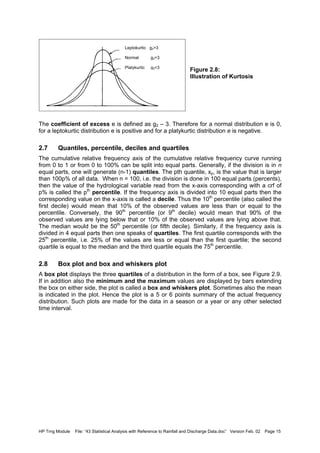
  • 13.
    HP Trng ModuleFile: “43 Statistical Analysis with Reference to Rainfall and Discharge Data.doc” Version Feb. 02 Page 3 with time intervals less than a year should not be subjected to statistical analysis. Annual values generally do not have the problem of periodicity (unless spectral analysis shows otherwise due to some over-annual effect) and are fit for statistical analysis, provided that transient components are not present or have been eliminated. Now, returning to our monthly series, periodicity is avoided if the months are considered separately, that is e.g. if only the values of July of successive years are considered. Similarly, if seasonal series are available, one should consider one season at a time for statistical analysis, i.e. the same season for a number of years. To illustrate the above considerations monthly rainfall and its statistics of station Chaskman are shown in Figures 1.2 and 1.3. As can be observed from Figure 1.3, there is a strong periodic component in the time series; the mean and standard deviation vary considerably from month to month. Figure 1.2: 3-D plot of monthly rainfall of station Chaskman If one would combine the rainfall values of all months one assumes that their probability distribution is the same, which is clearly not so. To fulfil the stationarity condition, statistics is to be applied to each month separately, see Figure 1.2 A series composed of data of a particular month or season in successive years is likely to be serially uncorrelated, unless over-annual effects are existent. Hence, such series will be fully random. Similar observations apply to annual maximum series. It implies that the time sequence of the series considered is unimportant. Above considerations are typical for statistical analysis. In this module statistics is discussed and the following topics will be dealt with: • Description of data sets • Probabilistic concepts • Discrete and continuous probability distributions • Estimation of distribution parameters • Making statistical inference 1 2 3 4 5 6 7 8 9 10 11 12 13 14 15 16 17 18 19 20 21 Jan Feb Mar Apr May Jun Jul Aug Sep Oct Nov Dec 0 50 100 150 200 250 300 350 400 450 Rainfall(mm) DIRECTION OF STATISTICAL ANALYSIS
  • 14.
    HP Trng ModuleFile: “43 Statistical Analysis with Reference to Rainfall and Discharge Data.doc” Version Feb. 02 Page 4 Figure 1.3: Mean and standard deviation of monthly rainfall series of station Chaskman, period 1977 - 1998 2 Description of Datasets 2.1 General In this sub-section on basic statistics attention will be given to: • Graphical presentation of data • Measures of central tendency • Measures of dispersion • Measure of asymmetry: skewness • Measure of peakedness: kurtosis • Percentiles • Box plots • Covariance and correlation coefficient 2.2 Graphical representation For graphical presentation of the distribution of data the following options are discussed: • Line diagram or bar chart • Histogram • Cumulative relative frequency diagram • Frequency and duration curves Note: prior to the presentation of data in whatever frequency oriented graph, it is essential to make a time series plot of the data to make sure that a strong trend or any other type of inhomogeneity, which would invalidate the use of such presentation, does not exist. Line Diagram or Bar Chart The occurrences of a discrete variate can be classified on a line diagram or a vertical bar chart. In this type of graph, the horizontal axis gives the values of the discrete variable, and the occurrences are represented by the heights of vertical lines. The horizontal spread of 0 20 40 60 80 100 120 140 160 180 Jan Feb Mar Apr May Jun Jul Aug Sep Oct Nov Dec Rainfall(mm) Mean STDV
  • 15.
    HP Trng ModuleFile: “43 Statistical Analysis with Reference to Rainfall and Discharge Data.doc” Version Feb. 02 Page 5 these lines and their relative heights indicate the variability and other characteristics of the data. An example is given in Figure 2.1, where the number of occurrences that in one year the monthly rainfall at Chaskman will exceed 100 mm is presented. The period presented refers to the years 1978 – 1997. Figure 2.1: Line diagram of number of months in a year with rainfall sum > 100 mm for period 1978 - 1997 If the number of entries on the horizontal axis would have been small, it means that the variability in the number of months in a year with P > 100 mm is small. Histogram If the range of outcomes on the variable is becoming large, then the line diagram is not an appropriate tool anymore to present the distribution of the variable. Grouping of data into classes and displaying the number of occurrences in each class to form a histogram will then provide better insight, see Figure 2.2. By doing so information is lost on the exact values of the variable, but the distribution is made visible. The variability of the data is shown by the horizontal spread of the blocks, and the most common values are found in blocks with the largest areas. Other features such as the symmetry of the data or lack of it are also shown. At least some 25 observations are required to make a histogram. An important aspect of making a histogram is the selection of the number of classes nc and of the class limits. The following steps are involved in preparing a histogram: • The number of classes is determined by one of the following options (see e.g. Kottegoda and Rosso (1997): (2.1) (2.2) where: nc = number of classes n = number of observations R = range of observations: Xmax – Xmin Riq = interquartile range, defined by: Riq = Mup – Mlow Mup = median of highest 50% of the data, i.e. 75% of the data is less Mlow = median of lowest 50% of the data, i.e. 25% of the data is less 10 9 8 7 6 5 4 3 2 1 0 0 1 2 3 4 5 Number of months with P > 100 mm in a year Numberofoccurrences Nnc = iq 3 c R2 nR n =
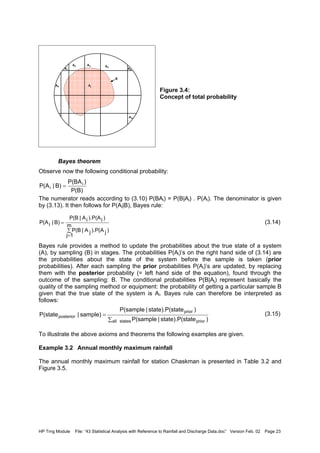
  • 16.
    HP Trng ModuleFile: “43 Statistical Analysis with Reference to Rainfall and Discharge Data.doc” Version Feb. 02 Page 6 • To obtain rounded numbers for the class limits convenient lower and upper limits below Xmin and above Xmax respectively the lowest and highest value have to be selected. • Count the occurrences within each class: class frequency • Present the results in a histogram Figure 2.2: Histogram and cumulative relative frequency diagram of monthly rainfall at Chaskman, months June-September, period 1977 – 1997. The application is shown for monthly rainfall of Chaskman. From Figure 1.2 it is observed, that rainfall in the months June to September behave more or less like a homogeneous group of data. A histogram is made of these monthly values for the years 1977-1997, i.e. 21 years of data. Hence in total the data set comprises 21 x 4 = 84 data points. The data are ranked in ascending order and displayed in Table 2.1 1 2 3 4 5 6 7 8 9 1 12.1 55.4 71.8 92.8 118.1 152.2 196.3 229.0 326.2 2 19.6 55.8 72.2 97.8 124.8 154.4 201.2 234.6 342.6 3 20.8 55.8 74.8 100.2 127.2 158.0 202.8 237.2 404.6 4 26.6 61.2 75.4 101.4 128.0 160.2 206.4 258.0 418.7 5 35.4 61.8 75.8 101.4 130.2 161.0 207.0 258.8 6 37.2 62.8 76.6 103.0 132.8 166.8 221.2 268.2 7 48.8 64.6 77.4 103.8 136.0 169.2 221.4 268.4 8 52.4 65.0 77.6 105.2 136.6 172.8 225.7 281.4 9 52.8 65.6 78.9 105.7 144.0 188.0 227.6 281.8 10 53.4 69.8 87.2 112.4 148.0 193.4 228.4 282.3 The values for Xmin and Xmax are respectively 12.1 mm and 418.7 mm, hence for the range it follows R = 418.7 – 12.1 = 406.6 mm. Since 84 data points are available 42 data are available in the lowest as well as in the highest group, so the values at positions 21 and 63 in the sorted data vector will give the medians for the lowest and highest 50% of the data Mlow and Mup. These values are respectively 71.8 mm and 202.8 mm, hence the interquartile range is Riq = 202.8 – 71.8 = 131.0 mm. According to (2.1) the number of classes in the histogram should be MONTHLY RAINFALL CHASKMAN, JUN-SEP 1977-1997 Frequency R elative Frequency Rainfall (m m) 420360300240180120600 Frequency 30 28 26 24 22 20 18 16 14 12 10 8 6 4 2 0 Cumulativerelativefrequency 1 0.9 0.8 0.7 0.6 0.5 0.4 0.3 0.2 0.1 0 78.6 0.131x2 )84(x6.406 R2 nR n 3/1 iq 3 c ≈=== Table 2.1: June-September monthly rainfall at Chaskman 1977-1997 ranked in ascending order
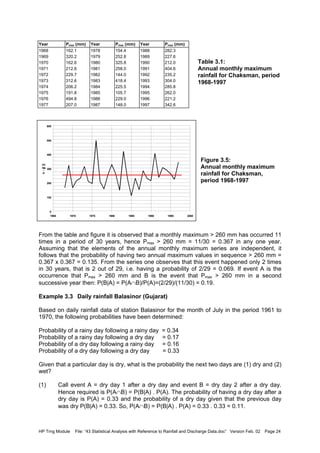
  • 17.
    HP Trng ModuleFile: “43 Statistical Analysis with Reference to Rainfall and Discharge Data.doc” Version Feb. 02 Page 7 Now, with 7 classes, R = 406.6 mm a class interval should be ≥ R/7 ≈ 58 mm, which is rounded to 60 mm. Using this class-interval and since Xmin = 12.1 mm and Xmax = 418.7 mm appropriate overall lower and upper class limits would be 0 mm and 420 mm. The result is displayed in Figure 2.2. The data points in a class are > the lower class limit and ≤ the upper class limit, with the exception of the lowest class, where the lowest value may be = lower class limit. Note that if one uses (2.1) the result would have been √84 ≈ 9 classes, which is a slightly higher value. It follows that the guidelines given in (2.1) and (2.2) are indicative rather than compulsory. In general, at least 5 and at maximum 25 classes are advocated. Equation (2.2) has preference over equation (2.1) as it adapts its number of classes dependent on the peakedness of the distribution. If the histogram is strongly peaked then the inter-quantile range will be small. Consequently, the number of classes will increase, giving a better picture of the peaked zone. Cumulative Relative Frequency Diagram By dividing the frequency in each class of the histogram by the total number of data, the relative frequency diagram is obtained. By accumulating the relative frequencies, starting off from the lower limit of the lowest class up to the upper limit of the highest class the cumulative relative frequency diagram is obtained. For the data considered in the above example, the cumulative relative frequency diagram is shown with the histogram in Figure 2.2. The computational procedure is shown in Table 2.2. Class LCL UCL Freq. Rel. Freq. Cum.R. Fr. 1 0 60 13 0.155 0.155 2 60 120 28 0.333 0.488 3 120 180 17 0.202 0.690 4 180 240 15 0.179 0.869 5 240 300 7 0.083 0.952 6 300 360 2 0.024 0.976 7 360 420 2 0.024 1.000 On the vertical axis of the graph, this line gives the cumulative relative frequencies of values shown on the horizontal axis. Instead of deriving this plot via the histogram, generally it is made by utilising and displaying every item of data distinctly. For this purpose, one ranks the series of size N in ascending order. The cumulative frequency given to the observation at rank m then becomes m/N, i.e. there are m data points less than or equal to the data point at rank m. This is shown in Figure 2.3. Figure 2.3: Cumulative relative frequency distribution for Chaskman June–September data in the period 1977-1997 0.0 0.1 0.2 0.3 0.4 0.5 0.6 0.7 0.8 0.9 1.0 0 60 120 180 240 300 360 420 Rainfall (mm) CumulativerelativefrequencyProb(P<Pi) Table 2.2: Computation of cumulative relative frequencies
  • 18.
    HP Trng ModuleFile: “43 Statistical Analysis with Reference to Rainfall and Discharge Data.doc” Version Feb. 02 Page 8 In Figure 2.3 the highest ranked data point (m = N) gets a cumulative relative frequency of m/N = N/N = 1. To describe the distribution of the data in that particular sample series this statement is correct. No observation exceeded the maximum value. However, in statistics one wants to say something about the distribution of data in the population of which the N observations are just one of many possible samples series. The cumulative relative frequency (crf) is then replaced by the non-exceedance probability. A non-exceedance probability of 1 for the maximum observed in the sample series would then imply that all possible outcomes would be less than or equal to that maximum. Unless there is a physical limit to the data such a statement is not justified. The non-exceedance probability of the maximum in the sample series will be less than 1. The non-exceedance probability to be given to the data point with rank m can be determined by viewing the series of ranked observations as order statistics: X(1), X(2), X(3), …,,X(m),…X(N). The expected value of order statistic X(m) depends first of all on the rank of X(m) relative to X(N). Furthermore is the expected value of X(m) a function of the probability distribution of the process from which the sample points are drawn. This will be discussed in more detail in Section 4. Frequency Curves Considering again the monthly rainfall series of Chaskman, for each month one can make a cumulative frequency distribution. Distinct crf’s are the identified, say e.g. 10%, 50% and 90%, for each month. By displaying the rainfall having say a crf = 10% for all months in the year in a graph a frequency curve is obtained. Similarly for other crf’s such a curve can be made. This is shown in Figure 2.4. Figure 2.4: Frequency curves of monthly rainfall at station Chaskman, period 1968-1997 The computational procedure to arrive at the frequency curves is presented in the Tables 2.3 and 2.4. In Table 2.3 the actual monthly rainfall for a 30-year period is displayed. Next, the data for each month are put in ascending order, see Table 2.4, with the accompanying crf presented in the first column. The rows with crf = 0.1 (10%), 0.5 (50%) and 0.9 (90%) are highlighted and displayed in Figure 2.4. 0 50 100 150 200 250 300 Jan Feb Mar Apr May Jun Jul Aug Sep Oct Nov Dec Rainfall(mm) 10% 50% 90% Cumulative relative frequency
  • 19.
    HP Trng ModuleFile: “43 Statistical Analysis with Reference to Rainfall and Discharge Data.doc” Version Feb. 02 Page 9 Year Jan Feb Mar Apr May Jun Jul Aug Sep Oct Nov Dec Year 1968 0 0 0 0 0 49.8 144.3 60.5 162.1 43.4 47 0 507.1 1969 0 0 0 0 0 10.5 320.2 267.1 81.2 0 50.2 0 729.2 1970 0 0 0 0 60.8 80 124.9 140.5 30 162.6 0 0 598.8 1971 0 0 0 0 44.4 159.2 85.4 197.8 212.6 12 0 0 711.4 1972 0 0 0 3.2 31.4 46 229.7 38.3 0 0 0 0 348.6 1973 0 0 8.6 0 25 85 312.6 134.6 109.2 101.6 0 0 776.6 1974 0 0 0 0 132.2 72 150.8 175.2 206.2 183.4 0 0 919.8 1975 0 0 0 0 8 123.2 146.2 139.4 191.8 111.6 0 0 720.2 1976 0 0 0 0 0 494.8 323.8 208.6 115.2 3 139.2 0 1284.6 1977 0 0 0 0 16.4 188 207 61.8 64.6 44.2 119.4 3.6 705 1978 0 12.6 10.4 53 43.4 154.4 77.4 127.2 124.8 32.8 73.6 0.2 709.8 1979 0 0 0 0 21.4 75.4 93.8 252.8 221.4 13.4 57 0 735.2 1980 0 0 1 14.2 1.4 325.8 169.2 192.4 136.6 17.8 57.6 11.8 927.8 1981 10.8 2.2 0 20.6 9.2 152.2 258 101.4 160.2 53 7.4 2.2 777.2 1982 6.4 0 0 0 21.2 101.4 71.8 144 132.8 47.8 39.2 0 564.6 1983 0 0 0 0 4.2 55.8 75.8 418.4 268.2 2.8 0 0 825.2 1984 0 1.8 0 5.2 0 78.9 225.45 55.4 104.2 0 7 0 477.95 1985 0 0 0 0 31.6 62.8 105.7 74.8 26.6 91.3 0 0 392.8 1986 0 0 0 0 26.8 229 87.2 97.8 105.2 5.1 3.6 46.6 601.3 1987 0 0 0 0 80.2 118.1 65 148 12.1 89.4 8 11.9 532.7 1988 0 0 0.4 22.2 0 72.2 268.4 53.4 282.3 18.1 0 0 717 1989 0 0 6.4 1.4 9.2 37.2 227.6 61.2 190.7 7.6 0 0 541.3 1990 13.8 0 0 0 33.2 66.6 212 161.4 32.4 195.8 18 3.2 736.4 1991 0 0 0 16.2 12.8 404.6 235.4 50.2 48.6 21 9.4 0.6 798.8 1992 0 0 0 0 10.6 112.4 102 235.2 202.8 13.8 20 0 696.8 1993 0 0 1 3.8 15.8 130.2 226.4 66.6 53.4 304 7.2 31.6 840 1994 3.8 0 0 11.4 26 169 285.8 92.2 85 130.8 40.6 0 844.6 1995 35.2 0 2.2 17 15.4 20.8 157.8 19.8 262 87.8 2.2 0 620.2 1996 0.6 0 0 29.4 10.2 206.4 221.2 55.8 128 217.4 2.4 0 871.4 1997 5.4 0 0 12.4 10 136 166.8 342.6 77.6 66.3 148.7 41 1006.8 Table 2.3: Monthly and annual rainfall at station Chaskman, period 1968-1997 crf Jan Feb Mar Apr May Jun Jul Aug Sep Oct Nov Dec Year 0.033 0 0 0 0 0 10.5 65 19.8 0 0 0 0 348.6 0.067 0 0 0 0 0 20.8 71.8 38.3 12.1 0 0 0 392.8 0.100 0 0 0 0 0 37.2 75.8 50.2 26.6 0 0 0 478.0 0.133 0 0 0 0 0 46 77.4 53.4 30 2.8 0 0 507.1 0.167 0 0 0 0 0 49.8 85.4 55.4 32.4 3 0 0 532.7 0.200 0 0 0 0 1.4 55.8 87.2 55.8 48.6 5.1 0 0 541.3 0.233 0 0 0 0 4.2 62.8 93.8 60.5 53.4 7.6 0 0 564.6 0.267 0 0 0 0 8 66.6 102 61.2 64.6 12 0 0 598.8 0.300 0 0 0 0 9.2 72 105.7 61.8 77.6 13.4 0 0 601.3 0.333 0 0 0 0 9.2 72.2 124.9 66.6 81.2 13.8 0 0 620.2 0.367 0 0 0 0 10 75.4 144.3 74.8 85 17.8 2.2 0 696.8 0.400 0 0 0 0 10.2 78.9 146.2 92.2 104.2 18.1 2.4 0 705.0 0.433 0 0 0 0 10.6 80 150.8 97.8 105.2 21 3.6 0 709.8 0.467 0 0 0 0 12.8 85 157.8 101.4 109.2 32.8 7 0 711.4 0.500 0 0 0 0 15.4 101.4 166.8 127.2 115.2 43.4 7.2 0 717.0 0.533 0 0 0 0 15.8 112.4 169.2 134.6 124.8 44.2 7.4 0 720.2 0.567 0 0 0 0 16.4 118.1 207 139.4 128 47.8 8 0 729.2 0.600 0 0 0 1.4 21.2 123.2 212 140.5 132.8 53 9.4 0 735.2 0.633 0 0 0 3.2 21.4 130.2 221.2 144 136.6 66.3 18 0 736.4 0.667 0 0 0 3.8 25 136 225.45 148 160.2 87.8 20 0 776.6 0.700 0 0 0 5.2 26 152.2 226.4 161.4 162.1 89.4 39.2 0.2 777.2 0.733 0 0 0 11.4 26.8 154.4 227.6 175.2 190.7 91.3 40.6 0.6 798.8 0.767 0 0 0 12.4 31.4 159.2 229.7 192.4 191.8 101.6 47 2.2 825.2 0.800 0.6 0 0.4 14.2 31.6 169 235.4 197.8 202.8 111.6 50.2 3.2 840.0 0.833 3.8 0 1 16.2 33.2 188 258 208.6 206.2 130.8 57 3.6 844.6 0.867 5.4 0 1 17 43.4 206.4 268.4 235.2 212.6 162.6 57.6 11.8 871.4 0.900 6.4 0 2.2 20.6 44.4 229 285.8 252.8 221.4 183.4 73.6 11.9 919.8 0.933 10.8 1.8 6.4 22.2 60.8 325.8 312.6 267.1 262 195.8 119.4 31.6 927.8 0.967 13.8 2.2 8.6 29.4 80.2 404.6 320.2 342.6 268.2 217.4 139.2 41 1006.8 1.000 35.2 12.6 10.4 53 132.2 494.8 323.8 418.4 282.3 304 148.7 46.6 1284.6 Table 2.4: Monthly and annual rainfall at station Chaskman, period 1968-1997 ordered in ascending order per column
  • 20.
    HP Trng ModuleFile: “43 Statistical Analysis with Reference to Rainfall and Discharge Data.doc” Version Feb. 02 Page 10 By plotting the rainfall of a particular year with the frequency curves one has a proper means to assess how the rainfall in each month in that particular year behaved compared to the long term rainfall in that month. However, the say 10% curve should not be considered as a 10%-wet year. To show this in the last column of Table 2.4 the ranked annual values are presented as well. The rainfall in 10%-wet year amounts 478 mm, whereas the sum of the 10% monthly rainfall amounts add up to 189.8 mm only. Similar conclusions can be drawn for other crf’s. This is shown in Figure 2.5 a, b, c. Figure 2.5a Figure 2.5b Figure 2.5c Figure 2.5 a, b, c: Frequency curves of crf = 10, 50 and 90% with 10%, 50% and 90% wet year records. 0 50 100 150 200 250 300 Jan Feb Mar Apr May Jun Jul Aug Sep Oct Nov Dec Rainfall(mm) 10% 50% 90% 1984 (dry) 0 50 100 150 200 250 300 Jan Feb Mar Apr May Jun Jul Aug Sep Oct Nov Dec Rainfall(mm) 10% 50% 90% 1988 (medium) 0 50 100 150 200 250 300 Jan Feb Mar Apr May Jun Jul Aug Sep Oct Nov Dec Rainfall(mm) 10% 50% 90% 1974 (wet)
  • 21.
    HP Trng ModuleFile: “43 Statistical Analysis with Reference to Rainfall and Discharge Data.doc” Version Feb. 02 Page 11 In the above text frequency curves were discussed for monthly rainfall data. Basically, the technique can be applied to any hydrological variable and the interval may also be day, 10 days, season, etc. Generally, say, we have M observations in a year for N years. Let the observation on the hydrological variable in interval m in year n be denoted by Xm,n. Then for n = 1, N the Xm’s are put in ascending order: Xm,k, where k is the rank of Xm,n, with k running from 1 to N. De crf attributed to Xm,n is k/N (or k/(N+1) or some other estimate for the probability of non-exceedance as discussed earlier). By selecting a specific value for k = k1 corresponding to a required crf the sequence of Xm,k1 for m = 1,M will give us the required frequency curve. In case a required crf, for which a frequency curve is to be made, does not correspond with the kth rank in the sequence of N values, linear interpolation between surrounding values is to be applied. Duration Curves For the assessment of water resources, navigational depths, etc. it may be useful to draw duration curves. When dealing with flows in rivers, this type of graphs is known as a flow duration curve. It is in effect a cumulative frequency diagram with specific time scales. On the horizontal axis the percentage of time or the number of days/months per year or season during which the flow is not exceeded may be given. The volume of flow per day/month or flow intensity is given on the vertical axis. (The above convention is the display adopted in HYMOS; others interchange the horizontal and vertical axis.) Similarly, duration curves may be developed for any other type of variable. In Figure 2.6 the duration curve for the monthly rainfall at Chaskman for the period 1968-1997 is presented. Figure 2.6 tells us that there is no rain during at least four months in a year, and on average there is only one month in a year with a monthly total larger than 200 mm. However, from Table 2.3 it can be observed that during 8 years out of 30 the 200 mm threshold was exceeded during two months. So the curve only displays average characteristics. The curve is obtained by multiplying the cumulative relative frequency associated with an observation with the number of intervals one has considered in a year or a season. Figure 2.6: Duration curve of monthly rainfall for station Chaskman D uration (month) 1211109876543210 Rainfall(mm) 500 450 400 350 300 250 200 150 100 50 0
  • 22.
    HP Trng ModuleFile: “43 Statistical Analysis with Reference to Rainfall and Discharge Data.doc” Version Feb. 02 Page 12 2.3 Measures of Central Tendency Measures of the central tendency of a series of observations are: • Mean • Median • Mode Mean The mean of a sample of size N is defined by (2.3) where xi = individual observed value in the sample N = sample size i.e. total number of observed values m = mean of the sample size n. When dealing with catchment rainfall determined by Thiessen method, the mean is weighted according to the areas enclosed by bisectors around each station. The sum of the weights is 1: (2.4) Median The median M of a sample is the middle value of the ranked sample, if N is odd. If N is even it is the average of the two middle values. The cumulative relative frequency of the median is 0.5. For a symmetrical distribution the mean and the median are similar. If the distribution is skewed to the right, then M < m, and when skewed to the left M > m. Mode The mode of a sample is the most frequently occurring value and hence corresponds with the value for which the distribution function is maximum. In Figure 2.2 the mode is in the class 60-120 mm and can be estimated as 90 mm. 2.4 Measures of Dispersion Common measures of dispersion are: • the range, • the variance, • the standard deviation, and • coefficient of variation. Range The range of a sample is the difference between the largest and smallest sample value. Since the sample range is a function of only two of the N sample values it contains no information about the distribution of the data between the minimum and maximum value. ∑ = = N 1i i x N 1 m ∑ = ∑ == N 1i i w N 1i i x i w w m
  • 23.
    HP Trng ModuleFile: “43 Statistical Analysis with Reference to Rainfall and Discharge Data.doc” Version Feb. 02 Page 13 The population range of a hydrological variable is in many cases, the interval from 0 to ∞, and as such displays no information about the process. In hydrology the word ‘range’ is also used to quantify the range of accumulative departures from the mean (also indicated as partial sums). That value has important implications when dealing with water storage. It is a measure for the required storage when the average flow is to be drawn from a reservoir. Variance The most common measure of dispersion used in statistical analysis is the variance, estimated by s2 : . (2.5) The reason for using the divisor N-1 instead of N is that it will result in an unbiased estimate for the variance. The units of the variance are the same as the units of x2 . Standard deviation The standard deviation s is the root of the variance and provides as such a measure for the dispersion of the data in the sample set in the same dimension as the sample data. It is estimated by: (2.6) Coefficient of Variation A dimensionless measure of dispersion is the coefficient of variation Cv defined as the standard deviation divided by the mean: (2.7) Note that when m = 0 the coefficient of variation Cv becomes undefined; hence for normalised distributions this measure cannot be applied. From Figure 1.3 it is observed that the coefficient of variation of the monthly rainfall at Chaskman is > 1 for the dry period, but < 1 during the monsoon. 2.5 Measure of Symmetry: Skewness Distributions of hydrological variables are often skewed, i.e. non-symmetrical. The distributions are generally skewed to the right, like daily rainfall. By aggregation of data, the distribution of the aggregate will approach normality, i.e. will become symmetrical. Positively and negatively skewed distributions and symmetrical distributions are shown in Figure 2.7. ∑ = − − = N 1i 2 i 2 m)(x 1N 1 s s = 1 N-1 (x m)i 2 i 1 N − = ∑ m s Cv =
  • 24.
    HP Trng ModuleFile: “43 Statistical Analysis with Reference to Rainfall and Discharge Data.doc” Version Feb. 02 Page 14 Figure 2.7: Examples of symmetrical and positively and negatively skewed distributions, with locations of mean, median and mode The skewness is derived from the third central moment of the distribution, scaled by the standard deviation to the power 3. An unbiased estimate for the coefficient of skewness can be obtained from the following expression: (2.8) In Figure 2.7 the relative position of the mean, median and mode for symmetrical and positively and negatively skewed distributions is presented. 2.6 Measure of Peakedness: Kurtosis Kurtosis refers to the extent of peakedness or flatness of a probability distribution in comparison with the normal distribution, see Figure 2.8. The sample estimate for kurtosis is: (2.9) The kurtosis is seen to be the 4th moment of the distribution about the mean, scaled by the 4th power of the standard deviation. The kurtosis for a normal distribution is 3. The normal distribution is said to be mesokurtic. If a distribution has a relatively greater concentration of probability near the mean than does the normal, the kurtosis will be greater than 3 and the distribution is said to be leptokurtic. If a distribution has a relatively smaller concentration of a probability near the mean than does the normal, the kurtosis will be less than 3 and the distribution is said to be platykurtic. P o s itiv e s k e w n e s s D is trib u tio n s k e w e d to th e rig h t M O D E M E D IA N M E A N M O D E M E D IA N M E A N N e g a tiv e s k e w n e s s D is trib u tio n s k e w e d to th e le ft S y m m e tric a l d is trib u tio n S k e w n e s s = 0 M O D E = M E D IA N = M E A N 3 N 1i 3 i 1 s m)(x 2)1)(N(N N g ∑ = − −− = 4 N 1i 4 i2 2 s m)(x 3)2)(N1)(N(N 32NN g ∑ = − −−− +− =
  • 25.
    HP Trng ModuleFile: “43 Statistical Analysis with Reference to Rainfall and Discharge Data.doc” Version Feb. 02 Page 15 Figure 2.8: Illustration of Kurtosis The coefficient of excess e is defined as g2 – 3. Therefore for a normal distribution e is 0, for a leptokurtic distribution e is positive and for a platykurtic distribution e is negative. 2.7 Quantiles, percentile, deciles and quartiles The cumulative relative frequency axis of the cumulative relative frequency curve running from 0 to 1 or from 0 to 100% can be split into equal parts. Generally, if the division is in n equal parts, one will generate (n-1) quantiles. The pth quantile, xp, is the value that is larger than 100p% of all data. When n = 100, i.e. the division is done in 100 equal parts (percents), then the value of the hydrological variable read from the x-axis corresponding with a crf of p% is called the pth percentile. If the frequency axis is divided into 10 equal parts then the corresponding value on the x-axis is called a decile. Thus the 10th percentile (also called the first decile) would mean that 10% of the observed values are less than or equal to the percentile. Conversely, the 90th percentile (or 9th decile) would mean that 90% of the observed values are lying below that or 10% of the observed values are lying above that. The median would be the 50th percentile (or fifth decile). Similarly, if the frequency axis is divided in 4 equal parts then one speaks of quartiles. The first quartile corresponds with the 25th percentile, i.e. 25% of the values are less or equal than the first quartile; the second quartile is equal to the median and the third quartile equals the 75th percentile. 2.8 Box plot and box and whiskers plot A box plot displays the three quartiles of a distribution in the form of a box, see Figure 2.9. If in addition also the minimum and the maximum values are displayed by bars extending the box on either side, the plot is called a box and whiskers plot. Sometimes also the mean is indicated in the plot. Hence the plot is a 5 or 6 points summary of the actual frequency distribution. Such plots are made for the data in a season or a year or any other selected time interval. Leptokurtic g2>3 Normal g2=3 Platykurtic g2<3
  • 26.
    HP Trng ModuleFile: “43 Statistical Analysis with Reference to Rainfall and Discharge Data.doc” Version Feb. 02 Page 16 Figure 2.9: Features of a box and whiskers plot By displaying the box and bars for successive years a quick insight is provided into the variation of the process from year to year. This form is very popular for displaying the behaviour of water quality variables. For that purpose the plot is extended with threshold values on a particular water quality variable. In Figure 2.10 an example is given of a box and whiskers plot applied to discharge measurements at station Rakshewa in Bhima basin, where the statistics of the measurements from 1995 to 1998 are shown for each year separately. Figure 2.10: Box and whiskers plot of discharge measurements at station Rakshewa in Bhima basin, period 1995 – 1998. It is clearly observed from the boxes and bars in Figure 2.10 that the distribution of the measured discharges in a year is skewed to the right. Generally, a large number of discharge measurements are available for the very low stages and only a few for the higher stages. Hence the extent of the box (which comprises 50% of the measurements) is very small compared to the range of the data. The mean is seen to be always larger than the median. 1998199719961995 1,500 1,400 1,300 1,200 1,100 1,000 900 800 700 600 500 400 300 200 100 0 Hydrologicalvariable P,Q,etc. Time MAXIMUM 3rd QUARTILE (75th PERCENTILE) MEAN MEDIAN (= 2nd QUARTILE = 50th PERC.) 1st QUARTILE (25th PERCENTILE) MINIMUM
  • 27.
    HP Trng ModuleFile: “43 Statistical Analysis with Reference to Rainfall and Discharge Data.doc” Version Feb. 02 Page 17 2.9 Covariance and Correlation Coefficient When simultaneous observations on hydrological variables are available then one may be interested in the linear association between the variables. This is expressed by the covariance and correlation coefficient. If there are N pairs of observations (x1, y1), (x2, y2), …, (xN, yN), of two variables X and Y, the sample covariance is obtained from the following expression: (2.10) where: mX, mY = sample means of X and Y respectively: The correlation coefficient rXY is obtained by scaling the covariance by the standard deviations of X and Y: (2.11) where: sX , sY = sample standard deviations of X and Y. To get the limits of rXY consider the case that X and Y have a perfect linear correlation. Then the relationship between X and Y is given by : Y = a + bX and hence: mY = a + bmX and: sY 2 = b2 sX 2 or: sY = |b|sX Substituting above relations in (2.11) gives: (2.12) If Y increases for increasing X, i.e. they are positively correlated, then b > 0 and rXY is seen to be 1. If on the other hand Y decreases when X is increasing, they are negatively correlated; then b < 0 and rXY is –1. So rXY is seen to vary between ±1: –1 ≤ rXY ≤ 1. If there is no linear association between X and Y then rXY is 0. If rXY is 0 it does not mean that X and Y are independent or that there is no association between X and Y. It only means that the linear association is not existing. Still, there may be for example a circular association. A convenient means to investigate the existence of linear association is by making a XY- scatter plot of the samples. Typical examples of scatter plots are shown in Figure 2.11. ∑ = −− − = N 1i YiXiXY )m)(ym(x 1N 1 Cˆ YX YiX N 1i i YX XY XY ss )m)(ym(x 1N 1 ss Cˆ r −− − == ∑ = b b s )m(x 1N 1 b b sbs ))bm(abx)(am(x 1N 1 r 2 X 2 Xi XX XiXi XY = − − = +−+− − = ∑∑
  • 28.
    HP Trng ModuleFile: “43 Statistical Analysis with Reference to Rainfall and Discharge Data.doc” Version Feb. 02 Page 18 Figure 2.11: Examples of scatter plots In some cases the scatter plot may indicate a non-linear type of relationship between the two variables. In such cases some transformation, e.g. a logarithmic, square root, negative reciprocal, or other appropriate transformation to one or both variables may be applied before analysis. Spurious correlation The lower left plot in Figure 2.11 gives an example of spurious correlation, which is easily obtained in hydrology, when blindly data are being compared. For example if there is a distinct wet and dry period and the discharges of two sites in different regions, but both subjected to monsoonal variation, are plotted in an XY-plot, a situation like the one displayed will occur. In the wet period the data at X and Y may be completely uncorrelated, but simply by the fact of the existence of a dry and wet period, which clusters observations in the low and the high regions, the correlation is seemingly very high. This effect is due to the acceptance of heterogeneous data, see also Figure 1.2 and 1.3. By taking the low and high flow values in the same data set, the overall mean value for X and Y will be somewhere between the low and the high values. Hence entries in the wet period on either side will be positive relative to the mean and so will be their products. In the same way, entries in the dry period will both be negative relative to the mean, so their product will be positive as well, ending up into a large positive correlation. Similarly, wrong conclusions can be drawn by comparing data having the same denominator. If X, Y and Z are uncorrelated and X/Z and Y/Z are subjected to correlation analysis, a non-zero correlation will be found (see e.g. Yevjevich, (1972)): (2.13) From (2.13) it is observed, that when all coefficients of variation are equal, it follows that r = 0.5!!! It indicates that one has to select the sample sets to be subjected to correlation and regression analysis carefully. Common divisors should be avoided. Also, the direction of analysis as indicated in Figure 2.2 is of utmost importance to ensure homogeneous data sets. Y X Y X Y X Y X Strong linear correlation between X and Y No correlation between X and Y; X and Y are independent No linear correlation between X and Y but strong circular correlation: X and Y are not independent Spurious correlation ( ) ( )1/22 v,Z 2 Yv, 1/22 v,Z 2 Xv, 2 v,Z CCCC C r ++ =
  • 29.
    HP Trng ModuleFile: “43 Statistical Analysis with Reference to Rainfall and Discharge Data.doc” Version Feb. 02 Page 19 3 Fundamental Concepts of Probability 3.1 3.1 Axioms and Theorems Sample and Space Events The sample space denoted by Ω, is defined here as the collection of all possible outcomes of sampling on a hydrological variable. An event is a collection of sample points in the sample space Ω of an experiment. An event can consists of a single sample point called a simple or elementary event, or it can be made up of two or more sample points known as a compound event. An event is (denoted by a capital letter A (or any other letter)) is thus a subset of sample space Ω. The Null Event, Intersection and Union Two events A1 and A2 are mutually exclusive or disjoint if the occurrence of A1 excludes A2, i.e. none of the points contained in A1 is contained in A2. and vice versa. The intersection of the events A1 and A2 is that part of the sample space they have in common. This is denoted by A1∩A2 or A1A2. If A1 and A2 are mutually exclusive then their intersection constitutes a null event: A1∩A2 = A1A2 = ∅. The union of two events A1 and A2 represents their joint occurrences, and it comprises the event containing the entire sample in A1 and A2. This is denoted by A1∪A2, or simply A1+ A2. With the latter notation one has to be careful as the sum of the two has to be corrected for the space in common (i.e. the intersection. The intersection is equivalent to the “and” logical statement, whereas the union equivalent to “and/or”. The above definitions have been visualised in Figure 3.1 by means of Venn diagrams. Figure 3.1: Definition sketch by Venn diagrams The definitions are illustrated in the following example: Ω ΩΩ Ω A1 A A1 A1 A2 A2 A2 B A1 and A2 mutually exclusive intersection A1 ∩A2 A1 ∪A2 A∩B Union Conditional probability
  • 30.
    HP Trng ModuleFile: “43 Statistical Analysis with Reference to Rainfall and Discharge Data.doc” Version Feb. 02 Page 20 Example 3.1 Events in a sample space. Sample space and events representing rainy days (i) and total rainfall (p) at a rainfall station during the period 1-10 July are given in Figure 3.2: The sample space reads: Ω ≡ {(i,p): i = 0, 1, 2,…,10; and 0 ≤ p} Event A1 ≡ {(i,p): i > 3, and p > 50} Event A2 ≡ {(i,p): 3 ≤ i < 5, and p > 20} Event A3 ≡ {(i,p): 1 ≤ i < 3, and 2 ≤ p < 30} Figure 3.2: Presentation of sample space Ω events A1, A2 and A3 The union and intersection of A1 and A2 and of A2 and A3 are presented in Figure 3.3. Event A1 + A2 ≡ {(i,p): 3 ≤ i < 5, and p > 20; i ≥ 5, and p > 50} Event A1A2 ≡ {(i,p): i = 4 and p > 50} Event A2 + A3 ≡ {(i,p): 1 ≤ i < 3, and 2 ≤ p < 30; 3 ≤ i < 5, and p > 20} Event A2A3 = ∅, since A2 and A3 are disjoint, having no points in common. Figure 3.3: Unions and intersections of AI and A2 and of A2 and A3 Rainydays 10 9 8 7 6 5 4 3 2 1 0 50 100 Rainfall (mm) 10 9 8 7 6 5 4 3 2 1 0 50 100 Rainydays 10 9 8 7 6 5 4 3 2 1 0 50 100 Rainfall (mm) 10 9 8 7 6 5 4 3 2 1 0 50 100 Rainydays 10 9 8 7 6 5 4 3 2 1 0 50 100 Rainfall (mm) 10 9 8 7 6 5 4 3 2 1 0 50 100 Rainydays 10 9 8 7 6 5 4 3 2 1 0 50 100 Rainfall (mm) 10 9 8 7 6 5 4 3 2 1 0 50 100 Sample space Event A1 Event A2 Event A3 Rainydays 10 9 8 7 6 5 4 3 2 1 0 50 100 Rainfall (mm) 10 9 8 7 6 5 4 3 2 1 0 50 100 Rainydays 10 9 8 7 6 5 4 3 2 1 0 50 100 Rainfall (mm) 10 9 8 7 6 5 4 3 2 1 0 50 100 Rainydays 10 9 8 7 6 5 4 3 2 1 0 50 100 Rainfall (mm) 10 9 8 7 6 5 4 3 2 1 0 50 100 Event A1+A2 Event A2A3 Rainydays 10 9 8 7 6 5 4 3 2 1 0 50 100 Rainfall (mm) 10 9 8 7 6 5 4 3 2 1 0 50 100 Event A1A2 Event A2+A3
  • 31.
    HP Trng ModuleFile: “43 Statistical Analysis with Reference to Rainfall and Discharge Data.doc” Version Feb. 02 Page 21 Probability axioms and theorems Using these definitions the following axioms and theorems are discussed dealing with the probability of an event or several events in the sample space. Definition of probability If a random events occurs a large number of times N, of which NA times the event A happens, then the probability of the occurrence of event A is: (3.1) Hence, if A is any event in a sample space Ω, then: 0 ≤ P(A) ≤ 1 (3.2) The event in the sample space not contained in A is the complement of A, denoted by AC : P(AC ) = 1 – P(A) (3.3) If A is a certain event then: P(A) = 1 (3.4) Probability of the union of events For any set of arbitrary events A1 and A2 the probability of the union of the events, i.e. the probability of event A1 and/or A2 is: P(A1∪A2) = P(A1) + P(A2) – P(A1∩A2) (3.5) The last term is the intersection of A1 and A2, i.e. the part in the sample space they have in common. So, if A1 and A2 have no outcomes in common, i.e if they are mutually exclusive, then the intersection of the two events is a null event and then (3.5) reduces to: P(A1∪A2) = P(A1) + P(A2) (3.6) For three joint events it generally follows: P(A1 + A2 + A3) = P(A1) + P(A2) + P(A3) – P(A1 A2) – P(A1 A3) – P(A2 A3) + P(A1 A2 A3) (3.7) For any set of arbitrary events A1, A2, … , Am the probability of the union becomes a complicated expression, (see e.g. Suhir, 1997), but if the events A1, A2, … , Am have no outcomes or elements in common, i.e. if they are mutually exclusive, then the union of the events have the probability: (3.8) N N limP(A) A N ∞→= ∑∑ == =        m 1j jj )P(AAP m j 1
  • 32.
    HP Trng ModuleFile: “43 Statistical Analysis with Reference to Rainfall and Discharge Data.doc” Version Feb. 02 Page 22 Hence, the probability of the intersection is seen to have vanished as it constitutes a null event for mutually exclusive events. Conditional probability The conditional probability P(B|A) gives the probability of event B given that A has occurred. Here A serves as a new (reduced) sample space (see Figure 3.1) and P(B|A) is that fraction of P(A) which corresponds to A∩B, hence: (3.9) Denoting P(A∩B) ≡ P(AB) it follows: P(AB) = P(B|A) . P(A) (3.10) Independence If A and B are independent events, i.e. the occurrence of B is not affected by the occurrence of A, then: P(B|A) = P(B) (3.11) and hence: P(AB) = P(B) . P(A) (3.12) It states that if the events A and B are independent, the probability of the occurrence of event A and B equals the product of the marginal probabilities of the individual events. Total probability Consider an event B in Ω with P(B) ≠ 0 and the mutually exclusive events A1, A2, …, Am, which are collectively exhaustive, i.e. A1 + A2 + …+ Am = Ω. Then the events BA1, BA2, …, BAm are also mutually exclusive and BA1 + BA2 + …+ BAm = B(A1 + A2 + …+ Am) = BΩ = B. Hence: (3.13) This is called the theorem of total probability, which is visualised in Figure 3.4. P(A) B)P(A A)|P(B ∩ = ∑=∑= == m 1j jj m 1j j )).P(AA|P(B)P(BAP(B)
  • 33.
    HP Trng ModuleFile: “43 Statistical Analysis with Reference to Rainfall and Discharge Data.doc” Version Feb. 02 Page 23 Figure 3.4: Concept of total probability Bayes theorem Observe now the following conditional probability: The numerator reads according to (3.10) P(BAi) = P(B|Ai) . P(Ai). The denominator is given by (3.13). It then follows for P(Ai|B), Bayes rule: (3.14) Bayes rule provides a method to update the probabilities about the true state of a system (A), by sampling (B) in stages. The probabilities P(Ai)’s on the right hand side of (3.14) are the probabilities about the state of the system before the sample is taken (prior probabilities). After each sampling the prior probabilities P(Ai)’s are updated, by replacing them with the posterior probability (= left hand side of the equation), found through the outcome of the sampling: B. The conditional probabilities P(B|Aj) represent basically the quality of the sampling method or equipment: the probability of getting a particular sample B given that the true state of the system is Ai. Bayes rule can therefore be interpreted as follows: (3.15) To illustrate the above axioms and theorems the following examples are given. Example 3.2 Annual monthly maximum rainfall The annual monthly maximum rainfall for station Chaskman is presented in Table 3.2 and Figure 3.5. B Am A5 A4 A3A2 A1 AjA6 P(B) )P(BA B)|P(A i i = ∑ = = m 1j )j).P(AjA|P(B )i).P(AiA|P(B B)|iP(A ∑ = statesall prior prior posterior )tatestate).P(s|P(sample )tatestate).P(s|P(sample sample)|P(state
  • 34.
    HP Trng ModuleFile: “43 Statistical Analysis with Reference to Rainfall and Discharge Data.doc” Version Feb. 02 Page 24 Year Pmax (mm) Year Pmax (mm) Year Pmax (mm) 1968 162.1 1978 154.4 1988 282.3 1969 320.2 1979 252.8 1989 227.6 1970 162.6 1980 325.8 1990 212.0 1971 212.6 1981 258.0 1991 404.6 1972 229.7 1982 144.0 1992 235.2 1973 312.6 1983 418.4 1993 304.0 1974 206.2 1984 225.5 1994 285.8 1975 191.8 1985 105.7 1995 262.0 1976 494.8 1986 229.0 1996 221.2 1977 207.0 1987 148.0 1997 342.6 Figure 3.5: Annual monthly maximum rainfall for Chaksman, period 1968-1997 From the table and figure it is observed that a monthly maximum > 260 mm has occurred 11 times in a period of 30 years, hence Pmax > 260 mm = 11/30 = 0.367 in any one year. Assuming that the elements of the annual monthly maximum series are independent, it follows that the probability of having two annual maximum values in sequence > 260 mm = 0.367 x 0.367 = 0.135. From the series one observes that this event happened only 2 times in 30 years, that is 2 out of 29, i.e. having a probability of 2/29 = 0.069. If event A is the occurrence that Pmax > 260 mm and B is the event that Pmax > 260 mm in a second successive year then: P(B|A) = P(A∩B)/P(A)=(2/29)/(11/30) = 0.19. Example 3.3 Daily rainfall Balasinor (Gujarat) Based on daily rainfall data of station Balasinor for the month of July in the period 1961 to 1970, the following probabilities have been determined: Probability of a rainy day following a rainy day = 0.34 Probability of a rainy day following a dry day = 0.17 Probability of a dry day following a rainy day = 0.16 Probability of a dry day following a dry day = 0.33 Given that a particular day is dry, what is the probability the next two days are (1) dry and (2) wet? (1) Call event A = dry day 1 after a dry day and event B = dry day 2 after a dry day. Hence required is P(A∩B) = P(B|A) . P(A). The probability of having a dry day after a dry day is P(A) = 0.33 and the probability of a dry day given that the previous day was dry P(B|A) = 0.33. So, P(A∩B) = P(B|A) . P(A) = 0.33 . 0.33 = 0.11. 0 100 200 300 400 500 600 1965 1970 1975 1980 1985 1990 1995 2000 P ma x (m m) Table 3.1: Annual monthly maximum rainfall for Chaksman, period 1968-1997
  • 35.
    HP Trng ModuleFile: “43 Statistical Analysis with Reference to Rainfall and Discharge Data.doc” Version Feb. 02 Page 25 (2) Call event A = wet day 1 after a dry day and event B = wet day 2 after a dry day. Now we require again P(A∩B) = P(B|A) . P(A). The probability of a wet day after a dry day is P(A) = 0.17 and the probability of a wet day given that the previous day was also wet = P(B|A) = 0.34. Hence, P(A∩B) = P(B|A). P(A) = 0.34 . 0.17 = 0.06. This probability is seen to be about half the probability of having two dry days in a row after a dry day. This is due to the fact that for Balasinor the probability of having a wet day followed by a dry day or vice versa is about half the probability of having two wet or two dry days sequentially. Example 3.4 Prior and posterior probabilities, using Bayes rule In a basin for a considerable period of time rainfall was measured using a dense network. Based on these values for the month July the following classification is used for the basin rainfall. Class Rainfall (mm) Probability Dry Moderate Wet Extremely wet P < 50 50 ≤ P < 200 200 ≤ P < 400 P ≥ 400 P[A1] = 0.15 P[A2] = 0.50 P[A3] = 0.30 P[A4] = 0.05 Table 3.2: Rainfall classes and probability. The probabilities presented in Table 3.2 refer to prior probabilities. Furthermore, from the historical record it has been deduced that the percentage of gauges, which gave a rainfall amount in a certain class given that the basin rainfall felt in a certain class is given in Table 3.3. Percentage of gaugesBasin rainfall P < 50 50 ≤ P < 200 200 ≤ P < 400 P ≥ 400 P < 50 50 ≤ P < 200 200 ≤ P < 400 P ≥ 400 80 25 5 0 15 65 20 10 5 8 60 25 0 2 15 65 Table 3.3: Conditional probabilities for gauge value given the basin rainfall Note that the conditional probabilities in the rows add up to 100%. For a particular year a gauge gives a rainfall amount for July of 230 mm. Given that sample value of 230 mm, what is the class of the basin rainfall in July for that year. Note that the point rainfall falls in class III. The posterior probability of the actual basin rainfall in July of that year becomes: The denominator becomes: The denominator expresses the probability of getting sample 1 when the prior probabilities are as given in Table 3.2, which is of course very low. ∑ = = 4 1i ii ii i ]].P[AA|1P[sample ]].P[AA|1P[sample 1]sample|P[A 0.2950.15x0.050.60x0.300.20x0.500.05x0.15]A|[sample1 4 1i i =+++=∑ =
  • 36.
    HP Trng ModuleFile: “43 Statistical Analysis with Reference to Rainfall and Discharge Data.doc” Version Feb. 02 Page 26 Hence, Note that the sum of posterior probabilities adds up to 1. Now, for the same month in the same year from another gauge a rainfall of 280 mm is obtained. Based on this second sample the posterior probability of the actual July basin rainfall in that particular year can be obtained by using the above posterior probabilities as revised prior probabilities for the July rainfall: Note that the denominator has increased from 0.240 to 0.478. Again note that the posterior probabilities add up to 1. From the above it is seen how the probability on the state of July rainfall changes with the two sample values: Class Prior probability After sample 1 After sample 2 I II III IV 0.15 0.50 0.30 0.05 0.025 0.340 0.610 0.025 0.003 0.155 0.834 0.008 Table 3.4: Updating of state probabilities by sampling Given the two samples, the probability that the rainfall in July for that year is of class III has increased from 0.30 to 0.834. Question: What will be the change in the last column of Table 3.4 if the third sample gives a value of 180 mm? 0.025 0.295 0.15x0.05 sample1]|P[A 0.610 0.295 0.60x0.30 sample1]|P[A 0.340 0.295 0.20x0.50 sample1]|P[A 0.025 0.295 0.05x0.15 sample1]|P[A 4 3 2 1 == == == == ∑ = =+++= 4 1i i 0.4390.15x0.0250.60x0.6100.20x0.3400.05x0.025]A|2[sample 0.008 0.439 0.15x0.025 2]sample|P[A 0.834 0.439 0.60x0.610 2]sample|P[A 0.155 0.439 0.20x0.340 2]sample|P[A 0.003 0.439 0.05x0.025 2]sample|P[A 4 3 2 1 == == == ==
  • 37.
    HP Trng ModuleFile: “43 Statistical Analysis with Reference to Rainfall and Discharge Data.doc” Version Feb. 02 Page 27 3.2 Frequency distributions 3.2.1 Univariate distributions Discrete random variables Formally, given a data set x1, x2, …., xN of a stochatic variable X, the probability mass function (pmf) pX(x) expresses: pX(x) = P(X = x) (3.16) and the cumulative distribution function (cdf) FX(x) gives the probability of occurrence X ≤ x: (3.17) Continuous random variables In terms of continuous random variables, the continuous equivalent of the pmf is the probability density function (pdf), fX(x). The probability that X takes on values in the interval (x, x + dx) then reads fX(x).dx: fX(x).dx = P(x ≤ X < x + dx) (3.18) The cumulative probability density function (cdf) FX(x) is now defined as: (3.19) The functions are displayed in Figure 3.6. Figure 3.6: Probability density cumulative probability density function FX(x) has the following properties: • FX(-∞) = 0 • If x1 < x2 then FX(x1) < FX(x2) (FX(x) is monotonous increasing) • lim FX(x + h) = FX(x) for h ↓ 0 (FX(x) is right continuous) For the pdf it follows: ( ) ( ) 1xpxandxpx)xX(P)X(F ii allx i sxallx iX =∑∑=≤= ( ) ( ) ( ) ( )∫ =∫=≤= ∞ ∞−∞− 1dyyfanddyyfxXPxF x x xx dx fX(x) x fX(x0)dx x0 Probability density function FX(x) P(X ≤ x0) 1 0 x0 x x0 FX(x ≤ x0) =∫ fX(x)dx -∞ Cumulative probability density function
  • 38.
    HP Trng ModuleFile: “43 Statistical Analysis with Reference to Rainfall and Discharge Data.doc” Version Feb. 02 Page 28 (3.20) Example 3.5 Exponential pdf and cdf The exponential pdf reads: fX(x) = λexp(-λx) for x ≥ 0 Hence, the exponential cdf becomes with (3.19): The exponential pdf and cdf for λ = 0.2 is shown in Figure 3.7. For example (P(X≤7) = Fx(7) = 1 – exp(-0.2 x 7) = 0.75 as shown in Figure 3.7. Figure 3.7: Exponential pdf and cdf for λ=0.2 3.2.2 Features of distributions In Chapter 2 some features of relative distribution functions were discussed. Here in a similar fashion this will be done for the pdf and the cdf. The following features of distributions are discussed: • parameters • return period • mathematical expectation • moments Parameters The distribution functions commonly used in hydrology are not specified uniquely by the functional form; the parameters together with the functional form describe the distribution. The parameters determine the location, scale and shape of the distribution. Return period The cdf gives the non-exceedance probability P(X ≤ x). Hence, the exceedance probability follows from: P(X > x) = 1 – FX(x) is. Its reciproke is called the return period. So if T is the return period and xT is its corresponding quantile, then: dx (x)dF (x)f X X = x)exp(1z)exp(z)dzexp((x)F x 0 x 0 X λ−−=λ−−=∫ λ−λ= 0.00 0.02 0.04 0.06 0.08 0.10 0.12 0.14 0.16 0.18 0.20 0 5 10 15 20 25 x fX(x) 0.0 0.1 0.2 0.3 0.4 0.5 0.6 0.7 0.8 0.9 1.0 FX(x) pdf cdf
  • 39.
    HP Trng ModuleFile: “43 Statistical Analysis with Reference to Rainfall and Discharge Data.doc” Version Feb. 02 Page 29 (3.21) Note that in the above the notation for the quantile xT or x(T) is used. Others use the notation xp for quantile where p = Fx(xp), i.e. non-exceedance probability. Mathematical expectation If X is any continuous random variable with pdf fX(x), and if g(X) is any real-valued function, defined for all real x for which fX(x) is not zero, then the mathematical expectation of the function g(X) reads: (3.22) Moments If one chooses g(X) = Xk , where k = 1, 2, …. Then the kth moment of X about the origin is defined by: (3.23) Note that an (‘) is used to indicate moments about the origin. Of special interest is the first moment about the origin, i.e. the mean: (3.24) If instead of the origin, the moment is taken around the mean, then the central moment follows (µk). Note that the accent (‘) is omitted here to denote a central moment. The second central moment is the variance: (3.25) With the above one defines: • the standard deviation σX, which expresses the spread around the mean in the same dimension as the original variate: (3.26) • the coefficient of variation Cv: (3.27) • the skewness coefficient γ1,x of the distribution is defined by: (3.28) • the peakedness of the distribution, expressed by the kurtosis γ2,X: (3.29) [ ] ∫= +∞ ∞− (x)dxg(x)fg(X)E X [ ] ∫==µ +∞ ∞− (x)dxfxXE X kk' k [ ] ( )∫==µ=µ′ +∞ ∞− dxxxfXE xx1 [ ][ ] [ ] ∫ µ−=µ−=−==µ +∞ ∞− (x)dxf)(x)(XE)XE(XEVar(X) X 2 X 2 X 2 2 2X Var(X) µ==σ X X ' 1 2 vC µ σ = µ µ = ∫ +∞ ∞− µ− σ = σ µ =γ (x)dxf)(x 1 X 3 X3 X 3 X 3 X1, ∫ +∞ ∞− µ− σ = σ µ =γ (x)dxf)(x 1 X 4 X4 X 4 X 4 X2, )(xF1 1 )xP(X1 1 )xP(X 1 T TXTT − = ≤− = > =
  • 40.
    HP Trng ModuleFile: “43 Statistical Analysis with Reference to Rainfall and Discharge Data.doc” Version Feb. 02 Page 30 The parameter µX is a location parameter, σX a scale parameter, while γ1,X and γ2,X are shape parameters. The central moments µk are related to the moments about the origin µk’ as follows: (3.30) Example 3.7 Moments of the exponential distribution Since the exponential pdf reads: fX(x) = λexp(-λx) for x ≥ 0 its first moment about the origin is: It shows that the parameter λ is the reciproke of the mean value. The exponential distribution is well suited to model inter-arrival times, for example of flood occurrences. Then x has the dimension of time, and λ 1/time. If a flood of say 1,000 m3 /s is on average exceeded once every 5 years, and the exponential distribution applies, then µX = 5 years and hence λ = 1/5 = 0.2. In extension to the above derivation, one can easily show, that the kth order moments about the origin of the exponential distribution read: Then from (3.30) it follows for the central moments: And for the standard deviation, skewness and kutosis with (3.26), (3.28) and (3.29): 4' 1 2' 1 ' 2 ' 1 ' 3 ' 44 3' 1 ' 2 ' 1 ' 33 2' 1 ' 22 1 )3()(64 )2(3 )( 0 µ−µµ+µµ−µ=µ µ+µµ−µ=µ µ−µ=µ =µ λ =             λ + λ− −λ=             λ + λ− λ− λ=∫ λ−λ=µ=µ ∞ ∞ 11 0 1 0 1 x x)exp( x)dxexp(x 00 X ' 1 4 ' 43 ' 32 ' 2 ' 1k ' k 24 ; 6 ; 2 ; 1 :hence !k λ =µ λ =µ λ =µ λ =µ λ =µ 4 42 234 4' 1 2' 1 ' 2 ' 1 ' 3 ' 44 3 3 23 3' 1 ' 1 ' 2 ' 33 222 2' 1 ' 2 2 X2 91 3 1 . 2 6 1 . 6 4 24 )(3).(6.4 21 2 1 . 2 3 6 )(2.3 112 )( λ =      λ −      λλ + λλ − λ =µ−µµ+µµ−µ=µ λ =      λ + λλ − λ =µ+µµ−µ=µ λ = λ − λ =µ−µ=σ=µ 9 /1 /9 2 /1 /2 1 4 4 4 X 4 X,2 3 3 3 X 3 X,1 X = λ λ = σ µ =γ = λ λ = σ µ =γ λ =σ
  • 41.
    HP Trng ModuleFile: “43 Statistical Analysis with Reference to Rainfall and Discharge Data.doc” Version Feb. 02 Page 31 It is observed from the above that for the exponential distribution the mean and the standard deviation are the same. The distribution has a fixed positive skewness and a kurtosis of 9, which implies that the probability density of an exponential distribution is more closely concentrated around the mean than for a normal distribution. 3.2.3 Multivariate distribution functions Occasionally, statistics about the joint occurrence of stochastic variables is of concern. In this subsection we discuss: • Joint cdf and pdf • Marginal cdf and pdf • Conditional distribution function • Moments • Covariance and correlation Joint distributions The probability of joint events (i.e. intersections in the sample space) is given by the joint k- dimensional cdf FX1, X2, …, Xk(x1, x2, …, xk). In case of two stochastic variables X and Y the joint 2-dimensional cdf FXY(x,y) reads: (3.31) where fXY(x,y) is the joint 2-dimensional pdf: (3.32) Marginal distributions The marginal cdf FX(x) of X only, gives the non-exceedance probability of X irrespective of the value of Y, hence (3.33) and similarly the marginal pdf fX(x) reads: (3.34) Conditional distribution Analogous to (3.5) the conditional distribution function can be defined: (3.35) and the conditional pdf: (3.36) Independent variables Equivalently to (3.8), if X and Y are independent stochastic variables, the distribution function can be written as: ∫ ∫=≤∩≤= ∞− ∞− x y XYXY dsdt)t,s(f)yYxX(P)y,x(F yx )y,x(F )y,x(f XY 2 XY ∂∂ ∂ = ),x(F)YxX(P)x(F XYX ∞=∞<<−∞∩≤= ∫=∞== ∞ ∞− dt)t,x(f),x(F dx d dx )x(dF )x(f XYXY X X )y(F )y,x(F )yY|xX(P)y,x(F Y XY Y|X =≤≤= )y(f )y,x(f )y,x(f Y XY Y|X =
  • 42.
    HP Trng ModuleFile: “43 Statistical Analysis with Reference to Rainfall and Discharge Data.doc” Version Feb. 02 Page 32 (3.37) and similarly for the density function: (3.38) Moments In addition to the moments for univariate distributions the moments for bivariate distributions are defined as follows: (3.39) Covariance and correlation function Of special interest is the central moment expressing the linear dependency between X and Y, i.e. the covariance: (3.40) Note that if X is independent of Y, then with (3.38) it follows: (3.41) As discussed in Chapter 2, a standardised representation of the covariance is given by the correlation coefficient ρXY: (3.42) In Chapter 2 it was shown that ρXY varies between +1 (positive correlation) and –1 (negative correlation). If X and Y are independent, then with (3.41) it follows ρXY = 0. Example 3.6: Bivariate exponential and normal distribution Assume that storm duration and intensity, (X and Y), are both distributed according to an exponential distribution (see Kottegoda and Rosso, 1997): FX(x) = 1 – exp(-ax), x ≥ 0; a > 0 FY(y) = 1 - exp(-by), y ≥ 0; b > 0 (3.43) Their joint cdf given as a bivariate exponential distribution reads: (3.44) Hence, with (3.32), the joint pdf becomes: (3.45) )y(F).x(F)yY(P).xX(P)yYxX(PF YXXY =≤≤=≤∩≤= )y(f).x(f)y,x(f YXXY = [ ] dxdy)y,x(fyxYXE XY mkmk' m,k ∫∫==µ ∞ ∞− ∞ ∞− ( )( )[ ] ∫ ∫ µ−µ−=−−= ∞ ∞− ∞ ∞− dxdy)y,x(f)y)(x(]Y[EY]X[EXEC XYYXXY 0dy)y(f)y(dx)x(f)x(C YYXXXY =∫ µ−∫ µ−= ∞ ∞− ∞ ∞− YX XY YYXX XY XY C CC C σσ ==ρ abc0and0b,0a;0y,x:with )cxybyaxexp()byexp()axexp(1)y,x(FXY ≤≤>>≥ −−−+−−−−= )cxybyaxexp(}c)cxb)(cya{( )}cxybyaxexp()cya()axexp(a{ y x )y,x(F yyx )y,x(F )y,x(f XYXY 2 XY −−−−++= =−−−+−− ∂ ∂ = =      ∂ ∂ ∂ ∂ = ∂∂ ∂ =
  • 43.
    HP Trng ModuleFile: “43 Statistical Analysis with Reference to Rainfall and Discharge Data.doc” Version Feb. 02 Page 33 The joint exponential probability density function with a = 0.05 h-1 , b = 0.4 h/mm and c = 0.01 mm-1 is shown in Figure 3.8. Figure 3.8: Joint probability density function of storm duration and rainfall intensity The conditional pdf of storm intensity given rain duration is: (3.46) The conditional cdf of a storm of given duration not exceeding a certain intensity reads: (3.47) With a = 0.05 h-1 , b = 0.4 h/mm and c = 0.01 mm-1 , the conditional probability that a storm lasting 8 hours will exceed an average intensity of 4 mm/h becomes: The marginal distributions follow from: (3.49) ))cxb(yexp( a }c)cxb)(cya{( )axexp(a )cxybyaxexp(}c)cxb)(cya{( )x(f )y,x(f )y,x(f X XY X|Y +− −++ = = − −−−−++ = )y)cxb(exp( a cya 1 dt))cxb(texp( a }c)cxb)(cta{ dt)t,x(f)y,x(F y 0 y 0 X|YX|Y +− + −= =+− −++ == ∫∫ 26.0 )4)8x01.04.0(exp( 05.0 4x01.005.0 11 )4,8(F1)8X|4Y(P X|Y = =+− + +−= =−==> ∫ −=−−−−++=∫= ∫ −=−−−−++=∫= ∞∞ ∞∞ 00 XYY 00 XYX )byexp(bdx)cxybyaxexp(}c)cxb)(cya{(dx)y,x(f)y(f )axexp(ady)cxybyaxexp(}c)cxb)(cya{(dy)y,x(f)x(f 0.0 0.9 1.8 2.7 3.6 4.5 5.4 6.3 7.2 0 7 14 21 28 35 42 0.000 0.001 0.002 0.003 0.004 0.005 0.006 0.007 0.008 0.009 0.010 fXY(x,y) Intensity (mm/hr) Storm duration (hr) 0.009-0.01 0.008-0.009 0.007-0.008 0.006-0.007 0.005-0.006 0.004-0.005 0.003-0.004 0.002-0.003 0.001-0.002 0-0.001
  • 44.
    HP Trng ModuleFile: “43 Statistical Analysis with Reference to Rainfall and Discharge Data.doc” Version Feb. 02 Page 34 If X and Y are independent, then c = 0 and it follows from (3.45): (3.50) Other examples of joint probability density functions are given in Figures 3.9 and 3.10, with the effect of correlation. In Figure 3.9 the joint standard normal pdf is given when the variables are independent, whereas in Figure 3.10 the variables are positively correlated (ρ = 0.8) Figure 3.9: Bivariate standard normal distribution (ρ=0) Figure 3.10: Bivariate standard normal distribution (ρ=08) The effect of correlation on the probability density function is clearly observed from the density contours in the right hand side representations of the joint pdf’s. 3.2.4 Moment generating function In some cases the moments as discussed before, cannot be computed in a simple manner. Then, often, use can be made of an auxiliary function, called the moment generating )y(f).x(f)byexp(b).axexp(a)byaxexp(ab)y,x(f YXXY =−−=−−=-3.0 -2.3 -1.6 -0.9 -0.2 0.5 1.2 1.9 2.6 -3.0 -2.2 -1.4 -0.6 0.2 1.0 1.8 2.6 0.00 0.02 0.04 0.06 0.08 0.10 0.12 0.14 0.16 -3.0 -2.6 -2.2 -1.8 -1.4 -1.0 -0.6 -0.2 0.2 0.6 1.0 1.4 1.8 2.2 2.6 3.0 -3.0 -2.6 -2.2 -1.8 -1.4 -1.0 -0.6 -0.2 0.2 0.6 1.0 1.4 1.8 2.2 2.6 3.0 0.14-0.16 0.12-0.14 0.1-0.12 0.08-0.1 0.06-0.08 0.04-0.06 0.02-0.04 0-0.02 X Y -3.0 -1.7 -0.4 0.9 2.2 -3.0 -2.6 -2.2 -1.8 -1.4 -1.0 -0.6 -0.2 0.2 0.6 1.0 1.4 1.8 2.2 2.6 3.0 0.00 0.02 0.04 0.06 0.08 0.10 0.12 0.14 0.16 0.18 0.20 0.22 0.24 0.26 0.28 -3.0 -2.6 -2.2 -1.8 -1.4 -1.0 -0.6 -0.2 0.2 0.6 1.0 1.4 1.8 2.2 2.6 3.0 -3.0 -2.6 -2.2 -1.8 -1.4 -1.0 -0.6 -0.2 0.2 0.6 1.0 1.4 1.8 2.2 2.6 3.0 0.26-0.28 0.24-0.26 0.22-0.24 0.2-0.22 0.18-0.2 0.16-0.18 0.14-0.16 0.12-0.14 0.1-0.12 0.08-0.1 0.06-0.08 0.04-0.06 0.02-0.04 0-0.02 X Y
  • 45.
    HP Trng ModuleFile: “43 Statistical Analysis with Reference to Rainfall and Discharge Data.doc” Version Feb. 02 Page 35 function G(s), which is the expectation of exp(sX): G(s) = E[exp(sX)]. In case of a continuous distribution: (3.50) Assuming that differentiation under the integral sign is permitted one obtains: (3.51) For s = 0 it follows: exp(sx) = 1, and the right hand side of (3.51) is seen to equal the kth moment about the origin: (3.52) Of course this method can only be applied to distributions for which the integral exists. Similar to the one-dimensional case, the moment generating function for bivariate distributions is defined by: (3.53) of which by partial differentiation to s and t the moments are found. Example 3.7: Moment generating function for exponential distribution The moment generating function for an exponential distribution and the k-th moments are according to (3.50) and (3.52): (3.54) 3.2.5 Derived distributions Consider the variables X and Y and their one to one relationship Y = h(X). Let the pdf of X be fX(x), then what is the pdf of Y? For this, consider Figure 3.11. It is observed that the probability that X falls in the interval x, x + dx equals the probability that Y falls in the interval y, y + dy. Hence, fY(y)dy = fX(x)dx (3.55) [ ] ∫== ∞ ∞− dx)x(f)sxexp()sXexp(E)s(G X ∫= ∞ ∞− dx)x(f)sxexp(x ds )s(Gd X k k k [ ] 0s k k )k()k(k ds Gd )0(G:where)0(GXE = == [ ] ∫ +∫=+= dxdy)y,x(f)tysxexp((tysxexp(E)t,s(H XY k 0s 1k 0s k k k 33 0s 4 0s 3 3 3 2 0s 3 0s 2 2 2 0s 2 0s 0 !k )s( xk...x3x2 ds Gd ]X[E ........ 63x2 )s( 3x2 ds Gd ]X[E 2 )s( 2 ds Gd ]X[E 1 )s(ds dG ]X[E s dx)xexp()sxexp()s(G λ = −λ λ == λ = λ = −λ λ == λ = −λ λ == λ = −λ λ == ∫ −λ λ =λ−λ= = + = == == == ∞
  • 46.
    HP Trng ModuleFile: “43 Statistical Analysis with Reference to Rainfall and Discharge Data.doc” Version Feb. 02 Page 36 Since fY(y) cannot be negative, it follows: (3.56) where the first derivative is called the Jacobian of the transformation, denoted by J. In a similar manner bivariate distributions can be transformed. Figure 3.11: Definition sketch for derived distributions Example 3.8: Transformation of normal to lognormal pdf A variable Y is said to have a logarithmic normal or shortly log-normal distribution if its logarithm is normally distributed, hence ln(Y) = X. So: 3.2.6 Transformation of stochastic variables Consider the function Z = a + bX + cY, where X, Y and Z are stochastic variables and a, b and c are coefficients. Then for the mean and the variance of Z it follows: E[Z] = E[a + bX + cY] = a + bE[X] + cE[Y] (3.57) E[(Z – E[Z])2 ] = E[(a + bX + cY – a – bE[X] – cE[Y])2 ] = = E[b2 (X - E[X])2 + c2 (Y - E[Y])2 + 2bc(X - E[X])(Y - E[Y])] = = b2 E[(X - E[X])2 ] + c2 E[(Y - E[Y])2 ] + 2bcE[(X - E[X])(Y - E[Y])] )x(fJ)y(for dy dx )x(f)y(f XYXY == Y=h(X) XfY(y) YfX(x) fY(y) fX(x) Shaded areas are equal Shaded areas are equal dy dx ∞<<               σ µ− − σπ = = = ∞<<∞−               σ µ− − σπ = Y0 yln 2 1 exp y2 1 )y(f y 1 dy dx )Yln(X X x 2 1 exp 2 1 )x(f 2 Yln Yln )Yln( Y 2 X X X X
  • 47.
    HP Trng ModuleFile: “43 Statistical Analysis with Reference to Rainfall and Discharge Data.doc” Version Feb. 02 Page 37 or: Var(Z) = b2 Var(X) + c2 Var(Y) + 2bcCov(X,Y) (3.58) Equations (3.57) and (3.58) are easily extendible for any linear function Z of n-random variables: (3.59) (3.60) Or in matrix notation by considering the vectors: (3.61) (3.62) The matrix [V] contains the following elements: (3.63) This matrix is seen to be symmetric, since Cov(Xi,Xj) = Cov(Xj,Xi). This implies [V] = [V]T . Furthermore, since the variance of a random variable is always positive, so is Var([a]T [X]). Taylor’s series expansion For non-linear relationships it is generally difficult to derive the moments of the dependent variable. In such cases with the aid of Taylor’s series expansion approximate expressions for the mean and the variance can be obtained. If Z = g(X,Y), then (see e.g. Kottegoda and Rosso (1997)): ∑∑∑ ∑ ∑ ∑ = == = = = == µ== = n 1i n 1j jiji n 1i ii n 1i n 1i iiii n 1i ii )XX(Covaa)Xa(Var)Z(Var a]X[Ea]Z[E XaZ )])[]])([[](([E][:where ]][[][])[])[]])([[]([]([E])[]([Var)(Var ][])([E:where ][][])([E][])[]([E][E X . . X X X ][ a . . a a a ][ T TTTT TTT n 3 2 1 n 3 2 1 µ−µ−= =µ−µ−== µ= µ===                     =                     = XXV aVaaXXaXaZ X aXaXaZ Xa                     = )X(Var.............)X,X(Cov)X,X(Cov . . . )X,X(Cov..................)X(Var)X,X(Cov )X,X(Cov...................)X,X(Cov)X(Var ][ n2n1n n2221 n1211 V
  • 48.
    HP Trng ModuleFile: “43 Statistical Analysis with Reference to Rainfall and Discharge Data.doc” Version Feb. 02 Page 38 (3.64) Above expressions are easily extendable to more variables. Often the variables in g(..) can be considered to be independent, i.e. Cov(..) = 0. Then (3.64) reduces to: (3.65) Example 3.9 Given a function Z = X/Y, where X and Y are independent. Required are the mean and the variance of Z. Use is made of equation (3.65). The coefficients read: (3.66) Hence: (3.67) Example 3.10: Joint cumulative distribution function The joint pdf of X and Y reads: Q: determine the probability that 2<X<5 and 1<Y<7 A: the requested probability is obtained from: )Y,X(Cov y g x g 2)Y(Var y g )X(Var x g )Z(Var )Y,X(Cov yx g )Y(Var y g 2 1 )X(Var x g 2 1 ),(g]Z[E 22 2 2 2 2 2 YX       ∂ ∂ ∂ ∂ +      ∂ ∂ +      ∂ ∂ ≈ ∂∂ ∂ + ∂ ∂ + ∂ ∂ +µµ≈ )Y(Var y g )X(Var x g )Z(Var )Y(Var y g 2 1 )X(Var x g 2 1 ),(g]Z[E 22 2 2 2 2 YX       ∂ ∂ +      ∂ ∂ ≈ ∂ ∂ + ∂ ∂ +µµ≈ 32 2 2 2 2 y x2 y g y x y g 0 x g y 1 x g = ∂ ∂ −= ∂ ∂ = ∂ ∂ = ∂ ∂ ( ) ( )2 vY 2 vX 2 Y X 2 Y 2 Y 2 X 2 X 2 Y X2 Y 2 2 Y X2 X 2 Y 2 vY Y X2 Y3 Y X Y X CC 1 )Z(Var C1]Z[E +      µ µ =         µ σ + µ σ       µ µ =σ         µ µ +σ      µ ≈ + µ µ =σ µ µ + µ µ ≈ 0y,0x:for0)y,x(f 0y,0x:for)2/yxexp()y,x(f XY XY ≤≤= >>−−= 0741.0))6065.0(0302.0))(1353.0(0067.0( ))2/yexp(2)()xexp((dy)2/yexp(dx)xexp(dxdy)y,x(f)7Y15X2(P 7 1 5 2 7 1 5 2 7 1 5 2XY =−−−−−−= =−−−−=−−==<<∩<< ∫∫ ∫ ∫
  • 49.
    HP Trng ModuleFile: “43 Statistical Analysis with Reference to Rainfall and Discharge Data.doc” Version Feb. 02 Page 39 Example 3.11: Marginal distributions and independence (from: Reddy, 1997) Given is the joint pdf of the variables X and Y: Q: a. find the marginal distributions of X and Y and b. are X and Y independent? A: a. the marginal distributions are obtained from: b. if X and Y are independent, then their conditional distributions should be equal to their marginal distributions. Hence is fX|Y(x,y) = fX(x) or is fY|X(x,y) = fY(y)? So: fX|Y(x,y) ≠ fX(x), i.e. X and Y are not independent. A similar answer would of course have been obtained while examining fY|X(x,y) relative to fY(y). Example 3.12: Joint pdf and independence (adapted from: Reddy, 1997) Given are two variables X and Y who’s marginal distributions read: Q: a. find the joint pdf of X and Y if X and Y are independent b. find the probability that X is always larger than Y A: a. If X and Y are independent then their joint pdf is the product of their marginal distributions: b. the probability that X is always larger than Y can be obtained from the answer under a: 1y,0y,1x,0x:for0)y,x(f 1y0,1x0:for)y2x( 3 2 )y,x(f XY XY ≥≤≥≤= <<<<+= { } 1y,0y:for0)y(f 1y0:for)y41( 3 1 )}0()y2 2 1 {( 3 2 )xy2 2 x ( 3 2 dx)y2x( 3 2 dx)y,x(f)y(f 1x,0x:for0)x(f 1x0:for)1x( 3 2 )0()1x( 3 2 ) 2 y 2xy( 3 2 dy)y2x( 3 2 dy)y,x(f)x(f Y 1 0 1 0 2 XYY X 1 0 1 0 2 XYX ≥≤= <<+=−+=+=+== ≥≤= <<+=−+=+=+== ∫∫ ∫ ∫ ∞ ∞− ∞ ∞− )1x( 3 2 )y41( )yx( 2 )y41( 3 1 )yx( 3 2 )y(f )y,x(f )y,x(f Y XY Y|X +≠ + + = + + == ∞<≤−= ∞<≤−= y0:for)byexp(a2)y(f x0:for)bxexp(a2)x(f Y X )yx(bexp(a4)y(f).x(f)y,x(f 2 YXXY +−== ∫∫ ∫ ∫ ∞ ∞ =         −−==<≤∩∞<≤ 0 x 0 0 x 0 2 XY dxdy)byexp()bxexp(a4dydx)y,x(f)xY0X0(P
  • 50.
    HP Trng ModuleFile: “43 Statistical Analysis with Reference to Rainfall and Discharge Data.doc” Version Feb. 02 Page 40 4 Theoretical Distribution Functions 4.1 General A number of theoretical (analytical) frequency distributions has been developed to model or represent the relative frequency distributions found in practice. In this chapter a summary is given of the distribution functions commonly used in hydrology and included in HYMOS. A distinction is made between: • Discrete distributions, and • Continuous distributions. A discrete distribution is used to model a random variable that has integer-valued outcomes, like the number of times an event occurs (successes) out of a number of trials. In contrast to this are the continuous distributions where the random variable is real-valued. The discrete distributions (Section 4.2), which will be discussed, include: • Binomial distribution • Poisson distribution The continuous distribution models comprise: • Uniform distribution (Section 4.3), • Distributions related to the normal distribution(Section 4.4), including: − Normal distribution − Log-normal distribution − Box-Cox transformations to normality • Distributions related to Gamma or Pearson distribution, (Section 4.5), including: − Exponential distribution − Gamma distribution − Pearson Type 3 distribution or 3 parameter gamma distribution − Log-Pearson Type 3 distribution − Weibull distribution − Rayleigh distribution • Distributions for extreme values(Section 4.6), including: − Generalised Extreme Value distributions, including the EV-1, EV-2 and EV-3 distributions for largest and smallest value − Generalised Pareto distributions, including Pareto Type 1, 2 and 3 distributions • Sampling distributions(Section 4.7),: − Chi-square distribution − Student’s t-distribution − Fisher F-distribution { } 222 00 2 0 0 2 0 2 0 2 0 x 0 2 b a 2 b2 1 b 1 b a4 b2 1 0 b 1 0 b a4 b2 )bx2exp( b )bxexp( b a4 dx)bx2exp(dx)bxexp( b a4 dx)bxexp(1)bxexp( b a4 dx) b 1 ())bxexp( b 1 ()bxexp(a4dx b )bxexp( )bxexp(a4       =      −=             − −−      − −=         − − − − − =         −−−=−−− =       −−−−−=         − − − ∞∞ ∞ ∞∞ ∞∞ ∫ ∫∫ ∫∫
  • 51.
    HP Trng ModuleFile: “43 Statistical Analysis with Reference to Rainfall and Discharge Data.doc” Version Feb. 02 Page 41 It is stressed here that none of the theoretical distributions do have a physical background. They do not explain the physical phenomenon behind a population, but rather describe the behaviour of its frequency distribution. In this sub-section a short description of the various distributions is given. Binomial distribution The binomial distribution applies to a series of Bernoulli trials. In a Bernoulli trial there are two possible outcomes, that is an event occurs or does not occur. If the event occurs one speaks of a success (probability p) and if it does not occur it is a failure (probability 1 - p). If the probability of a success in each trial is constant, then the binomial distribution gives the distribution of the number successes in a series of independent trials. For example, the trial outcome could be that the water level in the river exceeds the crest of the embankment in a year and the other possible outcome that it does not. Let’s call the event of an exceedance (how unfortunate for the designers) a “success”. If the climatic conditions and the drainage characteristics in the basin do not vary one can assume that the success probability is constant from year to year. Knowing this success probability, then the Bernoulli distribution can be used to determine the probability of having exactly 0, 1, 2,…, or ≤1, ≤2, ≤…exceedances (“successes”) during the next say 75 years (or any other number of years = number of trials). The distribution is therefore of extreme importance in risk analysis. Poisson distribution The Poisson distribution is a limiting case of the binomial distribution when the number of trials becomes large and the probability of success small, but their product finite. The distribution describes the number of occurrences of an event (a success) in a period of time (or space). Occurrences in a period of time (space) form a Poisson process if they are random, independent, and occur at some constant average rate. Essential is that the time (space) interval between the last occurrence and the next one is independent of past occurrences; a Poisson process, therefore, is memory-less. Uniform distribution The uniform distribution describes a random variable having equal probability density in a given interval. The distribution is particularly of importance for data generation, where the non-exceedance probability is a random variable with constant probability density in the interval 0,1. Normal distribution The normal distribution has a bell shaped probability density function, which is an appropriate model for a random variable being the sum of a large number of smaller components. Apart from being used as a sampling distribution or error model, the distribution applies particularly to the modelling of the frequency of aggregated data like monthly and annual rainfall or runoff. Direct application to model hydrological measurements is limited in view of its range from - ∞ to + ∞. Lognormal distribution If Y = ln X has normal distribution, then X is said to have a 2-parameter lognormal distribution. In view of its definition and with reference to the normal distribution, X can be seen as the product of a large number of small components. Its range from 0 to + ∞ is more appropriate to model hydrological series, whereas the logarithmic transformation reduces the positive skewness often found in hydrological data sets. Its applicability in hydrology is
  • 52.
    HP Trng ModuleFile: “43 Statistical Analysis with Reference to Rainfall and Discharge Data.doc” Version Feb. 02 Page 42 further enhanced by introducing a shift parameter x0 to X to allow a data range from x0 to + ∞. Then, if Y = ln(X – x0) has normal distribution it follows that X has a 3-parameter lognormal distribution Box-Cox transformation The Box-Cox transformation is a suitable, effective two-parameter transformation to data sets to normality. Such transformations may be desired in view of the extensive tabulation of the normal distribution. Exponential distribution The time interval between occurrences of events in a Poisson process or inter-arrival time is described by the exponential distribution, where the distribution parameter represents the average occurrence rate of the events. Gamma distribution The distribution of the time until the γth occurrence in a Poisson process has a gamma distribution. In view of the definition of the exponential distribution the gamma distribution models the sum of γ independent, identical exponentially distributed random variables. Note that γ may be a non-integer positive value. The gamma distribution is capable of modelling skewed hydrological data series as well as the lognormal distribution is capable of. The gamma distribution has a zero lower bound and is therefore not applicable to phenomena with a non-zero lower bound, unless a shift parameter is introduced. Pearson Type 3 or 3-parameter gamma distribution The gamma distribution with a shift parameter to increase the flexibility on the lower bound is called the Pearson Type 3 distribution. Sometimes it is also called 3-parameter gamma distribution, though in literature the name gamma distribution is generally related to the 2- parameter case. The distribution can take on variety of shapes like the 3-parameter lognormal distribution and is therefore often used to model the distribution of hydrological variables. A large number of distributions are related to the Pearson Type 3 distribution. For this, consider the standard incomplete gamma function ratio: Note that the distribution reduces to an exponential function when γ = 1. In the above distribution x0 = location parameter, β = scale parameter and γ and k are shape parameters. The following distributions are included: • k = 1, γ = 1: exponential distribution • k = 1, x0 = 0: gamma distribution • k = 1, x0 = 0, β = 2, γ = ν/2: chi-squared distribution • k = 1: 3-parameter gamma or Pearson Type 3 distribution • k = 1, Z = (ln(X - x0)-y0)/β)k : log-Pearson Type 3 distribution • k = -1: Pearson Type 5 distribution • k = 2, γ = 1: Rayleigh distribution • k = 2, γ = 3/2: Maxwell distribution • γ = 1: Weibull distribution ∫       β − =− γΓ = −γ z 0 k 01 xX Z:whereds)sexp(s )( 1 )z(F
  • 53.
    HP Trng ModuleFile: “43 Statistical Analysis with Reference to Rainfall and Discharge Data.doc” Version Feb. 02 Page 43 Log-Pearson Type 3 distribution If X = ln(Y – y0) has a Pearson Type 3 distribution, then Y follows a log-Pearson Type 3 distribution. The distribution is often used to model annual maximum floods when the skewness is high. Weibull distribution The Weibull distribution is a special type of exponential or Pearson Type 3 distribution. The Weibull distribution is often used to model distributions of annual minimum values and as such it equals the Extreme Value Type III distribution for smallest values. Rayleigh distribution The Rayleigh distribution is a special case of the Weibull distribution. By comparison with the definition of the chi-squared distribution it is observed that a random variable is Rayleigh distributed if it is the root of the sum of two squared normal random variables. The distribution is often used to model distributions of maximum wind speed but also for annual maximum flows, if the skewness is limited. Generalised Extreme Value distributions Three types of Extreme Value distributions have been developed as asymptotic distributions for the largest or the smallest values. It depends on the parent distribution which type applies. The distributions are often called Fisher-Tippett Type I, II and III or shortly EV-1, EV- 2 and EV-3 distributions for largest and smallest value. EV-1 for largest is known as the Gumbel distribution, EV-2 for largest as Fréchet distribution and EV-3 for smallest value as Weibull or Goodrich distribution. Above models apply typically to annual maximum or minimum series. Despite the fact that these distributions have particularly been derived for extreme values, it does not mean that one of the types always applies. Often the lognormal, Pearson and log-Pearson Type 3, Weibull or Rayleigh distributions may provide a good fit. Generalised Pareto distributions The Pareto distributions are particularly suited to model the distribution of partial duration series or annual exceedance series. The Extreme Value distributions for the annual maximum value can be shown to be related to the Pareto distributions with an appropriate model for the number of exceedances. Consequently as for the Extreme Value distributions also for the generalised Pareto distributions three types are distinguished: Pareto Type 1, 2 and 3 distributions. Sampling distributions An estimate is thought of as a single value from the imaginary distribution of all possible estimates, called the sampling distribution. Sampling distributions are introduced to be able to give the likely range of the true value of a parameter for which an estimate is made. Chi-squared distribution The sum of ν squared normally distributed random variables has a chi-squared distribution, where ν is the number of degrees of freedom. The distribution is a special case of the gamma distribution. The distribution is used to describe the sampling distribution of the variance; also, it finds application in goodness of fit tests for frequency distributions.
  • 54.
    HP Trng ModuleFile: “43 Statistical Analysis with Reference to Rainfall and Discharge Data.doc” Version Feb. 02 Page 44 Student’s t-distribution The sampling distribution of many statistics is approximately standard normal if the statistic is scaled by its standard deviation. If the latter is replaced by its sample estimate with ν degrees of freedom then the sampling distribution of the statistic becomes a Student’s t-distribution with the same number of degrees of freedom. When the number of degrees of freedom is sufficiently large, the Student distribution can be replaced by the normal distribution. The t variable is the ratio of a normal and the root of a chi-distributed variable divided by the number of degrees of freedom. Fisher F-distribution The ratio of two chi-squared variables divided by their degrees of freedom has a Fisher F- distribution. The distribution is used in significance tests on difference between variances of two series. 4.2 Discrete distribution functions 4.2.1 Binomial distribution Distribution and cumulative distribution function A Bernoulli trial is defined as a trial with only two possible outcomes: a success or a failure, with constant probability p and (1-p) respectively. The outcomes of a series of such trials are independent. Let X be the random variable for the number of successes out of n trials. Its probability distribution pX(x) is then given by the binomial distribution: (4.1) The cdf reads: (4.2) Moment related distribution parameters The mean, variance and skewness are given by: (4.3a) (4.3b) From the skewness it is observed that only for p = 0.5 a symmetrical distribution function is obtained. For p < 0.5 the distribution is skewed to the right and for p > 0.5 skewed to the left. A few examples are given in Figure 4.1 )!xn(!x !n x n :andn,...,2,1,0x:with)p1(p x n )p,n;xX(P)x(p xnx X − =      =−      ==≡ − ∑ −      =≤≡ = − x 0k knk X )p1(p k n )p;n;xX(P)x(F )p1(np np 2 X X −=σ =µ )p1(np )p1(p61 3 )p1(np )p21( X,2 X,1 − −− +=γ − − =γ
  • 55.
    HP Trng ModuleFile: “43 Statistical Analysis with Reference to Rainfall and Discharge Data.doc” Version Feb. 02 Page 45 Figure 4.1: Binomial distributions for n = 20 and p = 0.1, 0.5 and 0.9 From (4.3b) and Figure 4.2 it is observed that for large n, the skewness γ1,X gradually tends to 0 and the kurtosis γ2,X becomes close to 3. Then, the distribution approaches the normal distribution with same mean and variance (see Subsection 4.3.2). Figure 4.2: Skewness and kurtosis of binomial distribution as function of n and p Example 4.1 Number of rainy days in a week Let the probability of a rainy day in a particular week in the year be 0.3, then: • what is the probability of having exactly 4 rainy days in that week, and • what is the probability of having at least 4 rainy days in that week? Assuming that the occurrence of rainy days are independent, then the random variable X being the number of rainy days in that week follows a binomial distribution with n = 7 and p = 0.3. From (4.1) it then follows: Note that this is different from the probability of having 4 successive rainy days, which probability is 0.3 x 0.3 x 0.3 x 0.3 = 0.008, which is of course much less. The probability of having at least 4 rainy days in that week of the year should be larger than 0.097, because also the probabilities of having 5, 6 or 7 days of rain should be included. The solution is obtained from (4.2): From the above it is observed that in case n and X are big numbers the elaboration of the sum will require some effort. In such cases the normal approximation is a better less cumbersome approach. 0.0 0.2 0.4 0.6 0.8 1.0 1.2 1.4 1.6 1.8 2.0 0 10 20 30 40 50 60 70 80 90 100 number of data n Skewness 2.0 2.2 2.4 2.6 2.8 3.0 3.2 3.4 3.6 3.8 4.0 Kurtosis skewness p 0.1 0.2 0.3 0.4 0.5 values for p > 0.5 are negative but symmetrical about p = 0.5 kurtosis p 0.1 & 0.9 0.2 & 0.8 0.3 & 0.7 0.4 & 0.6 0.5 097.07.03.0 !3x!4 !7 )3.01(3.0 4 7 )3.0,7;4X(P)x(p 34474 X ==−      ==≡ − 127.0)226.0318.0247.0082.0(1)3.01(3.0 k 7 1)3X(F1)4X(F k7k 3 0k XX =+++−=−∑       −=≤−=≥ − = 0.00 0.05 0.10 0.15 0.20 0.25 0.30 0 2 4 6 8 10 12 14 16 18 20 X p X (x) p=0.1 p=0.5 p=0.9
  • 56.
    HP Trng ModuleFile: “43 Statistical Analysis with Reference to Rainfall and Discharge Data.doc” Version Feb. 02 Page 46 Related distributions If the number of trials n = 1 then the binomial distribution is called Bernoulli distribution with mean p and variance p(1-p). The geometric distribution describes the probability that the first success takes place on the Nth trial. This distribution can be derived from (4.1) by noting that the Nth trial is preceded by (N – 1) trials without success, followed by a successful one. The probability of having first (N-1) failures is (1-p)N-1 (from (3.12) or (4.1) with n = N-1 and x = 0) and the successful one has probability p, hence the probability of the first success in the Nth trial is p(1-p)N-1 for N = 1,2,3,… In a similar manner the distribution function for the negative binomial distribution can be derived. This distribution describes the probability that the kth exceedance takes place in the Nth trial. Hence, the Nth trial was preceded by (k-1) successes in (N-1) trials, which is given by (4.1) (with: n = N-1 and x = k-1), followed by a success with probability p. 4.2.2 Risk and return period Consider a series of annual maximum discharges Qmax (t): t = 1,…, n. If a discharge Qd is exceeded during these n years k-times then Qd has in any one year an average probability of being exceeded of pE = k/n and the average interval between the exceedances is n/k = 1/pE. The latter is called the return period T = 1/pE, as discussed in Sub-section 3.2.2, equation (3.21). More generally, instead of Qmax, if we denote the random variable by Q, then the relation between FQ(q), T and p is: (4.4) If one states that an embankment has been designed for a discharge with a return period of T years it means that on average only once during T years the river will overtop the embankment. But each year there is a probability p = 1/T that the river overtops the embankment. Consequently, each year the probability that the river does not overtop the embankment is (1 – pE) = FQ(q). Since the outcomes in any one-year are independent, the probability of not being exceeded in N consecutive years is given by: (4.5) Note that this result is directly obtained from (4.1) with the number of successes x = 0. If q is the design level (storm, flow, stage, etc.), then the probability that this level q will be exceeded one or more times during the lifetime N of a structure (i.e. the probability of one or more failures), is simply the complement of the probability of no failures in N years. The probability of failure is called the risk r, hence: (4.6) It is noted that the above definition of risk is basically incomplete. The consequence of failure should also be taken into account. Risk is therefore often defined as the probability of failure times the consequence of failure. Example 4.2 Risk of failure A culvert has been designed to convey a discharge with a return period of 100 years. The lifetime of the structure is 50 years. What is the probability of failure during the lifetime of the structure? T 1 1p1)qQ(P1)qQ(P)q(F EQ −=−=>−=≤= ( ) N N E N Q T 1 1)p1()q(F)yearsNinqofsexceedanceno(P       −=−== ( ) N N E N Q T 1 11)p1(1)q(F1r       −−=−−=−=
  • 57.
    HP Trng ModuleFile: “43 Statistical Analysis with Reference to Rainfall and Discharge Data.doc” Version Feb. 02 Page 47 Example 4.3 Return period and risk To be 90% sure that a design discharge is not exceeded in an 80-year period, what should be the return period of the design discharge? If we want to be 90% sure, then we take a risk of failure of 10%. From (4.6) it follows: Hence for an event with an average return period of 760 years there is a 10% chance that in a period of 80 years such an event will happen. 4.2.3 Poisson distribution Distribution and cumulative distribution function If in the binomial distribution n becomes large and p very small, then (4.1) can be approximated by the Poisson distribution. Let the average number of successes in a series of n Bernoulli trials be ν = np, then the distribution of the number of successes X in n trials, with probability of occurrence in each trial of p, becomes, see also Figure 4.3: (4.7) The cdf of the Poisson distribution reads: (4.8) Moment related distribution parameters The mean, variance, skewness and kurtosis are: (4.9a) (4.9b) For ν→∞ the skewness becomes 0 and the kurtosis 3, and the Poisson distribution converges to a normal pdf. %40395.0605.01 100 1 11r 50 ≈=−=      −−= years760 )10.01(1 1 )r1(1 1 T 80/1N/1 = −− = −− = n,....,2,1,0x:for !x )exp( );xX(P)x(p x X = ν−ν =ν=≡ ∑ ν−ν =≤≡ = x 0k k X !k )exp( )v;xX(P)x(F ν=σ ν=µ 2 X X ν +=γ ν =γ 1 3 1 X,2 X,1
  • 58.
    HP Trng ModuleFile: “43 Statistical Analysis with Reference to Rainfall and Discharge Data.doc” Version Feb. 02 Page 48 Figure 4.3: Poisson distribution for different values of ν Example 4.4: Drought From a statistical analysis it was deduced that the monsoon rainfall at a location falls below 200 mm on average once in 100 years. What is the probability that the monsoon rainfall will fall below 200 mm less than twice in a 75-year period? In this case n = 75 and the ‘success’ probability (falling below 200 mm) p = 1/100 = 0.01, hence n is large and p is small, which fulfils the condition for the applicability of the Poisson distribution. With ν = np = 75 x 0.01 = 0.75 it follows from (4.8): With the binomial cdf (4.2) we would have obtained: (4.10) Hence the cumulative probability distribution of the time between arrivals becomes with (4.10): (4.11) It shows that the waiting time between successive events of a Poisson process follows an exponential distribution. Instead of time, the Poisson process can also be defined for space, length, etc. Essential for a Poisson process is that the “period” can be divided in subintervals ∆t so small, that the probability of an arrival in ∆t tends to λ∆t, while the probability of more than one arrival in ∆t is zero and an occurrence in one subinterval is independent of the occurrence in any other, (Kottegoda and Rosso, 1997). This makes the process memory-less. 0 0.1 0.2 0.3 0.4 0.5 0.6 0 1 2 3 4 5 6 7 8 9 10 11 12 13 14 15 16 17 18 19 20 x pX(x) ν = 0.5 ν = 1 ν = 5 ν = 10 Distribution only defined at integer values of x 8266.0)75.0exp()75.01()75.0exp( !1 75.0 !0 75.0 !k )75.0exp(75.0 )75.0;1X(P)x(F 10 1 0k k X =−+=−        += = − =≤= ∑ = 8271.03565.04706.099.0x01.0x7599.0x1x1 )01.01(01.0 k 75 )01.0;75;1X(P)x(F 7475 k75k 1 0k X =+=+= =−      =≤= − = ∑ )t( !0 )texp()t( )t;0X(P)tT(P exp 0 a λ−= λ−λ =λ==> )texp(1)tT(P)t(F aTa λ−−=≤=
  • 59.
    HP Trng ModuleFile: “43 Statistical Analysis with Reference to Rainfall and Discharge Data.doc” Version Feb. 02 Page 49 Example 4.2 continued Risk of failure The average waiting time for the design event was 100 years. The structure will fail in the 50 year period, if the waiting time between the design events is less or equal to 50 years, which was defined as risk. From (4.11) with λ = 1/T = 1/100 and t = N = 50 we obtain: This result is seen to be close to the outcome of (4.6), which was r = 0.395. 4.3 Uniform distribution Probability density and cumulative frequency distribution The uniform or rectangular distribution describes the probability distribution of a random variable X, which has equal non-zero density in an interval ‘ab’ and zero density outside. Since the area under the pdf should equal 1, the pdf of X is given by: (4.12) The cdf of the uniform distribution reads: (4.13) The pdf and cdf of the uniform distribution are shown in Figure 4.4. Figure 4.4: Pdf and cdf of uniform distribution Moment related distribution parameters The mean and the variance simply follow from the definition of the moments: (4.14) 393.0607.01)50 100 1 exp(1)50T(Fr a =−=−−=≤= bx;ax:for0)x(f bxa:for ab 1 )x(f X X ><= ≤≤ − = bx:for1)x(F bxa:for ab ax ds ab 1 )x(F ax:for0)x(F X x a X X >= ≤≤ − − = − = <= ∫ 1/(b-a) 0 1 x x a b a b fX(x) FX(x) 12 )ab( 2 ba 2 2 X X − =σ + =µ
  • 60.
    HP Trng ModuleFile: “43 Statistical Analysis with Reference to Rainfall and Discharge Data.doc” Version Feb. 02 Page 50 The uniform distribution is of particular importance for data generation, where with a = 0 and b = 1 the density function provides a means to generate the non-exceedance probabilities. It provides also a means to assess the error in measurements due to limitations in the scale. If the scale interval is c, it implies that an indicated value is ± ½ c and the standard deviation of the measurement error is σ = √(c2 /12) ≈ 0.3c. 4.4 Normal distribution related distributions 4.4.1 Normal Distribution Four conditions are necessary for a random variable to have a normal or Gaussian distribution (Yevjevich, 1972): • A very large number of causative factors affect the outcome • Each factor taken separately has a relatively small influence on the outcome • The effect of each factor is independent of the effect of all other factors • The effect of various factors on the outcome is additive. Probability density and cumulative frequency distribution The pdf and cdf of the normal distribution read: (4.15) (4.16) where: x = normal random variable µX, σX = parameters of the distribution, respectively the mean and the standard deviation of X. The pdf and cdf are displayed in Figure 4.5. Figure 4.5: Normal probability density and cumulative density functions for µ = 0 and σ = 1 The normal pdf is seen to be a bell-shaped symmetric distribution, fully defined by the two parameters µX and σX. The coefficient (σX√(2π))-1 in Equation (4.15) is introduced to ensure that the area under the pdf-curve equals unity, because the integral: 0and,xwith x 2 1 exp 2 1 (x)f XX 2 X X X X >σ∞<µ<∞−∞<<∞−               σ µ− − πσ = ds s 2 1 exp 2 1 ]xX[P)x(F 2 X X x X X               σ µ− −∫ πσ =≤≡ ∞− 0.00 0.05 0.10 0.15 0.20 0.25 0.30 0.35 0.40 0.45 0.50 -3 -2 -1 0 1 2 3 x pdff(x) 0 0.1 0.2 0.3 0.4 0.5 0.6 0.7 0.8 0.9 1 cdfF(x) normal probability normal cumulative density function a dx)axexp(2dx)axexp( 0 22 π =∫ −∫ =− ∞∞ ∞−
  • 61.
    HP Trng ModuleFile: “43 Statistical Analysis with Reference to Rainfall and Discharge Data.doc” Version Feb. 02 Page 51 With a = 1/(2σX 2 ) the integral becomes σX√(2π), so dividing the integral by the same makes the area under the pdf equal to 1. The notation N(µX, σX 2 ) is a shorthand for the normal distribution. The normal pdf for different values of µX and of σX are shown in Figures 4.6 and 4.7. Clearly, µX is a location parameter; it shifts the distribution along the x-axis, but does not change the shape or scale of the distribution as is shown in Figure 4.6. The parameter σX is a scale parameter; it stretches or reduces the scale of the horizontal axis, see Figure 4.7, but it has no effect on the shape of the distribution. Figure 4.6: Normal probability density functions for different values of µx’ (σx=1) Figure 4.7: Normal probability density functions for different values of σX, (µX = 0). Moment related parameters of the distribution The characteristics of the distribution are as follows: Mean = median = mode: µX (4.17a) Variance: σX 2 (4.17b) Standard deviation: σX (4.17c) Coefficient of variation: Cv,X = σX/µX (4.17d) Skewness: γ1,X = 0 (4.17e) Kurtosis: γ2,X = 3 (4.17f) Standard normal distribution The location and scale parameters µX and σX are used to define the standard normal variate or reduced variate Z: (4.18) 0.00 0.05 0.10 0.15 0.20 0.25 0.30 0.35 0.40 0.45 -4 -3 -2 -1 0 1 2 3 4 5 6 x f(x) µ=0 µ=2 0 0.1 0.2 0.3 0.4 0.5 0.6 0.7 0.8 0.9 -5 -4 -3 -2 -1 0 1 2 3 4 5 x f(x) σ = 0.5 σ = 1.0 σ = 2.0 X XX Z σ µ− =
  • 62.
    HP Trng ModuleFile: “43 Statistical Analysis with Reference to Rainfall and Discharge Data.doc” Version Feb. 02 Page 52 It is observed that Z = X for µX =0 and σX = 1, hence Z is an N(0,1) variate with pdf and cdf respectively: (4.19) (4.20) Equations (4.19) and (4.20) describe the standard normal probability density and cumulative density function, see Figure 4.5. From (4.18) it follows: Substitution of this expression in (4.20) with (4.18) results in equation (4.16) and by taking the derivative with respect to X one obtains (4.15). The procedures used in HYMOS to solve (4.20) given Z and to calculate the inverse (i.e. the value of Z given FZ(z)) are presented in Annex 4.1. The standard normal distribution is generally tabulated in statistical textbooks. Such tables generally only address the positive arguments. To apply these tables for negative arguments as well, note that because of the symmetry of the pdf it follows: fZ(-z) = fZ(z) (4.21) and FZ(-z) = 1 – FZ(z) (4.22) Quantiles Values of xT and zT for which FX(xT) = FZ(zT) = 1 – 1/T are related by (4.18) and by its inverse: (4.23) ZT is obtained as the inverse of the standard normal distribution. Example 4.5 Tables of the normal distribution For z = 2, fZ(2) = 0.0540, hence fZ(-2) = 0.0540 For z = 1.96 FZ(1.96) = 0.9750, Hence: FZ(-1.96) = 1 – 0.9750 = 0.0250 It implies that the area under the pdf between z = -1.96 and z = 1.96 (see Figure 4.8) amounts 0.9750 – 0.0250 = 0.95 or 95%. Given that the mean of a random variable is 100 and its standard deviation is 50, the quantile for T = 100 is derived as follows: For T = 100, FZ(z) = 1 – 1/100 = 0.99. From the table of the normal distribution this non- exceedance probability corresponds with a reduced variate zT = 2.33. Hence, using (4.23): xT = µX + σXzT = 100 + 50 x 2.33 = 216.5 )z 2 1 exp( 2 1 )z(f 2 Z − π = ) 2 z (erf 2 1 2 1 ds)s 2 1 exp( 2 1 )z(F z 2 Z +=∫ − π = ∞− dx 1 dz Xσ = TXXT zx σ+µ=
  • 63.
    HP Trng ModuleFile: “43 Statistical Analysis with Reference to Rainfall and Discharge Data.doc” Version Feb. 02 Page 53 Figure 4.8: Use of symmetry of standard normal pdf around 0 to find non-exceedance probabilities Some Properties of the Normal Distribution 1. A linear transformation Y = a + bX of an N(µX, σX 2 ) random variable X makes Y an N(a + bµX, b2 σX 2 ) random variable. 2. If Sn is the sum of n independent and identically distributed random variables Xi each having a mean µX and variance σX 2 , then in the limit as n approaches infinity, the distribution of Sn approaches a normal distribution with mean nµX and variance nσX 2 . 3. Combining 1 and 2, for the mean Xm of Xi it follows, using the statement under 1 with a = 0 and b = 1/n, that Xm tends to have an N(µX, σX 2 /n) distribution as n approaches infinity: If Xi is from an N(µX, σX 2 ) population, then the result for the sum and the mean holds regardless of the sample size n. The Central Limit Theorem, though, states that irrespective of the distribution of Xi the sum Sn and the mean Xm will tend to normality asymptotically. According to Haan (1979) if interest is in the main bulk of the distribution of Sn or Xm then n as small as 5 or 6 will suffice for approximate normality, whereas larger n is required for the tails of the distribution of Sn or Xm. It can also be shown that even if the Xi’s have different means and variances the distribution of Sn will tend to be normal for large n with N(ΣµXi; ΣσXi 2 ), provided that each Xi has a negligible effect on the distribution of Sn, i.e. there are no few dominating Xi’s. An important outcome of the Central Limit Theorem is that if a hydrological variable is the outcome of n independent effects and n is relatively large, the distribution of the variable is approximately normal. Application in hydrology The normal distribution function is generally appropriate to fit annual rainfall and annual runoff series, whereas quite often also monthly rainfall series can be modelled by the normal distribution. The distribution also plays an important role in modelling random errors in measurements. 0.00 0.05 0.10 0.15 0.20 0.25 0.30 0.35 0.40 0.45 0.50 -3 -2 -1 0 1 2 3 x pdff(x) 0 0.1 0.2 0.3 0.4 0.5 0.6 0.7 0.8 0.9 1 cdfF(x) 0.95 [ ] [ ] [ ] ( ) ( ) ( ) ( ) ( ) ( ) n xVarn n 1 xVar n 1 xVar n 1 xVar n 1 xVar n 1 mVar n. n 1 xE n 1 EE n 1 mE:sox n 1 x n 1 x n 1 x n 1 m 2 x 2i2n2i2i2x xxixxn21 1i ix i σ =⋅==+++= µ=µ===+++== ∑ ∑∑ = L L
  • 64.
    HP Trng ModuleFile: “43 Statistical Analysis with Reference to Rainfall and Discharge Data.doc” Version Feb. 02 Page 54 4.4.2 Lognormal Distribution Definition In the previous section it was reasoned, that the addition of a large number of small random effects will tend to make the distribution of the aggregate approximately normal. Similarly, a phenomenon, which arises from the multiplicative effect of a large number of uncorrelated factors, the distribution tends to be lognormal (or logarithmic normal); that is, the logarithm of the variable becomes normally distributed (because if X = X1X2X3…. Then ln(X) = ln(X1) + ln(X2) + ln(X3) + …). Let X be a random variable such that X – x0 > 0 and define Y = ln(X – x0) (4.23) If Y has a normal distribution N(µY, σY 2 ), then X is said to have a 3-parameter log-normal distribution LN(x0, µY, σY) or shortly LN-3. If x0 is zero (or given) then the distribution of X is called a 2-parameter log-normal distribution LN(µY, σY) or LN-2. Probability density and cumulative frequency distribution The pdf of the normal random variable Y is given by: (4.24) The pdf of X is obtained from the general transformation relation (3.56): Since Y = ln (X – x0) so: |dy/dx| = 1/(X – x0) for X > x0, it follows from (4.24) for the pdf of X: (4.25) Equation (4.25) is the LN-3 pdf. The LN-2 pdf follows from (4.25) with x0 = 0: (4.26) To appreciate the parameters of the distribution, note the relation between the moment related parameters of the distribution and the parameters x0, µY and σY: Moment related parameters (4.27a)               σ µ− − πσ = 2 Y Y Y Y y 2 1 exp 2 1 (y)f dx dy )y(f)x(f YX = 0 2 Y Y0 Y0 X x>x:with )xx(nl 2 1 exp 2)xx( 1 (x)f               σ µ−− − πσ− = 0x:with lnx 2 1 exp 2x 1 (x)f 2 Y Y Y X >               σ µ− − πσ = )exp(xm:Mode )exp(xM:Median ) 2 1 exp(x:Mean 2 YY0X Y0X 2 YY0X σ−µ+= µ+= σ+µ+=µ
  • 65.
    HP Trng ModuleFile: “43 Statistical Analysis with Reference to Rainfall and Discharge Data.doc” Version Feb. 02 Page 55 (4.27b) It is observed from the above equations that the first moment parameters are dependent on x0, µY and σY. The variance depends on µY and σY, whereas the skewness and kurtosis are only dependent on σY. This is also illustrated in the Figures 4.9 to 4.11. Clearly, x0 is a location parameter (see Figure 4.9); it shifts only the distribution function, whereas µY is a scale parameter, as the latter does not affect the skewness (see Figure 4.10). The parameter σY is a shape parameter, since it affects the shape of the pdf as is deduced from (4.27) and Figure 4.11). Figure 4.9: Effect of location parameter x0 on lognormal distribution Figure 4.10: Effect of scale parameter µy on lognormal distribution ( ) 1)exp() 2 1 exp(:Stdv 1)exp() 2 1 exp(:Variance 2 Y 2 YYX 2 Y 2 2 YY 2 X −σσ+µ=σ −σ      σ+µ=σ 8642 X,2 3 X,1 2 Y 0X X 615163:Kurtosis 3:Skewness 1)exp( x :Parameter η+η+η+η+=γ η+η=γ −σ= −µ σ =ηη 0.0 0.1 0.2 0.3 0.4 0.5 0.6 0.7 0.8 0.9 1.0 0.0 0.5 1.0 1.5 2.0 2.5 3.0 3.5 4.0 4.5 5.0 x f(x) pdf µy σy x0 mean median mode skew 1 0 0.5 0 1.13 1.00 0.78 1.75 2 0 0.5 2 3.13 3.00 2.78 1.75 1 2 0 0.1 0.2 0.3 0.4 0.5 0.6 0.7 0.8 0.9 1 0.0 0.5 1.0 1.5 2.0 2.5 3.0 3.5 4.0 4.5 5.0 x f(x) pdf µy σy x0 mean median mode skew 1 0.0 0.5 0 1.13 1.00 0.78 1.75 2 0.5 0.5 0 1.87 1.65 1.28 1.75 3 1.0 0.5 0 3.08 2.72 2.11 1.75 1 2 3
  • 66.
    HP Trng ModuleFile: “43 Statistical Analysis with Reference to Rainfall and Discharge Data.doc” Version Feb. 02 Page 56 Figure 4.11: Effect of is a shape parameter σy on lognormal distribution Equation (4.27a) shows that for a lognormal distribution the following inequality holds: x0 < mode < median < mean From (4.27b) it is observed that η > 0 hence γ1 > 0 and γ2 > 3; so the skewness is always positive and since the kurtosis is greater than 3 the lognormal distribution has a relatively greater concentration of probability near the mean than a normal distribution. The relation between γ1 and η is displayed in Figure 4.12.To cope with negative skewness and distributions of smallest values, the sign of X or (X-x0) has to be changed, see Sub-section 4.3.13. Figure 4.12: η as function of skewness γ1 Distribution parameters expressed in moment related parameters The distinction between LN-2 and LN-3 is important. From equation (4.27) it is observed that when x0 = 0 the parameters µY and σY are fully determined by the first two moments µX and σX which then also determine the skewness and kurtosis through their fixed relation with the coefficient of variation η. For LN-2 the following inverse relations can be derived: (4.28) (4.29) The mean and the coefficient of variation of X are seen to describe the LN-2 pdf. 0.0 0.2 0.4 0.6 0.8 1.0 1.2 1.4 1.6 1.8 0.0 0.2 0.4 0.6 0.8 1.0 1.2 1.4 1.6 1.8 2.0 2.2 2.4 2.6 2.8 3.0 x f(x) pdf µy σy x0 mean median mode skew 1 0 1.0 0 1.65 1.00 0.37 6.18 2 0 0.5 0 1.13 1.00 0.78 1.75 3 0 0.25 0 1.03 1.00 0.94 0.78 1 2 3 0.0 0.2 0.4 0.6 0.8 1.0 1.2 0.0 0.5 1.0 1.5 2.0 2.5 3.0 3.5 4.0 4.5 5.0 skewness η )1Cln( 2 1 )ln(1ln 2 1 )ln( 2 X,vX 2 X X XY +−µ=         +      µ σ −µ=µ )1Cln(1ln 2 X,v 2 X X Y +=         +      µ σ =σ
  • 67.
    HP Trng ModuleFile: “43 Statistical Analysis with Reference to Rainfall and Discharge Data.doc” Version Feb. 02 Page 57 For LN-3 the inverse relations are more complex as the starting point is the cubic equation in η relating η and γ1,X, from (4.27b): (4.30) The parameters of the LN-3 distribution can be expressed in η (i.e. γ1,X), µX and σX : (4.31) The parameters of the LN-3 distribution can be expressed in η (i.e. γ1,X), µX and σX: (4.32) (4.33) (4.34) If the parameters would be determined according to equations (4.32) to (4.34) one observes that the shape parameter σY is solely determined by the skewness, the scale parameter µY by the variance and the skewness and the location parameter x0 by the first three moments. Moment generating function The expressions presented in (4.27a/b) can be derived by observing that: Hence, the power of the exponential can be replaced by: The last integral is seen to be 1, hence it follows for E[(X-x0)k ] = E[exp(kY)]: (4.35) 03 X,1 3 =γ−η+η 3/1 2 X,1X,1 3/1 2 X,1X,1 2 1 22 1 2                 γ ++ γ −−                 γ ++ γ =η η σ −µ= X X0x )1ln( 2 Y +η=σ         +ηη σ =σ−−µ=µ )1( ln 2 1 2 1 )xln( 22 2 X2 Y0XY ( ) :followsitk y u:with dy y 2 1 kyexp 2 1 )]kY[exp(Edy y 2 1 exp( 2 1 )kyexp(dx)x(f)xx(])xX[(E Y Y Y y 2 y 2 Y Y Y X k 0 k 0 σ− σ µ− =         σ µ− − πσ = ==      σ µ− − πσ =−=− ∫ ∫ ∫ ∞ ∞− ∞ ∞− ∞ ∞− )k 2 1 kexp(])xX[(E 2 Y 2 Y k 0 σ+µ=− ( ) 2 y 2 y 2 y y 2 y y y2 kyk2 y k y u σ+µ−−         σ µ− =         σ− σ µ− = 22 y 2 y 2 y y2 y 2 y 2 y y2 u 2 1 k 2 1 k y 2 1 ky:ork 2 1 kky y 2 1 u 2 1 −σ+µ=         σ µ− −σ−µ−+         σ µ− −=− :getsonedudy:ordy 1 du:withandu 2 1 k 2 1 k y y 22 y 2 y σ= σ =−σ+µ du)u 2 1 exp( 2 1 )k 2 1 kexp()]kY[exp(E 22 Y 2 Y − π σ+µ= ∫ ∞ ∞−
  • 68.
    HP Trng ModuleFile: “43 Statistical Analysis with Reference to Rainfall and Discharge Data.doc” Version Feb. 02 Page 58 Quantiles The non-exceedance probability of the lognormally distributed variable X is derived through the standard normal distribution by inserting the standard normal variate Z derived as follows: (4.36) The computation of the standard normal distribution is presented in Annex A4.1 or is obtained from tables in statistical textbooks. The reverse, given a return period T or non-exceedance probability p, the quantile xT or xp is obtained from the standard normal distribution presented in Annex A4.2 or from tables through the standard normal deviate Z as follows: (4.37) Example 4.6 Lognormal distribution Given is a LN-3 distributed variate X with mean 20, standard deviation 6 and skewness 1.5. Derive: • the quantile for T=10. • Return period of x = 35 To solve the first problem use is made of equation (4.37). The reduced variate zT is obtained as the inverse of the standard normal distribution for a non-exceedance probability of FZ(zT) =1-1/10 = 0.9. From the tables of the standard normal distribution one obtains: zT = 1.282 Next application of (4.37) requires values for the parameters x0, σY and µY. These are determined using equations (4.31) to (4.34). The parameter η as a function of the skewness follows from (4.31), which gives with γ1,X = 1.5: Then for x0, σY and µY it follows from (4.32) to (4.34) respectively: Hence with (4.37) one obtains for the quantile xT: )xXln(Y:and Y Z 0 Y Y −= σ µ− = )zexp(xx YTY0T σ+µ+= 466.0794.0260.1 2 1 22 1 2 3/1 2 X,1X,1 3/1 2 X,1X,1 =−=                 γ ++ γ −−                 γ ++ γ =η 456.2 2 1 )xln( 444.0:so197.0)1ln( 130.7 466.0 6 20x 2 Y0XY Y 22 Y X X0 =σ−−µ=µ =σ=+η=σ =−= η σ −µ= 7.2760.2013.7)444.0x282.1456.2exp(13.7)zexp(xx YTY0T =+=++=σ+µ+=
  • 69.
    HP Trng ModuleFile: “43 Statistical Analysis with Reference to Rainfall and Discharge Data.doc” Version Feb. 02 Page 59 To solve the second problem, use is made of equation (4.36). The normal variate y is derived from the LN-3 variate x = 35 and x0: Since z is a standard normal variate, the non-exceedance probability attached to Z is found from the standard normal distribution: Application in hydrology The lognormal distribution function finds wide application in hydrology. It is generally appropriate to fit monthly rainfall and runoff series, whereas quite often also annual maximum discharge series can be modelled by the lognormal distribution. 4.4.3 Box-Cox transformation Transformation equations Box and Cox (1964) describe a general transformation of the following form: (4.38) The transformed variable Y has, by approximation, a normal distribution N(µY, σY). The transformation is seen to have two parameters, a location or shift parameter x0 and the power and scale parameter λ. The reduced variate Z, defined by: (4.39) with Y defined by (4.38) has a standard normal distribution. Once x0 and λ are known, with the inverse of (4.39) and (4.38) the quantiles can be derived from the standard normal distribution. Quantiles For a particular return period T it follows for quantile xT: (4.40) 963.1 444.0 456.2328.3y z 328.3)130.735ln()xxln(y Y Y 0 = − = σ µ− = =−=−= 40 025.0 1 )963.1Z(P 1 T 025.0975.01)963.1Z(P 975.0)963.1Z(P)z(FZ == > = =−=> =≤= 0:for)xXln(Y 0:for 1)xX( Y 0 0 =λ−= ≠λ λ −− = λ Y YY Z σ µ− = ( ) 0:for)zexp(xx 0:for)z(1xx YTY0T /1 YTY0T =λσ+µ+= ≠λσ+µλ++= λ
  • 70.
    HP Trng ModuleFile: “43 Statistical Analysis with Reference to Rainfall and Discharge Data.doc” Version Feb. 02 Page 60 It is noted that for very extreme values this transformation should not be used in view of the normality by approximation. In HYMOS flexibility is added by considering |X-x0| instead of (X- x0). Application of the transformation shows that it returns a transformed series Y with a skewness close to zero and a kurtosis near 3. Example 4.7 Box-Cox transformation An example of its application is given below for annual maximum rainfall for Denee (Belgium), period 1882-1993. Statistics before Box-Cox transformation Number of data Mean Standard deviation Skewness Kurtosis 112 37.0 11.8 1.23 4.56 Statistics after Box-Cox transformation with x0 = 15.0 and λ = 0.142 Number of data Mean Standard deviation Skewness Kurtosis 112 3.70 0.81 0.00 3.05 Table 4.1: Results of Box-Cox transformation on annual maximum rainfall From the result it is observed that the skewness and kurtosis of the transformed variable are indeed close to 0 and 3. On the other hand λ is seen to be very small. It implies that the normal variates will be raised to a very high power to arrive at the quantiles, which is rather unfortunate. In such a case a lognormal distribution would be more appropriate. 4.5 Gamma or Pearson related distributions 4.5.1 Exponential distribution Probability density and cumulative frequency distribution In Sub-section 4.2.2 the exponential distribution was derived from the Poisson distribution. The exponential distribution models the distribution of the waiting time between successive events of a Poisson process. The exponential distribution is a special case of the gamma or Pearson Type 3 distribution (see next sub-sections). The general form of the exponential distribution is given by: (4.41) and the cdf reads: (4.42) The distribution is seen to have 2 parameters x0 and β and will therefore be denoted by E-2. With x0 = 0 it reduces to 1-parameter exponential distribution E-1. 0 0 X xx:for) xx exp( 1 )x(f > β − − β = ) xx exp(1ds) xs exp( 1 )x(F 0 x x 0 X 0 β − −−∫ = β − − β =
  • 71.
    HP Trng ModuleFile: “43 Statistical Analysis with Reference to Rainfall and Discharge Data.doc” Version Feb. 02 Page 61 Standardised distribution Introducing the reduced variate Z: (4.43) it is observed that Z = X if x0 = 0 and β = 1, hence the standardised exponential pdf becomes: (4.44) and the standardised exponential cdf is given by: (4.45) Replacing Z in (4.45) by (4.43) equation (4.42) is seen to be obtained, and differentiating the cdf with respect to X gives pdf (4.41). Moment related distribution parameters The moment related parameters are given by: (4.46) It is observed that the distribution parameter x0 is a location parameter as it affects only the first moment of the distribution. The parameter β is a scale parameter as it scales variate X. The skewness of the distribution is fixed. The distribution is shown in Figure 4.13. Figure 4.13: Exponential distribution as function of the reduced variate (x-x0) From (4.46) it follows for the mean, variance and skewness of the standardised gamma function (x0 = 0, β = 1) respectively 1, 1 and 2. Distribution parameters expressed in moment related parameters From (4.46) it follows for the distribution parameters as function of the moments: (4.47) (4.48) )zexp()z(fZ −= )zexp(1)z(FZ −−= 2 x X,1 22 X 0X =γ β=σ β+=µ β − = 0xX Z 0.0 0.1 0.2 0.3 0.4 0.5 0.6 0.7 0.8 0.9 1.0 0 1 2 3 4 5 x/β βxpdf,cdf pdf cdf Xσ=β XX0x σ−µ=
  • 72.
    HP Trng ModuleFile: “43 Statistical Analysis with Reference to Rainfall and Discharge Data.doc” Version Feb. 02 Page 62 If x0 = 0 the distribution reduces to 1-parameter exponential distribution E-1. Then the mean and the standard deviation are seen to be identical. Note also that with x0 = 0 and λ = 1/β substituted in (4.42) equation (4.11) is obtained. Quantiles The values of X and Z for which FX(x) = FZ(z) are related by (4.43). Using the inverse the quantiles xT are obtained from the reduced variate zT for a specified return period T: (4.49) The quantile xT can also directly be obtained from the first two moments and T: (4.50) Example 4.8: Exponential distribution A variate X is exponentially distributed with mean 50 and standard deviation 20. Determine: • the value of X, which corresponds with a non-exceedance probability of 0.95. • the probability that 50 ≤ X ≤ 75. Note that since µX ≠ σX the exponential distribution is E-2.The non-exceedance probability implies an exceedance probability of 1 – 0.95 = 0.05, hence the return period T is 1/0.05 = 20. From (4.50) the variate value for this return period becomes: XT = 50 + 20 x {ln(20) – 1} = 50 + 20 x (3.0 – 1) = 90 To solve the second problem equation (4.42) is used, which requires the parameters x0 and β to be available. From (4.47) one gets β = σX = 20 and from (4.48) x0 = µX - β = 30, hence: Application in hydrology The exponential distribution finds wide application. In engineering one applies the distribution to model time to failure, inter-arrival time, etc. In hydrology the distribution is a.o. applied to model time between flood peaks exceeding a threshold value. Furthermore, the distribution models a process, where the outcomes are independent of past occurrences, i.e. the process is memory-less. 4.5.2 Gamma distribution Definition The distribution of the sum of k exponentially distributed random variables each with parameter β (equation (4.41) with x0 = 0) results in a gamma distribution with parameter k and β. The gamma distribution describes the waiting time till the kth exceedance and is readily derived from the Poisson distribution (like the exponential) by multiplying the probability of having (k-1) arrivals till t, described by equation (4.7), and the arrival rate T0T zxx β+= ( )1)Tln(x XXT −σ+µ= 263.0632.0895.0) 20 3050 exp(1() 20 3075 exp(1 )50(F)75(F}75X50{P XX =−= − −−− − −−= =−=≤≤
  • 73.
    HP Trng ModuleFile: “43 Statistical Analysis with Reference to Rainfall and Discharge Data.doc” Version Feb. 02 Page 63 (λ=1/β) at t, leading to the Erlang distribution. Since k does not need to be an integer it is replaced by the positive real γ, and a gamma distribution with two parameters γ and β is obtained, shortly denoted by G-2. Probability density and distribution function The gamma pdf has the following form: (4.51) and the cdf reads: (4.52) Standardised gamma distribution Introducing the reduced gamma variate Z, defined by: (4.53) it is observed that Z = X for β = 1 and the pdf and cdf of the standardised gamma distribution then read: (4.54) (4.55) Note that by substituting (4.53) in (4.55) and with dx = β dz equation (4.52) is obtained, and by differentiating the cdf with respect to X the pdf equation (4.51) follows. Gamma function Equation (4.55) is called the incomplete gamma function ratio. The complete (standard) gamma function Γ(γ), needed to get area = 1 under the pdf curve, is defined by: (4.56) The gamma function provides a continuous alternative for discrete factorials. The function has the following properties: (4.57) And hence: (4.58) 0;0;0x:with )( ) x exp( x )x(f 1 X >γ>β> γΓβ       β −      β = −γ 0;0:fords) s exp( s )( 1 )x(F x 0 1 X >γ>β      β −      βγΓβ = ∫ −γ β = X Z )( )zexp(z )z(f 1 Z γΓ − = −γ ∫ − γΓ = −γ z 0 1 Z dt)texp(t )( 1 )z(F ∫ −=γΓ ∞ −γ 0 1 dt)texp(t)( !n)1n( =+Γ 1!0:with,...2,1,0n:for)n(n)1n( ==Γ=+Γ
  • 74.
    HP Trng ModuleFile: “43 Statistical Analysis with Reference to Rainfall and Discharge Data.doc” Version Feb. 02 Page 64 Furthermore: (4.59) The gamma function is tabulated for values of γ: 1 ≤ γ ≤ 2. In HYMOS the complete gamma function is computed in two steps: • first γ is reduced to a value between 1 and 2 using the recursive equation (4.58): Γ(γ -1) = Γ(γ)/γ for γ < 1 or: Γ(γ + 1) = γΓ(γ) for γ > 2, and then • secondly, a third order interpolation procedure is used to obtain a value from the basic gamma function table. Example 4.9 Gamma function Derive the gamma function values for γ = 3.2 and 0.6. Procedure: γ = 3.2, then Γ(3.2) = 2.2Γ(2.2) = 1.2x2.2Γ(1.2) = 1.2x2.2x0.9182 = 2.424 γ = 0.6, then Γ(0.6) = Γ(1.6)/0.6 = 0.8935/0.6 = 1.489 Note that the values for Γ(1.2) and Γ(1.6) are obtained from the basic gamma function table. The computational procedure for the incomplete gamma function as used in HYMOS is presented in Annex A4.3 and A4.4 for its inverse. Moment related parameters of the distribution The mean, mode, variance, skewness and kurtosis of the gamma distribution read: (4.60a) (4.60b) From (4.53) it is observed that β is a scale parameter and from (4.60b) γ is a shape parameter. This is also seen from Figures 4.14 to 4.16. Comparison of (4.60a) with (4.46) with x0 = 0 shows that the mean and the variance of the gamma distribution is indeed γ-times the mean and the variance of the exponential distribution. This supports the statement that the gamma distribution is the distribution of the sum of γ exponentially distributed random variables. Note that for large γ the skewness tends to zero and kurtosis to 3 and hence the gamma distribution approaches the normal distribution. Note that the mode mX > 0 for γ > 1 and the distribution is single peaked. If γ ≤ 1 the pdf has a reversed J-shape. 21:for1)y(88560.0 1)2()1( )2/1( )0( ≤γ≤≤Γ≤ =Γ=Γ π=Γ ∞=Γ γβ=σ −γβ= βγ=µ 22 X X X )1(m γ +γ =γ γ =γ )2(3 2 X,2 X,1
  • 75.
    HP Trng ModuleFile: “43 Statistical Analysis with Reference to Rainfall and Discharge Data.doc” Version Feb. 02 Page 65 From (4.60a) it is also observed that with β = 1 the mean and the variance of the standardised gamma distribution are both equal to γ; the skewness and kurtosis are as in (4.60b). Figure 4.14: Gamma distribution effect of scale parameter β Figure 4.15: Gamma distribution effect of shape parameter γ Figure 4.16: Gamma cdf’s Distribution parameters expressed in moment related parameters From (4.60a) it follows for the gamma parameters β and γ: (4.61) (4.62) Hence, by the mean and the standard deviation the distribution parameters are fully determined. From a comparison of (4.62) with (4.60b) it is observed that for the gamma X 2 X µ σ =β 2 X,v 2 X X C 1 =      σ µ =γ 0.0 0.1 0.2 0.3 0.4 0.5 0.6 0.7 0.8 0.9 1.0 1.1 1.2 1.3 1.4 1.5 0 1 2 3 4 5 6 7 8 9 10 x fX(x) Gamma distribution β = 1; γ varying γ = 5 γ = 2 γ = 1 γ = 0.5 0 0.1 0.2 0.3 0.4 0.5 0.6 0.7 0.8 0 1 2 3 4 5 6 7 8 9 10 11 12 x fX(x) Gamma distribution β varying; γ = 2 β = 2 β = 1 β = 0.5 0.0 0.1 0.2 0.3 0.4 0.5 0.6 0.7 0.8 0.9 1.0 0 1 2 3 4 5 6 7 8 9 10 11 12 F(x) x/β FX(x) Gamma distribution function γ = 1 γ = 2 γ = 5
  • 76.
    HP Trng ModuleFile: “43 Statistical Analysis with Reference to Rainfall and Discharge Data.doc” Version Feb. 02 Page 66 distribution there is a fixed relation between the coefficient of variation and the skewness. It follows: (4.63) It implies that from a simple comparison of the coefficient of variation with the skewness a first impression can be obtained about the suitability of the 2-parameter gamma distribution to model the observed frequency distribution. As will be shown in the next sub-section more flexibility is obtained by adding a location parameter to the distribution. Quantiles of the gamma distribution The quantiles xT of the gamma distribution are derived from the inverse of the standard incomplete gamma function and the reduced variate zT: (4.64) The required parameters γ for the standard incomplete gamma function and β to transform the standardised variate zT into xT can be obtained from equations (4.61) and (4.62) or some other parameter estimation method. 4.5.3 Chi-squared and gamma distribution Probability density and cumulative distribution function By putting β = 2 and γ = ν/2 the gamma distribution becomes the Chi-squared distribution: (4.65) (4.66) The parameter ν is the number of degrees of freedom. The chi-square distribution is the distribution of the sum of ν squared normally distributed random variables N(0, 1) and find wide application in variance testing and goodness of fit testing of observed to theoretical distributions. It also follows, that the sum of 2 squared standard normal variables has an exponential distribution. 4.5.4 Pearson type 3 distribution Probability density and cumulative distribution function By introducing a location parameter x0 in the gamma distribution, discussed in the previous sub-section, a Pearson type 3 distribution is obtained, shortly denoted by P-3. This distribution is sometimes also called a 3-parameter gamma distribution or G-3. Its pdf has the following form: (4.67) and the cdf reads: X,vX,1 C2=γ TT zx β= 0,0x:for) 2 x exp( 2 x )2/(2 1 )x(f 12/ X >ν≥−      νΓ = −ν ds) 2 s exp( 2 s )2/(2 1 )x(F x 0 12/ X −      νΓ = ∫ −ν 0;0;xx:with )( xx exp xx )x(f 0 0 1 0 X >γ>β> γΓβ               β − −      β − = −γ 0;0:fords xs exp xs )( 1 )x(F x x 0 1 0 X 0 >γ>β              β − −      β − γΓβ = ∫ −γ
  • 77.
    HP Trng ModuleFile: “43 Statistical Analysis with Reference to Rainfall and Discharge Data.doc” Version Feb. 02 Page 67 (4.68) The reduced Pearson Type 3 variate Z, is defined by: (4.69) It is observed that Z = X for x0 = 0 and β = 1. Introducing this into (4.67) and (4.68) leads to the standardised gamma distributions presented in equations (4.54) and (4.55). Moment related parameters of the distribution The mean, mode, variance, skewness and kurtosis of the P-3 distribution read: (4.70a) (4.70b) It is observed that x0 is a location parameter as it affects only the first moment of the distribution about the origin. This is also seen from Figures 4.17. As for the (2-parameter) gamma distribution β is a scale parameter and γ is a shape parameter. Also, for large γ the distribution becomes normal. The mode of the distribution is at x0+β(γ-1), for γ > 1 and the distribution is unimodal. For γ ≤ 1 the distribution is J-shaped similar to the gamma distribution, with its maximum at x0. Figure 4.17: Pearson Type 3 distribution effect of location parameter x0 Distribution parameters expressed in moment related parameters The parameters of the Pearson Type 3 distribution can be expressed in the mean, standard deviation and skewness as follows: (4.71) β − = 0xX Z γβ=σ −γβ+= βγ+=µ 22 X 0X 0X )1(xm x γ +γ =γ γ =γ )2(3 2 X,2 X,1 0 .0 0 0 .0 5 0 .1 0 0 .1 5 0 .2 0 0 .2 5 0 .3 0 0 .3 5 0 .4 0 0 1 2 3 4 5 6 7 8 9 1 0 1 1 1 2 x fX(x) P e a rs o n ty p e 3 d is trib u tio n x 0 v a ry in g ; β = 1; γ = 2 x 0 = 3 x 0 = 0 2 X,1 2         γ =γ X,1X 2 1 γσ=β
  • 78.
    HP Trng ModuleFile: “43 Statistical Analysis with Reference to Rainfall and Discharge Data.doc” Version Feb. 02 Page 68 (4.72) (4.73) From the last expression it is observed that: (4.74) The term within brackets can be seen as an adjusted coefficient of variation, and then the similarity with Equation (4.63) is observed. Moment generating function The moments of the distribution are easily obtained from the moment generating function: (4.75) Or introducing the reduced variate Z = (x-x0)/β, and dx = β dz: Introducing further: u = z(1-sβ), or z = u/(1-sβ) and dz = 1/(1-sβ)du, it follows: (4.76) By taking the derivatives of G(s) with respect to s at s = 0 the moments about the origin can be obtained: Since for the computation of the central moments the location parameter is of no importance, the moment generating function can be simplified with x0 = 0 to: (4.78) Using equation (3.30) the central moments can be derived from the above moments about the origin. X,1 X X0 2x γ σ −µ=       −µ σ =γ 0X X X,1 x 2 dx )( xx exp xx )sxexp()]sx[exp((E)s(G 0x 0 1 0 ∫ ∞ −γ γΓβ               β − −      β − == dz )( )s1(zexp(z )sxexp()s(G 0 1 0 ∫ γΓ β−− = ∞ −γ γ− ∞ −γ γ− β−= = γΓ − β−= ∫ )s1)(sxexp( du )( )uexp(u )s1)(sxexp()s(G 0 0 1 0 βγ+=µ=µ β−βγ+β−=µ= = +γ−γ− 0X ' 1 0s )1( 00 ' 1 x:so })s1()s1(x){sxexp( ds )0(dG .etc )1()s1)(1( ds )0(Gd )s1( ds )0(dG :hence )s1()s(G 2' 2 0s )2(2 2 2 0x ' 1 0s )1( 0 +γγβ=µ→β−+γγβ= βγ=µ→β−βγ= β−= = +γ− == +γ− λ−
  • 79.
    HP Trng ModuleFile: “43 Statistical Analysis with Reference to Rainfall and Discharge Data.doc” Version Feb. 02 Page 69 Quantiles The quantile xT of the gamma distribution follows from the inverse of the standard incomplete gamma function zT and (4.67): (4.79) Example 4.10: Gamma distribution The mean, standard deviation and skewness of a P-3 variate are respectively 50, 20 and 1.2. Required is the variate value at a return period of 100. First, the parameters of the P-3 distribution are determined from (4.71) – (4.73). It follows: From the standard incomplete gamma function with γ = 2.78 it follows that zT = z100 = 8.03. Then from (4.77) it follows for xT = x100: Note that the standardised gamma variate can also be obtained from the tables of the chi- squared distribution for distinct non-exceedance probabilities. Since γ = ν/2 it follows ν = 2γ = 2 x 2.78 = 5.56. From the χ2 - tables one gets for T = 100 or p = 0.99 a χ2 – value by interpolation between ν = 5 and ν = 6 of 16.052. For the chi-squared distribution β = 2, so: χT 2 = βzT or zT or zT = χT 2 /β = 16.052/2 = 8.03. The values can of course also directly be obtained via the “Statistical Tables” option in HYMOS under “Analysis”. Related distributions For specific choices of the parameters x0, β and γ, a number of distribution functions are included in the Pearson Type 3 or 3-parameter gamma distribution, see Tables 4.2 and 4.3. The moment related parameters of these distributions are summarised in Table 4.3. By considering the logarithm of the variate or by raising the reduced variate Z of (4.69) to a power k further distributions like Weibull and Rayleigh distributions can be defined as presented in Sub-section 4.1 Those are discussed in the next sub-sections. x0 = 0: 1-par. exponential γ = 1: exponential x0 ≠ 0: 2-par. exponential β = 1: 1-par gamma β ≠ 1: 2-par gamma Pearson Type 3 or 3-parameter gamma (x0,β,γ) x0 = 0: gamma β = 2, γ = ν/2: chi-squared Table 4.2: Summary of related distributions T0T zxx β+= 67.1678.2x1250x 12 2 20x2.1 2 78.2 2.1 22 X0 XX,1X 22 X,1 =−=βγ−µ= == σγ = γ σ =β =      =         γ =γ 11303.8x1267.16zxx T0T =+=β+=
  • 80.
    HP Trng ModuleFile: “43 Statistical Analysis with Reference to Rainfall and Discharge Data.doc” Version Feb. 02 Page 70 distribution mean mode Variance Skewness kurtosis Standardised variate z 1-par. exponential β - β 2 2 9 z=x/β 2-par. exponential x0+β - β 2 2 9 z=(x-x0)/β 1-par. gamma γ γ-1, γ>1 γ 2/√γ 3(γ+2)/γ z=x 2-par. gamma βγ β(γ-1) β 2 γ 2/√γ 3(γ+2)/γ z=x/β 3-par. Gamma or P-3 x0+βγ x0+β(γ-1) β 2 γ 2/√γ 3(γ+2)/γ z=(x-x0)/β Chi-squared ν ν-2, ν>2 2ν 2 3/2 /√ν 3(ν+4)/ν z=x/2 Table 4.3: Moment related parameters of the exponential and gamma family of distributions 4.5.5 Log-Pearson Type 3 distribution Probability density function When Y = ln(X - x0) follows a Pearson Type 3 distribution then (X - x0) is log-Pearson Type 3 distributed. Its pdf is given by: (4.82) The log-Pearson Type 3distribution finds application in hydrology particularly for strongly positively skewed annual flood peaks. The skewness is reduced by a logarithmic transformation, to arrive at a Pearson type III distribution. In the USA the log-Pearson type III is the standard for modelling annual maximum floods (Water Resources Council, 1967). All relations presented in the previous sub-section are valid for ln(X-x0). Quantiles of LP-3 The quantiles xT of the LP-3 distribution are obtained from the inverse of the standard incomplete gamma function leading to zT and (4.81): (4.81) 4.5.6 Weibull distribution Probability density and cumulative distribution function With γ = 1 equation (4.55) reduces to: it follows for the pdf and cdf of the Weibull distribution: (4.82) (4.83) Note that for k = 1 the Weibull distribution reduces to an exponential distribution. 00 00 1 00 0 X y)xxln(:for y)xxln( exp y)xxln( )()xx( 1 )x(f >−              β −− −      β −− γΓ−β = −γ )zyexp(xx T00T β++= dx xxk dz:so xx z:withds)sexp()z(F 1k 0 k 0 z 0 −       β − β =      β − =−= ∫ 0,0k,xx:for xx exp xxk dx )x(dF )x(f 0 k 0 1k 0X X >β>≥               β − −      β − β == −               β − −−= k 0 X xx exp1)x(F
  • 81.
    HP Trng ModuleFile: “43 Statistical Analysis with Reference to Rainfall and Discharge Data.doc” Version Feb. 02 Page 71 Moment related parameters of the distribution The mean, mode, variance and skewness of the Weibull distribution read: (4.84a) (4.84b) The distribution is seen to have 3 parameters: x0 is a location parameter, β a scale parameter and k is a shape parameter. For k > 1 the pdf is seen to be unimodal, see also Figure 4.19. Figure 4.19a: Figure 4.19b: Figure 4.19a and 4.19b: Weibull distribution for various values of k(x0 = 0 and β = 1) The expression for the skewness as a function of k is rather complicated and has therefore been visualised in Figure 4.20. From the Figure it is observed that for k < 1 the skewness             +Γ−      +Γβ=σ       − β+= β+=       +Γβ+=µ k 1 1 k 2 1 k 1k xm )2(lnxM k 1 1x 222 X k/1 0X k/1 0X 0X 2/3 2 3 X,1 ) k 1 1() k 2 1( ) k 1 1(2) k 1 1() k 2 1(3) k 3 1(       +Γ−+Γ +Γ++Γ+Γ−+Γ =γ 0.0 0.1 0.2 0.3 0.4 0.5 0.6 0.7 0.8 0.9 1.0 0.0 0.5 1.0 1.5 2.0 2.5 3.0 3.5 4.0 x FX(x) k 1.0 1.5 2.0 2.5 3.0 0.0 0.2 0.4 0.6 0.8 1.0 1.2 0.0 0.5 1.0 1.5 2.0 2.5 3.0 3.5 4.0 x fX(x) k 3.0 2.5 2.0 1.5 1.0
  • 82.
    HP Trng ModuleFile: “43 Statistical Analysis with Reference to Rainfall and Discharge Data.doc” Version Feb. 02 Page 72 increases rapidly to very high values. In practice the region 1< k < 3 is mostly of interest. Note that for k > 3.5 the skewness becomes slightly negative. Note also that above expressions for the mean, variance and skewness can easily be derived from the moment generating function. For x0 = 0 the rth moment about the origin becomes: (4.85) Subsequently, equation (3.30) is used to obtain the central moments. For the mean x0 has to be added. Figure 4.20: Skewness of W-3 as function of k Quantiles of W-3 From (4.83) the quantile of the Weibull distribution is easily determined. For a given return period T it follows for xT: (4.86) From (4.86) it is observed that for given x0, β and T values xT decreases with increasing k. The Weibull distribution is often used to model the frequency distribution of wind speed and flow extremes (minimum and maximum). It is one of the asymptotic distributions of the general extreme value theory, to be discussed in the next sub-section. 4.5.7 Rayleigh distribution Probability density and cumulative distribution function From the Weibull distribution with k = 2 the Rayleigh distribution is obtained. Its pdf and cdf read: (4.87) ) k r 1(r' r +Γβ=µ -1 0 1 2 3 4 5 6 7 0 1 2 3 4 5 6 7 8 9 10 k-parameter skewness detail 0.0 0.2 0.4 0.6 0.8 1.0 1.2 1.4 1.6 1.8 2.0 2.2 1.0 1.2 1.4 1.6 1.8 2.0 2.2 2.4 2.6 2.8 3.0 k/1 0T )T(lnxx β+=               β − −      β − β = 2 00 X xx exp xx2 )x(f
  • 83.
    HP Trng ModuleFile: “43 Statistical Analysis with Reference to Rainfall and Discharge Data.doc” Version Feb. 02 Page 73 (4.88) Moment related parameters of the distribution From (4.84) the mean, mode, variance and skewness are given by: (4.89) The distribution is seen to have location parameter x0 and a scale parameter β. The skewness of the distribution is fixed. The pdf and cdf of the Rayleigh distribution are shown in Figure 4.21. Figure 4.21: Rayleigh distribution The distribution parameters are easily related to the mean and standard deviation of the Rayleigh variate X: (4.90) (4.91) Quantiles of R-2 The quantiles xT of the Rayleigh distribution for a return period T follow from (4.88): (4.92) The Rayleigh distribution is suitable to model frequency distributions of wind speed and of annual flood peaks in particular. 4.6 Extreme value distributions 4.6.1 Introduction A number of distribution functions are available specially suited to model frequency distributions of extreme values, i.e. either largest values or smallest values. These can be divided in two groups:               β − −−= 2 0 X xx exp1)x(F { } { } 631.0 )5.1(1 5.1)5.1(2)5.1( 21460.0))5.1(1( 70711.0x2 2 1 xm 88623.0x)5.1(x 2/32 2 X,1 222 X 00X 00X = Γ− −ΓΓ =γ β=βΓ−=σ β+=β+= β+=βΓ+=µ 0.0 0.1 0.2 0.3 0.4 0.5 0.6 0.7 0.8 0.9 1.0 0 0.2 0.4 0.6 0.8 1 1.2 1.4 1.6 1.8 2 2.2 2.4 2.6 2.8 3 x fX(x) 0.0 0.1 0.2 0.3 0.4 0.5 0.6 0.7 0.8 0.9 1.0 FX(x) Raleigh pdf Raleigh cdf X15866.2 σ=β XX0 91307.1x σ−µ= Tlnxx 0T β+=
  • 84.
    HP Trng ModuleFile: “43 Statistical Analysis with Reference to Rainfall and Discharge Data.doc” Version Feb. 02 Page 74 General extreme value distributions GEV, or EV-1, EV-2 and EV-3, and 1. Generalised Pareto distributions, also with 3 types, P-1, P-2 and P-3. The GEV distributions and the generalised Pareto distributions are related. The first group is generally applicable to annual maximum or annual minimum series, whereas the Pareto distributions are often used to model exceedance series, i.e. peaks exceeding a threshold value. Though any of the distributions may be applied to any of the series of extremes. There is however a distinct difference in the interpretation of the return period between extremes in a fixed interval and extremes exceeding a threshold, though both methods are related. It is noted that instead of the extreme value distributions also the distributions dealt with in the previous sections may be applied to model the distribution to extremes. Note further that statistical distributions are generally used far beyond the observed frequency range. It is noted, though, that the use of statistical distributions for extrapolation purposes is strongly limited by physical features and limitations in sources and basins, neither included in the distribution or in the data used to fit the distribution. The main difficulty is with the assumption of the independent identically distributed random variable (‘iidrv’) and the invariability of the distribution with time. In this respect, you are strongly advised to read the paper by V. Klemes entitled: ‘Tall tales about tails of hydrological distributions’ in Journal of Hydrologic Engineering, Vol 5, No 3, July 2000, pages 227 – 239. As an example consider the routing of a design storm through a channel reach. The design storms for different return periods are determined using the procedures proposed by NERC (1975). The design storms are routed through a channel reach with an inbank capacity of 350 m3 /s. Beyond that discharge level part of the flow is transferred through the floodplain. The exceedance of the inbank capacity occurs on average once in 30 years. Two types of flood plains are considered: a narrow one and a wide one. The effect of the two types of flood plains on the behaviour of the distribution function of the flood peaks, observed at the downstream end of the reach, is shown in Figure 4.22. Figure 4.22: Extreme value distribution of routed design storms From Figure 4.22 it is observed that the frequency distribution is strongly affected by physical features of the river, which affect discharges of various magnitudes differently. It implies that data points gathered for the more frequent extreme events may include no information for the rare extreme events. Hence the validity of extrapolation beyond the measured range, no matter how scientific and/or complex the mathematical expressions may be, remains highly questionable. It should always be verified whether physical limitations and behaviour under very wet or very dry conditions may affect the extreme events. Blind application of extreme value distributions is always wrong. 300 350 400 450 500 550 600 10 100 1000 10000 Return period Discharge(m3/s) Flood plain width narrow wide
  • 85.
    HP Trng ModuleFile: “43 Statistical Analysis with Reference to Rainfall and Discharge Data.doc” Version Feb. 02 Page 75 The use of confidence bands about the frequency distribution will not help you much, as those are based on the assumption that the used distribution is applicable to the considered case. If the distribution is not applicable, the confidence limits will give a completely false picture of the uncertainty in the extreme value for a particular return period. Also, the use of goodness of fit tests will not help you in this respect and may lead you to an unjustified believe in the applicability of the distribution. 4.6.2 General extreme value distributions The general extreme value distributions are applicable to series with a fixed interval like annual maximum or annual minimum series; i.e. one value per interval. Consider the extreme values (largest Xmax and smallest Xmin) of a sample of size n. Hence, Xmax = max(X1, X2, …., Xn) and let the Xi’s be independent and identically distributed, then: (4.95) Note that the third expression stems from the independence of the Xi’s, whereas the fourth expression is due to the identical distribution of the Xi’s. The pdf of Xmax reads: (4.96) Similarly for Xmin = min(X1, X2, …., Xn) it follows under the same assumptions of independence and identical distribution: (4.97) and the pdf of Xmin: (4.98) Above expressions for Xmax and Xmin show that their distributions depend on sample size and the parent distribution from which the sample is taken. However, it can be shown, that full details about the parent distribution are not required to arrive at the distribution of extremes. For large n and limited assumptions about the parent distributions three types of asymptotic distributions for extreme values have been developed: 1. Type I: parent distribution is unbounded in the direction of the extreme and all moments of the distribution exist (exponential type distributions), like • Largest: normal, lognormal, exponential, gamma, Weibull • Smallest: normal 2. Type II: parent distribution is unbounded in the direction of the extreme but not all moments exist (Pareto type distributions): • Largest: Cauchy, Pareto, log-gamma, Student’s t • Smallest: Cauchy distribution 3. Type III: parent distribution is bounded in the direction of the extreme (limited distributions): • Largest: beta • Smallest: beta, lognormal, gamma, exponential. The above types of extreme value distributions are often indicated as Fisher-Tippett Type I, II and III distributions or shortly as EV-1, EV-2 and EV-3 respectively. ( ) ( )n X n 1i Xn21maxX )x(F)x(FxX......xXxXP)x(F i ∏ ==≤∩∩≤∩≤= = ( ) )x(f)x(Fn)x(f X 1n XmaxX − = ( ) ( ) ( )n X n 1i iXn21minX )x(F11)x(F11xX......xXxXP1)x(F −−=∏ −−=>∩∩>∩>−= = ( ) )x(f)x(F1n)x(f X 1n XminX − −=
  • 86.
    HP Trng ModuleFile: “43 Statistical Analysis with Reference to Rainfall and Discharge Data.doc” Version Feb. 02 Page 76 Asymptotic distributions for Xmax The distributions for Xmax of the 3 distinguished types have the following forms: • Type I distribution, largest value, for -∞ < x < ∞ and β > 0: (4.99) • Type II distribution, largest value, for x ≥ x0, k < 0 and β > 0 (4.100) • Type III distribution, largest value, for x ≤ x0, k > 0 and β > 0 (4.101) It is observed that the forms of the Type II and Type III distributions are similar, apart from sign differences and location of boundaries relative to the variable. All above asymptotic distributions for the largest value can be represented by the following general form of the extreme value distribution or shortly GEV distribution (Jenkinson, 1969): (4.102) Dependent on the sign of k the following cases are distinguished: • k = 0: extreme value distribution Type I, EV-1 • k < 0: extreme value distribution Type II, EV-2 • k > 0: extreme value distribution Type III, EV-3 To arrive at the Type I distribution from (4.102) consider the Taylor series expansion of the argument of the exponential function in the limit for k → 0: Hence, for k = 0 with b = x0 and a = β equation (4.99) is obtained from (4.102). Equivalently, with b + a/k = x0 and ±a/k = β equations (4.100) and (4.101) for the Type II and Type III distributions follow from (4.102). The GEV-form is sometimes used in literature on extreme value distributions to describe the Type II and Type III distributions, like in the Flood Studies Report (NERC, 1975). The different type of distributions for Xmax are presented in Figure 4.23. It is observed that there is an upper limit to Xmax in case of EV-3. Figure 4.23: Presentation of EV-1, EV-2 and EV- 3 as function of reduced EV-1 variate ) xx exp(exp()x(F 0 maxX       β − −−= ) xx exp()x(F k/1 0 maxX       β − −= ) xx exp()x(F k/1 0 maxX       β − −−= ) a bx k1exp()x(F k/1 maxX             − −−=       − −=            − −→ a bx exp a bx k1lim k/1 0k 0 5 10 15 20 25 -2.0 -1.5 -1.0 -0.5 0.0 0.5 1.0 1.5 2.0 2.5 3.0 Reduced Variate Z (Gumbel) VariateXmax EV-1 EV-2 EV-3
  • 87.
    HP Trng ModuleFile: “43 Statistical Analysis with Reference to Rainfall and Discharge Data.doc” Version Feb. 02 Page 77 As shown in Figure 4.24, there is a distinct difference in the skewness of the Xmax series suitable to be modelled by one of the EV-distributions. EV-1 has a fixed skewness (= 1.14), whereas EV-2 has a skewness > 1.14 and EV-3 a skewness < 1.14. Hence, a simple investigation of the skewness of a series of Xmax will give a first indication of the suitability of a distribution. Figure 4.24: Skewness as function of EV- parameter k Asymptotic distributions for Xmin From the principle of symmetry (see e.g. Kottegoda and Rosso, 1997), the asymptotic distributions for the smallest value can be derived from the distribution of the largest value by reversing the sign and taking the complementary probabilities. Let X denote a variate with pdf fX(x) and X* a variate whose pdf is the mirror image of fX(x), it then follows: fX(x) = fX*(-x) and therefore: 1 - FX(x) = FX*(-x). So for the distributions of Xmin as a function of those of Xmax it follows: (4.103) Hence, the asymptotic distributions of Xmin for the 3 distinguished types read: • Type I distribution, smallest value, for -∞ < x < ∞ and β > 0: (4.104) • Type II distribution, smallest value, for x ≤ x0, k < 0 and β > 0: (4.105) • Type III distribution, smallest value, for x ≥ x0, k > 0 and β > 0 (4.106) In hydrology, particularly Type I for largest value and Type III for smallest value are frequently used. In the next sub-sections all types are discussed. 0 1 2 3 4 5 6 -0.25 -0.20 -0.15 -0.10 -0.05 0.00 0.05 0.10 0.15 0.20 0.25 k-parameter(EV-distributions) Skewness EV-2 EV-1 EV-3 )x(F1)x(F maxXminX −−=       β − −−= 0 minX xx expexp(1)x(F               β − −−−= k/1 0 minX xx exp1)x(F               β − −−= k/1 0 minX xx exp1)x(F
  • 88.
    HP Trng ModuleFile: “43 Statistical Analysis with Reference to Rainfall and Discharge Data.doc” Version Feb. 02 Page 78 4.6.3 Extreme value Type 1 or Gumbel distribution EV-1 for largest value The Extreme Value Type I distribution for the largest value was given by equation (4.99): (4.99) The pdf is obtained by differentiating (4.99) with respect to x and reads: (4.107) In view of the form, equation (4.99) is called the double exponential distribution or in honour to its promoter the Gumbel distribution. Introducing the reduced or standardised variate Z, defined by: (4.108) The standardised Gumbel distribution is obtained by observing that Z = X for x0 = 0 and β = 1: (4.109) (4.110) The standardised pdf and cdf are shown in Figure 4.25 Figure 4.25: Standardised Gumbel pdf and cdf The moment related parameters of the distribution, the mean, median, mode, variance skewness and kurtosis are given by: (4.111a) (4.111b) 0andx:for xx expexp)x(F 0 maxX >β∞<<∞−                       β − −−=                       β − −−      β − − β = 00 maxX xx exp xx exp 1 )x(f β − = 0max xX Z ))zexp(exp()z(FZ −−= ))zexp(zexp()z(fZ −−−= 0.00 0.05 0.10 0.15 0.20 0.25 0.30 0.35 0.40 0.45 0.50 -3 -2 -1 0 1 2 3 4 5 6 7 Reduced variate Z fZ(z) 0.0 0.1 0.2 0.3 0.4 0.5 0.6 0.7 0.8 0.9 1.0 FZ(z) pdf cdf 0maxX 00maxX 0E0maxX xm 3665.0x)2ln(lnxM 5772.0xx = β+=β+= β+=βγ+=µ 4.5 1396.1 6 maxX,2 maxX,1 22 2 maxX =γ ≈γ βπ =σ
  • 89.
    HP Trng ModuleFile: “43 Statistical Analysis with Reference to Rainfall and Discharge Data.doc” Version Feb. 02 Page 79 The constant γE = 0.577216 is called Euler’s constant and can be read from mathematical tables. The parameter x0 is seen to be a location parameter and β is a scale parameter. The skewness is fixed at 1.14 and the kurtosis is > 3, hence the pdf is more peaked than the normal distribution. The moments of the distribution and its related parameters can be obtained from the moment generating function: (4.112) More easily the moment related parameters for the Gumbel distribution can be obtained from the cumulants κn of the distribution (see e.g. Abramowitz and Stegun, 1970): (4.113) The function ζ(n) is the Riemann Zeta Function and is tabulated in mathematical tables. The relation between the cumulants and the moments are: (4.114) Hence: Distribution parameters expressed in moment related parameters From (4.111) the following relations between x0, β and µ and σ are obtained: (4.115) (4.116) Quantiles of EV-1 for Xmax The value for Xmax for a specified return period T, xmax(T), can be derived from (4.108) and (4.109): (4.117) )s1()sxexp()s(G 0maxX β−Γ= 90 )4(; 6 )2(:lyspecifical r 1 )n(:where )n()n( x 42 1r n n n E01 π =ς π =ς=ς ςΓβ=κ βγ=κ ∑ ∞ = + 2 2443322 ' 11 3;;; µ−µ=κµ=κµ=κµ=κ ( ) ( ) 4.53 5 12 3 90 36x3x2 3 6 )2( 90 )4( 3 )2()2( )4()4( 3 139541.1 10971.2 20205.1x2 6 )3()3( )2( )3()3( 6 )2()2( 2 2 4 22 4 2 2 4 2 2/3 2 2/32 3 2/3 2 3 1 2 22 2 2 =+=+=+         π Γ π Γ =+ ςΓβ ςΓβ =+ κ κ =γ ==         π ςΓ = ςβ ςΓβ = κ κ =γ π β=ςΓβ=κ=σ σ π =β 6 σ−µ=σ π γ−µ= 45.0 6 x E0                   − +γ π σ−µ=            − β−= 1T T lnln 6 1T T lnlnx)T(x EmaxXmaxX0max
  • 90.
    HP Trng ModuleFile: “43 Statistical Analysis with Reference to Rainfall and Discharge Data.doc” Version Feb. 02 Page 80 In some textbooks the quantiles are determined with the aid of a frequency factor K(T): (4.118) Hence: (4.119) Values for K(T) for selected return periods are presented in table below: T K(T) T K(T) 2 -0.1643 100 3.1367 5 0.7195 250 3.8535 10 1.3046 500 4.3947 25 2.0438 1000 4.9355 50 2.5923 1250 5.1096 From (4.118) it is observed that if to a given set of extremes some very low values are added the quantile for high return periods may increase!! This stems from the fact that though µxmax may reduce some what, σxmax will increase, since the overall variance increases. Because for large T, K(T) becomes large, it follows that xmax(T) may be larger than before. This is a “lever” effect. Application of EV-1 for largest value The Gumbel distribution appears to be a suitable model for annual maximum rainfall and runoff in a number of cases, though many a times it does not apply. A first rapid indication about the applicability of the Gumbel distribution can be obtained from the skewness of the data set of maximum values. If this deviates substantially from 1.14, the distribution is not suitable to model the extremes. EV-1 for smallest value The cdf of the EV-1 distribution for the smallest value is given by (4.104): (4.104) and the pdf then reads: (4.120) Introducing the reduced variate Z defined by: (4.121) then the standardised cdf and pdf read: (4.122) (4.123) The standardised distribution is shown in Figure 4.26. From this figure it is observed that the pdf for the smallest value is the mirror image of the pdf of the largest value around z = 0. maxXmaxXmax )T(K)T(x σ+µ=                   − +γ π −= 1T T lnln 6 )T(K E               β − −−= 0 minX xx expexp1)x(F             β − −      β − β = 00 minX xx exp xx exp 1 )x(f β − = 0min xX Z ))zexp(exp(1)z(FZ −−= ))zexp(zexp()z(fZ −=
  • 91.
    HP Trng ModuleFile: “43 Statistical Analysis with Reference to Rainfall and Discharge Data.doc” Version Feb. 02 Page 81 Figure 4.26: Standardise EV-1 pdf and cdf for smallest value The moment related parameters of the distribution, the mean, median, mode, variance skewness and kurtosis are given by: (4.124a) (4.124b) Comparing these results with (4.111) it is observed that, apart from some changes in sign, the components of the above formulae are similar. For the distribution parameters expressed in the moment related parameters it now follows: (4.125) (4.126) Quantiles of EV-1 for Xmin In case of the smallest value we are interested in non-exceedance probability of Xmin. Let this non-exceedance probability pbe denoted by p then the value of Xmin for a specified non- exceedance probability p can be derived from (4.121) and (4.122): (4.125) Example 4.11 EV-1 for smallest value Annual minimum flow series of a river have a mean and standard deviation of 500 m3 /s and 200 m3 /s. Assuming that the frequency distribution of the minimum flows is EV-1, what is the probability of zero flow? 0.00 0.05 0.10 0.15 0.20 0.25 0.30 0.35 0.40 0.45 0.50 -7 -6 -5 -4 -3 -2 -1 0 1 2 3 Reduced Variate Z fZ(z) 0.0 0.1 0.2 0.3 0.4 0.5 0.6 0.7 0.8 0.9 1.0 FZ(z) pdf cdf 0minX 00minX 0E0minX xm 3665.0x)2ln(lnxM 5772.0xx = β−=β−= β−=βγ−=µ 4.5 1396.1 6 minX,2 minX,1 22 2 minX =γ −≈γ βπ =σ σ π =β 6 σ+µ=σ π γ+µ= 45.0 6 x E0 { }))p1ln(ln( 6 ))p1ln(ln(x)p(x EminXminX0min −−+γ π σ+µ=−−β+=
  • 92.
    HP Trng ModuleFile: “43 Statistical Analysis with Reference to Rainfall and Discharge Data.doc” Version Feb. 02 Page 82 The problem can be solved by equation (4.104), which requires values for x0 and β. From (4.125) and (4.126) it follows for x0 and β: Substituting the parameter values in equation (4.104) gives: Hence, on average once every 45 years the river will run dry according to the EV-1 distribution 4.6.4 Extreme value Type 2 or Fréchet distribution EV-2 for largest value The cdf of the Extreme Value Type II distribution for largest value for is given by (4.100): (4.100) The pdf is obtained by differentiation: (4.126) Introducing the reduced variate Z according to (4.108), the following standardised forms are obtained for the cdf and the pdf: (4.127) (4.128) In Figures 4.27 and 4.28 the pdf and cdf of the EV-2 distribution are presented for different values of k. Figure 4.27: Pdf of EV-2 distribution for different k values 0.590200x45.050045.0x 9.155200x7797.0 6 0 =+=σ+µ= ==σ π =β 45 1 0225.09775.01 9.155 0.590 expexp1 x0 expexp1)0(F 0 minX ≈=−=         −−−=          β − −−= 0;0k;xx:for xx exp)x(F 0 k/1 0 maxX >β<≥               β − −=               β − −      β − β −= − k/1 0 1k/1 0 maxX xx exp xx k 1 )x(f )zexp()z(F k/1 Z −= )zexp(z k 1 )z(f k/11k/1 Z −−= − 0 1 2 3 4 5 6 7 8 0.6 0.8 1.0 1.2 1.4 1.6 1.8 2.0 Reduced Variate Z fZ(z) k -0.05 -0.10 -0.15 -0.20 -0.25
  • 93.
    HP Trng ModuleFile: “43 Statistical Analysis with Reference to Rainfall and Discharge Data.doc” Version Feb. 02 Page 83 Figure 4.28: Cdf of EV-2 distribution for different k-values The moment related parameters of the distribution read: (4.129a) (4.129b) Above expressions show that x0 is a location parameter, β a scale parameter and k a shape parameter as the latter is the sole parameter affecting skewness. From the above figures it is observed that the skewness decreases with increasing k. The moment related parameters (4.129 a and b) can easily be derived from the following expression for the rth moment about the origin in case x0 = 0 substituted in (3.30): (4.130) From (4.129) it is observed that the distribution parameters cannot analytically be expressed in the moments of the distribution; an iterative procedure is required for this. Quantiles of EV-2 for Xmax The quantile xmax(T) for a given return period T follows from (4.100): (4.131) Fréchet and log-Gumbel distributions EV-2 for the largest value is also indicated as Fréchet distribution or log-Gumbel distribution. With respect to the latter it can be shown that if (xmax-x0) has a EV-2 distribution, its logarithm Y= ln(xmax-x0) has a Gumbel distribution with parameters a and b, as follows: 0.0 0.1 0.2 0.3 0.4 0.5 0.6 0.7 0.8 0.9 1.0 0.5 1.0 1.5 2.0 2.5 3.0 Reduced Variate Z FZ(z) k -0.25 -0.20 -0.15 -0.10 -0.05 k 0maxX k 0maxX 0maxX )k1(xm )2(lnxM )k1(x −β+= β+= +Γβ+=µ { } ( ) 2/32 3 maxX,1 222 maxX )k1()k21( )k1(2)k21()k1(3)k31( )k1()k21( +Γ−+Γ +Γ++Γ+Γ−+Γ =γ +Γ−+Γβ=σ )rk1(r' r +Γβ=µ k 0max 1T T lnx)T(x             − β+=
  • 94.
    HP Trng ModuleFile: “43 Statistical Analysis with Reference to Rainfall and Discharge Data.doc” Version Feb. 02 Page 84 Since: it follows: It is observed that above expression equals (4.100) for (4.132) EV-2 for smallest value The Extreme Value Type II distribution for the smallest value is given by (4.105) (4.105) The pdf can be derived by taking the derivative of (4.105) with respect to x: (4.133) The moment related parameters of the distribution can easily be obtained from (4.129a and b) knowing that the pdf is the mirror image of the pdf for the largest value: (4.134a) (4.134b) It appears that the EV-2 for the smallest value finds little application in hydrology and will therefore not be discussed any further.                       −− −−=                   − −−= a b)xxln( expexp)x(F a by expexp)y(F 0 maxX Y a/1 0 0 )xx( a )xxln( exp( − −=      − − { }               − −=−−= − − a/1 b 0a/ba/1 0maxX e xx expe)xx(exp)x(F )ln(b ka β= −= 0;0k;xx:for xx exp1)x(F 0 k/1 0 minX >β<≤               β − −−−=               β − −−      β − − β −= − k/1 0 1k/1 0 minX xx exp xx k 1 )x(f k 0minX k 0minX 0minX )k1(xm )2(lnxM )k1(x −β−= β−= +Γβ−=µ { } ( ) 2/32 3 minX,1 222 minX )k1()k21( )k1(2)k21()k1(3)k31( )k1()k21( +Γ−+Γ +Γ++Γ+Γ−+Γ −=γ +Γ−+Γβ=σ
  • 95.
    HP Trng ModuleFile: “43 Statistical Analysis with Reference to Rainfall and Discharge Data.doc” Version Feb. 02 Page 85 4.6.5 Extreme value Type 3 distribution EV-3 for largest value The Extreme Value Type III distribution for largest value is given by (4.101) and is defined for x ≤ x0, k > 0 and β > 0 (4.101) The pdf reads: (4.135) The mean, median, mode, variance and skewness are given by: (4.136a) (4.136b) Note that these expressions are similar to those of the smallest value modelled as EV-2. Above moment related parameters are easily obtained from the rth moment of (x0 – Xmax) which can shown to be: (4.137) To simplify the computation, note that for the higher moments x0 can be omitted, so for r > 1 one can put x0 = 0 and use (3.30). Equation (4.137) then simplifies to: So: The fact that Xmax is bounded by x0 makes that EV-3 is seldom used in hydrology for modelling the distribution of Xmax. Its application only make sense, if there is a physical reason that limits Xmax to x0. EV-3 for smallest value The extreme value Type III distribution for the smallest value, for x ≥ x0, k > 0 and β > 0, has the following form: (4.106) )rk1()1( rr' r +Γβ−=µ )k31( )k21( 3' 3 2' 2 +Γβ−=µ +Γβ=µ               β − −−= k/1 0 maxX xx exp)x(F               β − −−      β − − β = − k/1 0 1k/1 0 maxX xx exp xx k 1 )x(f k 0maxX k 0maxX 0maxX )k1(xm )2(lnxM )k1(x −β−= β−= +Γβ−=µ { } ( ) 2/32 3 maxX,1 222 maxX )k1()k21( )k1(2)k21()k1(3)k31( )k1()k21( +Γ−+Γ +Γ++Γ+Γ−+Γ −=γ +Γ−+Γβ=σ [ ] )rk1()Xx(E rr max0 +Γβ=− ) xx exp(1)x(F k/1 0 minX       β − −−=
  • 96.
    HP Trng ModuleFile: “43 Statistical Analysis with Reference to Rainfall and Discharge Data.doc” Version Feb. 02 Page 86 and the pdf reads: (4.138) In above equations, x0 is a location parameter, β a scale parameter and k a shape parameter. This distribution is seen to be identical to the Weibull distribution, equation (4.84) and (4.85), by putting 1/k = k*, where k* is the shape parameter of the Weibull distribution. Hence reference is made to Sub-section 4.3.11 for further elaboration of this distribution. Above distribution is also called Goodrich distribution. The moment related parameters according to the above definition are shown here, as it corresponds to the parameter definition adopted in HYMOS. The mean, median, mode, variance and skewness read: (4.139a) (4.139b) The location parameter x0 is seen to be the lower bound of the distribution. Often, the parent distribution will have a lower bound equal to zero and so will have the EV-3 for the smallest value. Above form with x0 is therefore often indicated as the shifted Weibull distribution. In literature the shifted Weibull distribution is often presented as: (4.140) where the resemblance with the above parameter definition is seen for: x0 = b, β = a – b and k = 1/c. Quantiles of EV-3 for Xmin Since one is dealing with the smallest value, interest is in the non-exceedance probability of Xmin. If this non-exceedance probability is denoted by p then the value of xmin for a specified non-exceedance probability p can be derived from (4.106): (4.141) Example 4.11 (continued.) EV-3 for smallest value. Annual minimum flow series of a river have a mean and standard deviation of 500 m3 /s and 200 m3 /s. Assuming that the frequency distribution of the minimum flows is EV-3, with x0 = 0, what low flow value will not be exceeded on average once in 100 years? ) xx exp( xx k 1 )x(f k/1 0 1k/1 0 minX       β − −      β − β = − k 0minX k 0minX 0minX )k1(xm )2(lnxM )k1(x −β+= β+= +Γβ+=µ { } ( ) 2/32 3 minX,1 222 minX )k1()k21( )k1(2)k21()k1(3)k31( )k1()k21( +Γ−+Γ +Γ++Γ+Γ−+Γ =γ +Γ−+Γβ=σ ba;bx:with ba bx exp1)x(F c minX >>               − − −−= { }k 0min )p1ln(x)p(x −−β+=
  • 97.
    HP Trng ModuleFile: “43 Statistical Analysis with Reference to Rainfall and Discharge Data.doc” Version Feb. 02 Page 87 The non-exceedance probability q = 0.01. To apply (4.141) k and β have to be known. The parameters k and β are obtained as follows. Note that for x0, the coefficient of variation becomes: From above equation it is observed that the coefficient of variation is only a function of k when x0 = 0. By iteration one finds k = 0.37. From (4.139b) it follows for β: With β = 564 and k = 0.37 one finds with (4.141) for the 100 year low flow: According to the EV-1 distribution for the smallest value, which was applied to the same series in Sub-section 4.4.3, Q = 103 m3 /s has a return period of about 23 years. It follows that the two distributions lead to very different results. In practice, the EV-3 for smallest value finds widest application. 4.6.6 Generalised Pareto distribution For modelling frequency distributions of extremes, particularly of partial duration series, the Pareto distribution is often used.The cdf of the generalised Pareto distribution has the following form: (4.142) Like for the Extreme Value distributions as discussed in the previous sub-sections, three types of Pareto distributions are distinguished, which are directly related to EV-1, 2 and 3 (see next sub-chapter): • Type I distribution, P-1: (4.143) • Type II distribution, P-2: (4.144) • Type III distribution, P-3: (4.145) The pdf’s of the Pareto distributions are respectively with the validity range as defined for the cdf’s above, for P-1: (4.146) 16.0 500 200 1 )k1( )k21( C 2 2 2 minX minX2 minX,v =      =− +Γ +Γ =      µ σ = ( ) 564 3549.0 200 )k1()k21( 2/12 minX == +Γ−+Γ σ =β { } s/m103182.0x564)01.01ln(x5640)01.0(X 337.0 min ==−−+= θ             σ − θ−−= /1 0 X xx 11)x(F 0:whenxx:for xx exp1)x(F 0 0 X =θ∞<≤              σ − −−= 0:whenxx:for xx 11)x(F 0 /1 0 X <θ∞<≤              σ − θ−−= θ 0:whenxxx:for xx 11)x(F 00 /1 0 X >θ θ σ +≤≤              σ − θ−−= θ               σ − − σ = 0 X xx exp 1 )x(f
  • 98.
    HP Trng ModuleFile: “43 Statistical Analysis with Reference to Rainfall and Discharge Data.doc” Version Feb. 02 Page 88 and for P-2 and P-3: (4.147) Note that the P-1 distribution results as a special for θ = 0 from P-2 or P-3 similar to the EV-1 distribution resulting from GEV, see Sub-section 4.4.2. In the above distributions, x0 is a location parameter, σ is a scale parameter and θ is a shape parameter. The mean, variance, skewness and kurtosis of the distributions are given by: (4.148) Above expressions can be derived by noticing (Metcalfe, 1997): (4.149) For θ < -1/r the rth moment does not exist. The generalised Pareto distribution in a standardised form (x0 = 0 and σ = 1) for various values of θ are given in Figures 4.29 and 4.30. Figure 4.29: Pdf of Pareto distribution for various values of shape parameter 1/1 0 X xx 1 1 )x(f −θ             σ − θ− σ = )41)(31( )23)(21(3 31 21)1(2 )21)(1( 1 x 2 X,2 X,1 2 2 2 X 0X θ+θ+ θ+θ−θ+ =γ θ+ θ+θ− =γ θ+θ+ σ =σ θ+ σ +=µ r 1 :for r1 1 ) X 1(E r −>θ θ+ =      σ θ− 0.0 0.1 0.2 0.3 0.4 0.5 0.6 0.7 0.8 0.9 1.0 0.0 0.5 1.0 1.5 2.0 2.5 3.0 3.5 4.0 Z=(X - x0)/σ fZ(z) θ-parameter 0.75 0.50 0.25 0.00 -0.25 -0.50
  • 99.
    HP Trng ModuleFile: “43 Statistical Analysis with Reference to Rainfall and Discharge Data.doc” Version Feb. 02 Page 89 Figure 4.30: Cdf of Pareto distribution for various of shape parameter Quantiles The quantiles, referring to a return period of T years, follow from (4.143) to (1.145) and read: • For Type I distribution P-1: (4.150) • For Type II and III distributions, P-2, P-3: (4.151) Note that above two expressions should not directly be applied to exceedance series unless the number of data points coincide with the number of years, see next sub-section. 4.6.7 Relation between maximum and exceedance series The GEV distributions are applicable to series with a fixed interval, e.g. a year: series of the largest or smallest value of a variable each year, like annual maximum or minimum flows. If one considers largest values, such a series is called an annual maximum series. Similarly, annual minimum series can be defined. In contrast to this, one can also consider series of extreme values above or below a certain threshold value, i.e. the maximum value between an upcrossing and a downcrossing or the minimum between a downcrossing and an upcrossing, see Figure 4.31. Figure 4.31: Definition of partial duration or peaks over threshold series Tlnxx 0T σ+= )T1(xx 0T θ− − θ σ += T im e in d ays 27-03-199512-03-199525-02-199510-02-199526-01-199511-01-199527-12-199412-12-1994 Discharge[m3/s] 1,600 1,500 1,400 1,300 1,200 1,100 1,000 900 800 700 600 500 400 300 200 100 0 upcrossing downcrossing threshold Peaks over threshold 0.0 0.1 0.2 0.3 0.4 0.5 0.6 0.7 0.8 0.9 1.0 0.0 0.5 1.0 1.5 2.0 2.5 3.0 3.5 4.0 4.5 5.0 Z FZ(z) θ-parameter 0.75 0.50 0.25 0.00 -0.25 -0.50
  • 100.
    HP Trng ModuleFile: “43 Statistical Analysis with Reference to Rainfall and Discharge Data.doc” Version Feb. 02 Page 90 The series resulting from exceedance of a base or threshold value x0 thereby considering only the maximum between an upcrossing and a downcrossing is called a partial duration series (PDS) or peaks over threshold series, POT-series. The statistics may be developed for the exceedance of the value relative to the base only or for the value as from zero. The latter approach will be followed here. In a similar manner partial duration series for non- exceedance of a threshold value can be defined. When considering largest values, if the threshold is chosen such that the number of exceedances N of the threshold value equals the number of years n, the series is called annual exceedance series. So, if there are n years of data, in the annual exceedance series the n largest independent peaks out of N ≥ n are considered. To arrive at independent peaks, there should be sufficient time between successive peaks. The physics of the process determines what is a sufficient time interval between peaks to be independent; for flood peaks a hydrograph analysis should be carried out. The generalised Pareto distribution is particularly suited to model the exceedance series. Note that there is a distinct difference between annual maximum and annual exceedance series. In an annual maximum series, for each year the maximum value is taken, no matter how low the value is compared to the rest of the series. Therefore, the maximum in a particular year may be less than the second or the third largest in another year, which values are considered in the annual exceedance series if the ranking so permits. Hence the lowest ranked annual maximums are less than (or at the most equal to) the tail values of the ranked annual exceedance series values. The procedure to arrive at the annual exceedance series via a partial duration series and its comparison with the annual maximum series is shown in the following figures, from a record of station Chooz on Meuse river in northern France (data 1968-1997). The original discharge series is shown in Figure 4.32. Next a threshold level of 400 m3 /s has been assumed. The maximum values between each upcrossing and the next downcrossing are considered. In this particular case, peaks which are distanced ≥ 14 days apart are expected to be independent and are included in the partial duration series, shown in Figure 4.33. This results in 72 peaks. Since there are 30 years of record, the partial duration series has to be reduced to the 30 largest values. For this the series values are ranked in descending order and the first 30 values are taken to form the annual exceedance series. The threshold value for the annual exceedance series appears to 620 m3 /s. The annual exceedance series is shown in Figure 4.34. It is observed that some years do not contribute to the series, as their peak values were less than 620 m3 /s, whereas other years contribute with 2 or some even with 3 peaks. The annual maximum series is presented in Figure 4.35, together with the threshold for the annual exceedance series. It is observed that indeed for a number of years that threshold level was not reached. A comparison of the two series is depicted in Figure 4.36. Figure 4.32: Discharge series of station chooz on Meuse river with applied threshold Q = 400 m3 /s 28-10-199528-12-199127-02-198828-04-198428-06-198028-08-197628-10-197228-12-1968 Discharge[m3/s] 1,600 1,500 1,400 1,300 1,200 1,100 1,000 900 800 700 600 500 400 300 200 100 0 Applied threshold
  • 101.
    HP Trng ModuleFile: “43 Statistical Analysis with Reference to Rainfall and Discharge Data.doc” Version Feb. 02 Page 91 Figure 4.33: Partial duration series of peaks over 400 m3 /s Figure 4.34: Annual exceedance series Q ≥ 620 m3 /s Figure 4.35: Annual maximum series Figure 4.36: Comparison of annual maximum series and annual exceedance series 0 200 400 600 800 1000 1200 1400 1600 1800 1968 1970 1972 1974 1976 1978 1980 1982 1984 1986 1988 1990 1992 1994 1996 1998 Date Peakflow(m3/s) 0 200 400 600 800 1000 1200 1400 1600 1800 1968 1970 1972 1974 1976 1978 1980 1982 1984 1986 1988 1990 1992 1994 1996 1998 Date Peakflow(m3/s) Annual exceedance series threshold Partial duration series threshold peak values 0 200 400 600 800 1000 1200 1400 1600 1800 1968 1969 1970 1971 1972 1973 1974 1975 1976 1977 1978 1979 1980 1981 1982 1983 1984 1985 1986 1987 1988 1989 1990 1991 1992 1993 1994 1995 1996 1997 Peakdischarge(m3/s) threshold level applied for annual exceedance series annual maximum series 0 200 400 600 800 1000 1200 1400 1600 1800 1 2 3 4 5 6 7 8 9 10 11 12 13 14 15 16 17 18 19 20 21 22 23 24 25 26 27 28 29 30 Rank of peak values Peakdischarge(m3/s) Annual maximum series Annual exceedance series
  • 102.
    HP Trng ModuleFile: “43 Statistical Analysis with Reference to Rainfall and Discharge Data.doc” Version Feb. 02 Page 92 From Figure 4.36 it is observed that the largest values in both series are the same, but the lower tail is quite different. It follows that the annual maximum series will produce lower extremes for low return periods, say up to T = 5 or T = 10 years return period. Conditional exceedance probabilities It is noted that straightforward application of fitting a frequency distribution to a partial duration or peak over threshold series (i.e. an exceedance series) involves a conditional distribution, i.e. the probability of an exceedance given that a threshold level x0 has been exceeded. Let this distribution of peaks over a threshold x0 be denoted by FPOT(x). If there are Ne exceedances of x0 during Ny years, then the average number of exceedances of x0 in one year is λ= Ne / Ny, and the average number of peaks X>x|x>x0 per year becomes λ(1- FPOT(x)). The average number of peaks X>x|x>x0 in T years then is λT(1- FPOT(x)). To arrive at the T year flood the average number of peaks in T year should be 1, i.e. or: (4.152) Substitution of a suitable model for FPOT(x) in (4.152) like the P-1 distribution gives for the quantile xT: (4.153) It is observed that (4.153) is identical to (4.150) for λ = 1, i.e. when the number of exceedances is equal to the number of years and then the peak over threshold series becomes the annual exceedance series. From exceedances to maximum Consider again the distribution of the peaks over threshold: FPOT(x). The number of exceedances N of the threshold in a fixed time period is a random variable, having a certain probability mass function pN(n). It can be shown (see e.g. Kottegoda and Rosso, 1997) that the cdf of Xmax (i.e. the largest of the exceedances) can be derived from the conditional frequency distribution FPOT(x) and pN(n) as follows: (4.154) If pN(n), i.e. the number of exceedances, is modelled by a Poisson distribution, which is equivalent to stating that the intervals between exceedances is exponentially distributed, then (4.154) simplifies to: (4.155) where: λ = average number of exceedances (e.g. per year). Equation (4.155) gives a relation between the conditional exceedance distribution FPOT(x) and the unconditional (annual) maximum distribution. If annual exceedance series are considered (i.e. on average one exceedance per year: λ = 1) with distribution function FAE(x) it follows from (4.155): (4.156) ( ) 1)x(F1T POT =−λ T 1 1)x(FPOT λ −= )Tln(xx 0T λσ+= { }∑= ∞ =0n N n POTmaxX )n(p)x(F)x(F { }))x(F1(exp)x(F POTmaxX −λ−= { })x(F1(exp)x(F AEmaxX −−=
  • 103.
    HP Trng ModuleFile: “43 Statistical Analysis with Reference to Rainfall and Discharge Data.doc” Version Feb. 02 Page 93 Equation (4.156) gives the relation between the annual maximum distribution Fxmax(x)=FAM(x) and the frequency distribution of the annual exceedance series FAE(x). For the relation between the return period of the annual exceedance series TAE and the annual maximum series TAM it follows: (4.157) Equivalently (4.158) From Pareto to GEV If one substitutes in equation (4.156) for the distribution of the exceedances FAE(x) the generalised Pareto distribution as discussed in the previous sub-section, then the distribution of Xmax will be a GEV distribution with the same shape parameter. The cdf of the generalised Pareto distribution was given by (4.142): (4.142) Substitution in (4.156) gives: To prove the resemblance with the GEV distribution given by equation (4.102), note that: (4.102) It follows that (4.142) and (4.102) are equivalent if: (4.159) It shows that the generalised Pareto distribution and the GEV distribution are directly related, provided that the number of exceedances per fixed period of time can be modelled by a Poisson distribution. Example 12: Annual exceedances and annual maxima As an example consider the exceedances shown above for Chooz on Meuse river. Since there are 72 exceedances in 30 years, the average number of exceedances per year is 72/30 = 2.4, hence λ = 2.4. The comparison of the Poisson distribution with the observed distribution of exceedances N is presented in Figure 4.37. 1 AE AM AEAM T 1 exp1T:or T 1 exp T 1 1 −               −−=      −=− 1 M M E 1T T lnT −               − = θ             σ − θ−−= /1 0 X xx 11)x(F ) )xx( exp() xx 111exp()x(F /1 0 /1 0 maxX θ θ− θ             θ σλ −− θ σ −=                             σ − θ−−−λ−= ) k a )bx( k a exp() a bx k1exp()x(F k/1 k/1 maxX             −− −=            − −−= )1(xb a k 0 θ− θ− λ− θ σ += σλ= θ=
  • 104.
    HP Trng ModuleFile: “43 Statistical Analysis with Reference to Rainfall and Discharge Data.doc” Version Feb. 02 Page 94 Figure 4.37: Modelling of number of Q = 400 m3 /s threshold; Meuse river at Chooz From Figure 4.37 it is observed that in the example case the Poisson distribution is a suitable model for the frequency distribution of the number of exceedances per year. Summing up To model the distributions of exceedances, apart from Pareto type distributions, basically any other distribution may be used, provided a proper fit is obtained. Then equation (4.155) or (4.156) is used to compute from such a fit the return period referring to the annual maximum value, consistent with annual maximum series. It follows: (4.160) Example 12 (continued) To show the procedure let’s follow the Meuse example presented above. The average number of exceedances per year was λ = 2.4. The exceedances are fitted by an exponential distribution. The average discharge of the recorded peak flows exceeding 400 m3 /s is 232.5 m3 /s, hence x0 = 400 and β = 233, see Sub-section 4.5.1 Hence FPOT(x) reads: (4.161) The fit of the exponential distribution to the observed frequencies is shown in Figure 4.38. Figure 4.38: Fir of exponential distribution to Meuse flow at Chooz exceeding threshold of 400 m3 /s 0.0 0.1 0.2 0.3 0.4 0.5 0.6 0.7 0.8 0.9 1.0 0 1 2 3 4 5 6 7 8 Number of exceedances per year FN(n) Observed distribution Poisson distribution, mean = 2.4 { } { }))x(F1(exp1 1 ))x(F1(exp1 1 )x(T AEPOT AM −−− = −λ−− = 0.0 0.1 0.2 0.3 0.4 0.5 0.6 0.7 0.8 0.9 1.0 0 200 400 600 800 1000 1200 X-400 FX(x)       − −−= 233 400x exp(1)x(FPOT
  • 105.
    HP Trng ModuleFile: “43 Statistical Analysis with Reference to Rainfall and Discharge Data.doc” Version Feb. 02 Page 95 From equation (4.155) the cdf of the annual flood discharge then reads: (4.157) The distribution of the annual maximum is seen to have a Gumbel distribution, and for the return period it follows: (4.158) If the procedure is carried out by applying the Gumbel distribution on annual maximum series for the same period, the parameter values are instead of 604 and 233, respectively 591 and 238. A comparison between both approaches is shown in Figure 4.39. It is observed that both procedures give very similar results (differences <1% for 2<T≤100). Figure 4.39: Flow extremes as function of return period derived from POT- series transferred to maximum and directly from annual maximum series. From (4.158) it follows for the quantile xT: (4.159) According to the conditional distribution it follows from (4.153) and (4.161) with λ = 2.4 for the quantile xT: (4.160) A comparison between both approaches is seen in Figure 4.40: 100 1000 10000 1 10 100 1000 Return Period T (years) Peakflow(m3/s) Maximum from POT-data model Annual maximum data model )) 233 604x exp(exp( )) 233 400x exp(1(1(4.2exp()))x(F1(exp()x(F XmaxX       − −−= =      − −−−−=−λ−= )) 233 604x exp(exp(1 1 )x(T       − −−− = ) 1T T ln(ln233604xT       − −= )T4.2(ln233400xT +=
  • 106.
    HP Trng ModuleFile: “43 Statistical Analysis with Reference to Rainfall and Discharge Data.doc” Version Feb. 02 Page 96 Figure 4.40: Quantiles according to POT and Maximum, both from exceedance series From Figure (4.40) it is observed that there is a distinct difference between the two approaches for return periods up to about 3 (diff > 5%), at a return periods of 10 the difference in only 1% and reduces thereafter to insignificant differences. 4.7 Sampling distributions 4.7.1 General A distribution parameter can be estimated from a particular sample in a number of ways. The rule or method used to estimate a parameter is called an estimator; the value that the estimator gets, when applied, is called an estimate. An estimate of a distribution parameter of a particular series will assume a number of values dependent on the sample taken from the entire population. It is a random variable itself with a particular frequency distribution. Hence, one can only speak about the true value of a parameter in probabilistic terms. Consequently, also the quantiles computed from the frequency distributions are random variables with a particular distribution. Many of the estimated distribution parameters and quantiles are asymptotically normally distributed. This implies that for large sample sizes N the estimate and the standard error fully describe the probability distribution of the statistic. For small sample sizes the sampling distributions may, however, deviate significantly from normality. In addition to the normal distribution important sampling distributions are the Chi- square distribution, the Student-t distribution and the Fisher F-distribution. The normal distribution was described in detail in Sub-section 4.4.1. The latter 3 distributions will be described in the next sub-sections. 4.7.2 Chi-squared distribution Let Z1, Z2, Z3, …, Zν be ν independent standard normal random variables, then the Chi- squared variable χν 2 with ν degrees of freedom is defined as: χν 2 = Z1 2 + Z2 2 + Z3 2 + …+ Zν 2 (4.161) The number of degrees of freedom ν represents the number of independent or ‘free’ squares entering into the expression. The pdf and cdf are given by (4.65) and (4.66) respectively, which with X replaced by χ2 read: (4.162) 0 200 400 600 800 1000 1200 1400 1600 1800 2000 1 10 100 Return period T QuantilexT(m3 /s) 0 5 10 15 20 25 30 35 40 45 50 PercentagedifferencexT(POT),xT(Max) xT (POT) xT(Max) percentage difference 0,0x:for) 2 x exp( 2 x )2/(2 1 )x(f 12/ 2 >ν≥−      νΓ = −ν χ
  • 107.
    HP Trng ModuleFile: “43 Statistical Analysis with Reference to Rainfall and Discharge Data.doc” Version Feb. 02 Page 97 (4.163) The χ2 -distribution is a particular case of the gamma distribution by putting β = 2 and γ = ν/2 in equations (4.51) and (4.52).The function fχ2 (x) for different degrees of freedom is depicted in Figure 4.41. Figure 4.41: χν 2 -probability density function for ν = 2, 4 and 10 degrees of freedom Moment related parameters of the distribution The mean, mode, variance, skewness and kurtosis of the distribution of χν 2 are: (4.164a) (4.164b) From (164b) it is observed that for large ν the skewness tends to 0 and the kurtosis becomes 3, and the χ2 -distribution approaches the normal distribution, with N(ν, 2ν). It is noted that the addition theorem is valid for the χ2 –distribution. This implies that a new variable formed by χν 2 =χν1 2 +χν2 2 has ν = ν1+ν2 degrees of freedom as is simple seen from (4.161). The χ2 –distribution is often used for making statistical inference about the variance. An unbiased estimator for the variance reads, see (2.5), with the mean estimated by (2.3): (2.5) The sum term can be written as follows: (4.165) ds) 2 s exp( 2 s )2/(2 1 )x(F x 0 12/ 2 −∫       νΓ = −ν χ 0.00 0.05 0.10 0.15 0.20 0.25 0.30 0.35 0.40 0.45 0.50 0 2 4 6 8 10 12 14 16 18 20 x fX(x) Degrees of freedom 2 4 10 ν=σ ≥ν−ν= ν=µ ν ν ν χ χ χ 2 2:for2m 2 2 2 2       ν +ν =γ ν =γ ν ν χ χ 4 3 8 2 2 ,2 ,1 ∑ = − − = N 1i 2 Xi 2 X )mx( 1N 1 s { }∑ ∑∑ = == µ−−µ−=µ−−µ−=− N 1i N 1i 2 XX 2 Xi 2 XXXi N 1i 2 Xi )m(N)x()m()x()mx(
  • 108.
    HP Trng ModuleFile: “43 Statistical Analysis with Reference to Rainfall and Discharge Data.doc” Version Feb. 02 Page 98 When the first term of the last right-hand part is divided by σX, then one gets a sum of N standard normal variates; if one divides the second part by the standard deviation of the mean, which is σX/√N then one standard normal variate is obtained. Hence it follows: (4.166) Substitution of (4.166) into (2.5) gives: (4.167) Hence the random variable νsX 2 /σX 2 has a χ2 –distribution with ν = N-1 degrees of freedom. So, the distribution can be used to make statistical inference about the variance. The χ2 – distribution is also used for statistical tests on the goodness of fit of a theoretical distribution function to an observed one. This will be discussed in Chapter 6. 4.7.3 Student t distribution The Student t-distribution results from a combination of a normal and a chi-square random variable. Let Y and Z be independent random variables, such that Y has a χν 2 -distribution and Z a standard normal distribution then the variable Tν is the Student t variable with ν degrees of freedom when defined by: (4.168) The probability density function of Tν it follows: (4.169) The function fT(t) for different degrees of freedom is shown in Figure 4.42. Figure 4.42: Student t-distribution for ν = 2, 4 and 10 degrees of freedom Moment related parameters of the distribution The mean and the variance of the variable Tν are respectively: 2 1N 2 X 2 1 2 N 2 X 2 X XX2 X 2N 1i X Xi2 X N 1i 2 Xi )( N/ mx )mx( − == χσ=χ−χσ=         σ µ− σ−      σ µ− σ=− ∑∑ 0.00 0.05 0.10 0.15 0.20 0.25 0.30 0.35 0.40 0.45 -4 -3 -2 -1 0 1 2 3 4 t fT(t) Student distribution number of degrees of freedom 2 4 10 standard normal 1N:with s :or s)1N( 2 2 X 2 X2 1N2 X 2 X −=νχ= σ ν χ= σ − ν− ν =ν /Y Z T { } 2/)1( 2 T t 1 1 )2/( 2/)1( )t(f +ν−         ν + πννΓ +νΓ =
  • 109.
    HP Trng ModuleFile: “43 Statistical Analysis with Reference to Rainfall and Discharge Data.doc” Version Feb. 02 Page 99 (4.170) The Student t-distribution approaches a standard normal distribution when the number of degrees of freedom becomes large. From (4.170) it is observed that the standard deviation is slightly larger than 1 particularly for small ν. Hence, the dispersion about the mean is somewhat larger than in the standard normal case. The sampling distribution of the sample mean when the standard deviation is estimated by (2.5) can shown to be a t-distribution as follows. Consider the random variable: (4.171) The first part of the last term is a standard normal variate, whereas the second part, which followed from (4.167), is the root of a χ2 -variate with ν = N-1 divided by ν. Hence the expression is a Tν –variate with ν = N-1 degrees of freedom: (4.172) It will be shown in the next sub-section that the t-distribution is related to the Fisher F- distribution. 4.7.4 Fisher’s F-distribution Let X and Y de independent random variables, both distributed as χ2 with respectively ν1 and ν2 degrees of freedom, then the random variable F defined by: (4.173) has a so called F-distribution, which probability density function reads: (4.174) With the definition of the beta function B(α,β): (4.175) equation (4.174) may also be written as: (4.176) 2:for 2 1:for0 2 T T >ν −ν ν =σ >ν=µ 1N:withT N/s m X XX −=ν= µ− ν 1N:with 1 N/ m sN/ m N/s m 2 X XX X X X XX X XX −=ν ν χ         σ µ− = σ         σ µ− = µ− ν 2 1 /Y /X F ν ν = ( ) 2/)( 2 1 1)2/(2/ 2 1 21 21 F 21 11 )f1( f )2/()2/( 2/)( )f(h ν+ν −νν ν ν +       ν ν νΓνΓ ν+νΓ = )( )()( ),(B β+αΓ βΓαΓ =βα 2/)( 2 1 1)2/( 21 2/ 2 1 F 21 1 1 )f1( f ) 2 , 2 (B )f(h ν+ν −ν ν ν ν + νν       ν ν =
  • 110.
    HP Trng ModuleFile: “43 Statistical Analysis with Reference to Rainfall and Discharge Data.doc” Version Feb. 02 Page 100 The pdf is shown in Figure 4.43: Figure 4.43: Fisher F-probability density function for various degrees of freedom The F-distribution is also called the variance-ratio distribution as from the definition of the F- variable (4.173) combined with (4.167) can be observed. Hence, if we consider m respectively n observations from two standard normal random variables Z1 and Z2 with variances σ1 2 and σ2 2 estimated according to (2.5) by s1 2 and s2 2 then the ratio: (4.177) has an F-distribution with (m-1,n-1) degrees of freedom. The F-distribution is thus particularly suited for variance ratio tests. From a comparison of (4.173) with (4.167) it is observed that the root of an F-variate with (1,ν) degrees of freedom has a Student t- distribution 5 Estimation of Statistical Parameters 5.1 General To apply the theoretical distribution functions dealt with in the previous chapter the following steps are required: 1. Investigate the homogeneity of the data series, subjected to frequency analysis 2. Estimate the parameters of the postulated theoretical frequency distribution 3. Test the goodness of fit of the theoretical to the observed frequency distribution In this chapter the second step will be dealt with. The objective of representing the observed frequency distribution by a theoretical one is to increase its mathematical tractability, and to facilitate extrapolation. The procedure in itself is no more than curve fitting. It involves the estimation of the parameters of a theoretical distribution function based on a sample from the population. It implies that the sample values of the parameters are stochastic variables themselves with a frequency distribution, called the sampling distribution as discussed in Chapter 4. The parameters can be estimated in various ways including: 1. Graphical method, and 2. Analytical methods, like: • Method of moments 0 0.1 0.2 0.3 0.4 0.5 0.6 0.7 0.8 0.9 0 1 2 3 4 5 6 f hF(f) number of degrees of freedom 10,20 10,10 10,5 1n,1m 2 2 2 2 2 1 2 1 F s s −−= σ σ
  • 111.
    HP Trng ModuleFile: “43 Statistical Analysis with Reference to Rainfall and Discharge Data.doc” Version Feb. 02 Page 101 • Maximum likelihood method • Method of least squares • Mixed moment-maximum likelihood method, etc. Estimation error The parameters estimated with the above methods differ. To compare the quality of different estimators of a parameter, some measure of accuracy is required. The following measures are in use: • mean square error and root mean square error • error variance and standard error • bias • efficiency • consistency Mean square error A measure for the quality of an estimator is the mean square error, mse. It is defined by: (5.1) where φ is an estimator for Φ. Hence, the mse is the average of the squared differences between the sample value and the true value. Equation (5.1) can be expanded to the following expression: (5.2) Since: (5.3) and: (5.4) it follows that: (5.5) The mean square error is seen to be the sum of two parts: • the first term is the variance of φ, equation (5.3), i.e. the average of the squared differences between the sample value and the expected mean value of φ based on the sample values, which represents the random portion of the error, and • the second term of (5.5) is the square of the bias of φ, equation (5.4), describing the systematic deviation of expected mean value of φ from its true value Φ, i.e. the systematic portion of the error. Note that if the bias in φ is zero, then mse = σφ 2 . Hence, for unbiased estimators, i.e. if systematic errors are absent, the mean square error and the variance are equivalent. If mse(φ1) < mse (φ2) then φ1 is said to be more efficient than φ2 with respect to Φ. ])[(Emse 2 Φ−φ= ])][E[(E]])[E[(Emse 22 Φ−φ+φ−φ= [ ]( )[ ] 22 EE φσ=φ−φ 22 b])][E[(E φ=Φ−φ 22 bmse φφ +σ=
  • 112.
    HP Trng ModuleFile: “43 Statistical Analysis with Reference to Rainfall and Discharge Data.doc” Version Feb. 02 Page 102 Root mean square error Instead of using the mse it is customary to work with its square root to arrive at an error measure, which is expressed in the same units as Φ, leading to the root mean square (rms) error: (5.6) Standard error When discussing the frequency distribution of statistics like of the mean or the standard deviation, for the standard deviation σφ the term standard error is used, e.g. standard error of the mean and standard error of the standard deviation, etc. (5.7) In Table 5.1, a summary of unbiased estimators for moment parameters is given, together with their standard error. With respect to the latter it is assumed that the sample elements are serially uncorrelated. If the sample elements are serially correlated a so-called effective number of data Neff has to be applied in the expressions for the standard error in Table 5.1 Consistency If the probability that φ approaches Φ becomes unity if the sample becomes large then the estimator is said to be consistent or asymptotically unbiased: (5.8) To meet this requirement it is sufficient to have a zero mean square error in the limit for n→∞. 5.2 Graphical estimation In graphical estimations, the variate under consideration is regarded as a function of the standardised or reduced variate with known distribution. With a properly chosen probability scale a linear relationship can be obtained between the variate and the reduced variate representing the transformed probability of non-exceedance. Consider for this the Gumbel distribution. From (4.108) it follows: (5.9) According to the Gumbel distribution the reduced variate z is related to the non-exceedance probability by: (5.10) To arrive at an estimate for x0 and β we plot the ranked observations xi against zi by estimating the non-exceedance probability of xi, i.e. Fi. The latter is called the plotting position of xi, i.e. the probability to be assigned to each data point to be plotted on probability paper. Basically, appropriate plotting positions depend on the distribution function one wants to fit the observed distribution function to. A number of plotting positions has been proposed, which is summarised in Table 5.4.To arrive at an unbiased plotting position for the Gumbel distribution Gringorten’s plotting position has to be applied, which reads: 222 b])[(Ermse φφ +σ=Φ−φ= ]])[E[(E 2 φ−φ=σφ ε=ε>Φ−ϕ∞→ anyfor0)||(obPrlimn zxx 0 β+= ))x(Fln(ln(z X−−=
  • 113.
    HP Trng ModuleFile: “43 Statistical Analysis with Reference to Rainfall and Discharge Data.doc” Version Feb. 02 Page 103 (5.11) This non-exceedance frequency is transformed into the reduced variate zi by using (5.10). If the data xi are from a Gumbel distribution then the plot of xi versus zi will produce approximately a straight line. The slope of the line gives an estimate for the parameter β and the intercept is x0. Hence the steps involved are as follows: 1. Rank the observations in ascending order, i = 1 is the smallest and i = N the largest 2. Compute the non-exceedance frequency Fi of xi using (5.11) 3. Transform Fi into zi using equation (5.10) 4. Plot xi versus zi and draw a straight line through the points 5. Estimate the slope of the line and the intercept at z=0 to get estimates for β and the intercept is x0 The same steps apply to other frequency distributions, though with different plotting positions. 12.0N 44.0i Fi + − =
  • 114.
    HP Trng ModuleFile: “43 Statistical Analysis with Reference to Rainfall and Discharge Data.doc” Version Feb. 02 Page 104 Parameter Estimator Standard error Remarks Mean N Y mY σ =σ The sampling distribution of mY is very nearly normal for N>30, even when the population is non-normal. In practice σY is not known and is estimated by sY. Then the sampling distribution of mY has a Student distribution, with N-1 degrees of freedom Variance ∑= − − = N 1i 2 Yi 2 Y )my( 1N 1 s 2 Ys N 2 2 Y σ=σ Expression applies if the distribution of Y is approximately normal. The sampling distribution of sY 2 is nearly normal for N>100. For small N the distribution of sY 2 is chi- square (χ 2 ), with N-1 degrees of freedom Standard deviation 2 Y N 1i iY )my( 1N 1 s − − = ∑= N2 Y sY σ =σ The remarks made for the standard error of the variance apply here as well Coefficient of variation Y Y Y m s CV = ∧ Sample value of CVY limited to: )1N(CVY −< 2 Y YY Y CV 21 N2         µ σ + µ σ =σ ∧ This result holds if Y being normally or nearly normally distributed and N>100. Covariance ∑= ∧ −− − = N 1i YiXiXY )my)(mx( 1N 1 C Correlation coefficient YX XY XY ss C r =         − + = − =σ XY XY W r1 r1 ln 2 1 W where 3N 1 Rather then the standard error of rXY the standard error of the transformed variable W is considered. The quantity W is approximately normally distributed for N>25. Lag one auto- correlation coefficient 2 Y 1N 1i Y1iYi YY s )my)(my( 1N 1 )1(r ∑ − = + −− − = as for rXY above Skewness 3 Y N 1i 3 Yi Y s )my( )2N)(1N( N g ∑= − −− = Skewness limited to: 1N 2N gY − − < N 6 Yg =σ A reasonably reliable estimate of the skewness requires a large sample size. Standard error applies if Y is normally distributed. Quantiles 1. first rank the sample values in ascending order: y(i)<y(i+1) 2. next assign to each ranked value a non-exceedance probability i/(N+1) 3. then interpolate between the probabilities to arrive at the quantile value of the required non-exceedance level N )p1(p )y(f 1 pYyp − =σ∧ Y y Np σ β =σ∧ The denominator is derived from the pdf of Y. If Y is normally distributed then the standard error of the quantile is determined by the second expression. The coefficient β depends on the non-exceedance probability p. For various values of p the value of β can be obtained from Table 5.2. Table 5.1: Estimators of sample parameters with their standard error p 0.5 0.4/ 0.6 0.3/ 0.7 0.25/0.75 0.2/ 0.8 0.15/0.85 0.1/0.9 0.05/0.95 β 1.253 1.268 1.318 1.362 1.428 1.531 1.709 2.114 Table 5.2: β(p) for computation of σ of quantiles if Y is normally distributed Example 5.1: Graphical estimation of distribution parameters Above procedure is shown for annual maximum river flows of the Meuse river at Chooz for the period 1968-1997 presented in Example 4.12. In Table 5.3 the peak flows are presented in Column 2. In Column 4 the ranked discharges are presented in ascending order. py ∧ py ∧ ∑ = = N 1i iY y N 1 m
  • 115.
    HP Trng ModuleFile: “43 Statistical Analysis with Reference to Rainfall and Discharge Data.doc” Version Feb. 02 Page 105 Subsequently the non-exceedance frequency Fi of xi is presented in Column 5, derived from equation (5.11), whereas in the last column the reduced variate zi referring to the non- exceedance frequency Fi. Year Qmax Rank xi Freq zi Year Qmax Rank xi Freq zi 1 2 3 4 5 6 1 2 3 4 5 6 1968 386 1 274 0.019 -1.383 1983 1199 16 685 0.517 0.415 1969 910 2 295 0.052 -1.085 1984 675 17 690 0.550 0.514 1970 550 3 386 0.085 -0.902 1985 760 18 735 0.583 0.617 1971 274 4 406 0.118 -0.759 1986 735 19 760 0.616 0.725 1972 468 5 406 0.151 -0.635 1987 780 20 780 0.649 0.840 1973 406 6 423 0.185 -0.524 1988 660 21 785 0.683 0.963 1974 615 7 468 0.218 -0.421 1989 690 22 795 0.716 1.096 1975 295 8 491 0.251 -0.324 1990 1080 23 840 0.749 1.241 1976 795 9 550 0.284 -0.230 1991 491 24 860 0.782 1.404 1977 685 10 615 0.317 -0.138 1992 1135 25 910 0.815 1.589 1978 680 11 635 0.351 -0.047 1993 1510 26 1080 0.849 1.807 1979 785 12 642 0.384 0.043 1994 1527 27 1135 0.882 2.073 1980 635 13 660 0.417 0.134 1995 406 28 1199 0.915 2.421 1981 860 14 675 0.450 0.226 1996 642 29 1510 0.948 2.934 1982 840 15 680 0.483 0.319 1997 423 30 1527 0.981 3.976 Table 5.3: Annual maximum river flows of Meuse river at Chooz, period 1968-1997 The Columns 6 and 4 are plotted in Figure 5.1. It is observed that the points are located on a straight line, which indicates that the Gumbel distribution is applicable to data set of annual maximum riverflows in this case. The slope of the line is estimated at 1200/4.85 = 247 and the intercept at z = 0 is about 590 m3 /s, which are the estimates for β and x0 respectively. Figure 5.1: Application of graphical estimation method to annual maximum river flows of Meuse river at Chooz, period 1968-1997 In Chapter 4 Example 4.12 the parameters were estimated using the maximum likelihood method (MLM), which gave estimates for β and x0 respectively of 238 and 591 m3 /s. For a 100 year return period flood (T = 100 years, i.e. FX(x) = 1 – 1/100 = 0.99 or z = -ln(-ln(0.99))=4.60) the quantile xT=100 becomes with the two methods using (5.9): Graphical method: x100 = 590 + 247 x 4.60 = 1726 m3 /s MLM: x100 = 591 + 238 x 4.60 = 1686 m3 /s 0 200 400 600 800 1000 1200 1400 1600 -2 -1 0 1 2 3 4 Reduced variate z x=Qmax(m3/s) x0 = 590 β = 1200/4.85 = 247 4.85 1200
  • 116.
    HP Trng ModuleFile: “43 Statistical Analysis with Reference to Rainfall and Discharge Data.doc” Version Feb. 02 Page 106 It is observed that the difference between the methods in this case is very small. There is in the graphical method, however, a strong subjective element. Different analysts may obtain different results. This method is therefore not suitable for final design calculations. Plotting of the observed frequency distribution with the fitted one is extremely important. Before accepting a theoretical frequency distribution to be applicable to an observed frequency distribution inspection of the frequency plot is a must. Such a comparison gives you a visual impression about the goodness of fit particularly at the lower and upper end of the curve, something a statistical test does not give. In this respect it is of importance to apply the appropriate plotting position for each of the frequency distributions to arrive at an unbiased plotting position. Plotting positions Defining the plotting position for each data point, when put in ascending order, by: (5.12) where: Fi = non-exceedance frequency of xi ranked in ascending order i = ith element in ranked sequence in ascending order N = number of data in series b = parameter dependent on type of distribution Cunnane (1978) investigated various plotting positions that can be derived from (5.12) by assuming an appropriate value for b. Two criteria were used: • unbiasedness, which implies that for a large number of equally sized samples the average of the plotted points for each i will fall on the theoretical line • minimum variance, i.e. the variance of the plotted point about the theoretical line is minimum. It appears that the often-used Weibull plotting position with b = 0 gives a biased result, plotting the largest values at a too low return period. Some of his results and those of NERC (1975) are summarised in Table 5.4. Name of formula b distribution remarks Hazen Weibull Blom Chegodayev Gringorten NERC Tukey 0.5 0 3/8 0.3 0.44 2/5 1/3 - - N, LN-2, LN-3, G-2 for large γ various EV-1, E-1, E-2, G-2 G-2, P-3 - For i = N: T = 2N biased LP-3: for γ1>0 b>3/8 and γ1<0 b<3/8 Overall compromise Compromise plotting position Table 5.4: Plotting position formula (Cunnane, 1978; NERC, 1975) In HYMOS the parameter b can be set to the requirement; the default value is b = 0.3. 5.3 Parameter estimation by method of moments The method of moments makes use of the fact that if all the moments of a frequency distribution are known, then everything about the distribution is known. As many moments as there are parameters are needed to define the distribution. The frequency distributions discussed in Chapter 4 contain at maximum four parameters, hence the first four moments, 1b2N bi Fi +− − =
  • 117.
    HP Trng ModuleFile: “43 Statistical Analysis with Reference to Rainfall and Discharge Data.doc” Version Feb. 02 Page 107 generally represented by the mean, variance, skewness and kurtosis, are at maximum required to specify the distribution and to derive the distribution parameters. Most distributions, however, need only one, two or three parameters to be estimated. It is to be understood that the higher the order of the moment the larger the standard error will be. In HYMOS the unbiased estimators for the mean, variance, skewness and kurtosis as presented by equations (2.3), (2.5) or (2.6), (2.8) and (2.9) are used, see also Table 5.1. Substitution of the required moments in the relations between the distribution parameters and the moments will provide the moment estimators: • Normal distribution: the two parameters are the mean and the standard deviation, which follow from (2.3) and (2.6) immediately • LN-2: equations (2.3) and (2.6) substituted in (4.28) and (4.29) • LN-3: equations (2.3), (2.6) and (2.8) substituted in (4.31) to (4.34) • G-2: equations (2.3) and (2.6) substituted in (4.61) and (4.62) • P-3: equations (2.3), (2.6) and (2.8) substituted in (4.71) to (4.73) • EV-1:equations (2.3) and (2.6) substituted in (4.115) and (4.116) For all other distributions the method of moments is not applied in HYMOS. Biased-unbiased From (2.5) it is observed that the variance is estimated from: (2.5) The denominator (N-1) is introduced to obtain an unbiased estimator. A straightforward estimator for the variance would have been: (5.13) The expected value of this estimator, in case the xi’s are independent, is: (5.14) From equation (5.14) it is observed that although the estimator is consistent, it is biased. Hence, to get an unbiased estimator for σX 2 the moment estimator should be multiplied by N/(N-1), which leads to (2.5) Remark The method of moments provides a simple procedure to estimate distribution parameters. For small sample sizes, say N < 30, the sample moments may differ substantially from the population values. Particularly if third order moments are being used to estimate the parameters, the quality of the parameters will be poor if the sample size is small. In such cases single outliers will have a strong effect on the parameter estimates. Probability weighted moments and L-moments The above method of moments is called Product Moments. The negative effects the use of higher moments have on the parameter estimation is eliminated by making use of L- moments, which are linear functions of probability weighted moments (PWM’s). Probability weighted moments are generally defined by: ∑ = − − = N 1i 2 Xi 2 X )mx( 1N 1 s ∑ = −= N 1i 2 Xi 2 X )mx( N 1 s ) ( ) 2 X 2 X2 X N 1i 2 XXXi 2 Xi 2 X N 1N N ])m()x([E])mx[(E N 1 ]sˆ[E σ      − = σ −σ=µ−−µ−=−= ∑ = { } { }[ ]s X r X p s,r,p )x(F1)x(FXEM −=
  • 118.
    HP Trng ModuleFile: “43 Statistical Analysis with Reference to Rainfall and Discharge Data.doc” Version Feb. 02 Page 108 (5.15) By choosing p=1 and s=0 in (5.15) one obtains the rth PWM, which reads: (5.16) Comparing this expression with the definition of moments in (3.23) it is observed that instead of raising the variable to a power ≥ 1 now the cdf is raised to a power ≥ 1. Since the latter has values < 1, it is observed that these moments are much less sensitive for outliers, which in the case of product moments strongly affect the moments and hence the parameters to be estimated. L-moments are developed for order statistics. Let the XI’s be independent random variables out of a series of sample of size N, which are put in ascending order: X1:N < X2:N <….<XN:N then Xi:N is the ith largest in a random sample of N, and is known as the ith order statistic. L- moments are used to characterize the distribution of order statistics. In practice the first four L-moments are of importance: (5.17) The first moment is seen to be the mean, the second a measure of the spread or scale of the distribution, the third a measure of asymmetry and the fourth a measure of peakedness. Dimensionless analogues to the skewness and kurtosis are (Metcalfe, 1997): (5.18) The relation between the L-moments and parameters of a large number of distributions are presented in a number of statistical textbooks. For some distributions they are given below (taken from Dingman, 2002): • Uniform distribution (5.19) • Normal distribution { }[ ] { }∫ ∞ ∞− ==β dx)x(f)x(Fx)x(FXE X r X r Xr [ ] [ ] [ ]{ } [ ] [ ] [ ]{ } [ ] [ ] [ ] [ ]{ }4:14:24:34:44 3:13:23:33 2:12:22 1 XEXE3XE3XE 4 1 XEXE2XE 3 1 XEXE 2 1 XE −+−=λ +−=λ −=λ =λ 1)15( 4 1 :with:kurtosisL 11:with:skewnessL 4 2 3 2 4 4 3 2 3 3 <τ≤−τ λ λ =τ− <τ<− λ λ =τ− 0 0 6 ab 2 ba 4 3 2 1 =τ =τ − =λ + =λ 1226.0 0 4 3 X 2 X1 =τ =τ π σ =λ µ=λ
  • 119.
    HP Trng ModuleFile: “43 Statistical Analysis with Reference to Rainfall and Discharge Data.doc” Version Feb. 02 Page 109 (5.20) • Gumbel (5.21) So to estimate the parameters of a distribution estimates of L-moments are required. From (5.17) it is observed that to estimate the L-moments all possible combinations of samples of size 2, 3 and 4 have to be selected to arrive at the expected value of the various order statistics. This is a rather cumbersome exercise. However, the L-moments can be related to the probability weighted moments as follows: (5.22) The sample estimates of the probability weighted moments follow from the ordered set of data: (5.23) Example 5.1: continued The L-moments method is applied to the annual maximum river flows of Meuse river at Chooz. The computation of the probability weighted moments is presented in Table 5.5. Note that first the data are ordered. The ordered series is presented in Column 2. In Column 3 the numerical values of (i – 1)xi:N is presented, which is the sum term in the derivation of b1; similarly the columns 4 and 5 contain the sum-terms for the derivation of b2 and b3. The values in the columns are summed and subsequently divided by N, N(N-1), N(N-1)(N-2) and N(N-1)(N-2)(N-3) respectively to arrive at the estimates for the probability weighted moments b0, b1, b2 and b3, according to equation (5.23). 1504.0 1699.0 6931.0 5772.0x 4 3 2 01 =τ =τ β=λ β+=λ 01234 0123 012 01 123020 66 2 β−β+β−β=λ β+β−β=λ β−β=λ β=λ N:i N 4i 3 N 3i N:i2 N 2i N:i1 N 1i XN:i0 x)3i)(2i)(1i( )3N)(2N)(1N(N 1 b x)2i)(1i( 2N)(1N(N 1 b x)1i( )1N(N 1 b mx N 1 b −−− −−− = −− −− = − − = == ∑ ∑ ∑ ∑ = = = =
  • 120.
    HP Trng ModuleFile: “43 Statistical Analysis with Reference to Rainfall and Discharge Data.doc” Version Feb. 02 Page 110 Rank Q-max C-b1 C-b2 C-b3 1 274 2 295 295 3 386 772 772 4 406 1217 2435 2435 5 406 1624 4872 9744 6 423 2117 8467 25402 7 468 2808 14040 56160 8 491 3437 20622 103110 9 550 4400 30800 184800 10 615 5535 44280 309960 11 635 6350 57150 457200 12 642 7066 70656 635908 13 660 7920 87120 871200 14 675 8775 105300 1158300 15 680 9520 123760 1485120 16 685 10275 143850 1870050 17 690 11040 165600 2318400 18 735 12495 199920 2998800 19 760 13680 232560 3720960 20 780 14820 266760 4534920 21 785 15700 298300 5369400 22 795 16695 333900 6344100 23 840 18480 388080 7761600 24 860 19780 435160 9138360 25 910 21840 502320 11051040 26 1080 27000 648000 14904000 27 1135 29511 737776 17706624 28 1199 32373 841698 21042450 29 1510 42270 1141295 29673680 30 1527 44295 1240273 33487375 Sum 21898 392090 8145767 177221098 Parameters b0 b1 b2 b3 729.92 450.68 334.39 269.45 Table 5.5: Annual maximum river flows of Meuse river at Chooz, period 1968-1997 From the probability weighted moments one can derive the L-moments, with the aid of equation (5.22) as follows. If the estimates for λ are indicated by L then: L1 = b0 = 729.92 L2 = 2b1 – b0 = 2x450.68 – 729.92 = 171.44 L3 = 6b2 – 6b1 + b0 = 6x334.39 – 6x450.68 + 729.92 = 32.18 L4 = 20b3 - 30b2 + 12b1 – b0 = 20x269.45 – 30x334.39 + 12x450.68 – 729.92 = 35.54 The parameters of the Gumbel distribution can be obtained through equation (5.21): With the product moment method one obtains for the two parameters respectively 244 and 589 and with the MLM-method 238 and 591. Hence the 100-year flood derived with the various methods becomes: Product moments: 589 + 244x4.6 = 1711 m3 /s 21.0 44.171 54.35 L L 19.0 44.171 18.32 L L 58735.247x5772.092.7295772.0Lx 247 6931.0 44.171 6931.0 L 2 4 4 2 3 3 10 2 ===τ ===τ =−=β−= ===β ) ) )) )
  • 121.
    HP Trng ModuleFile: “43 Statistical Analysis with Reference to Rainfall and Discharge Data.doc” Version Feb. 02 Page 111 L-moments: 587 + 247x4.6 = 1723 m3 /s MLM-method: 591 + 238x4.6 = 1686 m3 /s The 100-year flood values are seen to be very close to each other. The values for the L- skewness and L-kurtosis of 0.19 and 0.21, respectively, are close to their theoretical values of 0.17 and 0.15 for the Gumbel distribution, which shows that the distribution is an appropriate model for the data set. Charts have been designed where L-skewness and L- kurtosis are plotted against each other for various distributions to guide the selection of a distribution, see also Figure 5.2. Figure 5.2: L-moment diagram (source: Dingman, 2002) Note By definition of the probability weighted moments and by close observation of Table 5.5 it is noticed that in the estimation of the probability weighted moments larger weight is given to the higher ranked values in the data set. Hence, the method is biased towards the larger values, particularly when more than 2 parameters have to be estimated. So, though the method is less sensitive to outliers than the product moment method, its application also has its drawbacks. 5.4 Parameter estimation by maximum likelihood method The Maximum Likelihood method (MLM) was developed by R.A. Fisher in 1922. It is based on the idea that the best estimators for a (set of) parameter(s) are those, which give the greatest probability that precisely the sample series is obtained with the set of parameters. Let X be a random variable with pdf fX(x), with parameters α1, α2, …, αk. The sample taken out of X is xi, i=1, 2, …, N. Making the basic assumption that the sample values are independent and identically distributed, then with the parameter set α the probability that the random variable will fall in the interval including xi is fX(xI|α)dx. So, the joint probability of the occurrence of the sample set xi, i=1, 2, …, N is, in view of their independence, equal to the product: Since all dx are equal, maximising the joint probability simply implies the maximisation of the product: N N 1i iXNX2X1X dx)|x(fdx)|x(f........dx)|x(f.dx)|x(f       α=ααα ∏=
  • 122.
    HP Trng ModuleFile: “43 Statistical Analysis with Reference to Rainfall and Discharge Data.doc” Version Feb. 02 Page 112 (5.24) L is called the likelihood function. Then the best set of parameters α are those which maximise L. Hence the estimators for the parameters α1, α2, …, αk are found from: (5.25) The estimators obtained in this way are called Maximum Likelihood estimators. Instead of using the likelihood function itself it is usually more convenient to maximise its logarithm in view of the many distributions of the exponential type. Therefore instead of (5.25) the log- likelihood function lnL is usually maximised: (5.26) This has the advantage of replacing the products by sum-terms. Application to lognormal distribution The procedure will be shown for getting estimators for the lognormal-2 distribution, LN-2. From (4.26) the likelihood function for a sample xi, i=1, 2, …, N reads: (5.27) Hence, the log-likelihood function reads: (5.28) (5.29) From above equations the MLM estimators for µY and σY 2 become respectively: (5.30) (5.31) From (5.30) and (5.31) it is observed that the MLM estimators are equivalent to the first moment about the origin and the second moment about the mean of ln(x). In a similar manner for the 3-parameter lognormal distribution the estimators for the distribution parameters can be derived, however, at the expense of more complicated equations. As is discussed in Sub-section 5.6 mixed moment-maximum likelihood estimators are preferred when a third parameter (generally the shift or location parameter) is to be estimated particularly when the sample sizes are small. ∏ = α=α n 1i iX )|x(f)|x(L k,...,3,2,1i:for0 )|x(L i == ∂α α∂ k,....,3,2,1i:for0 )|x(Lln i == ∂α α∂               σ µ− − πσ =σµ ∏ = 2 Y Yi N 1i Yi YY xln 2 1 exp 2x 1 ),|x(L ∑∑ == µ− σ −π−σ−−=σµ N 1i 2 Yi2 Y N 1i 2 YiYY )x(ln 2 1 )2ln( 2 N ln 2 N )x(ln),|x(Lln 0 )( 1 x(ln 2 11 2 NLln 0N)x(ln 1 )1)(x(ln(2 2 1Lln 22 Y 2 N 1i Yi2 Y 2 Y N 1i Yi2 Y N 1i Yi2 YY =        σ −        µ−− σ −= ∂σ ∂ =      µ− σ =−µ− σ −= ∂µ ∂ ∑ ∑∑ = == ∑ = =µ N 1i iY xln N 1 ˆ ( )∑ = µ−=σ N 1i 2 Yi 2 Y ˆxln N 1 ˆ
  • 123.
    HP Trng ModuleFile: “43 Statistical Analysis with Reference to Rainfall and Discharge Data.doc” Version Feb. 02 Page 113 For the other distribution functions the MLM procedure can also easily be developed along the same lines as discussed for the lognormal distribution, though their solutions are sometimes cumbersome. Reference is made to the HYMOS manual for a description of the formulas used. 5.5 Parameter estimation by method of least squares The graphical estimation procedure explained in Subsection 5.3 by drawing a line through the data points of the variable x and the reduced variate z can also be done applying linear regression, with z the independent variable and x the dependent variable. The parameters then follow from a minimisation of the sum of squared differences. Such a procedure does not suffer from subjectivity as the graphical method does. The procedures for regression analysis are dealt with in detail in Module 37. Example 5.1: continued The annual maximum flows presented in column 4 of Table 5.3 are regressed against the reduced variate z shown in column 6. From linear regression the following estimates for the parameters are obtained (with standard error): x0 = 589 ± 10.8 and β = 250 ± 8.0, values which are very close to those obtained from the graphical method. Figure 5.3: Fitting annual maximum flows by regression on reduced variate If instead of Gringorten’s plotting position Weibull’s plotting position would have been used, the result would have been: x0 = 584 ± 11.3 and β = 273 ± 9.2. The T=100 year floods from these procedures would have been for: • Gringorten: x100 = 1739 m3 /s and • Weibull: x100 = 1840 m3 /s The difference with the MLM estimate are respectively: 3% and 9%. It is observed that the Weibull procedure leads to considerably higher quantile values. This is due to the fact that this method assigns a relatively low return period to the largest values. As a result, the slope of the regression line (i.e. β) will be larger, and so will be the quantiles. 5.6 Parameter estimation by mixed moment-maximum likelihood method For frequency distributions with a location parameter often the MLM method performs poorly particularly when the sample series is small, like for LN-3 and P-3. In such cases estimating one parameter from a moment relation and the rest with the MLM procedure provides much better parameter estimators, as can be shown by means of Monte Carlo simulations. 0 200 400 600 800 1000 1200 1400 1600 1800 2000 -2 -1 0 1 2 3 4 5 Reduced variate z x=Qmax(m 3 /s) Gringorten Weibull T = 100
  • 124.
    HP Trng ModuleFile: “43 Statistical Analysis with Reference to Rainfall and Discharge Data.doc” Version Feb. 02 Page 114 The procedure will be shown for LN-3. For given location parameters the MLM estimators for µY and σY 2 become similar to (5.30) and (5.31) with x replaced by x-x0 respectively: (5.32) (5.33) Next, the first moment relation for the lognormal distribution is taken, (4.27a), to arrive at a value for x0: (5.34) The location parameter x0 is solved iteratively from a modified form of (5.34) as follows: (5.35) For each value of x0 the parameters µY and σY 2 are estimated by (5.32) and (5.33). Given an initial estimate of x0, an improved estimate is obtained by means of the Newton-Raphson method: (5.36) Since µY and σY 2 are also a function of x0 it follows for the derivative g’(x0,old): (5.37) To speed up the computations, in HYMOS the expected value of g’(x0,old) is calculated rather than computing g’(x0,old) for each x0: (5.38) By substitution of (5.37) in (5.36) it follows for the improved estimate of x0: (5.39) The iteration is continued till: (5.40) The initial value of x0 is taken as: (5.41) ∑ = −=µ N 1i 0iY )xxln( N 1 ˆ ( )∑ = µ−−=σ N 1i 2 Y0i 2 Y ˆ)xxln( N 1 ˆ         σ +µ−µ= 2 ˆ ˆexpˆx 2 Y YX0 0)xˆln( 2 ˆ ˆ)x(g 0X 2 Y Y0 =−µ− σ +µ= )x('g )x(g xx old,0 old,0 old,0new,0 −= 1 0 N 1i X 1 0iY 0 0 )xˆ()xx( N 1 )1ˆ( dx dg )x('g − = − −µ+−−µ== ∑ 0X 2 Y 2 Y 0 xˆ 1)ˆexp()1ˆ( )]x('g[E −µ +σ−σ = )ˆexp().1ˆ(1 )xˆ.()xˆln( 2 ˆ ˆ xx 2 Y 2 Y 0X0X 2 Y Y old,0new,0 σ−σ+ −µ        −µ− σ +µ −= 1000 x :withxx minX old,0new,0 −µ =εε<− )x(1.0xx minXmin0 −µ−=
  • 125.
    HP Trng ModuleFile: “43 Statistical Analysis with Reference to Rainfall and Discharge Data.doc” Version Feb. 02 Page 115 Similar to this mixture of moment and MLM procedures, HYMOS provides mixed moment MLM estimators for the Pearson Type distributions. Reference is made to the HYMOS manual for the details. 5.7 Censoring of data In some cases one wants to eliminate data from frequency analysis either at the upper end or at the lower end. Eliminating data from the frequency analysis at the upper end is called right censoring and eliminating data at the lower end is called left censoring. This is illustrated in Figure 5.3. Figure 5.4: Left and right censoring With censoring, the relative frequencies attached to the remaining data is left unchanged. Hence, one performs frequency analysis on a reduced data set, but with frequency information from the original set. So the procedure is not the same as simply eliminating data from the data set and working with a reduced set, where the relative frequencies are determined based on the reduced series. Right censoring may be required when there is evidence that the highest or a few of the highest values are unreliable (poorly measured extremes) or do have a return period which is believed to be much higher than one would expect based on the ordered data set. Left censoring may be required if the lower part of the ordered data set is not representative for the physics of the phenomena, which govern the higher part. Then, if one wants to extrapolate based on the higher values, the lower part can be censored, thereby leaving the relative frequencies of the higher ones intact. This procedure is often applied for analysis of river flow extremes, where the flow extremes refer to situations when the river stays inbank for the low peaks (lower part) and enters the flood plain with strong attenuation of the flood peaks (higher part). In such case the lower part will be steeper than the higher part (opposite to what is shown in Figure 5.3 !!). In HYMOS censoring is possible for the Gumbel distribution. Great care is needed in applying censoring: there should be clear evidence that censoring is required. 0 200 400 600 800 1000 1200 1400 1600 1800 -2.0 -1.0 0.0 1.0 2.0 3.0 4.0 5.0 Reduced variate Quantile(m 3 /s) Right censoringRight censoring Left censoringLeft censoring
  • 126.
    HP Trng ModuleFile: “43 Statistical Analysis with Reference to Rainfall and Discharge Data.doc” Version Feb. 02 Page 116 5.8 Quantile uncertainty and confidence limits Quantile uncertainty The estimates for the distribution parameters involve estimation errors, and hence the same applies for the quantiles derived from it. The parameter uncertainties have to be translated to the uncertainty in the estimate of the quantile. The estimation error is used to draw the confidence limits about the estimated quantiles to indicate the likely range of the true value of the quantile. The procedure to derive the confidence limits will be illustrated for the quantile of a normally distributed random variable. From (4.23) the quantile xp is given by: xp = µX + σX.zp (5.42) where: zp = standard normal deviate corresponding to a non-exceedance probability p. The quantile is estimated by: xp = mX + sX.zp (5.43) The parameters m and s are estimated by (2.3) and (2.6) respectively. The estimation variance of the quantile follows from: var(xe,p) = var (mX + sX.zp) = var(mX) + zP 2 var (sX) + 2 cov(mX,sX) (5.44) Since var (mX) = σX 2 /N, var (sX) ≈ σX 2 /(2N) (see Table 5.1) and for a normally distributed variable cov(mX, sX) = 0, the variance of xp becomes approximately: (5.45) Hence with σX replaced by sX, the standard error of the quantile follows from: (5.46) The 100(1-α)% confidence limits for xp then read: (5.47) The confidence limits express that the true quantile xp falls within the interval xp,LCL and xp,UCL with a confidence of 100(1-α)%. The quantity 100(1-α)% is the confidence level and α is the significance level. From the limits shown in (5.47) it is observed that the confidence band about the quantile increases with zp, i.e. the further away from the mean of the distribution the larger the uncertainty of the quantile becomes. Also the effect of the number of data is apparent from (5.47); a small number of data results in a large uncertainty for the quantile.       ++=      +−= α−α− 2 pX2/1pUCL,p 2 pX2/1pLCL,p z 2 1 1 N 1 szxxz 2 1 1 N 1 szxx ( ) ( ) ( )       + σ =+≈ 2 p 2 x x 2 pxp z 2 1 1 N svarzmvarxvar       +≈ 2 pxx z 2 1 1 N 1 ss p
  • 127.
    HP Trng ModuleFile: “43 Statistical Analysis with Reference to Rainfall and Discharge Data.doc” Version Feb. 02 Page 117 -20 0 20 40 60 80 100 120 140 160 180 200 220 -3 -2 -1 0 1 2 3 reduced variate Z = (X - 100)/25 VariateX line of best fit LCL, n = 10 UCL, n = 10 LCL, n = 50 UCL, n = 50 LCL, n = 100 UCL, n = 100 Figure 5.5: Fit by normal distribution (mX= 100, sX = 25) with 95% confidence limits for different length of data series Uncertainty in the probability of the quantile In the above we were looking at the standard error of the quantile for a given non- exceedance probability. One can also look at the uncertainty in the non-exceedance probability for a fixed value of xp. From (5.42) it follows: (5.48) Hence, the standard error of the reduced variate zp becomes: (5.49) The reduced variate zp is approximately normally distributed with N(zp, σzp). Hence, the confidence interval for p at a significance level α becomes PLCL = FN(zp – z1-α/2.σzp) and PUCL = FN(zp – z1-α/2.σzp), where FN is the standard normal distribution function. The standard error σp of p for fixed xp then becomes: (5.50) Example 5.2: Annual rainfall Vagharoli Annual rainfall of station Vagharoli for the period 1978 –1997 is considered. After having tested the homogeneity of the series, the observed frequency distribution was fitted by the normal distribution, which should be applicable on basis of the conditions needed for a Gaussian distribution. The result with HYMOS is presented in the table below. In the result first the basic statistics are presented. From the skewness and kurtosis being close to 0 and 3 respectively it is observed that the data are approximately normally distributed. In the next part of the result a summary is presented of the ranked observations, including: • In the 1st column the year number as from 1978 onward is presented for each ranked observation; e.g. the first row has year number 10 which means that this represents the X Xp p x z σ µ− = X x z X x z s s sbyestimated p p p p = σ σ =σ X x 2 p z 2 p zpNp s s ) 2 z exp( 2 1 s) 2 z exp( 2 1 )z(f p pp         − π =         − π ≈σ≈σ
  • 128.
    HP Trng ModuleFile: “43 Statistical Analysis with Reference to Rainfall and Discharge Data.doc” Version Feb. 02 Page 118 value of year (1978 –1) +10 i.e. 1987. The observation for the year 1978 is seen to be ranked as one but highest value. • The 2nd column shows the ranked observations. • The 3rd column gives the non-exceedance probability of the observation according to the observed frequency distribution, using the plotting position most appropriate for the normal distribution. According to Table 5.4, Blom’s formula gives an unbiased plotting position for the normal distribution. For the first row (rank 1) the following value will then be obtained: • The 4th column gives the theoretical non-exceedance probability accepting the normal distribution with mean m = 877.3 and standard deviation 357.5. The reduced variate then reads: For the lowest ranked value (on the first row) it then follows: From tables of the normal distribution one reads for z = 1.805 a non-exceedance probability of p = 0.9645. Hence the non-exceedance probability for z = -1.805 is in view of the symmetry of the normal distribution p1 = 1 - 0.9645 = 0.0355. Using HYMOS it is not necessary to consult a statistical textbooks for the table of the normal distribution as it is included in the software under the option ‘Statistical Tables’. • The 5th column gives the return period, which is derived from the non-exceedance probability by: The 6th column presents the standard error of the quantile xp, derived from (5.46). Since we are discussing here observations, hence, there is no statistical uncertainty in it as such (apart from measurement errors). But the standard error mentioned here refers to the standard error one would have obtained for a quantile with the same value as the observation when derived from the normal distribution. It is a necessary step to derive the uncertainty in the non-exceedance probability presented in column 7. For the first row e.g. it then follows with (5.46): 0309.0 25.20 625.0 4/120 8/31 F:becomes 4/1N 8/3i F 1i == + − = + − = 5.357 3.877x s mx z X X − = − = 805.1 5.357 3.877232 357 877x z 1 1 −= − = − = 04.1037.1 0355.01 1 p1 1 T:hence )x(F1 1 T 1 x1 ≈= − = − = − = 6.129363.0x357 2 )805.1( 1 20 1 357s:hence 2 z 1 N 1 ss 2 x 2 p Xx 0355.0p ==        − +=         +=
  • 129.
    HP Trng ModuleFile: “43 Statistical Analysis with Reference to Rainfall and Discharge Data.doc” Version Feb. 02 Page 119 • The standard error of the non-exceedance probability follows from (5.50): In the third part of the results the output from the goodness of fit tests are presented. This will be discussed in the next chapter. In the last part of the results for distinct return periods and non-exceedance probabilities the quantiles are presented with their standard error and 100(1-α) = 95% confidence limits, which are also shown in the plot of the observed distribution fitted by the normal one in Figure 5.4. The values are obtained as follows: • The 1st column presents the return period • The 2nd column gives the non-exceedance probability associated with the return period in column 1 • In the 3rd column the quantile is given, which is derived from (5.43) for the reduced variate corresponding with the non-exceedance probability; this is derived from the inverse of the standard normal distribution. E.g. for T=100, p = 0.99, zp =2.33 and the quantile follows from: • In the 4th column the standard error of xp is given which is obtained from (5.46)., e.g. for the T= 100 year event: • In the 5th and 6th column the lower and upper confidence limits for the quantile are given, which are derived from (5.47) in case of 95% confidence limits. In case e.g. 90% limits are used (hence α = 0.10 instead of 0.05) then in equation (5.47) the value 1.96 (p=1-α/2 =0.975) has to be replaced by 1.64 (p=1-α/2=0.95), values which can be obtained from the tables of the normal distribution or from the Statistical Tables option in HYMOS. It follows for the 100 year event: Results by HYMOS: Annual rainfall Vagharoli Period 1978 - 1997 Fitting the normal distribution function Number of data = 20 Mean = 877.283 Standard deviation = 357.474 Skewness = -.088 Kurtosis = 2.617 Nr./year observation obs.freq. theor.freq.p theo.ret-per. st.dev.xp st.dev.p 10 232.000 .0309 .0355 1.04 129.6295 .0283 5 267.000 .0802 .0439 1.05 125.3182 .0325 9 505.000 .1296 .1488 1.17 99.2686 .0644 18 525.000 .1790 .1622 1.19 97.4253 .0669 ( ) 0283.0 5.357 6.129 2 805.1 exp 14.3x2 1 s :rowfirsttheforhence s s 2 z exp 2 1 s 2 p x x 2 p p 1 p =         − ≈                 − π ≈ mm0.170933.2x5.3573.877x:hencezsmx ppXXp =+=+= mm9.153 2 )33.2( 1 20 1 5.357 2 z 1 N 1 ss 22 p Xxp =        +=         +≈ mm7.20109.153x96.11709s96.1xx mm3.14079.153x96.11709s96.1xx p p xpUCL,p xpLCL,p =+=+= =−=−=
  • 130.
    HP Trng ModuleFile: “43 Statistical Analysis with Reference to Rainfall and Discharge Data.doc” Version Feb. 02 Page 120 15 606.000 .2284 .2240 1.29 90.7089 .0759 14 628.000 .2778 .2428 1.32 89.1161 .0780 7 649.580 .3272 .2621 1.36 87.6599 .0799 4 722.000 .3765 .3320 1.50 83.6122 .0849 11 849.400 .4259 .4689 1.88 80.0545 .0891 3 892.000 .4753 .5164 2.07 79.9673 .0892 16 924.000 .5247 .5520 2.23 80.2727 .0888 20 950.000 .5741 .5806 2.38 80.7532 .0883 19 1050.000 .6235 .6855 3.18 84.4622 .0839 6 1110.000 .6728 .7425 3.88 87.9885 .0795 12 1167.684 .7222 .7917 4.80 92.1776 .0740 8 1173.000 .7716 .7959 4.90 92.5994 .0734 13 1174.000 .8210 .7967 4.92 92.6794 .0733 2 1197.000 .8704 .8144 5.39 94.5736 .0708 1 1347.000 .9198 .9056 10.59 109.1187 .0513 17 1577.000 .9691 .9748 39.76 136.5096 .0224 Results of Binomial goodness of fit test variate dn = max(|Fobs-Fest|)/sd= .7833 at Fest= .7917 prob. of exceedance P(DN>dn) = .4335 number of observations = 20 Results of Kolmogorov-Smirnov test variate dn = max(|Fobs-Fest|) = .0925 prob. of exceedance P(DN>dn) = .9955 Results of Chi-Square test variate = chi-square = 1.2000 prob. of exceedance of variate = .2733 number of classes = 4 number of observations = 20 degrees of freedom = 1 Values for distinct return periods Return per. prob(xi<x) p value x st. dev. x confidence intervals lower upper 2 .50000 877.283 79.934 720.582 1033.985 5 .80000 1178.082 93.013 995.740 1360.424 10 .90000 1335.468 107.878 1123.984 1546.952 25 .96000 1503.247 127.221 1253.844 1752.650 50 .98000 1611.602 140.961 1335.263 1887.941 100 .99000 1709.048 153.900 1407.343 2010.753 250 .99600 1825.469 169.899 1492.399 2158.539 500 .99800 1906.275 181.273 1550.908 2261.643 1000 .99900 1982.065 192.101 1605.471 2358.660 1250 .99920 2005.533 195.482 1622.312 2388.754 2500 .99960 2075.895 205.685 1672.672 2479.118 5000 .99980 2142.841 215.477 1720.421 2565.260 10000 .99990 2206.758 224.893 1765.878 2647.638 The fit of the normal distribution to the observed frequency distribution is shown in Figure 5.6. The Blom plotting position has been used to assign non-exceedance frequencies to the ranked observations.
  • 131.
    HP Trng ModuleFile: “43 Statistical Analysis with Reference to Rainfall and Discharge Data.doc” Version Feb. 02 Page 121 Fit of normal distribution to annual rainfall of Vagharoli Norm a l Distrib utio n m x = 877.28 sx = 357.47 95% Co nfid e nce Inte rva l regres s ion Line reduc ed v ariate obs erv ed f requenc ies low er c onf idenc e limit data upper c onf idenc e limit data F re q u e n c y 0.2 0.5 0.8 0.9 0.95 0.99 0.999 1 R etu rn P erio d 1.25 2 5 10 20 100 1,000 10,000 Rainfall(mm) 2600 2400 2200 2000 1800 1600 1400 1200 1000 800 600 400 Figure 5.6: Fit of normal distribution to annual rainfall at Vaharoli, period 1978-1997 6 Hypothesis Testing 6.1 General To apply the theoretical distribution functions dealt with in Chapter 5 the following steps are required: 1. Investigate the homogeneity of the data series, subjected to frequency analysis 2. Estimate the parameters of the postulated theoretical frequency distribution 3. Test the goodness of fit of the theoretical to the observed frequency distribution In this chapter attention will be given to series homogeneity tests and goodness of fit tests. First an overview is given of the principles of hypothesis testing. 6.2 Principles A statistical hypothesis is an assumption about the distribution of a statistical parameter. The assumption is stated in the null-hypothesis H0 and is tested against one or more alternatives formulated in the alternative hypothesis H1. For easy reference the parameter under investigation is usually presented as a standardised variate, called test statistic. Under the null-hypothesis the test statistic has some standardised sampling distribution, e.g. a standard normal, a Student t-distribution, etc. as discussed in Chapter 4. For the null- hypothesis to be true the value of the test statistic should be within the acceptance region of the sampling distribution of the parameter under the null-hypothesis. If the test statistic does not lie in the acceptance region, the null-hypothesis is rejected and the alternative is assumed to be true. Some risk, however, is involved that we make the wrong decision about the test: • Type I error, i.e. rejecting H0 when it is true, and • Type II error, i.e. accepting H0 when it is false. The probability of making a Type I error is equal to the significance level of the test α. When a test is performed at a 0.05 or 5% level of significance it means that there is about 5% chance that the null-hypothesis will be rejected when it should have been accepted. This
  • 132.
    HP Trng ModuleFile: “43 Statistical Analysis with Reference to Rainfall and Discharge Data.doc” Version Feb. 02 Page 122 probability represents the critical region at the extreme end(s) of the sampling distribution under H0. Note, however, the smaller the significance level is taken, the larger becomes the risk of making Type II error and the less is the discriminative power of the test. Choosing the significance level α Consider the following hypothesis. Let Φ denote the parameter under investigation and let: H0: Φ = Φ0, and H1: Φ = Φ1, with Φ1 > Φ0 The estimate of Φ is φ. The hypothesis is tested by means of a one-tailed test. The decision rule of acceptance is stated as follows: Accept H0 if: φ ≤ c Reject H0 and accept H1 if: φ > c where c is a constant, for the time being chosen arbitrarily between Φ0 and Φ1. To specify c the relative positions of the pdf’s of φ are considered f0(φ|H0) and f1((φ|H1) are, see Figure 6.1. Figure 6.1: Definition sketch for hypothesis testing The region φ ≤ c is called the acceptance region for H0 and, reversely, the region φ > c is called the rejectance or critical H0 region. If H0 is true and φ ≤ c, then the right decision is made. However, if H0 is true and φ > c then the wrong decision is made, i.e. an error of Type I. Formally: (6.1) On the other hand, if H1 is true and φ ≤ c, or equivalently, accepting H0 when it is false, then a Type II error is made. It has a probability of occurrence defined by: (6.2) In production processes, the risk associated with Type I errors is called the producer’s risk and the Type II risk the consumer’s risk. Now basically c has to be chosen such that the total loss associated with making errors of Type I and of Type II are minimised. Hence, if Lα 1-α α β c Acceptance region of H0 Rejectance region of H0 or critical H0 region ϕ ϕ f0(ϕ|H0) f1(ϕ|H1) Φ0 Φ1 ∫ ∞ α=φφ=>φ= c 000 d)H|(f)trueisH|c(P)ITypeoferror(P ∫ ∞− β=φφ=≤φ= c 111 d)H|(f)trueisH|c(P)IITypeoferror(P
  • 133.
    HP Trng ModuleFile: “43 Statistical Analysis with Reference to Rainfall and Discharge Data.doc” Version Feb. 02 Page 123 and Lβ are the losses associated with errors of Type I and Type II respectively, and L is the total loss, with: L = α(c) Lα + β(c)Lβ (6.3) Then c follows from the minimum of L. In practice, however, the loss functions Lα and Lβ are usually unknown and the significance level α is chosen arbitrarily small like 0.1 or 0.05. From Figure 6.1 it is observed that a low value of α implies a very high value of β. The test then is seen to have a very low discriminative power; the likelihood of accepting H0, when it is false, is becoming very large. By definition, the power of a test = 1 - β, i.e. the complement of β and it expresses the probability of rejecting H0 when it is false, or the probability of avoiding Type II errors. In this case: (6.4) If the test is two-sided with acceptance region for H0: d ≤ φ ≤ c, the power of the test is given by: (6.5) If the alternative is not a single number, but can take on different values, then β becomes a function of φ. This function β(φ) is called the operating characteristic (OC) of the test and its curve the OC-curve. Similarly, η(φ) = 1-β(φ) is called the power function of the test. In summary: Type I and Type II errors in testing a hypothesis Φ = Φ0 against an alternative Φ = Φ1 read: Test hypothesis H0: Φ = Φ0 Accepted Rejected Φ = Φ0 Correct decision P = 1 - α Type I error P = α True state Φ = Φ1 Type II error P = β Correct decision P = 1 - β Table 6.1: Overview of hypothesis test results Test procedure Generally, the following procedure is used in making statistical tests (Haan, 1977): 1. Formulate the hypothesis to be tested 2. Formulate an alternative hypothesis 3. Determine a test statistic 4. Determine the distribution of the test statistic 5. Collect data needed to calculate the test statistic 6. Determine if the calculated value of the test statistic falls in the rejection region of the distribution of the test statistic. Depending on the type of alternative hypothesis H1 one- or two-tailed tests are considered. This is explained by the following example. To test the significance of serial correlation the value of the serial correlation coefficient r is considered. The null-hypothesis reads H0: ρ = 0 against one of the following alternatives: ∫ ∞ φφ=β− c 11 d)H|(f1 ∫ ∫ φφ+φφ=β− ∞− ∞d c 1111 d)H|(fd)H|(f1
  • 134.
    HP Trng ModuleFile: “43 Statistical Analysis with Reference to Rainfall and Discharge Data.doc” Version Feb. 02 Page 124 1. H1 : ρ > 0, i.e. a right-sided test 2. H1 : ρ < 0, i.e. a left-sided test 3. H1 : ρ ≠ 0, i.e. a two-sided test The serial correlation coefficient is estimated from: (6.6) The test statistic to measure the significance of r is: (6.7) Under the null-hypothesis the test statistic Tr has a Student t-distribution with ν = N-3 degrees of freedom. Let the tests be performed at a significance level α, then H0 will not be rejected in: 1. a right-sided test, if: Tr ≤ tν,1-α 2. a left-sided test, if: Tr ≥ tν,α 3. a two-sided test, if: tν,α/2 ≤ Tr ≤tν,1-α/2 Since the Student distribution is symmetrical the last expression may be replaced by: Tr ≤ tν,1-α/2 (6.8) The latter condition is investigated when testing randomness of a series. The various options are displayed in Figure 6.2. Figure 6.2: Right-tailed, left-tailed and two-tailed tests From Figure 6.2 it is observed that for the same significance level the critical values differ in a one-tailed or a two-tailed test. 6.3 Investigating homogeneity Prior to fitting of theoretical distributions to observed ones, the sample series should fulfil the following conditions: ∑ − ∑ −− − = = − = + N 1i 2 Xi 1N 1i X1iXi )mx( N 1 )mx)(mx( 1N 1 r 2r r1 3N rT − − = 1-α α tν,1-α Tr f0(Tr|H0) 1-αα tν, α Tr f0(Tr|H0) Right - tailed test Left - tailed test 1-2α α tν,1-α Tr f0(Tr|H0) 1-α α tν, α Tr f0(Tr|H0) Right - tailed testLeft - tailed test α/2α/2 tν, α/2 tν, 1-α/2 Two-tailed test
  • 135.
    HP Trng ModuleFile: “43 Statistical Analysis with Reference to Rainfall and Discharge Data.doc” Version Feb. 02 Page 125 stationarity: i.e. the properties or characteristics of the series do not vary with time; homogeneity: i.e. all elements of a series belong to the same population; randomness: i.e. series elements are independent. The first two conditions are transparent and obvious. Violating the last one, while the series were tested homogeneous, means that the effective number of data is reduced and hence the power of the tests and the quality of the estimates. Lack of randomness may, however, have several causes; in case of a trend there will also be serial correlation. HYMOS includes numerous statistical tests to investigate the stationarity, homogeneity or randomness. A number of them are parametric tests, which assume that the sample is taken from a population with an approximately normal distribution. Non-parametric or distribution-free do not set conditions to the distribution of the sample. Generally, this freedom affects the discriminative power of the test negatively. Tests included in HYMOS suitable for series inspection prior to frequency analysis comprise a.o.: On randomness: 1. Median run test: a test for randomness by calculating the number of runs above and below the median; 2. Turning point test: a test for randomness by calculating the number of turning points; 3. Difference sign test: a test for randomness by calculating the number of positive and negative differences; On correlation and trend: 1. Spearman rank correlation test: the Spearman rank correlation coefficient is computed to test serial correlation or significance of a trend; 2. Spearman rank trend test 3. Arithmetic serial correlation coefficient: a test for serial correlation; 4. Linear trend test: a test on significance of linear trend by statistical inference on slope of trend line; On homogeneity: 1. Wilcoxon-Mann-Whitney U-test: a test to investigate whether two series are from the same population; 2. Student t-test: a test on difference in the mean between two series; 3. Wilcoxon W-test: a test on difference in the mean between two series; 4. Rescaled adjusted range test: a test for series homogeneity by the rescaled adjusted range. From each group an example will be given. Difference sign test The difference-sign test counts the number of positive differences np and of negative differences nn between successive values of series xi,(i = 1,N): x(i+1) - x(i). Let the maximum of the two be given by Nds: (6.9))n,n(MaxN npds =
  • 136.
    HP Trng ModuleFile: “43 Statistical Analysis with Reference to Rainfall and Discharge Data.doc” Version Feb. 02 Page 126 For an independent stationary series of length Neff (Neff = N - zero differences) the number of negative or positive differences is asymptotically normally distributed with N(µds,σds): (6.10) The following hypothesis is considered: H0: series xi is random, and H1: series is not random, with no direction for the deviation of randomness; hence, a two- tailed test is performed The following standardised test statistic is considered: (6.11) The null-hypothesis will not be rejected at a α level of significance if: (6.12) where z1-α/2 is the standard normal deviate with F(z < z1-α/2) = 1-α/2. A requirement is that the sample size has to be N ≥ 10. Linear trend test The slope of the trend line of series xi, (i=1,N) with time or sequence is investigated. The linear trend equation reads: (6.13) The trend parameters are given by: (6.14) where: mX = mean of xi, i = 1, N The following hypothesis is made: H0: no trend, i.e. the slope of the trend line should be zero: µb2 = 0, and H1: significant trend, i.e. µb2 ≠ 0, hence a two-tailed test is performed The absolute value of the following standardised test statistic is computed: (6.15) )1N( 12 1 )1N( 2 1 eff 2 ds effds +=σ −=µ ds dsds ds N n σ µ− = 2/1ds zn α−< ),0(N:withibbx ii21i εσ≈εε++= i2X1 2 ii2 i N 1i iXi 2 mbmb )1N(N 12 1 :and 2 1N m:with )mi)(mx( 1N 1 b −= +=σ + = σ −− − = ∑ = ( ) 2N 1i 21i 2 n2 i 2 n2 b b 2 t )ibb(x 2N 1 :and 1N 1 s:with s b T 2 2 ∑ +− − =σ σ σ − == =
  • 137.
    HP Trng ModuleFile: “43 Statistical Analysis with Reference to Rainfall and Discharge Data.doc” Version Feb. 02 Page 127 Under the null-hypothesis of no trend, the test statistic Tt has a Student t-distribution with ν=N-2 degrees of freedom for N ≥ 10. The null-hypothesis of zero trend will not be rejected at a significance level α, if: (6.16) where tν,1-α/2 is the Student-t variate defined by: F(t<tν,1-α/2) = 1-α/2 Student t-test and Fisher F-test A good indicator for stationarity and homogeneity of a series is the behaviour of the mean value, for which the t-test is appropriate. With the Student t-test differences in mean values of two series yi,(i=1,m) and zi,(i=1,n) are investigated. In this case of frequency analysis the test is used as a split-sample test as it will be applied to the data from the same data set xi, I = 1, N. The series X is split in two parts Y and Z. The series Y and Z are chosen such that the first m represent Y and the last N-m are represented by Z. Let mY and mZ denote the sample values of population means of Y and Z: µY and µZ. The following hypothesis is now tested: H0: µY = µZ, and H1: µY ≠ µZ, hence a two-tailed test is performed The absolute value of the following standardised test statistic is therefore investigated: (6.17) Under the null-hypothesis of equal population means the test statistic TS has a Student t-distribution with ν = m+n-2 degrees of freedom for N = m + n > 10. The null-hypothesis µY = µZ will not be rejected at a significance level α, if: (6.18) where tν,1-α/2 is the Student-t variate defined by: F(t<tν,1-α/2) = 1-α/2 The way the standard deviation sYZ is computed depends on whether the series Y and Z have the same population variance. For this a Fisher F-test is performed on the ratio of the variances. The following hypothesis is made: H0: σY 2 = σZ 2 , and H1: σY 2 ≠ σZ 2 , by putting the largest one on top a one-tailed test is performed. Following test statistic is considered: (6.19) Under the null-hypothesis the test statistic FS has a Fisher F-distribution with (m-1, n-1) degrees of freedom if sY2 > sZ2, otherwise the number of degrees of freedom is (n-1, m-1). The null-hypothesis σY2 = σZ2 will not be rejected at a significance level α, if: (6.20) 2/1,t tT α−ν< YZ ZY S s mm T − = 2/1,S tT α−ν< 2 Y 2 Z S 2 Z 2 Y2 Z 2 Y S s s F:elsess:if s s F =>= α−−−< 1,1n,1mS fF
  • 138.
    HP Trng ModuleFile: “43 Statistical Analysis with Reference to Rainfall and Discharge Data.doc” Version Feb. 02 Page 128 where fm-1,n-1,1-α is the Fisher-F variate defined by: F(f < fm-1,n-1,1-α) = 1-α. For fitting distributions to the sample series X it is essential that the hypothesis on the mean and the variance are both not rejected. If one of the hypotheses is rejected, the series should not be applied. The outcome of the variance test determines in which way the standard deviation sYZ is being estimated (Hald, 1952). The standard deviation sYZ is computed from: 1. in case of equal variances: (6.21) 2. in case of unequal variances: (6.22) Practically, it implies that in the latter case the number of degrees of freedom ν becomes less than in the equal variance case, so the discriminative power of the test diminishes somewhat. With respect to the sample size it is noted that the following conditions apply: N≥10, m≥5 and n≥5. Example 5.2: continued: Annual rainfall Vagharoli. The above-discussed tests have been applied to the annual rainfall series of Vagharoli available for the period 1978-1997. In the split-sample test on the mean and the variance the series have been split in equal parts. It is noted though, that in practice one should first inspect the time series plot of the series to determine where the boundary between the two parts is to be put. The time series of the annual rainfall is shown in Figure 6.3. Results of tests Difference Sign Test Number of difference signs (=Nds)= 11 Mean of Nds = 9.500 Standard deviation of Nds = 1.323 Test statistic [nds](abs.value) = 1.134 Prob(nds.le. nds,obs = .872 Hypothesis: H0: Series is random H1: Series is not random A two-tailed test is performed Level of significance is α 5.00 percent Critical value for test statistic z1-α/2 = 1.960 Result: H0 not rejected Test for Significance of Linear Trend Intercept parameter (=b1) = 871.612 Slope parameter (=b2) = .5401E+00 St.dev. of b2 (=sb2) = .1424E+02 St.dev. of residual (=se) = .3673E+03 Test statistic [Tt] (abs.value) = .038 Degrees of freedom = 18 Prob(Tt.le Tt,obs = .515 Hypothesis: H0: Series is random 2nm s)1n(s)1m( n 1 m 1 s 2 Z 2 Y YZ −+ −+−       += n s m s m s :and 1n )1( 1m :and n s m s s 2 Z 2 Y 2 Y1 222 Z 2 Y YZ + =ψ        − ψ− + − ψ =ν+= −
  • 139.
    HP Trng ModuleFile: “43 Statistical Analysis with Reference to Rainfall and Discharge Data.doc” Version Feb. 02 Page 129 H1: Series is not random A two-tailed test is performed Level of significance α is 5.00 percent Critical value for test statistic t ,1-α/2 = 2.101 Result: H0 not rejected Figure 6.3: Annual rainfall at Vagharoli, period 1978-1997, with division for split sample test Student t-Test with Welch modification Number of data in first set = 10 Number of data in second set = 10 Test statistic [TS] (abs.value) = .842 Degrees of freedom = 18 Prob(t.<.[TS]) = .795 Mean of first set (mY) = 809.458 St.dev. of first set (sY) = 397.501 Mean of second set (mZ) = 945.108 St.dev. of second set (sZ) = 318.659 Var. test stat. FS = sY 2 /sZ 2 ) = 1.556 Prob(F ≤ FS ) = .740 Hypothesis: H0: Series is homogeneous H1: Series is not homogeneous A two-tailed test is performed Level of significance is α = 5.00 percent Critical value for test statistic mean t ,1-α/2 = 2.101 Critical value for test statistic variance Fm-1,n-1,1-α = 3.18 Result: H0 not rejected 6.4 Goodness of fit tests To investigate the goodness of fit of theoretical frequency distribution to the observed one three tests are discussed, which are standard output in the results of frequency analysis when using HYMOS, viz: • Chi-square goodness of fit test • Kolmogorov-Smirnov test, and • Binomial goodness of fit test. Chi-square goodness of fit test The hypothesis is that F(x) is the distribution function of a population from which the sample xi, i = 1,…,N is taken. The hypothesis is tested by comparing the actual to the theoretical 0 200 400 600 800 1000 1200 1400 1600 1800 1978 1979 1980 1981 1982 1983 1984 1985 1986 1987 1988 1989 1990 1991 1992 1993 1994 1995 1996 1997 Year Annualrainfall(mm) Series Y Series Z
  • 140.
    HP Trng ModuleFile: “43 Statistical Analysis with Reference to Rainfall and Discharge Data.doc” Version Feb. 02 Page 130 number of occurrences within given class intervals. The following procedure is followed in the test First, the data set is divided in k class intervals such that each class contains at least 5 values. The class limits are selected such that all classes have equal probability pj = 1/k = F(zj)-F(zj-1). For example if there are 5 classes, the upper class limits will be derived from the variate corresponding with the non-exceedance frequencies p = 0.20, 0.40, 0.60, 0.80 and 1.0. The interval j contains all xi with: Uc(j-1) < xi ≤ Uc(j), where Uc(j) is the upper class limit of class j, see Figure 6.4. The number of sample values falling in class j is denoted by bj. Figure 6.4: Definition sketch for class selection in Chi- square goodness of fit test Next, the number of values expected in class j according to the theoretical distribution is determined, which number is denoted by ej. The theoretical number of values expected in any class is N/k, since all classes have equal probability. The following test statistic is considered: (6.23) This test statistic has under the assumption of the null-hypothesis a chi-squared distribution with ν = k-1-m degrees of freedom, where k = number of classes and m = number of parameters in the theoretical distribution. Because of the choice of equal probabilities (6.23) can be simplified as follows: (6.24) The null-hypothesis will not be rejected at a significance level α if: (6.25) The following number of class intervals k given N are suggested, see Table 6.2 N k N k N k 20-29 30-39 40-49 50-99 5 7 9 10 100-199 200-399 400-599 600-799 13 16 20 24 800-999 1000-1499 1500-1999 ≥ 2000 27 30 35 39 Table 6.2: Recommended number of class intervals for Ch-square goodness of fit test F(zj) F(zj-1) zjzj-1 Class j Upper class limit of class j is: Uc(j)= α + β.zj z pj If Z=(X-α)/β ∑ − =χ = k 1j j 2 jj2 c e )eb( ∑ −=∑ − =χ == k 1j 2 j k 1j 2 j2 c Nb N k k/N )k/Nb( m1k:with2 1, 2 c −−=νχ<χ α−ν
  • 141.
    HP Trng ModuleFile: “43 Statistical Analysis with Reference to Rainfall and Discharge Data.doc” Version Feb. 02 Page 131 Example 5.2: continued: Annual rainfall Vagharoli. It is investigated if the null-hypothesis that the sample series of annual rainfall fits to the normal distribution. It is observed from the results in Chapter 5 that HYMOS has selected 4 class intervals, hence k = 4 and the upper class levels are obtained at non-exceedance probabilities 0.25, 0.50, 0.75 and 1.00. The reduced variates for these probabilities can be obtained from tables of the normal distribution or with the Statistical Tables option in HYMOS. The reduced variates are respectively –0.674, 0.000, 0.674 and ∞, hence with mean = 877 and standard deviation = 357 the class limits become 877- 0.674x357, 877, 877+0.674x357 and ∞, i.e. 636, 877, 1118 and ∞. The number of occurrences in each class is subsequently easily obtained from the ranked rainfall values presented in Chapter 5, Example 5.2. The results are presented in Table 6.3 Non-exc. probability of upper class limits Reduced variate of upper class limits Class intervals expressed in mm Number of occurrences bj bj 2 0.25 0.50 0.75 1.00 -0.67 0.00 0.67 ∞ 0- 636 637-877 878-1118 1119-∞ 6 3 5 6 36 9 25 36 sum 106 Table 6.3: Number of occurrences in classes From Table 6.3 it follows for the test statistic (6.24): The critical value at a 5% significance level, according to the chi-squared distribution for ν = 4-1-2 = 1 degrees of freedom, is 3.84. Hence the computed value is less than the critical value. Consequently, the null-hypothesis is not rejected at the assumed significance level, as can be observed from the HYMOS results as well. Kolmogorov-Smirnov test In the Kolmogorov-Smirnov test the differences between the theoretical and observed frequency distribution is analysed and when the difference at a particular non-exceedance frequency exceeds a critical limit then the null-hypothesis that the sample is from the assumed theoretical distribution is rejected. Let the observed frequency distribution be denoted by SN(x) and is defined by: (6.26) where x1 and xN are respectively the smallest and largest elements of the sample. Now, at each observed value xi, I = 1,N the difference between F(x), i.e. the theoretical distribution, and SN(x) is determined. The difference has two values as SN(x) changes at each step. If these two differences are denoted by ∂i+ and ∂i-, (see Figure 6.5) then the test statistic DN is developed as follows: 2.120106x 20 42 c =−=χ        ≤ <≤ < = + xx:for1 xxx:for N i xx:for0 )x(S N 1ii 1 N
  • 142.
    HP Trng ModuleFile: “43 Statistical Analysis with Reference to Rainfall and Discharge Data.doc” Version Feb. 02 Page 132 (6.27) Figure 6.5: Definition sketch Kolmogorov-Smirnov test (adapted from NERC, 1975) The null hypothesis is not rejected at a significance level α if DN does not exceed the critical values ∆ read from Kolmogorov-Smirnov’s table: . (6.28) Critical values at the 10, 5 and 1% significance level for N ≥ 35 are respectively 1.22/√N, 1.36/√N, and 1.63/√N. Example 5.2: continued: annual rainfall Vagharoli. The results of the application of the Kolmogorov-Smirnov test to the annual rainfall series of Vagharoli are presented in the table below. Year nr Rainfall Blom i/N (i-1)/N F(x) d+ d- max(d+,d-) 10 232 0.031 0.05 0.00 0.0355 0.0145 0.0355 0.0355 5 267 0.080 0.10 0.05 0.0439 0.0561 -0.0061 0.0561 9 505 0.130 0.15 0.10 0.1488 0.0012 0.0488 0.0488 18 525 0.179 0.20 0.15 0.1622 0.0378 0.0122 0.0378 15 606 0.228 0.25 0.20 0.2240 0.0260 0.0240 0.0260 14 628 0.278 0.30 0.25 0.2428 0.0572 0.0072 0.0572 7 650 0.327 0.35 0.30 0.2621 0.0879 0.0379 0.0879 4 722 0.377 0.40 0.35 0.3320 0.0680 -0.0180 0.0680 11 849 0.426 0.45 0.40 0.4689 -0.0189 0.0689 0.0689 3 892 0.475 0.50 0.45 0.5164 -0.0164 0.0664 0.0664 16 924 0.525 0.55 0.50 0.5520 -0.0020 0.0520 0.0520 20 950 0.574 0.60 0.55 0.5806 0.0194 0.0306 0.0306 19 1050 0.624 0.65 0.60 0.6855 -0.0355 0.0855 0.0855 6 1110 0.673 0.70 0.65 0.7425 -0.0425 0.0925 0.0925 12 1168 0.722 0.75 0.70 0.7917 -0.0417 0.0917 0.0917 8 1173 0.772 0.80 0.75 0.7959 0.0041 0.0459 0.0459 13 1174 0.821 0.85 0.80 0.7967 0.0533 -0.0033 0.0533 2 1197 0.870 0.90 0.85 0.8144 0.0856 -0.0356 0.0856 1 1347 0.920 0.95 0.90 0.9056 0.0444 0.0056 0.0444 17 1577 0.969 1.00 0.95 0.9748 0.0252 0.0248 0.0252 Max 0.0925 ),....,,( ),( )1( )(:)( 21 NN iii ii dddMaxD Maxd N i xFandxF N i = = − −=−= −+ −+ ∂∂ ∂∂ ∂i - ∂I + F(x) SN(x) probability x i/N (i-1)/N α∆<ND
  • 143.
    HP Trng ModuleFile: “43 Statistical Analysis with Reference to Rainfall and Discharge Data.doc” Version Feb. 02 Page 133 Table 6.4: Kolmogorov-Smirnov test on annual rainfall It is observed from Table 6.4 that the test statistic DN = 0.0925. According to the Statistical Tables of the Kolmogorov-Smirnov test the critical value at a 5% confidence level for N = 20 is: ∆5 = 0.29. Hence, the observed DN is less than the critical value, so the null hypothesis that the observations are drawn from a normal distribution with mean 877 mm and standard deviation 357 mm is not rejected. Binomial goodness of fit test A third goodness of fit test is based on the fact that, when the observed and the theoretical distribution functions, respectively F1(x) and F2(x), are from the same distribution, then the standardised variate DB, defined by: (6.29) is approximately normally distributed with N(0,1). Hence, the null-hypothesis is not rejected at a α % significance level if: (6.30) The test is used in the range where: N F2(x){1- F2(x)} > 1 (6.31) This criterion generally means that the tails of the frequency distribution are not subjected to the test. Example 5.2 continued: annual rainfall Vagharoli. The results of the test are displayed in Table 6.5 Nr./year observation F1(x) F2(x) sB DB criterion 10 232 0.0343 0.0355 0.0414 0.0290 0.6848 5 267 0.0833 0.0439 0.0458 0.8601 0.8395 9 505 0.1324 0.1488 0.0796 0.2061 2.5332 18 525 0.1814 0.1622 0.0824 0.2329 2.7178 15 606 0.2304 0.2240 0.0932 0.0686 3.4765 14 628 0.2794 0.2428 0.0959 0.3817 3.6770 7 650 0.3284 0.2621 0.0983 0.6742 3.8681 4 722 0.3775 0.3320 0.1053 0.4321 4.4355 11 849 0.4265 0.4689 0.1116 0.3800 4.9807 3 892 0.4755 0.5164 0.1117 0.3660 4.9946 16 924 0.5245 0.5520 0.1112 0.2473 4.9459 20 950 0.5735 0.5806 0.1103 0.0643 4.8701 19 1050 0.6225 0.6855 0.1038 0.6068 4.3118 6 1110 0.6716 0.7425 0.0978 0.7251 3.8239 12 1168 0.7206 0.7917 0.0908 0.7830 3.2982 8 1173 0.7696 0.7959 0.0901 0.2918 3.2489 13 1174 0.8186 0.7967 0.0900 0.2434 3.2394 2 1197 0.8676 0.8144 0.0869 0.6120 3.0231 1 1347 0.9167 0.9056 0.0654 0.1698 1.7098 17 1577 0.9657 0.9748 0.0350 0.2597 0.4913 Max 0.7830 ( ) N )x(F1)x(F s:with s )x(F)x(F D 22 B B 21 B − = − = 2/1B zD α−<
  • 144.
    HP Trng ModuleFile: “43 Statistical Analysis with Reference to Rainfall and Discharge Data.doc” Version Feb. 02 Page 134 Table 6.5: Results of binomial goodness of fit test, annual rainfall Vagharoli In HYMOS, the observed non-exceedance frequency distribution F1(x) is obtained from Chegodayev plotting position, see Table 5.4. From Table 6.5 it is observed that the maximum value for DB = 0.8601 at a non-exceedance frequency = 0.0439. However, criterion (6.31), which is presented in the last column, is not fulfilled for that non-exceedance frequency (criterion is less than 1). For the range of data for which this criterion is fulfilled, the maximum value for DB = 0.7830 at F2(x) = 0.7917. The critical value for DB at a 5% confidence level is 1.96, hence, according to (6.30), the null-hypothesis that both F1(x) and F2(x) are from the same distribution is not rejected.
  • 145.
    HP Trng ModuleFile: “43 Statistical Analysis with Reference to Rainfall and Discharge Data.doc” Version Feb. 02 Page 135 ANNEX 4.1 Standard normal distribution The standard normal distribution function reads: F z s ds erf z Z z ( ) exp( ) ( )= − = + −∞ ∫ 1 2 1 2 1 2 2 2 π (A4.1.1) The following approximation is used in HYMOS to solve FZ(z) for a given value of the standard normal variate z: F z a T a T a T a T a T with T b z For z F z F For z F z F Z Z = − + + + + = + ≤ = > = − exp( )(((( ) ) ) ) : : ( ) : ( ) 2 1 2 3 4 5 2 1 1 0 0 1 (A4.1.2) The coefficients in (A4.2) read: a1 = 0.530702715 a2 = -0.726576014 a3 = 0.71070687 a4 = -0.142248368 a5 = 0.127414796 b = 0.2316419 The absolute error in above approximation is < 7.5 x 10⁻⁸ . The equation in a slightly different form can be found in Ambramowitz et al (1970) equation 26.2.17 ANNEX 4.2 Inverse of the standard normal distribution The standard normal distribution function is given by (A4.1.1). The inverse of the standard normal distribution is found from: y T a a T a T a T a T a T for F z z y for F z z y with T P where P F z for F z and P F z for F z Z Z Z Z Z Z = − + + + + + < = − ≥ = = − = ≤ = − > 1 2 3 2 4 5 2 6 3 1 05 05 2 05 1 05 ( ) . : ( ) . : : ln : ( ) ( ) . ( ) ( ) . (A4.2.1) The coefficients in (A4.2.1) read: a1 = 2.515517 a2 = 0.802853 a3 = 0.010328 a4 = 1.432788 a5 = 0.189269 a6 = 0.001308 The absolute error in above approximation is < 4.5x10⁻⁴ . The equation can be found in Ambramowitz et al (1970) equation 26.2.23.
  • 146.
    HP Trng ModuleFile: “43 Statistical Analysis with Reference to Rainfall and Discharge Data.doc” Version Feb. 02 Page 136 ANNEX 4.3 Incomplete gamma function The incomplete gamma function is defined by: F z t t dtZ z ( ) ( ) exp( )= −− ∫ 1 1 0 Γ γ γ (A4.3.1) To determine the non-exceedance probability for any value of z > 0 the following procedure is used. Three options are considered dependent on the value of γ and z: • If γ ≥ 500: then the Wilson-Hilverty transformation: y z =       − +         3 1 1 9 1 3 γ γ γ / (A4.3.2) The variable y has a standard normal distribution. • If z ≤ γ or z ≤ 1 a rapidly converging series development is used: F z z z z j Z j j ( ) exp( ) ( ) = − + − = ∞ ∑γ γ 1 1 Γ (A4.3.3) The algorithm is taken to have converged when the summation S fulfils: S S S n n n − ≤− −1 6 10 • If z > γ and z > 1 a rapidly converging continued fraction development is used: F z z z z z z z Z ( ) exp( ) ( ) .... = − − + − + + − + + − + +                                       1 1 1 1 1 2 1 2 3 1 3 γ γ γ γ γ Γ or shortly written as: F z z z z z z z Z ( ) exp( ) ( ) ........= − − + − + + − + + − + +      1 1 1 1 1 2 1 2 3 1 3γ γ γ γ γ Γ (A4.3.4) The continued fraction S can be rewritten as: S z z z z = + − − + + − − + + − − + +       1 1 1 2 2 4 2 3 6 γ γ γ γ γ γ( ) ( ) ( ) ( ) ......
  • 147.
    HP Trng ModuleFile: “43 Statistical Analysis with Reference to Rainfall and Discharge Data.doc” Version Feb. 02 Page 137 The nth convergent of S reads: S A B z a b a b a b a b n n n n n = = + + +       + 1 1 1 1 2 2 3 3 ......... (A4.3.5) which is calculated using recursively: A0 = 1 B0 = z A1 = z + 1 B1 = z(2 - γ + z) aj = (j - 1)(γ - j) bj = 2j – g + z Aj = bjAj-1 + ajAj-2 Bj =bjBj-1 + ajBj-2 for: j = 2, ……, n The iteration is taken to have converged when: S S S n n n − ≤− −1 6 10 ANNEX 4.4 Inverse of incomplete gamma function The above procedure is also used to arrive at the inverse of the incomplete gamma function. For this the routine to compute the incomplete gamma function is seeded with a variate z = 2k , for k = 1, 2, …, 50. The function returns the non-exceedance probability FZ(z) for each z. Let the required exceedance probability be denoted by P. If for a particular value of z = 2k the function return be an FZ(z) > P, then the computation is stopped and an interpolation is made between z = 2k-1 and 2k such that FZ(z) - P = 0. The interpolation is repeated to arrive at a required accuracy.