.NET 8
Microservices
Swipe
Level Up Your Career
SHAILENDRA CHAUHAN
Microsoft MVP, Founder & CEO - ScholarHat
ROADMAP: 2024
Swipe
Master ASP.NET Core MVC Fundamentals including
MVC pattern, Razor syntax, Routing, Helpers, Forms,
Validations and Data Passing Techniques.
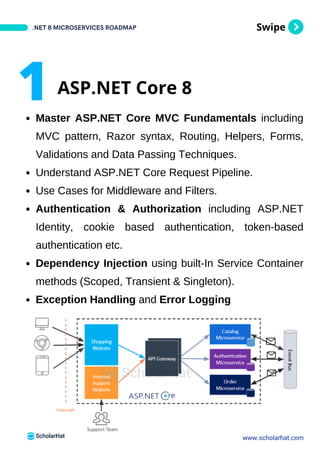
Understand ASP.NET Core Request Pipeline.
Use Cases for Middleware and Filters.
Authentication & Authorization including ASP.NET
Identity, cookie based authentication, token-based
authentication etc.
Dependency Injection using built-In Service Container
methods (Scoped, Transient & Singleton).
Exception Handling and Error Logging
.NET 8 MICROSERVICES ROADMAP
www.scholarhat.com
1 ASP.NET Core 8
Swipe
Learn to build REST API using ASP.NET Core Web
API and API documentation using Swagger.
Learn integration techniques using API Gateway like
Ocelot, and Azure APIM.
Use gRPC for high-performance, cross-platform APIs,
and for efficient communication between microservices.
Use proper status codes to indicate success, failure,
or errors in API responses.
Implement versioning to manage changes in your API
over time without breaking existing clients.
Secure APIs using authentication mechanisms like
JSON Web Tokens, OAuth, or OpenID Connect.
Use Postman for manual API testing and automation.
.NET 8 MICROSERVICES ROADMAP
www.scholarhat.com
2API Design & Integration
Understand about the concept, benefits, and challenges
of microservices.
Highlight the differences between monolithic and
microservices architectures.
Familiarize yourself with key principles like single
responsibility, loose coupling, and high cohesion.
Understand how these principles apply to designing and
implementing microservices.
Swipe
.NET 8 MICROSERVICES ROADMAP
www.scholarhat.com
3 Microservices Architecture
Modelled around business domain : Separate system
capability into different domains and its associated logic.
Culture of Automation : Follow DevOps for continues
integration and continuous delivery.
Hide implementation details : It helps to do changes &
improvement without affecting the overall architecture.
Decentralization : No centralized database, usually
each service is designed to manage its own database.
Deploy Independently : Each service can be deployed
independently.
Failure Isolation: A microservices failure impact that
service & its associates. Others services keep running.
Highly Observable : Collect enough information about
a microservice to analyze what is happening within each
of them like log events and stats.
Swipe
.NET 8 MICROSERVICES ROADMAP
www.scholarhat.com
4Microservices Principles
Decomposition Patterns
Decompose by Business Capability
Decompose by Subdomain
Strangler Pattern
Integration Patterns
API Gateway Pattern
Aggregator Pattern
Client-Side UI Composition Pattern
Database Patterns
Database per Service
Shared Database
CQRS Pattern
Saga Pattern
Communication Patterns
Request/Response Pattern
Messaging Pattern
Event Driven Pattern
Swipe
.NET 8 MICROSERVICES ROADMAP
www.scholarhat.com
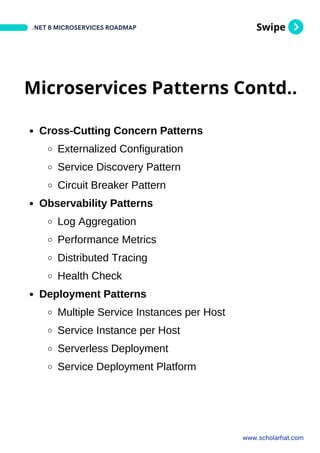
5 Microservices Patterns
Cross-Cutting Concern Patterns
Externalized Configuration
Service Discovery Pattern
Circuit Breaker Pattern
Observability Patterns
Log Aggregation
Performance Metrics
Distributed Tracing
Health Check
Deployment Patterns
Multiple Service Instances per Host
Service Instance per Host
Serverless Deployment
Service Deployment Platform
Swipe
.NET 8 MICROSERVICES ROADMAP
www.scholarhat.com
Microservices Patterns Contd..
Swipe
Learn the benefits of Docker and containerization.
Practice Docker CLI commands, Configure Docker
Compose and Docker Swarm.
Know Built-in containerization feature from .NET 7
and above (you no longer need a Dockerfile).
Learn Multi-Stage Docker Builds, Networking and
Volumes.
Practice to build and publish docker image to docker
registry like DockerHub or ACR and run the container
by pulling image from registry.
Have an understanding of Kubernetes fundamentals
and kubectl commands.
Practice to run docker image locally k8s cluster or on
Cloud based k8s cluster like AKS, EKS or GKE.
.NET 8 MICROSERVICES ROADMAP
www.scholarhat.com
6 Docker and Kubernetes
Swipe
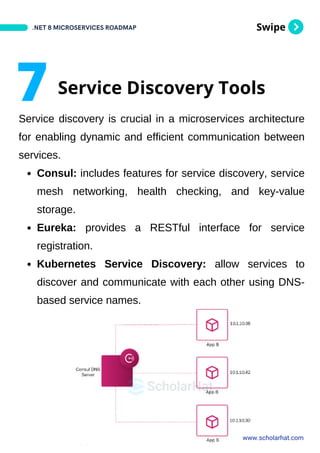
Service discovery is crucial in a microservices architecture
for enabling dynamic and efficient communication between
services.
Consul: includes features for service discovery, service
mesh networking, health checking, and key-value
storage.
Eureka: provides a RESTful interface for service
registration.
Kubernetes Service Discovery: allow services to
discover and communicate with each other using DNS-
based service names.
.NET 8 MICROSERVICES ROADMAP
www.scholarhat.com
7 Service Discovery Tools
Swipe
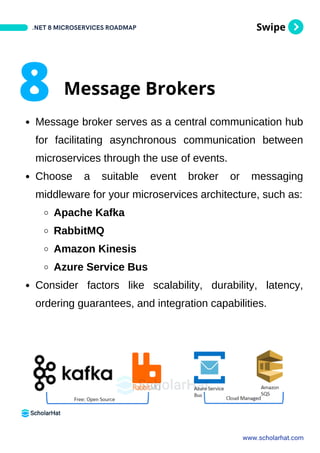
Message broker serves as a central communication hub
for facilitating asynchronous communication between
microservices through the use of events.
Choose a suitable event broker or messaging
middleware for your microservices architecture, such as:
Apache Kafka
RabbitMQ
Amazon Kinesis
Azure Service Bus
Consider factors like scalability, durability, latency,
ordering guarantees, and integration capabilities.
.NET 8 MICROSERVICES ROADMAP
www.scholarhat.com
8 Message Brokers
Swipe
Implementing monitoring and logging is crucial for
maintaining the health, performance, and reliability of
microservices-based systems.
Learn about the importance of monitoring and logging
in distributed systems.
Understand the differences between monitoring (real-
time observation of system metrics) and logging
(capturing and storing application events and errors).
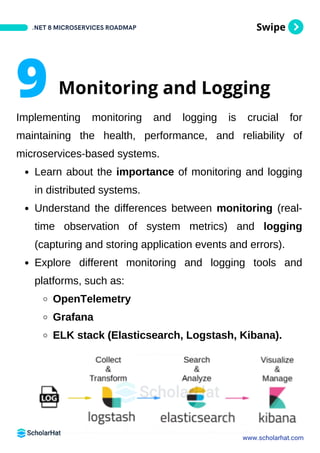
Explore different monitoring and logging tools and
platforms, such as:
OpenTelemetry
Grafana
ELK stack (Elasticsearch, Logstash, Kibana).
.NET 8 MICROSERVICES ROADMAP
www.scholarhat.com
9 Monitoring and Logging
Swipe
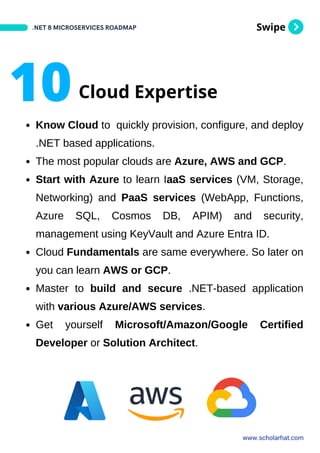
Know Cloud to quickly provision, configure, and deploy
.NET based applications.
The most popular clouds are Azure, AWS and GCP.
Start with Azure to learn IaaS services (VM, Storage,
Networking) and PaaS services (WebApp, Functions,
Azure SQL, Cosmos DB, APIM) and security,
management using KeyVault and Azure Entra ID.
Cloud Fundamentals are same everywhere. So later on
you can learn AWS or GCP.
Master to build and secure .NET-based application
with various Azure/AWS services.
Get yourself Microsoft/Amazon/Google Certified
Developer or Solution Architect.
.NET 8 MICROSERVICES ROADMAP
www.scholarhat.com
10Cloud Expertise
Swipe
Familiarize yourself with built-in security features in
.NET, Frontend and Cloud including code access
security, role-based security, and encryption APIs.
Know how to implement various authentication
methods like OAuth, OpenID Connect.
Learn to write secure code to prevent common
vulnerabilities like SQL injection, cross-site scripting
(XSS), and cross-site request forgery (CSRF) in .NET.
Understand how to use HTTPS, SSL/TLS, and other
protocols to secure communication in .NET applications.
Secure Web APIs in .NET, including token-based
authentication and rate limiting.
Use tools like OWASP ZAP or Burp Suite for
vulnerability scanning and penetration testing.
.NET 8 MICROSERVICES ROADMAP
www.scholarhat.com
11 Security Expertise
Swipe
Health Management System: Include aspects such as
appointment scheduling, electronic health records
(EHR), billing. Each microservice can specialize in
domains like appointment, patient information, and
notifications for scalability and maintainability.
Retail Inventory and Order Management System:
Microservices can handle aspects like inventory
tracking, order routing, and payment processing, and
integrating with third-party services.
Financial Services Platform: Each microservice
manages specific financial operations. For instance, one
microservice handles account management while
another deals with transaction processing and fraud
detection.
eShopOnContainers: The application simulates an e-
commerce platform with features like product catalog,
shopping cart, and order and payment processing.
.NET 8 MICROSERVICES ROADMAP
www.scholarhat.com
12 Build Projects
Swipe
Step1 - Learn Skills: You can learn Microservices skills
by using official docs on Microservices or through
Videos on YouTube or Videos based courses. For
topic revision and recalling make short notes. You can
also learn Live from Microsoft MVP at ScholarHat.
Step2 - Build Experience: You can build hands-on
experience by creating microservices workflow like
order workflow, cart workflow, payment gateway
workflow, Security workflow. Further build end-to-end
real world applications like E-commerce, Dominoz,
Flipkart, OTT platform, Social Media etc.
Step3 - Empower Yourself: Build your strong profile
by mentioning all the above skills with hands-on
experience on projects. Prepare yourself with interview
Q&A about Microservices to crack your next job
interview.
.NET 8 MICROSERVICES ROADMAP
www.scholarhat.com
How to follow this roadmap?
At ScholarHat, we believe mastering a technology
is a three-step process as mentioned below:
Swipe
.NET 8 MICROSERVICES ROADMAP
www.scholarhat.com
Congrats!
You are just one interview away!
Share with your friend who needs it!
Learn. Build. Empower.
.NET 8 MICROSERVICES ROADMAP
WAS THIS
HELPFUL?
Love. Like. Comment. Share.

Dot Net 8 Microservices Roadmap By ScholarHat PDF

  • 1.
    .NET 8 Microservices Swipe Level UpYour Career SHAILENDRA CHAUHAN Microsoft MVP, Founder & CEO - ScholarHat ROADMAP: 2024
  • 2.
    Swipe Master ASP.NET CoreMVC Fundamentals including MVC pattern, Razor syntax, Routing, Helpers, Forms, Validations and Data Passing Techniques. Understand ASP.NET Core Request Pipeline. Use Cases for Middleware and Filters. Authentication & Authorization including ASP.NET Identity, cookie based authentication, token-based authentication etc. Dependency Injection using built-In Service Container methods (Scoped, Transient & Singleton). Exception Handling and Error Logging .NET 8 MICROSERVICES ROADMAP www.scholarhat.com 1 ASP.NET Core 8
  • 3.
    Swipe Learn to buildREST API using ASP.NET Core Web API and API documentation using Swagger. Learn integration techniques using API Gateway like Ocelot, and Azure APIM. Use gRPC for high-performance, cross-platform APIs, and for efficient communication between microservices. Use proper status codes to indicate success, failure, or errors in API responses. Implement versioning to manage changes in your API over time without breaking existing clients. Secure APIs using authentication mechanisms like JSON Web Tokens, OAuth, or OpenID Connect. Use Postman for manual API testing and automation. .NET 8 MICROSERVICES ROADMAP www.scholarhat.com 2API Design & Integration
  • 4.
    Understand about theconcept, benefits, and challenges of microservices. Highlight the differences between monolithic and microservices architectures. Familiarize yourself with key principles like single responsibility, loose coupling, and high cohesion. Understand how these principles apply to designing and implementing microservices. Swipe .NET 8 MICROSERVICES ROADMAP www.scholarhat.com 3 Microservices Architecture
  • 5.
    Modelled around businessdomain : Separate system capability into different domains and its associated logic. Culture of Automation : Follow DevOps for continues integration and continuous delivery. Hide implementation details : It helps to do changes & improvement without affecting the overall architecture. Decentralization : No centralized database, usually each service is designed to manage its own database. Deploy Independently : Each service can be deployed independently. Failure Isolation: A microservices failure impact that service & its associates. Others services keep running. Highly Observable : Collect enough information about a microservice to analyze what is happening within each of them like log events and stats. Swipe .NET 8 MICROSERVICES ROADMAP www.scholarhat.com 4Microservices Principles
  • 6.
    Decomposition Patterns Decompose byBusiness Capability Decompose by Subdomain Strangler Pattern Integration Patterns API Gateway Pattern Aggregator Pattern Client-Side UI Composition Pattern Database Patterns Database per Service Shared Database CQRS Pattern Saga Pattern Communication Patterns Request/Response Pattern Messaging Pattern Event Driven Pattern Swipe .NET 8 MICROSERVICES ROADMAP www.scholarhat.com 5 Microservices Patterns
  • 7.
    Cross-Cutting Concern Patterns ExternalizedConfiguration Service Discovery Pattern Circuit Breaker Pattern Observability Patterns Log Aggregation Performance Metrics Distributed Tracing Health Check Deployment Patterns Multiple Service Instances per Host Service Instance per Host Serverless Deployment Service Deployment Platform Swipe .NET 8 MICROSERVICES ROADMAP www.scholarhat.com Microservices Patterns Contd..
  • 8.
    Swipe Learn the benefitsof Docker and containerization. Practice Docker CLI commands, Configure Docker Compose and Docker Swarm. Know Built-in containerization feature from .NET 7 and above (you no longer need a Dockerfile). Learn Multi-Stage Docker Builds, Networking and Volumes. Practice to build and publish docker image to docker registry like DockerHub or ACR and run the container by pulling image from registry. Have an understanding of Kubernetes fundamentals and kubectl commands. Practice to run docker image locally k8s cluster or on Cloud based k8s cluster like AKS, EKS or GKE. .NET 8 MICROSERVICES ROADMAP www.scholarhat.com 6 Docker and Kubernetes
  • 9.
    Swipe Service discovery iscrucial in a microservices architecture for enabling dynamic and efficient communication between services. Consul: includes features for service discovery, service mesh networking, health checking, and key-value storage. Eureka: provides a RESTful interface for service registration. Kubernetes Service Discovery: allow services to discover and communicate with each other using DNS- based service names. .NET 8 MICROSERVICES ROADMAP www.scholarhat.com 7 Service Discovery Tools
  • 10.
    Swipe Message broker servesas a central communication hub for facilitating asynchronous communication between microservices through the use of events. Choose a suitable event broker or messaging middleware for your microservices architecture, such as: Apache Kafka RabbitMQ Amazon Kinesis Azure Service Bus Consider factors like scalability, durability, latency, ordering guarantees, and integration capabilities. .NET 8 MICROSERVICES ROADMAP www.scholarhat.com 8 Message Brokers
  • 11.
    Swipe Implementing monitoring andlogging is crucial for maintaining the health, performance, and reliability of microservices-based systems. Learn about the importance of monitoring and logging in distributed systems. Understand the differences between monitoring (real- time observation of system metrics) and logging (capturing and storing application events and errors). Explore different monitoring and logging tools and platforms, such as: OpenTelemetry Grafana ELK stack (Elasticsearch, Logstash, Kibana). .NET 8 MICROSERVICES ROADMAP www.scholarhat.com 9 Monitoring and Logging
  • 12.
    Swipe Know Cloud toquickly provision, configure, and deploy .NET based applications. The most popular clouds are Azure, AWS and GCP. Start with Azure to learn IaaS services (VM, Storage, Networking) and PaaS services (WebApp, Functions, Azure SQL, Cosmos DB, APIM) and security, management using KeyVault and Azure Entra ID. Cloud Fundamentals are same everywhere. So later on you can learn AWS or GCP. Master to build and secure .NET-based application with various Azure/AWS services. Get yourself Microsoft/Amazon/Google Certified Developer or Solution Architect. .NET 8 MICROSERVICES ROADMAP www.scholarhat.com 10Cloud Expertise
  • 13.
    Swipe Familiarize yourself withbuilt-in security features in .NET, Frontend and Cloud including code access security, role-based security, and encryption APIs. Know how to implement various authentication methods like OAuth, OpenID Connect. Learn to write secure code to prevent common vulnerabilities like SQL injection, cross-site scripting (XSS), and cross-site request forgery (CSRF) in .NET. Understand how to use HTTPS, SSL/TLS, and other protocols to secure communication in .NET applications. Secure Web APIs in .NET, including token-based authentication and rate limiting. Use tools like OWASP ZAP or Burp Suite for vulnerability scanning and penetration testing. .NET 8 MICROSERVICES ROADMAP www.scholarhat.com 11 Security Expertise
  • 14.
    Swipe Health Management System:Include aspects such as appointment scheduling, electronic health records (EHR), billing. Each microservice can specialize in domains like appointment, patient information, and notifications for scalability and maintainability. Retail Inventory and Order Management System: Microservices can handle aspects like inventory tracking, order routing, and payment processing, and integrating with third-party services. Financial Services Platform: Each microservice manages specific financial operations. For instance, one microservice handles account management while another deals with transaction processing and fraud detection. eShopOnContainers: The application simulates an e- commerce platform with features like product catalog, shopping cart, and order and payment processing. .NET 8 MICROSERVICES ROADMAP www.scholarhat.com 12 Build Projects
  • 15.
    Swipe Step1 - LearnSkills: You can learn Microservices skills by using official docs on Microservices or through Videos on YouTube or Videos based courses. For topic revision and recalling make short notes. You can also learn Live from Microsoft MVP at ScholarHat. Step2 - Build Experience: You can build hands-on experience by creating microservices workflow like order workflow, cart workflow, payment gateway workflow, Security workflow. Further build end-to-end real world applications like E-commerce, Dominoz, Flipkart, OTT platform, Social Media etc. Step3 - Empower Yourself: Build your strong profile by mentioning all the above skills with hands-on experience on projects. Prepare yourself with interview Q&A about Microservices to crack your next job interview. .NET 8 MICROSERVICES ROADMAP www.scholarhat.com How to follow this roadmap? At ScholarHat, we believe mastering a technology is a three-step process as mentioned below:
  • 16.
    Swipe .NET 8 MICROSERVICESROADMAP www.scholarhat.com Congrats! You are just one interview away!
  • 17.
    Share with yourfriend who needs it! Learn. Build. Empower. .NET 8 MICROSERVICES ROADMAP WAS THIS HELPFUL? Love. Like. Comment. Share.