Specialist Mental
Health and Women’s
Health
Working In
Partnership To Better
Address the
Intersection(s) of
Mental Health and
Violence and Abuse
Tracey Sloan, Women’s Health Statewide
Zhila Javidi, Centre for Anxiety and Related
Disorders
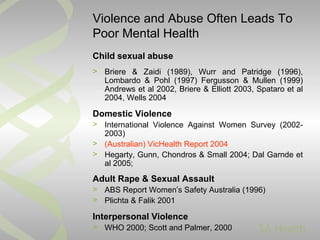
Violence and Abuse Often Leads To
Poor Mental Health
Child sexual abuse
> Briere & Zaidi (1989), Wurr and Patridge (1996),
Lombardo & Pohl (1997) Fergusson & Mullen (1999)
Andrews et al 2002, Briere & Elliott 2003, Spataro et al
2004, Wells 2004
Domestic Violence
> International Violence Against Women Survey (2002-
2003)
> (Australian) VicHealth Report 2004
> Hegarty, Gunn, Chondros & Small 2004; Dal Garnde et
al 2005;
Adult Rape & Sexual Assault
> ABS Report Women’s Safety Australia (1996)
> Plichta & Falik 2001
Interpersonal Violence
> WHO 2000; Scott and Palmer, 2000
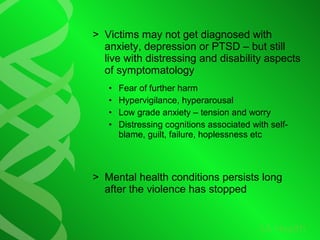
> Victims may not get diagnosed with
anxiety, depression or PTSD – but still
live with distressing and disability aspects
of symptomatology
• Fear of further harm
• Hypervigilance, hyperarousal
• Low grade anxiety – tension and worry
• Distressing cognitions associated with self-
blame, guilt, failure, hoplessness etc
> Mental health conditions persists long
after the violence has stopped
Violence A Risk Factor For
Mental Health Problems
> Specialist mental health outpatient clinic
• Anxiety, depression and related disorders
> Assessment – diagnosis - treatment framework
> Evidence-based treatments
• Behaviour therapy, cognitive behaviour therapy
• Motivational interviewing, mindfulness, acceptance
and commitment therapy
> Multidisciplinary emphasis
• Mental health nurses, social workers, psychologists,
occupational therapists, psychiatrist
Centre for Anxiety and Related
Disorders (CARD)
> Provision of CBT-Based training and lectures for
anxiety, depression and psychosis
• Mental Health Sciences Programs, Flinders
University
> Provision of multidisciplinary student clinical
placements
> Provision of CBT-based clinical supervision
• General practitioners
• Psychologists
• Organisations
> Specialist cross sector initiatives
• Substance use comorbidity
• Interconnections of anxiety, depression and related
problems with experiences of past/ present violence
and abuse
Centre for Anxiety and Related
Disorders (CARD)
Women’s Health Statewide
> Women’s community health centre
> Primary health care and feminist service delivery
framework
> Client Services
• Counselling
 Anxiety, depression, complex PTSD & related problems
 Eating disorders
 Rural Women’s Telephone Counselling Service
• Group programs
 Mindfulness group for peri and post natal women
 Walking group for depression
• Women’s counselling line – Counselling intake,
information & referral
• Medical clinic for newly arrived women refugee women
Women’s Health Statewide
> Training and seminars
• Therapeutic relationship – exploring enabling skills and values
• Establishing safety when using exposure therapy for trauma-
related avoidances
• Working with somatisation
• Working with complex trauma and substance use
• Vicarious traumatisation and worker mental health and
wellbeing
> Project work
• Aboriginal and Torres Strait Islander Women’s projects
• Culturally and Linguistically Diverse Women’s projects
• HIV Positive Women’s Project
• Female Genital Mutilation Project
> Violence and abuse and mental health activities
• Health promotion/ community education activities
• Resource development
> Sector development work
• Committees, mini-conferences
Partnership effects
Social View of Mental Health and Illness
With
Assessment – Diagnosis – Treatment
Framework
Good Reasons For Partnership (WHS)
• Gender is a critical determinant of mental health
and mental illness (WHO 2002, 2007)
• Limited Access to gender specific services
• Violence Is a risk factor for poor mental health
• Experiences of violence and abuse effect mental
health service utilisation
• Validation of link between current mental health
problems and past abuse is usually therapeutic
• Culture of silencing contributes to the many ways
the mental health effects of interpersonal
violence are played out in people’s lives
• Women’s health and mental health best practice
principles require it
• Effects a level of services integration
• Better health outcomes for women
Good Reasons For Partnership
(CARD)
• Could accept the need to respond to the
relevance of violence and abuse to
treatment of anxiety and depression
• Continuous quality improvement of
service and practice framework
 Respond to the evidence
• Improve health outcomes and quality of
life for client’s
• Support for clinician’s – who are working
with/at the intersections anyway
Partnership processes – small steps
> Learnt language, context, culture and frameworks of
each others service:
• DSM-IV, diagnosis and labelling (CARD)
• Social construction & contextualising of problems
(WHS)
> Joint activities
• Seminars, conference presentations
• Co-authoring of articles in relation to mental health,
violence and abuse, gender and their various
intersections
> Opportunities to work, train or teach in each others
organisations
• Secondments
• Service Outreach Model
> Small grants
• Joint training, resource development
> Review of clinical and service guidelines
Centre for Anxiety and Related
Disorders
> Violence and abuse is screened and assessed for
> Mental health clinicians:
• Trained and skilled at responding to disclosures of
abuse
• Able to treat or refer as appropriate
> Current violence is always referred to specialist
domestic violence or sexual assault services
> Context of development mental health conditions is
acknowledged and responded to
> Re-establishing safety is a central therapeutic
intervention
> Psycho-educational, supportive interventions re
violence and abuse
> New position - leadership and support re integration
of issues of violence and abuse within the service
1.1.7 Tracey Sloan

1.1.7 Tracey Sloan

  • 1.
    Specialist Mental Health andWomen’s Health Working In Partnership To Better Address the Intersection(s) of Mental Health and Violence and Abuse Tracey Sloan, Women’s Health Statewide Zhila Javidi, Centre for Anxiety and Related Disorders
  • 2.
    Violence and AbuseOften Leads To Poor Mental Health Child sexual abuse > Briere & Zaidi (1989), Wurr and Patridge (1996), Lombardo & Pohl (1997) Fergusson & Mullen (1999) Andrews et al 2002, Briere & Elliott 2003, Spataro et al 2004, Wells 2004 Domestic Violence > International Violence Against Women Survey (2002- 2003) > (Australian) VicHealth Report 2004 > Hegarty, Gunn, Chondros & Small 2004; Dal Garnde et al 2005; Adult Rape & Sexual Assault > ABS Report Women’s Safety Australia (1996) > Plichta & Falik 2001 Interpersonal Violence > WHO 2000; Scott and Palmer, 2000
  • 4.
    > Victims maynot get diagnosed with anxiety, depression or PTSD – but still live with distressing and disability aspects of symptomatology • Fear of further harm • Hypervigilance, hyperarousal • Low grade anxiety – tension and worry • Distressing cognitions associated with self- blame, guilt, failure, hoplessness etc > Mental health conditions persists long after the violence has stopped
  • 5.
    Violence A RiskFactor For Mental Health Problems
  • 6.
    > Specialist mentalhealth outpatient clinic • Anxiety, depression and related disorders > Assessment – diagnosis - treatment framework > Evidence-based treatments • Behaviour therapy, cognitive behaviour therapy • Motivational interviewing, mindfulness, acceptance and commitment therapy > Multidisciplinary emphasis • Mental health nurses, social workers, psychologists, occupational therapists, psychiatrist Centre for Anxiety and Related Disorders (CARD)
  • 7.
    > Provision ofCBT-Based training and lectures for anxiety, depression and psychosis • Mental Health Sciences Programs, Flinders University > Provision of multidisciplinary student clinical placements > Provision of CBT-based clinical supervision • General practitioners • Psychologists • Organisations > Specialist cross sector initiatives • Substance use comorbidity • Interconnections of anxiety, depression and related problems with experiences of past/ present violence and abuse Centre for Anxiety and Related Disorders (CARD)
  • 8.
    Women’s Health Statewide >Women’s community health centre > Primary health care and feminist service delivery framework > Client Services • Counselling  Anxiety, depression, complex PTSD & related problems  Eating disorders  Rural Women’s Telephone Counselling Service • Group programs  Mindfulness group for peri and post natal women  Walking group for depression • Women’s counselling line – Counselling intake, information & referral • Medical clinic for newly arrived women refugee women
  • 9.
    Women’s Health Statewide >Training and seminars • Therapeutic relationship – exploring enabling skills and values • Establishing safety when using exposure therapy for trauma- related avoidances • Working with somatisation • Working with complex trauma and substance use • Vicarious traumatisation and worker mental health and wellbeing > Project work • Aboriginal and Torres Strait Islander Women’s projects • Culturally and Linguistically Diverse Women’s projects • HIV Positive Women’s Project • Female Genital Mutilation Project > Violence and abuse and mental health activities • Health promotion/ community education activities • Resource development > Sector development work • Committees, mini-conferences
  • 10.
    Partnership effects Social Viewof Mental Health and Illness With Assessment – Diagnosis – Treatment Framework
  • 11.
    Good Reasons ForPartnership (WHS) • Gender is a critical determinant of mental health and mental illness (WHO 2002, 2007) • Limited Access to gender specific services • Violence Is a risk factor for poor mental health • Experiences of violence and abuse effect mental health service utilisation • Validation of link between current mental health problems and past abuse is usually therapeutic • Culture of silencing contributes to the many ways the mental health effects of interpersonal violence are played out in people’s lives • Women’s health and mental health best practice principles require it • Effects a level of services integration • Better health outcomes for women
  • 12.
    Good Reasons ForPartnership (CARD) • Could accept the need to respond to the relevance of violence and abuse to treatment of anxiety and depression • Continuous quality improvement of service and practice framework  Respond to the evidence • Improve health outcomes and quality of life for client’s • Support for clinician’s – who are working with/at the intersections anyway
  • 13.
    Partnership processes –small steps > Learnt language, context, culture and frameworks of each others service: • DSM-IV, diagnosis and labelling (CARD) • Social construction & contextualising of problems (WHS) > Joint activities • Seminars, conference presentations • Co-authoring of articles in relation to mental health, violence and abuse, gender and their various intersections > Opportunities to work, train or teach in each others organisations • Secondments • Service Outreach Model > Small grants • Joint training, resource development > Review of clinical and service guidelines
  • 14.
    Centre for Anxietyand Related Disorders > Violence and abuse is screened and assessed for > Mental health clinicians: • Trained and skilled at responding to disclosures of abuse • Able to treat or refer as appropriate > Current violence is always referred to specialist domestic violence or sexual assault services > Context of development mental health conditions is acknowledged and responded to > Re-establishing safety is a central therapeutic intervention > Psycho-educational, supportive interventions re violence and abuse > New position - leadership and support re integration of issues of violence and abuse within the service

Editor's Notes

  • #2 Ask people to introduce themselves + where they are from What are they hoping to gain from presentation, learn, contribute Acknowledge people’s knowledge Permission to interrupt and ask questions or contribute A lot of information to cover
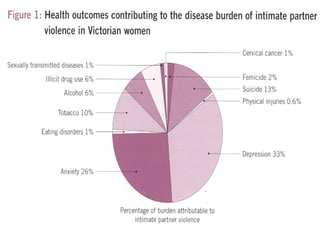
  • #4 Found a strong connection between being subjected to intimate partner violence and poor mental health: Poor mental health: including ongoing anxiety and depression, disordered eating, post traumatic stress symptoms and a higher incidence of psychiatric disorders. Makes up the largest proportion of health outcomes contributing to burden of disease due to Intimate Partner Violence. Shock, fear and feeling numb are common psychological response to IP. However, the mental health effects can/often persist long after the violent episode. Self-harming thoughts or behavior: Women subjected to violence are 9 times more likely than other women to experience these. Harmful tobacco & alcohol use, higher use of non-prescriptive drugs, sleeping pills & anti-depressants. Women reporting IP are more likely to use medication for depression & anxiety.
  • #6 Ask people to introduce themselves + where they are from What are they hoping to gain from presentation, learn, contribute Acknowledge people’s knowledge Permission to interrupt and ask questions or contribute A lot of information to cover
  • #7 CARD is a statewide service that provides specialist, evidence-based outpatient clinical services, training and research in relation to anxiety, depression and related disorders. Clinical services include both one-on-one and group therapy, and a two to three week inpatient program at Flinders Medical Centre is offered to those clients who require additional support or live in rural and remote areas CARD is linked strongly with the Statewide Gambling Therapy Service in South Australia And the Mental Health Sciences Postgraduate Programs (MHSP) at Flinders University The MHSP are clinically focused programs for qualified professional from various professions, including nursing, social work, occupational therapy, psychology and psychiatry, who want to specialise in CBT-based treatment approaches for anxiety, depression and related problems CARD therapists are Lecturers within the programs, playing a central role in the development, delivery and review of the clinical coursework and workforce training programs And many MHSP students obtain their clinical placements at CARD, The services has a multidisciplinary preference, historically it has been primarily staffed by mental health nurse with postgraduate qualifications in CBT, now social workers, occupational therapists, psychologist, as well a a psychiatrist, provide clinical services to clients So, overtime, what we have done is establish a partnership that represents a coming together of the social view of mental health and wellbeing central to a primary health care approach with the more traditional, individual, assessment-diagnosis-treatment framework of mental illness
  • #8 CARD is a statewide service that provides specialist, evidence-based outpatient clinical services, training and research in relation to anxiety, depression and related disorders. Clinical services include both one-on-one and group therapy, and a two to three week inpatient program at Flinders Medical Centre is offered to those clients who require additional support or live in rural and remote areas CARD is linked strongly with the Statewide Gambling Therapy Service in South Australia And the Mental Health Sciences Postgraduate Programs (MHSP) at Flinders University The MHSP are clinically focused programs for qualified professional from various professions, including nursing, social work, occupational therapy, psychology and psychiatry, who want to specialise in CBT-based treatment approaches for anxiety, depression and related problems CARD therapists are Lecturers within the programs, playing a central role in the development, delivery and review of the clinical coursework and workforce training programs And many MHSP students obtain their clinical placements at CARD, The services has a multidisciplinary preference, historically it has been primarily staffed by mental health nurse with postgraduate qualifications in CBT, now social workers, occupational therapists, psychologist, as well a a psychiatrist, provide clinical services to clients So, overtime, what we have done is establish a partnership that represents a coming together of the social view of mental health and wellbeing central to a primary health care approach with the more traditional, individual, assessment-diagnosis-treatment framework of mental illness
  • #9 So just briefly, who is Women’s Health Statewide? We are part of the Community Health Division of Children, Youth and Women’s Health Service in South Australia. As you can see, the work of WHS includes a number of different client services, project work, and then training, health promotion and community education activities and resource development in relation to violence and abuse, and the intersections between mental health and violence and abuse WHS is community service based on primary health care and feminist principles. Primary health care is both a philosophy and system response to reducing health inequities and ameliorating the effects of disadvantage. In keeping with, or because of, the Ottowa Chart, what this allows for its that some resources can be directed towards reorientating health services towards prevention of illness and promotion of health – where the role of the health sector must be to move increasingly in a health promotion direction, beyond its responsibility for providing clinical and curative services
  • #10 So just briefly, who is Women’s Health Statewide? We are part of the Community Health Division of Children, Youth and Women’s Health Service in South Australia. As you can see, the work of WHS includes a number of different client services, project work, and then training, health promotion and community education activities and resource development in relation to violence and abuse, and the intersections between mental health and violence and abuse WHS is community service based on primary health care and feminist principles. Primary health care is both a philosophy and system response to reducing health inequities and ameliorating the effects of disadvantage. In keeping with, or because of, the Ottowa Chart, what this allows for its that some resources can be directed towards reorientating health services towards prevention of illness and promotion of health – where the role of the health sector must be to move increasingly in a health promotion direction, beyond its responsibility for providing clinical and curative services
  • #12 5. Difficult patients: Additionally, experiences of past violence and abuse have a significant impact of the way people present to mental health services and the patient-practitioner relationship (Courtis 2001). A key aspect of being subjected to violence and abuse is that it robs people of a sense of power and control. Issues of power and control often play themselves out in complicated ways in consumer-practitioner relationships. Often people with mental health issues who have been subjected to violence and abuse are the consumers that mental health workers experience as “difficult”. Just to say that helping interactions are usually not as helpful as they could be if issues of safety, power and control haven’t been adequately attended to. And can lead to the unhelpful labelling of consumers as “difficult”. 6. In consumer interviews conducted with survivors of child sexual abuse (CSA) by WHS during 2005-2006 a common request from consumers is for practitioners to recognize the context of violence and abuse that surrounds either the development of their mental health issues, or their capacity to manage. When talking about mental health services, this consumer states “ … even if the reality is they can’t deal with the CSA some acknowledgement of it effects on our [mental health] problems and our lives would be useful, it would help a lot … ” . The acknowledgement that a person did not just wake up crazy, the validation of the injustice – usually has a freeing effects in terms of enabling the person to then undertake the here and now nature of CBT. 7. A culture of silencing in relation to these links contributes to the many ways the mental health effects of interpersonal violence are played out in people’s lives. Silencing, as it does with anything generally obscures understanding in relation to mental health & interpersonal violence, and forecloses the development of more helpful informed treatment options, and contributes to the silo effects between mental health services and services for interpersonal violence. Puts this type of “pressure to forget” on client’s 8. Best Practice Principles in Women’s Health and the National Mental Health Strategy both advocate for collaborative responses to address experiences as a result of the diagnosis of mental illness. 9. And finally, the WHS-CARD partnership effects a level or degree of service integration, which we all tend to agree, even we when can’t operationalise it, is most effective for working with people.
  • #13 5. Difficult patients: Additionally, experiences of past violence and abuse have a significant impact of the way people present to mental health services and the patient-practitioner relationship (Courtis 2001). A key aspect of being subjected to violence and abuse is that it robs people of a sense of power and control. Issues of power and control often play themselves out in complicated ways in consumer-practitioner relationships. Often people with mental health issues who have been subjected to violence and abuse are the consumers that mental health workers experience as “difficult”. Just to say that helping interactions are usually not as helpful as they could be if issues of safety, power and control haven’t been adequately attended to. And can lead to the unhelpful labelling of consumers as “difficult”. 6. In consumer interviews conducted with survivors of child sexual abuse (CSA) by WHS during 2005-2006 a common request from consumers is for practitioners to recognize the context of violence and abuse that surrounds either the development of their mental health issues, or their capacity to manage. When talking about mental health services, this consumer states “ … even if the reality is they can’t deal with the CSA some acknowledgement of it effects on our [mental health] problems and our lives would be useful, it would help a lot … ” . The acknowledgement that a person did not just wake up crazy, the validation of the injustice – usually has a freeing effects in terms of enabling the person to then undertake the here and now nature of CBT. 7. A culture of silencing in relation to these links contributes to the many ways the mental health effects of interpersonal violence are played out in people’s lives. Silencing, as it does with anything generally obscures understanding in relation to mental health & interpersonal violence, and forecloses the development of more helpful informed treatment options, and contributes to the silo effects between mental health services and services for interpersonal violence. Puts this type of “pressure to forget” on client’s 8. Best Practice Principles in Women’s Health and the National Mental Health Strategy both advocate for collaborative responses to address experiences as a result of the diagnosis of mental illness. 9. And finally, the WHS-CARD partnership effects a level or degree of service integration, which we all tend to agree, even we when can’t operationalise it, is most effective for working with people.