Domain Models - Part Deux
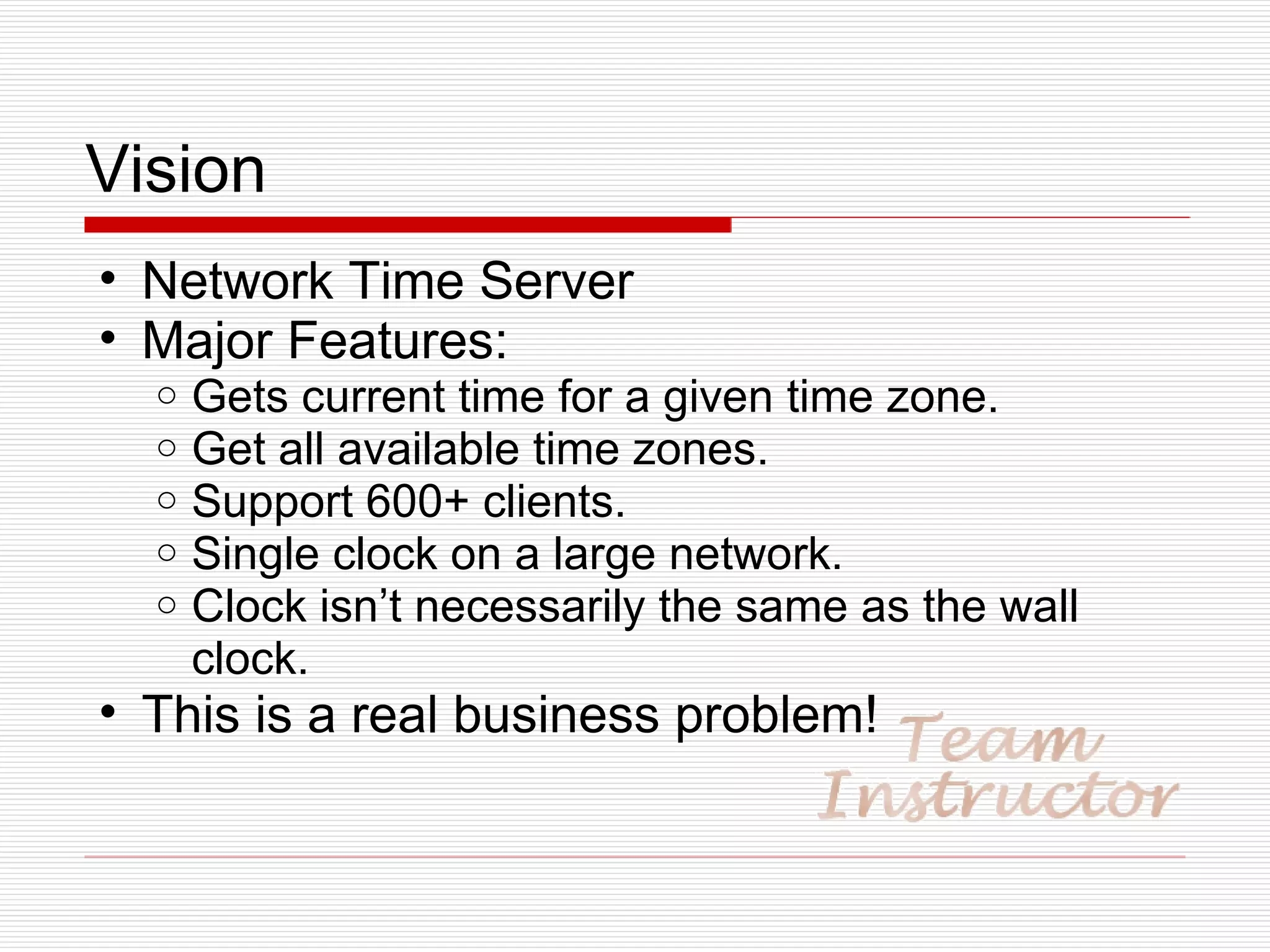
Vision Network Time Server Major Features: Gets current time for a given time zone. Get all available time zones. Support 600+ clients. Single clock on a large network. Clock isn’t necessarily the same as the wall clock. This is a real business problem!
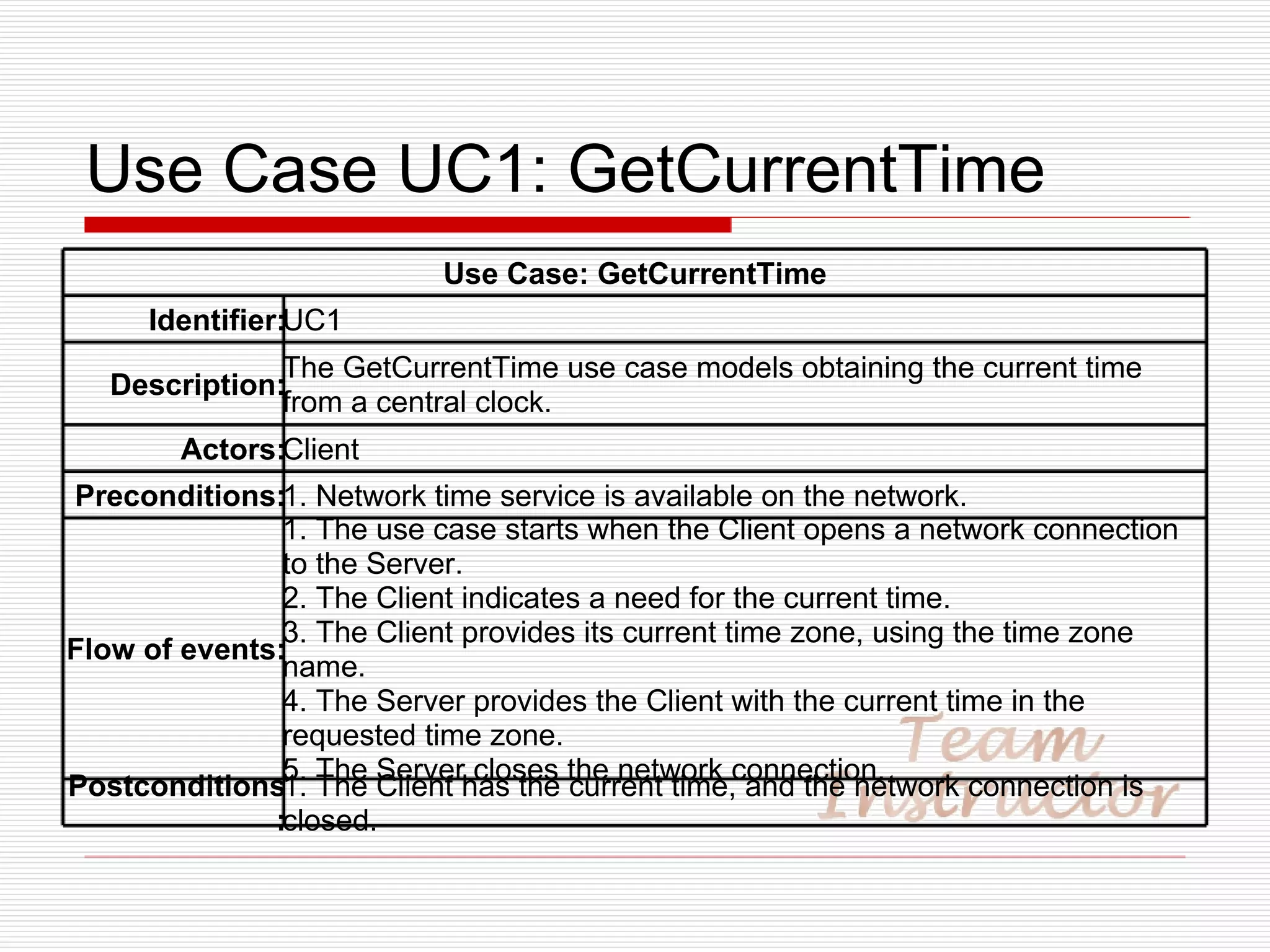
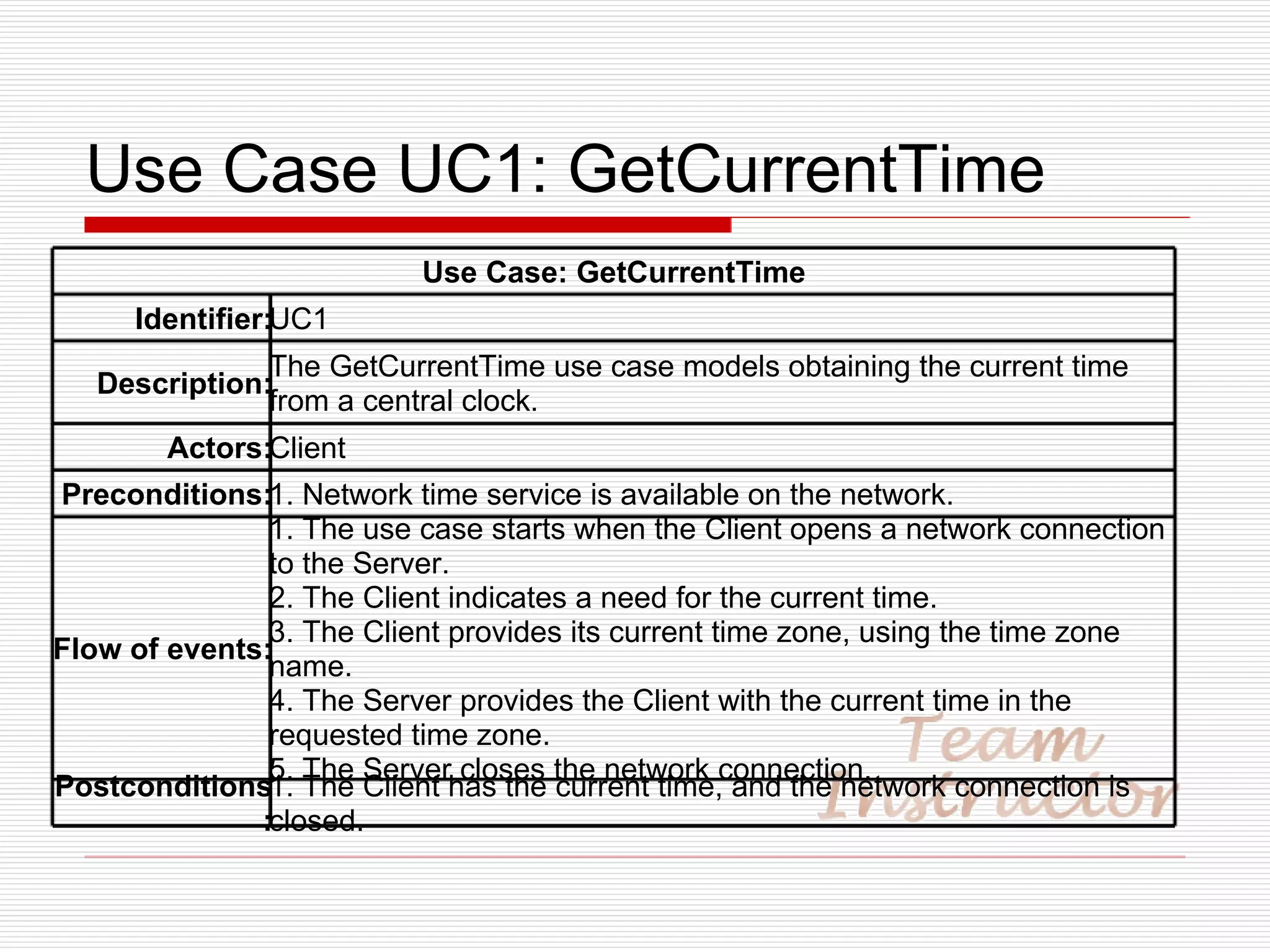
Use Case UC1: GetCurrentTime Use Case: GetCurrentTime Identifier: UC1 Description: The GetCurrentTime use case models obtaining the current time from a central clock. Actors: Client Preconditions: 1. Network time service is available on the network. Flow of events: 1. The use case starts when the Client opens a network connection to the Server. 2. The Client indicates a need for the current time. 3. The Client provides its current time zone, using the time zone name. 4. The Server provides the Client with the current time in the requested time zone. 5. The Server closes the network connection. Postconditions: 1. The Client has the current time, and the network connection is closed.
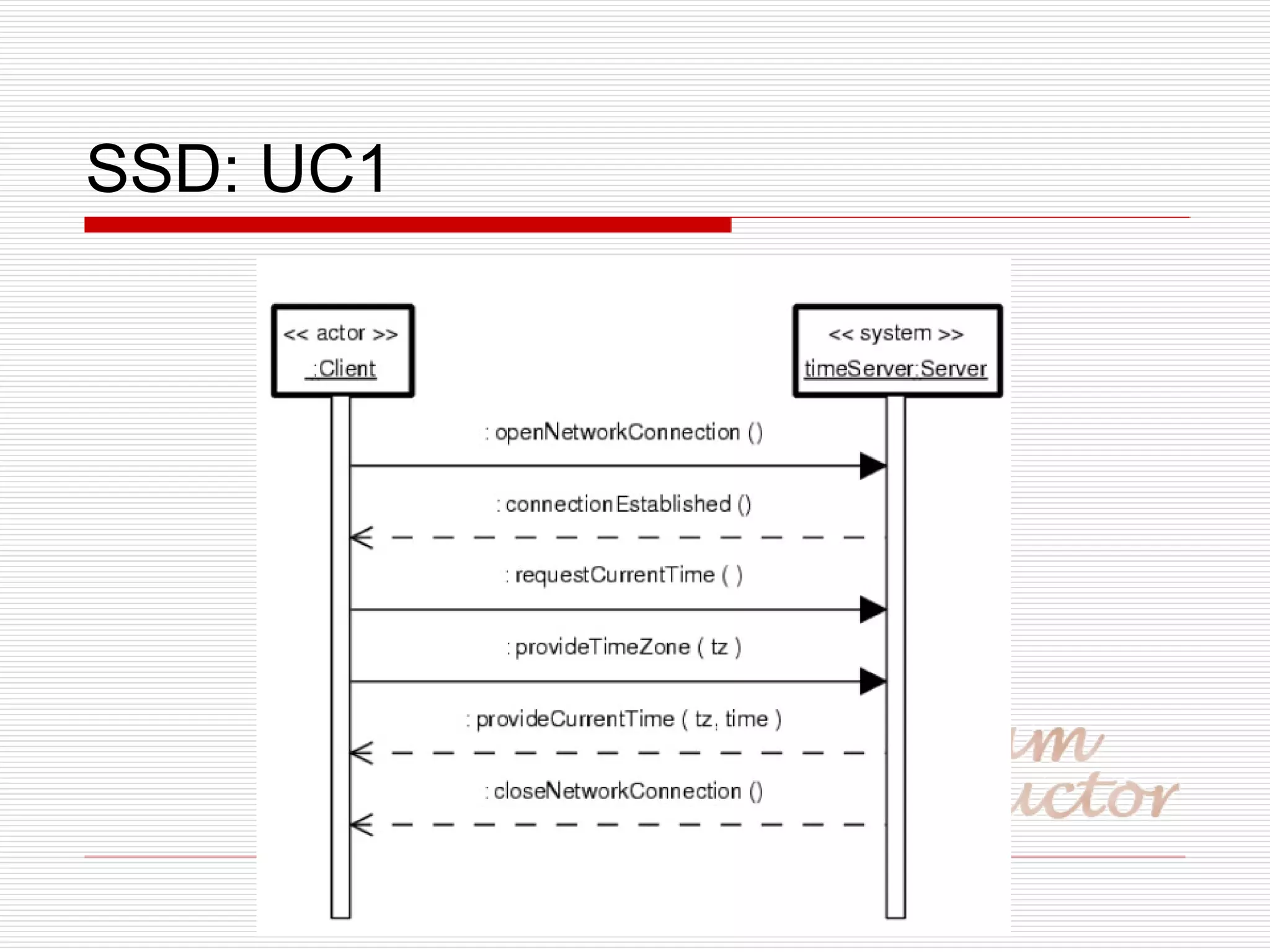
SSD: UC1
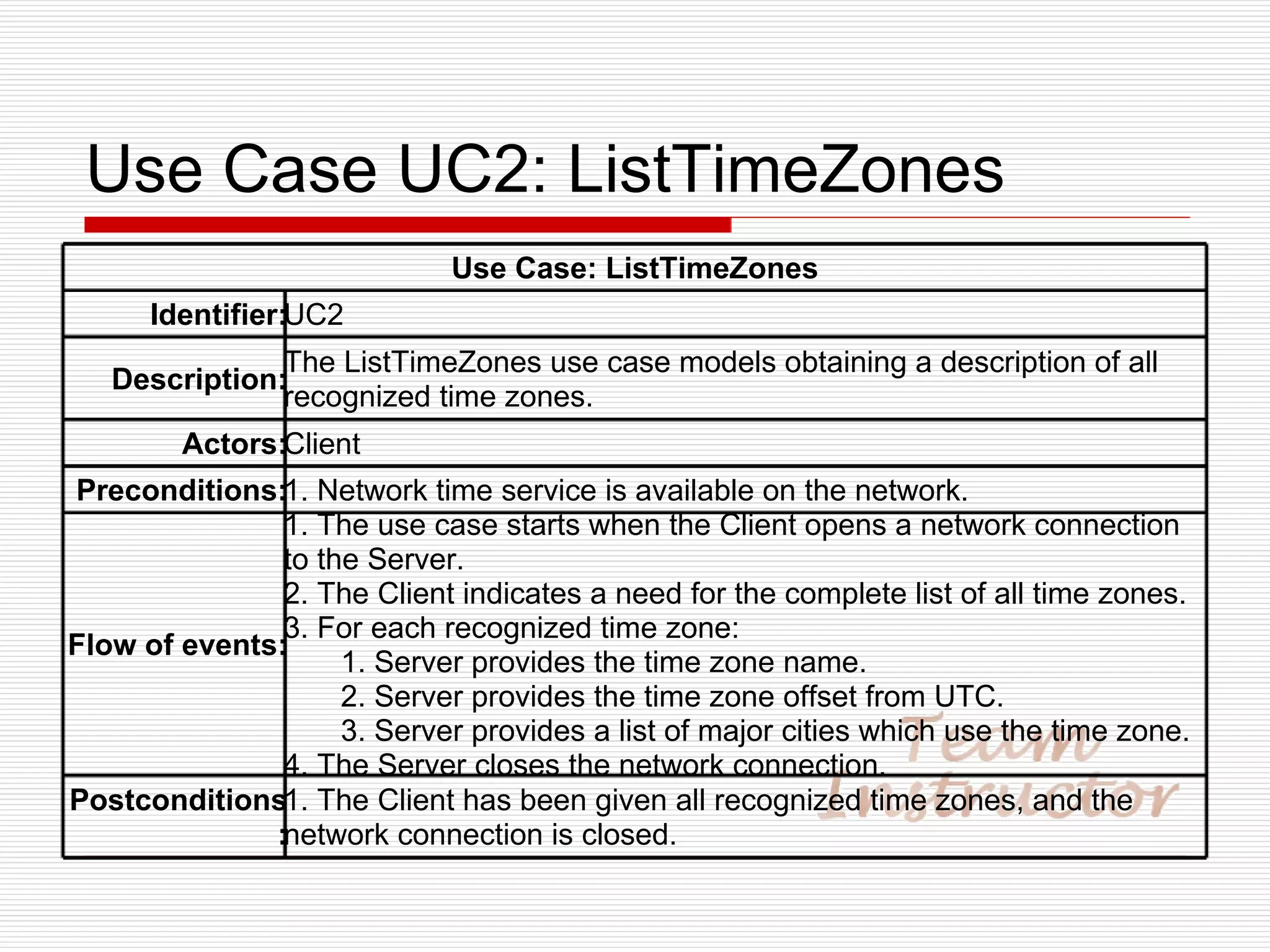
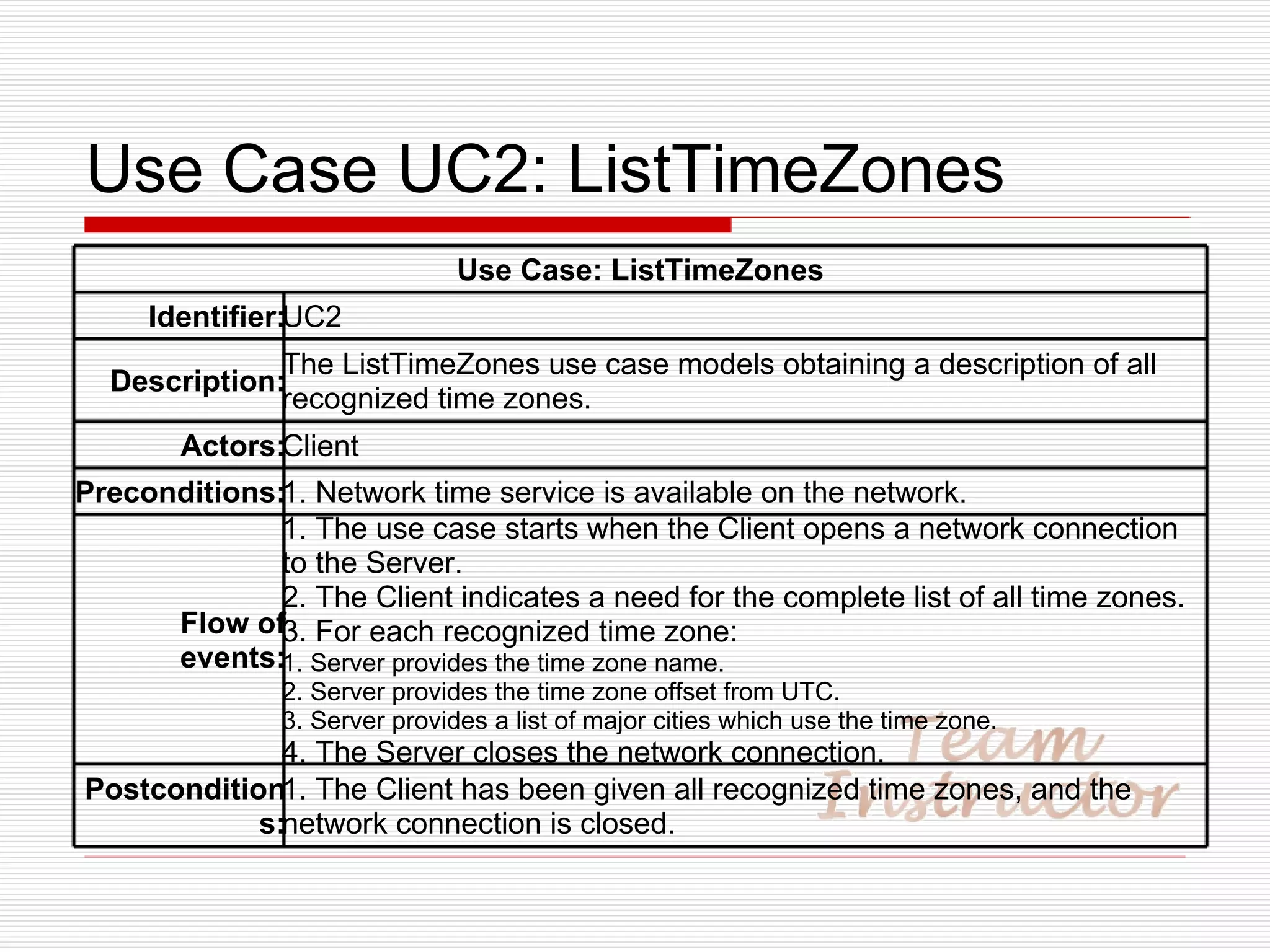
Use Case UC2: ListTimeZones Use Case: ListTimeZones Identifier: UC2 Description: The ListTimeZones use case models obtaining a description of all recognized time zones. Actors: Client Preconditions: 1. Network time service is available on the network. Flow of events: 1. The use case starts when the Client opens a network connection to the Server. 2. The Client indicates a need for the complete list of all time zones. 3. For each recognized time zone: 1. Server provides the time zone name. 2. Server provides the time zone offset from UTC. 3. Server provides a list of major cities which use the time zone. 4. The Server closes the network connection. Postconditions: 1. The Client has been given all recognized time zones, and the network connection is closed.
How To Make A Domain Model Identify Conceptual Classes
Use Case UC1: GetCurrentTime Use Case: GetCurrentTime Identifier: UC1 Description: The GetCurrentTime use case models obtaining the current time from a central clock. Actors: Client Preconditions: 1. Network time service is available on the network. Flow of events: 1. The use case starts when the Client opens a network connection to the Server. 2. The Client indicates a need for the current time. 3. The Client provides its current time zone, using the time zone name. 4. The Server provides the Client with the current time in the requested time zone. 5. The Server closes the network connection. Postconditions: 1. The Client has the current time, and the network connection is closed.
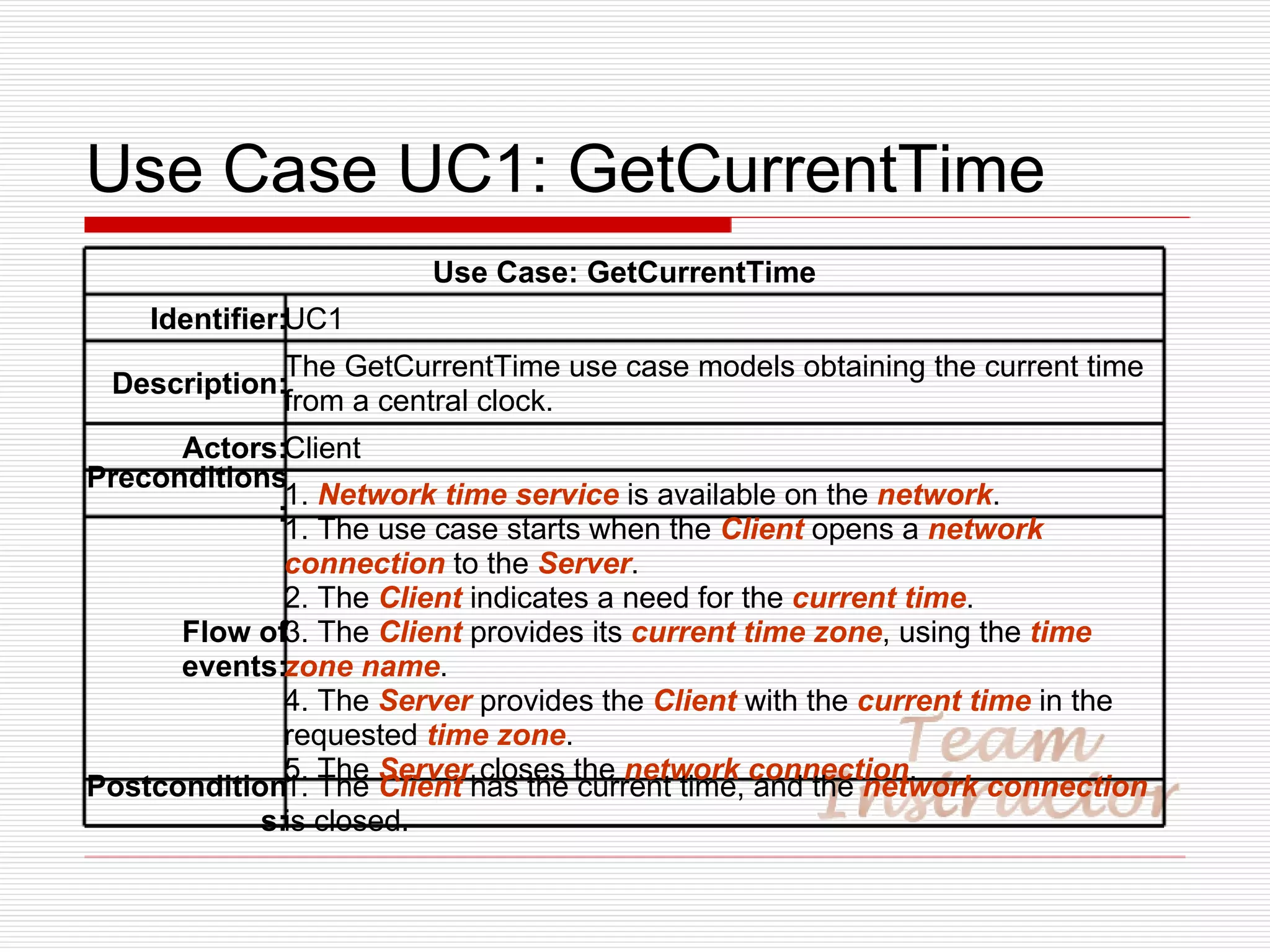
Use Case UC1: GetCurrentTime Use Case: GetCurrentTime Identifier: UC1 Description: The GetCurrentTime use case models obtaining the current time from a central clock. Actors: Client Preconditions: 1.  Network time service  is available on the  network . Flow of events: 1. The use case starts when the  Client  opens a  network connection  to the  Server . 2. The  Client  indicates a need for the  current time . 3. The  Client  provides its  current time zone , using the  time zone name . 4. The  Server  provides the  Client  with the  current time  in the requested  time zone . 5. The  Server  closes the  network connection . Postconditions: 1. The  Client  has the current time, and the  network connection  is closed.
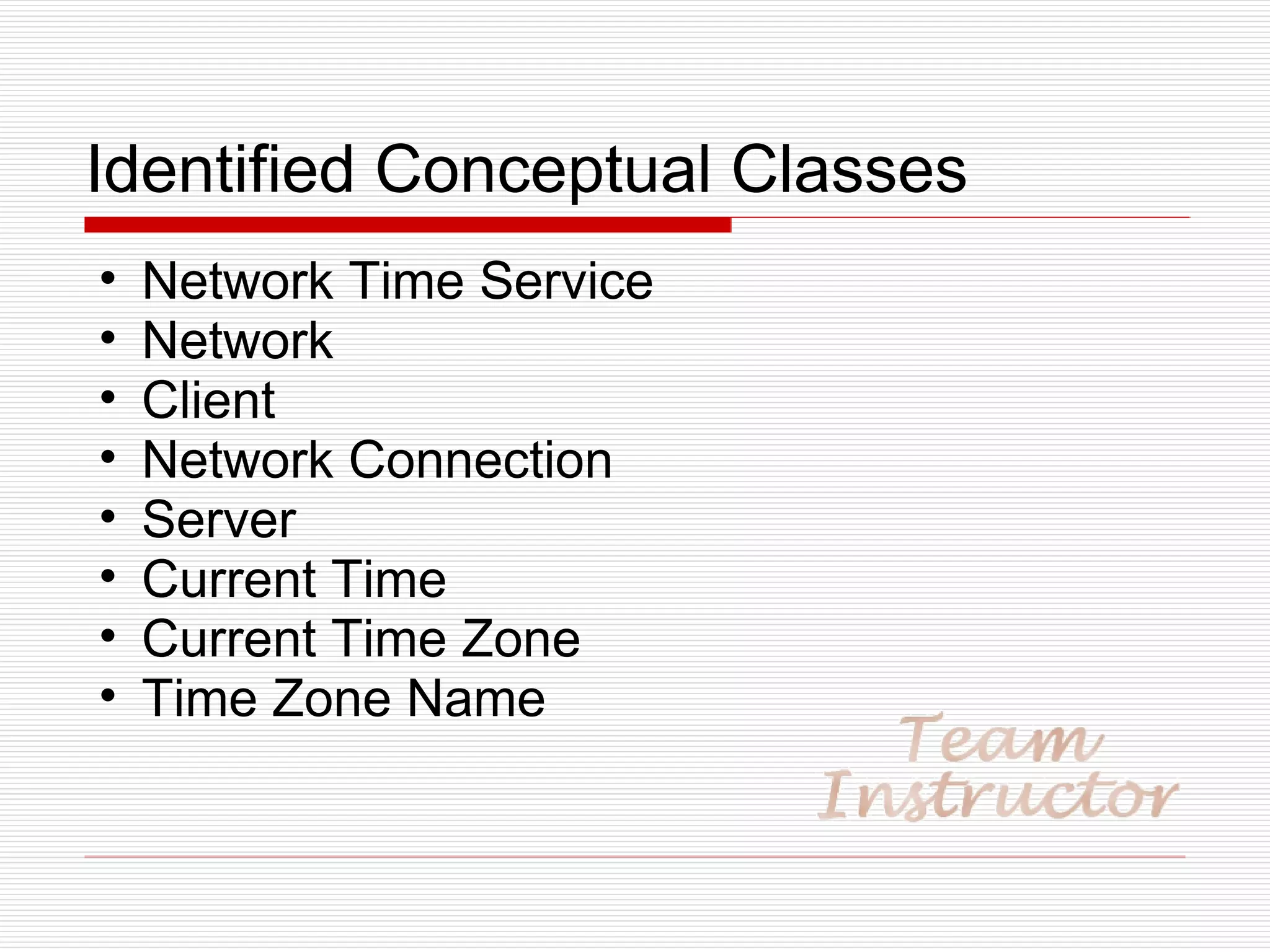
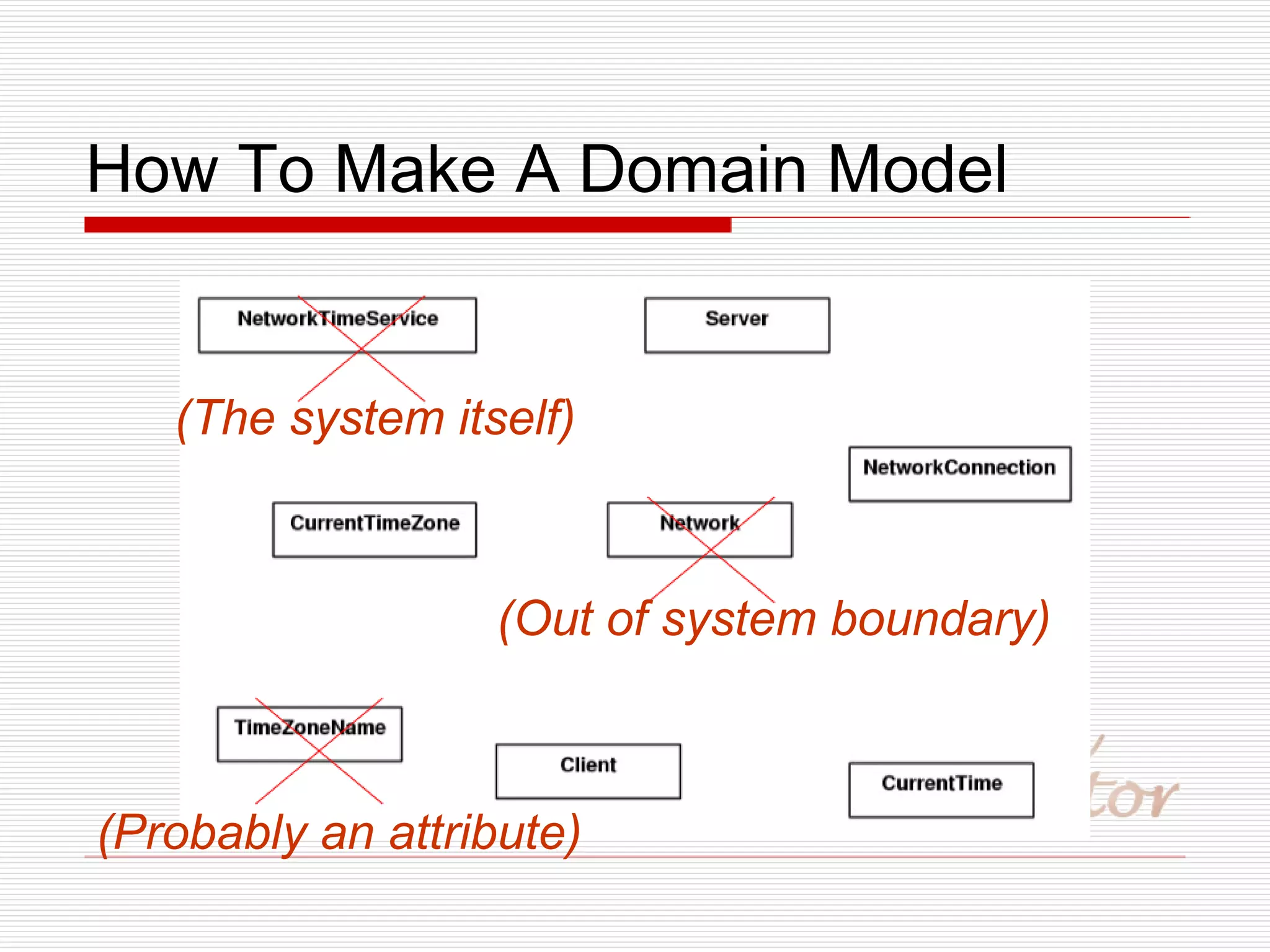
Identified Conceptual Classes Network Time Service Network Client Network Connection Server Current Time Current Time Zone Time Zone Name
How To Make A Domain Model (The system itself) (Probably an attribute) (Out of system boundary)
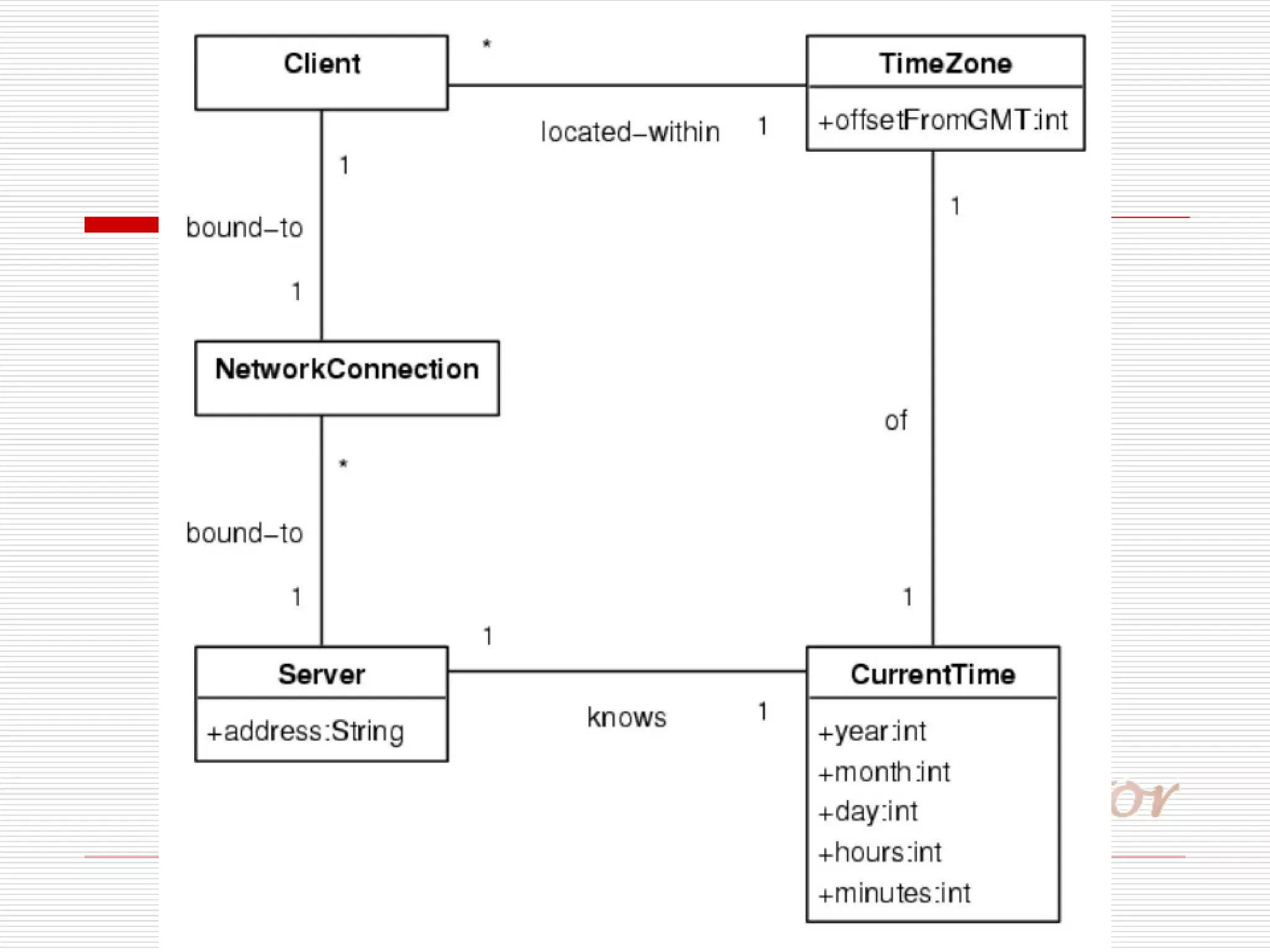
How To Make A Domain Model Identify Conceptual Classes Put them onto a picture. Draw associations between them.
 
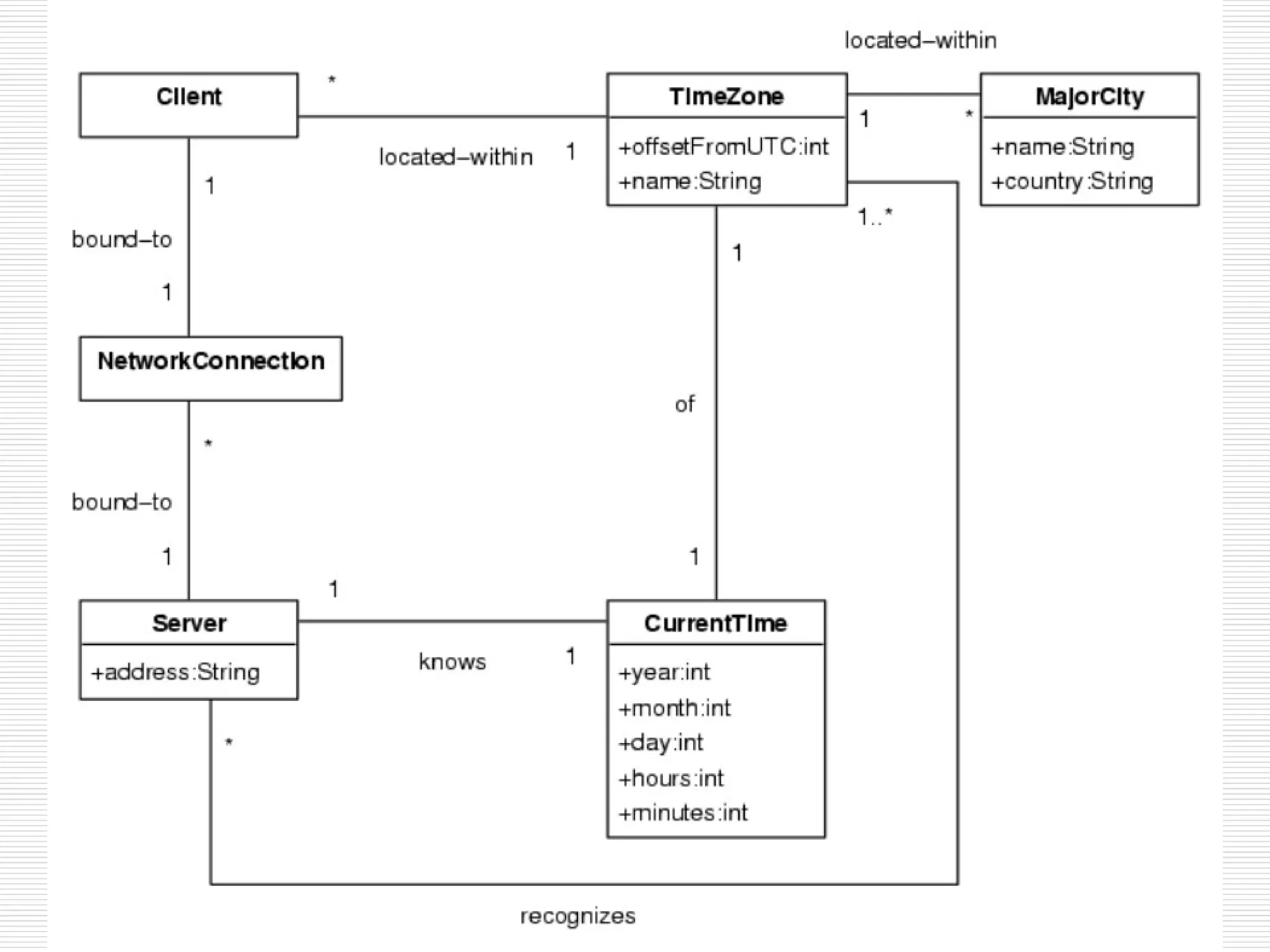
How To Make A Domain Model Identify Conceptual Classes Put them onto a picture. Draw associations between them. Add attributes to fill in details.
 
Use Case UC2: ListTimeZones Use Case: ListTimeZones Identifier: UC2 Description: The ListTimeZones use case models obtaining a description of all recognized time zones. Actors: Client Preconditions: 1. Network time service is available on the network. Flow of events: 1. The use case starts when the Client opens a network connection to the Server. 2. The Client indicates a need for the complete list of all time zones. 3. For each recognized time zone: 1. Server provides the time zone name. 2. Server provides the time zone offset from UTC. 3. Server provides a list of major cities which use the time zone. 4. The Server closes the network connection. Postconditions: 1. The Client has been given all recognized time zones, and the network connection is closed.
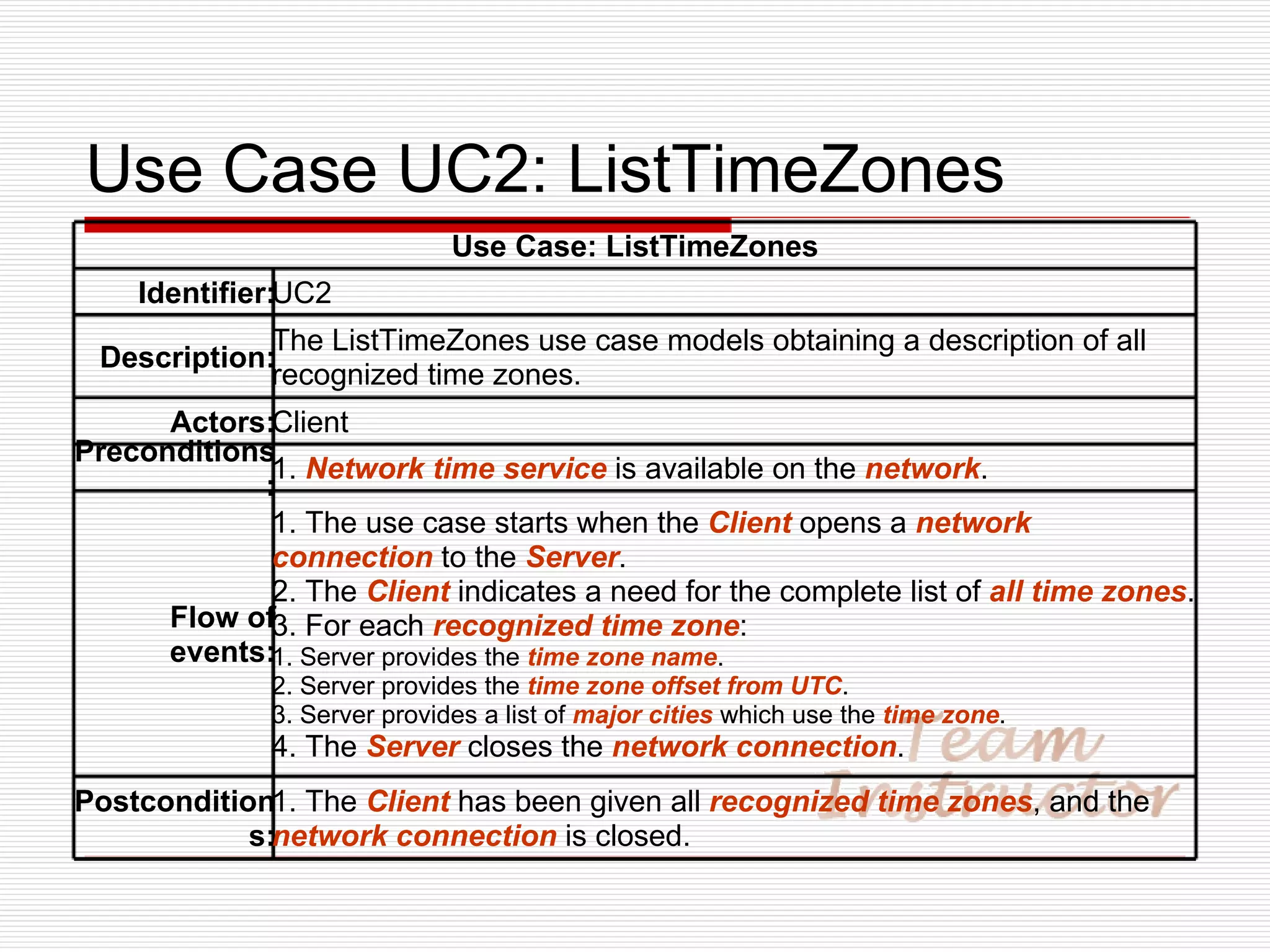
Use Case UC2: ListTimeZones Use Case: ListTimeZones Identifier: UC2 Description: The ListTimeZones use case models obtaining a description of all recognized time zones. Actors: Client Preconditions: 1.  Network time service  is available on the  network . Flow of events: 1. The use case starts when the  Client  opens a  network connection  to the  Server . 2. The  Client  indicates a need for the complete list of  all time zones . 3. For each  recognized time zone : 1. Server provides the  time zone name . 2. Server provides the  time zone offset from UTC . 3. Server provides a list of  major cities  which use the  time zone . 4. The  Server  closes the  network connection . Postconditions: 1. The  Client  has been given all  recognized time zones , and the  network connection  is closed.
 

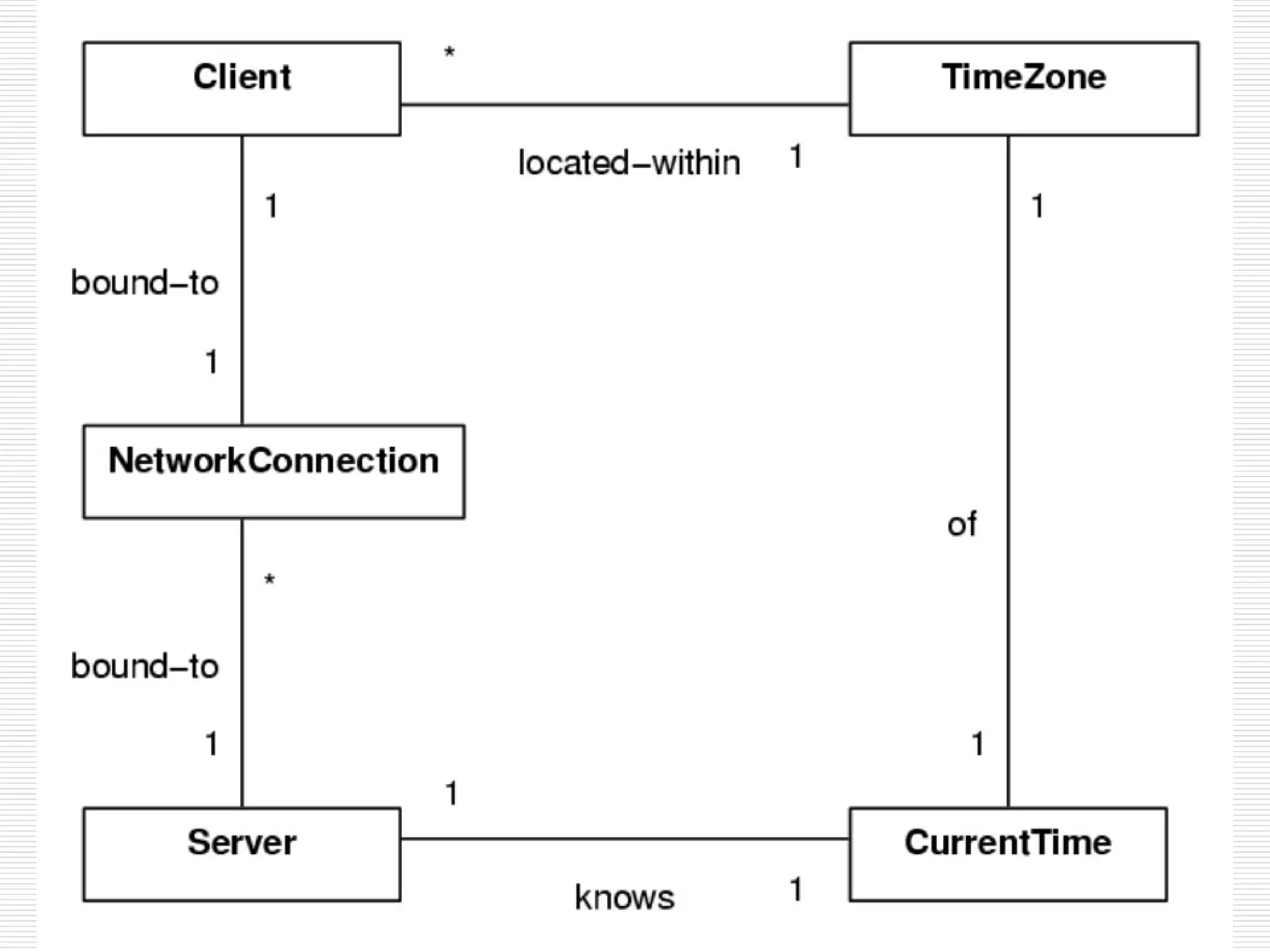
Domain model example

  • 1.
    Domain Models -Part Deux
  • 2.
    Vision Network TimeServer Major Features: Gets current time for a given time zone. Get all available time zones. Support 600+ clients. Single clock on a large network. Clock isn’t necessarily the same as the wall clock. This is a real business problem!
  • 3.
    Use Case UC1:GetCurrentTime Use Case: GetCurrentTime Identifier: UC1 Description: The GetCurrentTime use case models obtaining the current time from a central clock. Actors: Client Preconditions: 1. Network time service is available on the network. Flow of events: 1. The use case starts when the Client opens a network connection to the Server. 2. The Client indicates a need for the current time. 3. The Client provides its current time zone, using the time zone name. 4. The Server provides the Client with the current time in the requested time zone. 5. The Server closes the network connection. Postconditions: 1. The Client has the current time, and the network connection is closed.
  • 4.
  • 5.
    Use Case UC2:ListTimeZones Use Case: ListTimeZones Identifier: UC2 Description: The ListTimeZones use case models obtaining a description of all recognized time zones. Actors: Client Preconditions: 1. Network time service is available on the network. Flow of events: 1. The use case starts when the Client opens a network connection to the Server. 2. The Client indicates a need for the complete list of all time zones. 3. For each recognized time zone: 1. Server provides the time zone name. 2. Server provides the time zone offset from UTC. 3. Server provides a list of major cities which use the time zone. 4. The Server closes the network connection. Postconditions: 1. The Client has been given all recognized time zones, and the network connection is closed.
  • 6.
    How To MakeA Domain Model Identify Conceptual Classes
  • 7.
    Use Case UC1:GetCurrentTime Use Case: GetCurrentTime Identifier: UC1 Description: The GetCurrentTime use case models obtaining the current time from a central clock. Actors: Client Preconditions: 1. Network time service is available on the network. Flow of events: 1. The use case starts when the Client opens a network connection to the Server. 2. The Client indicates a need for the current time. 3. The Client provides its current time zone, using the time zone name. 4. The Server provides the Client with the current time in the requested time zone. 5. The Server closes the network connection. Postconditions: 1. The Client has the current time, and the network connection is closed.
  • 8.
    Use Case UC1:GetCurrentTime Use Case: GetCurrentTime Identifier: UC1 Description: The GetCurrentTime use case models obtaining the current time from a central clock. Actors: Client Preconditions: 1. Network time service is available on the network . Flow of events: 1. The use case starts when the Client opens a network connection to the Server . 2. The Client indicates a need for the current time . 3. The Client provides its current time zone , using the time zone name . 4. The Server provides the Client with the current time in the requested time zone . 5. The Server closes the network connection . Postconditions: 1. The Client has the current time, and the network connection is closed.
  • 9.
    Identified Conceptual ClassesNetwork Time Service Network Client Network Connection Server Current Time Current Time Zone Time Zone Name
  • 10.
    How To MakeA Domain Model (The system itself) (Probably an attribute) (Out of system boundary)
  • 11.
    How To MakeA Domain Model Identify Conceptual Classes Put them onto a picture. Draw associations between them.
  • 12.
  • 13.
    How To MakeA Domain Model Identify Conceptual Classes Put them onto a picture. Draw associations between them. Add attributes to fill in details.
  • 14.
  • 15.
    Use Case UC2:ListTimeZones Use Case: ListTimeZones Identifier: UC2 Description: The ListTimeZones use case models obtaining a description of all recognized time zones. Actors: Client Preconditions: 1. Network time service is available on the network. Flow of events: 1. The use case starts when the Client opens a network connection to the Server. 2. The Client indicates a need for the complete list of all time zones. 3. For each recognized time zone: 1. Server provides the time zone name. 2. Server provides the time zone offset from UTC. 3. Server provides a list of major cities which use the time zone. 4. The Server closes the network connection. Postconditions: 1. The Client has been given all recognized time zones, and the network connection is closed.
  • 16.
    Use Case UC2:ListTimeZones Use Case: ListTimeZones Identifier: UC2 Description: The ListTimeZones use case models obtaining a description of all recognized time zones. Actors: Client Preconditions: 1. Network time service is available on the network . Flow of events: 1. The use case starts when the Client opens a network connection to the Server . 2. The Client indicates a need for the complete list of all time zones . 3. For each recognized time zone : 1. Server provides the time zone name . 2. Server provides the time zone offset from UTC . 3. Server provides a list of major cities which use the time zone . 4. The Server closes the network connection . Postconditions: 1. The Client has been given all recognized time zones , and the network connection is closed.
  • 17.