The Documentary
Film Techniques
Exposition
• In a documentary, the exposition occurs at
the beginning and introduces the important
themes of the film. It is important because
it creates the viewer's first impression and
introduces the viewer to the content.
Direct Narration
• We see and hear the narrator of the film
as the narration is presented; suggests an
intimacy between narrator and audience;
this type of narration is seldom
objective--its biases reflect the speaker's
background, conflicts, values)
Interviews
• The interview is a common documentary
technique. It allows people being filmed to
speak directly about events, prompted by
the questions asked by the filmmaker. An
interview may take place on screen, or off
screen, on a different set. Interviews in a
documentary give the viewer a sense of
realism, that the documentary maker’s
views are mutually shared by another
person or source, and thus more valid.
Point of View Shot
• (Often abbreviated as 'pov'). A shot which
shows the scene from the specific point of
view of one of the characters.
Flash-Forward
• On the model of the flashback, scenes or
shots of future time; the future tense of the
film.
Flashback
• A scene or sequence (sometime an entire
film), that is inserted into a scene in
"present" time and that deals with the past.
The flashback is the past tense of the film.
Indirect & Direct Interview
Technique
• Indirect: We see subject talking on
camera, but we don't see or hear the
interviewer asking questions in the same
shot; this gives the impression of the
character speaking directly to the viewer.
• Direct: We see subject talking on camera,
and we see and hear the interviewer
asking questions in the same shot or in
part B of a two-part parallel track;
suggests journalistic basis of reporting).
Montage
• An edited sequence that elicits a strong
emotional reaction on the part of the
viewer; often used as transitional or
climactic sequences; static shots.
Reaction Shot
• A primary means of conveying meaning
within the context of narrative is through
the use of a reaction shot--a medium shot
or close-up of a character/person just after
significant action occurs within the scene.
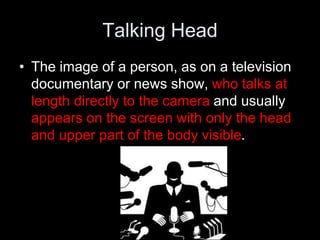
Talking Head
• The image of a person, as on a television
documentary or news show, who talks at
length directly to the camera and usually
appears on the screen with only the head
and upper part of the body visible.
Sound
• Diegetic sound: It is sound that the
characters can hear as well as the
audience, and usually implies a reaction
from the character. Also called "literal
sound" or "actual sound“
• Examples: voices of characters or sounds
within the story
Sound
• Non-diegetic sound: It is sound which is
represented as coming from a source
outside the story space, i.e. its source is
neither visible on the screen, nor has been
implied to be present in the action. Also
called "non-literal sound" or "commentary
sound":
• Examples: Narrator’s commentary, voice-
over and music
The Voice Over
• the voice over in a documentary is a
commentary by the filmmaker, spoken
while the camera is filming, or added to
the soundtrack during the production.
Through this the filmmaker can speak
directly to the viewer, offering information,
explanations and opinions.
Close Up Shot
• One way filmmakers break down narrative
scenes is by inserting a close-up in an
unexpected context; when this is done the
shot is often a close-up in order to draw
our attention to the image/object and
facilitate our judgment of the action.
Editing
• Editing refers literally to how shots are put
together to make up a film. Traditionally a
film is made up of sequences or in some
cases, as with art cinema, of successive
shots that are assembled in what is known
as collision editing, or montage.
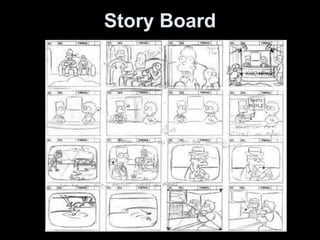
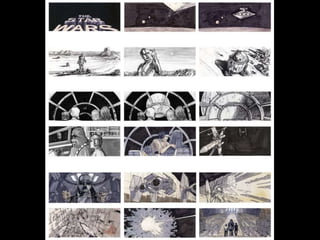
Story Board
• A series of drawings and captions
(sometimes resembling a comic strip) that
shows the planned shot divisions and
camera movements of the film.
Story Board
Documentary-Film-Techniques.ppt

Documentary-Film-Techniques.ppt

  • 1.
  • 2.
    Exposition • In adocumentary, the exposition occurs at the beginning and introduces the important themes of the film. It is important because it creates the viewer's first impression and introduces the viewer to the content.
  • 3.
    Direct Narration • Wesee and hear the narrator of the film as the narration is presented; suggests an intimacy between narrator and audience; this type of narration is seldom objective--its biases reflect the speaker's background, conflicts, values)
  • 4.
    Interviews • The interviewis a common documentary technique. It allows people being filmed to speak directly about events, prompted by the questions asked by the filmmaker. An interview may take place on screen, or off screen, on a different set. Interviews in a documentary give the viewer a sense of realism, that the documentary maker’s views are mutually shared by another person or source, and thus more valid.
  • 5.
    Point of ViewShot • (Often abbreviated as 'pov'). A shot which shows the scene from the specific point of view of one of the characters.
  • 6.
    Flash-Forward • On themodel of the flashback, scenes or shots of future time; the future tense of the film.
  • 7.
    Flashback • A sceneor sequence (sometime an entire film), that is inserted into a scene in "present" time and that deals with the past. The flashback is the past tense of the film.
  • 8.
    Indirect & DirectInterview Technique • Indirect: We see subject talking on camera, but we don't see or hear the interviewer asking questions in the same shot; this gives the impression of the character speaking directly to the viewer. • Direct: We see subject talking on camera, and we see and hear the interviewer asking questions in the same shot or in part B of a two-part parallel track; suggests journalistic basis of reporting).
  • 9.
    Montage • An editedsequence that elicits a strong emotional reaction on the part of the viewer; often used as transitional or climactic sequences; static shots.
  • 10.
    Reaction Shot • Aprimary means of conveying meaning within the context of narrative is through the use of a reaction shot--a medium shot or close-up of a character/person just after significant action occurs within the scene.
  • 11.
    Talking Head • Theimage of a person, as on a television documentary or news show, who talks at length directly to the camera and usually appears on the screen with only the head and upper part of the body visible.
  • 12.
    Sound • Diegetic sound:It is sound that the characters can hear as well as the audience, and usually implies a reaction from the character. Also called "literal sound" or "actual sound“ • Examples: voices of characters or sounds within the story
  • 13.
    Sound • Non-diegetic sound:It is sound which is represented as coming from a source outside the story space, i.e. its source is neither visible on the screen, nor has been implied to be present in the action. Also called "non-literal sound" or "commentary sound": • Examples: Narrator’s commentary, voice- over and music
  • 14.
    The Voice Over •the voice over in a documentary is a commentary by the filmmaker, spoken while the camera is filming, or added to the soundtrack during the production. Through this the filmmaker can speak directly to the viewer, offering information, explanations and opinions.
  • 15.
    Close Up Shot •One way filmmakers break down narrative scenes is by inserting a close-up in an unexpected context; when this is done the shot is often a close-up in order to draw our attention to the image/object and facilitate our judgment of the action.
  • 16.
    Editing • Editing refersliterally to how shots are put together to make up a film. Traditionally a film is made up of sequences or in some cases, as with art cinema, of successive shots that are assembled in what is known as collision editing, or montage.
  • 17.
    Story Board • Aseries of drawings and captions (sometimes resembling a comic strip) that shows the planned shot divisions and camera movements of the film.
  • 18.