Documentary analysis
The marketing of meatloaf
Type of documentary
• The marketing of meatloaf is a mixed
documentary because it uses many
conventions of a documentary. For example it
uses narration, talking head interviews, vox
pop interviews and archive footage all of the
above conventions anchor the meaning of the
documentary and support the expositions.
Themes
• The themes the documentary explores include
music and its effect on the public and the
artist. The world of award ceremonies, and an
incite in to the business of music development
and marketing.
Narrative Structure
• The narrative structure of the documentary is split in to
three sections as it is linear:
• Beginning
– Opens at awards ceremony
• Middle
– In the middle the program explores and follows on how the
industry rebrands meatloaf.
• End
– At the end meatloaf’s rebranding is complete and a success.
Furthermore at the end we return to the awards ceremony
• this completes the equilibrium, this allows the
documentary to conform to Todorov’s media theory of
narrative.
Camerawork
• Close ups of meatloaf show the work the artist
has had to put in.
• During the scene with the music company the
execs are all filmed at eye level using a head and
shoulder medium close up. The use of a wide
angle in the board room portrays every person as
an equal.
• The use of panning and tracking shots whilst with
a low angle portray meatloaf as an important
person.
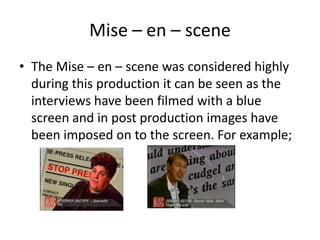
Mise – en – scene
• The Mise – en – scene was considered highly
during this production it can be seen as the
interviews have been filmed with a blue
screen and in post production images have
been imposed on to the screen. For example;
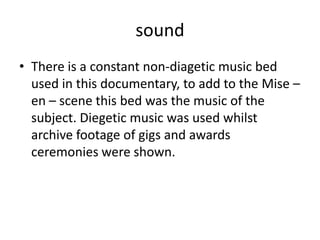
sound
• There is a constant non-diagetic music bed
used in this documentary, to add to the Mise –
en – scene this bed was the music of the
subject. Diegetic music was used whilst
archive footage of gigs and awards
ceremonies were shown.
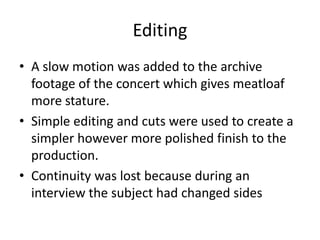
Editing
• A slow motion was added to the archive
footage of the concert which gives meatloaf
more stature.
• Simple editing and cuts were used to create a
simpler however more polished finish to the
production.
• Continuity was lost because during an
interview the subject had changed sides
Archive footage
• Archive footage of concerts awards
ceremonies the music videos and meet and
greets were used to give the production a
more sophisticated finish.
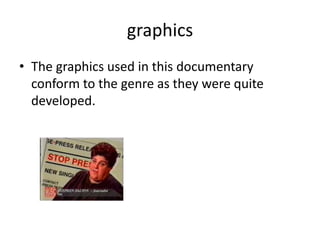
graphics
• The graphics used in this documentary
conform to the genre as they were quite
developed.

Documentary analysis 2

  • 1.
  • 2.
    Type of documentary •The marketing of meatloaf is a mixed documentary because it uses many conventions of a documentary. For example it uses narration, talking head interviews, vox pop interviews and archive footage all of the above conventions anchor the meaning of the documentary and support the expositions.
  • 3.
    Themes • The themesthe documentary explores include music and its effect on the public and the artist. The world of award ceremonies, and an incite in to the business of music development and marketing.
  • 4.
    Narrative Structure • Thenarrative structure of the documentary is split in to three sections as it is linear: • Beginning – Opens at awards ceremony • Middle – In the middle the program explores and follows on how the industry rebrands meatloaf. • End – At the end meatloaf’s rebranding is complete and a success. Furthermore at the end we return to the awards ceremony • this completes the equilibrium, this allows the documentary to conform to Todorov’s media theory of narrative.
  • 5.
    Camerawork • Close upsof meatloaf show the work the artist has had to put in. • During the scene with the music company the execs are all filmed at eye level using a head and shoulder medium close up. The use of a wide angle in the board room portrays every person as an equal. • The use of panning and tracking shots whilst with a low angle portray meatloaf as an important person.
  • 6.
    Mise – en– scene • The Mise – en – scene was considered highly during this production it can be seen as the interviews have been filmed with a blue screen and in post production images have been imposed on to the screen. For example;
  • 7.
    sound • There isa constant non-diagetic music bed used in this documentary, to add to the Mise – en – scene this bed was the music of the subject. Diegetic music was used whilst archive footage of gigs and awards ceremonies were shown.
  • 8.
    Editing • A slowmotion was added to the archive footage of the concert which gives meatloaf more stature. • Simple editing and cuts were used to create a simpler however more polished finish to the production. • Continuity was lost because during an interview the subject had changed sides
  • 9.
    Archive footage • Archivefootage of concerts awards ceremonies the music videos and meet and greets were used to give the production a more sophisticated finish.
  • 10.
    graphics • The graphicsused in this documentary conform to the genre as they were quite developed.