NIC 2004-13
Report of the National Intelligence Council’s
2020 Project
Based on consultations with nongovernmental
experts around the world
December 2004
To obtain a copy of this publication, please contact:
Government Printing Office (GPO), Superintendent of Documents, PO Box 391954,
Pittsburgh, PA 15250-7954; Phone: (202) 512-1800; Fax: (202) 512-2250; http:bookstore.gpo.gov;
GPO Stock 041-015-0024-6; ISBN 0-16-073-218-2.
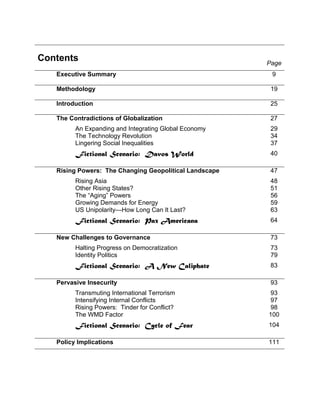
Contents Page
Executive Summary 9
Methodology 19
Introduction 25
The Contradictions of Globalization
An Expanding and Integrating Global Economy
The Technology Revolution
Lingering Social Inequalities
Fictional Scenario: Davos World
27
29
34
37
40
Rising Powers: The Changing Geopolitical Landscape
Rising Asia
Other Rising States?
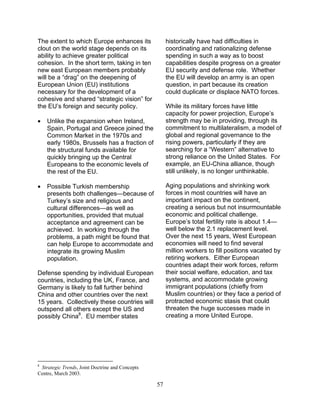
The “Aging” Powers
Growing Demands for Energy
US Unipolarity—How Long Can It Last?
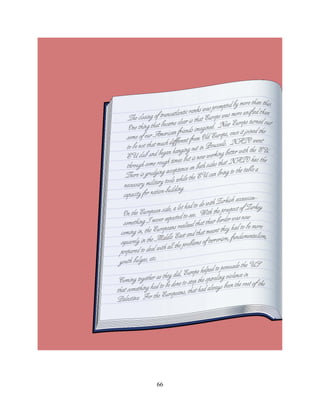
Fictional Scenario: Pax Americana
47
48
51
56
59
63
64
New Challenges to Governance
Halting Progress on Democratization
Identity Politics
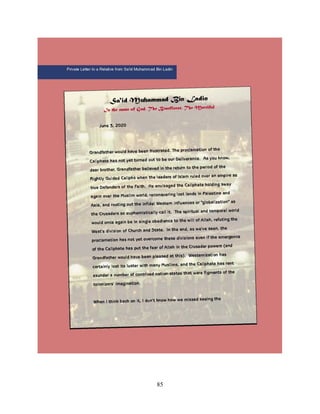
Fictional Scenario: A New Caliphate
73
73
79
83
Pervasive Insecurity
Transmuting International Terrorism
Intensifying Internal Conflicts
Rising Powers: Tinder for Conflict?
The WMD Factor
Fictional Scenario: Cycle of Fear
93
93
97
98
100
104
Policy Implications 111
4
5
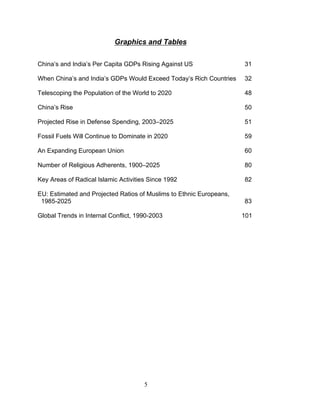
Graphics and Tables
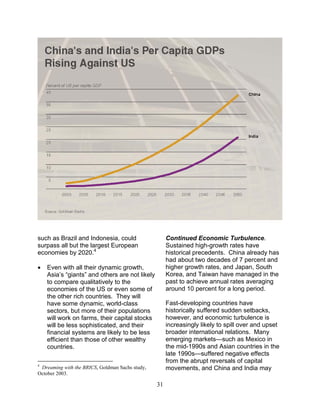
China’s and India’s Per Capita GDPs Rising Against US 31
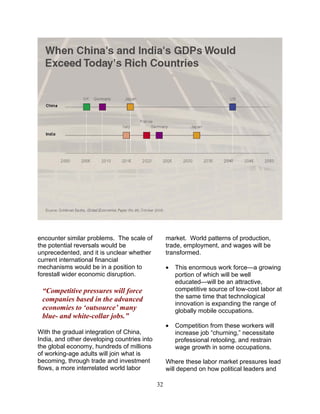
When China’s and India’s GDPs Would Exceed Today’s Rich Countries 32
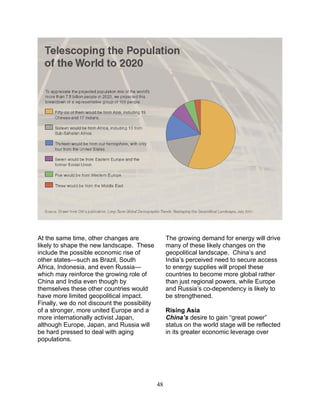
Telescoping the Population of the World to 2020 48
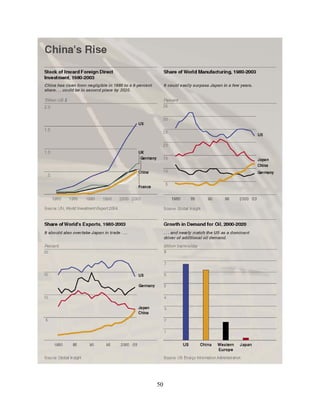
China’s Rise 50
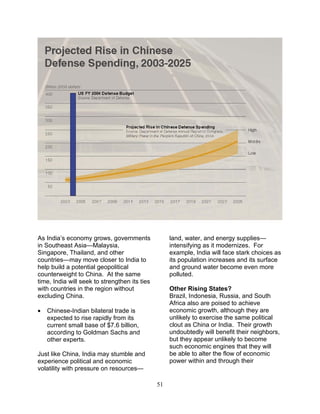
Projected Rise in Defense Spending, 2003–2025 51
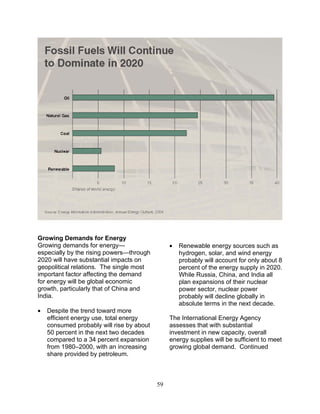
Fossil Fuels Will Continue to Dominate in 2020 59
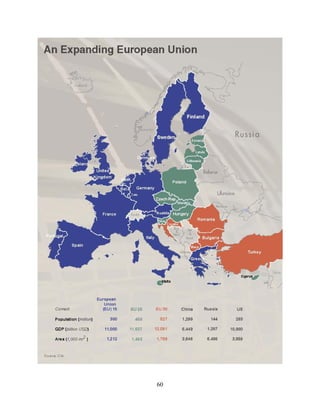
An Expanding European Union 60
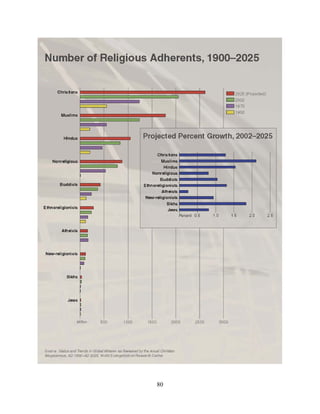
Number of Religious Adherents, 1900–2025 80
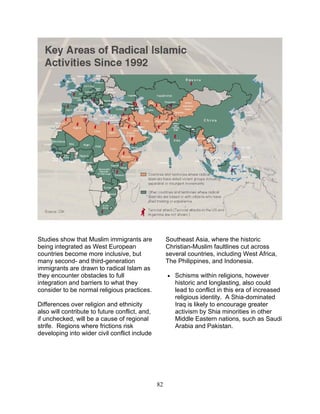
Key Areas of Radical Islamic Activities Since 1992 82
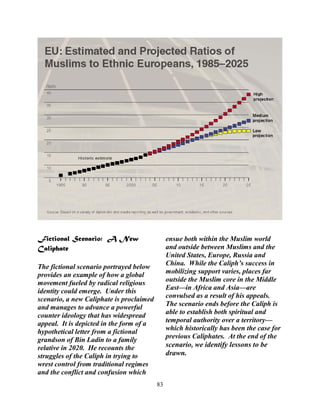
EU: Estimated and Projected Ratios of Muslims to Ethnic Europeans,
1985-2025 83
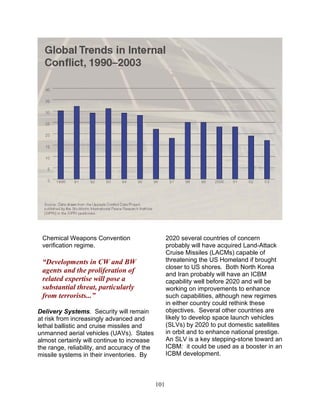
Global Trends in Internal Conflict, 1990-2003 101
6
7
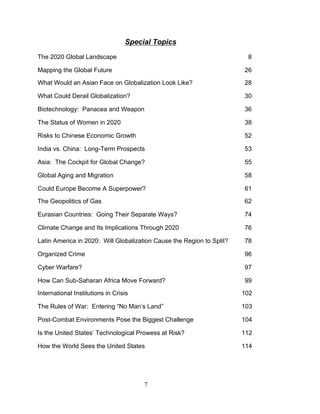
Special Topics
The 2020 Global Landscape 8
Mapping the Global Future 26
What Would an Asian Face on Globalization Look Like? 28
What Could Derail Globalization? 30
Biotechnology: Panacea and Weapon 36
The Status of Women in 2020 38
Risks to Chinese Economic Growth 52
India vs. China: Long-Term Prospects 53
Asia: The Cockpit for Global Change? 55
Global Aging and Migration 58
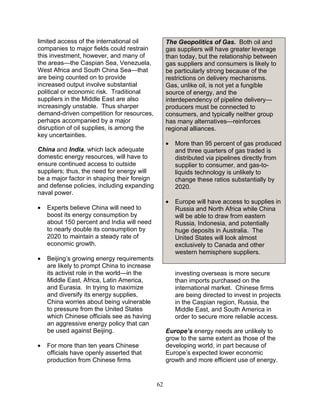
Could Europe Become A Superpower? 61
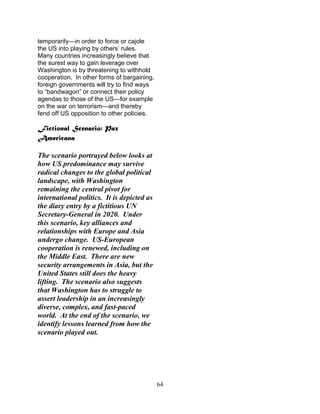
The Geopolitics of Gas 62
Eurasian Countries: Going Their Separate Ways? 74
Climate Change and Its Implications Through 2020 76
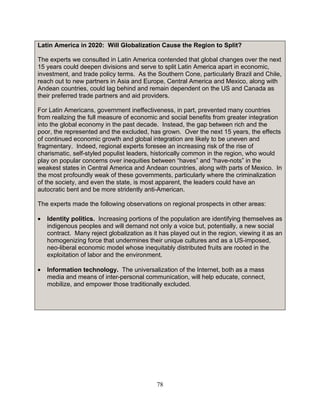
Latin America in 2020: Will Globalization Cause the Region to Split? 78
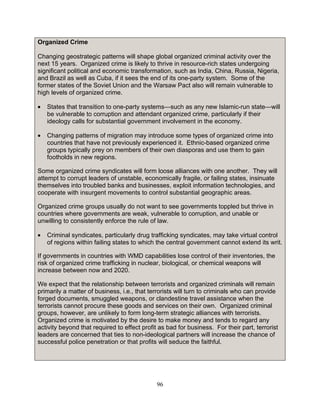
Organized Crime 96
Cyber Warfare? 97
How Can Sub-Saharan Africa Move Forward? 99
International Institutions in Crisis 102
The Rules of War: Entering “No Man’s Land” 103
Post-Combat Environments Pose the Biggest Challenge 104
Is the United States’ Technological Prowess at Risk? 112
How the World Sees the United States 114
8
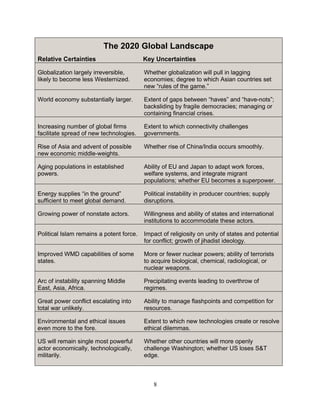
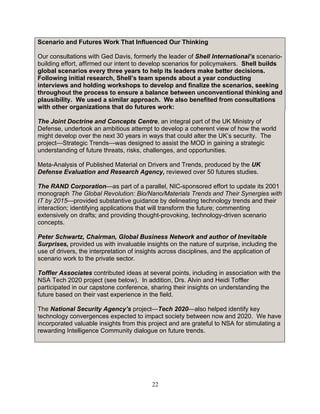
The 2020 Global Landscape
Relative Certainties Key Uncertainties
Globalization largely irreversible,
likely to become less Westernized.
Whether globalization will pull in lagging
economies; degree to which Asian countries set
new “rules of the game.”
World economy substantially larger. Extent of gaps between “haves” and “have-nots”;
backsliding by fragile democracies; managing or
containing financial crises.
Increasing number of global firms
facilitate spread of new technologies.
Extent to which connectivity challenges
governments.
Rise of Asia and advent of possible
new economic middle-weights.
Whether rise of China/India occurs smoothly.
Aging populations in established
powers.
Ability of EU and Japan to adapt work forces,
welfare systems, and integrate migrant
populations; whether EU becomes a superpower.
Energy supplies “in the ground”
sufficient to meet global demand.
Political instability in producer countries; supply
disruptions.
Growing power of nonstate actors. Willingness and ability of states and international
institutions to accommodate these actors.
Political Islam remains a potent force. Impact of religiosity on unity of states and potential
for conflict; growth of jihadist ideology.
Improved WMD capabilities of some
states.
More or fewer nuclear powers; ability of terrorists
to acquire biological, chemical, radiological, or
nuclear weapons.
Arc of instability spanning Middle
East, Asia, Africa.
Precipitating events leading to overthrow of
regimes.
Great power conflict escalating into
total war unlikely.
Ability to manage flashpoints and competition for
resources.
Environmental and ethical issues
even more to the fore.
Extent to which new technologies create or resolve
ethical dilemmas.
US will remain single most powerful
actor economically, technologically,
militarily.
Whether other countries will more openly
challenge Washington; whether US loses S&T
edge.
9
Executive Summary
At no time since the formation of the Western alliance system in 1949 have the
shape and nature of international alignments been in such a state of flux. The end
of the Cold War shifted the tectonic plates, but the repercussions from these momentous
events are still unfolding. Emerging powers in Asia, retrenchment in Eurasia, a roiling
Middle East, and transatlantic divisions are among the issues that have only come to a
head in recent years. The very magnitude and speed of change resulting from a
globalizing world—apart from its precise character—will be a defining feature of the
world out to 2020. Other significant characteristics include: the rise of new powers, new
challenges to governance, and a more pervasive sense of insecurity, including terrorism.
As we map the future, the prospects for increasing global prosperity and the limited
likelihood of great power conflict provide an overall favorable environment for coping
with what are otherwise daunting challenges. The role of the United States will be an
important variable in how the world is shaped, influencing the path that states and
nonstate actors choose to follow.
New Global Players
The likely emergence of China and India, as well as others, as new major global
players—similar to the advent of a united Germany in the 19th
century and a
powerful United States in the early 20th
century—will transform the geopolitical
landscape, with impacts potentially as dramatic as those in the previous two
centuries. In the same way that commentators refer to the 1900s as the “American
Century,” the 21st
century may be seen as the time when Asia, led by China and India,
comes into its own. A combination of sustained high economic growth, expanding
military capabilities, and large populations will be at the root of the expected rapid rise in
economic and political power for both countries.
• Most forecasts indicate that by 2020 China’s gross national product (GNP) will
exceed that of individual Western economic powers except for the United States.
India’s GNP will have overtaken or be on the threshold of overtaking European
economies.
• Because of the sheer size of China’s and India’s populations—projected by the US
Census Bureau to be 1.4 billion and almost 1.3 billion respectively by 2020—their
standard of living need not approach Western levels for these countries to become
important economic powers.
Barring an abrupt reversal of the process of globalization or any major upheavals in
these countries, the rise of these new powers is a virtual certainty. Yet how China and
India exercise their growing power and whether they relate cooperatively or
competitively to other powers in the international system are key uncertainties. The
economies of other developing countries, such as Brazil, could surpass all but the
largest European countries by 2020; Indonesia’s economy could also approach the
economies of individual European countries by 2020.
10
By most measures—market size, single currency, highly skilled work force, stable
democratic governments, and unified trade bloc—an enlarged Europe will be able to
increase its weight on the international scene. Europe’s strength could be in providing a
model of global and regional governance to the rising powers. But aging populations
and shrinking work forces in most countries will have an important impact on the
continent. Either European countries adapt their work forces, reform their social
welfare, education, and tax systems, and accommodate growing immigrant populations
(chiefly from Muslim countries), or they face a period of protracted economic stasis.
Japan faces a similar aging crisis that could crimp its longer run economic recovery, but
it also will be challenged to evaluate its regional status and role. Tokyo may have to
choose between “balancing” against or “bandwagoning” with China. Meanwhile, the
crisis over North Korea is likely to come to a head sometime over the next 15 years.
Asians’ lingering resentments and concerns over Korean unification and cross-Taiwan
Strait tensions point to a complicated process for achieving regional equilibrium.
Russia has the potential to enhance its international role with others due to its position
as a major oil and gas exporter. However, Russia faces a severe demographic crisis
resulting from low birth rates, poor medical care, and a potentially explosive AIDS
situation. To the south, it borders an unstable region in the Caucasus and Central Asia,
the effects of which—Muslim extremism, terrorism, and endemic conflict—are likely to
continue spilling over into Russia. While these social and political factors limit the
extent to which Russia can be a major global player, Moscow is likely to be an important
partner both for the established powers, the United States and Europe, and for the
rising powers of China and India.
With these and other new global actors, how we mentally map the world in 2020 will
change radically. The “arriviste” powers—China, India, and perhaps others such as
Brazil and Indonesia—have the potential to render obsolete the old categories of East
and West, North and South, aligned and nonaligned, developed and developing.
Traditional geographic groupings will increasingly lose salience in international relations.
A state-bound world and a world of mega-cities, linked by flows of telecommunications,
trade and finance, will co-exist. Competition for allegiances will be more open, less
fixed than in the past.
Impact of Globalization
We see globalization—growing interconnectedness reflected in the expanded flows of
information, technology, capital, goods, services, and people throughout the world—as
an overarching “mega-trend,” a force so ubiquitous that it will substantially shape
all the other major trends in the world of 2020. But the future of globalization is not
fixed; states and nonstate actors—including both private companies and NGOs—will
struggle to shape its contours. Some aspects of globalization—such as the growing
global interconnectedness stemming from the information technology (IT) revolution—
almost certainly will be irreversible. Yet it is also possible, although unlikely, that the
process of globalization could be slowed or even stopped, just as the era of globalization
11
in the late 19th
and early 20th
centuries was reversed by catastrophic war and global
depression.
Barring such a turn of events, the world economy is likely to continue growing
impressively: by 2020, it is projected to be about 80 percent larger than it was in
2000, and average per capita income will be roughly 50 percent higher. Of course,
there will be cyclical ups and downs and periodic financial or other crises, but this basic
growth trajectory has powerful momentum behind it. Most countries around the world,
both developed and developing, will benefit from gains in the world economy. By
having the fastest-growing consumer markets, more firms becoming world-class
multinationals, and greater S&T stature, Asia looks set to displace Western countries as
the focus for international economic dynamism—provided Asia’s rapid economic growth
continues.
Yet the benefits of globalization won’t be global. Rising powers will see exploiting
the opportunities afforded by the emerging global marketplace as the best way to assert
their great power status on the world stage. In contrast, some now in the “First World”
may see the closing gap with China, India, and others as evidence of a relative decline,
even though the older powers are likely to remain global leaders out to 2020. The
United States, too, will see its relative power position eroded, though it will remain in
2020 the most important single country across all the dimensions of power. Those left
behind in the developing world may resent China and India’s rise, especially if they feel
squeezed by their growing dominance in key sectors of the global marketplace. And
large pockets of poverty will persist even in “winner” countries.
The greatest benefits of globalization will accrue to countries and groups that can
access and adopt new technologies. Indeed, a nation’s level of technological
achievement generally will be defined in terms of its investment in integrating and
applying the new, globally available technologies—whether the technologies are
acquired through a country’s own basic research or from technology leaders. The
growing two-way flow of high-tech brain power between the developing world and the
West, the increasing size of the information computer-literate work force in some
developing countries, and efforts by global corporations to diversify their high-tech
operations will foster the spread of new technologies. High-tech breakthroughs—such
as in genetically modified organisms and increased food production—could provide a
safety net eliminating the threat of starvation and ameliorating basic quality of life issues
for poor countries. But the gap between the “haves” and “have-nots” will widen unless
the “have-not” countries pursue policies that support application of new technologies—
such as good governance, universal education, and market reforms.
Those countries that pursue such policies could leapfrog stages of development,
skipping over phases that other high-tech leaders such as the United States and Europe
had to traverse in order to advance. China and India are well positioned to become
technology leaders, and even the poorest countries will be able to leverage
prolific, cheap technologies to fuel—although at a slower rate—their own
development.
12
• The expected next revolution in high technology involving the convergence of nano-,
bio-, information and materials technology could further bolster China and India’s
prospects. Both countries are investing in basic research in these fields and are well
placed to be leaders in a number of key fields. Europe risks slipping behind Asia in
some of these technologies. The United States is still in a position to retain its
overall lead, although it must increasingly compete with Asia to retain its edge and
may lose significant ground in some sectors.
More firms will become global, and those operating in the global arena will be
more diverse, both in size and origin, more Asian and less Western in orientation.
Such corporations, encompassing the current, large multinationals, will be
increasingly outside the control of any one state and will be key agents of change
in dispersing technology widely, further integrating the world economy, and
promoting economic progress in the developing world. Their ranks will include a
growing number based in such countries as China, India, or Brazil. While North
America, Japan, and Europe might collectively continue to dominate international
political and financial institutions, globalization will take on an increasingly non-Western
character. By 2020, globalization could be equated in the popular mind with a rising
Asia, replacing its current association with Americanization.
An expanding global economy will increase demand for many raw materials, such as oil.
Total energy consumed probably will rise by about 50 percent in the next two decades
compared to a 34 percent expansion from 1980-2000, with a greater share provided by
petroleum. Most experts assess that with substantial investment in new capacity,
overall energy supplies will be sufficient to meet global demands. But on the supply
side, many of the areas—the Caspian Sea, Venezuela, and West Africa—that are being
counted on to provide increased output involve substantial political or economic risk.
Traditional suppliers in the Middle East are also increasingly unstable. Thus sharper
demand-driven competition for resources, perhaps accompanied by a major
disruption of oil supplies, is among the key uncertainties.
• China, India, and other developing countries’ growing energy needs suggest a
growing preoccupation with energy, shaping their foreign policies.
• For Europe, an increasing preference for natural gas may reinforce regional
relationships—such as with Russia or North Africa—given the interdependence of
pipeline delivery.
New Challenges to Governance
The nation-state will continue to be the dominant unit of the global order, but
economic globalization and the dispersion of technologies, especially
information technologies, will place enormous new strains on governments.
Growing connectivity will be accompanied by the proliferation of virtual communities of
interest, complicating the ability of states to govern. The Internet in particular will spur
13
the creation of even more global movements, which may emerge as a robust force in
international affairs.
Part of the pressure on governance will come from new forms of identity politics
centered on religious convictions. In a rapidly globalizing world experiencing population
shifts, religious identities provide followers with a ready-made community that serves as
a “social safety net” in times of need—particularly important to migrants. In particular,
political Islam will have a significant global impact leading to 2020, rallying
disparate ethnic and national groups and perhaps even creating an authority that
transcends national boundaries. A combination of factors—youth bulges in many
Arab states, poor economic prospects, the influence of religious education, and the
Islamization of such institutions as trade unions, nongovernmental organizations, and
political parties—will ensure that political Islam remains a major force.
• Outside the Middle East, political Islam will continue to appeal to Muslim migrants
who are attracted to the more prosperous West for employment opportunities but do
not feel at home in what they perceive as an alien and hostile culture.
Regimes that were able to manage the challenges of the 1990s could be overwhelmed
by those of 2020. Contradictory forces will be at work: authoritarian regimes will face
new pressures to democratize, but fragile new democracies may lack the adaptive
capacity to survive and develop.
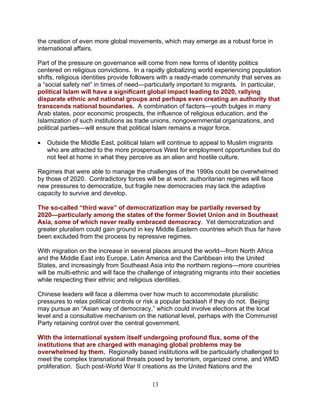
The so-called “third wave” of democratization may be partially reversed by
2020—particularly among the states of the former Soviet Union and in Southeast
Asia, some of which never really embraced democracy. Yet democratization and
greater pluralism could gain ground in key Middle Eastern countries which thus far have
been excluded from the process by repressive regimes.
With migration on the increase in several places around the world—from North Africa
and the Middle East into Europe, Latin America and the Caribbean into the United
States, and increasingly from Southeast Asia into the northern regions—more countries
will be multi-ethnic and will face the challenge of integrating migrants into their societies
while respecting their ethnic and religious identities.
Chinese leaders will face a dilemma over how much to accommodate pluralistic
pressures to relax political controls or risk a popular backlash if they do not. Beijing
may pursue an “Asian way of democracy,” which could involve elections at the local
level and a consultative mechanism on the national level, perhaps with the Communist
Party retaining control over the central government.
With the international system itself undergoing profound flux, some of the
institutions that are charged with managing global problems may be
overwhelmed by them. Regionally based institutions will be particularly challenged to
meet the complex transnational threats posed by terrorism, organized crime, and WMD
proliferation. Such post-World War II creations as the United Nations and the
14
international financial institutions risk sliding into obsolescence unless they adjust to the
profound changes taking place in the global system, including the rise of new powers.
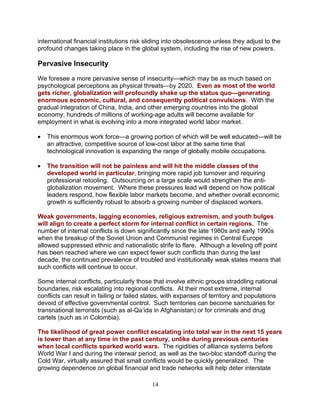
Pervasive Insecurity
We foresee a more pervasive sense of insecurity—which may be as much based on
psychological perceptions as physical threats—by 2020. Even as most of the world
gets richer, globalization will profoundly shake up the status quo—generating
enormous economic, cultural, and consequently political convulsions. With the
gradual integration of China, India, and other emerging countries into the global
economy, hundreds of millions of working-age adults will become available for
employment in what is evolving into a more integrated world labor market.
• This enormous work force—a growing portion of which will be well educated—will be
an attractive, competitive source of low-cost labor at the same time that
technological innovation is expanding the range of globally mobile occupations.
• The transition will not be painless and will hit the middle classes of the
developed world in particular, bringing more rapid job turnover and requiring
professional retooling. Outsourcing on a large scale would strengthen the anti-
globalization movement. Where these pressures lead will depend on how political
leaders respond, how flexible labor markets become, and whether overall economic
growth is sufficiently robust to absorb a growing number of displaced workers.
Weak governments, lagging economies, religious extremism, and youth bulges
will align to create a perfect storm for internal conflict in certain regions. The
number of internal conflicts is down significantly since the late 1980s and early 1990s
when the breakup of the Soviet Union and Communist regimes in Central Europe
allowed suppressed ethnic and nationalistic strife to flare. Although a leveling off point
has been reached where we can expect fewer such conflicts than during the last
decade, the continued prevalence of troubled and institutionally weak states means that
such conflicts will continue to occur.
Some internal conflicts, particularly those that involve ethnic groups straddling national
boundaries, risk escalating into regional conflicts. At their most extreme, internal
conflicts can result in failing or failed states, with expanses of territory and populations
devoid of effective governmental control. Such territories can become sanctuaries for
transnational terrorists (such as al-Qa’ida in Afghanistan) or for criminals and drug
cartels (such as in Colombia).
The likelihood of great power conflict escalating into total war in the next 15 years
is lower than at any time in the past century, unlike during previous centuries
when local conflicts sparked world wars. The rigidities of alliance systems before
World War I and during the interwar period, as well as the two-bloc standoff during the
Cold War, virtually assured that small conflicts would be quickly generalized. The
growing dependence on global financial and trade networks will help deter interstate
15
conflict but does not eliminate the possibility. Should conflict occur that involved one or
more of the great powers, the consequences would be significant. The absence of
effective conflict resolution mechanisms in some regions, the rise of nationalism in
some states, and the raw emotions and tensions on both sides of some issues—for
example, the Taiwan Strait or India/Pakistan issues—could lead to miscalculation.
Moreover, advances in modern weaponry—longer ranges, precision delivery, and more
destructive conventional munitions—create circumstances encouraging the preemptive
use of military force.
Current nuclear weapons states will continue to improve the survivability of their
deterrent forces and almost certainly will improve the reliability, accuracy, and lethality
of their delivery systems as well as develop capabilities to penetrate missile defenses.
The open demonstration of nuclear capabilities by any state would further discredit the
current nonproliferation regime, cause a possible shift in the balance of power, and
increase the risk of conflicts escalating into nuclear ones. Countries without nuclear
weapons—especially in the Middle East and Northeast Asia—might decide to
seek them as it becomes clear that their neighbors and regional rivals are doing
so. Moreover, the assistance of proliferators will reduce the time required for additional
countries to develop nuclear weapons.
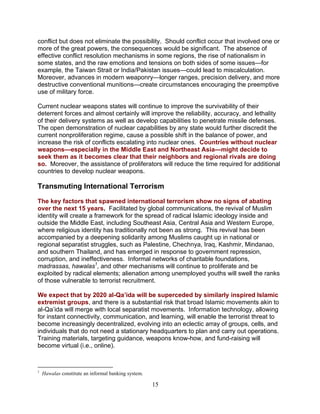
Transmuting International Terrorism
The key factors that spawned international terrorism show no signs of abating
over the next 15 years. Facilitated by global communications, the revival of Muslim
identity will create a framework for the spread of radical Islamic ideology inside and
outside the Middle East, including Southeast Asia, Central Asia and Western Europe,
where religious identity has traditionally not been as strong. This revival has been
accompanied by a deepening solidarity among Muslims caught up in national or
regional separatist struggles, such as Palestine, Chechnya, Iraq, Kashmir, Mindanao,
and southern Thailand, and has emerged in response to government repression,
corruption, and ineffectiveness. Informal networks of charitable foundations,
madrassas, hawalas1
, and other mechanisms will continue to proliferate and be
exploited by radical elements; alienation among unemployed youths will swell the ranks
of those vulnerable to terrorist recruitment.
We expect that by 2020 al-Qa’ida will be superceded by similarly inspired Islamic
extremist groups, and there is a substantial risk that broad Islamic movements akin to
al-Qa’ida will merge with local separatist movements. Information technology, allowing
for instant connectivity, communication, and learning, will enable the terrorist threat to
become increasingly decentralized, evolving into an eclectic array of groups, cells, and
individuals that do not need a stationary headquarters to plan and carry out operations.
Training materials, targeting guidance, weapons know-how, and fund-raising will
become virtual (i.e., online).
1
Hawalas constitute an informal banking system.
16
Terrorist attacks will continue to primarily employ conventional weapons, incorporating
new twists and constantly adapting to counterterrorist efforts. Terrorists probably will be
most original not in the technologies or weapons they use but rather in their operational
concepts—i.e., the scope, design, or support arrangements for attacks.
Strong terrorist interest in acquiring chemical, biological, radiological and nuclear
weapons increases the risk of a major terrorist attack involving WMD. Our greatest
concern is that terrorists might acquire biological agents or, less likely, a nuclear
device, either of which could cause mass casualties. Bioterrorism appears
particularly suited to the smaller, better-informed groups. We also expect that terrorists
will attempt cyber attacks to disrupt critical information networks and, even more likely,
to cause physical damage to information systems.
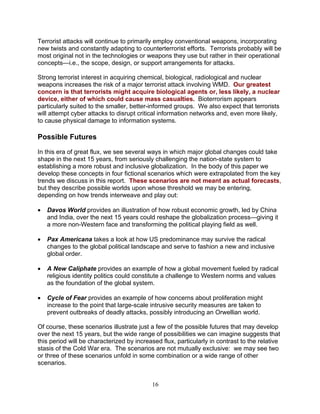
Possible Futures
In this era of great flux, we see several ways in which major global changes could take
shape in the next 15 years, from seriously challenging the nation-state system to
establishing a more robust and inclusive globalization. In the body of this paper we
develop these concepts in four fictional scenarios which were extrapolated from the key
trends we discuss in this report. These scenarios are not meant as actual forecasts,
but they describe possible worlds upon whose threshold we may be entering,
depending on how trends interweave and play out:
• Davos World provides an illustration of how robust economic growth, led by China
and India, over the next 15 years could reshape the globalization process—giving it
a more non-Western face and transforming the political playing field as well.
• Pax Americana takes a look at how US predominance may survive the radical
changes to the global political landscape and serve to fashion a new and inclusive
global order.
• A New Caliphate provides an example of how a global movement fueled by radical
religious identity politics could constitute a challenge to Western norms and values
as the foundation of the global system.
• Cycle of Fear provides an example of how concerns about proliferation might
increase to the point that large-scale intrusive security measures are taken to
prevent outbreaks of deadly attacks, possibly introducing an Orwellian world.
Of course, these scenarios illustrate just a few of the possible futures that may develop
over the next 15 years, but the wide range of possibilities we can imagine suggests that
this period will be characterized by increased flux, particularly in contrast to the relative
stasis of the Cold War era. The scenarios are not mutually exclusive: we may see two
or three of these scenarios unfold in some combination or a wide range of other
scenarios.
17
Policy Implications
The role of the United States will be an important shaper of the international order in
2020. Washington may be increasingly confronted with the challenge of managing—at
an acceptable cost to itself—relations with Europe, Asia, the Middle East, and others
absent a single overarching threat on which to build consensus. Although the
challenges ahead will be daunting, the United States will retain enormous
advantages, playing a pivotal role across the broad range of issues—economic,
technological, political, and military—that no other state will match by 2020.
Some trends we probably can bank on include dramatically altered alliances and
relationships with Europe and Asia, both of which formed the bedrock of US power in
the post-World War II period. The EU, rather than NATO, will increasingly become the
primary institution for Europe, and the role which Europeans shape for themselves on
the world stage is most likely to be projected through it. Dealing with the US-Asia
relationship may arguably be more challenging for Washington because of the greater
flux resulting from the rise of two world-class economic and political giants yet to be fully
integrated into the international order. Where US-Asia relations lead will result as much
or more from what the Asians work out among themselves as any action by
Washington. One could envisage a range of possibilities from the US enhancing its role
as balancer between contending forces to Washington being seen as increasingly
irrelevant.
The US economy will become more vulnerable to fluctuations in the fortunes of others
as global commercial networking deepens. US dependence on foreign oil supplies also
makes it more vulnerable as the competition for secure access grows and the risks of
supply side disruptions increase.
While no single country looks within striking distance of rivaling US military
power by 2020, more countries will be in a position to make the United States pay
a heavy price for any military action they oppose. The possession of chemical,
biological, and/or nuclear weapons by Iran and North Korea and the possible
acquisition of such weapons by others by 2020 also increase the potential cost of any
military action by the US against them or their allies.
The success of the US-led counterterrorism campaign will hinge on the capabilities and
resolve of individual countries to fight terrorism on their own soil. Counterterrorism
efforts in the years ahead—against a more diverse set of terrorists who are connected
more by ideology than by geography—will be a more elusive challenge than focusing on
a centralized organization such as al-Qa’ida. A counterterrorism strategy that
approaches the problem on multiple fronts offers the greatest chance of
containing—and ultimately reducing—the terrorist threat. The development of
more open political systems and representation, broader economic opportunities, and
empowerment of Muslim reformers would be viewed positively by the broad Muslim
communities who do not support the radical agenda of Islamic extremists.
18
Even if the numbers of extremists dwindle, however, the terrorist threat is likely to
remain. The rapid dispersion of biological and other lethal forms of technology
increases the potential for an individual not affiliated with any terrorist group to be able
to wreak widespread loss of life. Despite likely high-tech breakthroughs that will make it
easier to track and detect terrorists at work, the attacker will have an easier job than the
defender because the defender must prepare against a large array of possibilities.
The United States probably will continue to be called on to help manage such conflicts
as Palestine, North Korea, Taiwan, and Kashmir to ensure they do not get out of hand if
a peace settlement cannot be reached. However, the scenarios and trends we analyze
in the paper suggest the possibility of harnessing the power of the new players in
contributing to global security and relieving the US of some of the burden.
Over the next 15 years the increasing centrality of ethical issues, old and new,
have the potential to divide worldwide publics and challenge US leadership.
These issues include the environment and climate change, privacy, cloning and
biotechnology, human rights, international law regulating conflict, and the role of
multilateral institutions. The United States increasingly will have to battle world public
opinion, which has dramatically shifted since the end of the Cold War. Some of the
current anti-Americanism is likely to lessen as globalization takes on more of a non-
Western face. At the same time, the younger generation of leaders—unlike during the
post-World War II period—has no personal recollection of the United States as its
“liberator” and is more likely to diverge with Washington’s thinking on a range of issues.
In helping to map out the global future, the United States will have many opportunities to
extend its advantages, particularly in shaping a new international order that integrates
disparate regions and reconciles divergent interests.
19
Methodology
To launch the NIC 2020 Project, in November 2003 we brought together some 25
leading outside experts from a wide variety of disciplines and backgrounds to engage in
a broad-gauged discussion with Intelligence Community analysts. We invited three
leading “futurists”—Ted Gordon of the UN’s Millennium Project; Jim Dewar, Director of
the RAND Corporation’s Center for Longer Range Global Policy and the Future of the
Human Condition; and Ged Davis, former head of Shell International’s scenarios
project2
—to discuss their most recent work and the methodologies they employed to
think about the future. Princeton University historian Harold James gave the keynote
address, offering lessons from prior periods of “globalization.”
We surveyed and studied various methodologies (see box on page 22) and reviewed a
number of recent “futures” studies. Besides convening a meeting of counterparts in the
UK, Canada, Australia, and New Zealand to learn their thinking, we organized six
regional conferences in countries on four continents—one in the United Kingdom, South
Africa, Singapore, and Chile, two in Hungary—to solicit the views of foreign experts from
a variety of backgrounds—academics, business people, government officials, members
of nongovernmental organizations and other institutions—who could speak
authoritatively on the key drivers of change and conceptualize broad regional themes.
Our regional experts also contributed valuable insights on how the rest of the world
views the United States. In addition to the conferences held overseas, which included
hundreds of foreign participants, we held a conference in the Washington, DC area on
India.
We augmented these discussions with conferences and workshops that took a more in-
depth view of specific issues of interest, including new technologies, the changing
nature of warfare, identity politics, gender issues, climate change and many others (see
box on page 20 for a complete list of the conferences). Participants explored key trends
that were presented by experts and then developed alternative scenarios for how the
trends might play out over the next 15 years. And we consulted numerous organizations
and individuals on the substantive aspects of this study, as well as on methodologies
and approaches for thinking about the future.
• The UN Millennium Project—an independent body that advises the UN on strategies
for achieving the Millennium development goals—provided invaluable data on cross-
cutting issues. We also consulted the Eurasia Group, Oxford Analytica, CENTRA
Technologies, and the Stimson Center.
• Other individual scholars we consulted included Michael F. Oppenheimer, President,
Global Scenarios, who facilitated several of our sessions and informed our thinking
on methodologies; Georgetown and now Princeton Professor John Ikenberry, who
organized several seminars of academic experts over the course of more than a
2
Shell International Limited has for decades used scenarios to identify business risks and opportunities. Ged Davis
led this effort for many years.
20
year to examine various aspects of US preeminence and critique preliminary drafts
of the report; Enid Schoettle, who was one of the architects of Global Trends 2015;
Professor Barry B. Hughes, Graduate School of International Studies, University of
Denver, whose related statistical and scenario work is featured on our Web site;
Anne Solomon, Senior Adviser on Technology Policy and Director of the
Biotechnology and Public Policy Program at the Center for Strategic and
International Studies in Washington, DC, who organized several stimulating
conferences on S&T topics; Elke Matthews, an independent contractor who
conducted substantial open-source research; Philip Jenkins, Distinguished Professor
of History and Religious Studies, Pennsylvania State University, who provided
invaluable insights on global trends pertaining to religion; Nicholas Eberstadt, Henry
Wendt Chair in Political Economy, American Enterprise Institute, who provided us
with important perspectives on demographic issues; and Jeffrey Herbst, Chair,
Department of Politics, Princeton University, who was instrumental in our analysis of
issues pertaining to Africa.
NIC 2020 Project Conferences and Workshops
Presentation by Joint Doctrine and Concepts Center (MoD/UK)—CIA Headquarters (September
2003)
Conference on Anti-Americanism—Wye Plantation (October 2003)
Inaugural NIC 2020 Project Conference—Washington, DC (November 2003)
Professor Ikenberry’s series of International Relations Roundtables—Georgetown University
(November 2003-November 2004)
Joint US-Commonwealth Intelligence Officials’ Conference —Washington, DC (December 2003)
African Experts’ Roundtable—Washington, DC (January 2004)
Middle East NIC 2020 Workshop—Wilton Park, UK (March 2004)
Africa NIC 2020 Workshop—Johannesburg, South Africa (March 2004)
Global Evolution of Dual-Use Biotechnology—Washington, DC (March 2004)
Russia and Eurasia NIC 2020 Workshop—Budapest, Hungary (April 2004)
Europe NIC 2020 Workshop—Budapest, Hungary (April 2004)
Global Identity Roundtable Discussion—CIA Headquarters (May 2004)
Asia NIC 2020 Workshop—Singapore (May 2004)
Conference on The Changing Nature of Warfare—Center for Naval Analysis (May 2004)
Latin America NIC 2020 Workshop—Santiago, Chile (June 2004)
Technological Frontiers, Global Power, Wealth, and Conflict—Center for Strategic and
International Studies (CSIS) (June 2004)
Climate Change—University of Maryland (June 2004)
NSA Tech 2020—Baltimore, Maryland (June 2004)
Conference on Muslims in Europe—Oxford, England (July 2004)
Women in 2020—Washington, DC (August 2004)
Business Leader Roundtable Discussion—CIA Headquarters (September 2004)
India and Geopolitics in 2020–Rosslyn, Virginia (September 2004)
Stimson Center-sponsored roundtables on Scenarios—Washington, DC (Spring-Summer, 2004)
Information and Communications, Technological and Social Cohesion and the Nation-State—
Washington, DC (September 2004)
Wrap-Up NIC 2020 Project Workshop—Virginia (October 2004)
Consultation on Preliminary NIC 2020 Draft with UK experts and the International Institute of
Strategic Studies—London, England (October 2004)
21
• The following organizations arranged the regional conferences for the project:
Wilton Park, Central European University, Bard College, the South African Institute
for International Affairs, Adolfo Ibañez University, Nueva Mayoria, and the Asia
Society. Timothy Sharp and Professor Ewan Anderson of Sharp Global Solutions
Ltd arranged a conference in London of UK experts to critique a preliminary draft of
the report.
• We also want to thank our colleagues in the US Intelligence Community, who
provided us with useful data and shared their ideas about global trends.
Scenario Development Process
While straight-line projections are useful in establishing a baseline and positing a
mainline scenario, they typically present a one-dimensional view of how the future might
unfold and tend to focus attention exclusively on the “prediction.” Scenarios offer a
more dynamic view of possible futures and focus attention on the underlying interactions
that may have particular policy significance. They are especially useful in thinking about
the future during times of great uncertainty, which we believe is the case for the next 15
years. Scenarios help decisionmakers to break through conventional thinking and basic
assumptions so that a broader range of possibilities can be considered—including new
risks and opportunities.
The six international workshops generated an enormous amount of data and analysis on
the key drivers that are likely to lead to regional change in the 2020 timeframe. The NIC
2020 Project staff conducted additional research, drafted papers, and initiated follow-up
roundtable discussions and conferences. We analyzed the findings from the regional
workshops, highlighted key regional trends that had global implications, and looked at
the regional product in its totality to identify salient cross-regional trends. These key
findings were set aside as the raw material for development of the global scenarios.
To jumpstart the global scenario development process, the NIC 2020 Project staff
created a Scenario Steering Group (SSG)—a small aggregation of respected members
of the policy community, think tanks, and analysts from within the Intelligence
Community—to examine summaries of the data collected and consider scenario
concepts that take into account the interaction between key drivers of global change.
SSG examined the product of the international workshops and explored fledgling
scenarios for plausibility and policy relevance.
We studied extensively key futures work developed in the public and private sectors that
employed scenario techniques, identified the “best practices,” and then developed our
own unique approach, combining trend analysis and scenarios. Papers that influenced
our work include those produced by Goldman Sachs, the UK Ministry of Defense, and
Shell International, Ltd. (see box on page 22).
22
Scenario and Futures Work That Influenced Our Thinking
Our consultations with Ged Davis, formerly the leader of Shell International’s scenario-
building effort, affirmed our intent to develop scenarios for policymakers. Shell builds
global scenarios every three years to help its leaders make better decisions.
Following initial research, Shell’s team spends about a year conducting
interviews and holding workshops to develop and finalize the scenarios, seeking
throughout the process to ensure a balance between unconventional thinking and
plausibility. We used a similar approach. We also benefited from consultations
with other organizations that do futures work:
The Joint Doctrine and Concepts Centre, an integral part of the UK Ministry of
Defense, undertook an ambitious attempt to develop a coherent view of how the world
might develop over the next 30 years in ways that could alter the UK’s security. The
project—Strategic Trends—was designed to assist the MOD in gaining a strategic
understanding of future threats, risks, challenges, and opportunities.
Meta-Analysis of Published Material on Drivers and Trends, produced by the UK
Defense Evaluation and Research Agency, reviewed over 50 futures studies.
The RAND Corporation—as part of a parallel, NIC-sponsored effort to update its 2001
monograph The Global Revolution: Bio/Nano/Materials Trends and Their Synergies with
IT by 2015—provided substantive guidance by delineating technology trends and their
interaction; identifying applications that will transform the future; commenting
extensively on drafts; and providing thought-provoking, technology-driven scenario
concepts.
Peter Schwartz, Chairman, Global Business Network and author of Inevitable
Surprises, provided us with invaluable insights on the nature of surprise, including the
use of drivers, the interpretation of insights across disciplines, and the application of
scenario work to the private sector.
Toffler Associates contributed ideas at several points, including in association with the
NSA Tech 2020 project (see below). In addition, Drs. Alvin and Heidi Toffler
participated in our capstone conference, sharing their insights on understanding the
future based on their vast experience in the field.
The National Security Agency’s project—Tech 2020—also helped identify key
technology convergences expected to impact society between now and 2020. We have
incorporated valuable insights from this project and are grateful to NSA for stimulating a
rewarding Intelligence Community dialogue on future trends.
23
After scenario concepts were explored, critiqued, and debated within the SSG and with
other groups that the NIC engaged, eight global scenarios that held particular promise
were developed. The NIC then held a wrap-up workshop with a broader group of
experts to examine the eight scenarios, discuss the merits and weaknesses of each,
and ultimately narrow the number of scenarios included in the final publication to four.
The scenarios depicted in this publication were selected for their relevance to
policymakers and because they cause us to question key assumptions about the
future—but they do not attempt to predict it. Nor are they mutually exclusive.
Interactive Tools
Significantly, the NIC 2020 Project also employs information technology and analytic
tools unavailable in earlier NIC efforts. Its global sweep and scope required that we
engage in a continuing, worldwide dialogue about the future. With the help of CENTRA
Technologies, we created an interactive, password-protected Web site to serve as a
repository for discussion papers and workshop summaries. The site also provided a
link to massive quantities of basic data for reference and analysis. It contained
interactive tools to keep our foreign and domestic experts engaged and created “hands-
on” computer simulations that allowed novice and expert alike to develop their own
scenarios.3
Much of this supporting material involving the Empirical Web-boxes
Scenario capability has now been transferred to the open, unclassified NIC Web site
with publication of this report.
3
To access these new innovations log on to the NIC website: www.cia.gov/nic.
24
25
Introduction
The international order is in the midst of
profound change: at no time since the
formation of the Western alliance system
in 1949 have the shape and nature of
international alignments been in such a
state of flux as they have during the past
decade. As a result, the world of 2020
will differ markedly from the world of
2004, and in the intervening years the
United States will face major
international challenges that differ
significantly from those we face today.
The very magnitude and speed of
change resulting from a globalizing
world—regardless of its precise
character—will be a defining feature of
the world out to 2020. Other significant
characteristics include:
• The contradictions of globalization.
• Rising powers: the changing
geopolitical landscape.
• New challenges to governance.
• A more pervasive sense of insecurity.
As with previous upheavals, the seeds of
major change have been laid in the
trends apparent today. Underlying the
broad characteristics listed above are a
number of specific trends that overlap
and play off each other:
• The expanding global economy.
• The accelerating pace of scientific
change and the dispersion of dual-
use technologies.
• Lingering social inequalities.
• Emerging powers.
• The global aging phenomenon.
• Halting democratization.
• A spreading radical Islamic ideology.
• The potential for catastrophic
terrorism.
• The proliferation of weapons of mass
destruction.
• Increased pressures on international
institutions.
As we survey the next 15 years, the role
of the United States will be an important
variable in how the world is shaped,
influencing the path that states and
nonstate actors choose to follow. In
addition to the pivotal role of the United
States, international bodies including
international organizations, multinational
corporations, nongovernmental
organizations (NGOs) and others can
mitigate distinctly negative trends, such
as greater insecurity, and advance
positive trends.
26
27
The Contradictions of Globalization
Whereas in Global Trends 2015 we
viewed globalization—growing
interconnectedness reflected in the
expanded flows of information,
technology, capital, goods, services, and
people throughout the world—as among
an array of key drivers, we now view it
more as a “mega-trend”—a force so
ubiquitous that it will substantially shape
all of the other major trends in the world of
2020.
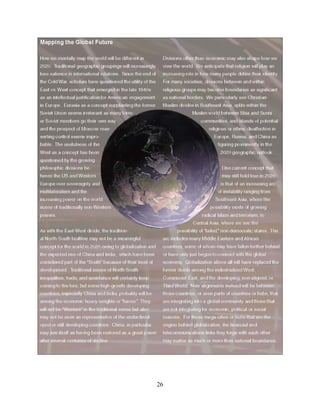
“[By 2020] globalization is likely
to take on much more of a ‘non-
Western’ face…”
The reach of globalization was
substantially broadened during the last 20
years by Chinese and Indian economic
liberalization, the collapse of the Soviet
Union, and the worldwide information
technology revolution. Through the next
15 years, it will sustain world economic
growth, raise world living standards, and
substantially deepen global interdepen-
dence. At the same time, it will profoundly
shake up the status quo almost
everywhere—generating enormous
economic, cultural, and consequently
political convulsions.
Certain aspects of globalization, such as
the growing global inter-connectedness
stemming from the information technology
revolution, are likely to be irreversible.
Real-time communication, which has
transformed politics almost everywhere, is
a phenomenon that even repressive
governments would find difficult to
expunge.
• It will be difficult, too, to turn off the
phenomenon of entrenched economic
interdependence, although the pace of
global economic expansion may ebb
and flow. Interdependence has
widened the effective reach of
multinational business, enabling
smaller firms as well as large
multinationals to market across
borders and bringing heretofore non-
traded services into the international
arena.
Yet the process of globalization, powerful
as it is, could be substantially slowed or
even reversed, just as the era of
globalization in the late 19th
and early 20th
centuries was reversed by catastrophic
war and global depression. Some
features that we associate with the
globalization of the 1990s—such as
economic and political liberalization—are
prone to “fits and starts” and probably will
depend on progress in multilateral
negotiations, improvements in national
governance, and the reduction of
conflicts. The freer flow of people across
national borders will continue to face
social and political obstacles even when
there is a pressing need for migrant
workers.
“India and China probably will be
among the economic
heavyweights or ‘haves.’”
28
What Would An Asian Face on Globalization Look Like?
Rising Asia will continue to reshape globalization, giving it less of a “Made in the USA” character
and more of an Asian look and feel. At the same time, Asia will alter the rules of the globalizing
process. By having the fastest-growing consumer markets, more firms becoming world-class
multinationals, and greater S&T stature, Asia looks set to displace Western countries as the
focus for international economic dynamism—provided Asia’s rapid economic growth continues.
Asian finance ministers have considered establishing an Asian monetary fund that would
operate along different lines from IMF, attaching fewer strings on currency swaps and giving
Asian decision-makers more leeway from the “Washington macro-economic consensus.”
• In terms of capital flows, rising Asia may still accumulate large currency reserves—currently
$850 billion in Japan, $500 billion in China, $190 billion in Korea, and $120 million in India,
or collectively three-quarters of global reserves—but the percentage held in dollars will fall.
A basket of reserve currencies including the yen, renminbi, and possibly rupee probably will
become standard practice.
• Interest-rate decisions taken by Asian central bankers will impact other global financial
markets, including New York and London, and the returns from Asian stock markets are
likely to become an increasing global benchmark for portfolio managers.
As governments devote more resources to basic research and development, rising Asia will
continue to attract applied technology from around the world, including cutting-edge technology,
which should boost their high performance sectors. We already anticipate (as stated in the text)
that the Asian giants may use the power of their markets to set industry standards, rather than
adopting those promoted by Western nations or international standards bodies. The
international intellectual property rights regime will be profoundly molded by IPR regulatory and
law enforcement practices in East and South Asia.
Increased labor force participation in the global economy, especially by China, India, and
Indonesia, will have enormous effects, possibly spurring internal and regional migrations. Either
way it will have a large impact, determining the relative size of the world’s greatest new “mega-
cities” and, perhaps, act as a key variable for political stability/instability for decades to come.
To the degree that these vast internal migrations spill over national borders—currently, only a
miniscule fraction of China’s 100 million internal migrants end up abroad—they could have
major repercussions for other regions, including Europe and North America.
An expanded Asian-centric cultural identity may be the most profound effect of a rising Asia.
Asians have already begun to reduce the percentage of students who travel to Europe and
North America with Japan and—most striking—China becoming educational magnets. A new,
more Asian cultural identity is likely to be rapidly packaged and distributed as incomes rise and
communications networks spread. Korean pop singers are already the rage in Japan, Japanese
anime have many fans in China, and Chinese kung-fu movies and Bollywood song-and-dance
epics are viewed throughout Asia. Even Hollywood has begun to reflect these Asian
influences—an effect that is likely to accelerate through 2020.
29
Moreover, the character of globalization
probably will change just as capitalism
changed over the course of the 19th
and
20th
centuries. While today’s most
advanced nations—especially the United
States—will remain important forces
driving capital, technology and goods,
globalization is likely to take on much
more of a “non-Western face” over the
next 15 years.
• Most of the increase in world
population and consumer demand
through 2020 will take place in today’s
developing nations—especially China,
India, and Indonesia—and
multinational companies from today’s
advanced nations will adapt their
“profiles” and business practices to the
demands of these cultures.
• Able to disperse technology widely
and promote economic progress in the
developing world, corporations already
are seeking to be “good citizens” by
allowing the retention of non-Western
practices in the workplaces in which
they operate. Corporations are in the
position to make globalization more
palatable to people concerned about
preserving unique cultures.
• New or expanding corporations from
countries lifted up by globalization will
make their presence felt globally
through trade and investments abroad.
• Countries that have benefited and are
now in position to weigh in will seek
more power in international bodies and
greater influence on the “rules of the
game.”
• In our interactions, many foreign
experts have noted that while popular
opinion in their countries favors the
material benefits of globalization,
citizens are opposed to its perceived
“Americanization,” which they see as
threatening to their cultural and
religious values. The conflation of
globalization with US values has in
turn fueled anti-Americanism in some
parts of the world.
“…the world economy is
projected to be about 80 percent
larger in 2020 than it was in
2000, and average per capita
income to be roughly 50 percent
higher.”
Currently, about two-thirds of the world’s
population live in countries that are
connected to the global economy. Even
by 2020, however, the benefits of
globalization won’t be global. Over the
next 15 years, gaps will widen between
those countries benefiting from
globalization—economically,
technologically, and socially—and those
underdeveloped nations or pockets within
nations that are left behind. Indeed, we
see the next 15 years as a period in which
the perceptions of the contradictions and
uncertainties of a globalized world come
even more to the fore than is the case
today.
An Expanding and Integrating Global
Economy
The world economy is projected to be
about 80 percent larger in 2020 than it
was in 2000 and average per capita
income to be roughly 50 percent higher.
Large parts of the world will enjoy
unprecedented prosperity, and a
numerically large middle class will be
created for the first time in some formerly
poor countries. The social structures in
30
What Could Derail Globalization?
The process of globalization, powerful as it is, could be substantially slowed or even
stopped. Short of a major global conflict, which we regard as improbable, another
large-scale development that we believe could stop globalization would be a pandemic.
However, other catastrophic developments, such as terrorist attacks, could slow its
speed.
Some experts believe it is only a matter of time before a new pandemic appears, such
as the 1918–1919 influenza virus that killed an estimated 20 million worldwide. Such a
pandemic in megacities of the developing world with poor health-care systems—in Sub-
Saharan Africa, China, India, Bangladesh or Pakistan—would be devastating and could
spread rapidly throughout the world. Globalization would be endangered if the death toll
rose into the millions in several major countries and the spread of the disease put a halt
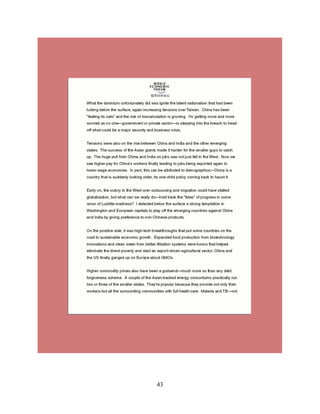
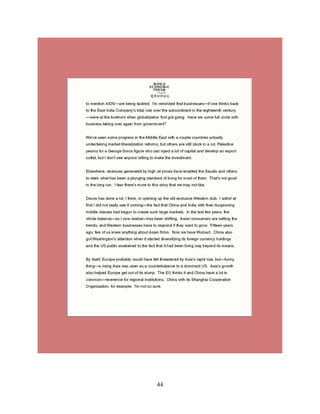
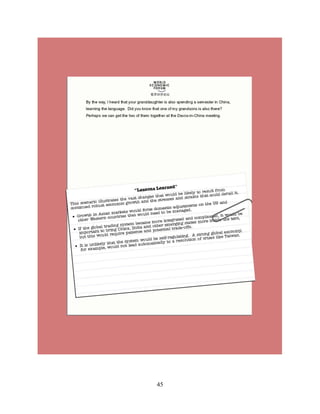
to global travel and trade during an extended period, prompting governments to expend
enormous resources on overwhelmed health sectors. On the positive side of the ledger,
the response to SARS showed that international surveillance and control mechanisms
are becoming more adept at containing diseases, and new developments in
biotechnologies hold the promise of continued improvement.
A slow-down could result from a pervasive sense of economic and physical
insecurity that led governments to put controls on the flow of capital, goods, people,
and technology that stalled economic growth. Such a situation could come about in
response to terrorist attacks killing tens or even hundreds of thousands in several US
cities or in Europe or to widespread cyber attacks on information technology. Border
controls and restrictions on technology exchanges would increase economic transaction
costs and hinder innovation and economic growth. Other developments that could
stimulate similar restrictive policies include a popular backlash against globalization
prompted, perhaps, by white collar rejection of outsourcing in the wealthy countries
and/or resistance in poor countries whose peoples saw themselves as victims of
globalization.
those developing countries will be
transformed as growth creates a greater
middle class. Over a long time frame,
there is the potential, so long as the
expansion continues, for more
traditionally poor countries to be pulled
closer into the globalization circle.
Most forecasts to 2020 and beyond
continue to show higher annual growth for
developing countries than for high-income
ones. Countries such as China and India
will be in a position to achieve higher
economic growth than Europe and Japan,
whose aging work forces may inhibit their
growth. Given its enormous population—
and assuming a reasonable degree of
real currency appreciation—the dollar
value of China’s gross national product
(GNP) may be the second largest in the
world by 2020. For similar reasons, the
value of India’s output could match that of
a large European country. The
economies of other developing countries,
31
such as Brazil and Indonesia, could
surpass all but the largest European
economies by 2020.4
• Even with all their dynamic growth,
Asia’s “giants” and others are not likely
to compare qualitatively to the
economies of the US or even some of
the other rich countries. They will
have some dynamic, world-class
sectors, but more of their populations
will work on farms, their capital stocks
will be less sophisticated, and their
financial systems are likely to be less
efficient than those of other wealthy
countries.
4
Dreaming with the BRICS, Goldman Sachs study,
October 2003.
Continued Economic Turbulence.
Sustained high-growth rates have
historical precedents. China already has
had about two decades of 7 percent and
higher growth rates, and Japan, South
Korea, and Taiwan have managed in the
past to achieve annual rates averaging
around 10 percent for a long period.
Fast-developing countries have
historically suffered sudden setbacks,
however, and economic turbulence is
increasingly likely to spill over and upset
broader international relations. Many
emerging markets—such as Mexico in
the mid-1990s and Asian countries in the
late 1990s—suffered negative effects
from the abrupt reversals of capital
movements, and China and India may
32
encounter similar problems. The scale of
the potential reversals would be
unprecedented, and it is unclear whether
current international financial
mechanisms would be in a position to
forestall wider economic disruption.
“Competitive pressures will force
companies based in the advanced
economies to ‘outsource’ many
blue- and white-collar jobs.”
With the gradual integration of China,
India, and other developing countries into
the global economy, hundreds of millions
of working-age adults will join what is
becoming, through trade and investment
flows, a more interrelated world labor
market. World patterns of production,
trade, employment, and wages will be
transformed.
• This enormous work force—a growing
portion of which will be well
educated—will be an attractive,
competitive source of low-cost labor at
the same time that technological
innovation is expanding the range of
globally mobile occupations.
• Competition from these workers will
increase job “churning,” necessitate
professional retooling, and restrain
wage growth in some occupations.
Where these labor market pressures lead
will depend on how political leaders and
33
policymakers respond. Against the
backdrop of a global economic recession,
such resources could unleash
widespread protectionist sentiments. As
long as sufficiently robust economic
growth and labor market flexibility are
sustained, however, intense international
competition is unlikely to cause net job
“loss” in the advanced economies.
• The large number of new service
sector jobs that will be created in India
and elsewhere in the developing
world, for example, will likely exceed
the supply of workers with those
specific skills in the advanced
economies.
• Job turnover in advanced economies
will continue to be driven more by
technological change and the
vicissitudes of domestic rather than
international competition.
Mobility and Laggards. Although the
living standards of many people in
developing and underdeveloped countries
will rise over the next 15 years, per capita
incomes in most countries will not
compare to those of Western nations by
2020. There will continue to be large
numbers of poor even in the rapidly
emerging economies, and the proportion
of those in the middle stratum is likely to
be significantly less than is the case for
today’s developed nations. Experts
estimate it could take China another 30
years beyond 2020 for per capita
incomes to reach current rates in
developed economies.
• Even if, as one study estimates,
China’s middle class could make up
as much as 40 percent of its
population by 2020—double what it is
now—it would be still well below the
60 percent level for the US. And per
capita income for China’s middle class
would be substantially less than
equivalents in the West.
• In India, there are now estimated to be
some 300 million middle-income
earners making $2,000-$4,000 a year.
Both the number of middle earners
and their income levels are likely to
rise rapidly, but their incomes will
continue to be substantially below
averages in the US and other rich
countries even by 2020.
• However, a $3,000 annual income is
considered sufficient to spur car
purchases in Asia; thus rapidly rising
income levels for a growing middle
class will combine to mean a huge
consumption explosion, which is
already evident.
Widening income and regional disparities
will not be incompatible with a growing
middle class and increasing overall
wealth. In India, although much of the
west and south may have a large middle
class by 2020, a number of regions such
as Bihar, Uttar Pradesh, and Orissa will
remain underdeveloped.
Moreover, countries not connected to the
world economy will continue to suffer.
Even the most optimistic forecasts admit
that economic growth fueled by
globalization will leave many countries in
poverty over the next 15 years.
• Scenarios developed by the World
Bank indicate, for example, that Sub-
Saharan Africa will be far behind even
under the most optimistic scenario.
The region currently has the largest
34
share of people living on less than $1
per day.
If the growing problem of abject poverty
and bad governance in troubled states in
Sub-Saharan Africa, Eurasia, the Middle
East, and Latin America persists, these
areas will become more fertile grounds
for terrorism, organized crime, and
pandemic disease. Forced migration also
is likely to be an important dimension of
any downward spiral. The international
community is likely to face choices about
whether, how, and at what cost to
intervene.
“…the greatest benefits of
globalization will accrue to
countries and groups that can
access and adopt new
technologies.”
The Technology Revolution
The trend toward rapid, global diffusion of
technology will continue, although the
stepped-up technology revolution will not
benefit everyone equally.
• Among the drivers of the growing
availability of technology will be the
growing two-way flow of high-tech
brain power between developing
countries and Western countries, the
increasing size of the technologically
literate workforce in some developing
countries, and efforts by multinational
corporations to diversify their high-
tech operations.
New technology applications will foster
dramatic improvements in human
knowledge and individual well-being.
Such benefits include medical
breakthroughs that begin to cure or
mitigate some common diseases and
stretch lifespans, applications that
improve food and potable water
production, and expansion of wireless
communications and language translation
technologies that will facilitate
transnational business, commercial, and
even social and political relationships.
Moreover, future technology trends will be
marked not only by accelerating
advancements in individual technologies
but also by a force-multiplying
convergence of the technologies—
information, biological, materials, and
nanotechnologies—that have the
potential to revolutionize all dimensions of
life. Materials enabled with
nanotechnology’s sensors and facilitated
by information technology will produce
myriad devices that will enhance health
and alter business practices and models.
Such materials will provide new
knowledge about environment, improve
security, and reduce privacy. Such
interactions of these technology trends—
coupled with agile manufacturing
methods and equipment as well as
energy, water, and transportation
technologies—will help China’s and
India’s prospects for joining the “First
World.” Both countries are investing in
basic research in these fields and are well
placed to be leaders in a number of key
fields. Europe risks slipping behind Asia
in creating some of these technologies.
The United States is still in a position to
retain its overall lead, although it must
increasingly compete with Asia and may
lose significant ground in some sectors.
To Adaptive Nations Go Technology ‘s
Spoils. The gulf between “haves” and
“have-nots” may widen as the greatest
benefits of globalization accrue to
countries and groups that can access and
35
adopt new technologies. Indeed, a
nation’s level of technological
achievement generally will be defined in
terms of its investment in integrating and
applying the new, globally available
technologies—whether the technologies
are acquired through a country’s own
basic research or from technology
leaders. Nations that remain behind in
adopting technologies are likely to be
those that have failed to pursue policies
that support application of new
technologies—such as good governance,
universal education, and market
reforms—and not solely because they are
poor.
Those that employ such policies can
leapfrog stages of development, skipping
over phases that other high-tech leaders
such as the United States and Europe
had to traverse in order to advance.
China and India are well positioned to
achieve such breakthroughs. Yet, even
the poorest countries will be able to
leverage prolific, cheap technologies to
fuel—although at a slower rate—their
own development.
• As nations like China and India surge
forward in funding critical science and
engineering education, research, and
other infrastructure investments, they
will make considerable strides in
manufacturing and marketing a full
range of technology applications—
from software and pharmaceuticals to
wireless sensors and smart-materials
products.
Rapid technological advances outside the
United States could enable other
countries to set the rules for design,
standards, and implementation, and for
molding privacy, information security, and
intellectual property rights (IPR).
• Indeed, international IPR enforcement
is on course for dramatic change.
Countries like China and India will,
because of the purchasing power of
their huge markets, be able to shape
the implementation of some
technologies and step on the
intellectual property rights of others.
The attractiveness of these large
markets will tempt multinational firms
to overlook IPR indiscretions that only
minimally affect their bottom lines.
Additionally, as many of the expected
advancements in technology are
anticipated to be in medicine, there
will be increasing pressure from a
humanitarian and moral perspective to
“release” the property rights “for the
good of mankind.”
Nations also will face serious challenges
in oversight, control, and prohibition of
sensitive technologies. With the same
technology, such as sensors, computing,
communication, and materials,
increasingly being developed for a range
of applications in both everyday,
commercial settings and in critical military
applications the monitoring and control of
the export of technological components
will become more difficult. Moreover,
joint ventures, globalized markets and the
growing proportion of private sector
capital in basic R&D will undermine
nation-state efforts to keep tabs on
sensitive technologies.
• Questions concerning a country’s
ethical practices in the technology
realm—such as with genetically
modified foods, data privacy,
biological material research,
concealable sensors, and biometric
devices—may become an increasingly
important factor in international trade
policy and foreign relations.
36
Biotechnology: Panacea and Weapon
The biotechnological revolution is at a relatively early stage, and major advances in the
biological sciences coupled with information technology will continue to punctuate the
21st century. Research will continue to foster important discoveries in innovative
medical and public health technologies, environmental remediation, agriculture,
biodefense, and related fields.
On the positive side, biotechnology could be a “leveling” agent between developed and
developing nations, spreading dramatic economic and healthcare enhancements to the
neediest areas of the world.
• Possible breakthroughs in biomedicine such as an antiviral barrier will reduce the
spread of HIV/AIDS, helping to resolve the ongoing humanitarian crisis in Sub-
Saharan Africa and diminishing the potentially serious drag on economic growth in
developing countries like India and China. Biotechnology research and innovations
derived from continued US investments in Homeland Security—such as new
therapies that might block a pathogen’s ability to enter the body—may eventually
have revolutionary healthcare applications that extend beyond protecting the US
from a terrorist attack.
• More developing countries probably will invest in indigenous biotechnology
developments, while competitive market pressures increasingly will induce firms and
research institutions to seek technically capable partners in developing countries.
However, even as the dispersion of biotechnology promises a means of improving the
quality of life, it also poses a major security concern. As biotechnology information
becomes more widely available, the number of people who can potentially misuse such
information and wreak widespread loss of life will increase. An attacker would appear to
have an easier job—because of the large array of possibilities available—than the
defender, who must prepare against them all. Moreover, as biotechnology advances
become more ubiquitous, stopping the progress of offensive BW programs will become
increasingly difficult. Over the next 10 to 20 years there is a risk that advances in
biotechnology will augment not only defensive measures but also offensive biological
warfare (BW) agent development and allow the creation of advanced biological agents
designed to target specific systems—human, animal, or crop.
Lastly, some biotechnology techniques that may facilitate major improvements in health
also will spur serious ethical and privacy concerns over such matters as comprehensive
genetic profiling; stem cell research; and the possibility of discovering DNA signatures
that indicate predisposition for disease, certain cognitive abilities, or anti-social
behavior.
37
At the same time, technology will be a
source of tension in 2020: from
competition over creating and attracting
the most critical component of
technological advancement—people—to
resistance among some cultural or
political groups to the perceived privacy-
robbing or homogenizing effects of
pervasive technology.
Lingering Social Inequalities
Even with the potential for technological
breakthroughs and the dispersion of new
technologies, which could help reduce
inequalities, significant social welfare
disparities within the developing and
between developing and OECD countries
will remain until 2020.
Over the next 15 years, illiteracy rates of
people 15 years and older will fall,
according to UNESCO, but they will still
be 17 times higher in poor and
developing countries than those in
OECD5
countries. Moreover, illiteracy
rates among women will be almost twice
as high as those among men. Between
1950 and 1980 life expectancy between
the more- and less-developed nations
began to converge markedly; this
probably will continue to be the case for
many developing countries, including the
most populous. However, by US Census
Bureau projections, over 40 countries—
including many African countries, Central
Asian states, and Russia—are projected
5
The OECD, Organization for Economic Cooperation
and Development, an outgrowth of the Marshall Plan-
era Organization for European Economic Cooperation,
boasts 30 members from among developed and
emerging-market nations and active relationships with
70 others around the world.
to have a lower life expectancy in 2010
than they did in 1990.
Even if effective HIV/AIDS prevention
measures are adopted in various
countries, the social and economic impact
of the millions already infected with the
disease will play out over the next 15
years.
• The rapid rise in adult deaths caused
by AIDS has left an unprecedented
number of orphans in Africa. Today in
some African countries one in ten
children is an orphan, and the
situation is certain to worsen.
The debilitation and death of millions of
people resulting from the AIDS pandemic
will have a growing impact on the
economies of the hardest-hit countries,
particularly those in Sub-Saharan Africa,
where more than 20 million are believed
to have died from HIV/AIDS since the
early 1980s. Studies show that
household incomes drop by 50 to 80
percent when key earners become
infected. In “second wave” HIV/AIDS
countries—Nigeria, Ethiopia, Russia,
India, China, Brazil, Ukraine, and the
Central Asian states—the disease will
continue to spread beyond traditional
high-risk groups into the general
population. As HIV/AIDS spreads, it has
the potential to derail the economic
prospects of many up-and-coming
economic powers.
38
The Status of Women in 2020
By 2020, women will have gained more rights and freedoms—in terms of education,
political participation, and work force equality—in most parts of the world, but UN and
World Health Organization data suggest that the gender gap will not have been closed
even in the developed countries and still will be wide in developing regions. Although
women’s share in the global work force will continue to rise, wage gaps and regional
disparities will persist.
• Although the difference between women’s and men’s earnings narrowed during the
past 10 years, women continue to receive less pay than men. For example, a UN
study in 2002 showed that in 27 of 39 countries surveyed—both in OECD and
developing countries—women’s wages were 20 to 50 percent less than men’s for
work in manufacturing.
Certain factors will tend to work against gender equality while others will have a positive
impact.
Factors Impeding Equality
In regions where high youth bulges intersect with historical patterns of patriarchal bias,
the added pressure on infrastructure will mean intensified competition for limited public
resources and an increased probability that females will not receive equal treatment.
For instance, if schools cannot educate all, boys are likely to be given first priority. Yet
views are changing among the younger generation. In the Middle East, for example,
many younger Muslims recognize the importance of educated wives as potential
contributors to family income.
In countries such as China and India, where there is a pervasive “son preference”
reinforced by government population control policies, women face increased risk not
only of female infanticide but also of kidnapping and smuggling from surrounding
regions for the disproportionately greater number of unattached males. Thus far, the
preference for male children in China has led to an estimated shortfall of 30 million
women.
Such statistics suggest that the global female trafficking industry, which already earns
an estimated $4 billion every year, is likely to expand, making it the second most
profitable criminal activity behind global drug trafficking.
The feminization of HIV/AIDS is another worrisome trend. Findings from the July 2004
Global AIDS conference held in Bangkok reveal that the percentage of HIV-infected
women is rising on every continent and in every major region in the world except
Western Europe and Australia. Young women comprise 75 percent of those between
the ages of 15 to 24 who are infected with HIV globally.
(Continued on next page…)
39
(continued…) The Status of Women in 2020
Factors Contributing to Equality
A broader reform agenda that includes good governance and low unemployment
levels is essential to raising the status of women in many countries. International
development experts emphasize that while good governance need not fit a Western
democratic mold, it must deliver stability through inclusiveness and accountability.
Reducing unemployment levels is crucial because countries already unable to provide
employment for male job-seekers are not likely to improve employment opportunities for
women.
The spread of information and communication technologies (ICT) offers great
promise. According to World Bank analysis, increases in the level of ICT infrastructure
tend to improve gender equality in education and employment. ICT also will enable
women to form social and political networks. For regions suffering political oppression,
particularly in the Middle East, these networks could become a 21st
century counterpart
to the 1980s’ Solidarity Movement against the Communist regime in Poland.
Women in developing regions often turn to nongovernmental organizations (NGOs)
to provide basic services. NGOs could become even more important to the status of
women by 2020 as women in developing countries face increased threats and acquire
IT networking capabilities.
The current trend toward decentralization and devolution of power in most states will
afford women increased opportunities for political participation. Despite only
modest gains in the number of female officeholders at the national level—women
currently are heads of state in only eight countries—female participation in local and
provincial politics is steadily rising and will especially benefit rural women removed from
the political center of a country.
Other Benefits
The stakes for achieving gender parity are high and not just for women. A growing body
of empirical literature suggests that gender equality in education promotes economic
growth and reduces child mortality and malnutrition. At the Millennium Summit, UN
leaders pledged to achieve gender equity in primary and secondary education by the
year 2005 in every country of the world.
• By 2005, the 45 countries that are not on course to meet the UN targets are likely to
suffer 1 to 3 percent lower GDP per capita growth as a result.
40
Fictional Scenario: Davos World
This scenario provides an illustration
of how robust economic growth over
the next 15 years could reshape the
globalization process—giving it a
more non-Western face. It is depicted
in the form of a hypothetical letter
from the head of the World Economic
Forum to a former US Federal
Reserve chairman on the eve of the
annual Davos meeting in 2020.
Under this scenario, the Asian giants
as well as other developing states
continue to outpace most “Western”
economies, and their huge, consumer-
driven domestic markets become a
major focus for global business and
technology. Many boats are lifted, but
some founder. Africa does better than
one might think, while some medium-
sized emerging countries are
squeezed. Western powers, including
the United States, have to contend
with job insecurity despite the many
benefits to be derived from an
expanding global economy. Although
benefiting from energy price
increases, the Middle East lags behind
and threatens the future of
globalization. In addition, growing
tensions over Taiwan may be on the
verge of triggering an economic
meltdown. At the end of the scenario,
we identify some lessons to be drawn
from our fictional account, including
the need for more management by
leaders lest globalization slip off the
rails.
41
42
43
44
45
46
47
Rising Powers: The Changing
Geopolitical Landscape
The likely emergence of China and India
as new major global players—similar to
the rise of Germany in the 19th
century
and the United States in the early 20th
century—will transform the geopolitical
landscape, with impacts potentially as
dramatic as those of the previous two
centuries. In the same way that
commentators refer to the 1900s as the
“American Century,” the early 21st
century
may be seen as the time when some in
the developing world, led by China and
India, come into their own.
• The population of the region that
served as the locus for most 20th
-
century history—Europe and Russia—
will decline dramatically in relative
terms; almost all population growth
will occur in developing nations that
until recently have occupied places on
the fringes of the global economy (see
graphic on page 48).6
• The “arriviste” powers—China, India,
and perhaps others such as Brazil and
Indonesia—could usher in a new set
of international alignments, potentially
marking a definitive break with some
of the post-World War II institutions
and practices.
• Only an abrupt reversal of the process
of globalization or a major upheaval in
these countries would prevent their
rise. Yet how China and India
6
CIA, Long-Term Global Demographic Trends:
Reshaping the Geopolitical Landscape, July 2001.
exercise their growing power and
whether they relate cooperatively or
competitively to other powers in the
international system are key
uncertainties.
A combination of sustained high
economic growth, expanding military
capabilities, active promotion of high
technologies, and large populations will
be at the root of the expected rapid rise in
economic and political power for both
countries.
• Because of the sheer size of China’s
and India’s populations—projected by
the US Census Bureau to be 1.4
billion and almost 1.3 billion
respectively by 2020—their standard
of living need not approach Western
levels for these countries to become
important economic powers.
• China, for example, is now the third
largest producer of manufactured
goods, its share having risen from four
to 12 percent in the past decade. It
should easily surpass Japan in a few
years, not only in share of
manufacturing but also of the world’s
exports. Competition from “the China
price” already powerfully restrains
manufactures prices worldwide.
• India currently lags behind China (see
box on page 53) on most economic
measures, but most economists
believe it also will sustain high levels
of economic growth.
48
At the same time, other changes are
likely to shape the new landscape. These
include the possible economic rise of
other states—such as Brazil, South
Africa, Indonesia, and even Russia—
which may reinforce the growing role of
China and India even though by
themselves these other countries would
have more limited geopolitical impact.
Finally, we do not discount the possibility
of a stronger, more united Europe and a
more internationally activist Japan,
although Europe, Japan, and Russia will
be hard pressed to deal with aging
populations.
The growing demand for energy will drive
many of these likely changes on the
geopolitical landscape. China’s and
India’s perceived need to secure access
to energy supplies will propel these
countries to become more global rather
than just regional powers, while Europe
and Russia’s co-dependency is likely to
be strengthened.
Rising Asia
China’s desire to gain “great power”
status on the world stage will be reflected
in its greater economic leverage over
49
countries in the region and elsewhere as
well as its steps to strengthen its military.
East Asian states are adapting to the
advent of a more powerful China by
forging closer economic and political ties
with Beijing, potentially accommodating
themselves to its preferences, particularly
on sensitive issues like Taiwan.
• Japan, Taiwan, and various Southeast
Asian nations, however, also may try
to appeal to each other and the United
States to counterbalance China’s
growing influence.
China will continue to strengthen its
military through developing and acquiring
modern weapons, including advanced
fighter aircraft, sophisticated submarines,
and increasing numbers of ballistic
missiles. China will overtake Russia and
others as the second largest defense
spender after the United States over the
next two decades and will be, by any
measure, a first-rate military power.
Economic setbacks and crises of
confidence could slow China’s
emergence as a full-scale great power,
however. Beijing’s failure to maintain its
economic growth would itself have a
global impact.
• Chinese Government failure to satisfy
popular needs for job creation could
trigger political unrest.
• Faced with a rapidly aging society
beginning in the 2020s, China may be
hard pressed to deal with all the
issues linked to such serious
demographic problems. It is unlikely
to have developed by then the same
coping mechanisms—such as
sophisticated pension and health-care
systems—characteristic of Western
societies.
• If China’s economy takes a downward
turn, regional security would weaken,
resulting in heightened prospects for
political instability, crime, narcotics
trafficking, and illegal migration.
“Economic setbacks and crises of
confidence could slow China’s
emergence as a full-scale great
power…. ”
The rise of India also will present
strategic complications for the region.
Like China, India will be an economic
magnet for the region, and its rise will
have an impact not only in Asia but also
to the north—Central Asia, Iran, and other
countries of the Middle East. India seeks
to bolster regional cooperation both for
strategic reasons and because of its
desire to increase its leverage with the
West, including in such organizations as
the World Trade Organization (WTO).
50
51
As India’s economy grows, governments
in Southeast Asia—Malaysia,
Singapore, Thailand, and other
countries—may move closer to India to
help build a potential geopolitical
counterweight to China. At the same
time, India will seek to strengthen its ties
with countries in the region without
excluding China.
• Chinese-Indian bilateral trade is
expected to rise rapidly from its
current small base of $7.6 billion,
according to Goldman Sachs and
other experts.
Just like China, India may stumble and
experience political and economic
volatility with pressure on resources—
land, water, and energy supplies—
intensifying as it modernizes. For
example, India will face stark choices as
its population increases and its surface
and ground water become even more
polluted.
Other Rising States?
Brazil, Indonesia, Russia, and South
Africa also are poised to achieve
economic growth, although they are
unlikely to exercise the same political
clout as China or India. Their growth
undoubtedly will benefit their neighbors,
but they appear unlikely to become
such economic engines that they will
be able to alter the flow of economic
power within and through their
52
Risks to Chinese Economic Growth
Whether China’s rise occurs smoothly is a key uncertainty. In 2003, the RAND
Corporation identified and assessed eight major risks to the continued rapid growth of
China’s economy over the next decade. Its “Fault Lines in China’s Economic Terrain”
highlighted:
• Fragility of the financial system and state-owned enterprises
• Economic effects of corruption
• Water resources and pollution
• Possible shrinkage of foreign direct investment
• HIV/AIDS and epidemic diseases
• Unemployment, poverty, and social unrest
• Energy consumption and prices
• Taiwan and other potential conflicts
RAND’s estimates of the negative growth impact of these adverse developments
occurring separately on a one-at-a-time basis range from a low of between 0.3 and
0.8 percentage points for the effects of poverty, social unrest, and unemployment to a
high of between 1.8 and 2.2 percentage points for epidemic disease.
• The study assessed the probability that none of these developments would occur
before 2015 as low and noted that they would be more likely to occur in clusters
rather than individually – financial distress, for example, would also worsen
corruption, compound unemployment, poverty, and social unrest, and reduce foreign
direct investment.
• RAND assessed the probability of all of these adverse developments occurring
before 2015 as very low but estimated that should they all occur their cumulative
effect would be to reduce Chinese economic growth by between 7.4 and 10.7
percentage points—effectively wiping out growth during that time frame.
53
India vs. China: Long-Term Prospects
India lags economically behind China, according to most measures such as overall GDP,
amount of foreign investment (today a small fraction of China’s), and per capita income. In
recent years, India’s growth rate has lagged China’s by about 20 percent. Nevertheless,
some experts believe that India might overtake China as the fastest growing economy in the
world. India has several factors working for it:
• Its working-age population will continue to increase well into the 2020s, whereas, due to
the one-child policy, China’s will diminish and age quite rapidly.
• India has well-entrenched democratic institutions, making it somewhat less vulnerable to
political instability, whereas China faces the continuous challenge of reconciling an
increasingly urban and middle-class population with an essentially authoritarian political
system.
• India possesses working capital markets and world-class firms in some important high-
tech sectors, which China has yet to achieve.
On the other hand, while India has clearly evolved beyond what the Indians themselves
referred to as the 2-3 percent “Hindu growth rate,” the legacy of a stifling bureaucracy still
remains. The country is not yet attractive for foreign investment and faces strong political
challenges as it continues down the path of economic reform. India is also faced with the
burden of having a much larger proportion of its population in desperate poverty. In
addition, some observers see communal tensions just below the surface, citing the overall
decline of secularism, growth of regional and caste-based political parties, and the 2002
“pogrom” against the Muslim minority in Gujarat as evidence of a worsening trend.
Several factors could weaken China’s prospects for economic growth, especially the risks to
political stability and the challenges facing China’s financial sector as it moves toward a
fuller market orientation. China might find its own path toward an “Asian democracy” that
may not involve major instability or disruption to its economic growth—but there are a large
number of unknowns.
In many other respects, both China and India still resemble other developing states in the
problems each must overcome, including the large numbers, particularly in rural areas, who
have not enjoyed major benefits from economic growth. Both also face a potentially serious
HIV/AIDS epidemic that could seriously affect economic prospects if not brought under
control. According to recent UN data, India has overtaken South Africa as the country with
the largest number of HIV-infected people.
The bottom line: India would be hard-pressed to accelerate economic growth rates to levels
above those reached by China in the past decade. But China’s ability to sustain its current
pace is probably more at risk than is India’s; should China’s growth slow by several
percentage points, India could emerge as the world’s fastest-growing economy as we head
towards 2020.
54
regions—a key element in Beijing and
New Delhi’s political and economic
rise.
Experts acknowledge that Brazil is a
pivotal state with a vibrant democracy, a
diversified economy and an
entrepreneurial population, a large
national patrimony, and solid economic
institutions. Brazil’s success or failure in
balancing pro-growth economic measures
with an ambitious social agenda that
reduces poverty and income inequality
will have a profound impact on region-
wide economic performance and
governance during the next 15 years.
Luring foreign direct investment and
advancing regional stability and equitable
integration—including trade and
economic infrastructure—probably will
remain axioms of Brazilian foreign policy.
Brazil is a natural partner both for the
United States and Europe and for rising
powers China and India and has the
potential to enhance its leverage as a net
exporter of oil.
Experts assess that over the course of
the next decade and a half Indonesia
may revert to high growth of 6 to 7
percent, which along with its expected
increase in its relatively large population
from 226 to around 250 million would
make it one of the largest developing
economies. Such high growth would
presume an improved investment
environment, including intellectual
property rights protection and openness
to foreign investment. With slower growth
its economy would be unable to absorb
the unemployed or under-employed labor
force, thus heightening the risk of greater
political instability. Indonesia is an
amalgam of divergent ethnic and religious
groups. Although an Indonesian national
identity has been forged in the five
decades since independence, the
government is still beset by stubborn
secessionist movements.
Russia’s energy resources will give a
boost to economic growth, but Russia
faces a severe demographic challenge
resulting from low birth rates, poor
medical care, and a potentially explosive
AIDS situation. US Census Bureau
projections show the working-age
population likely to shrink dramatically by
2020. Russia’s present trajectory away
from pluralism toward bureaucratic
authoritarianism also decreases the
chances it will be able to attract foreign
investment outside the energy sector,
limiting prospects for diversifying its
economy. The problems along its
southern borders—including Islamic
extremism, terrorism, weak states with
poor governance, and conflict—are likely
to get worse over the next 15 years.
Inside Russia, the autonomous republics
in North Caucasus risk failure and will
remain a source of endemic tension and
conflict. While these social and political
factors limit the extent to which Russia
can be a major global player, in the
complex world of 2020 Russia could be
an important, if troubled, partner both for
the established powers, such as the
United States and Europe, and the rising
powers of China and India. The potential
also exists for Russia to enhance its
leverage with others as a result of its
position as a major oil and gas exporter.
55
Asia: The Cockpit for Global Change?
According to the regional experts we consulted, Asia will exemplify most of the trends
that we see as shaping the world over the next 15 years. Northeast and Southeast Asia
will progress along divergent paths—the countries of the North will become wealthier
and more powerful, while at least some states in the South may lag economically and
will continue to face deep ethnic and religious cleavages. As Northeast Asia acts as a
political and economic center of gravity for the countries of the South, parts of
Southeast Asia will be a source of transnational threats—terrorism and organized
crime—to the countries of the North. The North/South divisions are likely to be reflected
in a cultural split between non-Muslim Northeast Asia, which will adapt to the continuing
spread of globalization, and Southeast Asia, where Islamic fundamentalism may
increasingly make inroads in such states as Indonesia, Malaysia, and parts of The
Philippines. The diversion of investment towards China and India also could spur
Southeast Asia to implement plans for a single economic community and investment
area by 2020.
The experts also felt that demographic factors will play a key role in shaping regional
developments. China and other countries in Northeast Asia, including South Korea, will
experience a slowing of population growth and a “graying” of their peoples over the next
15 years. China also will have to face the consequences of a gender imbalance caused
by its one-child policy. In Southeast Asian countries such as The Philippines and
Indonesia, rising populations will challenge the capacity of governments to provide basic
services. Population and poverty pressures will spur migration within the region and to
Northeast Asia. High population concentrations and increasing ease of travel will
facilitate the spread of infectious diseases, risking the outbreak of pandemics.
The regional experts felt that the possibility of major inter-state conflict remains higher in
Asia than in other regions. In their view, the Korean Peninsula and Taiwan Strait crises
are likely to come to a head by 2020, risking conflict with global repercussions. At the
same time, violence within Southeast Asian states—in the form of separatist
insurgencies and terrorism—could intensify. China also could face sustained armed
unrest from separatist movements along its western borders.
Finally, the roles of and interaction between the region’s major powers—China, Japan,
and the US—will undergo significant change by 2020. The United States and China
have strong incentives to avoid confrontation, but rising nationalism in China and fears
in the US of China as an emerging strategic competitor could fuel an increasingly
antagonistic relationship. Japan’s relationship with the US and China will be shaped by
China’s rise and the nature of any settlement on the Korean Peninsula and over
Taiwan.
56
“Russia’s energy resources will
give a boost to economic growth,
but Russia faces a severe
demographic challenge…[with
its] working-age population likely
to shrink dramatically.”
South Africa will continue to be
challenged by AIDS and widespread
crime and poverty, but prospects for its
economy—the largest in the region—look
promising. According to some forecasts,
South Africa’s economy is projected to
grow over the next decade in the 4- to
5-percent range if reformist policies are
implemented. Experts disagree over
whether South Africa can be an engine
for more than southern Africa or will
instead forge closer relationships with
middling or up-and-coming powers on
other continents. South African experts
adept at scenario-building and gaming
see the country’s future as lying with
partnerships formed outside the region.
The “Aging” Powers
Japan’s economic interests in Asia have
shifted from Southeast Asia toward
Northeast Asia—especially China and the
China-Japan-Korea triangle—over the
past two decades and experts believe the
aging of Japan’s work force will reinforce
dependence on outbound investment and
greater economic integration with
Northeast Asia, especially China7
. At the
same time, Japanese concerns regarding
regional stability are likely to grow owing
to the ongoing crisis over North Korea,
continuing tensions between China and
7
Asia’s Shifting Strategic Landscape, Foreign Policy
Research Institute, 26 November 2003.
Taiwan and the challenge of integrating
rising China and India without major
disruption. If anything, growing Chinese
economic power is likely to spur
increased activism by Japan on the world
stage.
Opinion polls indicate growing public
support for Japan becoming a more
“normal” country with a proactive foreign
policy. Experts see various trajectories
that Japan could follow depending on
such factors as the extent of China’s
growing strength, a resurgence or lack of
continued vitality in Japan’s economy, the
level of US influence in the region and
how developments in Korea and Taiwan
play out. At some point, for example,
Japan may have to choose between
“balancing” against or “bandwagoning”
with China.
“…Europe’s strength may be in
providing… a model of global and
regional governance to the rising
powers…”
By most measures—market size, single
currency, highly skilled work force, stable
democratic governments, unified trade
bloc, and GDP—an enlarged Europe will
have the ability to increase its weight on
the international scene. Its crossroads
location and the growing diversity of its
population—particularly in pulling in new
members—provides it with a unique
ability to forge strong bonds both to the
south with the Muslim world and Africa
and to the east with Russia and Eurasia.
57
The extent to which Europe enhances its
clout on the world stage depends on its
ability to achieve greater political
cohesion. In the short term, taking in ten
new east European members probably
will be a “drag” on the deepening of
European Union (EU) institutions
necessary for the development of a
cohesive and shared “strategic vision” for
the EU’s foreign and security policy.
• Unlike the expansion when Ireland,
Spain, Portugal and Greece joined the
Common Market in the 1970s and
early 1980s, Brussels has a fraction of
the structural funds available for
quickly bringing up the Central
Europeans to the economic levels of
the rest of the EU.
• Possible Turkish membership
presents both challenges—because of
Turkey’s size and religious and
cultural differences—as well as
opportunities, provided that mutual
acceptance and agreement can be
achieved. In working through the
problems, a path might be found that
can help Europe to accommodate and
integrate its growing Muslim
population.
Defense spending by individual European
countries, including the UK, France, and
Germany is likely to fall further behind
China and other countries over the next
15 years. Collectively these countries will
outspend all others except the US and
possibly China8
. EU member states
8
Strategic Trends, Joint Doctrine and Concepts
Centre, March 2003.
historically have had difficulties in
coordinating and rationalizing defense
spending in such a way as to boost
capabilities despite progress on a greater
EU security and defense role. Whether
the EU will develop an army is an open
question, in part because its creation
could duplicate or displace NATO forces.
While its military forces have little
capacity for power projection, Europe’s
strength may be in providing, through its
commitment to multilateralism, a model of
global and regional governance to the
rising powers, particularly if they are
searching for a “Western” alternative to
strong reliance on the United States. For
example, an EU-China alliance, though
still unlikely, is no longer unthinkable.
Aging populations and shrinking work
forces in most countries will have an
important impact on the continent,
creating a serious but not insurmountable
economic and political challenge.
Europe’s total fertility rate is about 1.4—
well below the 2.1 replacement level.
Over the next 15 years, West European
economies will need to find several
million workers to fill positions vacated by
retiring workers. Either European
countries adapt their work forces, reform
their social welfare, education, and tax
systems, and accommodate growing
immigrant populations (chiefly from
Muslim countries) or they face a period of
protracted economic stasis that could
threaten the huge successes made in
creating a more United Europe.
58
Global Aging and Migration
According to US Census Bureau projections, about half of the world’s population lives in
countries or territories whose fertility rates are not sufficient to replace their current
populations. This includes not only Europe, Russia, and Japan, where the problem is
particularly severe, but also most parts of developed regions such as Australia, New
Zealand, North America, and East Asian countries like Singapore, Hong Kong, Taiwan,
and South Korea. Certain countries in the developing world, including Arab states such
as Turkey, Algeria, Tunisia, and Lebanon, also are dropping below the level of 2.1
children per woman necessary to maintain long-term population stability.9
China is a special case where the transition to an aging population—nearly 400 million
Chinese will be over 65 by 2020—is particularly abrupt and the emergence of a serious
gender imbalance could have increasing political, social, and even international
repercussions. An unfunded nationwide pension arrangement means many Chinese
may have to continue to work into old age.
Migration has the potential to help solve the problem of a declining work force in Europe
and, to a lesser degree, Russia and Japan and probably will become a more important
feature of the world of 2020, even if many of the migrants do not have legal status.
Recipient countries face the challenge of integrating new immigrants so as to minimize
potential social conflict.
• Remittances from migrant workers are increasingly important to developing
economies. Some economists believe remittances are greater than foreign direct
investment in most poor countries and in some cases are more valuable than
exports.
However, today one-half of Nigerian-born medical doctors and PhDs reside in the
United States. Most experts do not expect the current, pronounced trend of “brain
drain” from the Middle East and Africa to diminish. Indeed, it could increase with the
expected growth of employment opportunities, particularly in Europe.
9
Nicholas Eberstadt, “Four Surprises in Global Demography,” Foreign Policy Research Institute’s Watch on the
West, Vol 5, Number 5, July 2004.
59
Growing Demands for Energy
Growing demands for energy—
especially by the rising powers—through
2020 will have substantial impacts on
geopolitical relations. The single most
important factor affecting the demand
for energy will be global economic
growth, particularly that of China and
India.
• Despite the trend toward more
efficient energy use, total energy
consumed probably will rise by about
50 percent in the next two decades
compared to a 34 percent expansion
from 1980–2000, with an increasing
share provided by petroleum.
• Renewable energy sources such as
hydrogen, solar, and wind energy
probably will account for only about 8
percent of the energy supply in 2020.
While Russia, China, and India all
plan expansions of their nuclear
power sector, nuclear power
probably will decline globally in
absolute terms in the next decade.
The International Energy Agency
assesses that with substantial
investment in new capacity, overall
energy supplies will be sufficient to meet
growing global demand. Continued
60
61
Could Europe Become A Superpower?
According to the regional experts we consulted, Europe’s future international role depends
greatly on whether it undertakes major structural economic and social reforms to deal with its
aging work-force problem. The demographic picture will require a concerted, multidimensional
approach including:
• More legal immigration and better integration of workers likely to be coming mainly
from North Africa and the Middle East. Even if more guest workers are not allowed in,
Western Europe will have to integrate a growing Muslim population. Barring increased legal
entry may only lead to more illegal migrants who will be harder to integrate, posing a long-
term problem. It is possible to imagine European nations successfully adapting their work
forces and social welfare systems to these new realities; it is harder to see a country—
Germany, for example—successfully assimilating millions of new Muslim migrant workers in
a short period of time.
• Increased flexibility in the workplace, such as encouraging young women to take a
few years off to start families in return for guarantees of reentry. Encouraging the
“younger elderly” (50-65 year olds) to work longer or return to the work force also would help
ease labor shortages.
The experts felt that the current welfare state is unsustainable and the lack of any economic
revitalization could lead to the splintering or, at worst, disintegration of the European Union,
undermining its ambitions to play a heavyweight international role.
The experts believe that the EU’s economic growth rate is dragged down by Germany and its
restrictive labor laws. Structural reforms there—and in France and Italy to lesser extents—
remain key to whether the EU as a whole can break out of its slow-growth pattern. A total break
from the post-World War II welfare state model may not be necessary, as shown in Sweden’s
successful example of providing more flexibility for businesses while conserving many worker
rights. Experts are dubious that the present political leadership is prepared to make even this
partial break, believing a looming budgetary crisis in the next five years would be the more likely
trigger for reform.
If no changes were implemented Europe could experience a further overall slowdown, and
individual countries might go their own way, particularly on foreign policy, even if they remained
nominal members. In such a scenario, enlargement is likely to stop with current members,
making accession unlikely for Turkey and the Balkan countries, not to mention long-term
possibilities such as Russia or Ukraine. Doing just enough to keep growth rates at one or two
percent may result in some expansion, but Europe probably would not be able to play a major
international role commensurate with its size.
In addition to the need for increased economic growth and social and welfare reform, many
experts believe the EU has to continue streamlining the complicated decision-making process
that hinders collective action. A federal Europe—unlikely in the 2020 timeframe—is not
necessary to enable it to play a weightier international role so long as it can begin to mobilize
resources and fuse divergent views into collective policy goals. Experts believe an economic
“leap forward”—stirring renewed confidence and enthusiasm in the European project—could
trigger such enhanced international action.
62
limited access of the international oil
companies to major fields could restrain
this investment, however, and many of
the areas—the Caspian Sea, Venezuela,
West Africa and South China Sea—that
are being counted on to provide
increased output involve substantial
political or economic risk. Traditional
suppliers in the Middle East are also
increasingly unstable. Thus sharper
demand-driven competition for resources,
perhaps accompanied by a major
disruption of oil supplies, is among the
key uncertainties.
China and India, which lack adequate
domestic energy resources, will have to
ensure continued access to outside
suppliers; thus, the need for energy will
be a major factor in shaping their foreign
and defense policies, including expanding
naval power.
• Experts believe China will need to
boost its energy consumption by
about 150 percent and India will need
to nearly double its consumption by
2020 to maintain a steady rate of
economic growth.
• Beijing’s growing energy requirements
are likely to prompt China to increase
its activist role in the world—in the
Middle East, Africa, Latin America,
and Eurasia. In trying to maximize
and diversify its energy supplies,
China worries about being vulnerable
to pressure from the United States
which Chinese officials see as having
an aggressive energy policy that can
be used against Beijing.
• For more than ten years Chinese
officials have openly asserted that
production from Chinese firms
The Geopolitics of Gas. Both oil and
gas suppliers will have greater leverage
than today, but the relationship between
gas suppliers and consumers is likely to
be particularly strong because of the
restrictions on delivery mechanisms.
Gas, unlike oil, is not yet a fungible
source of energy, and the
interdependency of pipeline delivery—
producers must be connected to
consumers, and typically neither group
has many alternatives—reinforces
regional alliances.
• More than 95 percent of gas produced
and three quarters of gas traded is
distributed via pipelines directly from
supplier to consumer, and gas-to-
liquids technology is unlikely to
change these ratios substantially by
2020.
• Europe will have access to supplies in
Russia and North Africa while China
will be able to draw from eastern
Russia, Indonesia, and potentially
huge deposits in Australia. The
United States will look almost
exclusively to Canada and other
western hemisphere suppliers.
investing overseas is more secure
than imports purchased on the
international market. Chinese firms
are being directed to invest in projects
in the Caspian region, Russia, the
Middle East, and South America in
order to secure more reliable access.
Europe’s energy needs are unlikely to
grow to the same extent as those of the
developing world, in part because of
Europe’s expected lower economic
growth and more efficient use of energy.
63
Europe’s increasing preference for
natural gas, combined with depleting
reserves in the North Sea, will give an
added boost to political efforts already
under way to strengthen ties with Russia
and North Africa, as gas requires a higher
level of political commitment by both
sides in designing and constructing the
necessary infrastructure. According to a
study by the European Commission, the
Union’s share of energy from foreign
sources will rise from about half in 2000
to two-thirds by 2020. Gas use will
increase most rapidly due to
environmental concerns and the phasing
out of much of the EU’s nuclear energy
capacity.
“…many of the areas… being
counted on to provide increased
[energy] output involve substantial
political or economic risk.… Thus
sharper demand-driven
competition… perhaps accompanied
by a major disruption of oil supplies,
is among the key uncertainties.”
Deliveries from the Yamal-Europe
pipeline and the Blue Stream pipeline will
help Russia increase its gas sales to the
EU and Turkey by more than 40 percent
over 2000 levels in the first decade of the
21st
century; as a result, Russia’s share of
total European demand will rise from 27
percent in 2000 to 31 percent in 2010.
Russia, moreover, as the largest energy
supplier outside of OPEC, will be well
positioned to marshal its oil and gas
reserves to support domestic and foreign
policy objectives. Algeria has the world’s
eighth largest gas reserves and also is
seeking to increase its exports to Europe
by 50 percent by the end of the decade.
US Unipolarity—How Long Can It
Last?
A world with a single superpower is
unique in modern times. Despite the rise
in anti-Americanism, most major powers
today believe countermeasures such as
balancing are not likely to work in a
situation in which the US controls so
many of the levers of power. Moreover,
US policies are not perceived as
sufficiently threatening to warrant such a
step.
• Growing numbers of people around
the world, especially in the Middle
East and the broader Muslim world,
believe the US is bent on regional
domination—or direct political and
economic domination of other states
and their resources. In the future,
growing distrust could prompt
governments to take a more hostile
approach, including resistance to
support for US interests in
multinational forums and development
of asymmetric military capabilities as a
hedge against the US.
“There are few policy-relevant
theories to indicate how states are
likely to deal with a situation in
which the US continues to be the
single most powerful actor
economically, militarily, and
technologically.”
Most countries are likely to experiment
with a variety of different tactics from
various degrees of resistance to
engagement in an effort to influence how
US power is exercised. We expect that
countries will pursue strategies designed
to exclude or isolate the US—perhaps
64
temporarily—in order to force or cajole
the US into playing by others’ rules.
Many countries increasingly believe that
the surest way to gain leverage over
Washington is by threatening to withhold
cooperation. In other forms of bargaining,
foreign governments will try to find ways
to “bandwagon” or connect their policy
agendas to those of the US—for example
on the war on terrorism—and thereby
fend off US opposition to other policies.
Fictional Scenario: Pax
Americana
The scenario portrayed below looks at
how US predominance may survive
radical changes to the global political
landscape, with Washington
remaining the central pivot for
international politics. It is depicted as
the diary entry by a fictitious UN
Secretary-General in 2020. Under
this scenario, key alliances and
relationships with Europe and Asia
undergo change. US-European
cooperation is renewed, including on
the Middle East. There are new
security arrangements in Asia, but the
United States still does the heavy
lifting. The scenario also suggests
that Washington has to struggle to
assert leadership in an increasingly
diverse, complex, and fast-paced
world. At the end of the scenario, we
identify lessons learned from how the
scenario played out.
65
66
67
68
69
70
71
72
73
New Challenges to Governance
The nation-state will continue to be the
dominant unit of the global order, but
economic globalization and the dispersion
of technologies, especially information
technologies, will place enormous strains
on governments. Regimes that were able
to manage the challenges of the 1990s
could be overwhelmed by those of 2020.
Contradictory forces will be at work:
authoritarian regimes will face new
pressures to democratize, but fragile new
democracies may lack the adaptive
capacity to survive and develop.
• With migration on the increase in
several places around the world—
from North Africa and the Middle East
into Europe, Latin America and the
Caribbean into the United States, and
increasingly from Southeast Asia into
the northern regions—more countries
will be multi-ethnic and multi-religious
and will face the challenge of
integrating migrants into their societies
while respecting their ethnic and
religious identities.
Halting Progress on Democratization
Global economic growth has the potential
to spur democratization, but backsliding
by many countries that were considered
part of the “third wave” of democratization
is a distinct possibility. In particular, by
2020 democratization may be partially
reversed among the states of the former
Soviet Union and in Southeast Asia,
some of which never really embraced
democracy. Russia and most of the
Central Asian regimes appear to be
slipping back toward authoritarianism,
and global economic growth probably will
not on its own reverse such a trend. The
development of more diversified
economies in these countries—by no
means inevitable—would be crucial in
fostering the growth of a middle class,
which in turn would spur democratization.
• Beset already by severe economic
inequalities, aging Central Asian rulers
must contend with unruly and large
youth populations lacking broad
economic opportunities. Central
Asian governments are likely to
suppress dissent and revert to
authoritarianism to maintain order,
risking growing insurgencies.
“…backsliding by many countries
that were considered part of the
‘third wave’ of democratization is
a distinct possibility.”
Chinese leaders will face a dilemma over
how much to accommodate pluralistic
pressure and relax political controls or
risk a popular backlash if they do not.
Beijing also has to weigh in the balance
its ambition to be a major global player,
which would be enhanced if its rulers
moved towards political reform.
China may pursue an “Asian way” of
democracy that might involve elections at
the local level and a consultative
mechanism on the national level, perhaps
74
Eurasian Countries: Going Their Separate Ways?
The regional experts who attended our conference felt that Russia’s political development since
the fall of Communism has been complicated by the continuing search for a post-Soviet national
identity. Putin has increasingly appealed to Russian nationalism—and, occasionally,
xenophobia—to define Russian identity. His successors may well define Russian identity by
highlighting Russia’s imperial past and its domination over its neighbors even as they reject
communist ideology.
In the view of the experts, Central Asian states are weak, with considerable potential for
religious and ethnic conflict over the next 15 years. Religious and ethnic movements could
have a destabilizing impact across the region. Eurasia is likely to become more differentiated
despite the fact that demographic counterforces—such as a dearth of manpower in Russia and
western Eurasia and an oversupply in Central Asia—could help pull the region together.
Moreover, Russia and the Central Asians are likely to cooperate in developing transportation
corridors for energy supplies.
The participants assessed that among the resource-rich countries, Russia has the best
prospects for expanding its economy beyond resource extraction and becoming more integrated
into the world economy. To diversify its economy, Russia would need to undertake structural
changes and institute the rule of law, which could in turn encourage foreign direct investment
outside of the energy sector. Knowing that Europe probably would want to forge a “special
relationship” with a Russia that is stronger economically, Moscow probably would be more
tolerant of former Soviet states moving closer to Europe. If Russia fails to diversify its economy,
it could well experience the petro-state phenomenon of unbalanced economic development,
huge income inequality, capital flight, and increased social problems.
Regional experts were less confident about the potential for significant economic diversification
in the other resource-rich countries in Central Asia and the South Caucasus over the next 15
years—in particular, Kazakhstan, Turkmenistan, and Azerbaijan. For countries with more
limited natural resources, such as Ukraine, Georgia, Kyrgyztan, Tajikistan and Uzbekistan, the
challenge will be to develop effective project and service industries, requiring better governance.
Central Asian countries—Kazakhstan, Krgyzstan, Tajikistan, Turkmenistan, and Uzbekistan—
face the stiff challenge of keeping the social peace in a context of high population growth, a
relatively young population, limited economic prospects, and growing radical Islamic influence.
Allowing more emigration could help alleviate these pressures in Central Asian countries.
Russia would benefit from migration as a means of compensating for its loss of approximately
one million people a year through 2020. Russia, however, has little experience in integrating
migrants from other cultures; Russian nationalism is on the increase as a result of growing
ethnic unrest domestically, and our experts believe any efforts to expand immigration policies
would be exploited by nationalist politicians.
Ironically, the experts foresaw more unity if economic conditions worsen globally and Eurasia is
isolated. In that case, a stagnant Russia would be looked to by the others to maintain order
along the southern rim as some Central Asian countries—Turkmenistan, Tajikistan, and
Kyrgyzstan—faced potential collapse.
75
with the Communist Party retaining
control over the central government.
• Younger Chinese leaders who are
already exerting influence as mayors
and regional officials have been
trained in Western-style universities
and have a good understanding of
international standards of governance.
• Most of the experts at our regional
conference, however, believe present
and future leaders are agnostic on the
issue of democracy and are more
interested in developing what they
perceive to be the most effective
model of governance.
Democratic progress could gain ground in
key Middle Eastern countries, which thus
far have been excluded from the process
by repressive regimes. Success in
establishing a working democracy in Iraq
and Afghanistan—and democratic
consolidation in Indonesia—would set an
example for other Muslim and Arab
states, creating pressures for change.
However, a 2001 Freedom House study
showed a dramatic and expanding gap in
the levels of freedom and democracy
between Islamic countries and the rest of
the world. The lack of economic growth
in the Middle East outside the energy
sector is one of the primary underlying
factors for the slow pace. Many regional
experts are not hopeful that the
generational turnover in several of the
regimes will by itself spur democratic
reform.
• The extent to which radical Islam
grows and how regimes respond to its
pressures will also have long-term
repercussions for democratization and
the growth of civil society institutions,
although radicals may use the ballot
box to gain power.
• An extended period of high oil prices
would allow regimes to put off
economic and fiscal reform.
High-Tech Pressures on Governance.
Today individual PC users have more
capacity at their fingertips than NASA had
with the computers used in its first moon
launches. The trend toward even more
capacity, speed, affordability, and mobility
will have enormous political implications:
myriad individuals and small groups—
many of whom had not been previously
so empowered—will not only connect with
one another but will plan, mobilize, and
accomplish tasks with potentially more
satisfying and efficient results than their
governments can deliver. This almost
certainly will affect individuals’
relationships with and views of their
governments and will put pressure on
some governments for more
responsiveness.
• China is experiencing among the
fastest rates of increase of Internet
and mobile phone users in the world,
according to the International
Telecommunications Union, and is the
leading market for broadband
communication.
• Reports of growing investment by
many Middle Eastern governments in
developing high-speed information
infrastructures, although they are not
yet widely available to the population
nor well-connected to the larger world,
show obvious potential for the spread
of democratic—and undemocratic—
ideas.
76
Climate Change and Its Implications Through 2020
Policies regarding climate change are likely to feature significantly in multilateral
relations, and the United States, in particular, is likely to face significant bilateral
pressure to change its domestic environmental policies and to be a leader in global
environmental efforts. There is a strong consensus in the scientific community that the
greenhouse effect is real and that average surface temperatures have risen over the
last century, but uncertainty exists about causation and possible remedies. Experts in a
NIC-sponsored conference judged that concerns about greenhouse gases, of which
China and India are large producers, will increase steadily through 2020. There are
likely to be numerous weather-related events that, correctly or not, will be linked to
global warming. Any of these events could lead to widespread calls for the United
States, as the largest producer of greenhouse gases, to take dramatic steps to reduce
its consumption of fossil fuels.
Policymakers will face a dilemma: an environmental regime based solely on economic
incentives will probably not produce needed technological advances because firms will
be hesitant to invest in research when there is great uncertainty about potential profits.
On the other hand, a regime based on government regulation will tend to be costly and
inflexible. The numerous obstacles to multilateral action include resistance from OPEC
countries that depend on fossil fuel revenues, the developing world’s view that climate
change is a problem created by the industrial world and one they cannot address given
their economic constraints, and the need for significant technological innovation to
maximize energy efficiency.
Among reasons for optimism, participants noted that the world is ready and eager for
US leadership and that new multilateral institutions are not needed to address this
issue. Indeed, crafting a policy to limit carbon emissions would be simplified by the fact
that three political entities—the United States, the European Union, and China—
account for over half of all CO2 emitted into the atmosphere. An agreement that
included these three plus the Russian Federation, Japan, and India would cover two-
thirds of all carbon emissions.
77
• Some states will seek to control the
Internet and its contents, but they will
face increasing challenges as new
networks offer multiple means of
communicating.
Growing connectivity also will be
accompanied by the proliferation of
transnational virtual communities of
interest, a trend which may complicate
the ability of state and global institutions
to generate internal consensus and
enforce decisions and could even
challenge their authority and legitimacy.
Groups based on common religious,
cultural, ethnic or other affiliations may be
torn between their national loyalties and
other identities. The potential is
considerable for such groups to drive
national and even global political
decisionmaking on a wide range of issues
normally the purview of governments.
The Internet in particular will spur the
creation of global movements, which may
emerge even more as a robust force in
international affairs. For example,
technology-enabled diaspora
communications in native languages
could lead to the preservation of
language and culture in the face of
widespread emigration and cultural
change as well as the generation of
political and economic power.
Populist themes are likely to emerge as
a potent political and social force,
especially as globalization risks
aggravating social divisions along
economic and ethnic lines. In parts of
Latin America particularly, the failure of
elites to adapt to the evolving demands of
free markets and democracy probably will
fuel a revival in populism and drive
indigenous movements, which so far
have sought change through democratic
means, to consider more drastic means
for seeking what they consider their “fair
share” of political power and wealth.
• However, as with religion, populism
will not necessarily be inimical to
political development and can serve to
broaden participation in the political
process. Few experts fear a general
backsliding to the rule of military
juntas in Latin America.
The Latin American countries that are
adapting to challenges most effectively
are building sturdier and more capable
democratic institutions to implement more
inclusive and responsive policies and
enhance citizen and investor confidence.
A sense of economic progress and hope
for its continuance appears essential to
the long-term credibility of democratic
systems.
Rising nationalism and a trend toward
populism also will present a challenge to
governments in Asia. Many, such as
Laos, Cambodia, and Burma, are unable
to deliver on expanding popular demands
and risk becoming state failures.
78
Latin America in 2020: Will Globalization Cause the Region to Split?
The experts we consulted in Latin America contended that global changes over the next
15 years could deepen divisions and serve to split Latin America apart in economic,
investment, and trade policy terms. As the Southern Cone, particularly Brazil and Chile,
reach out to new partners in Asia and Europe, Central America and Mexico, along with
Andean countries, could lag behind and remain dependent on the US and Canada as
their preferred trade partners and aid providers.
For Latin Americans, government ineffectiveness, in part, prevented many countries
from realizing the full measure of economic and social benefits from greater integration
into the global economy in the past decade. Instead, the gap between rich and the
poor, the represented and the excluded, has grown. Over the next 15 years, the effects
of continued economic growth and global integration are likely to be uneven and
fragmentary. Indeed, regional experts foresee an increasing risk of the rise of
charismatic, self-styled populist leaders, historically common in the region, who would
play on popular concerns over inequities between “haves” and “have-nots” in the
weakest states in Central America and Andean countries, along with parts of Mexico. In
the most profoundly weak of these governments, particularly where the criminalization
of the society, and even the state, is most apparent, the leaders could have an
autocratic bent and be more stridently anti-American.
The experts made the following observations on regional prospects in other areas:
• Identity politics. Increasing portions of the population are identifying themselves as
indigenous peoples and will demand not only a voice but, potentially, a new social
contract. Many reject globalization as it has played out in the region, viewing it as an
homogenizing force that undermines their unique cultures and as a US-imposed,
neo-liberal economic model whose inequitably distributed fruits are rooted in the
exploitation of labor and the environment.
• Information technology. The universalization of the Internet, both as a mass
media and means of inter-personal communication, will help educate, connect,
mobilize, and empower those traditionally excluded.
79
• Experts note that a new generation of
leaders is emerging in Africa from the
private sector; these leaders are much
more comfortable with democracy
than their predecessors and might
provide a strong internal dynamic for
democracy in the future.
Identity Politics
Part of the pressure on governance will
come from new forms of identity politics
centered on religious convictions and
ethnic affiliation. Over the next 15 years,
religious identity is likely to become an
increasingly important factor in how
people define themselves. The trend
toward identity politics is linked to
increased mobility, growing diversity of
hostile groups within states, and the
diffusion of modern communications
technologies.
• The primacy of ethnic and religious
identities will provide followers with a
ready-made community that serves as
a “social safety net” in times of need—
particularly important to migrants.
Such communities also provide
networks that can lead to job
opportunities.
“Over the next 15 years, religious
identity is likely to become an
increasingly important factor in
how people define themselves.”
While we do not have comprehensive
data on the number of people who have
joined a religious faith or converted from
one faith to another in recent years,
trends seem to point toward growing
numbers of converts and a deepening
religious commitment by many religious
adherents.
• For example, Christianity, Buddhism,
and other religions and practices are
spreading in such countries as China
as Marxism declines, and the
proportion of evangelical converts in
traditionally heavily Catholic Latin
America is rising.
• By 2020, China and Nigeria will have
some of the largest Christian
communities in the world, a shift that
will reshape the traditionally Western-
based Christian institutions, giving
them more of an African or Asian or,
more broadly, a developing world
face.
• Western Europe stands apart from
this growing global “religiosity” except
for the migrant communities from
Africa and the Middle East. Many of
the churches’ traditional functions—
education, social services, etc.—are
now performed by the state. A more
pervasive, insistent secularism,
however, might not foster the cultural
acceptance of new Muslim immigrants
who view as discriminatory the ban in
some West European countries
against displays of religious
adherence.
Many religious adherents—whether
Hindu nationalists, Christian evangelicals
in Latin America, Jewish fundamentalists
in Israel, or Muslim radicals—are
becoming “activists.” They have a
worldview that advocates change of
society, a tendency toward making sharp
Manichaean distinctions between good
and evil, and a religious belief system that
connects local conflicts to a larger
struggle.
80
81
Such religious-based movements have
been common in times of social and
political turmoil in the past and have
oftentimes been a force for positive
change. For example, scholars see the
growth of evangelism in Latin America as
providing the uprooted, racially
disadvantaged and often poorest groups,
including women, “with a social network
that would otherwise be lacking…
providing members with skills they need
to survive in a rapidly developing
society...(and helping) to promote the
development of civil society in the
region.”10
At the same time, the desire by activist
groups to change society often leads to
more social and political turmoil, some of
it violent. In particular, there are likely to
be frictions in mixed communities as the
activists attempt to gain converts among
other religious groups or older
established religious institutions. In
keeping with the intense religious
convictions of many of these movements,
activists define their identities in
opposition to “outsiders,” which can foster
strife.
Radical Islam. Most of the regions that
will experience gains in religious
“activists” also have youth bulges, which
experts have correlated with high
numbers of radical adherents, including
Muslim extremists.11
• Youth bulges are expected to be
especially acute in most Middle
10
Philip Jenkins, consultations with the National
Intelligence Council, August 4, 2004.
11
We define Muslim extremists as a subset of Islamic
activists. They are committed to restructuring political
society in accordance with their vision of Islamic law
and are willing to use violence.
Eastern and West African countries
until at least 2005-2010, and the
effects will linger long after.
• In the Middle East, radical Islam’s
increasing hold reflects the political
and economic alienation of many
young Muslims from their
unresponsive and unrepresentative
governments and related failure of
many predominantly Muslim states to
reap significant economic gains from
globalization.
The spread of radical Islam will have a
significant global impact leading to 2020,
rallying disparate ethnic and national
groups and perhaps even creating an
authority that transcends national
boundaries. Part of the appeal of radical
Islam involves its call for a return by
Muslims to earlier roots when Islamic
civilization was at the forefront of global
change. The collective feelings of
alienation and estrangement which
radical Islam draws upon are unlikely to
dissipate until the Muslim world again
appears to be more fully integrated into
the world economy.
“Radical Islam will have a
significant global impact…
rallying disparate ethnic and
national groups and perhaps even
creating an authority that
transcends national boundaries.”
Radical Islam will continue to appeal to
many Muslim migrants who are attracted
to the more prosperous West for
employment opportunities but do not feel
at home in what they perceive as an alien
culture.
82
Studies show that Muslim immigrants are
being integrated as West European
countries become more inclusive, but
many second- and third-generation
immigrants are drawn to radical Islam as
they encounter obstacles to full
integration and barriers to what they
consider to be normal religious practices.
Differences over religion and ethnicity
also will contribute to future conflict, and,
if unchecked, will be a cause of regional
strife. Regions where frictions risk
developing into wider civil conflict include
Southeast Asia, where the historic
Christian-Muslim faultlines cut across
several countries, including West Africa,
The Philippines, and Indonesia.
• Schisms within religions, however
historic and longlasting, also could
lead to conflict in this era of increased
religious identity. A Shia-dominated
Iraq is likely to encourage greater
activism by Shia minorities in other
Middle Eastern nations, such as Saudi
Arabia and Pakistan.
83
Fictional Scenario: A New
Caliphate
The fictional scenario portrayed below
provides an example of how a global
movement fueled by radical religious
identity could emerge. Under this
scenario, a new Caliphate is proclaimed
and manages to advance a powerful
counter ideology that has widespread
appeal. It is depicted in the form of a
hypothetical letter from a fictional
grandson of Bin Ladin to a family
relative in 2020. He recounts the
struggles of the Caliph in trying to
wrest control from traditional regimes
and the conflict and confusion which
ensue both within the Muslim world
and outside between Muslims and the
United States, Europe, Russia and
China. While the Caliph’s success in
mobilizing support varies, places far
outside the Muslim core in the Middle
East—in Africa and Asia—are
convulsed as a result of his appeals.
The scenario ends before the Caliph is
able to establish both spiritual and
temporal authority over a territory—
which historically has been the case for
previous Caliphates. At the end of the
scenario, we identify lessons to be
drawn.
84
85
86
87
88
89
90
91
92
93
Pervasive Insecurity
We foresee a more pervasive sense of
insecurity, which may be as much based
on psychological perceptions as
physical threats, by 2020. The
psychological aspects, which we have
addressed earlier in this paper, include
concerns over job security as well as
fears revolving around migration among
both host populations and migrants.
Terrorism and internal conflicts could
interrupt the process of globalization by
significantly increasing the security
costs associated with international
commerce, encouraging restrictive
border control policies, and adversely
affecting trade patterns and financial
markets. Although far less likely than
internal conflicts, conflict among great
powers would create risks to world
security. The potential for the
proliferation of weapons of mass
destruction (WMD) will add to the
pervasive sense of insecurity.
Transmuting International Terrorism
The key factors that spawned
international terrorism show no signs of
abating over the next 15 years. Experts
assess that the majority of international
terrorist groups will continue to identify
with radical Islam. The revival of Muslim
identity will create a framework for the
spread of radical Islamic ideology both
inside and outside the Middle East,
including Western Europe, Southeast
Asia and Central Asia.
• This revival has been accompanied
by a deepening solidarity among
Muslims caught up in national or
regional separatist struggles, such
as Palestine, Chechnya, Iraq,
Kashmir, Mindanao, or southern
Thailand and has emerged in
response to government repression,
corruption, and ineffectiveness.
• A radical takeover in a Muslim
country in the Middle East could spur
the spread of terrorism in the region
and give confidence to others that a
new Caliphate is not just a dream.
• Informal networks of charitable
foundations, madrasas, hawalas,12
and other mechanisms will continue
to proliferate and be exploited by
radical elements.
• Alienation among unemployed
youths will swell the ranks of those
vulnerable to terrorist recruitment.
“Our greatest concern is that
[terrorist groups] might acquire
biological agents, or less likely, a
nuclear device, either of which
could cause mass casualties.”
There are indications that the Islamic
radicals’ professed desire to create a
transnational insurgency, that is, a drive
by Muslim extremists to overthrow a
number of allegedly apostate secular
12
Hawalas constitute an informal banking system.
94
governments with predominately Muslim
subjects, will have an appeal to many
Muslims.
• Anti-globalization and opposition to
US policies could cement a greater
body of terrorist sympathizers,
financiers, and collaborators.
“…We expect that by 2020
al-Qa’ida will have been
superceded by similarly inspired
but more diffuse Islamic
extremist groups.”
A Dispersed Set of Actors. Pressure
from the global counterterrorism effort,
together with the impact of advances in
information technology, will cause the
terrorist threat to become increasingly
decentralized, evolving into an eclectic
array of groups, cells, and individuals.
While taking advantage of sanctuaries
around the world to train, terrorists will
not need a stationary headquarters to
plan and carry out operations. Training
materials, targeting guidance, weapons
know-how, and fund-raising will
increasingly become virtual (i.e., online).
The core al-Qa’ida membership
probably will continue to dwindle, but
other groups inspired by al-Qa’ida,
regionally based groups, and individuals
labeled simply as jihadists—united by a
common hatred of moderate regimes
and the West—are likely to conduct
terrorist attacks. The al-Qa’ida
membership that was distinguished by
having trained in Afghanistan will
gradually dissipate, to be replaced in
part by the dispersion of the
experienced survivors of the conflict in
Iraq. We expect that by 2020 al-Qa’ida
will have been superceded by similarly
inspired but more diffuse Islamic
extremist groups, all of which will
oppose the spread of many aspects of
globalization into traditional Islamic
societies.
• Iraq and other possible conflicts in
the future could provide recruitment,
training grounds, technical skills and
language proficiency for a new class
of terrorists who are “profession-
alized” and for whom political
violence becomes an end in itself.
• Foreign jihadists—individuals ready
to fight anywhere they believe
Muslim lands are under attack by
what they see as “infidel invaders”—
enjoy a growing sense of support
from Muslims who are not
necessarily supporters of terrorism.
Even if the number of extremists
dwindles, however, the terrorist threat is
likely to remain. Through the Internet
and other wireless communications
technologies, individuals with ill intent
will be able to rally adherents quickly on
a broader, even global, scale and do so
obscurely. The rapid dispersion of bio-
and other lethal forms of technology
increases the potential for an individual
not affiliated with any terrorist group to
be able to inflict widespread loss of life.
Weapons, Tactics, and Targets.
In the past, terrorist organizations relied
on state sponsors for training, weapons,
logistical support, travel documents, and
money in support of their operations. In
a globalized world, groups such as
Hizballah are increasingly self-sufficient
in meeting these needs and may act in a
state-like manner to preserve “plausible
deniability” by supplying other groups,
working through third parties to meet
95
their objectives, and even engaging
governments diplomatically.
Most terrorist attacks will continue to
employ primarily conventional weapons,
incorporating new twists to keep
counterterrorist planners off balance.
Terrorists probably will be most original
not in the technologies or weapons they
employ but rather in their operational
concepts—i.e., the scope, design, or
support arrangements for attacks.
• One such concept that is likely to
continue is a large number of
simultaneous attacks, possibly in
widely separated locations.
While vehicle-borne improvised
explosive devices will remain popular as
asymmetric weapons, terrorists are
likely to move up the technology ladder
to employ advanced explosives and
unmanned aerial vehicles.
“Terrorist use of biological
agents is therefore likely, and
the range of options will grow.”
The religious zeal of extremist Muslim
terrorists increases their desire to
perpetrate attacks resulting in high
casualties. Historically, religiously
inspired terrorism has been most
destructive because such groups are
bound by few constraints.
The most worrisome trend has been an
intensified search by some terrorist
groups to obtain weapons of mass
destruction. Our greatest concern is
that these groups might acquire
biological agents or less likely, a nuclear
device, either of which could cause
mass casualties.
• Bioterrorism appears particularly
suited to the smaller, better-informed
groups. Indeed, the bioterrorist’s
laboratory could well be the size of a
household kitchen, and the weapon
built there could be smaller than a
toaster. Terrorist use of biological
agents is therefore likely, and the
range of options will grow. Because
the recognition of anthrax, smallpox
or other diseases is typically
delayed, under a “nightmare
scenario” an attack could be well
under way before authorities would
be cognizant of it.
• The use of radiological dispersal
devices can be effective in creating
panic because of the public’s
misconception of the capacity of
such attacks to kill large numbers of
people.
With advances in the design of
simplified nuclear weapons, terrorists
will continue to seek to acquire fissile
material in order to construct a nuclear
weapon. Concurrently, they can be
expected to continue attempting to
purchase or steal a weapon, particularly
in Russia or Pakistan. Given the
possibility that terrorists could acquire
nuclear weapons, the use of such
weapons by extremists before 2020
cannot be ruled out.
We expect that terrorists also will try to
acquire and develop the capabilities to
conduct cyber attacks to cause physical
damage to computer systems and to
disrupt critical information networks.
The United States and its interests
abroad will remain prime terrorist
targets, but more terrorist attacks might
96
Organized Crime
Changing geostrategic patterns will shape global organized criminal activity over the
next 15 years. Organized crime is likely to thrive in resource-rich states undergoing
significant political and economic transformation, such as India, China, Russia, Nigeria,
and Brazil as well as Cuba, if it sees the end of its one-party system. Some of the
former states of the Soviet Union and the Warsaw Pact also will remain vulnerable to
high levels of organized crime.
• States that transition to one-party systems—such as any new Islamic-run state—will
be vulnerable to corruption and attendant organized crime, particularly if their
ideology calls for substantial government involvement in the economy.
• Changing patterns of migration may introduce some types of organized crime into
countries that have not previously experienced it. Ethnic-based organized crime
groups typically prey on members of their own diasporas and use them to gain
footholds in new regions.
Some organized crime syndicates will form loose alliances with one another. They will
attempt to corrupt leaders of unstable, economically fragile, or failing states, insinuate
themselves into troubled banks and businesses, exploit information technologies, and
cooperate with insurgent movements to control substantial geographic areas.
Organized crime groups usually do not want to see governments toppled but thrive in
countries where governments are weak, vulnerable to corruption, and unable or
unwilling to consistently enforce the rule of law.
• Criminal syndicates, particularly drug trafficking syndicates, may take virtual control
of regions within failing states to which the central government cannot extend its writ.
If governments in countries with WMD capabilities lose control of their inventories, the
risk of organized crime trafficking in nuclear, biological, or chemical weapons will
increase between now and 2020.
We expect that the relationship between terrorists and organized criminals will remain
primarily a matter of business, i.e., that terrorists will turn to criminals who can provide
forged documents, smuggled weapons, or clandestine travel assistance when the
terrorists cannot procure these goods and services on their own. Organized criminal
groups, however, are unlikely to form long-term strategic alliances with terrorists.
Organized crime is motivated by the desire to make money and tends to regard any
activity beyond that required to effect profit as bad for business. For their part, terrorist
leaders are concerned that ties to non-ideological partners will increase the chance of
successful police penetration or that profits will seduce the faithful.
97
Over the next 15 years, a growing range
of actors, including terrorists, may acquire
and develop capabilities to conduct both
physical and cyber attacks against nodes
of the world’s information infrastructure,
including the Internet, telecommunica-
tions networks, and computer systems
that control critical industrial processes
such as electricity grids, refineries, and
flood control mechanisms. Terrorists
already have specified the US information
infrastructure as a target and currently
are capable of physical attacks that would
cause at least brief, isolated disruptions.
The ability to respond to such attacks will
require critical technology to close the
gap between attacker and defender.
A key cyber battlefield of the future will be
the information on computer systems
themselves, which is far more valuable
and vulnerable than physical systems.
New technologies on the horizon provide
capabilities for accessing data, either
through wireless intercept, intrusion into
Internet-connected systems, or through
direct access by insiders.
be aimed at Middle Eastern regimes and
at Western Europe.
Intensifying Internal Conflicts
Lagging economies, ethnic affiliations,
intense religious convictions, and youth
bulges will align to create a “perfect
storm,” creating conditions likely to spawn
internal conflict. The governing capacity
of states, however, will determine
whether and to what extent conflicts
actually occur. Those states unable both
to satisfy the expectations of their
peoples and to resolve or quell conflicting
demands among them are likely to
encounter the most severe and most
frequent outbreaks of violence. For the
most part, those states most susceptible
to violence are in a great arc of instability
from Sub-Saharan Africa, through North
Africa, into the Middle East, the Balkans,
the Caucasus and South and Central
Asia and through parts of Southeast Asia.
Countries in these regions are generally
those “behind” the globalization curve.
• The number of internal conflicts is
down significantly since the late 1980s
and early 1990s, when the breakup of
the Soviet Union and Communist
regimes in Central Europe allowed
suppressed ethnic and nationalist
strife to flare. Although a leveling off
point has been reached, the continued
prevalence of troubled and
institutionally weak states creates
conditions for such conflicts to occur
in the future.
“Lagging economies, ethnic
affiliations, intense religious
convictions, and youth bulges will
align to create a ‘perfect storm’
[for] internal conflict.”
Internal conflicts are often particularly
vicious, long-lasting, and difficult to
terminate. Many of these conflicts
generate internal displacements and
external refugee flows, destabilizing
neighboring countries.
• Sub-Saharan Africa will continue to be
particularly at risk for major new or
worsening humanitarian emergencies
stemming from conflict. Genocidal
conflicts aimed at annihilating all or
part of a racial, religious, or ethnic
group, and conflicts caused by other
crimes against humanity—such as
Cyber Warfare?
98
forced, large-scale expulsions of
populations—are particularly likely to
generate migration and massive,
intractable humanitarian needs.
“Africa in 2020 … will
increasingly resemble a
patchwork quilt with significant
differences in economic and
political performance.”
Some internal conflicts, particularly those
that involve ethnic groups straddling
national boundaries, risk escalating into
regional conflicts. At their most extreme,
internal conflicts can produce a failing or
failed state, with expanses of territory and
populations devoid of effective
governmental control. In such instances,
those territories can become sanctuaries
for transnational terrorists (like al-Qa’ida
in Afghanistan) or for criminals and drug
cartels (such as in Colombia).
Rising Powers: Tinder for Conflict?
The likelihood of great power conflict
escalating into total war in the next 15
years is lower than at any time in the past
century, unlike during previous centuries
when local conflicts sparked world wars.
The rigidities of alliance systems before
World War I and during the interwar
period, as well as the two-bloc standoff
during the Cold War, virtually assured
that small conflicts would be quickly
generalized. Now, however, even if
conflict would break out over Taiwan or
between India and Pakistan, outside
powers as well as the primary actors
would want to limit its extent.
Additionally, the growing dependence on
global financial and trade networks
increasingly will act as a deterrent to
conflict among the great powers—the US,
Europe, China, India, Japan and Russia.
This does not eliminate the possibility of
great power conflict, however. The
absence of effective conflict resolution
mechanisms in some regions, the rise of
nationalism in some states, and the raw
emotions on both sides of key issues
increase the chances for miscalculation.
• Although a military confrontation
between China and Taiwan would
derail Beijing’s efforts to gain
acceptance as a regional and global
power, we cannot discount such a
possibility. Events such as Taiwan’s
proclamation of independence could
lead Beijing to take steps it otherwise
might want to avoid, just as China’s
military buildup enabling it to bring
overwhelming force against Taiwan
increases the risk of military conflict.
• India and Pakistan appear to
understand the likely prices to be paid
by triggering a conflict. But
nationalistic feelings run high and are
not likely to abate. Under plausible
scenarios Pakistan might use nuclear
weapons to counter success by the
larger Indian conventional forces,
particularly given Pakistan’s lack of
strategic depth.
“Advances in modern
weaponry—longer ranges,
precision delivery, and more
destructive conventional
munitions—create circumstances
encouraging the preemptive use
of military force.”
Should conflict occur that involved one or
more of the great powers, the
consequences would be significant.
Advances in modern weaponry—longer
99
How Can Sub-Saharan Africa Move Forward?
Most of the regional experts we consulted believe the most likely scenario for Africa in 2020
is that it will increasingly resemble a patchwork quilt with significant differences in economic
and political performance.
Africa’s capacity to benefit from the positive elements of globalization will depend on the
extent to which individual countries can bring an end to conflict, improve governance, rein in
corruption, and establish the rule of law. If progress is achieved in these areas, an
expansion of foreign investment, which currently is mostly confined to the oil sector, is
possible. Our regional experts felt that if African leaders used such investment to help their
economies grow—opening avenues to wealth other than through the power of the state—
they might be able to mitigate the myriad other problems facing their countries, with the
prospect of prosperity decreasing the level of conflict.
Expanded development of existing or new sources of wealth will remain key. Although
mineral and natural resources are not evenly distributed among its countries, Sub-Saharan
Africa is well endowed with them and has the potential not only to be self-sufficient in food,
but to become a major exporter of agricultural, animal, and fish products. The lowering or
elimination of tariff barriers and agricultural subsidies in the European Union and the United
States, combined with the demand for raw materials from the burgeoning Chinese and
Indian economies, could provide major stimulus to African economies and overcome
decades of depressed commodity prices.
African experts have agreed that economic reform and good governance are essential for
high economic growth and also have concluded that African countries must take the
initiative in negotiating new aid and trade relationships that heretofore were essentially
dictated by the international financial institutions and the developed world. The New
Partnership for Africa’s Development (NEPAD), with its peer review mechanism, provides
one mechanism for bringing about this economic transformation, if its members individually
and collectively honor their commitments.
Over the next 15 years, democratic reform will remain slow and imperfect in many countries
due to a host of social and economic problems, but it is highly unlikely that democracy will
be challenged as the norm in Africa. African leaders face alliances of international and
domestic nongovernmental organizations that sometimes want to supplant certain state
services, criminal networks that operate freely across borders, and Islamic groups bent on
establishing safehavens. Some states may fail but in others the overall quality of
democracy probably will increase. An emerging generation of leaders includes many from
the private sector, who are more comfortable with democracy than their predecessors and
who could provide a strong political dynamic for democracy in the future.
Leadership will remain the ultimate wild card, which, even in the least promising
circumstances, could make a huge, positive difference. Although countries with poor
leadership will find it harder not to fail, those with good leadership that promotes order,
institutions, and conflict resolution will at least have a chance of progressing.
100
ranges, precision delivery, and more
destructive conventional munitions—
create circumstances encouraging the
preemptive use of military force. The
increased range of new missile and
aircraft delivery systems provides
sanctuary to their possessors.
Until strategic defenses become as
strong as strategic offenses, there will be
great premiums associated with the ability
to expand conflicts geographically in
order to deny an attacker sanctuary.
Moreover, a number of recent high-
technology conflicts have demonstrated
that the outcomes of early battles of
major conflicts most often determine the
success of entire campaigns. Under
these circumstances, military experts
believe preemption is likely to appear
necessary for strategic success.
The WMD Factor
Nuclear Weapons. Over the next 15
years, a number of countries will continue
to pursue their nuclear, chemical, and
biological weapons programs and in
some cases will enhance their
capabilities. Current nuclear weapons
states will continue to improve the
survivability of their deterrent forces and
almost certainly will improve the reliability,
accuracy, and lethality of their delivery
systems as well as develop capabilities to
penetrate missile defenses. The open
demonstration of nuclear capabilities by
any state would further discredit the
current nonproliferation regime, cause a
possible shift in the balance of power,
and increase the risk of conflicts
escalating into nuclear ones.
• Countries without nuclear weapons,
especially in the Middle East and
Northeast Asia, may decide to seek
them as it becomes clear that their
neighbors and regional rivals already
are doing so.
• The assistance of proliferators,
including former private entrepreneurs
such as the A.Q. Khan network, will
reduce the time required for additional
countries to develop nuclear weapons.
“Countries without nuclear
weapons … may decide to seek
them as it becomes clear that their
neighbors and regional rivals are
already doing so.”
Chemical and Biological Weapons.
Developments in CW and BW agents and
the proliferation of related expertise will
pose a substantial threat, particularly from
terrorists, as we have noted.
• Given the goal of some terrorist
groups to use weapons that can be
employed surreptitiously and generate
dramatic impact, we expect to see
terrorist use of some readily available
biological and chemical weapons.
Countries will continue to integrate both
CW and BW production capabilities into
apparently legitimate commercial
infrastructures, further concealing them
from scrutiny, and BW/CW programs will
be less reliant on foreign suppliers.
• Major advances in the biological
sciences and information technology
probably will accelerate the pace of
BW agent development, increasing
the potential for agents that are more
difficult to detect or to defend against.
Through 2020 some countries will
continue to try to develop chemical
agents designed to circumvent the
101
Chemical Weapons Convention
verification regime.
“Developments in CW and BW
agents and the proliferation of
related expertise will pose a
substantial threat, particularly
from terrorists...”
Delivery Systems. Security will remain
at risk from increasingly advanced and
lethal ballistic and cruise missiles and
unmanned aerial vehicles (UAVs). States
almost certainly will continue to increase
the range, reliability, and accuracy of the
missile systems in their inventories. By
2020 several countries of concern
probably will have acquired Land-Attack
Cruise Missiles (LACMs) capable of
threatening the US Homeland if brought
closer to US shores. Both North Korea
and Iran probably will have an ICBM
capability well before 2020 and will be
working on improvements to enhance
such capabilities, although new regimes
in either country could rethink these
objectives. Several other countries are
likely to develop space launch vehicles
(SLVs) by 2020 to put domestic satellites
in orbit and to enhance national prestige.
An SLV is a key stepping-stone toward an
ICBM: it could be used as a booster in an
ICBM development.
102
International Institutions in Crisis
Increased pressures on international institutions will incapacitate many, unless and until
they can be radically adapted to accommodate new actors and new priorities.
Regionally based institutions will be particularly challenged to meet the complex
transnational threats posed by economic upheavals, terrorism, organized crime, and
WMD proliferation. Such post-World War II creations as the United Nations and
international financial institutions risk sliding into obsolescence unless they take into
consideration the growing power of the rising powers.
• Both supporters and opponents of multilateralism agree that Rwanda, Bosnia, and
Somalia demonstrated the ineffectiveness, lack of preparation, and weaknesses of
global and regional institutions to deal with what are likely to be the more common
types of conflict in the future.
The problem of state failure—which is a source or incubator for a number of
transnational threats—argues for better coordination between institutions, including the
international financial ones and regional security bodies.
Building a global consensus on how and when to intervene is likely to be the biggest
hurdle to greater effectiveness but essential in many experts’ eyes if multilateral
institutions are to live up to their potential and promise. Many states, especially the
emerging powers, continue to worry about setting precedents for outside intervention
that can be used against them. Nevertheless, most problems, such as failing states,
can only be effectively dealt with through early recognition and preventive measures.
Other issues that are likely to emerge on the international agenda will add to the
pressures on the collective international order as well as on individual countries. These
“new” issues could become the staples of international diplomacy much as human rights
did in the 1970s and 1980s. Ethical issues linked to biotechnological discoveries such
as cloning, GMOs, and access to biomedicines could become the source of hot debates
among countries and regions. As technology increases the capabilities of states to
track terrorists, concerns about privacy and extraterritoriality may increasingly surface
among publics worldwide. Similarly, debates over environmental issues connected with
tempering climate change risk scrambling the international order, pitting the US against
its traditional European allies, as well as developed countries against the developing
world, unless more global cooperation is achieved. Rising powers may see in the
ethical and environmental debates an attempt by the rich countries to slow down their
progress by imposing “Western” standards or values. Institutional reform might
increasingly surface as an issue. Many in the developing world believe power in
international bodies is too much a snapshot of the post-World War II world rather than
the current one.
103
The Rules of War: Entering “No Man’s Land”
With most armed conflict taking unconventional or irregular forms—such as
humanitarian interventions and operations designed to root out terrorist home bases—
rather than conventional state-to-state warfare, the principles covering resort to, and
use of, military force will increasingly be called into question. Both the international law
enshrining territorial sovereignty and the Geneva Conventions governing the conduct of
war were developed before transnational security threats like those of the twenty-first
century were envisioned.
In the late 1990s, the outcry over former Serbian President Milosevic’s treatment of
Kosovars spurred greater acceptance of the principle of international humanitarian
interventions, providing support to those in the “just war” tradition who have argued
since the founding of the UN and before that the international community has a “duty to
intervene” in order to prevent human rights atrocities. This principle, however,
continues to be vigorously contested by countries worried about harm to the principle of
national sovereignty.
The legal status and rights of prisoners taken during military operations and suspected
of involvement in terrorism will be a subject of controversy—as with many captured
during Operation ENDURING FREEDOM in Afghanistan. A debate over the degree to
which religious leaders and others who are perceived as abetting or inciting violence
should be considered international terrorists is also likely to come to the fore.
The Iraq war has raised questions about what kind of status, if any, to accord to the
increasing number of contractors used by the US military to provide security, man POW
detention centers, and interrogate POWs or detainees.
Protection for nongovernmental organizations (NGOs) in conflict situations is another
issue that has become more complicated as some charitable work—such as Wahabi
missionaries funding terrorist causes—has received criticism and enforcement action at
the same time that Western and other NGOs have become “soft targets” in conflict
situations.
The role of the United States in trying to set norms is itself an issue and probably will
complicate efforts by the global community to come to an agreement on a new set of
rules. Containing and limiting the scale and savagery of conflicts will be aggravated by
the absence of clear rules.
104
“Such post-World War II
creations as the UN and
international financial
institutions risk sliding into
obsolescence unless they take
into consideration the growing
power of the developing world.”
Post-Combat Environments Pose the
Biggest Challenge
For the United States particularly, if the
past decades are any guide waging and
winning a conventional war is unlikely to
be much of a challenge over the next 15
years in light of our overarching
capabilities to conduct such a war.
However, the international community’s
efforts to prevent outbreaks and ensure
that conflicts are not a prelude to new
ones could remain elusive.
• Nation-building is at best an
imperfect concept, but more so with
the growing importance of cultural,
ethnic, and religious identities.
• Africa’s effort to build a regional
peacekeeping force shows some
promise, but Sub-Saharan Africa will
struggle with attracting sufficient
resources and political will.
• The enormous costs in resources
and time for meaningful nation-
building or post-conflict/failed state
stability operations are likely to be a
serious constraint on such coalition
or international commitments.
Fictional Scenario: Cycle of
Fear
This scenario explores what might
happen if proliferation concerns
increased to the point that large-
scale intrusive security measures
were taken. In such a world,
proliferators—such as illegal arms
merchants—might find it
increasingly hard to operate, but at
the same time, with the spread of
WMD, more countries might want to
arm themselves for their own
protection. This scenario is depicted
in a series of text-message exchanges
between two arms dealers. One is
ideologically committed to leveling
the playing field and ensuring the
Muslim world has its share of WMD,
while the other is strictly for hire.
Neither knows for sure who is at the
end of his chain—a government
client or terrorist front. As the
scenario progresses, the cycle of fear
originating with WMD-laden
terrorist attacks has gotten out of
hand—to the benefit of the arms
dealers, who appear to be engaged in
lucrative deals. However, fear begets
fear. The draconian measures
increasingly implemented by
governments to stem proliferation
and guard against terrorism also
have the arms dealers beginning to
run scared. In all of this,
globalization may be the real victim.
are u there? Marco contacted me
already. It's going to
be difficult.
You're kidding. U're in
one of the poorest
countries
How? In procuring it? No. Moving it. Too
many eyes on me.
And to get back at
the Crusaders?
Those terrorists are
ruining our business.
That series of
attacks spooked
everybody, not just
the Americans.
How do you know
you didn't help the
terrorists?
Can't know for
certain, but I think
my ultimate client's
different.
Yeah I know you're
committed. I'm in it
for the money.
Doesn't matter too
much who pays just
so long as they do.
Yeah, went
overboard. Still I
worry. Lots of people
sympathize, worry
even in Muslim world.
America also had its
share of the real
thing. A big hit
happened before hoof
and mouth. That new
Patriot Act went way
beyond anything
imagined after 9/11.
I worry about the
chip.
You'r telling me.
Dubai was so
civilized, but now it's
impossible to operate
there.
I want my people and
faith to be respected.
The bomb's
important.
Don't be so sure.
America's got a lot of
support 'cause of the
terrorists. People also
leery of attacks,
especially bw.
Yeah they really got
the superpower on
the run. Even when it
isn't WMD, they think
it is. Regular hoof and
mouth, I heard. Hard
to tell the difference
at first.
That too. But the
yanks are doing us a
favor. Their military
threats got my
client's attention. He
can't wait now for
things to happen. The
more talk of military
action, the better, I
say. And I have other
buyers who are
interested. Let's say
more shady types.
Dealer B (gold phone)
warns that the tide of
international public
opinion may be turning
in favor of stronger
counter-proliferation
because of the terrorist
attacks.
Two arms dealers engage in unspecified illegal activity. . .
. . . and are finding
conducting business
increasingly difficult.
Dealer A (green phone)
seems to think he is
working for a country.
The material he is
interested in could be
nuclear technology.
However, he intimates
that terrorists are also
interested in doing
business with him.
Both dealers indicate
they are increasingly
worried about new
devices that can track
them.
But maybe not as
many as they think, if
you know what I
mean.
You're right. Lots of
legits going belly up.
What happened to
globalization? Ha, ha.
Yeah, but that's not
bad for business
Which business? I've
got several to tend to.
Yeah some have
turned into mini-
states.
Lots of countries
want an insurance
policy.
Big brother and some
of the smaller fry.
What do you mean?Against big brother. My client's scared
s------- about the
terrorists and their
capabilities.
. . . or they run them.
Sa'id contacted you? Yeah. No relation to
marco, of course.
Conversation breaks off
at this point.
A month later. Dealer A (in black) again talks to Dealer
B (in blue). Marco, the in-between mentioned in last
month's conversation, has changed aliases and is now
known as Sa'id, which may or may not be his real
name. The dealer's quip about there being no relation
is an obvious inside joke. The first dealer also reverts
to his theme that the downturn in the world economy
has been a boon to the illegal business. Legitimate
businesses are now turning a blind eye and selling
dual-use technology even when they have doubts
about the end user. Dealers have also changed
devices, which are shown in new colors.
D-- well better not,
but I don't beleive
what those guys
claim about
protecting privacy.
Too much has
happened. martial
law. Talk of
preemption, special
measures. Those
operations last year
wrapped up a big
chain.
Got one imbedded in
you?
You can't trust the
Americans, and they
have friends in the
world to help them.
Dealer A (in green )
goes back to explaining
why the increased
terrorist attacks have
also increased
government interest in
WMD programs.
Dealer A (in green)
looks on the bright side.
With the world slipping
into a recession
because of the terrorist
attacks and the severe
clampdown, he thinks
he can get legitimate
businesses to look the
other way.
A little hangup with
the certification.
Corporate type told
me he was
questioned. But he
was cool. He said
Feds did not suspect.
Why the feds? It
wasn't transiting
America.
Yeah but they traced
it back from the
subsidiary. Got
some help in other
country. Have to be
extremely careful
these days. They
get confused by our
names. Can't keep
up-marco, sa'id,
muhammed. Just
don't have an ear for
it.
It is not clear if text
messaging has failed to
go through, Dealer B
has gone underground
or been swept up by a
security roundup. One
would hope Dealer A is
now getting nervous.
I'd say witting, but
with plausible
deniability.
Witting or unwitting?This recession's
helping.
What do you mean? Makes the corporate
world an easy target.
Got the stuff through?
This would indicate that
authorities inside some
countries remain helpful
despite the clampdown
or outward cooperation
with the United States.
One month later
Dealer A (in black) is no
doubt being intentionally
cryptic about the
material for fear of
interception. It may
have something to do
with nuclear technology
or possibly other illicit
goods.
Are u there?
Where are u?
"Lessons Learned"
·The fear cycle generated by an increasing spread of WMD and terrorist attacks,
once under way, would be one of the hardest to break. The greater sense of
insecurity might prompt more countries to acquire WMD for protection or
deterrence.
·A complication in combating the spread of WMD would be the ideological factor, as
exemplified by one of the dealers in the scenario story. Some dealers would not be
in it for the money but to level the playing field between the Muslim world and the
West.
·Achieving a balance so that international commerce was not obstructed by
excessive security would be important since any economic meltdown could spur
legitimate businesses and scientists to engage in a highly lucrative, albeit illegal
activity.
·Developing and sustaining international cooperation when the fear cycle might
drive some to go it alone would be a challenge.
111
Policy Implications
The international order will be in greater
flux in the period out to 2020 than at any
point since the end of the Second World
War. As we map the future, the
prospects for global prosperity and the
limited likelihood of great power conflict
provide an overall favorable environment
for coping with the challenges ahead.
Despite daunting challenges, the United
States, in particular, will be better
positioned than most countries to adapt to
the changing global environment.
As our scenarios illustrate, we see
several ways in which major global
changes could begin to take shape and
be buffeted or bolstered by the forces of
change over the next 15 years. In a
sense, the scenarios provide us with four
different lenses on future developments,
underlining the wide range of factors,
discontinuities, and uncertainties shaping
a new global order. One lens is the
globalized economy, another is the
security role played by the US, a third is
the role of social and religious identity,
and a fourth is the breakdown of the
international order because of growing
insecurity. They highlight various
“switching points” that could shift
developments onto one path or the other.
The most important tipping points include
the impact of robust economic growth and
the spread of technology; the nature and
extent of terrorism; the resiliency or
weakness of states, particularly in the
Middle East, Central Asia, and Africa; and
the potential spread of conflict, including
between states.
• On balance, for example, as the
hypothetical Davos World scenario
shows, robust economic growth
probably will help to overcome
divisions and pull more regions and
countries into a new global order.
However, the rapid changes might
also produce disorder at times; one of
the lessons of that and the other
scenarios is the need for management
to ensure globalization does not go off
the rails.
The evolving framework of international
politics in all the scenarios suggests that
nonstate actors will continue to assume
a more prominent role even though they
will not displace the nation-state. Such
actors range from terrorists, who will
remain a threat to global security, to
NGOs and global firms, which exemplify
largely positive forces by spreading
technology, promoting social and
economic progress, and providing
humanitarian assistance.
The United States and other countries
throughout the world will continue to be
vulnerable to international terrorism.
As we have noted in the Cycle of Fear
scenario, terrorist campaigns that
escalate to unprecedented heights,
particularly if they involve WMD, are one
of the few developments that could
threaten globalization.
Counterterrorism efforts in the years
ahead—against a more diverse set of
terrorists who are connected more by
ideology and technology than by
geography—will be a more elusive
challenge than focusing on a relatively
centralized organization such as
al-Qa’ida. The looser the connections
112
Is the United States’ Technological Prowess at Risk?
US investment in basic research and the innovative application of technology has
directly contributed to US leadership in economic and military power during the post-
World War II era. Americans, for example, invented and commercialized the
semiconductor, the personal computer, and the Internet with other countries following
the US lead.a
While the United States is still the present leader, there are signs this
leadership is at risk.
The number of US engineering graduates peaked in 1985 and is presently down 20
percent from that level; the percentage of US undergraduates taking engineering is the
second lowest of all developed countries. China graduates approximately three times
as many engineering students as the United States. However, post-9/11 security
concerns have made it harder to attract incoming foreign students and, in some cases,
foreign nationals available to work for US firms.b
Non-US universities—for which a US
visa is not required—are attempting to exploit the situation and bolster their strength.
Privately funded industrial research and development—which accounts for 60 percent of
the US total—while up this year, suffered three previous years of decline.c
Further,
major multinational corporations are establishing corporate “research centers” outside of
the United States.
While these signs are ominous, the integrating character of globalization and the
inherent strengths of the US economic system preclude a quick judgment of an
impending US technological demise. By recent assessments, the United States is still
the most competitive society in the world among major economies.d
In a globalized
world where information is rapidly shared—including cross-border sharing done
internally by multinational corporations—the creator of new science or technology may
not necessarily be the beneficiary in the marketplace.
a
“Is America Losing Its Edge? Innovation in a Globalized World.” Adam Segal, Foreign Affairs, November
December 2004; New York, NY p.2.
b “
Observations on S&T Trends and Their Potential Impact on Our Future.” William Wulf (President, National
Academy of Engineering). Paper submitted to the Center for Strategic and International Studies (CSIS) in support
of the National Intelligence Council 2020 Study, Summer 2004.
c “
Is America Losing Its Edge?,” p.3.
d
Global Competitiveness Report 2004-2005, World Economic Forum, http://www.weforum.org. October 2004.
113
among individual terrorists and various
cells, the more difficult it will be to
uncover and disrupt terrorist plotting.
• One of our scenarios—Pax
Americana—envisages a case in
which US and European consensus
on fighting terrorism would grow much
stronger but, under other scenarios,
including the hypothetical New
Caliphate, US, Russian, Chinese and
European interests diverge, possibly
limiting cooperation on
counterterrorism.
“The US will have to battle world
public opinion, which has
dramatically shifted since the end
of the Cold War.”
The success of the US-led global
counterterrorism campaign will hinge on
the capabilities and resolve of individual
countries to fight terrorism on their own
soil. Efforts by Washington to bolster the
capabilities of local security forces in
other countries and to work with them on
their priority issues (such as soaring
crime) would be likely to increase
cooperation.
• Defense of the US Homeland will
begin overseas. As it becomes more
difficult for terrorists to enter the
United States, they are likely to try to
attack the Homeland from neighboring
countries.
A counterterrorism strategy that
approaches the problem on multiple
fronts offers the greatest chance of
containing—and ultimately reducing—the
terrorist threat. The development of more
open political systems, broader economic
opportunities, and empowerment of
Muslim reformers would be viewed
positively by the broad Muslim
communities who do not support the
radical agenda of Islamic extremists. A
New Caliphate scenario dramatizes the
challenge of addressing the underlying
causes of extremist violence, not just its
manifest actions.
• The Middle East is unlikely to be the
only battleground in which this
struggle between extremists and
reformers occurs. European and
other Muslims outside the Middle East
have played an important role in the
internal ideological conflicts, and the
degree to which Muslim minorities feel
integrated in European societies is
likely to have a bearing on whether
they see a clash of civilizations as
inevitable or not. Southeast Asia also
has been increasingly a theater for
terrorism.
Related to the terrorist threat is the
problem of the proliferation of WMD and
the potential for countries to have
increased motivation to acquire nuclear
weapons if their neighbors and regional
rivals are doing so. As illustrated in the
Cycle of Fear scenario, global efforts to
erect greater barriers to the spread of
WMD and to dissuade any other
countries from seeking nuclear arms or
other WMD as protection will continue to
be a challenge. As various of our
scenarios underline, the communications
revolution gives proliferators a certain
advantage in striking deals with each
other and eluding the authorities, and the
“assistance” they provide can cut years
off the time it would take for countries to
develop nuclear weapons.
114
How the World Sees the United States
In the six regional conferences that we hosted we asked participants about their views of the
role of the United States as a driver in shaping developments in their regions and globally.
Asia
Participants felt that US preoccupation with the war on terrorism is largely irrelevant to the
security concerns of most Asians. The key question that the United States needs to ask itself is
whether it can offer Asian states an appealing vision of regional security and order that will rival
and perhaps exceed that offered by China.
US disengagement from what matters to US Asian allies would increase the likelihood that they
would climb on Beijing’s bandwagon and allow China to create its own regional security order
that excludes the United States.
Participants felt that the rise of China need not be incompatible with a US-led international
order. The critical question is whether or not the order is flexible enough to adjust to a changing
distribution of power on a global level. An inflexible order would increase the likelihood of
political conflict between emerging powers and the United States. If the order is flexible, it may
be possible to forge an accommodation with rising powers and strengthen the order in the
process.
Sub-Saharan Africa
Sub-Saharan African leaders worry that the United States and other advantaged countries will
“pull up the drawbridge” and abandon the region.
Participants opined that the United States and other Western countries may not continue to
accept Africa’s most successful “export,” its people. The new African diaspora is composed
overwhelmingly of economic migrants rather than political migrants as in previous eras.
Some participants felt that Africans worry that Western countries will see some African countries
as “hopeless” over the next 15 years because of prevailing economic conditions, ecological
problems, and political circumstances.
Participants feared that the United States will focus only on those African countries that are
successful.
Latin America
Conference participants acknowledged that the United States is the key economic, political, and
military player in the hemisphere. At the same time, Washington was viewed as traditionally not
paying sustained attention to the region and, instead of responding to systemic problems, as
reacting primarily to crises. Participants saw a fundamentalist trend in Washington that would
lead to isolation and unilateralism and undercut cooperation. Most shared the view that the US
“war on terrorism” had little to do with Latin America’s security concerns.
Latin American migrants are a stabilizing force in relations with the United States. An important
part of the US labor pool, migrants also remit home needed dollars along with new views on
democratic governance and individual initiative that will have a positive impact on the region.
(Continued on next page…)
115
(Continued…) How the World Sees the United States
US policies also can have a positive impact. Some participants said the region would benefit
from US application of regional mechanisms to resolve problems rather than punitive measures
against regimes not to its liking, such as that of Fidel Castro.
Middle East
Participants felt that the role of US foreign policy in the region will continue to be crucial. The
perceived propping up of corrupt regimes by the United States in exchange for secure oil
sources has in itself helped to promote continued stagnation. Disengagement is highly unlikely
but would in itself have an incalculable effect.
Regarding the prospects for democracy in the region, participants felt that the West placed too
much emphasis on the holding of elections, which, while important, is only one element of the
democratization process. There was general agreement that if the United States and Europe
can engage with and encourage reformers rather than confront and hector, genuine democracy
would be achieved sooner.
Some Middle East experts argued that Washington has reinforced zero-sum politics in the
region by focusing on top Arab rulers and not cultivating ties with emerging leaders in and
outside the government.
Although the Middle East has a lot to gain economically from globalization, it was agreed that
Arabs/Muslims are nervous that certain aspects of globalization, especially the pervasive
influence of Western, particularly American, values and morality are a threat to traditional
cultural and religious values.
Europe and Eurasia
Participants engaged in a lively debate over whether a rift between the US and Europe is likely
to occur over the next 15 years with some contending that a collapse of the US-EU partnership
would occur as part of the collapse of the international system. Several participants contended
that if the United States shifts its focus to Asia, the EU-US relationship could be strained to the
breaking point.
• They were divided over whether China’s rise would draw the United States and Europe
closer or not.
• They also differed over the importance of common economic, environmental, and energy
problems to the alliance.
In our Eurasia workshop, participants agreed that the United States has only limited influence
on the domestic policies of the Central Asian states, although US success or failure in Iraq
would have spillover effects in Central Asia. Countries in western Eurasia, they believed, will
continue to seek a balance between Russia and the West. In their view, Ukraine almost
certainly will continue to seek admission to NATO and the European Union while Georgia and
Moldova probably will maintain their orientation in the same direction.
116
“A counterterrorism strategy that
approaches the problem on multiple
fronts offers the greatest chance of
containing—and ultimately
reducing—the terrorist threat.”
On the more positive side, one of the
likely features of the next 15 years is the
greater availability of high technology,
not only to those who invent it. As we try
to make clear in our Davos World
scenario, the high-tech leaders are not
the only ones that can expect to make
gains, but also those societies that
integrate and apply the new technologies.
For example, our scenario points up the
beneficial effects of possible new
technologies in Africa in helping to
eradicate poverty. As we have noted
elsewhere in this paper, global firms will
play a key role in promoting more
widespread prosperity and more
technological innovation.
The dramatically altered geopolitical
landscape also presents a huge
challenge for the international system as
well as for the United States, which has
been the security guarantor of the post-
World War II order. The possible
contours as several trends develop—
including rising powers in Asia,
retrenchment in Eurasia, a roiling Middle
East, and greater divisions in the
transatlantic partnership—remain
uncertain and variable.
• With the lessening in ties formed
during the Cold War, nontraditional
ad hoc alliances are likely to develop.
For example, shared interest in
multilateralism as a cornerstone of
international relations has been
viewed by some scholars as the basis
for a budding relationship between
Europe and China.
As the Pax Americana scenario
suggests, the transatlantic partnership
would be a key factor in Washington’s
ability to remain the central pivot in
international politics. The degree to
which Europe is ready to shoulder more
international responsibilities is unclear
and depends on its ability to surmount its
economic and demographic problems as
well as forge a strategic vision for its role
in the world. In other respects—GDP,
crossroads location, stable governments,
and collective military expenditures—it
has the ability to increase its weight on
the international stage.
“For Washington, dealing with a
rising Asia may be the most
challenging of all its regional
relationships.”
Asia is particularly important as an
engine for change over the next 15 years.
A key uncertainty is whether the rise of
China and India will occur smoothly. A
number of issues will be in play, including
the future of the world trading system,
advances in technology, and the shape
and scope of globalization. For
Washington, dealing with a rising Asia
may be the most challenging of all its
regional relationships. One could
envisage a range of possibilities from the
US enhancing its role as regional
balancer between contending forces to
Washington being seen as increasingly
irrelevant. Both the Korea and Taiwan
issues are likely to come to a head, and
how they are dealt with will be important
factors shaping future US-Asia ties as
well as the US role in the region. Japan’s
117
position in the region is also likely to be
transformed as it faces the challenge of a
more independent security role.
“A key uncertainty is whether the
rise of China and India will occur
smoothly.”
With the rise of the Asian giants, US
economic and technological
advantages may be vulnerable to
erosion.
• While interdependencies will grow,
increased Asian investment in high-
tech research coupled with the rapid
growth of Asian markets will increase
the region’s competitiveness across a
wide range of economic and technical
activity.
• US dependence on foreign oil
supplies also makes it more
vulnerable as the competition for
secure access grows and the risks of
supply-side disruptions increase.
In the Middle East, market reforms,
greater democracy, and progress toward
an Arab-Israeli peace would stem the
shift towards more radical politics in the
region and foster greater accord in the
transatlantic partnership. Some of our
scenarios highlight the extent to which the
Middle East could remain at the center of
an arc of instability extending from Africa
through Central and Southeast Asia,
providing fertile ground for terrorism and
the proliferation of WMD.
Realization of a Caliphate-like scenario
would pose the biggest challenge
because it would reject the foundations
on which the current international system
has been built. Such a possibility points
up the need to find ways to engage and
integrate those societies and regions that
feel themselves left behind or reject
elements of the globalization process.
Providing economic opportunities alone
may not be sufficient to enable the “have-
nots” to benefit from globalization; rather,
the widespread trend toward religious and
cultural identification suggests that
various identities apart from the nation-
state will need to be accommodated in a
globalized world.
The interdependence that results from
globalization places increasing
importance not only on maintaining
stability in the areas of the world that
drive the global economy, where about
two thirds of the world’s population
resides, but also on helping the poor or
failing states scattered across a large
portion of the world’s surface which have
yet to modernize and connect with the
larger, globalizing community. Two of our
scenarios—Pax Americana and Davos
World—point up the different roles that
the United States is expected to play as
security provider and as a financial
stabilizer.
Eurasia, especially Central Asia and the
Caucasus, probably will be an area of
growing concern, with its large number of
potentially failing states, radicalism in the
form of Islamic extremism, and
importance as a supplier or conveyor belt
for energy supplies to both West and
East. The trajectories of these Eurasian
states will be affected by external powers
such as Russia, Europe, China, India and
the United States, which may be able to
act as stabilizers. Russia is likely to be
particularly active in trying to prevent
spillover, even though it has enormous
internal problems on its own plate.
Farther to the West, Ukraine, Belarus,
and Moldova could offset their
118
vulnerabilities as relatively new states by
closer association with Europe and the
EU.
Parts of Africa share a similar profile with
the weak states of Eurasia and will
continue to form part of an extended arc
of instability. As the hypothetical Davos
World scenario suggests, globalization in
terms of rising commodity prices and
expanded economic growth may be a
godsend where good governance is also
put in place. North Africa may benefit
particularly from growing ties with Europe.
Latin America is likely to become a more
diverse set of countries: those that
manage to exploit the opportunities
provided by globalization will prosper,
while those—such as the Andean nations
currently—that do not or cannot will be
left behind. Governance and
leadership—often a wild card—will
distinguish societies that prosper from
those that remain ill-equipped to adapt.
Both regions may have success stories—
countries like Brazil or South Africa—
which can provide a model for others to
follow. The United States is uniquely
positioned to facilitate Latin America
growth and integration stemming the
potential for fragmentation.
In that vein, the number of interstate and
internal conflicts has been ebbing, but
their lethality and potential to grow in
impact once they start is a trend we have
noted.
• While no single country looks within
striking distance of rivaling US military
power by 2020, more countries will be
in a position to contest the United
States in their regions. The
possession of chemical, biological,
and/or nuclear weapons by more
countries by 2020 would increase the
potential cost of any military action by
the United States and its coalition
partners.
• Most US adversaries, be they states
or nonstate actors, will recognize the
military superiority of the United
States. Rather than acquiesce to US
force, they will try to circumvent or
minimize US strengths and exploit
perceived weaknesses, using
asymmetric strategies, including
terrorism and illicit acquisition of
WMD, as illustrated in the Cycle of
Fear scenario.
“…no single country looks within
striking distance of rivaling US
military power by 2020.”
As our Pax Americana scenario
dramatizes, the United States probably
will continue to be called on to help
manage such conflicts as Palestine,
North Korea, Taiwan, and Kashmir to
ensure they do not get out of hand if a
peace settlement cannot be reached.
However, the scenarios and trends we
analyze in the paper suggest the
challenge will be to harness the power of
new players to contribute to global
security, potentially relieving the United
States of some of the burden. Such a
shift could usher in a new phase in
international politics.
• China’s and, to a lesser extent, India’s
increasing military spending and
investment plans suggest they might
be more able to undertake a larger
security burden.
• International and regional institutions
also would need to be reformed to
119
meet the challenges and shoulder
more of the burden.
Adapting the international order may also
be increasingly challenging because of
the growing number of other ethical
issues that have the potential to divide
worldwide publics. These issues include
the environment and climate change,
cloning and stem cell research, potential
biotechnology and IT intrusions into
privacy, human rights, international law
regarding conflict, and the role of
multilateral institutions.
Many ethical issues, which will become
more salient, cut across traditional
alliances or groupings that were
established to deal mainly with security
issues. Such divergent interests
underline the challenge for the
international community, including the
United States, in having to deal with
multiple, competing coalitions to achieve
resolution of some of these issues.
• Whatever its eventual impact or
success, the Kyoto climate change
treaty exemplifies how formerly
nontraditional policy issues can come
to the fore and form the core of
budding new networks or
partnerships.
• The media explosion cuts both ways:
on the one hand, it makes it potentially
harder to build a consensus because
the media tends to magnify
differences; on the other hand, the
media can also facilitate discussions
and consensus-building.
The United States will have to battle
world public opinion, which has
dramatically shifted since the end of the
Cold War. Although some of the current
anti-Americanism13
is likely to lessen as
globalization takes on more of a non-
Western face, the younger generation of
leaders—unlike during the post-World
War II period—has no personal
recollection of the United States as its
“liberator.” Thus, younger leaders are
more likely than their predecessors to
diverge with Washington’s thinking on a
range of issues.
Finally, as the Pax Americana scenario
suggests, the United States may be
increasingly confronted with the challenge
of managing—at an acceptable cost to
itself—relations with Europe, Asia, the
Middle East and others, absent a single
overarching threat on which to build
consensus. For all the challenges ahead,
the United States will nevertheless retain
enormous advantages, playing a pivotal
role across the broad range of issues—
economic, technological, political, and
military—that no other state can or will
match by 2020. Even as the existing
order is threatened, the United States will
have many opportunities to fashion a new
one.
13
The Pew Research survey of attitudes around the
world revealed sharply rising anti-Americanism,
especially in the Muslim world, but it also found that
people in Muslim countries place a high value on such
democratic values as freedom of expression, freedom
of the press, multiparty political systems, and equal
treatment under the law. Large majorities in almost
every Muslim country favor free market economic
systems and believe that Western-style democracy can
work in their own country.
120
Doc 10502 290_en
Doc 10502 290_en

Doc 10502 290_en

  • 3.
    NIC 2004-13 Report ofthe National Intelligence Council’s 2020 Project Based on consultations with nongovernmental experts around the world December 2004 To obtain a copy of this publication, please contact: Government Printing Office (GPO), Superintendent of Documents, PO Box 391954, Pittsburgh, PA 15250-7954; Phone: (202) 512-1800; Fax: (202) 512-2250; http:bookstore.gpo.gov; GPO Stock 041-015-0024-6; ISBN 0-16-073-218-2.
  • 7.
    Contents Page Executive Summary9 Methodology 19 Introduction 25 The Contradictions of Globalization An Expanding and Integrating Global Economy The Technology Revolution Lingering Social Inequalities Fictional Scenario: Davos World 27 29 34 37 40 Rising Powers: The Changing Geopolitical Landscape Rising Asia Other Rising States? The “Aging” Powers Growing Demands for Energy US Unipolarity—How Long Can It Last? Fictional Scenario: Pax Americana 47 48 51 56 59 63 64 New Challenges to Governance Halting Progress on Democratization Identity Politics Fictional Scenario: A New Caliphate 73 73 79 83 Pervasive Insecurity Transmuting International Terrorism Intensifying Internal Conflicts Rising Powers: Tinder for Conflict? The WMD Factor Fictional Scenario: Cycle of Fear 93 93 97 98 100 104 Policy Implications 111
  • 8.
  • 9.
    5 Graphics and Tables China’sand India’s Per Capita GDPs Rising Against US 31 When China’s and India’s GDPs Would Exceed Today’s Rich Countries 32 Telescoping the Population of the World to 2020 48 China’s Rise 50 Projected Rise in Defense Spending, 2003–2025 51 Fossil Fuels Will Continue to Dominate in 2020 59 An Expanding European Union 60 Number of Religious Adherents, 1900–2025 80 Key Areas of Radical Islamic Activities Since 1992 82 EU: Estimated and Projected Ratios of Muslims to Ethnic Europeans, 1985-2025 83 Global Trends in Internal Conflict, 1990-2003 101
  • 10.
  • 11.
    7 Special Topics The 2020Global Landscape 8 Mapping the Global Future 26 What Would an Asian Face on Globalization Look Like? 28 What Could Derail Globalization? 30 Biotechnology: Panacea and Weapon 36 The Status of Women in 2020 38 Risks to Chinese Economic Growth 52 India vs. China: Long-Term Prospects 53 Asia: The Cockpit for Global Change? 55 Global Aging and Migration 58 Could Europe Become A Superpower? 61 The Geopolitics of Gas 62 Eurasian Countries: Going Their Separate Ways? 74 Climate Change and Its Implications Through 2020 76 Latin America in 2020: Will Globalization Cause the Region to Split? 78 Organized Crime 96 Cyber Warfare? 97 How Can Sub-Saharan Africa Move Forward? 99 International Institutions in Crisis 102 The Rules of War: Entering “No Man’s Land” 103 Post-Combat Environments Pose the Biggest Challenge 104 Is the United States’ Technological Prowess at Risk? 112 How the World Sees the United States 114
  • 12.
    8 The 2020 GlobalLandscape Relative Certainties Key Uncertainties Globalization largely irreversible, likely to become less Westernized. Whether globalization will pull in lagging economies; degree to which Asian countries set new “rules of the game.” World economy substantially larger. Extent of gaps between “haves” and “have-nots”; backsliding by fragile democracies; managing or containing financial crises. Increasing number of global firms facilitate spread of new technologies. Extent to which connectivity challenges governments. Rise of Asia and advent of possible new economic middle-weights. Whether rise of China/India occurs smoothly. Aging populations in established powers. Ability of EU and Japan to adapt work forces, welfare systems, and integrate migrant populations; whether EU becomes a superpower. Energy supplies “in the ground” sufficient to meet global demand. Political instability in producer countries; supply disruptions. Growing power of nonstate actors. Willingness and ability of states and international institutions to accommodate these actors. Political Islam remains a potent force. Impact of religiosity on unity of states and potential for conflict; growth of jihadist ideology. Improved WMD capabilities of some states. More or fewer nuclear powers; ability of terrorists to acquire biological, chemical, radiological, or nuclear weapons. Arc of instability spanning Middle East, Asia, Africa. Precipitating events leading to overthrow of regimes. Great power conflict escalating into total war unlikely. Ability to manage flashpoints and competition for resources. Environmental and ethical issues even more to the fore. Extent to which new technologies create or resolve ethical dilemmas. US will remain single most powerful actor economically, technologically, militarily. Whether other countries will more openly challenge Washington; whether US loses S&T edge.
  • 13.
    9 Executive Summary At notime since the formation of the Western alliance system in 1949 have the shape and nature of international alignments been in such a state of flux. The end of the Cold War shifted the tectonic plates, but the repercussions from these momentous events are still unfolding. Emerging powers in Asia, retrenchment in Eurasia, a roiling Middle East, and transatlantic divisions are among the issues that have only come to a head in recent years. The very magnitude and speed of change resulting from a globalizing world—apart from its precise character—will be a defining feature of the world out to 2020. Other significant characteristics include: the rise of new powers, new challenges to governance, and a more pervasive sense of insecurity, including terrorism. As we map the future, the prospects for increasing global prosperity and the limited likelihood of great power conflict provide an overall favorable environment for coping with what are otherwise daunting challenges. The role of the United States will be an important variable in how the world is shaped, influencing the path that states and nonstate actors choose to follow. New Global Players The likely emergence of China and India, as well as others, as new major global players—similar to the advent of a united Germany in the 19th century and a powerful United States in the early 20th century—will transform the geopolitical landscape, with impacts potentially as dramatic as those in the previous two centuries. In the same way that commentators refer to the 1900s as the “American Century,” the 21st century may be seen as the time when Asia, led by China and India, comes into its own. A combination of sustained high economic growth, expanding military capabilities, and large populations will be at the root of the expected rapid rise in economic and political power for both countries. • Most forecasts indicate that by 2020 China’s gross national product (GNP) will exceed that of individual Western economic powers except for the United States. India’s GNP will have overtaken or be on the threshold of overtaking European economies. • Because of the sheer size of China’s and India’s populations—projected by the US Census Bureau to be 1.4 billion and almost 1.3 billion respectively by 2020—their standard of living need not approach Western levels for these countries to become important economic powers. Barring an abrupt reversal of the process of globalization or any major upheavals in these countries, the rise of these new powers is a virtual certainty. Yet how China and India exercise their growing power and whether they relate cooperatively or competitively to other powers in the international system are key uncertainties. The economies of other developing countries, such as Brazil, could surpass all but the largest European countries by 2020; Indonesia’s economy could also approach the economies of individual European countries by 2020.
  • 14.
    10 By most measures—marketsize, single currency, highly skilled work force, stable democratic governments, and unified trade bloc—an enlarged Europe will be able to increase its weight on the international scene. Europe’s strength could be in providing a model of global and regional governance to the rising powers. But aging populations and shrinking work forces in most countries will have an important impact on the continent. Either European countries adapt their work forces, reform their social welfare, education, and tax systems, and accommodate growing immigrant populations (chiefly from Muslim countries), or they face a period of protracted economic stasis. Japan faces a similar aging crisis that could crimp its longer run economic recovery, but it also will be challenged to evaluate its regional status and role. Tokyo may have to choose between “balancing” against or “bandwagoning” with China. Meanwhile, the crisis over North Korea is likely to come to a head sometime over the next 15 years. Asians’ lingering resentments and concerns over Korean unification and cross-Taiwan Strait tensions point to a complicated process for achieving regional equilibrium. Russia has the potential to enhance its international role with others due to its position as a major oil and gas exporter. However, Russia faces a severe demographic crisis resulting from low birth rates, poor medical care, and a potentially explosive AIDS situation. To the south, it borders an unstable region in the Caucasus and Central Asia, the effects of which—Muslim extremism, terrorism, and endemic conflict—are likely to continue spilling over into Russia. While these social and political factors limit the extent to which Russia can be a major global player, Moscow is likely to be an important partner both for the established powers, the United States and Europe, and for the rising powers of China and India. With these and other new global actors, how we mentally map the world in 2020 will change radically. The “arriviste” powers—China, India, and perhaps others such as Brazil and Indonesia—have the potential to render obsolete the old categories of East and West, North and South, aligned and nonaligned, developed and developing. Traditional geographic groupings will increasingly lose salience in international relations. A state-bound world and a world of mega-cities, linked by flows of telecommunications, trade and finance, will co-exist. Competition for allegiances will be more open, less fixed than in the past. Impact of Globalization We see globalization—growing interconnectedness reflected in the expanded flows of information, technology, capital, goods, services, and people throughout the world—as an overarching “mega-trend,” a force so ubiquitous that it will substantially shape all the other major trends in the world of 2020. But the future of globalization is not fixed; states and nonstate actors—including both private companies and NGOs—will struggle to shape its contours. Some aspects of globalization—such as the growing global interconnectedness stemming from the information technology (IT) revolution— almost certainly will be irreversible. Yet it is also possible, although unlikely, that the process of globalization could be slowed or even stopped, just as the era of globalization
  • 15.
    11 in the late19th and early 20th centuries was reversed by catastrophic war and global depression. Barring such a turn of events, the world economy is likely to continue growing impressively: by 2020, it is projected to be about 80 percent larger than it was in 2000, and average per capita income will be roughly 50 percent higher. Of course, there will be cyclical ups and downs and periodic financial or other crises, but this basic growth trajectory has powerful momentum behind it. Most countries around the world, both developed and developing, will benefit from gains in the world economy. By having the fastest-growing consumer markets, more firms becoming world-class multinationals, and greater S&T stature, Asia looks set to displace Western countries as the focus for international economic dynamism—provided Asia’s rapid economic growth continues. Yet the benefits of globalization won’t be global. Rising powers will see exploiting the opportunities afforded by the emerging global marketplace as the best way to assert their great power status on the world stage. In contrast, some now in the “First World” may see the closing gap with China, India, and others as evidence of a relative decline, even though the older powers are likely to remain global leaders out to 2020. The United States, too, will see its relative power position eroded, though it will remain in 2020 the most important single country across all the dimensions of power. Those left behind in the developing world may resent China and India’s rise, especially if they feel squeezed by their growing dominance in key sectors of the global marketplace. And large pockets of poverty will persist even in “winner” countries. The greatest benefits of globalization will accrue to countries and groups that can access and adopt new technologies. Indeed, a nation’s level of technological achievement generally will be defined in terms of its investment in integrating and applying the new, globally available technologies—whether the technologies are acquired through a country’s own basic research or from technology leaders. The growing two-way flow of high-tech brain power between the developing world and the West, the increasing size of the information computer-literate work force in some developing countries, and efforts by global corporations to diversify their high-tech operations will foster the spread of new technologies. High-tech breakthroughs—such as in genetically modified organisms and increased food production—could provide a safety net eliminating the threat of starvation and ameliorating basic quality of life issues for poor countries. But the gap between the “haves” and “have-nots” will widen unless the “have-not” countries pursue policies that support application of new technologies— such as good governance, universal education, and market reforms. Those countries that pursue such policies could leapfrog stages of development, skipping over phases that other high-tech leaders such as the United States and Europe had to traverse in order to advance. China and India are well positioned to become technology leaders, and even the poorest countries will be able to leverage prolific, cheap technologies to fuel—although at a slower rate—their own development.
  • 16.
    12 • The expectednext revolution in high technology involving the convergence of nano-, bio-, information and materials technology could further bolster China and India’s prospects. Both countries are investing in basic research in these fields and are well placed to be leaders in a number of key fields. Europe risks slipping behind Asia in some of these technologies. The United States is still in a position to retain its overall lead, although it must increasingly compete with Asia to retain its edge and may lose significant ground in some sectors. More firms will become global, and those operating in the global arena will be more diverse, both in size and origin, more Asian and less Western in orientation. Such corporations, encompassing the current, large multinationals, will be increasingly outside the control of any one state and will be key agents of change in dispersing technology widely, further integrating the world economy, and promoting economic progress in the developing world. Their ranks will include a growing number based in such countries as China, India, or Brazil. While North America, Japan, and Europe might collectively continue to dominate international political and financial institutions, globalization will take on an increasingly non-Western character. By 2020, globalization could be equated in the popular mind with a rising Asia, replacing its current association with Americanization. An expanding global economy will increase demand for many raw materials, such as oil. Total energy consumed probably will rise by about 50 percent in the next two decades compared to a 34 percent expansion from 1980-2000, with a greater share provided by petroleum. Most experts assess that with substantial investment in new capacity, overall energy supplies will be sufficient to meet global demands. But on the supply side, many of the areas—the Caspian Sea, Venezuela, and West Africa—that are being counted on to provide increased output involve substantial political or economic risk. Traditional suppliers in the Middle East are also increasingly unstable. Thus sharper demand-driven competition for resources, perhaps accompanied by a major disruption of oil supplies, is among the key uncertainties. • China, India, and other developing countries’ growing energy needs suggest a growing preoccupation with energy, shaping their foreign policies. • For Europe, an increasing preference for natural gas may reinforce regional relationships—such as with Russia or North Africa—given the interdependence of pipeline delivery. New Challenges to Governance The nation-state will continue to be the dominant unit of the global order, but economic globalization and the dispersion of technologies, especially information technologies, will place enormous new strains on governments. Growing connectivity will be accompanied by the proliferation of virtual communities of interest, complicating the ability of states to govern. The Internet in particular will spur
  • 17.
    13 the creation ofeven more global movements, which may emerge as a robust force in international affairs. Part of the pressure on governance will come from new forms of identity politics centered on religious convictions. In a rapidly globalizing world experiencing population shifts, religious identities provide followers with a ready-made community that serves as a “social safety net” in times of need—particularly important to migrants. In particular, political Islam will have a significant global impact leading to 2020, rallying disparate ethnic and national groups and perhaps even creating an authority that transcends national boundaries. A combination of factors—youth bulges in many Arab states, poor economic prospects, the influence of religious education, and the Islamization of such institutions as trade unions, nongovernmental organizations, and political parties—will ensure that political Islam remains a major force. • Outside the Middle East, political Islam will continue to appeal to Muslim migrants who are attracted to the more prosperous West for employment opportunities but do not feel at home in what they perceive as an alien and hostile culture. Regimes that were able to manage the challenges of the 1990s could be overwhelmed by those of 2020. Contradictory forces will be at work: authoritarian regimes will face new pressures to democratize, but fragile new democracies may lack the adaptive capacity to survive and develop. The so-called “third wave” of democratization may be partially reversed by 2020—particularly among the states of the former Soviet Union and in Southeast Asia, some of which never really embraced democracy. Yet democratization and greater pluralism could gain ground in key Middle Eastern countries which thus far have been excluded from the process by repressive regimes. With migration on the increase in several places around the world—from North Africa and the Middle East into Europe, Latin America and the Caribbean into the United States, and increasingly from Southeast Asia into the northern regions—more countries will be multi-ethnic and will face the challenge of integrating migrants into their societies while respecting their ethnic and religious identities. Chinese leaders will face a dilemma over how much to accommodate pluralistic pressures to relax political controls or risk a popular backlash if they do not. Beijing may pursue an “Asian way of democracy,” which could involve elections at the local level and a consultative mechanism on the national level, perhaps with the Communist Party retaining control over the central government. With the international system itself undergoing profound flux, some of the institutions that are charged with managing global problems may be overwhelmed by them. Regionally based institutions will be particularly challenged to meet the complex transnational threats posed by terrorism, organized crime, and WMD proliferation. Such post-World War II creations as the United Nations and the
  • 18.
    14 international financial institutionsrisk sliding into obsolescence unless they adjust to the profound changes taking place in the global system, including the rise of new powers. Pervasive Insecurity We foresee a more pervasive sense of insecurity—which may be as much based on psychological perceptions as physical threats—by 2020. Even as most of the world gets richer, globalization will profoundly shake up the status quo—generating enormous economic, cultural, and consequently political convulsions. With the gradual integration of China, India, and other emerging countries into the global economy, hundreds of millions of working-age adults will become available for employment in what is evolving into a more integrated world labor market. • This enormous work force—a growing portion of which will be well educated—will be an attractive, competitive source of low-cost labor at the same time that technological innovation is expanding the range of globally mobile occupations. • The transition will not be painless and will hit the middle classes of the developed world in particular, bringing more rapid job turnover and requiring professional retooling. Outsourcing on a large scale would strengthen the anti- globalization movement. Where these pressures lead will depend on how political leaders respond, how flexible labor markets become, and whether overall economic growth is sufficiently robust to absorb a growing number of displaced workers. Weak governments, lagging economies, religious extremism, and youth bulges will align to create a perfect storm for internal conflict in certain regions. The number of internal conflicts is down significantly since the late 1980s and early 1990s when the breakup of the Soviet Union and Communist regimes in Central Europe allowed suppressed ethnic and nationalistic strife to flare. Although a leveling off point has been reached where we can expect fewer such conflicts than during the last decade, the continued prevalence of troubled and institutionally weak states means that such conflicts will continue to occur. Some internal conflicts, particularly those that involve ethnic groups straddling national boundaries, risk escalating into regional conflicts. At their most extreme, internal conflicts can result in failing or failed states, with expanses of territory and populations devoid of effective governmental control. Such territories can become sanctuaries for transnational terrorists (such as al-Qa’ida in Afghanistan) or for criminals and drug cartels (such as in Colombia). The likelihood of great power conflict escalating into total war in the next 15 years is lower than at any time in the past century, unlike during previous centuries when local conflicts sparked world wars. The rigidities of alliance systems before World War I and during the interwar period, as well as the two-bloc standoff during the Cold War, virtually assured that small conflicts would be quickly generalized. The growing dependence on global financial and trade networks will help deter interstate
  • 19.
    15 conflict but doesnot eliminate the possibility. Should conflict occur that involved one or more of the great powers, the consequences would be significant. The absence of effective conflict resolution mechanisms in some regions, the rise of nationalism in some states, and the raw emotions and tensions on both sides of some issues—for example, the Taiwan Strait or India/Pakistan issues—could lead to miscalculation. Moreover, advances in modern weaponry—longer ranges, precision delivery, and more destructive conventional munitions—create circumstances encouraging the preemptive use of military force. Current nuclear weapons states will continue to improve the survivability of their deterrent forces and almost certainly will improve the reliability, accuracy, and lethality of their delivery systems as well as develop capabilities to penetrate missile defenses. The open demonstration of nuclear capabilities by any state would further discredit the current nonproliferation regime, cause a possible shift in the balance of power, and increase the risk of conflicts escalating into nuclear ones. Countries without nuclear weapons—especially in the Middle East and Northeast Asia—might decide to seek them as it becomes clear that their neighbors and regional rivals are doing so. Moreover, the assistance of proliferators will reduce the time required for additional countries to develop nuclear weapons. Transmuting International Terrorism The key factors that spawned international terrorism show no signs of abating over the next 15 years. Facilitated by global communications, the revival of Muslim identity will create a framework for the spread of radical Islamic ideology inside and outside the Middle East, including Southeast Asia, Central Asia and Western Europe, where religious identity has traditionally not been as strong. This revival has been accompanied by a deepening solidarity among Muslims caught up in national or regional separatist struggles, such as Palestine, Chechnya, Iraq, Kashmir, Mindanao, and southern Thailand, and has emerged in response to government repression, corruption, and ineffectiveness. Informal networks of charitable foundations, madrassas, hawalas1 , and other mechanisms will continue to proliferate and be exploited by radical elements; alienation among unemployed youths will swell the ranks of those vulnerable to terrorist recruitment. We expect that by 2020 al-Qa’ida will be superceded by similarly inspired Islamic extremist groups, and there is a substantial risk that broad Islamic movements akin to al-Qa’ida will merge with local separatist movements. Information technology, allowing for instant connectivity, communication, and learning, will enable the terrorist threat to become increasingly decentralized, evolving into an eclectic array of groups, cells, and individuals that do not need a stationary headquarters to plan and carry out operations. Training materials, targeting guidance, weapons know-how, and fund-raising will become virtual (i.e., online). 1 Hawalas constitute an informal banking system.
  • 20.
    16 Terrorist attacks willcontinue to primarily employ conventional weapons, incorporating new twists and constantly adapting to counterterrorist efforts. Terrorists probably will be most original not in the technologies or weapons they use but rather in their operational concepts—i.e., the scope, design, or support arrangements for attacks. Strong terrorist interest in acquiring chemical, biological, radiological and nuclear weapons increases the risk of a major terrorist attack involving WMD. Our greatest concern is that terrorists might acquire biological agents or, less likely, a nuclear device, either of which could cause mass casualties. Bioterrorism appears particularly suited to the smaller, better-informed groups. We also expect that terrorists will attempt cyber attacks to disrupt critical information networks and, even more likely, to cause physical damage to information systems. Possible Futures In this era of great flux, we see several ways in which major global changes could take shape in the next 15 years, from seriously challenging the nation-state system to establishing a more robust and inclusive globalization. In the body of this paper we develop these concepts in four fictional scenarios which were extrapolated from the key trends we discuss in this report. These scenarios are not meant as actual forecasts, but they describe possible worlds upon whose threshold we may be entering, depending on how trends interweave and play out: • Davos World provides an illustration of how robust economic growth, led by China and India, over the next 15 years could reshape the globalization process—giving it a more non-Western face and transforming the political playing field as well. • Pax Americana takes a look at how US predominance may survive the radical changes to the global political landscape and serve to fashion a new and inclusive global order. • A New Caliphate provides an example of how a global movement fueled by radical religious identity politics could constitute a challenge to Western norms and values as the foundation of the global system. • Cycle of Fear provides an example of how concerns about proliferation might increase to the point that large-scale intrusive security measures are taken to prevent outbreaks of deadly attacks, possibly introducing an Orwellian world. Of course, these scenarios illustrate just a few of the possible futures that may develop over the next 15 years, but the wide range of possibilities we can imagine suggests that this period will be characterized by increased flux, particularly in contrast to the relative stasis of the Cold War era. The scenarios are not mutually exclusive: we may see two or three of these scenarios unfold in some combination or a wide range of other scenarios.
  • 21.
    17 Policy Implications The roleof the United States will be an important shaper of the international order in 2020. Washington may be increasingly confronted with the challenge of managing—at an acceptable cost to itself—relations with Europe, Asia, the Middle East, and others absent a single overarching threat on which to build consensus. Although the challenges ahead will be daunting, the United States will retain enormous advantages, playing a pivotal role across the broad range of issues—economic, technological, political, and military—that no other state will match by 2020. Some trends we probably can bank on include dramatically altered alliances and relationships with Europe and Asia, both of which formed the bedrock of US power in the post-World War II period. The EU, rather than NATO, will increasingly become the primary institution for Europe, and the role which Europeans shape for themselves on the world stage is most likely to be projected through it. Dealing with the US-Asia relationship may arguably be more challenging for Washington because of the greater flux resulting from the rise of two world-class economic and political giants yet to be fully integrated into the international order. Where US-Asia relations lead will result as much or more from what the Asians work out among themselves as any action by Washington. One could envisage a range of possibilities from the US enhancing its role as balancer between contending forces to Washington being seen as increasingly irrelevant. The US economy will become more vulnerable to fluctuations in the fortunes of others as global commercial networking deepens. US dependence on foreign oil supplies also makes it more vulnerable as the competition for secure access grows and the risks of supply side disruptions increase. While no single country looks within striking distance of rivaling US military power by 2020, more countries will be in a position to make the United States pay a heavy price for any military action they oppose. The possession of chemical, biological, and/or nuclear weapons by Iran and North Korea and the possible acquisition of such weapons by others by 2020 also increase the potential cost of any military action by the US against them or their allies. The success of the US-led counterterrorism campaign will hinge on the capabilities and resolve of individual countries to fight terrorism on their own soil. Counterterrorism efforts in the years ahead—against a more diverse set of terrorists who are connected more by ideology than by geography—will be a more elusive challenge than focusing on a centralized organization such as al-Qa’ida. A counterterrorism strategy that approaches the problem on multiple fronts offers the greatest chance of containing—and ultimately reducing—the terrorist threat. The development of more open political systems and representation, broader economic opportunities, and empowerment of Muslim reformers would be viewed positively by the broad Muslim communities who do not support the radical agenda of Islamic extremists.
  • 22.
    18 Even if thenumbers of extremists dwindle, however, the terrorist threat is likely to remain. The rapid dispersion of biological and other lethal forms of technology increases the potential for an individual not affiliated with any terrorist group to be able to wreak widespread loss of life. Despite likely high-tech breakthroughs that will make it easier to track and detect terrorists at work, the attacker will have an easier job than the defender because the defender must prepare against a large array of possibilities. The United States probably will continue to be called on to help manage such conflicts as Palestine, North Korea, Taiwan, and Kashmir to ensure they do not get out of hand if a peace settlement cannot be reached. However, the scenarios and trends we analyze in the paper suggest the possibility of harnessing the power of the new players in contributing to global security and relieving the US of some of the burden. Over the next 15 years the increasing centrality of ethical issues, old and new, have the potential to divide worldwide publics and challenge US leadership. These issues include the environment and climate change, privacy, cloning and biotechnology, human rights, international law regulating conflict, and the role of multilateral institutions. The United States increasingly will have to battle world public opinion, which has dramatically shifted since the end of the Cold War. Some of the current anti-Americanism is likely to lessen as globalization takes on more of a non- Western face. At the same time, the younger generation of leaders—unlike during the post-World War II period—has no personal recollection of the United States as its “liberator” and is more likely to diverge with Washington’s thinking on a range of issues. In helping to map out the global future, the United States will have many opportunities to extend its advantages, particularly in shaping a new international order that integrates disparate regions and reconciles divergent interests.
  • 23.
    19 Methodology To launch theNIC 2020 Project, in November 2003 we brought together some 25 leading outside experts from a wide variety of disciplines and backgrounds to engage in a broad-gauged discussion with Intelligence Community analysts. We invited three leading “futurists”—Ted Gordon of the UN’s Millennium Project; Jim Dewar, Director of the RAND Corporation’s Center for Longer Range Global Policy and the Future of the Human Condition; and Ged Davis, former head of Shell International’s scenarios project2 —to discuss their most recent work and the methodologies they employed to think about the future. Princeton University historian Harold James gave the keynote address, offering lessons from prior periods of “globalization.” We surveyed and studied various methodologies (see box on page 22) and reviewed a number of recent “futures” studies. Besides convening a meeting of counterparts in the UK, Canada, Australia, and New Zealand to learn their thinking, we organized six regional conferences in countries on four continents—one in the United Kingdom, South Africa, Singapore, and Chile, two in Hungary—to solicit the views of foreign experts from a variety of backgrounds—academics, business people, government officials, members of nongovernmental organizations and other institutions—who could speak authoritatively on the key drivers of change and conceptualize broad regional themes. Our regional experts also contributed valuable insights on how the rest of the world views the United States. In addition to the conferences held overseas, which included hundreds of foreign participants, we held a conference in the Washington, DC area on India. We augmented these discussions with conferences and workshops that took a more in- depth view of specific issues of interest, including new technologies, the changing nature of warfare, identity politics, gender issues, climate change and many others (see box on page 20 for a complete list of the conferences). Participants explored key trends that were presented by experts and then developed alternative scenarios for how the trends might play out over the next 15 years. And we consulted numerous organizations and individuals on the substantive aspects of this study, as well as on methodologies and approaches for thinking about the future. • The UN Millennium Project—an independent body that advises the UN on strategies for achieving the Millennium development goals—provided invaluable data on cross- cutting issues. We also consulted the Eurasia Group, Oxford Analytica, CENTRA Technologies, and the Stimson Center. • Other individual scholars we consulted included Michael F. Oppenheimer, President, Global Scenarios, who facilitated several of our sessions and informed our thinking on methodologies; Georgetown and now Princeton Professor John Ikenberry, who organized several seminars of academic experts over the course of more than a 2 Shell International Limited has for decades used scenarios to identify business risks and opportunities. Ged Davis led this effort for many years.
  • 24.
    20 year to examinevarious aspects of US preeminence and critique preliminary drafts of the report; Enid Schoettle, who was one of the architects of Global Trends 2015; Professor Barry B. Hughes, Graduate School of International Studies, University of Denver, whose related statistical and scenario work is featured on our Web site; Anne Solomon, Senior Adviser on Technology Policy and Director of the Biotechnology and Public Policy Program at the Center for Strategic and International Studies in Washington, DC, who organized several stimulating conferences on S&T topics; Elke Matthews, an independent contractor who conducted substantial open-source research; Philip Jenkins, Distinguished Professor of History and Religious Studies, Pennsylvania State University, who provided invaluable insights on global trends pertaining to religion; Nicholas Eberstadt, Henry Wendt Chair in Political Economy, American Enterprise Institute, who provided us with important perspectives on demographic issues; and Jeffrey Herbst, Chair, Department of Politics, Princeton University, who was instrumental in our analysis of issues pertaining to Africa. NIC 2020 Project Conferences and Workshops Presentation by Joint Doctrine and Concepts Center (MoD/UK)—CIA Headquarters (September 2003) Conference on Anti-Americanism—Wye Plantation (October 2003) Inaugural NIC 2020 Project Conference—Washington, DC (November 2003) Professor Ikenberry’s series of International Relations Roundtables—Georgetown University (November 2003-November 2004) Joint US-Commonwealth Intelligence Officials’ Conference —Washington, DC (December 2003) African Experts’ Roundtable—Washington, DC (January 2004) Middle East NIC 2020 Workshop—Wilton Park, UK (March 2004) Africa NIC 2020 Workshop—Johannesburg, South Africa (March 2004) Global Evolution of Dual-Use Biotechnology—Washington, DC (March 2004) Russia and Eurasia NIC 2020 Workshop—Budapest, Hungary (April 2004) Europe NIC 2020 Workshop—Budapest, Hungary (April 2004) Global Identity Roundtable Discussion—CIA Headquarters (May 2004) Asia NIC 2020 Workshop—Singapore (May 2004) Conference on The Changing Nature of Warfare—Center for Naval Analysis (May 2004) Latin America NIC 2020 Workshop—Santiago, Chile (June 2004) Technological Frontiers, Global Power, Wealth, and Conflict—Center for Strategic and International Studies (CSIS) (June 2004) Climate Change—University of Maryland (June 2004) NSA Tech 2020—Baltimore, Maryland (June 2004) Conference on Muslims in Europe—Oxford, England (July 2004) Women in 2020—Washington, DC (August 2004) Business Leader Roundtable Discussion—CIA Headquarters (September 2004) India and Geopolitics in 2020–Rosslyn, Virginia (September 2004) Stimson Center-sponsored roundtables on Scenarios—Washington, DC (Spring-Summer, 2004) Information and Communications, Technological and Social Cohesion and the Nation-State— Washington, DC (September 2004) Wrap-Up NIC 2020 Project Workshop—Virginia (October 2004) Consultation on Preliminary NIC 2020 Draft with UK experts and the International Institute of Strategic Studies—London, England (October 2004)
  • 25.
    21 • The followingorganizations arranged the regional conferences for the project: Wilton Park, Central European University, Bard College, the South African Institute for International Affairs, Adolfo Ibañez University, Nueva Mayoria, and the Asia Society. Timothy Sharp and Professor Ewan Anderson of Sharp Global Solutions Ltd arranged a conference in London of UK experts to critique a preliminary draft of the report. • We also want to thank our colleagues in the US Intelligence Community, who provided us with useful data and shared their ideas about global trends. Scenario Development Process While straight-line projections are useful in establishing a baseline and positing a mainline scenario, they typically present a one-dimensional view of how the future might unfold and tend to focus attention exclusively on the “prediction.” Scenarios offer a more dynamic view of possible futures and focus attention on the underlying interactions that may have particular policy significance. They are especially useful in thinking about the future during times of great uncertainty, which we believe is the case for the next 15 years. Scenarios help decisionmakers to break through conventional thinking and basic assumptions so that a broader range of possibilities can be considered—including new risks and opportunities. The six international workshops generated an enormous amount of data and analysis on the key drivers that are likely to lead to regional change in the 2020 timeframe. The NIC 2020 Project staff conducted additional research, drafted papers, and initiated follow-up roundtable discussions and conferences. We analyzed the findings from the regional workshops, highlighted key regional trends that had global implications, and looked at the regional product in its totality to identify salient cross-regional trends. These key findings were set aside as the raw material for development of the global scenarios. To jumpstart the global scenario development process, the NIC 2020 Project staff created a Scenario Steering Group (SSG)—a small aggregation of respected members of the policy community, think tanks, and analysts from within the Intelligence Community—to examine summaries of the data collected and consider scenario concepts that take into account the interaction between key drivers of global change. SSG examined the product of the international workshops and explored fledgling scenarios for plausibility and policy relevance. We studied extensively key futures work developed in the public and private sectors that employed scenario techniques, identified the “best practices,” and then developed our own unique approach, combining trend analysis and scenarios. Papers that influenced our work include those produced by Goldman Sachs, the UK Ministry of Defense, and Shell International, Ltd. (see box on page 22).
  • 26.
    22 Scenario and FuturesWork That Influenced Our Thinking Our consultations with Ged Davis, formerly the leader of Shell International’s scenario- building effort, affirmed our intent to develop scenarios for policymakers. Shell builds global scenarios every three years to help its leaders make better decisions. Following initial research, Shell’s team spends about a year conducting interviews and holding workshops to develop and finalize the scenarios, seeking throughout the process to ensure a balance between unconventional thinking and plausibility. We used a similar approach. We also benefited from consultations with other organizations that do futures work: The Joint Doctrine and Concepts Centre, an integral part of the UK Ministry of Defense, undertook an ambitious attempt to develop a coherent view of how the world might develop over the next 30 years in ways that could alter the UK’s security. The project—Strategic Trends—was designed to assist the MOD in gaining a strategic understanding of future threats, risks, challenges, and opportunities. Meta-Analysis of Published Material on Drivers and Trends, produced by the UK Defense Evaluation and Research Agency, reviewed over 50 futures studies. The RAND Corporation—as part of a parallel, NIC-sponsored effort to update its 2001 monograph The Global Revolution: Bio/Nano/Materials Trends and Their Synergies with IT by 2015—provided substantive guidance by delineating technology trends and their interaction; identifying applications that will transform the future; commenting extensively on drafts; and providing thought-provoking, technology-driven scenario concepts. Peter Schwartz, Chairman, Global Business Network and author of Inevitable Surprises, provided us with invaluable insights on the nature of surprise, including the use of drivers, the interpretation of insights across disciplines, and the application of scenario work to the private sector. Toffler Associates contributed ideas at several points, including in association with the NSA Tech 2020 project (see below). In addition, Drs. Alvin and Heidi Toffler participated in our capstone conference, sharing their insights on understanding the future based on their vast experience in the field. The National Security Agency’s project—Tech 2020—also helped identify key technology convergences expected to impact society between now and 2020. We have incorporated valuable insights from this project and are grateful to NSA for stimulating a rewarding Intelligence Community dialogue on future trends.
  • 27.
    23 After scenario conceptswere explored, critiqued, and debated within the SSG and with other groups that the NIC engaged, eight global scenarios that held particular promise were developed. The NIC then held a wrap-up workshop with a broader group of experts to examine the eight scenarios, discuss the merits and weaknesses of each, and ultimately narrow the number of scenarios included in the final publication to four. The scenarios depicted in this publication were selected for their relevance to policymakers and because they cause us to question key assumptions about the future—but they do not attempt to predict it. Nor are they mutually exclusive. Interactive Tools Significantly, the NIC 2020 Project also employs information technology and analytic tools unavailable in earlier NIC efforts. Its global sweep and scope required that we engage in a continuing, worldwide dialogue about the future. With the help of CENTRA Technologies, we created an interactive, password-protected Web site to serve as a repository for discussion papers and workshop summaries. The site also provided a link to massive quantities of basic data for reference and analysis. It contained interactive tools to keep our foreign and domestic experts engaged and created “hands- on” computer simulations that allowed novice and expert alike to develop their own scenarios.3 Much of this supporting material involving the Empirical Web-boxes Scenario capability has now been transferred to the open, unclassified NIC Web site with publication of this report. 3 To access these new innovations log on to the NIC website: www.cia.gov/nic.
  • 28.
  • 29.
    25 Introduction The international orderis in the midst of profound change: at no time since the formation of the Western alliance system in 1949 have the shape and nature of international alignments been in such a state of flux as they have during the past decade. As a result, the world of 2020 will differ markedly from the world of 2004, and in the intervening years the United States will face major international challenges that differ significantly from those we face today. The very magnitude and speed of change resulting from a globalizing world—regardless of its precise character—will be a defining feature of the world out to 2020. Other significant characteristics include: • The contradictions of globalization. • Rising powers: the changing geopolitical landscape. • New challenges to governance. • A more pervasive sense of insecurity. As with previous upheavals, the seeds of major change have been laid in the trends apparent today. Underlying the broad characteristics listed above are a number of specific trends that overlap and play off each other: • The expanding global economy. • The accelerating pace of scientific change and the dispersion of dual- use technologies. • Lingering social inequalities. • Emerging powers. • The global aging phenomenon. • Halting democratization. • A spreading radical Islamic ideology. • The potential for catastrophic terrorism. • The proliferation of weapons of mass destruction. • Increased pressures on international institutions. As we survey the next 15 years, the role of the United States will be an important variable in how the world is shaped, influencing the path that states and nonstate actors choose to follow. In addition to the pivotal role of the United States, international bodies including international organizations, multinational corporations, nongovernmental organizations (NGOs) and others can mitigate distinctly negative trends, such as greater insecurity, and advance positive trends.
  • 30.
  • 31.
    27 The Contradictions ofGlobalization Whereas in Global Trends 2015 we viewed globalization—growing interconnectedness reflected in the expanded flows of information, technology, capital, goods, services, and people throughout the world—as among an array of key drivers, we now view it more as a “mega-trend”—a force so ubiquitous that it will substantially shape all of the other major trends in the world of 2020. “[By 2020] globalization is likely to take on much more of a ‘non- Western’ face…” The reach of globalization was substantially broadened during the last 20 years by Chinese and Indian economic liberalization, the collapse of the Soviet Union, and the worldwide information technology revolution. Through the next 15 years, it will sustain world economic growth, raise world living standards, and substantially deepen global interdepen- dence. At the same time, it will profoundly shake up the status quo almost everywhere—generating enormous economic, cultural, and consequently political convulsions. Certain aspects of globalization, such as the growing global inter-connectedness stemming from the information technology revolution, are likely to be irreversible. Real-time communication, which has transformed politics almost everywhere, is a phenomenon that even repressive governments would find difficult to expunge. • It will be difficult, too, to turn off the phenomenon of entrenched economic interdependence, although the pace of global economic expansion may ebb and flow. Interdependence has widened the effective reach of multinational business, enabling smaller firms as well as large multinationals to market across borders and bringing heretofore non- traded services into the international arena. Yet the process of globalization, powerful as it is, could be substantially slowed or even reversed, just as the era of globalization in the late 19th and early 20th centuries was reversed by catastrophic war and global depression. Some features that we associate with the globalization of the 1990s—such as economic and political liberalization—are prone to “fits and starts” and probably will depend on progress in multilateral negotiations, improvements in national governance, and the reduction of conflicts. The freer flow of people across national borders will continue to face social and political obstacles even when there is a pressing need for migrant workers. “India and China probably will be among the economic heavyweights or ‘haves.’”
  • 32.
    28 What Would AnAsian Face on Globalization Look Like? Rising Asia will continue to reshape globalization, giving it less of a “Made in the USA” character and more of an Asian look and feel. At the same time, Asia will alter the rules of the globalizing process. By having the fastest-growing consumer markets, more firms becoming world-class multinationals, and greater S&T stature, Asia looks set to displace Western countries as the focus for international economic dynamism—provided Asia’s rapid economic growth continues. Asian finance ministers have considered establishing an Asian monetary fund that would operate along different lines from IMF, attaching fewer strings on currency swaps and giving Asian decision-makers more leeway from the “Washington macro-economic consensus.” • In terms of capital flows, rising Asia may still accumulate large currency reserves—currently $850 billion in Japan, $500 billion in China, $190 billion in Korea, and $120 million in India, or collectively three-quarters of global reserves—but the percentage held in dollars will fall. A basket of reserve currencies including the yen, renminbi, and possibly rupee probably will become standard practice. • Interest-rate decisions taken by Asian central bankers will impact other global financial markets, including New York and London, and the returns from Asian stock markets are likely to become an increasing global benchmark for portfolio managers. As governments devote more resources to basic research and development, rising Asia will continue to attract applied technology from around the world, including cutting-edge technology, which should boost their high performance sectors. We already anticipate (as stated in the text) that the Asian giants may use the power of their markets to set industry standards, rather than adopting those promoted by Western nations or international standards bodies. The international intellectual property rights regime will be profoundly molded by IPR regulatory and law enforcement practices in East and South Asia. Increased labor force participation in the global economy, especially by China, India, and Indonesia, will have enormous effects, possibly spurring internal and regional migrations. Either way it will have a large impact, determining the relative size of the world’s greatest new “mega- cities” and, perhaps, act as a key variable for political stability/instability for decades to come. To the degree that these vast internal migrations spill over national borders—currently, only a miniscule fraction of China’s 100 million internal migrants end up abroad—they could have major repercussions for other regions, including Europe and North America. An expanded Asian-centric cultural identity may be the most profound effect of a rising Asia. Asians have already begun to reduce the percentage of students who travel to Europe and North America with Japan and—most striking—China becoming educational magnets. A new, more Asian cultural identity is likely to be rapidly packaged and distributed as incomes rise and communications networks spread. Korean pop singers are already the rage in Japan, Japanese anime have many fans in China, and Chinese kung-fu movies and Bollywood song-and-dance epics are viewed throughout Asia. Even Hollywood has begun to reflect these Asian influences—an effect that is likely to accelerate through 2020.
  • 33.
    29 Moreover, the characterof globalization probably will change just as capitalism changed over the course of the 19th and 20th centuries. While today’s most advanced nations—especially the United States—will remain important forces driving capital, technology and goods, globalization is likely to take on much more of a “non-Western face” over the next 15 years. • Most of the increase in world population and consumer demand through 2020 will take place in today’s developing nations—especially China, India, and Indonesia—and multinational companies from today’s advanced nations will adapt their “profiles” and business practices to the demands of these cultures. • Able to disperse technology widely and promote economic progress in the developing world, corporations already are seeking to be “good citizens” by allowing the retention of non-Western practices in the workplaces in which they operate. Corporations are in the position to make globalization more palatable to people concerned about preserving unique cultures. • New or expanding corporations from countries lifted up by globalization will make their presence felt globally through trade and investments abroad. • Countries that have benefited and are now in position to weigh in will seek more power in international bodies and greater influence on the “rules of the game.” • In our interactions, many foreign experts have noted that while popular opinion in their countries favors the material benefits of globalization, citizens are opposed to its perceived “Americanization,” which they see as threatening to their cultural and religious values. The conflation of globalization with US values has in turn fueled anti-Americanism in some parts of the world. “…the world economy is projected to be about 80 percent larger in 2020 than it was in 2000, and average per capita income to be roughly 50 percent higher.” Currently, about two-thirds of the world’s population live in countries that are connected to the global economy. Even by 2020, however, the benefits of globalization won’t be global. Over the next 15 years, gaps will widen between those countries benefiting from globalization—economically, technologically, and socially—and those underdeveloped nations or pockets within nations that are left behind. Indeed, we see the next 15 years as a period in which the perceptions of the contradictions and uncertainties of a globalized world come even more to the fore than is the case today. An Expanding and Integrating Global Economy The world economy is projected to be about 80 percent larger in 2020 than it was in 2000 and average per capita income to be roughly 50 percent higher. Large parts of the world will enjoy unprecedented prosperity, and a numerically large middle class will be created for the first time in some formerly poor countries. The social structures in
  • 34.
    30 What Could DerailGlobalization? The process of globalization, powerful as it is, could be substantially slowed or even stopped. Short of a major global conflict, which we regard as improbable, another large-scale development that we believe could stop globalization would be a pandemic. However, other catastrophic developments, such as terrorist attacks, could slow its speed. Some experts believe it is only a matter of time before a new pandemic appears, such as the 1918–1919 influenza virus that killed an estimated 20 million worldwide. Such a pandemic in megacities of the developing world with poor health-care systems—in Sub- Saharan Africa, China, India, Bangladesh or Pakistan—would be devastating and could spread rapidly throughout the world. Globalization would be endangered if the death toll rose into the millions in several major countries and the spread of the disease put a halt to global travel and trade during an extended period, prompting governments to expend enormous resources on overwhelmed health sectors. On the positive side of the ledger, the response to SARS showed that international surveillance and control mechanisms are becoming more adept at containing diseases, and new developments in biotechnologies hold the promise of continued improvement. A slow-down could result from a pervasive sense of economic and physical insecurity that led governments to put controls on the flow of capital, goods, people, and technology that stalled economic growth. Such a situation could come about in response to terrorist attacks killing tens or even hundreds of thousands in several US cities or in Europe or to widespread cyber attacks on information technology. Border controls and restrictions on technology exchanges would increase economic transaction costs and hinder innovation and economic growth. Other developments that could stimulate similar restrictive policies include a popular backlash against globalization prompted, perhaps, by white collar rejection of outsourcing in the wealthy countries and/or resistance in poor countries whose peoples saw themselves as victims of globalization. those developing countries will be transformed as growth creates a greater middle class. Over a long time frame, there is the potential, so long as the expansion continues, for more traditionally poor countries to be pulled closer into the globalization circle. Most forecasts to 2020 and beyond continue to show higher annual growth for developing countries than for high-income ones. Countries such as China and India will be in a position to achieve higher economic growth than Europe and Japan, whose aging work forces may inhibit their growth. Given its enormous population— and assuming a reasonable degree of real currency appreciation—the dollar value of China’s gross national product (GNP) may be the second largest in the world by 2020. For similar reasons, the value of India’s output could match that of a large European country. The economies of other developing countries,
  • 35.
    31 such as Braziland Indonesia, could surpass all but the largest European economies by 2020.4 • Even with all their dynamic growth, Asia’s “giants” and others are not likely to compare qualitatively to the economies of the US or even some of the other rich countries. They will have some dynamic, world-class sectors, but more of their populations will work on farms, their capital stocks will be less sophisticated, and their financial systems are likely to be less efficient than those of other wealthy countries. 4 Dreaming with the BRICS, Goldman Sachs study, October 2003. Continued Economic Turbulence. Sustained high-growth rates have historical precedents. China already has had about two decades of 7 percent and higher growth rates, and Japan, South Korea, and Taiwan have managed in the past to achieve annual rates averaging around 10 percent for a long period. Fast-developing countries have historically suffered sudden setbacks, however, and economic turbulence is increasingly likely to spill over and upset broader international relations. Many emerging markets—such as Mexico in the mid-1990s and Asian countries in the late 1990s—suffered negative effects from the abrupt reversals of capital movements, and China and India may
  • 36.
    32 encounter similar problems.The scale of the potential reversals would be unprecedented, and it is unclear whether current international financial mechanisms would be in a position to forestall wider economic disruption. “Competitive pressures will force companies based in the advanced economies to ‘outsource’ many blue- and white-collar jobs.” With the gradual integration of China, India, and other developing countries into the global economy, hundreds of millions of working-age adults will join what is becoming, through trade and investment flows, a more interrelated world labor market. World patterns of production, trade, employment, and wages will be transformed. • This enormous work force—a growing portion of which will be well educated—will be an attractive, competitive source of low-cost labor at the same time that technological innovation is expanding the range of globally mobile occupations. • Competition from these workers will increase job “churning,” necessitate professional retooling, and restrain wage growth in some occupations. Where these labor market pressures lead will depend on how political leaders and
  • 37.
    33 policymakers respond. Againstthe backdrop of a global economic recession, such resources could unleash widespread protectionist sentiments. As long as sufficiently robust economic growth and labor market flexibility are sustained, however, intense international competition is unlikely to cause net job “loss” in the advanced economies. • The large number of new service sector jobs that will be created in India and elsewhere in the developing world, for example, will likely exceed the supply of workers with those specific skills in the advanced economies. • Job turnover in advanced economies will continue to be driven more by technological change and the vicissitudes of domestic rather than international competition. Mobility and Laggards. Although the living standards of many people in developing and underdeveloped countries will rise over the next 15 years, per capita incomes in most countries will not compare to those of Western nations by 2020. There will continue to be large numbers of poor even in the rapidly emerging economies, and the proportion of those in the middle stratum is likely to be significantly less than is the case for today’s developed nations. Experts estimate it could take China another 30 years beyond 2020 for per capita incomes to reach current rates in developed economies. • Even if, as one study estimates, China’s middle class could make up as much as 40 percent of its population by 2020—double what it is now—it would be still well below the 60 percent level for the US. And per capita income for China’s middle class would be substantially less than equivalents in the West. • In India, there are now estimated to be some 300 million middle-income earners making $2,000-$4,000 a year. Both the number of middle earners and their income levels are likely to rise rapidly, but their incomes will continue to be substantially below averages in the US and other rich countries even by 2020. • However, a $3,000 annual income is considered sufficient to spur car purchases in Asia; thus rapidly rising income levels for a growing middle class will combine to mean a huge consumption explosion, which is already evident. Widening income and regional disparities will not be incompatible with a growing middle class and increasing overall wealth. In India, although much of the west and south may have a large middle class by 2020, a number of regions such as Bihar, Uttar Pradesh, and Orissa will remain underdeveloped. Moreover, countries not connected to the world economy will continue to suffer. Even the most optimistic forecasts admit that economic growth fueled by globalization will leave many countries in poverty over the next 15 years. • Scenarios developed by the World Bank indicate, for example, that Sub- Saharan Africa will be far behind even under the most optimistic scenario. The region currently has the largest
  • 38.
    34 share of peopleliving on less than $1 per day. If the growing problem of abject poverty and bad governance in troubled states in Sub-Saharan Africa, Eurasia, the Middle East, and Latin America persists, these areas will become more fertile grounds for terrorism, organized crime, and pandemic disease. Forced migration also is likely to be an important dimension of any downward spiral. The international community is likely to face choices about whether, how, and at what cost to intervene. “…the greatest benefits of globalization will accrue to countries and groups that can access and adopt new technologies.” The Technology Revolution The trend toward rapid, global diffusion of technology will continue, although the stepped-up technology revolution will not benefit everyone equally. • Among the drivers of the growing availability of technology will be the growing two-way flow of high-tech brain power between developing countries and Western countries, the increasing size of the technologically literate workforce in some developing countries, and efforts by multinational corporations to diversify their high- tech operations. New technology applications will foster dramatic improvements in human knowledge and individual well-being. Such benefits include medical breakthroughs that begin to cure or mitigate some common diseases and stretch lifespans, applications that improve food and potable water production, and expansion of wireless communications and language translation technologies that will facilitate transnational business, commercial, and even social and political relationships. Moreover, future technology trends will be marked not only by accelerating advancements in individual technologies but also by a force-multiplying convergence of the technologies— information, biological, materials, and nanotechnologies—that have the potential to revolutionize all dimensions of life. Materials enabled with nanotechnology’s sensors and facilitated by information technology will produce myriad devices that will enhance health and alter business practices and models. Such materials will provide new knowledge about environment, improve security, and reduce privacy. Such interactions of these technology trends— coupled with agile manufacturing methods and equipment as well as energy, water, and transportation technologies—will help China’s and India’s prospects for joining the “First World.” Both countries are investing in basic research in these fields and are well placed to be leaders in a number of key fields. Europe risks slipping behind Asia in creating some of these technologies. The United States is still in a position to retain its overall lead, although it must increasingly compete with Asia and may lose significant ground in some sectors. To Adaptive Nations Go Technology ‘s Spoils. The gulf between “haves” and “have-nots” may widen as the greatest benefits of globalization accrue to countries and groups that can access and
  • 39.
    35 adopt new technologies.Indeed, a nation’s level of technological achievement generally will be defined in terms of its investment in integrating and applying the new, globally available technologies—whether the technologies are acquired through a country’s own basic research or from technology leaders. Nations that remain behind in adopting technologies are likely to be those that have failed to pursue policies that support application of new technologies—such as good governance, universal education, and market reforms—and not solely because they are poor. Those that employ such policies can leapfrog stages of development, skipping over phases that other high-tech leaders such as the United States and Europe had to traverse in order to advance. China and India are well positioned to achieve such breakthroughs. Yet, even the poorest countries will be able to leverage prolific, cheap technologies to fuel—although at a slower rate—their own development. • As nations like China and India surge forward in funding critical science and engineering education, research, and other infrastructure investments, they will make considerable strides in manufacturing and marketing a full range of technology applications— from software and pharmaceuticals to wireless sensors and smart-materials products. Rapid technological advances outside the United States could enable other countries to set the rules for design, standards, and implementation, and for molding privacy, information security, and intellectual property rights (IPR). • Indeed, international IPR enforcement is on course for dramatic change. Countries like China and India will, because of the purchasing power of their huge markets, be able to shape the implementation of some technologies and step on the intellectual property rights of others. The attractiveness of these large markets will tempt multinational firms to overlook IPR indiscretions that only minimally affect their bottom lines. Additionally, as many of the expected advancements in technology are anticipated to be in medicine, there will be increasing pressure from a humanitarian and moral perspective to “release” the property rights “for the good of mankind.” Nations also will face serious challenges in oversight, control, and prohibition of sensitive technologies. With the same technology, such as sensors, computing, communication, and materials, increasingly being developed for a range of applications in both everyday, commercial settings and in critical military applications the monitoring and control of the export of technological components will become more difficult. Moreover, joint ventures, globalized markets and the growing proportion of private sector capital in basic R&D will undermine nation-state efforts to keep tabs on sensitive technologies. • Questions concerning a country’s ethical practices in the technology realm—such as with genetically modified foods, data privacy, biological material research, concealable sensors, and biometric devices—may become an increasingly important factor in international trade policy and foreign relations.
  • 40.
    36 Biotechnology: Panacea andWeapon The biotechnological revolution is at a relatively early stage, and major advances in the biological sciences coupled with information technology will continue to punctuate the 21st century. Research will continue to foster important discoveries in innovative medical and public health technologies, environmental remediation, agriculture, biodefense, and related fields. On the positive side, biotechnology could be a “leveling” agent between developed and developing nations, spreading dramatic economic and healthcare enhancements to the neediest areas of the world. • Possible breakthroughs in biomedicine such as an antiviral barrier will reduce the spread of HIV/AIDS, helping to resolve the ongoing humanitarian crisis in Sub- Saharan Africa and diminishing the potentially serious drag on economic growth in developing countries like India and China. Biotechnology research and innovations derived from continued US investments in Homeland Security—such as new therapies that might block a pathogen’s ability to enter the body—may eventually have revolutionary healthcare applications that extend beyond protecting the US from a terrorist attack. • More developing countries probably will invest in indigenous biotechnology developments, while competitive market pressures increasingly will induce firms and research institutions to seek technically capable partners in developing countries. However, even as the dispersion of biotechnology promises a means of improving the quality of life, it also poses a major security concern. As biotechnology information becomes more widely available, the number of people who can potentially misuse such information and wreak widespread loss of life will increase. An attacker would appear to have an easier job—because of the large array of possibilities available—than the defender, who must prepare against them all. Moreover, as biotechnology advances become more ubiquitous, stopping the progress of offensive BW programs will become increasingly difficult. Over the next 10 to 20 years there is a risk that advances in biotechnology will augment not only defensive measures but also offensive biological warfare (BW) agent development and allow the creation of advanced biological agents designed to target specific systems—human, animal, or crop. Lastly, some biotechnology techniques that may facilitate major improvements in health also will spur serious ethical and privacy concerns over such matters as comprehensive genetic profiling; stem cell research; and the possibility of discovering DNA signatures that indicate predisposition for disease, certain cognitive abilities, or anti-social behavior.
  • 41.
    37 At the sametime, technology will be a source of tension in 2020: from competition over creating and attracting the most critical component of technological advancement—people—to resistance among some cultural or political groups to the perceived privacy- robbing or homogenizing effects of pervasive technology. Lingering Social Inequalities Even with the potential for technological breakthroughs and the dispersion of new technologies, which could help reduce inequalities, significant social welfare disparities within the developing and between developing and OECD countries will remain until 2020. Over the next 15 years, illiteracy rates of people 15 years and older will fall, according to UNESCO, but they will still be 17 times higher in poor and developing countries than those in OECD5 countries. Moreover, illiteracy rates among women will be almost twice as high as those among men. Between 1950 and 1980 life expectancy between the more- and less-developed nations began to converge markedly; this probably will continue to be the case for many developing countries, including the most populous. However, by US Census Bureau projections, over 40 countries— including many African countries, Central Asian states, and Russia—are projected 5 The OECD, Organization for Economic Cooperation and Development, an outgrowth of the Marshall Plan- era Organization for European Economic Cooperation, boasts 30 members from among developed and emerging-market nations and active relationships with 70 others around the world. to have a lower life expectancy in 2010 than they did in 1990. Even if effective HIV/AIDS prevention measures are adopted in various countries, the social and economic impact of the millions already infected with the disease will play out over the next 15 years. • The rapid rise in adult deaths caused by AIDS has left an unprecedented number of orphans in Africa. Today in some African countries one in ten children is an orphan, and the situation is certain to worsen. The debilitation and death of millions of people resulting from the AIDS pandemic will have a growing impact on the economies of the hardest-hit countries, particularly those in Sub-Saharan Africa, where more than 20 million are believed to have died from HIV/AIDS since the early 1980s. Studies show that household incomes drop by 50 to 80 percent when key earners become infected. In “second wave” HIV/AIDS countries—Nigeria, Ethiopia, Russia, India, China, Brazil, Ukraine, and the Central Asian states—the disease will continue to spread beyond traditional high-risk groups into the general population. As HIV/AIDS spreads, it has the potential to derail the economic prospects of many up-and-coming economic powers.
  • 42.
    38 The Status ofWomen in 2020 By 2020, women will have gained more rights and freedoms—in terms of education, political participation, and work force equality—in most parts of the world, but UN and World Health Organization data suggest that the gender gap will not have been closed even in the developed countries and still will be wide in developing regions. Although women’s share in the global work force will continue to rise, wage gaps and regional disparities will persist. • Although the difference between women’s and men’s earnings narrowed during the past 10 years, women continue to receive less pay than men. For example, a UN study in 2002 showed that in 27 of 39 countries surveyed—both in OECD and developing countries—women’s wages were 20 to 50 percent less than men’s for work in manufacturing. Certain factors will tend to work against gender equality while others will have a positive impact. Factors Impeding Equality In regions where high youth bulges intersect with historical patterns of patriarchal bias, the added pressure on infrastructure will mean intensified competition for limited public resources and an increased probability that females will not receive equal treatment. For instance, if schools cannot educate all, boys are likely to be given first priority. Yet views are changing among the younger generation. In the Middle East, for example, many younger Muslims recognize the importance of educated wives as potential contributors to family income. In countries such as China and India, where there is a pervasive “son preference” reinforced by government population control policies, women face increased risk not only of female infanticide but also of kidnapping and smuggling from surrounding regions for the disproportionately greater number of unattached males. Thus far, the preference for male children in China has led to an estimated shortfall of 30 million women. Such statistics suggest that the global female trafficking industry, which already earns an estimated $4 billion every year, is likely to expand, making it the second most profitable criminal activity behind global drug trafficking. The feminization of HIV/AIDS is another worrisome trend. Findings from the July 2004 Global AIDS conference held in Bangkok reveal that the percentage of HIV-infected women is rising on every continent and in every major region in the world except Western Europe and Australia. Young women comprise 75 percent of those between the ages of 15 to 24 who are infected with HIV globally. (Continued on next page…)
  • 43.
    39 (continued…) The Statusof Women in 2020 Factors Contributing to Equality A broader reform agenda that includes good governance and low unemployment levels is essential to raising the status of women in many countries. International development experts emphasize that while good governance need not fit a Western democratic mold, it must deliver stability through inclusiveness and accountability. Reducing unemployment levels is crucial because countries already unable to provide employment for male job-seekers are not likely to improve employment opportunities for women. The spread of information and communication technologies (ICT) offers great promise. According to World Bank analysis, increases in the level of ICT infrastructure tend to improve gender equality in education and employment. ICT also will enable women to form social and political networks. For regions suffering political oppression, particularly in the Middle East, these networks could become a 21st century counterpart to the 1980s’ Solidarity Movement against the Communist regime in Poland. Women in developing regions often turn to nongovernmental organizations (NGOs) to provide basic services. NGOs could become even more important to the status of women by 2020 as women in developing countries face increased threats and acquire IT networking capabilities. The current trend toward decentralization and devolution of power in most states will afford women increased opportunities for political participation. Despite only modest gains in the number of female officeholders at the national level—women currently are heads of state in only eight countries—female participation in local and provincial politics is steadily rising and will especially benefit rural women removed from the political center of a country. Other Benefits The stakes for achieving gender parity are high and not just for women. A growing body of empirical literature suggests that gender equality in education promotes economic growth and reduces child mortality and malnutrition. At the Millennium Summit, UN leaders pledged to achieve gender equity in primary and secondary education by the year 2005 in every country of the world. • By 2005, the 45 countries that are not on course to meet the UN targets are likely to suffer 1 to 3 percent lower GDP per capita growth as a result.
  • 44.
    40 Fictional Scenario: DavosWorld This scenario provides an illustration of how robust economic growth over the next 15 years could reshape the globalization process—giving it a more non-Western face. It is depicted in the form of a hypothetical letter from the head of the World Economic Forum to a former US Federal Reserve chairman on the eve of the annual Davos meeting in 2020. Under this scenario, the Asian giants as well as other developing states continue to outpace most “Western” economies, and their huge, consumer- driven domestic markets become a major focus for global business and technology. Many boats are lifted, but some founder. Africa does better than one might think, while some medium- sized emerging countries are squeezed. Western powers, including the United States, have to contend with job insecurity despite the many benefits to be derived from an expanding global economy. Although benefiting from energy price increases, the Middle East lags behind and threatens the future of globalization. In addition, growing tensions over Taiwan may be on the verge of triggering an economic meltdown. At the end of the scenario, we identify some lessons to be drawn from our fictional account, including the need for more management by leaders lest globalization slip off the rails.
  • 45.
  • 46.
  • 47.
  • 48.
  • 49.
  • 50.
  • 51.
    47 Rising Powers: TheChanging Geopolitical Landscape The likely emergence of China and India as new major global players—similar to the rise of Germany in the 19th century and the United States in the early 20th century—will transform the geopolitical landscape, with impacts potentially as dramatic as those of the previous two centuries. In the same way that commentators refer to the 1900s as the “American Century,” the early 21st century may be seen as the time when some in the developing world, led by China and India, come into their own. • The population of the region that served as the locus for most 20th - century history—Europe and Russia— will decline dramatically in relative terms; almost all population growth will occur in developing nations that until recently have occupied places on the fringes of the global economy (see graphic on page 48).6 • The “arriviste” powers—China, India, and perhaps others such as Brazil and Indonesia—could usher in a new set of international alignments, potentially marking a definitive break with some of the post-World War II institutions and practices. • Only an abrupt reversal of the process of globalization or a major upheaval in these countries would prevent their rise. Yet how China and India 6 CIA, Long-Term Global Demographic Trends: Reshaping the Geopolitical Landscape, July 2001. exercise their growing power and whether they relate cooperatively or competitively to other powers in the international system are key uncertainties. A combination of sustained high economic growth, expanding military capabilities, active promotion of high technologies, and large populations will be at the root of the expected rapid rise in economic and political power for both countries. • Because of the sheer size of China’s and India’s populations—projected by the US Census Bureau to be 1.4 billion and almost 1.3 billion respectively by 2020—their standard of living need not approach Western levels for these countries to become important economic powers. • China, for example, is now the third largest producer of manufactured goods, its share having risen from four to 12 percent in the past decade. It should easily surpass Japan in a few years, not only in share of manufacturing but also of the world’s exports. Competition from “the China price” already powerfully restrains manufactures prices worldwide. • India currently lags behind China (see box on page 53) on most economic measures, but most economists believe it also will sustain high levels of economic growth.
  • 52.
    48 At the sametime, other changes are likely to shape the new landscape. These include the possible economic rise of other states—such as Brazil, South Africa, Indonesia, and even Russia— which may reinforce the growing role of China and India even though by themselves these other countries would have more limited geopolitical impact. Finally, we do not discount the possibility of a stronger, more united Europe and a more internationally activist Japan, although Europe, Japan, and Russia will be hard pressed to deal with aging populations. The growing demand for energy will drive many of these likely changes on the geopolitical landscape. China’s and India’s perceived need to secure access to energy supplies will propel these countries to become more global rather than just regional powers, while Europe and Russia’s co-dependency is likely to be strengthened. Rising Asia China’s desire to gain “great power” status on the world stage will be reflected in its greater economic leverage over
  • 53.
    49 countries in theregion and elsewhere as well as its steps to strengthen its military. East Asian states are adapting to the advent of a more powerful China by forging closer economic and political ties with Beijing, potentially accommodating themselves to its preferences, particularly on sensitive issues like Taiwan. • Japan, Taiwan, and various Southeast Asian nations, however, also may try to appeal to each other and the United States to counterbalance China’s growing influence. China will continue to strengthen its military through developing and acquiring modern weapons, including advanced fighter aircraft, sophisticated submarines, and increasing numbers of ballistic missiles. China will overtake Russia and others as the second largest defense spender after the United States over the next two decades and will be, by any measure, a first-rate military power. Economic setbacks and crises of confidence could slow China’s emergence as a full-scale great power, however. Beijing’s failure to maintain its economic growth would itself have a global impact. • Chinese Government failure to satisfy popular needs for job creation could trigger political unrest. • Faced with a rapidly aging society beginning in the 2020s, China may be hard pressed to deal with all the issues linked to such serious demographic problems. It is unlikely to have developed by then the same coping mechanisms—such as sophisticated pension and health-care systems—characteristic of Western societies. • If China’s economy takes a downward turn, regional security would weaken, resulting in heightened prospects for political instability, crime, narcotics trafficking, and illegal migration. “Economic setbacks and crises of confidence could slow China’s emergence as a full-scale great power…. ” The rise of India also will present strategic complications for the region. Like China, India will be an economic magnet for the region, and its rise will have an impact not only in Asia but also to the north—Central Asia, Iran, and other countries of the Middle East. India seeks to bolster regional cooperation both for strategic reasons and because of its desire to increase its leverage with the West, including in such organizations as the World Trade Organization (WTO).
  • 54.
  • 55.
    51 As India’s economygrows, governments in Southeast Asia—Malaysia, Singapore, Thailand, and other countries—may move closer to India to help build a potential geopolitical counterweight to China. At the same time, India will seek to strengthen its ties with countries in the region without excluding China. • Chinese-Indian bilateral trade is expected to rise rapidly from its current small base of $7.6 billion, according to Goldman Sachs and other experts. Just like China, India may stumble and experience political and economic volatility with pressure on resources— land, water, and energy supplies— intensifying as it modernizes. For example, India will face stark choices as its population increases and its surface and ground water become even more polluted. Other Rising States? Brazil, Indonesia, Russia, and South Africa also are poised to achieve economic growth, although they are unlikely to exercise the same political clout as China or India. Their growth undoubtedly will benefit their neighbors, but they appear unlikely to become such economic engines that they will be able to alter the flow of economic power within and through their
  • 56.
    52 Risks to ChineseEconomic Growth Whether China’s rise occurs smoothly is a key uncertainty. In 2003, the RAND Corporation identified and assessed eight major risks to the continued rapid growth of China’s economy over the next decade. Its “Fault Lines in China’s Economic Terrain” highlighted: • Fragility of the financial system and state-owned enterprises • Economic effects of corruption • Water resources and pollution • Possible shrinkage of foreign direct investment • HIV/AIDS and epidemic diseases • Unemployment, poverty, and social unrest • Energy consumption and prices • Taiwan and other potential conflicts RAND’s estimates of the negative growth impact of these adverse developments occurring separately on a one-at-a-time basis range from a low of between 0.3 and 0.8 percentage points for the effects of poverty, social unrest, and unemployment to a high of between 1.8 and 2.2 percentage points for epidemic disease. • The study assessed the probability that none of these developments would occur before 2015 as low and noted that they would be more likely to occur in clusters rather than individually – financial distress, for example, would also worsen corruption, compound unemployment, poverty, and social unrest, and reduce foreign direct investment. • RAND assessed the probability of all of these adverse developments occurring before 2015 as very low but estimated that should they all occur their cumulative effect would be to reduce Chinese economic growth by between 7.4 and 10.7 percentage points—effectively wiping out growth during that time frame.
  • 57.
    53 India vs. China:Long-Term Prospects India lags economically behind China, according to most measures such as overall GDP, amount of foreign investment (today a small fraction of China’s), and per capita income. In recent years, India’s growth rate has lagged China’s by about 20 percent. Nevertheless, some experts believe that India might overtake China as the fastest growing economy in the world. India has several factors working for it: • Its working-age population will continue to increase well into the 2020s, whereas, due to the one-child policy, China’s will diminish and age quite rapidly. • India has well-entrenched democratic institutions, making it somewhat less vulnerable to political instability, whereas China faces the continuous challenge of reconciling an increasingly urban and middle-class population with an essentially authoritarian political system. • India possesses working capital markets and world-class firms in some important high- tech sectors, which China has yet to achieve. On the other hand, while India has clearly evolved beyond what the Indians themselves referred to as the 2-3 percent “Hindu growth rate,” the legacy of a stifling bureaucracy still remains. The country is not yet attractive for foreign investment and faces strong political challenges as it continues down the path of economic reform. India is also faced with the burden of having a much larger proportion of its population in desperate poverty. In addition, some observers see communal tensions just below the surface, citing the overall decline of secularism, growth of regional and caste-based political parties, and the 2002 “pogrom” against the Muslim minority in Gujarat as evidence of a worsening trend. Several factors could weaken China’s prospects for economic growth, especially the risks to political stability and the challenges facing China’s financial sector as it moves toward a fuller market orientation. China might find its own path toward an “Asian democracy” that may not involve major instability or disruption to its economic growth—but there are a large number of unknowns. In many other respects, both China and India still resemble other developing states in the problems each must overcome, including the large numbers, particularly in rural areas, who have not enjoyed major benefits from economic growth. Both also face a potentially serious HIV/AIDS epidemic that could seriously affect economic prospects if not brought under control. According to recent UN data, India has overtaken South Africa as the country with the largest number of HIV-infected people. The bottom line: India would be hard-pressed to accelerate economic growth rates to levels above those reached by China in the past decade. But China’s ability to sustain its current pace is probably more at risk than is India’s; should China’s growth slow by several percentage points, India could emerge as the world’s fastest-growing economy as we head towards 2020.
  • 58.
    54 regions—a key elementin Beijing and New Delhi’s political and economic rise. Experts acknowledge that Brazil is a pivotal state with a vibrant democracy, a diversified economy and an entrepreneurial population, a large national patrimony, and solid economic institutions. Brazil’s success or failure in balancing pro-growth economic measures with an ambitious social agenda that reduces poverty and income inequality will have a profound impact on region- wide economic performance and governance during the next 15 years. Luring foreign direct investment and advancing regional stability and equitable integration—including trade and economic infrastructure—probably will remain axioms of Brazilian foreign policy. Brazil is a natural partner both for the United States and Europe and for rising powers China and India and has the potential to enhance its leverage as a net exporter of oil. Experts assess that over the course of the next decade and a half Indonesia may revert to high growth of 6 to 7 percent, which along with its expected increase in its relatively large population from 226 to around 250 million would make it one of the largest developing economies. Such high growth would presume an improved investment environment, including intellectual property rights protection and openness to foreign investment. With slower growth its economy would be unable to absorb the unemployed or under-employed labor force, thus heightening the risk of greater political instability. Indonesia is an amalgam of divergent ethnic and religious groups. Although an Indonesian national identity has been forged in the five decades since independence, the government is still beset by stubborn secessionist movements. Russia’s energy resources will give a boost to economic growth, but Russia faces a severe demographic challenge resulting from low birth rates, poor medical care, and a potentially explosive AIDS situation. US Census Bureau projections show the working-age population likely to shrink dramatically by 2020. Russia’s present trajectory away from pluralism toward bureaucratic authoritarianism also decreases the chances it will be able to attract foreign investment outside the energy sector, limiting prospects for diversifying its economy. The problems along its southern borders—including Islamic extremism, terrorism, weak states with poor governance, and conflict—are likely to get worse over the next 15 years. Inside Russia, the autonomous republics in North Caucasus risk failure and will remain a source of endemic tension and conflict. While these social and political factors limit the extent to which Russia can be a major global player, in the complex world of 2020 Russia could be an important, if troubled, partner both for the established powers, such as the United States and Europe, and the rising powers of China and India. The potential also exists for Russia to enhance its leverage with others as a result of its position as a major oil and gas exporter.
  • 59.
    55 Asia: The Cockpitfor Global Change? According to the regional experts we consulted, Asia will exemplify most of the trends that we see as shaping the world over the next 15 years. Northeast and Southeast Asia will progress along divergent paths—the countries of the North will become wealthier and more powerful, while at least some states in the South may lag economically and will continue to face deep ethnic and religious cleavages. As Northeast Asia acts as a political and economic center of gravity for the countries of the South, parts of Southeast Asia will be a source of transnational threats—terrorism and organized crime—to the countries of the North. The North/South divisions are likely to be reflected in a cultural split between non-Muslim Northeast Asia, which will adapt to the continuing spread of globalization, and Southeast Asia, where Islamic fundamentalism may increasingly make inroads in such states as Indonesia, Malaysia, and parts of The Philippines. The diversion of investment towards China and India also could spur Southeast Asia to implement plans for a single economic community and investment area by 2020. The experts also felt that demographic factors will play a key role in shaping regional developments. China and other countries in Northeast Asia, including South Korea, will experience a slowing of population growth and a “graying” of their peoples over the next 15 years. China also will have to face the consequences of a gender imbalance caused by its one-child policy. In Southeast Asian countries such as The Philippines and Indonesia, rising populations will challenge the capacity of governments to provide basic services. Population and poverty pressures will spur migration within the region and to Northeast Asia. High population concentrations and increasing ease of travel will facilitate the spread of infectious diseases, risking the outbreak of pandemics. The regional experts felt that the possibility of major inter-state conflict remains higher in Asia than in other regions. In their view, the Korean Peninsula and Taiwan Strait crises are likely to come to a head by 2020, risking conflict with global repercussions. At the same time, violence within Southeast Asian states—in the form of separatist insurgencies and terrorism—could intensify. China also could face sustained armed unrest from separatist movements along its western borders. Finally, the roles of and interaction between the region’s major powers—China, Japan, and the US—will undergo significant change by 2020. The United States and China have strong incentives to avoid confrontation, but rising nationalism in China and fears in the US of China as an emerging strategic competitor could fuel an increasingly antagonistic relationship. Japan’s relationship with the US and China will be shaped by China’s rise and the nature of any settlement on the Korean Peninsula and over Taiwan.
  • 60.
    56 “Russia’s energy resourceswill give a boost to economic growth, but Russia faces a severe demographic challenge…[with its] working-age population likely to shrink dramatically.” South Africa will continue to be challenged by AIDS and widespread crime and poverty, but prospects for its economy—the largest in the region—look promising. According to some forecasts, South Africa’s economy is projected to grow over the next decade in the 4- to 5-percent range if reformist policies are implemented. Experts disagree over whether South Africa can be an engine for more than southern Africa or will instead forge closer relationships with middling or up-and-coming powers on other continents. South African experts adept at scenario-building and gaming see the country’s future as lying with partnerships formed outside the region. The “Aging” Powers Japan’s economic interests in Asia have shifted from Southeast Asia toward Northeast Asia—especially China and the China-Japan-Korea triangle—over the past two decades and experts believe the aging of Japan’s work force will reinforce dependence on outbound investment and greater economic integration with Northeast Asia, especially China7 . At the same time, Japanese concerns regarding regional stability are likely to grow owing to the ongoing crisis over North Korea, continuing tensions between China and 7 Asia’s Shifting Strategic Landscape, Foreign Policy Research Institute, 26 November 2003. Taiwan and the challenge of integrating rising China and India without major disruption. If anything, growing Chinese economic power is likely to spur increased activism by Japan on the world stage. Opinion polls indicate growing public support for Japan becoming a more “normal” country with a proactive foreign policy. Experts see various trajectories that Japan could follow depending on such factors as the extent of China’s growing strength, a resurgence or lack of continued vitality in Japan’s economy, the level of US influence in the region and how developments in Korea and Taiwan play out. At some point, for example, Japan may have to choose between “balancing” against or “bandwagoning” with China. “…Europe’s strength may be in providing… a model of global and regional governance to the rising powers…” By most measures—market size, single currency, highly skilled work force, stable democratic governments, unified trade bloc, and GDP—an enlarged Europe will have the ability to increase its weight on the international scene. Its crossroads location and the growing diversity of its population—particularly in pulling in new members—provides it with a unique ability to forge strong bonds both to the south with the Muslim world and Africa and to the east with Russia and Eurasia.
  • 61.
    57 The extent towhich Europe enhances its clout on the world stage depends on its ability to achieve greater political cohesion. In the short term, taking in ten new east European members probably will be a “drag” on the deepening of European Union (EU) institutions necessary for the development of a cohesive and shared “strategic vision” for the EU’s foreign and security policy. • Unlike the expansion when Ireland, Spain, Portugal and Greece joined the Common Market in the 1970s and early 1980s, Brussels has a fraction of the structural funds available for quickly bringing up the Central Europeans to the economic levels of the rest of the EU. • Possible Turkish membership presents both challenges—because of Turkey’s size and religious and cultural differences—as well as opportunities, provided that mutual acceptance and agreement can be achieved. In working through the problems, a path might be found that can help Europe to accommodate and integrate its growing Muslim population. Defense spending by individual European countries, including the UK, France, and Germany is likely to fall further behind China and other countries over the next 15 years. Collectively these countries will outspend all others except the US and possibly China8 . EU member states 8 Strategic Trends, Joint Doctrine and Concepts Centre, March 2003. historically have had difficulties in coordinating and rationalizing defense spending in such a way as to boost capabilities despite progress on a greater EU security and defense role. Whether the EU will develop an army is an open question, in part because its creation could duplicate or displace NATO forces. While its military forces have little capacity for power projection, Europe’s strength may be in providing, through its commitment to multilateralism, a model of global and regional governance to the rising powers, particularly if they are searching for a “Western” alternative to strong reliance on the United States. For example, an EU-China alliance, though still unlikely, is no longer unthinkable. Aging populations and shrinking work forces in most countries will have an important impact on the continent, creating a serious but not insurmountable economic and political challenge. Europe’s total fertility rate is about 1.4— well below the 2.1 replacement level. Over the next 15 years, West European economies will need to find several million workers to fill positions vacated by retiring workers. Either European countries adapt their work forces, reform their social welfare, education, and tax systems, and accommodate growing immigrant populations (chiefly from Muslim countries) or they face a period of protracted economic stasis that could threaten the huge successes made in creating a more United Europe.
  • 62.
    58 Global Aging andMigration According to US Census Bureau projections, about half of the world’s population lives in countries or territories whose fertility rates are not sufficient to replace their current populations. This includes not only Europe, Russia, and Japan, where the problem is particularly severe, but also most parts of developed regions such as Australia, New Zealand, North America, and East Asian countries like Singapore, Hong Kong, Taiwan, and South Korea. Certain countries in the developing world, including Arab states such as Turkey, Algeria, Tunisia, and Lebanon, also are dropping below the level of 2.1 children per woman necessary to maintain long-term population stability.9 China is a special case where the transition to an aging population—nearly 400 million Chinese will be over 65 by 2020—is particularly abrupt and the emergence of a serious gender imbalance could have increasing political, social, and even international repercussions. An unfunded nationwide pension arrangement means many Chinese may have to continue to work into old age. Migration has the potential to help solve the problem of a declining work force in Europe and, to a lesser degree, Russia and Japan and probably will become a more important feature of the world of 2020, even if many of the migrants do not have legal status. Recipient countries face the challenge of integrating new immigrants so as to minimize potential social conflict. • Remittances from migrant workers are increasingly important to developing economies. Some economists believe remittances are greater than foreign direct investment in most poor countries and in some cases are more valuable than exports. However, today one-half of Nigerian-born medical doctors and PhDs reside in the United States. Most experts do not expect the current, pronounced trend of “brain drain” from the Middle East and Africa to diminish. Indeed, it could increase with the expected growth of employment opportunities, particularly in Europe. 9 Nicholas Eberstadt, “Four Surprises in Global Demography,” Foreign Policy Research Institute’s Watch on the West, Vol 5, Number 5, July 2004.
  • 63.
    59 Growing Demands forEnergy Growing demands for energy— especially by the rising powers—through 2020 will have substantial impacts on geopolitical relations. The single most important factor affecting the demand for energy will be global economic growth, particularly that of China and India. • Despite the trend toward more efficient energy use, total energy consumed probably will rise by about 50 percent in the next two decades compared to a 34 percent expansion from 1980–2000, with an increasing share provided by petroleum. • Renewable energy sources such as hydrogen, solar, and wind energy probably will account for only about 8 percent of the energy supply in 2020. While Russia, China, and India all plan expansions of their nuclear power sector, nuclear power probably will decline globally in absolute terms in the next decade. The International Energy Agency assesses that with substantial investment in new capacity, overall energy supplies will be sufficient to meet growing global demand. Continued
  • 64.
  • 65.
    61 Could Europe BecomeA Superpower? According to the regional experts we consulted, Europe’s future international role depends greatly on whether it undertakes major structural economic and social reforms to deal with its aging work-force problem. The demographic picture will require a concerted, multidimensional approach including: • More legal immigration and better integration of workers likely to be coming mainly from North Africa and the Middle East. Even if more guest workers are not allowed in, Western Europe will have to integrate a growing Muslim population. Barring increased legal entry may only lead to more illegal migrants who will be harder to integrate, posing a long- term problem. It is possible to imagine European nations successfully adapting their work forces and social welfare systems to these new realities; it is harder to see a country— Germany, for example—successfully assimilating millions of new Muslim migrant workers in a short period of time. • Increased flexibility in the workplace, such as encouraging young women to take a few years off to start families in return for guarantees of reentry. Encouraging the “younger elderly” (50-65 year olds) to work longer or return to the work force also would help ease labor shortages. The experts felt that the current welfare state is unsustainable and the lack of any economic revitalization could lead to the splintering or, at worst, disintegration of the European Union, undermining its ambitions to play a heavyweight international role. The experts believe that the EU’s economic growth rate is dragged down by Germany and its restrictive labor laws. Structural reforms there—and in France and Italy to lesser extents— remain key to whether the EU as a whole can break out of its slow-growth pattern. A total break from the post-World War II welfare state model may not be necessary, as shown in Sweden’s successful example of providing more flexibility for businesses while conserving many worker rights. Experts are dubious that the present political leadership is prepared to make even this partial break, believing a looming budgetary crisis in the next five years would be the more likely trigger for reform. If no changes were implemented Europe could experience a further overall slowdown, and individual countries might go their own way, particularly on foreign policy, even if they remained nominal members. In such a scenario, enlargement is likely to stop with current members, making accession unlikely for Turkey and the Balkan countries, not to mention long-term possibilities such as Russia or Ukraine. Doing just enough to keep growth rates at one or two percent may result in some expansion, but Europe probably would not be able to play a major international role commensurate with its size. In addition to the need for increased economic growth and social and welfare reform, many experts believe the EU has to continue streamlining the complicated decision-making process that hinders collective action. A federal Europe—unlikely in the 2020 timeframe—is not necessary to enable it to play a weightier international role so long as it can begin to mobilize resources and fuse divergent views into collective policy goals. Experts believe an economic “leap forward”—stirring renewed confidence and enthusiasm in the European project—could trigger such enhanced international action.
  • 66.
    62 limited access ofthe international oil companies to major fields could restrain this investment, however, and many of the areas—the Caspian Sea, Venezuela, West Africa and South China Sea—that are being counted on to provide increased output involve substantial political or economic risk. Traditional suppliers in the Middle East are also increasingly unstable. Thus sharper demand-driven competition for resources, perhaps accompanied by a major disruption of oil supplies, is among the key uncertainties. China and India, which lack adequate domestic energy resources, will have to ensure continued access to outside suppliers; thus, the need for energy will be a major factor in shaping their foreign and defense policies, including expanding naval power. • Experts believe China will need to boost its energy consumption by about 150 percent and India will need to nearly double its consumption by 2020 to maintain a steady rate of economic growth. • Beijing’s growing energy requirements are likely to prompt China to increase its activist role in the world—in the Middle East, Africa, Latin America, and Eurasia. In trying to maximize and diversify its energy supplies, China worries about being vulnerable to pressure from the United States which Chinese officials see as having an aggressive energy policy that can be used against Beijing. • For more than ten years Chinese officials have openly asserted that production from Chinese firms The Geopolitics of Gas. Both oil and gas suppliers will have greater leverage than today, but the relationship between gas suppliers and consumers is likely to be particularly strong because of the restrictions on delivery mechanisms. Gas, unlike oil, is not yet a fungible source of energy, and the interdependency of pipeline delivery— producers must be connected to consumers, and typically neither group has many alternatives—reinforces regional alliances. • More than 95 percent of gas produced and three quarters of gas traded is distributed via pipelines directly from supplier to consumer, and gas-to- liquids technology is unlikely to change these ratios substantially by 2020. • Europe will have access to supplies in Russia and North Africa while China will be able to draw from eastern Russia, Indonesia, and potentially huge deposits in Australia. The United States will look almost exclusively to Canada and other western hemisphere suppliers. investing overseas is more secure than imports purchased on the international market. Chinese firms are being directed to invest in projects in the Caspian region, Russia, the Middle East, and South America in order to secure more reliable access. Europe’s energy needs are unlikely to grow to the same extent as those of the developing world, in part because of Europe’s expected lower economic growth and more efficient use of energy.
  • 67.
    63 Europe’s increasing preferencefor natural gas, combined with depleting reserves in the North Sea, will give an added boost to political efforts already under way to strengthen ties with Russia and North Africa, as gas requires a higher level of political commitment by both sides in designing and constructing the necessary infrastructure. According to a study by the European Commission, the Union’s share of energy from foreign sources will rise from about half in 2000 to two-thirds by 2020. Gas use will increase most rapidly due to environmental concerns and the phasing out of much of the EU’s nuclear energy capacity. “…many of the areas… being counted on to provide increased [energy] output involve substantial political or economic risk.… Thus sharper demand-driven competition… perhaps accompanied by a major disruption of oil supplies, is among the key uncertainties.” Deliveries from the Yamal-Europe pipeline and the Blue Stream pipeline will help Russia increase its gas sales to the EU and Turkey by more than 40 percent over 2000 levels in the first decade of the 21st century; as a result, Russia’s share of total European demand will rise from 27 percent in 2000 to 31 percent in 2010. Russia, moreover, as the largest energy supplier outside of OPEC, will be well positioned to marshal its oil and gas reserves to support domestic and foreign policy objectives. Algeria has the world’s eighth largest gas reserves and also is seeking to increase its exports to Europe by 50 percent by the end of the decade. US Unipolarity—How Long Can It Last? A world with a single superpower is unique in modern times. Despite the rise in anti-Americanism, most major powers today believe countermeasures such as balancing are not likely to work in a situation in which the US controls so many of the levers of power. Moreover, US policies are not perceived as sufficiently threatening to warrant such a step. • Growing numbers of people around the world, especially in the Middle East and the broader Muslim world, believe the US is bent on regional domination—or direct political and economic domination of other states and their resources. In the future, growing distrust could prompt governments to take a more hostile approach, including resistance to support for US interests in multinational forums and development of asymmetric military capabilities as a hedge against the US. “There are few policy-relevant theories to indicate how states are likely to deal with a situation in which the US continues to be the single most powerful actor economically, militarily, and technologically.” Most countries are likely to experiment with a variety of different tactics from various degrees of resistance to engagement in an effort to influence how US power is exercised. We expect that countries will pursue strategies designed to exclude or isolate the US—perhaps
  • 68.
    64 temporarily—in order toforce or cajole the US into playing by others’ rules. Many countries increasingly believe that the surest way to gain leverage over Washington is by threatening to withhold cooperation. In other forms of bargaining, foreign governments will try to find ways to “bandwagon” or connect their policy agendas to those of the US—for example on the war on terrorism—and thereby fend off US opposition to other policies. Fictional Scenario: Pax Americana The scenario portrayed below looks at how US predominance may survive radical changes to the global political landscape, with Washington remaining the central pivot for international politics. It is depicted as the diary entry by a fictitious UN Secretary-General in 2020. Under this scenario, key alliances and relationships with Europe and Asia undergo change. US-European cooperation is renewed, including on the Middle East. There are new security arrangements in Asia, but the United States still does the heavy lifting. The scenario also suggests that Washington has to struggle to assert leadership in an increasingly diverse, complex, and fast-paced world. At the end of the scenario, we identify lessons learned from how the scenario played out.
  • 69.
  • 70.
  • 71.
  • 72.
  • 73.
  • 74.
  • 75.
  • 76.
  • 77.
    73 New Challenges toGovernance The nation-state will continue to be the dominant unit of the global order, but economic globalization and the dispersion of technologies, especially information technologies, will place enormous strains on governments. Regimes that were able to manage the challenges of the 1990s could be overwhelmed by those of 2020. Contradictory forces will be at work: authoritarian regimes will face new pressures to democratize, but fragile new democracies may lack the adaptive capacity to survive and develop. • With migration on the increase in several places around the world— from North Africa and the Middle East into Europe, Latin America and the Caribbean into the United States, and increasingly from Southeast Asia into the northern regions—more countries will be multi-ethnic and multi-religious and will face the challenge of integrating migrants into their societies while respecting their ethnic and religious identities. Halting Progress on Democratization Global economic growth has the potential to spur democratization, but backsliding by many countries that were considered part of the “third wave” of democratization is a distinct possibility. In particular, by 2020 democratization may be partially reversed among the states of the former Soviet Union and in Southeast Asia, some of which never really embraced democracy. Russia and most of the Central Asian regimes appear to be slipping back toward authoritarianism, and global economic growth probably will not on its own reverse such a trend. The development of more diversified economies in these countries—by no means inevitable—would be crucial in fostering the growth of a middle class, which in turn would spur democratization. • Beset already by severe economic inequalities, aging Central Asian rulers must contend with unruly and large youth populations lacking broad economic opportunities. Central Asian governments are likely to suppress dissent and revert to authoritarianism to maintain order, risking growing insurgencies. “…backsliding by many countries that were considered part of the ‘third wave’ of democratization is a distinct possibility.” Chinese leaders will face a dilemma over how much to accommodate pluralistic pressure and relax political controls or risk a popular backlash if they do not. Beijing also has to weigh in the balance its ambition to be a major global player, which would be enhanced if its rulers moved towards political reform. China may pursue an “Asian way” of democracy that might involve elections at the local level and a consultative mechanism on the national level, perhaps
  • 78.
    74 Eurasian Countries: GoingTheir Separate Ways? The regional experts who attended our conference felt that Russia’s political development since the fall of Communism has been complicated by the continuing search for a post-Soviet national identity. Putin has increasingly appealed to Russian nationalism—and, occasionally, xenophobia—to define Russian identity. His successors may well define Russian identity by highlighting Russia’s imperial past and its domination over its neighbors even as they reject communist ideology. In the view of the experts, Central Asian states are weak, with considerable potential for religious and ethnic conflict over the next 15 years. Religious and ethnic movements could have a destabilizing impact across the region. Eurasia is likely to become more differentiated despite the fact that demographic counterforces—such as a dearth of manpower in Russia and western Eurasia and an oversupply in Central Asia—could help pull the region together. Moreover, Russia and the Central Asians are likely to cooperate in developing transportation corridors for energy supplies. The participants assessed that among the resource-rich countries, Russia has the best prospects for expanding its economy beyond resource extraction and becoming more integrated into the world economy. To diversify its economy, Russia would need to undertake structural changes and institute the rule of law, which could in turn encourage foreign direct investment outside of the energy sector. Knowing that Europe probably would want to forge a “special relationship” with a Russia that is stronger economically, Moscow probably would be more tolerant of former Soviet states moving closer to Europe. If Russia fails to diversify its economy, it could well experience the petro-state phenomenon of unbalanced economic development, huge income inequality, capital flight, and increased social problems. Regional experts were less confident about the potential for significant economic diversification in the other resource-rich countries in Central Asia and the South Caucasus over the next 15 years—in particular, Kazakhstan, Turkmenistan, and Azerbaijan. For countries with more limited natural resources, such as Ukraine, Georgia, Kyrgyztan, Tajikistan and Uzbekistan, the challenge will be to develop effective project and service industries, requiring better governance. Central Asian countries—Kazakhstan, Krgyzstan, Tajikistan, Turkmenistan, and Uzbekistan— face the stiff challenge of keeping the social peace in a context of high population growth, a relatively young population, limited economic prospects, and growing radical Islamic influence. Allowing more emigration could help alleviate these pressures in Central Asian countries. Russia would benefit from migration as a means of compensating for its loss of approximately one million people a year through 2020. Russia, however, has little experience in integrating migrants from other cultures; Russian nationalism is on the increase as a result of growing ethnic unrest domestically, and our experts believe any efforts to expand immigration policies would be exploited by nationalist politicians. Ironically, the experts foresaw more unity if economic conditions worsen globally and Eurasia is isolated. In that case, a stagnant Russia would be looked to by the others to maintain order along the southern rim as some Central Asian countries—Turkmenistan, Tajikistan, and Kyrgyzstan—faced potential collapse.
  • 79.
    75 with the CommunistParty retaining control over the central government. • Younger Chinese leaders who are already exerting influence as mayors and regional officials have been trained in Western-style universities and have a good understanding of international standards of governance. • Most of the experts at our regional conference, however, believe present and future leaders are agnostic on the issue of democracy and are more interested in developing what they perceive to be the most effective model of governance. Democratic progress could gain ground in key Middle Eastern countries, which thus far have been excluded from the process by repressive regimes. Success in establishing a working democracy in Iraq and Afghanistan—and democratic consolidation in Indonesia—would set an example for other Muslim and Arab states, creating pressures for change. However, a 2001 Freedom House study showed a dramatic and expanding gap in the levels of freedom and democracy between Islamic countries and the rest of the world. The lack of economic growth in the Middle East outside the energy sector is one of the primary underlying factors for the slow pace. Many regional experts are not hopeful that the generational turnover in several of the regimes will by itself spur democratic reform. • The extent to which radical Islam grows and how regimes respond to its pressures will also have long-term repercussions for democratization and the growth of civil society institutions, although radicals may use the ballot box to gain power. • An extended period of high oil prices would allow regimes to put off economic and fiscal reform. High-Tech Pressures on Governance. Today individual PC users have more capacity at their fingertips than NASA had with the computers used in its first moon launches. The trend toward even more capacity, speed, affordability, and mobility will have enormous political implications: myriad individuals and small groups— many of whom had not been previously so empowered—will not only connect with one another but will plan, mobilize, and accomplish tasks with potentially more satisfying and efficient results than their governments can deliver. This almost certainly will affect individuals’ relationships with and views of their governments and will put pressure on some governments for more responsiveness. • China is experiencing among the fastest rates of increase of Internet and mobile phone users in the world, according to the International Telecommunications Union, and is the leading market for broadband communication. • Reports of growing investment by many Middle Eastern governments in developing high-speed information infrastructures, although they are not yet widely available to the population nor well-connected to the larger world, show obvious potential for the spread of democratic—and undemocratic— ideas.
  • 80.
    76 Climate Change andIts Implications Through 2020 Policies regarding climate change are likely to feature significantly in multilateral relations, and the United States, in particular, is likely to face significant bilateral pressure to change its domestic environmental policies and to be a leader in global environmental efforts. There is a strong consensus in the scientific community that the greenhouse effect is real and that average surface temperatures have risen over the last century, but uncertainty exists about causation and possible remedies. Experts in a NIC-sponsored conference judged that concerns about greenhouse gases, of which China and India are large producers, will increase steadily through 2020. There are likely to be numerous weather-related events that, correctly or not, will be linked to global warming. Any of these events could lead to widespread calls for the United States, as the largest producer of greenhouse gases, to take dramatic steps to reduce its consumption of fossil fuels. Policymakers will face a dilemma: an environmental regime based solely on economic incentives will probably not produce needed technological advances because firms will be hesitant to invest in research when there is great uncertainty about potential profits. On the other hand, a regime based on government regulation will tend to be costly and inflexible. The numerous obstacles to multilateral action include resistance from OPEC countries that depend on fossil fuel revenues, the developing world’s view that climate change is a problem created by the industrial world and one they cannot address given their economic constraints, and the need for significant technological innovation to maximize energy efficiency. Among reasons for optimism, participants noted that the world is ready and eager for US leadership and that new multilateral institutions are not needed to address this issue. Indeed, crafting a policy to limit carbon emissions would be simplified by the fact that three political entities—the United States, the European Union, and China— account for over half of all CO2 emitted into the atmosphere. An agreement that included these three plus the Russian Federation, Japan, and India would cover two- thirds of all carbon emissions.
  • 81.
    77 • Some stateswill seek to control the Internet and its contents, but they will face increasing challenges as new networks offer multiple means of communicating. Growing connectivity also will be accompanied by the proliferation of transnational virtual communities of interest, a trend which may complicate the ability of state and global institutions to generate internal consensus and enforce decisions and could even challenge their authority and legitimacy. Groups based on common religious, cultural, ethnic or other affiliations may be torn between their national loyalties and other identities. The potential is considerable for such groups to drive national and even global political decisionmaking on a wide range of issues normally the purview of governments. The Internet in particular will spur the creation of global movements, which may emerge even more as a robust force in international affairs. For example, technology-enabled diaspora communications in native languages could lead to the preservation of language and culture in the face of widespread emigration and cultural change as well as the generation of political and economic power. Populist themes are likely to emerge as a potent political and social force, especially as globalization risks aggravating social divisions along economic and ethnic lines. In parts of Latin America particularly, the failure of elites to adapt to the evolving demands of free markets and democracy probably will fuel a revival in populism and drive indigenous movements, which so far have sought change through democratic means, to consider more drastic means for seeking what they consider their “fair share” of political power and wealth. • However, as with religion, populism will not necessarily be inimical to political development and can serve to broaden participation in the political process. Few experts fear a general backsliding to the rule of military juntas in Latin America. The Latin American countries that are adapting to challenges most effectively are building sturdier and more capable democratic institutions to implement more inclusive and responsive policies and enhance citizen and investor confidence. A sense of economic progress and hope for its continuance appears essential to the long-term credibility of democratic systems. Rising nationalism and a trend toward populism also will present a challenge to governments in Asia. Many, such as Laos, Cambodia, and Burma, are unable to deliver on expanding popular demands and risk becoming state failures.
  • 82.
    78 Latin America in2020: Will Globalization Cause the Region to Split? The experts we consulted in Latin America contended that global changes over the next 15 years could deepen divisions and serve to split Latin America apart in economic, investment, and trade policy terms. As the Southern Cone, particularly Brazil and Chile, reach out to new partners in Asia and Europe, Central America and Mexico, along with Andean countries, could lag behind and remain dependent on the US and Canada as their preferred trade partners and aid providers. For Latin Americans, government ineffectiveness, in part, prevented many countries from realizing the full measure of economic and social benefits from greater integration into the global economy in the past decade. Instead, the gap between rich and the poor, the represented and the excluded, has grown. Over the next 15 years, the effects of continued economic growth and global integration are likely to be uneven and fragmentary. Indeed, regional experts foresee an increasing risk of the rise of charismatic, self-styled populist leaders, historically common in the region, who would play on popular concerns over inequities between “haves” and “have-nots” in the weakest states in Central America and Andean countries, along with parts of Mexico. In the most profoundly weak of these governments, particularly where the criminalization of the society, and even the state, is most apparent, the leaders could have an autocratic bent and be more stridently anti-American. The experts made the following observations on regional prospects in other areas: • Identity politics. Increasing portions of the population are identifying themselves as indigenous peoples and will demand not only a voice but, potentially, a new social contract. Many reject globalization as it has played out in the region, viewing it as an homogenizing force that undermines their unique cultures and as a US-imposed, neo-liberal economic model whose inequitably distributed fruits are rooted in the exploitation of labor and the environment. • Information technology. The universalization of the Internet, both as a mass media and means of inter-personal communication, will help educate, connect, mobilize, and empower those traditionally excluded.
  • 83.
    79 • Experts notethat a new generation of leaders is emerging in Africa from the private sector; these leaders are much more comfortable with democracy than their predecessors and might provide a strong internal dynamic for democracy in the future. Identity Politics Part of the pressure on governance will come from new forms of identity politics centered on religious convictions and ethnic affiliation. Over the next 15 years, religious identity is likely to become an increasingly important factor in how people define themselves. The trend toward identity politics is linked to increased mobility, growing diversity of hostile groups within states, and the diffusion of modern communications technologies. • The primacy of ethnic and religious identities will provide followers with a ready-made community that serves as a “social safety net” in times of need— particularly important to migrants. Such communities also provide networks that can lead to job opportunities. “Over the next 15 years, religious identity is likely to become an increasingly important factor in how people define themselves.” While we do not have comprehensive data on the number of people who have joined a religious faith or converted from one faith to another in recent years, trends seem to point toward growing numbers of converts and a deepening religious commitment by many religious adherents. • For example, Christianity, Buddhism, and other religions and practices are spreading in such countries as China as Marxism declines, and the proportion of evangelical converts in traditionally heavily Catholic Latin America is rising. • By 2020, China and Nigeria will have some of the largest Christian communities in the world, a shift that will reshape the traditionally Western- based Christian institutions, giving them more of an African or Asian or, more broadly, a developing world face. • Western Europe stands apart from this growing global “religiosity” except for the migrant communities from Africa and the Middle East. Many of the churches’ traditional functions— education, social services, etc.—are now performed by the state. A more pervasive, insistent secularism, however, might not foster the cultural acceptance of new Muslim immigrants who view as discriminatory the ban in some West European countries against displays of religious adherence. Many religious adherents—whether Hindu nationalists, Christian evangelicals in Latin America, Jewish fundamentalists in Israel, or Muslim radicals—are becoming “activists.” They have a worldview that advocates change of society, a tendency toward making sharp Manichaean distinctions between good and evil, and a religious belief system that connects local conflicts to a larger struggle.
  • 84.
  • 85.
    81 Such religious-based movementshave been common in times of social and political turmoil in the past and have oftentimes been a force for positive change. For example, scholars see the growth of evangelism in Latin America as providing the uprooted, racially disadvantaged and often poorest groups, including women, “with a social network that would otherwise be lacking… providing members with skills they need to survive in a rapidly developing society...(and helping) to promote the development of civil society in the region.”10 At the same time, the desire by activist groups to change society often leads to more social and political turmoil, some of it violent. In particular, there are likely to be frictions in mixed communities as the activists attempt to gain converts among other religious groups or older established religious institutions. In keeping with the intense religious convictions of many of these movements, activists define their identities in opposition to “outsiders,” which can foster strife. Radical Islam. Most of the regions that will experience gains in religious “activists” also have youth bulges, which experts have correlated with high numbers of radical adherents, including Muslim extremists.11 • Youth bulges are expected to be especially acute in most Middle 10 Philip Jenkins, consultations with the National Intelligence Council, August 4, 2004. 11 We define Muslim extremists as a subset of Islamic activists. They are committed to restructuring political society in accordance with their vision of Islamic law and are willing to use violence. Eastern and West African countries until at least 2005-2010, and the effects will linger long after. • In the Middle East, radical Islam’s increasing hold reflects the political and economic alienation of many young Muslims from their unresponsive and unrepresentative governments and related failure of many predominantly Muslim states to reap significant economic gains from globalization. The spread of radical Islam will have a significant global impact leading to 2020, rallying disparate ethnic and national groups and perhaps even creating an authority that transcends national boundaries. Part of the appeal of radical Islam involves its call for a return by Muslims to earlier roots when Islamic civilization was at the forefront of global change. The collective feelings of alienation and estrangement which radical Islam draws upon are unlikely to dissipate until the Muslim world again appears to be more fully integrated into the world economy. “Radical Islam will have a significant global impact… rallying disparate ethnic and national groups and perhaps even creating an authority that transcends national boundaries.” Radical Islam will continue to appeal to many Muslim migrants who are attracted to the more prosperous West for employment opportunities but do not feel at home in what they perceive as an alien culture.
  • 86.
    82 Studies show thatMuslim immigrants are being integrated as West European countries become more inclusive, but many second- and third-generation immigrants are drawn to radical Islam as they encounter obstacles to full integration and barriers to what they consider to be normal religious practices. Differences over religion and ethnicity also will contribute to future conflict, and, if unchecked, will be a cause of regional strife. Regions where frictions risk developing into wider civil conflict include Southeast Asia, where the historic Christian-Muslim faultlines cut across several countries, including West Africa, The Philippines, and Indonesia. • Schisms within religions, however historic and longlasting, also could lead to conflict in this era of increased religious identity. A Shia-dominated Iraq is likely to encourage greater activism by Shia minorities in other Middle Eastern nations, such as Saudi Arabia and Pakistan.
  • 87.
    83 Fictional Scenario: ANew Caliphate The fictional scenario portrayed below provides an example of how a global movement fueled by radical religious identity could emerge. Under this scenario, a new Caliphate is proclaimed and manages to advance a powerful counter ideology that has widespread appeal. It is depicted in the form of a hypothetical letter from a fictional grandson of Bin Ladin to a family relative in 2020. He recounts the struggles of the Caliph in trying to wrest control from traditional regimes and the conflict and confusion which ensue both within the Muslim world and outside between Muslims and the United States, Europe, Russia and China. While the Caliph’s success in mobilizing support varies, places far outside the Muslim core in the Middle East—in Africa and Asia—are convulsed as a result of his appeals. The scenario ends before the Caliph is able to establish both spiritual and temporal authority over a territory— which historically has been the case for previous Caliphates. At the end of the scenario, we identify lessons to be drawn.
  • 88.
  • 89.
  • 90.
  • 91.
  • 92.
  • 93.
  • 94.
  • 95.
  • 96.
  • 97.
    93 Pervasive Insecurity We foreseea more pervasive sense of insecurity, which may be as much based on psychological perceptions as physical threats, by 2020. The psychological aspects, which we have addressed earlier in this paper, include concerns over job security as well as fears revolving around migration among both host populations and migrants. Terrorism and internal conflicts could interrupt the process of globalization by significantly increasing the security costs associated with international commerce, encouraging restrictive border control policies, and adversely affecting trade patterns and financial markets. Although far less likely than internal conflicts, conflict among great powers would create risks to world security. The potential for the proliferation of weapons of mass destruction (WMD) will add to the pervasive sense of insecurity. Transmuting International Terrorism The key factors that spawned international terrorism show no signs of abating over the next 15 years. Experts assess that the majority of international terrorist groups will continue to identify with radical Islam. The revival of Muslim identity will create a framework for the spread of radical Islamic ideology both inside and outside the Middle East, including Western Europe, Southeast Asia and Central Asia. • This revival has been accompanied by a deepening solidarity among Muslims caught up in national or regional separatist struggles, such as Palestine, Chechnya, Iraq, Kashmir, Mindanao, or southern Thailand and has emerged in response to government repression, corruption, and ineffectiveness. • A radical takeover in a Muslim country in the Middle East could spur the spread of terrorism in the region and give confidence to others that a new Caliphate is not just a dream. • Informal networks of charitable foundations, madrasas, hawalas,12 and other mechanisms will continue to proliferate and be exploited by radical elements. • Alienation among unemployed youths will swell the ranks of those vulnerable to terrorist recruitment. “Our greatest concern is that [terrorist groups] might acquire biological agents, or less likely, a nuclear device, either of which could cause mass casualties.” There are indications that the Islamic radicals’ professed desire to create a transnational insurgency, that is, a drive by Muslim extremists to overthrow a number of allegedly apostate secular 12 Hawalas constitute an informal banking system.
  • 98.
    94 governments with predominatelyMuslim subjects, will have an appeal to many Muslims. • Anti-globalization and opposition to US policies could cement a greater body of terrorist sympathizers, financiers, and collaborators. “…We expect that by 2020 al-Qa’ida will have been superceded by similarly inspired but more diffuse Islamic extremist groups.” A Dispersed Set of Actors. Pressure from the global counterterrorism effort, together with the impact of advances in information technology, will cause the terrorist threat to become increasingly decentralized, evolving into an eclectic array of groups, cells, and individuals. While taking advantage of sanctuaries around the world to train, terrorists will not need a stationary headquarters to plan and carry out operations. Training materials, targeting guidance, weapons know-how, and fund-raising will increasingly become virtual (i.e., online). The core al-Qa’ida membership probably will continue to dwindle, but other groups inspired by al-Qa’ida, regionally based groups, and individuals labeled simply as jihadists—united by a common hatred of moderate regimes and the West—are likely to conduct terrorist attacks. The al-Qa’ida membership that was distinguished by having trained in Afghanistan will gradually dissipate, to be replaced in part by the dispersion of the experienced survivors of the conflict in Iraq. We expect that by 2020 al-Qa’ida will have been superceded by similarly inspired but more diffuse Islamic extremist groups, all of which will oppose the spread of many aspects of globalization into traditional Islamic societies. • Iraq and other possible conflicts in the future could provide recruitment, training grounds, technical skills and language proficiency for a new class of terrorists who are “profession- alized” and for whom political violence becomes an end in itself. • Foreign jihadists—individuals ready to fight anywhere they believe Muslim lands are under attack by what they see as “infidel invaders”— enjoy a growing sense of support from Muslims who are not necessarily supporters of terrorism. Even if the number of extremists dwindles, however, the terrorist threat is likely to remain. Through the Internet and other wireless communications technologies, individuals with ill intent will be able to rally adherents quickly on a broader, even global, scale and do so obscurely. The rapid dispersion of bio- and other lethal forms of technology increases the potential for an individual not affiliated with any terrorist group to be able to inflict widespread loss of life. Weapons, Tactics, and Targets. In the past, terrorist organizations relied on state sponsors for training, weapons, logistical support, travel documents, and money in support of their operations. In a globalized world, groups such as Hizballah are increasingly self-sufficient in meeting these needs and may act in a state-like manner to preserve “plausible deniability” by supplying other groups, working through third parties to meet
  • 99.
    95 their objectives, andeven engaging governments diplomatically. Most terrorist attacks will continue to employ primarily conventional weapons, incorporating new twists to keep counterterrorist planners off balance. Terrorists probably will be most original not in the technologies or weapons they employ but rather in their operational concepts—i.e., the scope, design, or support arrangements for attacks. • One such concept that is likely to continue is a large number of simultaneous attacks, possibly in widely separated locations. While vehicle-borne improvised explosive devices will remain popular as asymmetric weapons, terrorists are likely to move up the technology ladder to employ advanced explosives and unmanned aerial vehicles. “Terrorist use of biological agents is therefore likely, and the range of options will grow.” The religious zeal of extremist Muslim terrorists increases their desire to perpetrate attacks resulting in high casualties. Historically, religiously inspired terrorism has been most destructive because such groups are bound by few constraints. The most worrisome trend has been an intensified search by some terrorist groups to obtain weapons of mass destruction. Our greatest concern is that these groups might acquire biological agents or less likely, a nuclear device, either of which could cause mass casualties. • Bioterrorism appears particularly suited to the smaller, better-informed groups. Indeed, the bioterrorist’s laboratory could well be the size of a household kitchen, and the weapon built there could be smaller than a toaster. Terrorist use of biological agents is therefore likely, and the range of options will grow. Because the recognition of anthrax, smallpox or other diseases is typically delayed, under a “nightmare scenario” an attack could be well under way before authorities would be cognizant of it. • The use of radiological dispersal devices can be effective in creating panic because of the public’s misconception of the capacity of such attacks to kill large numbers of people. With advances in the design of simplified nuclear weapons, terrorists will continue to seek to acquire fissile material in order to construct a nuclear weapon. Concurrently, they can be expected to continue attempting to purchase or steal a weapon, particularly in Russia or Pakistan. Given the possibility that terrorists could acquire nuclear weapons, the use of such weapons by extremists before 2020 cannot be ruled out. We expect that terrorists also will try to acquire and develop the capabilities to conduct cyber attacks to cause physical damage to computer systems and to disrupt critical information networks. The United States and its interests abroad will remain prime terrorist targets, but more terrorist attacks might
  • 100.
    96 Organized Crime Changing geostrategicpatterns will shape global organized criminal activity over the next 15 years. Organized crime is likely to thrive in resource-rich states undergoing significant political and economic transformation, such as India, China, Russia, Nigeria, and Brazil as well as Cuba, if it sees the end of its one-party system. Some of the former states of the Soviet Union and the Warsaw Pact also will remain vulnerable to high levels of organized crime. • States that transition to one-party systems—such as any new Islamic-run state—will be vulnerable to corruption and attendant organized crime, particularly if their ideology calls for substantial government involvement in the economy. • Changing patterns of migration may introduce some types of organized crime into countries that have not previously experienced it. Ethnic-based organized crime groups typically prey on members of their own diasporas and use them to gain footholds in new regions. Some organized crime syndicates will form loose alliances with one another. They will attempt to corrupt leaders of unstable, economically fragile, or failing states, insinuate themselves into troubled banks and businesses, exploit information technologies, and cooperate with insurgent movements to control substantial geographic areas. Organized crime groups usually do not want to see governments toppled but thrive in countries where governments are weak, vulnerable to corruption, and unable or unwilling to consistently enforce the rule of law. • Criminal syndicates, particularly drug trafficking syndicates, may take virtual control of regions within failing states to which the central government cannot extend its writ. If governments in countries with WMD capabilities lose control of their inventories, the risk of organized crime trafficking in nuclear, biological, or chemical weapons will increase between now and 2020. We expect that the relationship between terrorists and organized criminals will remain primarily a matter of business, i.e., that terrorists will turn to criminals who can provide forged documents, smuggled weapons, or clandestine travel assistance when the terrorists cannot procure these goods and services on their own. Organized criminal groups, however, are unlikely to form long-term strategic alliances with terrorists. Organized crime is motivated by the desire to make money and tends to regard any activity beyond that required to effect profit as bad for business. For their part, terrorist leaders are concerned that ties to non-ideological partners will increase the chance of successful police penetration or that profits will seduce the faithful.
  • 101.
    97 Over the next15 years, a growing range of actors, including terrorists, may acquire and develop capabilities to conduct both physical and cyber attacks against nodes of the world’s information infrastructure, including the Internet, telecommunica- tions networks, and computer systems that control critical industrial processes such as electricity grids, refineries, and flood control mechanisms. Terrorists already have specified the US information infrastructure as a target and currently are capable of physical attacks that would cause at least brief, isolated disruptions. The ability to respond to such attacks will require critical technology to close the gap between attacker and defender. A key cyber battlefield of the future will be the information on computer systems themselves, which is far more valuable and vulnerable than physical systems. New technologies on the horizon provide capabilities for accessing data, either through wireless intercept, intrusion into Internet-connected systems, or through direct access by insiders. be aimed at Middle Eastern regimes and at Western Europe. Intensifying Internal Conflicts Lagging economies, ethnic affiliations, intense religious convictions, and youth bulges will align to create a “perfect storm,” creating conditions likely to spawn internal conflict. The governing capacity of states, however, will determine whether and to what extent conflicts actually occur. Those states unable both to satisfy the expectations of their peoples and to resolve or quell conflicting demands among them are likely to encounter the most severe and most frequent outbreaks of violence. For the most part, those states most susceptible to violence are in a great arc of instability from Sub-Saharan Africa, through North Africa, into the Middle East, the Balkans, the Caucasus and South and Central Asia and through parts of Southeast Asia. Countries in these regions are generally those “behind” the globalization curve. • The number of internal conflicts is down significantly since the late 1980s and early 1990s, when the breakup of the Soviet Union and Communist regimes in Central Europe allowed suppressed ethnic and nationalist strife to flare. Although a leveling off point has been reached, the continued prevalence of troubled and institutionally weak states creates conditions for such conflicts to occur in the future. “Lagging economies, ethnic affiliations, intense religious convictions, and youth bulges will align to create a ‘perfect storm’ [for] internal conflict.” Internal conflicts are often particularly vicious, long-lasting, and difficult to terminate. Many of these conflicts generate internal displacements and external refugee flows, destabilizing neighboring countries. • Sub-Saharan Africa will continue to be particularly at risk for major new or worsening humanitarian emergencies stemming from conflict. Genocidal conflicts aimed at annihilating all or part of a racial, religious, or ethnic group, and conflicts caused by other crimes against humanity—such as Cyber Warfare?
  • 102.
    98 forced, large-scale expulsionsof populations—are particularly likely to generate migration and massive, intractable humanitarian needs. “Africa in 2020 … will increasingly resemble a patchwork quilt with significant differences in economic and political performance.” Some internal conflicts, particularly those that involve ethnic groups straddling national boundaries, risk escalating into regional conflicts. At their most extreme, internal conflicts can produce a failing or failed state, with expanses of territory and populations devoid of effective governmental control. In such instances, those territories can become sanctuaries for transnational terrorists (like al-Qa’ida in Afghanistan) or for criminals and drug cartels (such as in Colombia). Rising Powers: Tinder for Conflict? The likelihood of great power conflict escalating into total war in the next 15 years is lower than at any time in the past century, unlike during previous centuries when local conflicts sparked world wars. The rigidities of alliance systems before World War I and during the interwar period, as well as the two-bloc standoff during the Cold War, virtually assured that small conflicts would be quickly generalized. Now, however, even if conflict would break out over Taiwan or between India and Pakistan, outside powers as well as the primary actors would want to limit its extent. Additionally, the growing dependence on global financial and trade networks increasingly will act as a deterrent to conflict among the great powers—the US, Europe, China, India, Japan and Russia. This does not eliminate the possibility of great power conflict, however. The absence of effective conflict resolution mechanisms in some regions, the rise of nationalism in some states, and the raw emotions on both sides of key issues increase the chances for miscalculation. • Although a military confrontation between China and Taiwan would derail Beijing’s efforts to gain acceptance as a regional and global power, we cannot discount such a possibility. Events such as Taiwan’s proclamation of independence could lead Beijing to take steps it otherwise might want to avoid, just as China’s military buildup enabling it to bring overwhelming force against Taiwan increases the risk of military conflict. • India and Pakistan appear to understand the likely prices to be paid by triggering a conflict. But nationalistic feelings run high and are not likely to abate. Under plausible scenarios Pakistan might use nuclear weapons to counter success by the larger Indian conventional forces, particularly given Pakistan’s lack of strategic depth. “Advances in modern weaponry—longer ranges, precision delivery, and more destructive conventional munitions—create circumstances encouraging the preemptive use of military force.” Should conflict occur that involved one or more of the great powers, the consequences would be significant. Advances in modern weaponry—longer
  • 103.
    99 How Can Sub-SaharanAfrica Move Forward? Most of the regional experts we consulted believe the most likely scenario for Africa in 2020 is that it will increasingly resemble a patchwork quilt with significant differences in economic and political performance. Africa’s capacity to benefit from the positive elements of globalization will depend on the extent to which individual countries can bring an end to conflict, improve governance, rein in corruption, and establish the rule of law. If progress is achieved in these areas, an expansion of foreign investment, which currently is mostly confined to the oil sector, is possible. Our regional experts felt that if African leaders used such investment to help their economies grow—opening avenues to wealth other than through the power of the state— they might be able to mitigate the myriad other problems facing their countries, with the prospect of prosperity decreasing the level of conflict. Expanded development of existing or new sources of wealth will remain key. Although mineral and natural resources are not evenly distributed among its countries, Sub-Saharan Africa is well endowed with them and has the potential not only to be self-sufficient in food, but to become a major exporter of agricultural, animal, and fish products. The lowering or elimination of tariff barriers and agricultural subsidies in the European Union and the United States, combined with the demand for raw materials from the burgeoning Chinese and Indian economies, could provide major stimulus to African economies and overcome decades of depressed commodity prices. African experts have agreed that economic reform and good governance are essential for high economic growth and also have concluded that African countries must take the initiative in negotiating new aid and trade relationships that heretofore were essentially dictated by the international financial institutions and the developed world. The New Partnership for Africa’s Development (NEPAD), with its peer review mechanism, provides one mechanism for bringing about this economic transformation, if its members individually and collectively honor their commitments. Over the next 15 years, democratic reform will remain slow and imperfect in many countries due to a host of social and economic problems, but it is highly unlikely that democracy will be challenged as the norm in Africa. African leaders face alliances of international and domestic nongovernmental organizations that sometimes want to supplant certain state services, criminal networks that operate freely across borders, and Islamic groups bent on establishing safehavens. Some states may fail but in others the overall quality of democracy probably will increase. An emerging generation of leaders includes many from the private sector, who are more comfortable with democracy than their predecessors and who could provide a strong political dynamic for democracy in the future. Leadership will remain the ultimate wild card, which, even in the least promising circumstances, could make a huge, positive difference. Although countries with poor leadership will find it harder not to fail, those with good leadership that promotes order, institutions, and conflict resolution will at least have a chance of progressing.
  • 104.
    100 ranges, precision delivery,and more destructive conventional munitions— create circumstances encouraging the preemptive use of military force. The increased range of new missile and aircraft delivery systems provides sanctuary to their possessors. Until strategic defenses become as strong as strategic offenses, there will be great premiums associated with the ability to expand conflicts geographically in order to deny an attacker sanctuary. Moreover, a number of recent high- technology conflicts have demonstrated that the outcomes of early battles of major conflicts most often determine the success of entire campaigns. Under these circumstances, military experts believe preemption is likely to appear necessary for strategic success. The WMD Factor Nuclear Weapons. Over the next 15 years, a number of countries will continue to pursue their nuclear, chemical, and biological weapons programs and in some cases will enhance their capabilities. Current nuclear weapons states will continue to improve the survivability of their deterrent forces and almost certainly will improve the reliability, accuracy, and lethality of their delivery systems as well as develop capabilities to penetrate missile defenses. The open demonstration of nuclear capabilities by any state would further discredit the current nonproliferation regime, cause a possible shift in the balance of power, and increase the risk of conflicts escalating into nuclear ones. • Countries without nuclear weapons, especially in the Middle East and Northeast Asia, may decide to seek them as it becomes clear that their neighbors and regional rivals already are doing so. • The assistance of proliferators, including former private entrepreneurs such as the A.Q. Khan network, will reduce the time required for additional countries to develop nuclear weapons. “Countries without nuclear weapons … may decide to seek them as it becomes clear that their neighbors and regional rivals are already doing so.” Chemical and Biological Weapons. Developments in CW and BW agents and the proliferation of related expertise will pose a substantial threat, particularly from terrorists, as we have noted. • Given the goal of some terrorist groups to use weapons that can be employed surreptitiously and generate dramatic impact, we expect to see terrorist use of some readily available biological and chemical weapons. Countries will continue to integrate both CW and BW production capabilities into apparently legitimate commercial infrastructures, further concealing them from scrutiny, and BW/CW programs will be less reliant on foreign suppliers. • Major advances in the biological sciences and information technology probably will accelerate the pace of BW agent development, increasing the potential for agents that are more difficult to detect or to defend against. Through 2020 some countries will continue to try to develop chemical agents designed to circumvent the
  • 105.
    101 Chemical Weapons Convention verificationregime. “Developments in CW and BW agents and the proliferation of related expertise will pose a substantial threat, particularly from terrorists...” Delivery Systems. Security will remain at risk from increasingly advanced and lethal ballistic and cruise missiles and unmanned aerial vehicles (UAVs). States almost certainly will continue to increase the range, reliability, and accuracy of the missile systems in their inventories. By 2020 several countries of concern probably will have acquired Land-Attack Cruise Missiles (LACMs) capable of threatening the US Homeland if brought closer to US shores. Both North Korea and Iran probably will have an ICBM capability well before 2020 and will be working on improvements to enhance such capabilities, although new regimes in either country could rethink these objectives. Several other countries are likely to develop space launch vehicles (SLVs) by 2020 to put domestic satellites in orbit and to enhance national prestige. An SLV is a key stepping-stone toward an ICBM: it could be used as a booster in an ICBM development.
  • 106.
    102 International Institutions inCrisis Increased pressures on international institutions will incapacitate many, unless and until they can be radically adapted to accommodate new actors and new priorities. Regionally based institutions will be particularly challenged to meet the complex transnational threats posed by economic upheavals, terrorism, organized crime, and WMD proliferation. Such post-World War II creations as the United Nations and international financial institutions risk sliding into obsolescence unless they take into consideration the growing power of the rising powers. • Both supporters and opponents of multilateralism agree that Rwanda, Bosnia, and Somalia demonstrated the ineffectiveness, lack of preparation, and weaknesses of global and regional institutions to deal with what are likely to be the more common types of conflict in the future. The problem of state failure—which is a source or incubator for a number of transnational threats—argues for better coordination between institutions, including the international financial ones and regional security bodies. Building a global consensus on how and when to intervene is likely to be the biggest hurdle to greater effectiveness but essential in many experts’ eyes if multilateral institutions are to live up to their potential and promise. Many states, especially the emerging powers, continue to worry about setting precedents for outside intervention that can be used against them. Nevertheless, most problems, such as failing states, can only be effectively dealt with through early recognition and preventive measures. Other issues that are likely to emerge on the international agenda will add to the pressures on the collective international order as well as on individual countries. These “new” issues could become the staples of international diplomacy much as human rights did in the 1970s and 1980s. Ethical issues linked to biotechnological discoveries such as cloning, GMOs, and access to biomedicines could become the source of hot debates among countries and regions. As technology increases the capabilities of states to track terrorists, concerns about privacy and extraterritoriality may increasingly surface among publics worldwide. Similarly, debates over environmental issues connected with tempering climate change risk scrambling the international order, pitting the US against its traditional European allies, as well as developed countries against the developing world, unless more global cooperation is achieved. Rising powers may see in the ethical and environmental debates an attempt by the rich countries to slow down their progress by imposing “Western” standards or values. Institutional reform might increasingly surface as an issue. Many in the developing world believe power in international bodies is too much a snapshot of the post-World War II world rather than the current one.
  • 107.
    103 The Rules ofWar: Entering “No Man’s Land” With most armed conflict taking unconventional or irregular forms—such as humanitarian interventions and operations designed to root out terrorist home bases— rather than conventional state-to-state warfare, the principles covering resort to, and use of, military force will increasingly be called into question. Both the international law enshrining territorial sovereignty and the Geneva Conventions governing the conduct of war were developed before transnational security threats like those of the twenty-first century were envisioned. In the late 1990s, the outcry over former Serbian President Milosevic’s treatment of Kosovars spurred greater acceptance of the principle of international humanitarian interventions, providing support to those in the “just war” tradition who have argued since the founding of the UN and before that the international community has a “duty to intervene” in order to prevent human rights atrocities. This principle, however, continues to be vigorously contested by countries worried about harm to the principle of national sovereignty. The legal status and rights of prisoners taken during military operations and suspected of involvement in terrorism will be a subject of controversy—as with many captured during Operation ENDURING FREEDOM in Afghanistan. A debate over the degree to which religious leaders and others who are perceived as abetting or inciting violence should be considered international terrorists is also likely to come to the fore. The Iraq war has raised questions about what kind of status, if any, to accord to the increasing number of contractors used by the US military to provide security, man POW detention centers, and interrogate POWs or detainees. Protection for nongovernmental organizations (NGOs) in conflict situations is another issue that has become more complicated as some charitable work—such as Wahabi missionaries funding terrorist causes—has received criticism and enforcement action at the same time that Western and other NGOs have become “soft targets” in conflict situations. The role of the United States in trying to set norms is itself an issue and probably will complicate efforts by the global community to come to an agreement on a new set of rules. Containing and limiting the scale and savagery of conflicts will be aggravated by the absence of clear rules.
  • 108.
    104 “Such post-World WarII creations as the UN and international financial institutions risk sliding into obsolescence unless they take into consideration the growing power of the developing world.” Post-Combat Environments Pose the Biggest Challenge For the United States particularly, if the past decades are any guide waging and winning a conventional war is unlikely to be much of a challenge over the next 15 years in light of our overarching capabilities to conduct such a war. However, the international community’s efforts to prevent outbreaks and ensure that conflicts are not a prelude to new ones could remain elusive. • Nation-building is at best an imperfect concept, but more so with the growing importance of cultural, ethnic, and religious identities. • Africa’s effort to build a regional peacekeeping force shows some promise, but Sub-Saharan Africa will struggle with attracting sufficient resources and political will. • The enormous costs in resources and time for meaningful nation- building or post-conflict/failed state stability operations are likely to be a serious constraint on such coalition or international commitments. Fictional Scenario: Cycle of Fear This scenario explores what might happen if proliferation concerns increased to the point that large- scale intrusive security measures were taken. In such a world, proliferators—such as illegal arms merchants—might find it increasingly hard to operate, but at the same time, with the spread of WMD, more countries might want to arm themselves for their own protection. This scenario is depicted in a series of text-message exchanges between two arms dealers. One is ideologically committed to leveling the playing field and ensuring the Muslim world has its share of WMD, while the other is strictly for hire. Neither knows for sure who is at the end of his chain—a government client or terrorist front. As the scenario progresses, the cycle of fear originating with WMD-laden terrorist attacks has gotten out of hand—to the benefit of the arms dealers, who appear to be engaged in lucrative deals. However, fear begets fear. The draconian measures increasingly implemented by governments to stem proliferation and guard against terrorism also have the arms dealers beginning to run scared. In all of this, globalization may be the real victim.
  • 109.
    are u there?Marco contacted me already. It's going to be difficult. You're kidding. U're in one of the poorest countries How? In procuring it? No. Moving it. Too many eyes on me. And to get back at the Crusaders? Those terrorists are ruining our business. That series of attacks spooked everybody, not just the Americans. How do you know you didn't help the terrorists? Can't know for certain, but I think my ultimate client's different. Yeah I know you're committed. I'm in it for the money. Doesn't matter too much who pays just so long as they do. Yeah, went overboard. Still I worry. Lots of people sympathize, worry even in Muslim world. America also had its share of the real thing. A big hit happened before hoof and mouth. That new Patriot Act went way beyond anything imagined after 9/11. I worry about the chip. You'r telling me. Dubai was so civilized, but now it's impossible to operate there. I want my people and faith to be respected. The bomb's important. Don't be so sure. America's got a lot of support 'cause of the terrorists. People also leery of attacks, especially bw. Yeah they really got the superpower on the run. Even when it isn't WMD, they think it is. Regular hoof and mouth, I heard. Hard to tell the difference at first. That too. But the yanks are doing us a favor. Their military threats got my client's attention. He can't wait now for things to happen. The more talk of military action, the better, I say. And I have other buyers who are interested. Let's say more shady types. Dealer B (gold phone) warns that the tide of international public opinion may be turning in favor of stronger counter-proliferation because of the terrorist attacks. Two arms dealers engage in unspecified illegal activity. . . . . . and are finding conducting business increasingly difficult. Dealer A (green phone) seems to think he is working for a country. The material he is interested in could be nuclear technology. However, he intimates that terrorists are also interested in doing business with him. Both dealers indicate they are increasingly worried about new devices that can track them.
  • 110.
    But maybe notas many as they think, if you know what I mean. You're right. Lots of legits going belly up. What happened to globalization? Ha, ha. Yeah, but that's not bad for business Which business? I've got several to tend to. Yeah some have turned into mini- states. Lots of countries want an insurance policy. Big brother and some of the smaller fry. What do you mean?Against big brother. My client's scared s------- about the terrorists and their capabilities. . . . or they run them. Sa'id contacted you? Yeah. No relation to marco, of course. Conversation breaks off at this point. A month later. Dealer A (in black) again talks to Dealer B (in blue). Marco, the in-between mentioned in last month's conversation, has changed aliases and is now known as Sa'id, which may or may not be his real name. The dealer's quip about there being no relation is an obvious inside joke. The first dealer also reverts to his theme that the downturn in the world economy has been a boon to the illegal business. Legitimate businesses are now turning a blind eye and selling dual-use technology even when they have doubts about the end user. Dealers have also changed devices, which are shown in new colors. D-- well better not, but I don't beleive what those guys claim about protecting privacy. Too much has happened. martial law. Talk of preemption, special measures. Those operations last year wrapped up a big chain. Got one imbedded in you? You can't trust the Americans, and they have friends in the world to help them. Dealer A (in green ) goes back to explaining why the increased terrorist attacks have also increased government interest in WMD programs. Dealer A (in green) looks on the bright side. With the world slipping into a recession because of the terrorist attacks and the severe clampdown, he thinks he can get legitimate businesses to look the other way.
  • 111.
    A little hangupwith the certification. Corporate type told me he was questioned. But he was cool. He said Feds did not suspect. Why the feds? It wasn't transiting America. Yeah but they traced it back from the subsidiary. Got some help in other country. Have to be extremely careful these days. They get confused by our names. Can't keep up-marco, sa'id, muhammed. Just don't have an ear for it. It is not clear if text messaging has failed to go through, Dealer B has gone underground or been swept up by a security roundup. One would hope Dealer A is now getting nervous. I'd say witting, but with plausible deniability. Witting or unwitting?This recession's helping. What do you mean? Makes the corporate world an easy target. Got the stuff through? This would indicate that authorities inside some countries remain helpful despite the clampdown or outward cooperation with the United States. One month later Dealer A (in black) is no doubt being intentionally cryptic about the material for fear of interception. It may have something to do with nuclear technology or possibly other illicit goods. Are u there? Where are u? "Lessons Learned" ·The fear cycle generated by an increasing spread of WMD and terrorist attacks, once under way, would be one of the hardest to break. The greater sense of insecurity might prompt more countries to acquire WMD for protection or deterrence. ·A complication in combating the spread of WMD would be the ideological factor, as exemplified by one of the dealers in the scenario story. Some dealers would not be in it for the money but to level the playing field between the Muslim world and the West. ·Achieving a balance so that international commerce was not obstructed by excessive security would be important since any economic meltdown could spur legitimate businesses and scientists to engage in a highly lucrative, albeit illegal activity. ·Developing and sustaining international cooperation when the fear cycle might drive some to go it alone would be a challenge.
  • 112.
    111 Policy Implications The internationalorder will be in greater flux in the period out to 2020 than at any point since the end of the Second World War. As we map the future, the prospects for global prosperity and the limited likelihood of great power conflict provide an overall favorable environment for coping with the challenges ahead. Despite daunting challenges, the United States, in particular, will be better positioned than most countries to adapt to the changing global environment. As our scenarios illustrate, we see several ways in which major global changes could begin to take shape and be buffeted or bolstered by the forces of change over the next 15 years. In a sense, the scenarios provide us with four different lenses on future developments, underlining the wide range of factors, discontinuities, and uncertainties shaping a new global order. One lens is the globalized economy, another is the security role played by the US, a third is the role of social and religious identity, and a fourth is the breakdown of the international order because of growing insecurity. They highlight various “switching points” that could shift developments onto one path or the other. The most important tipping points include the impact of robust economic growth and the spread of technology; the nature and extent of terrorism; the resiliency or weakness of states, particularly in the Middle East, Central Asia, and Africa; and the potential spread of conflict, including between states. • On balance, for example, as the hypothetical Davos World scenario shows, robust economic growth probably will help to overcome divisions and pull more regions and countries into a new global order. However, the rapid changes might also produce disorder at times; one of the lessons of that and the other scenarios is the need for management to ensure globalization does not go off the rails. The evolving framework of international politics in all the scenarios suggests that nonstate actors will continue to assume a more prominent role even though they will not displace the nation-state. Such actors range from terrorists, who will remain a threat to global security, to NGOs and global firms, which exemplify largely positive forces by spreading technology, promoting social and economic progress, and providing humanitarian assistance. The United States and other countries throughout the world will continue to be vulnerable to international terrorism. As we have noted in the Cycle of Fear scenario, terrorist campaigns that escalate to unprecedented heights, particularly if they involve WMD, are one of the few developments that could threaten globalization. Counterterrorism efforts in the years ahead—against a more diverse set of terrorists who are connected more by ideology and technology than by geography—will be a more elusive challenge than focusing on a relatively centralized organization such as al-Qa’ida. The looser the connections
  • 113.
    112 Is the UnitedStates’ Technological Prowess at Risk? US investment in basic research and the innovative application of technology has directly contributed to US leadership in economic and military power during the post- World War II era. Americans, for example, invented and commercialized the semiconductor, the personal computer, and the Internet with other countries following the US lead.a While the United States is still the present leader, there are signs this leadership is at risk. The number of US engineering graduates peaked in 1985 and is presently down 20 percent from that level; the percentage of US undergraduates taking engineering is the second lowest of all developed countries. China graduates approximately three times as many engineering students as the United States. However, post-9/11 security concerns have made it harder to attract incoming foreign students and, in some cases, foreign nationals available to work for US firms.b Non-US universities—for which a US visa is not required—are attempting to exploit the situation and bolster their strength. Privately funded industrial research and development—which accounts for 60 percent of the US total—while up this year, suffered three previous years of decline.c Further, major multinational corporations are establishing corporate “research centers” outside of the United States. While these signs are ominous, the integrating character of globalization and the inherent strengths of the US economic system preclude a quick judgment of an impending US technological demise. By recent assessments, the United States is still the most competitive society in the world among major economies.d In a globalized world where information is rapidly shared—including cross-border sharing done internally by multinational corporations—the creator of new science or technology may not necessarily be the beneficiary in the marketplace. a “Is America Losing Its Edge? Innovation in a Globalized World.” Adam Segal, Foreign Affairs, November December 2004; New York, NY p.2. b “ Observations on S&T Trends and Their Potential Impact on Our Future.” William Wulf (President, National Academy of Engineering). Paper submitted to the Center for Strategic and International Studies (CSIS) in support of the National Intelligence Council 2020 Study, Summer 2004. c “ Is America Losing Its Edge?,” p.3. d Global Competitiveness Report 2004-2005, World Economic Forum, http://www.weforum.org. October 2004.
  • 114.
    113 among individual terroristsand various cells, the more difficult it will be to uncover and disrupt terrorist plotting. • One of our scenarios—Pax Americana—envisages a case in which US and European consensus on fighting terrorism would grow much stronger but, under other scenarios, including the hypothetical New Caliphate, US, Russian, Chinese and European interests diverge, possibly limiting cooperation on counterterrorism. “The US will have to battle world public opinion, which has dramatically shifted since the end of the Cold War.” The success of the US-led global counterterrorism campaign will hinge on the capabilities and resolve of individual countries to fight terrorism on their own soil. Efforts by Washington to bolster the capabilities of local security forces in other countries and to work with them on their priority issues (such as soaring crime) would be likely to increase cooperation. • Defense of the US Homeland will begin overseas. As it becomes more difficult for terrorists to enter the United States, they are likely to try to attack the Homeland from neighboring countries. A counterterrorism strategy that approaches the problem on multiple fronts offers the greatest chance of containing—and ultimately reducing—the terrorist threat. The development of more open political systems, broader economic opportunities, and empowerment of Muslim reformers would be viewed positively by the broad Muslim communities who do not support the radical agenda of Islamic extremists. A New Caliphate scenario dramatizes the challenge of addressing the underlying causes of extremist violence, not just its manifest actions. • The Middle East is unlikely to be the only battleground in which this struggle between extremists and reformers occurs. European and other Muslims outside the Middle East have played an important role in the internal ideological conflicts, and the degree to which Muslim minorities feel integrated in European societies is likely to have a bearing on whether they see a clash of civilizations as inevitable or not. Southeast Asia also has been increasingly a theater for terrorism. Related to the terrorist threat is the problem of the proliferation of WMD and the potential for countries to have increased motivation to acquire nuclear weapons if their neighbors and regional rivals are doing so. As illustrated in the Cycle of Fear scenario, global efforts to erect greater barriers to the spread of WMD and to dissuade any other countries from seeking nuclear arms or other WMD as protection will continue to be a challenge. As various of our scenarios underline, the communications revolution gives proliferators a certain advantage in striking deals with each other and eluding the authorities, and the “assistance” they provide can cut years off the time it would take for countries to develop nuclear weapons.
  • 115.
    114 How the WorldSees the United States In the six regional conferences that we hosted we asked participants about their views of the role of the United States as a driver in shaping developments in their regions and globally. Asia Participants felt that US preoccupation with the war on terrorism is largely irrelevant to the security concerns of most Asians. The key question that the United States needs to ask itself is whether it can offer Asian states an appealing vision of regional security and order that will rival and perhaps exceed that offered by China. US disengagement from what matters to US Asian allies would increase the likelihood that they would climb on Beijing’s bandwagon and allow China to create its own regional security order that excludes the United States. Participants felt that the rise of China need not be incompatible with a US-led international order. The critical question is whether or not the order is flexible enough to adjust to a changing distribution of power on a global level. An inflexible order would increase the likelihood of political conflict between emerging powers and the United States. If the order is flexible, it may be possible to forge an accommodation with rising powers and strengthen the order in the process. Sub-Saharan Africa Sub-Saharan African leaders worry that the United States and other advantaged countries will “pull up the drawbridge” and abandon the region. Participants opined that the United States and other Western countries may not continue to accept Africa’s most successful “export,” its people. The new African diaspora is composed overwhelmingly of economic migrants rather than political migrants as in previous eras. Some participants felt that Africans worry that Western countries will see some African countries as “hopeless” over the next 15 years because of prevailing economic conditions, ecological problems, and political circumstances. Participants feared that the United States will focus only on those African countries that are successful. Latin America Conference participants acknowledged that the United States is the key economic, political, and military player in the hemisphere. At the same time, Washington was viewed as traditionally not paying sustained attention to the region and, instead of responding to systemic problems, as reacting primarily to crises. Participants saw a fundamentalist trend in Washington that would lead to isolation and unilateralism and undercut cooperation. Most shared the view that the US “war on terrorism” had little to do with Latin America’s security concerns. Latin American migrants are a stabilizing force in relations with the United States. An important part of the US labor pool, migrants also remit home needed dollars along with new views on democratic governance and individual initiative that will have a positive impact on the region. (Continued on next page…)
  • 116.
    115 (Continued…) How theWorld Sees the United States US policies also can have a positive impact. Some participants said the region would benefit from US application of regional mechanisms to resolve problems rather than punitive measures against regimes not to its liking, such as that of Fidel Castro. Middle East Participants felt that the role of US foreign policy in the region will continue to be crucial. The perceived propping up of corrupt regimes by the United States in exchange for secure oil sources has in itself helped to promote continued stagnation. Disengagement is highly unlikely but would in itself have an incalculable effect. Regarding the prospects for democracy in the region, participants felt that the West placed too much emphasis on the holding of elections, which, while important, is only one element of the democratization process. There was general agreement that if the United States and Europe can engage with and encourage reformers rather than confront and hector, genuine democracy would be achieved sooner. Some Middle East experts argued that Washington has reinforced zero-sum politics in the region by focusing on top Arab rulers and not cultivating ties with emerging leaders in and outside the government. Although the Middle East has a lot to gain economically from globalization, it was agreed that Arabs/Muslims are nervous that certain aspects of globalization, especially the pervasive influence of Western, particularly American, values and morality are a threat to traditional cultural and religious values. Europe and Eurasia Participants engaged in a lively debate over whether a rift between the US and Europe is likely to occur over the next 15 years with some contending that a collapse of the US-EU partnership would occur as part of the collapse of the international system. Several participants contended that if the United States shifts its focus to Asia, the EU-US relationship could be strained to the breaking point. • They were divided over whether China’s rise would draw the United States and Europe closer or not. • They also differed over the importance of common economic, environmental, and energy problems to the alliance. In our Eurasia workshop, participants agreed that the United States has only limited influence on the domestic policies of the Central Asian states, although US success or failure in Iraq would have spillover effects in Central Asia. Countries in western Eurasia, they believed, will continue to seek a balance between Russia and the West. In their view, Ukraine almost certainly will continue to seek admission to NATO and the European Union while Georgia and Moldova probably will maintain their orientation in the same direction.
  • 117.
    116 “A counterterrorism strategythat approaches the problem on multiple fronts offers the greatest chance of containing—and ultimately reducing—the terrorist threat.” On the more positive side, one of the likely features of the next 15 years is the greater availability of high technology, not only to those who invent it. As we try to make clear in our Davos World scenario, the high-tech leaders are not the only ones that can expect to make gains, but also those societies that integrate and apply the new technologies. For example, our scenario points up the beneficial effects of possible new technologies in Africa in helping to eradicate poverty. As we have noted elsewhere in this paper, global firms will play a key role in promoting more widespread prosperity and more technological innovation. The dramatically altered geopolitical landscape also presents a huge challenge for the international system as well as for the United States, which has been the security guarantor of the post- World War II order. The possible contours as several trends develop— including rising powers in Asia, retrenchment in Eurasia, a roiling Middle East, and greater divisions in the transatlantic partnership—remain uncertain and variable. • With the lessening in ties formed during the Cold War, nontraditional ad hoc alliances are likely to develop. For example, shared interest in multilateralism as a cornerstone of international relations has been viewed by some scholars as the basis for a budding relationship between Europe and China. As the Pax Americana scenario suggests, the transatlantic partnership would be a key factor in Washington’s ability to remain the central pivot in international politics. The degree to which Europe is ready to shoulder more international responsibilities is unclear and depends on its ability to surmount its economic and demographic problems as well as forge a strategic vision for its role in the world. In other respects—GDP, crossroads location, stable governments, and collective military expenditures—it has the ability to increase its weight on the international stage. “For Washington, dealing with a rising Asia may be the most challenging of all its regional relationships.” Asia is particularly important as an engine for change over the next 15 years. A key uncertainty is whether the rise of China and India will occur smoothly. A number of issues will be in play, including the future of the world trading system, advances in technology, and the shape and scope of globalization. For Washington, dealing with a rising Asia may be the most challenging of all its regional relationships. One could envisage a range of possibilities from the US enhancing its role as regional balancer between contending forces to Washington being seen as increasingly irrelevant. Both the Korea and Taiwan issues are likely to come to a head, and how they are dealt with will be important factors shaping future US-Asia ties as well as the US role in the region. Japan’s
  • 118.
    117 position in theregion is also likely to be transformed as it faces the challenge of a more independent security role. “A key uncertainty is whether the rise of China and India will occur smoothly.” With the rise of the Asian giants, US economic and technological advantages may be vulnerable to erosion. • While interdependencies will grow, increased Asian investment in high- tech research coupled with the rapid growth of Asian markets will increase the region’s competitiveness across a wide range of economic and technical activity. • US dependence on foreign oil supplies also makes it more vulnerable as the competition for secure access grows and the risks of supply-side disruptions increase. In the Middle East, market reforms, greater democracy, and progress toward an Arab-Israeli peace would stem the shift towards more radical politics in the region and foster greater accord in the transatlantic partnership. Some of our scenarios highlight the extent to which the Middle East could remain at the center of an arc of instability extending from Africa through Central and Southeast Asia, providing fertile ground for terrorism and the proliferation of WMD. Realization of a Caliphate-like scenario would pose the biggest challenge because it would reject the foundations on which the current international system has been built. Such a possibility points up the need to find ways to engage and integrate those societies and regions that feel themselves left behind or reject elements of the globalization process. Providing economic opportunities alone may not be sufficient to enable the “have- nots” to benefit from globalization; rather, the widespread trend toward religious and cultural identification suggests that various identities apart from the nation- state will need to be accommodated in a globalized world. The interdependence that results from globalization places increasing importance not only on maintaining stability in the areas of the world that drive the global economy, where about two thirds of the world’s population resides, but also on helping the poor or failing states scattered across a large portion of the world’s surface which have yet to modernize and connect with the larger, globalizing community. Two of our scenarios—Pax Americana and Davos World—point up the different roles that the United States is expected to play as security provider and as a financial stabilizer. Eurasia, especially Central Asia and the Caucasus, probably will be an area of growing concern, with its large number of potentially failing states, radicalism in the form of Islamic extremism, and importance as a supplier or conveyor belt for energy supplies to both West and East. The trajectories of these Eurasian states will be affected by external powers such as Russia, Europe, China, India and the United States, which may be able to act as stabilizers. Russia is likely to be particularly active in trying to prevent spillover, even though it has enormous internal problems on its own plate. Farther to the West, Ukraine, Belarus, and Moldova could offset their
  • 119.
    118 vulnerabilities as relativelynew states by closer association with Europe and the EU. Parts of Africa share a similar profile with the weak states of Eurasia and will continue to form part of an extended arc of instability. As the hypothetical Davos World scenario suggests, globalization in terms of rising commodity prices and expanded economic growth may be a godsend where good governance is also put in place. North Africa may benefit particularly from growing ties with Europe. Latin America is likely to become a more diverse set of countries: those that manage to exploit the opportunities provided by globalization will prosper, while those—such as the Andean nations currently—that do not or cannot will be left behind. Governance and leadership—often a wild card—will distinguish societies that prosper from those that remain ill-equipped to adapt. Both regions may have success stories— countries like Brazil or South Africa— which can provide a model for others to follow. The United States is uniquely positioned to facilitate Latin America growth and integration stemming the potential for fragmentation. In that vein, the number of interstate and internal conflicts has been ebbing, but their lethality and potential to grow in impact once they start is a trend we have noted. • While no single country looks within striking distance of rivaling US military power by 2020, more countries will be in a position to contest the United States in their regions. The possession of chemical, biological, and/or nuclear weapons by more countries by 2020 would increase the potential cost of any military action by the United States and its coalition partners. • Most US adversaries, be they states or nonstate actors, will recognize the military superiority of the United States. Rather than acquiesce to US force, they will try to circumvent or minimize US strengths and exploit perceived weaknesses, using asymmetric strategies, including terrorism and illicit acquisition of WMD, as illustrated in the Cycle of Fear scenario. “…no single country looks within striking distance of rivaling US military power by 2020.” As our Pax Americana scenario dramatizes, the United States probably will continue to be called on to help manage such conflicts as Palestine, North Korea, Taiwan, and Kashmir to ensure they do not get out of hand if a peace settlement cannot be reached. However, the scenarios and trends we analyze in the paper suggest the challenge will be to harness the power of new players to contribute to global security, potentially relieving the United States of some of the burden. Such a shift could usher in a new phase in international politics. • China’s and, to a lesser extent, India’s increasing military spending and investment plans suggest they might be more able to undertake a larger security burden. • International and regional institutions also would need to be reformed to
  • 120.
    119 meet the challengesand shoulder more of the burden. Adapting the international order may also be increasingly challenging because of the growing number of other ethical issues that have the potential to divide worldwide publics. These issues include the environment and climate change, cloning and stem cell research, potential biotechnology and IT intrusions into privacy, human rights, international law regarding conflict, and the role of multilateral institutions. Many ethical issues, which will become more salient, cut across traditional alliances or groupings that were established to deal mainly with security issues. Such divergent interests underline the challenge for the international community, including the United States, in having to deal with multiple, competing coalitions to achieve resolution of some of these issues. • Whatever its eventual impact or success, the Kyoto climate change treaty exemplifies how formerly nontraditional policy issues can come to the fore and form the core of budding new networks or partnerships. • The media explosion cuts both ways: on the one hand, it makes it potentially harder to build a consensus because the media tends to magnify differences; on the other hand, the media can also facilitate discussions and consensus-building. The United States will have to battle world public opinion, which has dramatically shifted since the end of the Cold War. Although some of the current anti-Americanism13 is likely to lessen as globalization takes on more of a non- Western face, the younger generation of leaders—unlike during the post-World War II period—has no personal recollection of the United States as its “liberator.” Thus, younger leaders are more likely than their predecessors to diverge with Washington’s thinking on a range of issues. Finally, as the Pax Americana scenario suggests, the United States may be increasingly confronted with the challenge of managing—at an acceptable cost to itself—relations with Europe, Asia, the Middle East and others, absent a single overarching threat on which to build consensus. For all the challenges ahead, the United States will nevertheless retain enormous advantages, playing a pivotal role across the broad range of issues— economic, technological, political, and military—that no other state can or will match by 2020. Even as the existing order is threatened, the United States will have many opportunities to fashion a new one. 13 The Pew Research survey of attitudes around the world revealed sharply rising anti-Americanism, especially in the Muslim world, but it also found that people in Muslim countries place a high value on such democratic values as freedom of expression, freedom of the press, multiparty political systems, and equal treatment under the law. Large majorities in almost every Muslim country favor free market economic systems and believe that Western-style democracy can work in their own country.
  • 121.