LOGO
Prepared by: Zekria
Muzafar
DNS(Domain Name
System)Introduction:
 If you've ever used the Internet, it's a good bet that
you've used the Domain Name System, or DNS, even
without realizing it.
 People prefer to use easy to remember names
instead of IP addresses.
 Domain names are alphanumeric names for IP
addresses.
 e.g., kr.yahoo.com, postech.ac.kr, ietf.org
DNS
DIFINATION:
 DNS is a protocol within the set of standards for how
computers exchange data on the Internet and on
many private networks, known as the TCP/IP
protocol suite.
OR:
 The domain name system (DNS) is an Internet-wide
distributed database that translates between domain
names and IP addresses.
DNS
Resolver and Name Server:
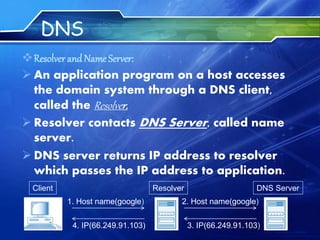
 An application program on a host accesses
the domain system through a DNS client,
called the Resolver.
 Resolver contacts DNS Server, called name
server.
 DNS server returns IP address to resolver
which passes the IP address to application.
Client Resolver DNS Server
1. Host name(google) 2. Host name(google)
3. IP(66.249.91.103)4. IP(66.249.91.103)
DNS
Domainnames:
If we had to remember the IP
addresses of all our favorite Web
sites we'd probably go nuts!
You probably have hundreds
of domain names stored in your
head, such as:
 howstuffworks.com -- our favorite domain name
 google.com -- one of the most used domain names in the world
 mit.edu -- a popular EDU name
 bbc.co.uk -- a three-part domain name using the country code
UK.
DNS
Domainname space:
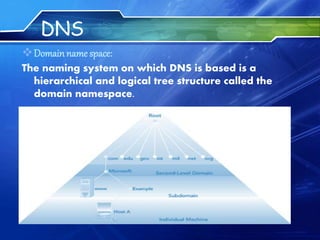
The naming system on which DNS is based is a
hierarchical and logical tree structure called the
domain namespace.
DNS
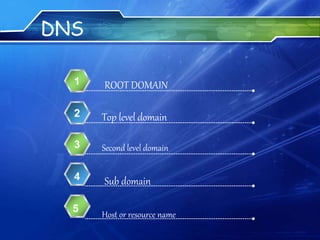
ROOT DOMAIN1
2
3
4
Top level domain
Second level domain
Sub domain
5
Host or resource name
DNS
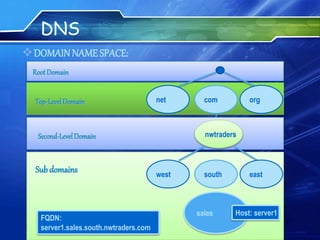
DOMAINNAMESPACE:
RootDomain
Top-LevelDomain
Sub domains
net com org
Second-LevelDomain nwtraders
west south east
sales
FQDN:
server1.sales.south.nwtraders.com
Host: server1
DNS
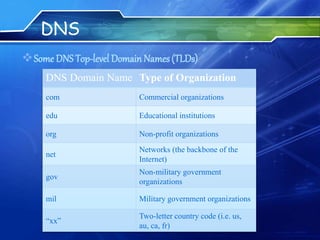
Some DNS Top-level DomainNames (TLDs)
DNS Domain Name Type of Organization
com Commercial organizations
edu Educational institutions
org Non-profit organizations
net
Networks (the backbone of the
Internet)
gov
Non-military government
organizations
mil Military government organizations
“xx”
Two-letter country code (i.e. us,
au, ca, fr)
DNS
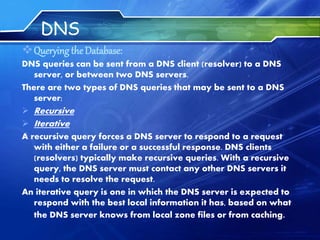
Querying the Database:
DNS queries can be sent from a DNS client (resolver) to a DNS
server, or between two DNS servers.
There are two types of DNS queries that may be sent to a DNS
server:
 Recursive
 Iterative
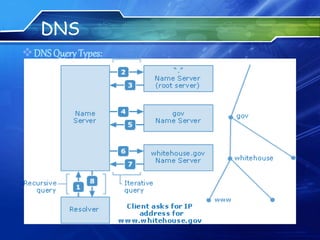
A recursive query forces a DNS server to respond to a request
with either a failure or a successful response. DNS clients
(resolvers) typically make recursive queries. With a recursive
query, the DNS server must contact any other DNS servers it
needs to resolve the request.
An iterative query is one in which the DNS server is expected to
respond with the best local information it has, based on what
the DNS server knows from local zone files or from caching.
DNS
DNS QueryTypes:
DNS
HOWIT WORKS:
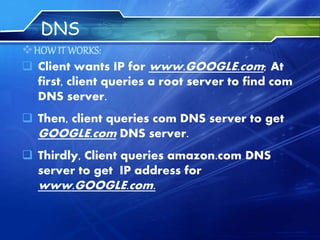
 Client wants IP for www.GOOGLE.com; At
first, client queries a root server to find com
DNS server.
 Then, client queries com DNS server to get
GOOGLE.com DNS server.
 Thirdly, Client queries amazon.com DNS
server to get IP address for
www.GOOGLE.com.
DNS
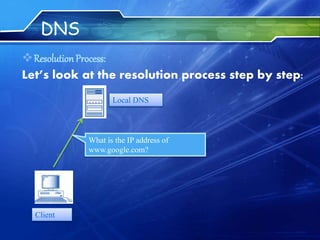
ResolutionProcess:
Let’s look at the resolution process step by step:
What is the IP address of
www.google.com?
Local DNS
Client
DNS
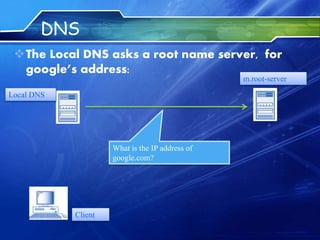
The Local DNS asks a root name server, for
google’s address:
Client
Local DNS
m.root-server
What is the IP address of
google.com?
DNS
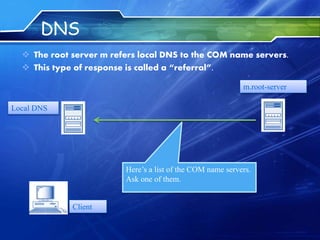
 The root server m refers local DNS to the COM name servers.
 This type of response is called a “referral”.
Client
Local DNS
m.root-server
Here’s a list of the COM name servers.
Ask one of them.
DNS
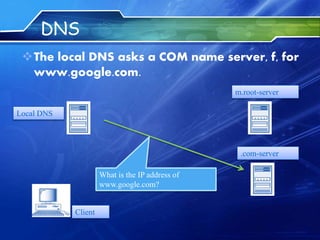
The local DNS asks a COM name server, f, for
www.google.com.
Client
Local DNS
m.root-server
.com-server
What is the IP address of
www.google.com?
DNS
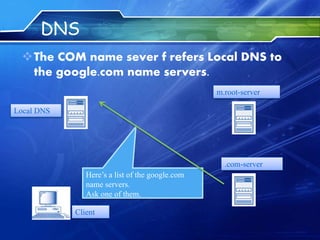
The COM name sever f refers Local DNS to
the google.com name servers.
Client
Local DNS
m.root-server
Here’s a list of the google.com
name servers.
Ask one of them.
.com-server
DNS
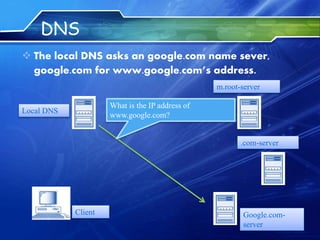
 The local DNS asks an google.com name sever,
google.com for www.google.com’s address.
Client
Local DNS
m.root-server
.com-server
Google.com-
server
What is the IP address of
www.google.com?
DNS
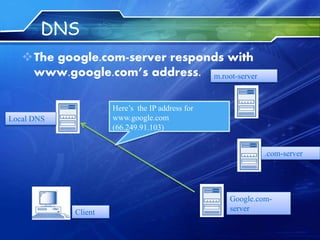
The google.com-server responds with
www.google.com’s address.
Client
Local DNS
m.root-server
.com-server
Google.com-
server
Here’s the IP address for
www.google.com
(66.249.91.103)
DNS
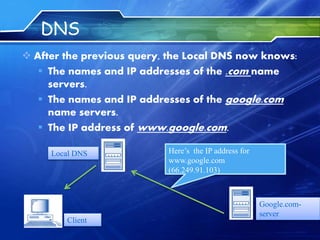
 After the previous query, the Local DNS now knows:
 The names and IP addresses of the .com name
servers.
 The names and IP addresses of the google.com
name servers.
 The IP address of www.google.com.
Client
Local DNS
Google.com-
server
Here’s the IP address for
www.google.com
(66.249.91.103)
LOGO
IRC (INTERNET RELAY CHAT)
Introduction:
IRC is an application layer protocol that facilitates
communication in the form of text. The chat process
works on a client/server networking model. IRC
clients are computer programs that a user can install
on their system. These clients communicate with chat
servers to transfer messages to other clients.
IRC is mainly designed for group communication in
discussion forums, called channels, but also allows
one-on-one communication via private messages as
well as chat and data transfer, including file sharing.
IRC
Definition:
“IRC (Internet Relay Chat) allows many users on
different systems at different locations to converge
into one "room" and have a discussion, similar to a
conference call or party line. IRC is used both for
entertainment and serious discussion purposes.”
OR:
“Internet Relay Chat (IRC) is a standard for exchanging
text messages in real time over the Internet.”
IRC
HISTORY OF IRC :
 Jarkko Oikarin decided to develop a multi-user chat
system where people convene on ‘channels’ to talk
in groups or privately .
 Birthday of Irc : summer of 1998
 First IRC server : olsun.oulu.fin
 Spread around Scandinavia
 Spread across the internet
 August 1990 : ‘Efnet’ was formed after a big
disagreement among programmers
1991 : The Persian Gulf War ==> International fame
IRC
 December 1992 : ‘The Undernet’ was born
 Summer 1994 : Dalvenjah formed ‘Dalnet’
 ‘The great split’
 ‘Ircnet-servers’ : mostly in Europe
 ‘Efnet-servers : mostly in the US
 Still a lot of new initiatives to improve and
develop the internet realy chat.
IRC
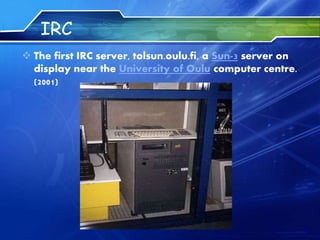
 The first IRC server, tolsun.oulu.fi, a Sun-3 server on
display near the University of Oulu computer centre.
(2001)
IRC
MIRCND XCHAT:
 One of the most famous IRC clients.
 Designed for Windows.
IRC
The advantages of IRC:
1. A friend of mine chats everyday via ICQ.
He chats on average 3 hours a week and
started chatting two years ago.
The reason why he chats is very functional.
He’s girlfriend lives in Spain; the telephone
costs a lot of money and in this way they can
talk to each other and say a lot of things
without a very high telephone bill. The
advantage of chatting in this example
doesn’t need any explanation.
IRC
2. Chatting can mean sharing ideas and information
with other people known or unknown.
3. It can be a global conferencing room
4. It’s like going to a pub and meeting people, but
then from all over the world
5. You can meet people in real live, you met before
on a chatbox. Maybe it will turn out in a wild love
affair ;)
6. It’s pretty cheap, the price of a local call. Makes
long distance communication more attractive.
IRC
6. It’s cheap, the price of a local call. Makes long
distance communication more attractive.
7. A lot is left up to imagination.
8. An Irc-client can be downloaded for free.
9. You get real time response.
10. There are a lot of channels and topics to choose
from.
IRC
The disadvantages of IRC:
1. It takes a lot of time. Or like they say time flies ,
when you are chatting
 2. People can get addicted to it , and so the
telephone bill can get expensive
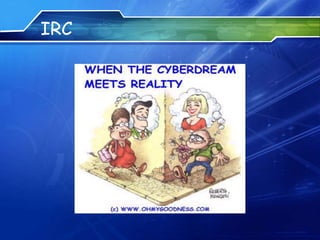
 3. It’s asocial. No real face-to-face contact.
 4. It isn’t easy to regulate , so can be abused.
 5. Maybe the other person you really like on the
chatbox , has got a totally different identity in real
life .
 6. Most people use it for fun , no really qualitative
information can be gathered from the chatbox.
IRC
LOGO
Dns and irc

Dns and irc

  • 1.
  • 3.
    DNS(Domain Name System)Introduction:  Ifyou've ever used the Internet, it's a good bet that you've used the Domain Name System, or DNS, even without realizing it.  People prefer to use easy to remember names instead of IP addresses.  Domain names are alphanumeric names for IP addresses.  e.g., kr.yahoo.com, postech.ac.kr, ietf.org
  • 4.
    DNS DIFINATION:  DNS isa protocol within the set of standards for how computers exchange data on the Internet and on many private networks, known as the TCP/IP protocol suite. OR:  The domain name system (DNS) is an Internet-wide distributed database that translates between domain names and IP addresses.
  • 5.
    DNS Resolver and NameServer:  An application program on a host accesses the domain system through a DNS client, called the Resolver.  Resolver contacts DNS Server, called name server.  DNS server returns IP address to resolver which passes the IP address to application. Client Resolver DNS Server 1. Host name(google) 2. Host name(google) 3. IP(66.249.91.103)4. IP(66.249.91.103)
  • 6.
    DNS Domainnames: If we hadto remember the IP addresses of all our favorite Web sites we'd probably go nuts! You probably have hundreds of domain names stored in your head, such as:  howstuffworks.com -- our favorite domain name  google.com -- one of the most used domain names in the world  mit.edu -- a popular EDU name  bbc.co.uk -- a three-part domain name using the country code UK.
  • 7.
    DNS Domainname space: The namingsystem on which DNS is based is a hierarchical and logical tree structure called the domain namespace.
  • 8.
    DNS ROOT DOMAIN1 2 3 4 Top leveldomain Second level domain Sub domain 5 Host or resource name
  • 9.
    DNS DOMAINNAMESPACE: RootDomain Top-LevelDomain Sub domains net comorg Second-LevelDomain nwtraders west south east sales FQDN: server1.sales.south.nwtraders.com Host: server1
  • 10.
    DNS Some DNS Top-levelDomainNames (TLDs) DNS Domain Name Type of Organization com Commercial organizations edu Educational institutions org Non-profit organizations net Networks (the backbone of the Internet) gov Non-military government organizations mil Military government organizations “xx” Two-letter country code (i.e. us, au, ca, fr)
  • 11.
    DNS Querying the Database: DNSqueries can be sent from a DNS client (resolver) to a DNS server, or between two DNS servers. There are two types of DNS queries that may be sent to a DNS server:  Recursive  Iterative A recursive query forces a DNS server to respond to a request with either a failure or a successful response. DNS clients (resolvers) typically make recursive queries. With a recursive query, the DNS server must contact any other DNS servers it needs to resolve the request. An iterative query is one in which the DNS server is expected to respond with the best local information it has, based on what the DNS server knows from local zone files or from caching.
  • 12.
  • 13.
    DNS HOWIT WORKS:  Clientwants IP for www.GOOGLE.com; At first, client queries a root server to find com DNS server.  Then, client queries com DNS server to get GOOGLE.com DNS server.  Thirdly, Client queries amazon.com DNS server to get IP address for www.GOOGLE.com.
  • 14.
    DNS ResolutionProcess: Let’s look atthe resolution process step by step: What is the IP address of www.google.com? Local DNS Client
  • 15.
    DNS The Local DNSasks a root name server, for google’s address: Client Local DNS m.root-server What is the IP address of google.com?
  • 16.
    DNS  The rootserver m refers local DNS to the COM name servers.  This type of response is called a “referral”. Client Local DNS m.root-server Here’s a list of the COM name servers. Ask one of them.
  • 17.
    DNS The local DNSasks a COM name server, f, for www.google.com. Client Local DNS m.root-server .com-server What is the IP address of www.google.com?
  • 18.
    DNS The COM namesever f refers Local DNS to the google.com name servers. Client Local DNS m.root-server Here’s a list of the google.com name servers. Ask one of them. .com-server
  • 19.
    DNS  The localDNS asks an google.com name sever, google.com for www.google.com’s address. Client Local DNS m.root-server .com-server Google.com- server What is the IP address of www.google.com?
  • 20.
    DNS The google.com-server respondswith www.google.com’s address. Client Local DNS m.root-server .com-server Google.com- server Here’s the IP address for www.google.com (66.249.91.103)
  • 21.
    DNS  After theprevious query, the Local DNS now knows:  The names and IP addresses of the .com name servers.  The names and IP addresses of the google.com name servers.  The IP address of www.google.com. Client Local DNS Google.com- server Here’s the IP address for www.google.com (66.249.91.103)
  • 22.
  • 23.
    IRC (INTERNET RELAYCHAT) Introduction: IRC is an application layer protocol that facilitates communication in the form of text. The chat process works on a client/server networking model. IRC clients are computer programs that a user can install on their system. These clients communicate with chat servers to transfer messages to other clients. IRC is mainly designed for group communication in discussion forums, called channels, but also allows one-on-one communication via private messages as well as chat and data transfer, including file sharing.
  • 24.
    IRC Definition: “IRC (Internet RelayChat) allows many users on different systems at different locations to converge into one "room" and have a discussion, similar to a conference call or party line. IRC is used both for entertainment and serious discussion purposes.” OR: “Internet Relay Chat (IRC) is a standard for exchanging text messages in real time over the Internet.”
  • 25.
    IRC HISTORY OF IRC:  Jarkko Oikarin decided to develop a multi-user chat system where people convene on ‘channels’ to talk in groups or privately .  Birthday of Irc : summer of 1998  First IRC server : olsun.oulu.fin  Spread around Scandinavia  Spread across the internet  August 1990 : ‘Efnet’ was formed after a big disagreement among programmers 1991 : The Persian Gulf War ==> International fame
  • 26.
    IRC  December 1992: ‘The Undernet’ was born  Summer 1994 : Dalvenjah formed ‘Dalnet’  ‘The great split’  ‘Ircnet-servers’ : mostly in Europe  ‘Efnet-servers : mostly in the US  Still a lot of new initiatives to improve and develop the internet realy chat.
  • 27.
    IRC  The firstIRC server, tolsun.oulu.fi, a Sun-3 server on display near the University of Oulu computer centre. (2001)
  • 28.
    IRC MIRCND XCHAT:  Oneof the most famous IRC clients.  Designed for Windows.
  • 29.
    IRC The advantages ofIRC: 1. A friend of mine chats everyday via ICQ. He chats on average 3 hours a week and started chatting two years ago. The reason why he chats is very functional. He’s girlfriend lives in Spain; the telephone costs a lot of money and in this way they can talk to each other and say a lot of things without a very high telephone bill. The advantage of chatting in this example doesn’t need any explanation.
  • 30.
    IRC 2. Chatting canmean sharing ideas and information with other people known or unknown. 3. It can be a global conferencing room 4. It’s like going to a pub and meeting people, but then from all over the world 5. You can meet people in real live, you met before on a chatbox. Maybe it will turn out in a wild love affair ;) 6. It’s pretty cheap, the price of a local call. Makes long distance communication more attractive.
  • 31.
    IRC 6. It’s cheap,the price of a local call. Makes long distance communication more attractive. 7. A lot is left up to imagination. 8. An Irc-client can be downloaded for free. 9. You get real time response. 10. There are a lot of channels and topics to choose from.
  • 32.
    IRC The disadvantages ofIRC: 1. It takes a lot of time. Or like they say time flies , when you are chatting  2. People can get addicted to it , and so the telephone bill can get expensive  3. It’s asocial. No real face-to-face contact.  4. It isn’t easy to regulate , so can be abused.  5. Maybe the other person you really like on the chatbox , has got a totally different identity in real life .  6. Most people use it for fun , no really qualitative information can be gathered from the chatbox.
  • 33.
  • 34.