DNA VS RNA
Ms. Daiseree Soriano
What is DNA?
- Deoxyribonucleic Acid
- often called the blueprint of life.
- contains the instructions for making proteins within
the cell.
Protein
- Responsible for all cell structures and functions
- Made of long chains of amino acids
- There are 20 amino acids in the body
- Responsible for hair, skin, hormones, muscle
movement, antibodies, chemical reactions,
oxygenation of cells..
Why is the Study of
DNA Important?
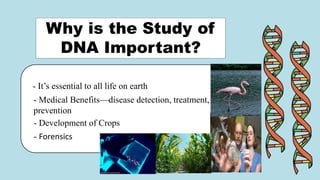
- It’s essential to all life on earth
- Medical Benefits—disease detection, treatment,
prevention
- Development of Crops
- Forensics
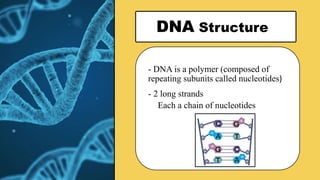
DNA Structure
- DNA is a polymer (composed of
repeating subunits called nucleotides)
- 2 long strands
Each a chain of nucleotides
CHARACTERISTICS OF DNA
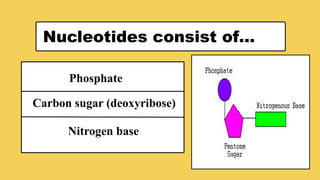
Nucleotides consist of…
Phosphate
Carbon sugar (deoxyribose)
Nitrogen base
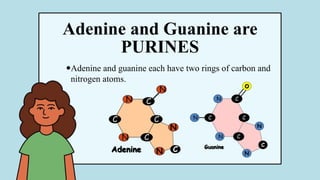
Adenine and Guanine are
PURINES
Adenine and guanine each have two rings of carbon and
nitrogen atoms.
C
C
C
C
N
N
O
N
Guanine
N
N
C
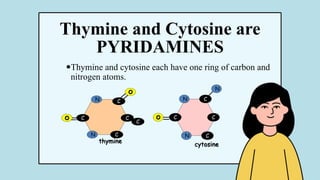
Thymine and Cytosine are
PYRIDAMINES
Thymine and cytosine each have one ring of carbon and
nitrogen atoms.
C
C
C
C
N
N
O
O
thymine
C
C
C
C
C
N
N
O
N
cytosine
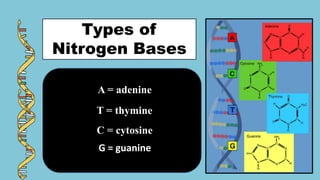
Types of
Nitrogen Bases
A = adenine
T = thymine
C = cytosine
G = guanine
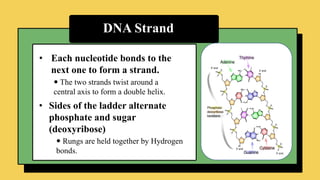
DNA Strand
• Each nucleotide bonds to the
next one to form a strand.
 The two strands twist around a
central axis to form a double helix.
• Sides of the ladder alternate
phosphate and sugar
(deoxyribose)
 Rungs are held together by Hydrogen
bonds.
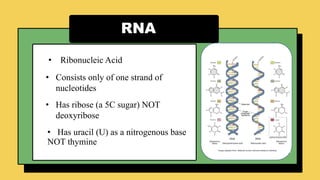
RNA
• Ribonucleic Acid
• Consists only of one strand of
nucleotides
• Has ribose (a 5C sugar) NOT
deoxyribose
• Has uracil (U) as a nitrogenous base
NOT thymine
REFERENCE
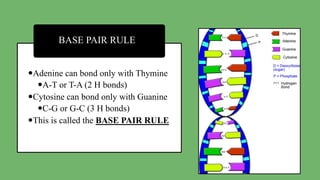
BASE PAIR RULE
Adenine can bond only with Thymine
A-T or T-A (2 H bonds)
Cytosine can bond only with Guanine
C-G or G-C (3 H bonds)
This is called the BASE PAIR RULE
Nitrogenous
Bases
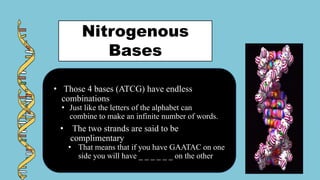
• Those 4 bases (ATCG) have endless
combinations
• Just like the letters of the alphabet can
combine to make an infinite number of words.
• The two strands are said to be
complimentary
• That means that if you have GAATAC on one
side you will have _ _ _ _ _ _ on the other.
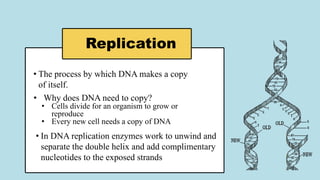
Replication
• The process by which DNA makes a copy
of itself.
• Why does DNA need to copy?
• Cells divide for an organism to grow or
reproduce
• Every new cell needs a copy of DNA
• In DNA replication enzymes work to unwind and
separate the double helix and add complimentary
nucleotides to the exposed strands
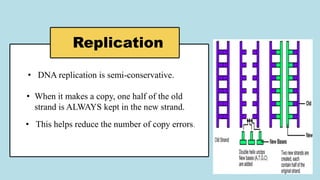
Replication
• DNA replication is semi-conservative.
• When it makes a copy, one half of the old
strand is ALWAYS kept in the new strand.
• This helps reduce the number of copy errors.
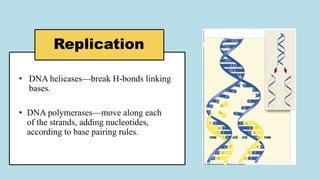
Replication
• DNA helicases—break H-bonds linking
bases.
• DNA polymerases—move along each
of the strands, adding nucleotides,
according to base pairing rules.
Replication
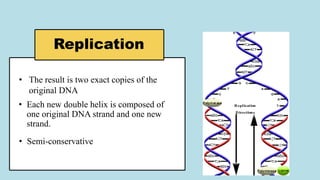
• The result is two exact copies of the
original DNA
• Each new double helix is composed of
one original DNA strand and one new
strand.
• Semi-conservative
REFERENCE
Translation
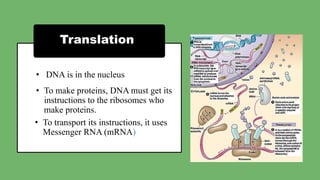
• DNA is in the nucleus
• To make proteins, DNA must get its
instructions to the ribosomes who
make proteins.
• To transport its instructions, it uses
Messenger RNA (mRNA)
Transcription
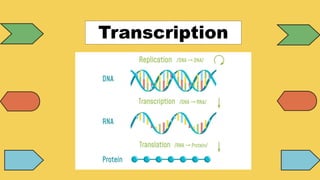
- Transcription is the process of mRNA copying DNA
• This is how new mRNA is made
• Copies a gene and can make many copies
-This occurs in the nucleus
- Occurs just like replication but with RNA instead
• Only one side of the DNA is copied
• Enzyme – RNA Polymerase
Transcription

DNA Vs RNA.pptx

  • 1.
    DNA VS RNA Ms.Daiseree Soriano
  • 2.
    What is DNA? -Deoxyribonucleic Acid - often called the blueprint of life. - contains the instructions for making proteins within the cell.
  • 3.
    Protein - Responsible forall cell structures and functions - Made of long chains of amino acids - There are 20 amino acids in the body - Responsible for hair, skin, hormones, muscle movement, antibodies, chemical reactions, oxygenation of cells..
  • 4.
    Why is theStudy of DNA Important? - It’s essential to all life on earth - Medical Benefits—disease detection, treatment, prevention - Development of Crops - Forensics
  • 5.
    DNA Structure - DNAis a polymer (composed of repeating subunits called nucleotides) - 2 long strands Each a chain of nucleotides
  • 6.
    CHARACTERISTICS OF DNA Nucleotidesconsist of… Phosphate Carbon sugar (deoxyribose) Nitrogen base
  • 7.
    Adenine and Guanineare PURINES Adenine and guanine each have two rings of carbon and nitrogen atoms. C C C C N N O N Guanine N N C
  • 8.
    Thymine and Cytosineare PYRIDAMINES Thymine and cytosine each have one ring of carbon and nitrogen atoms. C C C C N N O O thymine C C C C C N N O N cytosine
  • 9.
    Types of Nitrogen Bases A= adenine T = thymine C = cytosine G = guanine
  • 10.
    DNA Strand • Eachnucleotide bonds to the next one to form a strand.  The two strands twist around a central axis to form a double helix. • Sides of the ladder alternate phosphate and sugar (deoxyribose)  Rungs are held together by Hydrogen bonds.
  • 11.
    RNA • Ribonucleic Acid •Consists only of one strand of nucleotides • Has ribose (a 5C sugar) NOT deoxyribose • Has uracil (U) as a nitrogenous base NOT thymine
  • 12.
    REFERENCE BASE PAIR RULE Adeninecan bond only with Thymine A-T or T-A (2 H bonds) Cytosine can bond only with Guanine C-G or G-C (3 H bonds) This is called the BASE PAIR RULE
  • 13.
    Nitrogenous Bases • Those 4bases (ATCG) have endless combinations • Just like the letters of the alphabet can combine to make an infinite number of words. • The two strands are said to be complimentary • That means that if you have GAATAC on one side you will have _ _ _ _ _ _ on the other.
  • 14.
    Replication • The processby which DNA makes a copy of itself. • Why does DNA need to copy? • Cells divide for an organism to grow or reproduce • Every new cell needs a copy of DNA • In DNA replication enzymes work to unwind and separate the double helix and add complimentary nucleotides to the exposed strands
  • 15.
    Replication • DNA replicationis semi-conservative. • When it makes a copy, one half of the old strand is ALWAYS kept in the new strand. • This helps reduce the number of copy errors.
  • 16.
    Replication • DNA helicases—breakH-bonds linking bases. • DNA polymerases—move along each of the strands, adding nucleotides, according to base pairing rules.
  • 17.
    Replication • The resultis two exact copies of the original DNA • Each new double helix is composed of one original DNA strand and one new strand. • Semi-conservative
  • 18.
    REFERENCE Translation • DNA isin the nucleus • To make proteins, DNA must get its instructions to the ribosomes who make proteins. • To transport its instructions, it uses Messenger RNA (mRNA)
  • 19.
    Transcription - Transcription isthe process of mRNA copying DNA • This is how new mRNA is made • Copies a gene and can make many copies -This occurs in the nucleus - Occurs just like replication but with RNA instead • Only one side of the DNA is copied • Enzyme – RNA Polymerase
  • 20.