DNA, Genes, and Chromosomes
The Instructions for Life
Inheritance
 Process by which genetic information is
passed on from parents to offspring
Genetics
 Branch of Biology concerned with the
study of genes, genetic variation and
heredity of organism.
Gene
 Segment of DNA that has the information
(the code) for a protein.
 A single molecule of DNA has thousands
of genes.
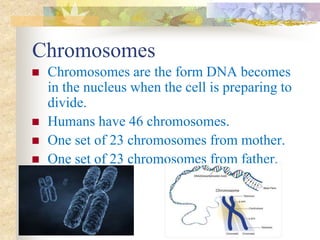
 Chromosomes are the form DNA becomes
in the nucleus when the cell is preparing to
divide.
 Humans have 46 chromosomes.
 One set of 23 chromosomes from mother.
 One set of 23 chromosomes from father.
Chromosomes
Types of Chromosomes:
 Autosomes: Body chromosomes or non
sex chromosomes (humans have 44 or
22 pairs)
 Sex Chromosomes: XX or XY (23rd
pair for humans) determines the sex of
the offspring
Each species has a specific number of
chromosomes.
Diploid (2n) : two sets of chromosomes
 Found in all the non-sex cells or autosomes
of an organism's body
Haploid (n) one set of chromosomes.
 Only sperm and egg cells(sex cells) have
the haploid number.
Chromatid
 Two exact copies of a chromosome that are
connected together.
 The point where they are connected near
the middle is called the centromere.
 Chromatids are made when new cells are
going to be made.
DNA
 DNA is commonly referred to as
deoxyribonucleic acid.
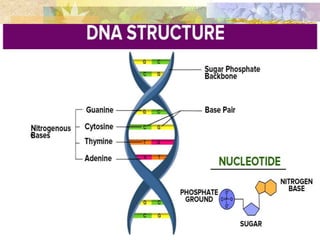
 The nucleic acid has a phosphate backbone
with bases such as adenine, cytosine,
guanine, and thymine, while the
deoxyribose portion contains pentose
sugar.
Genes
 Any difference between cells individual
organisms or groups of organism of any
species.
Variation
 Unit of heredity, a section of DNA that
codes for specific traits.
Genotype VS. Phenotype
Genetic makeup of
organism
Physical traits of organism
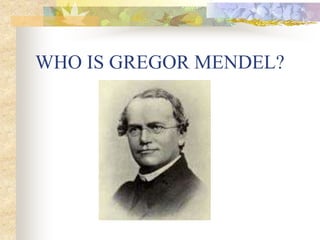
WHO IS GREGOR MENDEL?
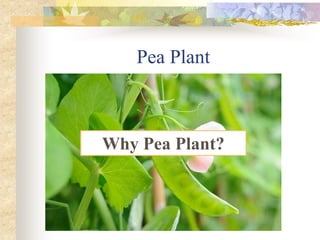
Pea Plant
Why Pea Plant?
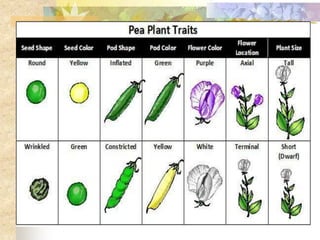
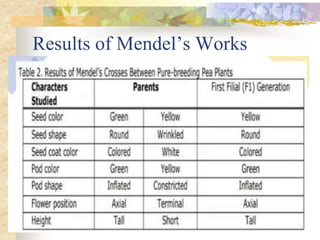
Results of Mendel’s Works
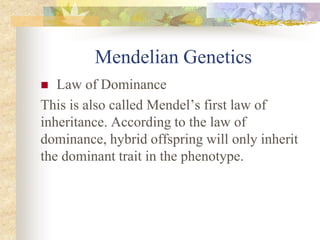
Mendelian Genetics
 Law of Dominance
This is also called Mendel’s first law of
inheritance. According to the law of
dominance, hybrid offspring will only inherit
the dominant trait in the phenotype.
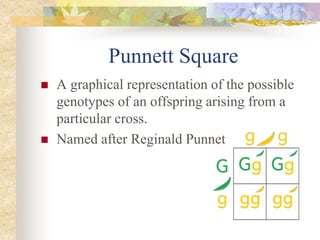
Punnett Square
 A graphical representation of the possible
genotypes of an offspring arising from a
particular cross.
 Named after Reginald Punnet
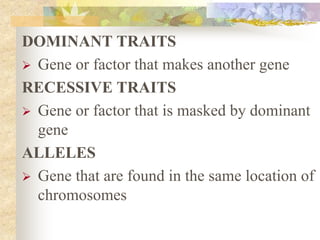
DOMINANT TRAITS
 Gene or factor that makes another gene
RECESSIVE TRAITS
 Gene or factor that is masked by dominant
gene
ALLELES
 Gene that are found in the same location of
chromosomes
Mendelian Genetics
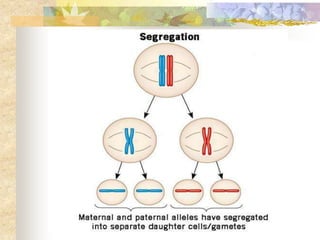
 Law of Segregation
The law of segregation states that during
the production of gametes, two copies of
each hereditary factor segregate so that
offspring acquire one factor from each
parent.
Mendelian Genetics
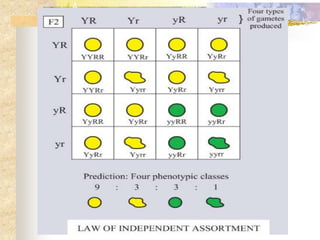
 Law of Independent Assortment
Also known as Mendel’s second law of
inheritance, the law of independent assortment
states that a pair of traits segregates
independently of another pair during
gamete formation
MONOHYBRID VS.
DIHYBRID
What is difference between Monohybrid and
dihybrid cross?
 A monohybrid cross is defined as the
cross happening in the F1 generation
offspring of parents differing in one trait
only. A dihybrid cross is a cross happens
F1 generation offspring of differing in two
traits.
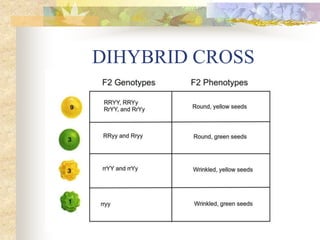
DIHYBRID CROSS
Practice task
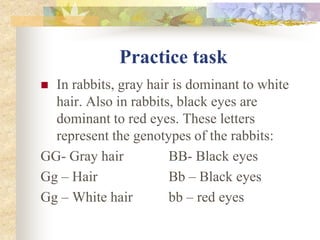
 In rabbits, gray hair is dominant to white
hair. Also in rabbits, black eyes are
dominant to red eyes. These letters
represent the genotypes of the rabbits:
GG- Gray hair BB- Black eyes
Gg – Hair Bb – Black eyes
Gg – White hair bb – red eyes
PRACTICE TASKS.
 1. A male rabbit with the genotype GGbb is
crossed with a female rabbit with the
genotype ggBb. Fill it out and determine
the phenotypes and proportions in the
offspring.
 A male rabbit with the genotype GgBb is
crossed with a female rabbit with the
genotype GgBb. Fill it out and determine
the phenotypes and proportions of
offspring.
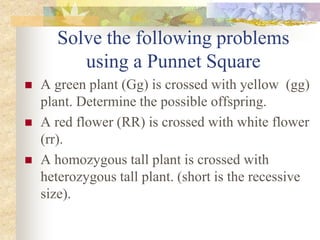
Solve the following problems
using a Punnet Square
 A green plant (Gg) is crossed with yellow (gg)
plant. Determine the possible offspring.
 A red flower (RR) is crossed with white flower
(rr).
 A homozygous tall plant is crossed with
heterozygous tall plant. (short is the recessive
size).
Non-Mendelian Inheritance
 Type of inheritance wherein the patterns of
phenotypes does not coincide with those
that was presented in the Mendelian Law of
Inheritance
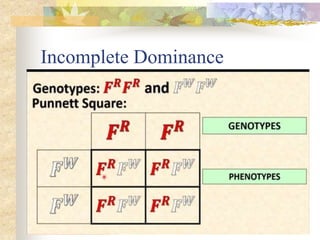
1. Incomplete Dominance
 A form of intermediate inheritance in
which one allele does not completely
dominate another allele, resulting a new
phenotype.
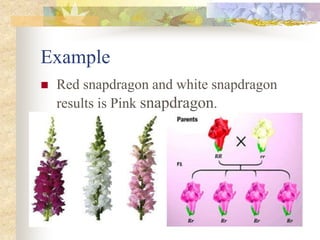
Example
 Red snapdragon and white snapdragon
results is Pink snapdragon.
Incomplete Dominance
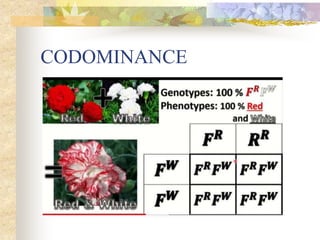
2. Codominance
 Both alleles are expressed equally in the
phenotype of the heterozygous
 Red and White flower the results is red and
white flower
CODOMINANCE
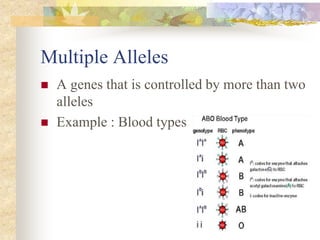
Multiple Alleles
 A genes that is controlled by more than two
alleles
 Example : Blood types
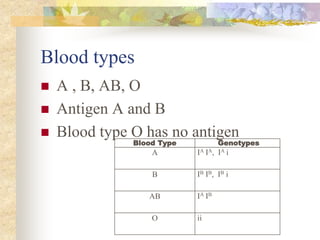
Blood types
 A , B, AB, O
 Antigen A and B
 Blood type O has no antigen
Blood Type Genotypes
A IA IA, IA i
B IB IB, IB i
AB IA IB
O ii
Problem 1.
 A couple gives birth to a baby boy. Both
parents have blood type AB. However
there is a confusion in the hospital. There
are two babies which have unknown
parents. The first baby has blood type B,
while the second baby has blood type O.
Help the couple find their son.
Sex Determination
 What determines the sex of
an individual?
 How do sex chromosomes
affect other traits found in
other chromosomes?
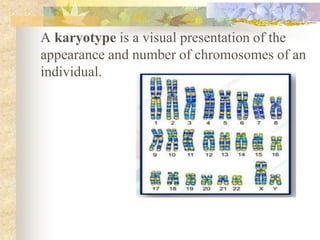
A karyotype is a visual presentation of the
appearance and number of chromosomes of an
individual.
Sex Chromosomes and Sex
Determination
 In each cell, humans have 46 chromosomes
or 23 pairs of chromosomes for both males
and females. Twenty-two (22) pairs are
somatic chromosomes. 23rd pairs consists of
sex chromosomes.
 Male XY non identical
 Female XX identical
How is Sex determined and
inherited?
 When an egg is fertilized by a sperm with a
Y chomosomes, the offspring is Male.
 When an egg is fertilized by a sperm
carrying an X chromosomes, the offspring
is Female.
How is Sex determined and
inherited?
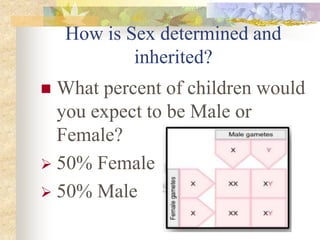
 What percent of children would
you expect to be Male or
Female?
 50% Female
 50% Male
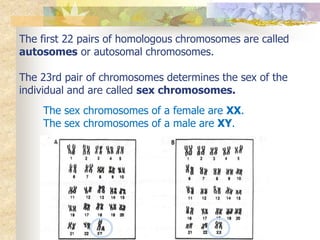
The first 22 pairs of homologous chromosomes are called
autosomes or autosomal chromosomes.
The 23rd pair of chromosomes determines the sex of the
individual and are called sex chromosomes.
The sex chromosomes of a female are XX.
The sex chromosomes of a male are XY.
ASSIGNMENT
 DEFINE THE FOLLOWING
CONCEPTS
A. SEX LINKED
B. SEX LIMITED
C. SEX INFLUENCED TRAITS

DNA Genes and Chromosomes.pptx

  • 1.
    DNA, Genes, andChromosomes The Instructions for Life
  • 2.
    Inheritance  Process bywhich genetic information is passed on from parents to offspring Genetics  Branch of Biology concerned with the study of genes, genetic variation and heredity of organism.
  • 3.
    Gene  Segment ofDNA that has the information (the code) for a protein.  A single molecule of DNA has thousands of genes.
  • 4.
     Chromosomes arethe form DNA becomes in the nucleus when the cell is preparing to divide.  Humans have 46 chromosomes.  One set of 23 chromosomes from mother.  One set of 23 chromosomes from father. Chromosomes
  • 5.
    Types of Chromosomes: Autosomes: Body chromosomes or non sex chromosomes (humans have 44 or 22 pairs)  Sex Chromosomes: XX or XY (23rd pair for humans) determines the sex of the offspring
  • 6.
    Each species hasa specific number of chromosomes. Diploid (2n) : two sets of chromosomes  Found in all the non-sex cells or autosomes of an organism's body Haploid (n) one set of chromosomes.  Only sperm and egg cells(sex cells) have the haploid number.
  • 7.
    Chromatid  Two exactcopies of a chromosome that are connected together.  The point where they are connected near the middle is called the centromere.  Chromatids are made when new cells are going to be made.
  • 8.
    DNA  DNA iscommonly referred to as deoxyribonucleic acid.  The nucleic acid has a phosphate backbone with bases such as adenine, cytosine, guanine, and thymine, while the deoxyribose portion contains pentose sugar.
  • 10.
    Genes  Any differencebetween cells individual organisms or groups of organism of any species. Variation  Unit of heredity, a section of DNA that codes for specific traits.
  • 11.
    Genotype VS. Phenotype Geneticmakeup of organism Physical traits of organism
  • 12.
  • 13.
  • 15.
  • 16.
    Mendelian Genetics  Lawof Dominance This is also called Mendel’s first law of inheritance. According to the law of dominance, hybrid offspring will only inherit the dominant trait in the phenotype.
  • 17.
    Punnett Square  Agraphical representation of the possible genotypes of an offspring arising from a particular cross.  Named after Reginald Punnet
  • 18.
    DOMINANT TRAITS  Geneor factor that makes another gene RECESSIVE TRAITS  Gene or factor that is masked by dominant gene ALLELES  Gene that are found in the same location of chromosomes
  • 19.
    Mendelian Genetics  Lawof Segregation The law of segregation states that during the production of gametes, two copies of each hereditary factor segregate so that offspring acquire one factor from each parent.
  • 21.
    Mendelian Genetics  Lawof Independent Assortment Also known as Mendel’s second law of inheritance, the law of independent assortment states that a pair of traits segregates independently of another pair during gamete formation
  • 22.
    MONOHYBRID VS. DIHYBRID What isdifference between Monohybrid and dihybrid cross?  A monohybrid cross is defined as the cross happening in the F1 generation offspring of parents differing in one trait only. A dihybrid cross is a cross happens F1 generation offspring of differing in two traits.
  • 24.
  • 25.
    Practice task  Inrabbits, gray hair is dominant to white hair. Also in rabbits, black eyes are dominant to red eyes. These letters represent the genotypes of the rabbits: GG- Gray hair BB- Black eyes Gg – Hair Bb – Black eyes Gg – White hair bb – red eyes
  • 26.
    PRACTICE TASKS.  1.A male rabbit with the genotype GGbb is crossed with a female rabbit with the genotype ggBb. Fill it out and determine the phenotypes and proportions in the offspring.  A male rabbit with the genotype GgBb is crossed with a female rabbit with the genotype GgBb. Fill it out and determine the phenotypes and proportions of offspring.
  • 27.
    Solve the followingproblems using a Punnet Square  A green plant (Gg) is crossed with yellow (gg) plant. Determine the possible offspring.  A red flower (RR) is crossed with white flower (rr).  A homozygous tall plant is crossed with heterozygous tall plant. (short is the recessive size).
  • 28.
    Non-Mendelian Inheritance  Typeof inheritance wherein the patterns of phenotypes does not coincide with those that was presented in the Mendelian Law of Inheritance
  • 29.
    1. Incomplete Dominance A form of intermediate inheritance in which one allele does not completely dominate another allele, resulting a new phenotype.
  • 30.
    Example  Red snapdragonand white snapdragon results is Pink snapdragon.
  • 31.
  • 32.
    2. Codominance  Bothalleles are expressed equally in the phenotype of the heterozygous  Red and White flower the results is red and white flower
  • 33.
  • 34.
    Multiple Alleles  Agenes that is controlled by more than two alleles  Example : Blood types
  • 35.
    Blood types  A, B, AB, O  Antigen A and B  Blood type O has no antigen Blood Type Genotypes A IA IA, IA i B IB IB, IB i AB IA IB O ii
  • 36.
    Problem 1.  Acouple gives birth to a baby boy. Both parents have blood type AB. However there is a confusion in the hospital. There are two babies which have unknown parents. The first baby has blood type B, while the second baby has blood type O. Help the couple find their son.
  • 37.
    Sex Determination  Whatdetermines the sex of an individual?  How do sex chromosomes affect other traits found in other chromosomes?
  • 38.
    A karyotype isa visual presentation of the appearance and number of chromosomes of an individual.
  • 39.
    Sex Chromosomes andSex Determination  In each cell, humans have 46 chromosomes or 23 pairs of chromosomes for both males and females. Twenty-two (22) pairs are somatic chromosomes. 23rd pairs consists of sex chromosomes.  Male XY non identical  Female XX identical
  • 40.
    How is Sexdetermined and inherited?  When an egg is fertilized by a sperm with a Y chomosomes, the offspring is Male.  When an egg is fertilized by a sperm carrying an X chromosomes, the offspring is Female.
  • 41.
    How is Sexdetermined and inherited?  What percent of children would you expect to be Male or Female?  50% Female  50% Male
  • 42.
    The first 22pairs of homologous chromosomes are called autosomes or autosomal chromosomes. The 23rd pair of chromosomes determines the sex of the individual and are called sex chromosomes. The sex chromosomes of a female are XX. The sex chromosomes of a male are XY.
  • 43.
    ASSIGNMENT  DEFINE THEFOLLOWING CONCEPTS A. SEX LINKED B. SEX LIMITED C. SEX INFLUENCED TRAITS